Building a Competency Taxonomy to Guide Experience
Acceleration of Lead Program Systems Engineers
Alice Squires
Stevens Institute of Technology, School of Systems and Enterprises, Babbio Center, 5th
Floor, Castle Point on the Hudson, Hoboken, NJ 07030 [email protected]
Pete Dominick
Stevens Institute of Technology, Howe School of Technology Management, Babbio
Center, 6th floor, Castle Point on the Hud-‐
son, Hoboken, NJ 07030 [email protected]
Jon Wade
Stevens Institute of Technology, School of Systems and Enterprises, Babbio Center, 5th
Floor, Castle Point on the Hudson, Hoboken, NJ 07030
Don Gelosh
Deputy Assistant Secretary of Defense for Systems Engineering,U.S. Department of
Defense, 1851 S. Bell Street, Suite 102 Arlington, VA 22202
Abstract
The goal for the initial phase of the systems engineering Experience Accelerator (ExpAcc) research project is to demonstrate the ability to leverage technology to accelerate the time it takes to mature a systems engineer. To demonstrate this goal, the ExpAcc team is developing a proto-type simulator for demonstrating the ability to increase the learner’s proficiency in a selected area of systems engineering competency. As an initial step in the project, a systems engineering competency taxonomy was built from a selected set of existing competency models combined with systems thinking research. The final competency taxonomy covers 87 unique competencies and includes a proficiency table based on the learner’s level of self-assessed and demonstrated ability. This paper describes in detail the approach used to develop the competency model for the ExpAcc research project, and describes in more detail the primary areas, categories, subgroups, and individual capabilities, as well as the proficiency matrix, that together form the taxonomy.
Introduction
Due to a real-time shortage in systems engineers (Goncalves, 2010; NDIA SE Division, 2010; Squires and Cloutier, 2010), a flurry of activity to develop systems engineering compe-tency models has occurred over the past decade (Squires, 2011; Ferris, 2010; Kasser, 2010). Government, industry and academia rely on these competency models to identify critical compe-tencies of systems engineers. In particular, systems engineering competency models are becom-ing more widely developed and used in support of systems engineerbecom-ing workforce selection, de-velopment, education and training (Burke, et. al., 2000; Jansma and Jones, 2006; Verma, Larson, and Bromley, 2008; Menrad and Larson, 2008; Squires, Larson, and Sauser, 2010). In order to define a competency model for lead program/technical systems engineers in the acquisition
ing competency model for the project:
1) The Systems Planning, Research Development, and Engineering (SPRDE) Systems En-gineering (SE) and Program Systems Engineer (PSE) competency model, known as the SPRDE-SE/PSE. (DAU, 2010)
2) The SERC Technical Lead Competency Model (Gavito, et. al, December, 2010) 3) A Critical/Systems Thinking Competency Model (Squires, 2007)
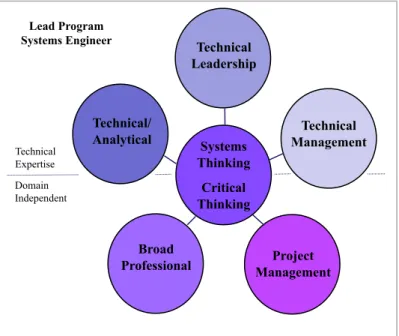
A summary of these models can be found in Appendix A. The final ExpAcc competency taxon-omy has six primary groupings as shown in Figure 1, that are further divided into two to six competency areas that contain a total of 87 unique competencies. The model includes a profi-ciency table that measures the learner’s profiprofi-ciency level in each competency based on the com-plexity of the system being simulated and the learner’s level of demonstrated ability to apply the competency for each level of complexity.
Background
The growing gap in systems engi-neering talent may be attributed to a combination of factors, including: 1) an increasing need for systems
engineers, driven by such trends as:
• increasing complexity in con-temporary systems (Davidz, et. al. 2005; Goncalves, 2008; Kalawsky, 2009),
• life extensions of legacy sys-tems (Sireli and Mengers, 2009), and
• a growing need for solving global sustainment challenges (Richmond, 1993: INCOSE Technical Operations, 2007); and
2) a depletion of systems engineers due to such trends as: • an aging and retiring baby boom generation, and
• an historical decrease in the United States in the interest/graduates in Science, Technology, Engineering and Mathematics (STEM) fields in the generations following.
This gap has created an urgent need to accelerate the time to mature a systems engineer, and the ExpAcc research project is focused on demonstrating the feasibility of achieving this accel-eration through the development of an engaging, realistic and authentic experiential-based
Figure 1. ExpAcc Competency Taxonomy
Technical Leadership Technical Management Technical/ Analytical Project Management Broad Professional Systems Thinking Critical Thinking Lead Program Systems Engineer Technical Expertise Domain Independent
The ExpAcc Competency Taxonomy
One goal of the ExpAcc simulator is to increase the learner’s level of systems engineering competency with each use. To address this, a baseline competency taxonomy was developed for use in identifying the total set of competencies being targeted. The developed competency tax-onomy is based on a three-pronged approach. As shown in Figure 1, the backbone (shown in the center) of the model is systems and critical thinking. The second prong represented by the three upper circles in Figure 1, is technical expertise and comprises technical leadership, technical management, and technical/analytical skills as shown in Figure 2. The third prong shown in the two lower circles of Figure 1, and expanded in Figure 3, comprises project management and other broad-based professional competencies.
Systems and Critical
Thinking
Systems thinking is the ability to think abstractly in order to:
• incorporate multiple
perspectives;
• work within a space where the boundary or scope of problem or system may be “fuzzy”; • understand diverse operational
contexts of the system;
• identify inter- and intra-
relationships and
dependencies;
• understand complex system behavior; and most important of all,
• reliably predict the impact of change to the system.
Critical thinking refers to a rigorous analytical approach to thinking and in this model is comprised of strategic and essential thinking. Strategic thinking focuses on the long-term interests of the institution in a global environment. Essential thinking focuses on the ability to quickly narrow in on the concepts that are essential to the opportunity or solution at hand.
Figure 2: Technical Expertise
Technical/ Analytical System Definition System Realization System Deployment and Use Domain Expertise Doing Technical Management System Definition Mgmt System Realization Mgmt Deployment, Use, and Life Mgmt Project Processes Mgmt Overall Technical Mgmt Managing Technical Leadership Enterprise Leadership Enterprise Management Enterprise Risk and Security Management Leading
Figure 3: Domain Independent
Project Management Business Acumen Project Conception Project Planning, Management and Control Resource Management Broad/ Professional Program Leadership and Development Program Assessment and Recovery
shown in Figure 2. Technical Leadership includes areas needed to effectively lead the team in systems engineering activities. Technical Management focuses on managing systems engineering processes. Technical/Analytical skills includes those competencies necessary for implementing systems engineering.
Technical Leadership
Technical leadership pertains to competencies needed to direct the enterprise and includes specialty foci on risk, safety, physical and cyber security, and environment and ecology at the enterprise level. These areas are divided into the 9 individual competencies in Table 1.
Technical Management
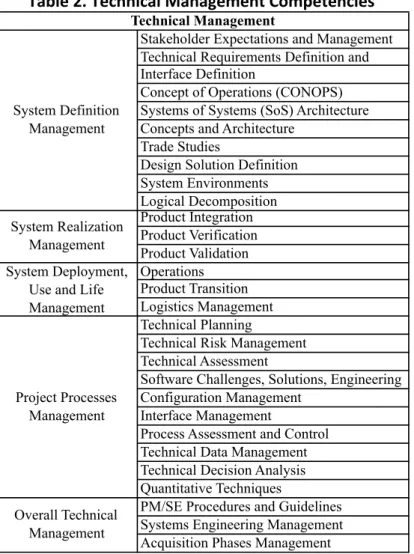
Technical management addresses managing the system life cycle and project management processes with a focus on the technical aspects and includes the systems engineering management competencies. These areas are divided into the 29 individual competencies in Table 2.
Technical/Analytical
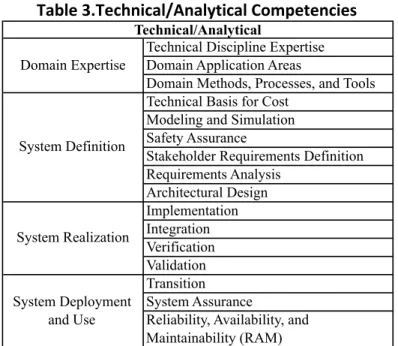
Technical/Analytical includes competencies required to implement systems engineering across the systems life cycle. This competency area also covers the specialties and domain centric competencies. These areas are divided into the 16 individual competencies in Table 3.
Table 1. Technical Leadership Competencies
Leading the Technical Enterprise
Governance for the Technical Enterprise Organizational Structure, Mission, Internal Goals Knowledge Capture, IP, Capture and Sharing International Standards and Political Implications Risk Management Process
Safety
Physical and Cyber Security Environment and Ecology Enterprise Risk and
Security Enterprise Leadership
Enterprise Management
Technical Leadership
Table 2. Technical Management Competencies Stakeholder Expectations and Management Technical Requirements Definition and Interface Definition
Concept of Operations (CONOPS) Systems of Systems (SoS) Architecture Concepts and Architecture
Trade Studies
Design Solution Definition System Environments Logical Decomposition Product Integration Product Verification Product Validation Operations Product Transition Logistics Management Technical Planning
Technical Risk Management Technical Assessment
Software Challenges, Solutions, Engineering Configuration Management
Interface Management
Process Assessment and Control Technical Data Management Technical Decision Analysis Quantitative Techniques
PM/SE Procedures and Guidelines Systems Engineering Management Overall Technical Management Technical Management System Definition Management System Realization Management System Deployment,
Use and Life Management
Project Processes Management
Domain Independent
Project management and other
broad-based professional
competencies, are important for lead program system engineers. For this reason, these critical competency areas are included in the ExpAcc competency taxonomy. Table 4 lists
the project management
competencies, and Table 5 focuses on
broad-based professional
competencies.
Competency Assessment
Competency assessment in the ExpAcc simulator begins with the learner’s self-ratings of their proficiency. These self-ratings
support skill development in two related ways. First,
the assessment is
prescriptive exposing learners to examples of effective behavior (Van Velsor and Leslie, 1991). They also establish a standard against which to provide learners with subsequent feedback on their actual performance in the ExpAcc and thereby to further focus
and facilitate
developmental goal
setting (e.g., Carver & Scheier, 1981) For the prototype model, the team chose to focus initially on
one competency:
“Problem Solving and Recovery Approach.”
This competency
comprises several
important elements: Table 4. Project Management Competencies
Technical Staffing and Performance Position Management
Budget and Full Cost Management Capital Management
Business Engineering External Relationships
Integration of Technical Programs and Portfolios Lifecycle Perspective
Management of Research and Development Needs or Opportunity Management
Project Proposal and Bid Management Requirements Management
Acquisition Strategies, Procurements and Management
Project Review and Evaluation Resource Management Contract Management Project Planning Project Control
Lifecycle Cost Estimating
Tracking/Trending of Project Performance Information Technology/Management Information Systems
Mission Assurance and Specialty Engineering Project Planning, Management and Control Project Management Project Conception Resource Management Business Acumen
Table 3.Technical/Analytical Competencies
Technical Discipline Expertise
Domain Application Areas
Domain Methods, Processes, and Tools Technical Basis for Cost
Modeling and Simulation Safety Assurance
Stakeholder Requirements Definition Requirements Analysis Architectural Design Implementation Integration Verification Validation Transition System Assurance
Reliability, Availability, and Maintainability (RAM) System Deployment and Use Technical/Analytical Domain Expertise System Definition System Realization
• Marshalling the resources needed to solve problems. • Recognizing the problems that
have the most impact to the overall system and appropriately prioritizing plans for solving them.
• Making recommendations, using technical knowledge and experience, by developing a clear understanding of the system.
• Identifying and analyzing problems using a systems approach, weighing the relevance and accuracy of information, accounting for interdependencies, and evaluating alternative solu-tions.
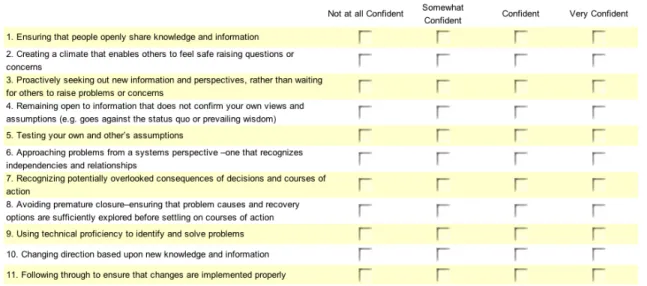
Table 6 shows how the definition of that competency breaks out into 11 individual behavioral elements that can then be presented to the learner for self-assessment.
Table 6. Behavioral Statements for Self-‐Assessment
Leadership Communication Professional Ethics Mentoring and Coaching
Team Dynamics and Management Multinational and Multicultural Issue Review and Assessment Process
Problem Solving and Recovery Approach Solution Definition and Lateral Thinking Program Assessment
and Recovery Professional Leadership and
Proficiency Scale
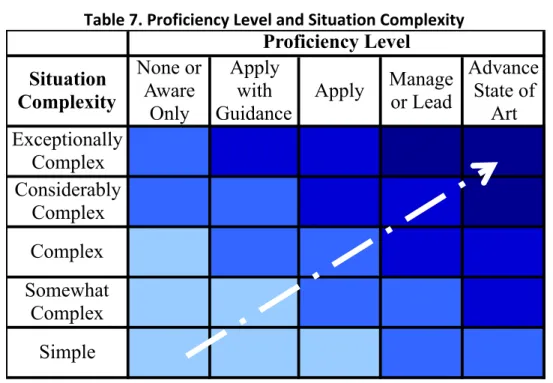
In future versions of the ExpAcc, the intent is for the user to progress - over time - to increas-ingly more complex situations (by level) in the simulation and from beginning to advanced stages of capability and understanding in each situational context. This is illustrated by the profi-ciency table shown in Table 7.
Conclusion
This paper described the approach used to develop the competency model for the ExpAcc re-search project, and describes the primary areas, categories, subgroups, and individual capabili-ties/behavioral statements, as well as the proficiency matrix, that together form the taxonomy. We have stressed the role the taxonomy has played in guiding the design of the ExpAcc simula-tor. We have also outlined how behavioral statements can be used in the operational model to enhance learning and developmental goal setting.
As the ExpAcc project continues we expect to learn more about how best to define, orga-nize, and use competency models to accelerate system engineering proficiency. Some have ar-gued that competency models can be overly prescriptive, driving users to think that there is one best way to get results (e.g., McCall, 2010, Hollenbeck, McCall & Silzer, 2006). To date our framework is driven more by a conceptual rather than empirically derived understanding of rele-vant systems engineering competencies. Data and information collected though the ExpAcc pro-ject will enable us to more closely examine the inter-relationships (e.g., factor structure) of the competencies we have identified and to ultimately refine this model to further enhance its accu-racy and relevance as a planning and learning tool.
Table 7. Proficiency Level and Situation Complexity
Situation
Complexity
None or
Aware
Only
Apply
with
Guidance
Apply
Manage
or Lead
Advance
State of
Art
Exceptionally
Complex
Considerably
Complex
Complex
Somewhat
Complex
Simple
Proficiency Level
Research Center (SERC). SERC is a federally funded University Affiliated Research Center managed by Stevens Institute of Technology.
Appendix A: Three Competency Models
Each of the competency models used to create the ExpAcc competency taxonomy is summa-rized in this appendix.
SPRDE-SE/PSE Competency Model
The SPRDE-SE/PSE competency model comprises 29 competency areas with 45 unique elements of competency defined. These are grouped according to three primary “units of compe-tences” – analytical, technical management, and professional. The analytical unit covers 13 com-petencies related to the technical base for cost and aspects of the system life cycle. The technical management unit addresses 12 competencies focused on the technical side of project manage-ment. The professional unit covers the broader competencies of communication, problem solving, systems thinking and ethics (DAU, 2010)
SERC Technical Lead Competency Model
The SERC Technical Lead Competency Model includes 12 primary categories of competen-cies and 71 unique competencompeten-cies; the 12 primary categories are (Gavito, et. al, December, 2010):
1. professional and leadership development 2. enterprise leadership and management 3. resource management
4. business acumen 5. risk and security
6. program assessment and recovery 7. project conception
8. project planning, management, and control 9. systems engineering thinking and perspective 10. technical management
11. production, product transition, and operations 12. technical acumen
The first 11 categories covered broad areas of systems engineering and technical leadership while the 12th category focuses on the specific technical discipline expertise and the associated
domain.
Systems/Critical Thinking Competency Model
The systems/critical thinking competency model (Squires, 2007) is summarized within the section on Systems and Critical Thinking in the body of the paper.
References
Burke, G. D., Harrison, M. J., Fenton, R. E., and Carlock, P. G. “An approach to develop a systems engineering cur-riculum for human capital and process improvement.” In Proceedings of the 10Th Annual International Sympo-sium, INCOSE 2000, Minneapolis, Minnesota, July 16-20, 2000.
Carver, C.S. & Scheier, M.F. Attention and self-regulation: A Control theory approach to human behavior. New York: Springer-Verlag. 1981.
Davidz, H. L., Nightingale, D. J., and Rhodes, D. H. “Accelerating the development of senior systems engineers.” In Proceedings of the 15Th Annual International Symposium, INCOSE 2005, Rochester, NY, USA, July 10-15, 2005.
Defense Acquisition University (DAU). SPRDE-SE/PSE competency model 4/14/10 version. https://acc.dau.mil/CommunityBrowser.aspx?id=315691&lang=en-US (accessed May 25, 2010).
Ferris, T. L. J. “Comparison of systems engineering competency frameworks.” In 4Th Asia-Pacific Conference on Systems Engineering (APCOSE 2010), Keelung, Taiwan, October 4-6, 2010.
Gavito, V., Verma, D., Dominick, P., Pennotti, M., Giffin, R., Barrese, T., et al. “Technical leadership development program: Final technical report SERC-2010-TR-013.” Systems Engineering Research Center (SERC), Stevens Institute of Technology, Hoboken, NJ. December 13, 2010.
Goncalves, D. “Developing systems engineers.” Proceedings portland international conference on management of engineering & technology (PICMET) 2008, Capetown, South Africa, July 27-31, 2008.
Hollenbeck, G.P. McCall, M.W. & Silzer, R.F. “Leadership competency models.” The Leadership Quarterly , 17, 398-413. 2006.
INCOSE Technical Operations. “INCOSE-TP-2004-004-02: Systems engineering vision 2020, version 2.03.” Inter-national Council on Systems Engineering, Seattle, WA. September, 2007.
Jansma, P. A. and Jones, R. M. “ Advancing the practice of systems engineering at JPL.” In Aerospace Conference, 2006 IEEE.
Kalawsky, R. S. “Grand challenges for systems engineering research.” In Proceedings of the 7Th annual conference on systems engineering research 2009, CSER 2009, loughborough university, UK, april 20-23 2009.
Kasser, J, Frank, M, and Zhao, Y. Y. “Assessing the competencies of systems engineers.” In Proceedings of the 7Th Bi-Annual European Systems Engineering Conference (EUSEC), Stockholm, Sweden, May 23-26, 2010. McCall, M. W. “Recasting leadership development.” Industrial and Organizational Psychology: Perspectives on
Practice and Science 3(1), 3-19. 2010.
Menrad, R. and Larson, W. “Development of a NASA integrated technical workforce career development model entitled: Requisite occupation competencies and knowledge --the ROCK.” Presented at the 59Th International Astronautical Congress (IAC), 29 September – 3 October, 2008, in Glasgow, Scotland.
NDIA SE Division. “Top systems engineering issues in department of defense and defense industry.” (Final 9a-7/15/10). July, 2010.
Richmond, B. “Systems thinking: Critical thinking skills for the 1990s and beyond.” System Dynamics Review, 9(2), 113-133. 1993.
Sireli, A. Y. and Mengers, C. A. “Need for change towards systems thinking in the U.S. Nuclear industry.” Systems Journal, IEEE, 3(2), 239-253. 2009.
Squires, A. “Qualifying Exam: Systems Thinking and K12 Education.” Stevens Institute of Technology, Hoboken, NJ. November, 2007.
Squires, A. “Investigating the Relationship of Online Pedagogy to Student Perceived Competency Knowledge De-velopment in Systems Engineering Education.” Thesis, Stevens Institute of Technology, School of Systems and Enterprises. Hoboken, NJ. 2011.
Squires, A. and Cloutier, R. “Developing a strategy to measure systems engineering competency knowledge demon-strated in the remote asynchronous online classroom.” In Proceedings of the 8Th annual conference on systems engineering research (CSER), Stevens Institute of Technology, Hoboken, NJ, USA, March 17-19, 2010. Squires, A., Larson, W. and Sauser. B. “Mapping space-based systems engineering curriculum to
government-industry vetted competencies for improved organizational performance.” Systems Engineering 13 (3): 246-260. Van Velsor, E. and Leslie, J.B. “ Feedback to Managers, Volume II: A Review and Comparison of Sixteen
Multi-rater Feedback Instruments.” Center for Creative Leadership, Greensboro, NC.1991.
Verma, D., Larson, W. and Bromley, L. “Space systems engineering: An academic program reflecting collaboration between government, industry and academia (open academic model).” Presented at the 59Th International As-tronautical Congress (IAC), 29 September – 3 October, 2008, in Glasgow, Scotland.
professor in Systems Engineering at Stevens Institute of Technology in the School of Systems and Enterprises. She has served as a Senior Systems Engineer consultant for ASSETT; a senior engineering manager for General Dynamics, and Lockheed Martin; and as a technical lead for IBM. Alice is an INCOSE Certified Systems Engineering Professional (CSEP, CSEP-Acq). She is completing her doctorate dissertation in “Investigating the Relationship Between Online Peda-gogy and Student Perceived Competency Knowledge Development in Systems Engineering Education".
Jon Wade is a Distinguished Service Professor in the School of Systems and Enterprises at the Stevens Institute of Technology and currently serves as the Associate Dean of Research. Dr. Wade has an extensive background in leading research and development organizations and man-aging the development of Enterprise products at International Game Technology, the UltraS-PARC V based Enterprise Server family at Sun Microsystems, and supercomputer development at Thinking Machines Corporation. Dr. Wade received his SB, SM, EE and PhD degrees in Electrical Engineering and Computer Science from the Massachusetts Institute of Technology.
Peter G. Dominick is an Industry Assistant Professor and teaches leadership development courses within the W.J. Howe School of Technology Management at Stevens Institute of Tech-nology. His research focuses on leadership development processes and practices. Pete received his Ph.D. in Applied Psychology from Stevens, earned his MA in Organizational Psychology from Columbia University, and completed his undergraduate studies in Industrial and Labor Re-lations at Cornell University. He has received the Howe School’s Outstanding Teacher Award and also the Institute’s Harvey N. Davis Award for Distinguished Teaching.
Don Gelosh is the Deputy Director for Workforce Development under the Deputy Assistant Secretary of Defense for Systems Engineering. He provides expertise in workforce develop-ment, competency models and assessments, and knowledge management with over 35 years of systems engineering experience from the US Air Force, government, industry, and academia. Don received his PhD in Electrical Engineering from the University of Pittsburgh in 1994, a MS in Computer System Design from the University of Houston at Clear Lake in 1989, and a BS in Electrical Engineering from the Ohio State University in 1981. He also holds an INCOSE CSEP-Acquisition certification.