Neo_M660 GPRS Module
AT Command Set
Copyright © Neoway Technology Co., Ltd i
Copyright © Neoway Technology Co., Ltd 2014. All rights reserved.
No part of this document may be reproduced or transmitted in any form or by any means without prior written consent of Shenzhen Neoway Technology Co., Ltd.
is the trademark of Shenzhen Neoway Technology Co., Ltd.
All other trademarks and trade names mentioned in this document are the property of their respective holders.
Notice
This document provides guide for users to use the M660.
This document is intended for system engineers (SEs), development engineers, and test engineers. The information in this document is subject to change without notice due to product version update or other reasons.
Every effort has been made in preparation of this document to ensure accuracy of the contents, but all statements, information, and recommendations in this document do not constitute a warranty of any kind, express or implied.
Shenzhen Neoway provides customers complete technical support. If you have any question, please contact your account manager or email to the following email addresses:
Copyright © Neoway Technology Co., Ltd ii
Revision Record
Issue Changes Date
V3.0 Initial draft 2013-08-26
V3.1
Added the following commands:AT+OFFTIME, AT+FCHW, AT+AUDIN, AT+AUDOUT, AT+IFC, AT+RINGTIME, AT+TRANSCLOSE, AT+UDPTRANS, AT+TCPTRANS, and AT+RINGOUT.
2013-09-02
V3.2
Deleted the command AT+TRANSCLOSE and use +++ to exit the
data mode.
Modified the default data format of the AT+DATAFORMAT
command.
Modified usage description of +++.
Modified the description of AT+TCPSEND.
Modified the description of AT+TCPLPORT, AT+UDPLPORT, and
AT+FTPPUT.
2013-09-17
V3.3 Added the echo suppression command AT+LESL. 2013-10-09 V3.4 Modified the description of the following commands: +++ in the
transparent transmission mode, AT+CLOSECLIENT,
AT+IPSTATUS, AT+TCPACK, and AT+CLIENTSTATUS.
Added the description of the ATO command in the transparent
transmission mode and AT+TRABSCLOSE command.
Added the description of the AT+REST and AT+CPWROFF
commands.
2013-11-06
V3.5 Added the following commands: AT+TCPACKS, HTTP commands,
AT+TCPSRVTRANS?, and ATE1/ATE0.
2013-11-29
V3.6 Modified the terminal display after the client is connected to the server
(transparent/non-transparent transmission) and the description of the
AT+TCPLPORT, AT+UDPLPORT, and AT+HANDFEE
commands.
Added SMTP commands: AT+SMTPSRV, AT+SMTPAUTH,
AT+SMTPFROM, AT+SMTPRCPT, AT+SMTPSUB, AT+SMTPBODY, and AT+SMTPSEND.
Added the AT+CNUM command to obtain my number and added the
following commands: AT+POPSRV, AT+POPAUTH,
AT+POPSTAT, AT+POPRSET, AT+POPDELE, AT+POPLIST,
AT+POPRETR, and AT+POPQUIT.
2013-12-18
V3.7 Added eCall commands: AT%EMSD, AT%EMSDSET, AT+CECALL,
AT%EMSDPUSH, etc.
2013-12-24
V3.8 Modified the description of the following commands: AT+TCPSEND,
AT+UDPSEND, AT+TCPSENDS, AT+TCPTRANS,
AT+UDPTRANS, AT+TCPSRVTRANS, AT+FTPGET, AT+FTPPUT, AT+CSMP, and AT+CSDH.
Added the following commands: AT+CSAS, ATQ, ATZ, ATV, and
AT&F.
Copyright © Neoway Technology Co., Ltd iii V3.9 Modified the description of the followoing commands: AT+FTPGET,
AT+REST, AT+TTSPLAY, AT+CFUN, and AT+SIGNAL.
Added AT+PWROFTIMING, AT+PWROFPERIOD,
+PWROFTIMING, +PWROFPERIOD, AT+XBANDSEL,
AT+JAMMINGDETECT, AT+READADC, AT+SERVINFO,
AT$MYBCCH, andAT+PLAYTTS.
Added AT+CIPGSMLOC, AT+REMOTEAT,
AT+UPDATETIME,AT&W, and AT+SSTL.
Deleted AT+SETCLSMODE.
Copyright © Neoway Technology Co., Ltd iv
Contents
Boot LOG Instruction ... 1
1 General Commands ... 2
1.1 Querying the Manufacturer: +CGMI ... 2
1.2 Querying the Module Model: +CGMM ... 2
1.3 Querying the Version: +CGMR ... 2
1.4 Querying IMEI: +CGSN ... 3
1.5 Querying the IMSI: +CIMI ... 3
1.6 Obtaining the ICCID of the SIM Card: +CCID ... 4
2 Mobile Device Control and Status Report ... 5
2.1 Querying the Module Status: +CPAS ... 5
2.2 Querying the Network Registration Status: +CREG ... 5
2.3 Setting Module Functions: +CFUN ... 7
2.4 Enabling or Disabling the Sleep Mode: +ENPWRSAVE ... 8
2.5 Clock: +CCLK ... 8
2.6 Setting the Baudrate of the Module: +IPR ... 9
2.7 Entering the PIN Codes: +CPIN ... 10
2.8 Enabling PIN and Querying MT and Network Device: +CLCK ... 11
2.9 Modifying the Password of the PIN: +CPWD ... 13
2.10 Extended Error Report: +CEER ... 14
2.11 Setting Error Information: +CMEE ... 15
2.12 Setting the Signal Indicator Status: +SIGNAL ... 15
2.13 Enabling the Hardware or Software Flow Control Function: +IFC ... 16
2.14 Enabling & Disabling the Terminal Display: ATE1/ATE0 ... 17
2.15 Setting the Code Result Suppression Mode: ATQ ... 18
2.16 Setting the Response Format of the Device: ATV ... 18
2.17 Resetting to the Default Setting: ATZ ... 19
2.18 Saving Parameter Settings: AT&W ... 20
2.19 Resetting the Module to Factory Settings: AT&F ... 20
2.20 Reading ADC Value: +READADC ... 21
2.21 Jamming Detect: +JAMMINGDETECT ... 21
3 Network Service Commands ... 23
3.1 Querying Signal Quality: +CSQ ... 23
3.2 Selecting and Registering a GSM Network: +COPS ... 24
3.3 Setting Band: +XBANDSEL ... 25
3.4 Locking BCCH Channel: $MYBCCH ... 27
4 Calling Control Commands ... 29
4.1 Setting the Speaker Volume: +CLVL ... 29
Copyright © Neoway Technology Co., Ltd v
4.3 Dialing Command: ATD ... 30
4.4 Call Answering: ATA ... 32
4.5 Hanging Up Calls: ATH ... 33
4.6 Caller ID: CLIP ... 33
4.7 Sending DTMF Tone: +VTS ... 34
4.8 Auto-Answer:ATS0 ... 35
4.9 Handfree Switch: +HANDFREE ... 35
4.10 Starting the DTMF Detection: +DTMFDETECT ... 36
4.11 Setting Echo Suppression Level in the Earphone Mode: +ESL ... 37
4.12 Setting Echo Suppression Level in the Receiver Mode: +HESL ... 37
4.13 Setting Echo Suppression Level of the Loud Speaker Mode: +LESL ... 38
4.14 MIC Volume Control: +MICL... 38
4.15 Switching the Audio Input Channel: +AUDIN ... 39
4.16 Switching the Audio Output Channel: +AUDIN ... 40
4.17 Setting the Sidetone Level of Voice Channel: +SSTL ... 40
5 SMS Commands ... 42
5.1 Selecting SMS Services: CSMS ... 42
5.2 Setting Preferred SMS Storage: +CPMS ... 42
5.3 Setting SMS Inputting Mode: +CMGF ... 43
5.4 Setting the TE Character Set: +CSCS ... 44
5.5 Setting the SMS Indication Mode: +CNMI... 45
5.6 Reading SMS Messages: +CMGR ... 46
5.7 SMS Message List: +CMGL ... 47
5.8 Sending SMS Messages: +CMGS ... 50
5.9 Writing SMS Messages: +CMGW ... 51
5.10 Sending Stored SMS Messages: +CMSS ... 52
5.11 Deleting SMS Messages: +CMGD ... 52
5.12 Setting the SMS Center Number: +CSCA ... 53
5.13 Setting the Parameters of the Text Mode: +CSMP ... 53
5.14 Displaying the Parameters of the Text Mode: +CSDH... 54
5.15 Selecting the Type of Cell Broadcast Messages: +CSCB... 55
5.16 Save Settings: +CSAS ... 56
6 Phonebook Commands ... 58
6.1 Selecting Phonebook Storage: +CPBS ... 58
6.2 Reading the Phonebook: +CPBR ... 59
6.3 Querying the Phonebook: +CPBF ... 60
6.4 Writing Information to the Phonebook: +CPBW ... 60
6.5 Reading My Number: +CNUM ... 61
7 Supplementary Service Commands ... 62
7.1 Call Forwarding: +CCFC ... 62
Copyright © Neoway Technology Co., Ltd vi
7.3 Call Holding and Multi-party Session: +CHLD ... 64
8 GPRS Commands ... 66
8.1 Setting PDP Format: CGDCONT ... 66
8.2 Sending USSD Data: +CUSD ... 67
8.3 Switching Data Mode to Command Mode: +++ ... 68
8.4 Switching Command Mode to Data Mode: ATO ... 68
8.5 Setting GPRS Attach and Detach: +CGATT ... 69
9 TCP/UDP Data Service ... 71
9.1 Setting Network APN: +NETAPN ... 71
9.2 Setting Up a PPP Link: +XIIC ... 71
9.3 Setting Up TCP link: +TCPSETUP ... 72
9.4 Sending TCP Data: +TCPSEND ... 73
9.5 Receiving TCP Data: +TCPRECV ... 74
9.6 Closing TCP link: +TCPCLOSE ... 74
9.7 Setting Up UDP link: +UDPSETUP ... 75
9.8 Sending UDP Data: +UDPSEND ... 75
9.9 Receiving UDP Data: +UDPRECV ... 76
9.10 Closing UDP link: +UDPCLOSE ... 77
9.11 Querying TCP/UDP Link Status: +IPSTATUS ... 77
9.12 Querying the Status of Data Sent by the TCP Link: +TCPACK ... 78
9.13 Setting Data Receiving Type: +ASCII ... 79
9.14 Setting Data TX/RX Type: +DATAFORMAT ... 80
9.15 Setting Data Receiving Mode: +TRANMODE ... 81
9.16 Setting Local TCP Port: +TCPLPORT ... 81
9.17 Setting Local UDP Port: +UDPLPORT ... 82
9.18 Setting Socket Timeout Parameter: +SSTP ... 82
9.19 Setting Up TCP Transparent Transmision Connection: +TCPTRANS ... 83
9.20 Setting Up UDP Transparent Transmission Connection: +UDPTRANS ... 84
9.21 Closing Transparent Transmission Link: +TRANSCLOSE ... 85
10 DNS Command... 86
10.1 Querying the IP Address: +DNS ... 86
11 FTP AT Commands ... 87
11.1 Logging In to the FTP Server: +FTPLOGIN... 87
11.2 Logging Out from the FTP Server: +FTPLOGOUT ... 88
11.3 Downloading Data from the FTP Server: +FTPGET ... 88
11.4 Uploading Data to the FTP Server: +FTPPUT ... 90
11.5 Querying FTP Link Status: +FTPSTATUS ... 92
12 TCP Server AT Commands ... 93
12.1 Setting TCP Listening for the Server: +TCPLISTEN ... 93
Copyright © Neoway Technology Co., Ltd vii
12.3 Closing Connections of the Client: +CLOSECLIENT ... 94
12.4 Receiving Data from the Client: +TCPRECV(S) ... 94
12.5 Sending Data to the Client: +TCPSENDS ... 95
12.6 Querying the Link Status on the Client: +CLIENTSTATUS ... 96
12.7 Obtaining the Local IP Address: +GETIP ... 96
12.8 Setting TCP Listening for the Server of Transparent Transmission: +TCPSRVTRANS ... 97
12.9 Querying the Status of Data Sent by the TCP Server: +TCPACKS ... 98
13 HTTP Commands ... 99
13.1 Setting HTTP Parameters: +HTTPPARA ... 99
13.2 Setting Up HTTP Link: +HTTPSETUP ... 99
13.3 Executing HTTP Request: +HTTPACTION ... 100
13.4 Closing HTTP Link: +HTTPCLOSE ... 103
13.5 Receiving HTTP Data: +HTTPRECV ... 103
13.6 HTTP Link Closing: +HTTPCLOSED ... 104
14 SMTP Commands ... 105
14.1 Setting Parameters for the SMTP Login Server: +SMTPSRV ... 105
14.2 Setting SMTP Login Account: +SMTPAUTH ... 105
14.3 Setting SMTP Sending Parameters: +SMTPFROM ... 105
14.4 Setting SMTP Receiving Parameters: +SMTPRCPT ... 106
14.5 Entering an Email Subject: +SMTPSUB ... 107
14.6 Entering Email Content: +SMTPBODY ... 107
14.7 Sending an Email: +SMTPSEND ... 108
15 POP3 Commands ... 109
15.1 Connecting POP3 Server: +POPSRV ... 109
15.2 Using Account to Log In to the Emailbox: +POPAUTH... 109
15.3 Querying the Email Box Status: +POPSTAT ... 110
15.4 Querying Specified Email Information: +POPLIST ... 110
15.5 Marking an Email Deleted: +POPDELE ... 113
15.6 Cancelling All Deleting Marks: +POPRSET ... 113
15.7 Ending the Session: +POPQUIT ... 114
15.8 Reading Emails: +POPRETR ... 114
16 eCall Commands ... 117
16.1 Enabling/Disabling the DSP Monitor: %EMSD ... 117
16.2 Configuring MSD Data: %EMSDSET ... 117
16.3 Initiating an eCall: +CECALL ... 117
16.4 Triggering an MSD Transmission: %EMSDPUSH ... 118
16.5 eCall Indications: ... 118
16.6 eCall Commands Process ... 119
17 Recording Commands ... 120
Copyright © Neoway Technology Co., Ltd viii
17.2 Starting/Stopping Recording: +RECF ... 120
17.3 Reading Recording Data: +RECR ... 121
18 LBS Command ... 122
18.1 Obtaining the Location of the Module: +CIPGSMLOC ... 122
19 Other AT Commands ... 123
19.1 Calculating MD5 Value: +CALMD5 ... 123
19.2 Calculating CRC32 Verification Value: +CALCRC32 ... 123
19.3 Calculating CRC16 Verification Value: +CALCRC16 ... 123
19.4 Querying Base Station Information: +POSI ... 124
19.5 Query Server Information: +SERVINFO ... 125
19.6 Opening/Closing Digital Audio Channel: +SETPCM ... 125
19.7 Setting Extra RING Pulses: +EXTRARING ... 126
19.8 Setting the Width of the RING Pulse: +RINGTIME ... 126
19.9 Configuring the Pin Mode of Flow Control by Hardware for UART1: +FCHW ... 127
19.10 Setting the Offtime of the ON/OFF Pin: +OFFTIME ... 128
19.11 Setting Mode and Volume of the Incoming Ring: +RINGOUT ... 128
19.12 Setting the Format of the Voice Broadcast: +TTSFMT ... 129
19.13 Inputting Broadcast Content Through AT: +TTSPLAY ... 130
19.14 Inputting Broadcast Content Through AT:+PLAYTTS ... 131
19.15 Configuring Parameters of Voice Broadcast: +TTSCFG ... 131
19.16 Resetting the Module: +REST ... 132
19.17 Shutting Down the Module: +CPWROFF ... 133
19.18 Timing On/Off Command: +PWROFTIMING ... 133
19.19 Timing On/Off Command: +PWROFPERIOD ... 134
19.20 Sending AT Command Remotely: +REMOTEAT ... 135
19.21 Updating Time:+UPDATETIME ... 137
A Reference Process of AT Command Programming ... 139
A.1 Content of PDU SMS Messages ... 139
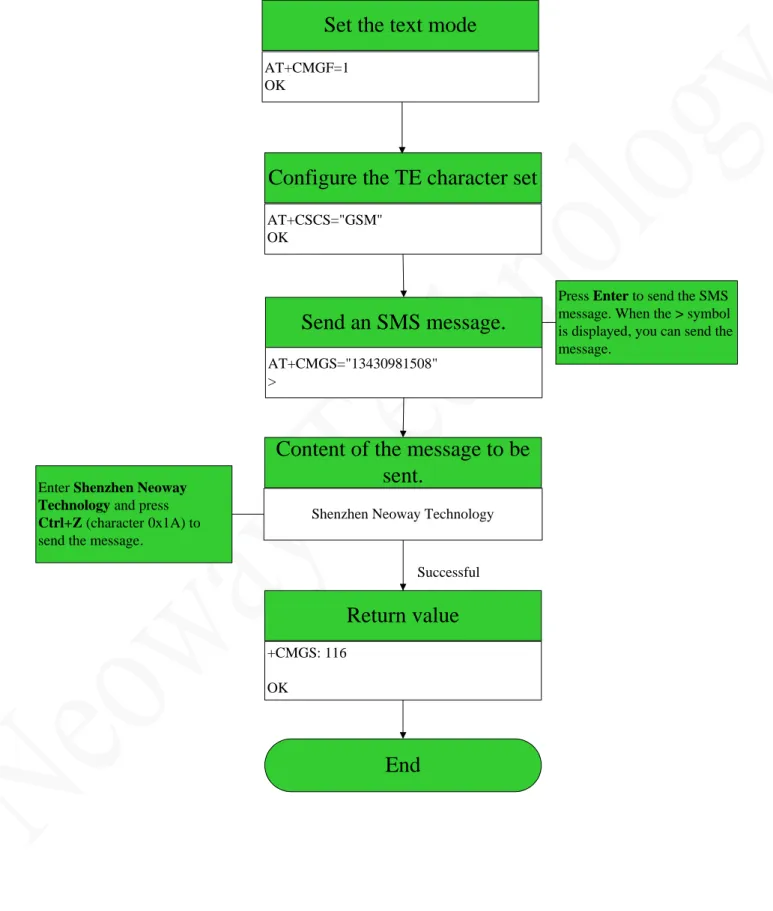
A.2 Flowchart of Sending Text SMS Messages (Through UART) ... 141
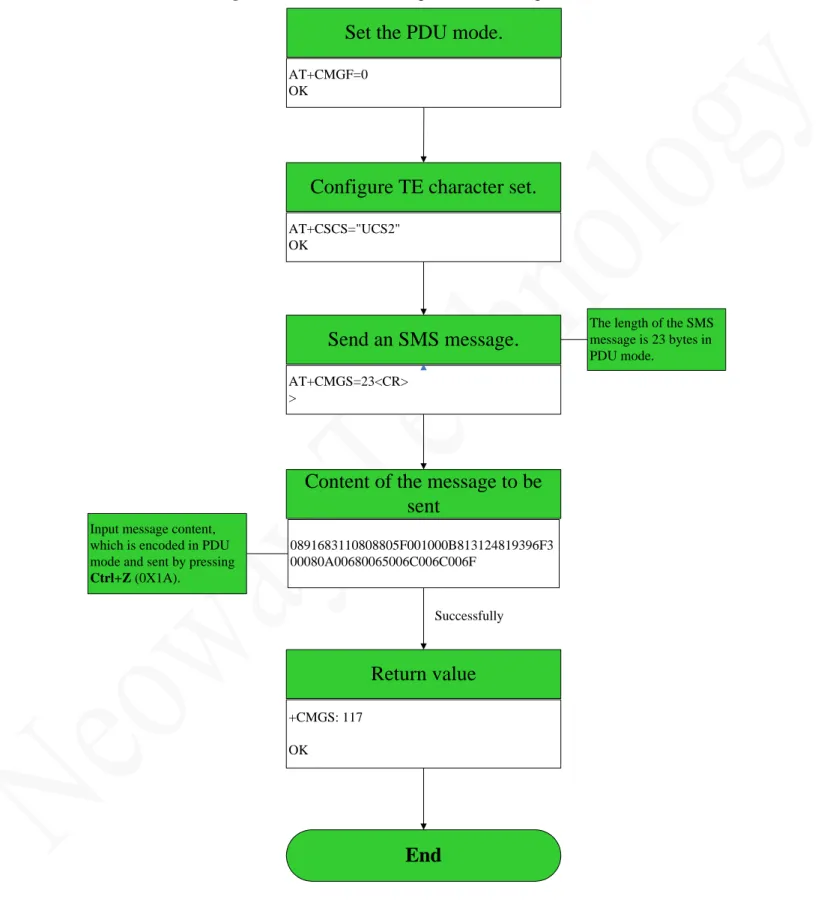
A.3 Flowchart of Sending PDU SMS Messages (Through UART) ... 142
A.4 Flowchart of AT Commands to Establish TCP Link ... 143
A.5 Flowchart of Receiving SMS Messages ... 145
A.6 Flowchart of Sending SMS Messages ... 147
A.7 Common AT Commands for SMS TX/RX ... 148
Copyright © Neoway Technology Co., Ltd 1
Boot LOG Instruction
After the module is booted, the UART sends the following boot LOG: +EIND: 128 +EUSIM: 0 +STKPCI:0,"D081EE01030125000202818205118052A8611F57305E2600530049004D53610F0E0180621176 848EAB4EFD8BA48BC10F160280624B673A901A5B9D52A8600153E34EE45E9475280F0A03808D857EA 753F77C3F0F0E0480621176847CBE54C163A883500F10058065E07EBF97F34E504FF14E5090E80F0E068 00031003300394E9280547F510F0A078079FB52A87CBE54C10F0E088079FB52A84F1860E04E13533A0F0 E098079FB52A875355B50554652A10F120A806211768400530049004D84254E1A53850F080B808D224FE 1901A0F0A0C8062117684573076D80F0A4D805E9475287BA174060F084F804E0B4E009875" +EIND: 2 +EIND: 1
LOG LOG Description
1 +EIND: 128 Indicates that the module starts up successfully and can receive AT commands.
2 +EUSIM: 0 Detect the SIM card.
For a China Mobile card, the module returns
+EUSIM:0.
For a China Unicom 2G card, the module returns
+EUSIM:1.
When the module does not detect any SIM card, the UART1 returns the following codes: +EIND: 128
+EIND: 2
+EIND: 1 3 +STKPCI:0,"D081EE01
030122…... SIM card information
4 +EIND: 2 The phonebook is available. 5 +EIND:1 SMS is available.
Remarks Users can determine whether the module starts up successfully or not by detecting "+EIND:128".
Copyright © Neoway Technology Co., Ltd 2
1 General Commands
1.1 Querying the Manufacturer: +CGMI
Description To query the manufacturer information
Format AT+CGMI<CR> Parameter N/A Return Value <CR><LF>+CGMI:<manufacturer><CR><LF> <CR><LF>OK<CR><LF> Example AT+CGMI +CGMI:Neoway Corp Ltd OK Remarks N/A
1.2 Querying the Module Model: +CGMM
Description To query the module model
Format AT+CGMM<CR> Parameter N/A Return Value <CR><LF>+CGMM:<model><CR><LF> <CR><LF>OK<CR><LF> Example AT+CGMM +CGMM:M660 OK Remarks N/A
1.3 Querying the Version: +CGMR
Description To query the software version
Format AT+CGMR<CR> Parameter N/A Return Value <CR><LF>+CGMR:<version><CR><LF> <CR><LF>OK<CR><LF> Example AT+CGMR
Copyright © Neoway Technology Co., Ltd 3 +CGMR:M660_1230_LQS13000_V013
OK
Remarks N/A
1.4 Querying IMEI: +CGSN
Description To query the International Mobile Equipment Identity (IMEI) of the module
Format AT+CGSN<CR> Parameter N/A Return Value <CR><LF><IMEI><CR><LF> <CR><LF>OK<CR><LF> Example AT+CGSN 864894010024181 OK
The IMEI is a character string of 15 digits.
Remarks N/A
1.5 Querying the IMSI: +CIMI
Description To query the international mobile subscriber identification (IMSI)
Format AT+CIMI<CR> AT+CIMI?<CR> Parameter N/A Return Value <CR><LF><IMSI><CR><LF> <CR><LF>OK<CR><LF> or <CR><LF>+CIMI: "IMSI"<CR><LF> <CR><LF>OK<CR><LF> or <CR><LF>ERROR<CR><LF> Or
<CR><LF>+CME ERROR: <err><CR><LF>
Example AT+CIMI
460022201575463
Query the IMSI.
Copyright © Neoway Technology Co., Ltd 4 OK
AT+CIMI?
+CIMI: "460020188385503"
OK
Query the IMSI.
IMSI: 460020188385503
AT+CIMI ERROR
No SIM card is installed, so the module returns ERROR.
AT+CIMI? ERROR
No SIM card is installed, so the module returns ERROR.
AT+CIMI?
+CME ERROR: 10
After AT+CMEE=1 is set, the module returns +CME ERROR: 10 if no SIM card is installed.
Remarks IMSI is a character string of 15 digits and starts with 3-bit MCC and 2-bit MNC. It is used
to authenticate the SIM card.
1.6 Obtaining the ICCID of the SIM Card: +CCID
Description To obtain the integrated circuit card identifier (ICCID) of the SIM card
Format AT+CCID<CR> Parameter N/A Return Value <CR><LF>+CCID:<ICCID><CR><LF> <CR><LF>OK<CR><LF> Or <CR><LF>ERROR<CR><LF> Example AT+CCID +CCID: 89860002190810001367 OK Read command AT+CCID ERROR
If no SIM card is installed, ERRORis returned.
Copyright © Neoway Technology Co., Ltd 5
2 Mobile Device Control and Status Report
2.1 Querying the Module Status: +CPAS
Description To query the work status of the module
Format AT+CPAS<CR>
AT+CPAS?<CR>
Parameter <pas>:
0: ready. The module is ready and is able to execute AT commands. 1: unavailable. The command is not allowed by the module terminal (MT). 2: unknown. The status is unknown.
3: ringing. There is an incoming call and the module is ringing. The module can execute AT commands.
4: call in progress. A call is going on and the module can execute AT commands. 5: asleep. The module is in the sleep mode and not prepared.
Return Value <CR><LF>+CPAS:<pas><CR><LF> <CR><LF>OK<CR><LF> or <CR><LF>+CME ERROR:<err><CR><LF> Example AT+CPAS +CPAS: 0 OK
Query the work status of the module. The module is ready to execute AT commands.
AT+CPAS=? +CPAS: (0-5)
OK
To query the value range of the module work status
AT+CPAS
+CME ERROR:<err>
Query the current status of the module.
+CME ERROR:<err> is returned. This value is returned only after you set
AT+CMEE=1.
Remarks N/A
2.2 Querying the Network Registration Status: +CREG
Description To query the network registration status of the module
Format AT+CREG=[<n>]<CR>
AT+CREG?<CR> AT+CREG=?<CR>
Copyright © Neoway Technology Co., Ltd 6
Parameter <n>:
0: Forbid unsolicited result codes of network registration (default setting). 1: Allow unsolicited result codes of network registration.
2: Allow unsolicited location information (Cell ID, Local ID) of network registration.
Return Value <CR><LF>+CREG:<n>,<stat>[,<lac>,<ci>[,<Act>]]<CR><LF> <CR><LF>OK<CR><LF> Or <CR><LF>ERROR<CR><LF> or <CR><LF>+CME ERROR:<err><CR><LF> <n>: Value:
0: Forbid unsolicited result codes of network registration (default setting). 1: Allow unsolicited result codes of network registration.
2: Allow unsolicited location information (Cell ID, Local ID) of network registration. <stat>:
Value:
0: Unregistered. The device is not searching for new carriers. 1: Registered the local network
2: Unregistered. The device is searching for base stations. 3: The registration is rejected.
4. Unknown code 5: Registered, roaming
<lac>:string type; two-byte location area code in hexadecimal format <ci>:string type; two-byte cell ID in hexadecimal format
<Act>: 0: GSM 2: UTRAN 3: GSM w/EGPRS Example AT+CREG=1 OK
Allow the module to provide
unsolicited network registration code. AT+CREG?
+CREG: 0,1
OK
Query the network registration status of the module.
AT+CREG=? +CREG: (0-2)
OK
Query the value range of the network registration status.
Copyright © Neoway Technology Co., Ltd 7 OK
AT+CREG=5 ERROR
AT+CMEE without parameter) after a SIM card is installed. Send the
AT+CREG=5 command and
ERROR is returned. AT+CMEE=1
OK
AT+CREG=5 +CME ERROR: 100
Set AT+CMEE=1 after a SIM card is installed. Send the AT+CREG=5
command and ERROR is returned.
Remarks N/A
2.3 Setting Module Functions: +CFUN
Description To select the functions of the module by setting <fun>
<fun> supports only a few values.
Format AT+CFUN=[<fun>[,<rst>]]<CR>
AT+CFUN?<CR> AT+CFUN=?<CR>
Parameter <fun>:
1: All functions (Default)
4: Turn off the RF transmit and receive circuit of the module (flight mode). 0: Turn off the radio an SIM power (minimum functions).
<rst>:
0: Do not reset the MT before setting it to <fun> power level.
1: Reset the MT before setting it to <fun> power level
Return Value
<CR><LF>+CFUN:(list of supported <fun>s), (list of supported <rst>s)<CR><LF> <CR><LF>OK<CR><LF> or <CR><LF>+CME ERROR:<err><CR><LF> Or <CR><LF>ERROR<CR><LF> Example AT+CFUN=1 OK
Set the module to work with all functions.
AT+CFUN? +CFUN: 1
OK
Query the current functions. All functions are turned on.
AT+CFUN=? +CFUN: (0,1,4),(0,1)
Copyright © Neoway Technology Co., Ltd 8 OK AT+CMEE=1 OK AT+CFUN ERROR
Set AT+CMEE=1 after a SIM card is installed. Send the AT+CFUN command and ERROR is returned.
AT+CMEE=1 OK
AT+CFUN
+CME ERROR: 100
No SIM card is installed and set
AT+CMEE=1. Send the AT+CFUN
command and ERROR is returned.
Remarks The setting of this command is not saved after the module is powered off.
2.4 Enabling or Disabling the Sleep Mode: +ENPWRSAVE
Description To enable or disable the sleep mode
Format AT+ENPWRSAVE=<n><CR>
AT+ENPWRSAVE?<CR>
Parameter <n>:
0: Disable the sleep mode.
1: Enable the sleep mode (The module enters the sleep mode when the DTR signal is at low level and exits from the sleep mode at high level).
2: Enable the sleep mode (The module enters the sleep mode when the DTR signal is at high level and exits from the sleep mode at low level).
Return
Value See the Example
.
Example AT+ENPWRSAVE=1
OK
Enable the sleep mode of the module.
AT+ENPWRSAVE? +ENPWRSAVE: 1
OK
Query the enabling status of the sleep mode of the module.
Remarks The setting of the parameter <n> will not be saved after the module is powered off.
The DTR signal of the module is at high level by default.
After the sleep mode is enabled and the DTR signal is at low (or high) level, the module
can enter the sleep mode only when all circuits of the module allows the sleep mode.
The DTR signal drive can wake the module up at high (low) level.
2.5 Clock: +CCLK
Copyright © Neoway Technology Co., Ltd 9
Format AT+CCLK=<time><CR>
AT+CCLK?<CR>
Parameter < time >:Character string in format of "YY/MM/DD,hh:mm:ss+TZ".
TZ: Two digits, indicating the time lag between the local time and the GMT time. This information is optional because it can be displayed only when the network supports it. A pair of quotation marks ("") is a must.
Return
Value See the Example
.
Example AT+CCLK="11/10/14,09:30:16"
OK
Set the real-time clock of the module.
AT+CCLK="11/10/14,09:30:" ERROR
Command format is incorrect.
AT+CCLK?
+CCLK: "11/10/14,09:32:04"
OK
Query the setting of the real-time clock.
Remarks The settings will not be saved after the module is powered off.
2.6 Setting the Baudrate of the Module: +IPR
Description To set the baudrate of the module
Format AT+IPR=<baud rate><CR>
AT+IPR?<CR> AT+IPR=?<CR>
Parameter <baud rate>:The value can be:300, 600, 1200, 2400, 4800, 9600, 14400, 19200, 38400,
57600, 115200, 230400, 460800, and 921600.
Return Value
See the Example.
Example AT+IPR=115200
OK
Set the baudrate of the module to 115200.
AT+IPR=100 ERROR
Set the baudrate to 100 that is not a valid value. ERROR is returned. AT+IPR?
+IPR: 115200
OK
Query the current baudrate of the module.
Copyright © Neoway Technology Co., Ltd 10 AT+IPR=? +IPR: 300, 600, 1200, 2400, 4800, 9600, 14400, 19200, 38400, 57600, 115200, 230400, 460800, 921600 OK
Query the valid baudrate range of the module.
Remarks The default baudrate is 115200.
The settingsby this command will be saved after the module is powered off.
2.7 Entering the PIN Codes: +CPIN
Description To query the PIN status and enter the PIN codes
Format AT+CPIN=<pin>[,<newpin>]<CR>
AT+CPIN=<PUK>,<PIN><CR> AT+CPIN?<CR>
Parameter <pin>, <newpin>:string type with a pair of quotation marks ("") <PUK>: PUK code of the SIM card
<PIN>: PIN code of the SIM card
Return Value <CR><LF>+CPIN:<code><CR><LF> <CR><LF>OK<CR><LF> <code>: READY: No password SIM PIN: Enter PIN code. SIM PUK: Enter PUK code. SIM PIN2: Enter PIN2 code. SIM PUK2: Enter PUK2 code.
Example AT+CPIN?
+CPIN:READY
OK
Query the PIN code status of the module.
AT+CPIN? ERROR
No SIM card is installed.
AT+CPIN? +CPIN: SIM PIN
OK
PIN code is required.
AT+CPIN="1245" ERROR
Copyright © Neoway Technology Co., Ltd 11 AT+CPIN="1234"
OK
The input PIN code is correct.
AT+CPIN? +CPIN: SIM PUK
OK
PUK code is required.
AT+CPIN="78357381","0000" OK
"78357381": Correct PUK code "0000": New PIN code
Remarks To enter PIN code, you must lock the current SIM card (running
AT+CLCK="SC",1,"1234") and then restart the module.
After correct PIN code is input, the module will return code indicating that the
initialization is completed. AT+CPIN="1234" OK +STKPCI: 0,"D081B6810301250082028182850B80795E5DDE884C592957308F0A01808F7B677 E95EE50198F0A028077ED4FE17FA453D18F0A0380670065B063A883508F0A04804 E1A52A17CBE90098F10058065E07EBF97F34E504FF14E5090E88F0E068000310033 00394E9280547F518F0807808D224FE1901A8F0E088079FB52A84F1860E04E13533 A8F0E098079FB52A875355B50554652A18F120A806211768400530049004D84254E1 A53858F0E0B8000530049004D53614FE1606F" +EIND: 2 +EIND: 1
If you enter wrong PIN code for three times, you must enter PUK to unlock.
2.8 Enabling PIN and Querying MT and Network Device:
+CLCK
Description To lock, unlock or interrogate an ME or a network facility
Format AT+CLCK=<fac>,<mode>[,<passwd>[,<class>]]<CR> AT+CLCK=?<CR>
Parameter <fac>: A pair of quotation marks is a must for the value.
"OI": Outgoing international calls "AI": All incoming calls
"IR": Incoming calls when roaming outside the home country "SC": SIM card
"AO": All outgoing calls
"OX": All outgoing international calls except to the home country "AB": All barring services
Copyright © Neoway Technology Co., Ltd 12 "AC": All incoming barring services
"FD": SIM fixed dialing memory feature "PS": PH-SIM (lock Phone to SIM card) "PN": Network authentication
"PU": Network subsystem authentication PP: Service provider authentication "PC": Corporate authentication <mode>:
0: Unlock 1: Lock
2: Query the status <status>:
0: not active 1: active
<passwd>: Password or code, string type. A pair of quotation marks is a must for the value. <classx>:
1: Voice service 2: Data service 4: Fax service 8: SMS
16: Synchronous data service 32: Asynchronous data service 64: Dedicated packet access 128: Dedicated PAD access
Return Value
When <mode>=2 and command successful:
<CR><LF>+CLCK:<status> [, <class1> [<CR><LF>+CLCK:<status>, <class2> [...]]<CR><LF> Example AT+CLCK="SC",2 +CLCK: 0 OK AT+CLCK=? +CLCK:("PF","SC","AO","OI","OX","AI", "IR", "AB","AG","AC","FD","PN","PU","PP", "PC") OK
Query the network information related to the module.
AT+CLCK="SC",1,"1234" OK
Lock the current SIM card. "1234" is the PIN code of current SIM card.
Copyright © Neoway Technology Co., Ltd 13 OK PIN code of current SIM card.
Remarks The settings of this command take effect after the module is restarted.
2.9 Modifying the Password of the PIN: +CPWD
Description To modify the password of the lock function of the module
Format AT+CPWD=<fac>,<oldpwd>,<newpwd><CR>
AT+CPWD=?<CR>
Parameter <fac>:A pair of quotation marks is a must for the value.
"P2":SIM PIN2
"OI": Outgoing international calls "AI": All incoming calls
"IR": Incoming calls when roaming outside the homing place "SC": SIM card
"AO": All outgoing calls
"OX": All outgoing international calls except to the home country "AB": All calling services
"AG": All outgoing call services "AC": All incoming call services "FD": Fixed dialing of the SIM card "PN": Network authentication
"PU": Network subsystem authentication "PP": Service provider authentication "PC": Corporate authentication
<oldpwd>:Old password or code, string type. A pair of quotation marks is a must for the value.
<newpwd>:New password or code, string type. A pair of quotation marks is a must for the value.
Return Value
<CR><LF>+CPWD:list of supported (<fac>,<pwdlength>)s<CR><LF> <CR><LF>+CME ERROR:<err><CR><LF> Example AT+CPWD=? +CPWD:("SC",8),("P2",8),("AO",4),("OI", 4), ("OX",4),("AI",4),("IR",4),("AB",4), ("AG",4),("AC",4) OK
Query the service range of the PIN password allowed by the module.
AT+CPWD="SC","1234","0000" OK
Modify the PIN code of the current SIM card. "1234" is the old PIN code and "0000" is the new PIN code.
Copyright © Neoway Technology Co., Ltd 14 AT+CPWD=SC,1234,0000
ERROR
The command format is incorrect. A pair of quotation marks ("") is required for each parameter.
Remarks To modify the PIN code, you must lock the SIM card (running
AT+CLCK="SC",1,"1234").
2.10 Extended Error Report: +CEER
Description To return text information <report> of one line or multiple lines (determined by the ME
manufacturers) Format AT+CEER<CR> Parameter N/A Return Value <CR><LF>+CEER:<cause>, <report><CR><LF> <CR><LF>OK<CR><LF>
<cause>:cause value listed in GSM 04.08 annex H.
<report>: The ME manufacturer provides the extended report about the following error causes:
Failure of the latest call (initiate or answer) or modification during the call Release of the latest call
The latest GPRS attach failure or PDP context activation The latest GPRS detach or PDP context deactivation
Example AT+CEER
+CEER:0, NONE
OK
Execute the ERROR report command.
AT+CEER
+CEER: 16, CM_NORMAL_CALL_CLR
OK
The module initializes a call and ends the call manually after the recipient rings.
AT+CEER
+CEER: 31, CM_NORMAL_UNSPECIFIED
OK
The module initializes a call and ends the call automatically since the recipient does not answer the call.
AT+CEER
+CEER: 17, CM_USER_BUSY
OK
The module initializes a call and the recipient refuses the call manually.
Copyright © Neoway Technology Co., Ltd 15
2.11 Setting Error Information: +CMEE
Description To enable or disable the +CME ERROR:<err> result code
Format AT+CMEE=[<n>]<CR>
AT+CMEE?<CR> AT+CMEE=?<CR>
Parameter <n>:
0: Disable the +CME ERROR:<err> result codeanddisplay ERROR. (default) 1: Enable the +CME ERROR:<err> result code and use the numeric <err> value. 2: Enable the +CME ERROR:<err> result code and use verbose <err> values.
Return
Value See the Example.
Example AT+CMEE=1
OK
Enable the result code in digit format.
AT+CMEE? +CMEE: 1
OK
Query the status of the current result code.
AT+CMEE=? +CMEE: (0-2)
OK
Query the status range of error code.
Remarks The setting of the parameter in this command is not saved after the modules is powered
off.
It is recommended that you set AT+CMEE=2 during commissioning.
2.12 Setting the Signal Indicator Status: +SIGNAL
Description To set the different blinking status of the signal indicator
Format AT+SIGNAL=<value><CR>
AT+SIGNAL?<CR> AT+SIGNAL=?<CR>
Parameter <value>:Integers, ranging from 0 to 5(Software V016 and later versions support value
range 0 to 6)
0: Blink once every second in normal situation. Being off or on if any abnormality occurs. 1: Blink once every second after the module is connected to the GPRS data service. Being off in any other situations.
2: Flash and blink. Flash every 250 ms for the GPRS data service and blink every second in other normal situations.
Copyright © Neoway Technology Co., Ltd 16 situations.
4: Being on after the GPRS data service is connected and being off in other situations. 5: Being off if the SIM card cannot be detected after the module is powered on, blinking every second if the SIM card is detected, and being on after the GPRS data service is connected.
6: Four indicator states (supported by V016 and later versions):
If no SIM card is installed or the SIM card does not register network, the indicator blinks
every one second and is on for 0.1 second.
If the SIM card registered network, the indicator blinks every three second and is on for
0.1 second.
If the GPRS data service is enabled, the indicator blinks every 125 ms and is on for 0.1
second.
The indicator is always on during a call. Return
Value
See the Example.
Example AT+SIGNAL?
+SIGNAL: 2
OK
The current signal indicator status is 2.
AT+SIGNAL=3 OK
Set current signal indicator status to 3.
AT+SIGNAL=7 ERROR
The parameter is set to an incorrect value.
AT+SIGNAL=? +SIGNAL: (0-5)
OK
The available value of the signal indicator status ranges from 0 to 5.
(Software V016 and later versions support value range 0 to -6)
Remarks The default status setting is 2.
The settingsby this command will be saved after the module is powered off.
2.13 Enabling the Hardware or Software Flow Control Function:
+IFC
Description To enable the hardware or software flow control function
Format AT+IFC=<n1>,<n2><CR>
AT+IFC=?<CR> AT+IFC?<CR>
Parameter <n1>:value ranges from 0 to 2.
Copyright © Neoway Technology Co., Ltd 17
Return
Value See the Example
.
Example AT+IFC=1, 1 Enable the software flow control
function.
AT+IFC=2, 2 Enable the hardware flow control function.
AT+IFC=0, 0 Disable the flow control function.
AT+IFC=0,1 ERROR
The parameter combination is not allowed. Only (0,0), (1,1), and (2,2) are allowed.
AT+IFC=? +IFC: (0-2),(0-2)
OK
Query the value ranges of flow control function.
AT+IFC? +IFC: 0, 0
OK
Query the current status of the flow control function.
Remarks You must configure the U1RTS and U1CTS pins before enabling the hardware flow
control. For details, see the AT+FCHW command.
This command supports only the (n1, n2) parameter combination: (0,0);(1,1);(2,2).
OK will be returned after the command is executed successfully.ERROR will be returned for other parameter combinations.
2.14 Enabling & Disabling the Terminal Display: ATE1/ATE0
Description To enable or disable the terminal display function of the AT commands
Format ATE1<CR>
ATE0<CR>
Parameter N/A
Return
Value See the Example
.
Example ATE1
OK AT OK
Enable the terminal display function of the AT commands.
ATE0 OK
Disable the terminal display function of the AT commands.
Copyright © Neoway Technology Co., Ltd 18 OK
Remarks The settings by this command will not saved after the module is powered off.
The terminal display function is enabled by default.
If you enter the command mode after dialing up to connect with the network, terminal
display is disabled automatically.
ATE is equal to ATE1.
2.15 Setting the Code Result Suppression Mode: ATQ
Description To set the mode whether to suppress the code result
Format ATQ[<value>]<CR>
Parameter <value>: 0, 1
0: Output the code result (default) 1: Suppress the code result
Return Value
See the Example.
Example ATQ1AT+CSQ
+CSQ: 31, 99
Set to code result suppress mode. (The module does not return OK after this command is executed successfully.) After the mode is set, the return value for the AT+CSO command does not contain the code result OK.
ATQ0 OK AT OK
Set to the code result output mode. After the mode is set, the return value for the AT command contains the code result OK.
Remarks After you set to the code result suppression mode, the command will not output OK or
ERROR.
The setting by this command cannot be saved after the module is powered off. The
setting is valid only for the GSM commands and invalid for customized commands.
ATQ is equal to ATQ1.
2.16 Setting the Response Format of the Device: ATV
Description To set the response format of the device
Format ATV[<value>]<CR>
Parameter <value>: 0, 1
0: Set the response format to output with only some header, footer, and digit text. 1: Set the response format to output with all headers, footers, and detailed response text (default).
Copyright © Neoway Technology Co., Ltd 19
Return
Value See the Example
. Example ATV1 OK AT+CSQ +CSQ: 31, 99 OK
Set the response format to output with all headers, footers, and detailed response text.
After the format is set successfully, the module returns the following value after you execute AT+CSQ: +CSQ: 31, 99
OK ATV00
AT+CSQ+CSQ: 31, 99 0
Set the response format to output with only some header, footer, and digit text. The module returns 0 after the format is set successfully.
After the format is set successfully, the module returns the following value after you execute AT+CSQ: +CSQ: 31, 99
0
Remarks ATV is equal to ATV1.
After you execute ATV0, the return value for a command in correct format is 0 (default
setting is OK); 4 for command in incorrect format (default setting is ERROR).
The setting by this command will not be saved after the module is powered off. The
setting is valid only for the GSM commands and invalid for customized commands.
2.17 Resetting to the Default Setting: ATZ
Description To reset the module to the default setting
Format ATZ[<value>]<CR>
Parameter <value>: 0, 1
You can use the command to reset the module to the default setting both with valid parameter values and without this parameter.
Return Value
See the Example.
Example ATZ1
OK
Reset the module to the default setting.
ATZ0 OK
Reset the module to the default setting.
Remarks If you have set the module to the code result suppression mode (ATQ1), you can reset it to
Copyright © Neoway Technology Co., Ltd 20
2.18 Saving Parameter Settings: AT&W
Description To save parameter settings
Format AT&W<CR>
Parameter NULL
Return Value
See the Example
Example AT+REMOTEAT? +REMOTEAT: 0 OK AT+REMOTEAT=1 OK AT&W OK AT+REMOTEAT? +REMOTEAT: 1 OK
Query the current parameter value. The value is 0.
Set commands that support parameter saving.
Save parameter settings and restart the module.
Query the current parameter value. The value is 1.
AT&W0 OK
Save parameter settings. This command has the same function as AT&W.
Remarks The following commands support parameter saving:
ATE, +CMEE, ATV, ATQ, +CSCS, +COPS, +CCWA, +CREG, +CLIP,
+ENPWRSAVE, +DATAFORMAT, +TRANMODE, +RSMODE, +EXTRARING, +FCHW, +TTSFMT, +RINGOUT, +REMOTEAT, etc.
AT&W0 is equal to AT&W. To restore to the default settings, you can execute AT&F
or ATZ.
This command is applicable to V016 and later versions.
2.19 Resetting the Module to Factory Settings: AT&F
Description To reset the module to the factory settings
Format AT&F[<value>]<CR>
Parameter <value>
0: Reset the module to factory settings.
Return Value
See the Example.
Example AT&F0
OK
Copyright © Neoway Technology Co., Ltd 21 AT&F
OK
Reset the module to factory settings.
Remarks If you have set the module to the code result suppression mode (ATQ1), you can reset it
to factory settings by executing this command.
This command is similar to the ATZ command in function.
2.20 Reading ADC Value: +READADC
Description To read the value from pins corresponding to the three ADC channels
Format AT+READADC=<channel><CR>
Parameter <channel>: Integer, ranging from 0 to 2, which indicates three ADC channels
Return Value
See the Example
Example AT+READADC=0
+READADC:0,53
OK
Read the value from the pin corresponding to ADC 0.
AT+READADC=2 +READADC:2,3244
OK
Read the value from the pin corresponding to ADC 2.
AT+READADC=3 ERROR
The parameter value is invalid.
Remarks Refer to the pin description in hardware user guide.
This command is applicable to V015 and later versions.
2.21 Jamming Detect: +JAMMINGDETECT
Description To detect GSM jamming
Format AT+JAMMINGDETECT=<mod1>,<mod2>[,<mod3>]<CR>
AT+JAMMINGDETECT?<CR>
Parameter <mod1>: Detection mode, ranging 1 to 2
1: Detection of all channels
2: Detection of part channels (based on the value of <mod3>) <mod2>: Strength of jamming to be detected, ranging from 1 to 3 1: High
2: Medium 3: Low
Copyright © Neoway Technology Co., Ltd 22 If you set the strength of jamming to be detected to low, it easier to detect weak jamming. <mod3>: Channel selection, ranging from 1 to 2
1: 900/1800 channel 2: 850/1900 channel
(This parameter is valid only when <mod1> is 2.
Return Value
See the Example
Example AT+JAMMINGDETECT=1,1
OK
AT+JAMMINGDETECT? OK
Set detection parameters and enable jamming detection.
Query the detection. No jamming is detected. AT+JAMMINGDETECT=1,1
OK
AT+JAMMINGDETECT? OK
+JAMMING DETECKED Detected jamming.
Remarks Example shows combination of commands and the commands must be executed in
sequence.
Copyright © Neoway Technology Co., Ltd 23
3 Network Service Commands
3.1 Querying Signal Quality: +CSQ
Description To check the receiving signal strength indication (RSSI) and the bit error rate (BER) of the
channel Format AT+CSQ<CR> AT+CSQ=?<CR> Parameter N/A Return Value <CR><LF> +CSQ:< signal >, <ber><CR><LF> <CR><LF> OK <CR><LF> < signal>
The following table shows the relationship between the signal and the RSSI. signal rssi 0 <4 or 99 <-107 dBm or unknown 1 <10 <-93dBm 2 <16 <-71 dBm 3 <22 <-69dBm 4 <28 <-57dBm 5 >=28 >=-57 dBm <ber>
0...7 Refer to the value of RXQUAL in the table of GSM 05.08 8.2.4.
99 Not known or not detectable
Example AT+CSQ
+CSQ: 1, 99
OK
Query the current signal strength of the module.
AT+CSQ=?
+CSQ: (0-31,99),(0-7,99)
OK
Query the range of the module signal strength.
Copyright © Neoway Technology Co., Ltd 24
3.2 Selecting and Registering a GSM Network: +COPS
Description To select and register a GSM network
Format AT+COPS=[<mode>[,<format>[,<oper>>[,<AcT>]]]]<CR> AT+COPS?<CR>
AT+COPS=?<CR>
Parameter <mode>:
To set automatic network selection or manual selection: 0: Automatic selection (ignore the parameter <per>) 1: Manual selection
2: Deregister from the network 3: Set <format>only
4: Manual/automatic selection (if the manual selection fails, automatic mode starts) <format>:
0: Long alphanumeric <oper> (default value) 1: Short format alphanumeric <oper> 2: Numeric <oper>
<oper>:
It is given in <format>. This field may be in 16-character long alphanumeric format, 8-characters short alphanumeric format, or 5-character numeric format (MCC/MNC). <AcT>: Indicates the radio access technology and its value can be 0, 1, and 2. 0: GSM 1: GSM compact 2: UTRAN Return Value <stat>: 0: Unknown network 1: Available network 2: Current network 3: Forbidden network Example AT+COPS=0,0 OK
Automatic network selection is enabled. Long alphanumeric mode. AT+COPS=0,2
OK
Set to digital mode
AT+COPS?
+COPS:0,0,"China Mobile"
OK
Copyright © Neoway Technology Co., Ltd 25 AT+COPS?
+COPS: 0,2,"46000"
OK
If it is set to digital mode, get the number 46000 AT+COPS? +COPS:0,0,"China Unicom" OK China Unicom AT+COPS? +COPS: 0,2,"46001" OK
If it is set to digital mode, then get the number 46001. AT+COPS=? +COPS: (2,"ChinaUnicom","CU-GSM","46001",0), (3,"China Mobile","CMCC","46000",0),, (0-3),(0-2) OK
Query the range of network selection.
AT+COPS=2 OK
Deregister the network.
Remarks When you try to query the current network selection parameters, <AcT>is displayed only
if the device supports UMTS.
<AcT> indicates the access technology of the manual attach procedure if you choose
GSM/UMTS dual mode and select network manually.
Ignore the parameter <AcT> if you set automatic network selection.
3.3 Setting Band: +XBANDSEL
Description To set band
Format AT+XBANDSEL=<band>[,<n>]<CR>
AT+XBANDSEL?<CR> AT+XBANDSEL=?<CR>
Parameter <band>: Band selection
850: 850M 900: 900M 1800: 1800M 1900: 1900M
Copyright © Neoway Technology Co., Ltd 26 0: not support
1: support
When <n> is omitted, only the current <band> is supported.
Return Value
See the Example
Example AT+XBANDSEL=900
OK
Supported band is set to 900M forcibly. 850M, 1800M, and 1900M are not supported.
AT+XBANDSEL? +XBANDSEL:850
OK
Query the current band supported. Support 850M band. AT+XBANDSEL=900,1 OK AT+XBANDSEL=1800,1 OK AT+XBANDSEL=850,0 OK AT+XBANDSEL=1900,0 OK
Set supported band to 900M forcibly.
Set supported band to 1800M forcibly.
Set 850M to band not supported forcibly.
Set 1900M to band not supported forcibly.
AT+XBANDSEL? +XBANDSEL:900,1800
OK
Query the current band that is set. Support 900M and 1800M bands.
AT+XBANDSEL?
+XBANDSEL:No Band Support
OK
Query the current band supported. No band is supported.
AT+XBANDSEL=?
+XBANDSEL:(850,900,1800,1900),(0,1)
OK
Query the value range of parameters.
Remarks
The settings by this command are saved after the module is powered off. By default all
those four bands are supported.
After this command is executed, the module will deregister the network. Then the
module need to register network again and you must set AT+COPS=0,0.It takes some time to set AT+COPS=0,0.
Copyright © Neoway Technology Co., Ltd 27
3.4 Locking BCCH Channel: $MYBCCH
Description To lock BCCH channel
Format AT$MYBCCH=<mode>[,<bcch1>,<bcch2>,<bcch3>]<CR> AT$MYBCCH?<CR>
AT$MYBCCH=?<CR>
Parameter <mode>: Integer. The settings of locked channel can be saved after the module is powered
off only if you run AT$MYBCCH=1,XX.If the BCCH locked does not exist or its signal is weak, the module cannot register network.
0: Unlock
1: Lock the BCCH cell
2: List IDs of seven BCCH channels that have the strongest signals at current place. <bcch>: channel ID
<num>: the number of BCCH channels in the BA list (7 at most) <mcc>: Mobile country code
<mnc>: mobile network code
<lac>: Location ID, four-byte characters in hexadecimal format <cell-id>: Cell ID, hexadecimal
Return Value <CR><LF>OK<CR><LF> <CR><LF>$MYBCCH: +BA(num): <CR><LF><bcch1>,<mcc1>,<mnc1>,<lac1>,<cell-id1><CR><LF> <CR><LF><bcch2>,<mcc2>,<mnc2>,<lac2>,<cell-id2><CR><LF> <CR><LF><bcch3>,<mcc3>,<mnc3>,<lac3>,<cell-id3><CR><LF> ... <CR><LF>OK<CR><LF> <CR><LF>$MYBCCH: <bcch1>,<mcc1>,<mnc1>,<lac1>,<cell-id1><CR><LF> <CR><LF>OK<CR><LF> <CR><LF>$MYBCCH: UNLOCKED<CR><LF> <CR><LF>OK<CR><LF> <CR><LF>ERROR<CR><LF>
<CR><LF>$MYBCCH: <mode list>,<bcch1>,…<bcch3><CR><LF> <CR><LF>OK<CR><LF>
Example AT$MYBCCH=2
$MYBCCH: +BA(7):
120,460,01,2543,A85D
List IDs of seven BCCH channels that have the strongest signals at current place.
Copyright © Neoway Technology Co., Ltd 28 734,460,01,2543,AB12 712,460,01,2543,AFF4 715,460,01,2543,AB13 736,460,01,2543,AB14 115,460,01,2543,A85E 719,460,01,2543,B04F OK AT$MYBCCH=? $MYBCCH: (0,1,2),120,734,712 OK
Query the value range of parameters in this command. Channels 120, 734, and 712 can be locked. AT$MYBCCH=1,120 OK Lock channel 120. AT$MYBCCH=? $MYBCCH: (0,1,2),120 OK
Query the value range of parameters in this command. Channels 120 can be locked.
AT$MYBCCH?
$MYBCCH: 120,460,01,2543,A85D
OK
Query channels that are locked currently.
AT$MYBCCH=0 OK
Unlock
Remarks The settings by this command are saved after the module is powered off.
Copyright © Neoway Technology Co., Ltd 29
4 Calling Control Commands
4.1 Setting the Speaker Volume: +CLVL
Description To set the level of the speaker volume, which is valid before a call or during a call
Format AT+CLVL=<level><CR>
AT+CLVL?<CR> AT+CLVL=?<CR>
Parameter <level>:Integers, ranging from 0 to 6. The default value is 3.
Return Value
See the Example.
Example AT+CLVL=4
OK
Set the level of the speaker volume to 4.
AT+CLVL? +CLVL:4
OK
Query the level of speaker volume of the module.
AT+CLVL=? +CLVL:0-6
OK
Query the valid speaker volume level for the module.
Remarks The setting by this command is not saved after the module is powered off.
4.2 Mute Control: +CMUT
Description To set mute control of the voice calls.
The setting is valid during a call
Format AT+CMUT=<n><CR>
AT+CMUT?<CR> AT+CMUT=?<CR>
Parameter <n>:
0: Mute off (default value) 1: Mute on
Return Value
See the Example.
Example AT+CMUT=0
OK
Copyright © Neoway Technology Co., Ltd 30 AT+CMUT=1
ERROR
Enable mute control before a call.
AT+CMUT? +CMUT: 0
OK
Query whetherthe mute mode is enabled.
AT+CMUT=? +CMUT: (0,1)
OK
Query the value range of mute mode function.
Remarks This command is valid only during a call. ERROR will be returned in any other situations.
4.3 Dialing Command: ATD
Description To initialize a data, fax, or voice link
For a voice link, the dialing string consists of numbers and modifiers and must end with a semicolon.
Format ATD<dial string><CR>
ATD><n><CR>
Parameter <dial string>:Phone number
<n>:The location of phone number
Return Value
OK
SPEECH ON
ALERTING
If the call is hung up directly on the other side: SPEECH OFF
RELEASE
BUSY
The phone is picked up on the other side: CONNECT
If the call is hung up on the other side during the call SPEECH OFF
Copyright © Neoway Technology Co., Ltd 31 NO CARRIER
Example .0123456789+. Valid characters for origination
W The W modifier is ignored but is included for compatibility reasons only , The comma modifier is ignored but is included for compatibility reasons only ; Informs the Infrared Modem that the number is a voice number rather than a fax or data number
T The T modifier is ignored but is included only for compatibility purposes P The P modifier is handled (pulse DTMF dialing functionality)
28800 Connected with data bit rate of 28800 bits/s (HSCSD) 19200 Connected with data bit rate of 19200 bits/s (HSCSD) 14400 Connected with data bit rate of 14400 bits/s (HSCSD) 9600 Connected with data bit rate of 9600 bits/s
4800 Connected with data bit rate of 28800 bits/s 2400 Connected with data bit rate of 28800 bits/s ATD15889758495; OK SPEECH ON ALERTING Make a call to 15889758495. ATD13510823499 ALERTING CONNECT CONNECT 9600 Fax to 13510823499. No semicolon (;). Data can be sent after the module returns
CONNECT<n>. ATD13510823499 ALERTING CONNECT RELEASE NO CARRIER RELEASE Fax to 13510823499. No semicolon (;). The fax link is released since data is sent before the module returns CONNECT<n>.
Copyright © Neoway Technology Co., Ltd 32 ATD>2;
OK
SPEECH ON
ALERTING
Dial up the number listed as 2 in the phonebook.
Remarks There are two types of calls: voice call, data and fax call. Semicolon is required for voice
calls and not required for data or fax calls.
4.4 Call Answering: ATA
Description To answer the call and establish a call connection
The return codes containing RING or +CRING indicate an incoming call.
Format ATA<CR> Parameter N/A Return Value <CR><LF>SPEECH ON<CR><LF> <CR><LF>OK<CR><LF>
If the call is hung up on the other side during the call, the command returns: <CR><LF>SPEECH OFF<CR><LF>
<CR><LF>RELEASE<CR><LF> <CR><LF>NO CARRIER<CR><LF>
Example 28800 Connected with data bit rate of 28800 bits/s (HSCSD)
19200 Connected with data bit rate of 19200 bits/s (HSCSD) 14400 Connected with data bit rate of 14400 bits/s (HSCSD) 9600 Connected with data bit rate of 9600 bits/s
4800 Connected with data bit rate of 28800 bits/s 2400 Connected with data bit rate of 28800 bits/s ATA
SPEECH ON
OK
Answer the call (voice).
ATA CONNECT
CONNECT 9600
Answer the call (fax).
Data can be sent after the module returns
CONNECT<n>.
Copyright © Neoway Technology Co., Ltd 33
4.5 Hanging Up Calls: ATH
Description To hang up all call links
Format ATH<CR> Parameter N/A Return Value <CR><LF>SPEECH OFF<CR><LF> <CR><LF>RELEASE<CR><LF> <CR><LF>OK<CR><LF> Example ATH SPEECH OFF RELEASE OK
End the call connection.
ATH RELEASE
OK
Refuse the incoming call. Hang up the call.
Remarks N/A
4.6 Caller ID: CLIP
Description To enable or disable caller ID
Format AT+CLIP=<n><CR>
AT+CLIP?<CR> AT+CLIP=?<CR>
Parameter <n>:
0: disable caller ID
1: enable caller ID (default value)
Return Value +CLIP:<n>,<m> <n>: 0: disable 1: enable <m>:
0: CLIP not provisioned 1: CLIP provisioned
2: unknown (no connection, etc.)
Copyright © Neoway Technology Co., Ltd 34 OK
RING
+CLIP: "136********",161,"",0,"",0
An incoming call from 136********.
AT+CLIP?
+CLIP:1, 1(default)
OK
Query the setting of the caller ID.
AT+CLIP=? +CLIP: (0-1)
OK
Query the value range of callee ID function.
Remarks The callee ID function is enabled by default.
4.7 Sending DTMF Tone: +VTS
Description To send the DTMF tone
Only for voice services in GSM
Format AT+VTS=<DTMF><CR>
AT+VTS=?<CR>
Parameter < DTMF >:A single ASCII character in the set 0-9, #, *, A-D.
Return Value
See the Example.
Example AT+VTS=?
+VTS:0,1,2,3,4,5,6,7,8,9,A,B,C,D,#,*
OK
Query the DTMF signal range of the module.
AT+VTS=1 OK
Set during a call.
AT+VTS=1 ERROR
Set not during a call.
Copyright © Neoway Technology Co., Ltd 35
4.8 Auto-Answer:ATS0
Description To control the auto-answer mode of the module
Format ATS0=<value><CR>
ATS0?<CR>
Parameter <value>:Integers, ranging from 0 to 255
The default value is 000.
Return Value
See the Example.
Example ATS0=1
OK
Set the auto-answer for one ring.
ATS0? 001
OK
Query the status of the auto-answer function.
Remarks If ATS0=0, the auto-answer function is not enabled; otherwise, the module will
automatically answer the call after ringing for certain times.
4.9 Handfree Switch: +HANDFREE
Description To control the handfree mode of a voice call
Format AT+HANDFREE=<value><CR>
AT+HANDFREE?<CR>
Parameter <value>:Integer, ranging from 0 to 2. 0: Receiver mode (Default value)
1: Handfree mode, always valid if the module is not powered off or switched to other modes
2: Handfree mode, only valid for the current call. It will switch to the receiver mode after the call ends.
Return Value <CR><LF>+HANDFREE:0<CR><LF> <CR><LF>OK<CR><LF> Example AT+HANDFREE=0 OK
Set to the receiver mode.
AT+HANDFREE=1 OK
Set to the handfree mode.
AT+HANDFREE? +HANDFREE:0
OK
Copyright © Neoway Technology Co., Ltd 36
Remarks It is recommended that you use the AT+AUDIN and AT+AUDOUT commands to switch
the voice input/output channels. For details, see the command description.
4.10 Starting the DTMF Detection: +DTMFDETECT
Description To start the DTMF detection
Format AT+DTMFDETECT=<value><CR>
Parameter <value>:Integer, ranging from 0 to 3.
1: Start DTMF detection (only valid in a call) 0: Stop DTMF detection (Pairing with 1) 2: Start DTMF detection (valid before a call) 3: Stop DTMF detection (Pairing with 2)
Return Value
<CR><LF> +DTMF:DETECT START OK<CR><LF> <CR><LF> +DTMF:DETECT STOP OK <CR><LF>
<CR><LF> +DTMF:DETECT ALREADY STARTED <CR><LF> <CR><LF> +DTMF:OPERATION NOT ALLOWED <CR><LF>
Example AT+DTMFDETECT=1
+DTMF:DETECT START OK
Set during a call. Start DTMF detection. AT+DTMFDETECT=1 +DTMF:DETECT START OK DTMF KEY(Rec): * DTMF KEY(Rec): # DTMF KEY(Rec): 8
Start the DTMF detection during a call.
The module detects *, #, and 8 respectively.
AT+ DTMFDETECT=0 +DTMF:DETECT STOP OK
Stop the DTMF detection during a call.
AT+DTMFDETECT=2
+DTMF:DETECT ALLOWED OK
Start the DTMF detection before a call.
AT+ DTMFDETECT=3
+DTMF:DETECT ALLOWED NOT OK
Stop the DTMF detection before a call.
Remarks After DTMF detection is started, the module will returns DTMF KEY(Rec):<key> if it
detects DTMF signals from the other side.
Copyright © Neoway Technology Co., Ltd 37
4.11 Setting Echo Suppression Level in the Earphone Mode:
+ESL
Description To set the level of the echo suppression level in the earphone mode
Format AT+ESL=<value><CR>
AT+ESL?<CR> AT+ESL=?<CR>
Parameter <value>: Integers, ranging from 0 to 6. The default value is 3.
Return Value
See the Example.
Example AT+ESL?
+ESL:2
OK
Query the current echo suppression level.
AT+ESL=1 OK
Set the level of echo suppression to 1.
AT+ESL=? +ESL:(0-6)
OK
Query the range of the command parameter.
Remarks The setting of this command is saved after the module is powered off.
4.12 Setting Echo Suppression Level in the Receiver Mode:
+HESL
Description To set the level of the echo suppression level in the receiver mode
Format AT+HESL=<value><CR>
AT+HESL?<CR> AT+HESL=?<CR>
Parameter <value>:Integers, ranging from 0 to 6. The default value is 3.
Return Value
See the Example.
Example AT+HESL?
+HESL:1
OK
Query the current echo suppression level.
Copyright © Neoway Technology Co., Ltd 38 OK
AT+HESL=? +HESL:(0-6)
OK
Query the range of the echo suppression parameter
Remarks The setting of this command is saved after the module is powered off.
4.13 Setting Echo Suppression Level of the Loud Speaker Mode:
+LESL
Description To set the level of the echo suppression level in the loud speaker mode
Format AT+LESL=<value><CR>
AT+LESL?<CR> AT+LESL=?<CR>
Parameter <value>: Integers, ranging from 0 to 6. The default value is 3.
Return Value
See the Example.
Example AT+LESL?
+LESL:1
OK
Query the current echo suppression level.
AT+LESL=2 OK
Set the level of echo suppression to 2.
AT+LESL=? +LESL:(0-6)
OK
Query the range of the echo suppression parameter.
Remarks The settingsby this command will be saved after the module is powered off.
4.14 MIC Volume Control: +MICL
Description To set the level of the MIC volume in a call
Format AT+MICL=<level><CR>
AT+MICL?<CR> �