St. John Fisher College St. John Fisher College
Fisher Digital Publications
Fisher Digital Publications
Education Doctoral Ralph C. Wilson, Jr. School of Education
5-2018
Black Educational Leaders’ Social Justice Educational Practices
Black Educational Leaders’ Social Justice Educational Practices
and Experiences Within Demographically Changing Inner-Ring
and Experiences Within Demographically Changing Inner-Ring
Suburban School Contexts
Suburban School Contexts
Anna B. RodriguezSt. John fisher College, [email protected]
Follow this and additional works at: https://fisherpub.sjfc.edu/education_etd
Part of the Education Commons
How has open access to Fisher Digital Publications
benefited you?
Recommended Citation Recommended Citation
Rodriguez, Anna B., "Black Educational Leaders’ Social Justice Educational Practices and Experiences Within Demographically Changing Inner-Ring Suburban School Contexts" (2018). Education Doctoral. Paper 376.
Please note that the Recommended Citation provides general citation information and may not be appropriate for your discipline. To receive help in creating a citation based on your discipline, please visit
http://libguides.sjfc.edu/citations.
This document is posted at https://fisherpub.sjfc.edu/education_etd/376 and is brought to you for free and open access by Fisher Digital Publications at St. John Fisher College. For more information, please contact
Black Educational Leaders’ Social Justice Educational Practices and Experiences Black Educational Leaders’ Social Justice Educational Practices and Experiences Within Demographically Changing Inner-Ring Suburban School Contexts
Within Demographically Changing Inner-Ring Suburban School Contexts
Abstract Abstract
Leadership practices used by Black educational leaders (BEL) to facilitate academic success for many Black students may also benefit rapidly changing demographic student populations within inner-ring suburban school contexts. Operating from a social justice educational leadership framework emanating from the work of Theoharis, an insider perspective by Black educational leaders was explored within demographically changing inner-ring suburban public-school environments. This qualitative study used a phenomenological inquiry approach to uncover the experiential practices of BEL who lead in a
northeastern United States inner-ring suburban school located adjacent to a Western New York metropolitan area. Qualitative data was collected from 10 Black educational leaders via individual interviews, demographic profile sheets, and researcher field notes. The results of the study indicate ways Black educational leaders demonstrate social justice educational leadership in demographically changing inner-ring suburban school contexts. Three themes emerging from this study included student advocacy, conceptualizing equity – a one size does not fit all, and providing accessibility to various educational opportunities and experiences. Based on this study’s findings, BEL have a unique sense of social justice educational leadership practices and experiences. The majority of study participants came from the ranks of teachers who eventually entered into administrative positions. It is recommended for stakeholders to recruitment from the Black teacher ranks, in an attempt to garner, locate, and employ potential Black educational leaders who have practices and experiences grounded in social justice educational leadership. Document Type Document Type Dissertation Degree Name Degree Name
Doctor of Education (EdD) Department Department Executive Leadership First Supervisor First Supervisor Jeannine Dingus-Eason Second Supervisor Second Supervisor Ruth Harris Subject Categories Subject Categories Education
Black Educational Leaders’ Social Justice Educational Practices and Experiences
Within Demographically Changing Inner-Ring Suburban School Contexts
By
Anna B. Rodriguez
Submitted in partial fulfillment
of the requirements for the degree
Ed.D. in Executive Leadership
Supervised by
Dr. Jeannine Dingus-Eason
Committee Member
Dr. Ruth Harris
Ralph C. Wilson, Jr. School of Education
St. John Fisher College
Copyright by Anna B. Rodriguez
iii
Dedication
This dissertation is dedicated to the Lord, Jesus Christ, who keeps me and guides
me in my path.
I was given loving parents, Albert Bibbs, Jr. and Laura Frances Hyatte Bibbs. My
love of people stems from my ancestral family and my extended families – the Green and
Forrest families of Piffard, New York. Without such genuine love and guidance, I would
be lost. Without my “diamond walking,” my supportive husband, Jose Rodriguez, I
would be unable to move forward professionally. To my in-laws, I give thanks for deeper
acceptance and awareness of others. For our son, Armando, I give thanks for you
growing into a productive American citizen. For our grandson, Armando, I give thanks
for his smile and intelligence as he moves into a bright and productive future. Most of all,
I give thanks to Christ who gave me salvation and a directive to “complete the
dissertation!”
I was given an excellent wise and knowledgeable Chair, Dr. Jeannine
Dingus-Eason, and a quiet, brilliant, tenderhearted committee member, Dr. Ruth Harris. Of
course, I must include my Godly, spirit-filled editor and friend, Dr. Corrine Houser, and
my “bestest friends,” Dr. Isabell Jones and Dr. Miriam Miranda Jurado.
Last, but not least, I must acknowledge my aunt, Jessie Hyatte Taylor, who
constantly encouraged and pushed me to excel in any and all educational endeavors,
much in the ways others, like my Aunt Dorothy Irvin Bibbs and Aunt Maureen
iv Without my God where would I be?
“I will bless the Lord at all times. His praise shall continually be in my mouth. My
soul shall make its boast in Him, the humble shall hear and be glad. Oh, magnify the Lord
v
Biographical Sketch
Anna Bibbs Rodriguez is currently retired from her positions as an Assistant
Principal in the Rochester City School District. Mrs. Bibbs Rodriguez attended the State
University of New York at Geneseo from 1968 to 1970 and graduated with a Bachelor of
Arts degree in 1970. She attended Nazareth College from 1981 to 1984 and graduated
with a Master of Science degree in 1984. She received her Certificate of Advanced Study
in Educational Administration from the State University of New York at Brockport in
1986. She came to St. John Fisher College in the summer of 2010 and began doctoral
studies in the Ed.D. Program in Executive Leadership. Mrs. Bibbs Rodriguez pursued her
research in Black educational leaders’ social justice educational practices and experiences
within demographically changing inner-ring suburban school contexts under the direction
of Dr. Jeannine Dingus-Eason and Dr. Ruth Harris and received the Ed.D. degree in
vi
Abstract
Leadership practices used by Black educational leaders (BEL) to facilitate
academic success for many Black students may also benefit rapidly changing
demographic student populations within inner-ring suburban school contexts. Operating
from a social justice educational leadership framework emanating from the work of
Theoharis, an insider perspective by Black educational leaders was explored within
demographically changing inner-ring suburban public-school environments. This
qualitative study used a phenomenological inquiry approach to uncover the experiential
practices of BEL who lead in a northeastern United States inner-ring suburban school
located adjacent to a Western New York metropolitan area. Qualitative data was
collected from 10 Black educational leaders via individual interviews, demographic
profile sheets, and researcher field notes.
The results of the study indicate ways Black educational leaders demonstrate
social justice educational leadership in demographically changing inner-ring suburban
school contexts. Three themes emerging from this study included student advocacy,
conceptualizing equity – a one size does not fit all,and providing accessibility to various
educational opportunities and experiences.
Based on this study’s findings, BEL have a unique sense of social justice
educational leadership practices and experiences. The majority of study participants came
from the ranks of teachers who eventually entered into administrative positions. It is
vii to garner, locate, and employ potential Black educational leaders who have practices and
viii
Table of Contents
Dedication ... iii
Biographical Sketch ... v
Abstract ... vi
Table of Contents ... viii
List of Tables ... xi
List of Figures ... 1
Chapter 1: Introduction ... 1
Black Educational Leadership Practices ... 4
Rapidly Changing Educational Demographics ... 10
Inner-ring Suburban School Context ... 11
Theoretical Framework of Social Justice Educational Leadership ... 16
Problem Statement ... 18
Research Question ... 19
Definition of Terms... 19
Chapter Summary ... 21
Chapter 2: Review of the Literature ... 23
Black Educational Leaders ... 24
Overview of Social Justice Educational Leadership ... 26
Rapidly Changing Educational Demographics ... 31
ix
Summary ... 40
Chapter 3: Research Design Methodology ... 42
Introduction ... 42
Research Context ... 42
Research Participants ... 45
Research Participants ... 46
Data Collection Methods ... 47
Data Analysis ... 49
Data Management ... 53
Summary ... 54
Chapter 4: Results ... 55
Introduction ... 55
Student Advocacy as a Black Educational Leadership Social Justice Practice ... 57
Conceptualizing Equity Practices One Size Does Not Fit All Students ... 67
Providing Accessibility to Various Educational Opportunities and Experiences ... 75
Chapter Summary ... 84
Chapter 5: Discussion ... 86
Introduction ... 86
Discussion of Findings ... 87
Implications of the Findings ... 94
Study Limitations ... 99
Recommendations ... 100
x References ... 105 Appendix A ... 114 Appendix B ... 116 Appendix C ... 118 Appendix D ... 121 Appendix E ... 123
xi
List of Tables
Item Title Page
1
List of Figures
Item Title Page
1
Chapter 1: Introduction
A comprehensive view of leadership requires in-depth searches of research
literature. In general, the complex nature of leadership is often ambiguous and
necessitates an understanding of various frameworks, approaches, styles, and
circumstances. Various researchers (Bolman & Deal, 2008; Kouzes & Posner, 2007;
Northouse, 2010; Siddle Walker, 2000, 2001; Tillman, 2002, 2004) have offered
conceptual guidelines for developing successful leadership. For example, Kouzes and
Posner (2007) asserted the importance of the Five Leadership Principles, which include
modeling the way, inspiring a shared vision, challenging the process, enabling others to
act, and encouraging the heart. From another leadership perspective, Bolman and Deal
(2008) offered the relevancy of reframing organizations. They asserted the need to use
four basic frames, or tools, to explore leadership including the structural, human
resource, political, and symbolic frameworks. Bolman and Deal’s frameworks allow for
versatility and clarification, and they can strengthen organizational development.
Additionally, Northouse (2010) stressed a nongender-based importance of theories,
practices, and specific styles of leadership and considered cultural perspectives of various
identity groups. Northouse further indicated the impact of personal influences on
leadership practices.
Educational leadership perspectives are also ever evolving. Research literature by
several authors has presented qualities, characteristics, frameworks, and various views of
2 2001, 2012; Siddle Walker, 2000, 2001; Theoharis, 2007; Tillman, 2002; Tyler, 2016).
Siddle Walker (2000, 2001) and Tillman (2006) emphasized the importance of leaders
who are culturally sensitive when conducting research as it relates to the perspectives of
leadership roles, particularly in changing educational locations. Moreover, race, gender,
power, visibility, and collaboration emerged as factors to be deliberated when
contemplating the dynamics associated with many Black educational leaders (BEL),
particularly as they relate to social justice (Delgado & Stanific, 2001). However,
educational leadership perspectives have not fully explored demographic changes and
geographical locations on the impact of educational leadership (Evans, 2007a; Wilson,
2009). This research study investigated BEL’s social justice educational practices and
experiences within rapidly changing inner-ring suburban school (IRSS) contexts.
According to U.S. Census Bureau (2018) designations, individuals who are
descendant from Africa and/or who identify themselves as such, are considered African
American or Black. BEL, such as building-based school principals, assistant principals,
counselors, and lead teachers frequently function as administrators within their respective
buildings (Fultz, 2004; Randolph & Sanders, 2011; Siddle Walker, 2000, 2001; Siddle
Walker & Byas, 2009; Tillman, 2004). Within their buildings, many BEL oversee
teachers, students, and parents in learning the process (Evans, 2007a; Hernandez,
Jurakami, & Quijada-Cerecer, 2014; Lomotey, 1987, 1989, 1993; Siddle Walker, 2002,
2013; Theoharis, 2007; Wilson, 2009). Furthermore, BEL are responsible for providing
and implementing practices associated with advocacy, equity, and access, according to
social justice principles (Horsford, 2014; Ladson Billings, 1995, 2004; Larson &
3 Tillman, 2004). This task has been accomplished as many BEL focus on specific
leadership skills, relationships, and practices stemming from a social justice perspective
(Kouzes & Posner, 2007; Lomotey, 1993; Siddle Walker, 2002, 2004; Siddle Walker &
Byas, 2009; Theoharis, 2007).
BEL’s social justice leadership practices have been documented in educational
leadership discourse, but their contributions have mainly been limited to the historical
South and urban Northeast United States (Alston, 2012; Gooden, 2005; Horsford, 2011;
Lomotey, 1987; Randolph & Sanders, 2011; Siddle Walker, 2000; Tillman, 2002).
Furthermore, from a contemporary context, BEL have successfully educated racially
marginalized students (Bloom & Erlandson, 2003; Delpit, 1995, 2006; Gooden, 2005;
Ladson Billings, 1995; Siddle Walker, 2013). However, their social justice educational
leadership practices have not been fully explored or documented in IRSS contexts
(Evans, 2007b; Mabokela & Madsen, 2005; Madsen & Mabokela, 2002, 2014; Wilson,
2009).
Additionally, as populations continue to be reflective of the change within the
United States, BEL may provide unique insights into educational research as it relates to
social justice educational leadership. Forexample, the National Center for Educational
Statistics (NCES, 2010) reported the disaggregation of urban, suburban, and rural
educational leaders. The report presented information regarding Black, White, and
Hispanic educational leaders and their work locations. Work locations included urban,
suburban, and rural regions. The data indicate that 21% of BEL, 62% of White
educational leaders, and 13.4% of Hispanic educational leaders were employed in urban
4 10.9% were placed in elementary levels and 9.8% were placed in secondary levels.
Additional data indicate that 10% of BEL, 81.7% of White educational leaders, and 6.9%
of Hispanic educational leaders were employed in suburban areas. Data also indicate that
5.1% of BEL, 81.7% of White educational leaders, and 2.1% of Hispanic educational
leaders were employed in rural areas.
As suburbs have continued to experience demographic changes, so have the
inner-ring suburbs. Various racial and ethnic individuals, as well as immigrants and families
with various socioeconomic status (SES) patterns, are relocating to the inner-ring suburbs
(Kneebone, 2014; Lucy & Phillips, 2001; Orfield & Puentes, 2002). Many neighborhoods
are changing, and they are no longer homogenous, and housing configurations are
different (Hanlon, 2008; Leigh & Lee, 2005). IRSSs are also experiencing diversification
particularly in student populations (Evans, 2007a; Madsen & Mabokela, 2014; Wilson,
2009). Addressing the different emerging demographic trends and BEL social justice
educational practices concerns for IRSSs are surfacing and may warrant additional
examination (Evans, 2007a; Hanlon, 2009; Horsford, 2014; Khalifa et al., 2014; Paris,
2012; Theoharis, 2007; Wilson, 2009).
Black Educational Leadership Practices
BEL have historically worked in segregated schools in the Southern or in
Northeastern United States urban schools (Fultz, 2004; Portin, 2000; Siddle Walker,
2002, 2004, 2013; Woods II, 2012). In the South, BEL lived in their local segregated
communities, and they were considered a communal asset (Randolph & Sanders, 2011).
BEL attended local Black churches, shopped in their neighborhood communities, and
5 cared for, and about, their students, and they held students accountable to high academic
standards (Ladson Billings, 1995; Noddings, 2001). BEL advocated for the improvement
of segregated schools and the overall segregated communities (Horsford, 2010, 2011;
Siddle Walker & Byas, 2009).
Ultimately, BEL navigated through a segregated system that suppressed equitable
and accessible educational needs for Black students (Fultz, 2004; Khalifa et al., 2016;
Siddle Walker, 2001; Tillman, 2004). BEL, parents, and local community partners value
education and have provided various resources that have ensured Black students obtain a
quality academic education (Dingus, 2006a; Horsford, 2010; Siddle Walker, 2013). Yet,
with the passing of federal legislation intended to end segregation and to implement
integration, political, sociocultural, and economics patterns have changed drastically
within the overall structure of segregated Black communities (Fultz, 2004; Horsford,
2010; Siddle Walker, 2000, 2001, 2013; Siddle Walker & Byas, 2009; Tillman, 2004).
The loss of employment in the field of education by BEL appears to be monumental. An
outcome of litigation resulted in the job losses of 82,000 Black teachers and
administrators who had been responsible for educating 2 million Black students in several
Southern states (Tillman, 2004). Furthermore, a burgeoning middle class of BEL
decreased, as political, economic, and sociocultural practices changed, and communities
lost their visible educational champions (Fultz, 2004; Horsford, 2010, 2011; Tillman,
2004). Additionally, demographics changed as did migratory patterns, and populations
shifted as many BEL moved to urban areas in the Northeastern USA.
Upon seeking employment in urban schools, BEL often found their credentials
6 pigeonholed into the roles as disciplinarians, and they were expected to use their skills
and abilities not as instructional leaders but to resolve “social, racial and cultural
differences” within the school buildings (Mabokela & Madsen, 2005; Madsen &
Mabokela, 2002). Reacting to various social, racial, and cultural differences often
resulted in tensions among individuals and diverse cultural groups in various school
settings (Mabokela & Madsen, 2005). According to the NCES (2010, 2012), BEL work
primarily in urban educational settings and represented 21% in 2010 and 20% in 2012.
However, in the same timeframes, according to NCES (2010, 2012). BEL represented
10% in 2010 and 9.2% in 2012 in suburban communities. Although BEL work in
suburban educational environments, their numbers are few, and they are generally
relegated to non-principal and subordinate leadership positions such as assistant
principals (Wilson, 2009). As assistant principals, the BEL share similar responsibilities
as principals, yet they are not recognized for their educational leadership perspectives
(Evans, 2007a).
Some educational research documents have been successful educational
leadership practices, which have led to academic success for many Black students (Fultz,
2004; Siddle Walker, 2001; Siddle Walker & Byas, 2009; Tillman, 2004). For example,
interpersonal caring connections used by BEL have proven beneficial for Black students
(Ladson Billings, 2004; Lomotey, 1993; Randolph & Sanders, 2011; Siddle Walker,
2002). Students are encouraged to reach high level standards as they strive for their full
academic potential. Furthermore, Black educational leaders have required high academic
expectations and individual accountability from students’ performance. This successful
7 is frequently used by Black educational leaders (Bondy & Ross, 2008; Irvine, 1998).
These practices are documented in the research as they relate to the experiences of many
BEL and their cultural beliefs, values, and customs. For example, communal connections
involve and utilize parents as resources (Dingus, 2006b; Paris, 2012; Tillman, 2004;
Wilson, 2009).
Furthermore, the documented work of BEL positions them to offer unique insider
perspectives into educational leadership practices. BEL may have experienced
marginalization in their personal and professional lives (Alston, 2012; Tillman, 2006).
This may offer BEL insight into social justice practices because they may have
confronted stereotypical beliefs, values, practices, and an overall lack of cultural
awareness as it relates to diverse student populations as well as to themselves (Horsford,
2010, 2011; Siddle Walker & Byas, 2009; Tillman, 2002). The lack of equity and access
creates an imbalance and marginalizes individuals who are not connected to the dominant
sociocultural framework and who have been disregarded due to their race, ethnicity,
class, gender, language, disability, or sexual orientation (Alston, 2012;
Beauboeuf-Lafontant, 2002; Evans, 2007b; Horsford, 2010; Siddle Walker & Archung, 2003;
Tillman, 2002, 2006). BEL’s experiences, grounded in social justice educational
practices, may position them to act as advocates for marginalized students (Madsen &
Mabokela, 2014; Siddle Walker, 2013).However,BEL’s perspectives have not always
been adequately explored in general educational leadership discourse. Thus, the lack of a
more comprehensive perspective creates a gap in general educational leadership as it
relates to social justice educational practices (Alston, 2012; Horsford, 2010; Theoharis,
8 Research literature indicates BEL hail from a perspective of social justice
educational leadership (Beauboeuf-Lafontant, 2002; Theoharis, 2007; Tillman, 2002,
2004). Furthermore, these specific, social justice educational leadership practices used by
BEL to facilitate academic success for many Black students may benefit demographically
changing student populations (Hilliard, 1992; Irvine1989; Ladson Billings, 1995, 2004;
Siddle Walker & Byas, 2009). BEL who have experienced marginalization both
personally and professionally can often empathize with students in similar contexts. For
example, some BEL have indicated that their role as instructional leader was questioned
and so were their competency levels when they were expected to be disciplinarians
(Madsen & Mabokela, 2002, 2014). Additionally, some BEL have confronted their
colleagues relating to stereotypical beliefs, values, and pedagogical practices concerning
their students and themselves (Siddle Walker, 2013; Tyler, 2016). Other BEL, acting as
mediators, have challenged school boards and have worked to advocate for various
students (Khalifa et al., 2016). As social justice advocates, BEL have also encouraged
communities as they sought to obtain school resources (Gooden, 2005).
BEL frequently consider moral and ethical responsibilities in their roles as
effective, dedicated, committed, and caring administrators who build schools and
communities (Dingus, 2006a; Fultz, 2004; Gardiner & Tenuto, 2015; Khalifa et al., 2016;
Randolph & Sanders, 2011; Siddle Walker & Archung, 2003; Siddle Walker & Sneary,
2004; Tillman, 2004). According to seminal researchers in the segregated southern
United States, BEL’s social justice leadership practices included writing letters to
politicians and walking picket lines to protest inequity and lack of access to education
9 1989, 1993; Siddle Walker, 2002, 2004). BEL’s actions were grounded in their personal
and professional responsibilities, obligation, and commitment as educators in a
democratic society (Beauboeuf-Lafontant, 2002; Randolph & Sanders, 2011).From an
educational leadership perspective, BEL continued to demonstrate social justice
educational leadership through their caring actions such as acting as surrogate parents,
counselors, and school cheerleaders. They also occasionally provided financial support
for community undertakings and were committed to making instructional changes to help
diverse students (Dingus, 2006b; Ryan, 2016; Siddle Walker, 2001, 2014; Siddle Walker
& Byas, 2009; Tillman, 2004; Tyler, 2016).
According to the research, BEL have held teachers accountable and have set high
expectations for their teachers as they teach using relevant pedagogical practices (Siddle
Walker & Byas, 2009). They have worked to improve student learning in a democratic
society; they have worked with students before and after school as well as with the
students’ family members (Randolph & Sanders 2011). BEL interact with the local
community and remain visible throughout the community, ensuring that all students learn
(Ladson Billing, 1995; Lomotey 1987; Siddle Walker, 2013; Siddle Walker & Byas,
2009). As educational demographics continue to change, educational leaders must modify
previous practices and embrace the importance of equitable and accessible practices for
all students (Theoharis, 2007; Ryan, 2016). As student demographics in IRSSs continue
to change to include student populations often marginalized by race, language, gender,
class, and disability, Black educational leaders may be uniquely positioned to offer an
insider perspective regarding social justice educational leadership based on both personal
10
Rapidly Changing Educational Demographics
Many suburban school districts face challenges, especially as they relate to
changing student populations. Within the last 20 years (since the late 1990s), these areas
have experienced rapid change, which has been emerging over several generations (Fry,
2009; Lucy & Phillips, 2001). The changing demographics have impacted communities
as well as schools (Alston, 2012; Frey, 2001; Lucy & Phillips, 2001; Mabokela &
Madsen, 2005, Madsen & Mabokela, 2014; Wiese, 1999, 2004). Some suburban
communities no longer comprise families with homogeneous socioeconomic status (SES)
patterns. Cultural incongruences, practices, beliefs, and values also differ and impact
school staff, parents, students, and administrators (Evans, 2007a; Mabokela & Madsen,
2005; Madsen & Mabokela, 2014). The combination of poverty, income, and education
are also impacted by diversity (Frey, 2015; Khalifa et al., 2016; Siddle Walker, 2013;
Tyler, 2016; Wilson, 2009).
For example, from 2008-2012, the poverty rate in suburban tracts was 6.3%, and
it continues to rise (Kneebone, 2014; Kneebone, & Reeves, 2016). Additionally, the
Schools and Staffing Survey for 2007-2009 (NCES, 2009) reported the total student
population of 1,200,730, when disaggregated, was: White 84.6%, Hispanic 7.8%, and
Black 6.3%. However, more recent information from 2011-2012 (NCES, 2013) noted the
racial patterns have changed and indicate that during this timeframe, 54% of the
population was White, 23% was Hispanic, 14% was Black, 6% was Asian Pacific,
American/Alaskan Native was 1%, and 3% were of composed of two or more races.
Income and poverty levels reported were also disaggregated by racial groups.
11 income levels. Asian income levels were the highest at $74,297, followed by White
income levels of $60,256, Hispanic income levels of $42,491 and Black income levels of
$35,398 (DeNavas-Walt, 2014). On the other hand, below poverty levels during the same
time period were: Asian 12.0%, White 10.1%, Black 26.2%, and Hispanic 23.6%
(DeNavas-Walt, 2014).
According to National Center for Educational Statistics (NCES, 2016), in
suburban school districts, Asian students scored higher than White students, followed by
Hispanic students, and Black students had the lowest scores in reading and math.
Suburban districts are confronted with the need to adjust curricular patterns, implement
culturally relevant pedagogical practices, and train professionals to adapt to a more
diverse student population (Evans, 2007a; Mabokela & Madsen, 2005). As many
suburban schools continue to resist change and maintain the same schools’ practices,
beliefs, and values, over time, they fail to create an environment conducive to changing
diverse demographic patterns (Evans, 2007a; Howard, 2007; Theoharis, 2007; Tillman,
2006).
Inner-ring Suburban School Context
Nomenclature for inner-ring suburbs has included trolley car suburbs, first
suburbs, first-tier communities, and edge cities. For the purpose of this study, the term
inner-ring suburbs is used to refer to suburban areas adjacent to large cities, which were
built from the 1930s to as late as 1970 (Berube & Frey, 2005; Hanlon, 2008; Lee &
12
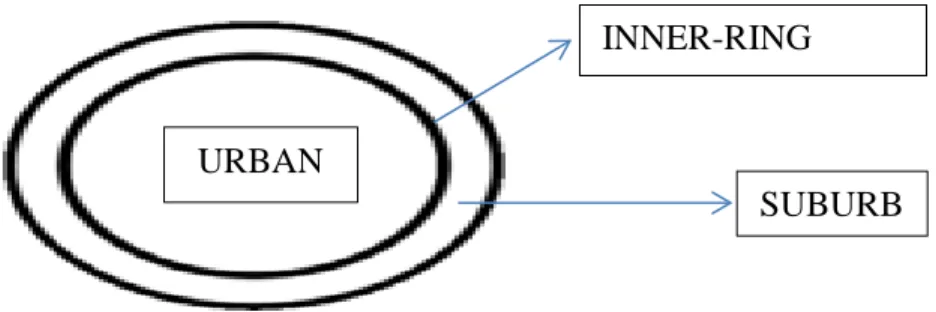
Figure 1.1. Inner-ring Suburbs.
The areas initially developed after World War II (WWII) formed concentric
circles around metropolitan areas. Figure 1.1 depicts the specific area of the inner-ring
suburbs. These traditional models of suburbia were reminiscent of Levittown, and they
were constructed for White residents (Hanlon, 2006; Wiese, 2004; Woods II, 2012).
These traditional models of geographically adjoined areas often provided close proximity
to large industrial and central cities where many city amenities existed while creating
additional opportunities for many White residents to be able to move beyond the city
limits (Hall & Lee, 2010; Orfield & Puentes, 2002). Automobile accessibility was a
welcomed advantage for many suburban residents, providing transportation, along with
mass transportation because major industries relocated or expanded to suburban areas
(Orfield & Puentes, 2002). Additional reasons for this eventual movement of residents
often included the ability to live in socioeconomic areas with like-minded individuals
who were seeking similar cultural neighborhoods and improved public schools (Lucy &
Phillips, 2006; Wiese, 2004). As national population trends began to shift, racial and
ethnic groups obtained various levels of employment in suburban areas. Socioeconomic
patterns, residential neighborhoods, and schools began to experience the impact of the
change (Garreau, 1991).
URBAN
INNER-RING
13 Inner-ring suburbs can be found throughout the United States.According to the
U.S. Census Bureau (2015), four geographical U.S. areas were designed from a
demographic perspective and they include the Northeast, Midwest, South, and West.
Although the inner-ring suburbs vary by SES, population, racial, and ethnic background,
they are most often defined by some seminal demographers as trolley car suburbs,
bedroom suburbs, first suburbs, first ring, or inner-ring suburbs (Hanlon, 2008, 2009; Lee
& Leigh, 2005, 2007; Lucy & Phillips, 2000, 2001; Orfield & Puentes, 2002; Puentes &
Warren, 2002, 2006). Furthermore, a definitive framework has not been established for
inner-ring suburbs. However, they have been defined by specific timeframes, such as pre-
and post-WWII construction, which references the age of the populations and age of the
housing construction (Lucy & Phillips, 2000; Orfield & Puentes, 2002; Puentes &
Warren, 2000).
Additionally, many Midwestern inner-ring suburbs, which were built prior to
1945, often have distinct architectural details and more square footage per home, but they
are undervalued because of aging infrastructure, overcrowded schools, and traffic
congestion (Orfield & Puentes, 2002). Whereas classic Northeastern inner-ring suburbs,
such as homes in Levittown, are considered cookie cutter homes with 800 square feet of
living space, they also contend with aging real estate, poor schools, and traffic congestion
(Leigh & Lee, 2005). Poverty concerns surface as new residents often purchase or rent
these outdated homes.
Puentes & Warren (2006) reported changes in racial populations as they relate to
White and Black residents in their first ring study of 22 states. Their 2000 data report
14 movement out of suburban communities. Beginning in 10-year increments, from 1980,
1990, and 2000, the White population decreased in the inner-ring suburbs by 83.6%,
76.25, and 66.6%, respectively. Additionally, most of the population changes occurred in
the top seven inner-ring suburb counties located in the Midwest and in Upstate New
York, thus these two regions had 93% of the White population in the overall study. On
the other hand, dissimilar statistics were reported in Prince George, MD where a 2.7%
Black population growth rate showed an increase faster than the national growth rate. As
first ring inner-ring suburbs continue to fluctuate, these regions contend with aging,
populations, housing, infrastructures, school facilities, and racial differences.
The research literature suggests that many suburbs are aging, falling into
disrepair, and experiencing an overall decline for various reasons (Bloom & Erlandson,
2003; Hanlon, 2008, 2009; Lucy & Phillips, 2000, 2001). For example, many of the
original White homeowners are aging, and younger White inhabitants are not replacing
them. Younger White residents often move beyond the inner-ring suburban areas (Frey,
2012). Some aging homes are not equipped with modern advantages and become rental
properties (Frey, 2012; Puentes & Warren, 2006). Yet, diverse racial and ethnic families
continue to move into these areas as they seek to improve overall lifestyles while
maintaining sociocultural and socioeconomic connections (Hanlon, 2006).
Additionally, social stratification of differing racial and income groups,
segregation, and integration patterns often frame many inner-ring suburban
neighborhoods, creating social differences (Jackson, 1985; Puentes & Warren, 2006).
Local governments struggle with decreased economic funding patterns due in part to the
15 Consequently, some suburban districts experience the erosion of tax bases, which
decreases funding for basic community infrastructure including public schools (Orfield &
Puentes, 2002). As funding patterns often vary in demographically changing school
communities, transformation of educational practices must adapt to diverse student
populations (Evans, 2007b; Madsen & Mabokela, 2014; Wilson, 2009). While suburban
school leaders continue to overlook the perspectives of marginalized staff, students,
parents, and administrators’ limited focus is directed to issues of diversity. Thus, the
focus on the dominant cultural perspectives continues as educational leaders’ practices,
beliefs, and values fail to create an environment conducive to the changing demographics
(Evans, 2007b; Howard, 2007; Theoharis, 2007; Tillman, 2006).
As of 2012, 9.2% of suburban educational leaders were Black, while in the same
year, over 80% of White educational leaders worked in the suburbs (NCES, 2012). The
lack of awareness of diverse perspectives and cultural differences within the school
culture, relating to overall diversity and acceptance, was limited (Evans, 2007a). For
example, a suburban school failed to recognize the importance of Black History activities
and terminated this cultural event in the school (Evans, 2007a). Research on suburban
schools highlights the inability of these districts to adjust to a changing overall diverse
student population (Evans, 2007a; Howard, 2007; Wilson, 2009). Furthermore,
administrators often blame students and their families for students not acquiring strong
academic skills—even though administrators claim to be diversity oriented (Evans,
2007a; Tyler, 2016). As students with differing sociocultural backgrounds enter suburban
schools, many school boards, as well as educational leaders, lack an awareness of the
16 dominant worldview continues to exclude diverse populations and their respective
sociocultural backgrounds (Evans, 2007b; Horsford, 2014; Rigby, 2013; Siddle Walker &
Archung, 2003; Theoharis, 2007; Tillman, 2004; Tyler, 2016).However, many BEL in
suburban districts are overlooked and devalued as potential sources of diversity
awareness from a Black educational leadership perspective based on personal and
professional experiences.
Theoretical Framework of Social Justice Educational Leadership
For the purpose of this study, a theoretical framework of social justice educational
leadership as described by Theoharis (2007), was applied because it addresses
educational leaders who seek to dismantle inequitable practices and lack of educational
access for historically marginalized individuals. Social justice educational leadership
theory considers race, sexual orientation, gender, language, class, and disability as crucial
factors of marginalized individuals that need to be equitably addressed. This theory
establishes a foundational perspective for educational leaders to design and recreate
practices that benefit all students in a larger democratic society. When this theory is
applied, the needs of the dominant population decreases and becomes less prominent the
needs of marginalized individuals surfaces as an emerging priority. Central to
Theoharis’s (2007) social justice educational leadership framework is educational
leaders’ advocacy, practice, and vision within their educational setting. BEL, regardless
of their work environment, have argued for equity and access in education (Hilliard,
1992; Riehl, 2000; Siddle Walker & Archung, 2003; Siddle Walker & Sneary, 2004;
Tillman, 2004). Furthermore, BEL have demonstrated concerns for students and
17 A social justice educational leadership theoretical framework allows for the
exploration of educational practices from an insider perspective within a demographically
changing IRSS context. Furthermore, it has been documented that some BEL employ
specific practices that stress advocacy methods and, subsequently, have enabled students
of color to achieve academic success within the segregated South as well as in the urban
North (Horsford, 2014; Siddle Walker, 2002, 2004, 2013; Siddle Walker & Archung,
2003; Siddle Walker & Byas, 2009; Sanders & Randolph 2011; Tillman, 2004). For
example, practices of interpersonal care, respect, recognition, and empathy are factors
associated with social justice, and they have been included in the research literature as
successful practices of some BEL. Social justice also embraces the potential of varying
pedagogical practices as progressive practices to benefit all students. BEL have been
placed in underperforming schools and advocated for better school facilities, resources,
and equipment for students (Gooden, 2005). BEL often advocate for pedagogical
practices that address culturally relevant strategies for marginalized students (Mabokela
& Madsen 2014; Tyler, 2016).
Additionally, some Black educational leaders demonstrate commitment,
compassion, and confidence in their students’ ability to succeed while encountering
resistance from colleagues and the school community (Gooden, 2005; Lomotey, 1987).
Theoharis (2007) indicated that educational leaders who implement social justice
educational practices face resistance from their colleagues, community, and central office
personnel, which creates personal discouragement and stress. Lack of support and
isolation from professional educators, like-minded peers, with teacher resistance and
18 responsible collaboration initiatives enabled the educational leaders cited in Theoharis’s
(2007) study to raise student achievement levels, improve school structures, refocus and
enhance staff capacity, and strengthen their school cultures and communities.
These accomplishments were decisions based on morally accepted attitudes that
were enlarged by the social justice orientation of the educational leaders. In summation,
there may be a connection between social justice educational leadership practices and
insider perspectives of BEL, based on their personal and professional experiences as
marginalized individuals.
Problem Statement
The purpose of this qualitative study is to investigate BEL’s social justice
educational leadership practices as they work with marginalized students within
demographically changing IRSS contexts. This study sought to disrupt the presumption
that suburban school communities, given high student performance measures, are devoid
of marginalized populations who may experience inequity and lack of access to
educational opportunities because of their race, ethnicity, class, gender, language,
disability, or sexual orientation. Failure to include BEL’s perspectives regarding
educational leadership practices creates a gap in the overall educational leadership
discourse This study will add to the educational research literature regarding social
justice educational leadership. The rapidly changing demographic patterns in the United
States also reflect the changes in student populations. Social justice educational
leadership from a BEL’s perspective addresses issues and suggests strategies that would
be beneficial for marginalized student populations (Evans, 2007b; Gooden, 2012; Madsen
19
Research Question
What remains to be investigated is an insider perspective that uniquely positions
BEL to be social justice educational leaders in demographically changing IRSS settings
(Evans, 2007a; Horsford, 2014; Theoharis, 2007; Wilson, 2009, 2010). This study is
guided by one research question:
In what waysdo Black educational leaders demonstrate social justice educational
leadership in demographically changing inner-ring suburban school contexts in Western
New York?
Definition of Terms
The following are key terms and definitions used in this study.
Accessibility – provision for marginalized students within K-16 and beyond
educational settings/context to have opportunities to obtain educational experiences for
self-improvement, which may have been denied due to marginalization.
Advocacy – a willingness (commitment, passion, readiness, duty, obligation) to
boldly interact on the behalf of marginalized students’ academic advancement within a
K-16 and beyond educational setting within a democratic society.
Black – an individual from a racial or ethnic background who is descendant from
African heritage and/or self-identifies as a descendant from African heritage, according to
U.S. Census Bureau information.
Black Educational Leaders – African American individuals who operate in the
role as an administrator, including school principals, assistant principals, counselors, and
20 Randolph & Sanders, 2011; Siddle Walker, 2000, 2001, 2014; Siddle Walker & Byas,
2009; Tillman, 2004).
Demographic Shifts – changes in populations within cities, towns, counties, and
urban and suburban areas, based on variables designated by the U.S. Census Bureau.
Equity – a skill (talent, expertise, proficiency, know how, ability) to seek and
infuse consistently and fairly educational quality and progress for the individual needs of
marginalized students throughout K-16 and beyond.
Inner-ring Suburban Community – an adjacent community next to a large
metropolitan area or central city. These areas were built between 1930 and 1969, and they
were inhabited primarily by White citizens who practiced Eurocentric values and beliefs.
These areas developed because of the national government’s decision to support
segregated housing and lending practices via bank regulations (Lucy & Phillips, 2000;
Wood II, 2012).
Insider Perspective – a theoretical approach employing an emic view to
qualitative research that can be based on the researcher’s race, ethnicity, and cultural
views of knowledge. The four knowledge-based perspectives are gained from “an
indigenous-insider, indigenous-outsider, external-insider, or an external-outsider
viewpoint” (Tillman, 2006, p. 268).
Marginalized Individuals – people within an educational environment who are not
considered to be connected to the dominant sociocultural framework. They are often
underrepresented and historically minimized because of their race, class, gender,
language, disability, or sexual orientation (Beauboeuf-Lafontant 2002; Evans, 2007a;
21
Social Justice Educational Leadership – “means that these principals make issues
of race, class, gender, disability, sexual orientation, and other historically and currently
marginalizing conditions in the United States central to their advocacy, leadership
practice and vision. This definition centers on addressing and eliminating marginalization
in schools” (Theoharis, 2007, p. 23).
Chapter Summary
A theoretical framework based on social justice educational leadership is used as
a lens to examine BEL’s leadership practices from an insider perspective in
demographically changing IRSS contexts (Theoharis, 2007; Tillman, 2006; Tyler, 2016).
Perspectives of BEL, although often overlooked, are important to examine and identify as
they relate to educational leadership practices because they often impact marginalized
students (Alston, 2004, 2005; Copper, 2009; Evans, 2007a; Ladson Billings, 1995; Loder,
2005; Tillman, 2006). Research indicates that many successful BEL leaders possess
specific educational leadership styles (Gooden, 2005; Horsford, 2010; Lomotey, 1989;
Randolph & Sanders, 2011; Siddle Walker, 2002). According to the NCES (2010), BEL
remain proportionally underrepresented in the role of educational leaders in most
demographic areas. However, many BEL are positioned to offer insider perspectives
concerning social justice educational leadership practices as they work in
demographically changing IRSS contexts.Perspectives of BEL and their social justice
educational leadership practices could potentially augment and transform current and
future educational leadership discourse.
This study was organized into five chapters. Chapter 1 discussed the overall
22 regarding the research topic. Chapter 3 outlines the research design, methodology, and
data collection procedures. Chapter 4 provides reports from 10 study participants
regarding their work in IRSS contexts, and Chapter 5 outlines the research study’s
23
Chapter 2: Review of the Literature
Chapter 2 presents a selective review of educational leadership research discourse
pertaining to Black educational leaders’ (BEL) social justice leadership practices. The
review of the literature focuses on inner-ring suburban school (IRSS) contexts within
demographically changing educational settings. Research indicates many BEL have
developed successful practices, which contribute to academic success for many Black
students (Siddle Walker, 2001).The experiences of BEL, though often overlooked,
dismissed, or ignored, have the potential to provide a broader view of educational
practices for all educational leaders. As educational research continues to evolve, it
suggests that educational leaders need to keep abreast of successful practices for all
students within various locales and communities. However, educational leadership
literature often fails to incorporate diverse cultural values, beliefs, and customs,
particularly the successful educational leadership practices employed by BEL as they
relate to social justice (Bloom & Erlandson, 2003; Gooden, 2005; 2005; Ladson Billings,
1995; Lomotoy,1987, 1983; Siddle Walker, 2001; Siddle Walker & Archung, 2003;
Siddle Walker & Sneary, 2004; Tillman, 2002, 2004).
Furthermore, the voices of many BEL within contemporary settings have not been
extensively explored and provide an opportunity for additional exploration. The omission
of BEL’s successful social justice practices is particularly significant as it affects policy
makers, student populations, and educational leaders in rapidly changing demographic
24 Investigating the social justice practices employed by some BEL within an inner-ring
suburban school context increases experiential research literature as it relates to
educational leadership practices in the 21st century (Evans, 2007a).
Black Educational Leaders
Transformation and change are not always accepted in leadership practice,
particularly as they impact diversity within student populations (Beauboeuf-Lafontant,
2002; Evans, 2007a, 2007b; Horsford, 2010; Siddle Walker & Sneary, 2004; Theoharis,
2007; Tillman, 2002, 2006). Students who are often devalued and marginalized, due to
race, class, gender, language, disability, or sexual orientation, are frequently overlooked
as the dominant population is considered the norm (Larson & Murtadha, 2003; Theoharis,
2007). Factors, such as a lack of resources, staff attitudes and beliefs, maintaining the
status quo, and failure to adapt to differing pedagogical practices, illustrate resisting
change (Larson & Murtadha, 2003; Theoharis, 2007; Tillman et al., 2006; Tyler, 2016).
Black educational leaders contend with racial inequities and lack of educational
accessibilities, both professionally and personally, yet they have proven to be advocates
for some students who are marginalized (Alston, 2004, 2012; Horsford, 2014; Lomotey,
1993, 1989; Randolph & Sanders, 2011; Siddle Walker, 2013). For example, practices of
interpersonal care, respect, recognition, and empathy are factors associated with social
justice and have been included in the research literature as successful practices of some
Black educational leaders (Beauboeuf-Lafontant, 2002; Bondy & Ross, 2008; Irvine &
James, 1998; Siddle Walker, 2002, 2004, 2014; Siddle Walker & Archung, 2003; Siddle
25 As a social justice educational leadership practice, BEL also embrace the potential
of varying pedagogical practices as progressive practices to benefit all students in a
democratic society (Irvine, 1989; Larson & Murtadha, 2003; Randolph & Sanders, 2011;
Theoharis, 2007). BEL often request pedagogical practices which address culturally
relevant strategies for marginalized students (Hilliard, 1992; Irvine & James, 1998;
Mabokela & Madsen 2014; Siddle Walker 2014; Tyler, 2016). An observation made by
Gooden (2005) reported BEL have been placed in underperforming schools and have
advocated for better school facilities, resources, and equipment for students. Gooden’s
(2005) observation is applicable in schools undergoing change, particularly as they relate
to equity, inclusivity, climate, and pedagogy (Khalifa et al., 2016).
Black educational leaders often establish positive relationships with students
because they may share similar marginalized experiences (Grant, 2010; Khalifa et al.,
2016; Lomotey, 1989). For example, the seminal research of Lomotey (1993) reported
many educational leaders operate as bureaucratic administrators as they oversee school
operations. However, Black educational leaders also act as ethno-humanistic educators
due in part to their understanding of racism and cultural perspectives (Gooden, 2005;
Lomotey, 1993). These dual roles practiced by BEL encourage relationships that are
frequently grounded in commitment, compassion, and confidence in students, and they
demonstrate interpersonal care, trust, visionary beliefs, and values of student academic
success (Lomotey, 1993; Randolph & Sanders, 2011; Siddle Walker & Archung, 2003).
Another example of Black educational leaders using social justice leadership is
presented in the research of Randolph and Sanders (2011) as they presented their research
26 States democratic society, Ms. Overby evoked social justice practices of advocacy,
equity, and access as they relate to marginalized students. After requesting and being
denied materials for her classroom library, the BEL obtained books by networking with
other educators and the local community. As time passed, Ms. Overby became a
principal, which enabled her continual advocacy, which resulted in obtaining a library for
the entire community.
As presented in here in Chapter 2, changing demographics impact communities,
particularly schools and educational leadership practices (Howard, 2007; Lee & Leigh,
2005, 2007; Tyler, 2016). Issues of diversity, as they relate to marginalized students who
are often underrepresented due to race, class, gender, language, disability, or sexual
orientation, impact the work of educational leaders (Evans, 2007b). Social justice
educational leadership practices are intended to be addressed through advocacy of
educational inequities while increasing educational accessibility for often marginalized
students (Larson & Murtadha, 2003; Theoharis, 2007). Though Black educational leaders
may be few in number, they continue to serve students. Pedagogy, values, beliefs, and
leadership practices remain concerns as educational leaders attempt to adjust to diverse
populations within an inner-ring suburban school context (Madsen & Mabokela, 2002;
Tyler, 2016). Insider knowledge and experiences of Black educational leaders, though
frequently challenged, may position them to contribute to a social justice educational
leadership perspective (Evans, 2007a, 2007b; Wilson, 2009).
Overview of Social Justice Educational Leadership
Three social justice educational leadership concepts, including advocacy, equity,
27 educational leadership exemplifies the ideology and practices of educational leaders
seeking to advocate for educational equity and access in schools with marginalized
students. These targeted students are often underrepresented and historically minimized
due to their race, class, gender, language, disability, or sexual orientation
(Beauboeuf-Lafontant, 2002; Evans, 2007a, 2007b; Hernandez, Murakami, & Cerecer, 2014;
Horsford, 2010; Randolph & Sanders, 2011; Siddle Walker, 2013; Siddle Walker &
Archung, 2003; Siddle Walker & Sneary, 2004; Theoharis, 2007; Tillman, 2002, 2006;
Villegas & Lucas, 2002;). Social justice educational leadership places an emphasis on
fairness for marginalized students who are often on the periphery of the dominant
sociocultural framework as it relates to educational settings. Consideration of the needs
of the dominant student population becomes subsidiary when including the needs of
marginalized students who are often overlooked due to their race, class, gender, language,
disability, or sexual orientation (Ryan, 2016; Theoharis, 2007, Tillman, 2006; Tyler,
2016). Emphasis is placed on marginalized individuals who are on the periphery of the
dominant sociocultural framework. These targeted individuals are often underrepresented
and historically minimized due to their race, class, gender, language, disability, or sexual
orientation (Beauboeuf-Lafontant, 2002; Evans, 2007b; Horsford, 2010; Siddle Walker &
Sneary, 2004; Theoharis, 2007; Tillman, 2002, 2006).
Schools, often considered a microcosm of society, reflect the values, beliefs,
attitudes, and practices of the larger society (Gooden, 2005; Hilliard 1992; Larson &
Murtadha, 2003). Educational leaders, teachers, students, parents, and neighboring
communities may subscribe to similar practices (Gooden, 2005). On the other hand, as
28 school districts, their background and differing cultural perspectives are frequently
dismissed, overlooked, or ignored (Evans, 2007a; Hernandez et al., 2014; Hilliard, 1992;
Howard, 2007). When diverse student populations arrive, schools often continue to resist
change and often fail to acknowledge opportunities to transform (Howard, 2007).
Educational leaders who utilize social justice educational practices contend with
the challenges as they implement and transform schools, particularly schools
experiencing changing demographics (Theoharis, 2007). Research conducted by
Theoharis (2007) outlines a social justice framework of significance. Theoharis’s (2007)
study investigated implementation of social justice educational leadership as experienced
by a group of principals. Participants were from three Midwestern states and consisted,
initially, of 18 individuals; however, seven principals were selected. Each principal self-
identified as an educational leader committed to educational advocacy, equity, and access
for all students who were marginalized. All principals were employed in urban schools,
and they were disaggregated as follows: two in high school, two in middle school, three
in elementary school. The demographic breakdown included three females, four males,
one gay, six heterosexual; one identified as Asian and six identified as White. Their ages
ranged from 30 years into their 50s with 3-16 years of experience. Theoharis (2007)
reported that a group such as this is not racially diverse.
After extensive in-depth interviews, field notes, document examination, group
meetings, and reflections, the findings were reported (Theoharis, 2007). Three specific
overlapping tenets emerged which recognized the importance of advocacy, equity, and
29 focused on specific goals and objectives.The three research questions for the Theoharis
(2007) study were:
1. In what ways are school principals enacting social justice in public schools?
2. What resistances do social-justice-driven principals face in their justice work?
3. What strategies do school principals develop to sustain their ability to enact
social justice in light of the resistance they face in public schools?
Strategies, issues, and practices were reported in the Theoharis (2007) study to be
consistent among the seven principals.
Social justice educational leaders focus on encouraging and enabling others, such
as students, teachers, parents, and the community at large, to actively participate in the
school environment (Kouzes & Posner, 2007; Siddle Walker & Sneary, 2004; Theoharis,
2007). This moral responsibility not only strengthens school and community cultures but
raises students’ academic achievement levels (Khalifa et al., 2016; Wilson, 2009).
Additionally, by eliminating pull outs and increasing curricular rigor, teachers realize the
need to adjust their curriculum to benefit all students and minimize educational
inequities. A further examination of Theoharis’s (2007) collected data identified
educational needs for diverse students and an opportunity to embrace all students.
Furthermore, Theoharis reported that professional development emerged as a result of
acknowledging professional biases when working with diverse student populations.
Social justice educational leaders also contend with oppositional actions from
teachers, parents, and the community at large as well as from the Central Office
(Mabokela & Madsen, 2005; Madsen & Mabokela, 2014; Siddle Walker & Byas, 2004;
30 collaborative school plans. White middle-class parents and faculty who feel privileged
expect the status quo to continue (Evans, 2007b; Mabokela & Madsen, 2005; Madsen &
Mabokela, 2014; Theoharis, 2007; Wilson, 2009). Social justice educational leaders
describe limited time to respond adequately to questions regarding school changes
(Theoharis, 2007). Inclusion of special education students was also found to be a struggle
for the social justice educational leaders (Gay, 2002; Theoharis, 2007). The Central
Office administrators in these studies did not provide support—neither did some
colleagues, which resulted in feelings of isolation by the social justice educational leaders
(Mabokela & Madsen, 2005; Madsen & Mabokela, 2014; Theoharis, 2007).
As social justice educational leaders continue their work, they develop proactive
and coping strategies to sustain the school community and themselves (Theoharis, 2007).
Building relationships with like-minded peers and networking while communicating with
all constituents enables social justice educational leaders to prioritize activities in and out
of the school building (Siddle Walker & Byas, 2009). Thus, the participants of
Theoharis’s study were more able to find some quality time for themselves such as
physical exercise and spending more time with their families. On the other hand, some
social justice educational leaders experienced self-destructive behaviors such as abusing
the use of alcohol or focusing up to 70 hours per week on school related matters.
In summary, Theoharis (2007) reported good educational leadership should
incorporate socially just educational practices especially for all marginalized students.
Furthermore, Theoharis posited that administrative preparation programs should also
include social justice educational ideologies. Theoharis (2007) further recommended that
31 rural and suburban school districts. Moreover, implementation of social justice
educational practices recognizes and disrupts educational practices, which perpetuate
educational inequities and lack of educational access for all students. Yet, within a
rapidly changing demographic school environment, a sense of fairness and impartiality
appears to be a crucial goal in establishing an educational environment for all students
(Evans, 2007a; Mabokela & Madsen, 2005; Ryan, 2016; Tyler, 2016; Wilson, 2009).
Social justice educational leadership addresses educational inconsistencies which
permeate schools attended by marginalized students located in the IRSS context.
Rapidly Changing Educational Demographics
Demographics change for various reasons and impact outcomes in various ways,
particularly in communities and schools (Frey, 2015; Hanlon, 2009; Kneebone & Reeves,
2016; Lucy & Phillips, 2001). For example, the U.S. Census Bureau data for 2000-2010
reported changes, which occurred every 10 years during 1960-2000 (Frey, 2015). The
U.S. Census Bureau reported that between 1960-1970, the population experienced an
increase of 13.3%; between 1970 and1980, a population decrease of 11.5% occurred;
between 1980 and 1990, the decrease in population was reported as 9.8%; but by 2000,
the population increased to 13.2%, and 2000-2010, there was a decrease in population of
9.7% (Mackun & Wilson, 2011). This represented a percentage change in the four major
regions of the US. Within the Northeast, there was a 3.2% increase; in the South, a 14.3%
increase; the Midwest experienced a 3.9% increase; and there was an increase in the West
of 13.8 % (Frey, 2015). During the same time period, the racial breakdown indicated an
increased percentage of Hispanic by 43%, White by 9.2%, Black/African American by
32 The U.S. Census Bureau indicated changes in national poverty and household
income levels. The news release indicated 43.1 million (13.5%) people lived in poverty
during 2015, which represented a rate decrease in poverty of 1.2%. Furthermore, the
median household income in 2015 was $56,516, which was an increase of 5.2% over
$53,718 in 2014 (U.S. Census Bureau, 2016). Regionally, between 2014-2015, increases
in household income were reported as follows: in the West, 6.4%; Midwest, 4.9%; and
the South and Northeast both increased by 2.9% (U.S. Census Bureau, 2016).
Communities and schools are also impacted by national data. For example, a
national survey of inner-ring suburbs concluded that socioeconomic status (SES), race,
class, and ethnicity remain as contributing factors in many suburban locales (Hanlon,
2009). Additionally, Hanlon identified five inner-ring suburban typologies, which were
categorized as vulnerable, ethnic, lower income, old, and mixed. Within each of the
categorized inner-ring suburban contexts, specific overlapping traits emerged regarding
socioeconomics, stereotypical patterns based on race and ethnicity, and employment
opportunities. Hanlon (2009) concluded changing migratory patterns are inevitable, but
regardless of the regional populations, race, class, and ethnic patterns appear constant
concerns.
When considering rapidly changing demographic patterns, student populations are
also impacted by family circumstances. A research study reported by Kneebone and
Reeves (2016) stressed the importance of multi-dimensional poverty and specific factors
which greatly affect communities and students (Kneebone & Reeves, 2016). The
33 development. Their report includes data regarding low incomes, lack of skills,
unemployment, poor health conditions, and living in distressed areas.
Furthermore, they reported Blacks and Hispanics experience the greatest number
of disadvantages within the suburbs; for example, of the total adult suburban population
reported, 11.7% of adults have at least two disadvantages. Additional disadvantages were
reported as adults living in poverty, 2.5%; lacking high school diplomas, 5.1%; lacking
health insurance, 5.7%; and living in a non-working household, 4.8% (Kneebone &
Reeves, 2016). The researchers also reported racial/ethnic statistics as: Whites living in
poverty, 0.9%; Blacks living in poverty, 4.9%; and Hispanics living in poverty, 7.5%;
Whites lacking high school diplomas, 2.6%; Blacks lacking a high school diploma, 5.8%;
Hispanics lacking a high school diploma, 14.5%; lacking health insurance: Whites, 3.2%;
Black, 7.2%; and Hispanic,14.6%; and those living in a non-working household: White,
4.2%; Black, 9.1%; and Hispanic, 4.8%.
Kneebone and Reeves (2016) recommended putting local, regional, state, and
federal policies into place to address the five disadvantages as they relate to increasing
income, job training, medical assistance, and addressing significant educational gaps. The
researchers stated that students with diverse student backgrounds present an opportunity
for school transformation as it impacts practices of educational leaders (Kneebone &
Reeves, 2016).
As migratory patterns continue to change, other demographic paradigms also are
affected (Frey, 2015). Research conducted by Frey (2015) examined population shifts
which are impacting current and future demographic dynamics. Frey found that in 2011,