NASA Technical Memorandum 108991 (Revised)
An Elementary Tutorial on Formal
Specication and Verication
Using PVS 2
Ricky W. Butler
September 1993 (revised June 1995)
NASA
National Aeronautics and
Space Administration
LangleyResearchCenterHampton, VA 23681
This paper presents a tutorial on the development of a formalspecication and its verication
using the Prototype Verication System (PVS). The tutorial presents the formal specication
and verication techniques by way of a specic example|an airline reservation system. The
airline reservation system is modeled as a simple state machine with two basic operations. These
operations are shown to preserve a state invariant using the theorem proving capabilities of PVS.
The technique of validating a specication via \putative theorem proving" is also discussed and
illustrated in detail. This paper is intended for the novice and assumes only some of the basic
concepts of logic. A complete description of user inputs and the PVS output is provided, and
thus it can be eectively used while one is sitting at a computer terminal. PVS is free and can
be retrieved via anonymous FTP. For information about how to obtain and install PVS, see
World Wide Web at http://www.csl.sri.com/sri-csl-pvs.html.
KEY WORDS: formal methods, formal specication, verication & validation,
theorem provers, PVS, mechanical verication
Contents
1 Introduction
1
1.1 Some Preliminary Concepts
: : : : : : : : : : : : : : : : : : : : : : : : : : : : : : : :1
1.2 Statement of The Example Problem
: : : : : : : : : : : : : : : : : : : : : : : : : : :1
2 Formal Specication of the Reservation System
2
2.1 Creating Basic TYPE Denitions
: : : : : : : : : : : : : : : : : : : : : : : : : : : : :2
2.2 Creating a PVS Specication File
: : : : : : : : : : : : : : : : : : : : : : : : : : : : :3
2.3 Denition of the Reservation System Database
: : : : : : : : : : : : : : : : : : : : :4
2.4 Aircraft Seat Layout
: : : : : : : : : : : : : : : : : : : : : : : : : : : : : : : : : : : :5
2.5 Specifying Operations on the Database
: : : : : : : : : : : : : : : : : : : : : : : : : :6
2.6 Seat Assignment Operations
: : : : : : : : : : : : : : : : : : : : : : : : : : : : : : : :6
2.7 Specifying Invariants On the State Of the Database
: : : : : : : : : : : : : : : : : :8
2.8 PVS Typechecking and Typecheck Conditions (TCCs)
: : : : : : : : : : : : : : : : :9
3 Formal Verications
12
3.1 Proof that
Cancel assnMaintains the Invariant
: : : : : : : : : : : : : : : : : : : :13
3.2 Proof that
Make assnMaintains the Invariant
: : : : : : : : : : : : : : : : : : : : : :24
3.2.1 Proof of MAe
: : : : : : : : : : : : : : : : : : : : : : : : : : : : : : : : : : : :24
3.2.2 Proof of MAu
: : : : : : : : : : : : : : : : : : : : : : : : : : : : : : : : : : : :33
3.2.3 Proof of Theorem
: : : : : : : : : : : : : : : : : : : : : : : : : : : : : : : : : :44
3.3 Proof that the Initial State Satises the Invariant
: : : : : : : : : : : : : : : : : : : :46
3.4 Proof of
one per seatInvariant
: : : : : : : : : : : : : : : : : : : : : : : : : : : : :47
3.5 System Properties and Putative Theorems
: : : : : : : : : : : : : : : : : : : : : : : :47
1 Introduction
This paper carefully guides the reader through the steps of a formal specication and verication
of the requirements for a simple system|an airline reservation system. This paper is intended for
the novice and is tutorial in nature. The goal is to explore a few important techniques and concepts
by way of example rather than to discuss interesting research issues.
This tutorial is intended to be used while one is sitting at a computer terminal. Therefore,
general discussions are limited to a few introductory comments. However, the commentary about
the example problem is extensive. The reader is referred to [1] for a detailed discussion about
contemporary issues in formal methods research.
This tutorial presents the techniques of formal specication and verication in the context
of the Prototype Verication System (PVS) developed by SRI International [2]. No specialized
knowledge of logic or computer science is assumed, though it is necessary for the reader to have
the PVS documentation [3, 4, 5] in order to eectively use this tutorial. The tutorial also assumes
that the reader is familiar with Emacs, the text editor the serves as a front-end to the PVS system.
This tutorial was revised in June 1995 to conform with the latest version of PVS, PVS version 2.0.
PVS is free and can be retrieved via anonymous FTP. For information about how to obtain and
install PVS, see World Wide Web at http://www.csl.sri.com/sri-csl-pvs.html.
1.1 Some Preliminary Concepts
The requirements specication or high-level design of many systems can be modeled as a state
machine. This involves the introduction of an abstract representation of system state and a set of
operations that operate on the system state. These operations transition a system from one state
to another in response to external inputs.
The development of a state machine representation of the system requires the development
of a suitable collection of type denitions with which to build the state description. Additional
types, constants, and functions are introduced as needed to support subsequent formalization of the
operations. Operations on the state are dened as functions that take the system from one state to
another or, more generally, as mathematical relations. Many times an invariant to the system state
is provided to formalize the notion of a \well-dened" system state. The invariant is shown to hold
in the presence of an arbitrary operation on the state assuming that the invariant holds before the
operation begins. Other desired properties may be expressed as predicates over the system state
and operations, and can be proved as putative theorems that follow from the formalization.
1.2 Statement of The Example Problem
In the next sections we will demonstrate some of the techniques of formal specication and
verica-tion by way of an example|an automated airline seat assignment system that meets the following
informal requirements:
1. The system shall make seat assignments for passengers on scheduled airline ights.
2. The system shall maintain a database of seat assignments.
3. The system shall support a eet having dierent aircraft types.
4. Passengers shall be allowed to specify preferences for seat type (e.g., window or aisle).
5. The system shall provide the following operations or transactions:
Make a new seat assignment
Cancel an existing seat assignment
This example problem was derived from an Ehdm specication presented by Ben Di Vito at the
Second NASA Formal Methods Workshop [6].
2 Formal Specication of the Reservation System
This section provides a step-by-step elaboration of the process one goes through in developing a
formal specication of the example system. Much of the typing required to carry out this
exer-cise can be reduced by retrieving the specications from
air16.larc.nasa.govusing anonymous
FTP. The specications are located in the directory
pub/fm/larc/PVS-tutorialin a le named
revised-specs.dmp.
2.1 Creating Basic TYPE Denitions
We begin our formal specication by creating some names for the objects that our formal
speci-cation will be describing. We obviously will be talking about seats in an airplane and will need
a way to identify a particular seat. We decide to represent an airplane's seating structure as a
two-dimensional array of \rows" and \positions". In PVS one writes
row: TYPE position: TYPE
to dene the two domains of values. Of course this specication says nothing about what kind of
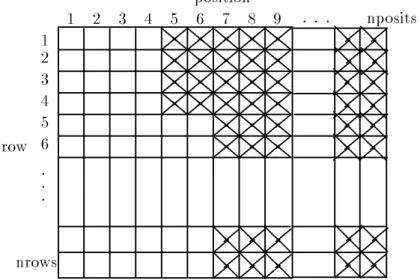
value \row" or \position" could be. We decide to number our rows and positions with positive
natural numbers. This is illustrated in gure 1. Of course we really don't need an innite set of
, , @ @ @ @ , , , , @ @ @ @ , , , , @ @ @ @ , , , , @ @ @ @ , , , , @ @ @ @ , , , , @ @ @ @ , , , , @ @ @ @ , , , , @ @ @ @ , , @ @ , , , , @ @ @ @ , , , , @ @ @ @ , , , , @ @ , , l l l l , , , , l l l l , , , , l l l l , , l l , , , , l l l l , , , , l l l l , , , , l l l l , , , , l l l l , , , , l l l l , , , , l l l l , , , , l l l l , , l l , , , , l l l l , , , , l l l l , ,
nrows
nposits
. . .
.
..
6
5
4
3
2
1
1
2
3
4
5
6
7
8
9
row
position
Figure 1: Model of Seating Arrangement In An Airplane
constants that delineate the maximum number of rows in any airplane and the maximum number
of positions for any row:
nrows: posnat % Max number of rows
nposits: posnat % Max number of positions per row
We now modify our specication of \row" and \position":
row: TYPE = {n: posnat | 1 <= n AND n <= nrows}
position: TYPE = {n: posnat | 1 <= n AND n <= nposits}
This denes
rowand
positionas subranges of the positive naturals (called
posnatin PVS). The
notation is very simple. The text before the
|denes the parent type and the text after the
|gives
a predicate that denes the particular subset of the parent type that you are interested in. Thus,
row
is any positive natural number between 1 and
nrowsinclusive.
2.2 Creating a PVS Specication File
We now put these together in a le. We start up PVS and type
M-x nf. PVS asks for a name for
the new le. We answer \
basic defs.pvs". PVS creates the following le:
basic_defs % [ parameters ] : THEORY BEGIN % ASSUMING % assuming declarations % ENDASSUMING END basic_defsWe remove all of the text after the
%characters, and then add our type denitions
1:
basic_defs: THEORY BEGIN
nrows: posnat % Max number of rows
nposits: posnat % Max number of positions per row row: TYPE = {n: posnat | 1 <= n AND n <= nrows}
position: TYPE = {n: posnat | 1 <= n AND n <= nposits} END basic_defs
We now issue the PVS typecheck command,
M-x tc. PVS responds \
basic defs typechecked in 3 seconds. No TCCS generated".
We now need to dene some other types that dene the ight number, aircraft type, a position
preference (e.g. aisle or window) and an identier for passengers:
1
The only remaining keywords are
THEORY
, which delineates the start of a new module, and the
BEGIN ENDflight: TYPE % Flight identifier plane: TYPE % Aircraft type
preference: TYPE % Position preference passenger: TYPE % Passenger identifier
We add this text to our le and typecheck again.
2.3 Denition of the Reservation System Database
We are ready to dene the database that will maintain all of the reservations. For each ight, the
system must maintain a set of seat assignments. We decide to represent each seat assignment as a
record that contains a passenger and his assigned seat. This can be formally represented in PVS
using the record constructor:
seat_assignment: TYPE = [# seat: [row, position], pass: passenger #]
The
seateld of the record is of type
[row, position], an ordered pair (or 2-tuple) of
rowand
position. The entire set of seat assignments for a ight can be represented using PVS's set
constructor,
set.
flight_assignments: TYPE = set[seat_assignment]
This denes a set type that contains only elements of type
seat assignmentand assigns it the
name
flight assignments. Sets are dened in the PVS prelude, which can be displayed using the
M-x vpfcommand. The
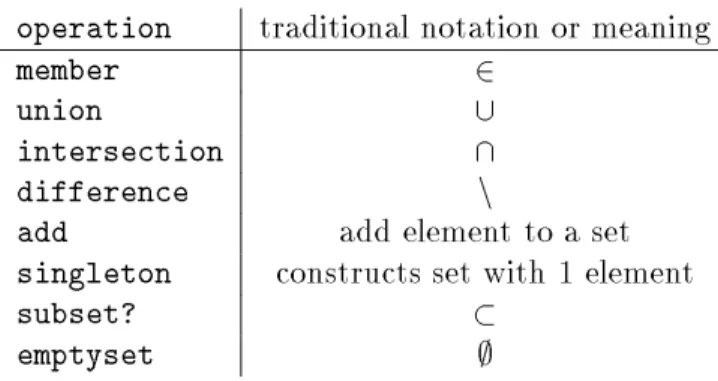
setsmodule provides denitions for the basic set operations. Some of
these operations are described in table 1.
operation
traditional notation or meaning
member 2
union [
intersection \
difference n
add
add element to a set
singleton
constructs set with 1 element
subset?
emptyset ;
Table 1: A partial list of PVS set operations
The complete ight-reservation database can now be modeled as a mapping from ight identier
into that ight's current set of seat assignments:
flt_db: TYPE = function[flight -> flight_assignments]
This denes a type that represents the domain of all possible databases. A particular database can
be represented by declaring a variable of this type:
Initially, each ight has no assignments:
initial_state(flt: flight): flight_assignments = emptyset[seat_assignment]
We add this to our specication and typecheck it.
2.4 Aircraft Seat Layout
Since there is a maximum number of rows and seats per row, we must indicate whether a (
row, position) pair exists for a given aircraft type. This can be accomplished through use of several
functions that are uniquely dened for dierent plane types:
seat_exists: function[plane, [row, position] -> bool]
meets_pref: function[plane, [row, position], preference -> bool]
Since we do not want to restrict our specication to any particular plane type, we do not supply
a denition (i.e., a function body) for these functions. They are left \uninterpreted." The
in-tended meaning of these functions are as follows. The function
seat existsis true only when the
indicated seat (i.e.
[row,position]) is physically present on the indicated airplane. The
func-tion
meets prefspecies whether the particular seat is consistent with the particular preference
indicated. The type of airplane assigned to a particular ight is given by the
aircraftfunction:
aircraft: function[flight -> plane]The description of the basic attributes of the system is now complete. The specication is:
basic_defs: THEORY BEGIN
nrows: posnat % Max number of rows
nposits: posnat % Max number of positions per row row: TYPE = {n: posnat | 1 <= n AND n <= nrows}
position: TYPE = {n: posnat | 1 <= n AND n <= nposits} flight: TYPE % Flight identifier
plane: TYPE % Aircraft type
preference: TYPE % Position preference passenger: TYPE % Passenger identifier seat_assignment: TYPE = [# seat: [row, position],
pass: passenger #] flight_assignments: TYPE = set[seat_assignment]
flt_db: TYPE = function[flight -> flight_assignments]
initial_state(flt: flight): flight_assignments = emptyset[seat_assignment] % ====================================================================
% Definitions that define attributes of a particular airplane
% ==================================================================== seat_exists: function[plane, [row, position] -> bool]
meets_pref: function[plane, [row, position], preference -> bool] aircraft: function[flight -> plane]
END basic_defs
2.5 Specifying Operations on the Database
Our method of formally specifying operations is based on the use of state transition functions. The
function denes the value of system state after invocation of the operation in terms of the system
state before the operation is invoked.
To produce a modular specication, we will place the operations in a new theory (i.e. a new
module). This is accomplished in PVS by using the
M-x ntcommand. We issue this command
and name the new theory
ops. All of the denitions of the
basic defstheory are made available
to this theory using the
IMPORTINGcommand:
ops: THEORYBEGIN
IMPORTING basic_defs END ops
2.6 Seat Assignment Operations
The rst operation that we need is
Cancel assn(flt,pas,db), which cancels the seat assignment
for a passenger,
pas,on ight
fltin database
db:
a: VAR seat_assignmentCancel_assn(flt: flight, pas: passenger, db: flt_db): flt_db = db WITH [(flt) := {a | member(a,db(flt)) AND pass(a) /= pas}]
The declaration of the function begins with its formal parameter list. Each argument is listed with
its type. The return type of the function is given after the parameter list. This specication uses
the PVS
WITHconstruct. The
WITHexpression is used to dene a new function that diers from
another function for a few indicated values. For example,
f WITH [(1) := y]is identical to f,
except possibly for f(1)
2. Thus, all seat assignment sets for ights other than
flt
are unchanged.
For ight
flt, however, all assignments on behalf of passenger
pasare removed (there should be
at most one). As discussed earlier (i.e. see table 1), the function
memberis dened in the
setsmodule of the PVS prelude.
The second operation is
Make assn(flt,pas,pref,db), which makes a seat assignment, if
possible, for passenger
pason ight
fltin database
db. There are two conditions that should
prevent us from carrying out this operation on the reservation database
1. when there is no seat available that meets the passenger's specied preference
2. when the passenger already has a seat on the plane
2
The resulting function is not dierent if f(1) = y. Formally
f WITH [(1) := y](x) = IF x = 1 THEN y ELSE f(x) ENDIF
Condition (1) can be expressed in PVS as follows:
(FORALL seat: meets_pref(aircraft(flt), seat, pref) IMPLIES
(EXISTS a: member(a, db(flt)) AND seat(a) = seat)))
This states that all seats that meet the passenger's preference (
meets pref(aircraft(flt), seat, pref)) are already assigned to another passenger, i.e., there already exists a record
ain the database
with the specied seat. Note that PVS departs from the traditional dot notation (e.g.
a.seat)and uses
seat(a)to dereference the seat eld of record
a. We can supply a name,
pref filledfor this condition as follows:
seat: VAR [row,position]
pref_filled(db: flt_db, flt: flight, pref: preference): bool = (FORALL seat: meets_pref(aircraft(flt), seat, pref)
IMPLIES (EXISTS a: member(a, db(flt)) AND seat(a) = seat))
The second condition (i.e., the passenger already has a seat on the plane) can be dened as follows:
pass_on_flight(pas: passenger, flt: flight, db: flt_db): bool = (EXISTS a: pass(a) = pas AND member(a,db(flt)))
We are now ready to dene the operation that assigns a passenger to a particular ight,
Make assn
:
Make_assn(flt:flight, pas:passenger, pref:preference, db:flt_db): flt_db = IF pref_filled(db, flt, pref) OR
pass_on_flight(pas,flt,db) THEN db ELSE
(LET a = (# seat := Next_seat(db,flt,pref), pass := pas #) IN db WITH [(flt) := add(a, db(flt))])
ENDIF
In this specication, if either of the two anomalous conditions is true, the database is not changed.
The
ELSEclause denes what happens otherwise. This clause uses PVS's
LETconstruct. The
LETstatement allows one to assign a name to a subexpression. This is especially useful when a
subexpression is used multiple times in an expression. In our case, the subexpression
aonly occurs
once|in the subexpression
add(a, db(flt)), which creates a new set by adding the element
ato
the set
db(flt). The
LETis used here to make the complete expression easier to read. The value
of the
LETvariable
ais dened using a record constructor, i.e.
(# ... #). In this case, the
passeld is set equal to the formal parameter
pas, and the
seateld of the record is updated with the
result from another function,
Next seat:
Next_seat: function[flt_db, flight, preference -> [row,position]]
This function selects the next seat to be given a passenger from all of the available seats. Any
number of algorithms can be imagined that would make this selection, e.g. the seat with the lowest
row and position number available. However, since this is a high-level specication, we decide to
leave the particular selection algorithm unspecied. Thus, we do not dene a body for this function
and leave it as an uninterpreted function. Nevertheless, we will need a general property about this
function in order for one of our proofs to go through
3. We dene this property with an axiom:
db: VAR flt_db flt: VAR flight pref: VAR preference
Next_seat_ax: AXIOM NOT pref_filled(db, flt, pref) IMPLIES seat_exists(aircraft(flt),Next_seat(db,flt,pref))
This axiom states that if a seat is available that matches the specied preference, then the function
Next seat
returns a [row, position] that actually exists on the airplane scheduled for ight
flt.
This axiom makes use of several variables. These will be used in subsequent PVS declarations.
Now that we have dened the operations, we are faced with the question, \How do we know that
the operations were specied correctly?" One approach to this problem is to construct \putative"
theorems. These are properties about the operations that should be true if we have dened them
properly. For example,
pas: VAR passenger
Make_Cancel: THEOREM NOT pass_on_flight(pas,flt,db) =>
Cancel_assn(flt,pas,Make_assn(flt,pas,pref,db)) = db
This states that if a particular passenger is not already assigned to a ight, then the result of
assigning that passenger to a ight and then canceling his reservation will return the database to
its original state
4. The process of attempting to prove such theorems can lead to the discovery of
errors in the specication. The proof of this theorem will be given in a later section. Some other
examples are:
Cancel_putative: THEOREM
NOT (EXISTS (a: seat_assignment):
member(a,Cancel_assn(flt,pas,db)(flt)) AND pass(a) = pas) Make_putative: THEOREM NOT pref_filled(db, flt, pref) =>
(EXISTS (x: seat_assignment):
member(x, Make_assn(flt, pas, pref, db)(flt)) AND pass(x) = pas)
2.7 Specifying Invariants On the State Of the Database
The system state is subject to three types of anomalies:
1. Assigning nonexistent seats to passengers
2. Assigning multiple seats to a single passenger
3. Assigning more than one passenger to a single seat
Prevention of anomaly (1) can be formalized as follows:
existence(db: flt_db): bool =
(FORALL a,flt: member(a, db(flt)) IMPLIES seat_exists(aircraft(flt), seat(a)))
Prevention of anomaly (2) can be formalized as follows:
4
We have used the alternate PVS syntax for logical implies:
=>.
uniqueness(db: flt_db): bool =
(FORALL a,b,flt: member(a, db(flt)) AND member(b, db(flt)) AND pass(a) = pass(b) IMPLIES a = b)
Prevention of anomaly (3) can be formalized as follows:
one_per_seat(db: flt_db): bool =
(FORALL a,b,flt: member(a, db(flt)) AND member(b, db(flt)) AND seat(a) = seat(b) IMPLIES a = b)
The overall state invariant is the conjunction of the three. However, in order to simplify the
dis-cussion we will work with the rst two and leave the last invariant as an exercise
5. The conjunction
of the rst two can be captured in a single function as follows:
db_invariant(db: flt_db): bool = existence(db) AND uniqueness(db)
2.8 PVS Typechecking and Typecheck Conditions (TCCs)
We combine the denitions for the operations and the invariants in a new theory called
ops:
ops: THEORYBEGIN
IMPORTING basic_defs a: VAR seat_assignment
Cancel_assn(flt: flight, pas: passenger, db: flt_db): flt_db = db WITH [(flt) := {a | member(a,db(flt)) AND pass(a) /= pas}] seat: VAR [row,position]
pref_filled(db: flt_db, flt: flight, pref: preference): bool = (FORALL seat: meets_pref(aircraft(flt), seat, pref)
IMPLIES (EXISTS a: member(a, db(flt)) AND seat(a) = seat)) pass_on_flight(pas: passenger, flt: flight, db: flt_db): bool =
(EXISTS a: pass(a) = pas AND member(a,db(flt))) Next_seat: function[flt_db, flight, preference -> [row,position]]
Make_assn(flt:flight, pas:passenger, pref:preference, db:flt_db): flt_db = IF pref_filled(db, flt, pref) OR
pass_on_flight(pas,flt,db) THEN db ELSE
(LET a = (# seat := Next_seat(db,flt,pref), pass := pas #) IN
db WITH [(flt) := add(a, db(flt))]) ENDIF
% ======================================================================= % Variable Declarations
% =======================================================================
flt: VAR flight pas: VAR passenger db: VAR flt_db
b: VAR seat_assignment pref: VAR preference
Next_seat_ax: AXIOM NOT pref_filled(db, flt, pref) IMPLIES seat_exists(aircraft(flt),Next_seat(db,flt,pref))
% ======================================================================= % Putative Theorems
% ======================================================================= Make_Cancel: THEOREM NOT pass_on_flight(pas,flt,db) =>
Cancel_assn(flt,pas,Make_assn(flt,pas,pref,db)) = db % =======================================================================
% Invariants
% ======================================================================= existence(db: flt_db): bool =
(FORALL a,flt: member(a, db(flt)) IMPLIES seat_exists(aircraft(flt), seat(a))) uniqueness(db: flt_db): bool =
(FORALL a,b,flt: member(a, db(flt)) AND member(b, db(flt)) AND pass(a) = pass(b) IMPLIES a = b)
one_per_seat(db: flt_db): bool =
(FORALL a,b,flt: member(a, db(flt)) AND member(b, db(flt)) AND seat(a) = seat(b) IMPLIES a = b)
db_invariant(db: flt_db): bool = existence(db) AND uniqueness(db)
% =======================================================================
% THEOREMS
Cancel_db_inv: THEOREM db_invariant(db) IMPLIES db_invariant(Cancel_assn(flt,pas,db))
MAe: THEOREM existence(db)
IMPLIES existence(Make_assn(flt,pas,pref,db)) MAu: THEOREM uniqueness(db)
IMPLIES uniqueness(Make_assn(flt,pas,pref,db)) Make_db_inv: THEOREM db_invariant(db) =>
db_invariant(Make_assn(flt,pas,pref,db))
initial_state_inv: THEOREM db_invariant(initial_state)
When we issue the
M-x tccommand we notice that the system responds
ops typechecked: 1 TCCs, 0 Proved, 0 subsumed, 1 unproved. Unlike many high-level programming languages,
PVS often requires theorem proving in order to guarantee that the specication is type correct.
This is the price one has to pay for the very powerful type structure of the language.
M-x show-tccs
opens up a window that displays the typecheck obligations:
% Existence TCC generated (line 24) for% Next_seat: FUNCTION[flt_db, flight, preference -> [row, position]] %
% unfinished
Next_seat_TCC1: OBLIGATION
(EXISTS (x: [[flt_db, flight, preference] -> [row, position]]): TRUE);
We position the cursor on the rst obligation and type
M-x pr. The PVS system responds by
opening up a proof buer containing the following output:
Next_seat_TCC1 :
|---{1} (EXISTS (x: [[flt_db, flight, preference] -> [row, position]]): TRUE) Rule?
The system wants us to prove that there exists a function from the triple
[flt_db, flight, preference]to the ordered pair
[row, position]. The constant function that returns the ordered pair
(1,1)should suce, but we have not yet dened such a function. Nevertheless, we can introduce an
unnamed function using the LAMBDA notation available in PVS:
(LAMBDA (x: [flt_db, flight, preference]): (1,1))
The
LAMBDAkeyword merely indicates that a function without a name is being dened. The
expressions immediately after a
LAMBDAdene the parameters of the function. In this case, there is
one parameter
xof type
[flt_db, flight, preference]. The body of the function follows the
and
position= 1. Now to tell the prover to use this function in formula
{1}, we use the
INSTcommand as follows:
Rule? (INST 1 "(LAMBDA (x: [flt_db, flight, preference]): (1,1))") Instantiating the top quantifier in 1 with the terms:
(LAMBDA (x: [flt_db, flight, preference]): (1,1)), this yields 2 subgoals:
Next_seat_TCC1.1 (TCC):
|---{1} 1 <= nposits
The prover tells us that we now have two subgoals to prove. The rst one named
Next_seat_TCC1.1is displayed for us, Since this is a trivial result that follows directly from the declaration of
nposits,
we issue an
ASSERTcommand:
Rule? (assert)Simplifying, rewriting, and recording with decision procedures, This completes the proof of Next_seat_TCC1.1.
Next_seat_TCC1.2 (TCC):
|---{1} 1 <= nrows
The prover tells us that
Next_seat_TCC1.1is complete and displays the other subgoal. We issue
ASSERTagain, and we receive:
Rule? (assert)
Simplifying, rewriting, and recording with decision procedures, This completes the proof of Next_seat_TCC1.2.
Q.E.D.
Run time = 1.77 secs. Real time = 25.04 secs.
The prover produces
Q.E.D.which informs us that we are done.
3 Formal Verications
In this section we will walk-through the mechanical verication of the invariant properties
dis-cussed previously. This will be done using the basic commands of PVS and not the more powerful
strategies. Although skilled PVS users would not approach the proofs in the manner presented
here, working through these proofs can be an excellent learning experience for the novice. Once the
basic commands have been mastered, the reader should continue with the following more advanced
tutorial that is based upon the same example used in this paper:
J. M. Rushby and D. W. J. Stringer-Calvert "A Less Elementary Tutorial for the PVS
Specication and Verication System", SRI International Technical Report CSL-95-10,
June 1995.
The more advanced tutorial presents proofs of all of the theorems and lemmas using no more than
two or three PVS commands.
To establish that the state invariant is preserved by every operation, we must prove theorems
of the form:
I(
S 1)
I(op spec(
S 1))
where
S1
is the state before the operation and
I
represents the state invariant. Note that op spec(
S 1)
is the state of the system after the operation. For our example, the required theorems can be
ex-pressed as follows:
Cancel_assn_inv: THEOREM db_invariant(db) =>
db_invariant(Cancel_assn(flt,pas,db)) Make_assn_inv: THEOREM db_invariant(db) =>
db_invariant(Make_assn(flt,pas,pref,db))
3.1 Proof that
Cancel assnMaintains the Invariant
Although it is almost always advisable to search for a proof before engaging the theorem prover,
the prover can be useful in the discovery of the proof. We shall use this approach on this example,
since the theorem is shallow and not hard to understand. This section is meant to guide the PVS
novice through his rst non-trivial use of the theorem prover. The goal is to gain some familiarity
with the capabilities of the system so that further reading in the user manuals is more productive.
The proofs given in this tutorial are by no means the best way of proving these theorems. They
were performed with the goal of walking the user through a large number of the PVS commands
6.
The user begins a proof session by positioning the cursor on a proof and typing
M-x pr. The
system responds with:
Cancel_assn_inv :
|---{1} (FORALL (db: flt_db, flt: flight, pas: passenger):
db_invariant(db) IMPLIES db_invariant(Cancel_assn(flt, pas, db)))
The user then issues commands that manipulate the formula using truth-preserving operations.
The goal, of course, is to simplify the formula to the point where the prover can identify the
6
All of these theorems can be proved using only a few of the more powerful PVS strategies. See
J. M. Rushby and D. W. J. Stringer-Calvert "A Less Elementary Tutorial for the PVS Specication
and Verication System", SRI International Technical Report CSL-95-10, June 1995.
formula as a tautology and thus a theorem. The user input in this paper can be identied by the
rule?
prompt. All of the inputs in this tutorial are only one line. Although PVS allows commands
to be entered in either lower or upper case, we will use upper-case letters exclusively to enhance
readability. However, the PVS language is case-sensitive and thus identiers within quotes must
be the same as they appear in the specication. The abbreviations for the commands (e.g. TAB
E) are case-sensitive.
The rst thing that one usually does when proving a formula containing quantiers (i.e.
FORALLSor
EXISTS) is to remove them. This is necessary because many of the PVS commands are only
eective when the quantiers have been removed. There are two basic strategies for removing
quantiers: skolemization and instantiation. Some situations require skolemization and others
require instantiation. In this case we need to skolemize formula [1]
7. In PVS this is accomplished
using the
SKOSIMP*command (TAB *):
Rule? (SKOSIMP*)Repeatedly Skolemizing and flattening, this simplifies to:
Cancel_assn_inv :
{-1} db_invariant(db!1)
|---{1} db_invariant(Cancel_assn(flt!1, pas!1, db!1))
To save the user from excessive amounts of typing, the PVS system provides abbreviated commands.
Thus, the user could have typed TAB * which is the abbreviation for
SKOSIMP*. We will follow the
command name with the abbreviation in parentheses as an aid throughout this paper. Notice that
the system has replaced the variable
dbwith a new constant
db!1. Similarly, the variables
pasand
flthave been replaced by
pas!1and
flt!1, respectively
8.
Clearly, no progress can be made until the meaning of
db_invariantis exposed to the prover.
This is done through use of the
EXPANDcommand (TAB e), i.e.
(EXPAND "db_invariant")9. The
system responds as follows:
Rule? (EXPAND "db_invariant" )
Expanding the definition of db_invariant, this simplifies to:
Cancel_assn_inv :
{-1} existence(db!1) AND uniqueness(db!1)
|---{1} existence(Cancel_assn(flt!1, pas!1, db!1))
AND uniqueness(Cancel_assn(flt!1, pas!1, db!1))
7
The basic idea of skolemization is that a formula like
8x
:
P(
x) which asserts the validity of a predicate
Pfor an
arbitrary value of
x, is equivalent to
P(
a) where
ais a previously unused constant.
8
This may not have been your rst choice for names, but it has the advantage that the name of the original
quantied variable is easily retrieved from the skolem name.
9
The TAB e command is special in that the user moves the cursor to point to an instance of the identier that is
to be expanded in the current sequent. This is done prior to typing TAB e. This saves the user from having to type
in the identier.
The conjunction in formula
{-1}can be broken into two separate formulas with the
FLATTENcommand (or TAB f):
Rule? (flatten)
Applying disjunctive simplification to flatten sequent, this simplifies to:
Cancel_assn_inv : {-1} existence(db!1) {-2} uniqueness(db!1)
|---[1] existence(Cancel_assn(flt!1, pas!1, db!1))
AND uniqueness(Cancel_assn(flt!1, pas!1, db!1))
This is a probably a good place to discuss in more detail the nature of a \sequent". The system
has broken the formula into three separate formulas labeled
{-1},
{-2}and
[1]separated by a
horizontal line. The basic idea is that all of the formulas labeled with positive numbers logically
follow from the formulas labeled with negative numbers. More precisely, the conjunction of the
antecedent (i.e. negative) formulas logically implies the disjunction of the consequent (i.e. positive)
formulas. The curly braces indicate recently changed formulas whereas the square brackets indicate
unchanged formulas. In this instance we have:
f,1g^f,2g,!
[
1]
We now notice that formula
{1}is the conjunction (i.e.
AND) of two formulas. In order for the
formula to be true, each of these must separately be true. To reduce the amount of text that we
have to think about at one time, it is helpful to break the proof into two separate steps. The PVS
system lets us do this with the
SPLITcommand (TAB s):
Rule? (SPLIT 1)
Splitting conjunctions, this yields 2 subgoals: Cancel_assn_inv.1 : {-1} existence(db!1) {-2} uniqueness(db!1)
|---{1} existence(Cancel_assn(flt!1, pas!1, db!1))
The \1" in the command indicates that it should only be applied to formula 1. The system
responds with
Splitting conjunctions, this yields 2 subgoals:and presents us with the
rst subgoal.
We then proceed to expand with denitions of
existenceand
Cancel assn: Rule? (EXPAND "existence")Expanding the definition of existence this simplifies to:
{-1} (FORALL (a: [# pass: passenger, seat: [row, position] #]), (flt: flight): member(a, db!1(flt)) IMPLIES seat_exists(aircraft(flt), seat(a)))
[-2] uniqueness(db!1)
|---{1} (FORALL (a: [# pass: passenger, seat: [row, position] #]), (flt: flight): member(a, Cancel_assn(flt!1, pas!1, db!1)(flt))
IMPLIES seat_exists(aircraft(flt), seat(a))) Rule? (EXPAND "Cancel_assn")
Expanding the definition of Cancel_assn, this simplifies to:
Cancel_assn_inv.1 :
[-1] (FORALL (a: [# pass: passenger, seat: [row, position] #]), (flt: flight): member(a, db!1(flt)) IMPLIES seat_exists(aircraft(flt), seat(a)))
[-2] uniqueness(db!1)
|---{1} (FORALL (a: [# pass: passenger, seat: [row, position] #]), (flt: flight): member(a,
db!1
WITH [(flt!1) := {a:
[# pass: passenger,
seat: [row, position] #] |
member(a, db!1(flt!1))
AND pass(a) /= pas!1}](flt)) IMPLIES seat_exists(aircraft(flt), seat(a)))
We note that the function
memberappears in several places in the formula. Although this function
is dened in the PVS prelude
10, it must still be expanded in order for PVS to know what it means:
Rule? (EXPAND "member")
Expanding the definition of member, this simplifies to:
Cancel_assn_inv.1 :
{-1} (FORALL (a: [# pass: passenger, seat: [row, position] #]), (flt: flight): db!1(flt)(a) IMPLIES seat_exists(aircraft(flt), seat(a)))
[-2] uniqueness(db!1)
|---{1} (FORALL (a: [# pass: passenger, seat: [row, position] #]), (flt: flight): db!1
WITH [(flt!1) := {a:
[# pass: passenger,
10
This can be inspected by typing
seat: [row, position] #] |
db!1(flt!1)(a)
AND pass(a) /= pas!1}](flt)(a) IMPLIES seat_exists(aircraft(flt), seat(a)))
Notice that
member(a,Db(flt))has been changed to
Db(flt)(a). This looks funny at rst, but
it is correct. In PVS, sets are represented as functions that map from the domain type of the set
into boolean
11. This boolean-valued function is true only for members of the set, i.e.
S(x)
is true
if and only if
x 2 S.
Since the formula
{1}once again has a
FORALLquantier below the line, we issue a
SKOSIMP*command (TAB *) to eliminate it:
Rule? (SKOSIMP*)
Repeatedly Skolemizing and flattening, this simplifies to:
Cancel_assn_inv.1 : {-1} db!1
WITH [(flt!1) := {a:
[# pass: passenger,
seat: [row, position] #] |
db!1(flt!1)(a)
AND pass(a) /= pas!1}](flt!2)(a!1)
[-2] (FORALL (a: [# pass: passenger, seat: [row, position] #]), (flt: flight): db!1(flt)(a) IMPLIES seat_exists(aircraft(flt), seat(a)))
[-3] uniqueness(db!1)
|---{1} seat_exists(aircraft(flt!2), seat(a!1))
The
WITHstatement in formula
{-1}can be reduced to an equivalent
IF-THEN-ELSEusing a
LIFT-IFcommand (TAB l):
Rule? (LIFT-IF -1)
Lifting IF-conditions to the top level, this simplifies to:
Cancel_assn_inv.1 : {-1} IF flt!1 = flt!2
THEN
({a: [# pass: passenger, seat: [row, position] #] | db!1(flt!1)(a) AND pass(a) /= pas!1})(a!1) ELSE db!1(flt!2)(a!1)
ENDIF
[-2] (FORALL (a: [# pass: passenger, seat: [row, position] #]), (flt: flight): db!1(flt)(a) IMPLIES seat_exists(aircraft(flt), seat(a)))
[-3] uniqueness(db!1)
|---[1] seat_exists(aircraft(flt!2), seat(a!1))
Formula
[1]requires us to show that
seat(a!1)exists on the aircraft associated with
flt!2.
Formula
[-2]contains the function
seat_exists, but it has a
FORALLquantier. If we substitute
a!1and
flt!2for the universal (i.e.
FORALL) variables) it will match
[1]. We can make this
substitution (or instantiation) using the
INSTcommand (TAB i):
Rule? (INST -2 "a!1" "flt!2" )Instantiating the top quantifier in -2 with the terms: a!1, flt!2,
this simplifies to: Cancel_assn_inv.1 : [-1] IF flt!1 = flt!2
THEN
({a: [# pass: passenger, seat: [row, position] #] | db!1(flt!1)(a) AND pass(a) /= pas!1})(a!1) ELSE db!1(flt!2)(a!1)
ENDIF
{-2} db!1(flt!2)(a!1) IMPLIES seat_exists(aircraft(flt!2), seat(a!1)) [-3] uniqueness(db!1)
|---[1] seat_exists(aircraft(flt!2), seat(a!1))
Notice that the values to be substituted are enclosed in quotes.
We now issue the
GROUNDcommand (TAB g). This command invokes the PVS decision
proce-dures to analyze the sequent. When there are no quantiers left around and the formulas have been
reduced to the point where simple propositional reasoning is adequate,
GROUNDwill automatically
nish o the proof.
Rule? (GROUND)
Applying propositional simplification and decision procedures, This completes the proof of Cancel_assn_inv.1.
Cancel_assn_inv.2 : [-1] existence(db!1) [-2] uniqueness(db!1)
The
GROUNDcommand nishes of the rst subgoal and the system displays the other subgoal. As
with the other subgoal we need to expand the denitions of
Cancel_assnand
uniqueness:
Rule? (EXPAND "Cancel_assn" )Expanding the definition of Cancel_assn, this simplifies to:
Cancel_assn_inv.2 : [-1] existence(db!1) [-2] uniqueness(db!1) |---{1} uniqueness(db!1 WITH [(flt!1) := {a: [# pass: passenger,
seat: [row, position] #] |
member(a, db!1(flt!1)) AND pass(a) /= pas!1}]) Rule? (EXPAND "uniqueness" )
Expanding the definition of uniqueness, this simplifies to:
Cancel_assn_inv.2 : [-1] existence(db!1)
{-2} (FORALL (a: [# pass: passenger, seat: [row, position] #]),
(b: [# pass: passenger, seat: [row, position] #]), (flt: flight): member(a, db!1(flt)) AND member(b, db!1(flt)) AND pass(a) = pass(b)
IMPLIES a = b)
|---{1} (FORALL (a: [# pass: passenger, seat: [row, position] #]),
(b: [# pass: passenger, seat: [row, position] #]), (flt: flight): member(a,
db!1
WITH [(flt!1) := {a:
[# pass: passenger,
seat: [row, position] #] |
member(a, db!1(flt!1))
AND pass(a) /= pas!1}](flt)) AND member(b, db!1 WITH [(flt!1) := {a: [# pass: passenger,
seat: [row, position] #] |
member(a, db!1(flt!1)) AND pass(a)
/= pas!1}](flt)) AND pass(a) = pass(b)
IMPLIES a = b)
We now issue another
SKOSIMP*(TAB *) to remove the
FORALLin formula [1]:
Rule? (SKOSIMP*)Repeatedly Skolemizing and flattening, this simplifies to:
Cancel_assn_inv.2 : {-1} member(a!1, db!1 WITH [(flt!1) := {a: [# pass: passenger,
seat: [row, position] #] |
member(a, db!1(flt!1))
AND pass(a) /= pas!1}](flt!2)) {-2} member(b!1,
db!1
WITH [(flt!1) := {a:
[# pass: passenger,
seat: [row, position] #] |
member(a, db!1(flt!1))
AND pass(a) /= pas!1}](flt!2)) {-3} pass(a!1) = pass(b!1)
[-4] existence(db!1)
[-5] (FORALL (a: [# pass: passenger, seat: [row, position] #]),
(b: [# pass: passenger, seat: [row, position] #]), (flt: flight): member(a, db!1(flt)) AND member(b, db!1(flt)) AND pass(a) = pass(b)
IMPLIES a = b)
|---{1} a!1 = b!1
We need to expand
member:
Rule? (EXPAND "member")Expanding the definition of member, this simplifies to:
Cancel_assn_inv.2 : {-1} db!1
WITH [(flt!1) := {a:
[# pass: passenger,
seat: [row, position] #] |
db!1(flt!1)(a)
AND pass(a) /= pas!1}](flt!2)(a!1) {-2} db!1
WITH [(flt!1) := {a:
[# pass: passenger,
seat: [row, position] #] |
db!1(flt!1)(a)
AND pass(a) /= pas!1}](flt!2)(b!1) [-3] pass(a!1) = pass(b!1)
[-4] existence(db!1)
{-5} (FORALL (a: [# pass: passenger, seat: [row, position] #]),
(b: [# pass: passenger, seat: [row, position] #]), (flt: flight): db!1(flt)(a) AND db!1(flt)(b) AND pass(a) = pass(b) IMPLIES a = b)
|---[1] a!1 = b!1
To replace the
WITHstatements with the corresponding
IF-THEN-ELSEstatement, we issue a
LIFT-IF(TAB l):
{-1} IF flt!1 = flt!2 THEN
({a: [# pass: passenger, seat: [row, position] #] | db!1(flt!1)(a) AND pass(a) /= pas!1})(a!1) ELSE db!1(flt!2)(a!1)
ENDIF
{-2} IF flt!1 = flt!2 THEN
({a: [# pass: passenger, seat: [row, position] #] | db!1(flt!1)(a) AND pass(a) /= pas!1})(b!1) ELSE db!1(flt!2)(b!1)
ENDIF
[-3] pass(a!1) = pass(b!1) [-4] existence(db!1)
[-5] (FORALL (a: [# pass: passenger, seat: [row, position] #]),
(b: [# pass: passenger, seat: [row, position] #]), (flt: flight): db!1(flt)(a) AND db!1(flt)(b) AND pass(a) = pass(b) IMPLIES a = b)
|---[1] a!1 = b!1
We see that formula
[-5]contains the term
a=b. Thus, we want to instantiate the variables
aand
bwith
a!1and
b!1. PVS provides a heuristic matching capability that often nds the substitution
we want. We decide to try it here. Therefore we issue the
INST?(TAB ?) command:
Rule? (INST? )Found substitution: b gets b!1,
a gets a!1,
Instantiating quantified variables, this simplifies to:
Cancel_assn_inv.2 : [-1] IF flt!1 = flt!2
THEN
({a: [# pass: passenger, seat: [row, position] #] | db!1(flt!1)(a) AND pass(a) /= pas!1})(a!1) ELSE db!1(flt!2)(a!1)
ENDIF
[-2] IF flt!1 = flt!2 THEN
({a: [# pass: passenger, seat: [row, position] #] | db!1(flt!1)(a) AND pass(a) /= pas!1})(b!1) ELSE db!1(flt!2)(b!1)
ENDIF
[-3] pass(a!1) = pass(b!1) [-4] existence(db!1)
{-5} (FORALL (flt: flight):
db!1(flt)(a!1) AND db!1(flt)(b!1) AND pass(a!1) = pass(b!1) IMPLIES a!1 = b!1)
|---[1] a!1 = b!1
and we see that it gets exactly the substitutions that we desired. Nevertheless, formula
[-5]still
contains a universal quantier, so we issue another
INST?(TAB ?) command:
Rule? (INST? )Found substitution: flt gets flt!2,
Instantiating quantified variables, this simplifies to:
Cancel_assn_inv.2 : [-1] IF flt!1 = flt!2
THEN
({a: [# pass: passenger, seat: [row, position] #] | db!1(flt!1)(a) AND pass(a) /= pas!1})(a!1) ELSE db!1(flt!2)(a!1)
ENDIF
[-2] IF flt!1 = flt!2 THEN
({a: [# pass: passenger, seat: [row, position] #] | db!1(flt!1)(a) AND pass(a) /= pas!1})(b!1) ELSE db!1(flt!2)(b!1)
ENDIF
[-3] pass(a!1) = pass(b!1) [-4] existence(db!1)
{-5} db!1(flt!2)(a!1) AND db!1(flt!2)(b!1) AND pass(a!1) = pass(b!1) IMPLIES a!1 = b!1
|---[1] a!1 = b!1
Now we issue the
GROUNDcommand (TAB g):
Rule? (ground)Applying propositional simplification and decision procedures, This completes the proof of Cancel_assn_inv.2.
Q.E.D.
Run time = 8.64 secs. Real time = 718.50 secs.
Wrote proof file /airlab/home/rwb/fm/pvs/tutorial-reservation-sys/pvs2/ops.prf
With the appearance of \
Q.E.D." we know we have succeeded. Using the PVS command
M-x edit-proofwe can see the total structure of the proof. PVS displays the completed proof as
follows:
("" (SKOSIMP*) (EXPAND "db_invariant") (FLATTEN) (SPLIT 1) (("1" (EXPAND "existence") (EXPAND "Cancel_assn") (EXPAND "member") (SKOSIMP*) (LIFT-IF -1) (INST -2 "a!1" "flt!2")(GROUND)) ("2" (EXPAND "Cancel_assn") (EXPAND "uniqueness") (SKOSIMP*) (EXPAND "member") (LIFT-IF) (INST?) (INST?) (GROUND))))
This may be edited and rerun using the C-c C-c command.
3.2 Proof that
Make assnMaintains the Invariant
In this subsection we will prove the
Make assn invinvariant:
Make_assn_inv: THEOREM assn_invariant(db) =>assn_invariant(Make_assn(flt,pas,pref,db))
However, we will perform the proof in a slightly dierent manner this time|we will prove two
lem-mas before we attack the theorem. We are doing this because we have noticed that
assn invariantconsists of two separate properties,
existenceand
uniqueness12:
MAe: THEOREM existence(db)
IMPLIES existence(Make_assn(flt,pas,pref,db)) MAu: THEOREM uniqueness(db)
IMPLIES uniqueness(Make_assn(flt,pas,pref,db))
Then, we will prove
Make assn invfrom these. The order of the proofs is not critical
13.
3.2.1 Proof of MAe
We begin with
MAe MAe :
|---{1} (FORALL (db: flt_db, flt: flight, pas: passenger, pref: preference): existence(db) IMPLIES existence(Make_assn(flt, pas, pref, db)))
As in the previous proof, we need to eliminate the universal quantier by skolemization:
12
This is not necessary for this proof, because the same result can be accomplished with
SPLIT
; however, this will
enable us to illustrate the
REWRITEcommand.
13
However, many times it is valuable rst to prove that the main theorem follows from the lemmas so that one
Rule? (SKOSIMP*)
Repeatedly Skolemizing and flattening, this simplifies to:
MAe :
{-1} existence(db!1)
|---{1} existence(Make_assn(flt!1, pas!1, pref!1, db!1))
Next, we expand the denition of
existence: Rule? (EXPAND "existence" )Expanding the definition of existence, this simplifies to:
MAe :
{-1} (FORALL (a: [# pass: passenger, seat: [row, position] #]), (flt: flight): member(a, db!1(flt)) IMPLIES seat_exists(aircraft(flt), seat(a)))
|---{1} (FORALL (a: [# pass: passenger, seat: [row, position] #]), (flt: flight): member(a, Make_assn(flt!1, pas!1, pref!1, db!1)(flt))
IMPLIES seat_exists(aircraft(flt), seat(a)))
We expand the denition of
Make assn: (expand "Make_assn" )Expanding the definition of Make_assn, this simplifies to:
MAe :
[-1] (FORALL (a: [# pass: passenger, seat: [row, position] #]), (flt: flight): member(a, db!1(flt)) IMPLIES seat_exists(aircraft(flt), seat(a)))
|---{1} (FORALL (a: [# pass: passenger, seat: [row, position] #]), (flt: flight): member(a, IF pref_filled(db!1, flt!1, pref!1) OR pass_on_flight(pas!1, flt!1, db!1) THEN db!1(flt) ELSE db!1 WITH [(flt!1) := add((# seat := Next_seat(db!1, flt!1, pref!1), pass := pas!1 #), db!1(flt!1))](flt) ENDIF)
In the previous theorem we had to expand
memberseveral times. So this time we decide to make
this automatic through use of the
AUTO-REWRITEcommand (TAB A):
(AUTO-REWRITE "member")Installing rewrite rule member Installing rewrite rule member Installing automatic rewrites:
member
this simplifies to: MAe :
[-1] (FORALL (a: [# pass: passenger, seat: [row, position] #]), (flt: flight): member(a, db!1(flt)) IMPLIES seat_exists(aircraft(flt), seat(a)))
|---[1] (FORALL (a: [# pass: passenger, seat: [row, position] #]), (flt: flight): member(a, IF pref_filled(db!1, flt!1, pref!1) OR pass_on_flight(pas!1, flt!1, db!1) THEN db!1(flt) ELSE db!1 WITH [(flt!1) := add((# seat := Next_seat(db!1, flt!1, pref!1), pass := pas!1 #), db!1(flt!1))](flt) ENDIF)
IMPLIES seat_exists(aircraft(flt), seat(a)))
Notice that
AUTO-REWRITEdoes not immediately replace
memberwith its denition. The rewrite
will take place when one issues an
ASSERTcommand. We issue another
SKOSIMP*command (TAB
*) to eliminate the universal quantiers in formula [1]:
Rule? (SKOSIMP*)
Repeatedly Skolemizing and flattening, this simplifies to:
MAe :
[-1] (FORALL (a: [# pass: passenger, seat: [row, position] #]), (flt: flight): member(a, db!1(flt)) IMPLIES seat_exists(aircraft(flt), seat(a)))
{-2} member(a!1, IF pref_filled(db!1, flt!1, pref!1) OR pass_on_flight(pas!1, flt!1, db!1) THEN db!1(flt!2) ELSE db!1 WITH [(flt!1) := add((# seat := Next_seat(db!1,
flt!1, pref!1), pass := pas!1 #), db!1(flt!1))](flt!2) ENDIF) |---{1} seat_exists(aircraft(flt!2), seat(a!1))
The universal quantier in
{-1}must be removed by instantiation. We want the expression
seat_exists(aircraft(flt),seat(a)))in formula
[-1]to match formula
{1}, so
a!1should be
substituted for
aand
flt!2for
flt. We try
INST?(TAB ?):
Rule? (INST? )Found substitution: a gets a!1,
flt gets flt!2,
Instantiating quantified variables, this simplifies to:
MAe :
{-1} member(a!1, db!1(flt!2)) IMPLIES seat_exists(aircraft(flt!2), seat(a!1)) [-2] member(a!1, IF pref_filled(db!1, flt!1, pref!1) OR pass_on_flight(pas!1, flt!1, db!1) THEN db!1(flt!2) ELSE db!1 WITH [(flt!1) := add((# seat := Next_seat(db!1, flt!1, pref!1), pass := pas!1 #), db!1(flt!1))](flt!2) ENDIF) |---[1] seat_exists(aircraft(flt!2), seat(a!1))
It nds the right substitutions, so we simplify with
ASSERT:
Rule? (ASSERT)member rewrites member(a!1, db!1(flt!2)) to db!1(flt!2)(a!1) member rewrites member(a!1, IF pref_filled(db!1, flt!1, pref!1) OR pass_on_flight(pas!1, flt!1, db!1) THEN db!1(flt!2) ELSE db!1 WITH [(flt!1) := add((# seat :=
Next_seat(db!1, flt!1, pref!1), pass := pas!1 #), db!1(flt!1))](flt!2) ENDIF) to IF pref_filled(db!1, flt!1, pref!1)
OR pass_on_flight(pas!1, flt!1, db!1) THEN db!1(flt!2)(a!1) ELSE db!1 WITH [(flt!1) := add((# seat := Next_seat(db!1, flt!1, pref!1), pass := pas!1 #), db!1(flt!1))](flt!2)(a!1) ENDIF
Simplifying, rewriting, and recording with decision procedures, this simplifies to:
MAe :
{-1} IF pref_filled(db!1, flt!1, pref!1)
OR pass_on_flight(pas!1, flt!1, db!1) THEN db!1(flt!2)(a!1) ELSE db!1 WITH [(flt!1) := add((# seat := Next_seat(db!1, flt!1, pref!1), pass := pas!1 #), db!1(flt!1))](flt!2)(a!1) ENDIF |---{1} db!1(flt!2)(a!1) [2] seat_exists(aircraft(flt!2), seat(a!1))
We notice that the rewrites of
membertake place at this time. We now notice that we have an
IF THEN ELSEstructure in formula
f-1
g. We decide to split into two subgoals based on the IF
expression using the
SPLITcommand (TAB s):
Rule? (SPLIT -1)Splitting conjunctions, this yields 2 subgoals: MAe.1 :
{-1} (pref_filled(db!1, flt!1, pref!1) OR pass_on_flight(pas!1, flt!1, db!1)) AND db!1(flt!2)(a!1)
|---[1] db!1(flt!2)(a!1)
[2] seat_exists(aircraft(flt!2), seat(a!1))
We issue the
GROUNDcommand (TAB g) to nish o the proof of the rst subgoal:
Rule? (ground)Applying propositional simplification and decision procedures, This completes the proof of MAe.1.
MAe.2 : {-1} NOT (pref_filled(db!1, flt!1, pref!1) OR pass_on_flight(pas!1, flt!1, db!1)) AND db!1 WITH [(flt!1) := add((# seat := Next_seat(db!1, flt!1, pref!1), pass := pas!1 #), db!1(flt!1))](flt!2)(a!1) |---[1] db!1(flt!2)(a!1) [2] seat_exists(aircraft(flt!2), seat(a!1))
The ground procedures simplify the sequent to the point where PVS recognizes the formula as
true. PVS writes \
This completes the proof of MAe.1" and turns our attention to
MAe.2.
Encouraged by our progress, we decide to expand
addaccording to its denition:
Rule? (EXPAND "add" )Expanding the definition of add, this simplifies to:
MAe.2 : {-1} NOT (pref_filled(db!1, flt!1, pref!1) OR pass_on_flight(pas!1, flt!1, db!1)) AND db!1 WITH [(flt!1) := {y: [# pass: passenger,
seat: [row, position] #] |
(# seat := Next_seat(db!1, flt!1, pref!1), pass := pas!1 #) = y OR member(y, db!1(flt!1))}](flt!2)(a!1) |---[1] db!1(flt!2)(a!1) [2] seat_exists(aircraft(flt!2), seat(a!1))
The presence of a conjunction (i.e. AND) on the negative side of the sequent (e.g.
{-1}) suggests
the need for a
FLATTENto simplify the sequent:
Rule? (FLATTEN)Applying disjunctive simplification to flatten sequent, this simplifies to:
MAe.2 : {-1} db!1
WITH [(flt!1) := {y:
[# pass: passenger,
seat: [row, position] #] |
(# seat := Next_seat(db!1, flt!1, pref!1), pass := pas!1 #) = y OR member(y, db!1(flt!1))}](flt!2)(a!1) |---{1} pref_filled(db!1, flt!1, pref!1) {2} pass_on_flight(pas!1, flt!1, db!1) [3] db!1(flt!2)(a!1) [4] seat_exists(aircraft(flt!2), seat(a!1))
To simplify the
WITHexpression of
{-1}we issue a
LIFT-IF(TAB l) followed by an
GROUND(TAB
g):
Rule? (LIFT-IF )
Lifting IF-conditions to the top level, this simplifies to:
MAe.2 :
{-1} IF flt!1 = flt!2 THEN
({y: [# pass: passenger, seat: [row, position] #] |
(# seat := Next_seat(db!1, flt!1, pref!1), pass := pas!1 #) = y OR member(y, db!1(flt!1))})(a!1)
ENDIF |---[1] pref_filled(db!1, flt!1, pref!1) [2] pass_on_flight(pas!1, flt!1, db!1) [3] db!1(flt!2)(a!1) [4] seat_exists(aircraft(flt!2), seat(a!1)) Rule? (GROUND)
member rewrites member(y, db!1(flt!1)) to db!1(flt!1)(y)
Applying propositional simplification and decision procedures, this simplifies to:
MAe.2 :
{-1} flt!1 = flt!2
{-2} (# seat := Next_seat(db!1, flt!1, pref!1), pass := pas!1 #) = a!1
|---[1] pref_filled(db!1, flt!1, pref!1) [2] pass_on_flight(pas!1, flt!1, db!1) [3] db!1(flt!2)(a!1)
[4] seat_exists(aircraft(flt!2), seat(a!1))
There is nothing in the antecedent formula that will make
[1],
[2],
[3]or
[4]true. Formula
[4]asserts that the seat determined by
seat(a!1)actually exists. But formula
{-2}tells us that
seat(a!1)is obtained from the
Next seatfunction. In our specication, we left these functions as
uninterpreted functions. Earlier we stated that we would need a property about these functions in
order to make the proofs go through. This is where we recognize this need. The desired property
is also obvious|the property given in the
Next seat axaxiom. We make this axiom available in
the sequent by use of the
LEMMAcommand (TAB L):
Rule? (LEMMA "Next_seat_ax")Applying Next_seat_ax where this simplifies to:
MAe.2 :
{-1} (FORALL (db: flt_db, flt: flight, pref: preference): NOT pref_filled(db, flt, pref)
IMPLIES seat_exists(aircraft(flt), Next_seat(db, flt, pref))) [-2] flt!1 = flt!2
[-3] (# seat := Next_seat(db!1, flt!1, pref!1), pass := pas!1 #) = a!1
|---[1] pref_filled(db!1, flt!1, pref!1) [2] pass_on_flight(pas!1, flt!1, db!1) [3] db!1(flt!2)(a!1)
Whenever one introduces a lemma one usually must quantify the universal variables in this lemma:
Rule? (inst? ) Found substitution: pref gets pref!1, flt gets flt!1, db gets db!1,
Instantiating quantified variables, this simplifies to:
MAe.2 :
{-1} NOT pref_filled(db!1, flt!1, pref!1)
IMPLIES seat_exists(aircraft(flt!1), Next_seat(db!1, flt!1, pref!1)) [-2] flt!1 = flt!2
[-3] (# seat := Next_seat(db!1, flt!1, pref!1), pass := pas!1 #) = a!1
|---[1] pref_filled(db!1, flt!1, pref!1) [2] pass_on_flight(pas!1, flt!1, db!1) [3] db!1(flt!2)(a!1)
[4] seat_exists(aircraft(flt!2), seat(a!1))
We now issue a
GROUNDcommand:
Rule? (ground)Applying propositional simplification and decision procedures, This completes the proof of MAe.2.
Q.E.D.
Run time = 8.55 secs. Real time = 1878.99 secs.
Wrote proof file /airlab/home/rwb/fm/pvs/tutorial-reservation-sys/pvs2/ops.prf
We are happy to see the arrival of \
Q.E.D." but then remember that
MAuand the main theorem
still await us. The complete proof is displayed by
M-x edit-proofas:
("" (SKOSIMP*) (EXPAND "existence") (EXPAND "Make_assn") (AUTO-REWRITE "member") (SKOSIMP*) (INST?) (ASSERT)(SPLIT -1) (("1" (GROUND)) ("2" (EXPAND "add") (FLATTEN) (LIFT-IF) (GROUND) (LEMMA "Next_seat_ax") (INST?) (GROUND))))
3.2.2 Proof of MAu
This lemma is a little harder than
MAe,but encouraged by past success we eagerly press on, issuing
M-x pron
MAu:
MAu :
|---{1} (FORALL (db: flt_db, flt: flight, pas: passenger, pref: preference): uniqueness(db) IMPLIES uniqueness(Make_assn(flt, pas, pref, db)))
The rst step is fairly routine by now|we eliminate the universal quantiers:
Rule? (SKOSIMP*)
Repeatedly Skolemizing and flattening, this simplifies to:
MAu :
{-1} uniqueness(db!1)
|---{1} uniqueness(Make_assn(flt!1, pas!1, pref!1, db!1))
We now expand
uniqueness:
Rule? (EXPAND "uniqueness")
Expanding the definition of uniqueness, this simplifies to:
MAu :
{-1} (FORALL (a: [# pass: passenger, seat: [row, position] #]),
(b: [# pass: passenger, seat: [row, position] #]), (flt: flight): member(a, db!1(flt)) AND member(b, db!1(flt)) AND pass(a) = pass(b)
IMPLIES a = b)
|---{1} (FORALL (a: [# pass: passenger, seat: [row, position] #]),
(b: [# pass: passenger, seat: [row, position] #]), (flt: flight): member(a, Make_assn(flt!1, pas!1, pref!1, db!1)(flt))
AND member(b, Make_assn(flt!1, pas!1, pref!1, db!1)(flt)) AND pass(a) = pass(b)
IMPLIES a = b)
We remove the universal quantiers in formula
f1
gusing
SKOSIMP*:
Rule? (SKOSIMP*)
Repeatedly Skolemizing and flattening, this simplifies to:
MAu :
[-1] (FORALL (a: [# pass: passenger, seat: [row, position] #]),
(b: [# pass: passenger, seat: [row, position] #]), (flt: flight): member(a, db!1(flt)) AND member(b, db!1(flt)) AND pass(a) = pass(b)
IMPLIES a = b)
{-2} member(a!1, Make_assn(flt!1, pas!1, pref!1, db!1)(flt!2)) {-3} member(b!1, Make_assn(flt!1, pas!1, pref!1, db!1)(flt!2)) {-4} pass(a!1) = pass(b!1)
|---{1} a!1 = b!1
We instantiate formula
[-1]with the constants just created in the previous skolemization. We
know what they are, so we do it the non-automatic way this time:
Rule? (INST -1 "a!1" "b!1" "flt!2")
Instantiating the top quantifier in -1 with the terms: a!1, b!1, flt!2,
this simplifies to: MAu :
{-1} member(a!1, db!1(flt!2))
AND member(b!1, db!1(flt!2)) AND pass(a!1) = pass(b!1) IMPLIES a!1 = b!1
[-2] member(a!1, Make_assn(flt!1, pas!1, pref!1, db!1)(flt!2)) [-3] member(b!1, Make_assn(flt!1, pas!1, pref!1, db!1)(flt!2)) [-4] pass(a!1) = pass(b!1)
|---[1] a!1 = b!1
We realize we aren't going much further until we expand
Make assn:
Rule? (EXPAND "Make_assn")Expanding the definition of Make_assn, this simplifies to:
[-1] member(a!1, db!1(flt!2))
AND member(b!1, db!1(flt!2)) AND pass(a!1) = pass(b!1) IMPLIES a!1 = b!1 {-2} member(a!1, IF pref_filled(db!1, flt!1, pref!1) OR pass_on_flight(pas!1, flt!1, db!1) THEN db!1(flt!2) ELSE db!1 WITH [(flt!1) := add((# seat := Next_seat(db!1, flt!1, pref!1), pass := pas!1 #), db!1(flt!1))](flt!2) ENDIF) {-3} member(b!1, IF pref_filled(db!1, flt!1, pref!1) OR pass_on_flight(pas!1, flt!1, db!1) THEN db!1(flt!2) ELSE db!1 WITH [(flt!1) := add((# seat := Next_seat(db!1, flt!1, pref!1), pass := pas!1 #), db!1(flt!1))](flt!2) ENDIF) [-4] pass(a!1) = pass(b!1) |---[1] a!1 = b!1
We are ready for
memberto be rewritten so we expand it:
Rule? (EXPAND "member")Expanding the definition of member, this simplifies to:
MAu :
{-1} db!1(flt!2)(a!1) AND db!1(flt!2)(b!1) AND pass(a!1) = pass(b!1) IMPLIES a!1 = b!1
{-2} IF pref_filled(db!1, flt!1, pref!1)
OR pass_on_flight(pas!1, flt!1, db!1) THEN db!1(flt!2)(a!1) ELSE db!1 WITH [(flt!1) := add((# seat := Next_seat(db!1, flt!1, pref!1), pass := pas!1 #),
db!1(flt!1))](flt!2)(a!1) ENDIF {-3} IF pref_filled(db!1, flt!1, pref!1) OR pass_on_flight(pas!1, flt!1, db!1) THEN db!1(flt!2)(b!1) ELSE db!1 WITH [(flt!1) := add((# seat := Next_seat(db!1, flt!1, pref!1), pass := pas!1 #), db!1(flt!1))](flt!2)(b!1) ENDIF [-4] pass(a!1) = pass(b!1) |---[1] a!1 = b!1
We would like to get rid of the
WITHstatements, so we issue a
LIFT-IFcommand:
Rule? (LIFT-IF)Lifting IF-conditions to the top level, this simplifies to:
MAu :
[-1] db!1(flt!2)(a!1) AND db!1(flt!2)(b!1) AND pass(a!1) = pass(b!1) IMPLIES a!1 = b!1
{-2} IF flt!1 = flt!2
THEN IF pref_filled(db!1, flt!1, pref!1) OR pass_on_flight(pas!1, flt!1, db!1) THEN db!1(flt!2)(a!1)
ELSE
add((# seat := Next_seat(db!1, flt!1, pref!1), pass := pas!1 #), db!1(flt!1))(a!1)
ENDIF
ELSE IF pref_filled(db!1, flt!1, pref!1)
OR pass_on_flight(pas!1, flt!1, db!1) THEN db!1(flt!2)(a!1) ELSE db!1(flt!2)(a!1)
ENDIF ENDIF
{-3} IF flt!1 = flt!2
THEN IF pref_filled(db!1, flt!1, pref!1) OR pass_on_flight(pas!1, flt!1, db!1) THEN db!1(flt!2)(b!1)
ELSE
add((# seat := Next_seat(db!1, flt!1, pref!1), pass := pas!1 #), db!1(flt!1))(b!1)
ELSE IF pref_filled(db!1, flt!1, pref!1) OR pass_on_flight(pas!1, flt!1, db!1) THEN db!1(flt!2)(b!1) ELSE db!1(flt!2)(b!1) ENDIF ENDIF [-4] pass(a!1) = pass(b!1) |---[1] a!1 = b!1
There are three IF expressions involving
pass_on_flight. We decide to case split on this common
expression to simplify the sequent into two smaller subgoals using the
CASEcommand (TAB c):
Rule? (CASE "pass_on_flight(pas!1, flt!1, db!1)")Case splitting on
pass_on_flight(pas!1, flt!1, db!1), this yields 2 subgoals:
MAu.1 :
{-1} pass_on_flight(pas!1, flt!1, db!1)
[-2] db!1(flt!2)(a!1) AND db!1(flt!2)(b!1) AND pass(a!1) = pass(b!1) IMPLIES a!1 = b!1
[-3] IF flt!1 = flt!2
THEN IF pref_filled(db!1, flt!1, pref!1) OR pass_on_flight(pas!1, flt!1, db!1) THEN db!1(flt!2)(a!1)
ELSE
add((# seat := Next_seat(db!1, flt!1, pref!1), pass := pas!1 #), db!1(flt!1))(a!1)
ENDIF
ELSE IF pref_filled(db!1, flt!1, pref!1)
OR pass_on_flight(pas!1, flt!1, db!1) THEN db!1(flt!2)(a!1) ELSE db!1(flt!2)(a!1)
ENDIF ENDIF
[-4] IF flt!1 = flt!2
THEN IF pref_filled(db!1, flt!1, pref!1) OR pass_on_flight(pas!1, flt!1, db!1) THEN db!1(flt!2)(b!1)
ELSE
add((# seat := Next_seat(db!1, flt!1, pref!1), pass := pas!1 #), db!1(flt!1))(b!1)
ENDIF
ELSE IF pref_filled(db!1, flt!1, pref!1)
OR pass_on_flight(pas!1, flt!1, db!1) THEN db!1(flt!2)(b!1) ELSE db!1(flt!2)(b!1)
ENDIF ENDIF
[-5] pass(a!1) = pass(b!1)
|---[1] a!1 = b!1
We issue an
ASSERTto clean-up after the case-split:
Rule? (ASSERT)Simplifying, rewriting, and recording with decision procedures, this simplifies to:
MAu.1 : [-1] pass_on_flight(pas!1, flt!1, db!1) {-2} db!1(flt!2)(a!1) {-3} db!1(flt!2)(b!1) [-4] pass(a!1) = pass(b!1) |---{1} db!1(flt!2)(a!1) AND db!1(flt!2)(b!1) [2] a!1 = b!1
This looks trivial so we issue another
ASSERT:
Rule? (ASSERT)Simplifying, rewriting, and recording with decision procedures, This completes the proof of MAu.1.
MAu.2 :
[-1] db!1(flt!2)(a!1) AND db!1(flt!2)(b!1) AND pass(a!1) = pass(b!1) IMPLIES a!1 = b!1
[-2] IF flt!1 = flt!2
THEN IF pref_filled(db!1, flt!1, pref!1) OR pass_on_flight(pas!1, flt!1, db!1) THEN db!1(flt!2)(a!1)
ELSE
add((# seat := Next_seat(db!1, flt!1, pref!1), pass := pas!1 #), db!1(flt!1))(a!1)
ENDIF
ELSE IF pref_filled(db!1, flt!1, pref!1)
OR pass_on_flight(pas!1, flt!1, db!1) THEN db!1(flt!2)(a!1) ELSE db!1(flt!2)(a!1)
ENDIF ENDIF
[-3] IF flt!1 = flt!2
THEN IF pref_filled(db!1, flt!1, pref!1) OR pass_on_flight(pas!1, flt!1, db!1) THEN db!1(flt!2)(b!1)
add((# seat := Next_seat(db!1, flt!1, pref!1), pass := pas!1 #), db!1(flt!1))(b!1)
ENDIF
ELSE IF pref_filled(db!1, flt!1, pref!1)
OR pass_on_flight(pas!1, flt!1, db!1) THEN db!1(flt!2)(b!1) ELSE db!1(flt!2)(b!1) ENDIF ENDIF [-4] pass(a!1) = pass(b!1) |---{1} pass_on_flight(pas!1, flt!1, db!1) [2] a!1 = b!1
The prover turns our attention to the second subgoal having nished the rst. We issue an
ASSERT(TAB a) here to simplify the sequent:
Rule? (ASSERT)
Simplifying, rewriting, and recording with decision procedures, this simplifies to:
MAu.2 :
{-1} IF flt!1 = flt!2
THEN IF pref_filled(db!1, flt!1, pref!1) THEN db!1(flt!2)(a!1)
ELSE
add((# seat := Next_seat(db!1, flt!1, pref!1), pass := pas!1 #), db!1(flt!1))(a!1)
ENDIF
ELSE db!1(flt!2)(a!1) ENDIF
{-2} IF flt!1 = flt!2
THEN IF pref_filled(db!1, flt!1, pref!1) THEN db!1(flt!2)(b!1)
ELSE
add((# seat := Next_seat(db!1, flt!1, pref!1), pass := pas!1 #), db!1(flt!1))(b!1) ENDIF ELSE db!1(flt!2)(b!1) ENDIF [-3] pass(a!1) = pass(b!1) |---[1] pass_on_flight(pas!1, flt!1, db!1) {2} db!1(flt!2)(a!1) AND db!1(flt!2)(b!1) [3] a!1 = b!1
We are happy with the simplication achieved. We set our attention on formula
[1]and expand
pass_on_flight:
Rule? (EXPAND "pass_on_flight")
Expanding the definition of pass_on_flight, this simplifies to:
MAu.2 :
[-1] IF flt!1 = flt!2
THEN IF pref_filled(db!1, flt!1, pref!1) THEN db!1(flt!2)(a!1)
ELSE
add((# seat := Next_seat(db!1, flt!1, pref!1), pass := pas!1 #), db!1(flt!1))(a!1)
ENDIF
ELSE db!1(flt!2)(a!1) ENDIF
[-2] IF flt!1 = flt!2
THEN IF pref_filled(db!1, flt!1, pref!1) THEN db!1(flt!2)(b!1)
ELSE
add((# seat := Next_seat(db!1, flt