EarthCube
Governance
Roadmap
Documentation, Research, and
Recommendations
Version 2.0
August 2012
2012
EARTHCUBE GOVERNANCE ROADMAP STEERING COMMITTEE
M. Lee Allison, Chair, Arizona Geological SurveyTim Ahern, IRIS Data Management
David Arctur, University of Texas at Austin Jim Bowring, College of Charleston
Gary Crane, Southeastern Universities Research Association
Cecelia DeLuca, NESII/CIRES/NOAA Earth System Research Laboratory Geoffrey Fox, Indiana University
Carroll Hood, Raytheon
Hannes Leetaru, Illinois Geological Survey Kerstin Lehnert, Columbia University
Chris MacDermaid, Colorado State University/CIRA Mohan Ramamurthy, Unidata
Erin Robinson, Federation of Earth Science Information Partners Ilya Zaslavsky, San Diego SuperComputer Center
Arizona Geological Survey Staff
Genevieve Pearthree Kim Patten
Debra Winstead
In addition, there were countless members of the EarthCube Governance Forum, EarthCube community, and other interested partners that contributed to this report.
PREFACE
EarthCube is a process established to transform the conduct of research through the development of community-guided cyberinfrastructure. Specifically, EarthCube is attempting to integrate data and information knowledge management across the Geosciences; providing capabilities that permit scientists to conduct research in a more productive way, integrating their work with data from other agencies as well as international partners. Thus, EarthCube aims to create a knowledge management system and infrastructure that integrates all Earth system and human dimensions data in an open, transparent, and inclusive manner. EarthCube requires broad community participation in concept, framework, and implementation, and must not be hindered by rigid preconceptions.
We were tasked with creating a roadmap for the future governance of EarthCube. This paper provides three complete units for accomplishing this. Part 1 – the Roadmap – provides action items and a timeline for developing and implementing a governance framework. Part 2 – the Roadmap Documentation – provides insight into the ten guidance points presented by the National Science Foundation (NSF) at the onset of this project. Part 3 – provides a complete summary of the research and community outreach conducted to produce parts 1 and 2.
This material is based upon work supported by the National Science Foundation Under Grant No. 1238951 and 0753154.
Any opinions, findings, and conclusions or recommendations expressed in this material are those of the author(s) and do not necessarily reflect the views of the National Science Foundation.
TABLE OF CONTENTS
EarthCube Governance Roadmap Steering Committee ... 1
Roadmap ... 5
Executive Summary ... 5
Milestones and Tasks ... 12
Roadmap Documentation ... 16
1.0 Purpose ... 16
1.1 Introduction ... 16
1.2 Background and History ... 18
1.3 What Is Meant by “Governance” and Why Do We Need It? ... 18
1.4 Communities to Be Served ... 20
1.5 Improved Capabilities due to Governance Outcomes ... 20
2.0 Communication ... 22
2.1 Communication To-Date ... 22
2.2 End-User Resource Recommendations ... 22
2.3 Community Driven Issues and Opportunities ... 24
2.4 Future Communications ... 31
3.0 Challenges... 33
3.1 General Earthcube Challenges ... 33
3.2 Conceptual and Procedural Challenges ... 35
3.3 Social and Cultural Challenges ... 37
3.4 Technical Challenges ... 38
3.5 Trends and Drivers ... 40
4.0 Requirements ... 43
4.1 Community Engagement Process ... 43
4.2 Current EarthCube Governance Requirements ... 44
5.0 Status ... 48
5.1 Governance Definitions ... 48
5.2 IT Governance ... 48
5.3 Not-For-Profit Governance ... 53
5.4 Open Source Software Governance ... 54
5.5 Governance Mechanisms ... 55
5.6 Characteristics of Top Governance Performers ... 55
5.7 Potential Barriers to Adopting a Governance Model ... 57
5.8 How to Create an open source software Governance charter ... 57
5.9 Pertinent Issues to Governance ... 58
5.10 Case Studies from Governance Research Review ... 61
5.11 Governance Recommendations from EarthCube White Papers... 72
6.1 Important Governance Issues ... 79
6.2 IT Governance Theory Applied to Earthcube ... 79
6.2 EarthCube Governance as a System or System of Systems ... 84
6.3 The Internet as an EarthCube analog ... 84
7.0 Process ... 87 7.1 General Process ... 87 7.2 Community Engagement ... 87 7.3 Gap Analysis ... 89 7.4 Governance Functions ... 89 7.5 Guiding Principles ... 90 8.0 Timeline ... 91 8.1 Timeline Recommendations ... 91
8.2 Milestones and Tasks ... 91
9.0 Management ... 96
9.1 Management Recommendations ... 96
9.2 Lessons Learned ... 96
9.3 Roles and Responsibilities ... 98
9.4 Support ... 99
9.5 Decision-Making Process ... 102
9.6 Contribution Process ... 102
10.0 Risks ... 105
10.1 Introduction ... 105
10.2 Risks to the Roadmap Process ... 105
10.3 Risks in Meeting EarthCube Goals ... 106
10.4 Risks in Institutional Commitment and Support ... 107
10.5 Risks in Community Commitment ... 107
10.6 Risk Mitigation ... 108
ROADMAP
EXECUTIVE SUMMARY
INTRODUCTION
In order to adequately absorb the concepts and drivers behind the motivations and suggestions in this roadmap and subsequent documentation, we first must define the concept of Governance. For our purposes, we the crafted following definition based on governance research and community input:
Governance refers to the processes, structure and organizational elements that determine, within an organization or system of organizations, how power is exercised, how stakeholders have their say, how decisions are made, and how decision makers are held accountable.
A key question the Governance Working Group struggled with is whether something as complex as EarthCube can be governed by one single model or by one encompassing entity. The unstated presumption entering the governance roadmap-writing process was that there would be a single governing entity for EarthCube and that such an approach is inherently necessary to proceed. There is long standing concern among some in the research community, however, whether something this important should be managed by a single entity. We have learned, from historical infrastructure case studies, background research on governance theory and models, and from community feedback during this roadmap process, that many large-scale, complex infrastructures, including the Internet, have no central control, administration, or management. No national infrastructure that we examined is governed by a single entity, let alone a single governance archetype. While this is precedence, we feel that through an aggressive community engagement process, EarthCube can do better, maximizing upon lessons learned.
Six months of governance research and engagement of potential EarthCube stakeholders provided a venue to begin to tackle these challenging and complex questions. Although limited time and resources constrained the scale of our research review and community engagement, they did provide the foundation to forge a viable path forward in setting of a governance framework for EarthCube. Thus, this roadmap represents a compilation of the governance information we have gathered to-date, with governance recommendations based on what we’ve learned throughout the roadmap-writing process. As further research occurs, these recommendations may change.
Recommendations
We feel the roadmap process must accommodate an organic governance system or system of systems. EarthCube may begin with a single governing entity or structure, but likely will evolve into a collective of governing bodies as warranted, in order to be successful. Additionally, we believe EarthCube governance will need to be flexible to accommodate a range of governance models that meet the needs of each of the sub-discipline communities and achieve the goals of the National Science Foundation (NSF), have the ability to address foreseen and unforeseen challenges, and be able to adequately address requirements identified by the community constituents.
We recommend a successor governance body be established to evaluate the single entity vs. system of systems approaches as part of the implementation of the Governance Roadmap for EarthCube. These should be considered for both short-term (i.e., design and build) and long-term (i.e., adoption and operation) goals.
We recommend a detailed timeline with action items and target dates, presented both in in the Milestones and Tasks section immediately following the Executive Summary:
1. August 31, 2012: Determine the Governance Framework to meet community needs and NSF goals for successful cyberinfrastructure.
2. August 31, 2012: Determine the stakeholder community and identify initial governance committee for engaging the community for input on the governance framework developed in Step 1.
3. Date TBD: Establish Terms of Reference for EarthCube Governance.
4. Date TBD: Implement the suggested EarthCube Governance Terms of Reference. It is the position of this Governance Working Group that the governance roadmap should be executed expeditiously and be completed in large part before the execution of other roadmaps. Thus, this roadmap should be completed as soon as feasible after the second NSF EarthCube Charrette in June, 2012, in order to provide groups and individuals focusing on more technical aspects of EarthCube with guidance to make informed decisions about the management environment in which they will operate.
NSF GUIDANCE POINTS
NSF provided each Working Group and Concept Team with 10 guidance points with the goal to expand and enhance each group’s ability to write an actionable roadmap to move EarthCube forward. These 10 guidance points are explored extensively in the Roadmap Documentation Section. A brief summary of each guidance point is provided here.
1.0 Purpose
The overarching goals of EarthCube are to build a unified, adaptive, and scalable
cyberinfrastructure framework for enabling transformative advances in geosciences research and education, thereby realizing the objectives articulated in the NSF Geo Vision report.1 In the process, EarthCube aims to create a knowledge management system and infrastructure that integrates all Earth system and human-dimensions data (data related to human uses of the Earth) in an open, transparent, and inclusive manner.
Developing a viable organizational and governance structure for any organization is a formidable challenge. Creating an effective structure for multi-disciplined, distributed, virtual collection of scientists, investigators, technologists, system operators, entrepreneurs, and administrators can be nearly impossible unless great care is taken to ensure that the proposed solution is flexible and responsive to meet participant’s needs and institutional goals.
We believe that there is general agreement that “effective governance for EarthCube will: 1. Actively engage its diverse users
2. Provide leadership and oversight to forge close cooperation, coordination, and
collaboration among distributed development activities and the principal EarthCube groups 3. Facilitate alignment of funding program plans and priorities with the needs of the
community
4. Guide the successful execution of the EarthCube mission, meeting stakeholder obligations.”2 To be effective, the governance framework the community adopts is likely to be for a system of governance (a matrix of mechanisms for different elements and groups) that accommodates different practices and requirements among different elements of a large and diverse community. The governance roadmap also allows for a variety of mechanisms for how the governance
mechanisms are chosen and implemented.
2.0 Communication
Community input on issues to consider and materials to review guided the governance roadmap-writing process. Weekly Governance Steering Committee calls, plenary sessions, outreach webinars to industry, government agency, and international representatives, extensive use of the EarthCube Ning site, and official liaisons to each of the EarthCube Working Groups and Concept Teams formed the backbone of the communications to-date. The liaisons coordinated between the more
technically focused groups and the Governance Working Group to help ensure unique governance issues and needs from each segment of EarthCube were identified and addressed.
An additional Governance Forum, composed of individuals and organizations forming a larger, broader constituency that had demonstrated their interest and participation in governance issues, was formed. One of the goals of organizing the Forum was to ensure representation from each of the Geoscience and closely related domains (e.g. Earth, Atmospheres, Ocean, Environment and Ecology), IT sectors, academia, agencies, and industry, involved in determining agendas, setting goals, and having an active role in formulating the roadmap.
Future community engagement and communication will build on processes developed during the writing of the EarthCube Governance Roadmap. A community engagement program to gather EarthCube governance requirements and vet initial governance framework recommendations may consist of:
1. Gathering requirements for the earthcube.org website
2. Engaging the geosciences, atmosphere, and ocean communities 3. Engaging the computer science, IT and software communities 4. Mapping the EarthCube stakeholder community
5. Developing materials to market EarthCube to potential new users 6. Holding webinars for target communities of practice
7. Engaging existing EarthCube Working Groups and Concept Teams 8. Publishing EarthCube articles in trade journals
2Mohan Ramamurthy, “Unidata Governance: A Quarter Century of Experience,” National Science Foundation EarthCube
9. Engaging domain and IT communities through a stakeholder survey 10.Engaging the community through social media
11.Attending conferences of opportunity, such as ESIP and AGU, to engage potential EarthCube stakeholders
12.Employing public listservs, wikis, and the EarthCube Ning site to communicate with EarthCube stakeholders and provide an additional forum for community input
3.0 Challenges
The challenges we considered in writing this roadmap were not just to creating the governance roadmap per se, but also to the role and impacts of a governance process and system on the overall viability and success of EarthCube as a community system. Challenges to the roadmapping process are inherent given the limited time frame, including:
1. Comprehensive background research review of governance topics from the domain sciences, IT, and social sciences is not yet complete.
2. We identified many governance models, but have not been able to fully evaluate them. 3. Further work is needed to evaluate the pros and cons of different models and determine
which may be suitable for EarthCube.
4. Our knowledge of the other EarthCube Working Group and Concept Team governance issues and needs is not yet complete.
5. We have yet to fully engage the broader Earth, information, and IT science communities. Thus our knowledge of their governance needs is limited.
6. There is limited information available about problems and failures of past projects that we can incorporate as things to avoid.
Challenges to the viability of EarthCube were generated by community feedback and the governance research review. We divided them into:
1. Conceptual and procedural challenges:3 Time (short-term funding decisions versus the long-term time-scale needed for infrastructures to grow); Scale (choices between worldwide interoperability and local optimization); Agency (how to navigate planned versus emergent change), intellectual property rights, infrastructure winners and losers, agreement on data storage, preservation, curation policies and procedures, incentives to share data and data sharing policies, and trust between data generators and data users. 2. Social and cultural challenges: Motivations and incentives, self-selected or closely-held
leadership, levels of participation, types of organizations, and collaboration among domain and IT specialists)
3. Technical challenges: From governance use cases.
4. Trends and drivers: Federal government initiatives, cloud computing.
4.0 Requirements
To continue forward, we recommend building upon the process of community engagement and research review begun as a cornerstone of the Governance Roadmap process to identify and
3 Paul Edwards, Steven Jackson, Geoffrey Bowker, and Cory Knobel, “Understanding Infrastructure: Dynamics, Tensions,
and Design - Report of a Workshop on “History & Theory of Infrastructure: Lessons for New Scientific Cyberinfrastructures,” 2007, 24-33.
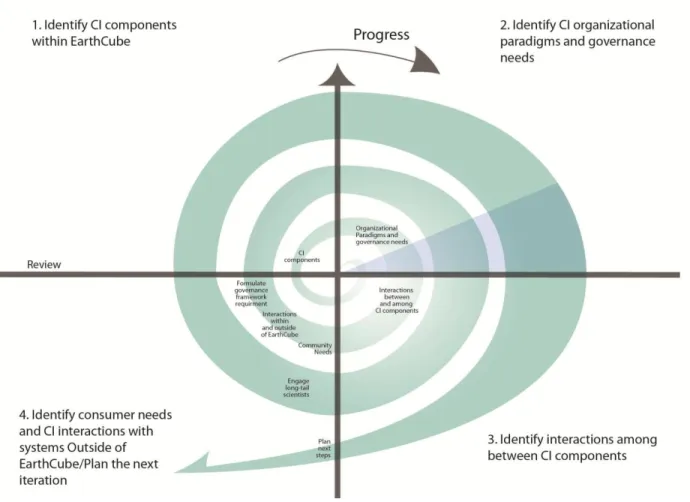
characterize the governance components of cyberinfrastructure. Community engagement is expected to occur in four steps (for a full description and graphic showing the progression of engagement see Roadmap Documentation Section 4: Requirements):
1. Identify cyberinfrastructure components of EarthCube.
2. Identify the cyberinfrastructure components’ organizational paradigms and governance needs.
3. Identify the interaction among and between cyberinfrastructure components and systems within EarthCube.
4. Identify the interactions between cyberinfrastructure components within and outside of EarthCube, and the needs of EarthCube consumers (including those composing the “long tail” of science).
The process of community engagement described above, in addition to extensive background governance research review (see Appendix 1), generated a list of initial requirements for EarthCube governance. EarthCube governance framework requirements identified thus far include:
1. Best practices and lessons learned 2. Barriers to participation 3. Collaboration 4. Communication 5. Community 6. Culture 7. Decision-making 8. Design
9. Education and outreach 10.Evaluation
11.Evolution
12.Goals and objectives
13.Governance as a system and multiple levels of governance
14.Integration and interoperability 15.Leadership 16.Legal issues 17.Metrics 18.Reproducible science 19.Risk Management 20.Scale 21.Sustainability 22.Temporal aspects 23.Trust 24.Vision
These requirements will be expanded upon and categorized in the Governance Framework to be presented to NSF and the EarthCube community by the end of August 2012 (Step 1 of the
Milestones and Tasks).
5.0 Status
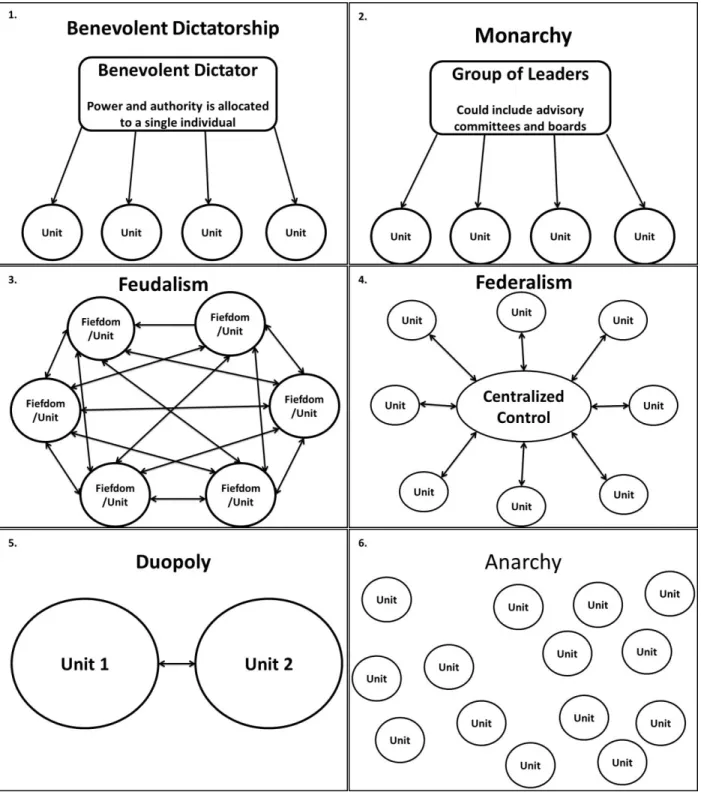
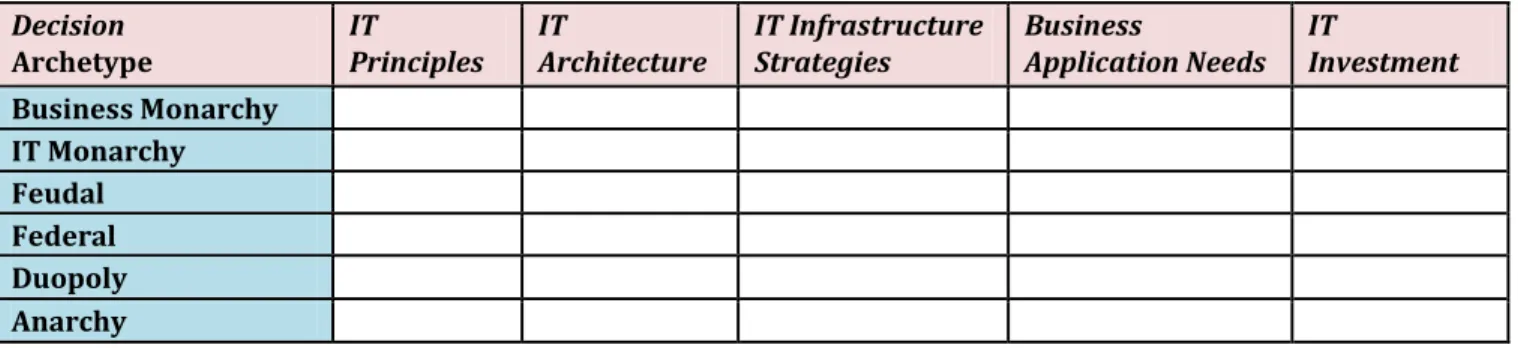
Drawing on the experience of IT governance, principally in the business environment but in other organizations, as many as seven different decision-making processes may be employed within an organization, ranging from monarchy to federal to anarchy (or crowdsourcing) and variations in between. Instead of a single monolithic model deployed across all elements, governance can be viewed as a system composed of many (potentially overlapping) models used as needed to generate information and make the types of decisions to ensure effective management and use of IT. It is necessary to resolve social, cultural, and organizational issues in tandem with IT services in order to create a strong and lasting infrastructure.
In addition, social science research identifies not only the options for governance but also the process for adoption and implementation of governance and organizational structure in the technical and scientific magisteria.
We also drew on research on the evolution of all infrastructures, which identify common characteristics across historical infrastructure development. Infrastructures start out with interplay among largely independent and even disparate elements that grow, link with other elements, and create and manage interactions among the components. Such is the current path for cyberinfrastructure.
6.0 Solutions
The objective of the EarthCube governance framework is to guide the development of
infrastructure that will become ubiquitous and effectively invisible to users. Thus, the currently preferred governance framework for distributed cyberinfrastructure like EarthCube is a system of systems approach, responsible for managing the dependent, independent, and interdependent components that form complex infrastructures such as EarthCube. In this way, different
governance models are employed to govern different aspects of the cyberinfrastructure. Thus, a single, one-size-fits-all governance model may not be appropriate for an entity as large and complex as EarthCube is envisioned to be. However, these concepts are designed to encourage critical thinking on governance at this point and the theory may change as more of the community is engaged
Of all the types of infrastructure we examined for this study, the Internet may be the closest analog to EarthCube. The Internet has no centralized governance in either technological implementation or policies for access and usage; each constituent network sets its own standards. There is no central control, administration, or management of the Internet, therefore it is misleading to use the term ‘Internet Governance’ when ‘The Internet’ is not a single entity to govern. Instead, several organizations work together in a relatively well structured and roughly democratic environment to collectively participate in the research, development, and management of the Internet. This is closer to how EarthCube is currently governed, but there is no agreement that this is the best or even a viable model for moving on to the next phase.
7.0 Process
Despite an intimidating list of challenges that we compiled, there is a growing realization that the initial roadmap is not required to solve all of them. In fact, the June 2012 NSF Charrette provided an ideal venue to address and try to resolve many of them in consultation with the other community and concept groups. We also have scheduled post-Charrette activities to revise the roadmap based on what was learned and discussed there. We envision a successor body to the Governance Work Group, generically named the Interim Governance Committee that will continue to handle these challenges as part of the implementation process. The Milestones and Tasks immediately following the Executive Summary describes in more detail the subsequent process and steps.
8.0 Timeline
We recommend a detailed timeline with action items and target dates:
1. August 31, 2012: Determine the Governance Framework to meet community needs and NSF goals for successful cyberinfrastructure.
2. August 31, 2012: Determine the stakeholder community and identify initial governance committee for engaging the community for input on the governance framework developed in Step 1.
3. Date TBD: Establish Terms of Reference for EarthCube Governance.
4. Date TBD: Implement the suggested EarthCube Governance Terms of Reference.
9.0 Management
Governance roadmap implementation begins with the formation of an Interim Governance Committee to determine the initial EarthCube stakeholder community, analyze potential governance models, and develop a framework for governance. It is important to examine the potential roles and responsibilities, support processes, decision-making processes, and contribution processes that may compose EarthCube governance.
10.0 Risks
Risks regarding the rapid development of a roadmap for EarthCube governance include: 1) radical departure from the traditional NSF process, 2) group think and limiting perceptions of the
Governance Steering Committee members, 3) inability to decide upon the scope and structure of the governance process, and 4) short-term thinking and development of a short-term governance framework.
Risks in meeting EarthCube goals include: 1) a lack of past examples and lessons learned, 2) lack of contingency plans, 3) interweaving architectures, 4) tyranny of the major players over the small or distributed users, 5) development of a governance approach that proves unwieldy or ineffective, and 6) sustainability and evolution of governance. Additional risks include 1) uncertainty of institutional commitment and support, 2) commitment of the potential user community, and 3) risks identified by other EarthCube roadmaps.
MILESTONES AND TASKS
Goal: To provide a roadmap such that an optimal implementation – agnostic governance framework can be put in place to meet the community needs and achieve the goals of EarthCube.
Step 1:Determine the appropriate Governance Framework to meet community needs and NSF goals for successful cyberinfrastructure
TIME: begin with Charrette, complete by August 31, 2012
DELIVERABLE: Document reporting findings and decisions leading to selection of Initial
Governance Framework
1. What Governance models may be best suited for EarthCube? a. How will competitive solicitations be enabled, if required? b. How will decisions be made?
c. How will the governance framework be held accountable? d. What are the relationships of governance elements to NSF?
2. What are the scopes of authority of governance within and among elements of EarthCube? a. Who is in charge of creating and updating EarthCube milestones and determining
how they will be achieved? [Key Question for Charrette]
b. A governance system provides overall steering and oversight for i. Leadership
ii. Adjudication
iii. Policy development (Science Priorities) iv. Intellectual property right protections
v. Data publishing & data citation vi. Model publishing & model citation vii. Other use cases
viii. Sustainability
c. Spending authority, pass-through funding coordination d. Operations
e. Outreach and communications f. Proactive coordination
g. Architecture maintenance and systems integration support (Technical Priorities) i. Standards selection processes supported by:
1. Prototyping and risk reduction 2. Testbeds
ii. Life-cycle data management 1. Certification of roles iii. Security architecture
1. Authentication 2. Identity Management 3. Single sign-on
4. Threat Mitigation
5. Policy decision and enforcement iv. Registry Management
3. How will the community be involved?
a. Management and organization - within each community-driven governance element, there could be
i. Board of Directors
ii. Advisory Committee structure iii. Science Advisory Committee iv. Technical Advisory Committee
v. Program Committees (e.g., Finance, Nominations, Policy, etc.) vi. Functional Committees (e.g., Workflow, Data Management, etc.) vii. Identification of desired communities of practice. (E.g. Community of
practice for outreach and education about current standards, conventions, and best practices for data models, model frameworks, and software
engineering. This would be cross-cutting among all science domains, and use social networking tools and outreach.)
b. End-user engagement & community ownership i. Decision and policy makers
ii. Existing data centers iii. Long-tail scientists
4. How will EarthCube governance functions be supported? Any or all of the following methods?
a. Grants and Contracts Funded b. Volunteer
c. Membership Fees
d. Public/Private Partnerships e. International Initiatives f. Provision of Services
5. How will the EarthCube Governance structure manage its own evolution? a. What processes are there to recognize new needs as they emerge? b. Governance structure should be dynamic
Step 2: Determine the stakeholder community and identify initial governance committee for engaging the community for input on the governance framework developed in Step 1.
TIME: begin with Charrette, complete engagement plan by August 31, 2012, complete initial engagement by beginning of 2013
DELIVERABLE: Document reporting findings and decisions, identifying who is involved
1. Much of this is being done through the current EarthCube community building process that NSF has initiated
a. Coordination with NSF Concept Awards and Working Groups
b. Coordination with Focus Groups (e.g. Industry, International, Federal Agencies, Education, etc.)
2. Identify an initial representative group to act for the larger community (EarthCube Governance Committee) to implement the Roadmap
b. What communities need representation? c. What role does NSF play in this?
d. Determine how this initial group is selected.
e. Identify linkages to other existing NSF cyberinfrastructure facilities f. Leadership -
i. Who is in charge of making decisions? ii. What decisions need to be made?
iii. Does the individual/group in charge of making decisions change depending on what type of decision is being made?
iv. Who has the authority to resolve disputes?
v. What mechanisms are in place to allow for new leadership to emerge if/when necessary?
3. Craft a community engagement program to gather EarthCube governance requirements and vet the initial Governance Framework developed in Step 1
a. Gather requirements for the earthcube.org website
b. Engage the geosciences, atmosphere, and ocean communities c. Engage the computer science, IT and software communities d. Map the EarthCube stakeholder community
e. Develop materials to market EarthCube to potential new users f. Hold webinars for target communities of practice
g. Engage existing EarthCube Working Groups and Concept Teams h. Publish EarthCube articles in trade journals
i. Engage domain and IT communities through a stakeholder survey j. Engage the community through social media
k. Attend conferences of opportunity, such as ESIP and AGU, to engage potential EarthCube stakeholders
l. Employ public listservs, wikis, and the EarthCube Ning site to communicate with EarthCube stakeholders and provide an additional forum for community input
Step 3: Establish Terms of Reference for EarthCube Governance TIME: Date To-Be-Determined
DELIVERABLE: Initial Terms of Reference for EC Governance Entity that covers the
following items
1. EarthCube Governance Committee tasked with drafting an EarthCube Governance Terms of Reference and other documentation that define and codify the Governance characteristics agreed to in the previous steps. This will include but is not limited to:
a. A process for creating a permanent EarthCube Governance Framework b. Decision making structure and leadership
c. Determination of issues regarding membership, representation, voting, planning d. Address issues of evolving EarthCube goals
i. Who is in charge of creating and updating EarthCube goals? [Key Question for Charrette]
ii. How does this relate to governance framework? e. A transition plan from initial to permanent framework
f. Participation policy - what does it mean to be a participating EarthCube community member, developer, contributor, etc.?
g. Process to gather and integrate feedback on proposed EarthCube governance structure from broader community
2. Revise proposed EarthCube Terms of Reference based on feedback
3. Finalize EarthCube Terms of Reference and seek approval of the EarthCube community
Step 4: Implement the suggested EarthCube Governance Terms of Reference TIME: Date To-Be-Determined
DELIVERABLE: Document reporting decisions; workshop series
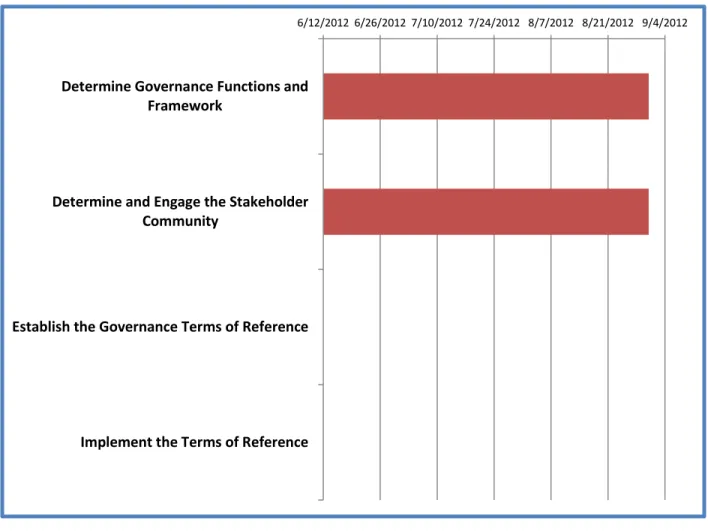
GANTT CHART
FIGURE 1: GANTT CHART FOR IMPLEMENTATION OF EARTHCUBE GOVERNANCE MILESTONES AND TASKS.
6/12/2012 6/26/2012 7/10/2012 7/24/2012 8/7/2012 8/21/2012 9/4/2012
Determine Governance Functions and Framework
Determine and Engage the Stakeholder Community
Establish the Governance Terms of Reference
ROADMAP DOCUMENTATION
The section provides further insight into the recommendations made in the actionable roadmap introduced in the previous section. We use the NSF Roadmap Guidance, or 10 points, to outline our research findings.
1.0 PURPOSE
1.1 INTRODUCTION
“All parties—scientists, societies, and funders—must play a role in creating governance around controlled vocabularies, taxonomies, and ontologies that can be used in scientific applications to ensure the currency and evolution of knowledge encoded in semantics”4
“To state it baldly, the paradigm that needs destruction is the idea that we as scientists exist as un-networked individuals”5
“Funding agencies must increasingly target the building of communities of practice, with emphasis on the types of interdisciplinary teams of researchers and practitioners that are needed to advance and sustain semantic eScience efforts”6
“We increasingly need to embrace e-Research techniques and use the internet not only to access nationally distributed datasets, instruments and compute infrastructure, but also to build online, ‘virtual’ communities of globally dispersed researchers."7
“The alignment of science supply and demand in the context of continuing scientific uncertainty will depend on seeking out new relationships, overcoming language and cultural barriers to enable collaboration, and merging models and data to evaluate scenarios.… Capturing the important elements of data preservation, collaboration, provenance, and accountability will require new approaches in the highly distributed, data-intensive research community.8
"Communities of Practice are groups of people who share a concern, a set of problems, or a passion about a topic, and who deepen their knowledge and expertise in this area by interacting on an ongoing basis"9
4 Peter Fox and James Hendler, “Semantic Escience: Encoding Meaning in Next Generation Digitally-Enhance Science,” in
The Fourth Paradigm, ed. Tony Hey, Steward Tansley, and Kristin Tolle (Redmond, WA: Microsoft Research, 2009), 147-152.
5 John Wilbanks, “I Have Seen the Paradigm Shift, and It Is Us.” ,” in The Fourth Paradigm, ed, Tony Hey Steward Tansley,
and Kristin Tolle (Redmond, WA: Microsoft Research, 2009), 209-214.
6Fox & Hendler, “Semantic Escience,” 147-152.
7“Earth Sciences and Beyond…Why Build an Integrative Earth Science e-Research Infrastructure?” AuScope GRID, last
modified August 2, 2011, http://www.auscope.org.au/site/grid.php.
8Mark Abott, “A New Path for Science?” in The Fourth Paradigm, ed. Tony Hey, Stewart Tansley, and Kristin Tolle
(Redmond, Washington: Microsoft Research, 2009), 114-116.
9Etienne Wenger, Richard McDermott, and William Snyder, Cultivating Communities of Practice, (Boston, MA: Harvard
The overarching goals of EarthCube are to build a unified, adaptive, and scalable
cyberinfrastructure for enabling transformative advances in geosciences research and education and realizing the vision articulated in the NSF Geo Vision report.10 In the process, EarthCube aims to create a knowledge management system and infrastructure that integrates all Earth system and human dimensions data in an open, transparent, and inclusive manner.
A specific goal of EarthCube is to seek agreement and initiate an ongoing process for the entire geoscience community and its stakeholders through coordinated approaches to
cyberinfrastructure, which is the very definition of sustainable cyberinfrastructure. With enhanced access to large, federated data and service networks, and the broader geoscience community, including academia and the private sector, scientists may use the synoptic data resources efficiently and integrate them with their own data and research.
The meshing of the domain sciences and the IT communities is fundamental to the success of the EarthCube vision. This integration is also emblematic of the underlying duality of science and infrastructure. The former depends on a culture of experimentation, flexibility, rapid change, and innovation, or in effect, a certain amount of anarchy. The latter requires continuity, certainty, and deliberative processes for incorporating change and cost effectiveness, and is inherently more centralized. The infrastructure should be largely transparent to the users of the system, but the coordination of the two environments is critical. Thus, the governance of scientific
cyberinfrastructure requires mechanisms to identify and manage synergy and autonomy among its disparate components.
The project of building a user-driven framework that addresses the computational, data, software, knowledge management, and user service needs of the diverse earth system science community is enormous. However, the biggest challenges in past infrastructure development have been
sociological and organizational rather than technical.11 Therefore EarthCube's governance must recognize and address the need to bridge cultural differences between disparate disciplines and developers, as well as user communities, bringing all stakeholders together to create system-wide solutions to community problems.12
Keeping this in mind, we believe that there is general agreement that “effective governance for EarthCube will:
“Actively engage its diverse users
Provide leadership and oversight to forge close cooperation, coordination, and
collaboration among distributed development activities and the principal EarthCube groups Facilitate alignment of funding program plans and priorities with the needs of the
community
Help the successful execution of the EarthCube mission, meeting stakeholder obligations”13
10National Science Foundation, Advisory Committee for Geosciences, “GEO Vision Report.” 11 Edwards et al., “Understanding Infrastructure.”
12Mohan Ramamurthy, “Unidata Governance.” 13Mohan Ramamurthy, “Unidata Governance,” 1.
We recognize that there exist models and implementations of governance within the scientific cyberinfrastructure arena, notably, the governance structures for Open Geospatial Consortium (OGC), TeraGrid, Open Grid Forum, Earth Science Information Partners (ESIP) Federation, CUAHSI-HIS, IRIS, Unidata, GENI, and SURAGrid, among many others. We also recognize that there are governance models for more complex systems system, such as the U.S. electric grid and the internet, that provide useful examples of how infrastructure, and cyberinfrastructure, can be governed. All of these models may provide useful insights regarding the development of an optimal governance for EarthCube.
1.2 BACKGROUND AND HISTORY
Cyberinfrastructure is being built by individuals, teams, groups, and communities. One example of this is the November 2011 NSF EarthCube Charrette, which demonstrated pervasive agreement on the basic attributes of EarthCube, and the need to coordinate the diverse array of activities already underway in the geosciences, related domain sciences, and information technology arenas.
There are a number of workshops and reports over the past decade that serve as references for the Governance roadmap process. Summaries of these reports are included in Appendix 1: Research Review.
1.3 WHAT IS MEANT BY “GOVERNANCE” AND WHY DO WE NEED IT?
Governance means different things to different groups. EarthCube governance must take all of these definitions into account.
Governance Definitions
Those involved in standards and procedures view it as a way to define relationships between system partners, agreements, contracts and enforcement mechanisms, determine lifecycle
management of system components (data, services, catalogs, identifiers, vocabularies, application clients, etc.), specify authority, performance expectations, and risk management strategies, enabling cross-disciplinary and cross-jurisdictional research designs, and formulation of policies needed to orchestrate consensus-building and regulate potential conflicts at the boundaries of subsystems.14 The EarthSystem Commodity Governance Project defines governance as “align[ing] an
organization’s practices and procedures with its goals, purposes, and values. Definitions vary, but in general governance involves overseeing, steering, and articulating organizational norms and
processes (as opposed to managerial activities such as detailed planning and allocation of effort). Styles of governance range from authoritarian to communalist to anarchical, each with advantages and drawbacks.”15
14Ilya Zaslavsky, Mark Williams, Anthony Aufdenkampe, Kerstin Lehnert, Emilio Mayorga, and Jeff Horsburgh, “Data
Infrastructure for the Critical Zone Observatories (CZOData): an EarthCube Design Prototype,” (National Science Foundation EarthCube White Paper: Designs Category), 2011.
15 “Governance,” EarthSystem Commodity Governance Project, last modified 2012,
Massachusetts Institute of Technology Sloan School of Management and Center for Information Systems Research (CISR) senior research scientist Peter Weill and director Jeanne Ross define IT governance as, “Specifying the decision rights and accountability framework to encourage desirable behavior in using IT. IT governance is not about making specific IT decisions−management does that−but rather determines who systematically makes and contributes to those decisions.”16 The Organization for Economic Cooperation and Development (OECD) defines governance as, “Providing the structure for determining organizational objectives and monitoring performance to ensure that objectives are attained.”17
In open source software projects, the “governance model describes the roles that project participants can take on and the process for decision making within the project. In addition, it describes the ground rules for participation in the project and the processes for communicating and sharing within the project team and community.”18
Additionally, the recent United States Geoscience Information Network (USGIN) strategic plan noted the need for governance to include education, outreach, communication, and marketing to other participants, funders, users, and students, as well as sustainability.19 We believe these components of governance should also be included in EarthCube.
Governance Implementation
Governance of IT components in larger organizations draw from the business environment,20 in which different governance models are applied for different functions. The choice of which model to apply for which decision area depends on the organization’s strategies, structure, and goals. There is no single matrix that works, or works best, for all groups or even for similar groups. Each decision process may be best enabled by a distinct governance model within a larger governance system or there may be a number of archetypes that work for a decision-making process but which may be chosen for cultural, social, or historical reasons.
Thus, to be effective, the governance of EarthCube that the community adopts is likely to be for a
system of governance (a matrix of mechanisms for different elements and groups) that accommodates different practices and requirements among different elements of a large and diverse community. The governance roadmap also allows for a variety of mechanisms to determine how the governance framework for EarthCube is chosen and implemented.
16 Peter Weill and Jeanne Ross, IT Governance: How Top Performers Manage IT Decision Rights for Superior Results,
(Boston, MA: Harvard Business School Press, 2004), 2.
17 Organization for Economic Cooperation and Development, Directorate for Financial, Fiscal and Enterprise Affairs, OECD
Principles of Corporate Governance, (April 1999), 5, 219, quoted in Weill and Ross, IT Governance, 4-5
18 Ross Gardler and Gabriel Hanganu, “Governance Models,” Open Source Software Watch, last modified February 14,
2012, http://www.oss-watch.ac.uk/resources/governanceModels.xml.
19Stephen Richard and Vivian Hutchison, “Recommendations for the Future of the U.S. Geoscience Information Network,”
(Arizona Geological Survey, 2011), 11p.
A short summary of governance definitions, archetypes/models, components of effective
governance, and lessons learned from past cyberinfrastructure projects is presented in Section 5.0 Status, and an expanded version may be found in Appendix 1: Research Review.
1.4 COMMUNITIES TO BE SERVED
The communities to be served by EarthCube governance include the current EarthCube participants as well as all organizations currently under the NSF Geosciences Directorate (Atmospheric and Geospace Sciences, Earth Sciences, and Ocean Sciences) and Office of Cyberinfrastructure. However, EarthCube governance must reach beyond these current participants, accommodating those currently involved in the ‘long-tail’ of science or data
integration as well as those involved in like-minded (or data intensive) communities external to NSF, including Federal Agencies, such as NASA, NOAA, and the Department of Defense; State Agencies; or academic communities. Similarly the EarthCube framework must include large-scale national data initiatives such as the White House’s BIGDATA and Open Data initiatives. Finally, in order to be all-inclusive, EarthCube governance must consider the role of industry participants as well as international organizations, students and policy makers.
1.5 IMPROVED CAPABILITIES DUE TO GOVERNANCE OUTCOMES
“… Governance can be messy. Governance fosters debate, negotiation, constructive disagreement, mutual education, and often frustration. The process is messy, but good governance arrangements enable individuals representing an enterprise’s conflicting goals to reconcile their views to the enterprise’s benefit.”21
Effective governance offers any number of improved capabilities, including but not limited to: Improving communication
Promoting collaboration
Helping to create and maintain overall goals
Ensuring daily practices are aligned towards overall goals Anticipating and mitigating risk
Providing mechanisms to respond to changing community needs and emerging technologies Evolving as to adapt to emerging needs and technologies
Defining roles and responsibilities
Defining leadership positions and how these positions may be filled Reconciling conflicts and arbitrating disputes
Defining clear processes for making decisions
By providing a framework that promotes communication, facilitation and collaboration, outcomes of the EarthCube Governance Roadmap activities should include moving the emerging field of geoinformatics forward; thus, exhibiting the positive implications of EarthCube to the broader community of researchers, educators and engineers. Huge effort has been expended developing
data resources and applications across all the domain sciences, but these have typically been developed in stand-alone project environments and all too often disappear when project funding ends. Thus an important component of EarthCube governance will be to incorporate best practices and lessons learned from past projects, thereby anticipating and mitigating past problems, and benefiting the geoscience community as whole by helping to create a more cohesive and sustainable community-based infrastructure.
The geoscience community will also benefit from a more persistent and standardized framework for implementing and deploying such services, such that information tools and data can be migrated from development environments to maintenance environments when projects are complete. Evolution of standards and the knowledge base for their application and extension in practice to make interoperable, loosely coupled, and transportable data and applications will be fostered by the community.
2.0 COMMUNICATION
2.1 COMMUNICATION TO-DATE
Communication and feedback from across the EarthCube stakeholder community were critical in the evolution of this roadmap and supporting documentation. We upheld a commitment to open and transparent processes from the very beginning. Using the EarthCube Ning site, we advertised all meetings, events, and webinars indicating that they were open to public attendance and
participation. We provided virtual capabilities for each of the events and recorded each of the face-to-face meetings, plenary sessions, and breakout sessions with allied fields and agencies, placing them on the EarthCube Vimeo site. We also employed a public listserv to communicate within the Governance Steering Committee.
We formed a Governance Forum, composed of individuals and organizations forming a larger, broader constituency that had demonstrated their interest and participation in governance issues, and a representative from each of the EarthCube Community Groups and Concept Award Teams. The latter served as liaisons between the more technically focused groups and the Governance Working Group to help ensure unique governance issues and needs from each segment of
EarthCube were identified and addressed. One of the goals of organizing the Forum was to ensure representation from each of the Geoscience and closely related domains (e.g. Earth, Atmospheres, Ocean, Environment and Ecology), IT sectors, academia, agencies, and industry, involved in determining agendas, setting goals, and having an active role in formulating the roadmap. We communicated with Forum members via an additional public listserv.
Community feedback was collected through the EarthCube Ning site and through email contact, although a series of virtual meetings and workshops hosted by the Governance Steering Committee formed the backbone of community input gathered thus far. The virtual workshops were held with different working groups and stakeholders, covering a range of topics, and began to tackle the complexity, scope, and diversity of issues regarding governance of EarthCube. These workshops were exceptional in providing the initial community feedback and basis required to author the Governance Roadmap.
A complete and detailed collection of community feedback and input, in addition to a list of meetings and EarthCube liaisons, is contained in Appendix 4. Below we summarize the input that we have received through June 7, 2012.
2.2 END-USER RESOURCE RECOMMENDATIONS
Community input and feedback on governance produced a number of important and complex questions that EarthCube governance should consider. Community feedback provided us with a list of recommended resources for review, as well as topical issues such as barriers to participation,
Recommended Resources
The Art of the Community, by Jono Bacon22
Double Loop Organizations Reference List, accessed at:
http://cybersocialstructure.org/2012/04/23/double-loop-governance-references/23
Workforce (Education, Outreach and Training; Underrepresented Populations), accessed at http://www.nsf.gov/od/oci/taskforces/TaskForceReport_Learning.pdf24
EarthCube as a Double Loop Organization, accessed at:
http://cybersocialstructure.org/2012/04/04/earth-cube-as-a-double-loop-organization/25
Information Technology Standardization: Theory, Process & Organizations by C. Cargill (1989)26
Emergence: The connected lives of ants, brains, cities, and software by S. Johnson, 200227
Workshop on Working towards a National Geoinformatics Community (NGC) USGS Denver Federal Center, Denver, Colorado, September 23-24, 201028
USGIN Strategic Plan 201129
Global Environment for Networking Innovations (GENI): Establishing the GENI Project Office (GPO) (GENI/GPO)Program Solicitation, NSF 06-60130
Community Recommendations from Steering Committee Calls, Plenary Sessions and Focus Groups
“Designing a Digital Future: Federally Funded Research and Development Networking and Information Technology,” President’s Council of Advisors on Science and Technology (PCAST) Report
Earth and Space Science Informatics 2008 Summit “Understanding Infrastructure” by Edwards, et.al.
NSF EarthCube White Papers: Designs Category (25 papers, submitted October 2011) NSF Reports on Virtual Organizations31
Open Source Software (OSS) Watch (multiple publications)
22 Bruce Caron, EarthCube Governance Group Forum Discussion Post, May 2, 2012,
http://earthcube.ning.com/group/governance/forum/topics/research-review-it-governance-how-top-performers-manage-it.
23 Ibid.
24 Geoffrey Fox, EarthCube Governance Group Forum Discussion Post, April 27, 2012,
http://earthcube.ning.com/group/governance/forum/topics/call-for-focus-group-participation .
25 Bruce Caron, EarthCube Governance Group Forum Discussion Post, April 4, 2012,
http://earthcube.ning.com/group/governance/forum/topics/earth-cube-as-a-double-loop-organization .
26 David Arctur, EarthCube Governance Group Forum Discussion Post, March 30, 2012,
http://earthcube.ning.com/group/governance/forum/topics/initial-earthcube-governance-references-and-works-cited-list.
27 Ibid.
28 Steve Richard, EarthCube Governance Group Forum Discussion Post, February 28, 2012,
http://earthcube.ning.com/group/governance/forum/topics/national-geoinfomatics-community-report
29 Steve Richard, EarthCube Governance Group Forum Discussion Post, February 28, 2012,
http://earthcube.ning.com/group/governance/forum/topics/usgin-strategic-plan-2011.
30 Recommended by Carroll Hood, Focus Group Webinar, “Engaging Industry Partners on Governance,” May 31, 2012. 31 Sayeed Choudhury, community discussion comment, “EarthCube Governance Virtual Plenary Session, April 17, 2012
2.3 COMMUNITY DRIVEN ISSUES AND OPPORTUNITIES
Potential EarthCube stakeholders had several recommendations for EarthCube governance. Some of these recommendations are direct quotes; others are paraphrased.
Barriers: When asked about the existence of potential barriers to participation, one individual replied, “Instead of barriers, there are opportunities to promote interoperability mechanisms.”32 “The principal barrier to participation in EarthCube is that the domain groups (including CUAHSI) continue to have a primary allegiance to specific domains. I am concerned that EarthCube could compromise the primary missions of the domain-specific groups, by siphoning resources away from serving the needs of domain users.”33
Case Studies: EarthCube should “[Generalize] from specific success stories to develop new general-purpose services.”34
One individual presentedtheiRODS data grid governance was presented as a short governance case study. Governance is accomplished through a series of components:35
1. “[Mechanisms to determine the] purpose of collaboration (shared collection, shared research initiative)
2. Properties that the collaboration environment will maintain (completeness, integrity, standards, access)
3. Policies that enforce the desired properties (computer actionable rules)
4. Procedures that derive the desired properties (computer executable workflows) 5. State information that tracks results of applying procedures
6. Assessment criteria that verify desired properties have been enforced”
Communication: It is important to consider the role of communication at EarthCube36. In
particular, a communication plan should be part of the roadmap and be set in place before the June 2012 Charrette.37
Community: “There are multiple user communities: Researchers in national scale projects, Researchers in the “long tail” of science, and Students. They all face the same challenges with quantifying context for research data and research results. There is generic infrastructure that enables each community to provide the needed context. One can build either a Student digital library, or a project data management system, or a collaboration environment with a policy-based data management system. The policies and procedures may be different in each environment, but the underlying data, information, and knowledge virtualization mechanisms are the same.”38
32 Reagan Moore, personal email, May 25, 2012. 33 Alva Couch, personal email, May 29, 2012. 34 Ibid.
35 Reagan Moore, May 25, 2012.
36 William Michener, community discussion comment, “EarthCube Governance Virtual Plenary Session,” April 17, 2012. 37 Erin Robinson, personal email, June 2, 2012.
“I am assuming that the two governance groups… are representative committees of the community, perhaps elected by the community.”39
Culture and Global Engagement: A member of the international community recommended: “If EarthCube will be expanding to include significant global collaboration, all governance aspects should consider cultural impacts. For instance, if a particular governance area were to adopt the meritocracy governance archetype, due consideration should be given to culturally induced ‘silent/unseen work ethic.’”40
Community-Based Collection Cycle: “Instead of a data life cycle, the focus is on a community-based collection life cycle. A collection defines the context for research data. Within a research project, the context may be minimal, since the members of the research team have tacit knowledge on how the data were generated, what processes were applied, and the properties of the individual files such as naming convention. When the user community is broadened, say through a data grid that enables other research teams to collaborate on analysis of the data, the tacit knowledge must be made explicit. This requires transition from governance policies for a research collection to governance policies for a data grid (shared collection). The tacit semantics, data formats, and processing algorithms now need to be defined for use by the additional research team. When the collection is made public for use by the entire discipline, the user community broadens again. Now expectations for the collection context must be mapped to the community consensus on semantics, descriptive metadata, and data formats. When the collection is preserved in a reference collection, the user community broadens again to include future researchers. The context must now include the information and knowledge that defined the original research question, the governance that controlled the approach to solving the research question, and the metrics for success. Within a community-based collection life cycle, the governance policies evolve to track the consensus of each broader user community. This is a direct measure of the NSF mandate to track broadened impact of research results.”41
Decision-Making: “I strongly urge a consensus-based model. However the consensus is relative to the community that is exploring a research topic.” 42
“Assertions about the community consensus are turned into properties that each object in a collection should possess. Policies are defined to ensure the desired properties are enforced. The policies are cast as computer actionable rules that control the execution of procedures. The
procedures are created by chaining computer executable functions (micro-services) into workflows that are executed at remote storage locations. Each consensus is then characterized by a set of policies and procedures. Each user community may choose to enforce a different set of policies and procedures. There is no single set of Technical governance policies. However there is a policy-based framework that enables each community to apply their specific policies.”43
39 Alva Couch, May 29, 2012.
40 Shahani Weerawarana, personal email, May 30, 2012. 41 Reagan Moore, May 25, 2012.
42 Ibid.
In CUAHSI, “Decision [-making] structures are organized around general policies, software policies, and user priorities, respectively. This works well.”44
Education and Outreach: Education and outreach should be important part of EarthCube, and particular focus should be on the scientific community. There should be a virtual focus group on the involvement of the scientific community and how to do better outreach.45
Evolution of organization: Most organizations start simply. Use cases are beneficial as a means to define scope and simplify the governance process.46
Funding: Recommendations include examining the number of paid staff vs. volunteer labor,47 and reviewing funding mechanisms of various organizations to study best practices and lessons learned.48
Goals: EarthCube goals need to be holistic and be focused on much more than just IT issues. A focus on the Grand Challenges research should answer the question “What are we trying to govern?”49
Integration and Engagement: Effective governance has an integrative function, and
cyberinfrastructure must be a means to better research and science, rather than an end itself. Past NSF activities have demonstrated that someone or something must fulfill a systems integration role to make the parts fit together. Thus, cyberinfrastructure needs to be built with an engineering framework. An example of a governance framework with an integrative function is project GENI [Global Environment for Network Innovations].50
Governance issues are associated with large and small science,51 thus an important question is: How do we integrate with organizations or communities that already have governance structures? (like NASA, for example).52 A recommendation is to research the strategies that have lasted the longest and have obtained the most results, i.e. the strategies that have made data the easiest to access, use, and maintain.53
Interoperability: Model interoperability and data interoperability are two different things.54 Both present huge challenges in a complex system like EarthCube, and use cases would be beneficial to understanding these issues.
44 Alva Couch, May 29, 2012.
45 Kerstin Lehnert, community discussion comment, “EarthCube Governance Virtual Plenary Session,” April 11, 2012. 46 William Michener, April 17, 2012.
47 Andrew Maffei, community discussion comment, “EarthCube Governance Virtual Plenary Session,” April 17, 2012. 48 Anonymous, recommendation from Focus Group Webinar, “Engaging Government Agency Partners on Governance,”
May 31, 2012
49 Carroll Hood, community discussion comment, Focus Group Webinar, “Engaging Industry Partners on Governance,”
May 31, 2012.
50 Carroll Hood, May 31, 2012.
51Robert Chen, community discussion comment, “EarthCube Governance Virtual Plenary Session,” April 17, 2012. 52 Ibid.
53 Anonymous, May 31, 2012.
A recommendation is to create an index for the groups that are trying to promote interoperability, with a focus on design-infrastructure, catalogs, trackers, schemas, etc. 55
“EarthCube needs mechanisms for technology to interoperate (virtualization mechanisms).”56 “The target for governance needs to be on interoperability. What strategies promote
interoperability? What standards will enable improved interoperability? What extensibility
mechanisms are needed to enable interoperability at the process level, the metadata level, the data level, and the user level? One way to characterize interoperability is through identification of name spaces for objects that are being shared, the identification of the operations that are performed upon each name space, and the virtualization mechanisms that are needed to ensure the operations can be performed across existing community resources. Within the DFC, the name spaces that are managed include users, data, collections, storage resources, state information (metadata), policies, and procedures. The document “Introduction to Layered Architecture” lists the associated
operations and virtualization mechanisms.”57
IT issues: Do vocabularies and ontologies fall into ‘soft’ ware, or are they separate?58 A focus group on software should study governance requirements for software tools.59
Leadership:There needs to be defined leadership in EarthCube. The concern that group thinking will yield “impossibly jumbled” criteria is greater than making sure every single person is included in the decision-making process. There needs to be a way to define focus in terms of goals and leadership, and the organization should be strong enough to say no. 60
Legal Aspects: “There are legal overtones to many governance activities. Consider something as simple as an EarthCube participant collaborating via a mailing list. What are the IP rights that are applicable on each communication? What are the legal strictures that apply to participants in community groups and project teams? What are the legalities present in policies and procedures? How can the governance framework ensure that international trade laws or global IP rights are not violated in the process of collaboration among global EarthCube members?”61
“So a governance roadmap should highlight the importance of providing legal guidelines. Most EarthCube participants would be completely unaware of legal aspects and it is up to the Governance framework to protect them, their community, and EarthCube as an entity.”62
Levels of Governance: There are multiple levels of governance.63 Governance is necessary in many areas, but it is also necessary at different levels, that is, at the community level, project level, and
55 Ibid.
56 Reagan Moore, May 25, 2012. 57 Ibid.
58 Andrew Maffei, April 17, 2012.
59 Ilya Zaslavksy, community discussion comment, “EarthCube Governance Virtual Plenary Session,” April 11, 2012. 60 David Fulker, community discussion comment, “EarthCube Governance Virtual Plenary Session,” April 11, 2012. 61 Shahani Weerawarana, personal email, June 1, 2012
62 Shahani Weerawarana, personal email, June 1, 2012
63 Sayeed Choudhury, April 17, 2012; Reagan Moore , May 25, 2012, and Shahani Weerawarana, community discussion
team level, etc.64 Thus “Each governance area requires specialized mechanisms/infrastructure/policies etc.”65
“There are multiple levels of governance. The entire discipline may select the next 10-year research challenges. National scale projects may implement the required infrastructure to collect data, implement solution methods, and make the capabilities available to the discipline. Researchers within the “long-tail” may compare local information with the national initiative results and refine, explore, develop extended result sets. Students may participate in research initiatives under appropriate policy controls. The governance for each of these communities is different.”66
Metrics: “Governance metrics that are not quantifiable are not needed. For Technical governance, it should be possible to verify each desired property of a collection. For each governance policy, there should be an associated validation policy.”67
Reproducible Science: “Governance should ensure reproducible science. At a minimum, the information and knowledge required to reproduce a research result has to be provided for each research project. Governance is the process to make this feasible through provision of the necessary infrastructure. If a project is funded, infrastructure must either be provided or developed to enable others to check the result.”68
“Each research community makes assertions about their research results. A research community should be able to verify each assertion. Governance needs to ensure each community has the infrastructure to validate their own assertions.”69
Risk Management: 70“All communication/collaboration plans that are specified in the EarthCube Governance Framework should include explicitly defined "escalation paths." “Many communication and collaboration plans are very detailed regarding regular activities that should happen. However, many forget to specify the escalation path when things go wrong! How can any member of the community create an "alert" to enable timely attention on a brewing risk? Who/What is responsible for following up on each alert. What is the escalation path that leads out of or beyond the immediate communication/collaboration group boundaries?” 71 “This would also be part of the overall risk mitigation plan in a governance framework.”72
Scale: Governance scales by two things: 1) Money; and 2) Size of organization and size of partners.73 “There are multiple national scale data cyberinfrastructure projects, each with a different set of challenges. For instance, the OOI manages real-time sensor data. The National Climatic Data Center [NCDC] manages climate data records. The two systems need to interoperate
64 Sayeed Choudhury, April 17, 2012, and Shahani Weerawarana, community discussion comment, Focus Group Webinar,
May 30, 2012.
65 Shahani Weerawarana, May 30, 2012 66 Reagan Moore, May 25, 2012. 67 Ibid.
68 Ibid. 69 Ibid.
70 Shahani Weerawarana, May 30, 2012 71 Shahani Weerawarana, June 1, 2012. 72 Ibid.
to enable deposition of OOI climate data records into NCDC. The two systems, however, are based on different infrastructure.”74
Operational/Managerial, Scientific and Technical Governance: Many individuals and liaisons to other EarthCube Working Groups and Concept teams identified differences between
operational/managerial, scientific and technical governance. Some of their responses are included below.
Operational/Managerial Governance
The Governance “Roadmap may need to include the process of identifying governance areas relevant to EarthCube and the specific governance aspects of each area…“There should be clear differentiation of strategic vs. operational governance structures. The operational structures would necessarily have a greater monitoring & management flavor, whereas the strategic structures would be more focused on guidance and decision-making.”75
“There are at least two types of governance: Managerial and Technical. Managerial governance defines the policies for interactions between funding agencies and communities of practice that implement standards and technologies.”76
…. For Managerial governance we need mechanisms to ensure sustainability of the infrastructure. This includes evolution of the infrastructure to incorporate new technologies, new approaches towards quantification of knowledge, and new approaches for governance.” 77
Scientific and Technical Governance
“This distinction [scientific vs. technical governance] is important and should be part of EC governance. It is particularly critical since much of EC technology development will be distributed and will involve federated activities. However, I do think that there needs to be a single overarching entity like the Board of Directors or some other committee that will steer the entire EC effort. Our experience in Unidata is consistent with that. We have a Policy Committee for overall policy decisions and governance, a User’s Committee for community engagement and working with our scientific users and educators, and technical advisory committees for our software projects.”78
“[Scientific vs. Technical governance is] a useful separation of tasks. For example, attention to SOA [Service-Oriented Architecture], software engineering practices, and data exchange standards would fall more under technical governance, while deciding what problems to solve would fall under scientific governance.”79
74 Reagan Moore, May 25, 201