COMMUNITY COLLEGES &
WORKFORCE PREPARATION
2020
Fiscal Year
GAP TUITION
ASSISTANCE PROGRAM
Iowa Department of Education
Grimes State Office Building Phone: 515-281-8260 Fax: 515-242-5988 www.educateiowa.gov Ann Lebo Director, Iowa Department of Education 515-281-3436 [email protected] Jeremy Varner Administrator, Division of Community Colleges and
Workforce Preparation 515-281-8260 [email protected] Paula Nissen Acting Chief, Bureau of Community Colleges 515-418-8273 [email protected] Mike Williams Consultant, Bureau of Community Colleges 515-725-2006 [email protected] Published: 2020 State of Iowa Department of Education Grimes State Office Building
400 E. 14th Street Des Moines, IA 50319-0146
State Board of Education Brooke Axiotis, Des Moines Bettie Bolar, Marshalltown Vacant
Brian J. Kane, Dubuque
Michael L. Knedler, Council Bluffs Mike May, Spirit Lake
John Robbins, Iowa Falls Georgia Van Gundy, Waukee Kimberly Wayne, Des Moines
Hannah Groos, Student Member, Norwalk
Administration
Ann Lebo, Director and Executive Officer of the State Board of Education Division of Community Colleges
and Workforce Preparation Jeremy Varner, Division Administrator
Bureau of Community Colleges Paula Nissen, Acting Bureau Chief Mike Williams, Education Consultant
It is the policy of the Iowa Department of Education not to discriminate on the basis of race, creed, color, sexual orientation, gender identity, national origin, sex, disability, religion, age, political party affiliation, or actual or potential parental, family or marital status in its programs, activities, or employment practices as required by the Iowa Code sections 216.9 and 256.10(2), Titles VI and VII of the Civil Rights Act of 1964 (42 U.S.C. § 2000d and 2000e), the Equal Pay Act of 1973 (29 U.S.C. § 206, et seq.), Title IX (Educational Amendments, 20 U.S.C.§§ 1681 – 1688), Section 504 (Rehabilitation Act of 1973, 29 U.S.C. § 794), and the Americans with Disabilities Act (42 U.S.C. § 12101, et seq.). If you have questions or complaints related to compliance with this policy by the Iowa Department of Education, please contact the legal counsel for the Iowa Department of Education, Grimes State Office Building, 400 E. 14th Street, Des Moines, IA 50319-0146, telephone number: 515-281-5295, or the Director of the Office for Civil Rights, U.S. Department of Education, Citigroup Center, 500 W. Madison Street,
About the Report
The Department of Education’s Division of Community Colleges and Workforce Preparation has prepared this report per the requirements in Iowa Code section 260I for the statewide Gap Tuition Program. This report was coordinated by the Department with the assistance of Iowa’s 15 community colleges.
Acknowledgments
The staff and administration of the Division of Community Colleges and Workforce Preparation wish to acknowledge and thank the 15 community college presidents and their staff for their timely submission of data for this report. The figures noted in this report were obtained from each of Iowa’s 15 community colleges.
Introduction . . . .
1
Eligible Costs . . . .1
Eligible Programs . . . .2
Process . . . .2
Reallocation of Funds . . . .3
Analysis . . . .3
Approved Programs and Enrollment . . . .
8
Gap Program Completers . . . .
9
Program Outcomes . . . .
11
Introduction
The Gap Tuition Program was established to provide funding to community colleges for need-based tuition assistance to applicants for the completion of continuing education certificate training programs for in-demand occupations.
One component of eligibility for Gap tuition assistance is based on financial need. Criteria to be assessed in determining financial need shall include, but is not limited to, the applicant’s:
•
family income for the 12 months prior tothe date of application;
•
family size and•
county of residence.An applicant must also have a demonstrated capacity to achieve the following outcomes in order to be eligible for Gap tuition assistance:
•
complete an eligible certificate program.•
enter a postsecondary certificate,diploma, or degree program for credit.
•
gain full-time employment.•
maintain full-time employment over time.Only an applicant eligible to work in the United States shall be approved for tuition assistance under this program. A person will not be approved for tuition assistance under this program for more than one eligible certificate program. Individuals earning incomes at or below 250 percent of the federal poverty level, as defined by the most recently revised poverty income guidelines published by the United States Department of Health and Human Services, shall be eligible to receive assistance under this program. (Note: Poverty level benchmark increased from 200 percent to 250 percent in fiscal year 2014 [FY14]). Applicants for the program can be found eligible for partial or total tuition assistance.
Eligible Costs
Costs eligible for coverage under the Gap Tuition Program shall include, but are not limited to:
•
tuition;•
direct training costs;•
required books and equipment;•
fees including, but not limited to, industrytesting services and background check testing services and
•
program support services.Staffing and support costs are capped at 20 percent of allocated funds for Iowa’s two smallest community colleges, 10 percent for the two largest community colleges and 15 percent for the remaining community colleges in Iowa.
Eligible Programs
Assistance can be provided to persons in eligible programs that meet the following criteria: 1. The program is not offered for credit, but is
aligned with a certificate, diploma or degree for credit, and does any of the following:
•
Offers a state, national, or locallyrecognized certificate.
•
Offers preparation for a professionalexamination or licensure.
•
Provides endorsement for an existingcredential or license.
•
Represents recognized skill standardsdefined by an industrial sector.
•
Offers a similar credential or training.2. The program offers training or a credential in an in-demand occupation. In-demand occupation includes the following industries:
•
Information technology•
Healthcare•
Advanced manufacturing•
Transportation and logistics3. The program may offer training in any other industry designated as in-demand by a regional advisory board.
A complete list of approved programs can be found on the Iowa Department of Education
website.
Process
An applicant for tuition assistance under the Gap Tuition Program is required to complete an initial assessment, administered by the community college receiving the application, to determine the applicant’s readiness to complete an eligible certificate program. As part of this process, all applicants are required to complete a National Career Readiness Certificate (NCRC). An applicant is then required to meet with a member of the college staff to discuss the related industry, any applicable occupational research and any applicable training related to the eligible certificate program. The discussion includes an evaluation of the applicant’s capabilities, needs, family situation, work history, educational background, attitude and motivation, employment skills, vocational potential and employment barriers. The discussion also includes potential start dates, support needs and other requirements for an eligible certificate program.
A participant in an eligible certificate program who receives Gap tuition assistance will be required to do all of the following:
•
maintain regular contact with staff membersfrom the certificate program to document the applicant’s progress in the program;
•
sign a release form to provide relevantinformation to community college faculty or case managers;
•
discuss with staff members from thecertificate program any issues that may impact the ability to complete the certificate program, obtain employment, or maintain employment over time;
•
meet with staff members from the certificateprogram to develop a job search plan;
Reallocation of Funds
Please note that in April of the FY 20 reporting year, the decision was made to reallocate a portion of funds from colleges with a surplus to those who indicated the need for additional funding. This reallocation was approved by the Iowa Association of Community College Presidents. Ultimately, North Iowa Area Community College, Iowa Valley Community College District, Iowa Western Community College, Southwestern Iowa Community College and Southeastern Iowa Community College sent back a total of $149,000, which was redistributed to Hawkeye Community College, Kirkwood Community College and Des Moines Area Community College ($32,000, $37,000, and $80,000, respectively). Accrued program interest of $5,939 was also distributed to those who had received the redistribution of funds this year. See Table 4 for additional detail.
Analysis
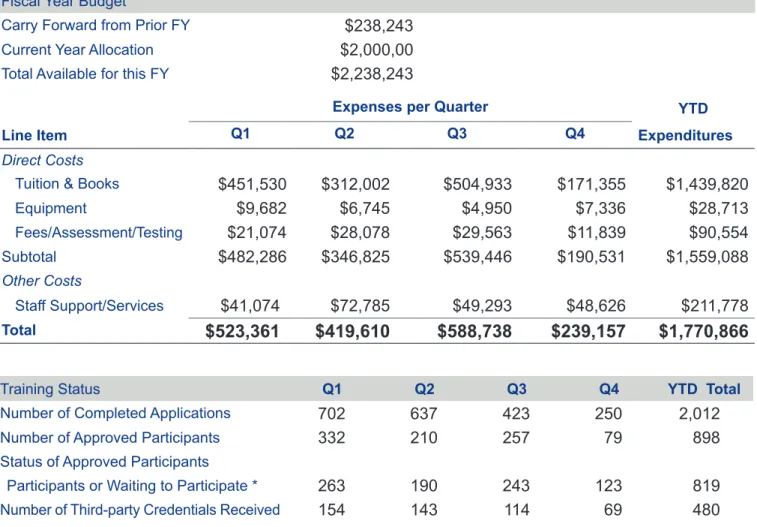
In FY 2020, the community colleges received a state appropriation of $2,000,000 to implement the Gap Tuition Program. Colleges continued to make significant progress in the implementation of their Gap tuition assistance funds.
In addition to the annual appropriation there was $238,243 of funding carried forward from FY19 into FY20, totaling $2,238,243. Of the total available funds, colleges spent $1,770,866 (79.1 percent) on tuition and books, equipment, fees and testing and program staff. Colleges will carry forward an estimated total of $467,376 into FY21. It should be noted that a portion of the funds carried forward may already be apportioned to active students who are currently participating in or waiting to participate in an approved training program (see Table 1 for additional detail).
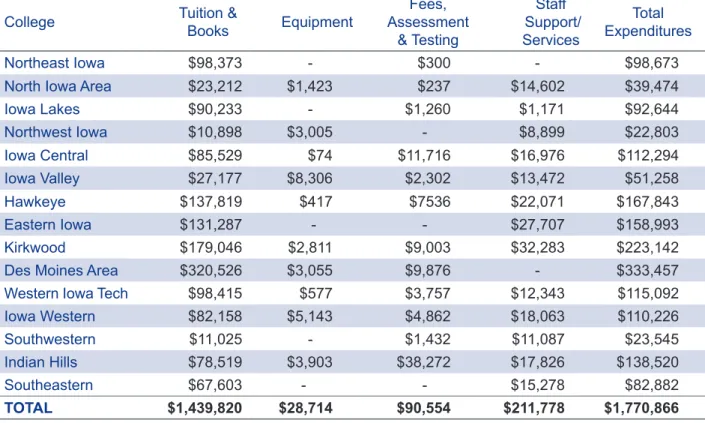
Breaking down the expenditures from FY20, $1,439,820 was spent on tuition and required books for approved participants; $28,714 was spent on equipment and $90,554 was spent on fees, assessments and testing. In addition, $211,778 was spent on staff support and services. Table 4 contains expenditure details by college.
An internal and external audit was performed in November, 2017 with business offices of each community college to confirm all annual allocations, expenses and carry forwards. The business offices of each community college continued to verify the quarterly numbers for this reporting year.
There were 2,012 individuals who completed an application to be considered for tuition assistance under the Gap Tuition Program, up slightly from last year. Of these applicants, 898 were approved to participate in a program. At the time of reporting, 610 individuals had completed the training program in which they enrolled. The remaining individuals were either actively participating or waiting to participate in a Gap-approved program (see Tables 1 and 2 for details).
Expenses per Quarter YTD
Line Item Q1 Q2 Q3 Q4 Expenditures
Direct Costs
Tuition & Books $451,530 $312,002 $504,933 $171,355 $1,439,820
Equipment $9,682 $6,745 $4,950 $7,336 $28,713 Fees/Assessment/Testing $21,074 $28,078 $29,563 $11,839 $90,554 Subtotal $482,286 $346,825 $539,446 $190,531 $1,559,088 Other Costs Staff Support/Services $41,074 $72,785 $49,293 $48,626 $211,778 Total
$523,361
$419,610
$588,738
$239,157
$1,770,866
Training Status Q1 Q2 Q3 Q4 YTD Total
Number of Completed Applications 702 637 423 250 2,012
Number of Approved Participants 332 210 257 79 898
Status of Approved Participants
Participants or Waiting to Participate * 263 190 243 123 819
Number of Third-party Credentials Received 154 143 114 69 480
TABLE 1: GAP PROGRAM SUMMARY FOR ALL COMMUNITY COLLEGES, FY20
Fiscal Year Budget
Carry Forward from Prior FY $238,243
Current Year Allocation $2,000,00
Total Available for this FY $2,238,243
CHART 1: GAP EXPENDITURES SUMMARY FOR ALL COMMUNITY COLLEGES, FY20
Tuition & Books
Equipment Fees/Assessment/Testing Staff Support/Services $1,439,820 $211,778 $90,554 $28,713
* Not all individuals were approved for participation in the current fiscal year. Individuals who were accepted into or active in the Gap Tuition Assistance Program from the previous fiscal year may be carried forward into the current fiscal year totals.
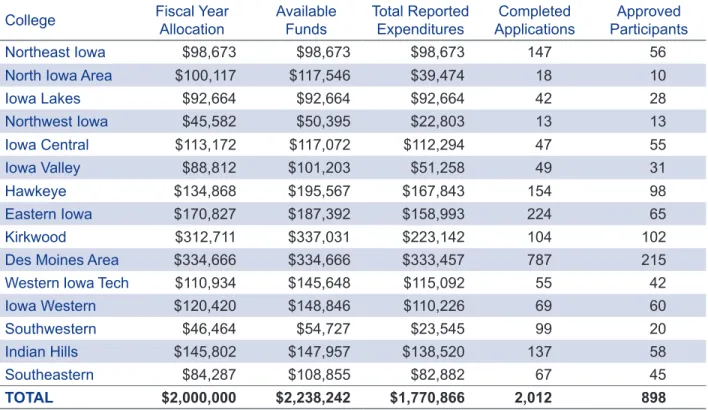
TABLE 2: GAP TUITION ASSISTANCE PROGRAM SUMMARY BY COLLEGE, FY20
College Fiscal Year Allocation Available Funds Total Reported Expenditures ApplicationsCompleted ParticipantsApproved
Northeast Iowa $98,673 $98,673 $98,673 147 56
North Iowa Area $100,117 $117,546 $39,474 18 10
Iowa Lakes $92,664 $92,664 $92,664 42 28 Northwest Iowa $45,582 $50,395 $22,803 13 13 Iowa Central $113,172 $117,072 $112,294 47 55 Iowa Valley $88,812 $101,203 $51,258 49 31 Hawkeye $134,868 $195,567 $167,843 154 98 Eastern Iowa $170,827 $187,392 $158,993 224 65 Kirkwood $312,711 $337,031 $223,142 104 102
Des Moines Area $334,666 $334,666 $333,457 787 215
Western Iowa Tech $110,934 $145,648 $115,092 55 42
Iowa Western $120,420 $148,846 $110,226 69 60
Southwestern $46,464 $54,727 $23,545 99 20
Indian Hills $145,802 $147,957 $138,520 137 58
Southeastern $84,287 $108,855 $82,882 67 45
TOTAL $2,000,000 $2,238,242 $1,770,866 2,012 898
TABLE 3: GAP TUITION ASSISTANCE PROGRAM SUMMARY, FY13 - FY20
Fiscal Year Fiscal Year Allocation Available Funds ExpendituresTotal ApplicationsCompleted ParticipantsApproved
FY 2013 $2,000,000 $2,000,000 $979,197 -- 898 FY 2014 $2,000,000 $3,020,803 $2,172,375 3,279 1,631 FY 2015 $2,000,000 $2,848,429 $2,424,061 3,272 1,348 FY 2016 $2,000,000 $2,424,368 $2,066,698 2,792 1,097 FY 2017 $2,000,000 $2,357,670 $1,924,285 2,331 965 FY 2018 $2,000,000 $2,219,973 $2,213,412 2,407 1,077 FY2019 $2,000,000 $2,239,792 $1,980,181 2,510 1,179 FY2020 $2,000,000 $2,467,376 $1,770,866 2,012 898
TABLE 4: REALLOCATION OF GAP FUNDS,
College AllocationFY20 Available FY20 Funds Amount Returned & Accrued Interest Amount Received Revised Available Funds
North Iowa Area $100,117 $117,546 $50,000 - $67,546
Iowa Western $120,420 $148,846 $25,000 - $123,846
Iowa Valley $88,812 $89,023 $30,000 - $71,203
Hawkeye $134,868 $195,567 - $33,275* $228,842
Kirkwood $312,711 $337,031 - $38,475* $375,506
Des Moines Area $334,667 $334,667 - $83,189* $417,856
Southwestern $46,464 $82,015 $20,000 - $52,015
Southeastern $84,287 $108,855 $24,000 -
-* Accrued Interest $5,039
Total - - $154,939 $154,939
-(* INCLUDES DISTRIBUTION AND INTEREST)
TABLE 5: GAP TUITION ASSISTANCE PROGRAM EXPENDITURES BY COLLEGE, FY20
College Tuition & Books Equipment Assessment Fees, & Testing Staff Support/ Services Total Expenditures Northeast Iowa $98,373 - $300 - $98,673
North Iowa Area $23,212 $1,423 $237 $14,602 $39,474
Iowa Lakes $90,233 - $1,260 $1,171 $92,644 Northwest Iowa $10,898 $3,005 - $8,899 $22,803 Iowa Central $85,529 $74 $11,716 $16,976 $112,294 Iowa Valley $27,177 $8,306 $2,302 $13,472 $51,258 Hawkeye $137,819 $417 $7536 $22,071 $167,843 Eastern Iowa $131,287 - - $27,707 $158,993 Kirkwood $179,046 $2,811 $9,003 $32,283 $223,142
Des Moines Area $320,526 $3,055 $9,876 - $333,457
Western Iowa Tech $98,415 $577 $3,757 $12,343 $115,092
Iowa Western $82,158 $5,143 $4,862 $18,063 $110,226
Southwestern $11,025 - $1,432 $11,087 $23,545
Indian Hills $78,519 $3,903 $38,272 $17,826 $138,520
Southeastern $67,603 - - $15,278 $82,882
CHART 2: TOTAL GAP TUITION ASSISTANCE PROGRAM FUNDS AND EXPENDITURES, FY14 - FY20
Total Funds Expenditures
$3,020,803 $2,848,429 $2,424,368 $2,357,670 $2,433,385 $2,219,973 $2,238,242 $2,172,375 $2,424,061 $2,066,698 $1,924,285 $2,213,412 $1,980,181 $1,770,866
Approved Programs and Enrollment
There are currently 461 approved noncredit programs in which participants of the Gap Tuition Assistance Program may enroll. The programs with the highest enrollment include certified nursing assistant (CNA) with 309 participants and truck and bus driver/commercial vehicle operator and instructor with 301 participants; making up 53.3 percent of the total overall enrollment (Table 6).
CIP Code CIP Title Number Enrolled
49.0205 Truck and Bus Driver/Commercial Vehicle Operator and Instructor 301 51.3902
&
51.3999 Nursing Assistant/Aide and Patient Care Assistant/Aide 309
48.0508 Welding Technology/Welder 105
52.0407 Business/Office Automation/Technology/Data Entry 55
51.0904 Emergency Medical Technology/Technician (EMT Paramedic) 53
51.0899 Allied Health and Medical Assisting Services, Other 29
52.0401 Administrative Assistant and Secretarial Science, General 28 10.0303 Prepress/Desktop Publishing and Digital Imaging Design 22
51.1009 Phlebotomy Technician/Phlebotomist 21
46.9999 Construction Trades, Other 20
52.0201 Business Administration and Management, General 19
51.0712 Medical Reception/Receptionist 19
51.0999 Allied Health Diagnostic, Intervention, and Treatment Professions, Other 17 47.0103 Communications Systems Installation and Repair Technology 12
47.0303 Industrial Mechanics and Maintenance Technology 12
51.0805 Pharmacy Technician/Assistant 12
49.9999 Transportation and Materials Moving, Other 11
51.0808 Veterinary/Animal Health Technology/Technician and Veterinary Assistant 11
11.0103 Information Technology 9
47.9999 Mechanic and Repair Technologies/Technicians, Other 8
TABLE 6: TOP GAP TUITION ASSISTANCE PROGRAM ENROLLMENT, FY20
Enrollment numbers can include duplicates depending upon program requirements for course work CIP - Classification Instructional Program
Gap Program Completers
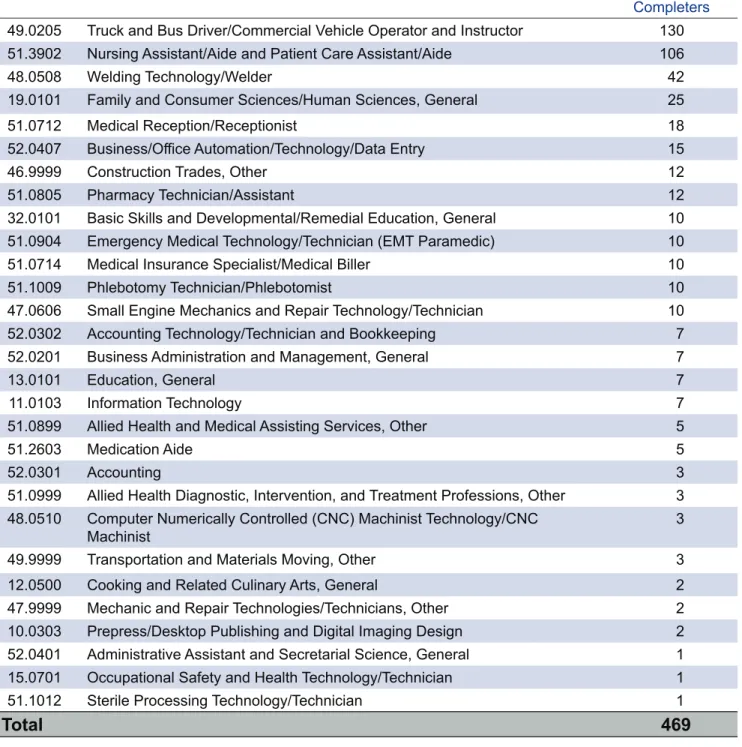
There were 469 Gap program completers reported in FY20. Table 7 shows the top Gap program completions. The commercial driver’s license (CDL)/Transportation programs had the highest number of completers with 130, followed by the Certified nursing assistant (CNA) program with 106 completers and welding technology had the third highest number of completers with 42 participants. It is important to note, however, that each training program has individual requirements for completion which may cause completion to be pushed into subsequent years.
CIP Code CIP Title Number of
Completers
49.0205 Truck and Bus Driver/Commercial Vehicle Operator and Instructor 130 51.3902 Nursing Assistant/Aide and Patient Care Assistant/Aide 106
48.0508 Welding Technology/Welder 42
19.0101 Family and Consumer Sciences/Human Sciences, General 25
51.0712 Medical Reception/Receptionist 18
52.0407 Business/Office Automation/Technology/Data Entry 15
46.9999 Construction Trades, Other 12
51.0805 Pharmacy Technician/Assistant 12
32.0101 Basic Skills and Developmental/Remedial Education, General 10 51.0904 Emergency Medical Technology/Technician (EMT Paramedic) 10 51.0714 Medical Insurance Specialist/Medical Biller 10 51.1009 Phlebotomy Technician/Phlebotomist 10 47.0606 Small Engine Mechanics and Repair Technology/Technician 10 52.0302 Accounting Technology/Technician and Bookkeeping 7 52.0201 Business Administration and Management, General 7
13.0101 Education, General 7
11.0103 Information Technology 7
51.0899 Allied Health and Medical Assisting Services, Other 5
51.2603 Medication Aide 5
52.0301 Accounting 3
51.0999 Allied Health Diagnostic, Intervention, and Treatment Professions, Other 3 48.0510 Computer Numerically Controlled (CNC) Machinist Technology/CNC
Machinist 3
49.9999 Transportation and Materials Moving, Other 3 12.0500 Cooking and Related Culinary Arts, General 2 47.9999 Mechanic and Repair Technologies/Technicians, Other 2 10.0303 Prepress/Desktop Publishing and Digital Imaging Design 2 52.0401 Administrative Assistant and Secretarial Science, General 1 15.0701 Occupational Safety and Health Technology/Technician 1 51.1012 Sterile Processing Technology/Technician 1
Total
469
The Gap Tuition Assistance Program is used to help students afford training toward a high demand, noncredit program that will lead to a job that employers in a region need to fill. Additionally, many of Iowa’s regional employers desire industry certifications to assess whether individuals possesses the skills and knowledge required for successful performance in particular job roles. Employers want to hire the best qualified individual who will make a positive contribution to their company. Gap-approved programs assist by providing specific certifications in various fields of expertise, which demonstrates that the candidates:
•
have met standards that have been established and verified by a third-party organization, and•
are dedicated to maintaining quality and competency in their work on a regular basis.Certification demonstrates to the employer and to the public that there is a commitment to the profession and fosters a collaborative environment between employer and employee.
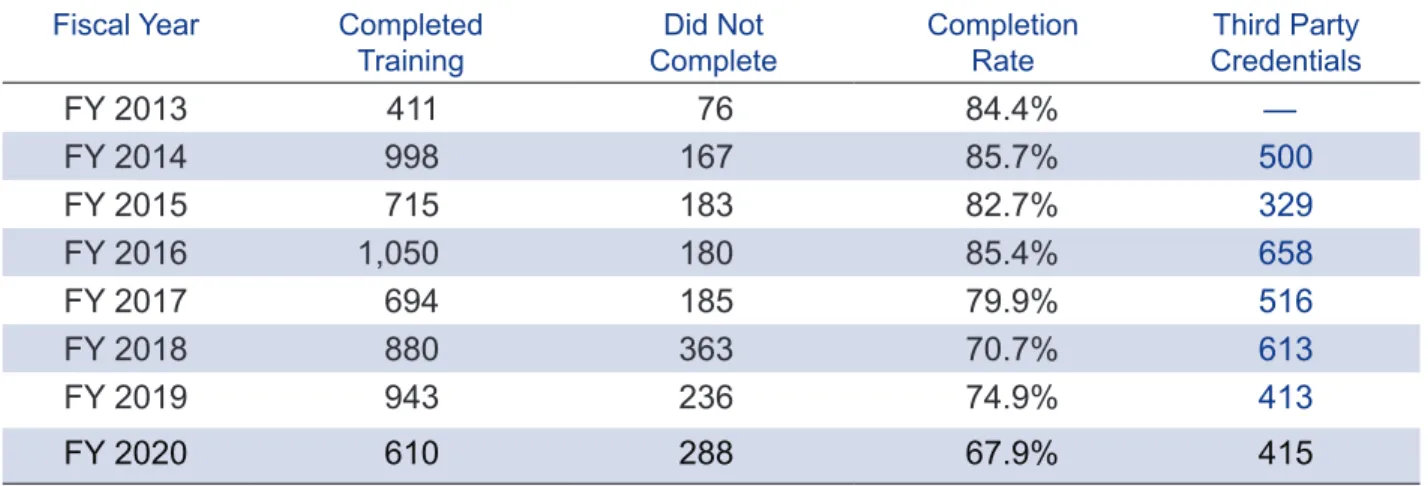
Table 8 below shows the number of students who completed training and third-party credentials during a fiscal year but it is noteworthy to state that not all programs begin and end in the same year so some students will complete the year following enrollment while others will complete in the same fiscal year.
TABLE 8: GAP PROGRAM COMPLETION AND THIRD PARTY CREDENTIAL SUMMARY
Fiscal Year Completed
Training Complete Did Not CompletionRate CredentialsThird Party
FY 2013 411 76 84.4% — FY 2014 998 167 85.7% 500 FY 2015 715 183 82.7% 329 FY 2016 1,050 180 85.4% 658 FY 2017 694 185 79.9% 516 FY 2018 880 363 70.7% 613 FY 2019 943 236 74.9% 413 FY 2020 610 288 67.9% 415
Third party credentialing is endorsed by a third party or a state or federal regulatory agency leading to employment. (Ex -amples include, but are not limited to: AWS, DOT, DIA, NIMS, and Microsoft). These are for initial certification only, not classes for recertification or re-licensure. Third party credentials would not include any locally awarded credential, as this is already being counted as a Gap completion of an approved Gap noncredit training program. Third party credentialing is for es -tablished industry standards. The NCRC credential should not be included in this count.
Program Outcomes
Community colleges are no longer required to collect basic employment statistics on program completers because data are now matched to the unemployment insurance (UI) wage record database following completion, and reported annually. This data, though for the previous year, are reliable and can be longitudinally analyzed for employment outcomes. Student records are matched to employer wage records and enrollment records for the year following completion (on a quarterly basis) to identify if they became newly employed, retained employment or continued their education in a credit-bearing program (Table 8).
Of the 1,061 participants who completed a Gap-approved program for the academic year 2017-2018 (AY18), 321 participants were employed in the same industry prior to and following their training but show an average increase in wages of 17.5 percent by the second quarter following completion of their program. Another 337 participants were employed in a different industry following their completion and had an average wage increase of 63.9 percent. Additionally, there were 180 participants who were previously unemployed, but following earned an average quarterly wage of $6,222.37 the second quarter following completion.
TABLE 9: GAP PARTICIPANT EMPLOYMENT STATUS SUMMARY BY COLLEGE, AY 2018 COHORT
College EmploymentRetained EmploymentNew Unemployed Following Training Total All New Employment Percentage Overall Employment (less Continued Education) Northeast 34 14 6 54 25.9% 100%
North Iowa Area 5 4 4 13 107.7% 100%
Iowa Lakes 18 2 5 25 56.0% 100% Northwest 4 0 0 4 350.0% 100% Iowa Central 11 6 7 24 58.3% 100% Iowa Valley 51 8 6 65 21.5% 100% Hawkeye 44 24 14 82 17.1% 100% Eastern Iowa 33 13 18 64 21.9% 100% Kirkwood 121 30 44 195 7.2% 77.4%
Des Moines Area 166 33 49 248 5.6% 80.6%
Western Iowa Tech 23 7 14 44 31.8% 86.4%
Iowa Western 37 10 19 66 21.2% 72.7%
Southwestern 20 3 2 25 56.0% 88.0%
Indian Hills 73 21 26 120 11.7% 74.2%
Southeastern 16 5 11 32 43.8% 84.4%
Total 656 180 225 1,061 17.1% 85.4%
* Employment based on program completers who responded to survey attempts. Actual employment rates may vary slightly. Employment and New Employment rate methodology changed this year due to new MIS reporting data inputs.
Overall Employment Rate = New Employment Rate =
New Employment + Retained Employment Total Employment - Continued Education
New Employment
COMMUNITY COLLEGES &
WORKFORCE PREPARATION
PROSPERITY THROUGH EDUCATION
The Division of Community Colleges and Workforce Preparation within the Iowa Department of Education administers a variety of diverse programs that enhance Iowa’s educational system and help to prepare a skilled and knowledgeable workforce. Divided between two bureaus — the Bureau of Community Colleges and the Bureau of Career and Technical Education — the division is committed to providing and supporting opportunities for lifelong learning. In addition to working with Iowa’s 15 public community colleges on state accreditation, program approval, equity review, and data reporting,