Luminaire efficiency factor system for
general lighting
Axel Stockmar
LCI Light Consult International D-29227 Celle
KE Y W O R D S
general lighting, luminaire efficiency, utilisation factor, European utilisation factor method, European luminaire efficiency labelling system.
A B S T R A C T
Lighting requirements concern the criteria illuminance level, luminance distribution, glare limitation, modelling, colour appearance, and colour rendition. Besides these photometric quality criteria special attention is paid to the costs for acquisition, installation, maintenance, and oper-ation of the illuminoper-ation. Here it is of particular interest to what extent the total costs could be reduced by utilising lamps with higher efficacy, ballast with lower losses, and luminaires with higher light output ratios and more ap-propriate luminous intensity distributions. For lamps and ballasts appropriate classification and labelling systems have been developed and are in use throughout Europe. For luminaires there are a number of proposals for energy-dependent classification and/or labelling procedures, but for various reasons non of the methods has been developed towards a usable system. As luminaires are being designed to fulfil particular needs, it seems to be impossible to create a system which would cover all luminaires. However for lu-minaires to be used for general lighting of e.g. offices, stores, workshops, sports facilities etc. a luminaire efficien-cy factor system could be developed based on an utilisation factors. As the utilisation factor is in proportion to the light output ratio and is dependent on the luminaire flux distri-bution, the luminaire layout, and the reflection properties of a space, it is necessary to define appropriate standard conditions. Concerning the luminous flux distribution
there is a need for more than one category, i.e. direct/semi-direct, direct/indirect/semi-direct, and semi-indirect/indirect. To keep the system simple there should be only a few standard rooms, but with two luminaire arrangements for ceiling mounted and suspended installations. The reflectances of ceiling and walls should be suitable also for luminaires with considerable upward flux components. Based on a comprehensive European utilisation factor method a lumi-naire efficiency factor labelling system for general lighting will be discussed.
I N T R O D U C T I O N
Lighting requirements concern the criteria illuminance level, luminance distribution, glare limitation, modelling, colour appearance, and colour rendition. Besides these photometric quality criteria special attention is paid to the costs of acquisition, installation, maintenance, and opera-tion of the illuminaopera-tion. Here it is of particular interest to what extent the total costs could be reduced by utilising lamps with higher efficacy, ballasts with löwer losses, and luminaires with higher light output ratios and/or more ap-propriate luminous intensity distributions. For lamps and ballasts appropriate classification and labelling systems have been developed and are in use throughout Europe. For luminaires a number of proposals have been emerged for energy-dependent classification or labelling proce-dures, but none of the ideas has been developed towards an approved system. The need for such a system has been stressed by the European Commission, which has initial-ised activities to create a mandated European standard. As luminaires are being designed to fulfil particular needs, it seems to be impossible to create a system, which would
SESSION 12: STANDARDS AND TECHNOLOGY STOCKMAR
cover all types of luminaires at the same time, such as floodlights, wall washers, and/or road lighting lanterns. However, for luminaires to be used for general lighting of e.g. offices, stores, workshops, sports facilities etc. a lumi-naire efficiency factor system could be developed based on utilisation factors. At the moment there are several utilisa-tion factor methods being used in Europe showing re-markable differences. A European approach towards a luminaire efficiency factor labelling system requires as a first step a harmonised European utilisation factor meth-od. Lamps, ballasts, and luminaires are usually regarded as independent components having different measures for energy efficiency classifications. But in many cases the combined effect of lamp, ballast, and luminaire type mat-ter, expressed in e.g. system efficacy. If this is specified in addition, it would help to take into account incompatibil-ities, ambient temperature influences etc.
FE A S I B I L I T Y S T U D I E S A N D P R O P O S A L S
The ratio of the achievable illumination level, expressed in terms of an average illuminance on a reference surface (usually the utilisation plane), to the necessary electric power depends on the selected lamps, ballasts, and lumi-naires as well as on the reflectances of all interior surfaces. For lamps and ballasts there are appropriate measures, ef-ficacy and ballast-lamp circuit power respectively, which serve as a basis for energy efficiency labelling systems. However, for luminaires the obvious measure, the light output ratio, is not a suitable quantity, as there exists no re-lationship to the achievable illumination level. In an early study [1] it was concluded that for general lighting in inte-riors only a system based on utilisation factors could de-scribe photometric properties while taking into account the necessary electric energy, as the utilisation factor is in proportion to the light output ratio and is dependent on the luminaire flux distribution for given standard condi-tions. Furthermore it was proposed to consider at the same time the glare limitation, as for some highly effective lumi-naires the glare could be exceedingly high. When this study has been made public [2] it was felt that the system should be developed further to cover more than one standard room, but without glare considerations. This was regarded not simple enough for a labelling system. In a different proposal [3] the light output ratio was considered as the suitable measure to describe the energy efficiency of lumi-naires. In building regulations where energy efficiency is expressed in terms of luminaire lumens per circuit watt the light output ratio plays an important role, but it will not describe the lighting performance of the installation. The more recent proposal [4] for the representation of lumi-naire efficiency factors based on utilisation factors for three standard rooms with room indices k=1.00, k=2.00, and k=5.00 seems to be a logic step towards a luminaire effi-ciency labelling systems. Unfortunately the
envisaged conversion of the room indices into approxi-mate floor plan area sizes is misleading and valid only for ceiling mounted luminaires. The room index depends not only on length and width of the interior but also on the
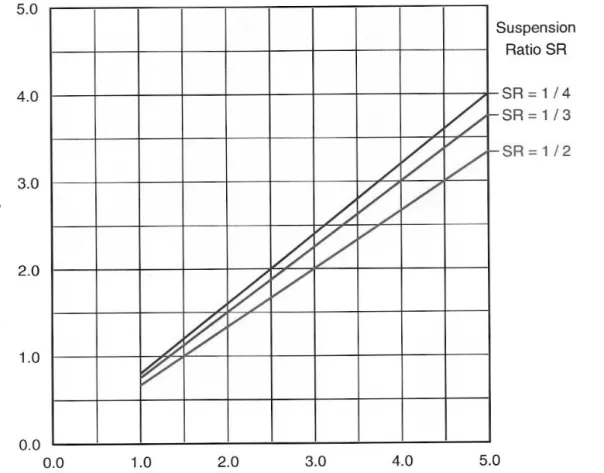
mounting height of the luminaires, i.e. the distance be-tween luminaire plane and reference plane. For a given sus-pension ratio SR, the ratio of sussus-pension height to mounting plus suspension height, a room index of for ex-ample k=5,00 for a suspended luminaire arrangement cor-responds with a room index of only 3.5 to 4.0 for a ceiling mounted luminaire arrangement (figure 1) in the same in-terior, which makes it very difficult to compare different lighting systems. In other words, the floor area leading to the same room index differs by a factor of up to two de-pendent on the suspension ratio (figure 2). A further prob-lem arises from the fact that there are several utilisation factor methods being used in Europe showing considera-ble differences.
U T I L I S A T I O N FA C T O R M E T H O D S B E I N G U S E D I N E U R O P E
Throughout Europe there are at the moment several methods being used for the calculation of utilisation fac-tors In particular these are the British as described in CIB-SE Technical Memoranda No 5 [5], the German as published in LiTG Publication 3.5 [6], the French as given in the French Norm NF C71-121 [7], the Nordic as part of the NB-Documentation of luminaires [8], and the CIE-Method as specified in Publications No 40 [9] and No 52 [10]. In all utilisation factor methods considered it is as-sumed that the interiors are empty rectangular parallelepi-peds. The working plane is assumed to be materialised by a surface, which will be counted as one of the room surfac-es - with reflectance of the floor cavity. All room surfacsurfac-es (ceiling, walls, and working plane) reflect uniformly and according to Lambert's law. The luminaires are arranged in regular patterns in the luminaire plane at a specified dis-tance above the working plane. The indirect component of the utilisation factors is calculated using the common flux transfer theory. Tabulated transfer factors show virtually no differences whether they have been evaluated for rooms with a square plan or with a rectangular plan (length to width equal to 1.6 to 1). Differences experienced between the different utilisation factor methods are caused by the procedures applied to the calculation of the utilization fac-tors for direct illumination. The important influencing factors are the luminaire layout - described best by the spacing-to-height ratio and the proximity - and the way in which the direct flux onto the working plane is calculated – zonal multipliers, stripe multipliers, point-by-point cal-culation etc.
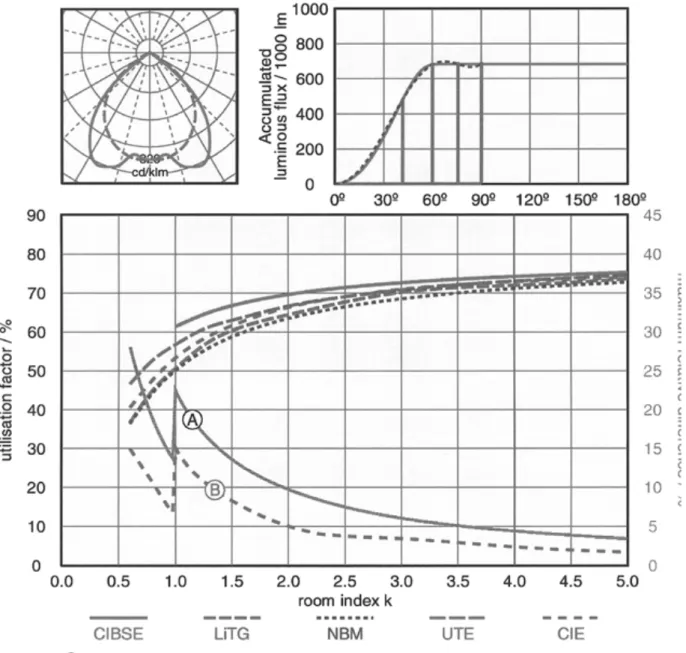
For the standard room with room index k=2.00 the lu-minaire layouts used in the different utilisation factor methods are shown in figure 3. Similar differences in lumi-naire arrangements are found for all room indices resulting in considerable differences between the utilisation factors obtained. An example is given in figure 4 – for the pro-posed reflectance combination. Following the proposal for representation of lighting efficiency factors [4] but using the room index instead of the plan area size as parameter leads in consequence to different results applying the dif-ferent utilisation factor methods (figure 5). The discrepan-cies are larger for smaller room indices, but also smaller
STOCKMAR SESSION 12: STANDARDS AND TECHNOLOGY
discrepancies for larger room indices could have quite some commercial impact.
R E Q U I R E M E N T S F O R A L U M I N A I R E E F F I C I E N C Y FA C T O R L A B E L L I N G SY S T E M
Utilisation factors for a set of standard rooms seem to be an adequate measure to form the basis for a luminaire effi-ciency factor labelling system. From the presented results it is obvious that there is still a need for a common European utilisation factor method. A harmonised method should reflect as far as possible current practice. Comparisons have shown that utilisation factors calculated according to the CIE method are somewhere in the middle of the band-width of the utilisation factors obtained using the other methods (figure 4) [11]. Therefore a
European utilisation factor method should apply the CIE method for the calculation of the utilisation factors for direct illumination. To take advantage of more pro-nounced luminous intensity distributions the method should allow for luminaire arrangements with different spacing-to-height ratios, preferably between 1.00 and 2.00 in steps of 0.25. For the luminaire efficiency factor system it is proposed to fix the spacing-to-height ratio at 1.00, oth-erwise it has to be stated every time. In addition to ceiling mounted systems the method should be extended to ena-ble the calculation of utilisation factors for suspended ar-rangements. This would make it possible to compare different systems regarding luminaire efficiencies. In this case a suspension ratio has to be standardised; a realistic suspension ratio would be _. The standard sets of reflect-ance combinations should include the one proposed for the representation of luminaire efficiency factors, i.e. 0.70 for ceiling, 0.50 for walls, and 0.20 for the floor cavity, and also a set with higher reflectances for lighting systems with considerable indirect components [12].
C O N C L U S I O N S
Provided a comprehensive European utilisation factor method could be established, calculated utilisation factors for well-defined standard conditions could be used for a luminaire efficiency factor labelling systems. It seems to be necessary to distinguish between ceiling mounted and sus-pended luminaires to make useful comparisons possible. The borderline between ceiling mounted and suspended luminaires could be set using a downward flux fraction of 0.90. Furthermore, for indirect lighting systems with downward flux fractions smaller than 0.10 it is probably more realistic to use higher than proposed standard re-flectances for ceilings and walls. In any case the mounting mode should be stated in the luminaire efficiency factor la-bel and/or the conversion from room index to floor plan area size should reflect the standard suspension ratio. In addition it could be useful to complement the luminaire efficiency factor label with information concerning the lu-minaire lumens per circuit watt – here called the system ef-ficacy – which is needed to check conformity with some building regulations as mentioned in an earlier proposal [3]. This could help to identify energy efficient luminaires, which can use only less efficient lamps or ballasts (figure
6). The only problem remaining is the fact that very effi-cient luminaires could cause considerable glare which will not be notified. Therefore the glare limitation has to be evaluated separately or a glare dependent modifying factor would have to be introduced.
B I B L I O G R A P H Y
[1] Stockmar, A.Evaluation of a Luminaire Specific Index for the Description of Photometric Properties of Inte-rior Luminaires Taking into Account the Efficient Use of Energy, Study on behalf of CELMA, 1994.
[2] Stockmar, A.Proposal for a Luminaire Specific Index for the Description of Photometric Properties of Inte-rior Luminaires Taking into Account the Efficient Use of Energy, Proceedings RIGHT LIGHT 4, Volume 2, p. 41-45, 1997.
[3] Hampton, B.Conservation of Fuel and Power: Regula-tions for Energy Efficiency to Protect the Environment – ‘An Industry Proposal’, CIBSE National Lighting Conference Lancaster,1998.
[4] CELMA Proposal for luminaire efficiency factor pre-sentation, CEN TC 169 document N 418, 2001. [5] CIBSE Technical Memoranda 5, The calculation and
use of utilisation factors, 1980.
[6] LiTG Publikation 3.5, Projektierung von Beleuch-tungsanlagen nach dem Wirkungsgradverfahren, 1988.
[7] NF C71-121, Méthode simplifiée de prédétermination des éclairement dans les espaces clos et classification correspondante des luminaires, UTE, 1993.
[8] NBDOC, A computer program for NB-documenta-tion of luminaires, LTLI Notat 248, 1987.
[9] CIE Publication No 40, Calculations for interior Ligh-ting, Basic method, 1978.
[10] CIE Publication No 52, Calculations for interior ligh-ting, Applied method, 1982.
[11]Stockmar, A.Comparison of Utilisation Factor Met-hods, CEN TC 169 / WG2 document N184, 2001. [12] Stockmar, A.Proposal for a European Utilisation
Fac-tor Method, Proceedings ILUMINAT 2001, paper no. 4, p. 1-4.
SESSION 12: STANDARDS AND TECHNOLOGY STOCKMAR
STOCKMAR SESSION 12: STANDARDS AND TECHNOLOGY
SESSION 12: STANDARDS AND TECHNOLOGY STOCKMAR
STOCKMAR SESSION 12: STANDARDS AND TECHNOLOGY
SESSION 12: STANDARDS AND TECHNOLOGY STOCKMAR
Figure 5: Comparison of Luminaire Efficiency Factors