eCommerce for
Small Enterprise
Development
A Handbook for
Enterprise Support
Agencies
in Developing Countries
2005
Richard Duncombe & Richard Heeks
IDPM, University of ManchesterRobert Kintu & Barbara Nakangu
FIT (Uganda)Institute for Development Policy
and Management The University of Manchester
Written by: Richard Duncombe and Richard Heeks
Institute for Development Policy and Management (IDPM)
University of Manchester, Precinct Centre, Manchester, M13 9QH, UK
Tel: +44-161-275-2800 Fax: +44-161-273-8829
Email: [email protected]
Email: [email protected]
Robert Kintu and Barbara Nakangu FIT (Uganda) Kampala, Uganda Email: [email protected] Sunil Abraham Mahiti Bangalore, India Email: [email protected]
Published by: Institute for Development Policy and Management (IDPM)
Email: [email protected]
Web: http://www.sed.manchester.ac.uk/idpm
Developed from a project supported by:
Building Digital Opportunities (BDO) Programme
Department for International Development
1 Palace Street, London, SW1E 5HE, UK Email: [email protected]
Web: http://www.dfid.gov.uk/
Commonwealth Telecommunications Organisation (CTO)
Clareville House, 26-27 Oxendon Street, London, SW1Y 4EL, UK
Email: [email protected]
Web: http://www.cto.int
This handbook can be used together with 'eCommerce for Small Enterprise
Development – A Handbook for Entrepreneurs in Developing Countries', which has been designed specifically for use by small business owners and employees.
View/download both handbooks from:
List of Contents
How To Use This Handbook ...1
A. Introduction...2
A1. What Is eCommerce? ...2
A2. What Is Driving eCommerce For Small Enterprises?...3
A3. What Are The Benefits Of eCommerce For Small Business? ...4
A4. What Are The Risks Of Going Into eCommerce? ...5
A5. What Are The Agency Benefits And Risks? ...6
A6. Assessing eReadiness For Small Enterprise ...8
A7. eCommerce And Developing Countries: SWOT Analysis...9
B. Small Enterprise On The Road To eCommerce...13
B1. Moving Up The eCommerce Ladder ...13
Enterprise Case 1: Sedu Welding and Fabrication – eCommerce Step 1 ...15
Enterprise Case 2: Mukono Women's AIDS Task Force – eCommerce Step 2 ...16
Enterprise Case 3: Adam Sons – eCommerce Step 3 ...17
Enterprise Case 4: Star Café – eCommerce Step 4...18
Enterprise Case 5: Kamal Bells – Elements of eCommerce Step 5...19
Enterprise Case 6: Project ToeHold – Getting to eCommerce Step 6 ...20
C. eCommerce Support ...21
C1. Different Types of eCommerce-Related Support...21
Agency Case A: Makerere University Small Business Centre...23
Agency Case B: Business Uganda Development Scheme...24
Agency Case C: Association of Women Entrepreneurs of Karnataka ...25
Agency Case D: Explocity...26
Agency Case E: Matex...27
D. Agency Strategy on eCommerce...31
D1. Agency Strategy For eCommerce And Small Enterprise ...31
D2. Understanding eCommerce Users...33
D3. Determining eCommerce Entry Points ...34
D4. Other Issues For Agencies ...36
D5. Strategies For eCommerce Promotion At National Level ...39
E. eCommerce Best Practice Guides ...41
Advice Sheet 1: Getting Connected And Making A Start ...41
Advice Sheet 2: Using Electronic Mail (Email) ...42
Advice Sheet 3: eCommerce Skills...43
Advice Sheet 4: Web Development ...44
Advice Sheet 5: Online Promotion ...45
Advice Sheet 6: Networking And Communities On The Internet...46
Advice Sheet 7: Contracting Out Web Services ...47
Advice Sheet 8: Order Fulfilment And Logistics ...48
Advice Sheet 9: Costs Of Web-Based eCommerce...49
Advice Sheet 10: Some Legal/Regulatory Issues ...50
Advice Sheet 11: Web Security ...51
Advice Sheet 12: Open Source Software...52
F. Understanding More About eCommerce ...53
F1. Glossary/Jargonbuster...53
How To Use This Handbook
This handbook is designed for agencies that are supporting entrepreneurs running micro and small-scale enterprises (MSEs) in developing countries. It is designed for agencies that have little current involvement in eCommerce support and have little knowledge of what is involved, as well as for more experienced agencies that are already using information and communication technologies (ICTs) – computers, email, the Internet, mobile phones, etc – or supporting their use in small enterprise. If your agency wishes to raise its level of support and involvement in eCommerce, then this handbook will be of use to you.
The objectives of the handbook are as follows:
• To outline some basic information about eCommerce including the benefits and risks for agencies and clients (Section A).
• To explain the different ways in which small enterprises use eCommerce (Section B).
• To review current practice in eCommerce support for small enterprises, and outline an approach to enterprise needs analysis for eCommerce (Section C).
• To encourage a strategic approach to eCommerce support by your agency (Section D).
• To provide practical information about different aspects of eCommerce (Section E).
• To direct you towards further information and support for eCommerce (Section F).
The first thing you should do is read through Section A to learn more about
eCommerce, then look at Section B to gauge how far your clients have climbed the 'eCommerce ladder'. Next look at Section C that focuses on client support. Section C1 outlines different approaches to eCommerce support for small enterprises and presents agency case study examples. Section C2 outlines a client-centred approach for improving your agency's analysis of eCommerce needs for small enterprises, concentrating on three areas – information needs, value chain analysis, and resources.
Then move on to Section D. Sections D1-D4 provide guidelines for developing an agency strategy towards eCommerce support for small enterprises – focusing on business integration, sustainability, user involvement, a step-by-step approach to scaling up activities, and how best to choose eCommerce facilitators. Additionally,
Section D5 suggests areas where agencies can actively lobby government to further assist with the development of eCommerce for small enterprises.
Finally, look at Section E that provides information on various aspects of 'best practice' for small enterprises implementing eCommerce, and Section F which provides sources of further information about eCommerce.
A. Introduction
There are tens of millions of small enterprises, including micro-enterprises, in
developing countries (DCs). More than 90% of all firms in DCs are micro- and small enterprises (MSEs), and these typically contribute 80-90% of all employment. They are also significant in wealth creation, making up perhaps around a quarter of gross domestic product and often contributing to exports as well.
In an increasingly competitive and globalised world, MSEs need to compete more effectively in order to further boost domestic economic activity and contribute toward increasing export earnings. MSEs will also continue to play an important role in increasing employment and incomes and thus contribute to poverty reduction on a sustainable basis.
eCommerce is emerging as a new way of helping business enterprises to compete in the market and thus contributing to economic success. eCommerce can help deliver economic growth, increased business opportunities, enhanced competitiveness and better access to markets. At present, though most small enterprises lack the
knowledge of how investment in eCommerce could benefit their businesses and help them develop that competitive edge. This is at a time when the opportunities for small enterprises to adopt eCommerce are growing due to improved access to the technical and communication infrastructure.
Enterprise support agencies can play a key role in helping small enterprises attain the benefits that eCommerce has to offer. Agencies can also look beyond the technology, and understand how real commercial benefits can flow to individual enterprises and sectors from adopting the new business methods that are required to use eCommerce effectively.
This handbook will help your agency understand more about eCommerce and what eCommerce has to offer your entrepreneur clients. It will help you to decide whether to expand support for eCommerce in your agency, what type of eCommerce support to provide, and how to go about providing that support.
A1. What Is eCommerce?
eCommerce involves the sale or purchase of goods and services over computer networks by businesses, individuals, governments or other organisations. eCommerce builds on traditional commerce by adding the flexibility and speed offered by
electronic communications. This can facilitate improvement in operations leading to substantial cost savings as well as increased competitiveness and efficiency through the redesign of traditional business methods.
However, eCommerce is not just about using new technologies. eCommerce can also help support profitable business relationships and assist you to more effectively manage and run your business enterprise. This will involve creating more effective external interactions with customers, clients, collaborators and suppliers, but it can also mean improving internal business efficiency and even the emergence of new products and services.
eCommerce may involve selling directly from businesses-to-consumers (B2C
eCommerce). For example, a number of craft producers and tourism enterprises have already found some success dealing directly with customers.
eCommerce can also be conducted directly between businesses (B2B eCommerce). This is by far the most common type of eCommerce at present. B2B activity includes portals that operate as electronic marketplaces or as auction sites. Benefits of
eMarketplaces can include reduced costs, better research and quicker transactions for buyers. Rewards for sellers include improved customer service levels and cheaper exposure to customers.
There is also business-to-government activity (B2G eCommerce) that refers to the growth in supply of goods and services for online government procurement – potentially a large growth area in developing countries.
A2. What Is Driving eCommerce For Small Enterprises?
The need for micro- and small enterprises to consider adopting eCommerce is driven by global, national and regional business trends. These relate to markets, costs, new technologies and political factors as follows:
• Adaptation to rapid market changes that are impacting on export-led and domestic markets.
• Cost competition and the need to compete more effectively in both local and export-led sectors.
• Globalisation of the production and supply of goods and services – and the need to integrate small enterprises more effectively into the supply chains of larger businesses.
• Increased customer expectations and consumer power – buyers expecting to be able to access web-based information about products and services, for
example.
• Adaptation to new technologies – an overall need for technological upgrading.
• Greater role for information in business and the need to access, process and communicate it efficiently and effectively.
• Government deregulation and liberalisation – lowering costs of access.
• Bilateral and multilateral trade agreements – opening up markets to developing country producers.
• Adaptation to higher quality standards such as ISO9000 – ICTs are acting as an enabler in this area.
It is important that enterprises – and agencies like yours that support them –
understand the specific driving forces for eCommerce in their particular sector. For example, eCommerce in some sectors – such as automotive and agricultural or
horticultural products – is driven by emergence of B2B eMarketplaces that use not the open web as their medium but private networks or restricted-access auction sites. In order for enterprises to participate in these marketplaces it is necessary to gain market entry to these supply chains, and to understand how they operate.
Other sectors driven by global growth – such as financial and business services or travel and tourism – will be reacting more to global developments. In all cases, then, it is important to understand what is driving eCommerce on a sector-by-sector basis.
A3. What Are The Benefits Of eCommerce For Small Business?
eCommerce can provide substantial benefits to small enterprises via improved efficiencies and raised revenues. It enables a new way of working to emerge as businesses face the future and embrace the new economy. eCommerce enables small business entrepreneurs to gain access to better quality information, and thus
empowers them to take informed decisions in their businesses.
Most importantly, eCommerce can give a competitive advantage. It can help
strengthen market position and open up new business opportunities with the potential to improve profits. Benefits of eCommerce can arise in the following ways:
Cost Reduction Benefits:
• Reduced travel costs: by using a mobile phone, email and other ICTs to substitute for journeys.
• Reduced cost of materials: more information means better choice of suppliers and more competitive prices.
• Reduced marketing and distribution costs: for example, publishing a brochure online can reach an unlimited number of potential export customers and allow regular update.
• Reduced sales costs: the Internet provides unprecedented opportunities for businesses to reduce the costs of trade locally and, even more, across borders.
• More efficient supply chain management: can eliminate the need for middlemen leading to lower transaction costs (including marketing, sales, transaction processing), reduced overhead, and reduced inventory and labour costs.
• Improved internal functions: cutting down on meetings, improving the exchange of critical knowledge, eliminating red tape, and streamlining communications.
Market Benefits:
• Greater reach: a web presence can allow entrepreneurs to reach out to customers far beyond their immediate location.
• More brand awareness: offering new avenues of promotion for products and services.
• Improved customer service: providing more responsive order taking and after-sales service to customers; this, in turn, can lead to increased customer loyalty.
• Increased market awareness: entrepreneurs can become more aware of
competition within their market and more aware of market changes, which can lead to product/service innovation or quality improvement.
Other Competitiveness Benefits:
• Increased efficiency: eCommerce not only reduces costs but it can also increase the speed of transactions; both buying and selling.
• Continuous trading: suppliers and customers, if they wish, can access a 24-hour/7-day sales service – particularly important when trading through time zones.
• Specialisation: eCommerce can help entrepreneurs focus their activities – making it easier to build relationships with other enterprises and communicate their needs to support agencies.
Many of these benefits can be gained through relatively modest investments in new technology and systems. Greater benefits may accrue as the enterprise moves up the eCommerce adoption ladder (see Section B1). It is important to realise, however, that the benefits outlined are not exclusively tied to eCommerce. For example, market benefits may be achieved more effectively through better business networking and the building of personal business relationships, rather than through use of the Internet. This emphasises the importance of adopting an approach towards eCommerce that puts business objectives first, rather than believing that technology alone can deliver the benefits described above.
A4. What Are The Risks Of Going Into eCommerce?
There are great potential benefits but there are also pitfalls of going into eCommerce. They are the financial costs, the business 'opportunity costs' and the dangers of failure. These are detailed below. It will be important for your agency to identify the pitfalls and help minimise the risks for clients.
eCommerce will bring extra costs as well as cost savings! Developing eCommerce for a business will almost certainly bring an increase in costs before such time that either savings due to greater efficiency or increased revenue become evident. Initial start-up costs (investment in a computer, network connection, etc) can be significant, and there are additional running costs too (see Advice Sheets 1 & 9). Even after start-up, eCommerce activity will need to run in parallel with existing business methods. For example, enterprises will need to continue to produce paper-based marketing material (brochures, stationery, leaflets, etc) as well as building up your web presence. This will duplicate some activities adding to overall costs.
These costs are definite whereas the new revenue streams from eCommerce are not, particularly given the relatively lower numbers of people online and with credit cards in developing countries. Hence, many small businesses you deal with may be – perhaps rightly – sceptical about eCommerce, and should be encouraged to approach it in the step-by-step manner outlined in Section B1.
eCommerce may divert attention away from more important 'offline' activities!
It is important that online and offline efforts are not in competition with each other within a business. In fact, for most MSEs, offline activities (such as face-to-face meetings) will remain far more important than online communication. In the long term, risks can be minimised through effective integration of online and offline
activities – using eCommerce to complement existing business processes. In the short and medium term, there is a risk that a business owner could lose sight of his/her true business needs if eCommerce is oversold, as happened during the dot.com boom during the late 1990s.
An eCommerce venture may well fail completely! Any new business venture is likely to fail. As the dot.com boom and subsequent bust demonstrated, eCommerce ventures may be more likely to fail than conventional businesses. This emphasises the importance for small businesses of not throwing all their eggs into the eCommerce basket. Failure can be avoided in one of two ways. First, by deciding not to adopt eCommerce at all. Second, and probably more appropriately, by taking a step-by-step approach that minimises risk – such as suggested in this handbook.
However, there are also risks of ignoring eCommerce! Technology and innovation are often described as the catalyst for change. Ignoring new technology may have significant implications for the ways business is done in the future. For example, having no website, or a badly designed or marketed website, may put a business at a disadvantage as compared with competitors. Over the medium and long term, unsuitable or inadequate technology can mean that your client enterprises remain without the communications systems that they will need to compete effectively.
A5. What Are The Agency Benefits And Risks?
You should also consider the benefits and risks for your agency in supporting eCommerce activities and in developing your own capacities for eCommerce. The message for agencies is essentially the same as for the enterprises you support. Technology should be an enabler and not a driver for the realisation of benefits, and risks need to be assessed in terms of actual costs, opportunity costs, and the dangers of failure.
Of course, there will be risks for your agency if eCommerce does not take off as anticipated, plus there are the costs involved since you will need to build capacity in the agency in various ways:
• Knowledge: improving your own and your staff's knowledge about eCommerce.
• Skills: gaining specific skills in using, advising and training on eCommerce.
• Attitudes: developing positive but realistic attitudes towards eCommerce.
• Finance: to afford the direct and ongoing costs of any investment you may need to make.
Agencies can support eCommerce in enterprises without themselves having to implement and use eCommerce. Having said that, however, one of the best ways to build up the human capacities noted above is for the agency itself to adopt
eCommerce for its own operations. This has both pros and cons:
Benefits of eCommerce Implementation within Agencies:
• Improving information/knowledge capacity – eCommerce will support marketing, communication and branding of your agency's activities. It will help you access, process and disseminate increased amounts of information and build your knowledge base.
• Improving technical capacity – building your internal technical capacity will make you less reliant on external infrastructure access and technical support.
• Improving human capacity – eCommerce will improve business and
organisational skills as well as technical skills. Additionally, the motivation and confidence of your staff can be enhanced.
• Improving processes of activity – both efficiency and effectiveness can be improved across a wide range of activities – particularly internal and external communications (including advocacy with donors, government, etc) and procurement.
Risks of eCommerce Implementation within Agencies:
• Costs factors – there is likely to be a high cost of initial investment in time, money and skills.
• Information and communication factors – are you able to handle increased amounts and complexity of information (information overload)? Are you able to use information effectively and ensure data reliability? Is there a danger you may neglect personal face-to-face communication channels – which may be the most relevant to your clients?
• Sustainability factors – initial investment may be forthcoming from donors, but is it sustainable in terms of recurrent costs, required staffing and skills, maintenance and upkeep? Additionally, what opportunity costs may arise due to time and efforts spent on eCommerce activities: is there a better way to spend these?
A6. Assessing eReadiness For Small Enterprise
Beyond understanding the pros and cons of eCommerce for both your agency and its entrepreneur clients, it can be helpful to analyse the background to eCommerce. One tool is the assessment of eReadiness – meaning finding out how ready local MSEs are to engage in eCommerce.
At a national level, there are eReadiness scales that can be accessed online which rank countries according to the degree of preparation to benefit from development in ICT generally (not just eCommerce). These rankings – such as that found at
http://www.bridges.org/ereadiness – take into account a wide range of indicators: not just technology but also policy, legal and market factors.
While these national eReadiness indicators may be of some use, they will not give you a precise guide to the particular MSEs your agency works with. Their eReadiness for eCommerce will vary because of different factors. For example, both their
geographical location and size will affect their access to technological and human resources. Similarly, their readiness will be impacted by the sector they operate in – tourism and exporting sectors tend to be much more ready than those focused on traditional domestic market goods and services.
Any detailed assessment of eReadiness for eCommerce must therefore done on a case-by-case basis by each agency considering its specific client group. The approach taken must look beyond simply the technology and must, instead, take a business-focused approach. A typical analysis of the eReadiness of your client enterprises would therefore include:
• Access – to affordable access technologies, local access network infrastructure and responsive ISPs (Internet Service Providers); including a consideration of any intermediated access such as via a telecentre.
• Awareness – of eCommerce applications, technology and market opportunities among the entrepreneurs.
• Knowledge – of the online environment, the benefits of eCommerce and viable business models.
• Skills – access to new ICT skills and business skills.
• Language – availability of eCommerce applications and content in local languages.
• Trust and confidence – the levels of these among current and potential eCommerce links (either other businesses or end customers).
• Business cost factors – relating to transport, delivery, and other overheads.
• Socio-cultural factors – that influence the diffusion and use of eCommerce, including issues like trust.
Overall, for the vast majority of small enterprises and their customers in developing countries (particularly those in rural areas) multiple external factors are still impeding eCommerce adoption – i.e. levels of eReadiness are relatively low. These barriers include limited Internet access, poor telecommunications infrastructure, multiple gaps in the current legal and regulatory framework, multiple issues of trust and lack of payment gateways, uncertainty of benefits, and fear of transparency. These barriers are slowly coming down, increasing opportunities for all but the barriers are still spread very unevenly leading some MSEs to have strong eCommerce opportunities while others have none. An eReadiness analysis of your clients will help reveal more about the level of opportunity available.
A7. eCommerce And Developing Countries: SWOT Analysis
eCommerce in developing countries has a number of key qualities found in most applications of ICTs:
• The level of eCommerce adoption is much lower than in industrialised countries because of many constraints that exist, for example in relation to available infrastructure, skills and finance.
• The growth rate of eCommerce is higher in developing than in industrialised countries, partly because it is starting from such a small base and is nowhere near 'saturation' or 'plateau'.
• eCommerce is and will be very unevenly spread; concentrating in urban areas and in sectors with global links and high-income customers. There may also be gender, education, age and ethnic biases in the spread of eCommerce.
• The potential benefits in developing countries may be higher because MSEs here use eCommerce as a rapid lever to significantly improve their operations.
• The potential threat of eCommerce in developing countries may be higher because, as well as helping local firms, it can also help foreign firms enter the local market.
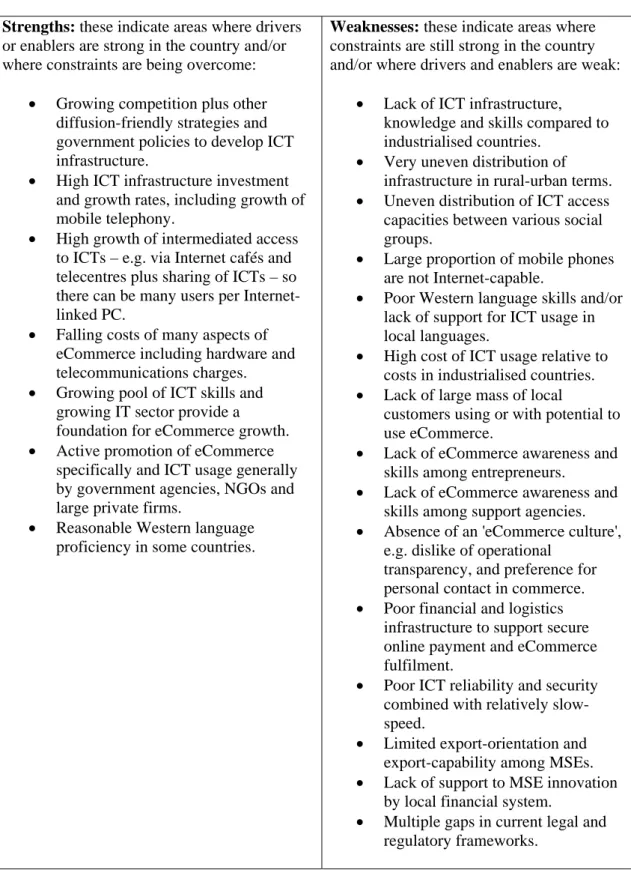
Table 1 summarises these and other points in a SWOT analysis of eCommerce in developing countries; an analysis that you can repeat for your particular region of responsibility to see what the overall prospects for eCommerce are.
Table 1. SWOT Analysis for eCommerce in Developing Countries Strengths: these indicate areas where drivers
or enablers are strong in the country and/or where constraints are being overcome:
• Growing competition plus other diffusion-friendly strategies and government policies to develop ICT infrastructure.
• High ICT infrastructure investment and growth rates, including growth of mobile telephony.
• High growth of intermediated access to ICTs – e.g. via Internet cafés and telecentres plus sharing of ICTs – so there can be many users per Internet-linked PC.
• Falling costs of many aspects of eCommerce including hardware and telecommunications charges.
• Growing pool of ICT skills and growing IT sector provide a foundation for eCommerce growth.
• Active promotion of eCommerce specifically and ICT usage generally by government agencies, NGOs and large private firms.
• Reasonable Western language proficiency in some countries.
Weaknesses: these indicate areas where constraints are still strong in the country and/or where drivers and enablers are weak:
• Lack of ICT infrastructure, knowledge and skills compared to industrialised countries.
• Very uneven distribution of infrastructure in rural-urban terms.
• Uneven distribution of ICT access capacities between various social groups.
• Large proportion of mobile phones are not Internet-capable.
• Poor Western language skills and/or lack of support for ICT usage in local languages.
• High cost of ICT usage relative to costs in industrialised countries.
• Lack of large mass of local
customers using or with potential to use eCommerce.
• Lack of eCommerce awareness and skills among entrepreneurs.
• Lack of eCommerce awareness and skills among support agencies.
• Absence of an 'eCommerce culture', e.g. dislike of operational
transparency, and preference for personal contact in commerce.
• Poor financial and logistics infrastructure to support secure online payment and eCommerce fulfilment.
• Poor ICT reliability and security combined with relatively slow-speed.
• Limited export-orientation and export-capability among MSEs.
• Lack of support to MSE innovation by local financial system.
• Multiple gaps in current legal and regulatory frameworks.
Opportunities: local, regional or global opportunities that are or may be available to eCommerce-enabled MSEs:
• Primary product export sectors such as agriculture, horticulture, fisheries, forestry and mining products.
• Manufactured exports.
• IT-based services that are readily traded over the Internet such as software, data entry, call centre operations, etc.
• Tourism and travel-related sectors.
• "Traditional" sectors with export market appeal such as handicrafts, textiles, art, natural medicines, etc.
• Fair traded goods, which are often sold via the Web in Western markets.
• Growing opportunity to leverage low labour costs.
• Strengthening local supply chains, and driving down input prices.
• Main export markets are OECD nations with already high levels of eCommerce.
• Main opportunities in early steps of eCommerce (see Section B1) including online ordering but offline payment.
• Large and young population profile, who may more-readily take to eCommerce.
• Domestic use of eCommerce using mobile networks and communications ('mCommerce').
• Diffusion of new generations of Internet-capable mobile phones.
• Plenty of 'virgin' markets providing opportunities for eCommerce first movers.
• Improved processes and
products/services through closer interaction with customers.
Threats: risks that face MSEs in the country specifically due to growth of eCommerce:
• Competition and penetration of local or existing export markets by eCommerce-capable overseas firms.
• Growth of larger firms able to invest more in eCommerce at the expense of MSEs.
• Increased disparities between few early adopters of eCommerce and many 'laggards'.
• Increased disparities between urban and rural areas.
• Wasted investments in eCommerce by early adopters.
• Growing automation leading to loss of low labour cost advantages.
Opportunity Analysis of B2B – B2C – B2G:
Beyond the general points summarised in the SWOT table, you can also analyse which of the three main types of eCommerce – B2B, B2C or B2G – offers most promise for your client group.
Now and in the future, the bulk of eCommerce for MSEs in developing countries is likely to be business-to-business – B2B – transactions. For larger MSEs, this may mean collaborating across a whole industry supply chain – sharing inventory
information, collaborating on product designs, etc. At higher levels of eCommerce, this will also mean connecting internal information systems with external systems (see Section B1). This will particularly happen where large local firms dominate supply chains and push their MSE suppliers and MSE customers to adopt
eCommerce. In some sectors in developing countries, such as consumer durables, it is estimated that almost 90% of procurement and 80% of business sales are already web-enabled – MSEs in these sectors must push on with e-commerce in order to survive. In other sectors and for smaller MSEs, though, both the current pressures and
opportunities for higher-level B2B eCommerce are far fewer. In these cases, opportunities lie only with the earlier eCommerce steps.
B2C (business-to-consumer) eCommerce offers greater opportunities for developing country MSEs at the lower level (e.g. use of simple messaging via mobile phone), but fewer opportunities at the higher level (e.g. selling goods and services online). Although transaction volumes for B2C are growing fast, the Internet is unlikely to become a key sales channel in any industry and the overall penetration is expected to remain below 1% of retail sales. Cultural factors and the current convenience of offline retailing are among the factors that will limit online sales.
Balanced against this message, though, are two aspects to B2C opportunity. First, the opportunities are far greater in some sectors than in others – telecom services,
consumer electronics, travel, automotive products and financial services have all been identified as good prospects for B2C growth. Second, if evidence in other countries can be followed, early movers can accrue a large share of the benefits that are realised through eCommerce. Early movers in eCommerce adoption are better positioned to keep the major share of cost savings and to build market share. Latecomers, on the other hand, can suffer significant erosion of their competitive positions.
Finally, MSEs should not ignore the B2G (business-to-government) market. Traditional means of procurement in the public sector are slowly changing in
developing countries, with pilots and then projects for 'eProcurement' starting to roll out. Some of these have an explicit intention to reduce barriers and enable more local MSEs to compete for government business. Entrepreneurs should therefore at least be alert to B2G's potential.
B. Small Enterprise On The Road To eCommerce
This section outlines the 'steps to eCommerce' describing the differing stages of eCommerce development that you may find in a small enterprise. It does this through a model and then presentation of six real-life case studies of small enterprises using eCommerce. The case studies show how enterprises are benefiting from eCommerce, as well as some of the pitfalls.
B1. Moving Up The eCommerce Ladder
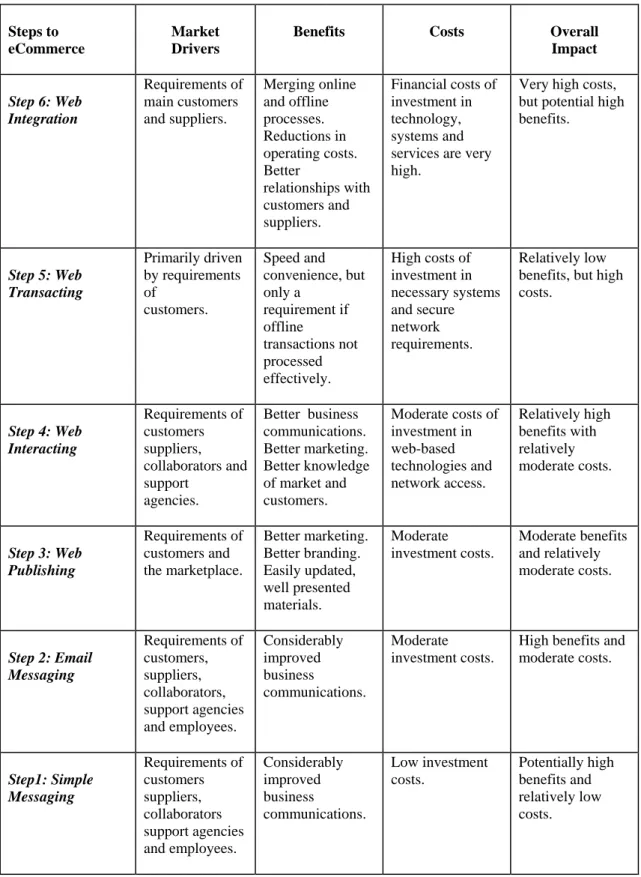
The 'steps' model can help you understand the different types of eCommerce business applications you may encounter. It may also help you to identify the types of
assistance you may provide to small enterprises.
Step 1. Starting Out: Simple messaging using mobile communications
Currently 'wireless' communications – including short messaging services (SMS) – provide a cheap and widely available option for enterprises. Mobile phones offer a number of key advantages over fixed line communications for small businesses – such as instant communications with customers and suppliers, even when on the move. They also provide greater connectivity and network coverage than landlines – users can be instantly connected by text messages and mobile chat – a powerful marketing and advertising tool.
Step 2. Getting Online: Email messaging
You can send or receive emails from a computer terminal either located on your business premises or via a facilitator (such as an Internet café or telecentre). Email is a cheap, quick and reliable way to exchange business information with customers, suppliers, and business contacts who are also connected to email. A variety of
information can be sent – not just messages, but documents, photographs, drawings, or any other computer data file (see Advice Sheet 2 for more information on email).
Step 3. Web Publishing
Web publishing can be used to make enterprise information available – by using an online brochure, for example. Its simplest form may consist of a 3-4 page website giving a basic business profile, some information about products and services, and contact information – physical and postal address, telephone and fax, and email contact. In a more advanced form it may include an online catalogue – an online version of a conventional catalogue that can be easily updated. Even a simple web presence offers the ability to access a wide – potentially global – market with 24/7 accessibility. (See Advice Sheet 4 for more information on creating websites.)
Step 4. Web Interacting
Web interaction will allow customers (for example) more scope to browse through images, descriptions and specifications relating to your products and services. It may allow them to submit email enquiry forms, to order online, to use online services or to use a shopping cart facility and order confirmation – that could be paid for and
fulfilled (delivered) offline. Interaction over the web can improve customer service and response to customer queries.
Step 5. Web Transacting
This can be termed as having a full eCommerce capability that covers the whole transaction process from the placing of an order to online payment for goods and services via secure networks. For B2C eCommerce this will involve making use of secure credit card payment systems, and for B2B eCommerce will involve payment through secure banking systems.
Step 6. Web Integration
eCommerce may also take on a wider role within a business through web integration. Web integration provides an electronic platform that links customer-facing processes such as sales and marketing (the "front office") with internal processes such as accounts, inventory control and purchasing (the "back office"). This is often called eBusiness or the business may be described as becoming fully "e-enabled". eBusiness links internal systems with external networks (customers, suppliers and collaborators) via the Internet. Integrating systems can make it easier and cheaper to do business, and it can encourage customer loyalty and repeat business.
Enterprise Case 1: Sedu Welding and Fabrication – eCommerce Step 1 Overview: A micro-enterprise run by a single entrepreneur producing fabricated metal products – windows, doorframes and beds – with two employees, and a turnover of about US$300-600 per year. The enterprise sells to local markets and serves many sectors including the construction sector, supplying windows and doorframes, and rural schools and hospitals supplying beds. The enterprise mainly sells to individual consumers and schools.
ICT Resources: The enterprise has a mobile phone which cost the owner US$80 and requires a monthly fee of at least US$4 of airtime to operate on the network. This enterprise has no financial support and depends solely on income generated and savings.
eCommerce Benefits:
• The use of a mobile phone has greatly improved business by enabling constant access to customers, even when the enterpreneur is away from his business site.
• Both customers and suppliers can be contacted giving an immediate response and direct communication that has tremendously cut down transport costs and given access to a wider market.
• The phone has helped him forge a personal relationship with clients for repeat orders.
• Suppliers can also be readily contacted.
• The enterprise has built use of the phone into its marketing strategy by distributing the phone number whenever possible via business cards and displaying it on finished products.
eCommerce Challenges: The phone itself does not bring challenges. As to further eCommerce steps, the business owner regards other ICTs (such as computers) as too expensive to use. Besides he does not know how to use them. He prefers to spend his resources on a cell phone as he could not risk being without one in his business.
eCommerce Support: The enterprise has not received any support except in the sense that the mobile network provider delivers the infrastructure required for the phone.
Lessons Learned: The phone should be available for use at all times of the day. Hence, it is advisable to join networks that do not charge a service fee. It is
important, therefore, to compare the packages that phone companies are offering in order to minimise costs and select a service that will meet your needs. Unfortunately he lost most of the numbers of his customers and contacts when his mobile phone was stolen – this reinforces the importance of keeping back-up records also.
Enterprise Case 2: Mukono Women's AIDS Task Force – eCommerce Step 2 Overview: MWATF is a self-help enterprise producing tree seedlings, vegetables and metallic stoves, employing sixty women, with a turnover of US$3,600. It serves the home market only. The vegetables are perishable so they only harvest when they can be sure of the market.
ICT Resources: The enterprise has no direct access to ICTs but uses a community telecentre that is located 2km away from their premises. They regularly use the telecentre landline phone that charges them US$0.25 per minute. They also use the email service to correspond and communicate with agencies in at home and abroad. They usually use the email services twice a week (costing US$0.025 per minute). Since the connections are slow it can take up to twenty minutes to complete their communication.
eCommerce Benefits:
• The telephone service is used to ascertain the market for their produce before they harvest or take their produce to market.
• The phone has saved both time and money, giving rise to better prices.
• Via email, they have been able to establish contacts with a number of new organisations and individuals who have subsequently offered assistance.
eCommerce Challenges: The computer currently provided at the telecentre are too few – just two for the whole local community – and also too slow. Slow transmission speeds also mean high costs for access.
eCommerce Support: MWATF has received support from the telecentre which has offered computer training to the staff and some members at a subsided rate. They have also assisted with training of the staff, and demonstrated how the Internet can be used to search for information. The telecentre also passes on messages to MWATF. Hence the telecentre is an important point of contact for the organization.
Lessons Learned: When using the telecentre users are encouraged to have letters typed beforehand and then just copied to send. This costs less compared with
composing a letter online. It is also important to use the telephone effectively to find out about the market or the prices before setting off to market – this is especially valuable if the market is far from the locality. The enterprise intends to install a phone at their premises that can be used by its members at a cheaper rate.
Enterprise Case 3: Adam Sons – eCommerce Step 3
Overview: The business makes machinery used in plantations such as machinery for processing coffee. They have nine employees, and recent annual turnover was US$126,000. Their main market is the home district but 5% of turnover comes from exports – they have been exporting machinery for five years.
ICT Resources: They have five landline phones and three mobile phones. In
addition, there is a single personal computer (PC) operating in the business for email, Web and other purposes. The PC has a UPS back-up system. Adam Sons also has created its own website.
eCommerce Benefits:
• They have attracted prospective clientèle and enthusiastic persons who have browsed through their website to get information regarding their coffee machinery units.
• They have received a number of visitors by ensuring that the site is listed on some main Web search engines.
• They have also found benefits as users of the Web; for example in finding information they needed about gasoline-powered generators.
• Email has been useful in saving costs when contacting external clients or suppliers; some orders are also received via email.
eCommerce Challenges:
• Climatic conditions in in their location can cause problems, including some unreliability of telecommunications.
• The high charges for airtime when using mobile phones.
• Problems upgrading website to obtain details of interested/prospective customers.
eCommerce Support: They have received no direct support, but the entrepreneur was motivated to make a website by a friend based in the US who said that this would help enhance the scope of the business.
Lessons Learned:
The entrepreneur states "Advertising in newspapers turns out to be expensive but if we have a website, we can just put the URL of the website in the newspaper – which saves a lot of space/money. Interested parties can log on to the net and find information about our business. Thus it should be on the agenda of every
entrepreneur to have a website". He also stated that customers are more enthusiastic about reputable companies and having a website gives weight to a company's
reputation. They plan to upgrade the website in order to add more transactional functionality to it, like a chat facility to allow one-to-one interaction with clients. They recommend seeking out a good network connection that offers attractive and less expensive packages. The entrepreneur would like to see government agencies supporting a website specifically for/about small enterprises, including a product catalogue displaying images with easy ways to order the products.
Enterprise Case 4: Star Café – eCommerce Step 4
Overview: This enterprise roasts, blends and packages coffee products and has 15 employees. The customer base is large since coffee is widely sold locally, including in rural areas. The enterprise supplies businesses, traders, supermarkets, restaurants, shops, and offices, with the local market making up 99% of turnover. The enterprise is planning to target the export market, and sees its eCommerce base as an important foundation for this.
ICT Resources: The enterprise has access to two computers with Internet access that were acquired in 2001/2002. It also has a fax and phones (both landline and mobile). The company has set up its own website that provides details of the products it offers.
eCommerce Benefits:
• 70% of the supermarkets and hotels that the enterprise supplies have email (though most other local customers tend to use the telephone to place orders). Email is a key tool to create or strengthen personalised relationships with major clients through faster communication links.
• Star Café has become better known and many new business contacts have been made through its website and email.
• The website has already demonstrated that it is a cost effective way to reach out to the export market. They estimate the costs for a network connection and designing and hosting the website to be about US$2500 per year.
• The enterprise also uses email for most business correspondence – this has proved to be a more efficient and cost-effective way of communication than non-ICT-based means.
eCommerce Challenges:
• Service breakdowns and slow dial-up Internet connections.
• High investment costs for the ICTs.
• Lack of sufficient know-how related to use of ICTs and their future development.
• Logistical requirements for the delivery of physical goods in order to fulfil electronic orders.
eCommerce Support: The enterprise has not received any support in the area of eCommerce. The company had its own in-house strategies to finance these ideas. The general manager indicated that once the benefits seem to justify the costs then an idea is considered.
Lessons Learned: Enterprises should apply cost/benefit analysis and determine if they really need the technology. Requirements need to be specified carefully and enterprises should shop around for different ways of solving problems in a cost
Enterprise Case 5: Kamal Bells – Elements of eCommerce Step 5
Overview: The business has 40 employees and was established in 1983. They manufacture machine and pressed metal components. Their customers are 100% home market but some export products containing their components are used in the motor industry. Their main customers are large motor engineering companies, and recent annual turnover was almost US$400,000.
ICT Resources: The company has four phones (two landline and two mobile) and three personal computers, one with an Internet connection. They make use of standard accounting software and a customised system for billing and invoicing. They use email but have no company website. However, they are able to transact online by make use of websites owned by suppliers or customers.
eCommerce Benefits:
• Access to a mobile phone is very useful to the CEO who is always on the move.
• Email has made communication much faster and easier
• They have registered with an export portal website through which they have received a lot of information from various similar units and clients from all over the world.
• They have saved time and money by completing transactions online. For example, from one major customer they received order details via email. They then used the customer website to fill in all necessary details about the order, enabling it to be processed electronically. All further correspondence was conducted via email so that the entire transaction was completed online.
eCommerce Challenges:
• Slow access speeds due to limited ICT infrastructure
• Lack of training in ICTs.
• Need to integrate basic business processes such as inventory and product lists with web-based tools.
eCommerce Support: The business has received support in the use of email and other aspects of eCommerce from one of their main clients, who are already experienced in using eCommerce.
Lessons Learned: There is a need for a continuous upgrading of technology. However, along with technology it is important the human element is retained in the unit; like the business owner says "each employee in my unit is treated like a family member, and we discuss various problems together". Hence, too, the human element must also remain in dealings with suppliers and customers. Location is also
important: they have benefited from being located alongside heavy ICT-using enterprises.
Enterprise Case 6: Project ToeHold – Getting to eCommerce Step 6 Overview: ToeHold manufactures and markets traditional leather slippers and sandals. These are manufactured by artisans of a local marginalised community Established in 1999, it is run on a cooperative basis with eight full-time employees. ToeHold's customers are mainly shoe shops and boutiques in Australia, Japan, Italy and other countries.
ICT Resources: The company has three computers at its head office and one in the manufacturing centre. ToeHold communicates with its customers and its own manufacturing unit via email. Its website contains a catalogue of its products and customers are able to browse and purchase its products via the integrated shopping cart application.
eCommerce Benefits:
• Workers in the villages are able to speak to their head offices via mobile telephony. Decisions get taken faster and more cheaply, removing the need for travel. Decisions also get communicated down the line more quickly and cheaply.
• Requests are received via email and company representatives follow up with a quotation. Clients also use email to send in suggestions, alterations and photographic evidence of damage/faults in products that might need
replacement. This helps ToeHold improve the quality of their product design.
• Orders are received via the website that would otherwise be very unlikely to come: ToeHold's export ambitions would have been very difficult to fulfil without eCommerce.
• A management information system keeps track of customers and predicts their buying patterns. This helps the enterprise to optimise their leather and
accessories purchases and keep inventory levels low.
eCommerce Challenges: Power supply remains erratic in the villages, which can sometimes undermine use of email. Internet connectivity is also limited in rural areas and finding trained staff is difficult. ToeHold is also concerned about retaining the intellectual property rights of its original designs – showcasing these designs on the web means they could be copied by others.
eCommerce Support: A local ISP offered a free template-based shopping cart application. Donor agencies have also provided ToeHold with computers and software at subsidised costs.
Lessons Learned: A digital camera is useful as images of new products or test designs can be edited and uploaded quickly onto a website, and images are an
C. eCommerce Support
For enterprises seeking to climb the steps to eCommerce it will be as important to understand their business strengths and weaknesses, as it will be to understand the opportunities presented by new technologies. Your agency will need to have a clear understanding of the business environment in order to assess the type of eCommerce support that will be most appropriate for your client enterprises.
This section provides a model of the different types of support that are being provided to small enterprises, and presents five case study examples of support. It then
suggests how your agency might go about improving the analysis of enterprise support needs for eCommerce.
C1. Different Types of eCommerce-Related Support
This model describes five different types of eCommerce-related support that agencies can provide to enterprises:
1. No Support
There may be a case for offering no eCommerce support to clients or members. It may be for any of the following reasons: a) The enterprise may not fulfil your particular criteria for offering support. b) The enterprise may already be operating eCommerce successfully. c) You may want to refer the enterprise to a different agency or facilitator. d) The enterprise may not yet be ready for eCommerce.
2. Awareness Raising
Most small enterprises in developing countries are at the stage of eCommerce development where awareness raising is likely to be of greatest benefit. Awareness raising should seek to develop a business-led approach that examines the potential costs and benefits of eCommerce in relation to overall business goals and strategies, and in the full knowledge of the commercial realities of the market.
Awareness raising for eCommerce should not, in the first instance, seek to stimulate the use of ICTs but should examine the actual information and communication needs of the enterprise. Awareness can be created through the use of case studies and with reference to current best practice for enterprise development more generally.
Awareness raising methods may include handbooks such as this one, workshops, award schemes or possibly web-based material – although the ability of your target audience to access web-based material must be gauged.
3. Training
It is unlikely that your agency will provide dedicated training courses for eCommerce. It is preferable that training for eCommerce is integrated with existing training
courses and programmes in order that eCommerce strategies can be seen in the context of the wider solutions to business problems – for example, integrating
eCommerce aspects into a course on marketing. For specific eCommerce skills (such as use of email or free software, for example) it would be preferable to work through private sector training agencies. Awareness raising strategies should also be fully
integrated into 'training of trainers' for small enterprise development programmes. This handbook could provide a useful conduit for that purpose.
4. Business Support Package
Agencies that already run business support packages – dealing with training, finance and advice – will need to integrate eCommerce support into these wider programmes. In fact, this integrated approach is a preferable option. Customised support for
eCommerce, however, may be preferable when focused on individual enterprises or sectors where specific eCommerce needs have been carefully identified.
5. Trading Portal
The most direct form of eCommerce intervention for an agency would be through the provision of a trading portal or some other form of web-based marketing or
information assistance for client enterprises. Some agencies, of course, already act as market facilitators providing marketing assistance and may purchase and resell goods and services on behalf of client enterprises. The use of a trading portal can be seen as an extension of this, and there may be benefits for agencies in developing their own eCommerce capacities. However, web-based approaches need to be considered on a strict cost/benefit basis in comparison with other more traditional avenues of
marketing and trading. In addition, such investments should take full account of the requirements for a needs-based approach set out in Section C2.
Rather than setting up their own web-based marketing, agencies should first consider the following approaches.
• Facilitating access to existing portals.
• Working through and coordinating with other web-based facilitators.
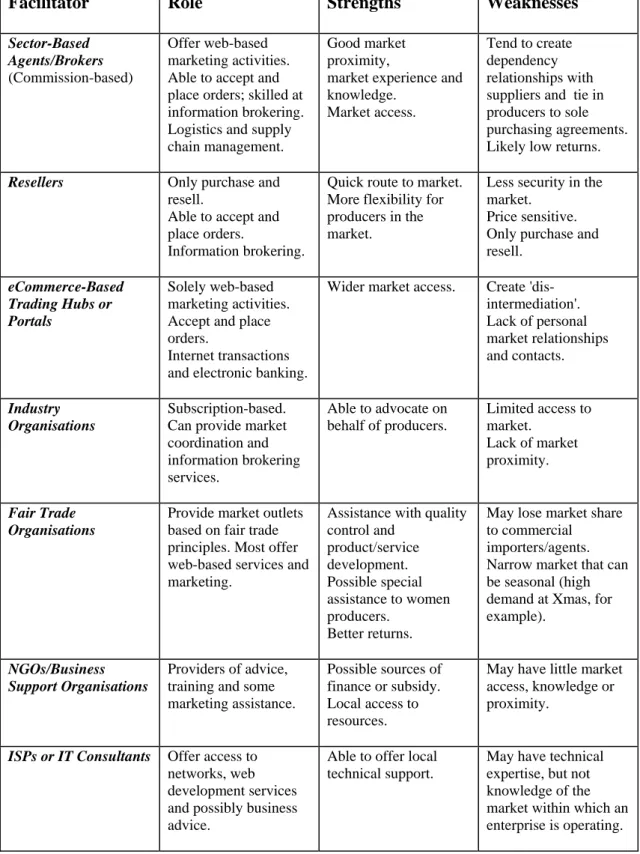
• Helping clients work through trusted third parties and other private sector trade facilitators (Table 4 provides a list of possible eCommerce facilitators).
The following case studies provide examples of current practice in developing
countries for eCommerce support to small enterprise, including 'for profit' and 'not for profit' agencies. Each of the case studies provides examples of one or more of the eCommerce support categories outlined above.
Agency Case A: Makerere University Small Business Centre
Overview: The Small Business Centre (SBC) was established in 1998. It is a commercial government agency that is largely self-funding and has three permanent staff and 15 part-time facilitators. Its aim is to promote an enterprise culture and support the creation and development of small businesses, targeting both students and MSE entrepreneurs for training.
ICT Resources: SBC has access to a lab of 30 computers based in the University's Business School, though most communication with clients is undertaken via phone or post.
Support for eCommerce: SBC offers a wide range of enterprise-related training courses such as business start-up, retail management, costing and pricing, and customer care. Training is carried out in both local language and English and, two weeks after course end SBC staff carry out a follow-contact with the client by phone or visit. Within some of the training courses, participants are able to pick up some knowledge of ICTs, though there are no specific eCommerce-related training courses.
Provision of eCommerce training would face some basic challenges including lack of awareness of eCommerce and lack of access to ICTs among participants, plus a more general lack of value attributed to training by entrepreneurs. This prevents high fees being charged for training, leading to financial constraints on SBC (thus restricting opportunities for development of eCommerce facilities and training).
Reflections On Best Practice: eCommerce needs to be approached with some care given the very limited base and demand locally – understanding eCommerce-related needs requires careful research on pros and cons including the use of cost-benefit analysis. At the current time, the need is for awareness raising and training on
eCommerce for agency staff before those staff can themselves think of trickling down skills to enterprises. On the question of use of eCommerce by the agency itself, one can readily create a website detailing the support that is on offer but the impact would be debatable since most of the target clientele cannot access the web. Use of mobile phones and, perhaps, email would be a more viable first step in strengthening
Agency Case B: Business Uganda Development Scheme for Small-Scale Enterprise
Overview: BUDS-SSE was founded in 2000 and now has six full-time workers, drawing co-funding from the European Union. Its main focus is the acquisition of technical skills by enterprise personnel through training in order to increase the capacity and performance of small enterprise. It provides enterprises with a grant equivalent to 50% of the cost of its business diagnostics and training provision services.
ICT Resources: These include a local area network of PCs with an Internet link plus services such as email. They are in the process of developing a website that will include a facility for online preliminary applications from entrepreneurs. BUDS-SSE itself makes use of the Internet for business information, donor correspondence and dissemination of information.
Support for eCommerce: The agency includes an assessment of ICT/eCommerce needs within its general initial assessment of enterprises based on the proposals that entrepreneurs present. This is usually followed by a diagnostic evaluation of the enterprise to determine what kind of support can be provided. Any ICT support provided would likely have some eCommerce angle – for example, BUDS-SSE has provided assistance on setting up a website, ICT outsourcing, and Internet marketing. In the main, BUDS-SSE focuses just on awareness raising and skills acquisition through training.
Support for eCommerce faces some quite severe challenges. Local entrepreneurs have limited access to ICTs and those with a phone and fax are reluctant to advance beyond this stage. Entrepreneurs have limited ability to analyse their own business situation, thus finding it hard to see how eCommerce would fit in. More generally, there is a lack of appreciation of business development services and a lack of finances, which make it difficult for agencies themselves to expand or innovate into areas like eCommerce.
Reflections on Best Practice: BUDS-SSE backs the idea that, where needs fall beyond their mandate, they would call on other agencies to provide eCommerce assistance. This good theoretical idea, though, faces the practical challenge that there are few local agencies that can provide eCommerce-related assistance. They see awareness raising and skill building as the main eCommerce priorities at present for most small enterprises. They do see eCommerce playing a role for small enterprise but caution that this must be based on a sound diagnosis of the enterprise – its needs and its capacities. There is no point ploughing ahead with purchase of ICTs if the enterprise lacks key foundations necessary for fulfilment, such as an ability to delivery the right quality and quantity of outputs that eCommerce-developed
Agency Case C: Association of Women Entrepreneurs of Karnataka
Overview: AWAKE is a non-commercial organisation with five full-time employees. Its main clientele are women entrepreneurs of whom 80% are below the national poverty line. It focuses on supporting new and established enterprises with programmes to help enhance the quality of enterprise operations via management counselling/advice and training courses.
ICT Resources: AWAKE has seven PCs that are linked together and to the Internet. They have their own website that they guide email-based enquirers to. The site also has membership forms that those with Internet access can print, fill and post back. They make use of email for contacting clients, including those in remote areas with access to telecentres, thus saving time and money on communication.
Support for eCommerce: AWAKE has acted as an ICT-enabled information intermediary supporting commerce. In one example, AWAKE staff wanted to support clients in one area growing vanilla beans. They undertook a web search and gathered information on ways to add value to basic farming by processing the beans into vanilla essence. This information was distributed to clients who now sell vanilla essence rather than simply lower-priced beans. AWAKE has made a basic start on web-enabled eCommerce by providing on its website a list of all its client
entrepreneurs and their activities. AWAKE has also conducted training for
eCommerce, leading some of the entrepreneurs to create their own website that has allowed direct customer links.
Reflections on Best Practice: AWAKE's eCommerce-related support in the future will definitely be enhanced because entrepreneurs are becoming increasingly interested in ICT-enabled business. Within AWAKE's own interactions with its clients, though, there is seen to be a continuing need for face-to-face interaction. This must have not just a rational side, dealing with advice and counselling on business, but also an emotional side as well. Only through making this emotional connection can AWAKE properly deliver the business messages – including those related to eCommerce – that it wants to get across.
Agency Case D: Explocity
Overview: Explocity is a private company with 100 employees, providing information-related services (branding, advertising, marketing, etc) to the small business sector on a fully fee-paid basis.
ICT Resources: Explocity has its own PCs and hosts a main website, based around an open source platform provided by a local IT consultancy. As noted below it also provides links to the ICT resources and services of other providers.
Support for eCommerce: Explocity's central service is the provision of a combined soft-and-hard copy portal of information about its client enterprises, for use as a marketing tool. Clients provide information on their businesses to Explocity which packages that information in two forms. First, as a section of the main website which Explocity designs, builds and hosts. It provides various value-added facilities on this site: mutual links to major commercial portals to bring in more web traffic; search and other interactive facilities to encourage potential buyers to use the site; a mobile phone service link that can provide news updates, contacts and local information from the main website to mobile phone users; and chat/instant messaging services for use by Explocity's own entrepreneur clients and by buyers who might wish to contact them to purchase goods and services. Second, all information from Explocity's clients is printed as a magazine – this comes out every 15 days with the same information being updated at the same time onto the website. The magazine is then circulated through appropriate channels to likely buyers – both businesses and individuals.
Reflections on Best Practice: The main lesson from Explocity's experiences is the need to avoid getting carried away by the hype surrounding eCommerce. Explocity had assumed in the late 1990s that the website would become the main focus for marketing and income, but this has not proved to be the case. The printed edition of their output still generates by far the major source of their revenue, and the same is true for the small enterprises that use their services. Although the web-based service is not seen as loss-making, it has certainly not generated the initially-anticipated revenues. Lower-than-anticipated take-up of web-based eCommerce is seen as due to lack of incentives for buyers to change their habits, limits on ICT access, and lack of credit card usage among the local population.
As an example, one of their clients runs a flower delivery service. To date less than 10% of its orders have come via the online route. Existing customers and traditional marketing remain its mainstays. The value of the website is thus more to act as an 'electronic brochure' rather than as a source of direct purchases. This seems to be the model for most enterprises except where the enterprise can deliver its outputs in digital format, which most MSEs using the Explocity service cannot. Hence, any approach to eCommerce must be 'twin-track': retaining a strong focus on traditional
Agency Case E: Matex
Overview: Matex is a private firm that employs around 45 people and provides business support and brokering services to fee-paying clients, 88% of which are small enterprises.
ICT Resources: Matex runs its own web-based trading exchange, MatexNet, which it began in 1999. This is hosted on Matex's main server which links to PCs in various branch offices.
Support for eCommerce: Matex offers an online exchange that connects large-scale industries and micro/small enterprises together. Large industries sell surplus and scrap items to the MSEs. The MSEs can sell their finished products to the large industries. The idea is that middlemen are eliminated because the online exchange allows direct one-to-one trading. MatexNet also has an online auction service for those items that are best sold to multiple buyers.
Matex's CEO explains: "Companies have a surplus of inventory build-ups of machinery and goods which are in excellent condition but unusable due to design changes, plant upgradation or excess production – these are inevitable in any manufacturing system. These companies are usually the large ones, and the surplus blocks space and money. And as other people in small firms require this inventory, but don't know where to get them, this is where MatexNet steps in, providing a matchmaking service".
Firms register with MatexNet online and can then list or search for items for trade – Matex had a client base of around 2,000 firms with about 200,000 traded items listed. Buyers or sellers can find the information themselves via the website, plus Matex itself scouts for appropriate traders using email, fax and phone calls. Initial
information for a trade is obtained from the website and the buyer—seller pair make initial contact via email. The remainder of the transaction is then undertaken offline with Matex charging both buyer and seller 2.5% of the traded value. Matex also has consultants who can suggest ways to add value to particular purchases.
Reflections on Best Practice: Benefits of online trading for MSEs are direct cost saving, provision of both a sell and buy facility, reduced overhead and labour costs, transparency, accessibility and speed. The main barriers are building trust and verification of MSEs. Skills are also important – there is a need for both suppliers and vendors to receive sufficient training in the use of web-based trading systems, online auctions and the workings of eCommerce.
Matex also notes limits to its online, disintermediated model of eCommerce.
Middlemen do still get involved in some trades in order to try to negotiate better rates on behalf of buyers. Likewise, although what MatexNet provides is essentially a virtual domain, a large part of the interaction is done personally. It is thus necessary to mix the personal with the virtual for the success of eCommerce.