Multiple Yard Cranes Scheduling Model and
Algorithm in the Mixture Storage Block
Hongxing Zheng1 , Kai Yu1 , Chuang Tu1
1Transportation Management College, Dalian Maritime University, Dalian, China 1Email: [email protected], [email protected], [email protected]
Abstract—In order to improve the operating efficiency of mixture storage yard, the problem of multiple yard cranes scheduling (MYCS) must to be solved. The paper develops a multiple yard cranes scheduling MIP model in order to minimize the sum of trucks’ waiting cost and yard cranes’ moving cost. An important feature is that the future has to be taken into account: the interference between two yard cranes, and the priorities of internal and external trucks, and the different arrival time of trucks and other factors. The study proposes an improved genetic algorithm (GA) to solve the MYCS problem and verifies the performance of algorithm by two numerical examples. The experimental results indicate that the proposed scheduling model is superior to the traditional scheduling and the algorithm is practically meaningful.
Index Terms—Port container terminal, Mixture storage mode, Multiple yard cranes scheduling, Task allocation, Service sequence, Improved Genetic Algorithm
I. INTRODUCTION
Currently, the competitions between port container terminals are increasingly fierce. So the research of how to improve the operational efficiency and effectiveness of yard is increasingly getting the attention of all parties. Yard crane (RTGC) scheduling optimization is one of the key factors, especially for the container port in the mixture storage mode. Firstly, the yard crane’s operational efficiency is one of the main bottlenecks affecting the operating capacity of yard. Low operational efficiency will lead to idle quay crane, then cause the excessive occupancy of the berth. Secondly, because, different yard cranes cannot be spanned and must have a safety distance in the same block, unreasonable yard crane scheduling can reduce the rate of the yard crane’s utilization and increase the operating cost. Finally, the unordered scheduling of yard cranes and lacking of discrimination between internal and external trucks will lead to the decline of Customers’ Satisfaction-Degree.
With the increasing trade quantities of port container terminals and constraints of yard’s space resources, a majority of container ports use the mixture storage mode to store. And there have been many scholars studying the
port container terminals in the mixture storage mode. L.M. Gambardella et al. proposed a solution to the
problems of resource allocation and scheduling of loading/ unloading operations in a container terminal. The allocation of quay cranes and yard cranes, and a scheduling problem of each allocated crane were
conquered by simulation method. But, the scheduling plan may be affected by external trucks was not considered [1]. Chuqian Zhang et al. study the storage space allocation problem in the storage yards of terminals. They solve the problem using a rolling-horizon approach. For each planning horizon, the problem is decomposed into two levels. First level to balance workloads among blocks, and the second was used for determine vessel berthing locations. However, the research neglected yard crane scheduling problem [2]. Wang Bin studied the optimal method to allocate the import and export random quantity in the rolling time and made the operation containers getting reasonable configuration [3]. Haigui Kang et al. in order to raise the allocation effectiveness and utilization rate of storage space by using integer programming method basing on rolling plan. Ligo was used for solve the problem, However, lacking an efficient algorithm to search for a globally good schedule [4]. Similarly, Hongxing Zheng et al. in order to raise the allocation effectiveness and utilization rate of storage space. The paper built an assigned optimizing model of the containers with the objective of minimizing the number of new pressed containers, and designed the corresponding heuristic algorithm. But, they just study the problem of container slot allocation independently; the trucks and yard cranes were not mentioned [5].
Regarding MYCS, W.C. Ng and K.L. Mak in order to ensure a high terminal throughput, the paper studied the problem of scheduling a yard crane to perform a given set of loading/unloading jobs with different ready times. A branch and bound algorithm was proposed to solve yard crane scheduling problem. The work was very meticulous, but just one yard crane was studied [6]. Considering more realistic constraints, Wenkai Li et al. built a multiple yard crane scheduling model and used heuristics & rolling-horizon algorithm to solve the model. However, the trucks’ arrive times were overlooked by them [7]. Matthew E.H. Petering et al. built yard cranes real-time control system for the sake of increasing quay crane work rates to remain competitive. They analyzed the system by simulation instead of some algorithms [8]. Meilong Le et al. were absorbed in the process of yard cranes loading of export container groups. So a multiple yard cranes scheduling MIP model was developed in order to minimize the total handling time of the all yard cranes including the travel time, the setup time at each yard-bay and the container handling time. Whereas external and internal trucks were not integrated into the study [9][10].
These researches above mostly are focused on space allocation based on mixture storage. However, in mixture storage mode, there are few researches about YCS. Therefore, this paper develops a novel MYCS model to promote the efficiency of mixture storage yard. Some novel factors in the MYSC model are as follow:
(1) The time of trucks arrive at designated location. (2) The external trucks may affect the scheduling. (3) The upper bound of waiting time.
(4) The priorities of internal and external trucks. At present the majority of port container terminals in China adopt assortment mode to stack. But there are also a few ports choosing mixture storage mode to improve space utilization. In mixture storage block, the types of containers are different. The operating time and requirements of internal and external trucks are also different, which leads to the high frequency of yard crane loading and moving. So in a certain period of time, a single block may need more than one yard crane (usually not more than three YCs) to satisfy the customers’ demand and reduce operating cost. Therefore the study about MYCS is very essential to port container terminals.
In the single block of mixture storage, since the slot task and the arrival times of container trucks are known during a period. This paper focuses on allocating tasks to each yard crane reasonably, and giving the Loading/ unloading sequences of each yard crane to minimize the costs of truck waiting and yard crane moving.
II.MULTIPLE YARD CRANES SCHEDULING MODEL A. Assumption
1)All the slots of tasks are known.
2)During a period of time, the tasks that matched with the container trucks’ arrival time are predictable. 3)Only when corresponding container trucks are in place,
loading/unloading tasks can be started.
4)Yard cranes can't span each other and need a safety distance between them.
5)When the external container trucks’ waiting time exceeded the upper limit, its service priority is higher than those internal container trucks whose waiting times are not beyond the upper limit.
6)When those internal container trucks’ waiting times have exceeded the upper limit, they have the highest priority, and yard cranes must serve for them.
B. Model Formulation
In the mixture storage mode container ports, a single block can equip three yard cranes at most and two yard cranes in general. Considering the objective and constraints are basically the same in the two types above, this paper constructs a MYCS model for a single block. Firstly, the parameter description of the model is given, and then the scheduling objective and the main constraints are put forward. Finally, the different constraints for the three yard cranes and two yard cranes are given out.
In the model, the following notations are used:
Xim the ID of the task which yard crane m ith loads/ unloads.
Km the number of tasks which loaded/ unloaded by the yard crane m.
r(Xim) the container truck’s arrival time of task Xim. h(Xim) the time of yard crane m takes to loads/ unloads task Xim.
t(Xim) the moment of yard crane m accomplish task Xim.
W(Xim) the type of container truck corresponding to task Xim (while task Xim is carried by internal container truck, W(Xim)=1. otherwise W(Xim)=0).
C(Xim) the waiting cost of task Xim per unit time (while W(Xim)=0 & the waiting time is under 30 minutes, C(Xim)=0. while W(Xim)=0 & the waiting time exceeds 30 minutes, C(Xim)=C1. while W(Xim)=1, C(Xim)=C2).
λij is a binary variable (while j=i+1, λij=1. otherwise
λij=0).
d(X(i-1)m,Xim) the time span which one yard crane takes to move from task X(i-1)m to task Xim.
B(Xim) the bay number of task Xim located.
B(X0m) the location of yard crane m at the beginning of a planning period.
Sim the moment of yard crane m starts to carry out task Xim.
Y the bay number which the yard crane m′ is located at time Sim.
B0 the total quantity of bays in a block.
bsafe the number of safety bay between adjacent yard cranes.
t(X0m) used to define the initial system moment, and t(X0m)=0.
d(X0m,X1m) the time span which yard crane m takes
to move from initial position to the first task.
T1 the waiting time of each internal container truck
can endure.
T2 the waiting time of each external container truck can endure.
M a Infinity positive value.
C0 the yard crane’s moving cost per unit time. V0 yard crane’s moving velocity.
l0 the length of one bay of block. m the IDs of yard cranes.
m0 the number of yard cranes in a block. n the number of tasks in a block. Decision variables: Xim,Km
The Mathematical model presented as follows. Objective function:
Min C X ∗ t X h X r X 30 ∗ W X
Min② C ∗ d X , X
Subject to:
t X h X r X , m 1,2 … m , i 1,2 … … K (1)
Constraint (1) ensures that the complete time of any task cannot be earlier than the sum of task arrival time and handling time.
t X t X d X , X h X 1 λ ∗ M,
Constraint (2) ensures that the relationship of complete time between the former task and the later task.
t X h X max t X d X , X , r X
m 1,2 … m , i 1,2 … K (3) Constraint (3) is the equation constraint among the task complete time, container trucks’ arrival time and handling time.
d X , X ∗ l ,
m 1,2 … m , i 1,2 … K (4) Constraint (4) is the equation constraint of time which a yard crane takes to move from one task to the next.
X X , m 1,2 … m ; i j i, j 1,2 … K (5)
X X ,
m 1,2 … m ; i j i 1,2 … K , j 1,2 … K (6) ∑ K n , m 1,2 … m (7) Constraints (5) (6) (7) ensure that a task can only be handled once by one yard crane.
S t X h X , m 1,2 … m , i 1,2 … K (8)
Constraint (8) is the equation constraint to ensure the task’s complete time equal to the operating time span plus the task’s beginning time.
C X ∈ 0, C , C , m 1,2 … m , i 1,2 … K (9) W X ∈ 0,1 , m 1,2 … m , i 1,2 … K (10) Constraint (9) (10) is the requirements of variable value.
t X h X r X T , W X 1
T , W X 0,
m 1,2 … m , i 1,2 … K (11) Constraint (11) ensures that every truck’s waiting time can't exceed the corresponding limit.
T T 0 (12) C , C , C , l , B , V , b 0 (13) λ ∈ 0,1 , m 1,2 … m ; i, j 1,2 … K (14) Constraints (12) (13) (14) are the restrictions of parameter value.
Y ′ ∈ 1, B , m 1,2 … m , i 1,2 … K (15) Constraint (15) ensures that yard crane can’t move beyond the range of block at any time.
X ∈ 01,02,03 … n , K ∈ 1,2,3 … n 1 ,
m 1,2 … m , i 1,2 … K (16) Constraint (16) is the constraint of decision variable values.
The above formulas are the public part of MYCS model in a block.
When there are three yard cranes working together in a block, five constraints must be increased to satisfy the safety distance between yard cranes and ensure they will not span each other, which are shown as the following five.
B X X X (17) Constraint (17) ensures the positions of three yard cranes at scheduling initial time are right.
1 B X Y b , i 0,1,2 … K (18) Constraints (18) means the range of the left yard crane can arrive at the moment Si1.
Y b B X B , i 0,1,2 … K (19) Constraint (19) means the range of the right yard crane can arrive at the moment Si3.
Y b B X Y b , i 0,1,2 … K (20) Constraint (20) means the range of the middle yard crane can arrive at the moment Si2.
m 3 (21) Constraint (21) means the operational yard cranes IDs. When there are two yard cranes working together in a block, four constraints should be increased to satisfy the safety distance between yard cranes and ensure they will not span each other, which are shown as the following four.
B X X (17) Constraint (17) means positions corresponding to the two yard cranes at the scheduling initial time.
1 B X Y b , i 0,1,2 … K (18) Constraints (18) means the range of the left yard crane can arrive at the moment Si1.
Y b B X B , i 0,1,2 … K (19) Constraint (19) means the range of the right yard crane can arrive at the moment Si2.
m 2 (20) Constraint (20) means the operational yard cranes IDs. In above model, the first objective ensures the total waiting cost of trucks minimum. The second objective ensures the total yard cranes’ moving cost minimum. In order to solve the multi-objective problem, this paper will set weight in the algorithm for two objective (which depend on the decision maker's preferences or the port specific conditions in the actual work), set the two objectives’ weighted cost as the individuals’ objective value in improved GA.
III.MULTIPLE YARD CRANES SCHEDULING MODEL Considering the features of the above model, the paper uses the improved genetic algorithm to solve the model. The specific algorithm is as follows.
A. Encoding Method
The MYCS can be served as the way that assign tasks between every yard crane and determine the loading and unloading tasks’ sequence of every yard crane. This paper adopts real-number to encode. The length of chromosome is the number, which sums the number of tasks and the number of yard cranes, and then subtracts one. The gene is “0” representing the space character between different yard cranes. The basic structure of the chromosome is shown in Figure 1 and Figure 2. Figure 1 shows chromosome with 10 loading/unloading tasks by two yard cranes. Figure 2 shows chromosome with 10 loading/ unloading tasks by three yard cranes.
Figure 1. Chromosome show (2 YCs)
Figure 2. Chromosome show (3 YCs)
B.Generate Initial Population
To generate the initial population, the constraints (5) (6) (7) must be satisfied to ensure the generated chromosomes being without repeated genetic value. It also ensures all yard cranes in the block to participate the operation. When there are two yard cranes, it must guarantee that the gene “0” cannot be at the beginning/ end of the chain. Being three yard cranes, it must ensure that there are two genes “0” in the chromosome and the gene “0” cannot be at the beginning/ end of the chain. And two genes “0” cannot adjacent, which avoids that the generated chromosome is meaningless.
C. Calculate The Fitness Values
The fitness value function of individuals derives from the individual (chromosome) objective value. When the individual scheduling scheme cannot be implemented, namely yard cranes are spanned or interfered. This individual fitness value will be distinguished. As the following formula:
Fitness[Xi]= , Did not occur spanning or interference 0, otherwise Considering the constraint (11), we introduce a penal rule when calculating f(Xi) in the algorithm. The specific measures is that when the individual scheme contains internal or external container trucks exceeding the corresponding upper limit, the individual objective value will be added a value of “M0” (a greater positive value) as the punishment.
D. Selection Process
When yard cranes in a block are operated at the same time, the population of each generation will have many individuals’ scheduling schemes, which may occur spanning or interference. In order to avoid selecting these individuals, the author adopts the following selection process:
Step 1: selecting an individual from the current population at random, dialing a roulette wheel to generate a random number.
Step 2: if the current individual can satisfy the selected conditions and the corresponding scheme are not spanned or interfered, the individual will be put into the cross-pool, or else return to Step 1.
Step 3: checking the number of selected individuals, if the number reaches the capacity of population, the selection process will stop. Otherwise, return to Step 1. E. Crossover Process
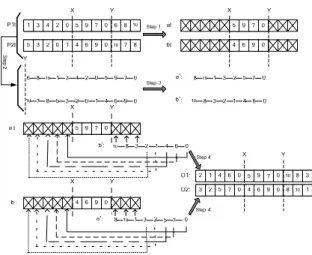
According to the feature of chromosome, this paper uses the order crossover, which is shown in Figure 3 and Figure 4. The specific measures are as follows:
Step 1: randomly selecting two intersection points “X” and “Y”, then determining the genetic fragment copied to the offspring from the two parent bodies and initially obtain two incomplete offspring “a” and “b”.
Step 2: after the second intersection point “Y”, presenting the original genetic code sequence from two parent bodies, then obtaining the genetic code arrangement of two parent bodies.
Step 3: deleting the genetic code that has been copied to the offspring from genetic code arrangement of two parent bodies, then respectively obtaining the arrangements a’ and b’.
Step 4: for “a”, from the second intersection point, the genetic code of arrangement b’ will be put to corresponding genetic location from left to right, and then replace the “X”. For “b”, repeating the operation, and then obtaining two complete child bodies.
When there are three yard cranes in the block, chromosome will have two “0”. So it is needed to remove too many “0”, which leads that the length of individuals is not same. To avoid this mistake, paper adopts the rule of “delete the first repeated gene”.
F. Mutation Process And Termination Rules
The traditional genetic algorithm has only one mutation operation, and each gene value can vary in a given range. While in this paper except for space character, the gene value cannot be repeated. Traditional mutation operation is unable to realize the change of assignment and sequence of tasks. So this paper designs a improved mutation operator, as follows:
The first mutation adopts “inversion mutation” to realize the change of assignment of tasks between yard cranes. Namely selecting two tasks from two different yard cranes and then switching the positions of the two tasks, as shown in the Figure 5.
The second mutation uses the “mutation of changing order” to change the sequence of loading and unloading tasks of a certain yard crane. Namely selecting one yard crane from the chromosome, and then selecting two genes from the corresponding task sequence of the yard crane to switch the positions, as shown in the Figure 6.
When the iterations reach to the preset-value, the algorithm is terminated.
Ⅳ.NUMERICAL EXAMPLE ANALYSIS A. Example Description
In two hours, the paper designs two examples for a mixture storage block of a container port. Example 1 is
that two yard cranes are responsible for 22 tasks, and in the example 2, three yard cranes are responsible for 30 tasks. Task conditions in the block of two examples are shown in TABLE I and TABLE II. Parameter values of two examples are shown in TABLE III and TABLE IV.
TABLE III.
PARAMETER VALUES OF EXAMPLE 1 Parameter V0(m.
min-1) l0(m) T1(min) T2(min) Cmin0(yuan.-1) Cmin1(yuan.-1) Cmin2(yuan.-1) B(X01) B(X02) bsafe α
Value 120 7 10 60 60 100 5 5 20 1 0.4
TABLE IV.
PARAMETER VALUES OF EXAMPLE 2
Parameter V0(m.min-1) l0(m) T1(min) T2(min) C.min0(yuan-1) Cmin1(yuan.-1) Cmin2(yuan.-1) B(X01) B(X02) B(X03) bsafe α
Value 120 7 10 60 60 100 5 5 13 25 1 0.4
TABLE I.
TASK CONDITION IN THE BLOCK OF EXAMPLE 1
Task number Bay RT(min) time (min)handle Tasktype Task number Bay RT(min) time (min) handle Task type
1 7 2 6 0 12 27 49 4 1 2 21 5 2 1 13 16 52 2 0 3 13 8 3 1 14 12 55 3 1 4 24 14 2.5 1 15 17 59 1.5 1 5 10 19 4 1 16 25 65 2 0 6 4 23 3 0 17 11 70 2 1 7 11 28 2 1 18 20 77 3 1 8 7 32 3 1 19 22 79 3 0 9 9 37 4 1 20 13 85 4 1 10 17 41 2.5 0 21 12 89 3 1 11 13 45 3 1 22 16 97 6 1
RT:“45”means the truck arrives working position at the 45th minutes(Initial time is 0). Task type: “0” represent external container truck,”1” represent internal container truck
Figure 5. Inversion mutation Figure 6. Mutation of changing order Figure 4. Crossover process (3 YCs) a’: 8 10 1 3 2 0 5 7 b : 4 6 9 a : 5 9 7 1 3 4 2 0 5 9 7 6 810 P1 5 3 2 0 1 4 6 910 7 8 P2 X Y 6 8 10 1 3 4 2 0 5 9 7 107 8 5 3 2 0 1 4 6 9 Y X Y Step 1 Step 3 X Y X Step 4 Step 4 2 0 1 4 6 5 9 7 10 8 3 O1: 3 2 0 5 7 4 6 9 8 10 1 O2: X Y b : 4 6 9 a : 5 9 7 b’: 10 8 3 2 0 1 4 6 a’: 8 10 1 3 2 0 5 7 b’: 10 8 3 2 0 1 4 6 Y
B. Analysis And Comparison Of The Outcome
By using the MATLAB, the paper has solved the above two numerical examples. In the experiment, the population size algorithm is set to 300, that crossover probability Pc is set to 0.4, that two mutation rate Pm1 and Pm2 are set to 0.1 and 0.08, and that the largest iteration number is set to 1000.
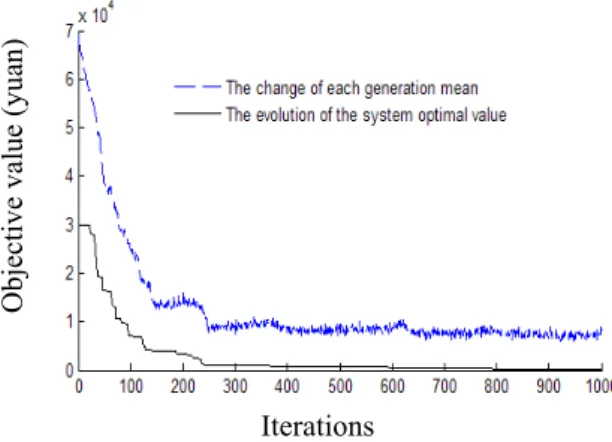
With the increase of iterations, convergence effect of each generation’s mean and system optimal value in calculation of the first example is shown as figure 7.The system optimal value tends to steady when the iteration time reaches the 620th generation, convergence speed is fast and converge to 208 many times. So the approximate optimal objective value is 208. The output individual is [1 5 7 6 8 9 11 17 20 21 16 19 22 0 2 3 4 12 14 13 15 10 18].
With the increase of iterations, convergence effect of each generation’s mean and system optimal value in calculation of the second example is shown as Figure 8. The system optimal value converges to 246.17 when the iteration time reaches the 800th generation. The approximate optimal objective value is 246.17. The output individual is [6 9 1 14 7 21 24 0 3 5 8 10 11 15 16 20 22 17 0 2 4 12 13 18 19 23 25 27 28 29 30 26].
For the first numerical example, this paper can obtain the optimized scheduling scheme using the proposed
scheduling model and costs are given in TABLE V. According to scheduling scheme of the “FCFS” (first-come, first-served), the costs are shown in the TABLE VI.
Using the traditional FCFS rule to dispatch yard cranes, the yard cranes’ moving cost is 381.5 yuan, and the trucks’ waiting cost is 1.75 yuan. While using the proposed scheduling model in this paper, the moving cost is 332.5 yuan, reducing by 12.8 percent. The trucks’ waiting cost slightly elevated is 21.38 yuan, but the weighted cost decreases by 9.4 percent compared with the traditional scheduling scheme.
Regarding the second numerical example, this paper can obtain the optimized scheduling scheme using the proposed model and the corresponding costs are given in TABLE VII. According to FCFS rule, the scheduling scheme and costs are shown in TABLE VIII.
According to the FCFS rule to dispatch yard cranes, the moving cost is 426 RMB, and the trucks’ waiting cost is 126.67 yuan. When using the scheme that obtained from the scheduling model in this paper, the yard cranes’ moving cost is 381.5 yuan, reducing by 17.4 percent. The trucks’ waiting cost is 43.17 yuan, reducing by 66 percent. For the weighted costs of the two scheduling scheme, the optimized scheduling scheme decreases by 25 percent than the traditional one.
TABLE II.
TASK CONDITION IN THE BLOCK OF EXAMPLE 2
Task number Bay RT(min) time (min)handle Tasktype Task number Bay RT(min) time (min) handle Task type
1 7 1 7 0 16 13 43 3 1 2 21 2 4 1 17 27 47 7 0 3 13 5 3 1 18 20 49 3 1 4 24 8 5 1 19 16 53 4 1 5 10 11 4 1 20 12 53 3 1 6 4 16 3 1 21 5 57 4 0 7 4 17 4 0 22 17 65 3 1 8 11 18 3 1 23 25 65 5 1 9 7 19 4 1 24 11 68 3 1 10 9 23 8 0 25 20 76 3 1 11 9 30 5 1 26 26 78 7 0 12 17 32 4 1 27 22 82 4 1 13 22 33 3 0 28 13 84 4 1 14 6 37 5 1 29 12 87 3 1 15 7 40 4 1 30 16 95 8 1
TABLE V.
OPTIMIZED SCHEDULING SCHEME AND COSTS (EXAMPLE 1) UNIT: YUAN
Yard crane Tasks and Sequence Moving cost Waiting cost Total weighted cost
1 1→5→7→6→8→9→11→17→20→21→16→19→22 171.5 14.92 208 2 2→3→4→12→14→13→15→10→18 161 6.46 Summation 332.5 21.38 TABLE VI.
TRADITIONAL SCHEDULING SCHEME AND COSTS (EXAMPLE 1) UNIT: YUAN
Yard crane Tasks and Sequence Moving cost Waiting cost Total weighted cost 1 1→3→5→6→8→9→10→14→17→22 129.5 1.75 229.6 2 2→4→7→11→12→13→15→16→18→19→20→21 252 0 Summation 381.5 1.75
TABLE VII.
OPTIMIZED SCHEDULING SCHEME AND COSTS (EXAMPLE 2) UNIT: YUAN
Yard crane Tasks and Sequence Moving cost Waiting cost Total weighted cost
1 6→9→1→14→7→21→24 49 0.875 246.17 2 3→5→8→10→11→15→16→20→22→17 105 11.75 3 2→4→12→13→18→19→23→25→27→28→29→30→26 227.5 30.54 Summation 381.5 43.17 V.CONCLUSIONS
In the mixture storage port container terminals, operational quantity and frequency of yard is very large. So how to effectively dispatch multiple yard cranes to ensure the efficiency and effectiveness has important practically meaningful. Considering yard cranes scheduling at single block in the mixed storage mode
during a period time, the paper takes into account the following aspects: priorities of internal and external trucks, yard cranes that cannot span each other and need a safe distance, upper limit of waiting time. Then the paper builds a MYCS model and designs the improved genetic algorithm to solve the model. The results of two given numerical examples shows that the proposed model in this paper can effectively distinguish internal and external Iterations Iterations
Figure 7. Convergence process of improved GA (example 1) Figure 8. Convergence process of improved GA (example 2)
Obj ect iv e val ue (yua n) Obj ect iv e val ue (yua n) TABLE VIII.
TRADITIONAL SCHEDULING SCHEME AND COSTS (EXAMPLE 2) UNIT: YUAN
Yard crane Tasks and Sequence Moving cost Waiting cost Total weighted cost
1 1→5→7→9→14→15→16→21→22 147 38.2
327.9 2 3→6→8→10→11→19→20→24→28→29 115.5 38.5
3 2→4→12→13→17→18→23→25→26→27→30 199.5 49.96
truck, and c reduce the pr The paper per block is the research combined m discuss the time window This work foundation University ba [1] L.M. Ga Zaffalon terminal Manufac [2] C.Q. Zh containe 10(37), p [3] B. Wang yard ba Engineer [4] H.G. Ka storage and Wate [5] H.H. Zh Containe Storage Engineer 153-159 [6] W.C. Ng containe 29(3), pp [7] W.K. Li, “Discret crane sc can ensure t roducing cost r assumes tha fixed during should focus multiple yard c allocation op ws. ACKNO k was support of China (7 asic research f REF ambardella, M. n, “An optimiz l manageme cturing, vol. 12
hang, and J.Y. er terminals”, T
pp. 883-903, 20 g, “Method of p ased on mixtu
ring, vol. 20(5)
ang, Y. Liu, and space allocatio
erway Engineer
heng, L. Du, and er Slot Allocat
Mode”, Jou ring and Inform
, 2012. g, and K.L. Ma er terminals”, Ap p. 263–276, 200 , Y. Wu, M.E. H te time model cheduling”, E the operation at the same ti at the number a period of ti on the real-t cranes in diff ptimization of OWLEDGMENT ted by Nation 71202108, 71 fund of china FERENCES . Mastrolilli, A zation methodo nt”, journal (5-6), pp. 521-5 Liu, “Storage Transporting Re 003. planned rolling p ure storage”, J ), pp. 466-471, 2 d P.F. Zhou, “R on based on mi ring, vol. 430(8 d J. Dong, “Op ion in Contain rnal of Tran mation Technol
ak, “Yard crane
pplied Mathem 05. H. Petering, M. and algorithms uropean Journ al efficiency me. r of yard cran ime. In the fu time schedulin ferent blocks, f yard crane
nal natural sci 1072081), ce
(017229).
A.E. Rizzoli, an logy for interm
l of Intel 534, 2001. space allocati esearch Part B period of a cont Journal of Sy 2005. Research on dyn xture storage”, 8), pp. 73-83, 20 timization Mod er Yard with M nsportation Sy logy, vol. 12(1 e scheduling in matical Modeling . Goh, and R. S s for container nal of Operat and ne in uture, ng of , and with ience entral nd M. modal lligent ion in B, vol. ntainer ystems namic , Port 009. del on Mixed ystems ), pp. n port g, vol. Souza, r yard tional [8] [9] [10] Research, vol M.E. H. Peter “Developmen crane control terminals”, OR
Y.Y. Lin, and crane consid Shanghai Mar M.L. Le, Y.Y yard-crane S Heuristic Alg Technology, v . 198(1), pp. 16 ring, Y. Wu, W nt and simulatio
systems for sea
R Spectrum, vo d M.L. Le, “Op ering interfere ritime Universi Y. Lin, and Z.Q cheduling Pro gorithm”, Journ vol. 34(1), pp. 6 Hong-xing province of Associate Managemen University. include lo logistics sys Kai Yu is china in candidate o His main logistics in system sim 65–172,2009. W.K. Li,M. Goh, on analysis of aport container ol. 31(4), pp. 80 ptimal routing ence condition ity, vol. 33(2), p Q. Fan, “Rese oblem Based nal of WUHAN 60-65, 2012. g Zheng is bo f china in July. Professor in nt College of D His main res ogistics inform stem simulation s born in Jiang Feb. 1989. H of Dalian Marit research int information sy mulation. , and R. Souza, real-time yard Transshipment 01–835, 2009. of multi-yard-n”, Journal of pp. 47-54, 2012 arch on Multi-on Two-phase N University of orn in He bei 1971. He is an Transportation Dalian Maritime search interests mation system, n. gsu province of He is a M.S. time University terests include stem, logistics , d t -f 2. -e f i n n e s , f . y. e s