South Dakota State University
Open PRAIRIE: Open Public Research Access Institutional
Repository and Information Exchange
South Dakota Beef Report, 2012
Animal Science Reports
2012
Effects of Weaning Age and Winter Development
Environment on Heifer Performance
N.L. Hojer
South Dakota State University
M.B. Hubert
South Dakota State University
P.S. Johnson
South Dakota State University
M.H. Price
South Dakota School of Mines and Technology
K.C. Olson
South Dakota State University
Follow this and additional works at:
http://openprairie.sdstate.edu/sd_beefreport_2012
Part of the
Animal Sciences Commons
This Report is brought to you for free and open access by the Animal Science Reports at Open PRAIRIE: Open Public Research Access Institutional Repository and Information Exchange. It has been accepted for inclusion in South Dakota Beef Report, 2012 by an authorized administrator of Open PRAIRIE: Open Public Research Access Institutional Repository and Information Exchange. For more information, please contact
Recommended Citation
Hojer, N.L.; Hubert, M.B.; Johnson, P.S.; Price, M.H.; and Olson, K.C., "Effects of Weaning Age and Winter Development Environment on Heifer Performance" (2012).South Dakota Beef Report, 2012.Paper 3.
11
BEEF 2012-03
Effects of weaning age and winter development environment on heifer performance1
N. L. Hojer*, M. B. Hubert*, P. S. Johnson†, M. H. Price‡, K. C. Olson* *Department of Animal Science, South Dakota State University;
†Department of Natural Resource Management,
South Dakota State University; ‡South Dakota School of Mines & Technology
SUMMARY
Our objective was to determine if early weaning (about 125 d) vs. normal weaning (about 250 d) and wintering replacement heifers in drylot vs. rangeland affected heifer growth and reproductive performance. Heifer calves from the 2009 and 2010 calf crops (n = 104 and 73, respectively) were allocated to the 2 weaning treatments and then stratified by age into the 2 winter development treatments forming a 2 by 2 factorial arrangement of treatments. Heifers wintered in drylot received mixed grass and alfalfa hay (yr 1: 11.6% CP, 52.5% TDN; yr2: 12.3% CP, 53.4% TDN) plus 1.8 kg of a dried distiller’s grain (DDGS)-based supplement/hd/d (yr1: 22.7% CP, 75.8% TDN; yr 2: 25.4% CP, 76.7% TDN). Heifers wintered on rangeland also received 1.8 kg/hd/d of the same supplement. Over the winter, each treatment was allocated to a separate pen or pasture. After estrus synchronization and timed AI, all heifers were placed on rangeland to graze through the summer. During the summer of yr 1, heifers were allocated by winter treatment to 2 pastures, and in yr 2 all 4 treatment combinations were allocated to separate pastures. Responses measured were BW, ADG, pubertal status at initiation of estrus
synchronization, and pregnancy status after breeding. Pubertal status was indicated by serum progesterone > 1 ng/ml. A winter by weaning treatment interaction affected (P<0.001) BW and ADG both years. During the winter months, range heifers were lighter and grew slower than drylot heifers, but BW did not differ due to winter treatments at the end of the summer. However, early-weaned heifers remained lighter than normal weaned heifers at the end of the summer. Weaning treatment affected (P=0.03) fall pregnancy rate (93.2%±4.0 and 74.7%±7.98 for early- and normal-weaning, respectively) in yr 2. In yr 1, there was a difference (P=0.006) between drylot and range heifers (92.7%±3.52 and 72.8%±6.47, respectively) in the proportion that obtained puberty before estrus synchronization. In conclusion, producers should consider important interactions between weaning and winter management practices when establishing a replacement heifer development program that best fits the goals of their operation.
INTRODUCTION
There have been multiple research projects on different heifer development programs to evaluate effectiveness of alternative options (Olson et al., 1992; Arthington and Kalmbacher, 2003; Salverson et al., 2005). Past research has suggested that rangeland may be an effective resource to develop heifers that are destined to become range cows (Olson et al., 1992; Salverson et al., 2005). The objective of this study was to evaluate how age at weaning, 125-d-of-age (early) and 250-d-of-age (normal), and two winter development environments, rangeland and drylot, affected heifer growth and development. We hypothesized that heifers wintered on rangeland with supplementation would have lower ADG and would be lighter at initation of breeding compared to the heifers wintered in drylot, but that they would
12
still be adequately developed to have similar reproductive performance to drylot-raised heifers. We also hypothesized that range heifers that grazed alongside their mothers longer would have improved ADG after weaning and therefore normal-weaned heifers would have better reproductive performance than early-weaned heifers. We further hypothesized that wintering heifers in drylot would produce the same results for both early-weaned and normal-weaned heifers.
MATERIALS AND METHODS
All animal procedures were approved by the South Dakota State University Institutional Animal Care and Use Committee.
Design and Treatments
Heifer calves from the 2009 and 2010 calf crop (n = 104 and 73, respectively) were split into two groups to either be early weaned (EW, about 125 d of age) or normal weaned (NW, about 250 d of age). These groups were based on dam assignments to weaning treatments for another study that was ongoing. In that study, dams had been stratified into two groups and then each group was randomly assigned to either be early- or normal-weaned when they entered the study. Within the two weaning-age groups, heifers were stratified by age into two winter development treatments. These groups were either wintered in drylot (D) or wintered on rangeland (R) from weaning to breeding. This created the following four treatment combinations in a 2 × 2 factorial treatment structure: 1) early weaned and developed from weaning to breeding in drylot (ED); 2) early weaned and developed from weaning to breeding on rangeland (ER); 3) normal weaned and developed from weaning to breeding in drylot (ND); 4) normal weaned and developed from weaning to breeding on rangeland (NR). Heifers wintered in drylot received mixed grass and alfalfa hay (Table 1) ad libitum plus 4 lb. of a dried distiller’s grain (DDGS)-based supplement/hd/d (Table 1). Heifers wintered on rangeland also received 4 lb/hd/d of the same supplement. During the winter when snow cover precluded grazing, Rheifers received the same hay as the Dheifers. Heifers in the ER treatment combination consumed 497 lb/hd of hay in year 1 and 671 lb/hd of hay in year 2. Heifers in the NR treatment combination consumed 482 lb/hd of hay in year 1 and 647 lbs/hd of hay in year 2. Over the winter, each treatment combination was allocated to a
separate pen or pasture. After estrus synchronization and timed AI, all heifers were placed on rangeland to graze through the summer. During the summer of year 1, heifers were allocated by winter treatment to 2 pastures, and all 4 treatment combinations were allocated to separate pastures in the summer of year 2.
Collections
Heifer BW were recorded at EW (August 18, 2010; August 17, 2011), NW (November 3, 2010; November 2, 2011 [NW heifers only]), middle of the winter treatment period (March 9, 2010; February 4, 2011), first blood sampling (May 14, 2010; May 18, 2011), breeding (June 19, 2010; June 9, 2011), July pregnancy detection (July 29, 2010; July 26, 2011), end of summer grazing period (September 1, 2010; August 24, 2011), and fall pregnancy detection (November 3, 2010; October 20, 2011).
Puberty
Pubertal status of the heifers at the beginning of the breeding season was determined by analysis of serum progesterone. Blood samples were collected via jugular or coccygeal venipuncture into a 10-ml Vacutainer tube at d -10 (May 14, 2010; May 18, 2011), d 0 (May 25, 2010; May 30, 2011), and d 15
13
(June 9, 2010 [yr 1 only]), relative to the initial start of estrus synchronization. Blood sat at room temperature for 1 hr to clot and was then centrifuged for 20 minutes. Serum was harvested and frozen at -20º C until analysis. Serum progesterone concentrations were analyzed by a previously validated radioimmunossay (Engel et al., 2008). Heifers were defined as having reached pubertal status if serum progesterone was ≥ 1 ng/ml in either serum sample.
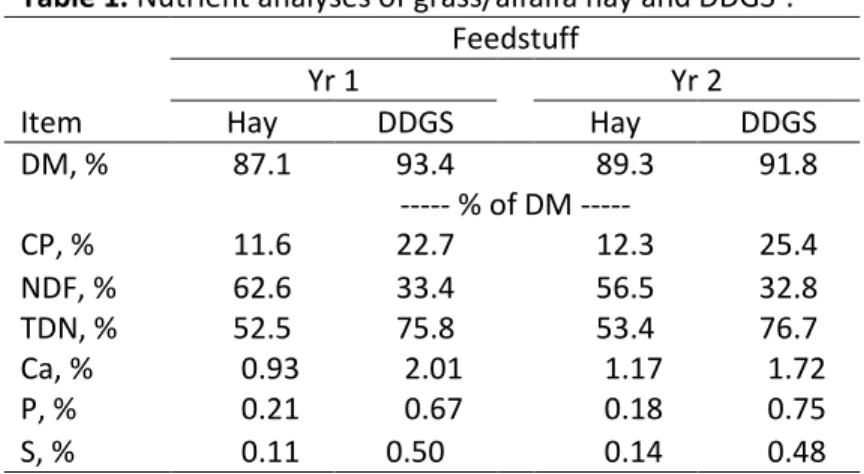
Table 1. Nutrient analyses of grass/alfalfa hay and DDGS1.
Feedstuff
Yr 1 Yr 2
Item Hay DDGS Hay DDGS
DM, % 87.1 93.4 89.3 91.8 --- % of DM --- CP, % 11.6 22.7 12.3 25.4 NDF, % 62.6 33.4 56.5 32.8 TDN, % 52.5 75.8 53.4 76.7 Ca, % 0.93 2.01 1.17 1.72 P, % 0.21 0.67 0.18 0.75 S, % 0.11 0.50 0.14 0.48
1 DDGS = dried distiller’s grains with soluble- based cube
Breeding
On d -7 (May 25, 2010 and May 30, 2011) heifers received an estrus synchronization protocol and were bred by timed AI (June 19, 2010 and June 9, 2011). The synchronization protocol included: 100 µg GnRH (Cystorelin, Merial Marysville, Kansas) and Controlled Internal Drug Releasing device (CIDR) insertion on d -7; 25 mg PG (Lutalyse, Pfizer Kalamazoo, Michigan) and CIDR removal on d 0; and timed AI with 100 µg GnRH at 72-hr after CIDR removal. An error was made in yr 1 and the CIDRs were reinserted on d 8 to d 15 and heifers were bred on June 19, 2010. Timed AI was followed by a 45-d exposure to natural service to complete the breeding season. Semen-tested bulls were used with a bull:heifer exposure ratio not exceeding 1:28 both years.
Conception to AI was determined by trans-rectal ultrasonography on d 40 after AI in yr 1 and d 47 after AI in yr 2 (July 29, 2010 and July 26, 2011). Overall pregnancy rate was determined by rectal palpation in yr 1 and trans-rectal ultrasonography in yr 2 on d 90 (November 3, 2010 and October 20, 2011) after the breeding season.
Statistics
Heifer BW and ADG were analyzed using the MIXED procedure of SAS. The model included weaning treatment, winter treatment, and their interaction as independent variables. Time of weighing (or the intervals between weighing for ADG) and its 2- and 3-way interactions with weaning and winter treatments were included as repeated measures. Animal was included as a random effect and was considered the experimental unit.
Pregnancy rates and puberty status were analyzed using the GENMOD procedure of SAS with the use of the logit structure for binomial data. The model included independent variables of weaning treatment and wintering treatment as well as their interaction.
14
RESULTS AND DISCUSSION
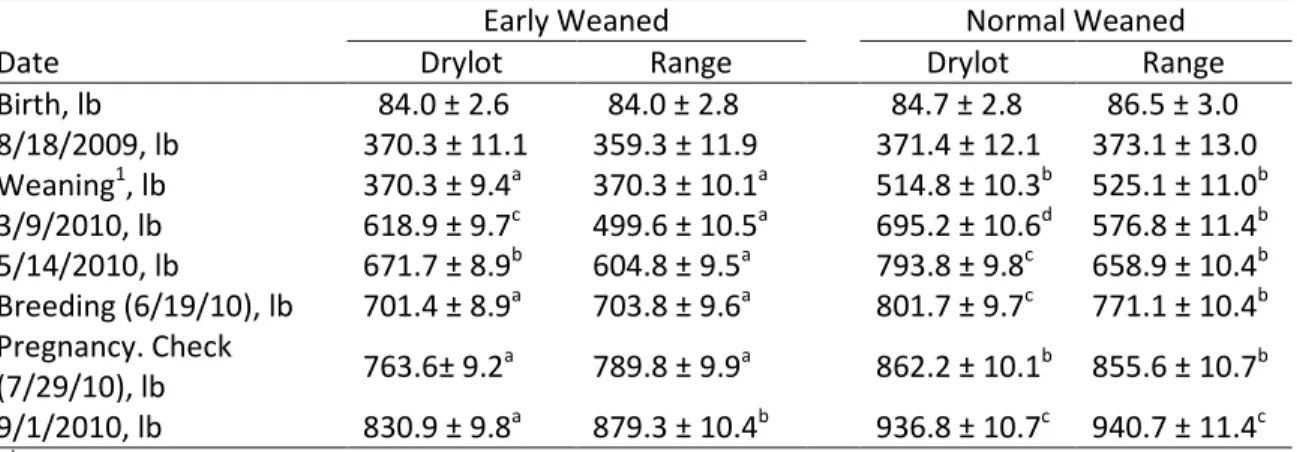
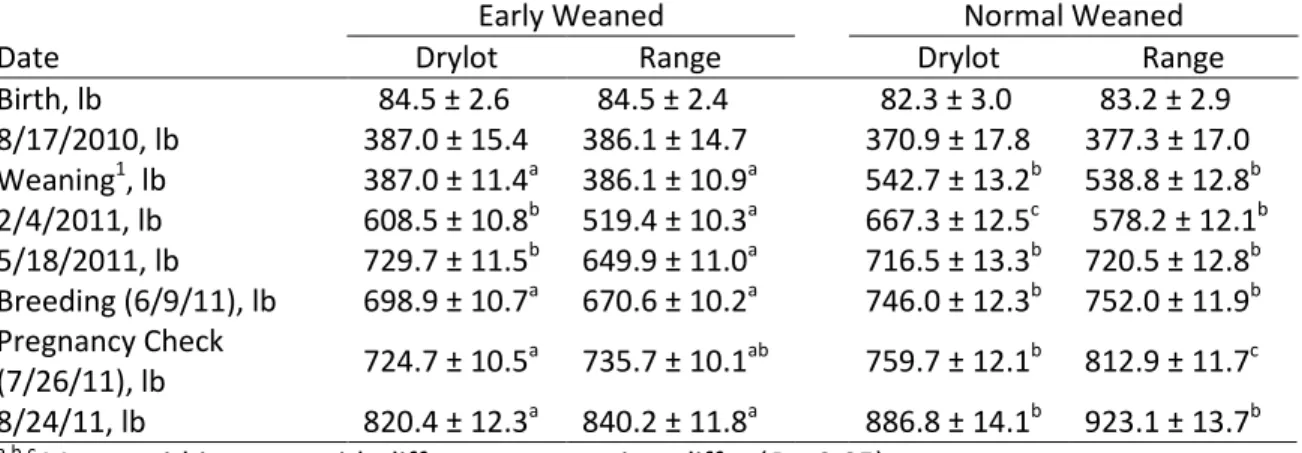
Weaning treatment, winter treatment, and weigh period interacted for BW and ADG during both years (P < 0.001) (Tables 2, 3, 4, and 5). In both years, R heifers were lighter and grew slower than D heifers during the winter months. Within each winter treatment the EW heifers were also lighter than the NW heifers. Once spring green-up occurred, R heifers had an increase in ADG and continued to gain more than the D heifers throughout the summer. At the end of the study in year 1, there was no difference in BW between the two NW groups, and they were both significantly heavier than the EW groups. At the end of year 2, there was no difference between wintering treatments, however EW heifers were still lighter than NW heifers. This agrees with other studies by Lusby et al. (1981); Olson et al. (1992); and Arthington and Kalmbacher (2003).
Table 2. Effect of weaning at an average of 125- or 250-d of age and development from weaning to breeding in a drylot or on range on BW in 2010 heifers
Early Weaned Normal Weaned
Date Drylot Range Drylot Range
Birth, lb 84.0 ± 2.6 84.0 ± 2.8 84.7 ± 2.8 86.5 ± 3.0 8/18/2009, lb 370.3 ± 11.1 359.3 ± 11.9 371.4 ± 12.1 373.1 ± 13.0 Weaning1, lb 370.3 ± 9.4a 370.3 ± 10.1a 514.8 ± 10.3b 525.1 ± 11.0b 3/9/2010, lb 618.9 ± 9.7c 499.6 ± 10.5a 695.2 ± 10.6d 576.8 ± 11.4b 5/14/2010, lb 671.7 ± 8.9b 604.8 ± 9.5a 793.8 ± 9.8c 658.9 ± 10.4b Breeding (6/19/10), lb 701.4 ± 8.9a 703.8 ± 9.6a 801.7 ± 9.7c 771.1 ± 10.4b Pregnancy. Check (7/29/10), lb 763.6± 9.2a 789.8 ± 9.9a 862.2 ± 10.1b 855.6 ± 10.7b 9/1/2010, lb 830.9 ± 9.8a 879.3 ± 10.4b 936.8 ± 10.7c 940.7 ± 11.4c a,b,c Means within a row with different superscripts differ (P < 0.05).
1 August 18, 2009 for early-weaned and November 3, 2009 for normal-weaned.
Table 3. Effect of weaning at an average of 125- or 250-d of age and development from weaning to breeding in a drylot or on range on ADG in 2010 heifers
Early Weaned Normal Weaned
Date Drylot Range Drylot Range
8/18/09 to 3/9/10 1.23 ± 0.026c 0.64 ± 0.031a 1.61 ± 0.031d 1.01 ± 0.033b
Weaning to 3/9/10 1.23 ± 0.029c 0.64 ± 0.033b 1.43 ± 0.031d 0.42 ± 0.035a
3/9/10 to Breeding (6/19/10) 0.81 ± 0.048a 2.00 ± 0.053c 1.06 ± 0.053b 1.91 ± 0.055c
Breeding (6/19/10) to 9/1/10 1.76 ± 0.066a 2.35 ± 0.073b 1.83 ± 0.073a 2.29 ± 0.077b a,b,c Means within a row with different superscripts differ (P < 0.05).
15
Table 4. Effect of weaning at an average of 125- or 250-d of age and development from weaning to breeding in a drylot or on range on BW in 2011 heifers
Early Weaned Normal Weaned
Date Drylot Range Drylot Range
Birth, lb 84.5 ± 2.6 84.5 ± 2.4 82.3 ± 3.0 83.2 ± 2.9 8/17/2010, lb 387.0 ± 15.4 386.1 ± 14.7 370.9 ± 17.8 377.3 ± 17.0 Weaning1, lb 387.0 ± 11.4a 386.1 ± 10.9a 542.7 ± 13.2b 538.8 ± 12.8b 2/4/2011, lb 608.5 ± 10.8b 519.4 ± 10.3a 667.3 ± 12.5c 578.2 ± 12.1b 5/18/2011, lb 729.7 ± 11.5b 649.9 ± 11.0a 716.5 ± 13.3b 720.5 ± 12.8b Breeding (6/9/11), lb 698.9 ± 10.7a 670.6 ± 10.2a 746.0 ± 12.3b 752.0 ± 11.9b Pregnancy Check (7/26/11), lb 724.7 ± 10.5a 735.7 ± 10.1ab 759.7 ± 12.1b 812.9 ± 11.7c 8/24/11, lb 820.4 ± 12.3a 840.2 ± 11.8a 886.8 ± 14.1b 923.1 ± 13.7b a,b,c Means within a row with different superscripts differ (P < 0.05).
1 August 17, 2010 for early-weaning and November 2, 2010 for normal-weaned.
Table 5. Effect of weaning at an average of 125- or 250-d of age and development from weaning to breeding in a drylot or on range on ADG in 2011 heifers
Early Weaned Normal Weaned
Date Drylot Range Drylot Range
8/17/10 to 2/4/11 1.30 ± 0.035c 0.77 ±0.033a 1.74 ± 0.042d 0.53 ± 0.018b
Weaning to 2/4/11 1.30 ± 0.042c 0.77 ± 0.040b 1.32 ± 0.048c 0.19 ± 0.022a
2/4/11 to Breeding (6/9/11) 0.73 ± 0.051a 1.21 ± 0.048b 0.64 ± 0.057a 0.63 ± 0.025c
Breeding (6/9/11) to 8/24/11 1.58 ± 0.097a 2.22 ± 0.095b 1.85 ± 0.40a 1.03 ± 0.049b a,b,c Means within a row with different superscripts differ (P < 0.05).
In y 1, more D heifers obtained puberty before the breeding season than R heifers (P = 0.006; 92.7 ± 3.5% vs. 72.8 ± 6.5%, respectively). However, after heifers were initially exposed to progestin
(immediately before the CIDR were re-inserted), there was no difference in pubertal status (P > 0.05; 96.8 ± 1.8%). In y 2 there was no difference (P > 0.05) in the percentage of heifers that obtained puberty between treatments (99 ± 2.8%). Other studies have also shown that as long as heifers obtain an
appropriate percentage of mature BW by initiation of breeding, winter gain should not affect puberty at breeding (Lemenager et al., 1980; Clanton et al., 1983; Lynch et al., 1997).
AI conception rate did not differ among treatments in either y 1 or 2 (P > 0.05; 53.7 ± 7.1% and 48.2 ± 8.5%, respectively), consistent with no differences in percentage of heifers that were pubertal at
initiation of breeding. In yr 1, there was also no difference in overall pregnancy rate between treatments (P > 0.05; 86.7 ± 5.0%). This supports previous finding by Lynch et al. (1997), Martin et al. (2008), and Funston and Larson (2011). However, in y2 more (P = 0.03) EW heifers were pregnant at fall pregnancy diagnosis than NW heifers (93.2% ± 0.040 and 74.7% ± 0.080, respectively).
Wintering heifers on rangeland or early weaning could be a beneficial option for certain heifer development programs. A producer needs to look at important interactions between weaning and winter treatment when selecting a development program that best fits the goals of their operation.
16
LITERATURE CITED
Arije, G. F., and J. N. Wiltbank. 1971. Age and weight at puberty in Hereford heifers. J. Anim. Sci. 33:401-406.
Arthington, J. D., and R. S. Kalmbacher. 2003. Effect of early weaning on the performance of three-year-old, first-calf beef heifers and calves reared in the subtropics. J. Anim. Sci. 81:1136-1141.
Byerley, D. J., R. B. Staigmiller, J. G. Berardinelli and R. E. Short. 1987. Pregnancy rates of beef heifers bred either on pubertal or third estrus. J. Anim. Sci. 66:645-650.
Clanton, D.C., L. E. Jones, and M. E. England. 1983. Effect of rate and time of gain after weaning on the development of replacement beef heifers. J. Anim. Sci. 56:280-285.
Engel, C. L., H. H. Patterson, and G. A. Perry. 2008. Effect of dried corn distillers grains plus solubles compared with soybean hulls, in late gestation heifer diets, on animal and reproductive performance. J Anim. Sci. 86: 1697-1708.
Ferrell, C. L. 1982. Effects of postweaning rate of gain on onset of puberty and productive performance of heifers of different breeds. J. Anim. Sci. 55:1272-1283.
Funston, R. N., and D. M. Larson. 2011. Heifer development systems: dry-lot feeding compared with grazing dormant winter forage. J. Anim. Sci. 89:1595-1602.
Lemenager, R. P., W. H. Smith, T. G. Martin, W. L. Singleton, and J. R. Hodges. 1980. Effects of winter and summer energy levels on heifer growth and reproductive performance. J. Anim. Sci. 51:837-842. Lusby, K. S., R. P. Wetteman, and E. J. Turman. 1981. Effects of early weaning calves from first-calf
heifers on calf and heifer performance. J. Anim. Sci. 53:1193-1197.
Lynch, J. M., G. C. Lamp, B. L. Miller, R. T. Brandt Jr., R. C. Cochran, and J. E. Minton. 1997. Influence of timing of gain on growth and reproductive performance of beef replacement heifers. J. Anim. Sci. 75:1715-1722.
Martin, J. L., K. W. Creighton, J. A. Musgrave, T. J. Klopfenstein, R. T. Clark, D. C. Adams, and R. N. Funston. 2008. Effect of prebreeding body weight or progestin exposure before breeding on beef heifer performance through the second breeding season. J. Anim. Sci. 86:451-459.
Olson, K.C., J.R. Jaeger, and J.R. Brethour. 1992. Growth and reproductive performance of heifers overwintered in range or drylot environments. J. Prod. Agric. 5:72-76.
Salverson, R.R., H.H. Patterson, G.A. Perry, and M.L. Gibson. 2005. Evaluation of performance and costs of two heifer development systems. Proc. West. Sec. Amer. Soc. Anim. Sci. 56:409-412.
Short, R. E., and R. A. Bellows. 1971. Relationships among weight gains, age at puberty and reproductive performance in heifers. J. Anim. Sci. 32:127-131.