A design thinking perspective on capability development: the case of
New Product Development for a service business model
Ahmad Beltagui
Operations and Information Management Department, Aston Business School, Birmingham, B4 7ET, United Kingdom
Abstract
Purpose: To examine the interaction between New Product Development (NPD) capabilities and Business Model Innovation (BMI) by studying the adaptation of capabilities in a
manufacturing firm as it adopts a service business model.
Approach: An in-depth case study is used to identify design capabilities and document how these have been developed as the firm has adapted its NPD processes to the needs of its service business model.
Findings: Design capabilities are proposed as a facilitator of servitization, allowing a manufacturing firm to develop service offerings that build on resources such as knowledge and experience. Conversely, the scope of servitization is restricted by the extent to which these design capabilities can be updated to suit the demands of a new business model. Practical implications: Servitization is presented as an imperative for manufacturing firms, yet research has not addressed the implications for NPD nor investigated how BMI affects NPD capabilities. This study shows the need to identify whether current NPD processes help or hinder BMI and proposes how managers can adapt NPD processes to a new business model.
This article has been accepted for publication in
International Journal of Operations and Production Management, please do not cite or distribute it without contacting the author
Originality: A three-stage process is identified for adapting NPD processes – as BMI
changes the nature of products and services required, existing processes are supplemented by design activities requiring expert knowledge, these are subsequently refined into design methods that can be incorporated into the NPD process, and eventually design tools allow automation and efficiency.
Keywords: Business Model Innovation, New Product Development, Servitization, Service Design, Design Capabilities, Design-thinking
1.0 Introduction
“… the act of arriving at a solution by strict calculation is not regarded as designing …
design involves a prescription or model, the intention of embodiment as hardware and the
presence of a creative step.”
(Archer, 1965, p4)
“… the design job has significantly changed over time. You say today what’s the difference
between analysis and design? Now there’s none.”
(Design Capability Owner, Eng Co.) The design of products and services has long been seen as an activity requiring human
intellect, creativity and problem-solving (Archer, 1965; Simon, 1996). Yet managers, such as the one in the second quotation, believe that human knowledge can be captured in systems that make New Product Development (NPD) processes more efficient (Løwendahl, 2005; Martin, 2009). Rather than fundamentally conflicting, these two perspectives can be seen as stages in the process of developing design capabilities (Mutanen, 2008). A design capability can be defined as a collective capability held by an organisation, which allows it to deploy a particular form of design in developing products and services. Firms develop capabilities in, for example, the design of electronic systems, mechanical components or customer
experiences, according to the offerings they deliver to their customers. Changes in
redundant. For example, if a product’s mechanical components are replaced by electronics, then mechanical design gives way to a need for electronic design capabilities.
Servitization represents a Business Model Innovation (BMI), altering a manufacturing firm’s revenue model, value propositions and capabilities to focus on co-creating value with
customers, rather than exchanging goods (Smith et al., 2014; Raja et al., 2018). It is both caused by changes in the operating environment and results in changes to how manufacturing firms operate, creating an imperative to update capabilities (Pawar et al., 2009; Benedettini et al., 2015).
Successful manufacturing firms develop their service business model based on capabilities, including their manufacturing technology and engineering expertise (Ulaga and Reinartz, 2011; Zhang et al., 2016). These capabilities support the firm’s NPD process and ability to create new products (Nonaka and Takeuchi, 1995; Daneels, 2002). For a service business model to succeed, manufacturing firms must be able to update these capabilities and
processes (Lightfoot et al., 2013; Burton et al., 2017). They must adapt supply-chain design and supplier relationships (Johnson and Mena, 2008; Pawar et al., 2009), enhance customer relationships (Tuli et al., 2007) and develop new approaches to product design that account for value-in-use of products (Morelli, 2003; Tan et al., 2010). While servitization research emphasises the need to develop customer-facing capabilities, there is little consideration of how products are affected and almost no research addresses whether and how manufacturing firms update their NPD process to facilitate servitization (Paslauski et al., 2016).
Many accounts of servitization, and BMI generally, suggest a smooth, linear and logical transition. In reality, it is often a messy and incremental process, entailing considerable trial and error (Kowalkowski et al., 2012) as the business model evolves incrementally through interaction with the knowledge and capabilities of the organisation (McGrath, 2010; Sosna et
al., 2010). A promising theoretical perspective to investigate this process is that of design-thinking, which entails reframing problems in order to devise novel solutions (Simon, 1996; Martin, 2009; Dorst, 2011). This article uses a design-thinking perspective to address the research question: What is the relationship between a manufacturing firm’s NPD capabilities
and business model innovation?
Prior research has not addressed NPD capabilities in this context. This study fills the gap by examining the adaptation of the NPD process in a manufacturing firm following its
implementation of a servitized business model. Four design capabilities are identified: design for product lifetime, design for maintenance, design for supply chain and design for service. Based on a theoretical framework drawing on design-thinking, the case explains how these capabilities develop from problem-solving activities that rely on expert knowledge, into standardised methods that can be applied more efficiently and, finally, tools that may become automated. The findings demonstrate how these design capabilities both drive BMI and restrict its scope, requiring the business model and capabilities to be developed
synchronously.
2.0 Background
2.1 Business Model Innovation
The business model relates strategy to organisational design. It relates relationships with customers to internal operations to define value creation, revenue capture and profit generation (Zott and Amit, 2007). The business model answers questions about who the customer is, what they value, how the supplier makes money and the economic logic governing revenues and costs (Magretta, 2002). Business models have, therefore, existed as long as businesses have. Only recently, however, has their scope expanded to designing novel
configurations of internal capabilities and external relationships, as well as products and operational processes (Tongur and Engwall, 2014).
Tools such as the business model canvas (Osterwalder and Pigneur, 2010) promote the belief that a business model can be selected. Complexity and bounded rationality, however, mean it is more realistic to view business models as designed (Simon, 1996; Boland and Collopy, 2004). Business models represent “holistic configurations … of design elements” (Amit and Zott, 2007, p183). In other words, the business model is greater than the sum of its parts and its development demands the evolution of organisational capabilities along with the
reconfiguration of relationships and value propositions. BMI requires insight,
experimentation and evolutionary learning as much as planning and execution (McGrath, 2010). Indeed, BMI can be seen through an organisational learning lens as a trial and error evolution, where exploration leads to errors, which facilitate the development of knowledge, which is, in turn, exploited in a successful business model (Sosna et al., 2010).
2.2 Business Model Innovation and NPD capabilities
For manufacturing firms, BMI may involve integrating services into products, which is often referred to as servitization (Kowalkowski et al., 2012; Visnjic Kastalli and Van Looy, 2013; Lightfoot et al., 2013; Raja et al., 2018). This is often conceptualised as a transition from pure manufacturing, with service seen as a necessary cost (Mathieu, 2001), to increased service provision as an additional revenue stream, to a change in value proposition, focused on building relations with customers (Tuli et al., 2007). Rather than a continuum from product to service, Cusumano et al. (2015) argue that different forms of service are utilised at different stages in an industry lifecycle. They identify smoothing services, which facilitate product purchase, for example through finance or insurance; adapting services, which involve customising products for individual customers; and substituting services, which replace
product purchase with delivery of performance. These services may be introduced in order to reduce the perceived risk of a new technology or facilitate access to the benefits of an
established technology; but, in most cases, they build upon manufacturing and NPD capabilities.
Manufacturing firms possess capabilities for developing and manufacturing new products, which provide the starting point for a service business model (Ulaga and Reinartz, 2011). These capabilities are updated to enhance relationships, but also to manage the development of customised solutions as individual projects (Davies and Brady, 2000). While the need to update capabilities is recognised, the impact on existing capabilities, more suited to larger volumes, is not well understood. Therefore, a key question is how manufacturing firmscan update their NPD process to adopt a service business model, to both create customised solutions and maintain volume production (Paslauski et al., 2016).
2.3 Capabilities and rigidities in New Product Development
NPD success is more likely when a fit is achieved with four key dimensions of an
organisation’s capabilities (Leonard-Barton, 1992). These are: the skills and knowledge of people, which form the basis of new products; technical systems that create competitive advantage and a barrier to entry for competitors; managerial systems that help NPD run efficiently; and the firm’s values and norms, which give a context for the capabilities. The NPD process captures knowledge from various organisational functions, such as engineering and marketing, which must be combined to create value for customers (Nonaka and
Takeuchi, 1995; Hong et al., 2005). Additionally, NPD capabilities and product innovation have a reciprocal relationship (Daneels, 2002). In other words, not only do the capabilities contribute to innovation, but product innovation can generate knowledge that improves the NPD process. This makes NPD a dynamic capability, since it allows the organisation to adapt
to changes in the external environment; must be developed internally rather than bought in, and is path dependent, building on previous knowledge and investments (Makadok, 2001). Aligning the NPD process with the organisation’s capability enhances efficiency, but may drive out exploratory activity (Gilbert, 2005). The result is the paradox described by Leonard-Barton (1992), whereby the same capabilities that make NPD successful cause rigidities that make it difficult to attempt unfamiliar projects. BMI at the strategic level can be restricted by these rigidities. For example, while servitization makes customer relationships a strategic necessity, engineers concerned with high-value technology are unlikely to be interested in relatively small service contracts (Oliva and Kallenberg, 2003). Firms can become locked into a path by historical and incremental investments in technical and managerial systems, which also makes them prone to missing opportunities that do not fit the current business model (Dierickx and Cool, 1989). Even a servitization pioneer such as Xerox (Cusumano et al., 2015) may be restricted by its capabilities from spotting innovation opportunities. Xerox invented much of the technology that formed the personal computer, but failed to recognise its commercial potential due to an overwhelming focus on leasing copiers (Chesborough and Rosenbloom, 2002).
To allow new capabilities to be developed without being restricted by the prevailing processes, values and norms, structural separation has been proposed (Taylor and Helfat, 2009). This entails isolating poorly fitting parts of the NPD process, so that new opportunities can be explored without disruption to, or restriction by, the existing processes. For example, new materials, technologies or applications may be investigated in isolation, prior to
2.4 A Design-thinking perspective on capability development
The idea of structural separation finds a parallel in Roger Martin’s (2009) representation of the design-thinking organisation as a knowledge funnel. The wide end of the funnel is filled with mysteries to be tackled by creative individuals who are suited to abductive reasoning and creative problem-solving, tackling wicked problems, which relate to complex interdependent systems of actors, such as most service systems. This type of activity is acknowledged to be inefficient and resource intensive, demanding the best (and most expensive) minds. The benefits of design-thinking are in going from solving mysteries to creating refined and scalable solutions that enable efficiency. Similarly, Mutanen’s (2008) study of design capability development in a manufacturing firm identifies a number of important stages. Initially, experts were hired for their industrial design expertise, before processes and tools were developed and embedded within the organisation.
The recent growth of interest in design (Verganti, 2009; Swan and Luchs, 2011) has reignited many of the old debates on its strategic value (Kotler and Rath, 1984) and opened new
proposals on its managerial value (Boland and Collopy, 2004). The work of Herbert Simon (1996) distinguishes artificial or design science from natural science and can be seen as the beginning of the current concept of design-thinking. It builds on the notion of bounded rationality in decision-making contexts (March, 1978), which suggests that problems cannot always be analysed and solved by implementing one of a pre-determined range of options (March, 1978; Boland and Collopy, 2004). Instead, managers design solutions through an abductive, incremental approach by making interventions, reflecting on the results and proposing possible next steps (Schön, 1990; Martin, 2009; Kowalkowski et al., 2012). Lawson (1996) confirms through behavioural experiments that while scientists approach a problem analytically, to understand all of its variables and determine the solution, designers approach a problem by acting and reflecting on the results. Organisations increasingly
recognise the value of this creative, abductive, problem-solving approach and attempt to develop it in their management teams (Boland and Collopy, 2004; Azadegan et al., 2008; Mutanen, 2008; Martin, 2009). As Simon argues:
Engineering, medicine, business, architecture, and painting are concerned not with the necessary but with the contingent—not how things are but how they might be—in short, with design. (Simon, 1996, xii)
2.5 New Service Development
New Service Development (NSD) differs from NPD in a number of key respects. Firstly, although a structured development process is a success factor for both (Storey et al., 2016), the rigidity of NPD processes may be counter-productive for NSD, particularly where there are resource constraints or uncertainty introduced by customer interaction (Witell et al., 2017). A second, related point is that unlike NPD, NSD often relies on combining existing technologies rather than new ones created through scientific research (den Hertog et al., 2010). This often leads to suggestions that service innovation is only every incremental, continuous improvement. NSD can create radical and disruptive innovations, but it normally does so by altering the prevailing means of creating or delivering value to customers (Smith et al., 2014; Biemans et al., 2016). These are typically achieved by combining elements of services (and products) that may exist individually, but create greater value when combined in a single solution (Tan et al., 2010). A third characteristic, therefore, is that NSD depends heavily upon customer co-creation. The emphasis on value has led to the recognition that both the ideas used to create new services and the value generated by using them, rely on customers’ collaboration (Ulaga and Reinartz, 2011).
The capabilities required for NSD depend on communication and empathy with customers and an ability to combine various types of knowledge. Processes must be open and driven by
customer engagement, with effective systems in place to capture and reuse the knowledge generated (Storey et al., 2016). Additionally, those performing the processes must display pragmatism and flexibility, making the most of limited resources and identifying potential linkages between available technologies and current or future customer needs (Witell et al., 2017). These characteristics of creativity, empathy and communication can be seen as a close match to the skills of designers in contemporary NPD, (Hong et al., 2005; Verganti, 2009). 2.6 Theoretical framework and propositions
The BMI literature suggests that a business model must be designed rather than selected from available options; that the capabilities of the firm act as a starting point for designing the business model, and that both business model and capabilities must evolve together. When considering servitization as BMI, this means the capabilities of a manufacturing firm offer the starting point, but a change in the business model demands a change in capabilities.
Considering the capabilities used to design and develop products, this can be expressed in the following research proposition:
P1. Design capabilities both enable BMI and require adaptation in response to it.
The literature on NPD capabilities suggests the paradoxical relationship whereby capabilities both enable and restrict innovation, depending on the fit with established capabilities. These rigidities must be overcome in order to enable the firm to create new products when the environment – or the business model – are altered, requiring products that may not be a good fit. To achieve this, it may be necessary to isolate parts of the product or process that are a poor fit, to apply different skills and knowledge, and facilitate different values and norms. For example, in servitization, structural separation of customer-facing activities is
recommended as a means of dealing with new challenges when a manufacturing firm creates service offerings (Galbraith, 2005). This leads to the second proposition:
P2. Design capabilities develop through structural separation to cope with challenges caused by BMI.
Finally, the design-thinking literature argues that this structural separation allows experts to usefully apply their skills to new challenges. However, relying on experts to continually design one-off customised solutions is expensive and inefficient (Mutanen, 2008; Martin, 2009). Therefore, the aim should be to refine the solutions generated in order to create processes and tools that capture knowledge and adapt the NPD process (Nonaka and
Takeuchi, 1995; Paslauski et al., 2016). The resulting capabilities, however, must be a good fit with the existing ones, particularly in terms of the values and norms of the organisation. This leads to the third proposition:
P3. Design capabilities must fit with organisational values and norms in order to be re-integrated.
3.0 Research methodology
Despite a considerable body of literature examining many aspects of servitization (Lightfoot et al., 2013), the impact on NPD is under-investigated. Little is known about the operational implications of a strategic shift towards service or customised solutions on processes geared towards developing products for volume production. Understanding the operational
implications and adaptation of capabilities demands research that captures multiple
perspectives in NPD (Paslauski et al., 2016) and allows a process view of BMI (Sosna et al., 2010). For this reason, an in-depth case study is used in which the unit of analysis is the NPD process and the adaptation of capabilities within the process. Although multiple case studies are typically favoured for their potential to build robust theory (Eisenhardt, 1989; Yin, 2003), single case studies offer depth of analysis to develop meaningful insights (Dubois and Gadde, 2014). With a single case, the researcher is better able to capture complex interactions;
whereas investigating a large number of cases may produce more replicable but potentially surface results (Dyer and Wilkins, 1991). NPD is complex and involves interactions between business functions (Paslauski et al., 2016). It is further complicated when service
considerations must be captured in the product design (Raddats et al., 2016).
Research, whether designed to be abductive or deductive is often abductive in practice (Voss et al., 2016). This means “…an (often surprising) single case is interpreted from a hypothetic overarching pattern, which, if it were true, explains the case in question” (Alvesson and Sköldberg, 2009, p4). The theoretical framework, empirical fieldwork and case analysis evolve simultaneously as the research progresses (Alvesson and Sköldberg, 2009; Voss et al., 2016). Rather than being entirely theory driven or entirely data driven, abductive research enables a continuous back and forth interaction between the data and theory. This is particularly useful for developing and testing technical or theoretical models that build an understanding of social actors’ accounts of a situation (Blaikie, 2000).
Central to the abductive approach is the emphasis not on what is, but on what might be (Martin, 2009). That is, making propositions and examining them in practice, combining theory and data. Working with qualitative data is considered to resemble piecing together a jigsaw puzzle from the individual pieces (Gummesson, 2005). Firstly, the pieces must be matched to theoretical patterns and, secondly, the search for the next piece (of data) is directed by the emerging image (Dubois and Gadde, 2014). A study can, therefore, move through different stages where the focus is more on theory or on the empirical context (Voss et al., 2016). This research took an abductive approach, with data collection following assumptions and propositions based on prior research. These assumptions were modified following the identification of new areas of interest, which necessitated a return to the literature. The research initially focused on design, based on definitions such as Archer’s
(1965), then moved towards an emphasis on organisational capabilities and then developed through a literature review, to focus on design capabilities.
3.1 Data collection
A total of 23 individuals, working in different parts of Eng Co.’s NPD process, were interviewed in order to gain insight into key design activities. Table 1 lists the interviewees and their location at either the firm’s headquarters or an overseas facility where interviews were conducted during a two-day visit. Additional sources of information included media reports, public presentations by executives and visits to the firm’s repair facilities in both of the locations.
TABLE 1 – SUMMARY OF INTERVIEWEES
Interviewee Job Title* Area* Location
1 Supply Chain Executive Logistics Headquarters
2 Design Specialist Engineering Headquarters
3 Supply Chain Planning Production Headquarters
4 Program Manager Production Headquarters
5 Supply Chain Projects Manager Production Headquarters
6 Component Analyst Production Headquarters
7 Material Supply Manager Service Delivery Headquarters 8 Supply Chain Projects Manager Production Headquarters 9 Supply Chain Projects Manager Production Headquarters 10 Manufacturing Engineering Manager Production Headquarters
11 Master Scheduler Service Delivery Overseas facility
12 Purchasing Executive Program Management Overseas facility 13 Manufacturing Engineer Engineering Overseas facility 14 Chief Development Engineer Research Overseas facility 15 Supply Chain Program Exec Logistics Overseas facility
16 Group Leader Engineering Overseas facility
17 Engineering Director Engineering Overseas facility
18 Design Capability Owner Engineering Overseas facility
19 Supply Chain Executive Logistics Headquarters
20 Head of Program Management Logistics Headquarters
21 Logistics Executive Logistics Headquarters
22 Supply Chain Projects Manager Service Delivery Headquarters
23 Head of Marketing Services Headquarters
* For anonymity, job titles and department names have been changed
Informants were identified through snowball sampling, since those qualified to provide data are few in number and otherwise difficult to identify (Easterby-Smith et al., 2015). As
interviews raised issues to be pursued subsequently, interviewees were asked to identify colleagues who could shed light on these topics. Interviews lasted between 45 and 120 minutes. Interviewees were asked to describe any activities in their part of the business that could be understood as design, the connections between their part of the process and others, and their perspective on the organisation’s BMI.
A challenge identified in prior research is separating the contribution of design from that of other organisational activities. Gorb and Dumas (1987) use the term silent design to describe design activity that is carried out routinely in organisations but not considered as such and is, therefore, difficult to identify. To overcome this issue, the following steps were taken. Firstly, interviews began with discussion to establish the interviewee’s understanding of design. Secondly, Archer’s (1965) definition was used to stimulate the discussion, resulting in quotations such as the one in the introduction. Thirdly, respondents were asked to consider design activities that are customer- or business-facing design, in addition to those related to products and services (Moultrie et al., 2009). For example, several interviewees considered design to be synonymous with engineering and used the term non-technical design to refer to other activities, such as supply chain design. Therefore, this term was adopted as part of the interview questions, to capture silent design activities.
3.2 Data analysis
Analysis was carried out using a grounded approach, which entailed coding key themes from interview transcripts, which are compared to the literature in order to develop a theoretical framework. Following Strauss and Corbin (1998), this began by open coding, examining transcripts line by line in search of potentially useful codes. Codes are labels that assign a meaning to a chunk of text, allowing it to be connected to other text addressing a similar theme (Miles and Huberman, 1994). For example, a code entitled design activities captured different tasks carried out in different functional areas of the organisation. Next, open codes
were grouped into axial codes, which identify common themes and patterns that emerge from comparing codes. This entailed reviewing all of the codes and altering the structure by
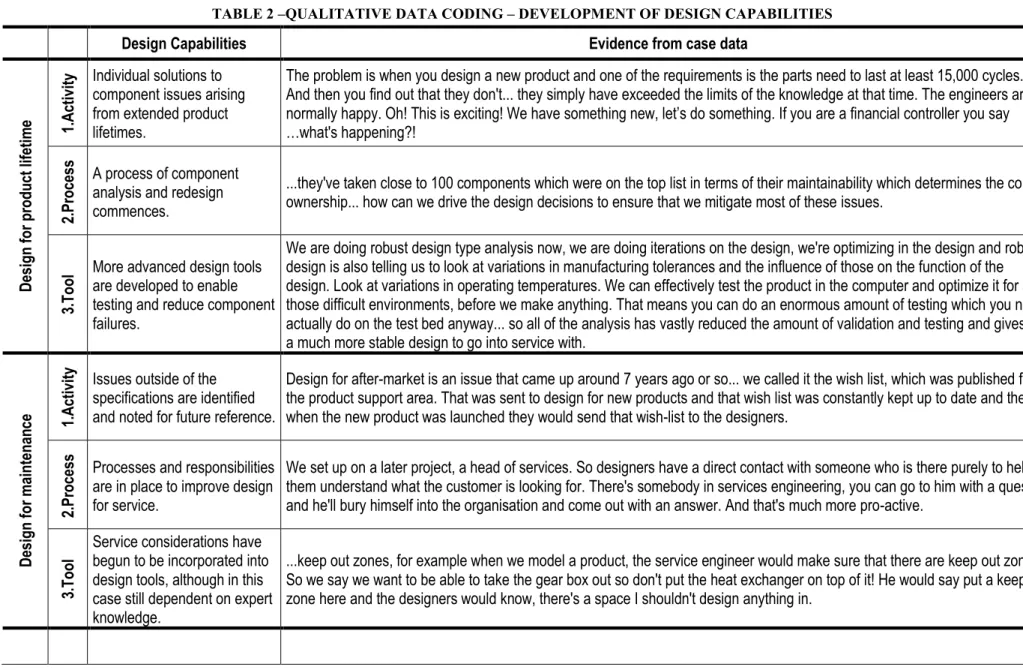
adding, deleting or grouping codes as appropriate; for example, creating new codes to separate different types of design activities. Finally, once a suitable coding structure was created, this could be populated by recoding to develop a more complete understanding. As a result, four main categories of design capabilities are identified in Table 2.
3.3 Reliability and validity
A key challenge for qualitative research in operations management is to demonstrate the trustworthiness of their findings (Beach et al., 2001; Karlsson, 2016). To achieve this, participants in the research must have a say in the interpretations and peers should review initial findings (Lincoln and Guba, 1985; Yin, 2003). To this end, participants were invited to comment on interview transcripts and summaries, to identify inaccuracies or
misinterpretations. Additionally, as the findings evolved, each subsequent interviewee was asked to comment on the researcher’s interpretations and to add their perspective. As these interpretations were analysed and compared with the literature, peer review was achieved through the presentation of preliminary findings at academic conferences (Lincoln and Guba, 1985). Additionally, inter-coder reliability was calculated as a ratio of agreement and
disagreement between individuals who independently coded parts of the data (Voss et al., 2016). Miles and Huberman (1994) recommend multiple researchers code at least 10% of the data; therefore, three interview transcripts (13% of the total) were given to two independent researchers, who were asked to label the text using the coding structure.
TABLE 2 –QUALITATIVE DATA CODING – DEVELOPMENT OF DESIGN CAPABILITIES
Design Capabilities Evidence from case data
D esign for pr odu ct lifetim e 1.Activity Individual solutions to component issues arising from extended product lifetimes.
The problem is when you design a new product and one of the requirements is the parts need to last at least 15,000 cycles. And then you find out that they don't... they simply have exceeded the limits of the knowledge at that time. The engineers are
normally happy. Oh! This is exciting! We have something new, let’s do something. If you are a financial controller you say …what's happening?!
2.Pr
ocess A process of component analysis and redesign commences.
...they've taken close to 100 components which were on the top list in terms of their maintainability which determines the cost of ownership... how can we drive the design decisions to ensure that we mitigate most of these issues.
3.Tool
More advanced design tools are developed to enable testing and reduce component failures.
We are doing robust design type analysis now, we are doing iterations on the design, we're optimizing in the design and robust design is also telling us to look at variations in manufacturing tolerances and the influence of those on the function of the design. Look at variations in operating temperatures. We can effectively test the product in the computer and optimize it for all those difficult environments, before we make anything. That means you can do an enormous amount of testing which you never actually do on the test bed anyway... so all of the analysis has vastly reduced the amount of validation and testing and gives us a much more stable design to go into service with.
D
esign for
maintenan
ce 1.A
ctivity
Issues outside of the specifications are identified and noted for future reference.
Design for after-market is an issue that came up around 7 years ago or so... we called it the wish list, which was published from the product support area. That was sent to design for new products and that wish list was constantly kept up to date and then when the new product was launched they would send that wish-list to the designers.
2.Pr
ocess Processes and responsibilities are in place to improve design for service.
We set up on a later project, a head of services. So designers have a direct contact with someone who is there purely to help them understand what the customer is looking for. There's somebody in services engineering, you can go to him with a question and he'll bury himself into the organisation and come out with an answer. And that's much more pro-active.
3.Tool
Service considerations have begun to be incorporated into design tools, although in this case still dependent on expert knowledge.
...keep out zones, for example when we model a product, the service engineer would make sure that there are keep out zones. So we say we want to be able to take the gear box out so don't put the heat exchanger on top of it! He would say put a keep out zone here and the designers would know, there's a space I shouldn't design anything in.
D esign for S upp ly C hain 1.A ctivity
Manufacturing and supply chain management was considered only after product design.
Previously some clever guys designed the product and some factory had a go at making it. [Supply chain management] was a jumbled mess!
2.Pr
ocess
Integrated teams and defined roles include product and supply chain design are managed concurrently.
For our operational supply chain we have very clear lines of communication. What we call line of sight. There is one and only one person in the company that each factory or supplier deals with. What we do is we have, in each of our supply chain units, a pairing of the sub-system manager and work package owner that have integrative capability for getting that sub-system together and in most cases they have to integrate across several supply chain units. Almost always I would say.
3.Tool
Design and analysis tools enhance the effectiveness of supply chain design.
We give [supply chain designers] additional tools and modelling tools and processes for them to work with so that when we make decisions at a senior level, they know they're made off an approved supply chain template or structure map that's backed up by models and simulations and that's the best option.
Ser
vice Design
1.A
ctivity
Initially small, reactive, maintenance services were offered.
The very early offerings had an emphasis on maintenance; they were maintenance payment programs almost. We created management programs [consisting of field service teams]. So as we got more and more of these customers on board, we realised that we can deploy some other capabilities to help support the deal... we should invent some best practice.
2.Pr
ocess
More advanced processes and facilities were put in place to enhance the level of service offered.
We have an operation, 24 hours 7 days a week. An operations room in the other block, there are sitting five or six engineers they get an email with the photo [of a product with a suspected fault], they have a huge screen wall in front of them and they will look at it and say we can help you with your decision. In our expectation everything is fine, you can close it again. Give the operator the right signal. Then he can make this decision and [arrange repairs] everywhere in the world. If they want to get help from an engineer, they can call them and send a picture or whatever and they clarify it online.
3.Tool
Analysis and management tools were developed to ensure a more sophisticated and integrated service offering.
Now we're selling a pretty sophisticated, integrated package. And we've moved away from it being a 'maintenance pension fund' if you like. You're now paying for a service, you're paying for all those guys looking after your product, making
recommendations, booking that overhaul slot for you two months in advance so that when your product is in maintenance, we have a spare one for you to use and we've arranged the transportation, it goes straight into the shop. And we've developed other more asset based services rather than just stuff to do with maintenance so we have things like a power-plant engineering team now that we can second into an operator. We have a more robust Entry Into Service process.
4.0 Case study
1Eng Co. is a well-established developer and producer of power systems. In the aerospace sector, Eng Co. is one of a small number of firms qualified to act as a supplier to systems integrators such as Sys Co. This allows Sys Co.’s customers to select Eng Co.’s products and has also allowed Eng Co. to offer services directly to Sys Co.’s customers. Eng Co. is a classic servitization case; it began offering maintenance services and subsequently
performance-based contracts rather than outright purchase of its products. Its transition from being a purely product firm to now being regarded as a service firm has been in progress for over a decade.
Within the aerospace supply chain, Eng Co.’s role is as a tier one supplier to an airframe producer such as Sys Co. By introducing service offerings, Eng Co. is able to deal more closely with Sys Co.’s customers. This is seen as a strategic move downstream in the supply chain, made possible by Eng Co.’s ability to develop and produce one of the most complex components in Sys Co.’s products (Supply Chain Executive, Logistics). This ability prevents Eng Co.’s suppliers from doing the same – i.e., dealing with customers directly rather than as a supplier to Eng Co. The product-related ability also restricts the extent to which Eng Co. can move downstream; for example, dealing with tier one customers such as airlines, but no further.
4.1 Product-service offerings
The design and production of complex engineered products remains Eng. Co.’s “bread and butter” (Head of Programme Management, Logistics), i.e., the basis of its product-service offerings and the core of its service business model. Previously, when a product was sold, customers had responsibility for its maintenance and Eng Co. had no guaranteed revenues
from it. Development costs would need to be recouped “before someone else makes a cheaper one” (Supply Chain Executive, Logistics) and service revenue from spares and repairs was “hoped for”. Services began as “maintenance pension funds” (Head of Marketing, Services) and subsequently developed into integrated performance-based contracts, whereby Eng Co. is responsible for keeping the product running and the customer pays for an agreed usage. The current service offering is characterised by three main components:
1. Scheduled maintenance: to maintain performance as well as the economic value of products – like automobiles, regular servicing by an approved dealer maintains resale value.
2. Unscheduled maintenance: service agreements penalise Eng. Co. for any downtime of products, making diagnosis, timely repair and even provision of temporary
substitutes all essential activities.
3. Condition monitoring: to facilitate maintenance, collection of data through sensors and analysis in dedicated facilities is essential.
These services develop knowledge of customers and products, creating new opportunities for service development, for example training or consultancy to smooth product purchase
(Cusumano et al., 2015). This includes educating the customer on the best usage of products and developing more sophisticated services than the initial maintenance offerings provided. Service contracts are agreed with customers annually, based on expected usage and
maintenance costs. The ability to calculate costs accurately is vital, since the responsibility for products has moved from the customer to Eng Co.
4.2 NPD process
The NPD process may commence with a Request for Quotations from Sys Co., the response to which is developed by a high-level design team of senior engineers. A quotation at this
stage must secure a contract for developing the product, or as one interviewee stated: “We don’t sell products, we sell the promise of a solution” (Logistics Executive, Logistics). The promised solution is normally based on previously developed and tested technology, due to the demands of certification that restrict new technologies. A high-level design will form the basis for a full development programme, conducted by a number of Integrated Project Teams (IPTs), each with a focus on a particular sub-system, governed through a series of strategic reviews. A team may include both customer- and product-related experts and potentially representatives from suppliers and other partners with an input into the design (Johnson and Mena, 2008).
The IPTs and reviews are concerned with both the feasibility of the engineering, referred to within the firm as technical design, and commercial considerations or non-technical design. For example, technical design may concern the geometry and specification of a component, while non-technical design concerns where it will be produced, how it will be transported and what supply-chain disruptions may be faced. Customer-Facing Units (CFU) interface with the product-facing parts of the organisation to capture customer requirements during NPD and, subsequently, to deliver services.
5.0 Findings
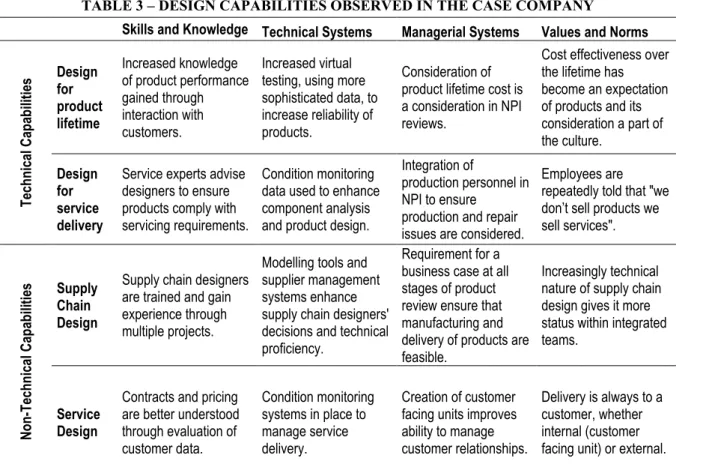
The NPD process incorporates several forms of technical and non-technical design. Analysis of the process focuses on identifying design capabilities and charting their development. Four categories of design capabilities are identified in Table 3.
TABLE 3 – DESIGN CAPABILITIES OBSERVED IN THE CASE COMPANY
Skills and Knowledge Technical Systems Managerial Systems Values and Norms
Tec hn ica l Cap ab ilit ies Design for product lifetime Increased knowledge of product performance gained through interaction with customers. Increased virtual testing, using more sophisticated data, to increase reliability of products.
Consideration of product lifetime cost is a consideration in NPI reviews.
Cost effectiveness over the lifetime has become an expectation of products and its consideration a part of the culture. Design for service delivery
Service experts advise designers to ensure products comply with servicing requirements.
Condition monitoring data used to enhance component analysis and product design.
Integration of
production personnel in NPI to ensure
production and repair issues are considered.
Employees are repeatedly told that "we don’t sell products we sell services". No n-Tec hn ica l Cap ab ili
ties Supply Chain Design
Supply chain designers are trained and gain experience through multiple projects.
Modelling tools and supplier management systems enhance supply chain designers' decisions and technical proficiency.
Requirement for a business case at all stages of product review ensure that manufacturing and delivery of products are feasible.
Increasingly technical nature of supply chain design gives it more status within integrated teams.
Service Design
Contracts and pricing are better understood through evaluation of customer data. Condition monitoring systems in place to manage service delivery. Creation of customer facing units improves ability to manage customer relationships.
Delivery is always to a customer, whether internal (customer facing unit) or external.
Eng. Co. has many years of history as a producer and innovator of power-systems
technology. This is reflected in its processes and tools for analysis, design and manufacture of products and components, some of which comprise technical design capabilities. The
demands of a service-oriented business model mean these capabilities have been extended in two directions, supporting extended product lifetime and supporting maintenance.
Additionally, a new set of capabilities have been developed to support non-technical design. Most prominent among these are supply-chain design – to develop responsive supply chains that cope with the inherent variability of service delivery – and service design – concerned with customer interfaces and product value propositions.
5.1 Technical capabilities
5.1.1 Design for product lifetime
Eng. Co.’s products have a design life measured in decades, meaning that engineers must cope with unplanned technical challenges that arise in the future. Such challenges excite engineers (Manufacturing Engineer, Eng Co.), who thrive on opportunities to solve complex problems, but cause concerns for those managing budgets (Løwendahl, 2005). To avoid the unsustainable costs of continually solving problems, Eng Co. seeks to analyse critical
components using data from products in service to facilitate their redesign. Such activities are led by senior engineers and aim to capture knowledge from service data in simulations used by more junior engineers to design products more effectively.
5.1.2 Design for service delivery
The service business model demands the easy diagnosis and repair of issues that could lead to downtime and penalties. For engineers, this means unfamiliar requirements added to
challenging performance specifications. To support design, an initial activity involves generating a “wish list” to capture issues in maintenance that were not understood when previous products were designed. This is supported by ensuring IPTs’ work with service experts, who can advise, for example, on access requirements for maintenance personnel. A foreseeable next step would be to systematically capture this knowledge in simulations or design tools that reduce dependence upon personnel.
5.2 Non-technical capabilities
Unlike technical capabilities, which appear to evolve from existing processes, non-technical capabilities represent a novelty for the organisation. In line with the proposed model, these are developed in separation before their integration into the NPD process.
5.2.1 Supply-chain design
A range of trends, including product complexity, reliance on joint ventures for investment and risk sharing, greater involvement from suppliers and the demands of through-life service, have made supply-chain management a more strategic priority Engineering previously took precedence over production planning, maintenance and other operational concerns; but this is now seen to risk misaligned supply chains and inefficiency in production, delivery and maintenance. Such risks are greatly felt since the service business model means Eng Co., rather than customers, bear the costs. As a result, supply-chain design has become more systematic and prominent in NPD.
A new role of supply-chain designer has been created to formalize the specific
responsibilities and training for IPT members, who work alongside engineers. The nature of NPD reviews also reflects an effort to make non-technical design more closely resemble the
technical. Tasks, such as assessing product lifetime cost, evaluating risk and predicting profitability under alternative supply-chain configurations, utilise data in a similar manner to engineering design analysis. Design tools such as simulation models and analysis software have been developed that mimic Computer Aided Design (CAD) and simulation tools used for engineering design. These tools “give [supply chain designers] more teeth” (Logistics Executive, Logistics). That is, they give status to the non-technical considerations in a culture that rewards technical excellence. Having formal tools and access to data gives supply-chain designers more credibility and demonstrates the value of formalising design activities into capabilities that allow systematic and repeatable processes.
5.2.2 Service design
Over years of service delivery, Eng Co.’s offerings have grown from add-ons, such as maintenance, largely due to the increased data afforded by interaction with customers and products in use. In particular, condition monitoring provides a source of reliable usage data
that facilitates maintenance scheduling, pricing of contracts and additional support. Detailed analysis of usage patterns helps generate more accurate estimates when agreeing annual contracts. It also enables Eng Co. to advise customers on how to reduce costs and improve product life; for example, advising on modifications to pilots’ procedures to reduce fuel consumption or wear. The capability to develop, customise and improve services offered to customers has developed incrementally and in isolation from the NPD process, with the CFUs acting as a “buffer” between customers and engineers (Material Supply Manager, Maintenance Services). The result is that services can be developed independently of product development by the CFUs, who capture customer knowledge which they integrate into NPD. CFUs act as an internal customer for IPTs during the NPD process to incorporate customer-, supplier- and product-related knowledge into new products.
6.0 Discussion
Viewed strategically, servitization is a radical BMI that substitutes services in place of products (Cusumano et al., 2015). From an operational perspective, as seen by examining NPD, the changes are subtler. NPD in Eng Co. is a two-stage process, whereby products are developed to meet Sys Co.’s specifications and then customised for individual customers using Sys Co.’s products. For those involved in the first stage, servitization has little
perceived impact. This is arguably because the process has been subtly updated, owing to the separation and incremental development of design capabilities. This is evident, for example, when interviewees describe “keep out zones” for maintenance purposes, which they design around: a small change that avoids disrupting their normal activity.
The second stage, meanwhile, involves what Cusumano et al. (2015) describe as adapting services, whereby products are customised for individual customers, including the adaptation of the supply network, and smoothing services, where analysis of customer data allows
increased service provision. Both of these rely on the firm’s NPD capabilities, but also demand that such capabilities are updated, for example, using customer data and engineering expertise to adapt products and smooth their purchase. As Ulaga and Reinartz (2011) argue, it is inconceivable that a pure service firm, lacking a track record with similar products or an NPD process to create them, could compete. These services are knowledge-intensive, customer focused and require integration across organizational and geographic boundaries (Zhang et al., 2016). They cannot easily be imitated because the key capabilities are the knowledge of experts (Løwendahl, 2005), which can be captured in the organisation’s
processes but not easily obtained by others. Evidence from this case study suggests that NPD enables servitization, but equally that capabilities must be updated to suit the change in the business model. This supports the first proposition.
For a manufacturing firm to deliver services profitably, it should be capable of both exploiting existing capabilities and exploring new ones (March, 1991). Design-thinking offers a perspective on how to balance these objectives through structural separation. More specifically, the proposed model underlying this research involves three steps:
1. Existing capabilities are deemed to be insufficient to produce the expected value proposition. The ad-hoc problem-solving, based on the knowledge of experts, is termed design activities.
2. As solutions are developed and refined, they become repeatable. These are design processes.
3. With sufficient data, the knowledge and processes become codified and incorporated into the firm’s NPD activities. The standardised and often computerised form
This supports and explains the second proposition, by demonstrating how capabilities may be developed.
When new capabilities are developed, their integration represents a challenge because these capabilities are unfamiliar. A known danger is that poor fit with the firm’s values and norms leads to opportunities being overlooked (Leonard-Barton, 1992) and the capabilities to act on them being unrecognised (Oliva and Kallenberg, 2003). The design capabilities identified in this case are deliberately developed to resemble existing capabilities. This is most clearly illustrated in the approach to supply-chain design, which may be dismissed as non-technical
and not taken seriously within IPTs. Managers recognise the importance of supply-chain design, for example in controlling costs over the product lifetime, but engineers may not. The aim of developing modelling tools and simulations that closely resemble the analysis
conducted by engineering designers is to give “teeth” to the supply-chain designers. This supports the third proposition, by identifying how organisational values and norms affect the acceptance of capabilities and why structural separation may be required to develop them. 6.1 Research implications
This research contributes to knowledge in three ways. Firstly, it identifies four categories of design capabilities developed by a servitized manufacturer, which adds to the knowledge on servitization. Secondly, it outlines a reciprocal relationship between BMI and NPD,
extending understanding of NPD capabilities and their dynamic nature. Finally, it proposes a process by which capabilities are developed as part of the servitization journey.
Priorresearch on servitization identifies the need for a manufacturing firm to update its capabilities. The focus has, thus far, been on service capabilities (Galbraith, 2005; den Hertog et al., 2010), particularly regarding customer relationships (Tuli et al., 2007) and partnerships with suppliers (Johnson and Mena, 2008; Pawar et al., 2009). Studies of manufacturing
capabilities (Ulaga and Reinartz, 2011) advise developing service capabilities but have not addressed how the NPD process is affected by servitization (Paslauski et al., 2016). The findings outline four design capabilities that enable NPD to adapt to servitization. Firstly, products must be designed for extended life or ease of component replacement, to facilitate longer life in service. Secondly, design for maintenance is an important concern, because the costs of maintenance and penalties for downtime are borne by the manufacturer, so
maintenance is a source of cost not revenue (Mathieu, 2001). Thirdly, design for supply chain is crucial, owing to the implications of sourcing decisions being felt over the lifetime of products, long after they leave the factory. Finally, service design should build on the knowledge created through customer interaction and product monitoring.
The literature on NPD identifies a paradoxical relationship between capabilities and
innovation, whereby capabilities that enable incremental product innovation become rigidities (Leonard-Barton, 1992). Daneels (2002) suggests this can be overcome by using product innovation, including the knowledge it generates, to update capabilities. The findings here suggest the same reciprocal relationships exists between capabilities and BMI. In particular, the co-evolution of business models and capabilities (Sosna et al., 2010) leads to a radical BMI (e.g., servitization of manufacturing firms) being accompanied by incremental innovation in products and the adaptation of the NPD process.
Finally, the design-thinking perspective adopted in this study contributes to the understanding of design as a creative problem-solving activity (Azadegan et al., 2008,) by demonstrating how it can be applied in organisational contexts. Design-thinking as outlined in Martin’s (2009) knowledge funnel is seen as a powerful approach to organisational learning (March, 1991) that helps to update and enhance capabilities. The proposed process for creating design capabilities, therefore, offers an important contribution to theory and practice.
6.2 Managerial implications
Implementing a service business model is a challenge for manufacturing firms. This is because the service builds on product knowledge and design processes at the same time as it makes these capabilities unsuitable. For managers, the lessons from this case study relate to the need to update design capabilities and an understanding of how this is achieved. While business models are regularly seen as planned strategies, servitization may occur
incrementally in response to requests from customers (Kowalkowski et al., 2012; Raja et al., 2018). This research highlights the importance of actively developing capabilities to ensure that they are aligned with the business model, which may evolve to match customer demand. A firm’s design capabilities should be clearly identified, because these define what types of products and services can be designed and, hence, whether customer demand can be met. As well as enabling offerings to customers, design capabilities may restrict the nature of services that can be offered. Therefore, managers must ensure these capabilities are updated. Initially this entails design activity that relies on experts’ creativity (Simon, 1996; Løwendahl, 2005; Mutanen, 2008), but the solutions these experts create should be refined, standardised and aligned with the organisation’s culture (Leonard-Barton, 1992). Two decisions are needed, according to the novelty of the design activities. Firstly, whether the activity should be separated and later re-integrated into the NPD process (Gilbert, 2005; Taylor and Helfat, 2009) and, secondly, whether existing personnel can address the task or if external experts should be recruited. Prior research has demonstrated that design capabilities can be catalysed by recruiting experts or the initial involvement of external design consultants (Mutanen, 2008; Azadegan et al., 2008). To be sustainable, however, the organisation should seek to codify expert knowledge within the NPD process (Nonaka and Takeuchi, 1995).
As the examples in this case study suggest, these may be new job roles, management structures or tools. As the example of supply-chain design in Eng Co. suggests, fit with
existing capabilities and organisational culture is key. Following Leonard-Barton (1992), this research suggests capabilities must align with the organisation’s skills and knowledge, technical systems, managerial systems and values and norms. Such fit may be achieved by creating tools that resemble existing ones, as in the case of supply-chain design tools and management structures that complement those in engineering.
6.2 Limitations and future research
Being based on a single case study, the purpose of this research is theoretical generalisation (Yin, 2003), which is enabled by the level of depth offered by multiple informants and multiple perspectives. Subjectivity in the responses of interviewees is acknowledged and, indeed, valued in this case, because it offers a number of perspectives and highlights the various managerial challenges faced in similar contexts. Specifically, the different
perspectives of those engaged in technical and non-technical design suggest the changes to processes and behaviours that are required for the implementation of a service business model. Measures were taken to address the reliability and validity of the analysis, both through interviewee feedback and peer-review by independent researchers.
The focus of this study is on the adaptation of the NPD process in a firm as it seeks to implement a service business model. The analysis identifies that service design capabilities are developed and suggests how they are integrated with product design capabilities. An important matter that demands further research, however, is how services are designed by product firms. The pricing of contracts, for example, is an important capability that depends on product and customer knowledge, but relatively little is known about how firms should develop this capability. In Eng Co.’s case, it has taken time as the “business structures” have developed, but looking at service design separately from NPD may be of benefit for a better understanding.
Further research is also needed to examine how the design capabilities interact in the development of complex product-service systems. For Eng Co., a system-level design is separated into components to be created by IPTs. While this is effective in terms of division of labour, it may lead to the interactions between, for example, products, services and partnerships being missed. A design-thinking approach should ideally view a problem as a system, in which addressing one aspect affects others. Whether and how design-thinking can be applied at the level of the system, rather than modularised components, would further enhance understanding. Finally, while the proposed model recognises the barriers that culture presents, there is scope to investigate further. In particular, future work should focus on a model for managing the change of organisational culture in a servitization context.
References
Alvesson, M. and Sköldberg, K. (2009) Reflexive methodology: New vistas for qualitative research, 2nd ed.,Sage, Thousand Oaks.
Archer, L.B. (1965) Systematic Method for Designers, Council of Industrial Design, London. Azadegan, A., Bush, D. and Dooley, K.J. (2008) “Design creativity: static or dynamic
capability”, International Journal of Operations and Production Management,Vol. 28, No. 7, pp. 636-662.
Benedettini, O., Neely, A. and Swink, M. (2015) “Why do servitized firms fail? A risk-based explanation”, International Journal of Operations and Production Management, Vol. 35, No. 6, pp. 946-979.
Biemans, W.G., Griffin, A. and Moenaert, R.K. (2016) “New service development: How the field developed, its current status and recommendations for moving the field forward”,
Journal of Product Innovation Management, Vol. 33, No. 4, pp. 382-397.
Boland, R.J., and Collopy, F. (2004) “Design Matters for Management”, in: Boland, R J and Collopy F (Eds.) Managing as Designing. Stanford Business Books, Stanford, CA.
Burton, J., Story, V.M., Raddats, C. and Zolkiewski, J. (2017) “Overcoming the challenges that hinder new service development by manufacturers with diverse service strategies”,
International Journal of Production Economics, Vol. 192, pp. 29-39.
Chesbrough, H. and Rosenbloom, R.S., (2002) “The role of the business model in capturing value from innovation: evidence from Xerox Corporation’s technology spin‐off
companies”,Industrial and Corporate Change,Vol. 11, No. 3, pp. 529-555.
Cusumano, M.A., Kahl, S.J. and Suarez, F.F. (2015) “Services, industry evolution, and the competitive strategies of product firms”, Strategic Management Journal, Vol. 36, No. 4, pp. 559-575.
Danneels, E. (2002) “The dynamics of product innovation and firm competences”, Strategic Management Journal, Vol. 23, No. 12, pp. 1095-1121.
Davies, A. and Brady T. (2000) “Organisational capabilities and learning in complex product systems: towards repeatable solutions”, Research Policy, Vol. 29, No. 7, pp. 931-953. Den Hertog, P., van der Aa, W. and de Jong, M.W. (2010) “Capabilites for managing service
innovation: towards a conceptual framework”, Journal of Service Management, Vol. 21, No. 4, pp. 490-514.
Dierickx, I. and Cool, K. (1989) “Asset stock accumulation and sustainability of competitive advantage”, Management Science, Vol. 35, No. 12, pp. 1504-1511.
Dorst, K. (2011) “The core of ‘design thinking’ and its application”, Design Studies, Vol. 32, No. 6, pp. 521-532.
Dubois, A. and Gadde, L. (2014) ““Systematic combining”—A decade later”, Journal of Business Research, Vol. 67, No. 6, pp. 1277-1284.
Dyer, W.G. and Wilkins, A.L. (1991) “Better Stories, Not Better Constructs, to Generate Better Theory: A Rejoinder to Eisenhardt”, Academy of Management Review, Vol. 16, No. 3, pp. 613-619.
Easterby-Smith, M., Thorpe, R. and Jackson, P.R. (2015) Management and Business Research, 5th ed. Sage, Thousand Oaks, CA.
Eisenhardt, K.M. (1989) “Building theories from case study research”, Academy of Management Review, Vol. 14, No. 4, pp. 532-550.
Galbraith, J.R. (2005) Designing the customer centric organization, Josey-Bass, San Francisco, CA.
Gilbert, C.G. (2005) “Unbundling the structure of inertia: resource versus routine rigidity”,
Academy of Management Journal, Vol. 48, No. 5, pp. 741-763.
Gorb, P. and Dumas, A. (1987) “Silent Design”, Design Studies, Vol. 8, No. 3, pp.150-156. Johnson, M. and Mena, C. (2008) “Supply chain management for servitised products: a
multi-industry case study”, International Journal of Production Economics, Vol. 114, No.1, pp. 27-39.
Hong, P., Vonderembse, M.A., Doll, W.J. and Nahm, A.Y. (2005) “Role change of design engineers in product development”, Journal of Operations Management, Vol. 24, No. 1, pp. 63-79.
Karlsson, C. (2016) “Research in operations management”, in Karlsson, C. (Ed.) Research Methods in Operations Management, Routledge, Abingdon, pp. 7-45.
Kotler, P. and Rath, G.A. (1984) “Design a powerful but neglected strategic tool”, Journal of Business Strategy, Vol. 5, No. 2, pp. 16-21.
Kowalkowski, C., Kindström, D., Alejandro, T.B., Brege, S. and Biggermann, S. (2012) “Service infusion as agile incrementalism in action”, Journal of Business Research, Vol. 65, No. 6, pp. 765-772.
Lawson, B. (2006) How designers think: the design process demystified, 4th ed., Elsevier,
Leonard-Barton, D. (1992) “Core capabilities and core rigidities: A paradox in managing new product development”, Strategic Management Journal, Vol. 13, S1, pp.111-125.
Lightfoot, H., Baines, T. and Smart, P. (2013) “The servitization of manufacturing: A systematic literature review of interdependent trends”, International Journal of Operations and Production Management, Vol. 33, No. 11, pp. 1408-1434.
Lincoln, Y.S. and Guba, E.G. (1985) Naturalistic enquiry, Sage, Newbury Park, CA. Løwendahl, B. (2005) Strategic management of professional service firms, 2nd ed.,
Copenhagen Business School Press, Copenhagen.
Magretta, J. (2002) “Why business models matter”, Harvard Business Review, Vol. 80, No. 5, pp. 86-92.
Makadok, R. (2001) “Toward a synthesis of the Resource Based and Dynamic Capability views of rent creation”, Strategic Management Journal, Vol. 22, No. 5, pp. 387-401. March, J.G. (1978) “Bounded rationality, ambiguity and the engineering of choice”, The Bell
Journal of Economics, Vol. 9, No. 2, pp. 587-608.
March, J.G. (1991) “Exploration and exploitation in organizational learning.” Organization Science, Vol. 2, No. 1, pp. 71-87.
Martin, R.L. (2009) The design of business: why design thinking is the next competitive advantage, Harvard Business School Press, Boston, MA.
Mathieu, V. (2001) “Service strategies within the manufacturing sector: benefits, costs and partnerships”, International Journal of Service Industry Management, Vol. 12, No. 5, pp. 451-475.
McGrath, R.G., (2010) “Business models: a discovery driven approach”, Long Range Planning, Vol. 43, No. 2, pp. 247-261.
Miles, M.B. and Huberman, A.M. (1994) Qualitative data analysis, an expanded sourcebook, 2nd ed., Sage, Thousand Oaks, CA.
Morelli, N. (2003) “Product-service systems, a perspective shift for designers: A case study: the design of a telecentre”, Design Studies, Vol. 24, No. 1, pp. 73-99.
Mutanen, U. (2008) “Developing organisational design capability in a Finland-based engineering corporation: the case of Metso”, Design Studies, Vol. 29, No. 5, pp. 500-520. Nonaka, I and Takeuchi, H. (1995) The knowledge creating company: how Japanese
companies create the dynamics of innovation., Oxford University Press, Oxford.
Oliva, R. and Kallenberg, R. (2003) “Managing the transition from products to services”,
International Journal of Service Industry Management, Vol. 14, No. 2, pp. 160-172. Osterwalder, A. and Pigneur, Y. (2005). “Clarifying business models: Origins, present, and
future of the concept”, Communications of AIS, No.16, pp. 1-25.
Paslauski, C.A., Ayala, N.F., Tortorella, G.L. and Frank, A.G. (2016) “The Last Border for Servitization”, Procedia CIRP, Vol. 47, pp. 394-399.
Pawar, K.S., Beltagui, A. and Riedel, J.C.K.H. (2009) “PSO Triangle: designing product, service and organisation to create value”, International Journal of Operations and Production Management, Vol. 29, No. 5, pp. 468-493.
Raddats, C., Baines, T., Burton, J., Story, V.M. and Zolkiewski, J. (2016) “Motivations for servitization: the impact of product complexity.” International Journal of Operations and Production Management, Vol. 36, No. 5, pp. 572-591.
Raja, J.Z., Chakkol, M., Johnson, M and Beltagui, A. (2018) “Organizing for servitization: examining front- and back-end design configurations”, International Journal of Operations and Production Management, Vol. 28, No. 1, pp.249-271.
Schön, D.A. (1991) The reflective practitioner: how professionals think in action, Ashgate, Aldershot.
Smith, L., Maull, R. and Ng, I.C.L. (2014) “Servitization and operations management: a service dominant-logic approach”, International Journal of Operations and Production Management, Vol. 34, No. 2, pp. 242-269.
Sosna, M., Trevinyo-Rodríguez, R.N. and Velamuri, S.R. (2010) “Business model innovation through trial-and-error learning: The Naturhouse case.” Long Range Planning, Vol. 43, No. 2, pp. 383-407.
Simon, H.A. (1996) The sciences of the artificial, 2nd ed., MIT Press, Cambridge, MA. Storbacka, K. (2011) “A solution business model: capabilities and management practices for
integrated solutions”, Industrial Marketing Management, Vol. 40, No. 5, pp. 699-711. Storey, C., Cankurtaran, P., Papastathopoulou, P. and Hultink, E.J. (2016) “Success Factors for Service Innovation: A Meta‐Analysis”, Journal of Product Innovation Management, Vol. 33, No. 5, pp. 527-548.
Strauss, A.L. and Corbin, J. (1998) Basics of qualitative research, Sage, Thousand Oaks, CA. Swan, K.S. and Luchs, M. (2011) “From the special issue editors: Product design research
and practice: past, present and future”, Journal of Product Innovation Management, Vol. 28, No.3 , pp. 321-326.
Tan, A.R., Matzen, D., McAloone, T.C. and Evans, S. (2010) “Strategies for designing and developing services for manufacturing firms”, CIRP Journal of Manufacturing Science and Technology, Vol. 3, No. 2, pp. 90-97.
Taylor, A. and Helfat, C.E. (2009) “Organizational linkages for surviving technological change: Complementary assets, middle management and ambidexterity”, Organization Science, Vol. 20, No. 4, pp. 718-739.
Tongur, S. and Engwall, M., (2014) “The business model dilemma of technology shifts.” Technovation, Vol. 34, No. 9, pp. 525-535.