Using a Computerized Fall Risk Assessment Process
to Tailor Interventions in Acute Care
Mary L. Hook, PhD, APRN, BC; Elizabeth C. Devine, PhD, RN, FAAN; Norma M. Lang, PhD, RN, FAAN, FRCN
Abstract
Patient falls account for a significant portion of injuries in hospitalized patients. The literature on falls and fall-related injury in acute care is extensive but includes primarily expert opinion and quality improvement reports. The evidence on the effect of standardized interventions to reduce falls in acute care settings is inconsistent. This lack of effect may be due to variability in
patients’ fall risk factors and the fact that interventions may only be effective if tailored to address specific patient needs. This paper describes how the Aurora-Cerner-University of
Wisconsin – Milwaukee Knowledge-Based Nursing Initiative© framework was used to create an
evidence-based, computerized, fall risk decisionmaking process to support nurses in tailoring prevention interventions based on patient need. In addition to supporting nurses in
decisionmaking and documentation, clinical information fields were created to facilitate data retrieval for quality improvement and research.
Introduction
In 2001, the Institute of Medicine (IOM) encouraged health care organizations, purchasers, and patients to work together to redesign patient care processes, emphasizing that care should be based on the best available scientific knowledge.1 However, the gap between knowledge development and subsequent clinical application is well known. The challenge is to bridge the gap by efficiently and effectively providing the best evidence to providers where it is needed most, at the bedside.
Patient falls in acute care hospitals account for a significant number of patient injuries.2 Serious
injuries (e.g., fractures, sprains, lacerations, or concussions) have been reported to occur in 6 to 10 percent of inpatients who fall, adding significantly to length of stay and cost of care.3, 4 The literature on falls and fall injury in acute care is extensive. However, much of it consists of literature reviews, expert opinions, or safety/quality improvement activities that are innovative but largely untested by research. Prevention efforts have been focused on identifying high-risk patients and reducing risk factors.2, 5
To date, consistent evidence on standardized interventions that effectively prevent falls among hospitalized patients is lacking.5, 6 This lack of evidence may be related to the fact that patient
fall risk factors vary, and that interventions may only be effective if they are based on sound evidence and are tailored to address patient-specific needs.
This paper describes how the Aurora-Cerner-University of Wisconsin – Milwaukee (ACW) Knowledge-Based Nursing Initiative© (KBNI) framework was used to create evidence-based
practice recommendations to reduce fall risk in hospitalized adults. It describes how
recommendations for patient assessment, nursing diagnosis/problem identification, nursing interventions, and nursing-sensitive outcomes are developed and computerized to help nurses tailor prevention interventions7 to reduce fall risk, based on patient characteristics and needs.
The ACW KBNI project was also designed to ensure that clinical care documentation was coded to a standardized language to facilitate data retrieval for quality improvement and research.
Background
The ACW KBNI is an innovative partnership between a health care system, an informatics vendor, and academia that is designed to facilitate “best practice” by nurses through embedding evidence-based practice recommendations in a clinical information system (CIS) with decision support. The partnership was formed in July 2004 between Aurora Health Care, Cerner
Corporation, and the University of Wisconsin-Milwaukee College of Nursing with a vision to accelerate and expand the use of knowledge and evidence in nursing practice through intelligent technology.8 Aurora Health Care is an integrated health delivery network in eastern Wisconsin
comprising 14 hospitals, over 100 outpatient clinics, and over 7,000 nurses. Cerner Corporation is a leading public, global health care technology company with more than 1,500 clients
worldwide. The University of Wisconsin-Milwaukee College of Nursing is the largest nursing school in Wisconsin.
The Knowledge-Based Nursing Initiative (KNBI) Process
The ACW KBNI process is divided into two distinct phases: one, a knowledge generation/ utilization phase; and two, a data-mining phase. This paper focuses on describing the knowledge generation/utilization phase, in particular, the topic of “risk for falls”for adults in acute care. This phase is divided into four major steps:
1. Searching and synthesizing the evidence.
2. Making actionable clinical practice recommendations.
3. Embedding these recommendations into the clinical documentation system with decision support.
4. Evaluating the outcome of this work.
To support the delivery of care, clinical practice recommendations are organized into the four parts of the nursing process: assessments, diagnoses, interventions, and outcomes. Reassessments and the revision of diagnoses and interventions are facilitated by embedded decision support to facilitate clinical decisionmaking throughout the hospital stay. The ACW KNBI process is described briefly, followed by details of how it was applied to the phenomenon, risk for falls. It is worth noting that the KBNI process has been used for other topics, such as delirium, activity intolerance, and venous thromboembolism, to name a few.
The KBNI process begins by identifying a “phenomenon” of concern (i.e., a clinical topic in a specific population) about which clinical practice recommendations will be made. The
knowledge development team includes:
• The knowledge developer, a nurse with graduate preparation, preferably at the doctoral level.
• A research librarian.
• Doctorally prepared nurses with expertise in knowledge synthesis, coding terminology, and data mining.
• Master’s-prepared advanced practice nurses and clinical nursing staff.
Searching, Evaluating, and Synthesizing Evidence into
Recommendations
The knowledge developer, research librarian, and knowledge synthesis expert collaborate to search the literature, looking for relevant research and clinical journal articles, literature reviews, clinical practice guidelines, and other professional reports. Once the initial search is complete, the knowledge developer screens each identified source for relevance (e.g., clinical topic, population, venue of care, outcome) and quality (e.g., appropriate methodology, fatal flaws). Relevant sources of acceptable quality are read and critiqued using evidence-specific criteria. After the critique, the results and conclusions from relevant, quality sources are abstracted and entered into an evidence table. The ACW KBNI Evidence Table© is formatted to facilitate the
abstraction of descriptive source information (e.g., question/topic, methodology, sample), findings, and author conclusions that warrant consideration when assessment, diagnosis, intervention, and outcome recommendations are made. Knowledge developers also gather information about background and problem significance and may code information to facilitate subsequent analysis. Results from relevant findings are noted, whether statistically significant or not.
To prepare for synthesizing practice recommendations, the knowledge developer reviews the evidence for quantity, quality, and consistency.9 Each source is evaluated and assigned an
evidence type (e.g., systematic review, randomized clinical trial, observational [cohort or case-control] study, descriptive or qualitative research, clinical article). Eventually, the relevant credible evidence is synthesized into practice recommendations, and each recommendation is assigned a rating for the strength of evidence supporting it based on a rating system10 modified from the evidence rating system proposed by Melnyk and Fineout-Overholt.11 Modifications are
done to account for types of evidence not specified in the original rating system (e.g., psychometric research).
Making Actionable, Evidence-Based Recommendations
The goal of the ACW KNBI process is to make clear, concise, actionable recommendations based on evidence using several strategies:
• First, as the recommendations are drafted, a corresponding flow diagram is created to ensure that recommendations flow logically with appropriate follow-through (e.g., recommended assessments are used in clinical decisionmaking and never “dead end,” causing nurses to gather data that are not clinically useful).
• Second, each recommendation is written to specify “For whom? Do what?” This ensures that recommendations are concrete and applied to appropriate patient population(s) based on the evidence. To facilitate bedside use, the knowledge developer identifies notes to be
embedded into the information system as referential text or decision support.
• Third, standardized terminology is used in the recommendations whenever possible, to facilitate consistent patient care documentation, coding, and subsequent data retrieval.
• Fourth, recommendations are reviewed for clarity and relevance by ACW project experts and practicing nurses.
The finished ACW KBNI referential product includes four parts: 1. A phenomenon overview.
2. The synthesis of clinical practice recommendations, strength of supporting evidence ratings, rationale, and notes for embedding.
3. A reference list, including types of evidence. 4. A flow chart of the recommendations.
The final product is made available to the personnel who embed the computerized care plans and decision-support mechanisms into the clinical information system and, as a reference document, to clients of the informatics vendor.
Embedding the Recommendations and Promoting Adoption of
Practice Changes
After the referential synthesis is complete, the KBNI knowledge-development team works closely with the informatics and clinical partners to embed the recommendations into the clinical information systems, closely adhering to the evidence-based recommendations.
Evaluating Outcomes
Once the recommendations are embedded into the clinical information system, important data become available in the clinical repository. During the KBNI data-mining phase, data can be extracted using quality improvement or research methods to determine the extent to which the processes of care and targeted interventions specified in the recommendations were used and to evaluate patient outcomes.
Applying the Process to Fall Prevention in Acute Care
Synthesizing the Evidence for the Phenomenon: Risk for Falls
A “patient fall” is defined as “an unplanned descent to the floor (or an extension of the floor; e.g., trash can or other equipment) during the course of a patient’s hospital stay with or without
injury to the patient.”12 The diagnosis of “risk for falls,” the focus of this paper, is defined as the
state in which an individual has “increased susceptibility to falling that may cause physical harm.”13
Searching the Literature
An extensive review of the literature was conducted with an initial focus on evidence published between 1996 and 2005 on nursing assessments, diagnoses, interventions, and outcomes related to risk for falling for adults in acute care. (Note: Postfall management was investigated as a separate ACW KBNI topic).
This search was supplemented with topic-specific searches and updated with new papers released during the review. The databases searched included PubMed, Cumulative Index to Nursing & Allied Health Literature® (CINAHL), Cochrane Database of Systematic Reviews, Web of
Science, PsycINFO®, and National Guideline Clearinghouse. Additional evidence was accessed
from professional and accrediting organizations and governmental agencies (e.g., the Joint Commission,2, 12 the Veterans Health Administration (VHA),14 the Agency for Healthcare
Research and Quality (AHRQ),15 and others).
Search terms and phrases included: falls, accidental falls, risk assessment, risk factors, risk management, and falls assessment. These were searched alone and in combination with other terms, including fall intervention, inpatient accidents, potential for injury, impaired physical mobility, accidental injuries, patient safety, safety management, injury control, safety promotion, and accident prevention, to name a few.
The search yielded a large number of citations. After preliminary screening for relevance and quality, more than 200 sources were entered into the “Risk for Falls” evidence table. A total of 30 fall risk-scoring tools were reviewed for reliability, validity, and feasibility for use in the acute care setting. Despite an attempt to strictly limit the review to evidence relevant to the acute care setting, many of the published systematic reviewers (10 percent of the evidence) reported on fall research findings from both community and acute care venues. The majority of available evidence on fall prevention in acute care settings was gleaned from observational (i.e., cohort or case control, 27 percent), descriptive (24 percent), and qualitative (6 percent) research; additional evidence was derived from publications classified as clinical articles, guidelines, and narrative literature reviews (27 percent). Clinical trials (randomized or controlled without randomization) represented only 6 percent of the evidence, a finding that was not surprising, given the nature of the acute care environment and the presence of regulatory requirements that mandate fall risk assessments and interventions to reduce the risk of falls.
Organizing the Evidence to Evaluate Risk Based on Fall Etiology
Morse16, 17 has identified three types of falls in the acute care setting:
1. Anticipated physiological falls. These are falls that occur in patients who are identified as “fall-prone,” based on identified risk factors (e.g., unstable gait, history of falling). Morse reported that anticipated falls are the most common (78 percent of falls),17 although a more
recent report suggests that this type of fall only accounts for 34 to 38 percent of falls in hospitalized patients.18
2. Unanticipated physiologic falls. These are falls that are attributed to physiologic causes, but occurrence of the condition could not be predicted (e.g., seizures, fainting).17
3. Accidental falls. Accidental falls are caused by the patient slipping, tripping, or having a mishap. Morse indicated that accidental falls are less common,17 but a more recent report
suggests that accidental falls account for 45 percent of falls in acute care.18
Therefore, the ACW KNBI recommendations for fall risk assessments, diagnoses, and interventions were designed to be comprehensive and to reduce fall risk across all three etiologies.
Assessing for Risks of Anticipated Physiologic Falling
Almost 75 percent of the citations that met the relevance and quality criteria for inclusion in the review provided evidence that pertained to the assessment of a patient’s risk of falling based on factors that can be anticipated. Clinical experts, researchers, and accrediting agencies2 agree that
patient assessment is important. However, the processes for evaluating patient risk are very diverse.
Fall risk assessment based solely on the clinical judgment of the nurse, without the use of a tool/questionnaire, has been shown to vary with the experience level of the clinician, and overall, it has been shown to have an accuracy of 35 percent.19 Although the literature contains many fall risk assessment tools, many are “home grown” without established reliability and validity.20
Using a reliable and valid fall risk assessment tool is recommended because it allows nurses to make decisions regarding the patient’s potential for falls in a systematic manner, rather than using intuition,21 and the process of risk assessment can be done reliably despite changes in
personnel and the advance of time.22
Over 50 sources of evidence dealt with the development, use, and/or validation of fall risk assessment tools that are designed to identify patients with physiologic conditions that allow one to predict that they would be at increased risk of falling. Of the 30 tools reported in the literature, the published report(s) on only 12 of these tools included sufficient psychometric information to allow for adequate review and comparison.
Several tools were developed and tested in acute care settings, where staff members were aware of the study and were allowed to implement interventions to prevent falls from occurring. This reduced the usefulness of reported tests of sensitivity and specificity because these values could be affected if high-risk patients, who are predicted to fall, do not fall because of the interventions that were used.23
In the synthesis, tools were recommended for use if they had published evidence of acceptable validity and reliability when hospital staff used the tool, and there was at least one replication study with acceptable reliability and validity. After reviewing the available psychometric data, four tools were found to meet the criteria for recommendation. These included: the Morse Fall Scale,17 the Schmid Fall Risk Assessment Tool,21 the Fall Risk Assessment Tool (FRAT),24 and the St. Thomas Risk Assessment Tool in Falling Elderly Patients (STRATIFY).25 However,
it was noted that the FRAT24 and STRATIFY25 tools were developed and tested primarily in
acute care geriatric or rehabilitation units and may not be suitable for use on general medical/surgical units.
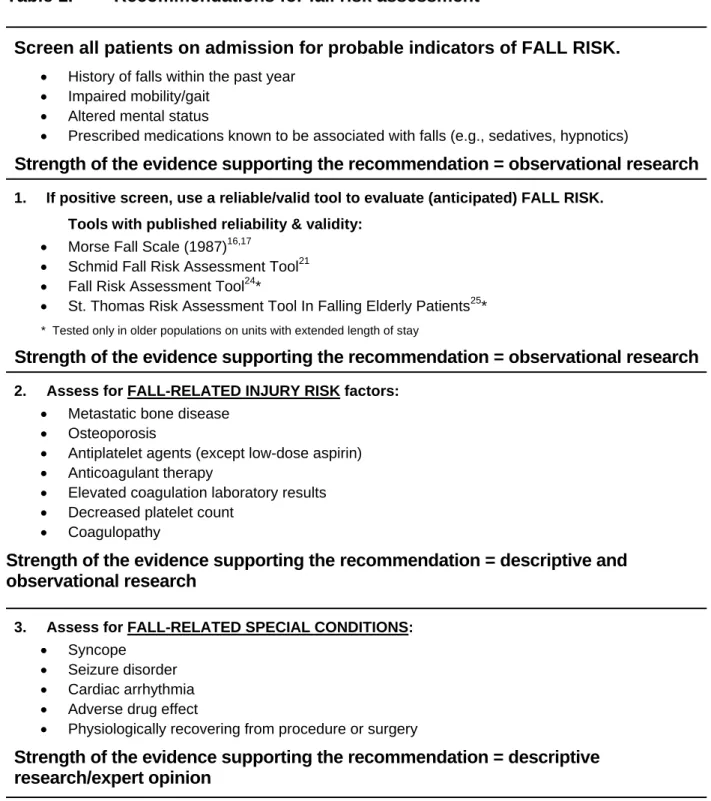
(Table 1).
In reviewing the acute care fall prevention literature and the risk factors evaluated by fall risk tools, a small number of risk factors were consistently identified: prior fall history; impaired mobility; altered mental status; altered elimination; and the use of sedative and hypnotic medication.5, 15, 17, 22, 26, 27, 28, 29, 30, 31 These five factors were recommended as screening
indicators to identify patients, who should be evaluated more closely for fall risk using a valid and reliable tool
Since researchers have documented that patient risk may change during a hospital stay,17, 29
reassessment has been encouraged.12 The KBNI synthesis recommended that these five screening
indicators be built into routine physical assessment screens so that they trigger a fall risk reassessment whenever a change in one of these factors is documented.
Strategies to Prevent Unanticipated Physiologic and Accidental Falls
Fall risk tools are typically designed to predict anticipated physiologic falls, which represent 34 to 78 percent of the falls that occur in acute care.17, 18 Patients also fall because ofspecial
conditions (e.g., seizures, fainting) or accidents. Both of these fall types are typically
unpredictable. In order to assess for and design interventions to prevent these unanticipated or accidental falls, three factors that were identified in the review of the literature were proposed (Table 1).
First, the presence of certain special conditions or diagnoses (e.g., syncope, fainting, seizures, or pathologic hip fracture) has been associated with unanticipated physiologic falls.17 Evidence
about falls related to these conditions in acute care is lacking. However, in community-based populations, syncope is most commonly caused by orthostatic hypotension, vasovagal response, and drugs; serious cardiac-related syncope occurs less often.32 Community-dwelling elders with
orthostatic hypotension or unstable blood pressure were reported to have a two-fold increase in risk of falling.33
In the absence of published studies to address these conditions in hospitalized patients, these community-based reports could be considered as evidence to support a recommendation for increased monitoring and assistance for patients with these conditions. Patients who have syncope, orthostatic hypotension, seizure disorder, or cardiac arrhythmias, as well as patients recovering from physiologic events—such as an adverse drug reaction, a procedure, or surgery— can be anticipated to be at increased risk for unstable blood pressure (hypotension), syncope, and subsequent falling at certain high-risk times (e.g., after the event, during their first time out of bed).
Table 1. Recommendations for fall risk assessment
Screen all patients on admission for probable indicators of FALL RISK.
• History of falls within the past year
• Impaired mobility/gait
• Altered mental status
• Prescribed medications known to be associated with falls (e.g., sedatives, hypnotics)
Strength of the evidence supporting the recommendation = observational research
1. If positive screen, use a reliable/valid tool to evaluate (anticipated) FALL RISK. Tools with published reliability & validity:
• Morse Fall Scale (1987)16,17
• Schmid Fall Risk Assessment Tool21
• Fall Risk Assessment Tool24*
• St. Thomas Risk Assessment Tool In Falling Elderly Patients25*
* Tested only in older populations on units with extended length of stay
Strength of the evidence supporting the recommendation = observational research
2. Assess for FALL-RELATED INJURY RISK factors: • Metastatic bone disease
• Osteoporosis
• Antiplatelet agents (except low-dose aspirin)
• Anticoagulant therapy
• Elevated coagulation laboratory results
• Decreased platelet count
• Coagulopathy
Strength of the evidence supporting the recommendation = descriptive and observational research
3. Assess for FALL-RELATED SPECIAL CONDITIONS: • Syncope
• Seizure disorder
• Cardiac arrhythmia
• Adverse drug effect
• Physiologically recovering from procedure or surgery
Strength of the evidence supporting the recommendation = descriptive research/expert opinion
4. Evaluate PATIENT WILLINGNESS or ABILITY to participate in fall prevention
Table 1. Recommendations for fall risk assessment (continued) Ongoing Assessment
Monitor all patients for changes in status that warrant a re-evaluation of fall risk: • New onset of probable indicators of fall risk (refer to screening criteria above)
• Occurrence of a fall event
• New medication that increases fall risk (e.g., hypnotic, sedative) or risk for injury (anticoagulant, antiplatelet agent, except low-dose aspirin)
• New occurrence of a special condition
• Planned (daily) re-evaluation for patients with diagnosis of high riskfor falls
Strength of the evidence supporting recommendation = observational research
Second, certain patient conditions may increase a patient’s risk for injury secondary to a
fall.27, 34 For example, metastatic bone disease and osteoporosis have both been associated with
increased risk of fracture.27 The use of antiplatelet therapy or anticoagulant therapy, increased prothrombin time (PT), increased partial thromboplastin time (PTT), decreased pl
(thrombocytopenia), and coagulopathy all can increase risk of bleeding. Anticoagulant-treated patients who fall and experience loss of consciousness or intracranial bleeding have a high rate of mortality.
atelet count
35, 36 Use of antiplatelet agents, such as aspirin and clopidogrel, in traumatized
elderly patients has been associated with a significant increase in risk of mortality related to intracranial bleeding,37, 38 although low-dose aspirin by itself does not appear to increase the rate
of bleeding.39 While these drugs and conditions do not affect actual fall risk, they do increase injury risk from a fall and warrant assessment and appropriate interventions to monitor for safety and motivate patients to adhere to fall prevention interventions.
Third, and possibly the most important factor that influences fall risk, is the degree to which the patient is willing and able to be involved in the fall-prevention process. Researchers have documented that a high percentage of falls occur when the patient is not in the presence of a caregiver.3, 4, 17, 40, 41 Patient understanding and active participation are critical components of all
strategies used to prevent falling and fall-related injuries, particularly in preventing accidental and unanticipated falls that occur in the absence of a caregiver.
Using Patient Assessments to Diagnose Fall Risk and Plan
Interventions
The KBNI recommendations related to diagnosing risk for falls (Table 1) advises the nurse to utilize information about fall risk, injury risk, special conditions, and patient willingness and ability to participate in prevention to formulate a fall-related diagnosis that will guide the selection of appropriate interventions to prevent falling for patients with any of the three identified etiologies. This process is consistent with the Joint Commission’s patient safety recommendations for assessment and creation of a fall-reduction program that includes
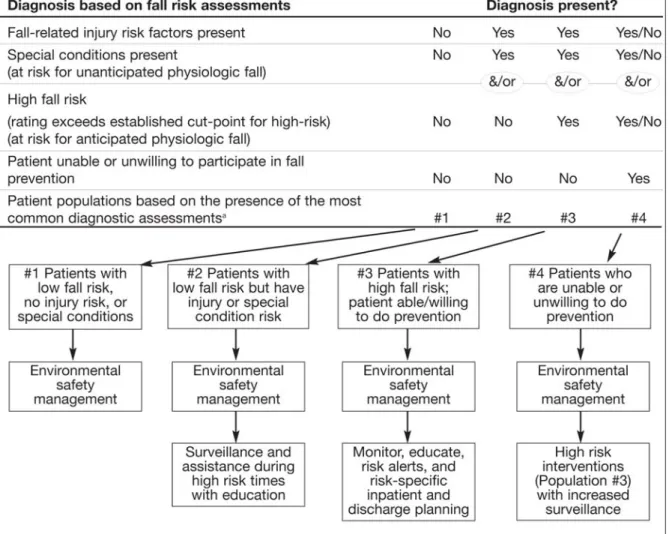
interventions to reduce patient risk.2 A decision-support mechanism was developed (Figure 1) to verify the presence of risk factors and support the nurse in formulating a diagnosis based on patient assessment. Four common patient populations were identified. Note: Other diagnoses are possible, requiring nurses to use clinical judgment to diagnose, plan, and implement appropriate
Figure 1. Overview: Using fall risk assessment to diagnose and tailor prevention interventions.
interventions to meet patient needs. An overview of these populations is provided with additional details for evidence-based interventions in the section that follows.
Population #1: Patients with low fall risk and the willingness/ability to participate in prevention. Patients who have none of the identified fall risks (i.e., injury risk, special
conditions, or anticipated fall risk) and who are willing and able to participate in fall prevention interventions have the lowest risk for falling. These patients and—in fact—all patients, require environmental safety interventions designed to prevent accidental falling.
Population #2: Patients with low fall risk, willingness/ability to participate in prevention, but have an injury and/or special condition risk. This population has a fall risk score below the cut-off value for being at high risk for anticipated physiologic falling; they are willing and able to participate in prevention; but they have special conditions (or injury risk factors) that increase the likelihood of a fall-related injury. Implementing traditional high-risk fall prevention
strategies for altered mobility, elimination, or mental status requires time and effort and is not likely to be useful, since these patients do not have these risk factors. However, they are at higher risk for injury if an unanticipated or accidental fall occurs, so they are likely to benefit from additional surveillance and assistance during activities/times when these falls are most likely (e.g., first time out of bed after a procedure/medication). Patient education about these risks and safety precautions to reduce risk are essential for these patients.
Population #3: Patients who are at high risk for anticipated falls and are willing/able to participate in prevention. Patients in this category include those who screen positive for one or more of the probable indictors of fall risk (e.g., history of falling, impaired mobility, altered mental status, altered elimination, or use sedatives/hypnotics) and exceed high-risk cut-off values on fall risk tools. Interventions include establishing risk alerts and implementing risk factor-specific plans of care with patient/family education to ensure that patients keep themselves safe when staff is not present.
Population #4: Patients who are unable or unwilling to participate in fall prevention. Patients who are unable or unwilling to participate in fall prevention because of cognitive or mental status impairments pose the greatest challenge. In addition to risk factor-specific plans, human and equipment resources must be appropriately deployed to provide a higher level of surveillance to ensure safety at all times.
Diagnosis-Based Interventions to Reduce Falls and Fall-Related Injury
Recommendations for evidence-based interventions focus on: monitoring all patients for changes in status that increase their fall risk and/or risk of fall-related injury (Table 1), preventing
accidental falling for all patients using environmental management strategies, and uniquely tailoring additional interventions to address individual patient needs according to their
assessment-based diagnosis (Figure 1). Interventions are recommended for the most common patient populations (Table 2) to achieve improvements in fall and fall-related injury outcomes using standard measures established by the Joint Commission for benchmarked comparison (Table 3).12 The following summary represents excerpts taken from the ACW KBNI synthesis
document, since the comprehensive report is too extensive to include here.
Interventions for Population #1 (and all patients): Environmental safety management. The effectiveness of environmental management strategies to prevent falls in acute care is generally untested. In the absence of research, many organizations have generated their own lists of “standard” environmental management interventions that often include strategies generated in response to adverse events that occurred in their organization. Many different lists of
environmental safety interventions to prevent falling have been published with more than 40 different environmental interventions being reported by 17 published sources included in the KBNI review.4, 6, 14, 22, 24, 29, 42, 43, 44, 45, 46, 47, 48, 49, 50, 51, 52 During the synthesis process, the
diverse list was condensed into a listing of the 10 most frequently reported interventions (Table s of
l volved fall prevention-related environmental management strategies, including placing call 2).
Although research on environmental interventions is limited, one study53 evaluated the effect a nursing staff “rounding protocol,” which involved performing 12 key actions to anticipate needs, reduce call light use, and increase patient satisfaction. Six of the 12 steps in the protoco in
Table 2. Recommended interventions for common patient populations
Population #1: Patients with Low Fall Risk (Designed to be used for all patients)
l Safety Management
based on risk assessment Interventions for
Implement Environmenta
ms niture or equipment
rates ability to use
ilable
f Evidence Supporting Recommendation: Expert Opinion/Descriptive Research
• Orient patient to room/call system
• Put bed in low position with wheels locked
• Encourage use of sensory and ambulatory support ite
• Remove clutter and any extra fur
• Put personal items within reach
• Put call light within reach; patient demonst
• Encourage use of nonskid slippers/shoes
• Provide adequate/glare-free lighting with night light ava
• Encourage use of handrails and bathroom safety bars
• Additional interventions based on individual patient needs
Strength o
Interventions for Population #2: Patients with Low Fall Risk, but with Injury or Special Co
tion
after discharge
orting Recommendation = Observational Research/Expert Opinion
ndition Risk
• Increase surveillance and assistance, based on disease/condition-specific factors (e.g., first time out of bed after a surgery or procedure; patient is likely to have an adverse reaction to treatment or medication)
• Inform patient and significant other (SO) of the presence of injury or special condi risk
• Reinforce importance of calling and waiting for assistance before activities that increase fall risk
• Provide patient/SO with disease/condition-specific education to reduce risk of falls (e.g., for seizure management, syncope)
• Help patient identify environmental hazards and personal behaviors that increase risk for accidental falling and to choose interventions that will reduce risks
Table 2. Recommended interventions for common patient populations based on risk assessment (continued)
Interventions for Population #3: Patients with High Fall Risk & Willingness/Ability to Participate in Fall Prevention
• Educate patient/significant other regarding fall risk and prevention
o Inform patient /SO of the presence of and fall-related injury risk factor(s)
o Reinforce importance of calling and wait for assistance during activities that increase risk of falling during hospitalization
o Reinforce use of sensory and ambulation aids at all times; consider use of a gait belt
o Appropriate use of side rails for environmental controls and enhanced mobility (not for restraint)
• Implement fall risk alert system (e.g., wrist bands, signage, electronic/written communication)
• Collaborate with physician (early in hospitalization) to address risk factor-specific patient problems, including mobility/gait, medications, elimination, or others, with referrals as appropriate
• For patients on medications that increase fall risk, consult pharmacist/physician
Strength of Evidence Supporting Recommendation = Descriptive/Observational Research
Interventions for Population #4: Patients Who Are Unable/Unwilling to Participate in Fall Prevention
• Implement all appropriate interventions for patients at high risk of falling (see Population #3)
• Increase supervision; intensity based on patient need ranging from moving patient for increased visibility to the use of continuous supervision (e.g., a sitter)
• Provide individualized toileting interventions (based on needs/patterns)
• For patients with altered cognitive/mental status, collaborate with the physician to evaluate and implement appropriate interventions
• Consider bed/chair exit alarms appropriate to the setting and needs of the patient
• Consider use of new bed/safety technologies
• Carefully progress activity in the cognitively impaired patient
• Minimal and appropriate use of restraints
• Develop fall prevention discharge plan
Strength of Evidence Supporting Recommendation = Expert Opinion/Descriptive Research
Table 3. Fall and fall-related injury outcome measures
Measure Definition
Fall An unplanned descent to the floor (or extension of the floor; e.g., trash can or other equipment), with or without injury to the patient.
Assisted fall
A fall in which any staff member (whether nursing service employee or not) was with the patient and attempted to minimize the impact of the fall by easing the patient’s descent to the floor or, in some manner, attempting to break the patient’s fall. “Assisting” the patient back to bed or chair after a fall is not an assisted fall.
Repeat fall More than one fall by the same patient after admission to a unit.
Fall rate (Number of falls (with or without injury) by unit type during calendar month x 1,000)
Divided by number of patient days by unit type during the calendar month
Fall injury level
The extent of injury experienced by a patient following a fall, with followup at least 24 hours later if injury extent is not known at the time of the initial fall report. None: Patient had no injuries resulting from the fall.
Minor: Resulted in application of a dressing, ice, cleaning of a wound, limb elevation, or topical medications.
Moderate: Resulted in suturing, application of Steri-Strips™/skin glue, or splinting.
Major: Resulted in surgery, casting, traction, or required consultation for neurologic or internal injury.
Death: Patient died as a result of injuries sustained from the fall.
Fall injury ratea
(Number of falls with an injury level of minor or greater by unit type during calendar month x 1,000)
Divided by patient days by unit type during the calendar month
a National standards for injury levels have yet to be established.
Source: The Joint Commission. Implementation guide for NQF-endorsed voluntary consensus standards for nursing-sensitive care performance measures: Patient falls (NSC-3) and falls with injury (NSC-4). Available at www.jointcommission.org.
light, telephone, table, tissue, water, and garbage receptacle within reach. Regular rounding (every 1-2 hours) using the protocol significantly reduced call light use and increased patient satisfaction. Although the study was not designed to evaluate falling as a primary outcome, the researchers reported that patient falls were reduced in the group that received the every-1-hour rounding intervention. The researchers did not report if the sample represented patients who were at risk for falls (no fall risk assessments were reported), and they evaluated fall outcomes based on fall counts by unit over a limited (10-week) time period. These two methodologic issues limit the generalizability of these findings for fall prevention. However, the study does provide some evidence that environmental management may influence the incidence of falling in acute care.
Interventions for Population #2: Patients with low fall risk, but with injury or special condition risk. The primary intervention for preventing unanticipated physiologic falling (e.g., due to dizziness, fainting, etc.) involves teaching or warning the patient.16 The
interventions described for this population (Table 2) are designed to increase staff and patient awareness of several very specific interventions to prevent falling in patients who typically are not identified to be at risk.
Interventions for Population #3: Patients with high fall risk and willing/able to participate in prevention. Systematic reviewers reported that most acute care fall prevention programs were heterogeneous and employed a variety of often labor-intensive strategies, without being designed to determine which treatment components were efficacious.6, 40 The most commonly reported
approach to fall prevention was the implementation of multiple interventions aimed at identifying high-risk patients and minimizing individual patients’ risk of falling. Reviewers reported that research quality varied across most studies, with incomplete reporting about how interventions were selected, implemented, and evaluated.6, 22, 41
Making sure that patients at high risk of falling are readily identifiable by health care personnel was one of the most commonly reported fall prevention interventions. Strategies for patient identification included signs on the patient’s door, signs above the patient’s bed, interdisciplinary communication, and the use of colored slippers or blankets to indicate level of risk. Research reviewers described several studies, where the use of high-risk patient identification bracelets, signs, stickers, or tags was inexpensive and easy, but none demonstrated that these measures as isolated interventions decreased falls.15, 22 Given broad clinical use, ease, and affordability,
high-risk patient identification was included as a recommendation, even though research to support its use was limited.
To synthesize the evidence, common fall prevention strategies reported in 19 published sources were gathered, summarized, and used to supplement the recommendations (Table 2). Most authors reported using multiple strategies, including risk assessment, risk identification, use of sensory and ambulatory assist devices, appropriate use of side rails, patient education, and referral (e.g., physical therapy). Most authors reported that interventions were established based on literature review and consensus opinion.4, 6, 14, 15, 22, 24, 29, 43, 44, 45, 46, 47, 48, 49, 50, 51, 52, 53,54, 55
Interventions for Population #4: Patients with high fall risk who are unable or unwilling to participate in prevention. Patients who screen positive for altered mental status may have symptoms associated with delirium, dementia, or depression. These are diagnoses that require specialized assessments and interventions that are beyond the scope of the current discussion. However, the immediate use of additional fall prevention interventions is warranted in this group of patients who demonstrate an unwillingness or inability to participate in fall prevention (refer to the details in Table 2).
Researchers have reported that a high percentage of falls occur when patients are not in the presence of a caregiver.3, 4, 17, 40, 42 Increasing supervision is an essential intervention for patients
who are unwilling or unable to participate in prevention. However, research on clinically
effective and cost-effective strategies to provide supervision is limited. Several authors24, 46, 48, 50, 51, 52, 55 haverecommended the use of periodic patient “checks” every 1 to 2 hours, a fairly
labor-intensive strategy. As noted above, a recently published study provided some exploratory evidence (with limited application to fall prevention) suggesting that active “rounding” with the offer of pain medication and toileting as needed and a protocol for environmental management did have an effect on falling when conducted at least hourly but not when done every 2 hours.54 Studies have shown that falls happen most frequently during times when patients are active16 and
frequently during elimination and toileting-related activities. 3, 16, 45, 56, 57 This was particularly true for older patients who were unattended while toileting. These falls were also observed to be frequently associated with injury. Individualized toileting care appears to be an intervention with a high potential to reduce falls and injury in this population.
Among recently discharged medical patients, 15 percent of readmissions during the first month after discharge were found to be due to an injury sustained from a fall. However, the
investigators were unable to determine whether the increased fall risk was due to acute illness or hospital-associated processes (bed rest/complications).57 Appropriate interventions to maintain
patients’ functional status—even as they assure the patient’s safety while in bed, sitting, or ambulating—are recommended.
Special care during mobilization may be needed with cognitively impaired patients. The findings of two randomized controlled trials and one descriptive study suggest that patients with impaired cognition experience balance problems when distracted by conversation or dual task
performance.58, 59, 60 Early risk factor-specific discharge planning is needed to ensure effective
post-hospital care for these patients.61
Using the Clinical Information System to Evaluate Process
and Outcomes
In addition to the creation of screens and a decision-support mechanism, additional fields were created to collect important information about patient characteristics, assessments, interventions, and outcomes to evaluate the effectiveness of the processes. As an added benefit, the system is capable of being programmed to provide real-time quality improvement data for unit-based staff intervention, as well as a dataset available for future research.
The KBNI process is in the early phases of development. The process appears to provide a useful format for formulating and implementing evidence-based recommendations to address all aspects of the nursing process. To date, risk for falls and two other phenomena have been embedded, and evaluation is in progress. The project is challenging because it requires intensive evidence
synthesis, new strategies to embed recommendations efficiently and effectively into the workflow, and mechanisms for updating content when new evidence becomes available.
Conclusion
The ACW KBNI provides a useful framework for gathering and synthesizing the best evidence into actionable recommendations for embedding decisionmaking tools to assist nurses. This article describes the process for conducting a comprehensive fall risk assessment and tailoring of prevention interventions to reduce risk for all three fall etiologies. The framework and the
process provide new data fields for documenting the nursing contribution to patient care and supports the retrieval of data to provide answers to quality improvement and research questions.
Acknowledgments
This ACW KBNI work was funded in part by contributions from all three partners: Aurora Health Care, Cerner Corporation, and the University of Wisconsin-Milwaukee College of Nursing, under the project Leadership of Norma Lang, Sue Ela, Sally Lundeen, and Paul Gorup. The authors would like to recognize Lenore Wilkas, ACW Research Librarian, for her valuable research contributions to support this work.
Author Affiliations
Aurora Health Care System (Dr. Hook); University of Wisconsin – Milwaukee College of Nursing (Drs. Devine and Lang).
Address correspondence to: Mary L. Hook, PhD, APRN, BC, Research Scientist, Aurora Health
Care; 945 N. 12th Street A603, Milwaukee, WI 53233. Telephone: 5394; fax
414-219-5381; e-mail: [email protected].
References
1. Institute of Medicine. Crossing the quality chasm: A new health system for the 21st century. Washington, DC: National Academies Press; 2001.
2. Joint Commission. 2008 National patient safety goals: Hospital program. Available at:
www.jointcommission.org/PatientSafety/NationalPatie ntSafetyGoals/08_hap_npsgs.htm. Accessed February 26, 2008.
3. Hitcho EB, Krauss MJ, Birge S, et al. Characteristics and circumstances of falls in a hospital setting: A prospective analysis. J Gen Intern Med 2004; 19: 732-739.
4. Mahoney JE. Immobility and falls. Clin Geriatr Med 1998; 14: 699-726.
5. Oliver D, Daly F, Martin FC, et al. Risk factors and risk assessment tools for falls in hospital in-patients: A systematic review. Age Ageing 2004; 33: 122-130. 6. Rutledge DN, Donaldson NE, Pravikoff DS. Update
2003: Fall risk assessment and prevention in hospitalized patients. J Clin Innovat 2003; 6: 1-55. 7. Lauver DR, Ward SE, Heidrich SM, et al.
Patient-centered interventions. Res Nurs Health 2002; 25: 246-255.
8. Lang NM, Hook ML, Akre ME, et al. Translating knowledge-based nursing into referential and executable applications in an intelligent clinical information system. In: Weaver C, Delaney C, Webber P, et al, eds. Nursing and informatics for the 21st century: An international look at the trends, cases, and the future. Chicago: Healthcare Information and Management Systems Society; 2006. p. 291-303. 9. Agency for Healthcare Research and Quality (AHRQ).
Systems to rate the strength of scientific evidence. Available at:
archive.ahrq.gov/clinic/epcsums/strengthsum.htm. Accessed February 26. 2008.
10. Devine EC. Knowledge-based nursing initiative system for rating the strength of evidence supporting recommendations. In: Devine EC, Kim TY, Johnson B, et al. ACW Knowledge Based Nursing Initiative evidence table protocol. Milwaukee, WI: University of Wisconsin-Milwaukee, College of Nursing; 2007: p. 8.
11. Melnyk B, Fineout-Overholt E. Evidence-based practice in nursing and healthcare: A guide to best practice. Philadelphia: Lippincott Williams & Wilkins; 2005.
12. Joint Commission. Implementation guide for NQF-endorsed voluntary consensus standards for nursing-sensitive care performance measures: Patient falls (NSC-3) and falls with injury (NSC-4). Available at:
www.jointcommission.org/PerformanceMeasurement/ MeasureReserveLibrary/nqf_nursing.htm. Accessed February 26, 2008.
13. North American Nursing Diagnosis Association. International. Nursing diagnoses: Definitions and classification. 7th ed. Philadelphia: NANDA-I; 2007-2008.
14. Veterans Health Administration. National Center on Patient Safety toolkit: Falls policy. Available at:
www.patientsafety.gov/SafetyTopics/fallstoolkit/noteb ook/completebooklet.pdf. Accessed February 26, 2008.
15. Agostini J, Baker D, Bogardus SJ. Prevention of falls in hospitalized and institutionalized older people. In: Shojania KG, Duncan BW, McDonald KM, et al, eds. Making health care safer: A critical analysis of patient safety practices. Rockville, MD: Agency for
Healthcare Research and Quality; 2001. AHRQ Publication No. 01-E058.
16. Morse JM, Tylko SJ, Dixon HA. Characteristics of the fall-prone patient. Gerontologist 1987; 27: 516-522. 17. Morse JM. Preventing patient falls. Thousand Oaks,
CA: Sage; 1997.
18. Donaldson N, Brown SD, Aydin CE, et al. Leveraging nurse-related dashboard benchmarks to expedite performance improvement and document excellence. J Nurs Admin 2005; 35: 163-172.
19. Myers H, Nikoletti S. Fall risk assessment: A prospective investigation of nurses' clinical judgment and risk assessment tools in predicting patient falls. Int J Nurs Pract 2003; 9: 158-165.
20. Brown DS, Donaldson N, Aydin CE, et al. Hospital nursing benchmarks: The California Nursing Outcomes Coalition Project. J Healthc Qual 2001; 23: 22-27.
21. Schmid NA. 1989 Federal Nursing Service Award Winner. Reducing patient falls: A research-based comprehensive fall prevention program. Mil Med 1990; 155: 202-207.
22. Evans D, Hodgkinson B, Lambert L, et al. Falls in acute hospitals. Available at:
www.joannabriggs.edu.au/pdf/1_1998_Falls.pdf. Accessed February 26, 2008.
23. Vassallo M, Stockdale R, Sharma JC, et al. A comparative study of the use of four fall risk-assessment tools on acute medical wards. J Am Geriatr Soc 2005; 53: 1034-1038.
24. MacAvoy S, Skinner T, Hines M. Fall risk-assessment tool. Appl Nurs Res 1996; 9: 213-218.
25 . Oliver D, Britton M, Seed P, et al. Development and evaluation of evidence based risk assessment tool (STRATIFY) to predict which elderly inpatients will fall: Case-control and cohort studies. Br Med J 1997; 315: 1049-1053.
26. American Geriatrics Society, British Geriatrics Society, & American Academy of Orthopaedic Surgeons panel on falls prevention. Guideline for the prevention of falls in older persons. J Am Geriatr Soc 2001; 49: 664-672.
27. Currie LM, Mellino LV, Cimino JJ, et al.
Development and representation of a fall-injury risk assessment instrument in a clinical information system. Medinfo 2004; 11: 721-725.
28. Evans D, Hodgkinson B, Lambert L, et al. Falls risk factors in the hospital setting: A systematic review. Int J Nurs Pract 2001; 7: 38-45.
29. Hendrich A, Nyhuis A, Kippenbrock T, et al. Hospital falls: Development of a predictive model for clinical practice. Appl Nurs Res 1995; 8: 129-139.
30. Krauss MJ, Evanoff B, Hitcho E, et al. A case-control study of patient, medication, and care-related risk factors for inpatient falls. J Gen Intern Med 2005; 20: 116-122.
31. Myers H. Hospital fall risk assessment tools: A critique of the literature. Int J Nurs Pract 2003; 9: 223-235.
32. Rubenstein Z, Josephson KR. The epidemiology of falls and syncope. Clin Geriatr Med 2002; 18: 141-158.
33. Heitterachi E, Lord SR, Meyerkort P, et al. Blood pressure changes on upright tilting predict falls in older people. Age Ageing 2002; 31: 181-186. 34. Hook M, Winchel S. Fall-related injuries in acute care:
Reducing the risk of harm. Medsurg Nurs 2006; 15; 370-377, 381.
35. Mina AA, Bair HA, Howells GA, et al. Complications of preinjury warfarin use in the trauma patient. J Trauma 2003; 54: 842-847.
36. Peel NM, Kassulke DJ, McClure RJ. Population based study of hospitalised fall-related injuries in older people. Inj Prevent 2002; 8: 280-283.
37. Garra G, Nashed AH, Capobianco L. Minor head trauma in anticoagulated patients. Acad Emerg Med 1999; 6: 121-124.
38. Ohm C, Mina A., Howells G, et al. Effects of antiplatelet agents on outcomes for elderly patients with traumatic intracranial hemorrhage. J Trauma 2005; 58: 518-522.
39. Spektor S, Agus S, Merkin V, et al. Low-dose aspirin prophylaxis and risk of intracranial hemorrhage in patients older than 60 years of age with mild or moderate head injury: A prospective study. J Neurosurg 2003; 99: 661-665.
40. Oliver D, Hopper A, Seed P. Do hospital fall prevention programs work? A systematic review. J Am Geriatr Soc 2000; 48: 1679-1689.
41. Lyons SS. Evidence-based protocol: Fall prevention in older adults. J Gerontol Nurs 2005; 31: 9-14.
42. Shorr RI, Guillen MK, Rosenblatt LC, et al. Restraint use, restraint orders, and the risk of falls in
hospitalized patients. J Am Geriatr Soc 2002; 50: 526-529.
43. Barnett K. Reducing patient falls project. Available at:
www.premierinc.com/safety/topics/falls/downloads/E-14-falls-project-uk.pdf. Accessed February 26, 2008. 44. Bolton LB, Goodenough A. A magnet nursing service
approach to nursing's role in quality improvement. Nurs Adm Q 2003; 27: 344-354.
45. Gowdy M, Godfrey S. Using tools to assess and prevent inpatient falls. Jt Comm J Qual Saf 2003; 29: 363-368.
46. Hougaard J. Developing evidence-based
interdisciplinary care standards and implications for improving patient safety. Int J Med Inform 2004; 73: 615-624.
47. Kinn S, Hood K. A falls risk-assessment tool in an elderly care environment. Br J Nurs 2001; 10: 440, 442, 444-449.
48. McCarter-Bayer A, Bayer F, Hall K. Preventing falls in acute care: An innovative approach. J Gerontol Nurs 2005; 31: 25-33.
49. McFarlane-Kolb H. Falls risk assessment,
multitargeted interventions and the impact on hospital falls. Int J Nurs Pract 2004; 10: 199-206.
50. Poe SS, Cvach MM, Gartrelu DG, et al. An evidence-based approach to fall risk assessment, prevention, and management: Lessons learned. J Nurs Care Qual 2005; 20: 107-117.
51. Resnick B. Preventing falls in acute care. In: Mezey M, Fulmer T, Abraham I, et al, editors. Geriatric nursing protocols for best practice. 2nd ed. New York: Springer; 2003. p. 141-164.
52. Szumlas S, Groszek J, Kitt S, et al. Take a second glance: A novel approach to inpatient fall prevention. Jt Comm J Qual Saf 2004; 30: 295-302.
53. Tideiksaar R. Falls in older persons: Prevention & management. 2nd ed. Baltimore, MD: Health Professions Press; 1998.
54. Meade CM, Bursell AL, Ketelsen L. Effects of nursing rounds: On patients’ call light use,
satisfaction, and safety. Am J Nurs 2006; 106: 58-71. 55. Alcee D. The experience of a community hospital in
quantifying and reducing patient falls. J Nurs Care Qual 2000; 14: 43-53.
56. Mills PD, Neily J, Luan D, et al. Using aggregate root cause analysis to reduce falls. Jt Comm J Qual Patient Saf 2005; 31: 21-31.
57. Meiner SE, Miceli DG. Safety. In: Lueckenotte AG, ed. Gerontologic nursing. 2nd ed. St. Louis, MO: Mosby; 2002. p. 232-255.
58. Hauer K, Pfisterer M, Weber C, et al. Cognitive impairment decreases postural control during dual tasks in geriatric patients with a history of severe falls. J Am Geriatr Soc 2003; 51: 1638-1644.
59. Brauer SG, Woollacott M, Shumway-Cook A. The interacting effects of cognitive demand and recovery of postural stability in balance-impaired elderly persons. J Gerontol A Biol Sci Med Sci 2001; 56: M489-M496.
60. Morioka S, Hiyamizu M, Yagi F. The effects of an attentional demand task on standing posture control. J Physiol Anthropol Appl Human Sci 2005; 24: 215-219.
61. Mahoney JE, Palta M, Johnson J, et al. Temporal association between hospitalization and rate of falls after discharge. Arch Intern Med 2000; 160: 2788-2795.