SECTION TWO
Textile
Fibers
2-1 WHAT IS A FIBER?
Fibers Are Fundamental
Most basic of all in selecting fabrics is the behavior of the fibers, the smallest visible components of most fabrics.
The two main divisions in textile fibers are
naturaland manufactured(see Figure 2.1). Nat-ural fibers are those found in nature already usable to make fabrics. The two main sources are plants (with the fibers called cellulosic from the main building material, cellulose), and animals (with the fibers called proteinfrom the main building mate-rial). Manufactured (MF) fibers (formerly termed “man-made”) are formed from a suitable raw mate-rial as a thick, sticky liquid, which is “spun” or extruded through spinneret holes, forming streams that are solidified into fibers. The raw material for MF fibers may be itself a natural substance, or it may be synthetic (synthesized from basic chemical units), but it is converted into textile fibers by a manufacturing process. While there are MF fibers made of natural rubber (as well as of synthetic rub-ber), there is no such thing as a natural rubber fiber. Similarly, Tencel® lyocell is not a natural fiber; it is an MF fiber made of a natural material, cellulose.
Textile fibers may be staple or filament. Staple
fibers are relatively short, measured in millimeters or inches. Filamentfibers are relatively long, mea-sured in meters or yards. Most natural fibers are staple; the only natural filament fiber is reeled or cultivated silk. On the other hand, all MF fibers can be staple or filament; they begin as filament, and in this form can give silky or (reeled) silk-like fabrics. They can also be cut or broken into staple to give fabrics that look and feel more like wool, cotton, or linen.
Textile Fibers Are Special
Many fibrous materials are not suitable to make into fabrics, e.g., corn silk or wood slivers. Textile fibers must have certain properties: flexible, thin (but not too thin), long (enough), cohesive, and strong (enough).
Textile fibers must be flexible. Wood fibers (unless processed, as into pulp) do not bend easily—you
can-not make fabrics from slivers! Textile fibers are also very thin—long in relation to diameter. To be mechan-ically spun into yarn—drawn out and twisted—staple fibers must have sufficient length, strength, and cohe-siveness (fiber-to-fiber friction). Many seed fibers are too short, weak, and slippery to spin into yarn; kapok, for instance, can be used only for stuffing.
Of course, for a fiber to be used a great deal, there must be a reasonable supply and price.
What’s in a Name? Fiber Generic Names
Fibers are classified into groups, each of which is given a generic name or “generic.” For natural fibers, this generic is the name of the plant (cotton) or animal (camel) from which the fiber comes, or an accepted name, such as wool or mohair. For MF fibers, the generic name is given to a family of fibers of similar chemical makeup and is defined in textile labeling regulations in the United States, Canada, and many other countries (see also “Fiber Content Labeling,” which follows. Definitions to be used in the United States may be found in full in the Appen-dix to Fabric Reference, which shows all of 16 CFR Part 303 of Rules and Regulations Under the Tex-tile Fiber Products Identification Act1[TFPIA, often
called “Textile Rules”]).
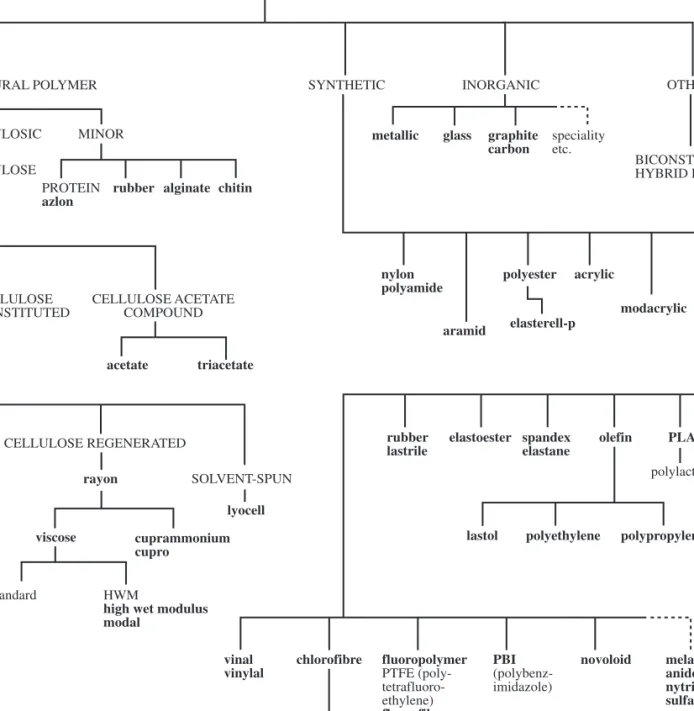
A listing of generics and their relationships is shown graphically as a textile fiber “family tree” in Figures 2.1 and 2.2, and as flowcharts in Figures 2.3 and 2.4. Only a few of these are used exten-sively by consumers; these major generics are shown in Figure 2.2 as a “pruned” textile fiber fam-ily tree. All are summarized and discussed in this section.
Note that some generic names legitimate in Europe or Canada are not recognized by the United States in its Textile Fiber Products Identification Act (16 CFR Part 303), although they are allowed to be used if recognized by the International Organization for Stan-dardization (ISO-2076-1999). Some of these are:
alginate, carbon, chlorofibre, cupro, elastane, elasto-diene, fluorofibre, metal fibre, modal, polyamide, polyethylene, polyimide, polypropylene, vinylal, vis-cose. Conversely, ISO rejected rayon as a generic name in 1971, although it remains a legitimate generic name in the United States and Canada.
Some names are not official in the United States or Canada:
polynosic (a term for one type of High Wet Modulus [HWM] viscose rayon)
fibranne (a term for viscose rayon used in France)
PVC (an acronym for polyvinyl chloride, United States generic vinyon)
PVA(an acronym for polyvinyl alcohol—vinal)
polyacrylonitrile (PAN) or polyacryl (terms for acrylic)
Fiber Content Labeling
In the United States, the Textile Fiber Products Identifica-tion Act2(TFPIA), enforced by the Federal Trade
Com-mission, specifies requirements for labels, invoices, or advertising for most textile fiber consumer products (there are some exemptions); in Canada, the Textile Labelling and Advertising Regulations made under the Textile Labelling Act, administered by Industry Canada, give similar specifications.3 Labels should
state in English (Canada: English and French) the con-tent by generic name (not capitalized) of each fiber present in an amount of 5 percent or more, listed in descending order of percentage. A fiber present as less than 5 percent, unless it clearly has functional signifi-cance, and excluding decoration, is labeled “other fiber.” Generic names are defined in the regulations. A trademark name (see the next section) may be added in immediate conjunction with and in type of roughly equal size and prominence to the generic. When the fiber content cannot be determined, terms such as “unknown fibers” and their origin, such as “waste materials” are allowable. A company name or regis-tered identification number must also appear on the label, and each act details declaration of the country where the textile product was processed or made.
What Is a Trademark Name?
With many fashion-forward, “high tech,” or “Space Age” articles, consumers are more familiar with trade-mark names than those of the maker, in many cases, or the generic type of a fiber. A few for examples: Fortrel®, a polyester fiber; Supplex®, a textured yarn; Ultrasuede® or Gore-Tex®, fabrics; and Scotchgard™, a finish.
Trademarks (brand, house, or trade names) are names or symbols given to a product by a company or association that has registered and owns the
name. Many names we use indiscriminately for any of similar products are actually trademarks of well-known products, such as Coke, Kodak, and Kleenex. These are powerful promotional tools, especially when they include or use a memorable logo(word in distinctive type) or symbol (such as the interlocking rings of the Olympic games). An example is shown in Figure 2.1: the Seal of Cotton symbol (a stylized cot-ton boll) plus the logo used by the trade association Cotton Incorporated.
DuPont, a company that owned some of the most famous trademarks in textiles, guided by market research, in 2000 “restructured” the definitions of some of its brands, including one of the best-known in the world, Lycra®(seeFigure 2.68), which originally meant the first spandex (elastane) fiber. Because of that restruc-turing, the name Lycra, now owned by Invista, does not necessarily connote a spandex fiber, but is attached to fabrics promising freedom of movement in clothing, no matter how achieved. Some others no longer associ-ated with a particular generic, type of yarn, or finish are: Coolmax®, Supplex®, and Thermolite®, all now owned by Invista.
Considerable emphasis in Fabric Reference has formerly been placed on trademark names as carriers of specific information, with the generic or chemical makeup most basic of all, but this shift has brought listing of all names into question, and in this edition,
manytrademark names have been removed, and vir-tually all information on names that are obsolete.
A great deal of money can be invested in estab-lishing a trademark with positive connotations; man-ufacturers naturally wish these to remain distinctive but part of their corporate image, rather than drifting into the dreaded area of a generic name, as aspirin
has done. In this text, every effort has been made to add the appropriate symbol and give the name of the company that owns a trademark in brackets immedi-ately after, at least for the first use on a page; in
Figure 2.1 The “Seal of Cotton” is a registered servicemark/trademark of Cotton Incorporated. (Courtesy of Cotton Incorporated)
STEM (BAST) flax (linen) hemp jute ramie kenaf sunn urena SEED cotton kapok coir wool mohair cashmere camel CAMELIDS (4) CROSS-BREDS e.g. cashgora angora qiviuq silk (broken) plumage FILAMENT standard viscose HWM rayon
high wet modulus modal acetate acrylic modacrylic lyocell spandex elastane polypropylene olefin polyethylene (+ lastol) polyester nylon polyamide LEAF sisal abaca (manila) henequen N.Z. “flax” piña (PALF) misc. bark Spanish moss STAPLE
CELLULOSE PROTEIN INORGANIC (MINERAL)
MANUFACTURED FIBERS NATURAL FIBERS INORGANIC NATURAL POLYMER SYNTHETIC CELLULOSE rayon viscose modified viscose self crimp high tenacity cuprammonium cupro triacetate anidex lastrile rubber nytril saran vinyon chlorofibre vinal vinylal fluoropolymer fluorofibre PBI aramid sulfar novoloid rubber azlon protein alginate glass metallic carbon graphite ceramic boron TEXTILE FIBER “FAMILY TREE”
ALL STAPLE STAPLE
silk (reeled) asbestos CELLULOSE COMPOUND solvent-spun PLA
fiber generic names in bold
(+elasterell-p)
flax cotton wool silk standard viscose rayon HWM rayon acetate acrylic modacrylic lyocell spandex elastane polypropylene olefin polyester nylon polyamide
TEXTILE FIBER TREE “PRUNED” TO MAJOR GENERICS
rayon solvent-spun MANUFACTURED FIBERS NATURAL FIBERS
fiber generic names in bold
Figure 2.3 Textile fiber family tree “pruned” to major generics.
advertisements you will usually find a footnote used to denote ownership, such as “Abcd is the Registered Trademark of Wxyz Company.” Such well-known trademarks carry a definite promise of quality to the consumer; see “Private Sector Labeling with Implica-tions for Care” in Section Six.
Fibers or fabrics sold without a trademark name or end product certification are termed commodity fibersor commodity goods.
Legal Framework of Trademarks
The symbol for a registered trademark is ®(™ if pend-ing), and for a certification mark, ©. Such a trademark is owned as “intellectual property” and may legally be used exclusively by the company that applied for it.
The owner may license others to use the mark, within provisions of legislation in each country. In the United States, this falls within the jurisdiction of the Depart-ment of Commerce, through the Patent, Trademark and Copyright Information Office. A trademark, if for interstate commerce, may be registered with the fed-eral Patent and Trademark Office. In Canada, the gov-erning legislation is the Trade Marks Act.
Since trademarks or brands are such an important factor in advertising and hence in competition, govern-ments handle registrations but leave policing of the sys-tem to those who own the trademarks. Infringement of trademark rights is pursued through the courts.
A few words and symbols cannot be used (e.g.,
United Nations; national, territorial, or civic flags; and the Red Cross symbol).
Figure 2.4 Natural fibers flowchart.
NATURAL FIBERS
fiber generic names in bold
CELLULOSE (PLANTS) PROTEIN (ANIMALS) MINERAL (INORGANIC)
STAPLE STAPLE FILAMENT STAPLE
SEED LEAF STEM
(BAST) SHEEP(DOMESTIC) SPECIALTY(HAIRS) (BROKEN)SILK
asbestos
reeled silk
cultivated silk
PLUMAGE
down, feathers
waste cultivated: spun, noile, douppioni; wild silk; India, Thai silk
cotton wool kapok coir coconut husk horse-hair
mohair cashmere camel hair qiviuq qiviut flax ramie rhea China grass
hemp jute kenaf sunn urena MISCELLANEOUS camelid ...ETC. Spanish moss bark
piña agave abaca
Manila “hemp” New Zealand “flax” huarizo (llama sire, alpaca dam) misti (alpaca sire, llama dam) guanaco vicuña sisal henequen alpaca llama rabbit angora beaver FUR FIBER ...etc cashgora roselle sacaton cross-bred cross-bred yucca raffia
chitin
MANUFACTURED FIBERS
fiber generic names in bold
NATURAL POLYMER SYNTHETIC INORGANIC
CELLULOSIC STAPLE OR FILAMENT MINOR PROTEIN azlon rubber alginate CELLULOSE ACETATE COMPOUND acetate triacetate cuprammonium cupro SOLVENT-SPUN standard HWM
high wet modulus modal
nylon polyamide
aramid
polyester acrylic metallic glass graphite
carbon speciality etc. rubber lastrile spandex elastane olefin PLA polyethylene polypropylene fluoropolymer PTFE (poly- tetrafluoro-ethylene) fluorofibre PBI (polybenz-imidazole) novoloid melamine anidex nytril sulfar speciality etc. vinal vinylal chlorofibre vinyon saran viscose lyocell CELLULOSE CELLULOSE RECONSTITUTED CELLULOSE REGENERATED rayon elastoester OTHER BICONSTITUENT HYBRID ETC. modacrylic polylactate elasterell-p lastol
2–2 FIBER PROPERTIES AND
AMOUNTS USED
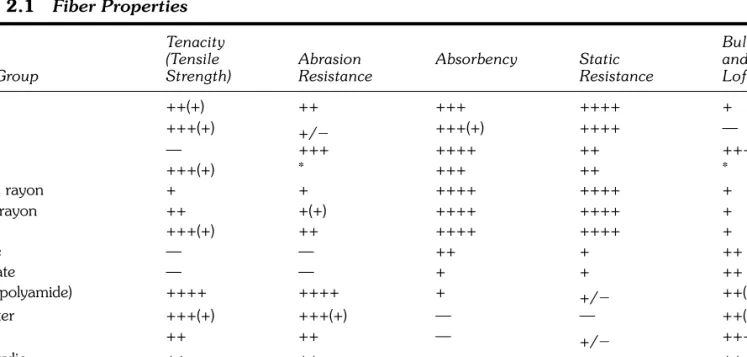
Section One listed the various properties by which a fabric or fiber may be evaluated; Table 2.1 gives the specifics of these properties for each fiber group.
Properties of Major Fiber Groups—
Important Relationships and Summaries
Table 2.2 gives the outstanding advantages and sig-nificant drawbacks of each of the major generic fiber groups. The following summarizes the properties of fiber groups and indicates relationships among the groups:
hand(feel):
cool: Cellulose fibers, especially flax (linen) woolly (soft, warm, and dry): Wool; acrylic; modacrylic
silky (smooth, drapable, lustrous): Silk (cultivated or reeled); filament acetate; fine and/or lobal forms (e.g., nylon; polyester)
absorbency:
most (comfortable, nonstatic): Protein natural; cellulose natural; reconstituted cellulose MF least (less comfortable, collects static [except olefin], dries quickly): Synthetics
wicking:Flax among natural fibers; olefin among MF fibers
resiliency (wrinkle and crush resistance, good insulation): Protein (wool especially); polyester; acrylic; modacrylic
loft (helps air-trapping or insulation with light weight, good cover): Olefin (lightest); polyester; acrylic; wool
strength (resists rubbing wear or abrasion and tearing, but stubborn pilling with staple fibers): Nylon; polyester; olefin
wet strength:
greater than dry: Cotton; flax (linen)
less than dry: Wool; silk; cellulosic MF fibers (includes viscose, lyocell, acetate)
no significant change: Synthetics
thermoplastic(softens, then melts on application of heat; moldable; can be heat set): All major MF fibers except reconstituted cellulose fibers
Table 2.1 Fiber Properties
Fiber Group Tenacity (Tensile Strength) Abrasion Resistance Absorbency Static Resistance Bulk and Loft cotton ++(+) ++ +++ ++++ + flax +++(+) +/⫺ +++(+) ++++ — wool — +++ ++++ ++ +++(+) silk +++(+) * +++ ++ * viscose rayon + + ++++ ++++ + HWM rayon ++ +(+) ++++ ++++ + lyocell +++(+) ++ ++++ ++++ + acetate — — ++ + ++ triacetate — — + + ++ nylon (polyamide) ++++ ++++ + +/⫺ ++(+) polyester +++(+) +++(+) — — ++(+) acrylic ++ ++ — +/⫺ ++++ modacrylic ++ ++ — +/⫺ +++(+) olefin (polypropylene) +++(+) +++(+) — ++++ ++++ glass ++++ — 0 * —
Wrinkle and Crush Resistance Wet Press Retention Resistance to Heat Resistance to Sunlight Other Sensitivities — — +++ ++ Mildew, acid — — +++ +++ Mildew, acid
++++1 +/⫺ + * Insect larvae, alkali, bleach2
+++ — + — Perspiration, alkali, bleach2
— — +++ ++ Mildew, acid — — +++ ++ Mildew, acid — — +++ ++ Mildew, acid + +/⫺ + +/⫺ Acetone dissolves ++(+) ++++ ++(+) +/⫺ Acetone disintegrates ++(+) ++++ + —3 Strong acid ++++ ++++ + +++ Strong alkali
+++ ++ + ++++ Strong alkali, steam
+++ ++ + ++++ Warm acetone
+++ * —4 —3 Oxidizing agents, chlorinated
solvents
++++ * ++++ ++++ None
*Data either not relevant or not available. 1When dry.
2Hypoclorite or “chlorine.” 3Without UV light stabilizers. 4Unless modified.
Permanent heat set in this Referencemeans that a yarn or fabric made 100 percent of that fiber can be set at a high enough temperature into crimps, pleats, smoothness, etc., that these will not alter in normal use and care (hot water, high dryer heat [not
hot ironing!]) for the life of the article. (Care related to fiber content is discussed in Section Six.)
heat set permanent:Nylon; polyester; triacetate
heat set durable:Other major thermoplastics
heat sensitive (can be damaged or affected by heat, e.g., dryer set on high): Standard olefin; modacrylic; acetate; acrylic
heat resistance: Cellulose natural and reconsti-tuted cellulosic MF fibers (there are other heat-resistant fibers, but these are special synthetic or minor generics)
flame resistance (self-extinguishes): Modacrylic (there are other special or minor generics that are flame resistant); wool has a degree of flame resistance if air is not dry
light (UV) resistance: Acrylic, modacrylic, poly-ester
economy to produce: Cotton among natural fibers; cellulosic MF fibers among all MF fibers; olefin among synthetic fibers
expense to produce, limited supply: Silk; spe-cialty hairs; finest (Merino) wool; flax among nat-ural fibers
expense to produce: Spandex (elastane) among MF fibers
produced from renewable resource(s): Cellu-losic MF; elasterell-p; PLA
Properties in Relation to Use
General Advantages of Natural Fibers
From prehistory to almost A.D. 1900 fabrics were made of natural fibers, the major ones being cotton, wool, flax, and silk. These and minor naturals are shown in Figure 2.3 as the roots of a textile fiber family tree. In our marketplace today, they are used to make the fabric for most of the top-quality and top-price consumer textile goods. We still value them, then—why? They are all absorbent, comfortable to
Table 2.2 Outstanding Advantages and Significant Drawbacks of Major Fiber Generics Used in Clothing and Household Textiles1
Group Advantages Drawbacks
cotton Absorbent; strong wet; ample supply;
soft (fine); cool hand
Wrinkles; swells in water (fabric shrinks); mildews
flax (linen) Absorbent; strong dry and wet; wicks; smooth; lustrous; cool hand
Wrinkles; limited supply; mildews
wool Absorbent; soft, warm, dry hand; moldable;
elastic recovery; lofty
Felts; weaker wet; eaten by insect larvae; limited supply; can irritate skin
silk Absorbent; lustrous; smooth; soft, dry hand;
drapes well; strong; good elastic recovery
Weakened by light and perspiration; limited supply
viscose rayon
(cupro less important)
Absorbent; economical to produce Wrinkles; swells in water (fabric shrinks or stretches); mildews; fair strength; much weaker wet
HWM rayon (modal) Absorbent; economical to produce; dry strength fairly good—better than that of standard viscose; loses less strength wet
Wrinkles; swells in water (fabric shrinks); mildews
lyocell Absorbent; good strength Wrinkles; swells in water (fabric shrinks);
mildews; loses some strength wet acetate (as filament) Drapes well; soft, silky hand; smooth;
economical to produce
Weak; low abrasion resistance; fairly heat sensitive; much weaker wet
triacetate Economical to produce; permanent heat set Weak; much weaker wet; low abrasion
resistance nylon (polyamide) Greatest strength and resistance to abrasion;
permanent heat set
Collects static; low UV light resistance (can be stabilized); stubborn pilling (staple)
polyester Good strength and resistance to abrasion;
permanent heat set; resilient.
Collects static and oily stains; low per-spiration absorbency; stubborn pilling (staple)
acrylic Soft, warm hand; resilient; lofty Collects static; low perspiration
absorbency; somewhat heat sensitive
modacrylic Soft, warm hand; resilient; flame resistant Collects static; low perspiration
absorbency; heat sensitive olefin (polypropylene) Strong; lofty; static resistant; wicks; most
economical synthetic; almost no absorbency (stain resistant); sunlight resistant if stabilized
Very heat sensitive unless modified; low resistance to oxidizing agents; low resistance to UV light (can be stabilized) spandex (elastane) Elastic; up to 10 times the strength of rubber;
can be used uncovered; more resistant to oil and dry heat than rubber; takes dye
Yellows in chlorine bleach
1References are to standard (unmodified) forms of fibers (except HWM rayon); special forms of various generics are discussed under “Modifications of Manufactured Fibers”later in this section.
wear, and collect little static. All have a pleasing hand, texture, and appearance, although they differ a great deal one from another. Our standards of com-fort and aesthetics are therefore still set by the natural fibers, which are also a renewable resource.
General Advantages of Manufactured Fibers
As the bar graph of world fiber production (Figure 2.6) shows, we use more and more MF fibers, especially synthetics, which have different characteristics from the CMF fibers. However, all MF fibers have the tremendous advantage of being free from most of
the hazards of agriculture that affect production of natural fibers: seasonal variations of weather (sun, wind, rain, floods) and variations of nutrients, with the addition of disease and infestations (sheep tick, boll weevil).
MF fibers are produced all year around and indoors, and require less labor and relatively little space. (One of the reasons for the limited supply of wool is the amount of pasture needed for flocks of sheep, even when otherwise arid land is reclaimed.) Production, and so quality, is controlled with MF fibers, much more so than with natural fibers.
The other main advantage stems from this con-trol—the versatility of MF fibers. MF fibers can be
Figure 2.6 Bar graph of world textile fiber production, excluding jute, ramie, flax (linen), and silk. Amounts for year 2005 from Fiber Organon, June 2006: 95. (Courtesy of Fiber Economics Bureau, Inc.)
Cotton Wool
CMF (Cellulosic Manufactured) Synthetic
TEXTILE FIBERS - WORLD PRODUCTION
1900 1950 1970 1960 1980 1990 2005 2000 1% 19% 80% 3.9 9.4 15.2 21.3 29.4 38.5 55.9 66.9 2% 17% 11% 5% 17% 10% 23% 16% 8% 36% 11% 5% 39% 7% 5% 57% 5% 2% 57% 4% 2% 70% 68% 53% 48% 49% 36% 37%
Total in millions of (metric) tons
any length (staple or filament); even, or thick and thin; any diameter (fish-line coarse or microfiber fine). The cross-sectional shape of the fiber can be altered; variations of chemical makeup can be made; and materials can be added to the fiber.
General Advantages of Cellulosic Manufactured (CMF) Fibers
The raw material for the first MF fibers was cellulose, which is obtained from wood, a renewable resource in large supply (though there is concern about de- and reforestation these days). Cellulose is a long-chain poly-mer, one of the main materials of plant structures. It comes to us, then, ready-made, a natural high polymer, and this is the most economical way to make a fiber. It is more expensive to synthesize such a polymer, by building small units and joining them together into very long chains, as we do to make a synthetic fiber.
CMF fibers have all the general advantages listed for MF fibers, but the two types within this grouping, reconstituted cellulose fibers and cellulose acetate compounds, cannot be described together beyond their economy of production from a renewable base. See the discussion of each or the summaries in this section for the specific advantages of each type.
General Advantages of Synthetic Fibers (and Some Drawbacks)
Synthetic fibers have the general advantages listed for MF fibers, but their special properties relate mainly to good performance. Because many are thermoplastic, synthetic fibers can be molded and heat set to give durable or permanent pleats or creases, garment shape, filament yarn texture, sur-face smoothness or texture, good wet press reten-tion, and dimensional stability. Most have fairly good to excellent resistance to abrasion and tensile strength or tenacity (spandex is an exception), and their wet strength is much the same as dry. Because synthetics absorb little moisture, they do not swell and distort as easily as natural fibers or reconstituted cellulose fibers, and they dry quickly.
It is this superior performance that makes syn-thetic fibers so important in consumer goods today, especially polyester, now the most-used synthetic.
There is no such thing (so far) as a miracle fiber,
however, and there are drawbacks to the synthetics,
finite resource, petrochemicals, for raw materials, although it is worth noting that only about 5 percent of the oil used worldwide goes to make chemicals, plastics, andfibers. Now renewable resources such as corn and soy are providing the raw material for syn-thetic polymers.
There are other sides to many of the properties valued for performance—durability and ease of care—that must be seen as disadvantages. The flip side of high strength is stubborn pilling, a problem met when staple fibers roll into balls on a fabric sur-face and are too strong to be brushed off easily. Low absorbency gives us quick drying, but makes for less comfortable fabrics that also tend to collect static electricity; a notable exception is the group of olefin fibers that absorb almost no moisture but exhibit wicking of moisture to a high degree, lead-ing to transfer of perspiration away from the skin and a low tendency to collect static.
Static
Static is a pervasive problem with most synthetics, and in dry air it makes fabrics cling to the body, crackle with sparks, and attract bits of lint and other airborne particles such as soot.
A charge is built up when fabrics are brought together and separated, e.g., as a person moves, so that layers of clothing rub against each other and the body. This is called tribocharging, and it happens when electrons transfer between layers, leaving the one with the added electrons negatively charged, the one with lost electrons positively charged. The mate-rial in most clothing, footwear, and furnishings does not conduct electricity well, while the body is a good conductor but is often insulated so that charges do not escape gradually. Then, when a conductor is touched, the discharge can be great enough to give an electric shock or a spark. Static is also generated as fabrics are tumble dried. A triboelectric series
can be made to show what type of charge is induced on various materials when they are rubbed together; one such series is shown in Figure 2.7.
Static is usually simply annoying, but in medical or industrial situations, it can be very dangerous (if flammable or explosive materials are around) or dam-aging (to delicate electronic equipment, either as it is assembled or in operation). Buildup of static is espe-cially common in winter conditions, when cold air holds little moisture, and humidifiers are not
opera-Fibers—Relative Position in World
Production
World textile fiber production is shown in the bar graph in Figure 2.6; note that this excludes coarse fibers such as jute (which, in 2000, would have repre-sented about 6 percent). It also ignores flax (linen), which that year was about 1 percent; silk production is relatively small so it does not make it into the fig-ures at all.
In 1900, 80 percent of this was one fiber, cot-ton! Although more and more cotton was grown, with total fiber use expanding, cotton’s portion fell to 50 percent in 1975. In the 1990s, it fell gradually to below 40 percent, and the total amount used also fell slightly in some years, but it still undeniably earned its name of “King Cotton,” as the most-used single fiber in the world. By 2005, it still accounted for over one-third of all fibers, but so did polyester. So in the 21st century, the “King” has had to share the throne, if not actually step down!
It may be hard for us to realize that in 1800, at least in European countries, cotton accounted for only 4 percent of fiber use, with wool at 78 percent and flax
at 18 percent. (Silk, then as now, was a luxury fiber only, at less than 1 percent.) Cotton did not become “king” until after the Industrial Revolution got well underway in the 19th century, after beginning in the 18th century with machine spinning of cotton yarn. This explains why a fabric such as lawn, originally made of flax and so historically of the flax or linen fam-ily, is today definitely considered a “cotton,” since it has long been made predominantly of cotton.
The total amount of textile fibers used world-wide since 1900 increased tenfold by 1990, and reached just over fourteenfold by the end of the 20th century. The beginning of that century had marked the earliest stages of use of MF fibers, those from cellulose: reconstituted, as in rayon, or cellu-lose compounds, as in acetate. In 1938, the first synthetic fiber—nylon—was introduced, and syn-thetics established themselves after World War II, in the 1950s. Textile fiber consumption increases almost directly with development of countries and the rise in standard of living. So, while some fierce competition between fibers for certain end uses exists, seldom does one major fiber drive another from the marketplace.
Of the MF fibers, it is the synthetic fibers that have shown the most notable growth in amount used; compare 1950 to 2005 in Figure 2.6. Among the synthetics, nylon led in growth and amount used until 1972, when polyester took the lead; by 2000, polyester represented 60 percent of all synthetics, and accounted for over a third of all fibers used—on a par with cotton, or just slightly ahead. Nylon, at 8 percent of synthetics, was in a distant second place. Polypropylene (olefin) which has long been a dark horse in this fiber steeplechase, has moved rapidly into prominence, especially for activewear, indus-trial floor coverings, and disposable nonwovens; it is now, at 6 percent, third in use of synthetics. Acrylic has regained ground, at 6 percent of synthetics. Spandex, although present in small amounts in most applications, gains steadily in importance, and a specialized fiber, aramid, has also found many uses for its flame and heat resistance. The early 2000s saw development of a type of synthetic fiber that is bound to be very important in the future,
headed by the generic PLA (polylactate—see
Figures 2.1 and 2.4), with excellent properties, and deriving its carbon from starch, an annually renew-able resource, rather than a hydrocarbon such as oil; it is also biogradable.
positive wool nylon viscose rayon cotton silk human skin acetate polyester acrylic polypropylene vinyon modacrylic polyethylene PTFE negative
Figure 2.7 Triboelectric series. (From N. Wilson, Shirley Institute, “Fabric Cling: The Problem and Some Remedies,” Textiles7/2, 1978: 54; and “Static Electricity and Textiles,” Textiles16/1, 1987: 18)
Cellulosic MF (CMF) fiber production has been far out-distanced by the synthetics, especially poly-ester, and use of CMF fibers decreased from 1980 to 2000, with the (HWM) rayons (high wet modulus rayons—see Figures 2.1 and 2.2 and Tables 2.1 and 2.2) never reaching their full stride. However, in the 21st century, the closely related CMF fibers of the
lyocell type, led by Tencel® (staple, originally from
Courtaulds) and Newcell® (filament by Acordis), can
deliver excellent properties and performance, are environmentally acceptable in raw material and process used (solvent spinning), and may register an increase.
The tremendous rise in production of synthetics from 1980 to 2005 (and continuing) is truly startling. It should be kept in mind by any student of textiles, as a verifier of the importance of the advantages of the syn-thetics discussed in this section. A major advantage is the specialized forms and modifications that have mul-tiplied since 1990, many of them suitable for the myr-iad industrial and technical applications or consumer gear that use “high tech” materials. The growth also reflects hugely increased MF production in areas other than the United States, Western Europe, and Japan, what are called “emerging markets,”—especially Tai-wan, China, South Korea, and India.
REVIEW QUESTIONS 2–1, 2–2
1. What is a textile fiber? How would you demon-strate this with a piece of woven fabric?
2. What is wrong with the statement: “textile fibers are either natural or synthetic”?
3. What are the two main sources of natural fibers, and what is the name of the main material of which each is made?
4. What are the two main terms to do with length of fibers?
5. Name five properties necessary for a textile fiber. Name three fibrous materials from which you cannot make a fabric, i.e., they are not tex-tile fibers.
6. Name five generic names for natural fibers, and five for manufactured fibers. Will you find these names on labels? Why or why not?
7. Find five examples of textile trademark names, and record if you also found the fiber generic group identified.
8. Of the major generic fiber types, which is the only one not ever used as 100 percent of a fabric?
9. What two properties have most to do with com-fort in apparel? Which property most affects smoothness retention? What two properties have most to do with creating fabrics that insu-late well? How is permanent heat setdefined in this text? Can a fiber be both heat sensitive and flame resistant?
10. List three important advantages of natural fibers over MF. List four significant advantages of MF fibers over natural. What are four main advantages of the major synthetic fibers among the MF types? What are four disadvan-tages?
11. What was the first manufactured fiber? What was the first synthetic fiber? What is the differ-ence?
12. Give three main reasons for the huge increase in use of cotton in the 19th century. Give three main reasons for the huge increase in use of synthetic fibers from the middle of the 20th cen-tury, and still continuing in the 21st.
2-6 FIBER IDENTIFICATION
The first and most basic information about a fabric is fiber content. Although the way a fabric or garment is made and finished will affect its suitability for differ-ent purposes, nothing will counteract the mistake of using a fiber in riding pants, for instance, that cannot withstand abrasion.
Although most fabrics are labeled as to fiber con-tent, there are many occasions when you might wish to determine or confirm this: You may have fabric that was a remnant, a gift, or acquired long ago, with content uncertain. In business, you may simply be unsure of the fiber content you are quoted; however, you cannot depend on your own determination in any legal sense.
For anyone studying the basics of textiles, few demonstrations are more convincing of the real dif-ferences between fibers or fabrics that may look and feel similar than a burning test or microscopic exami-nation; these can also show that a relationship does exist between fibers that may look and feel very dif-ferent!
Fiber identification is a useful skill and can develop into a kind of detective process. With very lit-tle equipment, you can at least determine a fiber’s general type. Conclusive tests probably have to be made in a laboratory, sometimes with expensive equipment, certainly needing skilled staff.
Fiber Identification Methods
The following is general information on the methods of fiber identification; we will then examine several of them more closely:
1.Burning test. A burning test is often the simplest to carry out, as long as precautions are taken with open flame and there is a receptacle for burning or melting material. The test is useful if only a single type of fiber is present in a yarn; if any yarn contains a blend of fibers, the test will reveal only the presence of fibers with very char-acteristic odors, such as protein and cellulose, or of fibers that melt—but that is good general in-formation. If someone has told you that a fabric is “all silk” and you do not smell burning protein, you know there is no silk at all; however, if you do smell the characteristic odor of burning silk, you do not know whether it is 100 percent silk.
Discussion in detail of this procedure follows, with results of typical burning tests on various fibers.
2.Microscopic examination. A lengthwise (longitudinal) view of fibers is easy to get and very helpful. A cross section of fibers may sometimes be needed for positive identification, but is much more demanding to prepare. You do not need an expensive microscope; a child’s or hobby type will do well, as fibers reveal most of their signifi-cant appearance at a magnification of 100 times (100×) or even less, and mounts made in water give a good, undistorted view, although they do dry up quickly. Detailed discussion of this proce-dure follows.
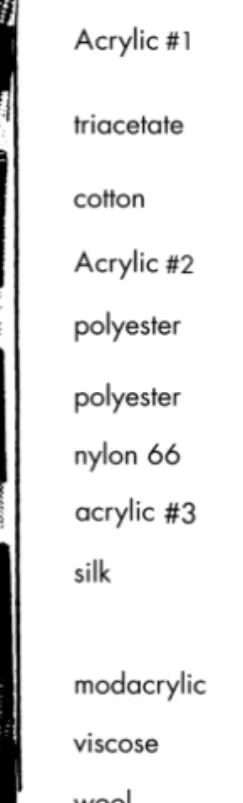
3.Staining test. A stain test provides a useful cross-check in identifying fibers, as long as they are not already too dark a color, either naturally or from having been dyed. The identification (ID) stain will have a mixture of dyestuffs in it that gives different colors on different fiber types—a variation of cross-dyeing. When microscopic examination is made of a sample that has already been stained, both appearance and color con-tribute information. For example, a number of major fiber groups are round in cross section and so appear structureless in lengthwise view—like a rod. Use of an ID stain, especially if a piece of multifiber cloth is included, often helps greatly to distinguish among these groups. Testing labora-tories regularly use such multifiber cloth, woven with 5 cm or 10 cm repeats of a variety of fibers in strips. The makeup of a 13-fiber cloth and a result with one ID stain mixture are shown in Figure 2.88; for sources of multifiber cloth, see Section Eight.
4.Solubility or chemical test. This kind of test is needed when an unknown is very dark in color, when two or more fibers are present in a blend (which makes a burning test inconclusive), when fibers have very little visible structure, and in general, as a conclusive cross-check to burning or stain tests or microscopic examination.
One of the few specific chemicals readily available is nail polish remover, which, although it is not acetone, will affect only acetate or triac-etate at room temperature. Most other chemicals needed in fiber identification are hazardous and used only in laboratories. However, a chart on page 99 shows some key fiber solubilities.
5.Fiber density, infrared spectrophotome-try, gas chromatography. These are all positive identifying tests, but are very specialized. Near-infrared (NIR) spectrophotometry has pro-vided a quick identification of fibers in textiles intended for recycling.29 DNA “fiber profiling”
has been developed by the British Textile Tech-nology Group to distinguish among animal fibers, such as cashmere and yak.30
6.Fiber melting point. This is a specialized method with significant drawbacks for identifica-tion. Many synthetic fibers give a range of melting point figures, or may decompose before their melt-ing point is reached. The copper block method commonly used indicates a softening point which may not be close enough to the melting point.
Textile Flammability
This topic touches far more than just fiber identifica-tion, so before proceeding with specific information
on burning tests, we should consider fire safety as it relates to textiles. Fabrics are all around us—in cloth-ing and household furnishcloth-ings; in whatever transport we use; in schools, offices, theaters. Concern that dangerously flammable textile products should not be allowed on the market has led to increasing legisla-tion in this area in a number of countries. In the United States, the original Flammable Fabrics Act (1953) was amended in 1967 to outlaw highly flam-mable fabrics for interiors as well as apparel. Since 1973, under the Consumer Products Safety Act, an independent agency, the Consumer Product Safety Commission, creates and enforces the rules for tex-tiles (as well as other products). Standards in effect can be found in parts of Title 16 of the Code of Federal Regulations, Subchapter D—Flammable Fab-rics Act Regulation in: part 1610, clothing textiles general; 1611, vinyl plastic film in apparel; 1615, children’s sleepwear, sizes 0 through 6X; 1616, chil-dren’s sleepwear sizes 7 through 14; 1630, 1631, carpets and rugs, small and large; 1632, mattresses, mattress pads. In Canada similar regulations exist under the Hazardous Products Act (1969), through Consumer Product Safety, under Health Canada’s Product Safety Programme. The standards in both countries establish a base level of safety for consumer apparel, with special standards for items such as chil-dren’s sleepwear, and also for carpets and mat-tresses.
Flammability of furnishings fabrics is also of great concern. The Upholstered Furniture Action Council has drawn up voluntary standards for upholstered fur-niture. There are many fire regulations governing acceptable levels for components of public buildings, such as hospitals and schools. Students in interior design should realize that professionals are expected to know and meet standards of safety set for contract work for their project and area, not only in the fabrics they choose, but to meet local fire codes in wallcover-ings as well—if designers are certified, the responsibil-ity is with them. A contractor can give the information on what class of fire rating is needed, and the designer should get a certificate from any fabric supplier stating that the fabric meets these ratings. If a fire were to occur and the proper materials had not been used, the designer could be held responsible.
So far as choosing apparel and fabric for domes-tic use, we should be aware of fire hazards in general, and this is an important focus of the general discus-sion of flammability that follows.
Figure 2.88 A 13-fiber multifiber cloth stained with an identification stain, made up to give different col-ors on different fiber types.
Burning Behavior
Flame retardancy is measured by the amount of oxy-gen needed to support combustion (Limiting Oxyoxy-gen Index or LOI31); fibers with an LOI greater than 25
are said to be flame resistant or retardant, that is, there must be at least 25 percent oxygen present for them to burn. Glass, for instance, will not burn even in an atmosphere of 100 percent oxygen. Glass is also very resistant to heat, but other fibers may be flame resistant yet heat sensitive, such as the modacrylics.
Fiber Type and Fire Safety
Just as fiber behavior is basic to wear, ease of care, or comfort of our textile articles, so it is to their relative flammability. However, at this point we should note that what follows is a description of the relative flam-mability of fibers without modifications. Many MF fibers are available also in a flame resistant or retardant form, with the trademark name often fol-lowed by the letters FR (see “Additions to Manufac-tured Fibers before Spinning” earlier in this Section). Flame retardant finishes can be given to natural and MF fibers, and will be covered in Section Five.
The following lists, then, describe behavior in flame and removed from it, by fibers not given any flame retardant modification or finish:
Most Flammable
I Cellulosic fibers (such as cotton, flax, viscose, lyocell). Once alight, these burn readily and so can “propagate” flame to other fabrics; can leave glowing embers.
Intermediate
I Acetate, triacetate. These melt as they burn; burn more readily than the groups listed next. I Nylon, polyester, olefin (polypropylene), acrylic,
spandex. These do not catch fire (ignite) readily; once ignited, burn and most melt; tend to drip (especially nylon); the drops tend to carry the flame away, so the fabric self-extinguishes in some situations.
Less Flammable
I Protein (wool, silk). These do not ignite easily; burn slowly; tend to self-extinguish, except in very dry air or with very open fabric.
Flame Resistant (LOI greater than 25)
Will not continue to burn when the source of ignition is removed (self-extinguishing).
I Modacrylic, saran, vinyon. These melt; mod-acrylic does not drip.
I Aramid. These do not melt but char; tend to self-extinguish; give little smoke.
I Certain modifications. Some MF fibers are given flame resistance by agents put in before the fiber is spun.
Flameproof (Nonflammable)
I Novoloid, polybenzimidazole (PBI). These will not burn; do not melt; char, but stay intact. I Inorganic fibers (asbestos, glass, metal, etc.).
These will not burn; can melt, but at temperatures so high they do not figure in textile fire safety!
Fabric Construction and Fire Safety
The way the fabric is constructed is another very important factor in fire safety:
I Lighter-weight fabrics, especially light, sheer, or open fabrics, burn faster than heavier fabrics (of equivalent fiber types).
I Fabrics with a raised surface burn faster than smooth fabrics.
I Open, porous fabrics or those with a more sparse pile burn faster than those with yarns packed closely together.
Garment Design and Construction and Fire Safety
The style and construction of a garment affects flam-mability:
I Loose-fitting garments, with flaring skirts or sleeves, with gathers, ruffles, trim like lace, any-thing with a lot of air incorporated with it, will ignite more readily and burn faster than closely fitting, virtually untrimmed articles. This means that flowing, at-home garments should be worn with care around the kitchen stove or barbecue. I Thread may be more flammable than garment
fabric, so an article can burn preferentially at the seams.
In almost a summary of the preceding “lineup” of hazards from fiber type, fabric construction, and gar-ment design, product safety authorities in the United States and Canada in August 1994 were alarmed about full skirts imported from India made up of rayon chiffon over gauze, some of which had been found to be dangerously flammable.
Other Fire Hazards
Other fire hazards involving textiles include the fol-lowing:
I Bedding and upholstery made of fabric covering over foam present a fire hazard; the resistance to burning or even melting of the covering fabric is evidently crucial in preventing fire from reach-ing the foam, which burns readily because of the air trapped in its structure.
I One of the hottest fire sources is an unextin-guished cigarette or cigar; a combination of one of these with a mattress or a wastebasket of paper is often deadly.
I Other areas of concern (and legislation) are tents, dining shelters, and the like.
I Clothes dryer fire hazards from lint and foam are noted in Section Six.
Fiber Identification Burning Test
You will be working with an open flame—from a Bunsen burner, a candle, or even a match—so take care, especially to keep long hair well clear of the flame. Samples for burning tests should be quite small, although if you use the recommended loose fibers or bundles of yarn, you will probably keep the sample small in any case. Fiber material burns very quickly when it is not held in a fabric, so twist fibers together and bundle yarn pieces, so they will not burn too quickly. Always hold the sample (or a flame source such as a match) in tweezers or tongs and work over something like a sheet of foil or metal tray, in case you drop burning material. Make sure the sur-face under the foil or tray is protected from heat.
The sampling procedure itself is very important if you wish to get the maximum information from your test. You should take yarns from warp separately from weft in a woven fabric, and if any contain more than one ply, test the plies separately. Twist short lengths of the yarns into a bundle; bring the sample
pushed into the top of the flame); note what happens as the sample approaches the flame—does it “shrink away” as a thermoplastic fiber will?
Put the sample in the flame and note whether and how it burns. Remove it and see whether it goes out on its own (self-extinguishing), whether it smol-ders, or whether it goes on burning. Samples that burn and melt will often drip; take care with this molten material—it is very hot. If a sample burns “fiercely,” you may have to blow it out so it will not all be burned up.
As the flame goes out, note the type of smoke and its odor.
Finally, let the residue cool (use caution again with this) and examine its character: soft ash, crush-able or hard bead, smooth or irregular.
Note that the dyes and finishes used on a fabric can affect its behavior in burning and the color of the residue.
Results for major fibers are presented in Table 2.5; the order is not connected with relative flammability as given in the opening of this segment; instead, it is one you might follow if you are doing a systematic series of burning tests, to prevent your sense of smell from get-ting fatigued early by the really acrid or pungent odors of the fibers listed farthest down the table.
Microscopic Fiber Examination
Microscopic examination can be a good first step in fiber identification, and the microscope need not be an expensive one. However, every microscope is a carefully engineered optical instrument and should be handled with knowledge and care. The main parts are shown in Figure 2.89; the two lenses that do the magnifying are the eye-piece (ocular) and the
objective. Many microscopes have a revolving turret nosepiece, allowing you to interchange objectives. An eyepiece of 15 times magnification (15×) used with an objective of 10×will give you a magnification of 15 × 10 or 150×. As mentioned in the introduc-tion to this segment, that is more than enough for examination of fibers; in fact, for an inexperienced person, too high a magnification (in the order of 600) can make locating the sample difficult, or give a very confusing picture.
Handle any microscope with care. A soft lens paper should be used to keep the lens system as
ocular or eyepiece adjustable graduated draw tube revolving objective turret
rack and pinion substage with iris diaphragm and polarizer illuminator objective body
coarse adjustment knob for body tube fine adjustment knob
inclination joint
stage
Figure 2.89 Main parts of a microscope.
Table 2.5 Burning Behavior of Major Types of Fibers
Fiber Type Behavior Up to Flame Behavior in Flame Behavior Removed from
Flame Odor of Smoke Type of Residue
asbestos, glass No effect Glows No change None NA
cellulosic, such as cotton, linen, viscose, lyocell
No effect Burns fiercely Burns, can glow, smolders
Like burning wood, paper, leaves
Soft, gray ash
acetate, triacetate Curls Burns, melts Burns, melts Like vinegar Bead—can crush
nylon Shrinks away Melts, drips Tends to go out Like celery seed(?) Hard bead
polyester Shrinks away Burns, melts, Tends to go out Aromatic(?) Hard bead
olefin (polypropylene) Shrinks away Burns, melts, black smoke
Burns, melts Like wax Hard bead
acrylic Shrinks away Burns Burns Fishy Bead—can break
modacrylic Shrinks away Burns GOES OUT Like animal waste! Bead—can break
silk No effect Burns slowly Tends to go out Like burning
feathers
Ash—can crush
wool No effect Burns slowly Tends to go out Like burning hair,
meat
Ash—can crush
NA, Not applicable.
reagents must never be allowed to come in contact with the lens. Care should also be taken that water does not seep between the slide and the stage.
You will need some microscope slides, cover slips, two long needles, and a dropper bottle of a liq-uid medium such as glycerine or just water. Glycerine
does have advantages over water for mounting all fibers except acetate: water evaporates quicker, swells many fibers, and does not allow as good defin-ition. On the other hand, water is readily available, and there is little distortion as light passes through the glass, water, and fiber. For student use in intro-ductory courses, or for amateur interest, water does very well. For the long needles, use dissecting nee-dles, hat pins, or darning needles with cork on the eye ends.
The procedure outlined here will give you a lengthwise (longitudinal) view of fibers; to see the cross section, you must take a slice across the fibers, which requires some special equipment plus manual skill and practice.
Fiber “knowns” are an invaluable help in micro-scopic examination of fibers for identification. You can consult printed guides such as you find in this
Referenceand others, but if you can look at an actual sample of what you know to be that fiber, it is much more revealing and conclusive. A collection of known samples can be made, of which only a fiber or two is needed, to be mounted alongside an “unknown,” to give you a great deal more assurance in making your identification.
Alternatively, you could assemble a set of perma-nent slides to give you a known to compare with an unknown. A permanent slide can be prepared by mounting in a medium such as collodion, which hardens on drying. (Collodion is available from a lab-oratory supply house.) If using such a medium, take care to move the fibers in it as little as possible, or many bubbles will form; these are most distracting and misleading when you are examining what is on the slide. A set of such slides can be prepared more cheaply than buying a commercially available set, can cover many more interesting examples (e.g., wool fibers bitten by larvae, see Figure 6.10), and, in my experience, can be prepared to a higher standard (fewer bubbles)!
See the sampling procedure described for the burning test. Ravel yarn off the cloth and untwist; if there is more than one ply, examine each separately, and look at warp separately from weft. In a fabric with yarns of different colors, you should really look at each color separately.
When the yarn is nearly untwisted, do not pull it apart—hold it over a drop of water or glycerine on a microscope slide and clip off a length of about 10 mm (1/2 in.), letting it drop onto the slide. Using two
needles, tease the fibers to separate them; ideally, you should not have fibers crossing each other at var-ious levels. It is a common mistake to have far too many fibers on a slide.
Drop a cover slip on top, and examine for air bubbles; if present, press gently on the cover slip with the tip of a needle, not your finger. If bubbles are still present, hold a needle against one edge of the cover slip, and raise the slip with the other needle from the opposite edge, using the first needle like a hinge; introduce a little liquid, and lower the slip slowly. You may wish to use this technique in any case, rather than “dropping” the cover slip on. Blot excess liquid away; absorbent papers are available from lab-oratory supply houses, with the rather W. C. Fields-ish name of bibulous paper.
Place the slide on the microscope stage so that the fibers on the slide are in the center of the hole. Use an objective and eyepiece to give a magnification of 100–150× if possible, but even 60× will do. The microscope can be tilted by the inclination joint. Clips on the stage hold the slide in place, and there is usu-ally an iris diaphragm below the stage to allow more or less light through. If a mirror is used, the concave side concentrates light more than the flat or plane side. An illuminator lamp, useful to throw a good light below the stage, may be clipped in place where a mirror would be, if a light source is not fitted to the microscope.
Focusing is done first with the coarse adjustment knob, then the fine. First, guiding yourself by looking from the sideof the microscope, lower the objective until it nearly touches the slide. Then, with your eye to the eyepiece, turn upslowly, until the material comes into focus. (If you do not follow this procedure, you run the risk of grinding a lens into the slide.)
When the fibers have been brought into view, focus carefully using the fine adjustment knob. Some-times details can be seen more clearly if the light coming into the microscope is reduced by use of the iris diaphragm. In other cases, such as with lobal MF fibers, you get a better impression of the shape of the fiber if you focus up and down through it. Try to keep both eyes open when using a microscope; this will result in less eye fatigue.
Typical Features
Following are descriptions of fibers seen through the microscope at magnification of 60–150×.
Cross-sectional shape is described and shown as well as longitudinal features. With reeled silk and (particularly) MF fibers, it is important to know the shape of the cross section in order to understand the lengthwise view you see. You will not be able to see the cross section, however, unless a slice has been taken of the fiber; as noted before, this requires special equipment and a good deal of prac-tice. What you will ordinarily be looking at is the lengthwise (longitudinal) view.
I Natural fibershave very definite characteristics in each type; e.g., hair fibers will have features in common, as will bast fibers; it is very difficult (if not impossible) to tell a cashmere fiber from very fine wool,32or flax from hemp or ramie, but
the typeis unmistakable.
I Cotton (mature or lint fiber) looks like a twisted ribbon, with a central canal, the lumen, clearly visible at this magnification. Views seen in many textbooks and Figure 5.4(a), given by a scanning electron microscope, show the surface but not the lumen. Immature cotton is twisted, but has no inner substance.
I Flax and other bast fibers show nodes— swellings along the length, like the “elbows” in bamboo—plus cross cracks.
lumen = central canal
immature cotton
I Mercerized cottonshows few twists, because it has been swollen in caustic soda; the smoother surface after mercerizing gives luster (see also Figure 5.4[a]). Immature cotton will not react in mercerizing, as there is no secondary wall to swell; it remains looking like (insubstantial) twisted ribbon.
node cracks
I Woolshows overlapping scales, like shingles on a roof or fish scales; the edges protrude slightly toward the tip of the fiber. Coarse wools may show a medulla—a dark space in the center (see also Figure 2.27).
I The finer the hair fiber, the smaller the scales, so
cashmere undercoat has very small scales that seldom overlap on one side of the fiber.
I Mohair has large, platelike scales that project hardly at all from the fiber; these account for the dirt-shedding character and luster of mohair.
I Angora has an appearance typical of fur
fibers: air spaces in the center of the fibers look like “box cars,” scales project hardly at all.
I Down shows a truly wonderful construction: a quill point with fine branching arms, carrying tiny barbs. Since this is all made of a light material (protein), it gives air trapping with little weight.
Note: Since down was intended to resistwetting, it is almost impossible to mount in water without a lot of air bubbles. Find a bit without too much intrusion from bubbles, and enjoy!
I Any MF fibermay appear clear, or with specks through the fiber, no matter which group it falls into according to the fiber shape and type. Clear fibers are called bright and will look shiny; the specks are granules of a white pigment dispersed in the fiber before it was spun, to give a dull, delustered, or matte appearance. Some fibers have very little delustrant, while others are heav-ily delustered; since light cannot pass through the (white) pigment granules, they look like dark specks.
nodes
waterfowl—duck
quill point
down
I Cultivated (reeled) silk is the only natural fiber that is structureless, since it was formed by a liquid solidifying. Sometimes a faint lengthwise line can be seen to mark the joining as the fiber was spun of the original two brins into one fila-ment. Silk is always very fine and is irregular in diameter; the cross section is roughly triangular.
Wild silkhas a rather striated appearance and is much coarser than cultivated silk.
wild silk
Major features identifying various groups of MF fibers follow:
I Structureless MF fibers have a rodlike shape, with a round cross section. Among the many structureless fibers are cuprammonium rayon lyocell, standard nylon and polyester, olefin, glass, and saran.
I One line or “crease” is the result of a
dog-boneor bean-shaped cross section. Fibers of this type could be spandex, some modacrylics, and some acrylics.
I A few linesare given by lobal cross sections of two differently appearing types:
1. Two to four lines lengthwise, the result of lobes a little like clover leaves, are found with acetate and triacetate.
2. A few wider, shallower grooves with more solid lobes, the swelling of which can be seen by focusing up and down through a fiber, can be seen in a lobal fiber either fine or the coarse filaments used for most of the “sparkling” fabrics. (A few such sparkling fab-rics may still be made of flat, tapelike fila-ments, such as “crystal” acetate.)
handle and not easily available. This portion, then, may largely be of limited interest, but is included for reference.
Sampling is done with very small clumps of fibers, short lengths of yarn, or (least desirable) small pieces of fabric. Comments on sampling for burning tests apply, in regards to trying to test each type of fiber present.
You should have at least 100 units of solution for every unit of sample. Leave the sample in the liquid for five minutes, stirring periodically. You may need a special light or background to see the effect on the sample.
The following are solvents specific for the fiber(s) mentioned, but often after other possibilities have been eliminated by burning, microscopic examina-tion, or stain testing:
I Many lines are seen only in viscose rayon, the result of a wrinkled, almost corrugated surface that gives a serrated cross section. This is a result of the fiber precipitating gradually in the acid bath.
It is also interesting to look at a sample contain-ing microfibers, to get an idea of just how fine these are. The tiny fibers in Thinsulate™ are on the order of the size of the fronds and barbs of down, and microfilaments can also be compared to silk.
Solubility or Chemical Tests
When other tests are inconclusive, solubility tests must be made using chemicals that are both hazardous to
Solvent
Temperature
(°C/°F) Specific for
acetone room acetate (dissolves),
triacetate (disintegrates), modacrylic, vinyon (softens)
cresol (meta-) 95/200 (hot) polyester (if nylon and acetate have been eliminated)
dimethyl-formamide
95/200 (hot) acrylic, modacrylic (if acetate has been eliminated and if saran, spandex or vinyon is unlikely) hydrochloric acid (20% by weight, sp.gr. 1.096 at 25°C/75°F) room nylon sodium hypochlorite (5% av. Cl)
room wool, silk
REVIEW QUESTIONS 2–6
1. What is the most available and easiest method to obtain information on fiber content from a fab-ric sample? Name two more methods possible to carry out with minimum laboratory facilities. 2. What is LOI? What use is made of this measure?
Discuss the difference between heat resistance and flame resistance in relation to specific fibers. 3. Name three elements of an article of clothing or
4. What information can a burning test (properly carried out) give as to fiber content of a yarn or fabric? (Take into account clues from the reac-tion of the fibers to heat; whether the material burns, and if so, the way it burns; whether the flame tends to go out; the smell of the smoke when the flame is extinguished; and the type of (cooled) residue.) What two main pieces of infor-mation are usually not clear from a burning test? 5. What accounts for the similarity in burning of cotton, flax, rayon, and lyocell? Name five other fibers that would give similar results.
6. What accounts for the difference in burning behavior of silk compared to wool?
7. What can a microscopic examination reveal that a burning test cannot?
8. What do lengthwise lines indicate in the longitu-dinal view of a fiber (fiber flat on the slide)? What does it mean if no lines at all are seen? What do dark specks throughout the fiber mean?
9. What common chemical substance can indicate presence of one common fiber?
INVESTIGATIONS TO DO WITH TEXTILE FIBERS
1. (a). What five fibers are present in most of your own clothing? Make up a table showing the arti-cle, the fiber content, and the properties of that fiber that make it suitable for that use.
(b). Do the same for your household fabrics (bed-ding, towels, drapes, upholstery, carpets, table linens).
2. Try the comparison test for absorption of a linen handkerchief (or tea towel) compared to one of cotton (see “Flax Quality,” this Section).
3. Demonstrate thermoplasticity by applying a dry hot iron (with a cotton pressing cloth to protect the iron in case a fabric melts) to folded or pleated fabric of: cotton, viscose rayon, acetate, nylon, polyester. Try to apply the iron with con-sistent pressure, and for the same time (e.g., a count of ten). Save a strip of the original, and wash the rest to see in which fabric the fold or pleat lines are most durable.
4. You have a “silky” fabric (filament yarns, no fiber ends protruding). Make one simple test to tell you whether it is made of silk or an MF fiber. What will this test by itself nottell you?
5. Demonstrate how acetate differs from viscose rayon.
6. Imitate dry spinning (with good ventilation and no open flame nearby). Clue: aim for an acetate filament.
7. Examine several clear wrapping films and deter-mine if any are made of cellophaneor if all are synthetic (e.g., saran wrap).
8. (a). You are the interior designer for an office suite, which will include selection of drapes,
upholstery, and carpet. What flammability regu-lations must be met? Whose responsibility is it to ensure that fabrics meet these?
(b). You are the buyer for children’s sleepwear. What flammability and other regulations must be met? Whose responsibility is it to ensure that fabrics meet these?
9. Gather five 100 percent cotton fabrics, of as widely varying weight, construction, and finish as you can find. Do the same for five 100 per-cent of wool, and five 100 perper-cent of polyester. Give a fabric name (as from Fabric Glossary) to each sample. This investigation should illustrate why the answer to “what is this fabric called?” should NOT be simply “a cotton,” “a wool,” or “a polyester.” If you can, continue to add to and identify entirely distinct fabrics in each of these three categories to see how many you can find. 10. Collect at least ten different advertisements, hangtags, or labels, for apparel, accessories, or household furnishing fabrics. Make out a page or large file card for each of the ten items. Record: (i) the merchandise to which that pro-motion refers, and all data the sources give, including any information from sales staff; and (ii) information on fabric behavior which the fiber content provides from your study of fibers so far in Fabric Reference, citing the page(s) where you find this information. KEEP THESE RECORDS and add to them later under head-ings (iii) yarn; (iv) fabric construction; (v) finish; contribution of dyeing, printing, or other treat-ment; and (vi) care, as these are covered in your course of study.