The Cambridge economy:
retrospect and prospect
Final report to EEDA and partners
Contents
Executive Summary ... i
1: Introduction to the study ... 1
PART A: OVERVIEW REPORT ... 6
2: Characterising the Cambridge Cluster at 50... 7
3: Overarching themes for the next 50 years: the Cambridge cluster in national and global space ... 19
4: Overarching themes for the future: the Cambridge cluster in local space ... 26
5: An Agenda for Action ...32
6: Towards implementation ... 37
PART B: ROLE REPORTS ...40
Role 1: Cambridge as a hub for high tech businesses ...41
Role 2: Cambridge as a “research community” (focusing on science and technology research funded principally by the public and charity sectors) ...64
Role 3: Cambridge as a city centre economy ...82
Role 4: Cambridge as a regional centre for the public sector...105
Role 5: Cambridge as an international visitor destination ...120
PART C: THEMATIC REPORTS ...130
Theme 1: Assessment of the availability and suitability of different types of land and premises ...131
Theme 2: Planning policies...153
Theme 3: Transport...179
Annex A: Labour market and employment projections ...A-1 Annex B: Quantifying the scale of the high tech community...B-1 Annex C: Bibliography ...C-1 Annex D: List of consultees...D-1
Contact: Christine Doel Tel: 01223 209400 email: [email protected]
Chris Green Date: March 2011 Approved by:
Executive Summary
Context and purpose
1. In May 2010, SQW was commissioned by the East of England Development Agency (EEDA) to examine the “Cambridge Cluster at 50”. In commissioning the study, EEDA was supported by a wide range of local partners, including: Cambridgeshire County Council, Cambridge City Council, South Cambridgeshire District Council, Greater Cambridge Partnership, Cambridgeshire Horizons, the University of Cambridge (through the Institute for Manufacturing), St John’s Innovation Centre and leading private sector representatives. 2. The purpose of the assignment was to analyse existing data and consult with businesses and
other key stakeholders about the Cambridge economy, in order:
• to understand better the performance of the Cambridge economy currently (including the impacts of recession), and the factors that underpin and explain this
• to understand long term opportunities and threats for the economy of Cambridge, taking into account changes in government policy and also the different aspirations of new generations of Cambridge-based businesses and residents
• to understand the potential synergies and conflicts that exist in relation to Cambridge’s different economic roles, both now and looking forward
• to examine the constraints to economic growth – infrastructural, workforce-related, spatial, attitudinal, institutional – and to distil what might be done to address these
• to understand – in broad terms – the spatial implications of the above.
3. The main focus of the study was the high tech cluster, which includes the high tech firms, Cambridge University and related research institutions, and specialist services which are located in Cambridge principally to support these core activities. However, the client group agreed at the outset of the study that it would take a broader view of the Cambridge economy, and examine its different roles, including but extending beyond the high tech cluster.
The Cambridge economy today
4. Currently, the Cambridge area (including Cambridge City and South Cambridgeshire District)1 has a resident population of around 265,000 people; it is home to around 153,000 employee jobs; and there are well over 10,000 businesses based in the area. On the basis of data from the East of England Forecasting Model (EEFM), the value of its annual economic output (GVA) is approaching £7.5bn (over 7% of the regional total) while GVA per job is
1
For data purposes, we are defining the Cambridge economy as the Local Authority Districts of Cambridge City and South Cambridgeshire. In general, this study has not sought to adhere to a rigid definition of Cambridge: the focus is on the urban area (which falls within Cambridge City and parts of South Cambridgeshire) but where relevant and appropriate, reference is also made to the ring of market towns (Ely, Newmarket, Saffron Walden, etc.) and the wider sub-region
about £40k in Cambridge City and close to £45k in South Cambridgeshire (compared to the UK and East of England averages of around £37k). According to the 2010 UK Competitiveness Index2, Cambridge is one of the five most competitive cities in the UK. Among local authorities, Cambridge and South Cambridgeshire are ranked 32nd and 24th for competitiveness out of 380 authorities nationally, with almost all those ranked as more competitive being located in London, Surrey and Berkshire (and in most cases due mainly to higher incomes). The Cambridge economy is therefore substantial, productive and competitive, and it contains institutions and firms of national, and in some cases global, significance.
5. Underneath these headline data, the Cambridge economy needs to be understood in relation to the five main roles it plays. All five are important, but the first two – which together comprise the high tech cluster - are likely to play a significant role in national economic recovery and growth, while others are concerned with servicing the local – but rapidly growing – population.
• Over the last 50 years, the area has developed a global profile and importance in terms of its technology-based business community (Role 1). In the Cambridge area, there are about 900 high tech businesses employing in total about 37,000 people – close to a quarter of all jobs. In Cambridgeshire as a whole, the figures are 1,400 high tech firms employing 48,000 people3. They include some major businesses such as ARM and Autonomy which are global leaders in their respective fields; and also a large number of smaller enterprises, some of which are growing quickly. Within this context, there is a wide range of business models at play, some of which rely on angel and venture funding to develop cutting edge science, while others are more likely to finance their growth internally and incrementally. Overall, and despite the recent severe recession, the high tech community continues to grow and to innovate. The hard and soft infrastructure to support technology-based businesses is generally well developed, with networks playing a particularly important role in business growth. These are very varied, with social networking now a key part of the mix, and links often developed at three crucially important scales: locally, with London, and globally. The “culture” of Cambridge – where “people go out of their way to be helpful” – is really important in explaining the cluster’s growth.
However, there are also some weaknesses which may constrain future growth. These include a shortage of venture funding and housing and infrastructure constraints. The forecasts for the growth of the technology based business community are modest, although they need to be treated with some caution, particularly during a period of considerable economic uncertainty (for example, forecasts cannot predict the impact of disruptive innovations, such as the past emergence of biotechnology as a key driver of high tech growth in Cambridge). They suggest that over the next 20 years, employment and GVA will grow at little more than half the rate of the last 20 years4.
2
UK Competitiveness Index, 2010, Robert Huggins and Piers Thompson, Centre for International Competitiveness, Cardiff School of Management, University of Wales Institute
3
Based on data for 2008 collated by Cambridge County Council Research Group
4
Forecasts produced by Oxford Economics in March 2010. GVA is Gross Value Added, which is essentially the difference between inputs costs and output prices.
• Integrally related to the area’s technology-based businesses is its wider research community, encompassing the University of Cambridge and various research institutes, many with genuinely world class science and research (Role 2). On virtually allglobal rankings, Cambridge Universityis consistently among the top five in the world. Over recent years, there has been substantial investment in facilities linked to the University and many of the research institutes – including development of the West Cambridge site for the University of Cambridge, Addenbrooke’s Biomedical Campus (including new buildings for Cancer Research UK and the Laboratory for Molecular Biology) and expansion of the Genome Campus at Hinxton and the Babraham Institute. Further development of these assets is planned, including the expansion of the University into North West Cambridge.
The links between Roles 1 and 2 are symbiotic and they have been very important with regard to the overall success and profile of the Cambridge area. For example, by 2005, 250 companies had been started on the basis of knowledge transfer from the University, including 175 located in the Cambridge area5. However these links have not always been straightforward; for example, over recent years, changing approaches to Intellectual Property within the University of Cambridge have been a source of some frustration.
• Cambridge has developed significantly as a city centre economy (Role 3) over the last decade or so as the centre has become a regional retail and business centre. Investment in the Grand Arcade catapulted Cambridge up the national retail rankings while maintaining the quality of the historic city centre. There have also been other significant developments, including Cambridge Retail Park (on Newmarket Road) and Cambridge Leisure Park (on the old cattle market site) which have complemented the established retail and cultural offer (linked to theatres, concerts, festivals and so on). All of this has been really important in terms of the “quality of life” and variety of facilities that Cambridge provides, and that in turn has proved very important in attracting and retaining what is, in part, a globally mobile workforce. However, there are concerns about the capacity of the central area to accommodate the range of businesses that want to locate there, and the impact on quality of experience of the ever-increasing number of people that want to use its services
• The last ten years have also seen the emergence of Cambridge as a regional hub for the public sector (Role 4). Cambridge became the “capital” of the East of England region and it attracted a number of institutions as a consequence: the Government Office for the East of England, the East of England Development Agency, the Strategic Health Authority, and so on. With the change of government, many of these organisations are being abolished. However, most of the growth in public sector jobs has actually been in health and education. Together, these two sectors account for about 30% of total employment in the Cambridge area, with under 4% in public administration and defence. Based on current knowledge about the impact of the planned cuts in public spending, our best estimate is for a reduction of between 2%
5
and 4% of all employee jobs in the Cambridge area6, and a slightly lower proportion in the rest of the county. This appears to be quite modest, but needs to be seen against the previous expectation that public sector jobs would contribute about one third of the net increase in employment for the Cambridge sub-area between 2008 and 20157
• Finally, Cambridge has continued to function as an important international visitor destination (Role 5). Although in some respects the “cinderella” of the economy – and an aspect that tends to be tolerated (at best) rather than supported locally – Cambridge’s strengths in relation to tourism are important in understanding the area’s current economic character. The fact that Cambridge continues to attract academics and business people from around the world is crucial in terms of its overall profile while international tourists – of all forms – provide a key source of income and one that is increasingly significant in relation to many of the Cambridge colleges as well as the commercial tourism (hotels, etc.) sector.
6. A key issue looking forward is how these different roles might all be accommodated and supported, recognising that they all have a claim on Cambridge as part of a balanced economy. While there are some synergies, there are also, undoubtedly, some dilemmas and tensions which will need to be resolved as the Cambridge area seeks to chart its future course. In considering how to address these dilemmas and tensions, the fundamental importance of the core Cambridge Cluster (including, crucially, the high tech firms, the University of Cambridge and related research institutes, but also other key players such as Anglia Ruskin University) to the future economic development of the area should be recognised. The other roles are important, both to businesses and residents, but they are secondary insofar as the Cambridge Cluster is likely to continue to be the main source of wealth creation for the area, and a significant contributor to national economic recovery.
Key issues looking ahead
The Cambridge Cluster as an international hub for the knowledge economy 7. Cambridge is a focus for globally significant science and its commercialisation, but it is
competing with knowledge hubs across Europe and North America, and in emerging centres in countries such as India and China. In this context, central government needs to advance a policy framework that allows Cambridge and other UK hubs to compete effectively in what is an intensely – and increasingly – competitive sphere. From the consultations undertaken in the course of this study, five priorities which need to be addressed nationally were identified. Specifically, calls were made for:
• an effective migration policy that does not place restrictions on highly skilled or talented people from outside the European Economic Area seeking to work or study within the Cambridge area
6
4% of employees in the Cambridge area amounts to approximately 6,500 jobs
7
The estimates of the impact of public spending cuts are based on research undertaken for this study and reported in Part B Role 4. The ‘previous expectation’ of growth in public sector jobs is based on forecast produced for EEDA by Cambridge Econometrics in January 2009.
• reforms to the regulation of the healthcare sector, particularly with regard to clinical trials, recognising that the UK now has one of the most stringent regulatory regimes in Europe which is seen by many as a deterrent to the growth of the bioscience sector
• reforms to fiscal regimes, including to encourage an increase in the volume of early stage investment finance (noting that the lack of finance is currently a real constraint to the growth of the high tech sector), and to support R&D, commercialisation and innovation
• continuing funding for scientific research, acknowledging that the strength of the cluster as a whole is premised in large part on the strength of the underpinning research
• linked to this, flexibility in terms of research funding with a stronger focus than hitherto on inter-disciplinary endeavour.
The Cambridge Cluster as a local place
8. As well as the national policy framework, there is a need to ensure that Cambridge itself – as a place – meets the needs of its businesses and residents, and in a way which supports continued growth of the high tech cluster. Across the roles that define the Cambridge economy currently, decisions with regard to the use of Cambridge – as a physical space – will have a bearing on future competitiveness. Specifically:
• there is a need to recognise that “doing business” – particularly within and between emerging high tech businesses – is as much a social process as it is a narrowly economic one; for this reason, designing and delivering new developments as social spaces – and not simply as physical locations for buildings – will be very important
• there is an urgent need to improve connectivity between Cambridge railway station,
the city centre and the principal employment sites (Cambridge Science Park, West
Cambridge and Addenbrooke’s hospital site), acknowledging the strong demand for easy access to both the city centre and to London. A key element of this should be the development of a new station at Chesterton which also links into the Cambridgeshire Guided Busway. This would take some pressure off the city centre as a location for firms needing excellent access to London, and it would help integrate the Guided Bus and rail network, enhancing the value of both
• there is a need to develop an holistic strategy and masterplan for the central area
which reflects and responds to the constantly increasing demands that the growing city-region places on a city centre whose quality is of paramount importance; and also to the changing nature of “doing business” in the 21st Century. The approach should be defined in relation to a series of “melting pots” such as those between scientific disciplines, different professions, and the interface between work and leisure.
Agenda for Action
9. Reflecting on these different priorities, a wide-ranging Agenda for Action has been developed. This ranges from lobbying government in relation to national policy and funding decisions and priorities, to actions which can be taken locally by the public and/or private sectors. Some elements of the Agenda for Action can be advanced quickly while others will take decades to implement; and whilst some will require substantial resources, others are more concerned with effective leadership and decision-making. Key themes within the Agenda for Action includethe need:
• to fix the “funding escalator”, recognising that it is currently not working effectively to support business growth
• to sustain Cambridge’s profile in relation to globally excellent research, both within the University of Cambridge and in the public and private research facilities in the area
• to encourage, nurture and support the process of entrepreneurship, including through the provision of key social spaces for “doing business” such as St John’s Innovation Centre and IdeaSpace at the Hauser Forum
• to refresh a range of planning policies and restrictions (including policies relating to headquarters operations and high value manufacturing) such that the Cambridge area as a whole is fully attuned to the process of “doing business” within a cluster which is both maturing and constantly evolving
• to make provision for key infrastructure, particularly in relation to housing and transport; within this context, supporting delivery of the planned scale and range of housing, and better connectivity between the city centre, railway station and key employment sites, ought to be the top priorities
• to sustain the quality of life that Cambridge provides, acknowledging that it needs to remain a place in which internationally mobile workers will choose to live and work. This includes the quality and range of city centre functions, and links within Cambridge and to London
• to ensure that growing businesses can recruit the workers they need, recognising a particular shortage of top quality management and marketing skills but also the imperative to attract internationally excellent professionals from all spheres
• to recognise and respond to the needs of key sectors within the cluster, both science-based and those that are concerned more with the “quality of life” that the Cambridge area needs to provide for residents and visitors alike.
10. This Agenda for Action is focused primarily on supporting growth of the high tech cluster, and ensuring Cambridge achieves more of its very considerable potential to contribute to the national economy. At present, there are real concerns that it will be prevented from doing so by constraints on business growth and a failure to match the strengthening offer of competing locations. Many of these constraints are not new (indeed, some have been present for the last
50 years), although the recession and public spending cuts have accentuated some of the issues. It is essential, therefore, that the area receives support and investment from national government, and that the growth agenda which has been agreed by all parties locally is pursued vigorously but appropriately.
Towards implementation
11. In seeking to advance the Agenda for Action, various public and private sector partners will have important roles to play, both individually and collectively. This project was undertaken during a period of substantial change in institutional structures and reduced public sector funding, and as a consequence some organisations which would have played a major role in implementation are disappearing – notably Cambridgeshire Horizons and EEDA – whilst the role and resources of others – particularly the newly-formed Local Enterprise Partnership (LEP) for Greater Cambridge–Greater Peterborough and the Greater Cambridge Partnership – are still uncertain.
12. The creation of the LEP, with private and public sector support, provides an opportunity to work collectively, but it will need strong leadership to ensure some difficult but crucial choices are made, and to secure more investment, if the global strengths of the cluster are to be sustained. Equally, local business leaders and public sector organisations have vital roles to play individually to deliver many of the proposed actions. In addition, the Government’s localism agenda suggests that securing the active support and talents of local communities will also be increasingly important.
13. The strength of the cluster lies in the strong relationships – many of a largely social nature – that exist locally, but also the cluster’s strong and growing interactions with London and internationally. Hence partners need to look outwards as well as inwards, recognising that many of the businesses and institutions in Cambridge are competing on a global stage. At the same time, the intrinsic character of Cambridge must be sustained: it must be a place where people choose to live, work and do business, acknowledging that the boundaries between these different spheres are increasingly blurred; indeed this “blurring” – arguably – constitutes a primary source of the area’s competitive advantage.
1: Introduction to the study
Purpose and objectives
1.1 In May 2010, SQW was commissioned by the East of England Development Agency (EEDA) to examine the “Cambridge Cluster at 50”. In commissioning the study, EEDA was supported by a wide range of local partners including Cambridgeshire County Council, Cambridge City Council, South Cambridgeshire District Council, Greater Cambridge Partnership, Cambridgeshire Horizons, the University of Cambridge (through the Institute for Manufacturing), St John’s Innovation Centre and leading private sector representatives. Together, EEDA and these partner organisations formed the study’s steering group.
1.2 The purpose of the assignment was to examine the recent performance of the economy of the Cambridge area in the light of some mixed messages about its current health and future prospects; to understand the principal challenges and opportunities arising from it; and to consider its future potential and prospects in the light of the global financial crisis and the subsequent recession and public sector spending cuts. From the outset, however, it was agreed that process elements were crucial. Specifically, the study was intended to effect an informed dialogue with the business and academic/research communities about Cambridge’s economic futures.
1.3 Drawing these two strands together, the objectives of this assignment were to engage businesses and other key stakeholders in an evidentially-robust discussion about the future of the Cambridge economy, in order:
• to understand better the performance of the Cambridge economy currently (including the impacts of recession), and the factors that underpin and explain this
• to understand long term opportunities and threats for the economy of Cambridge, taking into account, changes in government policy and also the aspirations of new generations of Cambridge-based businesses and residents
• to understand the potential synergies and conflicts that exist in relation to Cambridge’s different economic roles, both now and looking forward
• to examine the constraints to economic growth – infrastructural, workforce-related, spatial, attitudinal, institutional – and to distil what might be done to address these
• to understand – in broad terms – the spatial implications of the above. 1.4 Consistent with these objectives, two key definitions were agreed from the outset:
• Geography: The principal spatial focus for this study was assumed to be Cambridge
(defined as the physical footprint of the urban area). In terms of Local Authority Districts (LADs), the urban area falls within Cambridge City and parts of South Cambridgeshire – but this study was not about “lines on maps”, and indeed many of the key issues and potential solutions are “cross boundary” locally and some also
have implications nationally. The wider functional economic geography of Cambridge extends beyond the city, and therefore – where relevant – reference was made to the other LADs in Cambridgeshire and in the Greater Cambridge Partnership (GCP) area, and the ring of market towns (Ely, Newmarket, Haverhill, Saffron Walden, Bury St Edmunds, Royston, St Neots, St Ives and Huntingdon). However, the coverage of this wider sub-region was not comprehensive: it was Cambridge rather than the sub-region which formed the principal focus of this particular exercise8
• sectoral scope, etc.: as “the Cambridge Cluster at 50”,the title of the study indicated that the main focus was on the high tech cluster (including high tech firms, Cambridge University and the research institutes, and related specialist services). However the assignment was not concerned exclusively with high tech activity and the knowledge economy; it considered all of the main economic roles that Cambridge plays, and prospects and constraints in relation to them.
Approach
1.5 In approaching this study, it was agreed that Cambridge might most effectively be examined through the lens of five distinct “roles”. These were identified on the basis of their economic significance (and validated both by data and consultations). These roles are summarised in Figure 1-1. All five roles say something functional about the Cambridge economy as it has evolved over the last fifty years. The roles vary in terms of their current and likely future significance to economic growth, but all need to be understood in terms of the relationship between business activity, institutional behaviour and – in one form or another – public policy. All five have a definable spatial footprint within Cambridge. And, to differing degrees, all five need to be understood in relation to a broader spatial canvass: some have an international rationale while others are focused much more on the growing local population (of both people and businesses).
8
We understand, separately, that Cambridgeshire County Council is hoping to launch a review of the future roles of the county’s market towns
Figure 1-1: Cambridge’s key economic roles
Role 1: Cam bridge as
a high tech business hub
Role 2:Cam bridge as a “research community” (focusing on science and technology research) Role 5: Cambridge as an international visitor destination Role 4: Cam bridge as a regional centre for the public
sector Role 3: Cambridge as a city centre economy Role 1: Cam bridge as a high tech business hub
Role 2:Cam bridge as a “research community” (focusing on science and technology research) Role 5: Cambridge as an international visitor destination Role 4: Cam bridge as a regional centre for the public
sector Role 3: Cambridge as a city centre economy Source: SQW
Note: (i) The “knowledge economy” is encompassed by both Roles 1 and 2; and (ii) no attempt is made in this diagram to quantify the relative importance of the different roles, or how the balance between them might be changing
1.6 However, as the diagram attempts to show, the roles have “permeable boundaries” and in that sense – although each has an implicit coherence – the different roles need to be used as a series of prompts, not as a rigid framework. In addition, all of the roles overlap although the nature of this overlap varies: sometimes it is synergistic (e.g. Role 1 and Role 2 are inter-dependent) but sometimes there may be tensions between different roles as businesses/institutions within them compete for “their part of Cambridge”, whether this is defined in terms which are tangible (e.g. access to local workers, sites and premises, etc.) or intangible (e.g. how Cambridge is promoted on a global stage and branded).
Methodology
1.7 The study as a whole was divided into three broad phases of work:
• Phase 1 was concerned with reviewing the existing evidence base as it relates to the wider Cambridge economy and completing a series of scoping conversations with key stakeholders. It culminated in a scoping report which was completed in July 2010 and discussed at a meeting with the Steering Group. Included within it were a number of propositions for testing during subsequent stages of the study
• Phase 2 was focused on in-depth consultation, predominantly with businesses, members of the research community, and others within Cambridge who could make informed comments on each of the five roles depicted in Figure 1-1 and the propositions developed during Phase 1. Because of the intention to look forward rather than back, it included a particular (although by no means exclusive) focus on younger entrepreneurs – generally, individuals in their 20s/30s who were in the process of setting up and growing technology-based businesses. In total, individuals
from well over 60 firms/organisations were consulted on a bilateral basis. In addition, a number of workshop sessions were completed including: a grouping of early stage businesses which met at IdeaSpace; a group of manufacturing businesses which met at IfM; two groups of tenants from St John’s Innovation Centre; and a meeting of businesses in East Cambridgeshire. We also attended meetings of the Greater Cambridge Partnership’s operating and partnership boards at which emerging findings were presented and discussed
• Drawing together all of the preceding work and analysis, Phase 3 was concerned with responding to the issues, challenges, blockages and opportunities identified in Phases 1 and 2, and developing an Agenda for Action for the future economic prosperity of the Cambridge area. Given the simultaneous institutional upheaval and funding uncertainties, this was intended to be a reasonably high level statement. Its purpose – in part – was to ensure that sight is not lost of the “big issues” facing Cambridge whilst the public sector is adapting to new funding and structural circumstances.
Report structure
1.8 The report that follows is divided into three main parts and it is also supported by a number of technical and supporting annexes:
• Part A provides an overview report on the study as a whole and it focuses on the big issues facing the Cambridge cluster as it looks ahead. It includes a high level Agenda for Action and it sets out some suggested next steps
• Part B contains substantive reports on the five roles that have been used to structure this exercise as a whole. Consistent with the study methodology, these rely largely on consultation evidence although, in all cases, we have sought to draw in secondary and other data in support. Each Role Report ends by distilling a response to the key questions identified during the scoping phase of the study
• Part C includes three thematic reports, focusing on key elements of the physical context for growth. It reflects on the availability of commercial land and premises; planning policies; and key issues relating to transport in the Cambridge area
1.9 There are, in addition, four technical and supporting annexes. These contain:
• an analysis of labour market and employment projections (Annex A)
• a detailed quantitative analysis of the high tech community (Annex B)
• a bibliography of the main documents used to inform the work (Annex C)
• a list of consultees and workshop participants (Annex D).
Acknowledgements
1.10 This study has benefited from significant inputs from around 125 people and organisations, and we would like to acknowledge them fully. This includes, most importantly, all those that
were consulted bilaterally and/or attended workshops and other meetings during the course of the study (see Annex D). We would like to acknowledge the assistance of David Gill (SJIC), Peter Templeton (IfM) and Tim Minshall (IfM) in helping to convene a number of the workshop discussions. Tim Minshall, Walter Herriot and Charles Cotton have also provided further invaluable support in helping to navigate the high tech cluster more generally. Carter Jonas prepared the first Theme Report (in Part C), drawing on its extensive knowledge of the Cambridge property scene. Finally, we would like to thank EEDA and all the members of our Steering Group for the guidance, challenge, inputs and support they have provided throughout.
2: Characterising the Cambridge Cluster at 50
Introduction
2.1 Published in 1968, the first report of the East Anglia Economic Planning Council made the following observations with regard to the Cambridge sub-division:
Three facts of considerable significance for future planning stand out: first, the consistently high level of employment; secondly, the marked predominance of a few major industries in the manufacturing sector and the large numbers employed in professional and personal services
especially in the University, colleges and hospital; and thirdly, the overall concentration of employment at the city of Cambridge with some induced growth recently at the edges of the sub-division. The construction of the M11 from London will add to the pressures for growth, which would be increased if ultimately Stansted were chosen as the third London airport. Future planning in this sub-division should take advantage of the
important contribution that the numerous research and development activities in Cambridge can make to the national economy, and of Cambridge’s further potential as a regional centre for offices and
professional services, shops, entertainment and cultural activities, and as an international centre for tourism and specialist conferences. The major obstacles to this approach appear to us to be the immediate problems of labour shortage, because population and housing growth have not kept pace with growth in demand for labour; and the physical planning difficulties of preserving the architectural and historic environment9.
2.2 Reflecting back on the report of the East Anglia Economic Planning Council from approaching 50 years ago, three immediate observations need to be made:
• first, within the report, all five of the roles that have provided the analytical structure for this study were recognised and, to a degree, their subsequent growth was anticipated
• second, the intrinsic challenge of accommodating economic growth within a constrained physical environment – defined around invaluable architectural and historic assets – was well recognised
• third, the report notes that housing growth had not kept pace with growth in demand for labour – a problem which has persisted throughout the following 50 years.
2.3 So at one level – for Cambridge as an economy and as a place – nothing has changed: the economic roles of Cambridge are similar, as are the accompanying challenges. At another level, however, Cambridge is a fundamentally different place, and the global context in which it now operates has also changed substantially. Since the late 1960s, the resident population of Cambridge City and South Cambridgeshire has grown by about 100,000 – an increment of
9
East Anglia: A Study – A first report by the East Anglia Economic Planning Council, 1968, HMSO – paras 153-154
around 40%. Connectivity has been vastly improved: the M11 has been built (as has the A14) and Stansted did indeed become the third London airport, but more generally, rail communications to London have been significantly upgraded and through high speed broadband, instant and continuous communication across the globe is now the norm.
2.4 Moreover – and most notably – the high tech community has grown substantially. The first report on the Cambridge Phenomenon in 1985 identified about 300 businesses. On the basis of data gathered by the Research Group at Cambridgeshire County Council, the number of people employed in high tech activities is estimated to have risen from about 31,000 to 48,000 between 1991 and 2008 while the number of businesses increased from just over 1,000 to about 1,40010. From a very early stage in their development, these high tech businesses are frequently global operations in terms of the customers they serve, ownership structures, investment decisions and the specialist labour markets on which they draw.
2.5 In charting the progress of Cambridge’s high tech community, it is however important to note that the profile of growth across the high tech sector has not been without its “wobbles” over the 50 years. Commenting on the late 1970s, for example, Rob Koepp notes that:
The health of Cambridge’s established high tech firms gave little
indication that the area had a thriving technology cluster. At the time, not only Cambridge Scientific Instruments (CSI) but also Sinclair Radionics, a quirky but sometimes wildly successful local maker of calculators,
personal computers, and assorted electronic gizmos, was being sustained by emergency financing and management from British government. Philips-Pye was entering a final phase of decline. Another highly regarded high tech enterprise, Cambridge Consultants Limited, had over-expanded and been close to dissolution in the early 1970s11.
2.6 A couple of decades later, Ionica – a spin out from the Generics Group – enjoyed a spectacular IPO when it was floated in July 1997 with shares trading at 390p and a market capitalisation worth just over one billion dollars. Just over a year later, administrators were called in and half of the firm’s 1,200 staff were immediately made redundant. The dot-com bubble of the early 2000s also claimed some notable scalps. So the growth path has not been a smooth one – but much has been learned along the way.
2.7 In the remainder of this chapter – and as the backdrop to this Overview Report – we attempt to portray something of the character of Cambridge today, using the five roles depicted in Figure 1-1 as a vantage point. (Our comments here are intentionally brief; far more detail is provided in each of the Role Reports in Part B). We conclude this chapter by reporting on relative and absolute patterns of economic growth historically and we consider projections for the future.
Portraying Cambridge in 2010
2.8 Greater Cambridge includes some of the country’s most significant assets. The combined strength of the research institutions and universities is unparalleled, and the current economic
10
Figures are from unpublished data held by the Cambridgeshire County Council Research Group for Cambridgeshire. The latest published figures are for 2006
11
Clusters of creativity: enduring lessons on innovation and entrepreneurship from Silicon Valley and Europe’s Silicon Fen Rob Koepp, 2002 – page 166
contribution and future potential of businesses in the area is very substantial. On virtually all global rankings, Cambridge University is consistently among the top five in the world, and many of the area’s research institutes have outstanding reputations (e.g. only 12 countries in the world have more Nobel prize winners than the Laboratory for Molecular Biology in Cambridge). According to the 2010 UK Competitiveness Index12, Cambridge is one of the five most competitive cities in the UK. Among local authorities, Cambridge and South Cambridgeshire are ranked 32nd and 24th for competitiveness out of 380 authorities nationally, with almost all those ranked as more competitive being located in London, Surrey and Berkshire (and in most cases due mainly to higher incomes). In ‘Cities Outlook 2011’13, Cambridge is highlighted as one of the most recession-proof cities in the UK and one of the most likely places to lead Britain back to growth. On the basis of data from the East of England Forecasting Model, the value of the area’s annual economic output (GVA) is approaching £7.5bn (over 7% of the regional total) while GVA per job is about £40k in Cambridge City and close to £45k in South Cambridgeshire (compared to £37k across the East of England as a whole). GVA is expected to increase to £10.8bn by 2020 and to £14.4bn by 2030, a much faster rate of growth than nationally, and to account for 1% of the UK total. Employment growth in the area is likely to be nearer 2% of the UK total14.
Role 1: Cambridge as a hub for high tech businesses
2.9 In terms of its structure, Cambridge’s high tech business community is best understood as a pyramid (or a series of pyramids) with a few large businesses and a plethora of smaller ones. On conventional metrics, relatively few businesses have achieved substantial scale yet, although the absolute number needs to be seen within the context of the size of the Cambridge economy. Evans and Garnsey15 suggest that the cluster has grown just four firms of scale and that it has done so at a rate of one per decade: Domino, ARM, Autonomy and Cambridge Silicon Radio (CSR). All four of the firms identified by Evans and Garnsey, however, have genuine Cambridge pedigree:
• founded in 1978 as a spin-out from Cambridge Consultants, Domino sits at the heart of a sub-cluster linked to inkjet printing. Domino today employs over 2,000 people worldwide while Domino Printing Sciences (part of the wider group) has achieved turnover in excess of £200m
• formed in 1990, ARM was a spin-out from Acorn. Its business model has involved the designing and licensing of intellectual property (IP), rather than the manufacturing and selling of semi-conductor chips. It now employs 1,700 people worldwide and its headquarters are based in Cambridge
• founded in 1996 and initially operating from offices in St John’s Innovation Centre, Autonomy specialises in the provision of infrastructure software. It currently has a market cap of $7bn
12
UK Competitiveness Index, 2010, Robert Huggins and Piers Thompson, Centre for International Competitiveness, Cardiff School of Management, University of Wales Institute
13
Cities Outlook 2011, Centre for Cities, January 2011
14
Oxford Economics Regional Forecasting Model for the East of England, Autumn 2010 baseline forecast
15
• formed in 1999, CSR was a spin-out from Cambridge Consultants. It received early venture funding and first broke even in 2003. Following a successful IPO, its turnover was $253m in 2004 rising to well over $600m in 2009. Currently, it employs over 1,400 staff worldwide and its HQ is located on Cambridge Science Park.
2.10 In practice, Evans and Garnsey’s assessment may understate both the number and rate of formation of large firms: one of our consultees with an excellent overview of the high tech business community suggested that seven $1bn companies have been created in Cambridge over the last 15 years – ARM, Autonomy, CSR, Cambridge Antibody Technology, Chiroscience, Selexa and Virata – although some of these have since been sold, reduced their presence in Cambridge or changed their name. And these firms are not the only ones of interest or consequence. The technology consultancies – including the four largest (Cambridge Consultants, PA Technology, TTP and Sagentia (formerly Scientific Generics)) and various others – continue to play an important underpinning role. Significant success is being achieved by the likes of Abcam, Cambridge Display Technology, PlasticLogic and Redgate among the more established businesses and by Owlstone, Cambridge Temperature Concepts, Light Blue Optics and Horizon Drug Discovery amongst the rapidly growing and very exciting portfolio of emerging ones.
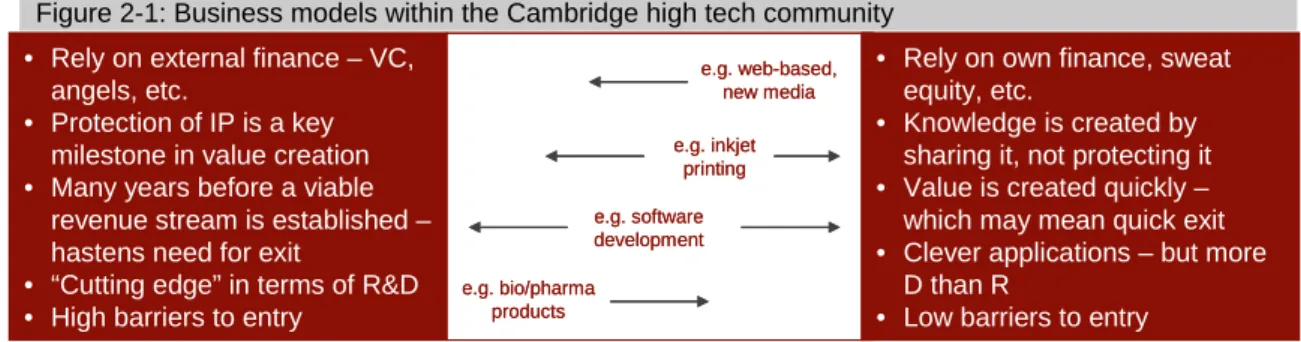
2.11 In 2011 – perhaps as compared to 20 or 30 (and certainly 50) years ago – one of the most notable features of the high tech business community is simply its diversity. There is a tremendous sectoral mix - drug discovery, bioinformatics, software, computer hardware, electronics, ink-jet printing, computer games, clean tech and web-based new media all feature within the high tech cluster – and Cambridge has been at the forefront of the development of the technologies underpinning many of these sectors. Some of the high tech businesses are producing physical products but increasingly, many are not. In addition, there is a great diversity of business models which appear to stem, ultimately, from the relationship between the process of realising value and the nature of the scientific/technical knowledge (and the steps that are taken to protect it) on which that business is based. Some of these relationships are highly formalised while others are extremely fluid. From the vantage point of public policy, the diversity of these models is seriously important and they need to be understood properly for there is no such thing as a “typical Cambridge high tech firm”. A simplified typology – and one that cuts across conventional sectors – is shown in Figure 2-1 below.
Figure 2-1: Business models within the Cambridge high tech community
• Rely on external finance – VC, angels, etc.
• Protection of IP is a key milestone in value creation • Many years before a viable
revenue stream is established – hastens need for exit
• “Cutting edge” in terms of R&D • High barriers to entry
• Rely on own finance, sweat equity, etc.
• Knowledge is created by sharing it, not protecting it • Value is created quickly – which may mean quick exit • Clever applications – but more
D than R
• Low barriers to entry
e.g. web-based, new media e.g. bio/pharma products e.g. software development e.g. inkjet printing
• Rely on external finance – VC, angels, etc.
• Protection of IP is a key milestone in value creation • Many years before a viable
revenue stream is established – hastens need for exit
• “Cutting edge” in terms of R&D • High barriers to entry
• Rely on own finance, sweat equity, etc.
• Knowledge is created by sharing it, not protecting it • Value is created quickly – which may mean quick exit • Clever applications – but more
D than R
• Low barriers to entry
e.g. web-based, new media e.g. bio/pharma products e.g. software development e.g. inkjet printing Source: SQW
2.12 The left hand side of Figure 2-1 depicts what we might regard as the archetypal “Cambridge model”. It is underpinned by genuinely “cutting edge” science and within it, the protection of Intellectual Property (IP) is a key feature. Typically, early stage business development relies
heavily on external sources of finance and in many cases, it is years – and sometimes decades – before a business can achieve a sustainable revenue stream and operate profitably. Within this model, the relationship between the business and the external financiers is absolutely critical – so much so that co-location (or at least real proximity) genuinely is very important. In Cambridge – over the last decade or so – we have seen the emergence of both a community of early stage business investors and the development of effective mechanisms through which they can be accessed. Business angel networks have become established and links to them – through, for example, business plan competitions within the University of Cambridge – have created a very effective “ecosystem”.
2.13 This model is not perfect and it does have its critics. Latterly, progress has slowed because of the difficulty of securing exit in the context of poor IPO conditions; and this problem has been compounded by the retreat of much of the venture capital – as opposed to business angel – sector from Cambridge. Moreover, there is some suggestion that external investors have sometimes been brought in far too early with the result that timescales for realising value are much too short. The consequence may be badly misaligned incentives which often can only be remedied through premature trade sales. It is particularly in the drug discovery segment of the biotechnology sector that early trade sales are pervasive, a phenomenon that – in the eyes of many – is sub-optimal for the businesses, the science, and for Cambridge as a whole: these firms do not grow big and instead their IP is rapidly sold on, generally to one of the major pharmaceuticals companies. Because of this, Cambridge is in danger of being perceived simply as a research and development laboratory for the global pharmaceuticals sector: this may have benefits (e.g. a trade sale may lead to greater investment in R&D in Cambridge, as happened with Cambridge Antibody Technology), but it means that Cambridge risks being seen as peripheral to the corporate headquarters, where the big decisions for the future are made. Given the huge scale and potential growth of the global pharmaceuticals industry, a perception of peripherality could be damaging to investment and diversification in Cambridge.
2.14 Within Cambridge, there is however another model which is quite different in its structure, and which appears to becoming relatively more important, even for firms in sectors which traditionally would be expected to adopt the ‘archetypal’ model. Within this other model, the relationship between the business and “its knowledge” is very much looser; indeed, rather than protecting knowledge, the aim is to “get it out there” and to do so as quickly as possible. In this model, knowledge is created by being shared (essentially, an open innovation process), and underpinning it, there is typically a dense network of what the American sociologist Mark Granovetter describes as “weak ties”. These may initially be entirely social and/or focused on technical problem solving, but they quickly morph into channels for recruitment, business development and routes to market. All sorts of networks have emerged informally within Cambridge, many of them supported by social networking media (Twitter, LinkedIn, etc.) and these seem to sustain themselves for as long as they are useful. Within this far more open business model – which seems to feature especially strongly within the web-based new media sector – speed is of the essence, value can be created very quickly, and there is a real sense of “can do”. A prime example of such businesses is Redgate, a company which is influential in the high tech cluster as well as successful in its own right.
2.15 Soft starts - in which businesses start up informally, or can set up as consultancy operations initially in order to generate cash flow, before ‘hardening’ into product development - are typical of this second model, but are also increasingly common in sectors such as biotechnology. This may be partly due to deteriorating access to funding, but for some at least it is clearly a deliberate rather than forced choice.
2.16 Between the two extremes, there are many other models. For example, business models based on the licensing of key technologies appear to work well in a Cambridge setting. In its field, ARM is one of the most influential global firms but it has achieved this by licensing the production of its chips and securing royalties on their use, not by engaging in large scale production – or therefore large scale employment – directly. And there are examples of similar approaches in other sectors, including a few from within bioscience.
2.17 The conclusion, then, is that in the process of extracting value from knowledge, there is a great variety of models at work within the Cambridge cluster. Although they take different forms, many of them are founded on dense networks of “weak ties” which are intrinsically embedded within the local area even though the businesses themselves are – for the most part – genuinely global in outlook, operation and aspiration. For many of them, links with London are also important, particularly for finance, access to a bigger and specialist labour market, and research relationships. The paradox of the continuing importance of the “local” within a global high tech setting is vitally important for the future of Cambridge. Policy makers – locally and nationally – must take note.
Role 2: Cambridge as a “research community” (focusing on science and technology research funded principally by the public and charity sectors) 2.18 The continuing vibrancy of the Cambridge high tech business sector is fuelled in no small part
by the scale and excellence of the wider research community. This “matters”, arguably, at two different levels: first, there is the science itself, but second, there is the impact on the character of the labour market in and around Cambridge. The high tech business sector and the research community overlap in important respects and the relationship between them is central to the cluster’s character and performance.
2.19 The most important observation with regard to Cambridge’s research community is a very positive one. Cambridge University remains one of the world’s best universities, and recent years have seen very substantial investment in both the University and other research institutions – for example, in West Cambridge, in the new buildings for the Laboratory for Molecular Biology and Cancer Research UK within the Addenbrooke’s Biomedical Campus, the Genome Campus at Hinxton, at Babraham, and so on. The facilities that now exist within the Cambridge area are very impressive and – used appropriately – they ought to secure Cambridge’s global positioning in science and the commercialisation of science. The priority now must be to exploit this investment to full effect, recognising that harnessing the benefits will require a strong policy framework which is implemented with real purpose and conviction, both locally and nationally.
2.20 However, the two domains have not always been “as one”. Some entrepreneurs have expressed concern about the changing stance of the University of Cambridge with regard to Intellectual Property. In essence, the University has moved from a very liberal regime to one
which is more restrictive and in managing the University’s interests in IP, Cambridge Enterprise has played a key role. For the entrepreneurs – and perhaps more especially the investors and business angels – any rules and restrictions in the exploitation of IP are a good bit less desirable than virtually none; and to make the point, evidence was cited of a significant decline in spin-out rates as the IP regime was changing16. Subsequently, however, the new arrangements appear to have settled down.
2.21 In addition – and separately – there has been some frustration surrounding the apparently inflexible stance of the University in relation to the use of its assets by would-be start-ups: why can’t un-used or under-used laboratory space simply be made available free of charge? The answer to this question may rest in part on institutional inertia, but equally important are the rules within which the University itself must operate and frequently, these are not fully understood: commercial use of property, for example, changes its VAT status and this, in turn, has significant cost implications.
Role 3: Cambridge as a city centre economy
2.22 In the past, Cambridge’s city centre offering has tended to be seen as quaint but somewhat out-of-kilter with a population which is growing in number and demanding in terms of its requirements. In part this has been caused by a city centre geography which is constrained both by a high incidence of historic buildings and open spaces, and by a very complex land ownership structure in which various colleges and the University feature strongly. Understandably, their property is used primarily to support their academic purpose, but this may not always coincide with the best interests of the wider local economy (part of the historic “town and gown” conflict). Latterly, however, there has been significant investment, most notably in the Grand Arcade (which took years to develop but has subsequently seen Cambridge rise rapidly up the national retail rankings) and in leisure amenities, particularly in and around the old cattle market site. As a consequence, Cambridge’s city centre offer, although disparate, is greatly improved and it is now, arguably, commensurate with a city of its size, and in some respects much better (e.g. the cultural offer, including theatres, concerts, festivals and the like, is more extensive and diverse than most UK cities of the size of Cambridge, and certainly those within little more than an hour of central London). Nevertheless, continued growth of the catchment area, and increasing expectations, mean there will be a need for continued improvement in the city centre offer.
2.23 The difficulty of achieving this continual improvement is compounded by the fact that the central area is spatially fragmented, which in turn is creating real challenges in terms of access and coherence. Moreover, there is significant demand for office space within the city centre; this stems from the financial and business services sector (as might be expected) but also from the high tech and research communities. Of great symbolic importance in this context has been the announcement from Microsoft of its intention to relocate its research facility from a prime site in West Cambridge to a more central location close to the railway station and within the CB1 development. Its reasons for moving include better access to London; the need for a bigger site; and the preference of its staff for a city centre – rather than
16
See Creating the climate for innovation: The Cambridge Phenomenon – Jack Lang, University of Cambridge www.proinno-europe.eu/.../Creating_the_climate_for_innovation__The_Cambridge_Phenomenon.pdf
(effectively) a business park – location. Microsoft’s decision has challenged the premise of planning policy within the city, this restricts users of office space from occupying space designated for R&D but – as with Microsoft – planning policies are powerless to influence moves in the opposite direction. More generally, the planning framework makes little or no provision for corporate HQ functions within the central area, yet as the cluster matures, it is in this domain that greatest demand may well emerge (for example, see paragraph 2.13 regarding concerns that Cambridge may miss out on investment because it is seen by the global pharmaceutical industry as solely as a location for R&D). With difficult access issues and complex land ownership structures and ‘town and gown’ relationships, development processes are slow, and the existing planning framework needs to evolve to respond to the functional evolution of wider cluster’s growth dynamic: if high tech firms succeed in becoming large corporate players, many will want their head office functions to be located in city centre locations And as the high tech sector and other parts of the Cambridge economy demand more business, financial and professional services, there will not be enough general office space in central, accessible locations to meet this demand There is available Grade A space on the Science Park and in West Cambridge (see Theme 1, Part C) but this has restrictive use clauses, and there is very little space in the central area. CB1 will provide some accommodation but there are likely to be serious capacity issues within a five year timeframe.
2.24 In the rest of the Cambridge sub-region, there are concerns that Cambridge city will continue to capture an increasing proportion of retail spend, and that only those town centres with a highly distinctive offer (e.g. around heritage, as in Ely, Bury St Edmunds and Saffron Walden, or because of accessibility improvements, such as at St Ives once the Cambridgeshire Guided Busway is operational) may be able to retain their current range of facilities and services. However, the market towns are unlikely to benefit from constraining the growth of retailing in Cambridge, which is in competition with other major centres such as Milton Keynes and Norwich.
Role 4: Cambridge as a regional centre for the public sector
2.25 Over the last decade, Cambridge has emerged as the regional capital for the East of England; the Government Office, Regional Development Agency, Strategic Health Authority, Arts Council England–East, the East of England Regional Health Observatory and the Homes and Communities Agency have all established a substantial physical presence, mainly in locations on the edge of the city. With the austerity programme announced by the new government, some of these organisations will be abolished and others will be significantly down-sized. 2.26 However, most public sector jobs in the recent past have not been in public administration,
but in education, and health and social care; together, these two sectors accounted for about 30% of employee jobs in Cambridge and South Cambridgeshire in 2008. These are less vulnerable to public spending cuts, but they are certainly not immune; for example, Addenbrooke’s Hospital has announced that 500 jobs will go over the next three years, and Cambridge University has launched a voluntary redundancy scheme across the whole institution. Although the full implications of the announcements in the Comprehensive Spending Review for public sector spending in the Cambridge sub-region have still to be worked through, our initial estimates suggest that planned public spending cuts will result in
the loss of between 2% and 4% of all employee jobs in Cambridge and South Cambridgeshire, and a slightly lower proportion in the rest of the county. Recent announcements such as those mentioned above and others by Cambridgeshire County and Cambridge City Councils, suggest that an impact towards the upper end of this range is likely (a reduction of 4% is equivalent to around 6,500 jobs in the Cambridge area). This needs to be seen against the previous expectation that public sector jobs would contribute about one third of the net increase in employment for the Cambridge area between 2008 and 201517.
Role 5: Cambridge as an international visitor destination
2.27 The first report of the East Anglia Economic Planning Council published in 1968 recognised the importance to Cambridge of international tourism and specialist conferences; on this front at least, little has changed over the last 43 years. Tourism remains a key part of the local economy, accounting for 6% of employment in Cambridge and South Cambridgeshire combined, and generating approximately £350m of expenditure in 2007 (according to the Cambridge Economic Impact Model” used by East of England Tourism). Nevertheless, tourism is met with ambivalence at best, particularly insofar as it impacts on the city centre. 2.28 However, visitors provide an important source of income and contribute to the vibrancy of the
city centre. Cambridge colleges are increasingly active in the provision of B&B accommodation and in the conference market (college turnover deriving from the conference market amounted to nearly £30m in 2008/09). Despite some significant recent investment in hotel capacity within Cambridge, there is consistent evidence18 to suggest that the market for larger conferences (above 300 delegates) in particular is under-provided for currently: development plans for both Cambridge Science Park and the Addenbrooke’s Biomedical Campus make specific provision for hotel/conference facilities, but not at this scale.
2.29 For Cambridge as a whole, international visitors are important – whether they are academics, business people, students or tourists. Their experience of Cambridge is integral to the city’s positioning on a global stage. The economic contribution of visitors deserves more sympathetic recognition.
Inter-relationships between the roles
2.30 Many of the most complex issues concerning Cambridge in 2011 and into the future are at the interface between these different roles. These interfaces are both positive and negative. The most obvious positive one - which has numerous dimensions - is between the high tech business and research communities. However, others include the opportunity that the relocation of some University departments to West Cambridge, and the reduction in some public sector functions, may offer for expansion of other uses, and benefits that visitor spend generates for the colleges and for the range of city centre retail and cultural facilities and activities. There are, of course, also problematic interface issues, some of which have already been mentioned (e.g. concerns about the effect of the University’s changing policies regarding Intellectual Property on the number of business spin-outs).
17
Cambridge Econometrics forecasts, January 2009
18
2.31 There is a strong spatial dimension to conflicts between different roles, with a particular focus on the city centre. This is the location of choice for retail, leisure, financial, business and professional services and a substantial number of high tech firms. It continues to be the sole or primary focus for most visitors to greater Cambridge, despite active promotion of the wider area. The future of the city centre is therefore crucial, but equally it is important to make other parts of the city more attractive to take some of the pressure off the central area.
2.32 A key challenge for the future will be to ensure the benefits of the interfaces are captured, and the conflicts minimised. But where conflicts cannot be avoided and choices are inevitable, they should be made with a perspective that the health of the high tech cluster is likely to be of greatest importance to the Cambridge economy in the long term.
Historical patterns of economic growth – and projections for the
future
2.33 A key question in relation to the five key roles and their inter-relationships is what the balance has been between them in driving forward Cambridge’s economy over the last 50 years, and how might this change in the future.
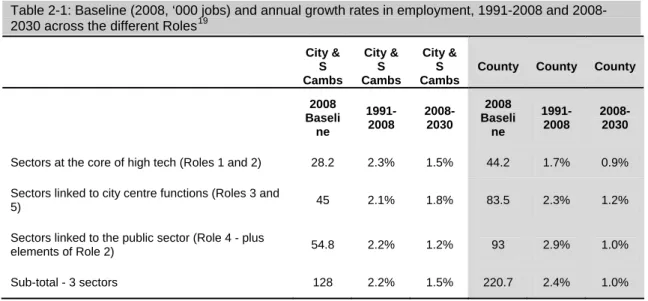
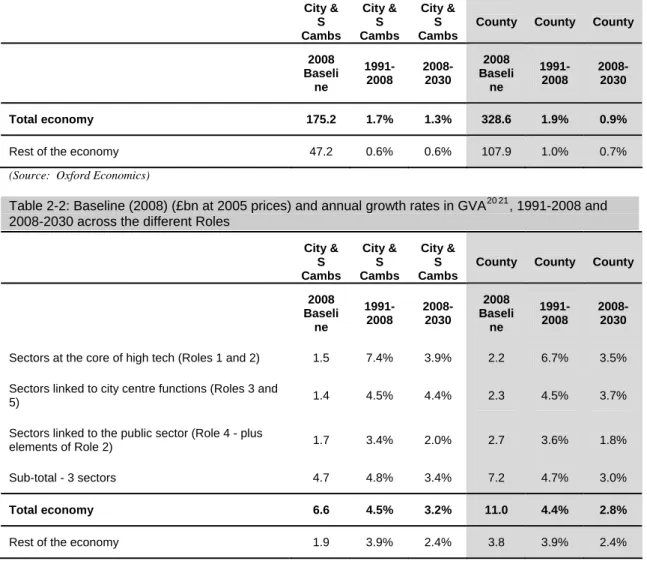
2.34 These questions are very difficult to answer. In part, they are hard because the roles do not translate neatly into standard sector-based definitions and data sources. Historical data are insufficiently robust to build a 50-year time series while modelled projections and forecasts also have their limitations. Nevertheless, using data produced by Oxford Economics on the basis of the East of England Forecasting Model (EEFM), we have tried to look backwards to 1991 and forwards to 2030 in relation to both employment and GVA. Data for 1991-2008 are historic (and therefore “real”); while those from 2008-2030 are modelled. The forecasts were prepared in March 2010. They therefore take account of the effects of the recession and anticipate some reductions in public sector employment, but not the full impact of decisions made by the Government in the Comprehensive Spending Review in October 2010. The results from this process are summarised in the tables that follow.
Table 2-1: Baseline (2008, ‘000 jobs) and annual growth rates in employment, 1991-2008 and 2008-2030 across the different Roles19
City & S Cambs City & S Cambs City & S Cambs
County County County
2008 Baseli ne 1991-2008 2008-2030 2008 Baseli ne 1991-2008 2008-2030
Sectors at the core of high tech (Roles 1 and 2) 28.2 2.3% 1.5% 44.2 1.7% 0.9%
Sectors linked to city centre functions (Roles 3 and
5) 45 2.1% 1.8% 83.5 2.3% 1.2%
Sectors linked to the public sector (Role 4 - plus
elements of Role 2) 54.8 2.2% 1.2% 93 2.9% 1.0%
Sub-total - 3 sectors 128 2.2% 1.5% 220.7 2.4% 1.0%
19
Note that as defined here, the allocation of sectors to roles is mutually exclusive (i.e. no sector is attached to more than one role). A different approach was adopted in the context of Part B of the report
City & S Cambs City & S Cambs City & S Cambs
County County County
2008 Baseli ne 1991-2008 2008-2030 2008 Baseli ne 1991-2008 2008-2030 Total economy 175.2 1.7% 1.3% 328.6 1.9% 0.9%
Rest of the economy 47.2 0.6% 0.6% 107.9 1.0% 0.7%
(Source: Oxford Economics)
Table 2-2: Baseline (2008) (£bn at 2005 prices) and annual growth rates in GVA20 21, 1991-2008 and 2008-2030 across the different Roles
City & S Cambs City & S Cambs City & S Cambs
County County County
2008 Baseli ne 1991-2008 2008-2030 2008 Baseli ne 1991-2008 2008-2030
Sectors at the core of high tech (Roles 1 and 2) 1.5 7.4% 3.9% 2.2 6.7% 3.5%
Sectors linked to city centre functions (Roles 3 and
5) 1.4 4.5% 4.4% 2.3 4.5% 3.7%
Sectors linked to the public sector (Role 4 - plus
elements of Role 2) 1.7 3.4% 2.0% 2.7 3.6% 1.8%
Sub-total - 3 sectors 4.7 4.8% 3.4% 7.2 4.7% 3.0%
Total economy 6.6 4.5% 3.2% 11.0 4.4% 2.8%
Rest of the economy 1.9 3.9% 2.4% 3.8 3.9% 2.4%
(Source: Oxford Economics)
2.35 The tables suggest that in 2008, the five roles together accounted for close to 75% of employment in Cambridge/South Cambridgeshire and 67% of employment across the county. The corresponding figures with regard to GVA were 71% and 65% respectively. On this definition, activities linked intrinsically to Role 1 and elements of Role 2 accounted for 16% of employment in Cambridge/South Cambridgeshire and 23% of GVA (suggesting notably higher levels of productivity than for the economy as a whole); the corresponding county-level figures were 13% and 20% respectively. We estimate that the economy linked to Cambridge’s city centre functions (Roles 3 and 5) accounted for a higher share of employment (26% in Cambridge/South Cambridgeshire) but a lower proportion of GVA (21% in Cambridge/South Cambridgeshire).
2.36 With regard to the dynamics of change, over the best part of two decades the two tables suggest further that:
• in terms of employment, all five roles grew at a similar rate, and faster than the economy of Cambridgeshire as a whole. This tends to confirm views expressed elsewhere22 that the Cambridge economy has proved relatively resistant to recession
20
GVA is Gross Value Added, and in essence is the difference between input costs and output value.
21
Note that the GVA data presented is this table are different from those elsewhere in this report. This is because the data here rely on a particular definition of GVA (which excludes GVA deriving from the ownership of dwellings (and is therefore lower)) and because the data are in 2005 constant prices