This paper can be downloaded without charge at: The Fondazione Eni Enrico Mattei Note di Lavoro Series Index: http://www.feem.it/Feem/Pub/Publications/WPapers/default.htm Social Science Research Network Electronic Paper Collection:
http://ssrn.com/abstract=677901
The opinions expressed in this paper do not necessarily reflect the position of
Key Environmental Innovations
Joseph Huber
NOTA DI LAVORO 33.2005
MARCH 2005
CCMP – Climate Change Modelling and Policy
Summary
This paper is based on empirical research on a taxonomy of technological environmental innovations. It draws on a databank with over 500 examples of new technologies (materials, products, processes and practices) which come with benign environmental effects. The approaches applied to interpreting the datasets are innovation life cycle analysis, and product chain analysis. Main results include the following:
1. Innovations merely aimed at eco-efficienc y do in most cases not represent significant contributions to improving the properties of the industrial metabolism. This can better be achieved by technologies that fulfill the criteria of eco-consistency (metabolic consistency), also called eco-effectiveness.
2. Ecological pressure of a technology is basically determined by its conceptual make-up and design. Most promising thus are technologies in earlier rather than later stages of their life cycle (i.e. during R&D and customisation in growing numbers), because it is during the stages before reaching the inflection point and maturity in a learning curve where technological environmental innovations can best contribute to improving ecological consistency of the industrial metabolism while at the same time delivering their maximum increase in efficiency as well.
3. Moreover, environmental action needs to focus on early steps in the vertical manufacturing chain rather than on those in the end. Most of the ecological pressure of a technology is no rmally not caused end-of-chain in use or consumption, but in the more basic steps of the manufacturing chain (with the exception of products the use of which consumes energy, e.g. vehicles, appliances).
There are conclusions to be drawn for refocusing attention from downstream to upstream in life cycles and product chains, and for a shift of emphasis in environmental policy from regulation to innovation. Ambitious environmental standards, though, continue to be an important regulative precondition of ecologically benign technological innovation.
Keywords: Technological innovation, Environmental innovation, Life cycle analysis, Sustainability strategies, Environmental policy
JEL Classification: O33, Q00
The author is the chair of economic and environmental sociology at Martin-Luther-University, Halle an der Saale, Germany. Main fields of research and teaching are modernisation processes in general, and ecological modernisation in particular.
Address for correspondence: Joseph Huber
Martin-Luther-University Emil-Abderhalden-Str. 7 Halle an der Saale 06099 Berlin Germany Phone: +49 0 345 5524251 Fax +49 0 345 5527150
1. Technological Environmental Innovations (TEIs) and Metabolic Consistency
Environmental innovation includes any kind of innovations – technical, economic, legal, insti-tutional, organisational, behavioural – that lead to an improvement of ecological quality, re-gardless of any additional advantage or motive (Klemmer et al. 1999 25, also Hemmels-kamp/Rennings/Leone 2000).
This paper just deals with technological environmental innovations (TEIs). A technology is a body of knowledge, especially know- how, but also includes some theoretical know-why as well as know-what-for (also Freeman 1987 235, Kemp 1997 pp7). As far as know-how is concerned, a technology is a method of applying a specific knowledge base for achieving a specified operative purpose by special operative means such as tools (instruments, materials, machinery, plant equipment, infrastruc tures) and practices. Products – as much as production processes and services – are specific instrumental manifestations, or apparatus- like implemen-tations of a technology. Products, processes and services tend to be marketable, commercia l-ised applications of a techno logy.
In order to qualify as a TEI for entry into the database of this study, technological innovations had to meet one or several aspects of the environmental innovation strategies as listed in Ta-ble 1.
Table 1 Selected concepts of technological environmental innovation according to the realm of innovation where they most apply
Realm Approach Energy incl. vehicles propulsion, heating Raw materials. Natural resources Agriculture Chemistry, Chemicals Materials processing and reproc-essing End-pro-ducts: Buil-ding, vehi-cles, utility goods Emissions control, waste proc-essing Industrial symbiosis. Zero-emission processes. Circulatory economy x x x x x x x Sustainable resource management x x x x x x Cleaner technologies x x x x x x Benign substitution x x x
Product design for environment x x x Bionics x x x Add-on purification technology x
Another, and perhaps more coherent way of deciding whether a technological innovation qualifies as an environmental innovation, is to determine whether a new technology or prod-uct contributes to significantly increasing eco-efficiency and/or improving ecological or
metabolic consistency. These terms are closely linked to the sustainability discourse and to the concept of industrial metabolism (Ayres 1996), or industrial ecology respectively. Criti-cism of the shortcomings of the previous sustainability discourse has been a key element in the more recent discourse on ecological modernisation (Andersen/Massa 2000, Mol/ Son-nenfeld 2000), and within this context it was the starting point of the concept of ecolo gical or metabolic consistency (Huber 2004, 2000), sometimes also referred to as eco-effective ness (Braungart/McDonough 2002 103–117).
Metabolic consistency focuses on the structural, qualitative side of technology, not just input-output-quantities within basically given structures. Ecological consistency is about how to re-embed the industrial metabolism within nature’s metabolism by introducing new technosys-tems, regimes and practices, thus changing technological structures and the metabolic quali-ties of products and processes, rather than mere qua ntity of turnover within old structures. E.g., energy demand on giga and tera levels may not be an ecological problem as such if the energy were based on clean fuels such as hydrogen, or represented fuelless energy from solar, wind, hydro and geothermal sources. Whereas an efficiency approach primarily appeals to green savings commissioners, a consistency approach calls for green inventors and investors. In terms of various lines of ecological discourse, TEIs can thus be characterised as being the operative tool-set of technological regimes aimed at ecological modernisation, i.e. structural change towards benign or at least strain-relieving effects on resources, sinks, ecosystems and the biosphere. TEIs eliminate, or reduce, or help to control environmental hazard (risk). TEIs create metabolic consistency and optimise eco-efficiency. TEIs can be add-on as well as inte-grated, although integrated solutions are in almost any case preferable from an ecological point of view.
2. Collection of TEIs and database
The criteria of TEIs and its systematics emerged in the course of long-standing empirical re-search, which has from 2001 to 2004 also been carried out in connection with the Key Envi-ronmental Innovations group of the German Federal Research Ministry’s Initiative on Sus-tainability and Innovation. An explorative databank has been created which now numbers 305 datasets, with a total of more than 500 examples of TEIs.
Corresponding to the approaches of innovation life cycle analysis and product chain analysis, the datasets include information on a technology (products, materials, processes, practices), its structural impact, the life cycle stage of development and diffusion, on rival like techno lo-gies, competitiveness and adoptability, as well as ecological properties and environmental improvements which have been achieved or can be expected.
The databank has been fed by a continuous survey of innovations as they were reported in ar-ticles in a number of specialised journals and newsletters (among these MIT Technology Re-view, The Economist and The Economist Quarterly, VDI Nachrichten) from the beginning of 2000 through to March 2003.
3. Some examples and trends of TEIs
Typical examples and trends of TEIs include the following. They all represent innovative re-gime shifts from mature conventional technologies to new ones that are metabolically more consistent, and normally also much more efficient than previous like technologies:
- Replacement of fossil fuels with clean-burn hydrogen, the use of which does not require additional end-of-pipe purification of emissions
- Substitution of clean electrochemical fuel cells for pollutant furnaces and combustion en-gines in manifold applications, from power stations to vehicle propulsion
- Clean coal, notably in zero-emission central power plants on the basis of IGCC technology (integrated gasifier combined cycle) and CO2 sequestration. The purpose of these power plants is to produce hydrogen by steam reformation as much as to generate electricity. - Fuelless energy such as photovoltaics and further regenerative energies which make use of
sun radiation, geothermal flows, or wind and water currents
- Decentral micropower, i.e. new sources of electricity generation that are leading towards distributed power generation (which includes a certain number of large central stations). Over-centralised power generation and one-way distribution will thus be replaced by an in-tegrated two-way-flow grid management.
- Trans genic biochemistry which makes use of enzymes and microorganisms especially de-signed and bred for various production tasks, thus replacing the conventional high-temperature high-pressure chemistry that poses a heavy burden on the environment and human health
- Substitution of high- hazard chemicals for more benign low- impact substances and new specialty chemicals which are, among other things, biodegradable, persistent, non-accumulative and non-toxic
- Biofeedstocks replacing petrol as a raw material to a certain extent
- New materials which are simultaneously ultra- light and ultra-strong, saving larger volumes of conventional materials and energy
- Micromachines and nanotechnology which relieve pressure on resources and sinks com-pared to larger conventio nal machines and chemical production
- Substituting sonar, photonic and microfluidic analyses for cumbersome conventional meth-ods involving many hazardous ingredients, and thus considerably improving quality and performance of production
- Circular production processes in which water, auxiliary substances, metals, bulk minerals and fibres are recycled at an optimum rate
- Last but not least, overcoming the ecologically devastating practices of today’s over-intensified and inappropriately chemicalised agriculture by introducing sound ecological
practices in combination with high-tech precision farming and, again, modern biotechno l-ogy which makes use of transgenic orga nisms.
Since biotechnology is a sensitive issue, it may deserve a brief comment: genetic engineering in agriculture, as well as transgenic biotechnology in chemistry, nano technology, materials processing, waste management, pharmacology and medicine, has to be considered as an im-portant field of TEIs, full in the knowledge that such an assessment will certainly remain con-troversial for another one or two decades to come. As tends to be the case with true key inno-vations of major structural importance, people’s sense of security is undermined. Conserva-tive opposition and risk aversion are strong. It takes time to replace uncertain expectations with realistic experience. Not all feelings of uneasiness are unfounded, but in most cases it has turned out that in fact they were. Almost all transgenic innovations seem to spur effi-ciency, and most of the examples represented in the database are environmentally benign in that they allow to substitute, e.g., for conventional high- temperature high-pressure processes, hazardous chemicals, resources input and emissions output. Biotechnologies improve on pro-ductivity and product quality. In comparison to these advantages, fears of particular disadva n-tages are dwarfed, or are untenable in face of the facts. But not all applications – such as pes-ticide-resistant crops – can be said to be metabolically consistent. Some are not, or not yet. 4. TEIs tend to be upstream the product chain and upstream a technology’s life cycle In terms of integrated solutions versus add-on measures, 85% of TEIs in the database repre-sent integrated solutions, 15% environmental add-on technology. This is hardly surprising, serving to confirm what was to be expected. Of the 85% integrated solutions, 49% can be said to be driven mainly by ecological motives so that these are TEIs by prime intention, whereas in 36% of the examples ecological motives, though these may also be considered, cannot be said to be the main reason behind that innovation.
The central finding which emerges from the present investigation is that most TEIs, and also the most important TEIs in terms of structural impact, tend to be upstream in the manufactur-ing chain, and upstream the learnmanufactur-ing curve in the life cycle of a technology or product. The upstream tendency of TEIs is all the more true if we consider energy technology to be up-stream in any production function in that it is a primary basic input component at each step in the manufacturing chain.
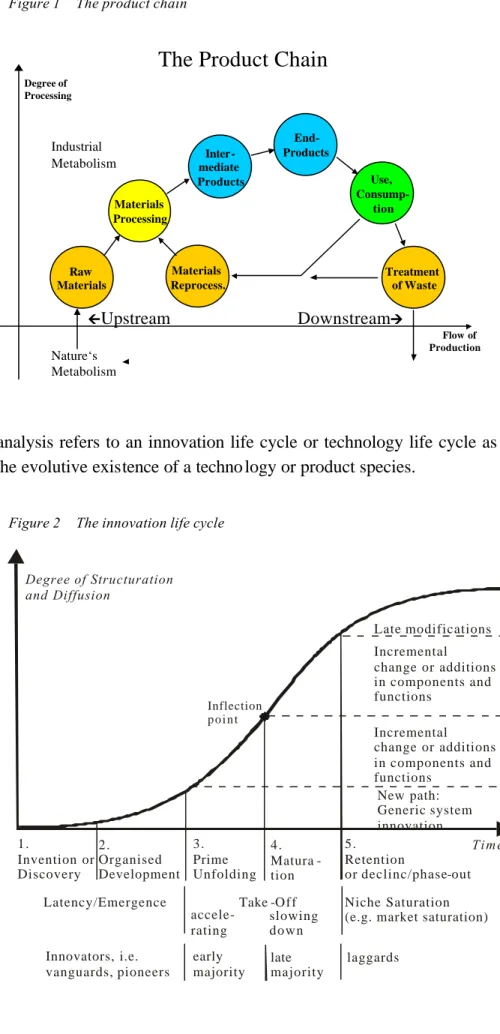
In the environmental literature, the term ‘life cycle analysis’ is often used interchangeably with ‘product chain analysis’ or ‘eco-balances’ that try to gauge the environmental impact of a product from first input by extraction of raw materials to last output by being definitely phased out as waste. What they represent more precisely, however, is analysis of the vertical manufacturing chain or product chain as shown in Figure 1. By contrast, another meaning of
Figure 1 The product chain
The Product Chain
Raw Materials Materials Reprocess. Treatment of Waste Materials Processing Inter-mediate Products End-Products Use, Consump-tion Degree of Processing Flow of Production Nature‘s Metabolism Industrial Metabolism ÙUpstream DownstreamÚ
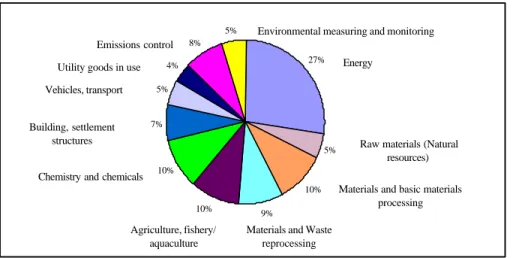
life cycle analysis refers to an innovation life cycle or technology life cycle as shown in Fig-ure 2, i.e. the evolutive existence of a techno logy or product species.
Figure 2 The innovation life cycle
Latency/Emergence Take -Off Niche Saturation
(e.g. market saturation) 5. Retention or declinc/phase-out 3. Prime Unfolding 2. Organised Development 1. Invention or Discovery New path: Generic system innovation Late modifications Incremental change or additions in components and functions Inflection p o i n t Degree of Structuration and Diffusion Time Incremental change or additions in components and functions accele-rating slowing down Innovators, i.e. vanguards, pioneers early majority late majority laggards 4. Matura -tion
As can be seen in Figure 3, more than a quarter of the datasets (27%) relate to energy, includ-ing vehicle propulsion and energy design of buildinclud-ings (not however innovations related to en-ergy demand of appliances). The number of TEIs in the realm of enen-ergy is matched only by 24% of technologies relating to the extraction, processing and reprocessing of materials, which accounts for 34% if agriculture is included, and 44% if TEIs in the realm the chemical industry, 52% if emissions control is added to this.
Figure 3 TEIs according to realm of innovation (n = 298)
We can try to specifically ascribe energy technologies and emissions control to the sectors where they actually occur within the vertical manufacturing chain. We can thus make a dis-tinction between end-products on the one hand, and intermediate products, and primary or base products, both representing pre-products, on the other hand. We can furthermore distin-guish user or consumer behaviour (practices) from producer practices (beha viour and regime rules). We again exclude TEIs regarding off- site measuring and monitoring. This results in the categories of (a) primary or base production and materials, (b) materials processing and intermediate productions, (c) final productions and products, and (d) user behaviour or con-sumer practices as shown in Table 2.
In this way the upstream concentration of TEIs emerges even more markedly. Primary pro-ductions and base products represent the biggest slice with 44%, materials processing and in-termediate products 27%, making up 71% of the TEIs in primary and inin-termediate produc-tions. Final productions and end-products represent 25%. Most of this relates to building and vehicles rather than office and household appliances and consumer goods. By contrast, inno-vative practices regarding consumption and private user behaviour (such as soft driving, car-sharing, leasing instead of buying, avoiding overheating of rooms, etc.) at 4% do not count for much. Even if this figure were doubled or tripled, the finding and its message would basically remain the same: TEIs are upstream rather than downstream in the manufacturing chain.
27% 5% 10% 9% 10% 10% 7% 5% 4% 8% 5% Energy
Raw materials (Natural resources)
Materials and basic materials processing Chemistry and chemicals
Building, settlement structures Vehicles, transport
Utility goods in use Emissions control
Environmental measuring and monitoring
Materials and Waste reprocessing Agriculture, fishery/
As a rule of thumb one can say the more products and production processes are placed chain-upwards, the more important the potential of their environmental impact is. This is particu-larly the case with regard to the difference between all of the steps of extracting and succes-sively (re)processing materials, which regularly cause large environmental impact, and the fi-nal assembly or finishing of fifi-nal products, which causes comparatively less impact. In the same sense it can be said that it is the processes of production rather than the use of products which cause environmental impact.
Table 2 TEIs (products, processes, practices) according to chain position
Primary productions or base products
e.g. raw materials, primary fuels, power stations, agriculture, for-estry, base materials (steel, cement, pulping, tanning, …), secon-dary raw materials from recycling, also incl. related add-on-purification technology
44 %
Materials processing and intermediate products
e.g. metal and surface working, paper making, wood processing, furniture, textiles manuf., production of cycleware, dye-ing/coating, food processing, etc., including related
energy technology (e.g. industrial furnaces, stoves, burners), also incl. related add-on-purification technology
Pre-products and pre-producer prac-tices 71 % 27 %
Final productions, end-products
Buildings, vehicles, utility and consumer goods, including related energy technology (e.g. car propulsion, house heating, electr. de-mand of appliances), also incl. related add-on-purification tech-nology, and producer practices
25 %
User behaviour, consumer practices 4 %
n = 288 100 %
There is, however, an important exception: long- lived complex energy apparatus such as mo-tors in cars, jet engines, power plants, heating systems and electric appliances which consume large quant ities of fuel. Food, feed and fuels have a metabolic rate of almost 100%. This makes a big difference to use-materials which by and large keep their physical structure when used. If there are important, unresolved environmental problems to be found in the use of fi-nal products, they indeed have in most cases to do with the fuels and the energy apparatus in-volved in using those products.
As regards the innovation life cycle stage of TEIs, as summarised in Table 3, 3% are just an idea on paper, 10% are in an early stage of research and laboratory demonstration, 26% in a more advanced stage of development, i.e. 36% in the development stage. 35% then are at market launch or shortly thereafter, or otherwise being introduced to regular practice. 16% are in experiencing growing adoption, though this does not always represent an impressive take-off. The remaining 10% represent mature technologies in a rather late stage of structuration and diffusion.
Table 3 TEIs according to stage of life cycle
Idea, concept on paper 3 %
Early stage of research and laboratory demonstration 10 %
Advanced stage of development 26 %
About market launch or introduction, or shortly thereafter 35 %
Experiencing growing adoption 16 %
Mature stage 10 %
n = 289 100 %
The distribution in Table 3 was to be expected. Ideas and early experiments are normally not communicated to a broader public, just as technologies in a late stage of their life cycle are normally not subject to public attention since nothing particular is occurring any more. It is nonetheless important to have this documented empirically, because it confirms one of the ba-sic recommendations that can be drawn from life cycle analysis: true progress which includes structural change, particularly regarding a change in the ecological consistency of the indus-trial metabolism, requires a change in path; i.e. it requires the development and implementa-tion of new technologies rather than the modificaimplementa-tion of mature systems already in place. It is important here to understand that with technologies, as with living organisms, the key features of a novel thing and its life course are determined upstream rather than downstream, i.e. with regard to an organism, in its genetic code and in its early days of growth, experienc-ing and learnexperienc-ing; and similarly with regard to technologies, in their conceptualisation and de-sign, in the early stages of research and development, i.e. the early stages of structuration and diffusion. What remains to be determined during later stages, consists of incremental changes and modifications of minor importance, after the point of inflection of a learning curve has been passed. Most of the environmental pressure which is caused by producing and using a certain kind of product or technology is determined right at the beginning with the conceptu-alisation and design of that product or technology. Once in place, there is not much left which one can do about it, aside from some improvements in later new- generation variants of that product, some percentage points of materials and energy savings in the factory, and a few per-centage points by being a good consumer.
As is shown in Table 4, most TEIs do indeed bring about change in ecological consistency. In about a quarter of the TEIs, there are significant efficiency increases without a change in metabolic properties. Typical examples of this include reuse of parts and recycling of materi-als, e.g. of solvents or sulphuric acid, or increased fuel-efficiency in internal-combustion en-gines. Three quarters, however, involve some consistency change.
The biggest share, at 41%, is that of examples where there are both consistency improvements and efficiency increases, e.g. latest-generation solar cells, fuel cells of any kind, and many biotech applications of where there is simultaneously less or no environmental pressure and higher yield. The percentage of such double-surplus-TEIs is nevertheless lower than was
hy-pothetically supposed, whereas the number of cases in which there is less inconsistency rather than really benign improvements are more than was expected.
Table 4 TEIs according to ecological consistency and efficiency
Consistency improvement
without efficiency change, or efficiency unclear, or even slightly decreased 16 % Consistency change in the sense of lesser degree of inconsistency
without efficiency change, or efficiency unclear, or even slightly decreased 8 % Consistency change in the sense of lesser degree of inconsistency
combined with increase in efficiency
12 % Both consistency improvement and efficiency increase 41 % Mere efficiency increase
without actual change in ecological consistency
23 % n = 281 100 %
Typical examples of lesser degree of inconsistency without efficiency change include exhaust catalysts, transmutation of nuclear waste, GM crops tolerant of agrochemicals, or HCFC-22 (chlorodifluoromethane) as a halocarbon replacements for conventional CFCs.
Replacement with SF6 then is an example of lesser degree of inconsistency combined with some efficiency increase, because on eco-balance SF6 helps to save CO2 emissions. Further examples in this category tend to be incremental process innovations which help to reduce hazardous auxiliaries or materials-content while simultaneously increasing output.
An example of benign consistency improvements without efficiency changes are hydrogen-fuelled internal-combustion engines. Previous generations of solar cells and wind power, though clearly clean and metabolically consistent, even came with less efficiency than con-ventional like technologies.
5. Conclusions: Paradigm shift from downstream to upstream the product chain and technology life cycles
The central message from the above findings concerns a paradigm shift from downstream to upstream in the vertical product chain and in technology life cycles. I would like to mention four aspects of such an upstreaming of environmental action and policies.
First, if environmentally significant technological innovations are to be found chain- upwards rather than chain-downwards, then priorities would need to be refocused onto those industrial operations where large environmental impact actually occurs – in energy, raw materials, agr i-culture, chemistry and base industries, partly also in building and vehicles.
Second, the key actor groups that have to be mobilised are technology developers, product de-signers and producers rather than users and consumers. With a focus on products and produc-tion, one would not be spending too much time with user behaviour and consumer demand.
New technologies do not occur by way of demand pull. Important environmental innovations originate on the supply side. They are science-driven and technology-pushed, induced by ideas and interests, one of which may be solving environmental problems – though further se-lective impulses from the side of regulation, government and user demand certainly come in later on.
The fact that most environmental impacts are determined and caused upstream in the life cy-cle and upstream in the product chain puts final consumption in a somewhat paradoxical role. This ecological paradox of consumption is as follows: On the one hand, expectations of high and still rising levels of affluence are indeed among the main driving forces behind the ongo-ing growth of industrial production and the large volumes of turnover of the industrial me-tabolism; on the other hand, however, the immediate contribution of consumer behaviour to the industrial metabolism is rather low, about 5–15% to gauge it generously. This is because most of the environmental pressure, the big ecological footprints or materials rucksacks of consumer society, occur during the different steps upstream in the product chain, and are de-termined by the basic principles of a techno logy and the physical design of a product, in the early stages of their life cycle. In contrast, consumption in service businesses and private households entails final steps downstream in the product chain. Approaches such as ‘sustain-able consumption’ or ‘sustain‘sustain-able household’ can, in the end indeed, not be particularly effec-tive in changing the industrial metabolism.
Third, in upstreaming environmental activities, chain management by key manufacturers and trade businesses has a particular role to play. It is the manufacturers of complex end-products such as buildings, vehicles, appliances, and also large retailers such as mail order firms, who are in the position to effectively implement supply chain management. This is none of a user’s nor of a government’s bus iness.
Final demand may be decisive with regard to the diffusion of innovations. Demand itself, however, cannot innovate, it cannot ‘buy into existence’ things which do not exist, i.e. things which are not on the market yet – with one exception, which is the demand by key manufac-turers and large trade businesses, because they have, or can have if they wish so, a decisive in-fluence on suppliers along the product chain, and a defining inin-fluence on the design and re-design of products.
Fourth, as far as government is concerned, upstreaming environmental policy would induce a shift of emphasis from regulation to innovation. Environmental policy, much more than has hitherto been the case, would have to become a policy of technology development, or will have to cooperate systematically with technological R&D policy. In consequence there would have to be a shift in the pattern of environmental policy from bureaucratic procedural control to co-ordination of national innovation ne tworks, European at the EU level, including suitable and well balanced financial support by granting regular research funds and seed money, as
well as providing venture capital and introductory aids in appropriate ways. What has to stay, though, is to set strict environmental performance standards (Ashford 1985, Kemp 1997 pp.317, Hemmelskamp/Rennings/Leone 2000). This remains by far the most effective con-trols instrument for environment and innovation alike (which is not astonishing given the fact that environmental standards are, or immediately translate into, technical standards).
In face of the discussed findings on TEIs one could go as far as to say: environmental aware-ness and will-building, regulation by law and environmental authorities, green marketing, and even green business management remain ultimately pointless in the absence of a prior strat-egy of technological environmental upstream innovation to give a common focus to environ-mental policies.
References
Andersen, Mikael Skou / Massa, Ilmo (Eds) (2000) Ecological Modernization, Journal of Environmental Policy
and Planning, Special issue, Vol. 2, Issue 4, Wiley & Sons.
Ashford, Nicholas A. / Ayers, C. / Stone, R.F. (1985) Using Regulation to Change the Markets for Innovation,
Harvard Environmental Law Review 9, 419–466.
Ayres, Robert U. / Ayres, Leslie W. (1996) Industrial Ecology. Towards Closing the Materials Cycle, Chel-tenham: Edward Elgar.
Braungart, Michael / McDonough, William (2002) Cradle to Cradle. Remaking the way we make things, New York: North Point Press.
Freeman, Christopher (1987) Technology Policy and Economic Performance, London: Pinter.
Hemmelskamp, Jens / Rennings, Klaus / Leone, Fabio (Eds) (2000) Innovation-Oriented Environmental Regula-tion, Heidelberg: Physica Verlag.
Huber, Joseph (2004) New Technologies and Environmental Innovation, Cheltenham: Edward Elgar.
Huber, Joseph (2000) Towards Industrial Ecology. Sustainable Development as a Concept of Ecological Mod-ernization, in: Andersen/Massa (Eds) 269–285.
Kemp, René (1997) Environmental Policy and Technical Change. A Comparison of the Technological Impact of Policy Instruments, Cheltenham: Edward Elgar.
Klemmer, Paul / Lehr, Ulrike / Löbbe, Klaus (1999) Environmental Innovation. Incentives and Barriers, Berlin: Analytica.
Mol, Arthur P.J. / Sonnenfeld, D.A. (2000) Ecological modernisation around the world. An introduction,
Fondazione Eni Enrico Mattei Working Paper Series
Our Note di Lavoro are available on the Internet at the following addresses: http://www.feem.it/Feem/Pub/Publications/WPapers/default.html
http://www.ssrn.com/link/feem.html http//www.repec.org
NOTE DI LAVORO PUBLISHED IN 2004
IEM 1.2004 Anil MARKANDYA, Suzette PEDROSO and Alexander GOLUB: Empirical Analysis of National Income and So2 Emissions in Selected European Countries
ETA 2.2004 Masahisa FUJITA and Shlomo WEBER: Strategic Immigration Policies and Welfare in Heterogeneous Countries PRA 3.2004 Adolfo DI CARLUCCIO, Giovanni FERRI, Cecilia FRALE and Ottavio RICCHI: Do Privatizations Boost
Household Shareholding? Evidence from Italy
ETA 4.2004 Victor GINSBURGH and Shlomo WEBER: Languages Disenfranchisement in the European Union ETA 5.2004 Romano PIRAS: Growth, Congestion of Public Goods, and Second-Best Optimal Policy
CCMP 6.2004 Herman R.J. VOLLEBERGH: Lessons from the Polder: Is Dutch CO2-Taxation Optimal PRA 7.2004 Sandro BRUSCO, Giuseppe LOPOMO and S. VISWANATHAN (lxv): Merger Mechanisms
PRA 8.2004 Wolfgang AUSSENEGG, Pegaret PICHLER and Alex STOMPER (lxv):IPO Pricing with Bookbuilding, and a When-Issued Market
PRA 9.2004 Pegaret PICHLER and Alex STOMPER (lxv):Primary Market Design: Direct Mechanisms and Markets PRA 10.2004 Florian ENGLMAIER, Pablo GUILLEN, Loreto LLORENTE, Sander ONDERSTAL and Rupert SAUSGRUBER
(lxv):The Chopstick Auction: A Study of the Exposure Problem in Multi-Unit Auctions
PRA 11.2004 Bjarne BRENDSTRUP and Harry J. PAARSCH (lxv):Nonparametric Identification and Estimation of Multi-Unit, Sequential, Oral, Ascending-Price Auctions With Asymmetric Bidders
PRA 12.2004 Ohad KADAN (lxv):Equilibrium in the Two Player, k-Double Auction with Affiliated Private Values PRA 13.2004 Maarten C.W. JANSSEN (lxv): Auctions as Coordination Devices
PRA 14.2004 Gadi FIBICH, Arieh GAVIOUS and Aner SELA (lxv): All-Pay Auctions with Weakly Risk-Averse Buyers PRA 15.2004 Orly SADE, Charles SCHNITZLEIN and Jaime F. ZENDER (lxv): Competition and Cooperation in Divisible
Good Auctions: An Experimental Examination
PRA 16.2004 Marta STRYSZOWSKA (lxv): Late and Multiple Bidding in Competing Second Price Internet Auctions CCMP 17.2004 Slim Ben YOUSSEF: R&D in Cleaner Technology and International Trade
NRM 18.2004 Angelo ANTOCI, Simone BORGHESI and Paolo RUSSU (lxvi): Biodiversity and Economic Growth: Stabilization Versus Preservation of the Ecological Dynamics
SIEV 19.2004 Anna ALBERINI, Paolo ROSATO, Alberto LONGO and Valentina ZANATTA: Information and Willingness to Pay in a Contingent Valuation Study: The Value of S. Erasmo in the Lagoon of Venice
NRM 20.2004 Guido CANDELA and Roberto CELLINI (lxvii): Investment in Tourism Market: A Dynamic Model of Differentiated Oligopoly
NRM 21.2004 Jacqueline M. HAMILTON (lxvii): Climate and the Destination Choice of German Tourists
NRM 22.2004 Javier Rey-MAQUIEIRA PALMER, Javier LOZANO IBÁÑEZ and Carlos Mario GÓMEZ GÓMEZ (lxvii): Land, Environmental Externalities and Tourism Development
NRM 23.2004 Pius ODUNGA and Henk FOLMER (lxvii): Profiling Tourists for Balanced Utilization of Tourism-Based Resources in Kenya
NRM 24.2004 Jean-Jacques NOWAK, Mondher SAHLI and Pasquale M. SGRO (lxvii):Tourism, Trade and Domestic Welfare NRM 25.2004 Riaz SHAREEF (lxvii): Country Risk Ratings of Small Island Tourism Economies
NRM 26.2004 Juan Luis EUGENIO-MARTÍN, Noelia MARTÍN MORALES and Riccardo SCARPA (lxvii): Tourism and Economic Growth in Latin American Countries: A Panel Data Approach
NRM 27.2004 Raúl Hernández MARTÍN (lxvii): Impact of Tourism Consumption on GDP. The Role of Imports CSRM 28.2004 Nicoletta FERRO: Cross-Country Ethical Dilemmas in Business: A Descriptive Framework
NRM 29.2004 Marian WEBER (lxvi): Assessing the Effectiveness of Tradable Landuse Rights for Biodiversity Conservation: an Application to Canada's Boreal Mixedwood Forest
NRM 30.2004 Trond BJORNDAL, Phoebe KOUNDOURI and Sean PASCOE (lxvi): Output Substitution in Multi-Species Trawl Fisheries: Implications for Quota Setting
CCMP 31.2004 Marzio GALEOTTI, Alessandra GORIA, Paolo MOMBRINI and Evi SPANTIDAKI: Weather Impacts on Natural, Social and Economic Systems (WISE) Part I: Sectoral Analysis of Climate Impacts in Italy
CCMP 32.2004 Marzio GALEOTTI, Alessandra GORIA ,Paolo MOMBRINI and Evi SPANTIDAKI: Weather Impacts on Natural, Social and Economic Systems (WISE) Part II: Individual Perception of Climate Extremes in Italy CTN 33.2004 Wilson PEREZ: Divide and Conquer: Noisy Communication in Networks, Power, and Wealth Distribution KTHC 34.2004 Gianmarco I.P. OTTAVIANO and Giovanni PERI (lxviii): The Economic Value of Cultural Diversity: Evidence
KTHC 36.2004 Franca ECKERT COEN and Claudio ROSSI (lxviii): Foreigners, Immigrants, Host Cities: The Policies of Multi-Ethnicity in Rome. Reading Governance in a Local Context
KTHC 37.2004 Kristine CRANE (lxviii): Governing Migration: Immigrant Groups’ Strategies in Three Italian Cities – Rome, Naples and Bari
KTHC 38.2004 Kiflemariam HAMDE (lxviii):Mind in Africa, Body in Europe: The Struggle for Maintaining and Transforming Cultural Identity - A Note from the Experience of Eritrean Immigrants in Stockholm
ETA 39.2004 Alberto CAVALIERE: Price Competition with Information Disparities in a Vertically Differentiated Duopoly PRA 40.2004 Andrea BIGANO and Stef PROOST: The Opening of the European Electricity Market and Environmental
Policy: Does the Degree of Competition Matter?
CCMP 41.2004 Micheal FINUS (lxix): International Cooperation to Resolve International Pollution Problems KTHC 42.2004 Francesco CRESPI: Notes on the Determinants of Innovation: A Multi-Perspective Analysis CTN 43.2004 Sergio CURRARINI and Marco MARINI: Coalition Formation in Games without Synergies CTN 44.2004 Marc ESCRIHUELA-VILLAR: Cartel Sustainability and Cartel Stability
NRM 45.2004 Sebastian BERVOETS and Nicolas GRAVEL (lxvi):Appraising Diversity with an Ordinal Notion of Similarity: An Axiomatic Approach
NRM 46.2004 Signe ANTHON and Bo JELLESMARK THORSEN (lxvi): Optimal Afforestation Contracts with Asymmetric Information on Private Environmental Benefits
NRM 47.2004 John MBURU (lxvi): Wildlife Conservation and Management in Kenya: Towards a Co-management Approach NRM 48.2004 Ekin BIROL, Ágnes GYOVAI and Melinda SMALE (lxvi): Using a Choice Experiment to Value Agricultural
Biodiversity on Hungarian Small Farms: Agri-Environmental Policies in a Transition al Economy
CCMP 49.2004 Gernot KLEPPER and Sonja PETERSON: The EU Emissions Trading Scheme. Allowance Prices, Trade Flows, Competitiveness Effects
GG 50.2004 Scott BARRETT and Michael HOEL: Optimal Disease Eradication
CTN 51.2004 Dinko DIMITROV, Peter BORM, Ruud HENDRICKX and Shao CHIN SUNG: Simple Priorities and Core Stability in Hedonic Games
SIEV 52.2004 Francesco RICCI: Channels of Transmission of Environmental Policy to Economic Growth: A Survey of the Theory
SIEV 53.2004 Anna ALBERINI, Maureen CROPPER, Alan KRUPNICK and Nathalie B. SIMON: Willingness to Pay for Mortality Risk Reductions: Does Latency Matter?
NRM 54.2004
Ingo BRÄUER and Rainer MARGGRAF (lxvi): Valuation of Ecosystem Services Provided by Biodiversity Conservation: An Integrated Hydrological and Economic Model to Value the Enhanced Nitrogen Retention in Renaturated Streams
NRM 55.2004 Timo GOESCHL and Tun LIN (lxvi): Biodiversity Conservation on Private Lands: Information Problems and Regulatory Choices
NRM 56.2004 Tom DEDEURWAERDERE (lxvi):Bioprospection: From the Economics of Contracts to Reflexive Governance CCMP 57.2004 Katrin REHDANZ and David MADDISON: The Amenity Value of Climate to German Households
CCMP 58.2004 Koen SMEKENS and Bob VAN DER ZWAAN: Environmental Externalities of Geological Carbon Sequestration Effects on Energy Scenarios
NRM 59.2004 Valentina BOSETTI, Mariaester CASSINELLI and Alessandro LANZA (lxvii): Using Data Envelopment Analysis to Evaluate Environmentally Conscious Tourism Management
NRM 60.2004 Timo GOESCHL and Danilo CAMARGO IGLIORI (lxvi):Property Rights Conservation and Development: An Analysis of Extractive Reserves in the Brazilian Amazon
CCMP 61.2004 Barbara BUCHNER and Carlo CARRARO: Economic and Environmental Effectiveness of a Technology-based Climate Protocol
NRM 62.2004 Elissaios PAPYRAKIS and Reyer GERLAGH: Resource-Abundance and Economic Growth in the U.S.
NRM 63.2004 Györgyi BELA, György PATAKI, Melinda SMALE and Mariann HAJDÚ (lxvi): Conserving Crop Genetic Resources on Smallholder Farms in Hungary: Institutional Analysis
NRM 64.2004 E.C.M. RUIJGROK and E.E.M. NILLESEN (lxvi): The Socio-Economic Value of Natural Riverbanks in the Netherlands
NRM 65.2004 E.C.M. RUIJGROK (lxvi): Reducing Acidification: The Benefits of Increased Nature Quality. Investigating the Possibilities of the Contingent Valuation Method
ETA 66.2004 Giannis VARDAS and Anastasios XEPAPADEAS: Uncertainty Aversion, Robust Control and Asset Holdings GG 67.2004 Anastasios XEPAPADEAS and Constadina PASSA: Participation in and Compliance with Public Voluntary
Environmental Programs: An Evolutionary Approach GG 68.2004 Michael FINUS: Modesty Pays: Sometimes!
NRM 69.2004 Trond BJØRNDAL and Ana BRASÃO: The Northern Atlantic Bluefin Tuna Fisheries: Management and Policy Implications
CTN 70.2004 Alejandro CAPARRÓS, Abdelhakim HAMMOUDI and Tarik TAZDAÏT: On Coalition Formation with Heterogeneous Agents
IEM 71.2004 Massimo GIOVANNINI, Margherita GRASSO, Alessandro LANZA and Matteo MANERA: Conditional Correlations in the Returns on Oil Companies Stock Prices and Their Determinants
IEM 72.2004 Alessandro LANZA, Matteo MANERA and Michael MCALEER: Modelling Dynamic Conditional Correlations in WTI Oil Forward and Futures Returns
SIEV 73.2004 Margarita GENIUS and Elisabetta STRAZZERA: The Copula Approach to Sample Selection Modelling: An Application to the Recreational Value of Forests
ETA 75.2004 Rosella LEVAGGI and Michele MORETTO: Investment in Hospital Care Technology under Different Purchasing Rules: A Real Option Approach
CTN 76.2004 Salvador BARBERÀ and Matthew O. JACKSON (lxx): On the Weights of Nations: Assigning Voting Weights in a Heterogeneous Union
CTN 77.2004 Àlex ARENAS, Antonio CABRALES, Albert DÍAZ-GUILERA, Roger GUIMERÀ and Fernando
VEGA-REDONDO (lxx): Optimal Information Transmission in Organizations: Search and Congestion CTN 78.2004 Francis BLOCH and Armando GOMES (lxx):Contracting with Externalities and Outside Options
CTN 79.2004 Rabah AMIR, Effrosyni DIAMANTOUDI and LicunXUE (lxx): Merger Performance under Uncertain Efficiency Gains
CTN 80.2004 Francis BLOCH and Matthew O. JACKSON (lxx): The Formation of Networks with Transfers among Players CTN 81.2004 Daniel DIERMEIER, Hülya ERASLAN and Antonio MERLO (lxx): Bicameralism and Government Formation CTN 82.2004 Rod GARRATT, James E. PARCO, Cheng-ZHONG QIN and Amnon RAPOPORT (lxx): Potential Maximization
and Coalition Government Formation
CTN 83.2004 Kfir ELIAZ, Debraj RAY and Ronny RAZIN (lxx): Group Decision-Making in the Shadow of Disagreement CTN 84.2004 Sanjeev GOYAL, Marco van der LEIJ and José Luis MORAGA-GONZÁLEZ (lxx): Economics: An Emerging
Small World?
CTN 85.2004 Edward CARTWRIGHT (lxx): Learning to Play Approximate Nash Equilibria in Games with Many Players IEM 86.2004 Finn R. FØRSUND and Michael HOEL: Properties of a Non-Competitive Electricity Market Dominated by
Hydroelectric Power
KTHC 87.2004 Elissaios PAPYRAKIS and Reyer GERLAGH: Natural Resources, Investment and Long-Term Income CCMP 88.2004 Marzio GALEOTTI and Claudia KEMFERT: Interactions between Climate and Trade Policies: A Survey IEM 89.2004 A. MARKANDYA, S. PEDROSO and D. STREIMIKIENE:Energy Efficiency in Transition Economies: Is There
Convergence Towards the EU Average?
GG 90.2004 Rolf GOLOMBEK and Michael HOEL :Climate Agreements and Technology Policy PRA 91.2004 Sergei IZMALKOV (lxv): Multi-Unit Open Ascending Price Efficient Auction KTHC 92.2004 Gianmarco I.P. OTTAVIANO and Giovanni PERI: Cities and Cultures
KTHC 93.2004 Massimo DEL GATTO: Agglomeration, Integration, and Territorial Authority Scale in a System of Trading Cities. Centralisation versus devolution
CCMP 94.2004 Pierre-André JOUVET, Philippe MICHEL and Gilles ROTILLON: Equilibrium with a Market of Permits CCMP 95.2004 Bob van der ZWAAN and Reyer GERLAGH: Climate Uncertainty and the Necessity to Transform Global
Energy Supply
CCMP 96.2004 Francesco BOSELLO, Marco LAZZARIN, Roberto ROSON and Richard S.J. TOL:Economy-Wide Estimates of the Implications of Climate Change: Sea Level Rise
CTN 97.2004 Gustavo BERGANTIÑOS and Juan J. VIDAL-PUGA: Defining Rules in Cost Spanning Tree Problems Through the Canonical Form
CTN 98.2004 Siddhartha BANDYOPADHYAY and Mandar OAK: Party Formation and Coalitional Bargaining in a Model of Proportional Representation
GG 99.2004 Hans-Peter WEIKARD, Michael FINUS and Juan-Carlos ALTAMIRANO-CABRERA: The Impact of Surplus Sharing on the Stability of International Climate Agreements
SIEV 100.2004 Chiara M. TRAVISI and Peter NIJKAMP: Willingness to Pay for Agricultural Environmental Safety: Evidence from a Survey of Milan, Italy, Residents
SIEV 101.2004 Chiara M. TRAVISI, Raymond J. G. M. FLORAX and Peter NIJKAMP: A Meta-Analysis of the Willingness to Pay for Reductions in Pesticide Risk Exposure
NRM 102.2004 Valentina BOSETTI and David TOMBERLIN: Real Options Analysis of Fishing Fleet Dynamics: A Test CCMP 103.2004 Alessandra GORIA e Gretel GAMBARELLI: Economic Evaluation of Climate Change Impacts and Adaptability
in Italy
PRA 104.2004 Massimo FLORIO and Mara GRASSENI: The Missing Shock: The Macroeconomic Impact of British Privatisation
PRA 105.2004 John BENNETT, Saul ESTRIN, James MAW and Giovanni URGA: Privatisation Methods and Economic Growth in Transition Economies
PRA 106.2004 Kira BÖRNER: The Political Economy of Privatization: Why Do Governments Want Reforms? PRA 107.2004 Pehr-Johan NORBÄCK and Lars PERSSON: Privatization and Restructuring in Concentrated Markets SIEV 108.2004
Angela GRANZOTTO, Fabio PRANOVI, Simone LIBRALATO, Patrizia TORRICELLI and Danilo
MAINARDI: Comparison between Artisanal Fishery and Manila Clam Harvesting in the Venice Lagoon by Using Ecosystem Indicators: An Ecological Economics Perspective
CTN 109.2004 Somdeb LAHIRI: The Cooperative Theory of Two Sided Matching Problems: A Re-examination of Some Results
NRM 110.2004 Giuseppe DI VITA: Natural Resources Dynamics: Another Look
SIEV 111.2004 Anna ALBERINI, Alistair HUNT and Anil MARKANDYA: Willingness to Pay to Reduce Mortality Risks: Evidence from a Three-Country Contingent Valuation Study
KTHC 112.2004 Valeria PAPPONETTI and Dino PINELLI: Scientific Advice to Public Policy-Making
SIEV 113.2004 Paulo A.L.D. NUNES and Laura ONOFRI: The Economics of Warm Glow: A Note on Consumer’s Behavior and Public Policy Implications
IEM 116.2004 Valeria COSTANTINI and Francesco GRACCEVA: Social Costs of Energy Disruptions
IEM 117.2004
Christian EGENHOFER, Kyriakos GIALOGLOU, Giacomo LUCIANI, Maroeska BOOTS, Martin SCHEEPERS, Valeria COSTANTINI, Francesco GRACCEVA, Anil MARKANDYA and Giorgio VICINI: Market-Based Options for Security of Energy Supply
IEM 118.2004 David FISK: Transport Energy Security. The Unseen Risk?
IEM 119.2004 Giacomo LUCIANI: Security of Supply for Natural Gas Markets. What is it and What is it not?
IEM 120.2004 L.J. de VRIES and R.A. HAKVOORT: The Question of Generation Adequacy in Liberalised Electricity Markets KTHC 121.2004 Alberto PETRUCCI: Asset Accumulation, Fertility Choice and Nondegenerate Dynamics in a Small Open
Economy
NRM 122.2004 Carlo GIUPPONI, Jaroslaw MYSIAK and Anita FASSIO: An Integrated Assessment Framework for Water Resources Management: A DSS Tool and a Pilot Study Application
NRM 123.2004 Margaretha BREIL, Anita FASSIO, Carlo GIUPPONI and Paolo ROSATO: Evaluation of Urban Improvement on the Islands of the Venice Lagoon: A Spatially-Distributed Hedonic-Hierarchical Approach
ETA 124.2004 Paul MENSINK: Instant Efficient Pollution Abatement Under Non-Linear Taxation and Asymmetric Information: The Differential Tax Revisited
NRM 125.2004 Mauro FABIANO, Gabriella CAMARSA, Rosanna DURSI, Roberta IVALDI, Valentina MARIN and FrancescaPALMISANI : Integrated Environmental Study for Beach Management:A Methodological Approach
PRA 126.2004 Irena GROSFELD and Iraj HASHI: The Emergence of Large Shareholders in Mass Privatized Firms: Evidence from Poland and the Czech Republic
CCMP 127.2004 Maria BERRITTELLA, Andrea BIGANO, Roberto ROSON and Richard S.J. TOL: A General Equilibrium Analysis of Climate Change Impacts on Tourism
CCMP 128.2004 Reyer GERLAGH: A Climate-Change Policy Induced Shift from Innovations in Energy Production to Energy Savings
NRM 129.2004 Elissaios PAPYRAKIS and Reyer GERLAGH: Natural Resources, Innovation, and Growth PRA 130.2004 Bernardo BORTOLOTTI and Mara FACCIO: Reluctant Privatization
SIEV 131.2004 Riccardo SCARPA and Mara THIENE: Destination Choice Models for Rock Climbing in the Northeast Alps: A Latent-Class Approach Based on Intensity of Participation
SIEV 132.2004 Riccardo SCARPA Kenneth G. WILLIS and Melinda ACUTT: Comparing Individual-Specific Benefit Estimates for Public Goods: Finite Versus Continuous Mixing in Logit Models
IEM 133.2004 Santiago J. RUBIO: On Capturing Oil Rents with a National Excise Tax Revisited ETA 134.2004 Ascensión ANDINA DÍAZ: Political Competition when Media Create Candidates’ Charisma SIEV 135.2004 Anna ALBERINI: Robustness of VSL Values from Contingent Valuation Surveys
CCMP 136.2004 Gernot KLEPPER and Sonja PETERSON: Marginal Abatement Cost Curves in General Equilibrium: The Influence of World Energy Prices
ETA 137.2004 Herbert DAWID, Christophe DEISSENBERG and Pavel ŠEVČIK: Cheap Talk, Gullibility, and Welfare in an Environmental Taxation Game
CCMP 138.2004 ZhongXiang ZHANG: The World Bank’s Prototype Carbon Fund and China
CCMP 139.2004 Reyer GERLAGH and Marjan W. HOFKES: Time Profile of Climate Change Stabilization Policy
NRM 140.2004 Chiara D’ALPAOS and Michele MORETTO: The Value of Flexibility in the Italian Water Service Sector: A Real Option Analysis
PRA 141.2004 Patrick BAJARI, Stephanie HOUGHTON and Steven TADELIS (lxxi): Bidding for Incompete Contracts PRA 142.2004 Susan ATHEY, Jonathan LEVIN and Enrique SEIRA (lxxi): Comparing Open and Sealed Bid Auctions: Theory
and Evidence from Timber Auctions
PRA 143.2004 David GOLDREICH (lxxi): Behavioral Biases of Dealers in U.S. Treasury Auctions
PRA 144.2004 Roberto BURGUET (lxxi): Optimal Procurement Auction for a Buyer with Downward Sloping Demand: More Simple Economics
PRA 145.2004 Ali HORTACSU and Samita SAREEN (lxxi): Order Flow and the Formation of Dealer Bids: An Analysis of Information and Strategic Behavior in the Government of Canada Securities Auctions
PRA 146.2004 Victor GINSBURGH, Patrick LEGROS and Nicolas SAHUGUET (lxxi): How to Win Twice at an Auction. On the Incidence of Commissions in Auction Markets
PRA 147.2004 Claudio MEZZETTI, Aleksandar PEKEČ and Ilia TSETLIN (lxxi): Sequential vs. Single-Round Uniform-Price Auctions
PRA 148.2004 John ASKER and Estelle CANTILLON (lxxi): Equilibrium of Scoring Auctions
PRA 149.2004 Philip A. HAILE, Han HONG and Matthew SHUM (lxxi): Nonparametric Tests for Common Values in First-Price Sealed-Bid Auctions
PRA 150.2004 François DEGEORGE, François DERRIEN and Kent L. WOMACK (lxxi): Quid Pro Quo in IPOs: Why Bookbuilding is Dominating Auctions
CCMP 151.2004 Barbara BUCHNER and Silvia DALL’OLIO: Russia: The Long Road to Ratification. Internal Institution and Pressure Groups in the Kyoto Protocol’s Adoption Process
CCMP 152.2004 Carlo CARRARO and Marzio GALEOTTI: Does Endogenous Technical Change Make a Difference in Climate Policy Analysis? A Robustness Exercise with the FEEM-RICE Model
PRA 153.2004 Alejandro M. MANELLI and Daniel R. VINCENT (lxxi): Multidimensional Mechanism Design: Revenue Maximization and the Multiple-Good Monopoly
ETA 154.2004 Nicola ACOCELLA, Giovanni Di BARTOLOMEO and Wilfried PAUWELS: Is there any Scope for Corporatism in Stabilization Policies?
ETA 158.2004 Y. Hossein FARZIN and Ken-Ichi AKAO: Non-pecuniary Value of Employment and Individual Labor Supply ETA 159.2004 William BROCK and Anastasios XEPAPADEAS: Spatial Analysis: Development of Descriptive and Normative
Methods with Applications to Economic-Ecological Modelling
KTHC 160.2004 Alberto PETRUCCI: On the Incidence of a Tax on PureRent with Infinite Horizons
IEM 161.2004 Xavier LABANDEIRA, José M. LABEAGA and Miguel RODRÍGUEZ: Microsimulating the Effects of Household Energy Price Changes in Spain
NOTE DI LAVORO PUBLISHED IN 2005
CCMP 1.2005 Stéphane HALLEGATTE: Accounting for Extreme Events in the Economic Assessment of Climate Change CCMP 2.2005 Qiang WU and Paulo Augusto NUNES: Application of Technological Control Measures on Vehicle Pollution: A
Cost-Benefit Analysis in China
CCMP 3.2005 Andrea BIGANO, Jacqueline M. HAMILTON, Maren LAU, Richard S.J. TOL and Yuan ZHOU: A Global Database of Domestic and International Tourist Numbers at National and Subnational Level
CCMP 4.2005 Andrea BIGANO, Jacqueline M. HAMILTON and Richard S.J. TOL: The Impact of Climate on Holiday Destination Choice
ETA 5.2005 Hubert KEMPF: Is Inequality Harmful for the Environment in a Growing Economy?
CCMP 6.2005 Valentina BOSETTI, Carlo CARRARO and Marzio GALEOTTI: The Dynamics of Carbon and Energy Intensity in a Model of Endogenous Technical Change
IEM 7.2005 David CALEF and Robert GOBLE: The Allure of Technology: How France and California Promoted Electric Vehicles to Reduce Urban Air Pollution
ETA 8.2005 Lorenzo PELLEGRINI and Reyer GERLAGH: An Empirical Contribution to the Debate on Corruption Democracy and Environmental Policy
CCMP 9.2005 Angelo ANTOCI: Environmental Resources Depletion and Interplay Between Negative and Positive Externalities in a Growth Model
CTN 10.2005 Frédéric DEROIAN: Cost-Reducing Alliances and Local Spillovers
NRM 11.2005 Francesco SINDICO: The GMO Dispute before the WTO: Legal Implications for the Trade and Environment Debate
KTHC 12.2005 Carla MASSIDDA: Estimating the New Keynesian Phillips Curve for Italian Manufacturing Sectors KTHC 13.2005 Michele MORETTO and Gianpaolo ROSSINI: Start-up Entry Strategies: Employer vs. Nonemployer firms PRCG 14.2005 Clara GRAZIANO and Annalisa LUPORINI: Ownership Concentration, Monitoring and Optimal Board
Structure
CSRM 15.2005 Parashar KULKARNI: Use of Ecolabels in Promoting Exports from Developing Countries to Developed Countries: Lessons from the Indian LeatherFootwear Industry
KTHC 16.2005 Adriana DI LIBERTO, Roberto MURA and Francesco PIGLIARU: How to Measure the Unobservable: A Panel Technique for the Analysis of TFP Convergence
KTHC 17.2005 Alireza NAGHAVI: Asymmetric Labor Markets, Southern Wages, and the Location of Firms
KTHC 18.2005 Alireza NAGHAVI:Strategic Intellectual Property Rights Policy and North-South Technology Transfer KTHC 19.2005 Mombert HOPPE:Technology Transfer Through Trade
PRCG 20.2005 Roberto ROSON: Platform Competition with Endogenous Multihoming
CCMP 21.2005 Barbara BUCHNER and Carlo CARRARO: Regional and Sub-Global Climate Blocs. A Game Theoretic Perspective on Bottom-up Climate Regimes
IEM 22.2005 Fausto CAVALLARO: An Integrated Multi-Criteria System to Assess Sustainable Energy Options: An Application of the Promethee Method
CTN 23.2005 Michael FINUS, Pierre v. MOUCHE and Bianca RUNDSHAGEN: Uniqueness of Coalitional Equilibria IEM 24.2005 Wietze LISE: Decomposition of CO2 Emissions over 1980–2003 in Turkey
CTN 25.2005 Somdeb LAHIRI: The Core of Directed Network Problems with Quotas
SIEV 26.2005 Susanne MENZEL and Riccardo SCARPA: Protection Motivation Theory and Contingent Valuation: Perceived Realism, Threat and WTP Estimates for Biodiversity Protection
NRM 27.2005 Massimiliano MAZZANTI and Anna MONTINI: The Determinants of Residential Water Demand Empirical Evidence for a Panel of Italian Municipalities
CCMP 28.2005 Laurent GILOTTE and Michel de LARA: Precautionary Effect and Variations of the Value of Information NRM 29.2005 Paul SARFO-MENSAH:Exportation of Timber in Ghana: The Menace of Illegal Logging Operations
CCMP 30.2005 Andrea BIGANO, Alessandra GORIA, Jacqueline HAMILTON and Richard S.J. TOL: The Effect of Climate Change and Extreme Weather Events on Tourism
NRM 31.2005 Maria Angeles GARCIA-VALIÑAS: Decentralization and Environment: An Application to Water Policies NRM 32.2005 Chiara D.ALPAOS, Cesare DOSI and Michele MORETTO: Concession Length and Investment Timing
Flexibility
(lxv) This paper was presented at the EuroConference on “Auctions and Market Design: Theory, Evidence and Applications” organised by Fondazione Eni Enrico Mattei and sponsored by the EU, Milan, September 25-27, 2003
(lxvi) This paper has been presented at the 4th BioEcon Workshop on “Economic Analysis of Policies for Biodiversity Conservation” organised on behalf of the BIOECON Network by Fondazione Eni Enrico Mattei, Venice International University (VIU) and University College London (UCL) , Venice, August 28-29, 2003
(lxvii) This paper has been presented at the international conference on “Tourism and Sustainable Economic Development – Macro and Micro Economic Issues” jointly organised by CRENoS (Università di Cagliari e Sassari, Italy) and Fondazione Eni Enrico Mattei, and supported by the World Bank, Sardinia, September 19-20, 2003
(lxviii) This paper was presented at the ENGIME Workshop on “Governance and Policies in Multicultural Cities”, Rome, June 5-6, 2003
(lxix)This paper was presented at the Fourth EEP Plenary Workshop and EEP Conference “The Future of Climate Policy”, Cagliari, Italy, 27-28 March 2003
(lxx) This paper was presented at the 9th Coalition Theory Workshop on "Collective Decisions and Institutional Design" organised by the Universitat Autònoma de Barcelona and held in Barcelona, Spain, January 30-31, 2004
(lxxi) This paper was presented at the EuroConference on “Auctions and Market Design: Theory, Evidence and Applications”, organised by Fondazione Eni Enrico Mattei and Consip and sponsored by the EU, Rome, September 23-25, 2004
CCMP Climate Change Modelling and Policy (Editor: Marzio Galeotti ) GG Global Governance (Editor: Carlo Carraro)
SIEV Sustainability Indicators and Environmental Valuation (Editor: Anna Alberini) NRM Natural Resources Management (Editor: Carlo Giupponi)
KTHC Knowledge, Technology, Human Capital (Editor: Gianmarco Ottaviano) IEM International Energy Markets (Editor: Anil Markandya)
CSRM Corporate Social Responsibility and Sustainable Management (Editor: Sabina Ratti) PRA Privatisation, Regulation, Antitrust (Editor: Bernardo Bortolotti)
ETA Economic Theory and Applications (Editor: Carlo Carraro) CTN Coalition Theory Network
2005 SERIES
CCMP Climate Change Modelling and Policy (Editor: Marzio Galeotti )
SIEV Sustainability Indicators and Environmental Valuation (Editor: Anna Alberini) NRM Natural Resources Management (Editor: Carlo Giupponi)
KTHC Knowledge, Technology, Human Capital (Editor: Gianmarco Ottaviano) IEM International Energy Markets (Editor: Anil Markandya)
CSRM Corporate Social Responsibility and Sustainable Management (Editor: Sabina Ratti) PRCG Privatisation Regulation Corporate Governance (Editor: Bernardo Bortolotti) ETA Economic Theory and Applications (Editor: Carlo Carraro)