Tech-based Innovations in Pedagogical Practices
The case of ISCAP
Anabela Mesquita
1, Sandra Ribeiro
1e Paula Peres
1,21CICE - School of Accounting and Administration of Oporto / Polytechnic of Porto, R. Dr. Jaime Lopes de Amorim, S. Mamede Infesta, {sarmento;sribeiro}@iscap.ipp.pt, Portugal
2Polytechnic of Porto (e-IPP) / ISCAP (CICE/UIE), R. Dr. Jaime Lopes de Amorim, S. Mamede Infesta, [email protected], Portugal
Abstract: The exponential growth of the use of Internet and educational technologies has fostered deep transformations in the teaching-learning process in Higher Education Institutions (HEI) in Portugal. Institutions have great responsibility in granting both teachers and students access not only to educational practices but also to suitable educational technologies, in order to potentiate learning opportunities and the dissemination of technical knowledge. At a time of deep societal and technological transformations, innovation in pedagogical practices at higher levels of learning may be the necessary propeller for HEI to redefine their mission and consequently develop and implement different initiatives and projects so as to support and motivate teachers and to offer today’s students complementary means for the acquisition of knowledge and skills.
Our paper examines the implementation of innovative pedagogical practices in ISCAP within Rogers’ Diffusion of Innovations Theory. We describe the shifts in innovations in a business school, whose roots are deeply embedded in traditional, teacher-centred pedagogical practices. Finally, we identify enablers that contributed to the emergence of the innovators and early adopters of the new technologies and practices.
Keywords: Innovation curve, distance learning, pedagogical innovation, case, ISCAP
1.
INTRODUCTION
After decades of the intense promotion of ICT by worldwide leaders, most teachers and students now have more access to technology than ever before. Yet, in practice, studies have shown that technological innovations maintain rather than transform existing pedagogical practices (Mehan, 1989; National Educational Assessment Program, 1996; Schofield, 1995).
In Portugal, the Bologna Declaration, implemented at the European level, has already brought about significant albeit insufficient changes, as they seem to be incapable yet of responding fully to the economic, social and technological demands (Alarcão, Andrade, Couceiro, Santos, & Vieira, 2006; Almeida, 2007; Almeida & Vasconcelos, 2008; Cabrito, 2008; Esteves, 2008; Feyo de Azevedo, 2008; Pereira, 2004; Ramos, 2012; Ribeiro, 2014; Simão, Santos, & Costa, 2005). Although Bologna has left a visible mark of profound changes, and has been seen by many as an influential and decisive driver, capable of mobilizing deep structural changes in HE systems (Taylor, Ferreira, Machado, & Santiago, 2008), it has not guaranteed practical results. In practice, whereas on the one hand technological changes and implementations are fast-paced, pedagogical practices seem to be deeply rooted and more resistant to change (Ribeiro, 2014; Ribeiro, Moreira, & Pinto da Silva, 2012).
The rise of technologies that enable not only the retrieval of information but active content creators to share information has had a tremendous impact in education on all grade levels. While first generation of the World Wide Web was strongly linked to the concept of information repository, with the “Web 2.0” (O’Reilly, 2005)
users have assumed a participatory role, blurring the distinction between traditional knowledge producer (the teacher) and the consumer of that knowledge (student). For teachers, the question that emerges strives beyond the significance of integrating technology per se, but as Redecker et al. (2009) admit, is in truth related to the ability to coordinate and moderate new technological environments.
Prensky (2001), among others (Conole, de Laat, Dillon, & Darby, 2008; Redecker et al., 2009) has claimed today’s students are different in terms of cognitive development and information processing, which will inevitably influence and force changes on educational contexts. However, although students do manipulate gadgets, not all students are optimal users (Ribeiro, 2014; Ribeiro et al., 2012). Our years of teaching at a Portuguese HEI allows us to conclude that every year students are more technology savvy, especially using mobile technology such as smartphones and tablets, and social networks such as Facebook. We were able to witness that student-generated content, however is still lacking. From a different standpoint, most HE teachers were not born in a knowledge society (and that is the reason why Prensky coins them as Digital Immigrant Teachers). Thus, for them, there is the need to first personally understand and appropriate these technologies to use them effectively. Additionally, digital technology has suffered exponential changes in recent years. So teachers need not only to adapt technology to an already established mindset, they need to implement and integrate digital technology that is changing faster than they are able to process.
The quality of the educative offer is an emergent criterion used when choosing which HEI to enrol in. Information and communication technologies are constantly evolving, providing an increasing amount of job offers, a fact which students are profoundly aware of. For this reason, they demand an increasing effort by the teachers and educational institutions and look forward to explore/access these technologies at an educational level. This inevitably impacts the organizational culture, pedagogical practices and leads, as well, to the redefinition of the roles of their intervenients. Thus, and in order to cope with the social pressure, HEI need to act proactively in order to provide suitable educational offers, adapted to the new requirements and with the capacity to follow change.
Although we can say that an institution is adopting a technology and changing towards a certain direction, if we take a closer look at this change, one realizes that it is asymmetric, i.e., it does not happen throughout the institution the same way, at the same pace. There are always some members of the teams/institution that play the role of drivers and enablers of change and who may or may not be followed by the rest of the team. Additionally, it is to be expected that some of the participants never accept the change or use the new technology implemented. In this paper we will describe a series of changes concerning technology adoption in a HEI and will verify if Rogers’ Innovation Curve (1995) has accompanied this scenario.
The rest of the paper will evolve as follows: after a short description of Rogers’ Innovation Curve (1995) we will present the case of the School of Accounting and Administration of Porto (Polytechnic Institute of Porto) and then verify if the Diffusion of Innovation Theory also applies to this case. Conclusions are drawn and future research is identified.
2.
ROGER’S DIFFUSION OF INNOVATION THEORY
According to Roger’s Diffusion of Innovation Theory (1995), the adoption of innovation depends on the intervenient. Rogers classifies people in certain situations during the process of adoption of a new idea, as Innovators, Early adopters, Early Majority, Late Majority and Laggards, as described in Figure 1.
According to the author, each of the groups has the following characteristics:
Innovators represent those who are always in the front line to adopt a new trend. They usually have a high level of education, social mobility and receive more information from the outside environment (Rogers, 1995). An innovator is important in the diffusion of new ideas and because of the innovations that they bring from outside systems (Rogers, 1995).
The Early Adopters group is characterized by following new ideas when the time is right and usually have a higher level of education (Rogers, 1995). The class of the early adopters, more than any other, has a higher level of opinion leaders in most systems. These look at the Innovators to receive advice and information regarding innovation. Their peers respect them and they know that, in order to maintain the respect that they have earned and to maintain the central position that they have in their communication net, they have to make decisions about the innovation. Early Adopters help diminish the uncertainty that results from the application of new ideas with the opinions that they collect form their peers.
The Early Majority prefers that others adopt innovations first (Rogers, 1995). The Early Majority tends to be the biggest group and they usually reflect deeply before completely adopting a new idea. They tend to follow the innovation, but they are rarely the ones that originate it. According to Rogers (1995), the Late Majority are very reluctant to innovate, and have to be convinced, through public opinion, to join efforts on developing a new idea. This may be due to economic reasons or because of community pressure. Peer motivation is necessary to impel the adoption of an innovation. Uncertainties have to be eliminated so that the
Late Majority feels safe in the adoption.
Finally Rogers refers to the Laggards. These tend to be characterized as an even more reluctant public to change. They are attached to tradition and become suspicious of all types of change. For Laggards, decisions must be made based on what has been done in the past. Their resistance can be entirely rational, so they tend to demand assurance of the success of the idea before they adopt it.
After this brief summary of the Roger’s Diffusion of Innovation Theory we will now present ISCAP’s case and analyse it through the lens of this theory to see whether or not it can be applied to this situation.
3.
INNOVATIVE PROJECTS IN ISCAP
PAOL – Online support project
The School of Accounting and Administration of Oporto (ISCAP) began its online support project in 2003 with WebCT, but soon changed its approach with the adoption of the open source platform Moodle (Modular Object-Oriented Dynamic Learning Environment). The main goals of the project were to provide the implementation of computer-assisted education at ISCAP in a blended learning model and to assist teachers and students in their adjustment to educational technologies, by developing training opportunities and resources, offering technical facilities and sharing good practices.
Integrating the open source LMS Moodle has allowed students online access to the subjects taught in class as well as new learning activities (individual and in group). Moodle offers a set of activities adaptable to the contents of the most diversified subjects. It has several activities that can be used differently as educational instruments. It is possible to insert texts and the necessary documentation for the subjects, to suggest assignments, promote discussion forums and to create term glossaries in a cooperative form. The assessment and self-evaluation of knowledge is done through the pages of lessons and questionnaires (Paula Peres, Ribeiro, Tavares, Oliveira, & Silva, 2011).
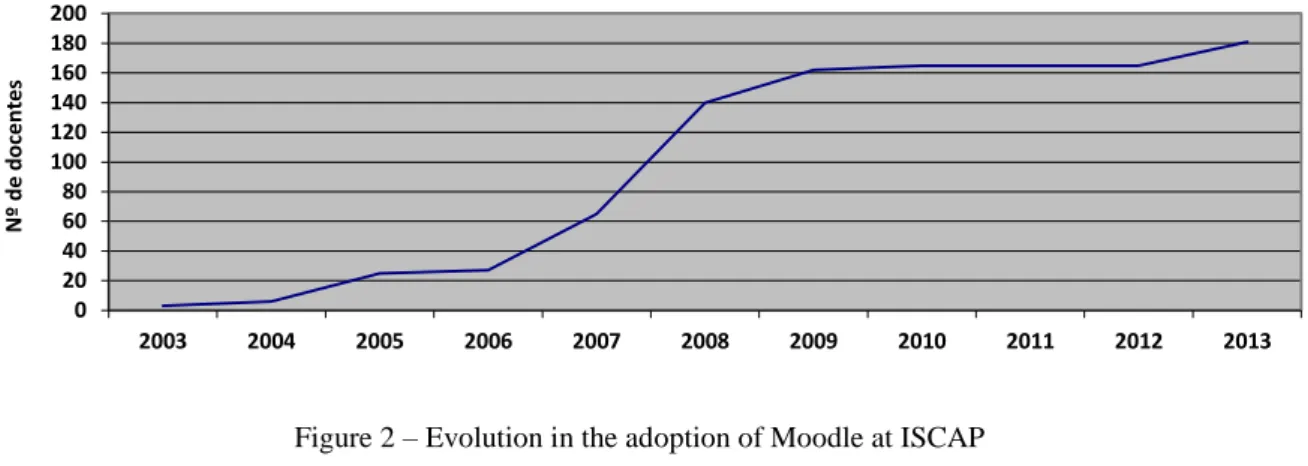
As said above, the innovation stage was initiated in 2003/2004 by 3 teachers, founders of the project, based on the use of WebCT learning management system. In the 1st semester of the adoption of Moodle another 6 teachers begun using the platform and by the end of the 2nd semester the number had increased to 14. If we look at Roger’s Innovation Curve, these teachers can be classified as Innovators. In ISCAP, the Early Adopters
of the technology came to contribute to the enlargement of the team. The team went from 3 to 7 teachers. This enlargement was required because the Project was starting to gain strength, due to student pressure, compelling teachers to upload contents into Moodle. Students became a key element for the Project’s growth (Paula Peres et al., 2011). In the year 2005/2006 it was when the Early Majority adopted Moodle. Later, in 2006/2007, the number of users increased substantially. It was when b/learning strategies were implemented in ISCAP, generating new habits among teachers and students, due also to the action of ISCAP’s leaders, which sought to impel the late majority to adopt b/learning strategies in their teaching practices. In 2007/08 ISCAP, 162 of the 230 teachers were using Moodle as an essential resource for their classes. And in 2013/2014, 182 out of 230 were using the platform. The 50 teachers that are still reluctant to adopt and use this platform can be considered and the Laggards.
The evolution of the number of users of the platform can be seen in Figure 2.
Figure 2 – Evolution in the adoption of Moodle at ISCAP
Over the last 10 years, the project initiated has developed and matured and, in turn, has brought about significant shifts in the school’s educational culture and pedagogical practices, namely regarding the teacher’s willingness or availability to integrate technology in the teaching-learning process. When we analyse how these roles impact the educational culture of the school, it is possible to verify that the integration of innovation curve has reached a horizontal status, or what could name as a comfort zone. This comfort zone is mainly occupied by the Late Majority classified by Rogers, as these were the teachers that were more reluctant to adopt the Moodle platform, but ended up by accepting it because they were impelled either by their students or their peers. The level of uncertainty that classifies this group has, in fact, transformed this integration of technology into a very slow process, where very basic practices, namely content display, are dominant.
Post-graduation in Communication Technologies and Business Innovation
In a context favourable to innovation and recognizing the importance and need to promote diversity in HE (agreement signed on 11th January 2010 between the Portuguese government and HEIs), together with some experience with the Moodle platform, one of the teachers that were among the Innovators at ISCAP, concluded a PhD on distance learning. At the end of her PhD she submitted a proposal to create a post-graduate course in Communication Technologies and Business Innovation, which had its first edition in 2010 (P. Peres & Pinto, 2011).
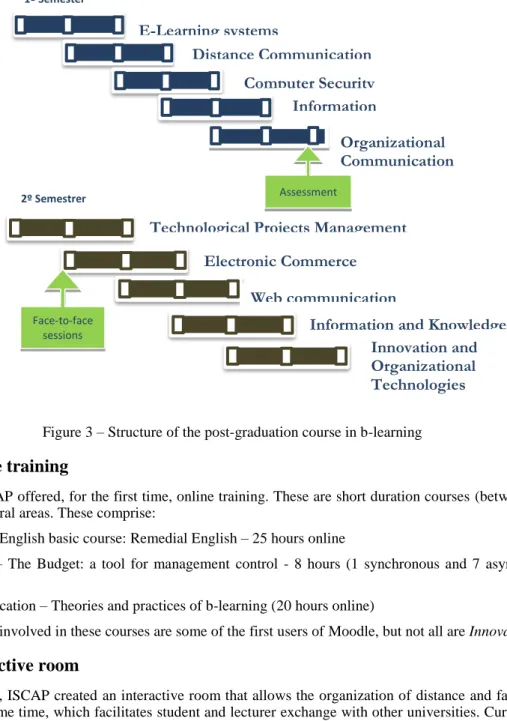
This course did not follow the traditional format of face-to-face courses since curricular units showed a sequence and justification supported by the development of an organizational / educational project based on the web. This course has 3 face-to-face sessions – one at the beginning of the module so the students can meet the lecturer, the colleagues and the curricular unit; another one in the middle of the module. Usually, in this session, companies are invited to present their cases. And finally, at the end the unit there is another face-to-face session for assessment. Between face-to-face-to-face-to-face sessions there are synchronous sessions where lecturer, in a schedule previously arranged with students, is online, does activities, clarify doubts or go deeper into certain topics. In parallel, lecturers make at students’ disposal in the platform, the contents under several formats. Figure 3 depicts the design structure of the b-learning course. In 2013/2014 academic year, the course had had 4 editions and 50 students enrolled.
Webinars
At the end of 2013, and after the euphoria of MOOC – Massive Open Online Courses, some lecturers in ISCAP decided to offer short duration courses on topics related to communication and distance education. These were called webinars and the first one took place in November 2013, under the topic “Secrets for the success of e-learning”. The course “5 steps to develop an online communication” followed. This kind of educational offer is characterized as short (about 1 hour) and free, and covers very concrete and specific topics. As of July 2014, 6 webinars were carried out in total, at an average pace of one per month (on the first Thursday of each month). There are already 3 more sessions scheduled until the end of 2014 (http://www.iscap.ipp.pt/siteceiscap/index.php/oferta-formativa/webinars-online). 0 20 40 60 80 100 120 140 160 180 200 2003 2004 2005 2006 2007 2008 2009 2010 2011 2012 2013 Nº de doce nt e s
The lecturers involved in these webinars are teachers that promote the use of Moodle at ISCAP and one of them is responsible for the post-graduate course in Communication Technology and Business Innovation. There is thus, a group of teachers who seem to be very dynamic and willing to try new education methods. They are looking for opportunities to try new technologies and ways to teach. Of course, none of these initiatives would happen without the support and commitment of the administration board of the school. So far about 40 persons attended these Webinars.
Figure 3 – Structure of the post-graduation course in b-learning
Online training
In 2008 ISCAP offered, for the first time, online training. These are short duration courses (between 8 and 30 hours) in several areas. These comprise:
Languages – English basic course: Remedial English – 25 hours online
Accounting – The Budget: a tool for management control - 8 hours (1 synchronous and 7 asynchronous with tutorials)
Distance Education – Theories and practices of b-learning (20 hours online)
The teachers involved in these courses are some of the first users of Moodle, but not all are Innovators.
Interactive room
In May 2014, ISCAP created an interactive room that allows the organization of distance and face-to-face courses at the same time, which facilitates student and lecturer exchange with other universities. Currently, the room works with the Grupo UNIS, from Varginha, Brazil (http://www.unis.edu.br/), who financed the technical equipment of the room in its entirety. Figure 4 depicts the layout of the room and technical structures, which comprise the equipment used for these courses.
This interactive room allows lecturers to open and enlarge the scope of the Backboard Collaborate (BC) tool, which comprises the interaction between teachers and students located in different places, using audio, video, and enables the sharing of the working spaces managed by a moderator (teacher or other) as well.
Organizational
Communication
1º SemesterFace-to-face sessions Assessment
E-Learning systems
Distance Communication
Computer Security
Information
Electronic Commerce
Information and Knowledge
Innovation and
Organizational
Technologies
Technological Projects Management
2º Semestrer
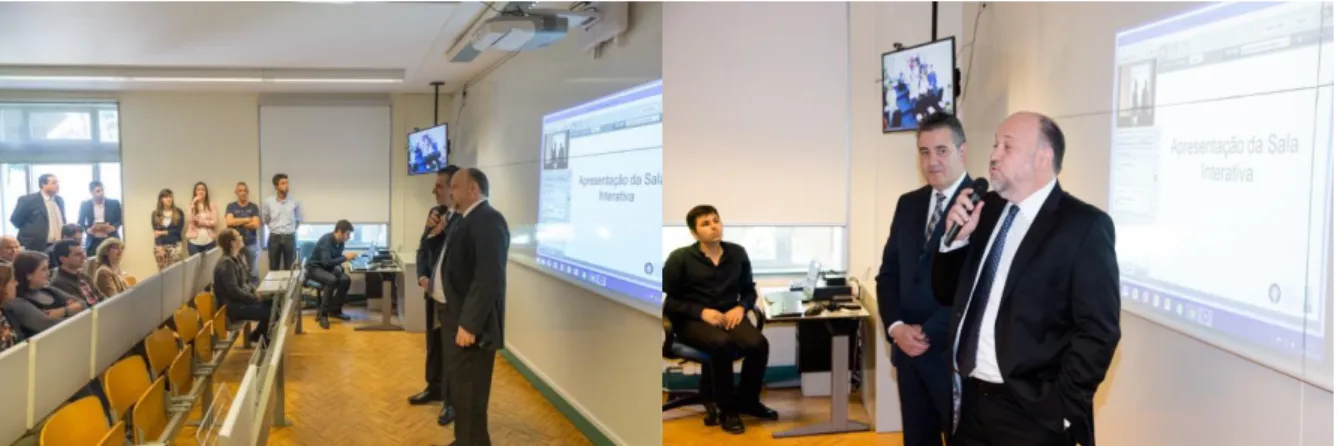
Figure 4 – Images of the interactive room in the day of its inauguration (23 May 2014)
The project of this interactive environment in particular, originally conceived by UNIS – MG, comprises the resources of this tool in a room equipped with an audio and video system, but enabling other web conferencing tools, such as Google Hangout, which foster greater interaction between the different locations. Besides this, the use of an interactive projector, such as the one in the room, allows the teacher not to focus on the computer and allows him/her to manage the class and the pedagogical materials on the BCs board. This way, the students in the room can see exactly the same class that students located in another place do.
Research centre in Communication and Education (CICE)
Finally, due to all the accumulated experience obtained in the last 11 years, the Research Centre in Communication and Education (CICE) was created at the end of 2013. Within this research centre, a unit related to Innovation in Education was also created, where distance learning is one of the topics under study. The research streams are related with online assessment, learning strategies, quality in e-learning, inclusion and accessibility in e-learning, among others.
4.
DISCUSSION OF RESULTS
When we analyse the evolution in the adoption of other forms of educational practices, and in particular, distance learning at ISCAP, one realizes that in some way it corresponds to Rogers’ (1995) Innovation Theory, which classifies people as Innovators, Early Adopters, Early Majority, Late Majority and Laggards, as depicted in Figure 1. In fact, the analysis of each of the projects briefly described above reveals that, in each one, there was always a group of teachers willing to innovate, who were then followed by the others, that we could clearly place in the other categories, throughout the years. One can say that each innovation / project corresponds to an innovation curve, meaning that, as one technology was introduced and used by teachers, there is the need to try something new, to innovate again by launching an idea for the next project.
We also tried to identify the factors that contributed to the evolution of distance learning at ISCAP. The analysis revealed that there are 3 intertwined factors that need to work in tandem: a) Institutional factors, b) Individual factors and c) Technological implementation.
Institutional factors
Among the institutional factors we would like to stress the role of the Administration board. In truth, the growth and adoption by lecturers of e-learning technologies could not have been possible without the commitment and support of ISCAP’s administration board. The board is always present in the most important moments, publicly showing its support by providing financial aid, when needed, through equipment and the support of training events and their dissemination. The fact that ISCAP’s community knows and feels that the
Administration board has supported this project, has unquestionably contributed to the increase in the teachers’ trial rate.
Individual factors
o Training concerning technology
It is very difficult for a lecture to voluntarily leave his/her comfort zone and try new technologies that will demand more time and effort. Aware of that fact, the school opted to train all lecturers in the use of the Moodle platform, as well as in the several tools that comprise it. During all these years, training encompassed more advanced applications since lecturers already had the basic knowledge of how the platform worked.
o Advanced education (PhD)
Another factor that contributed to this result was the advanced training the key lecturer had. In fact, as said above, one of the lecturers involved in the project of the post-graduate degree did her PhD in distance learning. This contributed to the acquisition of specific knowledge about how to develop and implement a distance-learning course, with its pedagogical methodologies and technologies. This lecturer trained her colleagues so they could also lecturer in the post-graduate course.
o Personality
The analysis also revealed that the personality of some lecturers also contributed to the development of the projects above. In fact, a group of teachers (either the Innovator group or the Early Adopters) are always willing to try new things, to take risks and use new technologies: the use of Moodle, when it was launched; the webinars, the online short duration courses and the use of the interactive room occurred due to the voluntarism of these lecturers. There was no financial reward given. The drive was personal and individual satisfaction due to the new possibility created for self-development and the results obtained.
Technological factors
Finally, we would like to refer to the available of technology. The Administration board, as said above, bought all the necessary equipment and software. If there was no technology at ISCAP, all these projects, as described above, would not have been possible.
5.
CONCLUSION
As shown by our personal experience, there are a lot of opportunities in terms of integrating and anchoring technologies to support HEI to develop their educational environments and offers. The use of a technological LMS constitutes an innovation opportunity in the teaching/learning process, and can be seen as an interesting leverage for the creation of new educational contexts. In ISCAP, the school’s educational culture has shifted greatly because of the teachers’ willingness to integrate technology in the teaching-learning process. However, despite the multiple activities and possibilities, activities still tend to be a reproduction of the classroom rather than focus on the use of technical innovations in the teaching/learning process. The continuous need for technological and pedagogical support walks hand-in-hand with the emergent need to develop new mechanisms to potentiate new technology-based learning environments.
We are aware that at the end of a cycle and the beginning of a new one, where a new group of Innovators
will arise to impel the introduction of new, yet unforeseen teaching and learning methodologies that will, in turn increase and diversify the number and nature of the tools that teachers use for educational purposes, with a clear focus on student-centred approaches. We foresee the need to accommodate new support mechanisms and new initiatives that not only facilitate the improvement of Innovator’s skills and activities, but also reinforce the global need for a readjustment of pedagogical methodologies amongst the first cycle Late Majority group.
The success of technology-enhanced learning relies deeply in the harmonious combination of the correct technologies with the most efficient pedagogies, allowing for the implementation of innovative, authentic and diversified teaching and learning opportunities, requiring an interconnected and in tandem development on three distinct yet inextricable levels: institution, technology and pedagogy