Performance Analysis of WiMax/WiFi System
under Different Codecs
Shaffatul Islam
American International University-Bangladesh Banani, Dhaka-1213 BangladeshMamunur Rashid
American International University-Bangladesh Banani, Dhaka-1213 BangladeshMohammed Tarique
American International University-Bangladesh Banani, Dhaka-1213 BangladeshABSTRACT
WiMAX and WiFi are considered as the promising broadband access solutions for wireless MANs and LANs, respectively. In the recent works WiMAX is considered suitable as a backhaul service to connect multiple dispersed WiFi „hotspots‟. Hence a new integrated WiMAX/WiFi architecture has been proposed in the literatures. In this paper the performances of integrated WiMAX/WiFi network have been investigated by using different „codecs‟ proposed in the literatures. In this investigation two WiFi hotspots have been connected to a WIMAX network. One of the Hotspots is located two kilometer from the WIMAX base station and the other one is located one kilometer from the same. The network was simulated via OPNET simulator. Two types of statistical data namely the global statistical parameter and node end statistical data have been collected from the simulations. By comparing both types of data some recommendations are made for choosing an appropriate codec for the integrated WiMAX/WiFi network
General
Terms
: Heterogeneous Networks, WiMAX/WiFi, VoIP, QoS, CodecsKeywords:
WIFI, WIMAX, codec, delay, jitter, voice activity detection, VoIP, MOS1.
INTRODUCTION
The applications of wireless communication systems have expanded from simple voice services to integrated data services. Existing wireless communication systems can be categorized as cellular networks, Wireless Local Area Networks (WLANs) and Wireless Personal Area Networks (WPANs). These communication systems have been standardized and deployed [11-13]. WiMax has already become popular technology for broadband access in Wireless Metropolitan Area Networks (WMAN) environment. It offers a rich set of features and flexibilities in terms of deployment options and it supports new applications. The physical layer of WiMAX is based on Orthogonal Frequency Division Multiplexing (OFDM), which is widely recognized as the modulation technique for mitigating multipath fading problem associated with any broadband wireless system. WiMAX is capable of supporting very high peak data rates. In fact a peak data rate of 74Mbps can be achieved when operating with a 20MHz wide spectrum. Under very good signal conditions, even higher peak rates may be achieved by using multiple antennas and spatial multiplexing [1]. WiMAX has a scalable physical-layer architecture that allows for the data rate to scale easily with available channel bandwidth. This scaling may be done dynamically to support a user roaming across different networks with different bandwidth allocations [1]. WiMAX supports a number of modulations and Forward Error Correction (FEC) coding schemes. These schemes can be changed on a per-user and per-frame basis depending on the
channel conditions [3]. The WiMAX MAC layer has a connection-oriented architecture that is designed to support a variety of applications, including voice and multimedia services. One of the potential applications of WiMAX is to provide backbone support for mobile WiFi hotspots. Traditionally wired connections are used as backhaul support for WiFi hotspots. But wired infrastructure is always considered expensive and it should be replaced by an alternative technology. Heterogeneous wireless networks consisting of WiMax and WiFi have been proposed in the literatures [9-10]. The architecture of this type of network is shown in Fig. 1.
Fig.1 Heterogeneous network architecture (WiMax/WiFi)
In this network model a WiMax base station (BS) serves both WiMax subscriber and WiFi access points in the coverage region. The connection between the WiMax base station and WiMax subscriber station is assigned to a single user. On the other hand, the connection between the access point and the base station is shared among the wireless LAN (WLAN) nodes. While integrating WiMax and WiFi one of the most challenging issues faced by the network designers is that of designing efficient links and optimizing the MAC layer protocols [14]. Several QoS provisioning mechanisms for integrated WiMax/WiFi systems have been proposed in the literatures [15-16].
WiMAX system also supports secure seamless handovers for delay-tolerant full-mobility applications, such as voice over internet protocol (VoIP) [5]. The WiMAX Forum has defined a reference network architecture that is based on an all-IP platform [7]. All end-to-end services are delivered over an IP architecture relying on IP-based protocols for the end-to-end transport, QoS, session management, security, and mobility. The Quality of Service (QoS) of VoIP application is defined in terms of the following parameters (a) availability: this is the
fraction of time for which network connectivity is available between an ingress point (entering point) and a specified egress point (exiting point), (b) packet loss: it is a comparative measure of packets received to the total number of packets that were transmitted, (c) delay: it is the finite amount of time that a packet takes to reach the receiving end point after being transmitted from the sending endpoint, (d) Jitter: it is the difference in the end-to-end delay between packets. Jitter is a significant, and usually undesired, factor in the design of almost all communications links, and (d) throughput: it is the available user bandwidth between an ingress point and an egress point.
In this article, we investigated the performance of WiMax/WiFi networks for VoIP application. Hence, VoIP and its Quality of Service (QoS) issues have been discussed in the following section.
2. QOS ISSUES OF VOIP APPLICATION
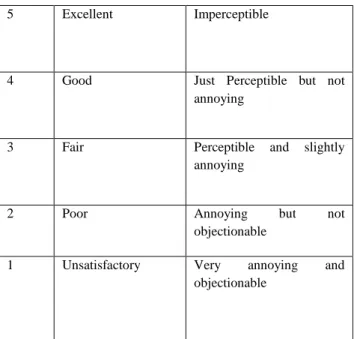
Traditionally circuit switching has been used for carrying voice traffic. But it requires a huge infrastructure. Hence it is considered an expensive solution. Presently the subscribers also want to communicate in myriad other ways such as e-mail, instant messaging and video in addition to voice traffic. Circuit switching really does not qualify as a suitable technology for this type of multimedia communications [2]. VoIP offers an alternative technology choice. VoIP is an attractive solution for voice transport for several reasons. Some of the reasons include (a) low equipment cost, (b) low operating expense, (c) integration of voice and data application, (d) potentially low bandwidth requirement, and (e) widespread availability of IP. When addressing the QoS needs for VoIP, the followings need to be considered (a) packet loss rate for high quality VoIP services should be less than 0.25 percent, (b) one-way latency should be no more than 150 ms (as per the International Telecommunication Union (ITU) G.114 specifications), (c) Jitter should be less than 10 ms, and (d) 21-106 kilobits per second (kbps) of guaranteed priority bandwidth is required per call.The voice quality can be interpreted as a way of evaluating speech clarity and the characteristic of the analogue voice itself; however it can also describe the performance of the underlying transport mechanism. Speech quality should be approached from an end-to-end perspective; that is, regardless of the systems, devices, and transmission methods used, any voice-quality metric should be expressed in the context of the user‟s experience. With this in mind, the ITU-T P.862 Perceptual Evaluation of Subjective Quality speech quality assessment is a good choice [6]. Objective Mean Opinion Score (OMOS) is used to measure the quality of speech because it predicts the subjective quality of speech evaluated by humans with Mean Opinion Score (MOS) or Degradation Mean Opinion Score (DMOS) scale. OMOS provides more detailed analysis compared to ordinary subjective MOS. The complete scale for this method is shown in the following table.
Table 1: Speech quality rating, MOS and DMOS
Rating Speech Quality (MOS)
Level of Distortion (DMOS)
5 Excellent Imperceptible
4 Good Just Perceptible but not annoying
3 Fair Perceptible and slightly annoying
2 Poor Annoying but not
objectionable
1 Unsatisfactory Very annoying and objectionable
3. THE EFFECTS OF ’CODECS’
Non-linear perceptual „codecs‟ compress voice such that the perceptually important information is preserved. In other words, these „codecs‟ preserve how the voice sounds without preserving all of the frequency spectrum information. This non-linear compression might then imply that the technique of measuring the parameters stated above may not give a true reflection of the actual quality of the audio output. For instance, when using „codecs‟ that use packet loss concealment strategies, the significance of the packet loss is smaller compared to jitter. This is obvious because the „codecs‟ can conceal a few consecutive packet losses by estimating a replacement for them, but the influence of jitter cannot be concealed unless it exceeds the packet loss indication delay. The delay does not affect speech quality directly but instead affects the quality of a conversation. For example, most users will not notice a delay of 100 msec, but they will notice a slight hesitation in their partner‟s response for longer delay. Hence, a short delay results in better conversation quality and in better perceived overall voice quality. When delay is excessive, users might also notice an echo which exists in most conversations but is undetectable due to short end-to-end delays in the network.
Each end station in VoIP or video over IP conversation has a jitter buffer. Jitter buffers are used to smooth out changes in arrival times of data packets containing voice. A jitter buffer can be dynamic and adaptive. If there are instantaneous changes in arrival times of packets that are outside of the capabilities of a jitter buffer‟s ability to compensate, there will be jitter buffer over-runs and under-runs, both of which result in a degradation of call quality.
4. SIMULATIONS AND RESULTS
In order to investigate the performances of the networks by using different „codecs‟ the OPNET Modeler simulation tool was used [4]. The OPNET Modeler supports WiMAX technology. It also supports the investigations on the performance of the „codecs‟ over a custom network. The investigated network topology consists of more realistic scenario structured like a WMAN. The network consists of a center IP cloud which is connected with an application server running VoIP application. There are 10 subscriber stations
under each base station (BS). Each BS is connected to a Point-to-Point (PPP) link with a speed of E3 standard interface with the IP cloud and each BS has the capacity of handling 100 SSs. Each node is static and the access technology is OFDMA 20 MHz TDD duplexing technology. The network topology used in this investigation is shown in Fig. 2.
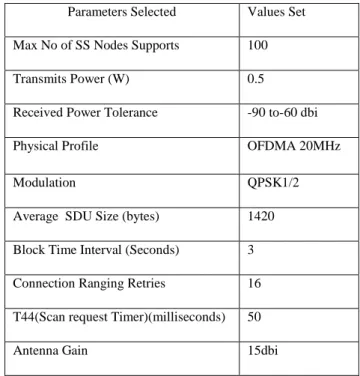
The application profile is running in serial mode which means that each application initiates packet generation in a serial manner. The packet generation started at times that are uniformly distributed. The whole process of packet generation lasts till the end of the simulation. There are two options available for voice „codecs‟ namely without voice detection and with voice detection. In this investigation we limit ourselves to „codecs‟ without voice detection option. Voice packet per frame was 1. The silence length (specified the time spent by the called party and the calling party in silence mode in single silence cycle) is 0.65 seconds and „Talk Spurt length‟ (specified the time spent by the called party and the calling party in Speech mode in single silence cycle) is 0.65 seconds. The Type of Service (ToS) is interactive voice. The compression and the decompression delays are 0.02 seconds. Conversation environment is quiet room. All traffics are discrete. The WiMax Mac layer was configured with two types of scheduling technique. Maximum sustained traffic was configured with 5 Mbps and maximum reserved traffic was configured with 1.5 Mbps. The maximum latency was set to 30 ms. The other parameters of WIMAX system and WiFI systemare listed in Table 2 and Table 3 respectively.
Fig.2: The network topology
Table 2 The parameters of WiMAX system
Parameters Selected Values Set Max No of SS Nodes Supports 100
Transmits Power (W) 0.5
Received Power Tolerance -90 to-60 dbi
Physical Profile OFDMA 20MHz
Modulation QPSK1/2
Average SDU Size (bytes) 1420 Block Time Interval (Seconds) 3 Connection Ranging Retries 16 T44(Scan request Timer)(milliseconds) 50
Antenna Gain 15dbi
While doing simulation results analysis we focus on four parameters namely voice Traffic, voice Jitter, voice MOS value and packet delay for three different „codecs‟. The results are graphically presented from the obtained data. The simulation results are presented in an order of per codec basis and their respective jitter, MOS value, packet end-to-end delay, and throughput results.
Table 3 The parameters of WiFi HotSpot
Parameters Selected Values Set Physical Layer Technology IEEE 802.11
Data Rates bits/sec 11Mbps
Transmit Power 0.0005 w
Packet Received Power -95 Threshold CTS to self option Enable
Short Relay 7
Long Relay 4
AP Beacon Interval 0.02
Max Received Lifetime 0.5 Large Packet Processing Drop
4.1 Codec G.726 40k
Fig. 3: Voice Jitter performance analysis using G.726 40k
The G.726.40k is a PCM based codec which was the first type codec that we investigated in this work. The Jitter performance of the G.726.40k codec is shown in Fig. 3. This figure shows that the Jitter is zero till 100 second and then it increases as more traffic was generated during the simulation. The jitter value becomes maximum (i.e., 0.05 second) at 200 second.
Fig. 4: Packet Delay Variation & End-to-End Delay using G.726 40k
Figure 5: Voice MOS Value performance analysis using G.726 40k
Fig.4 and Fig.5 present the end-to-end packet delay variations and MOS values. From Fig. 4, it is depicted that the delay variation is near to 600 second which is very high and the end-to-end delay of a packet is near to 100 second which is negligible [8]. On the other hand the MOS value which describes the voice perception quality is illustrated in Fig. 5. The MOS value is quite high at the starting time of the simulation and the MOS value decreases to a value 1.5. The MOS indicates that the quality of service is poor for the investigated network if this codec is used.
Figure 6: Voice Application performance analysis using G.726 40k
Voice traffic received and voice traffic sent have been compared in Fig. 6. This figure indicates that initially there was a small amount of packet loss in the network. But as more traffic was generated in the network the packet loss increases. There was a huge amount of packet loss (which is near about 800 packets per second) at the simulation time of 300 second. This huge packet loss has an adverse effect on the voice quality as well as the end-to-end delay of the packet. From the overall analysis of G.726 40k it can be concluded that this codec shows poor performance for the simulated network scenario.
4.2 Codec GSM-EFR
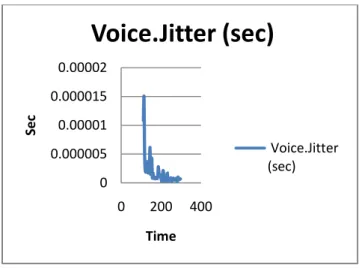
GSM-EFR is the first enhanced full rate codec and it has bit rate of 12.2 Kb/s using the ACELP (Algebraic Code Excited Linear Prediction) algorithm. Fig 7 shows the jitter performance of this codec. The jitter performance of GSM-EFR shows better performance compared to that of G.726.40k. Although the figure shows a high values initially, but it eventually decreases to a low value.
-0.01 0 0.01 0.02 0.03 0.04 0.05 0 200 400 Se c Time
Voice.Jitter (sec)
Voice.Jitter (sec) -200 0 200 400 600 0 200 400 Se c TimeDelay Variation &
End-to-End Delay (Sec)
Voice.Packet Delay Variation Voice.Packet End-to-End Delay (sec) 0 1 2 3 4 0 200 400 Time
Voice.MOS Value
Voice.MOS Value -200 0 200 400 600 800 1000 1200 0 200 400 Pac ke ts TimeVoice Application
Voice.Traffic Received (packets/sec) Voice.Traffic Sent (packets/sec)Figure 7 Voice Jitter performance analysis using GSM-EFR
Fig. 8: Voice Packet End-to-End Delay using GSM-EFR
Fig. 9: Voice Packet Delay Variation using GSM-EFR
The end-to-end delay per packet is illustrated in Fig. 8. This figure depicts that the voice packet end-to-end delay increases as the simulation time elapsed. The reason for this increase in the end-to-end delay per packet is that there is more traffic generated in the network that created congestion. The end-to-end delay per packet increases to a constant value at around
250 second and it remains constant at this value till the end of the simulation. This constant value indicates that the network has become saturated with the traffic. The final value of the packet‟s end-to-end delay was 0.087 sec. The delay variation is also shown in the Fig. 9. This figure shows that for the first 100 sec there is no result and at the end of the simulation the delay variation was increased by 0.00006 sec. The final value is .0.00007 second. For GSM-EFR the value of packet end-to-end delay and packet delay variation is too small and negligible compared to G.726.40 codec.
Fig. 10: Voice MOS Value performance analysis using GSM-EFR
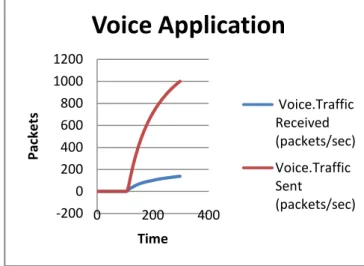
Figure 11 Voice Application performance analysis using GSM-EFR
The MOS value of GSM-EFR is depicted in Fig. 10. It is shown therein that the MOS value does not differ much but the graph is fluctuating through the whole simulation time. The final value of the MOS is 3.5. If we compare this value with the listed values in Table 1, we can conclude that the voice quality is better for GSM-EFR codec compared to that of G.726.40k codec. Fig. 11 dictates the voice traffic sent and packet received performance of GSM-EFR codec. From this figure it is noticeable that the packet loss rate was 200 packets/sec for this codec. But the same was 800 packets/sec for G.726.40k codec. There is a dependency in the voice application and other parameters such as packet end-to-end delay, the delay variation and the MOS value. It is realized 0 0.000005 0.00001 0.000015 0.00002 0 200 400 Se c Time
Voice.Jitter (sec)
Voice.Jitter (sec) 0.082 0.084 0.086 0.088 0 200 400 Se c TimeVoice.Packet End-to-End
Delay (sec)
Voice.Packet End-to-End Delay (sec) 0 0.00002 0.00004 0.00006 0.00008 0 200 400 Se c TimeVoice.Packet Delay
Variation
Voice.Packe t Delay Variation 3.562318 3.562318 3.562318 3.562318 3.562318 3.562318 3.562318 0 200 400 TimeVoice.MOS Value
Voice.MOS Value -100 0 100 200 300 400 500 0 200 400 Pack e ts TimeVoice Application
(Packets/Sec)
Voice.Traffic Received (packets/se c)from the figure that at the start of the simulation there is no packet loss. Hence the delay variation, the end-to-end delay and the MOS value are not significant. But at the end of the simulation the packet loss rate was increased and hence the other parameters were also increased.
Figure 12: Voice Jitter performance analysis using GSM-HR
4.3 Codec GSM-HR
The GSM-HR was first introduced in 1994. It uses the VSELP (Vector Sum Excited Linear Prediction) algorithm, which requires a high processing power. In GSM-HR the average bit rate is 5.6 Kb/s. Since this codec is operating at 5.6Kb/s, it requires half of the bandwidth of the full rate codec.
The jitter performance of GSM-HR codec is shown in Fig. 12. From Fig. 12 it is depicted that the jitter performance of GSM-HR is better than that of G.726.40k codec, but it is worse than GSM-EFR codec. The figure also shows that there is a random variation of the jitter over the time. The mean value of the jitter is about 0.00001 second, which is much lower compared to G.726.40k codec because the jitter value was 0.004 second for G.726.40k codec. On the other the jitter eventually became zero for GSM-EFR code. But this is not the case for GSM-HR codec.
Figure 13 Voice Packet End-to-End Delay using GSM-HR
The end-to-end delay per packet is illustrated Fig. 13. Similar to G.726.40k codec and GSM-EFR codec the end-to-end delay per packet increases with the simulation time. The final value of the end-to-end delay per packet becomes 0.92 sec at the end of the simulation when the network became saturated.
This final is value is much lower compared to that of G.726.40k codec, but it is higher than that of GSM-EFR code.
Fig. 14 Voice Packet Delay Variation using GSM-HR
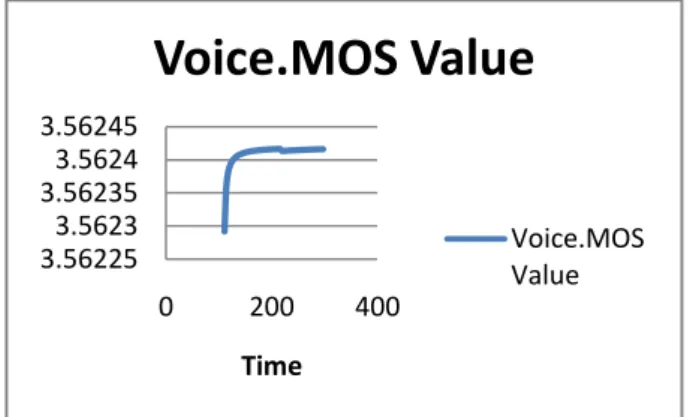
The packet delay variation of GSM-HR is shown in Fig. 14. The figure shows that GSM-HR has a low delay variation compared to that of G.724 40k and the maximum value of the delay is 0.00022 seconds. The MOS value of this codec is shown in Fig. 15. This figure shows that the MOS value is low at the beginning of the simulation time and it increases with the simulation time. This value becomes maximum at 200 seconds ad this value is at 3.56 which is same to GSM-HR. Among the all codecs without VAD(Voice Activity Detection) GSM-HR is performing well compared to other two codecs. .
Fig. 15 Voice MOS Value performance analysis using GSM-HR
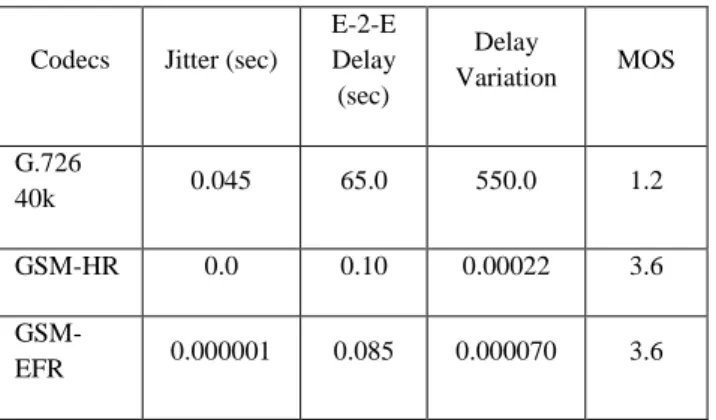
Based on the simulation results and the data presented in Table 4, we can conclude the followings:
(1) MOS: Mean Opinion Score defines the voice quality between the caller and the called party in conversation. Here we analyzed three voice „codecs‟ and all of them have a MOS value ranging from 1.2 – 3.6. From the MOS standard table, it is concluded that the voice quality is fair for a MOS value of 3.0, but it is slightly annoying and the voice quality is fair. For a MOS value of 1.0 it is unsatisfactory and very annoying. -0.00001 0 0.00001 0.00002 0.00003 0 200 400 Se c Time
Voice.Jitter (sec)
Voice.Jitter (sec) 0.08 0.0850.09 0.095 0 200 400 Se c TimeVoice.Packet
End-to-End Delay (sec)
Voice.Packe t End-to-End Delay (sec) 0 0.00005 0.0001 0.00015 0.0002 0.00025 0 200 400 Se c Time
Packet Delay Variation
Packet Delay Variation 3.56225 3.5623 3.56235 3.5624 3.56245 0 200 400 Time
Voice.MOS Value
Voice.MOS ValueMore or less the values are nearly the performance scale of the ITU-T standard. So from the point of view of network speech quality GSM-EFR and GSM-FR are performing well and G.726.40k is performing poor among all of the investigated codecs.
Table 4 Comparison of different ‘codecs’
(2) Network Throughput: The network Throughput is the parameter by which the performance of the network can be assessed. We probe the best and the worst performances of three „codecs‟. From the study of without voice activity detection G.726 40k is showing the worst performance because it has largest packet loss of near about to 750 packets/second. GSM-HR and GSM-FR have 200 packet losses.
(3) Packet End-to-End Delay: The network end-to-end packet delay is defined as the delay consisting of encoding delay, decoding delay, decompression delay and compression delay. In our results, from the scenario without voice activity detection GSM-EFR and G.726 40k have the lowest and the highest end-to-end delay with the value 0.085 and 65 sec respectively.
(4) Jitter: Jitter is the difference between the end-to-end delays between packets. GSM-HR and G.726 40k have jitter values of 0.0 and 0.045 sec respectively. But GSM-FER shows jitter performance in between G.726.40k and GSM-HR.
5. CONCLUSIONS
In this paper, we have investigated the performance of WiMAX /WiFi network. We studied 3 codecs and the performances of these three codecs have been investigated for WiMax/WiFi network. The performances of these three codecs have been presented and compared. There are also many other codecs available in the literatures. Those codecs need to be investigated for choosing the best codec for WiMAX/WiFi network. In this study we also only consider the effect of fixed topology of Mobile WiMAX. We did not consider the mobility effect in account. Our analysis is mostly covered the fixed topology of the nodes because the Mobile WiMAX is not yet under operation in fully commercial domain. There are many variants of future extension which can be done over the VoIP issue.
6. REFERENCES
[1] Jeffrey G. Andrews, Ph.D, Arunabha Ghosh, Ph.D. “Fundamentals of WiMAX Understanding Broadband Wireless Networking,” First Edition, Prentice Hall
[2] Aura Ganz, Zvi Ganz, Kitti Wongthavarawat , “Multimedia Wireless Networks: Technologies, Standards, and QoS,” Prentice Hall PTR, Pub Date: September 18, 2003
[3] Qingwen Liu, Shengli Zhou and Georgios B. Giannakis, “Queuing with Adaptive Modulation and Coding over Wireless Links: Cross-Layer Analysis and Design,” IEEE Transaction on Wireless Communications”, Vol. 4, No. 3, May 2005, pp. 1142 – 1153
[4] OPNET Modeler, http://www.opnet.com/solutions/ network_rd/modeler.html
[5] Amit Dhir, “WiMax-Delivering on the Promise of Wireless Broadband,” Wireless Design and Development, May 2006, Accessed: 28/05/2006, Source: Internet [6] ITU-T P.862, Perceptual evaluation of speech quality
(PESQ), an objective method for end-to-end speech quality assessment of narrowband telephone networks and speech coders, ITU, Geneva, February 2004.
[7] John Evans, Clarence Filsfils, “ Deploying IP and MPLS QOS for Multiservice Networks,” Morgan Kaufman Publication
[8] Prashant Bharadwaj, “Quality of Service in the Internet,” 2005,Accessed: 28/05/2006
[9] Dave Cavalcanti and Dharma Agrawal, “Issues in Integrating Cellular Networks, WLANS, and MANETs: A Futuristic Heterogeneous Wireless Networks”, IEEE Communication Magazine, June 2005, pp. 30-41
[10] Dusti Niyato and Ekram Hossain, “ Integrating of WiMax and WiFi: Optimal pricing for Bandwidth Sharing” IEEE Communication Magzine, May 2007, pp. 140-146
[11] IEEE Std 802.16-2004 , “ IEEE Standard for Loacl and Metropolitan Area Networks- Part 16: Air Interface for Fixed Broadband Wireless Access Systems”, October 2004
[12] C. Eklund, et. Al. , “ IEEE Standard 802.16: A technical Overview of the Wireless MAN Air Interface for Broadband Wireless Access”, IEEE Communication Magazine, Vol. 40, No. 6, pp. 98-107, June 2002
[13] A, Gosh, et al, “ Broadband Wireless Access with WiMax/802.16: Current Performance Benchmarks and Future Potential”, IEEE Communication Magazine, Vol. 43, No. 2, pp. 129-136, February 2005
[14] Cavalcanti D, et al, “Issues of Integrating Cellular Networks, WLANS, and MANETs: a Futuristic Heterogeneous Wireless Networks”, IEEE Wireless Communication Magazine, Vol. 12, No. 3, pp. 30-41, June 2005
[15] Kamal Gakhar, Annie Gravey and Alain Leroy, “ IROISE: A New QoS Architecture for IEEE 802.16 and IEEE 802.11e Interworking”, In the proceedings of IEEE International Conference on Broadband Networks”, pp. 607-612, October 2005
[16] Pedro Neves, Susana Sargento Rui and L, Aguiar, “ Support of Real-Time Services over Integrated 802.16 Metropolitan and Loacl Area networks”, In the proceedings of IEEE ISCC, pp. 15-22, June 2006
Codecs Jitter (sec)
E-2-E Delay (sec) Delay Variation MOS G.726 40k 0.045 65.0 550.0 1.2 GSM-HR 0.0 0.10 0.00022 3.6 GSM-EFR 0.000001 0.085 0.000070 3.6