© 2016. Hibatullah Alzahrani. This is a research/review paper, distributed under the terms of the Creative Commons
A Brief Survey of Cloud Computing
By
Hibatullah Alzahrani
Abstract-
Cloud computing is among the most promising technologies of the recent days, with the
potential to reach $ 204 billion by the end of 2016. Almost all major tech companies provide cloud
services of one sort or another like computing clusters and cloud storage. Cloud services can be
provisioned as Software as a Service (SaaS), Platform as a Service (PaaS) or Infrastructure as a
Service (IaaS) and they can be deployed as private, community, public or hybrid clouds. Cloud
computing provides several advantages like ease-of-deployment, no maintenance and up-front
costs, and rapid and efficient scalability. But it does pose several challenges with regards to security
of data and privacy issues, and many security sensitive companies tend to shy away from cloud
services due to this very reason
Keywords:
cloud-computing, computing, storage, SaaS, PaaS, IaaS, scalable, cheap, privacy issues.
GJCST-B Classification:
C.2.1, C.2.4, D.1.3
ABriefSurveyofCloudComputing
Strictly as per the compliance and regulations of: Publisher: Global Journals Inc. (USA)
Type: Double Blind Peer Reviewed International Research Journal Volume 16 Issue 3 Version 1.0 Year 2016
Cloud and Distributed
Global Journal of Computer Science and Technology
: BOnline ISSN: 0975-4172& Print ISSN: 0975-4350
Keywords: cloud-computing, computing, storage, SaaS, PaaS,IaaS, scalable, cheap, privacy issues.
loud computing, along with big data, is the biggest buzz of tech world these days. Just like Internet and Web took the world by storm in 1990s and early 2000s, and smartphones have shaped the new world order in communication in last decade or so, cloud computing is also expected to revolutionize the way in which businesses would be conducted and services would be provided to potential consumers. Almost all major tech giants like Microsoft, Google, Amazon and Apple provide cloud services to their consumers and even to other major businesses – for instance Netflix uses Amazon Web Services for hosting their streaming services. The cloud industry grew by 16.5% last year and is expected to rise to $204B by the end of 2016 according to tech research company Gartner Inc. [1]. But despite all its hype and usage, the concept of cloud computing is pretty elusive and its definition quite vague. In simplistic terms, cloud provides remote computing and storage services from a pool of shared resources to its consumers. Much more precise definition is provided by NIST [2] as:
"Cloud computing is a model for enabling convenient, on-demand network access to a shared pool of configurable computing resources (such as, networks, servers, storage, applications, and services) that can be rapidly provisioned and released with minimal management effort or service provider interaction."
II.
B
riefH
istory ofC
loudC
omputingThe idea of cloud computing is nothing new and its basic premise remains the same as it was
McCarthy floated the idea of computation being provided as public service just like any other service, a concept he named as “utility computing” [3], and in many ways, this is exactly what cloud computing is these days. Through the 1960’s and 70’s, large banks of computers provided so-called “time-sharing” services to local and remote users. In the 1980’s and early 90’s, large distributed data centers became commonplace in large corporations. There wasn’t any significant breakthrough until Internet became fairly common and easily accessible. Saalesforce.com [4] in 1999 was the first company to provide enterprise level applications to their customers through web. The next major breakthrough was the introduction of Amazon Web Services (AWS) [5] in 2002 which provided a multitude of cloud services like storage and computing. In 2006, Amazon introduced Elastic Compute Cloud, widely known as EC2 clusters [6], which enabled small and medium companies and even individuals to rent-off their servers to perform the desired computation. Same year, Amazon also introduced Simple Storage Service (S3) [7] to allow consumers to store their data online or on “cloud”. After that, all major tech players jumped in the “cloud” wagon, providing cloud services of various kinds. In 2009, Google introduced “Google Apps” [8] as add-ons with its chrome browser which enabled developers to make their product and then host it on Google servers as web application. At about the same time, Microsoft and Apple launched their cloud storage products –OneDrive [9] and ICloud [10]. Microsoft also launched Microsoft Azure [11] which lets consumers use it for variety of purposes from online storage to databases, web APIs to full-fledged web applications to fully hosted Linux and Windows virtual machines. As time goes on, more and more players are entering this arena and with the passage of time, cloud technology is expected to get cheaper and much more accessible and useful, especially for tech-startups and entrepreneurs.
C
Author: Saudi Arabian Cultural Mission. e-mail: [email protected]
Global Journal of Computer Science and Technology Volume XVI Issue III Version I
11
(
)
B
rapid and efficient scalability. But it does pose several challenges with regards to security of data and privacy issues, and many security sensitive companies tend to shy away from cloud services due to this very reason.
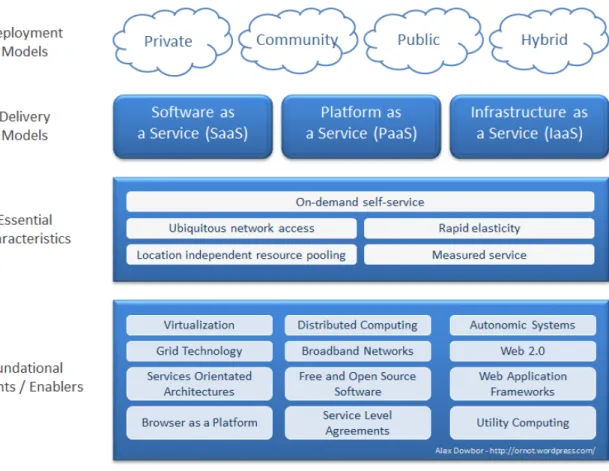
Figure 1 : Cloud Computing Architecture
III.
F
iveE
ssentialC
haracteristics ofC
loud-C
omputingNIST, in its 16th and final Definition of Cloud Computing, codenamed SP (Special Publication) 800-145 [2], has highlighted five key characteristics that every cloud technology should incorporate. They are: 1. On-demand Self-Service: The consumer should be
able to change the provisioned computing capabilities like number of cloud clusters and online storage unilaterally, without the intervention of human service provider.
2. Broad Network Access: Cloud services should be easily available through standard Internet mechanisms on all kinds of devices like mobiles, desktops, laptops, workstations etc.
3. Resource Pooling: It must be able to serve multiple consumers concurrently in location-independent way from same physical resources which are separated on logical level in a secure manner. 4. Rapid Elasticity: Resources should be provisioned
and released on demand, and at any point of time, the consumer should have exactly the amount of resources he needs for his product. In essence, consumer should be able to scale up and down the
resources,remove or add users, provision for more machines or storage in a seamless manner, and to him the resources should seem to be infinite, any amount of which can be provisioned at any point of time.
5. Measured Service:Cloud services should follow the pay-as-you-go pricing model. All consumption and usage of cloud resources should be monitored, logged and reported to consumer accordingly, and controlled from both sides under some agreement. A user should only be charged for what he used and also if there are limits on usage per user, it is the responsibility of service provider that such limits are not breached under normal circumstances.
IV.
C
loudC
omputingS
erviceM
odelsThere are three service models for Cloud Computing, depending on how a service is provided to the user, how much control user have over the resources and what kind of resources user has requested. These are:
1. Software as a Service (SaaS): In SaaS, consumers are provided with the capability to access and use service provider's application running on cloud infrastructure. Its standard definition is given as:
Global Journal of Computer Science and Technology Volume XVI Issue III Version I
12 Year 2016 ( ) B
Figure 2 : Three Cloud-Service Models
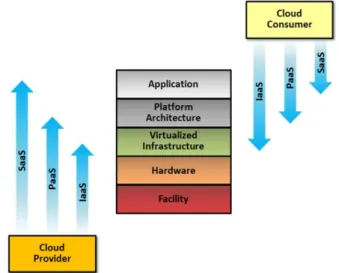
Users can access the software through a web-browser based interface or any other thin interface like ftp or some client-side application. Users normally subscribe to these services on monthly or yearly basis, and they have little control over these applications. Examples include Microsoft Office 365, Microsoft Skype, Google Apps, and Sales force.
2. Platform as a Service (PaaS): Platform as a Service provides the user with the capability to develop, deploy and manage their applications on hosted platform. PaaS service provider usually controls resources like storage and computation power and application is exposed to its potential users through application programming interfaces (APIs) and some other form of graphical or command-line interface. The consumer does not have control over the underlying infrastructure like servers, storage type and size, operating system and number of processors, but can only control the deployed application and its configuration. Examples include Web-hosting services like Microsoft Azure Web Services, Amazon Web Services and Heroku [13] App Hosting platform.
3. Infrastructure as a Service (IaaS): Infrastructure as a Service provides virtual and physical servers as well as network and storage resources on consumers’ discretion. The consumer does not have access over the underlying cloud infrastructure like type and power of servers but he can commission as much resources as he likes in terms of storage and computing power. He also has the choice to run the operating system of his own choice. Examples include Amazon EC2 clusters, Microsoft Azure (which provides both Linux and Windows VM). Similarly, cloud storage is a special example of IaaS
Figure 3:Control of Consumer for Each Service Model
V.
C
loudC
omputingD
eploymentM
odels1. Private Cloud: In private cloud, the cloud infrastructure is used exclusively by a single private entity like a business enterprise or a single company and can only be accessed by its employees and executives. The company can manage, own and operate the cloud services by itself or they can be out-sourced to a third party. The main advantage of this deployment is that safety and security of company's data and other vital information is ensured as no one from the outside world has access to the cloud.
2. Community Cloud: In community cloud, the cloud infrastructure is shared by a community of organizations which have common goals and are working on similar projects. So in that case, it makes sense to have a shared environment accessible by all relevant people with specific privileges designated to them. The infrastructure can be owned and managed by one or more or all of the organizations involved or it can be outsourced to a third party.
3. Public Cloud:The public cloud is open to access to general public and it can be owned by a business, a university or a government institution. A public cloud is owned by the cloud service provider at its own premises. Most SaaS providers use this deployment to serve their consumers, e.g. all cloud storage providers use public cloud model to allocate storage from a shared resource pool. It is also the most common model encountered by people, and most people believe this is the only cloud model.
Global Journal of Computer Science and Technology Volume XVI Issue III Version I
13 Year ( ) B
4. Hybrid Cloud: Hybrid cloud model is composed of two or more distinct cloud infrastructures (private or public) which exist as separate entities but are linked together through some standardization and protocols. Such models are usually used when businesses require some secure infrastructure for their storage but other tasks can be done on public or community cloud infrastructures.
VI.
A
dvantages ofC
loud-C
omputing1. Savings in Up-front Costs: For most cloud services, there are no up-front deployment and purchase costs. Almost all cloud services follow pay-as-you-go pricing model, in which consumers are only charged for whatever they services they use for fixed amount of time.
2. Ease of Scaling: Cloud services can easily be scaled up and down according to the consumer’s desire. For instance, cloud storage capability can be increased up to TBs or it can be as low as some GBs.
3. No Maintenance Costs: Cloud services have no maintenance costs, as it is the duty of cloud service provider to ensure the smooth and seamless working of underlying infrastructure. The consumer only has to pay for the services he used, and when servers wear-off or data drives fail, it is the service provider who has to bear the expenses for replacement.
4. Always-On Availability: Cloud services are always available to the users as long as they are connected to the Internet. There are some scheduled maintenance outage periods but such incidents are notified to users several days before and usually span a few hours at most. In some free or less expensive cloud services, there can be a maximum usage period for the user. For instance, the free account for Heroku Web Hosting platform provides 16 hours of up-time for the web application daily and 8 hours of outage period, but such outages are not continuous and are managed intelligently by the cloud service provider.
5. Reliability: Cloud services are pretty reliable in the sense that there is no need to worry about the potential data loss due to disk failure or break in computation task due to server failure or power outage. Cloud service providers use full back-up plans to ensure the integrity of data.
VII.
D
isadvantages ofC
loud-C
omputing1. Security of Data: The biggest question mark on cloud services is the security of data. Usually cloud service providers ensure excellent security mechanisms to prevent any leak of personal or
other vital data, but such incidents have happened in the past. Last year, there was a massive leak of data in ICloud storage, where ICloud accounts of several celebrities were hacked and their private pictures posted online. This is the biggest disadvantage of cloud – you are putting your data online where other people can potentially access it in case of some breach. This is the prime reason many enterprise level companies shy away from using cloud and despite the success of cloud in capturing the market of small and mid-level companies, it has little share in big corporate level companies.
2. Downtimes: Most cloud services remain available 24/7 but for some services there are scheduled time-outs. This can be due to periodic maintenance or as explained earlier, sometimes the service provider only commits for a limited period of time per day.
3. Limited Control: Consumers have very little control over their products in the cloud. The most control they have is in the IaaS (Infrastructure as a Service) model, in which they can provision whole VMs and customize them according to their needs. But they still don’t have any say over the underlying infrastructure. In SaaS, they have the least control as they can only configure certain parts of the application but they have no control over anything else.
4. Network Dependency: Another major disadvantage of cloud is its dependency on the Internet, or some other local network in case of private clouds. Even though Internet has become ubiquitous in the developed world, it is still finding its feet in the developing countries. So using cloud for your products essentially means you are ignoring that part of the world population which is without Internet, and for some products they can be a major demographic. Moreover, despite 3G and 4G data services in smartphones, people are still not very fond of using mobile data and essentially for data intensive applications they prefer to use Wi-Fi, which is not always available everywhere.
5. No Legal Liability for Vendors: Even though cloud service providers host the users’ data and other sensitive information and provide the best available security, they take no liability in case of potential breach. There are also legal complications involved in cases where data is stored in servers located in some other country and the question arises as to laws of which country would apply on provision and privacy of data. For instance, if the government of native country decides to gain access to that data in case of some criminal or civil proceedings, and the laws of country where data serves are actually located prohibits any such intrusion, the cloud
Global Journal of Computer Science and Technology Volume XVI Issue III Version I
14 Year 2016 ( ) B
Storage
IX.
C
onclusionCloud computing is one of the most exciting technologies in the recent decade with potential to grow much more rapidly as Internet access becomes more and more ubiquitous. Its ease of use, low maintenance and up-front costs and ease of scaling makes it the perfect candidate for many start-up businesses in the modern entrepreneurial world. But security of private data remains a big concern and in the absence of concrete laws to decide whether the liability of data leaks is on the service providers or not, the consumers are bound to take precautionary measures themselves and use cloud on their own risk. Nevertheless, cloud computing is here to stay for the foreseeable future and it would be prudent for many businesses to adopt it.
R
eferencesR
éférencesR
eferencias1. 4. 5.
6. Barr, Jeff (August 25, 2006).
Amazon Web Services Blog.
8. Sanderson, Dan (2009). Programming Google App
Engine: Build and Run Scalable Web Apps on Google's Infrastructure.
9. Thurrott, Paul (June 27, 2007).
SuperSite for Windows. Penton Media. Archived from
10.
6, 2011.
11.
Global Journal of Computer Science and Technology Volume XVI Issue III Version I
15 Year ( ) B
Global Journal of Computer Science and Technology Volume XVI Issue III Version I 16 Year 2016 ( ) B
A Brief Survey of Cloud Computing