Metropolitan Sewer District of Greater Cincinnati
LITTLE MIAMI WWTP SOLIDS PLAN
Preliminary Engineering Feasibility Analysis
Project ID 12270130
Little Miami WWTP Solids Plan
LITTLE MIAMI WWTP
SOLIDS PLAN
Final Draft
Preliminary Engineering Feasibility Analysis
Prepared for:
Metropolitan Sewer District of Greater Cincinnati
Prepared by: Arcadis U.S., Inc. 4665 Cornell Road Suite 350 Cincinnati, Ohio 45241 Tel (513) 860-8700 Fax (513) 860-8701 Our Ref.: 00167511.0311 Date: January 15, 2016
This document is intended only for the use of the individual or entity for which it was prepared and may contain information that is privileged, confidential and exempt from disclosure under applicable law. Any dissemination, distribution or copying of this document is strictly prohibited.
Bradley Olson. PE, BCEE Project Manager
CONTENTS
1 Executive Summary ... 5
1.1 Introduction ... 5
1.2 Evaluation of Alternatives ... 5
1.3 Total Present Value Summary ... 7
1.4 Recommendation ... 8
2 Introduction ... 11
2.1 Project Purpose ... 11
2.2 Project Background ... 11
2.3 Project Functional Requirements ... 11
2.4 Solids Quantities ... 12
2.5 Approach ... 13
2.6 Selection of Alternatives ... 13
3 Description of Alternatives & Technologies ... 15
3.1 Alternative No. 0 – Haul Dewatered Solids from the Muddy Creek and Little Miami WWTPs to a Centralized Incineration Facility at the Mill Creek WWTP ... 15
3.2 Alternative No. 1 – Rehab Existing Incinerator; Existing Source MACT Compliance ... 17
3.2.1 Description ... 17
3.2.2 General Arrangement ... 20
3.2.3 O&M Discussion ... 20
3.3 Alternative No. 2 – Replace Existing Incinerator; Modified (New) Source MACT Compliance . 21 3.3.1 Description ... 21
3.3.2 General Arrangement ... 23
3.3.3 O&M Discussion ... 23
3.4 Alternative No. 3 – Incineration via Janicki Industries Omni Processor ... 24
3.4.1 Description ... 24
3.4.2 General Arrangement ... 30
3.5.1 Description ... 32
3.5.2 General Arrangement ... 35
3.5.3 O&M Discussion ... 38
3.6 Alternative No. 5 – Class A Land Application via partnership Between MSDGC and the Private Entity (Cambi) ... 39
3.6.1 Description ... 39
4 Alternatives Cost Comparison ... 43
5 Alternative Advantages, Disadvantages, Screening And Conclusions ... 45
5.1 General ... 45
5.2 Centralized Solids Handling ... 45
5.3 Incinerator Solutions ... 46
5.4 Developing Technologies... 47
5.5 Contract Digestion/Land Application Solutions ... 48
5.6 Conclusions ... 49
6 Policy Considerations and Path Forward ... 51
6.1 Alternative No. 0: Centralized Incineration Facility at the Mill Creek WWTP ... 51
6.2 Alternative No. 2: Replace Existing Incinerator; Modified (New) Source MACT Compliance .. 54
6.3 Alternative No. 4C: Class A Land Application via Partnership Between MSDGC and the Private Entity ... 55
6.4 MSDGC Recommendation ... 57
6.5 Next Steps ... 58
6.6 Preliminary Schedule ... 59
TABLES
Table 1. Alternative No. 0: Advantages and Disadvantages ... 6Table 2. Alternative No. 2: Advantages and Disadvantages ... 6
Table 3. Alternative No. 4C: Advantages and Disadvantages ... 7
Table 4. Sludge Truck Hauling Data ... 9
Table 5. Current Solids Production ... 12
Table 7. Alternative No. 1B: FBI Modified Source Scope and Equipment Price ... 19
Table 8. Alternative No. 2: Modified Source Scope and Equipment Price ... 22
Table 9. Alternatives Total Present Value Cost Comparison ... 43
Table 10. Alternative No. 0: Advantages and Disadvantages ... 52
Table 11. Alternative No. 2: Advantages and Disadvantages ... 55
Table 12. Alternative No. 4C: Advantages and Disadvantages ... 56
Table 13. Sludge Truck Hauling Data ... 57
FIGURES
Figure 1. Alternatives Total Present Value Cost Summary ... 8Figure 2. Alternative No. 3: Proposed Omni Processor Site within Little Miami WWTP Site Plan ... 25
Figure 3. Alternative No. 3: Isometric View of Proposed Omni Processor Installation ... 26
Figure 4. Alternative No. 3: Solids Receiving Schematic ... 28
Figure 5. Alternative No. 3: Sludge Dewatering Schematic ... 29
Figure 6. Alternative No. 3: Central Storage Schematic ... 29
Figure 7. Alternative No. 3: Belt Press Dewatering Layout (EL 490.00) ... 30
Figure 8. Alternative No. 3: Belt Press Dewatering Layout (EL 475.00) ... 31
Figure 9. Alternative No. 3: Central Storage Area Plan ... 31
Figure 10. Alternative No. 4: Solids Handling “Triple Stack” Building Plan View (EL 506.00) ... 35
Figure 11. Alternative No. 4: Solids Handling “Triple Stack” Building Plan View (EL 529.00) ... 36
Figure 12. Alternative No. 4: Solids Handling “Triple Stack” Building Section View ... 37
Figure 13. Alternative No. 4: Little Miami WWTP Pipeline to Quasar Facility Site Plan ... 38
Figure 14. Alternatives Total Present Value Cost Makeup ... 44
Figure 15. Alternatives Screening ... 50
Figure 16. Alternative No. 0 Sludge Hauling Schematic ... 52
Figure 17. Revised Alternatives Screening ... 53
Figure 18. Alternative No. 2 Sludge Hauling Schematic ... 54
APPENDICES
A ... Alternatives Total Net Present Value Cost Tables B ... Vendor Proposals C ... Full Non-Economic Scoring D ... Risk Register E ... Schedule
1 EXECUTIVE SUMMARY
1.1 Introduction
The purpose of this evaluation is to prepare a preliminary engineering feasibility analysis that explores alternatives to solids disposal for the Little Miami WWTP. The Little Miami WWTP currently operates a single fluid bed incineration system that is in need of improvements to meet new regulatory emission standards as well as other improvements to make the process viable for the next 20 years. The Metropolitan Sewer District of Greater Cincinnati (MSDGC) was prepared for this and had conducted previous studies that had suggested that it was in the MSDGC’s best interest to cease incineration operation at the Little Miami WWTP and haul dewatered solids to a centralized incineration facility at Mill Creek WWTP where capacity is available. However, in the Fall of 2015, there was a change in policy away from centralization of solids handling at Mill Creek WWTP due to public concerns associated with increased trucking and traffic in and around the Mill Creek WWTP campus. Therefore, the need has arisen to revisit the future plan for Little Miami WWTP and the District’s Solids Handling Master Plan.
1.2 Evaluation of Alternatives
An alternatives analysis workshop was held on October 26, 2015. In addition to exploring alternatives to match the existing incineration practice, it was desired to explore a Class A land application alternative. Therefore, it was decided to explore the following alternatives:
• Alternative 0: Haul dewatered solids from the Muddy Creek and Little Miami WWTPs to a Centralized Incineration Facility at the Mill Creek WWTP.
• Alternative 1: Refurbish the existing Little Miami WWTP Incinerator Facility.
• Alternative 2: Replace the existing Little Miami WWTP Incinerator Facility with a new properly sized incinerator facility.
• Alternative 3: Replace the existing Little Miami WWTP Incinerator Facility with a new Janicki Bioenergy Omni Processor Sludge Disposal Technology.
• Alternative 4: Evaluate and explore a partnership between MSDGC and the private entity with a third party solids management company to create a Class A biosolid with land application. Quasar Energy Group (Quasar) was chosen for purposes of the feasibility analysis. Arcadis subcontracted with Quasar to develop a concept design and provide a cost of service estimate. It was expressly conveyed to Quasar and understood that if this alternative was eventually chosen, that MSDGC would seek competitive contract proposals of which Quasar and others could propose.
After the alternatives were selected, MSDGC explored options and obtained a preliminary proposal from Cambi. The Cambi process is a sludge conditioning process that precedes anaerobic digesters and produces a Class A Biosolid. The Cambi information is summarized in this report as Alternative 5 and the Cambi proposal is attached as an appendix. However, it must be noted that the schedule for this study did not allow for complete vetting of the Cambi proposal. Arcadis can evaluate this alternative more
• Alternative 5: Replace the existing Little Miami WWTP Incinerator Facility with a new Cambi Thermal Hydrolysis Process (THP) Sludge Treatment Technology with Anaerobic Digestion.
The alternatives can be arranged into four groups based on their similarity; and as a result, they share many of the same advantages, disadvantages, and risks. The four groups are as follows:
• Centralized Solids Handling – Alternative No. 0. • Incineration Solutions – Alternatives No. 1A, 1B, and 2. • Developing Technologies – Alternative No. 3.
• Contract Digestion/Land Application Solutions – Alternatives No. 4A, 4B, 4C, 4D, and 5.
The advantages and disadvantages of the alternatives brought forward for consideration are shown in the tables below.
Table 1. Alternative No. 0: Advantages and Disadvantages
Advantages Disadvantages
Provides the ability to operate the existing Mill Creek WWTP incineration facility more efficiently
May forfeit the existing Little Miami WWTP air permit
Eliminates the need to operate and maintain two incineration facilities
Requires hauling dewatered solids from Little Miami WWTP to Mill Creek WWTP
Less potential for off-site odors Potential negative economic impact to Price Hill community
Can operate independently of weather Not as environmentally sustainable as land application of biosolids
MSDGC will have complete control
Table 2. Alternative No. 2: Advantages and Disadvantages
Advantages Disadvantages
Least potential for off-site odors Not as environmentally sustainable as land application of biosolids
Least amount of noise, odor, and traffic associated with truck hauling
Need to operate and maintain two incineration facilities
No change from current public stakeholder standpoint
Requires compliance with stricter air emission criteria effective March 2016
Can operate independently of weather MSDGC will have complete control
Table 3. Alternative No. 4C: Advantages and Disadvantages
Advantages Disadvantages
Recycle waste/produces renewable energy Greater potential for noise, odor, and traffic associated with truck hauling to land application sites
Regional benefit by including the acceptance of non-sewage sludge waste that is already being hauled out of our region
Greater potential for odors
Diversification of sludge disposal options MSDGC is not in control - potential for less reliable service due to reliance on third party for operation
Minimal capital improvements needed at Little Miami WWTP
Land application of biosolids can be weather dependent
Operational risk effectively transferred to third party
More environmentally sustainable than incineration
Reduction in hauling with two facilities - one near Muddy Creek WWTP and one near Little Miami WWTP
1.3 Total Present Value Summary
Each alternative was broken down into line items corresponding to capital improvement projects that were required to comply with the functional requirements. Each item included the capital cost of the
improvement and the annual cost that was associated with that item. Annual costs include electricity, labor, minor maintenance, and consumables (like polymer where applicable). Note, however, that incinerator fuel was included as a separate item and not combined as a consumable with incinerator related annual costs. The detailed summary cost sheets for each alternative are provided in Appendix A. The following figure illustrates the makeup of each alternative’s total present value.
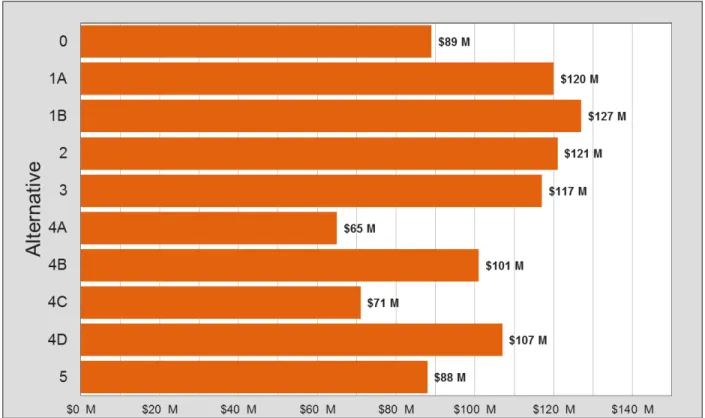
Figure 1. Alternatives Total Present Value Cost Summary
1.4 Recommendation
Based on objectives clearly laid out by the policy makers to reduce truck traffic, ensure some redundancy in operations and options, reduce and limit odors as well as deliver a cost effective solution, MSDGC Management recommends Alternative No. 4C for further development and implementation based on the following:
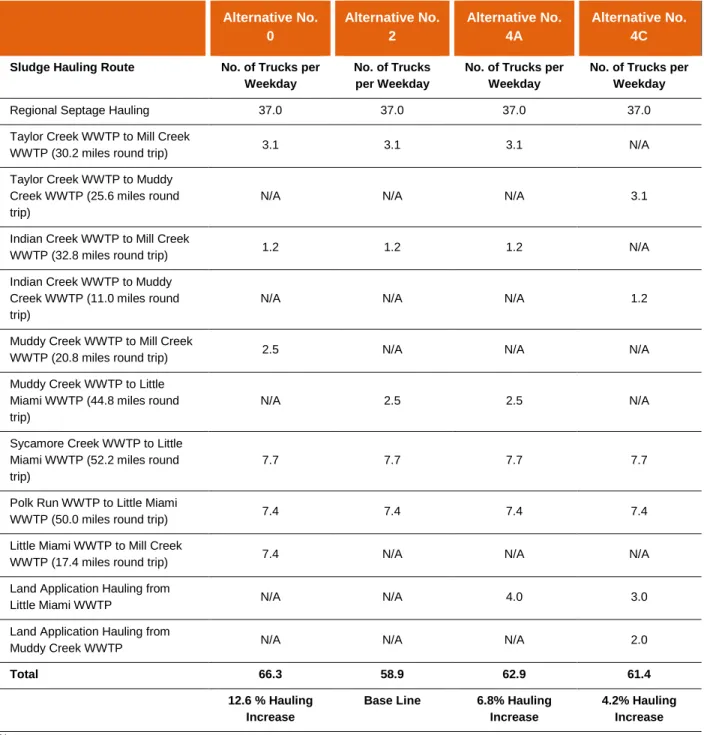
• Policy: This alternative is in-line with City and County policy to minimize trucking across the county in general and to Mill Creek WWTP in particular. The following table shows sludge truck hauling data across the alternatives brought forward under this evaluation:
Table 4. Sludge Truck Hauling Data Alternative No. 0 Alternative No. 2 Alternative No. 4A Alternative No. 4C Sludge Hauling Route No. of Trucks per
Weekday
No. of Trucks per Weekday
No. of Trucks per Weekday
No. of Trucks per Weekday
Regional Septage Hauling 37.0 37.0 37.0 37.0
Taylor Creek WWTP to Mill Creek
WWTP (30.2 miles round trip) 3.1 3.1 3.1 N/A
Taylor Creek WWTP to Muddy Creek WWTP (25.6 miles round trip)
N/A N/A N/A 3.1
Indian Creek WWTP to Mill Creek
WWTP (32.8 miles round trip) 1.2 1.2 1.2 N/A
Indian Creek WWTP to Muddy Creek WWTP (11.0 miles round trip)
N/A N/A N/A 1.2
Muddy Creek WWTP to Mill Creek
WWTP (20.8 miles round trip) 2.5 N/A N/A N/A
Muddy Creek WWTP to Little Miami WWTP (44.8 miles round trip)
N/A 2.5 2.5 N/A
Sycamore Creek WWTP to Little Miami WWTP (52.2 miles round trip)
7.7 7.7 7.7 7.7
Polk Run WWTP to Little Miami
WWTP (50.0 miles round trip) 7.4 7.4 7.4 7.4
Little Miami WWTP to Mill Creek
WWTP (17.4 miles round trip) 7.4 N/A N/A N/A
Land Application Hauling from
Little Miami WWTP N/A N/A 4.0 3.0
Land Application Hauling from
Muddy Creek WWTP N/A N/A N/A 2.0
Total 66.3 58.9 62.9 61.4
12.6 % Hauling Increase
Base Line 6.8% Hauling Increase
4.2% Hauling Increase
Notes:
(1) This table does not account for trucks already hauling food waste in the local area.
• Capital and Life-Cycle: The unique arrangement with a partnership between MSDGC and the private entity allows MSDGC to minimize capital outlay. As a result Alternative No. 4C has the 2nd lowest
• Environmental Sustainability: Land application allows for the ultimate nutrient recovery and recycle and minimizes consumption of commercial fertilizers. Furthermore, for poor soils, land application of biosolids is a proven soil reclamation technique to reestablish a normal functioning soil ecosystem. Municipal sludge can accelerate that process by years and even decades.
• Renewable Energy: The anaerobic digester facility will produce excess renewable energy for use at the Little Miami and Muddy Creek WWTPs.
• Regulation: Regulations at the federal and state levels are generally more favorable towards land application due to the environmental advantages of nutrient recovery and nutrient recycle.
2 INTRODUCTION
2.1 Project Purpose
The purpose of this evaluation is to prepare a preliminary engineering feasibility analysis that explores alternatives to solids disposal for the Little Miami WWTP. The Little Miami WWTP currently operates a single fluid bed incineration system that is in need of improvements to meet new regulatory emission standards as well as other improvements to make the process viable for the next 20 years. The Metropolitan Sewer District of Greater Cincinnati (MSDGC) was prepared for this and had conducted previous studies that had suggested that it was in the MSDGC’s best interest to cease incineration operation at the Little Miami WWTP and haul dewatered solids to a centralized incineration facility at Mill Creek WWTP where capacity is available. However, in the Fall of 2015, there was a change in policy away from centralization of solids handling at Mill Creek WWTP due to public concerns associated with increased trucking and traffic in and around the Mill Creek WWTP campus. Therefore, the need has arisen to revisit the future plan for Little Miami WWTP and the District’s Solids Handling Master Plan. This document provides a high level screening of alternatives based on economic and non-economic criteria. It is anticipated that upon completion of this study that it will serve as the business case for the new solids management plan for this facility, and the necessary planning/design will be incorporated into MSDGC’s Capital Improvement Program for immediate implementation.
2.2 Project Background
In March 2016 more stringent sewage sludge incinerator (SSI) pollutant emissions controls limits dictated by the USEPA’s SSI Maximum Achievable Control Technology (MACT) rule standards will take effect. The findings of the recently completed MSDGC Solids Management Study (MSDGC Project No. 10280123.59) concluded that the costs of upgrading and maintaining the aging Little Miami WWTP incinerator to comply with the standards would be significantly higher than those associated with the alternate strategy considered for offsite solids disposal to the Mill Creek WWTP. As a result, MSDGC embarked on a course to decommission the Little Miami WWTP incinerator permanently by March 21, 2016 and direct solids historically processed at this facility to the Mill Creek WWTP for incineration. However, the decision has been made by MSDGC to not send additional solids to the Mill Creek WWTP and instead to re-evaluate the processes at the Little Miami WWTP and Muddy Creek WWTP.
Besides the improvements required to meet the new SSI MACT standards, the Little Miami WWTP incinerator is also in need of reliability and service upgrades as the process is approaching nearly 20 years of service which is the expected useful life for the majority of incineration process equipment. The combination of emission upgrades and reliability and service upgrades will require significant investment. Therefore, MSDGC desires to explore other alternatives in addition to incineration to determine if
incineration is still the proper technology or if new technologies or other business relationships exist that would be more advantageous to MSDGC moving forward.
General
• Process maximum monthly solids loading. • Minimize solids directed to landfill.
• Provide odor control, monitoring, and mitigation for all storage tanks, silos, and processing areas. • Ensure adequate storage volumes that allow for changes in plant operation.
Dewatering
• Process maximum monthly solids loading.
• For alternatives involving incineration, achieve 28 ± 2% solids to provide optimum use of the
incinerator process and minimum auxiliary fuel consumption under this alternatives analysis. For all other alternatives, achieve 22 ± 2% solids.
• Process maximum monthly solids loading with 1 dewatering unit out of service.
• Provide firm capacity in auxiliary support systems to ensure dewatering can remain in service while auxiliary systems are undergoing maintenance.
• Provide adequate dewatered solids storage and feed capability to the greatest extent practical in order to ensure a consistent quality and quantity of dewatered solids material being fed to incineration under this alternatives analysis.
2.4 Solids Quantities
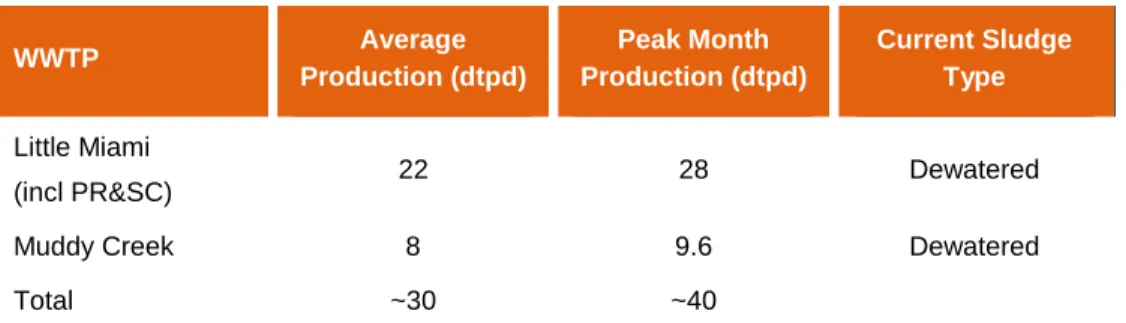
The Little Miami WWTP currently processes solids from Little Miami, Polk Run, Sycamore Creek, and Muddy Creek WWTPs. Liquid sludge is hauled from Sycamore Creek and Polk Run WWTPs on a daily basis to Little Miami WWTP. Dewatered Solids is hauled from Muddy Creek WWTP, typically on a Monday thru Friday schedule. The solids quantities were assembled using previous solids handling reports. The following table displays the current production of sludge from the Little Miami WWTP. The Little Miami WWTP is one of three plants that is currently able to dewater sludge. Sludge from all other plants are currently hauled as a liquid sludge to either the Mill Creek WWTP or the Little Miami WWTP for dewatering and incineration.
Table 5. Current Solids Production
WWTP Average Production (dtpd) Peak Month Production (dtpd) Current Sludge Type Little Miami
(incl PR&SC) 22 28 Dewatered
Muddy Creek 8 9.6 Dewatered
2.5 Approach
There have been recent solids related studies performed at the Little Miami WWTP. The technical and cost information contained in these reference studies was used in the development of this alternatives analysis. In some instances, Arcadis adjusted the information to ensure a proper comparison of the alternatives could be achieved. If the cost summary tables presented later in this alternatives analysis report, the source of each cost line item was identified. Arcadis developed some necessary capital and operations & maintenance (O&M) costs that were not available in previous reports. Since the studies had cost figures from several different years, the capital and O&M costs were normalized on a Q1 2015 cost basis.
The reference information is as follows:
• Little Miami WWTP Bundle Business Case Evaluation (Arcadis, September 2014). • Little Miami WWTP Bundle Conceptual Design Report (Arcadis, October 2014).
• Little Miami Bundle Solids Stream Treatment Technical Memorandum (Arcadis, April 2013). • Solids Management Study: MSDGC Solids Processing Capacity & Costs Technical Memorandum
(Black and Veatch, November 2012).
• Solids Management Study: MSDGC Solids Handling and Processing Alternatives Analysis (Black and Veatch, March 2013 with addendum January 2014).
2.6 Selection of Alternatives
An alternatives analysis workshop was held on October 26, 2015. In addition to exploring alternatives to match the existing incineration practice, it was desired to explore a Class A land application alternative. Therefore, it was decided to explore the following alternatives:
• Alternative 0: Haul dewatered solids from the Muddy Creek and Little Miami WWTPs to a Centralized Incineration Facility at the Mill Creek WWTP.
• Alternative 1: Refurbish the existing Little Miami WWTP Incinerator Facility.
• Alternative 2: Replace the existing Little Miami WWTP Incinerator Facility with a new properly sized incinerator facility.
• Alternative 3: Replace the existing Little Miami WWTP Incinerator Facility with a new Janicki Bioenergy Omni Process Sludge Disposal Technology.
• Alternative 4: Evaluate and explore a partnership between MSDGC and the private entity with a third party solids management company to create a Class A biosolid with land application. Quasar Energy Group (Quasar) was chosen for purposes of the feasibility analysis. Arcadis subcontracted with Quasar to develop a concept design and provide a cost of service estimate. It was expressly conveyed to Quasar and understood that if this alternative was eventually chosen, that MSDGC would seek competitive contract proposals of which Quasar and others could propose.
produces a Class A Biosolid. The Cambi information is summarized in this report as Alternative 5 and the Cambi proposal is attached as an appendix. However, it must be noted that the schedule for this study did not allow for complete vetting of the Cambi proposal. Arcadis can evaluate this alternative more thoroughly if requested and Cambi would be able to respond to a competitive RFP if one was issued. • Alternative 5: Replace the existing Little Miami WWTP Incinerator Facility with a new Cambi Thermal
3 DESCRIPTION OF ALTERNATIVES & TECHNOLOGIES
This section describes each alternative and sludge disposal/treatment technology, as well as providing a summary of the major components that form the costs and non-economic scoring for each alternative associated with the Little Miami WWTP.The findings of the recently completed MSDGC Solids Management Study (MSDGC Project No.
10280123.59) by Black and Veatch concluded that the costs of upgrading and maintaining the aging Little Miami WWTP incinerator to comply with the standards would be significantly higher than those associated with the alternate strategy considered for offsite solids disposal to the Mill Creek WWTP. As a result, MSDGC embarked on a course to decommission the Little Miami WWTP incinerator permanently by March 21, 2016 and direct solids historically processed at this facility to the Mill Creek WWTP for incineration. Decommissioning the Little Miami incinerator also has advantages and disadvantages. Decommissioning the Little Miami incinerator will reduce the effort required by MSD to operate and maintain the aging systems. In addition, elimination of incineration at the Little Miami WWTP may forfeit the emission permit. It will be difficult to acquire such a permit in the future if incineration was warranted at the Little Miami WWTP in the future. MSDGC has begun discussions with USEPA and Ohio EPA regarding these issues.
However, in the Fall of 2015, there was a change in policy away from the centralization of solids handling at the Mill Creek WWTP due to public concerns associated with increased trucking and traffic in and around the Mill Creek WWTP campus. The decision has been made by MSDGC to not send additional solids to the Mill Creek WWTP and instead to upgrade the processes at the Little Miami WWTP. For the completeness of the analysis, the previously recommended alternative is included in this evaluation under Alternative No. 0.
These general advantages and disadvantages are referenced in the specific alternative descriptions below:
3.1 Alternative No. 0 – Haul Dewatered Solids from the Muddy Creek
and Little Miami WWTPs to a Centralized Incineration Facility at
the Mill Creek WWTP
The significant aspects of this alternative are as follows: • The Incinerator at the Little Miami WWTP is abandoned.
• Sludge from the Little Miami WWTP is dewatered onsite and hauled to the Mill Creek WWTP for incineration.
• Sludge from the Polk Run and Sycamore Creek WWTPs is hauled as liquid to the Little Miami WWTP for dewatering and subsequent hauling to the Mill Creek WWTP for incineration.
The following capital improvement projects are required to implement this alternative: Mill Creek WWTP
• Emissions Upgrade: This project is already underway. It is necessary for compliance with the new MACT emission standards.
• New Solids Receiving Facility (and Emergency Solids Loadout): This is a new two-bay solids receiving facility as that will be required to accommodate the volume of solids that will be received from other plants.
• Dewatering Improvements: This project is necessary to provide a higher quality solids for more efficient incineration.
• Incinerator Solids Storage and Feed Improvements: This project is necessary to provide a “wide spot” in the solids stream prior to incineration. This will allow the dewatering centrifuges to operate at a rate independent from the incineration, allowing for more efficiency and convenience.
• Note: The liquid sludge from the Indian Creek and Taylor Creek WWTPs do not constitute a large enough volume to require a liquid receiving project. In this alternative they are assumed to be sent to the head of the plant.
Little Miami WWTP
• Dewatering and Solids Loadout: Also known as the “triple stack” facility, it is a combination fo dewatering, storage, and offloading. This project is necessary because solids will need to be loaded and hauled offsite. The dewatering improvements will provide higher quality solids for more efficient incineration.
Muddy Creek WWTP
• Centrifuge and Loadout: This project is already underway. It included dewatering improvements to provide a higher quality solids for more efficient incineration and loadout improvements.
3.2 Alternative No. 1 – Rehab Existing Incinerator; Existing Source
MACT Compliance
3.2.1
Description
The significant aspects of this alternative are as follows: • The Incinerator at the Little Miami WWTP is refurbished.
• Sludge from the Little Miami WWTP is dewatered and subsequently incinerated onsite
• Sludge from the Polk Run and Sycamore Creek WWTPs is hauled as liquid to the Little Miami WWTP to be dewatered and subsequently incinerated.
• Dewatered solids from the Muddy Creek WWTP are hauled to the Little Miami WWTP for Incineration.
Arcadis subcontracted with Suez, Inc., the original equipment manufacturer of the incinerator to perform a site inspection. The recommendations of this refurbish option are supported by the manufacturer.
Under this alternative the existing Fluid Bed Incinerator (FBI) vessel would be retained in its current condition. Upgrades to ancillary equipment would be required due to age and condition of existing equipment and for compliance with new MACT standards. This alternative has two sub-options which is dependent on whether the FBI system qualifies as an “existing source” or a “modified source” as defined by the MACT stipulations. A system is considered a “modified source” if major improvements have been implemented totaling greater than 50% of the original construction cost. This triggers additional emissions treatment under the requirements of 40 CFR 60, Subpart LLLL. If a system has not been modified in the manner described above it can be considered an “existing source” and would be subject to less
emissions treatment under the requirements of 40 CFR 60, Subpart MMMM. Based on experience with the current system, Arcadis believes it is likely that the Little Miami WWTP FBI can qualify as an existing source (Alternative 1A). However, since this categorization is not certain, a cost estimate was generated for both the existing source and modified source sub option (Alternative 1B).
Suez was contacted to provide budget pricing for refurbishing the existing FBI both as an existing and modified source. An onsite visual assessment of the major equipment and systems associated with the fluidized bed incinerator (FBI) facility was conducted by Arcadis with the incinerator manufacturer, Infilco Degremont, Inc. (subsidiary of Suez Environment) on November 19, 2015.
The scope items covered under these two sub options and corresponding cost is shown in the following tables.
The main changes to scope for providing upgrades to an existing source included eliminating the need for a WESP and eliminating the Demister/GAC Mercury removal system and instead including a SPC Module system. This scope and budget pricing is provided in the table below.
Table 6. Alternative No. 1A: FBI Existing Source Scope and Equipment Price
Scope Items
Replace Primary Heat Exchanger Replace Secondary Heat Exchanger
Replace Wet Scrubber with Venturi quench and provide new Caustic Addition system New SPC Module system
Replace Fluidizing Air Blower Replace Preheat Burner New CEMS stack monitoring
Integrated Controls, Field Instruments and PLC
Replace Refractory Lined Ducting and expansion joints from the FBI Vessel to Scrubber Inlet Replace Sand System
Lot of spare parts for all equipment provided
Budgetary Estimate for Furnishing Equipment: $10,054,000
Estimated amount for MACT Compliance Equipment = 27% of total or $1,841,000 Estimated amount for Incineration Upgrade Equipment = 73% of total or $7,364,000
Table 7. Alternative No. 1B: FBI Modified Source Scope and Equipment Price
Scope Items
Replace Primary Heat Exchanger Replace Secondary Heat Exchanger
Replace Wet Scrubber with Venturi quench and provide new Caustic Addition system New Wet Electrostatic Precipitator (WESP)
New Mercury Removal System with Demister and GAC Fixed Bed Polisher Replace Fluidizing Air Blower
Replace Preheat Burner New CEMS stack monitoring
Integrated Controls, Field Instruments and PLC
Replace Refractory Lined Ducting and expansion joints from the FBI Vessel to Scrubber Inlet Replace Sand System
Lot of spare parts for all equipment provided
Budgetary Estimate for Furnishing Equipment: $13,637,000
Estimated amount for MACT Compliance Equipment = 46% of total or $6,273,000 Estimated amount for Incineration Upgrade Equipment = 54% of total or $7,364,000
In addition to the equipment to be supplied by Suez, additional capital cost items were identified for directly refurbishing the incinerations system and emissions controls. These items were applied to both the existing source and modified source sub options and are described below:
• Demolition of existing equipment to be replaced.
• Equipment installation - assumed 25% of quoted budget cost of equipment. • New building to enclose the new Sand System to be provided by Suez. • Process piping connection and valves.
• I&C Work for integrating the new system into plant DCS - assumed 6% of installed equipment cost. These items were added as line items to the cost estimate prior to a percentage escalation for design contingency (30%) and project soft costs (39%). Applying these escalation factors gave the total estimated capital costs for direct incinerator and emissions controls upgrades.
There were also additional capital projects identified in the previous planning study that would be required if incineration was to be continued. These projects included:
• Dewatering Improvements.
• New Solids Storage and Incinerator Feed Improvements. • Replace Ash Slurry and Conveyance System.
These projects were previously cost estimated including contingencies and soft costs so they were applied to the total alternative capital expenditure as separate line items.
3.2.2
General Arrangement
The refurbished FBI system will include both in-kind replacement of existing equipment and several new pieces of emissions controls equipment that will be located within the Incinerator Building. It is assumed that equipment being replaced in kind will be located in the same area as existing equipment which will be demolished. The new equipment is expected to be located in the vacant space which previously
contained an old multiple hearth. The new pieces of equipment to be located in this area include: • New GAC Absorber.
• New Demister. • New WESP.
• New GAC Recharge Heat Exchanger.
The general arrangement of these items will be provided within the space previously occupied by an old multiple hearth. A new Caustic feed system for the Wet Scrubber will also be provided. This system was located in the lower level of the Sludge Disposal Building so that it can be close to the Wet Scrubber. Based on this general arrangement analysis, it appears that all the new equipment should be able to fit in the available space. More specific locations for egress of demolished equipment and ingress of new equipment will need to be examined during a more detailed design phase.
3.2.3
O&M Discussion
Operational and maintenance costs for the existing incineration system and related support systems were previously quantified in the District Wide Solids Planning Study. These cost were used as the estimated O&M cost for continuing to operate the refurbished existing incinerator. These costs include annual labor, materials, and consumables such as energy for each process evaluated. The annual operational cost items included:
• Dewatering.
• Incinerator O&M (including emissions controls). • Ash Disposal.
• Incinerator Fuel Usage.
Cost for incinerator fuel usage was assumed to be the same as current cost for fuel usage as the refurbished incinerator should operate approximately equal to current operations. There were also additional major maintenance items that occurred on the order of 5 to 15 year intervals. These major items were included in the 20 year life cycle on the years they were expected to occur as items separate from annual O&M.
3.3 Alternative No. 2 – Replace Existing Incinerator; Modified (New)
Source MACT Compliance
3.3.1
Description
The significant aspects of this alternative are as follows:
• The Incinerator at the Little Miami WWTP is replaced and resized.
• Sludge from the Little Miami WWTP is dewatered and subsequently incinerated onsite.
• Sludge from the Polk Run and Sycamore Creek WWTPs is hauled as liquid to the Little Miami WWTP to be dewatered and subsequently incinerated.
• Dewatered solids from the Muddy Creek WWTP are hauled to the Little Miami WWTP for Incineration.
Under this alternative the existing FBI vessel would demolished and replaced by smaller vessel sized for a capacity of 50 dry tons per day. This sizing more closely matches the actual solids loading at the Little Miami WWTP. Upgrades to ancillary equipment and addition of new equipment for compliance with MACT standards as a “new source” would also be included in this alternative and subject to additional emissions treatment under the requirements of 40 CFR 60, Subpart LLLL. The existing Incinerator 1 FBI vessel would be demolished and the new FBI vessel installed in its place.
Suez was contacted to provide budget pricing for providing a new FBI unit along with ancillary equipment including emission controls to meet MACT standards. The scope items covered under this quote and corresponding cost is given below.
Table 8. Alternative No. 2: Modified Source Scope and Equipment Price
Scope Items
Replace reactor vessel with new 50 dtpd vessel including shell, refractory, tuyeres and sand bed support, and all required connections
Installation of new reactor vessel Replace Primary Heat Exchanger Replace Secondary Heat Exchanger
Replace Wet Scrubber with Venturi quench and provide new Caustic Addition System Replace air compressor and dryer
Replace Sand System Replace Fluidizing Air Blower
New Mercury Removal System with Demister and GAC Fixed Bed Polisher New NOx removal system including ammonia injection and storage Replace Preheat Burner
Replace fuel train
Replace high pressure water pumps for roof spray Replace Ash slurry pumps
New CEMS stack monitoring
Integrated Controls, Field Instruments and PLC
Replace Refractory Lined Ducting and expansion joints from the FBI Vessel to Scrubber Inlet New stack to discharge to the environment
Lot of spare parts for all equipment provided Replace support steel and platforms
Adder for WESP (if needed) = $507,000
In addition to the equipment to be supplied by Suez, additional capital cost items were identified for directly refurbishing the incinerations system and emissions controls. These items were applied to both the existing source and modified source sub options and are described below:
• Existing building modifications
• Demolition of existing equipment to be replaced
• Equipment installation (other than reactor vessel) – same installation cost as for refurbish as modified source sub-option described in previous section.
• New building to enclose the new Sand System to be provided by Suez. • Process piping connection and valves
• Electrical Work - assumed 12% of installed equipment cost
• I&C Work for integrating the new system into plant DCS - assumed 6% of installed equipment cost
These items were added as line items to the cost estimate prior to a percentage escalation for design contingency (30%) and project soft costs (39%). Applying these escalation factors gave the total estimated capital costs for direct incinerator and emissions controls upgrades.
There were also additional capital projects identified in the previous planning study that would be required if incineration was to be continued. These projects included:
• Dewatering Improvements
• New Solids Storage and Incinerator Feed Improvements • Replace Ash Slurry and Conveyance System
These projects were previously cost estimated including contingencies and soft costs so they were applied to the total alternative capital expenditure as separate line items.
3.3.2
General Arrangement
The new FBI reactor vessel will be located in the space currently occupied by Incinerator 1 which would be demolished. The ancillary equipment including new equipment for emissions controls would be located in the same areas as for the refurbished incinerator options.
3.3.3
O&M Discussion
the alternative of installing a new incinerator. The only change made to the O&M cost was a reduction of incinerator fuel use cost by 80%. The new vessel will be better sized to the actual solids loading for the unit and thus autogenous burn should be achieved a greater percentage of the time.
3.4 Alternative No. 3 – Incineration via Janicki Industries Omni
Processor
3.4.1
Description
The significant aspects of this alternative are as follows: • The Incinerator at the Little Miami WWTP is removed.
The Janicki Omni Processor is a new proprietary technology, being developed as a potential technology for providing wastewater processing, clean drinking water, and electricity in developing nations. In developing nations, fecal waste is typically stored in open latrines; these latrines are pumped out by trucks, which then dump the waste in places like rivers and streams. This dumping often leads to the contamination of drinking water. The Omni Processor is designed to use wet waste as a fuel source for generating electricity. The electricity and waste heat is used to treat the liquid contents of the waste to potable drinking water quality.
The Omni Processor takes as input various types of dry waste, as well as raw septic sludge and dewatered sludge. As output, it produces electricity, treated water, ash, and exhaust. The combustion process is controlled in a fluidized sand bed, and downstream the exhaust is treated by absorbents and a bag house. The water treatment system works by distillation, followed by multistage filtering in the vapor phase, condensing, multi stage filtration and aeration in the liquid phase, ozone injection, and light chlorination for storage. This purified drinking water process is unnecessary for an application in conjunction with western style sewage and water treatment, and this portion of the technology can be removed in order to reduce the Omni Processor’s capital cost. Additionally, the Omni Processor can be customized to produce more electricity by not treating the water.
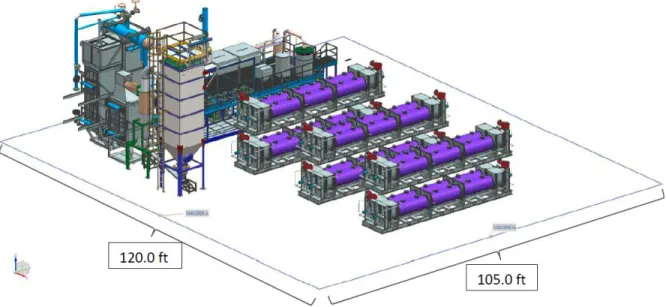
The Omni Processor can be started with butane or propane, and within 30 minutes it generates more electricity than it uses and thus doesn’t require any external power supply. In order to remain self-sustaining, the process must be supplied with at least 14 tons of dry waste per day, including the solids content of fecal sludge and other wet fuel. For wet fuels with solids contents greater than 20%, the Omni Processor can run continually without the help of additional solid waste or another dry fuel source. The Omni Processor is proposed to be placed at the site of the existing incinerator building. A new building will be constructed there specifically for housing the equipment and process. The figures below shows the site of the proposed site for the Omni Processor within the Little Miami WWTP, and an isometric plan of the proposed Janicki installation.
The Omni Processor is designed as a complete, self-contained system. Besides installation of the Omni Processor itself, updates will be made to other processes at the plant as well.
For this alternative, belt filter presses will be used for dewatering the sludge, which will then be stored temporarily in collection bins. The Little Miami WWTP processes more waste than the Omni Processor can process on a continuously rolling basis. Therefore, the dewatered sludge will have to be stored in silos as it is generated. The Omni Processor will continue to run during plant low flow and shutdown periods in order to meet the full demands of waste processing. Dewatered sludge pumps will move the sludge from the silos to the Omni Processor for processing.
Little Miami WWTP also receives sludge from several other MSDGC treatment plants, including thickened sludge from Polk Run WWTP and Sycamore WWTP and dewatered cake from Muddy Creek WWTP. The thickened sludge deliveries are added to the mixed sludge tank and combined with Little Miami sludge prior to dewatering. Dewatered cake from Muddy Creek is delivered to a separate cake receiving station and fed to the incinerator by means of a dewatered cake pump. Upgrades will need to be made to the cake receiving station to continue accepting sludge from Muddy Creek.
This alternative incorporates combining the centralized storage for waste received from other plants with that for dewatered sludge from the Little Miami plant. The sludge from dewatering and from receiving will be blended in order to achieve a consistent blend for feed to the Omni Processor. The updates for this alternative combine alternatives R-2B, D-2, and S-1 from the Solids Stream Treatment Technical Memorandum, dated 4/26/2013. These dewatering improvements are also required for the above referenced alternatives No. 1A, 1B, and 2. The existing odor control system will be removed and replaced with new two-stage biological scrubber.
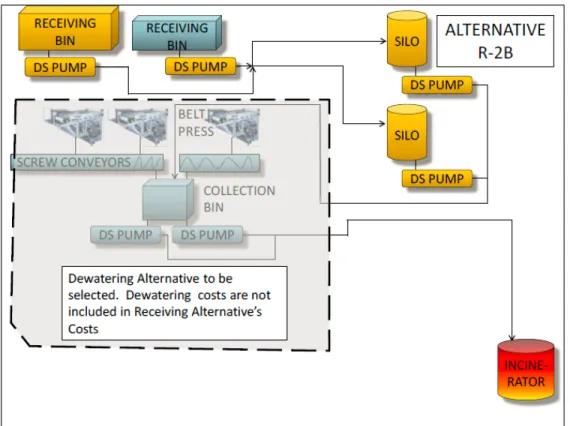
For this alternative, the Little Miami WWTP will continue to receive dewatered solids from other plants, and upgrades will be made to the Solids Receiving facilities at the Little Miami plant. This alternative incorporates alternative R-2B from the SSTTM, which involves the following improvements:
• Expand the footprint of the receiving facility in order to install an additional truck receiving bay. • Construct an additional receiving bay with a 12 ft. x 10 ft. x 14 ft. receiving bin.
• Install a dewatered solids piston pump at the new receiving bin, and retrofit the existing receiving bin with a larger capacity dewatered solids pump.
Figure 4. Alternative No. 3: Solids Receiving Schematic
For this alternative, sludge will be dewatered by belt filter presses and conveyed to collection bins by screw conveyors. From the collection bins, the dewatered solids would be pumped to the central storage facility by dewatered solids pumps. These improvements are described as alternative D-2 in the SSTTM, and they are summarized as follows:
• Provide a sludge feed system featuring a dedicated positive displacement pump for each belt filter press, plus a common standby pump.
• Install three belt filter presses for dewatering. • Install two transfer screw conveyors.
• Install two solids collection bins, each 12’ x 10’ x 7’. • Install a mannich polymer system.
• Provide a new electrical room for electrical instrumentation, and replace the existing MCC lineup. The figure below provides a schematic of the sludge dewatering process for this alternative.
Figure 5. Alternative No. 3: Sludge Dewatering Schematic
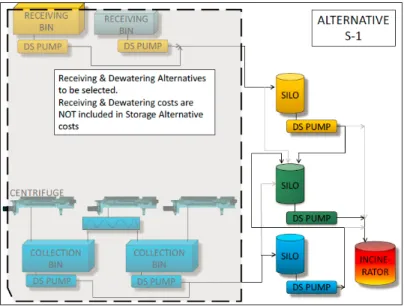
The dewatered solids from both the Dewatered Solids Receiving facility and the Sludge Dewatering will be pumped to a common central storage area. The facilities in this area will allow the two streams to be blended in order to create a consistent blend, optimized for feeding to the Janicki Omni Processor. This central storage area will be housed in the existing Maintenance Storage Building. These improvements are summarized as follows:
• Install three centralized storage silos. • Install three dewatered solids pumps.
The figure below provides a schematic of the sludge dewatering process for this alternative.
The 20 year life cycle cost for this alternative incorporates the following elements:
• Capital costs for new solids receiving, sludge dewatering, and odor control equipment. • Capital cost for both a Janicki Omni Processor unit and a building for housing the unit. • Annual O&M costs for repair, equal to 5% of the construction cost.
• Annual costs for the electricity used or produced for each process.
• Cost of hauling and of tipping fees for disposing of ash produced by the Omni Processor. • Cost of polymer used in the dewatering process.
• Labor costs associated with operating belt filter press and odor control equipment.
• Labor costs for three full-time employees dedicated to running the Janicki Omni Processor, based on the size/number of units recommended by Janicki based on the projected volumes.
See Appendix A for a cost breakdown by area.
3.4.2
General Arrangement
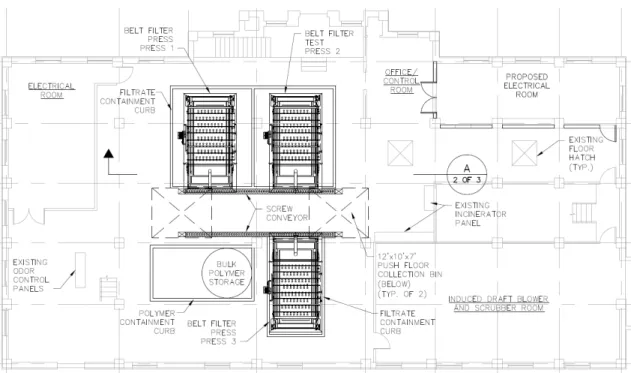
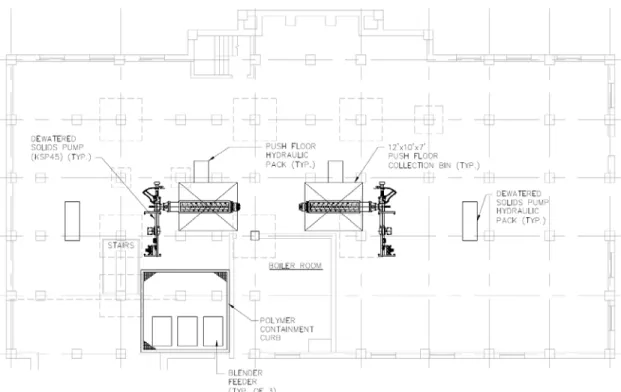
The figures below show the proposed layouts of the dewatering facility and the proposed Central Storage Area Plan.
Figure 8. Alternative No. 3: Belt Press Dewatering Layout (EL 475.00)
3.4.3
O&M Discussion
The Janicki Process and the upgraded dewatering and solids receiving processes will involve several operations and maintenance practices. Repair and replacement costs are projected at 3% of construction cost per year. The dewatering process will utilize Mannich polymer for coagulation of the solids, and polymer will be a regular operations cost. The Janicki process will generate useable electricity, but other parts of the process are power intensive, particularly the pumping, and the entire process will be a net consumer of electricity.
Each process will involve some amount of labor, and the Janicki process itself will involve the most significant amount of labor. The belt filter dewatering process is forecast to require one worker at half-time, and the odor control equipment may require a single worker for a few hours a week. Janicki’s resources forecast that the commercially available S200 Omni Processor requires one to two persons full-time. Because the facility will be running two machines at virtually all times, it is anticipated that three workers will be required to operate the Omni Processors. The process also is likely to operate 24 hours a day, 7 days a week, and three workers will be needed for operating the process at all times.
Janicki estimates that the Omni Processor for this facility will produce four tons of pathogen free ash per day. This ash will have to be disposed of, which will involve hauling and tipping fees for disposal.
3.5 Alternative No. 4 – Class A Land Application via Partnership
Between MSDGC and the Private Entity (Quasar Energy Group
Options)
Note: Quasar Energy Group was evaluated in this section for evaluation only and a competitive proposal for all other interested vendors will be entertained if this alternative is selected.
3.5.1
Description
The significant aspects of this alternative are as follows: • The Incinerator at the Little Miami WWTP is removed.
• Anaerobic Digestion is added to produce Class A product for beneficial re-use. • Implemented and managed by partnership between MSDGC and the private entity.
The following alternatives were developed under this evaluation and are based on the options discussed in the vendor proposal received by Quasar:
• Alternative No. 4A: Class A Land Application via partnership between MSDGC and the private entity (Quasar Option 1A).
• Alternative No. 4B: Class A Land Application via partnership between MSDGC and the private entity (Quasar Option 1B).
• Alternative No. 4C: Class A Land Application via partnership between MSDGC and the private entity (Quasar Option 2A).
• Alternative No. 4D: Class A Land Application via partnership between MSDGC and the private entity (Quasar Option 2B).
Quasar Liquid Pumping Options
Sludge from the Little Miami WWTP will be pumped through a 1500 linear foot (lf) force main to a new anaerobic digestion facility by Quasar or others (Quasar Option 1A). For the consideration of this
alternative, Quasar or others would build its facility on City owned land just to the northwest of Little Miami WWTP. A drawing of the proposed pipeline to be constructed from Little Miami WWTP to the new facility is shown in the Figure at the end of the section. The current thickened primary sludge pumps located in the Sludge Chamber are designed at 300 gpm at 81 feet TDH and 280 rpm. These existing pumps are fairly new and have enough head to pump to the new proposed facility.
The new 8-inch force main will be constructed of glass lined ductile iron pipe. Conveyance pipelines connecting Little Miami WWTP and the new facility will be below-grade for the entire route. The pipe will be installed using conventional trench excavation. Once the liquid sludge reaches the facility, Quasar or others will anaerobically digest, dewater, and process the sludge into Class A biosolids.
Another option presented by Quasar would be to have a second quasar facility located adjacent to Muddy Creek (Quasar Option 2A). This facility accept sludge produced form the Muddy Creek WWTP. Since this treatment plant has a current contract for new centrifuges, it was assumed that dewatered cake would be hauled from Muddy Creek WWTP to the new anaerobic digestion facility. This option would not involve any new capital expenditures at Muddy Creek WWTP beyond what is currently underway. Quasar Hauling Options
Dewatered sludge from the Little Miami WWTP will be hauled to a new anaerobic digestion facility (Quasar Option 1B), which Quasar or others plan to construct just north of the Little Miami WWTP. Quasar’s anaerobic digestion facility will accept liquid and solid biomasses such as food waste,
agricultural waste, and sewage sludge. The biomass will initially be processed in an equalization tank for stabilization purposes. Liquids may be discharged directly into the biomass equalization tank; solids must undergo an initial pass through grinders.
The organic slurry is then passed to the digester, where biomass is digested by the microorganisms. Following digestion, the biomass will be pasteurized to further reduce pathogens to obtain Class A Biosolids. Biogas will be collected from the tanks and conveyed to an engine where electricity is produced for onsite and offsite use. In addition to recycling waste and creating renewable energy, residuals from the digestion will be used for fertilizer and soils amendment.
Another option presented by Quasar would be to have a second quasar facility located adjacent to Muddy Creek (Quasar Option 2B). This facility accept sludge produced form the Muddy Creek WWTP. Since this treatment plant has a current contract for new centrifuges, it was assumed that dewatered cake would be hauled from Muddy Creek WWTP to the new anaerobic digestion facility. This option would not involve any new capital expenditures at Muddy Creek WWTP beyond what is currently underway. Originally, the solids stream processes at the Little Miami WWTP (Dewatered Solids Receiving and Load out, Thickening, Dewatering, and Incineration) all had their functional requirements focused on
away from receiving and incineration at Little Miami WWTP and towards hauling and disposal of the plant’s dewatered solids.
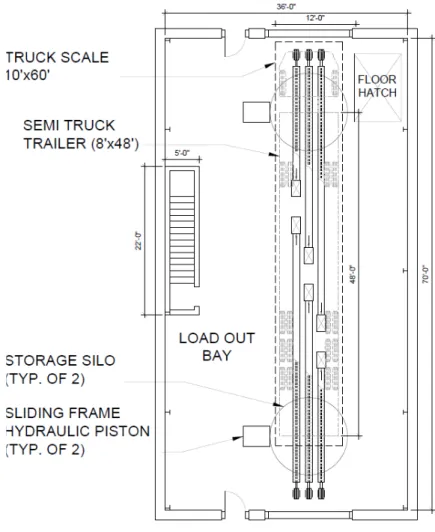
Implementation of Dewatering, Storage, and Load Out contained in new “Triple Stack” Solids Handling Building located at demolished Incineration Building location will include the following features:
•
Installation of 3 centrifuges on the top floor of the new Solids Handling Building.•
Installation of 2 screw conveyors to transfer solids to either of 2 storage silos.•
Installation 2 storage silos.•
Construction of Triple Stack Solids Handling Building located at the site of the existing Incinerator Building.•
Load cells mounted on Storage Silos.•
Installation of screw conveyors to load truck in 15 minutes.•
Installation of truck scale within Load Out Building or at a separate location.•
Installation of respective polymer, plumbing, electrical, HVAC, and Instrumentation and Controls systems.In “triple-stack” option, the centrifuges are located above the storage silos and the storage silos are in turn located above the truck loading bay. The centrifuges are located on the top floor of the building, conveyors transfer the solids to either of two silos directly beneath the centrifuges, and another set of conveyors loads the solids from the silos to trucks which are located beneath the silos. Conveyors will be controlled to load the trucks in a 15 minute period. Plans and elevation views of this building are in shown in Figures 9, 10, and 11 at the end of the section.
Quasar Experience
Quasar Energy Group is an Ohio based waste-to-energy company that designs, builds, owns and operates complete mixing systems that process organic waste to produce clean, renewable energy and valuable byproducts. The company uses anaerobic digestion technology to recycle energy from organic waste. The energy Quasar generates is then used for electricity, natural gas and vehicle fuel (CNG), as well as nutrient-rich soil amendments.
Quasar has 14 operational anaerobic digestion facilities throughout the United States, including facilities in Columbus, Wooster, Cleveland, Zanesville and Dayton. In 2013, the company built its first operation that is fully integrated into a wastewater treatment plant at the City of Wooster’s Water Pollution Control Plant. Wooster’s facility was experiencing operational problems and had accumulated a number of Ohio Environmental Protection Agency violations. Quasar rebuilt and updated the city’s aging treatment plant with three new digesters that converts wastewater into electricity and natural gas. Wooster’s transformed facility is now completely self-sufficient, using 600kW of electricity the digester produces on the plant’s equipment, while Quasar sends the other 500kW of energy into the local utility grid.
A cost analysis was conducted for each of the options listed in the above section. The cost includes construction and annual operations and maintenance with a 20 year estimated useful life. The results of each analysis are shown in Appendix A.
The subtotal of the construction costs were adjusted for overhead (10%), profit (5%), insurance (1%), bonding (1%), and design contingency (35%). The estimated costs for engineering assumed 10% of construction costs. Operation and maintenance costs include labor, power, raw material, repair and replacement, hauling fees, and Quasar tipping fees.
The Quasar hauling options has a high capital cost due to installation of new equipment and construction of the new “triple stack” structure. The Quasar Pumping Options requires no upgrades to the facility, beyond installing the pipeline that will run all the way to the proposed Quasar facility. Due to lower capital and operating costs, Option 1A Pumping to Quasar is the recommended method to transfer sludge to Quasar facility.
3.5.2
General Arrangement
Figure 13. Alternative No. 4: Little Miami WWTP Pipeline to Quasar Facility Site Plan
3.5.3
O&M Discussion
Under this alternative, MSDGC, Muddy Creek WWTP or Little Miami WWTP would not be responsible for any of the operations at the Quasar Facility. MSDGC, Muddy Creek WWTP and Little Miami WWTP would only be responsible for delivering the biosolids to the Quasar facility. Under the trucking option, Little Miami would be responsible for operating a dewatering and loadout facility. This would require electricity demand as well as operators time. For the liquid Pumping option, the MSDGC would only be responsible for running a thickening facility and thickened sludge pumps. It would also require electricity
and operators time, although less than the trucked loadout option. The sludge pumping would also require less maintenance than the dewatering facility. The operations and maintenance costs are detailed in the cost section below.
Under this alternative, Quasar would be responsible for:
• Maintaining odor control facilities for the receiving and loading of material. As part of the study, numerous odor control measures have been included in Alternatives 4A – 4D.
• Securing final beneficial use and disposal of the Class A product.
3.6 Alternative No. 5 – Class A Land Application via partnership
Between MSDGC and the Private Entity (Cambi)
3.6.1
Description
After the alternatives were selected, MSDGC explored options and obtained a preliminary proposal from Cambi. The Cambi process is a sludge conditioning process that precedes anaerobic digesters and produces a Class A Biosolid. The Cambi information is summarized in this report as Alternative 5 and the Cambi proposal is attached in Appendix B. However, it must be noted that the schedule for this study did not allow for complete vetting of the Cambi proposal. Arcadis can evaluate this alternative more
thoroughly if requested and Cambi would be able to respond to a competitive Request for Proposal if one is issued.
The following is an overview of the CAMBI process of thermohydrolysis and the intergration issues that must be considered if CAMBI were to be implemented in the Little Miami WWTP solids treatment process. CAMBI is a proprietary version of the more general “thermohydrolysis” technology which uses a
combination of high pressure and temperature precondition sludge prior to treatment in an anaerobic digester. The benefits of pretreating sludge with CAMBI include:
• Lysis of bacterial cells leading to more readily digestable sludge feed to digesters, larger percentage of solids destruction in the digesters, and greater biogas production.
• Lower viscosity in sludge feed to digesters allowing larger % Total Solids (TS) feed to digesters, which increases solids retention time (SRT) in digester without increasing tank volume.
• Time and temperature treatment by thermohydrolysis qualifies the final digested sludge product as Class A biosolids allowing for a wider range of end use options.
As can be seen from the list above, the benefits of installing a CAMBI system in a wastewater treatment plant are realized exclusively in the processes involving anaerobic digestion and thus would benefit the third party digestion provider in the case of the Little Miami WWTP. Solids feed to the digesters can typically be increased in concentration from 5% TS to 10% which essentially doubles the SRT provided by the digester tank, allowing the third party digester provider to reduce their built volume of tankage in half. Organic loading rates to the digester can also be increased making operations less sensitive to peak
the digester benefits the third party digester provider by reducing the amount of digested sludge that must be disposed of and by increasing biogas production which has significant value if utilized for energy purposes. CAMBI treated sludge has also shown to dewater very well in Belt Filter Presses (BFPs) in ranges of 30-35% TS leading to less water and ultimately less mass in the final cake product for disposal. Finally, because CAMBI has been approved as a technology that produces a Class A biosolids product the third party digester provider would have a wider range of beneficial reuse options for the final product to be disposed of.
Since the vast majority of benefits from CAMBI will be realized by the third party digester provider, the benefit to MSDGC would have to be realized in the form of a reduced unit cost charged by the third party digester provider for accepting solids from the Little Miami WWTP. Instead of MSDGC taking on the responsibility and cost of building and operating a CAMBI system, it would be more practical for the third party digester provider to own and operate the CAMBI systems as part of their side of the system. Aside from the contractual arrangements and the realization of benefits, there appear to be some
significant technical and feasibility issues for installing CAMBI at the Little Miami WWTP. Of these issues, the most significant is the need for high pressure steam which is required to drive the thermohydrolysis reaction. CAMBI systems need approximately 1 ton of steam at 175 psig for every dry ton of solids treated. Since Little Miami WWTP does not currently operate a central steam boiler system, there would have to be significant capital cost invested in constructing a high pressure boiler plant. This steam plant would also require 24/7 staffing with specially trained boiler operators and this would also consume significant amount of energy. Some of these steam demand issues can be dealt with by constructing large scale combined heat and power (CHP) systems that utilize biogas for power generation and can recover waste heat to generate steam. However, to generate high pressure steam the quantities needed, a large scale combustion turbine CHP system is required, which is more complex and costly than a more typical reciprocating engine CHP system.
There are a number of other considerations and additional cost centers that must be accounted for when implementing CAMBI. These items include:
• An additional screening process is needed to fine screen sludge prior to feeding to the CAMBI reactor.
• Sludge must be dewatered before undergoing thermal hydrolysis to 15-20% TS. This dewatering is addition to final dewatering of digested sludge meaning that there must be two different dewatering processes in operation.
• Sludge exiting the CAMBI reactors is very hot, and must be cooled down prior to being fed to the digesters. This requires extremely large heat exchangers to be built and operated to cool the digester feed sludge with large volumes of cooling water flow. These heat exchangers can use either potable water or plant effluent that has been finely screened to prevent clogging issues.
• Startup of anaerobic digesters becomes longer, typically 2-3 months, because CAMBI removes all active biology from the incoming sludge feed, including microorganisms necessary for the digestion process.
• Thermally hydrolyzed sludge releases very high amounts of ammonia leading to concentrations in digesters as high as 3,000 mg/L. Concentrations higher than this will become toxic to the digester so
operators must constantly monitor and manage ammonia concentrations. Process side streams such as BFP filtrate will also be very high in ammonia concentration.
• Because of the increased digester organic loading rates associated with CAMBI, rapid rise expansion foaming events will be of concern for digester operations. Additional mixing, controls and monitoring will be necessary to protect against rapid rise foam.
• Thermally hydrolyzed sludge produces extremely strong odors. Redundancy in sealing off the CAMBI reactors and robust odor control is required to prevent odors from spreading.
Many of these issues can be overcome with proper system design, properly trained and experienced operational staff, and sufficient capital and O&M budgeting for the project. While many of these issues and requirements relating to digester operations will fall on the side of the third party digester provider, several significant items will likely be the responsibility of MSDGC such as sludge screening, pre-digestion dewatering, and providing cooling water. All these items must be quantified and considered when deciding on implementation of CAMBI or any other thermohydrolysis system at the Little Miami WWTP.
4 ALTERNATIVES COST COMPARISON
The following table lists the bottom line total present value for each alternative and the ranking of each where 1 is the lowest cost and 10 is the highest cost.
Table 9. Alternatives Total Present Value Cost Comparison
Alternative Total Present Value
(in $2015) Rank
0 - Haul Dewatered Solids from the Muddy Creek and Little Miami WWTPs to a Centralized Incineration Facility at the Mill Creek WWTP
$ 89 M 4
1A – Rehab Existing Incinerator; Existing Source MACT
Compliance $ 120 M 8
1B – Rehab Existing Incinerator; Modified (New) Source
MACT Compliance $ 127 M 10
2 – New Incinerator; New Source MACT Compliance $ 121 M 9
3 – Incineration via Janicki Industries Omni Processor $ 117 M 7 4A – Class A Land Application via Partnership Between
MSDGC and the Private Entity (Quasar Option 1A) $ 65 M 1
4B – Class A Land Application via Partnership Between
MSDGC and the Private Entity (Quasar Option 1B) $ 101 M 5
4C – Class A Land Application via Partnership Between
MSDGC and the Private Entity (Quasar Option 2A) $ 71 M 2
4D – Class A Land Application via Partnership Between
MSDGC and the Private Entity (Quasar Option 2B) $ 107 M 6
5 – Class A Land Application via Partnership Between
MSDGC and the Private Entity (Cambi) $ 88 M 3
Each alternative was broken down into line items corresponding to capital improvement projects that were required to comply with the functional requirements. Each item included the capital cost of the
improvement and the annual cost that was associated with that item. Annual costs include electricity, labor, minor maintenance, and consumables (like polymer where applicable). Note, however, that incinerator fuel was included as a separate item and not combined as a consumable with incinerator related annual costs. The detailed summary cost sheets for each alternative are provided in Appendix A.
Figure 14. Alternatives Total Present Value Cost Makeup
5 ALTERNATIVE ADVANTAGES, DISADVANTAGES,
SCREENING AND CONCLUSIONS
5.1 General
The ten alternatives can be arranged into four groups based on their similarity; and as a result, they share many of the same advantages, disadvantages, and risks. The four groups are as follows:
• Centralized Solids Handling – Alternative No. 0. • Incineration Solutions – Alternatives No. 1A, 1B, and 2. • Developing Technologies – Alternative No. 3.
• Contract Digestion/Land Application Solutions – Alternatives No. 4A, 4B, 4C, 4D, and 5. The advantages and disadvantages of each group are discussed below.
5.2 Centralized Solids Handling
This alternative has liquid sludge from the Polk Run and Sycamore Creek WWTPs hauled first to the Little Miami WWTP for dewatering and subsequent hauling to the Mill Creek WWTP for incineration.
Dewatered solids from the Muddy Creek WWTP would also be hauled to the Mill Creek WWTP for incineration. Under this alternative, the importance of the solids train at the Mill Creek WWTP needs to be emphasized. Since the Mill Creek WWTP represents roughly about three-quarters of the districts solids handling, reliable operation of the incineration process at this plant is paramount to the success of the proposed centralized solids handling strategy. The Mill Creek WWTP must have the ability to provide a relatively consistent quality and quantity sludge tot the incinerators for proper operation. Achieving consistency in feed to the incinerators has been a challenge in the short operating history of the fluid bed incinerator facility. Close attention is needed