This is a peer-reviewed, final published version of the following document, Reproduced courtesy of IARIA and is licensed under Creative Commons: Attribution-Noncommercial-Share Alike 4.0 license:
Bakeer, Ali and Wynn, Martin G (2014) ICT Utilization in Libyan
Universities: A Report on Case Study Research. Ninth International
Multi-Conference on Computing in the Global Information Technology. pp.
165-170. ISSN 2308-4529
Official URL: http://www.thinkmind.org/index.php?view=instance&instance=ICCGI+2014
EPrint URI: http://eprints.glos.ac.uk/id/eprint/2081
Disclaimer
The University of Gloucestershire has obtained warranties from all depositors as to their title in the material deposited and as to their right to deposit such material.
The University of Gloucestershire makes no representation or warranties of commercial utility, title, or fitness for a particular purpose or any other warranty, express or implied in respect of any material deposited. The University of Gloucestershire makes no representation that the use of the materials will not infringe any patent, copyright, trademark or other property or proprietary rights.
The University of Gloucestershire accepts no liability for any infringement of intellectual property rights in any material deposited but will remove such material from public view pending investigation in the event of an allegation of any such infringement.
This is the final published version and is reproduced here with permission of I ARI A
http: / / www.iaria.org/ conferences.htmlBakeer, Ali and Wynn, Martin G (2014). ICT
Utilization in Libyan Universities: A Report on Case
Study Research. The Ninth International
Multi-Conference on Computing in the Global Information
Technology 165-170.
Published by Think Mind CENTRIC 2014, and available online at:
http://www.thinkmind.org/index.php?view=instance&instance=CENTRIC+2014
We recommend you cite the published version.
The URL for the published version is
http://www.thinkmind.org/index.php?view=article&articleid=iccgi_2014_8_20_10133
Disclaimer
The University of Gloucestershire has obtained warranties from all depositors as to their title
in the material deposited and as to their right to deposit such material.
The University of Gloucestershire makes no representation or warranties of commercial
utility, title, or fitness for a particular purpose or any other warranty, express or implied in
respect of any material deposited.
The University of Gloucestershire makes no representation that the use of the materials will
not infringe any patent, copyright, trademark or other property or proprietary rights.
The University of Gloucestershire accepts no liability for any infringement of intellectual
property rights in any material deposited but will remove such material from public view
pending investigation in the event of an allegation of any such infringement.
ICT Utilization in Libyan Universities: A Report on Case Study Research
Ali Bakeer
School of Information Technology University of Misurata
Misurata, Libya [email protected]
Martin Wynn
School of Computing and Technology University of Gloucestershire
Cheltenham, UK [email protected]
Abstract - There is a dearth of literature on the use of Information and Communication Technologies (ICTs) in Libyan universities and this paper aims to help address this imbalance by exploring and analyzing how ICTs are used in Libyan universities. Process maps and systems profiling are employed to examine the current and potential uses of ICTs and a new model for assessing ICT utilization in Libyan universities is put forward and applied at the University of Misurata in northern Libya. This innovative approach to assessing ICT deployment in Libya has emerged from initial case study research that will be further developed as other universities in Libya are investigated.
Keywords – information and communication technologies; ICTs; Libyan universities; process mapping; systems profiling; SCALE model
I. INTRODUCTION
With the development and application of Information and Communications Technologies (ICTs), organisations have started to accept that it is important for them to embrace new technologies in order to achieve competitive advantage [1]. The term ICT emerged in the new millennium and is generally considered to encompass the recent developments in communications and e-business infrastructure as well as the more traditional core IT functions of an organisation. It thus can also be considered to include an organisation’s Information Systems (IS). “The term IT is used interchangeably with IS, or it may even be used as a broader concept that describes a collection of several information systems, users, and management for an entire organisation” [2]. However, “information and communications technology is often used as an extended synonym for Information Technology (IT), but is usually a more general term that stresses the role of unified communications and the integration of telecommunications (telephone lines and wireless signals), computers, middleware as well as necessary software, storage and audio-visual systems, which enable users to create, access, store, transmit, and manipulate information” [3]. It is this broad definition of ICT that is adopted for this study.
The study investigates how ICT utilization can contribute to universities' overall performance. It is one of the few studies focusing on ICT utilization in the Higher Education Institutions sector in the developing World, in spite of the
growing importance of this sector [4]. This research attempts to support the universities in developing more efficient ways of managing core organizational processes and associated information flows, and will also explore the cultural and operational implications of using ICTs more widely and more effectively.
Following this introduction, an overview of some of the existing models relevant to this study is provided, leading to a statement of the three research questions that are subsequently addressed. The qualitative case study approach employed in this research is then briefly discussed, followed by a section which summarises the findings to date, in the main derived from analysis of processes and systems at Misurata University. From these findings, a new conceptual model for analyzing ICT deployment in Libyan universities is presented, and the concluding section discusses how this exploratory research will be advanced through further studies of ICT deployment in the university sector.
II. ORGANISATIONAL AND THEORETICAL FRAMEWORK
In Libya, ICT has had an undoubted impact on university operations [5]. In recent years, a national strategic plan for developing ICT infrastructure in universities has provided new impetus for change in university administration, making its future exploitation a key component of university development plans [6]. Libyan universities still face significant challenges that affect their management and services, which in turn affect their reputation locally and internationally. These barriers include management capability, poor processes and procedures, lack of accountability, lack of technology strategy, poor technology skills, and budgetary constraints [7].
There are eleven public universities in Libya (see Table I), and, in addition, there is one fledgling private university that has yet to receive approval from the Libyan Ministry of Higher Education (LMOHE). For this reason, it is excluded from this study. The LMOHE fund and manage the eleven public universities in Libya, with a common management, financing and regulation system that aims to improve the universities’ management and services. In terms of using ICT applications, managers in Libyan universities generally face a number of barriers such as lack of skills to deal with educational problems and they tend to struggle with the management of institutional inefficiencies [8]. It has been suggested [9] that, in order for the Libyan universities to
165 Copyright (c) IARIA, 2014. ISBN: 978-1-61208-346-9
meet international standards, it will be necessary to upgrade their ICT infrastructure. Barriers to the increased take-up of ICT applications in Libyan institutions include a lack of ICT infrastructure, a lack of qualified personnel and an institutional resistance to change [7]. The root cause of the current situation can be traced back to financial and cultural issues that have severely impeded technology adoption and associated process change.
Top level process mapping and systems profiling have been used in a number of studies in the UK to assess the ICT status of organizations [10][11]. This approach has been applied in a Libyan context in studies of information systems deployment in Libyan banks [13] and Libyan oil
companies [14].
In addition, since the turn of the millennium, and influenced by the growth of the internet, a number of models have been developed to gauge organizations’ use of ICT and/or e-business [15][16].Most of these e-business models have been designed in Western countries, where the technological and organizational environment is still significantly different to that in Libya. Heeks [17] is one of several authors to point out that systems designed and implemented in the West are often not appropriate for use in the developing world. This ‘design-actuality gap’ arguably applies equally to some of these models, and this research attempts to build a new conceptual framework better geared to developing world organizations.
The following Research Questions (RQs) will be addressed:
RQ1: What is the current level of ICT utilization in Libyan universities?
RQ2: How appropriate are existing models for assessing the current and potential use of ICTs in Libyan universities? RQ3: Can a new conceptual and operational model be developed for ICT utilization in universities in Libya?
III. RESEARCH METHODOLOGY
Research strategy can be defined as the general plan of how the researcher will go about answering the research questions [18]. The philosophical foundation of this study is based on the ontology of subjectivism, while the epistemological position will be interpretivism. The researcher is centrally involved in the phenomena being studied, and is a key player in the process of data collection and analysis to answer the research questions. In terms of the methodological approach, case studies are applicable when research addresses either a descriptive question such as “what is happing or has happened?” or an explanatory question such as “how or why did something happen?” [19].
It has also been asserted [18] that if a case study strategy incorporates multiple cases, then the resulting data can provide greater confidence in the research findings. The study population in this research is Libyan public universities, and the cases are likely to either produce similar results (literal replication), or produce contrasting results but for predictable reasons (theoretical replication).
The research approach will be qualitative, which is in accordance with others similar studies [13][20]. Six universities are being considered, selected on the basis of size and geographical location. At each university, a range of activities is being undertaken to gather and analyze the data and information. These activities include assessment of overall university strategy, assessment of information availability, process mapping and systems profiling.
In terms of research philosophy, this study is based on an inductive approach. The time horizon is cross-sectional as data is collected only once. For data collection, the study uses multiple-sources of evidence these include structured questionnaire, open qualitative semi-structured interviews with many different university employees and students,
document analysis, observation and personal experience. The rationale for using multiple-sources is the triangulation of evidence. Triangulation increases the reliability of the data and the process of gathering it [19].
IV. FINDINGS
In this section, the first two RQs are addressed: What is the current level of ICT utilization in Libyan universities? And: How appropriate are existing models for assessing the current and potential use of ICTs in Libyan universities?
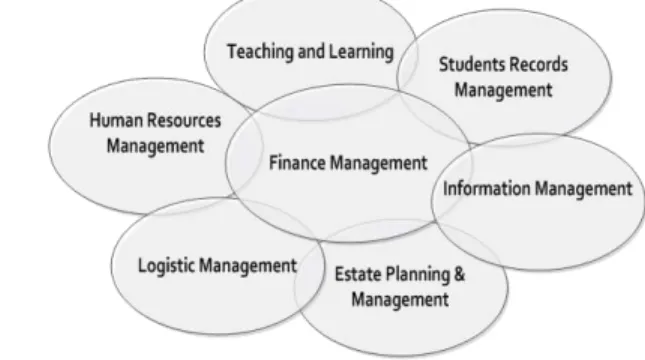
Top level process mapping undertaken at the two case study universities studied to date (Misurata and Al-Mergab) suggests that seven main organizational processes can be identified (Fig.1). This process map can act as a framework for assessing how ICTs are supporting these processes, each one of which can be broken down into two or more sub-processes. These processes appear to be fairly standard across the two universities studied to date, and derive from interviews with key staff and assessment of university departmental structures and operations.
Fig. 1. Top level processes at Misurata and Al-Mergab Universities
The overall picture is of organizations in the early stages of ICT adoption. There is some use of standalone office automation packages (word processors and spreadsheets) and there are some in-house developed systems, particularly for supporting the student records management and financial processes and functions. However, there are only very basic hard-wired networks, although these are currently being developed. Thus, systems are standalone and the use of email is limited. Both universities have a website, but only for providing basic information to the outside world. Knowledge and awareness of the capabilities of ICT is limited to a few individuals and there are but a few ICT training programmes for staff.
Systems profiling, based on interview responses and first hand assessment of systems performance, suggests the majority of information systems now in place are in need of replacement or major upgrade. The problem is particularly acute in the student management process where the three sub-processes are supported by a mix of in-house systems, developed in Visual Basic and the Delphi programming language with the aid of external programmers over the past 12 years, and ad hoc developments in MS Excel and MS WORD.
Fig. 2. Systems profiling in the student management process at Misurata University.
R = Red, in need of replacement
A = Amber, can possibly be retained, with upgrade/improvements
There is a basic local area network, which allows multi-user updates of these systems. In the engineering college, end-users have developed an in-house portal which allows students to edit and modify certain designated information regarding their courses and personal details. There is no electronic ID student card for identifying students as members of the university community. The in-house developed systems are not integrated nor interfaced with each other, leading to problems of data inconsistencies and multiple data updates. An assessment of these systems suggests they should be replaced, although the support spreadsheets and word-processed documents could remain (Fig. 2).
Similarly, the human resource management process is supported by an in-house developed system using the Visual Basic and Delphi programming languages, with an underpinning SQL database, introduced in 2006. This provided a great opportunity for keeping and reporting staff records, but it is a stand-alone system which is digitally isolated from the University’s networks. Data is gathered manually and organized by administrative staff using MS WORD or Excel before entry into the in-house system.
Fig. 3. Systems profiling in the human resources management process at Misurata University
A = Amber, can possibly be retained, with upgrade/improvements G = Green, strategically sound technology deployment
167 Copyright (c) IARIA, 2014. ISBN: 978-1-61208-346-9
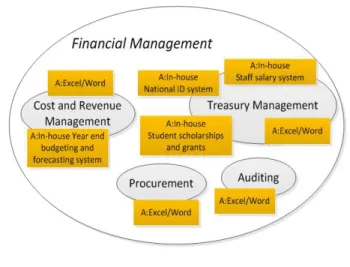
This is a time consuming process and there remains a high degree of manual and semi-manual processes and a lack of information sharing in the human resource management process (Fig. 3). The financial management process is arguably the most automated, with the majority of activities and procedures supported by systems developed in house (again in Visual Basic and Delphi) and/or in MS WORD and Excel. In house systems are the students scholarship and grants system; the national ID system; staff salary management; and year end budgeting. WORD and Excel systems are used for the preparation of disbursements; procurement; financial audit records; receipt and collection of various university incomes; cash rewards; grants and other activities. The university financial process and sub-processes are illustrated in Fig. 4.
Fig. 4. Systems profiling in the financial management process at Misurata University
A = Amber, can possibly be retained, with upgrade/improvements
ICT provision in the other processes at Misurata University follows a similar pattern, but in general is less well developed. The current ICT provision is a range of bespoke systems, running either in standalone mode or across disjointed networks, supported by ad hoc use of WORD and Excel. Use of email is limited to a few users, and there are no managed server based systems. From a strategic perspective, although WORD and Excel can be retained as strategically sound office automation tools, the majority of these systems are likely to be in need of replacement in the mid-term (3-5 year horizon).
Let us now discuss how appropriate existing models are for assessing the current and potential use of ICTs in Libyan universities (RQ2). Other studies [13][14] have applied Nolan’s model [21] to assess the overall status of the IT function in Libyan organizations. An assessment of the two universities studied to date indicates both universities are at or beyond the Contagion stage, but have not yet reached the Control stage, when a centralized IT department is established to plan, manage and control ICT implementation. There are however, some support functions within some of the process areas, notably the financial management process
at Misurata where systems support is combined with other job roles. The relatively limited impact of ICTs at process level and overall in the universities suggests that several of the models developed and applied in a developed world context may be inappropriate to gauge the current status of these universities. However, some of these models can be used as the basis for developing a new conceptual model with a better fit to the organizational and technology adoption situation in Libyan universities.
V. TOWARDS A NEW CONCEPTUAL MODEL FOR ICT
UTILISATION IN LIBYAN UNIVERSITIES
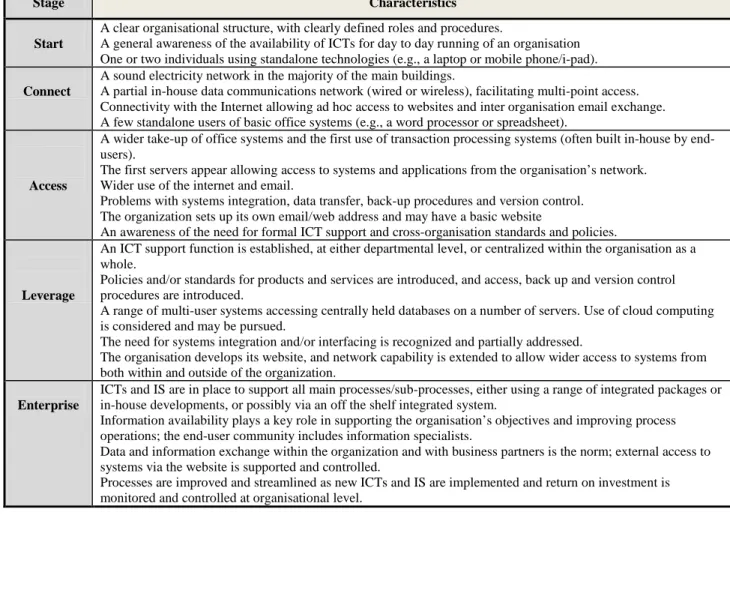
This section addresses RQ3: Can a new conceptual and operational model be developed for ICT utilization in universities in Libya? Research to date suggests a stage model which scales down the levels of organizational development and ICT deployment would be of value in assessing and comparing universities’ ICT utilization in Libya. A SCALE (start-connect-access-leverage-enterprise) model (Table II) is put forward as a useful provisional framework for further analysis. This model allows better differentiation of the use of ICTs at process level, compared with the application of other models, such as the CPIT model [11][16], which would show most processes registering relatively little progress.
Applying this model to Misurata University confirms that the three processes discussed above are the most advanced, with financial management being at the ‘leverage’ stage with the majority of staff working in this area using one or other of the deployed systems (Fig. 5). Learning and teaching, arguably the core university process where ICTs have the potential to radically improve the student learning experience, has some evidence of ICT utilisation in the classroom - computers, data shows, and related technologies. However, there is still no use of the internet (there is no connectivity) and no online course materials or lectures that can be accessed 24 hours a day, 7 days a week. In terms of the library resources, Misurata University is still in the early stage of ICT utilization – there is a library website, but access to learning resources is still reliant on printed books and other materials in the university site libraries. There is still a lack of electronic information on curriculum content and teaching materials that could be published and accessible via the Web, and there are neither e-learning applications nor educational portals in the University.
VI. CONCLUDING REMARKS
At the two Libyan universities studied so far, the utilization of ICTs remains limited and uncoordinated. There is a lack of electronic communication channels, such as email and web based media, networks are fragmented and systems are rudimentary and largely standalone. ICT knowledge and awareness is patchy amongst staff, and there has been a general lack of any overarching ICT strategy,
Characteristics Stage
A clear organisational structure, with clearly defined roles and procedures.
A general awareness of the availability of ICTs for day to day running of an organisation One or two individuals using standalone technologies (e.g., a laptop or mobile phone/i-pad). Start
A sound electricity network in the majority of the main buildings.
A partial in-house data communications network (wired or wireless), facilitating multi-point access. Connectivity with the Internet allowing ad hoc access to websites and inter organisation email exchange. A few standalone users of basic office systems (e.g., a word processor or spreadsheet).
Connect
A wider take-up of office systems and the first use of transaction processing systems (often built in-house by end-users).
The first servers appear allowing access to systems and applications from the organisation’s network. Wider use of the internet and email.
Problems with systems integration, data transfer, back-up procedures and version control. The organization sets up its own email/web address and may have a basic website
An awareness of the need for formal ICT support and cross-organisation standards and policies. Access
An ICT support function is established, at either departmental level, or centralized within the organisation as a whole.
Policies and/or standards for products and services are introduced, and access, back up and version control procedures are introduced.
A range of multi-user systems accessing centrally held databases on a number of servers. Use of cloud computing is considered and may be pursued.
The need for systems integration and/or interfacing is recognized and partially addressed.
The organisation develops its website, and network capability is extended to allow wider access to systems from both within and outside of the organization.
Leverage
ICTs and IS are in place to support all main processes/sub-processes, either using a range of integrated packages or in-house developments, or possibly via an off the shelf integrated system.
Information availability plays a key role in supporting the organisation’s objectives and improving process operations; the end-user community includes information specialists.
Data and information exchange within the organization and with business partners is the norm; external access to systems via the website is supported and controlled.
Processes are improved and streamlined as new ICTs and IS are implemented and return on investment is monitored and controlled at organisational level.
Enterprise
Fig. 5. SCALE model applied to Misurata University processes
The darker shading indicates the level or stage of ICT utilization in each process area. TABLE II.SCALEMODEL –STAGE CHARACTERISTICS
169 Copyright (c) IARIA, 2014. ISBN: 978-1-61208-346-9
with ICT spending and policies thus being ad hoc, short-term and limited in perspective.
As noted at the outset, there is a general lack of literature and particularly a lack of evaluation studies in developing countries. “Until very recently, the entire literature on IS and developing countries would struggle to fill a single bookshelf… those who have the will to evaluate, such as academics, often lack the resources and capacity” [22]. This research has developed an innovative framework for assessing ICT utilization in Libyan universities, building upon existing models designed for, and applied to, western technology environments. Research case studies in developing countries “help to elaborate such models and, in so doing, contribute to underlying theory… cases from developing countries therefore provide fertile ground for helping understand the complex interplay of action and context that underlies all organizational change” [17]. This research will further develop the framework in a number of ways. First, the existing model will be applied and refined in several other Libyan universities. Second, the other dimensions will be explored and incorporated into the model. This will include an evaluation and classification of the barriers that universities have to overcome to progress their utilization of ICTs, and it will also look at how processes and people skills must change, if these universities are to better exploit the benefits of modern information and communications technologies.
REFERENCES
[1] C. Yang and S. Lee, “Entry barrier’s difference between ICT and non-ICT industries”, Industrial Management & Data Systems, 113, (3), 2012, pp. 461-480.
[2] E.Turban, E.McLean, and J.Wetherbe, Information Technology for Management - Improving Quality and Productivity. New York: Wiley, 1996.
[3] Free Online Dictionary of Computing (FOLDOC), cited in Wikipedia.org
Available: http://en.wikipedia.org/wiki/Information_and_communi cations_technology. Retrieved: February, 2014.
[4] O. Espinoza and L. Gonzalez “Accreditation in higher
education in Chile”, Quality Assurance in Education, 21, (1), 2012, pp. 20-38.
[5] A. Elzawi and J. Underwood, “How Higher Engineering Researchers in Libya Perceive the Use of Internet Technology”. In: Proceedings of The International Arab Conf. on Information Technology, University of Garyounis, Benghazi, Libya, December 2010, pp. 89-98.
[6] ITU, ICT adoption and prospects in the Arab region, Geneva: ITU Press office, 2012.
[7] A. Kumar and M. Arteimi, “Potential Opportunities, Barriers and Enablers to Use E-Learning within Libyan Medical Educational Institutions”, The New York Times, 20th March, 2009. [8] A. Rhema and I. Miliszewska, “Towards E-Learning in Higher Education in Libya”, Issues in Informing Science and Information Technology, 7, 2010, pp. 423-437.
[9] Monitor Group, National Economic Strategy, 9th February 2006. United Kingdom: pp. 140-147.
[10] M. Wynn and O. Olubanjo, “Demand-supply chain management: systems implications in an SME packaging business in the UK”, International Journal of Manufacturing Research, vol. 7, no. 2, 2012, pp. 198-212.
[11] M. Wynn, P. Turner, and E. Lau, “E-business and process change in the UK SME sector”, Journal of Small Business and Enterprise Development, vol. 20, iss. 4, 2013, pp. 913-933. [12] Libyan Ministry of Higher Education (LMOHE), Libyan
Universities. Available at: http://highereducation.gov.ly/?page_id=108 [Accessed:
November, 2012].
[13] O. Sharkasi and M. Wynn, "Deployment evaluation of accounting information systems in Libyan commercial banks”, The African Journal of Information Systems, vol. 3, iss. 3, 2011, pp. 87-106.
[14] H. Akeel, M. Wynn, and S. Zhang, “Information systems deployment in Libyan oil companies: two case studies”, Electronic Journal of Information Systems in Developing Countries, (EJISDC), vol. 59, iss. 4, 2013, pp. 1-18.
[15] Department of Trade and Industry (DTI), Business in the information age: International Benchmarking Study 2001, London: Booz Allen Hamilton, 2001.
[16] M. Taylor and A. Murphy, “SMEs and e-business”, Journal of Small Business and Enterprise Development, 11, (3), 2004, pp. 280-289.
[17] R. Heeks, “Information Systems and Developing Countries: Failure, Success, and Local Improvisations,” The Information Society, 18, 2002, pp.101–112.
[18] M. Saunders, P. Lewis, and A. Thornhill, Research methods for business students, 5th edn., 2009, England: Pearson Education Limited.
[19] R. K. Yin, Applications of Case Study Research. 3rd edn, 2012, London: SAGE Publications, Inc.
[20] H. Al-Mobaideen, “ICT diffusion in Jordanian universities”. In: Proceedings of the European and Mediterranean Conference on Information Systems, Izmir, Turkey, July 2009, pp. 13-14. [21] R. L. Nolan, “Managing the crisis in data processing”, Harvard Business Review, 57 (2), Mar-April, 1979, pp. 115-126. [22] R. Gomez and S. Pather, “ICT Evaluation: are we asking the right questions”, Electronic Journal of Information Systems in Developing Countries (EJISDC), 50, 5, 2012, pp.1-14.