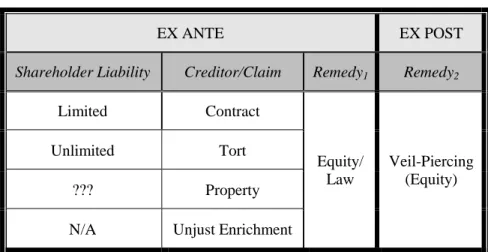
89
P
ETERB.
O
H∗I
NTRODUCTION... 90
I.
L
IBERATINGP
IERCING FROM THEV
EIL... 96
A.
Delimiting Liability ... 97
B.
Disclaiming Piercing ... 105
II.
R
ECONCEIVINGP
IERCING... 113
A.
Demystifying the Constructive Trust ... 113
B.
Dismantling the Alternatives ... 118
III.
P
IERCING VIA THEC
ONSTRUCTIVET
RUST... 123
A.
One Dimension ... 124
B.
Two Dimensions ... 127
C.
Three+ Dimensions ... 131
C
ONCLUSION... 136
Veil-piercing is an equitable remedy. This simple insight has been lost over
time. What started as a means for corporate creditors to reach into the
personal assets of a shareholder has devolved into a doctrinal black hole.
Courts apply an expansive list of amorphous factors, attenuated from the
underlying harm, that engenders under-inclusive, unprincipled, and
unpredictable results for entrepreneurs, litigants, and scholars alike.
Veil-piercing is misapplied because it is misconceived. The orthodox
approach is to view veil-piercing as an exception to limited liability that is
justified potentially only when the latter is not, a path that invariably leads to
examining scenarios based on different types of creditors/claims, corporations,
and shareholders. But the occasion to seek derivative relief from a shareholder
arises only when a claim cannot be enforced against a defendant corporation.
Veil-piercing is thus a secondary remedy, detached from limited liability and
its rationales.
To fix veil-piercing, corporate law must look beyond itself. For centuries the
law of restitution has featured the constructive trust, an equitable remedy that
disgorges misappropriated assets from unjustifiably enriched parties. This
Article novelly re-conceives veil-piercing as constructive trust and
∗ Associate Professor of Law, University of Pittsburgh School of Law. B.A., Yale
College; J.D., The University of Chicago. E-mail: [email protected]. I thank Steven A. Bank, Douglas M. Branson, Mirit Eyal-Cohen, Andrew Kull, David Millon, Greg Mitchell, as well as participants from a Distinguished Lecture at Queen Mary University of London School of Law and the 2011 Annual Meeting of the Association of American Law Schools’ Section on Remedies, for their comments and suggestions.
demonstrates how its application to judgment-proof corporations can yield
more coherent and effective results.
I
NTRODUCTIONVeil-piercing is an equitable remedy. This simple insight has been lost over
time. Since the dawn of modern civilization, corporations have been able to
enshroud themselves in a “veil” of limited liability.
1And by the early
nineteenth century, courts began to “pierce” this veil to reach into the personal
assets of a shareholder.
2Today, veil-piercing has become one of the most
litigated issues within corporate law,
3permeating the entire business
landscape, from ordinary transactions to environmental disasters.
4But from its inception, veil-piercing has been an abysmal failure. There is
no uniform test for veil-piercing, which typically requires demonstrating that a
corporation was an “alter ego” or “instrumentality,” controlled or dominated
by a shareholder to perpetuate a fraud, wrong, or injustice that proximately
caused loss or injury to a plaintiff.
5To apply this complex test, courts have
compiled an expansive list of ex post fact-specific factors, none of which is
dispositive, weighted, or necessarily related to the underlying harm.
6And then there are the metaphors. Despite Justice Cardozo’s venerable
caution that “[m]etaphors in law are to be narrowly watched, for starting as
devices to liberate thought, they end often by enslaving it,”
7veil-piercing has
1 Incarnations of limited liability can be found in early Byzantine, Islamic, and Roman
law. See, e.g., Timothy P. Glynn, Beyond “Unlimiting” Shareholder Liability: Vicarious
Tort Liability for Corporate Officers, 57 VAND.L.REV. 329, 336 & nn.20-22, 337 & nn.23-24 (2004) (delineating origins and citing sources).
2 In the United States, the “cradle” of veil-piercing, KAREN VANDEKERCKHOVE,PIERCING
THE CORPORATE VEIL 76 (2007), vestiges of the practice can be traced back to 1809, see Bank of the U.S. v. Deveaux, 9 U.S. (5 Cranch) 61, 75 (1809) (“[I]t is said that you may raise the veil which the corporate name interposes and see who stand behind it.”); Fairfield Cnty. Tpk. Co. v. Thorp, 13 Conn. 173, 179 (1839) (“There are cases . . . in which courts have drawn aside the veil and looked at the character of the individual corporators . . . .”).
3 Peter B. Oh, Veil-Piercing, 89 TEX.L.REV. 81, 90 n.59 (2010).
4 See, e.g., FRANKLIN A. GEVURTZ, CORPORATION LAW § 1.5, at 69 (2d ed. 2010)
(describing veil-piercing as “the area of corporation law which the attorney seeking to avoid corporate practice is most likely to confront”); see also United States v. Bestfoods, 524 U.S. 51, 61-64 (1998) (fashioning a variant of veil-piercing for claims brought under the Comprehensive Environmental Response, Compensation, and Liability Act of 1980 (CERCLA)).
5 FREDERICK J. POWELL, PARENT AND SUBSIDIARY CORPORATIONS: LIABILITY OF A
PARENT CORPORATION FOR THE OBLIGATIONS OF ITS SUBSIDIARY § 3, at 4-6 (1931).
6 See, e.g., Associated Vendors, Inc. v. Oakland Meat Co., 26 Cal. Rptr. 806, 813-15
(Dist. Ct. App. 1962) (listing twenty factors); Cathy S. Krendl & James R. Krendl, Piercing
the Corporate Veil: Focusing the Inquiry, 55 DENVER L.J. 1, 52-55 (1978) (listing thirty-one factors).
enabled judges to unleash their inner poet. The imagery of a corporate “alter
ego” or “instrumentality” has proven too seductive for courts to resist engaging
in “jurisprudence by metaphor or epithet,”
8liberally conjuring up a mish-mash
of gilded allusions.
9All of this has exacted a steep price from entrepreneurs and litigants.
Somehow they must navigate their way through an “incoherent”
10and
“intellectually disturbing”
11doctrine that more closely resembles a tolerated
evil than a preferred good. The task of justifying veil-piercing has been
described as “an exercise in futility: an attempt to articulate doctrinal standards
for an area all too often characterized by ambiguity, unpredictability, and even
a seeming degree of randomness.”
12Not surprisingly, this has prompted calls
to discard the doctrine altogether.
13Veil-piercing is misapplied because it is misconceived. For about a century,
veil-piercing has been regarded as an exception to, and thus “inextricably
linked with[,] the predicate principle of limited liability. Hence, what one
makes of veil piercing depends in the first instance on one’s view of limited
liability.”
14Pursuant to this view, veil-piercing is justified potentially only
when limited liability is not.
This stems from limited liability being framed as loss-allocation.
15The
orthodox approach defines the scope of shareholder liability according to its
distributive impact on different types of creditors/claims, corporations, and
shareholders.
16And nowhere is the approach more apparent than within
empirical studies of veil-piercing. Published two decades ago, the seminal
8 PHILLIP L.BLUMBERG,THE LAW OF CORPORATE GROUPS:PROCEDURAL PROBLEMS IN
THE LAW OF PARENT AND SUBSIDIARY CORPORATIONS 8 (1983).
9 See, e.g., HARRY G.HENN &JOHN R.ALEXANDER,LAWS OF CORPORATIONS § 146, at
344 n.2 (3d ed. 1983) (listing some of the “verbal characterizations, epithets, and metaphors” in which “judicial opinions indulge”); see also People v. Clauson, 41 Cal. Rptr. 691, 694 (Dist. Ct. App. 1965) (“If the corporation . . . has been acting as a juristic monkey to help pull the stockholder[’]s income-chestnuts out of the [income-tax-law-]fire then the court will deal with the stockholder-cat as though it was the corporation-monkey’s paw.” (quoting Albert Lévitt, Disregarding the Corporate Entity in Tax Cases, 22 TAXES 457, 458 (1944))); cf. THIS IS SPINAL TAP (Spinal Tap Prod. 1984) (“The musical growth of this band cannot even be charted. They are treading water in a sea of retarded sexuality and bad poetry.” (quote from character Marty diBergi, played by Rob Reiner)).
10 David Millon, Piercing the Corporate Veil, Financial Responsibility, and the Limits of Liability, 56 EMORY L.J. 1305, 1381 (2007).
11 ROBERT CHARLES CLARK,CORPORATE LAW 38 (1986).
12 Stephen M. Bainbridge, Abolishing Veil Piercing, 26 J.CORP.L. 479, 507 (2001). 13 Id. at 535; Douglas C. Michael, To Know a Veil, 26 J.CORP.L. 41, 42 (2001). 14 Bainbridge, supra note 12, at 481; see also infra Part I.
15 See infra Part I.B.
16 See, e.g., Bainbridge, supra note 12, at 487 fig.1; Michael, supra note 13, at 46 (“[I]t
was recognized that veil-piercing cases could be productively analyzed if divided by the type of case or plaintiff.”).
study is designed entirely from loss-allocation analysis,
17and that path has
been followed by all subsequent empirical veil-piercing studies.
18But this is a path to hell,
19dependent upon mistaken assumptions.
20The
orthodox approach posits a mutually exclusive choice between limited or
17 Robert B. Thompson, Piercing the Corporate Veil: An Empirical Study, 76 CORNELL
L.REV. 1036, 1044 (1991) (examining approximately 1600 veil-piercing cases according to whether they arose from contract, criminal, statutory, or tort claims; involved close or public corporations; and targeted corporate or individual shareholders); see also infra notes 98-106 and accompanying text.
18 See Christina L. Boyd & David A. Hoffman, Disputing Limited Liability, 104 NW.U.
L.REV. 853, 877 (2010) (examining 690 federal district court cases from 2000 to 2005); Nicholas L. Georgakopoulos, Bankruptcy Veil-Piercing: Bypassing Broken Nodes?, 27 EMORY BANKR.DEV.J. 471, 473-75 (2010) (extrapolating from West Key Number searches of 244,258 contract and/or tort cases from 1947 to 2010); Nicholas L. Georgakopoulos,
Contract-Centered Veil Piercing, 13 STAN.J.L.BUS.&FIN. 121, 129 (2007) (extrapolating from West Key Number searches of 175,316 contract and/or tort cases from 1947 to 2003); Lee C. Hodge & Andrew B. Sachs, Empirical Study, Piercing the Mist: Bringing the
Thompson Study into the 1990s, 43 WAKE FOREST L.REV. 341, 347 (2008) (sampling 228 cases from 1986 to 1995); John H. Matheson, The Modern Law of Corporate Groups: An
Empirical Study of Piercing the Corporate Veil in the Parent-Subsidiary Context, 87 N.C.L. REV. 1091, 1108 n.5, 1110 (2009) (examining 360 parent-subsidiary cases from January 1, 1990 to March 1, 2008); Richmond McPherson & Nader Raja, Empirical Study, Corporate
Justice: An Empirical Study of Piercing Rates and Factors Courts Consider When Piercing the Corporate Veil, 45 WAKE FOREST L.REV. 931, 940 (2009) (sampling 236 cases from 1996 to 2005); Geoffrey C. Rapp, Preserving LLC Veil Piercing: A Response to Bainbridge, 31 J.CORP.L. 1063, 1068, 1071-72 (2006) (examining sixty-one limited liability company rulings from 1997 to 2005); see also Charles Mitchell, Lifting the Corporate Veil in the
English Courts: An Empirical Study, 3 COMPANY FIN.&INSOLVENCY L.REV. 15, 20-24, app. at 24-28 (1999) (examining 290 British cases from 1859 up to and including 1998); Ian Ramsay & David B. Noakes, Piercing the Corporate Veil in Australia, 19 COMPANY &SEC. L.J. 250, 261 (2001) (examining 104 Australian cases up to and including 1999); Peter B. Oh, Piercing v. Lifting 9, 14 (Nov. 17, 2012) (unpublished manuscript) (on file with author) (examining 188 British cases from 1888 up to and including 2006). There have been, however, some minor refinements to Thompson’s loss-allocation approach. See, e.g., Boyd & Hoffman, supra, at 886-901 (parsing various substantive claims and reorganizing data by type of creditor).
19 Cf. PERCY BYSSHE SHELLEY,PROMETHEUS UNBOUND 37 (Lawrence John Zillman ed.,
Yale University Press 1968) (1820) (reinterpreting in poetic form the classic play by Aeschylus, Prometheus Bound, about the banishment and then liberation of Prometheus, whom Shelley envisioned to resemble Satan, in that he “leads us to weigh his faults with his wrongs, and to excuse the former because the latter exceed all measure,” but whom Shelley also thought distinctly represented “the type of the highest perfection of moral and intellectual nature, impelled by the purest and the truest motives to the best and noblest ends”).
20 Cf. Paul A. David, Clio and the Economics of QWERTY, 75 AM.ECON.REV. 332, 332
(1985) (“A path-dependent sequence of economic changes is one of which important influences upon the eventual outcome can be exerted by temporally remote events,
unlimited liability, in which veil-piercing serves to correct misallocated loss.
21On one level the choice is false because limited liability continues to be upheld
even in scenarios where it is broadly recognized to be unjustified.
22From a
positive and normative standpoint, there is thus no basis to presume that
efficiency-based rationales for limited liability necessarily govern
veil-piercing. On another level the choice is incomplete because analysis of limited
liability is preoccupied with the law of obligations, that is, claims by contract
and tort creditors.
23From an empirical and theoretical standpoint, the current
framework does not or cannot account for, respectively, property and unjust
enrichment, the remaining two pillars of private law.
24These problems reflect a deeply flawed conception of veil-piercing. For if
the analysis for limited liability is so clear and compelling, why is unlimited
liability analysis such a convoluted inquiry? To date, no one has supplied a
satisfactory answer.
25The reason may be that everyone apparently has
forgotten that veil-piercing originated as an equitable procedure to remedy the
problem of unenforceable judgments. The earliest forms of shareholder
liability were envisioned as incidental provisional relief, available only when
none could be had from a corporation.
26Accordingly, whether an initial claim
lay in contract, property, tort, or unjust enrichment against a corporation had
no ultimate bearing on whether liability should be imposed on a shareholder.
Veil-piercing thus was detached from the question of corporate liability.
In this light the shambled state of veil-piercing is hardly a surprise. Over the
years there have been incessant attempts to rehabilitate veil-piercing. Some
have argued for codifying the common law test in the hope that legislative
guidance and statutory interpretation might constrain courts.
27Others instead
including happenings dominated by chance elements rather than systematic forces.”); O.W. Holmes, The Path of the Law, 10 HARV.L.REV. 457, 472-73 (1897).
21 See, e.g., Frank H. Easterbrook & Daniel R. Fischel, Limited Liability and the Corporation, 52 U. CHI. L. REV. 89, 109 (1985) (“The [veil-piercing] cases may be understood, at least roughly, as attempts to balance the benefits of limited liability against its costs.”); see also infra notes 53-60 and accompanying text.
22 See infra Part I.A.
23 Cf. RUDOLPH SOHM,THE INSTITUTES:ATEXTBOOK OF THE HISTORY AND SYSTEM OF
ROMAN PRIVATE LAW § 77, at 371 (James Crawford Ledlie trans., Oxford at the Clarendon Press 3d ed. 1907) (“An obligation arises either from a declaration of consensus, i.e. ex contractu, or from an act done in contravention of the law, i.e. ex delicto.”); id. (acknowledging that the category does not comprise even the entire universe of possible obligatory-esque claims, including “obligationes quasi ex contractu” and “obligationes quasi ex delicto” (internal quotation marks omitted)); infra Part I.B.
24 See, e.g., JAMES GORDLEY, FOUNDATIONS OF PRIVATE LAW: PROPERTY, TORT,
CONTRACT,UNJUST ENRICHMENT 3 (2006); see also infra notes 121-130 and accompanying text.
25 Cf. infra note 183. 26 See infra Part I.
have focused on simplifying the test, proposing ways to distill the universe of
existing factors into their essential ingredients.
28But all of these approaches
are premised on loss-allocation analysis. Until this conceptual path linking
veil-piercing and limited liability can be extirpated, the prospect of a cogent
remedy will remain illusory.
To fix veil-piercing, corporate law must look beyond itself. And to find the
solution, one need look no further than Justice Cardozo, who regarded
conventional veil-piercing with such eloquent contempt.
29Years before
dallying with veil-piercing, Cardozo had coronated the constructive trust as
“the formula through which the conscience of equity finds expression.”
30For
centuries the law of restitution has provided courts with this means to enforce
Forcing the Common Law Doctrine into the Statutory Age, 70 U. CIN. L. REV. 95, 96 (2001); John H. Matheson & Raymond B. Eby, The Doctrine of Piercing the Veil in an Era
of Multiple Limited Liability Entities: An Opportunity to Codify the Test for Waiving Owners’ Limited-Liability Protection, 75 WASH.L.REV. 147, 152 (2000). But see, e.g., I. MAURICE WORMSER,DISREGARD OF THE CORPORATE FICTION AND ALLIED CORPORATION
PROBLEMS 37-38 (1927) (dismissing this idea as “not only impossible but preposterous”). Nevertheless, there have been some legislative attempts to control veil-piercing. See, e.g., Oh, supra note 3, at 121-23 (analyzing the effects of numerous revisions to article 2.21A of the Texas Business Corporation Act, which imposes an actual fraud requirement on veil-piercing claims grounded in contract).
28 See, e.g., Bainbridge, supra note 12, at 535 (advocating a test partially derived from
the factors of fraud and siphoning of funds, on the basis that “these tests are workable”); see
also infra Part III.A-B.
29 See supra note 7 and accompanying text. Cardozo’s eloquence ironically obscured, if
not undermined, his own attempt to fix veil-piercing. See Berkey v. Third Ave. Ry. Co., 155 N.E. 58, 61 (N.Y. 1926) (“The logical consistency of a juridical conception will be indeed sacrificed at times, when . . . essential to the end some accepted public policy may be defended or upheld.”); STEPHEN B.PRESSER,PIERCING THE CORPORATE VEIL § 1:4, at 1-24, 1-21 (2004) (“Shrouding his own analysis irretrievably in the mists of metaphor,” Cardozo’s “ringing phrases, when analyzed, yield little of substance.”). Cardozo’s proposed test essentially relies on basic agency principles, supplemented with public policy, to thwart a perceived “perversion” of limited liability as a state-conferred privilege; premised on this now-defunct concession theory, the test has suffered the same fate. See, e.g., Bainbridge,
supra note 12, at 495 (“It has been over half-a-century since corporate legal theory, of any
political or economic stripe, took the concession theory seriously.”); Michael, supra note 13, at 57 (“It makes no logical sense to base veil-piercing in a theory of corporate privilege.”).
30 Beatty v. Guggenheim Exploration Co., 122 N.E. 378, 380 (N.Y. 1919); see also
Meinhard v. Salmon, 164 N.E. 545, 548 (N.Y. 1928) (“A constructive trust is . . . the remedial device through which preference of self is made subordinate to loyalty to others.”). Indeed, the new Restatement of Restitution is modeled upon Cardozo’s conception of the constructive trust. RESTATEMENT (THIRD) OF RESTITUTION &UNJUST ENRICHMENT § 55(1) cmt. a (2011) (“The remedy described by § 55 is intended to be the same, in scope and in function, as the remedy described by Cardozo.”).
judgments by disgorging misappropriated assets from the hands of
unjustifiably enriched parties.
31At first blush the match seems perfect to even the most jaded skeptic. Never
have two remedies been so misunderstood. Like veil-piercing, the constructive
trust has been denigrated as a troubled child of equity.
32Moreover, the
constructive trust has been banished from the family of ordinary trusts,
33forced to reside within the shadowy world of quasi-law.
34And, to make
matters even worse, the constructive trust involves elements of unjust
enrichment, the shifty relative everyone knows but prefers to avoid.
35But in truth the constructive trust is what veil-piercing should be. Over time,
veil-piercing has been stripped of its equitable nature and remedial structure.
36These attributes, however, pristinely remain with the constructive trust, which
can supply alternative relief to an inferior, initial remedy in either equity or
31 See RESTATEMENT (THIRD) OF RESTITUTION &UNJUST ENRICHMENT § 55(1) (“If a
defendant is unjustly enriched by the acquisition of title to identifiable property at the expense of the claimant or in violation of the claimant’s rights, the defendant may be declared a constructive trustee . . . of the property in question and its traceable product.”); RESTATEMENT (FIRST) OF RESTITUTION:QUASI-CONTRACTS AND CONSTRUCTIVE TRUSTS § 160 (1937) (“Where a person holding title to property is subject to an equitable duty to convey it to another on the ground that he would be unjustly enriched if he were permitted to retain it, a constructive trust arises.”); infra note 142.
32 Cf. infra notes 143-149 and accompanying text.
33 See, e.g., RESTATEMENT (FIRST) OF RESTITUTION: QUASI-CONTRACTS AND
CONSTRUCTIVE TRUSTS § 160 cmt. a (“Constructive trusts are not dealt with in the Restatement of Trusts . . . .”); 5 AUSTIN WAKEMAN SCOTT &WILLIAM FRANKLIN FRATCHER, THE LAW OF TRUSTS § 461, at 300-02 (4th ed. 2006) (examining why constructive trusts are covered by the Restatement (First) of Restitution).
34 Other condemned cohabitants of this world include quasi-contracts and quasi-torts. See infra note 147. But cf. PETER BIRKS,AN INTRODUCTION TO THE LAW OF RESTITUTION 30 (1985) (“The common law has found no use for quasi-tort.”). Birks notes “‘[q]uasi-’ and ‘constructive’ have the same sense,” which is aptly captured by one of his “sillier Oxford stories”:
The college’s rules forbid the keeping of dogs. The Dean keeps a dog. Reflecting on the action to be taken, the governing body of the college decides that the labrador is a cat and moves to next business. That dog is a constructive cat. Deemed, quasi- or fictitious, it is not what it seems. When the law behaves like this you know it is in trouble, its intellect either genuinely defeated or deliberately indulging in some benevolent dishonesty. . . . If cuckoos had to be quasi-thrushes or constructive blackbirds we should know less about them.
Id. at 22.
35 The shiftiness can be attributed partially to the status of restitution, which is often
interchanged with unjust enrichment, as a substantive claim and a remedy. See, e.g., RESTATEMENT (THIRD) OF RESTITUTION &UNJUST ENRICHMENT § 1 cmt. e (“A liability in unjust enrichment (restitution) is enforced by restitution’s characteristic remedies . . . and a claim in unjust enrichment (restitution) is subject to characteristic defenses.”).
law.
37Accordingly, the constructive trust’s principles and rationales operate
independently of whatever kind of creditor/claim, corporation, or shareholder
is within the original suit.
And the constructive trust is not just lipstick on the veiled pig. Unlike
loss-allocation, the constructive trust concerns the location of benefit, namely
whether retention of a misappropriated asset is justified.
38Further, unlike
veil-piercing, this inquiry is not restricted to a shareholder, but instead follows and
traces a disputed asset to its ultimate holder.
39Moreover, once that holder has
been designated a constructive trustee, the plaintiff is conferred proprietary
rights to the asset.
40And when the constructive trustee is insolvent, these rights
take priority over any general unsecured creditors;
41indeed, although not a
necessary condition, bankruptcy is the context where the constructive trust
excels.
This Article novelly re-conceives veil-piercing as constructive trust. Part I
evinces how the orthodox approach to veil-piercing as an exception to limited
liability has no positive or normative merit, either empirically or theoretically.
Part II proceeds to introduce the constructive trust and demonstrate its
superiority over prominent alternatives. Part III concludes by showing how the
constructive trust can be applied to a triad of classic veil-piercing scenarios in a
more principled manner and with more effective outcomes than the current
approach.
I. L
IBERATINGP
IERCING FROM THEV
EILLimited liability has been romanticized to mythical proportions. Capping the
personal risk of shareholders has been hailed as “the greatest single discovery
of modern times”
42and “one of the first principles of American law.”
43These
lofty accolades are bolstered by rationales so compelling that they have framed
37 See infra Part II.A.
38 See infra notes 145-46, 159 and accompanying text. 39 See infra notes 165-67 and accompanying text. 40 See infra notes 189-92 and accompanying text. 41 See infra notes 193-96 and accompanying text.
42 NICHOLAS MURRAY BUTLER, WHY SHOULD WE CHANGE OUR FORM OF GOVERNMENT?
82 (1912) (“Even steam and electricity are far less important than the limited liability corporation, and they would be reduced to comparative unimportance without it.”); see also WORMSER, supra note 27, at 14 (“[M]any immigrants doubtless possess full knowledge of th[e] fact [that limited liability is the greatest advantage of incorporation] before coming within hailing distance of the Statue of Liberty.”).
43 PRESSER, supra note 29, § 1.1, at 1-4 to -5 (“It is now accepted as one of the first
principles of American law that those who own shares in corporations . . . normally are not liable for the debts of their corporations.”); see also William W. Cook, “Watered Stock” –
Commissions – “Blue Sky Laws” – Stock Without Par Value, 19 MICH.L.REV. 583, 583 n.4 (1921) (quoting President of Harvard University Charles William Eliot: “[T]he privilege of limited liability [is] the corporation’s most precious characteristic. [And it] is by far the most effective legal invention for business purposes made in the nineteenth century . . . .”).
and governed limited liability’s primary exception, veil-piercing. The question
of when a shareholder should be held liable personally for corporate debts is
answered by determining when limited liability is not justified. This invariably
leads to analysis of various scenarios, based on different types of
creditors/claims, corporations, and shareholders.
This Part shows how this path has been paved with mistaken notions. The
first Section evinces the illogic of conceiving limited liability in exclusive
terms with veil-piercing qua unlimited liability. The second Section then
exposes the illegitimacy of analyzing veil-piercing in connection with different
types of creditors/claims or corporations. After this conception and analysis are
shown to be dead ends that must be abandoned, piercing is left standing alone
as a post-judgment equitable remedy, independent of the veil of limited
liability and its rationales.
A. Delimiting Liability
The rationales for limited liability have mutated over time. Prior to 1809,
when the first general incorporation statute was enacted, unlimited liability
apparently was the initial default rule.
44But the advent of the War of 1812
provided a patriotic reason for states to limit the liability of shareholders as a
means of making the corporate form accessible to entrepreneurs of all kinds
and means.
45Roughly a century later, with the shift from a concessionary to
contractarian paradigm for conceiving the firm, the justifications for limited
liability correspondingly embraced a modern preference for economic
efficiency.
46Today, those principles unquestionably govern not only limited
liability, but its chief exception, veil-piercing.
One justification for limited liability is enhanced firm governance. The
characteristic separation between corporate ownership and control inherently
generates agency costs.
47Managers have an incentive to minimize these costs
44 See Act of Mar. 3, 1809, ch. 65, § 6, 1809 Mass. Acts 464, 466; Oscar Handlin &
Mary F. Handlin, Origins of the American Business Corporation, 5 J.ECON.HIST. 1, 10 (1945) (“Examination of contemporary Anglo-American law . . . strikes at the very roots of the common assumption that limited liability was always an essential attribute of corporateness . . . .”); Morton J. Horwitz, Santa Clara Revisited: The Development of
Corporate Theory, 88 W.VA.L.REV. 173, 208 (1985) (“[T]ruly limited shareholder liability was far from the norm in America even as late as 1900.”).
45 PRESSER, supra note 29, § 1:3, at 1-14 to -15 (arguing that limited liability served “as a
means of encouraging the small-scale entrepreneur, and of keeping entry into business markets competitive and democratic. Without [limited liability], it was believed, only the very wealthiest men . . . could possess the privilege of investing in corporations.” (emphasis omitted)).
46 See id. at 1-16 (“[W]hether or not the democratic justification has since been lost sight
of, the economic argument of the public’s potential gains from a policy of limited liability . . . has remained the primary justification for limited liability.”); Larry E. Ribstein, Limited
Liability and Theories of the Corporation, 50 MD.L.REV. 80, 83-84, 130 (1991).
because unrestricted transferability provides dissatisfied shareholders with an
option for disinvestment.
48Limited liability not only promotes such
transferability, but also permits managers to pursue more profitable projects
due to the capped risk for shareholders.
49As a result, investors can assume a
passive role with respect to monitoring the firm and their fellow shareholders’
solvency.
50Another justification for limited liability is more facile shareholding. With
the amount of risk restricted to the purchase price, shares can be a fungible and
normalized reflection of different firms’ value.
51And by stabilizing the extent
of total liability, investors can reduce risk even further by diversifying their
stock portfolios.
52In this way limited liability stimulates broad participation
within capital markets.
These well-established economic rationales all share a basic premise. As
Stephen Presser has noted, “[t]he principal thrust of law and economics
analysis of limited liability has been to demonstrate that the rule is more
efficient than a rule of unlimited liability.”
53In contractarian terms the issue
assumes the form of a hypothetical ex ante bargaining session that asks: “If the
shareholders and creditors could costlessly bargain . . . would they adopt a rule
of limited or unlimited personal liability?”
54The choice seems quite natural,
Behavior, Agency Costs and Ownership Structure, 3 J.FIN.ECON. 305, 308 (1976).
48 Easterbrook & Fischel, supra note 21, at 94-95 (“The costs of the separation of
investment and management (agency costs) may be substantial. . . . Investors individually respond to excessive agency costs by disinvesting.”).
49 Id. at 97 (“[M]anagers maximize investors’ welfare by investing in any project with a
positive net present value. They can accept high-variance ventures . . . without exposing the investors to ruin.”). Some might prefer to say “externalized” rather than “capped” risk. Nina A. Mendelson, A Control-Based Approach to Shareholder Liability for Corporate Torts, 102 COLUM.L.REV. 1203, 1206, 1239 (2002) (“[T]he presence of a controlling shareholder likely will prompt a corporation to externalize more costs than if the corporation’s equity is diffusely held by many very small shareholders.”). But see Easterbrook & Fischel, supra note 21, at 98 (“Limited liability is an arrangement under which the loss largely lies where it falls. Loss is swallowed rather than shifted.”).
50 See David W. Leebron, Limited Liability, Tort Victims, and Creditors, 91 COLUM.L.
REV. 1565, 1570-74 (1991).
51 See Paul Halpern et al., An Economic Analysis of Limited Liability in Corporation Law, 30 U.TORONTO L.J. 117, 129-31 (1980).
52 Henry G. Manne, Our Two Corporation Systems: Law and Economics, 53 VA.L.REV.
259, 262 (1967) (“One of the great advantages of the large corporate system is that it allows individuals to use small fractions of their savings for various purposes, without risking a disastrous loss if any corporation in which they have invested becomes insolvent.”).
53 PRESSER, supra note 29, § 1:7, at 1-35 (emphasis added).
54 Bainbridge, supra note 12, at 486-87; see also Richard A. Posner, The Rights of Creditors of Affiliated Corporations, 43 U.CHI.L.REV. 499, 522 (1976) (suggesting that one test for disregarding limited liability due to corporate misrepresentation “would be to differentiate among types of creditors in terms of their information costs”). Stephen Presser asserts that Posner “is simply developing an argument, the inappropriateness of piercing the
given the historical prominence of unlimited liability,
55as well as its default
status in the event of defective incorporation.
56Along these lines, the merits of
any prospective increase in shareholder liability are to be measured against the
costs of sacrificing limited liability.
57Indeed, this premise girds the relation between limited liability and
veil-piercing. Because the latter results in joint and several liability for
shareholders, its net effect mimics pure unlimited liability.
58Accordingly, the
orthodox approach is to conceptualize veil-piercing qua unlimited liability as a
contiguous exception to limited liability.
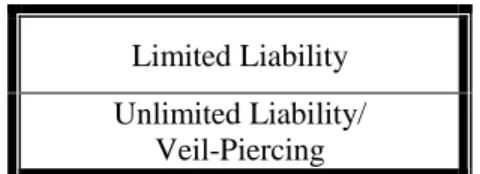
Figure 1. Limited Liability – Veil-Piercing
Limited Liability
Unlimited Liability/
Veil-Piercing
Figure 1 simply depicts the conventional view that, “[o]nce the appropriate
limits of limited liability are understood, veil piercing can police those limits.
That understanding, however, depends on a sound sense of the policy basis for
limited liability . . . .”
59Indeed, some have even argued that the difficulties
with veil-piercing are the product of “a failure to identify what is at stake in a
veil piercing case: the very principle of limited liability for the shareholders.”
60veil in a contractual context, already advanced by [Frederick] Powell.” PRESSER, supra note 29, § 1:7, at 1-38.
55 See supra notes 44-45 and accompanying text.
56 Fred S. McChesney, Doctrinal Analysis and Statistical Modeling in Law: The Case of Defective Incorporation, 71 WASH. U.L.Q. 493, 496-97 (1993) (characterizing defective incorporation as a subset of veil-piercing). But see Timothy R. Wyatt, Note, The Doctrine
of Defective Incorporation and Its Tenuous Coexistence with the Model Business Corporation Act, 44 WAKE FOREST L.REV. 833, 847-51 (2009) (criticizing McChesney’s assertion).
57 There are, however, alternatives to limited liability. See, e.g., Easterbrook & Fischel, supra note 21, at 101-03 (assessing the possibility of investor insurance purchased by the
firm).
58 Henry Hansmann & Reinier Kraakman, Toward Unlimited Shareholder Liability for Corporate Torts, 100 YALE L.J. 1879, 1932 (1991) (“[V]eil-piercing is itself simply a form of unlimited liability.”). But cf., e.g., Leebron, supra note 50, at 1578-79 (“Liability in excess of a corporation’s assets might be assessed against shareholders either on a joint and several or on a pro rata basis. . . . However, any joint liability rule probably would be coupled with a contribution rule. . . . [Joint liability coupled with contribution, in some aspects, would be] equivalent to a pro rata rule . . . .” (footnote omitted)).
59 Millon, supra note 10, at 1311; see also supra note 14 and accompanying text.
The principle, however, has its own limitations. A common distinction for
limited liability concerns its justifications for close versus public
corporations.
61Unlike their close peers, shareholders of public corporations
tend to be passive investors that enjoy the benefit of unrestricted
transferability.
62Accordingly, the corporate governance justifications for
limited liability would seem to be stronger in the publicly held context.
63And yet public corporations do present a moral-hazard problem.
64Limited
liability gives managers an incentive to pursue overly risky projects that inure
to shareholders.
65Further, moral hazard tends to be even more pervasive when
there are affiliates or subsidiaries,
66a common setup for public corporations.
67Questions in Bankruptcy, 42 U.CHI.L.REV. 589, 620 (1975).
61 Easterbrook & Fischel, supra note 21, at 109-10 (“The distinction between close and
public corporations is supported by economic logic. . . . This has profound implications for the role of limited liability.”); Manne, supra note 52, at 278 (“As we begin to examine the differences between [these two types of] corporations, it becomes apparent that the two are extremely dissimilar.”).
62 Cf. Manne, supra note 52, at 279 (“Participants in a small business have a very real
interest in knowing and controlling the identity of other participants. Thus it is not surprising to find that restrictions on share transferability are very common with small corporations.”).
63 Millon, supra note 10, at 1314 (“The argument for limited liability may be less
compelling as to shareholders of close corporations than as to those of publicly held companies.”). Certainly, the distinction enjoys considerable empirical support, as every veil-piercing study has found that plaintiffs prevail exclusively against close corporations. E.g., Oh, supra note 3, at 110 tbl.3 (finding a 0.00% veil-piercing rate in four cases involving a public corporation); Thompson, supra note 17, at 1055 tbl.7 (finding a 0.00% veil-piercing rate in nine cases involving a public corporation); Robert B. Thompson, Piercing the Veil
Within Corporate Groups: Corporate Shareholders as Mere Investors, 13 CONN.J.INT’L L. 379, 384 (1999) (updating his 1991 study with an additional ten years of cases, and still finding that “[p]iercing the veil is a doctrine directed exclusively at close corporations and corporate groups”). This finding, however, serves less to vindicate limited liability’s rationales, and more to reflect the reality that public corporations tend to feature disperse shareholding that in turn precludes a sufficient level of control or domination to justify veil-piercing. See, e.g., GEVURTZ, supra note 4, § 1.5.3, at 78 (“[R]equiring control screens out piercing against the shareholders of a publicly traded corporation . . . . This provides a doctrinal underpinning to explain the fact that there never has been a case in which the court pierced to hold shareholders in a public corporation liable for the company’s debts.”).
64 The moral-hazard problem is not restricted to publicly held corporations. On the
contrary, the problem arguably is more pernicious within the closely held context. Halpern et al., supra note 51, at 141 (stating that the moral hazard problem “is likely to be more severe for small, tightly held companies than for larger companies”). The point here is merely to illustrate that, even within the most compelling scenarios, efficiency-based justifications do not determine the complete scope of limited liability.
65 Id. at 140-41.
66 Easterbrook & Fischel, supra note 21, at 111 (“[T]he moral-hazard problem is
probably greater in parent-subsidiary situations because subsidiaries have less incentive to insure.”); Leebron, supra note 50, at 1617, 1619 (“With regard to integrated subsidiaries,
Accordingly, there is a broad consensus that limited liability should not apply
in these situations.
68This consensus, however, does not rest on efficiency grounds. Under the
shareholding rationale,
69imposing joint and several liability for mass risk
would discourage investment, as well as open the door to judgment-proof
firms.
70And, under the corporate-governance rationale, the loss due to mass
risk presents no direct concern to shareholders, provided agency costs are
relatively low.
71On balance, then, limited liability should apply to firms that
engage in mass-risk activities, even when they have a negative net social
value.
72The unpalatable nature of this conclusion, even for the staunchest
there is little reason to respect the separate corporate entities when noncontractual tort claimants are involved. . . . It is unclear what justifies the legal presumption against veil piercing between related corporations on behalf of noncontractual creditors.”).
67 Lynn M. LoPucki, The Death of Liability, 106 YALE L.J. 1, 21 (1996) (“Th[e]
parent-subsidiary ownership strategy is in wide use among the largest companies in America. Most large companies consist of numerous corporate entities. Limiting liability – that is, defeating part of it – is the principal reason for creating those entities.” (footnote omitted)).
68 E.g., Mendelson, supra note 49, at 1204 (“There is little disagreement that limited
shareholder liability for corporate torts can encourage socially costly corporate activity – risky activity selected because the corporation and its shareholders do not bear all the expected costs of the activity.” (footnote omitted)); id. at 1204 n.2 (citing sources). A notable few, however, maintain an agnostic position. See, e.g., Easterbrook & Fischel, supra note 21, at 104 (“Externalization of risk imposes social costs and thus is undesirable. The implications of this point, however, are unclear, both because modifying limited liability has its costs and because moral hazard would exist without limited liability.”).
69 See supra notes 51-52 and accompanying text.
70 See Bainbridge, supra note 12, at 492 (“[I]t would be prohibitively costly for the
creditor of a corporation to bring individual suits against thousands of geographically diverse investors.”); Hansmann & Kraakman, supra note 58, at 1903 (“There is no doubt that unlimited liability . . . would increase the cost of equity. . . . If shareholders faced joint and several liability for all corporate debts . . . these costs might be very large.”). Along with numerous other commentators, Hansmann and Kraakman instead provocatively propose a regime of pro rata liability. Id. at 1903 & n.69. Not everyone agrees with this proposal, however. See, e.g., Bainbridge, supra note 12, at 496-500 (criticizing the proposal and citing other critical sources). The proper scope and form of limited liability are beyond the purview of this paper; the point here is merely that limited liability and its rationales do not extend logically to veil-piercing.
71 See supra notes 47-50 and accompanying text. To be sure, shareholders would be
concerned if mass risk resulted in a diminished share price, but the effect is indirect as such liabilities would be diluted and spread over time, during which there would be ample opportunity for exit.
72 See Hansmann & Kraakman, supra note 58, at 1883 (“Since limited liability permits
cost externalization, a corporation engaged in highly risky activities can have positive value for its shareholder, and thus can be an attractive investment, even when its net present value to society as a whole is negative.”). A useful parallel is the theory of efficient breach of contracts. See Richard Craswell, Contract Remedies, Renegotiation, and the Theory of
proponents of limited liability,
73belies that limited liability’s “real policy
basis . . . does not appear to be efficiency. Instead, the goal seems to be to
promote investment by transferring risk from investors to creditors.”
74This is
the apparent goal of legislatures, which uniformly embrace broad limited
liability.
75Consequently, the task of minimizing moral hazard has fallen to
courts, which have imposed liability on corporate agents in specialized
scenarios.
76But this is not veil-piercing. Pure veil-piercing enables a plaintiff to reach
the personal assets of only a shareholder.
77From a strict efficiency standpoint,
courts can and should impose liability on a shareholder that induces a
corporation to generate mass risk with a negative net value. Liability in these
situations is directed at corporate agents, such as directors and officers, and yet
still analyzed within the veil-piercing rubric.
78And because the remedy is
designed for shareholders, courts have had to adapt the multiple factors that
already bear little, if no, connection with the underlying harm.
79As a result,
remedies depart in one direction or the other from the ‘ideal’ of perfect compensation, the prospect of inefficient breaches . . . would seem to loom large.”).
73 See supra note 49.
74 Millon, supra note 10, at 1317.
75 See Bainbridge, supra note 12, at 500 (highlighting that states apparently refuse to
repeal limited liability “for mass torts, or indeed, torts of any kind” and that “[t]he availability of limited liability in related contexts . . . likewise has been reaffirmed”); Millon, supra note 10, at 1314 (“Corporate statutes all confer limited liability in general terms. . . . There is no distinction between contract- and tort-based claims or between closely held or public corporations.”).
76 See infra note 80.
77 Helen Anderson, Piercing the Veil on Corporate Groups in Australia: The Case for Reform, 33 MELB.U.L.REV. 333, 342 (2009) (“‘Pure’ veil-piercing occurs where liability is imposed simply because a legal person occupies the position of a shareholder.”).
78 Cf. United States v. Bestfoods, 524 U.S. 51, 64-67 (1998) (examining vicarious
liability provisions within CERCLA). With unanimous support Justice Souter acknowledged that, “whereas the rules of veil piercing limit derivative liability for the actions of another corporation, CERCLA’s ‘operator’ provision is concerned primarily with direct liability for one’s own actions.” Id. at 65. The Court, however, ultimately rejected the suggestion from courts and commentators that an “indirect, veil-piercing approach can subject a parent corporation to liability only as an owner, and not as an operator” under CERCLA. Id. at 64 n.10.
79 See supra note 6 and accompanying text. In Bestfoods, for instance, the Court realized
that the amorphous veil-piercing standards for parent-subsidiary control could not be adapted to directors and officers, and instead fashioned an even more nebulous test:
[T]he presumption that an act is taken on behalf of the corporation for whom the officer claims to act is strongest when the act is perfectly consistent with the norms of corporate behavior, but wanes as the distance from those accepted norms approaches the point of action by a dual officer plainly contrary to the interests of the subsidiary yet nonetheless advantageous to the parent.
limited liability has spawned a group of cases that look and stumble like
veil-piercing, but in fact are not.
80This mutation belies how limited liability and veil-piercing are misaligned.
The rationales for limited liability justify its preservation within a broad range
of scenarios.
81But that justification does not quadrate perfectly with the scope
of veil-piercing qua unlimited liability:
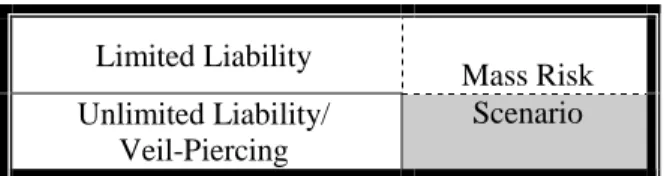
Figure 2A. The Mass Risk Scenario
82Limited Liability
Mass Risk
Unlimited Liability/
Veil-Piercing
Scenario
Figure 2A depicts the mass risk scenario as an area where limited liability
applies, albeit unjustifiably, while the shaded box represents the gap where
courts have attempted to stretch veil-piercing beyond its original form with
distortive results. The problem, however, cannot be ascribed to just a
misapplication of veil-piercing; somewhat understandably courts have elected
the path of least resistance by exploiting a malleable common law test for
veil-piercing rather than chipping away at the statutory strictures of limited
liability.
Rather, the principal culprit is a mistaken premise that limited liability and
veil-piercing are mutually exclusive. The moral-hazard problem highlights the
relevance of broad policy considerations, in addition to efficiency, to
determining the proper scope of limited liability. In the specific case of mass
stating that it was not an “attempt to recite the ways in which the Government could show that dual officers or directors were in fact acting on behalf of the parent.” Id.
80 See, e.g., Worth v. Tyler, 276 F.3d 249, 262 (7th Cir. 2001) (rejecting application of
“alter ego” theory for individual liability under Title VII); UA Local 343 of the United Ass’n of Journeymen v. Nor-Cal Plumbing, Inc., 48 F.3d 1465, 1475 (9th Cir. 1994) (“The alter ego doctrine as developed in labor law is analytically different from the traditional veil-piercing doctrine as developed in corporate law.”); Lumpkin v. Envirodyne Indus., Inc., 933 F.2d 449, 461 (7th Cir. 1991) (“[T]he corporate veil may be pierced more easily in ERISA cases . . . to promote the federal policies underlying the statute . . . .”); Morris Okun, Inc. v. Harry Zimmerman, Inc., 814 F. Supp. 346, 348 (S.D.N.Y. 1993) (distinguishing statutory trust for sellers and suppliers under the Perishable Agricultural Commodities Act “from the piercing the veil doctrine”); Comm’r v. RLG, Inc., 755 N.E.2d 556, 563 (Ind. 2001) (“The responsible corporate officer doctrine is distinct from piercing the corporate veil, and explicitly expands liability beyond veil-piercing.”).
81 See, e.g., sources cited supra notes 61-63 and accompanying text.
82 Mass risk is merely one example of the misalignment between limited liability and
veil-piercing. Another scenario concerns affiliate or sibling entities owned by a common shareholder. See infra Part III.C.
risk, a choice is posed between stimulating corporate investment and protecting
social welfare.
83Courts currently misframe the choice in terms of whether to
impose personal liability on corporate agents.
84But even if the inquiry were
focused properly on shareholders, the competing policies implicated by mass
risk have no bearing on whether veil-piercing will occur. Instead a myriad of
independent and unweighted factors determine whether a judgment against a
corporation will be satisfied by resort to personal assets.
85The application and
scope of veil-piercing thus are detached from the dynamics of the moral hazard
problem, which accounts for the unpredictable and unprincipled doctrinal state
of affairs.
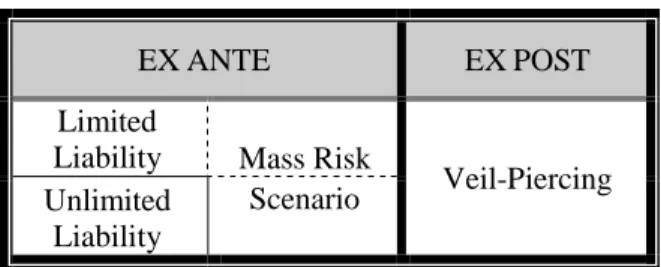
Instead, shareholder liability should be conceived as a balancing test. On the
one hand, whether liability should be applied on a limited or unlimited basis is
an ex ante inquiry, which turns on efficiency and policy considerations.
86On
the other hand, whether creditors should be awarded relief from a
shareholder’s (or agent’s) personal assets is an ex post inquiry, which involves
traditional veil-piercing or some other kind of remedy.
87These inquiries,
therefore, should be de-linked:
Figure 2B. The Mass Risk Scenario Redux
EX
ANTE
EX
POST
Limited
Liability
Mass Risk
Veil-Piercing
Unlimited
Liability
Scenario
To be sure, a regime of unlimited liability has the same ultimate effect as
veil-piercing, in that a shareholder is personally responsible for corporate
debts;
88conversely, for that shareholder, veil-piercing does entail displacing
83 See supra notes 69-75 and accompanying text.
84 See supra note 76 and accompanying text; cf. Leebron, supra note 50, at 1587 (“Even
assuming that shareholders who would be held liable will cause managers to act efficiently in taking potential losses into account . . . there may be costs to unlimited liability that outweigh its benefits.”).
85 See supra note 6.
86 See supra notes 50-57, 69-75 and accompanying text.
87 Kevin M. Warsh, Corporate Spinoffs and Mass Tort Liability, 1995 COLUM.BUS.L.
REV. 675, 696 (describing “what Professor [Reinier] Kraakman calls ‘ex post remedies,’ a series of legal doctrines that further protect contract creditors from the management and equityholders: veil-piercing, fraudulent conveyance law and equitable subordination”); see
also infra Part II.B.
limited liability. But the present approach to veil-piercing does not take into
account whether limited liability is justified. And there is no necessary logical
relationship between the propriety of protecting the corporate form and
awarding a remedy such as veil-piercing.
89B. Disclaiming Piercing
The conceptual shadow cast by limited liability has stunted veil-piercing in
another crucial way. Pursuant to the conventional view, the scope of
veil-piercing can be defined simply by determining the scenarios where limited
liability is justified. To organize these scenarios, scholars began to classify
veil-piercing cases based on different types of substantive claims. What was
once a scheme borne largely from convenience, however, has become an
integral, but deficient, feature of veil-piercing analysis.
The approach originated with William Douglas and Carrol Shanks.
90Their
early analysis of parent-subsidiary cases framed shareholder liability in terms
of loss-allocation: “The issue is whether the loss resulting from a contract or
tort claim against the subsidiary will be placed on it or the parent. . . . For
analytical reasons the cases will be grouped according to whether the claim is
tort or contract.”
91Those analytical reasons subsequently were articulated by
Elvin Latty, who observed that parent-subsidiary liability cases
present narrower issues, to be solved by principles . . . [that] follow[]
more or less beaten paths in fields of law often quite remote from that of
stockholder liability. . . . Many of the cases that purport to be, or are cited
as being, decided upon a broad ground of stockholder’s liability really
involve the stockholder’s own torts or contracts.
9289 This can be gleaned by the uncertainty over whether veil-piercing should be available
against unincorporated business entities. See Larry E. Ribstein, Reverse Limited Liability
and the Design of Business Associations, 30 DEL.J.CORP.L. 199, 216-19 (2005) (focusing on reverse-piercing, but also demonstrating how traditional veil-piercing is ill-equipped for asset partitioning within partnerships).
90 See William O. Douglas & Carrol M. Shanks, Insulation from Liability Through Subsidiary Corporations, 39 YALE L.J. 193, 194 (1929). One commentator has speculated that “[t]he trend toward principled analysis probably began with Alexander Hamilton Frey’s 1951 discussion of defective incorporation.” Michael, supra note 13, at 46 (citing Alexander Hamilton Frey, Legal Analysis and the “De Facto” Doctrine, 100 U.PA.L.REV. 1153, 1153 (1952)). Douglas and Shanks’ work, however, antedates Frey’s, which Michael admits is “not directly relevant to the veil-piercing issue.” Id.
91 Douglas & Shanks, supra note 90, at 194-95 (“The problem here is to ascertain the
manner of organization and operation which is necessary in order to secure the insulation from liability which the organizers desired and which the legal system permits. . . . On analysis the problem resolves itself into one of allocation of losses.”).
92 ELVIN R. LATTY, SUBSIDIARIES AND AFFILIATED CORPORATIONS: A STUDY IN
The distinction between contract and tort thus was introduced only to classify
various shareholder liability cases.
93Latty had the foresight to recast this distinction in terms of creditors. In his
view, the boundaries of contract and tort were drawn in ways that failed to
reflect differences between veil-piercing cases within the parent-subsidiary
context.
94Decades later, Henry Manne explained that the risk of corporate
insolvency simply represents a cost of doing business for voluntary creditors,
who have incentives to insure themselves, unlike involuntary creditors, who
are victims of unforeseeable harms.
95However drawn, the distinction continues to serve as a prism for identifying
scenarios when shareholder liability is justified.
96As one commentator has
observed, “modern veil-piercing analysis has created at least three types of
cases,” organized by the plaintiff’s original claim.
97This is most clearly
manifest within the methodology employed by the legion of empirical
veil-piercing studies. Loss-allocation analysis supplies the blueprint for Robert
Thompson’s seminal study, which collected data from approximately 1600
veil-piercing opinions on claims within four substantive areas: contract,
93 Cf. Holmes, supra note 20, at 462 (“If you commit a tort, you are liable to pay a
compensatory sum. If you commit a contract, you are liable to pay a compensatory sum unless the promised event comes to pass, and that is all the difference.”); Roy Kreitner,
Fault at the Contract-Tort Interface, 107 MICH.L.REV. 1533, 1534-37 (2009) (recounting how tort and contract law had “switch[ed] positions” with regard to fault by the late nineteen century, which contributed to the realignment of these two respective areas of private law “along the border between public regulation and private ordering”).
94 LATTY, supra note 92, § 49, at 201 (“To make the classification more significant, the
line of distinction should perhaps be drawn between involuntary and voluntary creditors, inasmuch as there may be some doubt as to whether . . . e.g., claimants under a breech [sic] of warranty, should be treated like those, say, who lend money to the subsidiary.”). Latty’s observation, however, tends to be disregarded in modern analysis. See, e.g., Bainbridge,
supra note 12, at 487 n.40 (using “the terms ‘contract creditor’ to encompass all classes of
voluntary creditors and ‘tort creditor’ to encompass all classes of involuntary creditors”); Millon, supra note 10, at 1316 (“Involuntary, or tort, creditors are in a quite different situation [than voluntary creditors with claims based on obligations arising out of contract].”).
95 See Manne, supra note 52, at 263 (“[A]t least in the case of voluntary creditors –
which certainly includes most business creditors – the risk of insolvency is regularly understood and, where significant, treated as any other cost. . . . This last explanation of limited liability does not account for the problem of the involuntary creditor, or . . . noncommercial creditors.”); see also Easterbrook & Fischel, supra note 21, at 107-09 (arguing that, with respect to involuntary creditors, the incentives for insurance are shifted to the corporation). But see Halpern et al., supra note 51, at 147 (“[M]erely because a creditor is ‘involuntary’ does not in every case conclude the case against limited liability.”).
96 The same function is performed by the conventional distinctions between closely and
publicly held corporations, as well as between individual and corporate shareholders. See
supra note 63; infra note 224. 97 Michael, supra note 13, at 54.
criminal, statute, and tort.
98And that basic approach has served as the template
for all subsequent empirical veil-piercing studies.
99Moreover, despite Thompson’s caution,
100his study ignited a controversy
about veil-piercing in relation to contract versus tort claims. The prevailing
view of courts and commentators, regardless of ideological stripe, long has
been that contract creditors should have less success with veil-piercing because
of the opportunity to assess and insure themselves from risk.
101Thompson’s
study, however, found that requests for veil-piercing occur and prevail
considerably more often when couched in contract than tort,
102a result that he
acknowledged, “more than any other in the project, go[es] against the
conventional wisdom.”
103My re-examination of opinions has restored the wisdom in favor of tort and
involuntary creditors, but even these results are unsatisfying. Federal and state
courts inexplicably still pierce in contract and voluntary creditor claims at rates
far higher than what one might expect, while the margin between these rates
and, respectively, tort and involuntary-creditor claims hardly reflects the
disparate strength of these rationales.
104Existing empirical data thus have
provided only part of the story about veil-piercing litigation.
10598 Thompson, supra note 17, at 1058 tbl.9 (reporting veil-piercing rates for contract,
criminal, statute, and tort claims); Robert B. Thompson, Piercing the Veil: Is the Common
Law the Problem?, 37 CONN. L. REV. 619, 628 (2005) (“Recognizing a corporation as separate from its shareholders is a way of allocating risk in a business transaction.” (emphasis omitted)); see also supra note 17 and accompanying text. But cf. Oh, supra note 3, at 94 nn.77-78 (noting that the approximate total dataset for Thompson’s study matches the total number of claims, manifesting a reduction of multiple claims within each opinion into one data entry).
99 See supra note 18.
100 Thompson, supra note 63, at 392 (“I would discourage devoting too much attention to
whether corporate law conflicts with tort law . . . .”).
101 E.g., PHILLIP I.BLUMBERG, THE LAW OF CORPORATE GROUPS:TORT,CONTRACT, AND
OTHER COMMON LAW PROBLEMS IN THE SUBSTANTIVE LAW OF PARENT AND SUBSIDIARY
CORPORATIONS §8.04, at 163 (1987) (“[V]ery special pressures in tort require a different treatment than [veil-piercing] cases arising in other areas of the law, such as contract.”); Easterbrook & Fischel, supra note 21, at 112 (“Courts are more willing to disregard the corporate veil in tort than in contract cases. . . . Contract creditors . . . are compensated ex ante for the increased risk of default ex post. Tort creditors, by contrast, are not compensated.”); Leebron, supra note 50, at 1601 (“[A]lmost every commentator has paused to note that limited liability cannot be satisfactorily justified for tort victims . . . .”).
102 Thompson, supra note 17, at 1058 tbl.9 (reporting a veil-piercing rate of 41.98% for
contract versus 30.97% for tort); Thompson, supra note 63, at 385 (reporting that “new data suggests that the judiciary is still reluctant to pierce the veil in tort cases”).
103 Thompson, supra note 17, at 1058; cf. PRESSER, supra note 29, § 1:7, at 1-36 n.5
(noting that Thompson’s results “appear to be on their way to becoming the conventional wisdom”).
104 See Oh, supra note 3, at 125 tbl.8 (finding a veil-piercing rate of 46.24% for contract
This may be because all of the studies share a conceptual deficiency. To
date, no one has classified veil-piercing opinions based on substantive claims
arising in either property or unjust enrichment.
106And these claims have been
neglected almost entirely by commentators.
107The neglect is curious,
particularly in light of the historical conception of shareholder liability as a
property-based mesne process.
108And the continued use of veil-piercing as an
equitable remedy should have exposed the incompleteness of an analysis
confined to contract and tort.
109The omission is due to our dependence on loss-allocation analysis. The
initial framing by Douglas and Shanks reflects their contemporary fancy with
splitting the unitary domain of obligations within Roman Law into contract and
tort along the lines of fault.
110While the line has been re-drawn by economic
analysis, the contract-tort divide continues to thrive within agency and, by
extension, corporate law.
111Pursuant to this orthodox approach, the scope of
voluntary creditors versus 52.83% for involuntary creditors).
105 Even an attempt to combat selection effects by analyzing veil-piercing dockets yields
materially similar results. See Boyd & Hoffman, supra note 18, at 886-901.
106 See supra note 18. Data for these claims are reported, if at all, within the diverse
category of statutory claims. See Oh, supra note 3, at 129 tbl.10 (reporting twenty-two real property and forty-nine remedial veil-piercing cases arising under a statute); see also Boyd & Hoffman, supra note 18, at 887 fig.7 (presenting cause-of-action data for “Equitable Solutions” and “Property Law,” as distinguished from “Enforcement Mechanisms,” “Other State Claims,” “Other Federal Claims,” and “Veil Piercing,” although the basis for that distinction is not clear and the categories are not necessarily of comparable scope).
107 But see Warner Fuller, The Incorporated Individual: A Study of the One-Man Company, 51 HARV.L.REV. 1373, 1397 (1938) (describing veil-piercing claims in property law); Jason W. Neyers, Canadian Corporate Law, Veil-Piercing, and the Private Law
Model Corporation, 50 U.TORONTO L.J. 173, 238 (2000) (“[I]f X would have been found liable under a general tort, contract, unjust enrichment, or statutory analysis, the court will find them liable through some sort of ‘veil-piercing.’”).
108 See, e.g., Act of Mar. 4, 1800, ch. 80, § 8, 1799 Mass. Acts 481, 484 (“[I]n any
judgment to be rendered against said Corporation, [a] Plaintiff, not being able to find any property of the Corporation to attach on mesne process, or whereon to levy his Execution, shall have the right of attaching or levying his Execution on any . . . individual Members of the Corporation, in the same manner as if the Action had been brought and the judgment rendered against them in their individual capacity.”).
109 See 1 WILLIAM MEADE FLETCHER ET AL., FLETCHER CYCLOPEDIA OF THE LAW OF
PRIVATE CORPORATIONS § 41.10, at 136-37 (perm. ed., rev. vol. 2006) (“A claim based on the alter ego theory is not in itself a claim for substantive relief, but rather is procedural. . . . It has been said that the alter ego doctrine is thus remedial, not defensive, in nature.”).
110 See supra note 23 and accompanying text. The influence of obligations on
loss-allocation analysis might explain why Thompson’s empirical study of veil-piercing did not recognize fraud as a separate substantive claim. See Oh, supra note 3, at 95-97.
111 See Caroline Bradley, Transatlantic Misunderstandings: Corporate Law and Societies, 53 U.MIAMI L.REV. 269, 279 (1999) (“[M]uch of corporate law is an adaptation of the rules of tort, contract, and agency to fit a special legal form . . . .”); Eric Rasmusen,
veil-piercing turns on a choice of whether shareholder liability should be
limited or unlimited,
112which then migrates into an analysis of different types
of creditors/claims.
Contributing to this migration is concern over the mass-risk scenario. Even
when analyzed by Ronald Coase,
113the prospect of third parties bearing risk
from corporate torts was more hypothetical than real. That started to change
two decades ago, setting the stage for Henry Hansmann and Reinier
Kraakman’s provocative proposal of a pro rata shareholder liability regime for
corporate t