Effect of Dividend Policy on Firm’s Performance:
A Case Study of Cement Sector of Pakistan
Abdur Rahman Abdul Wali Khan University, Mardan, Pakistan
The basic aim of this study is to investigate that whether the dividend policy makes an impact on the firm performance in Pakistan especially in cement sector. Data used have been collected from annual reports of the sample companies and website of Pakistan Stock Exchange from 2012 to 2016. The results of OLS indicate that there is an insignificant positive relationship between return on equity (ROE) and Dividend per share (D.P.S) which imply that by increasing cost dividend per share, return on equity increases for the selected companies. Furthermore, a significant positive relationship between earning per share (EPS) and return-on-equity (R.O.E) was found. In the case of firm size, significant relationship was found with ROE and financial leverage showed an insignificant relationship with firm performance (R.O.E). Hence this study supports the relevant theories of dividend policy.
Keywords: Earning-per-Share, Return-on-Equity, Dividend policy, Financial performance, Cement
sector
Introduction
Corporate finance comprises three main decisions: Financing decision, investment decision, and dividend decision. In dividend decision, firms decide about whether to retain the dividend or pay to shareholders and if retained, how much to retain. Dividends are cash payments which are made to the shareholders against their investment in the business. These dividends can take the shape of cash dividends as well as stock dividends, depending on the firm policy. Dividends are important in two ways. First, they offer a measure of actuality to the investors regarding the firm financial interest. Secondly, they are considered as a green signal to the market about the future performance of the firm. (Ong, Lim, Lim, Ow, & Tan, 2014) outlined the importance of dividend paying in their study for Malaysian firms. They argued that those firms which paying dividend were less likely to default and being unsafe as compared to non-dividend paying firms. Other researchers like (Lintner, 1956) also suggested in their study that previous year dividends and income impact the dividend policy of the organizations.
But on the other hand, there also exists the Dividend Irrelevance theory of M&M (Modigliani and Miller) which basically implies that dividends either have a less effect or no effect at all on stock price due to which stockholders are not concerned with a firm’s dividend policy. Numerous studies have documented a strong effect of dividend policy on the firm performance. Most of these studies have been undertaken in the developed countries however the focus of researchers is now shifting to under developed and developing countries like Pakistan. Dividend policies have not only changed over time but also changed across the countries, especially between developed and underdeveloped economy. (Jones, Willett, & Glen, 1995) discovered that dividend plans
and ratios are different in different economies. They describe that dividend disbursement ratios are approximately 2/3rd in developing countries as compared to that of developed countries.
The reason of conducting of this study is to further improve the arguments of dividend policy regarding developing economies by investigating the effect of dividend policy in Pakistan. Current studies have concentrated on the dividend behaviors of firms in developed economies like Germany, European Union, United States and Brazil but the data for developing countries are too limited.
In the case of Pakistan, (Mehar, 2005) and another researcher (Ahmed & Javid, 2008) both examined the effect of dividend policy but they have not considered the cash flow side that is debated by various researchers as an exponent finding of dividend policy. Moreover, the evidence on the effect of dividend policy frame on firm performance in Pakistan is also very limited. It means that the picture is incomplete, especially regarding the capital market of Pakistan. It is quite clear that the financial market of Pakistan shows a different picture than that of the developed countries’ capital markets.
The Firm Financial Performance
The aim of this study is to investigate the effect of dividend policy on firm performance in cement sector of Pakistan. Firm performance has been measured differently by different researchers. One such study conducted by (Iqbal, 2018) to show firm performance using stock exchange data. It depicts firm profit and loss and hence finding a picture which expresses a firm position in different sectors for a particular time frame. It shows that how a good firm is using its assets to increase the stockholder’s wealth or income. Financial performance is also measured in the form net income which can be broken down into two forms: dividend and retained earnings. The portion of retained earnings of the firm may be reinvested in the business while the portion of dividends are distributed among stockholders which increases their wealth. Apart from this angle, several other kinds of measurements have also been used but generally financial ratios are used to gauge the firm performance. In this study, firm performance has been measured through return on assets (ROA), return on equity (ROE) and EBT or net business profit.
Research problem
Dividend decision is one of the most critical decisions in corporate finance. It adds to the shareholders’ wealth and to the organizational value. That is the reason that numerous studies have been undertaken in this particular area. In Pakistan, there are not sufficient studies available which have investigated the effect of dividend policy on firm performance. Previous researchers have mainly focused on developed countries while for less developed countries like Pakistan, studies have been either conducted to less extent or no extent. This study has attempted to find out the effect of dividend policy on firm performance in cement sector of Pakistan
Literature Review
For the past fifty years, many theoretical and empirical studies have been carried out that led to three main results: variations in dividend payout have significant impact on the market price of the firm or the dividend policy of the firm does not affect the firm one way or the other. However, we can say that the actual witnesses on the findings of the dividend policy are regrettably blended.
“(Lintner, 1956) in which he finds out the changes in income and existing dividend rates are the most important results of a company’s dividend decision”. However, (Miller & Modigliani, 1961) proposed that in a stable market, usually dividends have no impact on the firm prices. Stockholders have not authority to receive cash in shape of dividend or capital gains for long term funds until the firm does not change its dividend policy. In this scenario, the company’s dividend payout is affected by the future free cash flows. If there is more cash to come in future, the company pay cash dividends and if the situation is the other way, the company gives shares instead of cash dividends. It also gives a green signal to the market abbot the future of the firm when a firm pay dividend.
(Gordon, 1963) introduced the bird in hand theory which means that a potential investor always prefers cash dividend over a capital gain. The agency theory of (Jensen & Meckling, 1976) states that are always issues between management and stockholders, which impact the dividend policy of the firm. Another researcher (Easterbrook, 1984) mentioned more details about the cost issues of agency theory which are divided into two categories: to control the cost and second is cost of risk hostile in regarding between manger and shareholders. (Olimalade A, 1987) focused on cash flows as to increase the shareholders’ wealth and equity. This is the type of return to stockholders on their funds which they invest in a firm and the main aim is to attract investment in the future for the firm. Dividends are often distributed among equity shareholders for both situations. This type of distribution is made after paying tax and mandatory payment of debt capital which shows the decrease in current assets of a firm (Kazman et al., 1998).
Therefore, the matter with the connection between firm performance and dividend policy, various researchers have described the impact of dividend policy on firm performance. But still broad concept has yet appeared after number of research studies as well as most of the researchers still don’t agree with the same results. Generally, dividend shows that how much a firm is stable. (Brigham EF, 2012) suggested that a firm’s dividend policy should be viewed as main decisive factor for a firm’s performance. (Baker & Wurgler, 2004) introduced a Catering theory suggesting that the managers have to encourage the investors as per their necessities and needs and along these lines, to furnish the financial investor by giving normal dividend of his investment when the investor put stock value premium on payers and by not paying when investor inclines toward non- payers. Dividend policy is a big problem in the corporate finance literature and still considered main factor both in developed and developing markets (Ahmed & Javid, 2008). So there are different researchers who have attempted to address the problem regarding the determinants of dividend policy yet despite everything, we don't have reasonable points of interest to observe the dividend behavior of a company. (Black, 1976; Ross, Westerfield, & Jordan, 2008). Dividend policy has been evaluated for a long time, however no generally acknowledged clarification for organizations checked on which dividend behavior have been built up (Peggs et al., 2011).
(Nduta Caroline N, 2016) studied on dividend policy which effect the financial performance of forms listed in Nairobi securities exchange find out that the major factors that affect financial performance of listed firms are timing of dividend payments and dividend payments. Other factors for example leverage and total assets and have no significant effect on the financial performance of a firm.”
(Velnampy, Nimalthasan, & Kalaiarasi, 2014) the results show that the dividend policy measures are not significantly correlated with dividend payout as dividend policy and earnings per share, return on equity and return on assets as firm performance measures.
(Enekwe, Nweze, & Agu, 2015) results suggest that dividend payout ratio (D.P.R) has positive relationship and dividend payout ratio (D.P.R) has statistically significant with Return on Asset (R.O.A) and Return on Capital
Employed (ROCE) while DPR has statistically insignificant with Return on Equity (ROE) of quoted cement companies in Nigeria. (Kanwal, 2017) the result of this study shows that there dividend payout positively influenced on financial performance of firm and also it is shows that the firm financial performance is influenced by the dividend policy. (Magnusson & Enebrand, 2018) the results show that the stock price of high dividend yield firms is more dependent on financial performance compared to low dividend yield firms. However, an overall positive correlation is found between stock price and financial performance. (EBIRE Kolawole, 2018) findings that retained earnings and dividend payout ratio positively impact earnings per share of listed oil and gas firms in Nigeria while dividend yield had a significant but negative effect on earnings per share. Based on this, the study therefore recommends that gas and oil firms willing to maximize shareholders wealth.
Dividend Irrelevance Theory
Modigliani and Miller introduced dividend irrelevance theory which means that with no charge of tax or default cost, dividend policy is unimportant. They argue that dividend policy has no effect on firm’s share value. Dividend irrelevance theory further explains that the investor could influence the return on a stock regardless of the stock’s dividend. For instance, from an investor’s point of view, if an organization's profit is too enormous then the investor can purchase more stock with the dividend as he desires. On the other hand, if an organization's profit is too limited then a potential investor can sell some of the organization’s stock to reproduce the cash as he wants. In short, investor doesn’t care about a firm’s dividend policy which means that dividend is unnecessary from investor’s perspective.
Bird-in-the-Hand Theory
Bird in hand theory states that dividends are less likely to default than capital gains so they are more secured. Usually investors prefer dividends over the capital gains (Amidu, 2007). (Gordon, 1963; Lintner, 1956) debated that investors prefer dividend against capital gains related to stocks. As the name of the theory implies the famous proverb “a bird in the hand is worth two in the bush," it says it all. And also, it depends on investor that how much he or she is risk taker or risk averse so chooses between the dividend and capital gains accordingly. Also, it has been observed that capital gains are taxed at higher rate than dividends. Moreover, dividends are a signal to the market about the financial position of the company. (Hussainey, Oscar Mgbame, & Chijoke-Mgbame, 2011) argued that despite of the tax drawback, management still manage to pay it to give a positive green signal to a market in case if investors have fear of uncertainty.
Signaling Theory
“Signaling theory” states that dividend policy would be considered as a mechanism to transfer information about a company’s future expectation to the investors. Paying dividend in cash gives valuable information to the stockholders as they don’t have much information regarding the future earnings of the company as compared to the management. This practice reduces information asymmetry. Therefore, investors can use this information to estimate the share value of a company.
Agency cost theory
Agency cost states that dividend policy is also regulated by the selfish conduct of the management. Management tends to choose the dividend policy which serves its own interest rather than to select those which boost the value of stockholders (DeAngelo, DeAngelo, & Stulz, 2006).
Theoretical Model
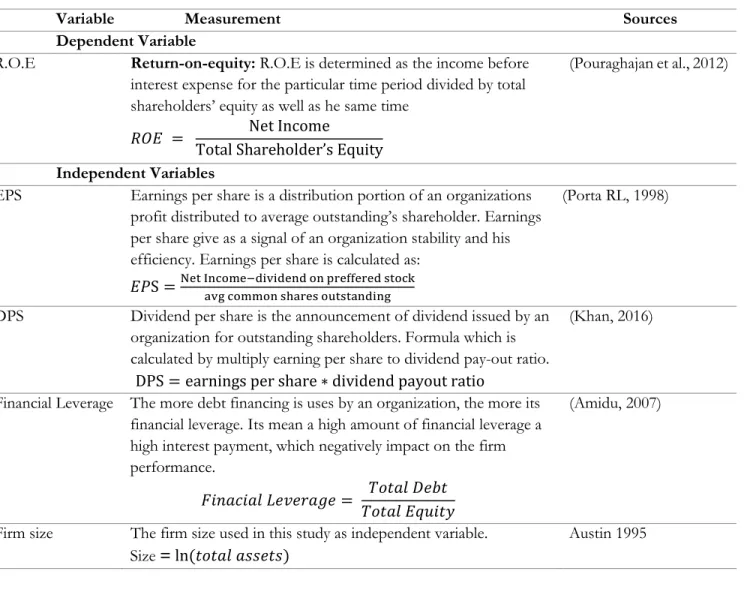
For the study theoretical model was derived after and expensive literature. Table 1 - Theoretical Framework metadata below is explaining how the dependent and independent variables were derived from the studies. Table 1 - Theoretical Framework metadata
Variable Measurement Sources
Dependent Variable
R.O.E Return-on-equity: R.O.E is determined as the income before
interest expense for the particular time period divided by total shareholders’ equity as well as he same time
𝑅𝑂𝐸 = Net Income
Total Shareholder’s Equity
(Pouraghajan et al., 2012)
Independent Variables
EPS Earnings per share is a distribution portion of an organizations profit distributed to average outstanding’s shareholder. Earnings per share give as a signal of an organization stability and his efficiency. Earnings per share is calculated as:
𝐸𝑃S =Net Income−dividend on preffered stockavg common shares outstanding
(Porta RL, 1998)
DPS Dividend per share is the announcement of dividend issued by an organization for outstanding shareholders. Formula which is calculated by multiply earning per share to dividend pay-out ratio.
DPS = earnings per share ∗ dividend payout ratio
(Khan, 2016)
Financial Leverage The more debt financing is uses by an organization, the more its financial leverage. Its mean a high amount of financial leverage a high interest payment, which negatively impact on the firm performance.
𝐹𝑖𝑛𝑎𝑐𝑖𝑎𝑙 𝐿𝑒𝑣𝑒𝑟𝑎𝑔𝑒 = 𝑇𝑜𝑡𝑎𝑙 𝐷𝑒𝑏𝑡 𝑇𝑜𝑡𝑎𝑙 𝐸𝑞𝑢𝑖𝑡𝑦
(Amidu, 2007)
Firm size The firm size used in this study as independent variable. Size = ln(𝑡𝑜𝑡𝑎𝑙 𝑎𝑠𝑠𝑒𝑡𝑠)
Methodology
The data used in this study is secondary data which has been collected from the annual reports of sample companies of cement sector and website of Pakistan Stock Exchange19 cement companies have been taken as sample. The cement sector is highly contribution in income of Pakistan. Even until no one researcher study on this sector that’s why I am the first that take a sample from this sector. Descriptive statistics have been used to check the behavior of the data. Mean, Median, Minimum, Maximum and Standard Deviation have been estimated for this purpose. Pearson’s correlation has been calculated to see the relationship among variables. In this study, model (1) are estimated to test hypothesis. Cost of debt, cost of equity, firm size and total debt ratio is added to the model as control variables for better clarity.
ROE = β_O + β_1 DPS + β (2) EPS + β_3 FIRM SIZE + β_4 FINANCIAL LEVERAGE + ε Where
ROE = Return on equity EPS = Earnings per share DPS = Dividend per share SIZE = Size of firm
F. Leverage = Financial leverage
ε = the remaining component of the firm (error term) β_O = Constant coefficient (intercept)
β_1, β_ 2, β_3 = coefficients of independent variables.
Hypotheses
H0: There is no relationship between dividend policy and firm value of cement sector in Pakistan.
H1: There is a significant relationship between dividend policy and firm value of cement sector in Pakistan.
Results and Discussions
The mean value for ROA is 0.091 in the range from -0.179 to 0.520 with standard deviation of 0.116. Similarly, ROE has the mean value of 0.225 in the range from -0.081to 1.050 and standard deviation of 0.173. Moreover,
Financial Performance (ROE) Earnings per share
Firm size Leverage Dividend per share
the average of dividend per share is 3.208 with the maximum value of 15.00 and the minimum value is 0.00 with standard deviation 3.290. The average earnings per share value for the cement sector is 7.737 with maximum value of 40.030 and minimum value of -5.340 with standard deviation of 9.801. Similarly, the mean values for firm size and financial leverage are 16.232 and 0.017 respectively, with the maximum values of 22.225 and 0.190 respectively and minimum of 9.577 and 0.011 with the standard deviation of 1.576 and 0.018 respectively.
Table 2 - Correlation Matrix
R.O. E DPS EPS ln Firm size F. leverage
R.O. E 1
DPS -0.03181 1
EPS 0.202** 0.517** 1
ln Firm size -0.165* 0.089** 0.29** 1
F. leverage 0.072* -0.00729 -0.068** 0.002964 1
This table show the correlation matrix calculated as Pearson correlation. The significance level follows as; ** significant at 1%, *significant at 5%.
To check the co-linearity among variables, in this study the correlation matrix and variance inflation factor (V.I.F) analysis have been used. The outcomes of co-relation matrix of all the variables are categorized in Table 2. The variables are, return-on-equity (R.O.E), earning-per-share (E.P.S), dividend-per-share (DPS), firm size and financial leverage. The correlation co-efficient of all variables are less than 0.7 which implies that the variables are not highly correlated to each other.
Regression Analysis
Before moving to the regression analysis, Hausman test was applied to check which model will be applied to the data.
Table 3 - The Hausman Test
Research models p-value Test result
Model (1) 0.002091 Fixed effect method
The above Table 3 - The Hausman Test shows the result of Hausman test. We can see that the P-value for model 1 is less than 0.05 hence we reject the null hypothesis H0 of random effect and accept the alternative hypothesis
H1 which represents the use of fixedeffects method. Usually, fixed effects method is accepted at the level of 95
percent.
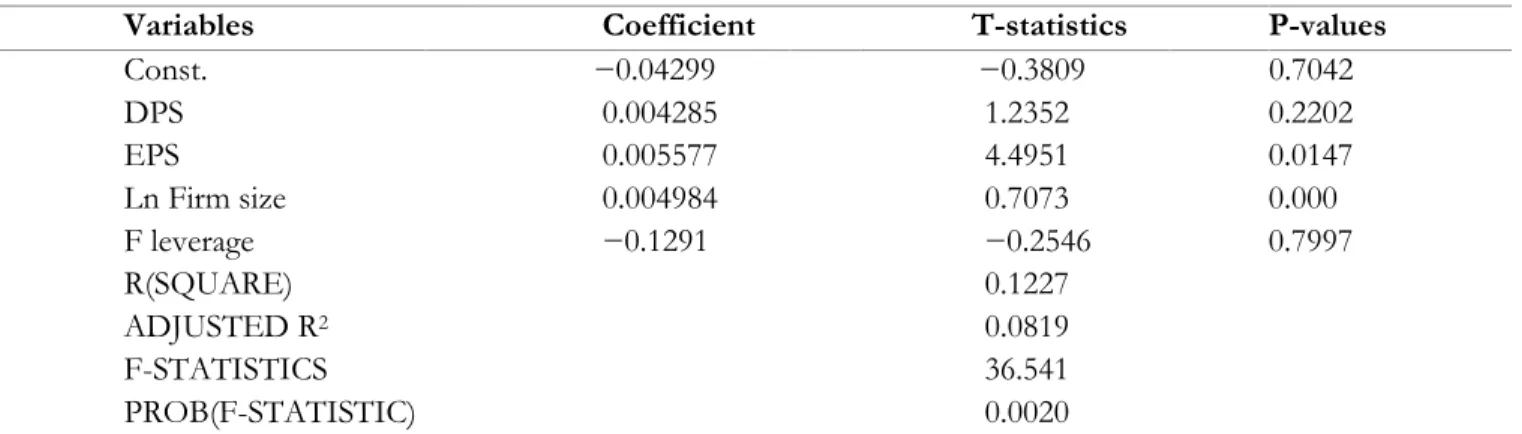
The results of regression in Table 4 - Regression Analysis show that the variable dividend per share (DPS) has a coefficient of 0.00428564 having p-value of 0.2202 which is greater than of .05. Therefore, it is concluded that there is positive but statistically insignificant relationship between Dividend per share (DPS) and return on equity (ROE). Moreover, there is a significant and positive relationship between earning per share (EPS) and return on equity (ROE). With the firm size there is also significant relation having p value less than .05. And lastly, the financial leverage has insignificant relationship having p value 0.7997 with return on equity.
The value of R2 is indicating that only 8.1% change in dependent variable is explained by the independent
variables. F value is 36.541 having a p value of less than .05 which shows that the model is statistically fit to establish the relationship.
Table 4 - Regression Analysis
Variables Coefficient T-statistics P-values
Const. −0.04299 −0.3809 0.7042 DPS 0.004285 1.2352 0.2202 EPS 0.005577 4.4951 0.0147 Ln Firm size 0.004984 0.7073 0.000 F leverage −0.1291 −0.2546 0.7997 R(SQUARE) 0.1227 ADJUSTED R2 0.0819 F-STATISTICS 36.541 PROB(F-STATISTIC) 0.0020
This table provides the result of regression model (fixed effect estimator) the dependent variable in the model is Return-on-Equity (R.O. E). The independent variables are given as: Dividend-per-share (D.P.S), Earning-per-share (EPS), firm size and financial leverage.
Conclusion
The main purpose of this study was to find out whether dividend policy has any significant effect on the performance of cement companies in Pakistan and whether this effect is positive or negative. For this purpose, a sample of 19 firms was chosen from cement sector and the data was taken for a period of 4 years i.e. from 2012 to 2016. Using the panel data (consolidate of cross-sectional and time-series data), ordinary least square (OLS) method was selected for estimating regression model.
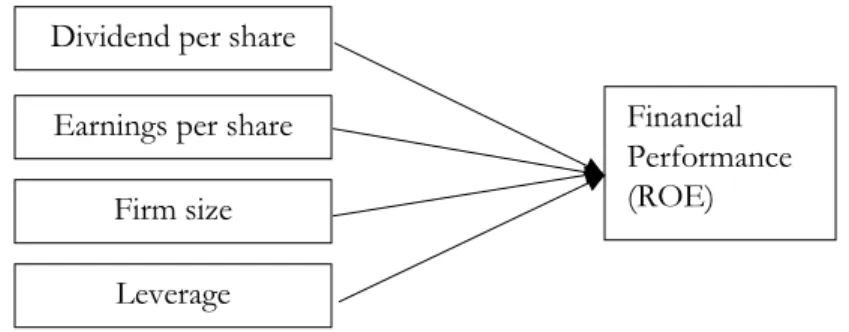
In the present study, Dividend Per Share (D.P.S), Earning Per Share (E.P.S), Firm size and Financial leverage were taken as the independent variables and return on equity (R.O.E) as dependent variable. Findings show that there is statistically insignificant and positive relationship between dividend per share (DPS) and return on equity (ROE). Which implies that if dividend per share is increased, the return on equity also increases and vice versa. Moreover, a significant positive relationship was found between earning per share (EPS) and return on equity (ROE) implying that if earnings per share are increased, return on equity will also increases. Also, a significant relationship was found between firm size and return on equity. At the end, an insignificant relationship was found in the case of financial leverage Therefore, this study supports the relevant theories of dividend policy.
In this research there are a few limitations. Firstly, our sample size is too small due to time constraint. Secondly, this study only uses OLS to estimate the penal data. Future researchers can use the multiple method and can work on other sectors as well. Also, other variables should also be considered other than those used in this study.
References
Ahmed, H., & Javid, A. Y. (2008). Dynamics and determinants of dividend policy in Pakistan (evidence from Karachi stock exchange non-financial listed firms).
Amidu, M. (2007). How does dividend policy affect performance of the firm on Ghana stock Exchange.
Investment Management and Financial Innovations, 4(2), 103-112.
Baker, M., & Wurgler, J. (2004). A catering theory of dividends. The Journal of finance, 59(3),
1125-1165.
Black, F. (1976). The dividend puzzle. Journal of portfolio management, 2(2), 5-8.
Brigham EF, H. J. (2012). undamentals of financial management: New York: McGraw Hill.
DeAngelo, H., DeAngelo, L., & Stulz, R. M. (2006). Dividend policy and the earned/contributed capital
mix: a test of the life-cycle theory. Journal of financial economics, 81(2), 227-254.
Easterbrook, F. H. (1984). Two agency-cost explanations of dividends. The American Economic Review,
74(4), 650-659.
EBIRE Kolawole, M. S. S., ONMONYA Lucky,. (2018). Effect of dividend policy on the performance of
listed oil and gas firms in Nigeria. International Journal of Scientific and Research Publications
(IJSRP), 8(6). doi: http://dx.doi.org/10.29322/IJSRP.8.6.2018.p7837
Enekwe, C. I., Nweze, A. U., & Agu, C. (2015). The effect of dividend payout on performance
evaluation: Evidence of quoted cement companies in Nigeria. European Journal of Accounting,
Auditing and Finance Research, 3(11), 40-59.
Gordon, M. J. (1963). Optimal investment and financing policy. The Journal of finance, 18(2), 264-272.
Hussainey, K., Oscar Mgbame, C., & Chijoke-Mgbame, A. M. (2011). Dividend policy and share price
volatility: UK evidence. The Journal of risk finance, 12(1), 57-68.
Iqbal, U., & Usman, M.,. (2018). Impact of Financial Leverage on Firm Performance. . SEISENSE
Journal of Management, 1(2), 70-78.
Jensen, M. C., & Meckling, W. H. (1976). Theory of the firm: Managerial behavior, agency costs and
ownership structure. Journal of financial economics, 3(4), 305-360.
Jones, G., Willett, P., & Glen, R. C. (1995). Molecular recognition of receptor sites using a genetic
algorithm with a description of desolvation. Journal of molecular biology, 245(1), 43-53.
Kanwal, M., and Shahid Hameed,. (2017). The Relationship between Dividend Payout And Firm
Financial Performance. Research in Business and Management, 4(1), 5-13.
Kazman, R., Klein, M., Barbacci, M., Longstaff, T., Lipson, H., & Carriere, J. (1998). The architecture
tradeoff analysis method. Paper presented at the Engineering of Complex Computer Systems, 1998. ICECCS'98. Proceedings. Fourth IEEE International Conference on.
Khan, M. N., Babar Nadeem, Fahad Islam, Muhammad Salman, and H. M. I. S. Gill. ,. (2016). Impact of dividend policy on firm performance: An empirical evidence from Pakistan Stock Exchange.
American Journal of Economics, Finance and Management, 2(4), 28-34.
Lintner, J. (1956). Distribution of incomes of corporations among dividends, retained earnings, and taxes.
The American Economic Review, 46(2), 97-113.
Magnusson, T., & Enebrand, A. (2018). Dividend policy and its impact on firm valuation: A study of the relationship between dividend policy and stock prices on the Swedish market.
Mehar, A. (2005). Corporate governance and dividend policy. Pakistan Economic and Social Review,
93-106.
Miller, M. H., & Modigliani, F. (1961). Dividend policy, growth, and the valuation of shares. the Journal
Nduta Caroline N. (2016). The effect of dividend policy on the financial performance of firms listed at the
Nairobi securities exchange. Master Theses - College of Humanities and Social Sciences.
Olimalade A, O. A., Adewumi W.,. (1987). Business Finance; Issues and Topics. Nigerian Education
Publication.
Ong, A. S. K., Lim, A. S., Lim, M. Y., Ow, Y. P. Y., & Tan, L. L. (2014). The impact of dividend policy
on shareholders' wealth: evidence on Malaysia's listed food producer sector. UTAR.
Peggs, K. S., Thomson, K., Samuel, E., Dyer, G., Armoogum, J., Chakraverty, R., . . . Lowdell, M. W. (2011). Directly selected cytomegalovirus-reactive donor T cells confer rapid and safe systemic
reconstitution of virus-specific immunity following stem cell transplantation. Clinical infectious
diseases, 52(1), 49-57.
Porta RL, L.-d.-S. F., Shleifer A, Vishny RW,. (1998). Law and finance. Journal of political economy,
106(6), 1113-1155.
Pouraghajan, A., Tabari, N. A. Y., Ramezani, A., Mansourinia, E., Emamgholipour, M., & Majd, P. (2012). Relationship Between Cost of Capital and Accounting Criteria of Corporate Performance
Evaluation: Evidence from Tehran Stock Exchange. World Applied Sciences Journal, 20(5),
666-673.
Ross, S. A., Westerfield, R., & Jordan, B. D. (2008). Fundamentals of corporate finance: Tata
McGraw-Hill Education.
Velnampy, T., Nimalthasan, M. P., & Kalaiarasi, M. K. (2014). Dividend policy and firm performance:
Evidence from the manufacturing companies listed on the Colombo stock exchange. Global