UNCERTAINTY, INTEGRATION AND SUPPLY
FLEXIBILITY
By Elcio Mendonça Tachizawa
PhD Dissertation Universitat Pompeu Fabra
Department of Economics and Business
Thesis director: Cristina Giménez-Thomsen
Acknowledgements
First of all, I would like to express my deep gratitude to my thesis supervisor, Cristina Giménez-Thomsen, for her constant orientation and encouragement. Her guidance and example were truly inspiring not only to this thesis, but also to my professional career. I am also in debt with my thesis tutor, Eva Ventura. Without their support this project would not have been possible.
I would also like to thank all my colleagues from GREL, in particular Juan Pablo Soto, for helping with the Internet survey.
I am also in debt with the technical director of AERCE (Associación Española de Responsible de Compras y Existencias), Ferran Baños, for the support in the data gathering process.
I also wish to thank the anonymous reviewers of the International Journal of
Operations and Production Management, for their comments and suggestions that
improved the quality of the first paper of the thesis.
I am also grateful to all the participants of the IFPSM Summer School of Advanced Purchasing Research and the EurOMA Conferences, especially Taco Van der Vaart, for their suggestions.
Last but not least, I would like to thank my family, for their unconditional support.
Contents
CHAPTER 1: INTRODUCTION _________________________________________ 5 CHAPTER 2: THE DRIVERS AND SOURCES OF SUPPLY FLEXIBILITY ___ 10
2.1 Introduction ___________________________________________________ 11 2.2 Literature review _______________________________________________ 12 2.2.1 Supply flexibility _____________________________________________ 12 2.2.2 Flexibility drivers ____________________________________________ 13 2.2.3 Flexibility sources ____________________________________________ 15 2.3 Methodology ___________________________________________________ 17 2.4 Cross-case analysis ______________________________________________ 20 2.4.1 Drivers _____________________________________________________ 20 2.4.2 Sources ____________________________________________________ 24 2.5 Conclusions ____________________________________________________ 30 References ________________________________________________________ 32 Appendix. Interview protocol ________________________________________ 37
CHAPTER 3: SUPPLY FLEXIBILITY STRATEGIES ______________________ 38
3.1 Introduction ___________________________________________________ 39 3.2 Literature review _______________________________________________ 40
3.2.1 Supply flexibility _____________________________________________ 40 3.2.2 Sources of supply flexibility ____________________________________ 42 3.2.3 Flexibility focus______________________________________________ 43 3.2.4 Environmental uncertainty _____________________________________ 44 3.2.5 Switching costs ______________________________________________ 45 3.3 Model development _____________________________________________ 47 3.4 Methodology ___________________________________________________ 47 3.4.1 The instrument_______________________________________________ 47 3.4.2 Sampling ___________________________________________________ 48 3.5 Data analysis ___________________________________________________ 49
3.5.1 Tests for scale validity and reliability _____________________________ 49 3.5.2 Cluster analysis ______________________________________________ 53
3.6 Discussion _____________________________________________________ 62 3.7 Conclusion _____________________________________________________ 66 References ________________________________________________________ 68 Appendix A. Questionnaire __________________________________________ 76 Appendix B. The matrix of the correlation coefficients ___________________ 80
CHAPTER 4: ASSESSING THE EFFECTIVENESS OF SUPPLY FLEXIBILITY SOURCES __________________________________________________________ 81
4.1 Introduction ___________________________________________________ 82 4.2 Literature review _______________________________________________ 83
4.2.2 Sources of supply flexibility ____________________________________ 84 4.2.3 Flexibility focus______________________________________________ 88 4.3 Model development _____________________________________________ 89 4.4 Methodology ___________________________________________________ 90 4.4.1 The instrument_______________________________________________ 90 4.4.2 Sampling ___________________________________________________ 90
4.5 Data analysis and discussion ______________________________________ 91
4.5.1 Factor analysis _______________________________________________ 91 4.5.2 Regression analysis ___________________________________________ 93
4.6 Conclusion ____________________________________________________ 100 References _______________________________________________________ 102 Appendix A. Questionnaire _________________________________________ 108 Appendix B. The matrix of correlation coefficients _____________________ 112
CHAPTER 5: CONCLUSION _________________________________________ 113
Substantial changes in the managerial practices are affecting dramatically the way firms compete. Increasing demand volatility, shorter product life cycles, global sourcing, just-in-time, e-business and mass customisation increase the turbulence in business environments. In order to cope with this, firms have to focus on the competitive dimension of flexibility (Slack, 1983; Hayes and Wheelwright, 1984; Upton, 1994). Although research in flexibility has been mostly conducted within firms (i.e. manufacturing flexibility), many researchers argue that it should be studied from a supply chain perspective. After all, competition occurs often between supply chains, rather than between firms (Christopher, 1998).
Sourcing is a critical element of flexibility in supply chains (Swafford et al.,
2006). The problems faced by Sony when launching the Playstation3 illustrate the importance of this issue. In May 2006, Sony said it would have 2 million PlayStation3 consoles available for the holiday-buying season. However, in November it had only 400,000 game players ready, due to the shortage of a console’s blu-ray DVD player included in the package. Consequently, Sony stocks fell, and competitors were motivated to increase their efforts to steal Sony's market share. Similar examples can be found in other sectors: for example, production ramp-ups of automotive manufacturers are frequently halted because suppliers just cannot respond quickly enough.
This paper focus on supply flexibility, which is defined as the ability of the purchasing function to respond in a timely and cost effective manner to changing requirements of purchased components, in terms of volume, mix and delivery date
(Upton (1994); Duclos et al., 2003).
In order to achieve meaningful research conclusions, supply flexibility should not be studied isolated from other constructs. For example, researchers often posit the connections between flexibility and two constructs: uncertainty (Swamidass and Newell, 1987) and supply chain integration (Jack and Raturi, 2002; Swafford et al.,
2006). Accordingly, the common theme throughout this thesis is the relationship between uncertainty, integration and supply flexibility. We believe that the relationship between those three constructs is a topic not sufficiently explored in the current OM literature. Hence, our research aims to shed light on this important issue. Specifically, we explore the relationship between uncertainty and supply flexibility, and the relationship between integration and supply flexibility.
Swamidass and Newell (1987) hypothesize that flexibility can be seen as a response to environmental uncertainty. Uncertainty has been an important concept in
OM, particularly in recent studies in Supply Chain Management (e.g. Chen and Paulraj, 2004). Uncertainty is “an individual’s perceived inability to predict something accurately” (Milliken, 1987), and it usually contributes to explain the relationship between management practices and the environment. The contingency theory is based on the belief that matching organizational resources with environmental characteristics leads to different “optimal sets” of choices (Gingsberg and Venkatraman, 1985).
Supply chainintegration is often associated to flexibility (Jack and Raturi, 2002;
Swafford et al., 2006). Integration as a concept is not well defined and it is hard to
measure it empirically (Frohlich and Westbrook, 2001). Research usually focuses on one of three perspectives of integration: as a series of interactions, as collaborative behaviours, or as a combination of both. We concentrate on the collaborative dimension (i.e. a process of decision making among interdependent parties), as in previous OM studies (e.g. Stank et al., 2001; Giménez and Ventura, 2005).
Accordingly, the objective of this thesis is to provide empirical evidence for better understanding the concept of supply flexibility, i.e. its motivations (e.g. environmental uncertainty), how it is achieved (e.g. supply chain integration), and which factors determine the strategy used to increase it. In order to do so, qualitative (a multiple case study) and quantitative study methods (survey statistical analysis) are used. The combination of both methods increases practitioner validity and generalizability of the study. Qualitative methods allow a “prior view of the general constructs or categories we intend to study and their relationships” (Voss et al., 2002).
In addition, previous to developing a conceptual framework the researcher has to reflect carefully the most adequate variables to be incorporated into the model (Miles and Huberman, 1994). Statistical methods, on the other hand, allow a more structured analysis and permit to determine the validity of formulated hypothesis. Thus, both methods are complementary and required to perform consistent empirical research (Mentzer and Flint, 1997).
The initial stage in theory building usually consists in exploratory research (Eisenhardt, 1989). Although there has been considerable research on other types of flexibility (e.g. manufacturing), supply flexibility is still an under-explored topic. Thus,
the first paper of the thesis is a multiple case study that aims to answer the following
increase supply flexibility? Is there any relationship between the whys and hows of
supply flexibility? In this paper, we propose a framework that can be used to study supply flexibility. It is based on two central concepts: supply flexibility driver, i.e. a
supply chain characteristic over which the purchasing function has little or no control, and which determines the level of supply flexibility required (for example, demand uncertainty); and supply flexibility source, i.e. a specific action to generate supply
flexibility (for example, the use of multiple sourcing). As the main result of this study, a list of drivers and sources is generated. In addition, we categorize the sources and relate factors that potentially influence the election of the supply flexibility sources. The results of the first paper suggest the existence of alternative strategies to achieve supply flexibility: improved supplier responsiveness (single sourcing, a high level of internal and external integration, co-location of suppliers and supplier selection based on supplier responsiveness capability), and flexible sourcing (multiple sourcing, lower levels of supplier responsiveness and faster supply network redesign).
In the second paper, the taxonomy of supply flexibility strategies is proposed. It
is a quantitatively-based study that aims to identify supply flexibility strategies using cluster analysis, a method used previously in manufacturing strategy and supply chain management studies. Empirical evidence was gathered through a web-based survey mailed to the members of the Spanish Association of Purchasing managers (AERCE). The supply flexibility strategies are depicted in terms of the sets of flexibility sources used jointly by the firms in the sample. The main result is the identification of three major strategies to achieve supply flexibility: “integrated”, “offshore” and “domestic”. Some context variables are also used to further characterize the different clusters. Results suggest that the groups present some differences according to firm revenue, supply uncertainty and supplier responsiveness.
Lastly, in the third paper it is argued that managerial actions may have different
effects on different dimensions of supply flexibility (i.e. delivery policy, supplier responsiveness and adaptability). Specifically, the aim of this paper is to identify the sources that are more effective to achieve each dimension of supply flexibility. Using the same dataset used in the second paper, we perform a regression analysis of each supply flexibility dimension on the different supply flexibility sources. Results suggest that each dimension of supply flexibility is associated with a particular group of sources, i.e. the sources used to increase a certain dimension of supply flexibility (e.g. supplier responsiveness) may be ineffective for another dimension (e.g. adaptability).
The thesis is organized as follows: chapter two introduces the multiple case study of supply flexibility. Chapter three describes the cluster analysis of supply flexibility strategies. Chapter four assesses the effectiveness of each supply flexibility source. Lastly, chapter five provides a summary of the main conclusions of the thesis and discusses further lines of research.
CHAPTER 2: THE DRIVERS AND SOURCES OF SUPPLY FLEXIBILITY
Tachizawa, E.M. and Giménez, C. (2007), International Journal of Operations and
2.1 Introduction
Nowadays, many companies are facing a highly volatile and uncertain environment: short product life cycles, frequent and unpredictable changes in demand, and global logistics issues. In this environment, the ability to change or react to environmental uncertainty is key for competitiveness; in other words, flexibility is a critical aspect.
Flexibility is “the ability to change or react to environmental uncertainty with
little penalty in time, effort, cost or performance” (Upton, 1994). In the last decade,
there has been a considerable amount of research on manufacturing flexibility (e.g. Upton, 1994; Koste and Malhotra, 1999; Vokurka and O’Leary-Kelly, 2000; Jack and Raturi, 2002; Koste et al., 2004) and an increasing tendency to extend this approach to
other processes within the supply chain. It is widely considered that complex supply chains are progressively connecting firms, and that the focus on internal (i.e. manufacturing) flexibility might be insufficient to deal with an increasingly turbulent environment (Prater et al., 2001; Jack and Raturi, 2002; Narasimhan and Das, 2000).
Indeed, supply chain flexibility is a complex and multi-dimensional construct. Recent studies have considered four types of supply chain flexibility: supply, manufacturing, distribution and product development (Swafford et al., 2006; Pujawan, 2004).
Recent empirical studies on supply chain management have highlighted the importance of supply management (e.g. Chen and Paulraj, 2004; Ponce and Prida, 2004). The ongoing outsourcing trend in several sectors and the use of information technology to create truly global supply chains increase the strategic importance of procurement. Accordingly, the impact of sourcing practices on supply chain flexibility has been increasingly recognized (Swafford et al., 2006). Hence, we have decided to
focus our study on supply flexibility, which, taking as our basis the definition by Upton (1994), we define as the ability of the purchasing function to respond in a timely and cost effective manner to changing requirements of purchased components, in terms of
volume, mix and delivery date.
Although some studies have recognized the influence of sourcing practices on manufacturing flexibility (e.g. Narasimhan and Das, 2000; Jack and Raturi, 2002), supply flexibility has rarely been studied as a separate construct. Furthermore, the drivers (reasons why supply flexibility is needed) and the sources (how supply flexibility is achieved) have seldom been studied simultaneously, and even when this has been done, the approach used has been mostly theoretical (e.g. Pujawan, 2004). Following the sequence of investigation previously found in the manufacturing
flexibility literature, research focus should move from theoretical frameworks to empirical studies. Consequently, future studies should focus on construct validation, using a variety of methods such as interviews, case studies, and surveys (e.g. Jack and Raturi, 2002; Koste et al., 2004).
Hence, the aim of this paper is to study the supply flexibility construct empirically. More specifically, we aim to answer the following research questions:
1. Why do firms need to increase supply flexibility? In other words: What are the drivers of supply flexibility?
2. How do firms increase supply flexibility? In other words: What are the sources of supply flexibility?
3. Is there any relationship between the drivers and sources of supply flexibility?
In order to answer these research questions, we first performed a literature review on supply flexibility and related topics. As a second step, we carried out an exploratory multiple case study based on interviews conducted in seven Spanish manufacturing firms.
The remainder of the paper is structured as follows. Section 2 briefly examines the literature on supply flexibility; Section 3 describes the research methodology; Section 4 presents the research results; and Section 5 draws conclusions from the research and provides some managerial implications of this work.
2.2 Literature review
The following section establishes a theoretical foundation for studying supply flexibility. The section begins with an introduction to supply flexibility. Next, we present a description of the drivers of supply flexibility (reasons why a firm needs supply flexibility). A discussion of the sources of supply flexibility (methods employed to increase supply flexibility) follows. The section concludes with a proposed research model that will be analysed with a multiple case study.
2.2.1 Supply flexibility
There is no single definition of supply flexibility. The literature has proposed several constructs to represent the flexibility related to purchasing, sourcing or supply. Zhang et al. (2002) defined purchasing flexibility as “the ability of the organization to provide
the variety of materials and supplies needed by manufacturing quickly and
performance-effectively through cooperative relationships with suppliers”. Duclos et al.
(2003) defined supply flexibility as “the ability to meet the changing needs of customers, changing the supply of product, including mix, volume, product variations
and new products”. Both studies were theoretical and highlighted the need for
cross-industry empirical studies that could give deeper insights into what constitutes flexibility in different industries. However, they did not present any methodology for assessing flexibility, being restricted to a conceptual framework. Pujawan (2004) drew on these previous definitions and the manufacturing flexibility framework to propose a set of items to assess supply flexibility. These items were based on operational issues encompassing not only the supplier base, but also inbound logistics and sourcing policy. Using empirical data, Swafford et al. (2006) developed and tested a sourcing flexibility
scale. They defined sourcing flexibility as “the availability of a range of options and the ability of the purchasing process to effectively exploit them so as to respond to changing
requirements related to the supply of purchased components”.
The above definitions present some important limitations. First, they refer to the flexibility of the firm as a whole. Accordingly, they do not consider the fact that different purchased components may require different levels of supply flexibility and thus different sourcing strategies. Second, they do not tie in supply flexibility and dimensions of uncertainty (e.g. volume, mix and delivery) that could motivate the utilization of certain practices instead of others.
In our study, in order to consider different dimensions of uncertainty we consider supply flexibility as the ability of the purchasing function to respond in a timely and cost effective manner to changing requirements of purchased components, in
terms of volume, mix and delivery date. Also, in our study, in order to take into account
the different flexibility requirements of different components we analyse the supply flexibility for the purchased component that requires the highest level of supply flexibility in each company.
2.2.2 Flexibility drivers
In order to analyse the supply flexibility construct properly, we need to know why firms
need this type of flexibility. A flexibility driver is “a factor that determines the need for
flexibility” (Pujawan, 2004). In this paper, a supply flexibility driver is defined as a
and which determines the level of supply flexibility required. It is important to note that in this study we focus on operational drivers, i.e. we do not take into consideration the
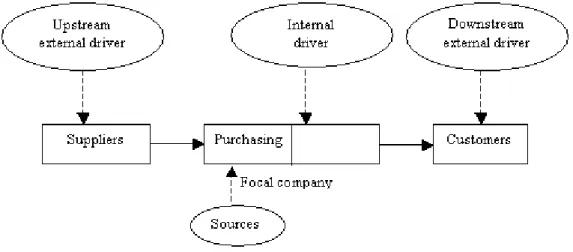
impact of the business unit strategy on sourcing practices (Virolainen, 1998). Flexibility drivers could include: demand volatility, fluctuations in the production schedule, etc. If we consider a very simple supply chain (see Figure 1), we can appreciate that supply flexibility drivers can be internal (related to the characteristics of the focal company) or external (related to the characteristics of its upstream and/or downstream supply chain). Demand volatility and seasonality are examples of downstream external drivers; low component commonality among the products of the company is an example of an internal driver; and incomplete supply is an example of an upstream external driver.
Figure 1. Supply flexibility drivers and sources
Flexibility drivers are related to uncertainty, as flexibility has been often seen as a reaction to environmental uncertainty (Swamidass and Newell, 1987; Gerwin, 1993). Slack (1983), Beamon (1999), Christopher (2000), and Van Donk and Van der Vaart (2005) distinguished three main types of uncertainty:
• Volume uncertainty: The level of uncertainty related to (1) the actual volume
demanded of a specific component and/or (2) the real volume of a component that will be received. For example, will it be 10 or 15 units of a certain component?
• Mix uncertainty: The level of uncertainty related to the exact mix/specification
• Delivery uncertainty: The level of uncertainty related to the date on which the
component will be (1) needed and/or (2) received. For example, will the delivery be on June 15th or June 18th?
For example, demand volatility and incomplete supplies are examples of volume uncertainty. Frequent changes in a production schedule that has been sent to a supplier are related to volume, mix and delivery uncertainty. However, if these frequent changes in the production schedule are in mix and dates, rather than quantities (which may have been frozen for a particular time window), frequent changes in the production schedule are related only to mix and delivery uncertainty.
2.2.3 Flexibility sources
As well as analysing why supply flexibility is required, it is important to investigate how
it is achieved in different contexts. Jack and Raturi (2002) defined flexibilitysources as
“specific actions to generate flexibility”. Accordingly, we define a supply flexibility
source as a practice in the purchasing function that allows an increase in supply flexibility (as can be seen in Figure 1, flexibility sources are only considered in the purchasing function). For example, a supply flexibility source could be the practice of establishing single-sourcing contracts with co-located key suppliers.
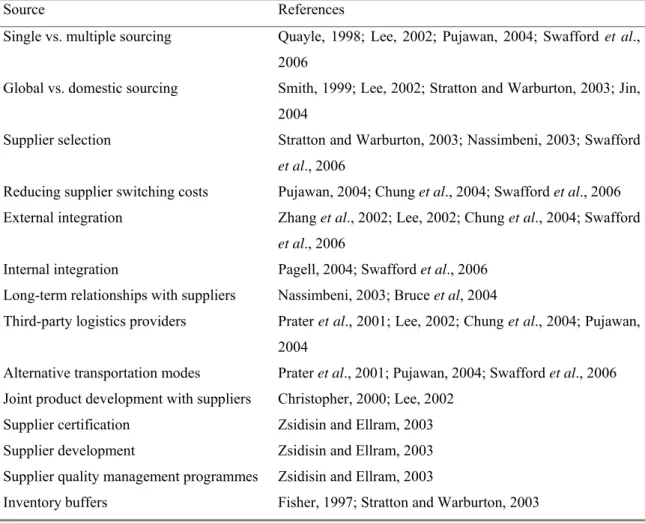
Several authors have analysed the impact of specific sourcing practices on supply flexibility, as can be appreciated in Table 1. Nevertheless, there is a lack of studies that depict how these various practices combine to increase supply flexibility, and the conditions that could support a set of sources in relation to another.
Industry characteristics may explain the utilization of the sources. For example, Stuckey and White (1993) and Bensaou (1999) suggest that asset specificity may determine decisions such as number of suppliers or level of integration, by increasing the switching costs. Similarly, Grover and Malhotra (2003) claim that there are considerable opportunities to apply concepts such as asset specificity and searching costs to the investigation of supply chain integration and coordination. A more holistic analysis of sourcing practices (i.e. identifying strategies based on sets of sourcing practices) is found in the purchasing portfolio literature. Several frameworks have been proposed for categorizing suppliers and the correspondent sourcing strategies (e.g. Kraljic, 1983; Olsen and Ellram, 1997; Bensaou, 1999). However, these classifications are focused on cost considerations, i.e. none of them explicitly addresses the supply flexibility implications of each sourcing strategy proposed. And, as mentioned above,
flexibility is becoming an increasingly important competitive dimension, influencing the sourcing strategy (Virolainen, 1998).
Table 1. Supply flexibility sources and references
Source References
Single vs. multiple sourcing Quayle, 1998; Lee, 2002; Pujawan, 2004; Swafford et al.,
2006
Global vs. domestic sourcing Smith, 1999; Lee, 2002; Stratton and Warburton, 2003; Jin, 2004
Supplier selection Stratton and Warburton, 2003; Nassimbeni, 2003; Swafford
et al., 2006
Reducing supplier switching costs Pujawan, 2004; Chung et al., 2004; Swafford et al., 2006
External integration Zhang et al., 2002; Lee, 2002; Chung et al., 2004; Swafford et al., 2006
Internal integration Pagell, 2004; Swafford et al., 2006
Long-term relationships with suppliers Nassimbeni, 2003; Bruce et al, 2004
Third-party logistics providers Prater et al., 2001; Lee, 2002; Chung et al., 2004; Pujawan,
2004
Alternative transportation modes Prater et al., 2001; Pujawan, 2004; Swafford et al., 2006
Joint product development with suppliers Christopher, 2000; Lee, 2002
Supplier certification Zsidisin and Ellram, 2003
Supplier development Zsidisin and Ellram, 2003
Supplier quality management programmes Zsidisin and Ellram, 2003
Inventory buffers Fisher, 1997; Stratton and Warburton, 2003
In the existing literature we have found only one paper that relates the type of supply flexibility strategy with the drivers. Zsidisin and Ellram (2003) conducted an exploratory factor analysis among the sourcing practices used to manage supply risk and found two main strategies: “behaviour-based management” (supplier certification, supplier development, target costing and supplier quality management programmes) and “buffer-oriented management” (multiple sourcing, safety stock and keeping inventory at suppliers). They found that purchasing organizations become increasingly involved in behaviour-based management given the threat of supply risk due to the inability of some suppliers to meet technological advances and quality standards; however, buffers were found to be implemented regardless of the extent of the perceived risk.
Pujawan (2004) also considered drivers and sources. He suggested a framework for assessing supply flexibility (using various sources, such as multiple sourcing,
availability of multiple transport modes, etc.) and provided a list of drivers (such as length of product life cycle, product variety, order stability, etc.). However, the relationship between drivers and sources was not analysed in this paper.
We share with Zsidisin and Ellram (2003) and Pujawan (2004) the framework of considering drivers and sources of supply flexibility simultaneously. Our study is empirically based, as is that of Zsidisin and Ellram (2003). The main difference between our study and theirs is that they focus on the sources of supply risk while we consider any flexibility driver along the supply chain (internal, upstream external or downstream external). Another main difference is that our study, due to the fact that is based on an exploratory multiple case study, has a wider scope (i.e. data collection is not constrained by rigid questionnaires), allowing for a broader set of sourcing practices.
Our research framework is summarized in Figure 2. First, we try to explore the reasons why firms in different sectors need to increase supply flexibility (drivers). We also try to analyse how firms increase supply flexibility (sources). And finally, we aim to analyse whether there is any relationship between the drivers and the sources.
Drivers Sources Driver 1 Driver 2 Driver 3 Driver n . . . Source 1 Source 2 Source 3 Source n . . .
Figure 2. Research framework
2.3 Methodology
As mentioned in the literature review, there is a lack of cross-industry empirical studies on supply flexibility, especially those regarding not the construct per se, but its whys
and hows. Flexibility drivers and sources have seldom been studied simultaneously, and
2004). Since the underlying dynamics of the drivers and sources of supply flexibility (i.e. how specific sets of drivers relate to each group of sources) is still not well understood, we have chosen to use an exploratory approach. In particular, this study aimed to fill the gap of empirical studies relating drivers and sources of supply flexibility. Thus, the research focus of this exploratory study is theory building, which has commonly three objectives: 1) identify / describe key variables, 2) identify linkages between variables, and 3) identify “why” these relationships exist (Handfield and Melnyk, 1998).
Due to the exploratory nature of this paper and the need to obtain an in-depth knowledge of drivers (reasons to increase supply flexibility), sources (how do firms increase supply flexibility?) and the relationship between them (drivers and sources), we adopted the case study methodology, as recommended by Yin (1994) and Eisenhardt (1989). The case study methodology is very useful when the research aims to answer “why” and “how” questions (Yin, 1994). This methodology has also been called to be more used by operations management researchers (Voss et al., 2002). The process
followed to design and implement this methodology has been adopted from Yin (1994). The sample consisted of seven Spanish manufacturers belonging to different industries. The sampling process was as follows: first, we selected sectors with high unpredictable demand (fashion apparel, electronics, automotive and electrical equipment), based on the “innovative” sectors (i.e. with high demand uncertainty) identified by Fisher (1997) and Lee (2002). This is justified by the fact that demand uncertainty is considered to be the most important component of supply chain uncertainty (Chung et al., 2004;
Pujawan, 2004). Then, we used the SABI database of Spanish firms to select our sample, which was composed of all firms in the aforementioned industries (i.e. fashion apparel, electronics, electrical equipments and automotive) that were located in the Barcelona’s metropolitan area and had a revenue’s figure greater than 20 million euros. The original sample was made up by 71 firms. Out of these 71 firms, 19 had an incorrect phone number, had ceased their activities or were in process of fusion with other companies. In 27 firms, informants were absent or could not be reached. In 8 companies, an initial contact showed that firms were not adequate for the study (e.g. were dedicated to retailing). Therefore, only 17 potential informants were reached and considered adequate for the study. Out of these 17 firms, 7 accepted to participate in the study, representing a participation rate of approximately 41%. The profile of the firms studied is shown in Table 2.
Table 2. Profile of firms
Sector Firm Number of
employees Revenue (euros) Informant position Product Production system Demand uncertainty
Manufacturer 1 306 51 million Purchasing manager Steering columns, shafts and gears (PULL) JIT Moderate Manufacturer 2 245 54 million Logistics manager Acoustic and thermal systems (PULL) JIT Moderate Automotive
Manufacturer 3 12,931 6.1 billion Purchasing manager Automobiles (PULL) JIT Moderate Fashion apparel Manufacturer 1 770 142 million Logistics manager Apparel and accessories MTS (PUSH) High
Manufacturer 1 190 102 million Materials manager Cathode-ray tubes (PUSH) MTS High Electronics
Manufacturer 2 182 168 million Purchasing manager TV sets (PUSH) MTS High Electrical
equipment Manufacturer 1
126 26 million Materials
manager Electric motors
MTS
(PUSH) Moderate
To maintain data consistency, we used a semi-structured interview approach (Yin, 1994). In order to increase the reliability of the case study analysis, it was decided to create an interview protocol (see Appendix) and a case study database. A pilot test was performed with practitioners before the interviews. As a result, the wording of some of the questions was changed in order to make them easier to understand. Interviewing the purchasing manager or equivalent minimized the limitation of using a single informant. High-ranking respondents tend to be more reliable sources of information than their subordinate ranks (Philips, 1981). A suitable informant was defined to be a person with in-depth knowledge of the supply base, purchasing and inbound logistics processes. Informants were selected as follows. When we contacted each firm, we asked for the purchasing manager. If, after we had explained our research, he/she felt he/she could not answer our questions, then he/she told us whom we should contact (in some of the firms analysed, the logistics or materials manager). The questionnaire was then pre-mailed to the key informant, two days before the interview.
In each firm, data was collected in the course of a one-hour interview. The interviews were conducted in February and March 2005. At the beginning of each interview, the informants were asked to present their own definition of supply flexibility, in order to verify how consistent was with our definition. The answers showed that our definition was compatible with the perception of the informants. Then, we used the interview protocol questions as a guideline, asking for further information
when needed. The answers were transcribed and analysed regarding clarity and sufficiency. If any information remained unclear and/or we felt more data was needed, informants were contacted later by phone for additional questions. Also, other sources of evidence such as industry databases, newspaper clippings and company websites were used to corroborate and augment evidence. If there was any sort of discrepancy between the data collected during the interview and the other sources of evidence, we checked all the information again and contacted the interviewee for clarification.
We believe all these procedures assured an adequate level of validity and reliability to our analysis. Following the case study methodology proposed by Yin (1994), we tried to assure construct validity by using multiple sources of evidence and
establishing a chain of evidence. We tried to increase the external validity by using
multiple case studies. And finally, reliability was assured by using a case study protocol
and developing a case study database.
2.4 Cross-case analysis
2.4.1 Drivers
A supply flexibility driver is a supply chain characteristic over which the purchasing function has little or no control, and which determines the level of supply flexibility required. From our interviews, we have identified internal drivers (characteristics of the focal company) and external drivers (characteristics of its upstream and/or downstream supply chains). Table 3 summarizes the results of the case studies. In this table, we display the flexibility drivers for each firm (based on the data collected on the interviews), classifying them by their position in the supply chain (internal, upstream or downstream). This table can be read vertically, e.g. automotive company 1 mentioned an internal driver (production schedule uncertainty) as the most important one. Also, the table can be interpreted horizontally, e.g. low component commonality was mentioned as an important driver by automotive firm 2, the fashion apparel firm, and consumer electronics firms 1 and 2. Table 4 relates each driver and the type of uncertainty associated with it (volume, mix or delivery), based on the literature and case evidence. Regarding internal drivers we found the following:
• Production schedule uncertainty, i.e. the uncertainty regarding production plans
in the short run (Krajewski et al., 2005). This driver is related mostly to mix and
component specification and delivery date is delayed as long as possible. Volume uncertainty is less affected because in the short run there is no significant uncertainty in the volume to be produced (most of these companies are working under a JIT philosophy, in which volumes are relatively stable for a given period of time).
• Low component commonality, i.e. the extent to which the same purchased
component can be used in several final products (Pujawan, 2004). This basically affects the mix uncertainty, although studies suggest that it has an indirect effect on volume uncertainty (Salvador et al., 2005). Accordingly, this driver is related
to mix and volume uncertainty.
• JIT purchasing, i.e. the use of small purchasing batches and frequent deliveries
(Womack et al., 1990; Ponce and Prida, 2004). This practice generates mix and
delivery uncertainty. Volume uncertainty is less important, because a pre-condition for JIT is to have stable supplier purchase orders in terms of volume (Womack et al., 1990; Ponce and Prida, 2004).
• Manufacturer slack capacity, i.e. the difference between the manufacturer’s
maximum output rate and the normal production rate (Jack and Raturi, 2002). This basically affects the volume uncertainty, because capacity is generally measured at an aggregate level.
We identified the following downstream supply chain drivers:
• Demand volatility, i.e. variability in the demand of the manufacturer’s customer,
in terms of volume and mix (Fisher, 1997; Lee, 2002; Pujawan, 2004). The effect on delivery uncertainty is not so significant, because none of the companies that stated this driver was producing in a “make-to-order” environment.
• Demand seasonality, i.e. the extent to which the demand of the manufacturer’s
customer is concentrated in the same periods each year. This driver has a direct impact on the level of volume uncertainty (Jack and Raturi, 2002), rather than mix and delivery uncertainty, since it affects medium and long-term materials planning, which are based on aggregate demand forecasts. Therefore, this driver is mainly related to volume uncertainty.
• Forecast accuracy, i.e. the deviation of customer’s actual demand from the sales
Warburton, 2003). Delivery flexibility needs are not significantly affected, since the delivery date is defined according to short-term requirements (i.e. not according to forecasts).
And finally, regarding upstream supply chain drivers, we found only one:
• Non-responsive suppliers, i.e. the use of suppliers who do not send the right
quantities on the established dates. This affects volume, mix and delivery uncertainty (Pujawan, 2004).
Table 3. Supply flexibility drivers
Automotive Fashion apparel Consumer electronics Electrical equipment Position in the
supply chain Driver Case
1 Case 2 Case 3 Case 1 Case 1 Case 2 Case 1
Production schedule uncertainty x x x
Low component commonality x x x x
JIT purchasing x
Internal
Slack capacity at focal company x
Demand volatility x x x
Demand seasonality x
Downstream
Low forecast accuracy x x
Upstream Unresponsive suppliers x
Table 4. Supply flexibility drivers and type of uncertainty Type of uncertainty Driver
Volume Mix Delivery
Production schedule uncertainty x x
JIT purchasing x x
Unresponsive suppliers x x x
Low component commonality x x
Demand volatility x x
Low forecast accuracy x x
Demand seasonality x
Slack capacity at focal company x
This list of drivers differs slightly from the supply flexibility drivers proposed by Pujawan (2004). In our study we observed that sometimes the uncertainties that drive the required supply flexibility are actually introduced by the focal company (e.g. through frequent changes in the production schedule). This is in line with recent
empirical studies in build-to-order supply chains (Krajewski et al., 2005). The focal
company can reduce the required supply flexibility by changing certain practices that are internal to the company but not under the control of the purchasing area. For example, automotive firm 3 reduced the delivery flexibility required from its suppliers by freezing a part of its production schedule. The decision to freeze a part of the production schedule was the responsibility of the production function. All the internal drivers (production schedule uncertainty, low component commonality, JIT purchasing and manufacturer slack capacity) are under the control not of the purchasing area but of other departments or functional areas of the company. Some highly disseminated practices of Supply Chain Management (e.g. integrated production planning, collaboration among functional areas) could reduce the need for supply flexibility. Interestingly, none of the companies in the study had a Supply Chain Management department, fact that possibly increased the level of supply flexibility required. Further studies should include firms that have implemented Supply Chain Management, and verify whether this practice can effectively reduce the supply flexibility needs.
Regarding internal drivers it is important to note that production schedule uncertainty is a driver that is only present in make-to-order or assemble-to-order environments (Krajewski et al., 2005). The companies interviewed that were working
with forecasts and a make-to-stock environment did not mention this driver.
As far as external drivers are concerned, there are more downstream drivers than upstream ones. Drivers related to demand uncertainty (demand volatility and low forecast accuracy) are the most important ones, which is consistent with previous studies (Chung et al., 2004; Pujawan, 2004). Upstream drivers relate to uncertainty in
the suppliers’ delivery (e.g. the supplier does not deliver the quantities ordered, or does not meet the agreed date). As can be observed in Table 3, only one company mentioned unresponsiveness of suppliers as a driver. This result was expected, since reliability is a prerequisite to becoming a supplier of a critical component (Nassimbeni, 2003; Stratton and Warburton, 2003).
Table 3 suggests some clear industry patterns: the automotive sector firms, for example, have significant internal drivers (i.e. most of the required flexibility is driven by internal decisions such as frequency of changes in production plans). The use of JIT purchasing increases the dependency on stable production plans to keep a smooth supply of components (Womack et al., 1990; Ponce and Prida, 2004). On the other
balanced distribution among internal and external drivers. In these sectors, demand volatility plays a more important role in determining the required flexibility. This is consistent with previous cross-sector studies (e.g. Fine, 1998; Ponce and Prida, 2004).
2.4.2 Sources
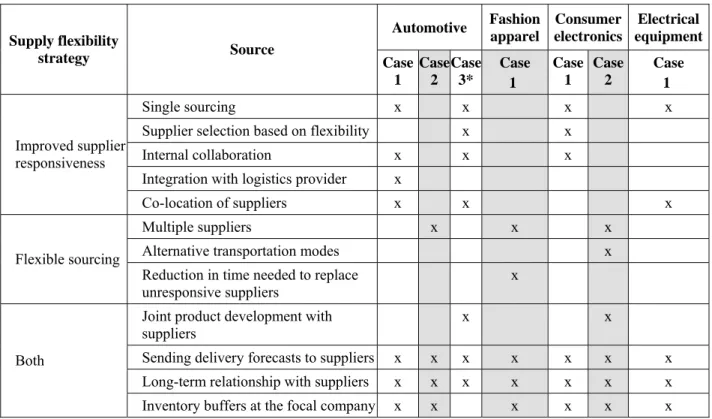
Table 5 shows the responses of the companies analysed in our study. In this analysis, based on empirical data, we tried to detect some patterns (i.e. supply flexibility sources that are used jointly). In parallel, we checked the literature in order to verify if the detected patterns were consistent. Naturally, this was just an exploratory study, and all conclusions should be regarded cautiously (especially considering the limited sample of firms). Our objective with this analysis was to formulate some propositions that should be tested in future confirmatory studies. On observing these results it seems that there are some common practices used by most of the firms to increase supply flexibility (e.g. long-term relationships with suppliers, inventory buffers, sending forecasts to suppliers). Also, there seem to be two main strategies (i.e. sets of practices), which we call improved supplier responsiveness and flexible sourcing:
• Improved supplier responsiveness. This first strategy includes practices aimed to
increase supplier responsiveness capabilities, such as suppliers’ short-term process flexibility (i.e. the ability to make frequent schedule changes efficiently (Krajewski et al., 2005)) or a supplier’s ability to produce efficiently in small
quantities (Fisher et al., 1997). Single sourcing, geographical proximity of
suppliers, supplier selection based on flexibility, internal collaboration (e.g. between the purchasing and production departments) and process integration with logistics providers are important elements of this strategy. The firms that apparently adopt this strategy are automotive firms 1 and 3 and consumer electronics firm 1.
Empirical evidence of similar flexibility-focused strategies include several industrial sectors such as the Italian eyewear district (Nassimbeni, 2003), cosmetics (Smock, 2005) and aeronautical (Rosseti and Choi, 2005). In all these examples, supply flexibility was achieved through a reduced, co-located and high-response supply base.
• Flexible sourcing. The second strategy is to adopt a larger supplier base and
constantly reconfigure the supply chain. The firms that seem to adopt such a strategy are automotive firm 2, the fashion apparel firm and the consumer
electronics firm 2. In this case, the main source of supply flexibility is not a particular supplier’s responsiveness capability, but the leading firm’s ability to coordinate the entire supply chain and redesign the supply network quickly and at a low cost. Likewise, Fine (1998) and Chung et al. (2004) argue that, in
uncertain environments, a company’s real core capability lies in the ability to design and manage the supply chain. For example, in the high-tech computer and peripheral sectors firms limit inter-dependence and retain the ability to easily switch partners, allowing greater organizational flexibility (Chung et al.,
2004). A similar pattern is found in the apparel sector, where the main job of the core company is to manage the production and trade networks and to make sure that all the pieces of the business come together as an integrated whole (Gereffi, 1994). In addition, suppliers are not located so close as in the “improved supplier responsiveness” strategy. In fact, studies suggest that lower-cost suppliers located further away may be more responsive than suppliers close to the market, since low wage rates enable suppliers to afford excess capacity, which compensates for longer transportation times (Fisher et al., 1997).
It should be mentioned that the firm in the electrical equipment sector was not classified in either of the supply flexibility strategies, because it did not present any significant driver, i.e. its supply flexibility requirements were very small. This classification (“improved supplier responsiveness” and “flexible sourcing”) is in line with previous segmentations of sourcing strategies, i.e. “strategic” or “leverage” components (Kraljic, 1983), and “strategic” or “market exchange” dyadic relationships (Bensaou, 1999). Nevertheless, neither of these previous frameworks focused on supply chain uncertainties (demand volatility, production schedule uncertainty, etc.). Moreover, they did not explicitly relate supplier segmentation and the corresponding impacts on supply flexibility.
It is important to make some comments on these results: Firstly, most of the supply flexibility sources may be also used to achieve other competitive priorities (e.g. cost, quality). However, due to the need of limiting the scope of our study we only asked companies for the practices used to increase supply flexibility. Other studies in the literature have followed the same approach - i.e. analysing broad sourcing practices focusing on a single competitive priority (e.g. Jack and Raturi, 2002; Zsidisin and Ellram, 2003). Nevertheless, in further studies it would be useful to understand to what
extent those sourcing practices are selected as a consequence of a mix of competitive priorities.
Secondly, although the segmentation of supply flexibility strategies coincides with previous studies, other results may seem counter-intuitive. For example, in case 2 supplier relationships are long term oriented with a multiple sourcing strategy and low cooperation with suppliers. The explanation can be that a long-term relationship is a prerequisite for establishing cooperation with suppliers, but it is not a sufficient condition, i.e. there are companies that have long-term relationships but they do not cooperate (Van der Vaart et al., 2006).
Another result that may seem counter-intuitive is how firms in the “flexible sourcing” strategy may adopt joint product development and long-term relationships (case 2, consumer electronics). This may happen because in areas of fast technological development suppliers are maintained and collaborate in product development as long as they are leaders in technology and quality. If they loose their leadership, they are quickly replaced. In a similar way, Dell’s sourcing strategy combines long-term commitments, joint product development and quick redesign of the supply chain (Magretta, 1998). Whether this is a particular situation for high-tech sectors should be verified in further studies.
Finally, although it was not mentioned in the interviews, the literature suggests that ordering policy may be an important source of flexibility. By reducing order
batching and shortage gaming (i.e. in a situation in which several buyers compete for a limited supply, the buyer’s orders may exceed his actual needs, aiming to prevent potential shortages) the purchasing function may avoid the well known “bullwhip effect” (Lee et al., 1997), a major source of supply disruptions and fluctuations in the
manufacturers’ orders to suppliers.
In accordance with these results we establish the following propositions, which should be analysed in further studies:
Proposition 1. Firms use two strategies to increase their supply flexibility: “improved supplier responsiveness” and “flexible sourcing”. The former is characterized by single sourcing, a high level of internal and external integration, co-location of suppliers and supplier selection based on supplier responsiveness capability. The latter is characterized by a larger supply base, lower levels of supplier responsiveness and faster supply network redesign (when compared to the first strategy).
Proposition 2. Some sources of supply flexibility are employed by firms
using both strategies: inventory buffers, long-term relationships with suppliers, forecast sharing with suppliers and joint product development.
Table 5. Supply flexibility sources
Automotive Fashion apparel Consumer electronics Electrical equipment Supply flexibility
strategy Source Case
1 Case 2 Case 3* Case 1 Case 1 Case 2 Case 1 Single sourcing x x x x
Supplier selection based on flexibility x x
Internal collaboration x x x
Integration with logistics provider x
Improved supplier responsiveness
Co-location of suppliers x x x
Multiple suppliers x x x
Alternative transportation modes x
Flexible sourcing
Reduction in time needed to replace
unresponsive suppliers x
Joint product development with
suppliers x x
Sending delivery forecasts to suppliers x x x x x x x
Long-term relationship with suppliers x x x x x x x
Both
Inventory buffers at the focal company x x x x x x
* Results shown for the JIT supplier of the most critical item.
Furthermore, firms may act concurrently on the supply flexibility drivers in order to reduce the required supply flexibility. For example, electronics firm 2, as well as adopting a flexible sourcing strategy, is increasing the parts commonality; and automotive firm 3, as well as adopting the “improved supplier responsiveness” strategy, has reduced the required supply flexibility by increasing the frozen part of the production schedule. This means that companies can reduce the supply flexibility gap (difference between the supply flexibility required and the supply flexibility achieved) by (1) working on the drivers, thus reducing the supply flexibility required, and/or (2) implementing a “flexible sourcing” or “improved supplier responsiveness” strategy and/or the other common practices such as inventory buffers or sending delivery forecasts to suppliers, thus increasing the supply flexibility achieved.
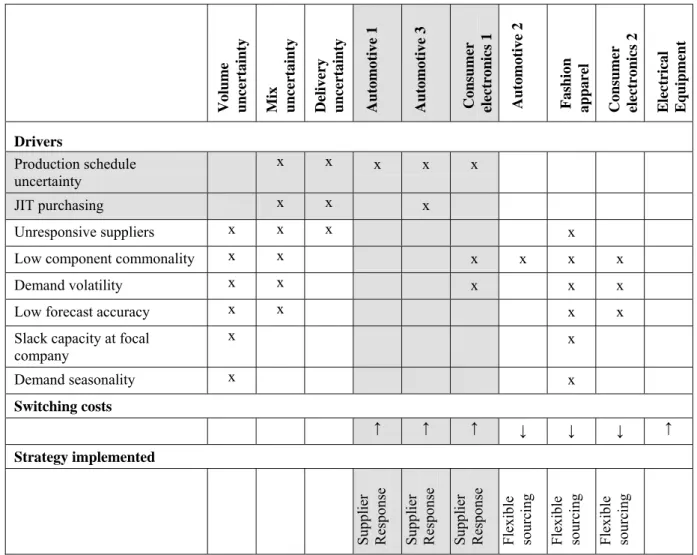
Table 6 summarizes the results of Tables 3, 4 and 5, and depicts the relationship between flexibility drivers, type of uncertainty, level of switching costs and sources.
This table can be read as follows: first, we show the relationship between each driver and the type of uncertainty (volume, mix or delivery) associated with it; second, we mark the cases in which this driver was mentioned as an important factor for defining the level of flexibility needed. Then, each case is categorized into one of the two strategies proposed (improved supplier responsiveness or flexible sourcing). Moreover, the level of searching and switching costs is depicted for each firm. Our objective in this table was to study what factors (types of uncertainty, drivers and switching costs) could explain why firms select a particular supply flexibility strategy (“improved supplier responsiveness” or “flexible sourcing”).
Table 6. Drivers, type of uncertainty and sources
Volum e uncertainty Mix uncertainty Deliv ery uncertainty Aut o m o ti ve 1 Aut o m o ti ve 3 Consumer electronics 1 Au to mo tive 2 Fas h ion
apparel Consumer electronics 2 Electrical Equipment
Drivers Production schedule uncertainty x x x x x JIT purchasing x x x Unresponsive suppliers x x x x
Low component commonality x x x x x x
Demand volatility x x x x x
Low forecast accuracy x x x x
Slack capacity at focal
company x x Demand seasonality x x Switching costs ↑ ↑ ↑ ↓ ↓ ↓ ↑ Strategy implemented Sup plier Response Sup plier Response Sup plier Response Flex ib le so ur cing Flex ib le so ur cing Flex ib le so ur cing
The decision between the “improved supplier responsiveness” and “flexible sourcing” strategies seems to be affected by two factors: the supplier searching and switching costs, and the type of uncertainty.
In this study, we consider supplier searching and switching costs as the costs associated with finding, certifying and switching a supplier, without a significant
decrease in performance (in terms of cost, quality and price). These costs can be
estimated by the buyer’s specific investments in relation to the supplier (Bensaou, 1999). These can be (1) tangible investments in buildings or physical assets dedicated to the components of a specific supplier, (2) internal processes customized to the components produced by this supplier, or (3) time and effort dedicated to learning the supplier’s business processes and nurturing the relationship (Stuckey and White, 1993; Bensaou, 1999).
On the basis of the results of the case studies (which are summarized in Table 6), it seems that when supplier searching and switching costs are low, companies increase supply flexibility by implementing a “flexible sourcing” strategy; however, when these costs are high, companies increase supply flexibility by implementing a “supplier responsiveness” strategy. In our case studies, consumer electronics firm 2, which can search and switch suppliers quickly (in less than three months), uses a “flexible sourcing” strategy. On the other hand, automotive firm 3, which has high supplier switching costs (due to supplier-specific investments), adopts an “improved supplier responsiveness” strategy. This is in line with previous research in supply chain management. Bensaou (1999) argues that the level of the buyer’s specific investments in the relationship influences the profile of the buyer-supplier dyad: the higher the level of specific investments, the higher the collaboration level. Similarly, Klein et al. (1990)
found that the level of asset specificity positively affects the integration level in the supply chain. In accordance with these results, we establish the following propositions:
Proposition 3. The supplier searching and switching costs influence the
selection of the supply flexibility strategy.
(a) When supplier searching and switching costs are high, firms select
the “improved supplier responsiveness” strategy.
(b) When supplier searching and switching costs are low, firms select
the “flexible sourcing” strategy.
Table 6 also suggests a relationship between the supply flexibility strategy adopted and the type of uncertainty. When the main driver of flexibility is the uncertainty in the production schedule and JIT purchasing (delivery and mix uncertainty), companies seem to increase flexibility by implementing the “improved supplier responsiveness” strategy. On the other hand, firms seem to select the “flexible
sourcing” strategy when the drivers of flexibility are low component commonality, demand volatility and low forecast accuracy (volume and mix uncertainty).
Proposition 4. The type of uncertainty influences the supply flexibility
strategy adopted.
(a) When mix and delivery uncertainties are predominant, firms select
the “improved supplier responsiveness” strategy.
(b) When volume and mix uncertainties are predominant, firms select the “flexible sourcing” strategy.
2.5 Conclusions
Our study suggests that firms increase supply flexibility for a variety of reasons, using different strategies. Supply flexibility drivers can be either external (demand volatility and seasonality, forecast accuracy) or internal to the firm (production schedule uncertainty, low component commonality, JIT purchasing, slack capacity at the focal company and unresponsive suppliers). The sources of supply flexibility can be divided into “improved supplier responsiveness” and “flexible sourcing”, but these strategies share some common practices (long-term relationships with suppliers, forecast sharing with suppliers, joint product development, and inventory buffers at the focal company).
Although most of these results were in line with the literature, it is surprising to note that collaborative planning practices were not mentioned as important sources of supply flexibility. Firms collaborated with suppliers by sharing delivery forecasts, but the forecasting and delivery planning processes were done individually (i.e. without suppliers’ involvement) in all firms studied. The reasons for this should be investigated in further studies.
Our contribution to the literature is twofold. First, we have explored the relationship between drivers and sources of supply flexibility. The results of the case study analysis suggest that this relationship can be summed up in the following propositions: When the main driver of flexibility is the uncertainty in the production schedule and JIT purchasing (mix and delivery uncertainty), companies can increase supply flexibility by implementing a strategy aimed at “improved supplier responsiveness”. On the other hand, when the drivers of flexibility are low component commonality, demand volatility and low forecast accuracy (volume and mix uncertainty), companies seem to increase supply flexibility by implementing a “flexible
sourcing” strategy. Moreover, the results suggest that supplier searching and switching costs may determine the supply flexibility strategy: the higher these costs, the more likely the firm is to adopt the “improved supplier responsiveness” strategy.
Our second contribution to the literature lies in the methodology adopted (multiple case study). As we pointed out earlier, most of the previous studies on supply flexibility aimed to build conceptual frameworks and lacked empirical validation. We believe that the concept of supply flexibility will benefit considerably from the insights provided by real business problems and constraints faced by firms in different industrial sectors, like those presented in this study.
Like many exploratory case studies, this paper has some limitations. Firstly, the reduced sample size restrains the level of generality of the theory. Moreover, the huge quantity of data makes it difficult to assess which are the most important relationships and which are idiosyncratic to a particular case (Eisenhardt, 1989). Also, there could be some sort of context bias, since the firm sample presented a limited environment differentiation (i.e. industries, countries). Another difficulty is the subjective criterion for some variables, such as the production schedule uncertainty or the integration level. Furthermore, the impact of the business unit strategy (e.g. flexibility focus) on the sourcing practices has not been covered in this study. Despite these limitations, our study contributes to the existing literature by empirically investigating the main reasons why companies need to increase supply flexibility and how they increase this flexibility, and by suggesting some factors that could influence the selection of a particular supply flexibility strategy.
We believe that this paper will be both informative and insightful for professionals and researchers in the area of supply chain management: Professionals are provided with a list of drivers and sources of flexibility and some guidelines on how to increase flexibility while taking into account the reasons why this flexibility is needed. Researchers are provided with some preliminary lists of drivers and sources of flexibility, which should be further analysed. The results could also be extended to other sectors in further studies. For example, the similarities between the automotive and aircraft industries, or between fashion apparel and toy firms, suggest that those sectors may have the same supply flexibility requirements and/or strategies. Researchers are also given some further lines of research into supply flexibility. Regarding this latter aspect, some lines of future research include:
• Testing the relationship between the two constructs
• Studying the interactions between the strategic goals of the business unit and the supply flexibility strategies identified (e.g. “What is the impact of other strategic objectives, such as cost or quality, on the selection of these strategies?”).
References
Beamon, B. (1999), “Measuring supply chain performance”, International Journal of
Operations and Production Management, Vol. 19 No. 3, pp. 275-292.
Bensaou, M. (1999), “Portfolios of buyer-supplier relationships”, Sloan Management
Review, Vol. 40 No. 4, pp. 35-44.
Bruce, M., Daly, L. and Towers, N. (2004), “Lean or agile: a solution for supply chain management in the textiles and clothing industry?”, International Journal of
Operations and Production Management, Vol. 24 No. 2, pp. 151-170.
Chen, I.J. and Paulraj, A. (2004), “Towards a theory of supply chain management: The constructs and measurements”, Journal of Operations Management, Vol. 22 No.
2, pp. 119-150.
Christopher, M. (2000), “The agile supply chain: Competing in volatile markets”,
Industrial Marketing Management, Vol. 29 No. 1, pp. 37-44.
Chung, W.W.C., Yam, A.Y.K. and Chan, M.F.S. (2004), “Networked enterprise: A new business model for global sourcing”, International Journal of Production
Economics, Vol. 87 No. 3, pp. 267-280.
Duclos, L.K., Vokurka, R.J. and Lummus, R.R. (2003), “A conceptual model of supply chain flexibility”, Industrial Management & Data Systems, Vol. 103 No. 6, pp.
446-456.
Eisenhardt, K.M. (1989), ”Building theories from case study research”, Academy of
Management Review,Vol. 14 No. 4, pp. 532-550.
Fine, C. (1998), Clockspeed: Winning Industry Control in the Age of Temporary
Advantage, Perseus, Reading, MA.
Fisher, M.L. (1997), “What is the right supply chain for your product?”, Harvard
Fisher, M., Hammond, J., Obermeyer, W. and Raman, A. (1997), “Configuring a supply chain to reduce the cost of demand uncertainty”, Production and Operations
Management,Vol.6 No. 3, pp. 211-225.
Gereffi, G. (1994), “The organization of buyer-driven global commodity chains: how US retailers shape global production networks”, in Gereffi, G. and Korzeniewicz, M. (Eds), Commodity Chains and Global Capitalism, Greenwood
Press, Westport, CT, pp. 95-122.
Gerwin, D. (1993), “Manufacturing flexibility: A strategic perspective”, Management
Science, Vol. 39 No. 4, pp. 395-410.
Grover, V. and Malhotra, M.K. (2003), “Transaction cost framework in operations and supply chain management research: theory and measurement”, Journal of
Operations Management, Vol. 21 No. 4, pp. 457-473.
Handfield, R.S. and Melnyk, S.A. (1998), “The scientific theory-building process: a primer using the case of TQM”, Journal of Operations Management, Vol. 16
No. 4, pp. 321-339.
Jack, E.P. and Raturi, A. (2002), “Sources of volume flexibility and their impact on performance”, Journal of Operations Management, Vol. 20 No. 5, pp. 519-548.
Jin, B. (2004), “Achieving an optimal global versus domestic sourcing balance under demand uncertainty”, International Journal of Operations and Production
Management, Vol. 24 No. 12, pp. 1292-1305.
Klein, S., Frazier, G.L. and Roth, V.J. (1990), “A transaction cost analysis model of channel integration in international markets”, Journal of Marketing Research,
Vol. 27 No. 2, pp. 196-208.
Koste, L.K. and Malhotra, M.K. (1999), “A theoretical framework for analyzing the dimensions of manufacturing flexibility”, Journal of Operations Management,
Vol. 18 No. 1, pp. 75-93.
Koste, L.L, Malhotra, M.K. and Sharma, S. (2004), “Measuring dimensions of manufacturing flexibility”, Journal of Operations Management, Vol. 22 No. 2,
pp. 171-196.
Krajewski, L., Wei, J. and Tang, L.L. (2005), “Responding to schedule changes in build-to-order supply chains”, Journal of Operations Management, Vol. 23, No.
5, pp. 452-469.
Kraljic, P. (1983), “Purchasing must become supply management”, Harvard Business
Lee, H.L. (2002), “Aligning supply chain strategies with product uncertainties”,
California Management Review, Vol. 44 No. 3, pp. 105-119.
Lee, H.L., Padmanabhan and V., Whang, S. (1997), “Information distortion in a supply chain: The Bullwhip Effect”, Management Science, Vol. 43 No. 4, pp. 546-558.
Magretta, J. (1998), “The power of virtual integration: An interview with Dell Computer’s Michael Dell”, Harvard Business Review, Vol. 76, No. 2, pp.
72-84.
Narasimhan, R. and Das, J. (2000), “An empirical examination of sourcing’s role in developing manufacturing flexibilities”, International Journal of Production
Research, Vol. 38 No. 4, pp. 875-893.
Nassimbeni, G. (2003), “Local manufacturing systems and global economy: Are they compatible? The case of the Italian eyewear district”, Journal of Operations
Management, Vol. 21 No. 2, pp. 151-171.
Olsen, R.F. and Ellram, L.M. (1997), “A portfolio approach to supplier relationships”,
Industrial Marketing Management, Vol. 26 No. 2, pp. 101-113.
Pagell, M. (2004), “Understanding the factors that enable and inhibit the integration of operations, purchasing and logistics”, Journal of Operations Management, Vol.
22 No. 5, pp. 459-487.
Philips, J. (1981), “Assessing measurement error in key informant reports: a methodological note on organizational analysis in marketing”, Journal of
Marketing Research, Vol. 18 No. 1, pp. 395-415.
Ponce, E. and Prida, B. (2004), La logística de aprovisionamientos para la integración
de la cadena de suministros, Pearson Educación, Madrid.
Prater, E., Biehl and M., Smith, M.A. (2001), “International supply chain agility: Tradeoffs between flexibility and uncertainty”, International Journal of
Operations and Production Management, Vol. 21, No. 5/6, pp. 823-839.
Pujawan, N. (2004), “Assessing supply chain flexibility: a conceptual framework and a case study”, International Journal of Integrated Supply Management, Vol. 1 No.
1, pp. 79-97.
Quayle, M. (1998), “Industrial procurement: Factors affecting sourcing decisions”,
European Journal of Purchasing and Supply Management, Vol.4 No. 1, pp.