CERIAS Tech Report 2001-31
Digital Government Security
Infrastructure Design Challenges
James Joshi, Arif Ghafoor,
Walid G. Aref, Eugene H. Spafford
Center for Education and Research in
Information Assurance and Security
Purdue University, West Lafayette, IN 47907
C O V E R F E A T U R E
public sectors that have become essential partners in supporting government’s public services.
Although Information Age technologies provide intriguing opportunities for developing DG concepts, they also create significant infrastructure challenges. Key challenges include1
• ensuring secure interoperability among systems from several agencies,
• developing methods and measures of citizen par-ticipation in the democratic processes,
• fostering public-private partnerships and other networked organizational forms,
• archiving and managing electronic records,
• developing better methods for IT resource man-agement, and
• ensuring availability and equity of access. Information security pervades all such needs. In a DG environment, secure interoperation ensures con-fidentiality when individuals, private organizations, and government agencies access information. Elec-tronic transactions and delivery systems must be secure to ensure protection against fraud and other vulnerabilities. The government’s archived informa-tion should be protected from tampering yet remain accessible under proper authorizations. Among all government functions, maintaining collective security remains the most crucial element, requiring that secu-rity concerns be addressed at each level of the gov-ernment’s information infrastructure.
In general, the concepts and ideas we describe here—although applied to DG uses—are applicable
Digital
Government Security
Infrastructure
Design Challenges
I
nformation Age technologies provide enormousopportunities for a government to transform its functions into the digital arena. Doing so taps the wellspring of information technology benefits that have driven down off-the-shelf component costs and fueled an unprecedented improvement rate in the cost-performance ratio. We can view a digital government (DG) as an amalgam of heterogeneous information systems in which government agencies and public and private sectors exchange a high vol-ume of information.1
Several US government agencies have aggressively adopted information technologies and spearheaded the search for improved services and decision-making processes. These agencies seek to modernize the gov-ernment’s highly fragmented service-centric informa-tion infrastructure. Accumulating evidence indicates that electronically improving information flow and the decision-making process provides increased efficiency, streamlined functionalities, and more effective use of government resources.
Discarding the US government’s traditional com-mand-and-controlpublic-management technique, in which agencies operate in a loosely coupled environ-ment, newly evolving approaches depend on close col-laboration, negotiation, and decision-making pro-cesses. These methods require more efficient, flexible, interoperable, and secure information systems. Creating such systems requires a holistic development approach to building a secure information infrastruc-ture. This infrastructure supports both the intricate interdependence of government programs at different levels and between government and the private and
Designing security systems for a digital government’s multidomain environment
requires a careful balancing act between providing convenient access and
carefully monitoring permissions.
James Joshi
Arif Ghafoor
Walid G. Aref
Eugene H.
Spafford
Purdue UniversityFebruary 2001 67
to any distributed information systems that support workflow-based applications2across several domains.
INFORMATION SECURITY
As industry analysts have observed,3information sys-tem security goals include confidentiality or secrecy, integrity, availability, accountability, and information assurance. To ensure information’s confidentiality, its disclosure must be restricted to authorized accesses only. Essentially, information integrity guarantees that information is protected from intentional or acciden-tal modifications. Information availability implies access to information uninterrupted by malicious denials of service or unauthorized deletions. Accounta-bility ensures that an entity’s every action is uniquely traceable to that entity. Information assurance implies that a specific implementation provides some degree of confidence about pre-established security goals.
Depending on the environment, the relative empha-sis assigned to each of these objectives may vary. For example, for defense applications, confidentiality may be the primary requirement, whereas in the commer-cial sector, information integrity is paramount. In many cases, a combination of these goals may be warranted. For example, in healthcare and airline applications, both confidentiality and data integrity can co-exist as main goals.
Key security mechanisms
An information security infrastructure’s foundation consists of three key mechanisms: authentication, access control, and audit. Authentication establishes the identity of an entity and is a prerequisite for access control. Access control limits the actions or operations that a legitimate entity performs. The audit process collects data about the system’s activity and detects possible security breaches.
Once it establishes user authentication, the system should enforce access control using an established technique such as a reference monitor that mediates each access by a user to an object. In large distributed and heterogeneous systems, like a DG, designing and implementing these mechanisms in an integrated man-ner poses a daunting challenge.
Access control
Researchers in the area of computer security have proposed several access-control models to address the security needs of information and database systems. Traditional access control models fall into two broad categories: discretionary (DAC) and mandatory (MAC). DAC policies let users grant their privileges to other users. MAC models use a classification approach for subjects and objects. User classification leads to several clearance levels for access control, whereas classification of objects can be established according
to their sensitivity. To avoid the unauthorized flow of sensitive information, the MAC model—also referred to as the multilevel model4—can enforce no read-up and no write-downrules at a given level.
For supporting large-scale distributed applications, DAC and MAC models have several shortcomings. For example, MAC models lack flexibility to support the arbitrary security requirements an application may have. On the other hand, the high degree of flexibil-ity in DAC models can let unauthorized users find ways to access protected objects.
Researchers have proposed several new approaches and models to address these issues. These models include role-based access control (RBAC) models, task-based access control (TBAC) models, and ticket-based approaches.4-6
MULTIDOMAIN SECURITY CHALLENGES
Inherently multidisciplinary and dynamic, a gov-ernment’s organizational and operational base re-quires a secure information infrastructure.
Multidomain environment
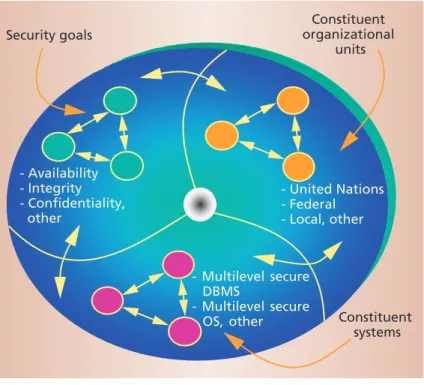
One key aspect of a multidisciplinary infrastructure is the existence of diverse information security poli-cies employed by individual government agenpoli-cies. These varied policies create a highly heterogeneous multidomain environment. Such environments should support interoperability of several security domains and allow strong interdomain interaction. The main features of a multidomain environment, as Figure 1 shows, consist of the following:
- Availability - Integrity - Confidentiality, other - United Nations - Federal - Local, other - Multilevel secure DBMS - Multilevel secure OS, other Security goals Constituent organizational units Constituent systems
Figure 1. Main features of a digital government’s multidomain environment. The com-ponents of a multidomain environment are composed of constituent organizational units such as the United Nations and federal and state agencies with different security goals (availability, integrity, and confidentiality). In addition, it consists of hetero-geneous software system components (for example, multilevel secure OS, DBMS).
• The environment can be composed of diverse interacting and collaborating constituent agencies that employ individual policies, such as private organizations or local, state, fed-eral, and international government agencies.
• The environment can have more than one security goal, with the multiple goals consist-ing of variations on the same goal or a series of drastically different ones. The collaborating agencies may design their constituent domains to achieve one or more security goals.
• The infrastructure supporting such an environ-ment can have heterogeneous system components, services, and applications, which can include data-base federations, multilevel secure datadata-base man-agement systems, and multilevel secure operated systems.7
Several security policies in a multidomain environ-ment can coexist and evolve with the changing oper-ational needs and services the government provides. The overall infrastructure must allow seamless and secure interoperation among diverse and heteroge-neous security mechanisms. The infrastructure should be scalable, open, and extensible. Meeting all these requirements presents several technical challenges.
Semantic heterogeneity and metapolicy
The diversity of organizational and user-specific security policies in a DG environment requires pow-erful formalisms for efficiently mapping security attributes across interacting domains. Determining a specification’s correctness and reasoning about the safety and liveliness properties of a multidomain envi-ronment’s security mechanism require formal models and metapolicies. These models should be generic and flexible enough to express a wide range of security policies and must provide a semantic basis for policy composition and modifications.
Policy neutrality avoids restricting security imple-mentations to DAC or MAC. Rather, a policy-neutral model supports arbitrary user-defined policies. The environment’s formal models and framework should also provide a theoretical basis for assessing the level of security assurance.
Metapolicies must also allow autonomy and trans-parency for the policies adopted by an individual domain, which provides for the policies’ continuous evolution.
Secure interoperability
Any policy change, addition, or deletion requires reevaluating the system’s secure interoperability. Secure interoperability poses a major challenge when dealing with an environment where subjects from a different domain access objects in a given domain. If
more than one rule governs the interaction among multiple domains, such a situation can cause rule con-flict and may require a mediation policy to identify appropriate rules.8
Many possible multidomain scenarios in a DG envi-ronment highlight the need for secure interoperability. For example, suppose an entrepreneur plans to establish a small business—a pharmaceutical factory—in a state in the US. Assume that the state government’s Business Development Agency has developed an integrated infor-mation system that provides a one-point interface for helping establish such a business. The BDA lets the entre-preneur obtain all necessary information to set up a busi-ness, including finding a suitable site, facilitating the process of purchasing land, and acquiring the permits and clearances essential to establishing the business.
The system also supports an integrated electronic application process that automatically generates all necessary transactions to other relevant agencies required to determine whether the BDA can permit the applicant to establish a business. These agencies can include the Environmental Protection Agency, which certifies the use of chemicals and disposal plans for haz-ardous by-products; the local police departments; the FBI, which provides a background check to certify that the applicant has no criminal record; the real estate agencies that maintain the GIS information about the sites suitable for building a pharmaceutical factory; and the BDAs for states where the applicant has pre-viously operated a business, who must certify that the applicant has maintained acceptable business conduct. In such a scenario, the local state’s BDA must inter-operate with all these agencies. The information sys-tems for each of these agencies can employ their own security policies, which can result in a possible access-rules conflict that requires a mediation policy. For example, in the case of poor metapolicy specifications, the domains of the local BDA and the real estate agency may overlap, with each agency explicitly defin-ing access policies for common objects restricted only to their own domain users. In addition, such interop-eration may create other risks.
In essence, secure interoperation should enforce the following two principles:9
• The autonomy principle, which states that if access is permitted within an individual system, it must also be permitted under secure interoperation.
• The security principle, which states that if an access is not permitted within an individual sys-tem, it must not be permitted under secure inter-operation.
It is impossible to guarantee secure interoperation among multiple domains because finding a secure solu-tion with some optimality presents an NP-complete
Any policy change,
addition, or
deletion requires
reevaluating the
system’s secure
interoperability.
fidential. Thus, users having the lowest clearance in either system can access the top-secret information.
Management challenges
Thanks to the large number of administrative domains, subjects, and objects, security management in a DG infrastructure presents a challenging task. One characteristic of a DG is that it forms an essentially open system where the entities that represent users, objects, policies, security domains, and other compo-nents are transient. This inherent dynamism makes the task of overall management and, in particular, secu-rity configuration management, highly complex.
INFORMATION SECURITY APPROACHES
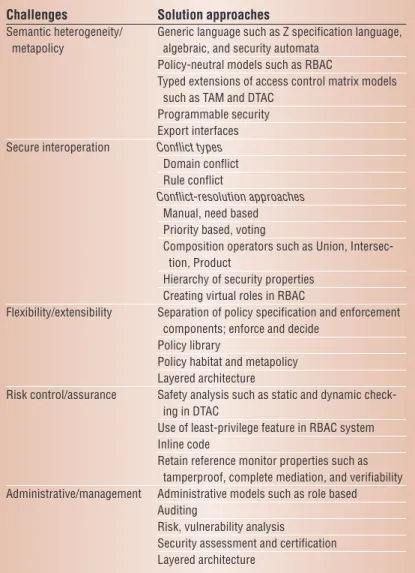
To meet the challenges we have described, security experts have developed several approaches to infor-mation security management. Here we profile the strengths and limitations of the most prominent meth-ods, which Table 1 summarizes.
Policy-metapolicy specification
In a multidomain environment, establishing
seman-February 2001 69
problem.9Optimization can include maximizing the amount of shared data among all domains, maximiz-ing the number of legal accesses, or—in an extreme case—minimizing the number of conflicting domains.
Assurance and risk propagation
In a multidomain environment, users must main-tain a cermain-tain degree of assurance about the entire sys-tem’s security. While some risks may be acceptable in a local system, such risks can, in a larger network, propagate and increase the level of vulnerability for all component systems.
For example, continuing our BDA scenario, if the local BDA has a security hole that lets the applicant obtain sufficient privileges in the BDA system, he can use it as a back door to access other systems and attempt to penetrate them. For example, assume that the local BDA and real estate agency use the follow-ing metapolicy rules:
• BDA employee B assumes the role of real estate agency employee E when B needs to access infor-mation in the real estate agency’s system, and
• real estate agency employee F assumes the role of BDA employee A when F needs to access infor-mation in the BDA system.
In addition, assume that A is senior to B in that A has all B’s security privileges, but B does not have all of A’s privileges. Similarly, assume that E’s role is higher than F’s role. In this case, employee F can enter the BDA sys-tem and assume A’s role and, since A is senior to B, can then assume B’s role and enter the real estate agency’s system using E’s role. In this case, F can acquire all the privileges of his senior, E. Similarly, B can enter the real estate agency’s system with E’s role and access the BDA system assuming A’s role, thus acquiring all A’s privi-leges, even though A is senior to him.
A related issue, the cascading problem, also arises in multidomain environments. Consider two multi-level systems, X and Y. Suppose system X is designed for managing information classified as either secret or top secret and that all users of X are cleared for secret information at least. System Y can handle information classified as confidential or secret, and its users are cleared for confidential information at least. Now, suppose their owners integrate the two sys-tems, and the resulting three levels of clearance include confidential, secret, and top secret. In the merged system, the secret information can pass between the two systems. If a penetrator overcomes the protection mechanisms in both the individual sys-tems, he can then downgrade the top-secret infor-mation of system X to the level of secret and pass such information to system Y. In system Y, the same pen-etrator can then downgrade that information to
con-Table 1. Digital government security challenges and potential approaches to solving them.
Challenges Solution approaches
Semantic heterogeneity/ Generic language such as Z specification language, metapolicy algebraic, and security automata
Policy-neutral models such as RBAC
Typed extensions of access control matrix models such as TAM and DTAC
Programmable security Export interfaces Secure interoperation Conflict types
Domain conflict Rule conflict
Conflict-resolution approaches
Manual, need based Priority based, voting
Composition operators such as Union, Intersec-tion, Product
Hierarchy of security properties Creating virtual roles in RBAC
Flexibility/extensibility Separation of policy specification and enforcement components; enforce and decide
Policy library
Policy habitat and metapolicy Layered architecture
Risk control/assurance Safety analysis such as static and dynamic check-ing in DTAC
Use of least-privilege feature in RBAC system Inline code
Retain reference monitor properties such as tamperproof, complete mediation, and verifiability Administrative/management Administrative models such as role based
Auditing
Risk, vulnerability analysis
Security assessment and certification Layered architecture
tically correct relationships among security policies is essential to ensuring secure cooperation. Metapolicies can specify such relationships as cooperation rules and guidelines for conflict resolution and interaction. Existing metapolicies are either ad hoc or based on formal approaches.
Ad hoc approaches.These policies put more emphasis on the system’s development and implementation details. In particular, they emphasize conflict resolution among multiple domains. Hilary Hosmer10has proposed sev-eral conflict-resolution methods, including manual, stan-dard form, and rule-based strategy approaches.
The manual approach, used most commonly, assigns a security officer the responsibility for manually inte-grating multiple policies and resolving conflicts. In the standard-form approach, the organization adopts some generic or policy-neutral guidelines to ensure secure interoperability. Each domain uses a conversion logic to translate its local rules to a global metapolicy schema. In a rule-based strategy, the conflict resolution mechanism uses a predefined set of rules that can include either a voting technique or a set of informal guidelines. The conflict resolution mechanism can use various trade-offs while resolving conflicts.9
Formal approaches.Winfried Kuhnhauser’s6formal approach to metapolicies classifies multidomain inter-actions into three unique classes:
• Class 1 represents the conflict-free interactions that occur when both subject and object belong to a single domain.
• Class 2 characterizes the situation in which no security policy can provide the rule for interac-tion across multiple domains. Such scenarios occur when the absence of a comprehensive secu-rity policy creates a policy hole.
• Class 3 describes those systems in which domains can overlap. In this case, a subject from a non-overlapping domain can access objects that hap-pen to be in the overlapped region. Such inter-actions can result in rule conflicts that require a mediation policy.
For mediation, Kuhnhauser’s framework uses con-flict and cooperation matrices. A concon-flict matrix pro-vides a ranking mechanism to resolve conflicts between
two policies. The cooperation matrix stores the infor-mation about a predetermined policy to be used when two domains interact.
Model-based methods
Traditional DAC and MAC models lack capabilities for expressing a domain’s arbitrary security require-ments. Increasingly, developers use flexible approaches that allow user-defined security policies. The RBAC model is a flexible approach that has generated great interest in the security community. Recently, Ravi Sandhu and colleagues have proposed the National Institute for Science and Technology RBAC5as a stan-dard reference model. Depicted in Figure 2, RBAC uses a four-level system in which each higher level includes the functional capabilities from all levels below it. The levels correspond to four RBAC models: flat, hierar-chical, constrained, and symmetric.
The flat RBAC model provides the minimal features essential for any RBAC mechanism. These include roles, user-role assignment, and role-privilege assignment.
Hierarchical RBAC includes as a requirement role hierarchies, which define relationships among roles in a domain. A role can be senior to other roles, in which case the senior role inherits all the privileges of the junior roles. Constrained RBAC requires separation of duties (SOD), which aims mainly to avoid fraud and errors in an organization. For example, in some domains, the same user cannot be assigned two roles—such as accounting clerk and purchasing clerk. Such a model uses the notion of static SOD. Alternatively, in a dynamic SOD case, a user may be assigned two roles but is restricted from activating both roles in a single session.
The symmetric RBAC model adds a permission-role review requirement. As a result, the model allows identification of the permissions assigned to existing roles and vice versa. Most RBAC models use roles to imply a collection of access privileges.
The RBAC model is an attractive candidate for a DG infrastructure because it provides flexible support in a multipolicy environment. Security administrators can use role hierarchy mapping between two RBAC-based domains to define a metapolicy for interoper-ability. An RBAC’s relatively simple security admin-istration allows separation of user-role and role-privilege assignments. When users receive multiple roles, RBAC ensures that they can activate only the required roles for a particular access, thereby mini-mizing damage from inadvertent errors.
RBAC’s policy neutrality, constraints, and role hier-archies make it a powerful model for specifying poli-cies from other models such as DAC and MAC and for specifying rules from any arbitrary user-specific model. A mixture of such policies can coexist in a DG infrastructure. This heterogeneity makes RBAC use-Symmetric RBAC
Permission-role review with performance
Constrained RBAC Separation of duty Hierarchical RBAC Role hierarchies
Flat RBAC
Basic features, user-role assignment view Figure 2. NIST’s
role-based access control (RBAC) model, a pro-posed standard refer-ence model, uses a four-level hierarchy in which each level includes all the capa-bilities of the levels below it.
ful in a multidomain environment. Further, models for administrative roles provide efficient mechanisms for distributing security management functions to a number of administrators.
Other new access control models that have shown potential for supporting a multipolicy environment include multiple-policy schematic protection, typed access matrices, and dynamically typed access control models, which use subject and object types. However, these models have reached only the initial phases of their development.
All the models we have described use the subject-object view for specifying security policies. These mod-els have a limited scope and, in a DG environment, cannot be expanded to include an access policy based on the content of information or the nature of tasks and transactions. Applications and services in a DG envi-ronment can require automated transactional functions and workflow-based processing, which result in a highly transaction-intensive infrastructure. Roshan K. Thomas and colleagues6 have proposed an initial TBAC family of models in which the authorization unit is a task.
Agent-based methods
With the growing maturity of software engineering, software agents have emerged as a popular system-building paradigm. Computer systems security design-ers can use agents—characterized by adaptation, cooperation, autonomy, and mobility—to provide security features for a DG infrastructure. Agent com-munication languages such as the Knowledge Query and Manipulation Language can negotiate policies during conflicts to ensure secure interoperation.11 The servers and clients in a distributed environment can assign security enforcement tasks to agents.
Although the mobility and adaptability characteris-tics of agents provide essential features for the efficient use of system resources, they can pose several security threats. For example, an agent can engage in malicious behavior, thus disrupting the host’s normal operation. Similarly, a host can hinder an agent’s activity by deny-ing required access to local information resources.
Information about agent technology that addresses the issue of security in a heterogeneous environment has begun appearing in the literature. For example, an agent-based architecture has been proposed11as a solution to the public-key infrastructure open stan-dard, which facilitates interoperable and flexible authentication for various applications. System designers can use similar approaches to address the issue of access control policies.
Architectural methods
Several approaches that address the challenges of multipolicy environments also address architectural issues. Notable among these are the Object
Manage-ment Group’s Common Object Request Broker Architecture (Corba) and the Open Software Foundation’s Distributed Computing Environ-ment. Corba offers a security policy specifica-tion but lacks formal semantics, thus making security-handling mechanisms more or less ad hoc. DCE addresses the general issue of object interoperability by providing a middleware architecture that implements an ad hoc security mechanism.
Some other proposed architectures include the Distributed Trusted Operating System and the Meta Object Operating System Environment12 (Moose). DTOS supports separation between the policy specification and policy enforcement components by using a mix of tabular represen-tation and a language-based specification model to provide a high degree of flexibility in security policy selection. Moose’s three-layer architecture uses a formal approach to integrate modeling, specification, verification, and implementation.
Database federation approach
The database federation approach, which integrates several database management systems, provides some solutions to the multidomain problem. Database researchers have proposed several approaches for devel-oping systems that achieve the autonomy of compo-nent databases yet remain transparent at the federation level. These approaches also address a multidomain environment’s security management issues. For exam-ple, Dirk Jonscher and Klaus R. Dittrich have reported a federated database system that uses several DAC and MAC policies.13This system uses a global access layer to map global authorizations into the local-access rights of individual databases.
The Distributed Object Kernel7is another example of a secure federated database system that uses a map-ping technique to build a global-access policy from local DAC and MAC policies. In the DOK system, the enforcement mechanism for global security involves layered processing by agents designed to check attribute constraints and sanitize query results. Developers can expand approaches for federated-database schema inte-gration to design the metapolicy for access control in a multidomain environment and to provide a viable secu-rity-management solution for a DG infrastructure.
O
f the many technologies currently in development,RBAC models appear to be the most attractive solution for providing security features in a mul-tidomain digital government infrastructure. RBAC fea-tures such as policy neutrality, principle of least privilege, and ease of management make them espe-cially suitable candidates. In addition, RBAC models can address some of the challenges we have described.
February 2001 71
Models that use the
subject-object view
for specifying
security policies
cannot be expanded
to include an access
policy based on
the content of
information or the
nature of tasks and
For example, such models can express both DAC and MAC policies, as well as user-specific policies. In essence, RBAC models can provide a generic frame-work for expressing diverse security requirements.
Federated database management system approaches also show promise and will likely be expanded to effec-tively address multipolicy issues. Agent systems, on the other hand, require further exploration to evaluate their security enforcement features. Much work remains before we can use agents safely in a complex environment such as a digital government, which does not permit the viable use of a centralized reference monitor. From the security management perspective, the architectural separation of policy specification and enforcement mechanisms is growing in importance. Providing the techniques needed to evaluate these mod-els for system assurance and risk analysis remains a major challenge. ✸
Acknowledgment
This study is supported, in part, by a grant from the Center for Education and Research in Information Assurance and Security at Purdue.
References
1. H. Schorr and S.J. Stolfo, “Towards the Digital Govern-ment of the 21st Century,” Workshop on Research and Development Opportunities in Federal Information Ser-vicesreport, June 1997, http://www.isi.edu/nsf/final.html. 2. E. Bertino, E. Ferrari, and V. Atluri, “The Specification and Enforcement of Authorization Constraints in Work-flow Management Systems,” ACM Trans. Information and System Security, vol. 2, no. 1, 1999, pp. 65-104. 3. G. Stoneburner, “Information System Security Engineering
Principles (ISSEP)—Initial Draft Outline,” NIST, 2000, http:// csrc.nist.gov/publications/drafts/epits-draft-0010231.pdf. 4. R.S. Sandhu, “Role Hierarchies and Constraints for Lattice-Based Access Control,” Computer Security ESORICS 96, LNCS 1146, Springer Verlag, Berlin, 1996, pp. 65-79. 5. R.S. Sandhu, D. Ferraiolo, and R. Kuhn, “The NIST
Model for Role-Based Access Control: Towards A Uni-fied Standard,” 5th ACM Workshop on Role-Based Access Control, ACM Press, New York, 2000, pp. 47-60. 6. R.K. Thomas and R.S. Sandhu, “Conceptual Founda-tions for a Model of Task-Based AuthorizaFounda-tions,” The Proc. 7th Computer Security Foundation Workshop
(CSFW94), IEEE CS Press, Los Alamitos, Calif., June 1994, pp. 66-79.
7. Z. Tari and G. Fernandez, “Security Enforcement in the DOK Federated Database System,” Database Security X: Status and Prospects, Chapman and Hall, London, 1997, pp. 23-42.
8. W.E. Kuhnhauser and M.K. Ostrowski, “A Formal Frame-work to Support Multiple Security Policies,” Proc. 7th
Canadian Computer Security Symp., Ottawa, Communi-cation Security Establishment Press,1995, pp. 1-19. 9. L. Gong and X. Qian, “Computational Issues in Secure
Interoperation,” IEEE Trans. Software Eng., Jan. 1996, pp. 43-52.
10. H.H. Hosmer, “Metapolicies I,” ACM SIGSAC Review, 1992, pp. 18-43.
11. Q. He, K. Sycara, and Z. Su, “A Solution to Open Stan-dard of PKI,” Proc. 3rd Australian Conf. Information Security and Privacy,ACISP 98, C. Boyd and E. Dawson, eds., Springer, Berlin, July 1998, pp. 99-110.
12. J. Hale, M. Papa, and S. Shenoi, “Programmable Secu-rity for Object-Oriented Systems,” Proc. Database Secu-rity XII: Status and Prospects, Kluwer Academic, Boston, 1998, pp. 109-123.
13. D. Jonscher and K.R. Dittrich, “Argos—A Configurable Access Control System for Interoperable Environments,”
Proc. 9th Ann. Working Conf. Database Security, Chap-man and Hall, London, 1995, pp. 43-60.
James Joshiis a graduate student in the School of Elec-trical and Computer Engineering at Purdue Univer-sity. His research interests are computer security and multimedia systems. He received an MS in computer science from Purdue University. He is a student mem-ber of the ACM and the IEEE. Contact him at joshij@ ecn.pudue.edu.
Arif Ghafooris a professor in the School of Electri-cal and Computer Engineering at Purdue University. His research interests are multimedia information sys-tems, database security, and distributed computing. He received a PhD in electrical engineering from Columbia University. He is a Fellow of the IEEE. Contact him at [email protected].
Walid G. Arefis an associate professor of computer sci-ences at Purdue University. His research interests are database systems, spatial and multimedia data index-ing, video servers, network-attached storage devices, data mining, algorithms, data structures, and geo-graphic information systems. He received a PhD in computer science from the University of Maryland at College Park. He is a member of the ACM and the IEEE. Contact him at [email protected].
Eugene H. Spaffordis a professor of computer sciences and the director of the Center for Education and Research in Information Assurance and Security at Purdue University. His research interests are computer and network security, ethical and societal implications of computing, software validation, and verification and debugging. He received a PhD in information and computer science from the Georgia Institute of Tech-nology. He is a Fellow of the AAAS, the ACM, and the IEEE. Contact him at [email protected].