Arkansas Landlord Selection of Land-Leasing Contract Type
and Terms
1Ronald L. Rainey aL, Bruce L. Dixon b, Bruce L. Ahrendsen c, Lucas D. Parsch d and
Ralph W. Bierlen e
a Assistant Professor, Department of Agricultural Economics and Community Development,
University of Arkansas, Little Rock, Arkansas, USA.
b Professor, Department of Agricultural Economics and Agribusiness, University of Arkansas,
Fayetteville, Arkansas, USA.
c Associate Professor, Department of Agricultural Economics and Agribusiness, University of
Arkansas, Fayetteville, Arkansas, USA.
d Associate Professor, Department of Agricultural Economics and Agribusiness, University of
Arkansas, Fayetteville, Arkansas, USA.
e Economist, GIPSA/USDA, Des Moines, Iowa, USA.
Abstract
Land leasing is a major source of the land input to production agriculture.
Responses from a survey of landlords leasing crop land in Arkansas are analyzed to better understand those factors motivating landlords in the type of lease they select and the terms of those leases. Probit models are estimated to determine the relative importance of variables representing credit constraint, agency problem, and risk aversion factors. Regression models then estimate the impact of site, landlord, and tenant characteristics on contract terms – the percentage of crop and cost sharing arrangements between landlord and tenant. Probit results suggest credit constraint factors influence lease-type selection. Risk aversion, managerial ability, and social capital factors are also supported. Regression models show that land and crop characteristics are significant determinants of contract terms.
Keywords: Land leasing, probit, contract, production agriculture
1 This study is based upon work supported by USDA-CSREES Agreement No. 97-35402-4633.
L Corresponding author: Tel: + 530-752-1668
Email: [email protected]
Other contact information: B. Dixon: [email protected], B. Ahrendsen: [email protected],
Introduction
Land leasing plays a significant role in providing the land input to U.S. production agriculture. Leased land accounts for 40% of total farm acreage (USDA/NASS, 1999a) and approximately 35% of farm assets (estimated by authors). Leasing allows farm operators to control more acreage with less equity, carries lower financial risk, and allows for greater managerial flexibility than purchasing land with debt financing. Aside from inheritance, leasing is the primary method by which family farms are able to control sufficient acreage to be commercially viable. Over two-thirds of leased land is found on farms with 1,000 or more operating acres (USDA/NASS, 1999a).
The small volume of U.S. land leasing literature (see Dasgupta et al., 1999, and Allen and Lueck, 1995) does not reflect its importance in U.S. agriculture. In particular, there is a paucity of literature explaining and modeling the behavior of the contracting parties at the lease-level. As noted by Bierlen and Parsch (1996), this is likely due to a lack of good lease-level data. Lease-level data are difficult to collect because lease agreements are determined by private negotiation between tenants and landlords in localized markets, which are often unique. Tenants and landlords are often unwilling to release proprietary information and data collecting agencies may be reluctant to use up goodwill with producers and landlords to collect lease data. A better understanding of empirical landlord-tenant contracts is
required for managerial and policy decisions. The analysis from the present study addresses this issue by relying on primary data from Arkansas landlords.
Contract type (cash rent and various share arrangements) substantially affects tenant/landlord sharing of revenue, costs, risk, and managerial responsibilities. Because of this, researchers have examined factors motivating cropland contract choice selection based on farm operator/landlord incentives in each contract type. Existing U.S. research, see e.g., Allen and Lueck (1992, 1993), Bierlen et al. (2000a), Gwilliam (1993), and Brown and Atkinson (1981), test for and find evidence
consistent with hypotheses deriving from the agency problem, tenant/landlord risk sharing, social capital, tenant managerial ability, the agricultural ladder, and tenant credit constraints. However, except for Bierlen, Parsch and Dixon (BPD) (1999), the literature focuses on the selection of contract type while ignoring the contract terms.
Farm operators need to understand landlord motivation in selecting lease type to be better able to negotiate with landlords. Also, by understanding what motivates other landlords, lessors can better understand the land market and their place in it. This paper estimates cropland contract decision-making models with data from owners of Arkansas cropland. The study follows the approach applied in BPD by examining both contract choice and selection of contract terms. While the BPD study examined factors affecting tenant decisions, the present study provides
information on leasing arrangements from the landlord’s perspective. There are no investigations to our knowledge that solely examine landlord selection of cropland contract type and the terms thereof. Therefore, this study provides information on the incentives – financing, risk, and cost – motivating landlords to provide this vital input, land, to the agricultural production process.
Data
In late fall 1998 a survey of 706 landlords who had leases in five Arkansas crop-reporting districts (3, 4, 5, 6 and 9) was administered. These districts are located in the Mississippi Delta of Arkansas (the eastern third of state) and along the
Arkansas River Valley in the west-central part of the state. The two regions include almost all of the state’s cropland operations.
The sampling frame did not include a complete listing of all landlords since such information is difficult, if not impossible to obtain. The sampling frame relied on information available from the National Agricultural Statistics Service (NASS) gathered from the 1997 Census of Agriculture. Of the 706 sampled cropland owners, 199 usable questionnaires were returned. This study only includes landlords who leased cropland for rice, soybean or cotton production and who personally farmed fewer than 80 acres – non-operator landlords. Because of different information sets between operators and non-operators, we wanted to exclude operator landlords who farmed cropland in addition to being lessors.
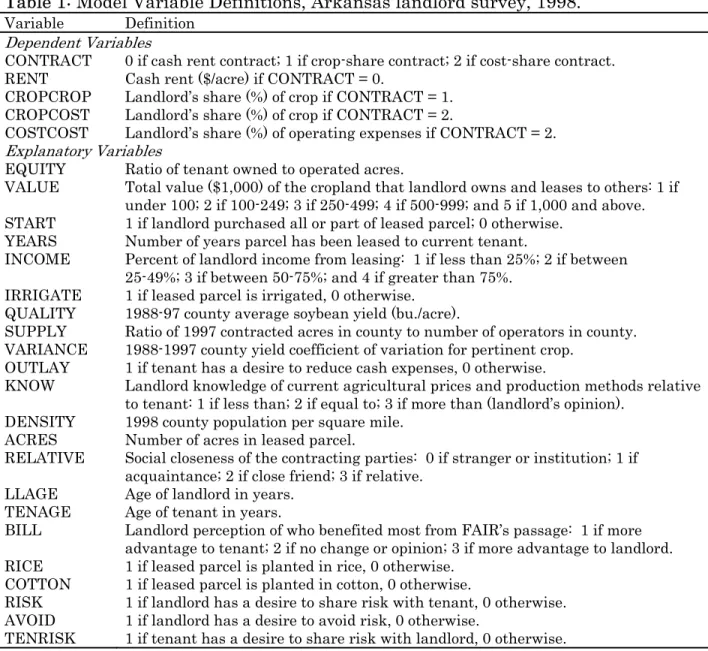
The landlords were queried about their largest rice, full-season soybean or cotton leases for 1998 cropping arrangements. Thus, each landlord gave information on at most one lease for each of these crops as requested by the survey instrument. Model variable definitions utilized from the survey are reported in Table 1.
1
Summary statistics for the variables utilized are reported in Table 2. Landlord age ranged from 34 to 93, but the average landlord age of 64 shows that landlords are of retirement age or close to it. USDA’s 1999 Agricultural Economics and Land
Ownership survey (AELOS) and Johnson et al. (1988) report similar numbers for landlord age. The average tenant age as given by the landlords was 47 ranging from 23 to 80.2 More than 75% of the respondents were over the age 55 and the landlords
were typically males representing 79% of the respondents. Landlord respondents were well educated with almost 90% of landlords having finished high school, 65% having pursued post-secondary education, and 42% were college graduates.
Compared with the earlier 1997 tenant survey (BPD), the landlords had more
formal education than did the responding tenants. Bierlen et al. (2000a) report that
1
2Results of a similar 1997 tenant survey reported 50.7 years for the median tenant age (Bierlen et
Table 1: Model Variable Definitions, Arkansas landlord survey, 1998. Variable Definition
Dependent Variables
CONTRACT 0 if cash rent contract; 1 if crop-share contract; 2 if cost-share contract.
RENT Cash rent ($/acre) if CONTRACT = 0.
CROPCROP Landlord’s share (%) of crop if CONTRACT = 1.
CROPCOST Landlord’s share (%) of crop if CONTRACT = 2.
COSTCOST Landlord’s share (%) of operating expenses if CONTRACT = 2.
Explanatory Variables
EQUITY Ratio of tenant owned to operated acres.
VALUE Total value ($1,000) of the cropland that landlord owns and leases to others: 1 if
under 100; 2 if 100-249; 3 if 250-499; 4 if 500-999; and 5 if 1,000 and above.
START 1 if landlord purchased all or part of leased parcel; 0 otherwise.
YEARS Number of years parcel has been leased to current tenant.
INCOME Percent of landlord income from leasing: 1 if less than 25%; 2 if between
25-49%; 3 if between 50-75%; and 4 if greater than 75%.
IRRIGATE 1 if leased parcel is irrigated, 0 otherwise.
QUALITY 1988-97 county average soybean yield (bu./acre).
SUPPLY Ratio of 1997 contracted acres in county to number of operators in county.
VARIANCE 1988-1997 county yield coefficient of variation for pertinent crop.
OUTLAY 1 if tenant has a desire to reduce cash expenses, 0 otherwise.
KNOW Landlord knowledge of current agricultural prices and production methods relative
to tenant: 1 if less than; 2 if equal to; 3 if more than (landlord’s opinion).
DENSITY 1998 county population per square mile.
ACRES Number of acres in leased parcel.
RELATIVE Social closeness of the contracting parties: 0 if stranger or institution; 1 if
acquaintance; 2 if close friend; 3 if relative.
LLAGE Age of landlord in years.
TENAGE Age of tenant in years.
BILL Landlord perception of who benefited most from FAIR’s passage: 1 if more
advantage to tenant; 2 if no change or opinion; 3 if more advantage to landlord.
RICE 1 if leased parcel is planted in rice, 0 otherwise.
COTTON 1 if leased parcel is planted in cotton, 0 otherwise.
RISK 1 if landlord has a desire to share risk with tenant, 0 otherwise.
AVOID 1 if landlord has a desire to avoid risk, 0 otherwise.
TENRISK 1 if tenant has a desire to share risk with landlord, 0 otherwise.
88% of their surveyed tenants were high school graduates but only 33% graduated from post-secondary institutions.
Consistent with AELOS, responding landlords were not overly dependent on leasing income.3 For 56% of landlords, leasing income represented less than 25% of their
total income, and only 21% of respondents indicated that leasing income
represented over half of their income.4 Respondents leased out an average of 565
acres with a range from 80 to 4,500 acres.
3 The Agricultural Economics and Land Ownership Survey (USDA/1999b) reported that 68% of
Table 2: Summary statistics of model variables, Arkansas landlord survey, 1998.
Full Sample Statistics Sub-sample Means
Variable Mean Min. Max. Cash
Rent Crop-share Cost-share
Dependent Variables CONTRACT 1.38 0 2 0 1 2 RENT - 20 112 50.08 - - CROPCROP - 3 50 - 25.05 - CROPCOST - 13 50 - - 29.70 COSTCOST - 3.23 50 - - 14.61 Explanatory Variables EQUITY 0.16 0 0.89 0.27 0.20 0.11 VALUE 3.14 1 5 3.04 3.15 3.16 START 0.52 0 1 0.33 0.53 0.56 YEARS 10.39 0 58 6.33 8.64 12.68 INCOME 1.76 1 4 1.50 1.82 1.79 IRRIGATE 0.84 0 1 0.75 0.87 0.84 QUALITY 27.93 28.14 33.78 26.79 28.00 28.25 SUPPLY 423.47 47.49 913.21 483.72 430.68 403.60 VARIANCE 12.12 4.73 22.89 14.77 12.24 11.52 OUTLAY 0.08 0 1 0 0.08 0.10 KNOW 1.57 1 3 1.58 1.45 1.66 DENSITY 58.11 14.69 465.66 69.50 53.84 58.57 ACRES 564.84 80 4500 497.08 580.85 569.10 RELATIVE 1.69 0 3 1.58 1.72 1.69 LLAGE 64 34 93 64 65 63 TENAGE 47 23 80 46 47 46 BILL 1.95 1 3 2.04 1.93 1.94 RICE 0.37 0 1 0.13 0.41 0.39 COTTON 0.15 0 1 0.13 0.17 0.13 RISK 0.31 0 1 0 0.16 0.49 AVOID 0.17 0 1 0.54 0.21 0.05 TENRISK 0.17 0 1 0.04 0.12 0.24
Conceptual Model and Testable Implications
Landlords and tenants in our sample chose among the following contract types: cash rent, crop-share, and cost-share. A cash rent contract requires the tenant to pay the landowner a fixed annual cash payment and be responsible for all operating
expenses, but the tenant receives all income from production and government payments. In a crop-share contract the tenant is responsible for all operating expenses but shares the production output, i.e. crop, and government payments with the landlord. A cost-share contract not only includes a sharing of the output
4 Bierlen et al. (2000a) report that 71.2% of tenants relied on farming income for 50% or more of total
and government payments between tenant and landlord but also – unlike the crop-share contract – a sharing of the operating expenses.
The type of contract chosen affects the level of tenant cash outlays. In a cash rent contract the tenant must pay the cash rent in addition to the full normal operating expenses. With a crop-share lease, expenses are similar to those of a cash rent lease, less the cash rent. In a cost-share lease, the tenant pays no cash rent and only a share of certain specified operating expenses – normally the same share as he/she receives of the crop. Since landlord income is dependent on variable crop yields and market prices with share contracts, additional financial and managerial
compensation is typically negotiated to induce landlords to utilize these contracts. The credit constraint paradigm is used to initially specify the model for selecting lease type. It adheres to the belief that producers use leasing arrangements as a substitute for debt (BPD and Bierlen et al., 2000b). This framework assumes tenants surmount credit constraints and increase the scale of operation by moving from a cost-share to a crop-share to a cash rent contract. This approach says that the probability of choosing a cost-share (cash rent) contract should increase (decrease) with operating expenses, cash rent levels, and landlord financial
strength. The framework also implies that tenants with strong financial conditions will choose cash rent contracts because per acre tenant profits are typically highest with a cash rent contract (BPD). This study tests the credit constraint framework by using variables that indicate the levels of operating expenses, cash rent, and tenant and landlord financial strengths as described below.5
Variables impacting operating expenses and cash rent levels include land quality and availability of contracted land. First, characteristics increasing the quality of the land are hypothesized to increase the probability of a cost-share contract. Soil fertility (QUALITY) and irrigation (IRRIGATE) enhance the land’s productive value. These two variables increase operating expenses and cash rent levels by encouraging higher input usage and being relatively more desirable resources to manage. Also, per acre cash rent levels are directly affected by the supply and demand of cropland acreage. High per acre rent levels are associated with a small supply of available contract acres. Therefore, leased cropland acreage per operator in a county (SUPPLY) is hypothesized to be negatively related to the probability of selecting a cost-share contract.
Financial indicators reflect (1) landlords’ ability to provide operating capital and (2) tenants’ credit constraints. As noted in BPD, tenants with higher equity
(owned/total operated acres) levels in their operations should be more financially stable than tenants with lower levels of ownership. The probability of choosing a
5 The survey instrument only queried landlords; therefore tenant information is based solely on
cost-share contract should decrease as tenant equity (EQUITY) increases. Similarly for landlords, the total value of their owned cropland acreage (VALUE) should indicate their financial strength. Therefore, VALUE is hypothesized to increase the probability of choosing a cost-share contract. Another variable indicating landlord financial strength is their percentage of total income derived from leasing
(INCOME). This implies that the probability of selecting a cost-share contract decreases as INCOME increases. Relatively speaking, landlords with highly valued cropland acreage and significant non-farm income should have a superior financial condition and are more able to assume the added risk and increased expenses associated with a cost-share contract. Landlords who inherited all or part of their cropland should face reduced debt payment obligations compared with landlords who purchased their acreage. The landlords who purchased their acreage would likely require a higher return for their acquired resources. This suggests that landlords who purchased their land (START) are more likely to prefer cost-share contracts.
Following BPD we hypothesize that tenants with a weak financial position continue to secure leased parcels for relatively longer periods of time. Therefore, we
hypothesize that the probability of selecting a cost-share contract increases as the length of the leasing period (YEARS) increases. Similarly, we test if tenants
attempting to reduce cash operating expenses during lease negotiations (OUTLAY) are more likely to utilize cost sharing arrangements. Lastly, crop yield variability measured by the county-level coefficient of variation for the crop raised
(VARIANCE) is used as a proxy for risk aversion. Increasing crop variance is assumed to increase the probability of selecting a cash rent contract by risk averse landlords.
Ordered Probit Analysis of Contract Choice Hypotheses
The estimation and statistical testing utilize McFadden’s (1981) ordered probit (discrete dependent variable) models to test hypotheses about cropland contract decision-making. The dependent variable numerical values indicate an ordinal ranking of the outcomes, with higher values indicating a more preferred or desired outcome than lower values. The underlying model of binomial or ordinally ranked estimation assumes that the true value of the dependent variable (y*i) is
unobservable. The process generating the unobserved values of (y*i) is:
y*i = β′xi + εi,
where y*i represents the unobserved value; xi is a vector of explanatory variables on
the ith observation; and εi the error term (normally distributed with mean zero and
unit variance). The observable yi is defined as follows for the ordered probit model:
If 0 < y*i ≤ λ, then yi = 1;
If λ < y*i , then yi = 2.
For the ordered probit model, λ is an unknown “threshold” parameter to be estimated along with β.
Models are estimated using maximum likelihood methods. The probability of a given discrete outcome is a function of β′xi. The components of β do not have the classical regression model interpretation of the marginal change in the dependent variable as the levels of xi change (Greene, 2000). Unlike the classical regression model, the marginal change in probabilities is a function of xi as well as β. In the general case, the signs of the coefficients only indicate direction of changes in the highest and lowest ranked categories of yi for changes in xi but not for the interior
category. That is, if a component of β is greater than zero, then an increase in the corresponding xi means that the probability that y = 0 decreases and the probability
that y = 2 increases.
Credit Constraint Model Results and Interpretation
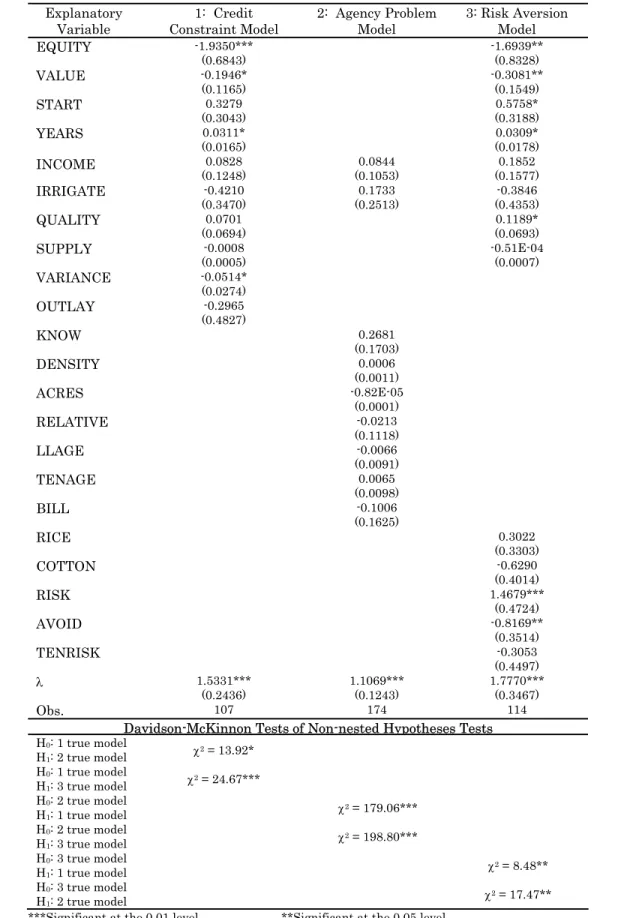
Table 3 reports the coefficient estimates for the credit constraint model (column 1) with the asymptotic standard errors reported in parentheses.6 The estimate of λ is
positive and significant. Variables significantly impacting contract selection in the credit constraint model at least the .1 level are EQUITY, VALUE, YEARS, and VARIANCE.
The coefficients of the variables representing landlord and tenant financial strengths give contradictory findings. As anticipated, increasing tenant financial strength, EQUITY, makes cash rent contracts more likely. This finding is consistent with the results reported in BPD. But contrary to the hypothesized outcome,
strengthening the landlord’s financial condition, VALUE, also makes cash rent contracts more likely. Tenant financial condition is the more statistically significant variable. The significance of EQUITY shows that credit constraints are an
important factor and supports the idea that tenants with higher equity have
influence in the contracting process. Furthermore, the significance and positive sign of YEARS indicates longer term leases are associated with cost-share leases. In addition to helping tenants with weak financials, social closeness might also grow out of cost-share arrangements leading farm operators to continue to cost-share. The coefficient of VARIANCE, as hypothesized, indicates that increasing the variability of the cropland’s yield makes cash rent contracts more likely. The
6 On the basis of condition indices as in Belsley, Kuh and Welch (1981), multicollinearity is only a
problem in the agency model and none of the other six models estimated in the study. Since the agency model is clearly inferior as indicated by the Davidson-McKinnon tests, no attempt is made to ameliorate the problem.
Table 3: Estimated Ordered Probit Coefficients for Landlord Contract Choice Models.
Explanatory
Variable Constraint Model 1: Credit 2: Agency Problem Model 3: Risk Aversion Model
EQUITY -1.9350*** (0.6843) -1.6939** (0.8328) VALUE -0.1946* (0.1165) -0.3081** (0.1549) START 0.3279 (0.3043) 0.5758* (0.3188) YEARS 0.0311* (0.0165) 0.0309* (0.0178) INCOME 0.0828 (0.1248) 0.0844 (0.1053) 0.1852 (0.1577) IRRIGATE -0.4210 (0.3470) (0.2513) 0.1733 (0.4353) -0.3846 QUALITY 0.0701 (0.0694) 0.1189* (0.0693) SUPPLY -0.0008 (0.0005) -0.51E-04 (0.0007) VARIANCE -0.0514* (0.0274) OUTLAY -0.2965 (0.4827) KNOW 0.2681 (0.1703) DENSITY 0.0006 (0.0011) ACRES -0.82E-05 (0.0001) RELATIVE -0.0213 (0.1118) LLAGE -0.0066 (0.0091) TENAGE 0.0065 (0.0098) BILL -0.1006 (0.1625) RICE 0.3022 (0.3303) COTTON -0.6290 (0.4014) RISK 1.4679*** (0.4724) AVOID -0.8169** (0.3514) TENRISK -0.3053 (0.4497) λ 1.5331*** (0.2436) 1.1069*** (0.1243) 1.7770*** (0.3467) Obs. 107 174 114
Davidson-McKinnon Tests of Non-nested Hypotheses Tests
H0: 1 true model H1: 2 true model χ 2 = 13.92* H0: 1 true model H1: 3 true model χ 2 = 24.67*** H0: 2 true model H1: 1 true model χ 2 = 179.06*** H0: 2 true model H1: 3 true model χ 2 = 198.80*** H0: 3 true model H1: 1 true model χ 2 = 8.48** H0: 3 true model H1: 2 true model χ 2 = 17.47**
*Significant at the 0.10 level. Asymptotic standard errors are in parentheses.
coefficient, although weakly significant, is consistent with a risk aversion
framework that suggests landlords attempt to limit their exposure to risky returns. Thus farm operators willing to accept risk can pursue the potentially higher returns from cash rent leases.
Alternative Model: Agency Problem
Following the specification in BPD, an alternative model emphasizing agency theory is estimated. With this approach, each lease presents unique opportunities for morally hazardous behavior, i.e. the tenant may take advantage of the landlord without detection. Examples of the agency problem include: 1) inputs are not set at levels which maximize joint tenant/landlord net returns for crop-share contracts, 2) incentives are present in share contracts which encourage tenants to underreport production levels, 3) cost-share contracts can lead to diversion of landlord supplied inputs to other enterprises, and 4) landlord supplied inputs like irrigation or soil fertility can be over-exploited in cash rent contracts. Two groups of variables are utilized to test the agency problem hypothesis: one group of “asset specific”
variables quantifies the productive characteristics of the cropland acreage, and the other group describes the experience, managerial abilities and profit motives of the tenants and landlords.
Variables identifying asset characteristics include irrigation equipment, alternative productive uses for the acreage, and size of the leased parcel. The presence of
irrigation (IRRIGATE) diminishes the option for tenants to deplete soil moisture. On the other hand, irrigation creates an incentive to “over-farm” the land. Therefore the sign of IRRIGATE is uncertain. Increasing population density, DENSITY, – which proxies for alternative uses of cropland – should increase the likelihood of a cash rent contract being utilized. This result follows since landowners should be less concerned with annual returns from the land when alternative uses for cropland are comparatively more profitable. The alternative uses make tenant misuse of
cropland less important. It also gives the landowner other options to generate returns from their land, thereby increasing the landlord’s bargaining position. ACRES is assumed to increase the probability of selecting a cost-share contract because opportunities for undetected abuse or misuse of resources increase with lease size.
To investigate possible effects of the Federal Agriculture Improvement and Reform (FAIR) Act of 1996 and the production flexibility contract payment issue, landlord perceptions of who benefits most from the legislation (BILL) are included as an explanatory variable. Schertz and Johnston (1997) find some evidence that lease terms were renegotiated as a result of the FAIR Act. In our survey only 7% of the leases experienced changes in rent and/or share levels between 1995 and 1998. Landlords with share leases benefit from the FAIR Act since they receive a
proportion of the production flexibility contract equal to their share of the crop. On the other hand, landlords with cash leases could attempt to capture part of the payment by raising rents. Thus it is not possible to sign the coefficient of BILL on a priori grounds.
Income is included in the agency problem model to control for the risk perceptions of the landlords. The variable INCOME is expected to be negatively related to the probability of choosing a cost-share contract due to lessor risk aversion.7 This
results from the belief that landlords are thought to want to reduce the variability of their farm income as the importance of their leasing income increases.
Tenant/landlord experience and managerial ability also have an impact on the operating expenses and cash rent levels. Tenants with relatively better production backgrounds are thought to be better managers and are able to negotiate better contract terms, thereby reducing contract costs and increasing tenant profits. This also holds true for landowners because experienced landlords are more able to vigorously pursue profit opportunities with their resources. KNOW represents the landlord’s opinion of whether the landlord has superior agricultural price and production knowledge relative to his/her tenant. Better landlord knowledge should increase the probability of selecting a cost-share contract. Landlords possessing this production expertise will more likely prefer relatively more involvement in
production decisions, utilizing their knowledge to generate a return. Age is used for both the landlord and tenant to measure their relative experience levels. Increasing tenant experience (TENAGE) should decrease the likelihood of cost-share contracts, while increasing landlord experience (LLAGE) makes cost sharing arrangements more likely.
Lastly, the effect of the social relationship between the contracting agents is examined. It is expected that agents with close social relationships (RELATIVE) negotiate mutually favorable contract terms and these terms should be more easily enforced (Otsuka and Hayami, 1988). Among close relations there should be less information asymmetry and likely less inclination to cheat. This implies that
RELATIVE is positively related to the probability of choosing a cost-share contract. The estimated coefficients of the agency problem model are presented in Table 3 (column 2). None of the included variables are significant. This result differs substantially from results reported for BPD’s agency model. The insignificant results are likely due, at least partially, to high levels of collinearity. As discussed shortly, the Agency model is found to be inferior so it merits no further discussion.
Alternative Model: Risk Aversion
Following BPD, an additional model is estimated that explores risk aversion as a means of explaining landlord lease type selection. For this framework, the risk characterizations have typically been that the landowner is risk-neutral and the tenant is averse, although in this study both landlords and tenants can be risk-averse. The estimated model examines how differing risk perceptions by both landlord and tenant affect contract type selection. Unlike risk averse tenants
preferring share arrangements, increasing risk could cause risk averse landlords to prefer cash rent contracts. Thus, the likelihood of share contracts being utilized increases (decreases) as the tenant’s (landlord’s) risk-aversion increases.
Land quality (QUALITY and IRRIGATE) should lower risk for both parties, so their signs are indeterminate. A crop with a higher yield or business risk is more likely to operate under a crop sharing arrangement. Rice and cotton production require intensive management and specialized equipment, thus increasing operating expenses. Therefore, RICE and COTTON are thought to increase the probability of a cost-share contract. Similarly to the credit constraint hypothesis, variables
representing operating expenses, cash rent levels, and tenant/landlord managerial ability and financial condition are indicators of risk or capacity to cope with risk. Therefore, these variables are included in the model. Variables indicating landlord financial strength and profit motives (VALUE, START, and YEARS) indicate some tolerance for risk and should increase the probability of a cost-share contract. For similar reasons, INCOME is expected to increase the probability of a cash rent contract. Landlords dependent on a relatively higher proportion of income from leasing would more likely want to reduce the variability of lease income if they are risk averse. Tenant financial risk should decrease as his/her financial condition strengthens. Therefore, EQUITY should increase the likelihood of a cash rent contract to maximize tenant returns. To assess the effect of the local supply of
cropland as in the credit constraint model, leased cropland acreage per operator in a county (SUPPLY) is included in the risk aversion model. It should be negatively related to the probability of selecting a cost-share contract.
Since the risk aversion model examines the role of risk perceptions and preferences on the contracting process, three variables (RISK, AVOID, and TENRISK) that gauge landlord/tenant risk motives are included in the model. Landlords and tenants having a desire to share risk (RISK and TENRISK) are more likely to utilize cost sharing contracts. Landlords wanting to avoid risk (AVOID) are more likely to utilize cash rent contracts.
The estimated coefficients of the risk aversion model are presented in Table 3 (column 3). The results indicate that EQUITY, VALUE, START, YEARS,
QUALITY, RISK and AVOID significantly affect cropland contract selection. The financial indicator variables⎯EQUITY, VALUE, START and YEARS⎯ indicate
that landlord and tenant financial conditions influence which contract type is selected. The estimated coefficient of YEARS indicates that as the contracting
relationship lengthens, cost-share contracts become more likely. The result provides support for both the credit constraint and risk aversion models. Similar to the
results of the credit constraint model, the sign of the VALUE coefficient is different from the anticipated sign and indicates that as the landlord’s cropland value
increases, cash rent arrangements are more likely.
While the tenant risk variable is insignificant, the landlord risk perception
variables, RISK and AVOID, are significant and have the expected signs. Landlords wanting to share risk utilize crop-sharing arrangements, while landlords who want to avoid risk select cash rent contracts. These results are consistent with the risk aversion theory and suggest that landlord risk preferences play an important role in the contracting process. Thus tenants who have some knowledge of the landlord risk preferences might be able to choose their lease types by choosing landlords with risk preferences consistent with the lease type they want. Tenants/landlords desiring a specific lease should partner with counterparts likely to prefer that lease type. Davidson-MacKinnon tests (Greene) are used to test among the three different competing hypotheses. As in BPD, the purpose of these tests is to determine if one of the models is statistically superior to the others. The tests essentially use the encompassing principle. The evidence against the agency model suggests it can be rejected at the 0.01 level. The evidence between the credit constraint and the risk aversion models is not as clear. Both models reject in favor of the other, although the risk aversion rejects the credit constraint with a higher p-value than credit constraint rejects risk aversion.
Analysis of Contract Term Regressions
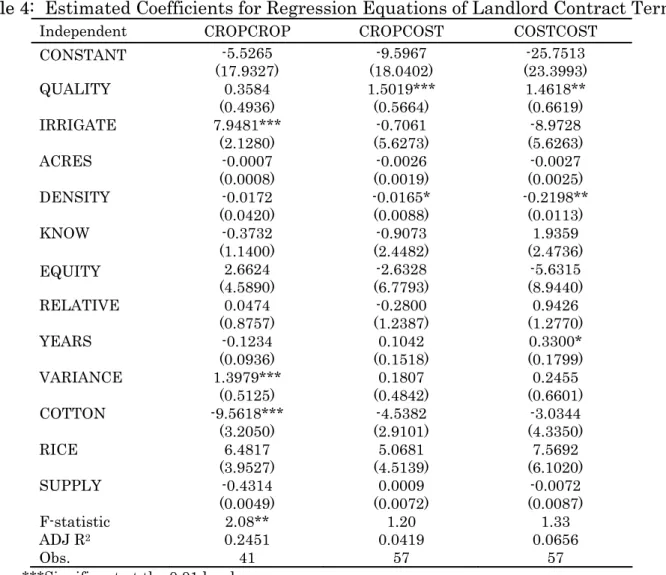
This section specifies and presents regression models of the terms of cropland contracts. Regression models are estimated and presented in Table 4 that explain the percentage share of crop in crop-share contracts, and the percentage share of the crop and costs in cost-share contracts. Because of an insufficient number of cash rent observations, estimation of a rent level equation was not possible. Landlord crop-share and cost-share proportions are hypothesized to be functions of land characteristics, landlord/tenant characteristics, landlord/tenant social capital, type of crop grown on acreage, and the available supply of cropland.
Land characteristics include: QUALITY, IRRIGATE, ACRES and DENSITY. QUALITY and IRRIGATE increase the land’s productivity and imply a higher valued asset to control. Therefore, both variables are believed to increase landlord crop-shares and decrease landlord cost-shares. Barry et al. (2000) find that soil productivity is a significant variable in leasing price equations for Illinois cropland. Larger land tracts may be more desirable because of operating convenience and
Table 4: Estimated Coefficients for Regression Equations of Landlord Contract Terms
Independent CROPCROP CROPCOST COSTCOST
CONSTANT -5.5265 (17.9327) (18.0402) -9.5967 (23.3993) -25.7513 QUALITY 0.3584 (0.4936) 1.5019*** (0.5664) 1.4618** (0.6619) IRRIGATE 7.9481*** (2.1280) (5.6273) -0.7061 (5.6263) -8.9728 ACRES -0.0007 (0.0008) (0.0019) -0.0026 (0.0025) -0.0027 DENSITY -0.0172 (0.0420) -0.0165* (0.0088) -0.2198** (0.0113) KNOW -0.3732 (1.1400) (2.4482) -0.9073 (2.4736) 1.9359 EQUITY 2.6624 (4.5890) (6.7793) -2.6328 (8.9440) -5.6315 RELATIVE 0.0474 (0.8757) (1.2387) -0.2800 (1.2770) 0.9426 YEARS -0.1234 (0.0936) (0.1518) 0.1042 (0.1799) 0.3300* VARIANCE 1.3979*** (0.5125) (0.4842) 0.1807 (0.6601) 0.2455 COTTON -9.5618*** (3.2050) (2.9101) -4.5382 (4.3350) -3.0344 RICE 6.4817 (3.9527) (4.5139) 5.0681 (6.1020) 7.5692 SUPPLY -0.4314 (0.0049) (0.0072) 0.0009 (0.0087) -0.0072 F-statistic 2.08** 1.20 1.33 ADJ R2 0.2451 0.0419 0.0656 Obs. 41 57 57
***Significant at the 0.01 level. **Significant at the 0.05 level. *Significant at the 0.10 level. Standard errors are in parentheses.
Note: Initially the regression models were estimated including the inverse Mill’s ratio from the risk aversion model to account for possible selection bias as in BPD. Since the inverse Mills ratio coefficients from the risk aversion model were all insignificant, selection bias was judged not to be a problem and the models were estimated by least squares. The estimated standard errors use White’s (1980) heteroscedasticity consistent estimator.
economies of scale. However, larger tracts of land require tenants capable of
financing larger operations, implying the pool of tenants bidding on land decreases as ACRES increases. Therefore, the sign of ACRES is unclear a priori. DENSITY should strengthen the landlord’s bargaining position, thereby increasing landlord crop-share percentages.
Landlord and tenant characteristics describe the management and bargaining expertise of the contracting agents. KNOW indicates the landlords’ relative
agricultural knowledge. Landlords possessing a strong knowledge of agricultural production, management and marketing practices are in a better bargaining position to negotiate contracts because of reduced information asymmetry. This should allow them to obtain higher crop-shares and lower cost-shares. Tenants with a strong financial condition (EQUITY) are less dependent on leasing, allowing them to negotiate from a position of strength resulting in lower landlord crop-share and higher landlord cost-share percentages.
The social closeness of the contracting agents has been found to influence the terms of the negotiated contracts (Gwilliam, 1993). RELATIVE and YEARS indicate the level of social capital and the information asymmetry between the agents. The impact of social capital is difficult to predict a priori given that BPD found mixed results over the various contract types. To the extent social capital reflects
landlords who are older relatives of tenants, lower landlord crop shares and higher cost shares would be expected as social closeness increases.
Yield variability, type of crop grown, and availability of cropland acreage likely affect share levels. Relatively more risky crops require additional tenant financial inducements. Therefore, higher VARIANCE levels should result in lower landlord crop-share levels. COTTON and RICE are included to examine specific crop effects on contract terms. The impact of these crops on lease terms is uncertain a priori. Both crops are highly valued thus inducing higher landlord crop shares to capture higher returns. But both crops are management intensive and require specialized equipment, indicating that tenants may need financial inducements to contract. This idea is more compelling with cotton where operating expenses are typically higher than for either rice or soybeans, and landlords sometime require cotton production on the acreage. A larger supply of available cropland acreage, SUPPLY, increases tenant bargaining power. This bargaining power results in lower landlord crop-share and higher cost-share percentages.
The estimated parameters for the crop-share model (CROPCROP) are listed in the first column of Table 4. Land and crop characteristics are significant determinants of crop-share percentages. IRRIGATE, VARIANCE and COTTON are all significant at the 0.01 level. The positive and significant sign on IRRIGATE suggests, as
hypothesized, irrigated acreage contracts at a premium. While VARIANCE is significant, it does not have the anticipated sign. The coefficient indicates that as the variance increases, so does the landlord’s share percentage. Landlords
apparently extract additional compensation for accepting more risk. The crop variable COTTON is significant indicating, as in BPD, that crop characteristics influence contract terms. Cotton is a management intensive crop and the negative sign for COTTON indicates a discount reflecting a favorable bargaining position for tenants possessing the production expertise and equipment needed to produce cotton. It may also reflect that certain landlords may be willing to accept a lower
share of the crop if they are able to make returns from other aspects of cotton production, e.g., ginning.
The estimated parameters for the crop-share percentages on the cost-share contracts model (CROPCOST) are listed in the second column of Table 4. Land quality and population density are significant in explaining crop-share levels for cost-share contracts. The positive and significant sign on QUALITY indicates that more productive land, i.e. better yields, contracts at a premium. The negative sign on DENSITY indicates that landlords who might be holding land for conversion to a non-agricultural use are less demanding in negotiations. In contrast, BPD found six variables significant at the 0.10 level or better in their tenant CROPCOST model, particularly with respect to crop types.
The estimated coefficients for the percent of cost shared in cost-sharing contracts model (COSTCOST) are listed in the third column of Table 4. The coefficients show that land quality, density, and the length of the leasing relationship are the
significant variables in explaining cost-share arrangements. The positive QUALITY coefficient implies landlords leasing higher quality land pay more of the costs but, as is clear in the crop-share level for cost-share contracts, lessors are also
compensated by taking a larger share of the crop. Thus landlords are willing to extend their risk exposure on higher quality land. The results on QUALITY agree with the findings of BPD. They found that quality land resulted in landlords paying about one and a half percentage points more of production costs and taking about one and a half percent more of the crop per unit increase in QUALITY. As with crop-shares on the cost-share contracts, BPD found crop effects to be significant in explaining the cost-shares of the contract, which we do not.
Consistent with the CROPCOST model, the coefficient on DENSITY is negative and significant in the COSTCOST model. The DENSITY result for the cost-sharing models implies that these landlords negotiate lower cost-sharing percentages for their contracts consistent with lower crop sharing. Increasing the length of the contracting relationship, YEARS, increases the percent of costs landlords pay. This result indicates that tenants gain more favorable terms as information asymmetries are diminished. It should be noted that the explanatory power of the CROPCOST and COSTCOST models is low. Thus while some of the variables are statistically significant, much of the variability in the cost-share terms remains to be explained.
Conclusions
This study identified factors affecting landlord selection of cropland contract types and the terms thereof. Utilizing 1998 data from Arkansas cropland landlords, three leasing theories were examined. Ordered probit models were estimated to test credit constraints, agency problem and risk aversion hypotheses in selection of cropland contracts. In addition to the probit models, regression equations were estimated to
identify variables affecting the level of crop-share and cost-share percentages for cropland contracts.
In the credit constraints model, tenant financial strength, value of landlord’s
cropland holdings, length of the contracting relationship, and yield variability of the leased land significantly affected cropland contract selection. Tenant equity and length of the contracting relationship additionally provide support for the credit constraint framework. Landlords display risk aversion by preferring cash rent to share leases as yield variability increases.
There was little support found for the agency problem model. None of the variables in that model were significant, indicating that perhaps an alternative specification is needed to examine agency problems from the landlord’s perspective.
Similarly to the credit constraint model, the risk aversion model supports both the credit constraint and risk aversion explanations. The significance of landlord risk preferences provides strong support for landlord risk aversion, while the tenant risk preferences variable was insignificant. Neither the credit constraint nor risk
aversion models were rejected in favor of the other. Therefore, credit constraints and landlord risk aversion should be considered as viable land-leasing models. The regression equation examining crop-share contract terms reveals that land and crop characteristics were important determinants of crop-share percentages for crop-share contracts. As expected, irrigated acreage contracted at a premium. Also, there was a significant difference in crop-share levels due to crop type with cotton being significantly lower than soybeans. For the crop-share and cost-share
percentages of the cost-share contract, land quality and potential alternative uses of the land were significant. The effect of land quality was similar to results found in a previous tenants’ survey. Social capital was not significant in any of the three contract terms equations in contrast to the earlier tenant study. However, as the length of the landlord/tenant relationship increased, the tenant’s share of costs for a cost-share contract decreased. This presents some support for social capital since social closeness presumably increases with longevity of the lease and decreases the costs associated with asymmetric information.
Land is an input to farm operators and an asset to landlords. The study results indicate that the factors motivating the two involved parties differ, primarily for lease type selection. This provides opportunities for both parties. The lease type selected is a function not only of the land characteristics, but also of the
characteristics of the two parties involved in the negotiation. This suggests that an operator has an incentive to seek landlords who are more inclined, due to varying risk preferences or financial situations, to agree to lease types that are compatible to the tenant’s preferences than landlords with conflicting preferences. For example, some landlords appear willing to share risk with tenants in exchange for a contract
type that may have a higher return, i.e., crop-share. Tenants with low risk-carrying capacity or preferences should try to identify such landlords with compatible
preferences. Clearly, landlords have similar incentives with respect to tenants. The results also indicate that farm management firms should be aware of the risk
preferences and financial situations of landlords and prospective tenants when trying to find compatible/well-matched contract types.
References
Allen, D. W. and D. Lueck. “Contract Choice in Modern Agriculture: Cash Rent Versus Crop-share.” Journal of Law and Economics. 35 (Oct. 1992): 397-426. ____________ “Transaction Costs and the Design of Crop-share Contracts.” Rand
Journal of Economics. 24 (Spring 1993):78-100.
____________ “Risk Preferences and the Economics of Contracts.” American Economic Review. 85 (May 1995):447-451.
Barry, P. J., L. M. Moss, N. L. Sotomayor and C. L. Escalante. “Lease Pricing for Farm Real Estate.” Review of Agricultural Economics. 22 (2000):2 –16. Belsely, D. A., E. Kuh and R. E. Welsch. Regression Diagnostics. John Wiley and
Sons, Inc., New York, 1981.
Bierlen, R. and L. D. Parsch. “Tenant Satisfaction with Land Leases.” Review of Agricultural Economics. 18 (Sept. 1996): 505-513.
Bierlen, R., L. D. Parsch and B. L. Dixon. “How Cropland Contract Type and Term Decisions Are Made: Evidence from an Arkansas Tenant Survey.”
International Food and Agribusiness Management Review. 2 (No.1 1999): 103-121.
Bierlen, R., L.D. Parsch, B. L. Dixon and B. L. Ahrendsen. “The 1996 FAIR Act: Measuring the Impacts on Land Leasing.” Review of Agricultural Economics. 22(Fall/Winter 2000a):336-354.
Bierlen, R., L.N. Langemeier, B.L. Ahrendsen and B.L. Dixon. “Land Leasing and Debt on Farms: Substitutes or Complements?” Quarterly Journal of Business and Economics. 39 (Spring 2000b):18-38.
Brown , D. J. and J. H. Atkinson. “Cash and Share Renting: An Empirical Test of the
Link Between Entrepreneurial Ability and Contracting Choice.” Bell Journal of Economics. 12 (Spring1981):296-299.
Dasgupta, S., T. O. Knight and H. A. Love. “Evolution of Agricultural Land Leasing Models: A Survey of the Literature.” Review of Agricultural Economics. 21(Spring/Summer1999):148-176.
Greene, W. H. Econometric Analysis, 4th Edition. Prentice Hall, Upper Saddle River, New Jersey. 2000.
Gwilliam, K. “Farmland Leasing and Contract Choice in Michigan: The Influence of Social Distance.” Ph.D. Dissertation. Michigan State University, East
Lansing, 1993.
Johnson, Bruce, L. Janssen, M. Lundeen and J. D. Aiken. Agricultural Land Leasing and Rental Market Characteristics: A Case Study of South Dakota and Nebraska. Report prepared for the Economic Research Service of the United States Department of Agriculture, Washington, D.C. 1988.
McFadden, D. “Econometric Models of Probabalistic Choice.” Structural Analysis of Discrete Data with Econometric Applications., eds. C. F. Manski and D. McFadden, Pp. 198-272. Cambridge, MA: The MIT Press, 1981.
Otsuka, K., and Y. Hayami. “Theories of Share Tenancy: A Critical Survey.” Economic Development and Cultural Change. 37 (Oct. 1988): 31-68.
Schertz, Lyle P. and Warren E. Johnston. “Managing Farm Resources in the Era of the1996 Farm Act”. Economic Research Service Staff Report Number 9711. December 1997.
United States Dept. of Agriculture, Economic Research Service. “Provisions of the Federal Agricultural Improvement and Reform Act of 1996.” Agricultural Information Bulletin No. 729. September 1996.
United States Dept. of Agriculture, National Agricultural Statistics Service. 1997 Agricultural Census. Vol.1: Geographic Area Series. Part 51, Chapter1: National Level Data. Washington, D.C., March 1999a.
United States Department of Agriculture, National Agricultural Statistics Service. 1999 Agriculture Economics and Land Ownership Survey. AELOS data available on the Internet: www.usda.gov/nass. 1999b.
White, H. “A Heteroscedasticity-Consistent Covariance Matrix Estimator and a Direct Test for Heteroscedasticity.” Econometrica. 48 (1980):817-838.