Optimizing Bioinformatics Workflows for Data Analysis
Using Cloud Management Techniques
Vincent C. Emeakaroha
∗, Michael
Maurer
∗, Ivona Brandic
Information Systems Institute Vienna University of Technology
Vienna, Austria
{Vincent, Maurer,
Ivona}@infosys.tuwien.ac.at
Pawe
ł
P.
Ł
abaj
∗, David P. Kreil
Chair of Bioinformatics Boku University Vienna
Vienna, Austria
{Pawel.Labaj, David.Kreil}@boku.ac.at
ABSTRACT
With the rapid development in recent years of high-throughput technologies in the life sciences, huge amounts of data are being generated and stored in databases. Despite signifi-cant advances in computing capacity and performance, an analysis of these large-scale data in a search for biomed-ically relevant patterns remains a challenging task. Sci-entific workflow applications support data-mining in more complex scenarios that include many data sources and com-putational tools, as commonly found in bioinformatics. A scientific workflow application is a holistic unit that defines, executes, and manages scientific applications using different software tools. Existing workflow applications are process-or data- rather than resource-process-oriented. Thus, they lack effi-cient computational resource management capabilities, such as those provided by Cloud computing environments. In-sufficient computational resources disrupt the execution of workflow applications, wasting time and money. To address this issue, advanced resource monitoring and management strategies are required to determine the resource consump-tion behaviours of workflow applicaconsump-tions for a dynamical allocation and deallocation of resources. In this paper, we present a novel Cloud resource monitoring technique and a knowledge management strategy to manage computational resources for workflow applications in order to guarantee their performance goals and their successful completion. We present the design description of these techniques, demon-strate how they can be applied to scientific workflow ap-plications, and present first evaluation results as a proof of concept.
Categories and Subject Descriptors
D.2.8,D4.8,K.6.2 [Software Engineering]: Metrics, Mon-itoring; J.3 [Life and Medical Science]: Biology and ge-netics
∗contributed equally to this paper
Permission to make digital or hard copies of all or part of this work for personal or classroom use is granted without fee provided that copies are not made or distributed for profit or commercial advantage and that copies bear this notice and the full citation on thefirst page. To copy otherwise, to republish, to post on servers or to redistribute to lists, requires prior specific permission and/or a fee.
WORKS’11,November 14, 2011, Seattle, Washington, USA. Copyright 2011 ACM 978-1-4503-1100-7/11/11 ...$10.00.
General Terms
Measurement, Managements, Performance
Keywords
Workflow Execution, Resource Monitoring, Workflow Man-agement, Knowledge Database
1. INTRODUCTION
Scientific workflow applications have become an empow-ering tool for large-scale data analysis in bioinformatics [33, 34], providing the necessary abstractions that enable effec-tive usage of computational and data resources. They also strive to manage their operation complexities to free re-searchers to focus on guiding the data analysis, interpreta-tion of results, and taking decisions whenever human inputs are required [19].
Considering the fast development of high-throughput tech-nologies, which generate huge amounts of data, scientific workflow applications can be instrumental in achieving au-tomation and breaking down extended complexity in the life sciences [37]. The execution of workflow applications can be computationally intensive and requires reliable re-source availability. Moreover, scientific workflow applica-tions should be highly flexible to accommodate changes of input data and parameter modifications dynamically, even during execution. Because, in scientific workflows, prelimi-nary results can indicate suboptimal parameter choice. In such situations, one may want to adapt these parameters im-mediately. Particularly in the field of Bioinformatics, anal-yses are often semi-interactive. A typical example is the significance threshold for continuing into the second step of an analysis. This may have to be set liberally in case few results are expected. If during execution surprisingly many results meet the threshold, one may want to revise it for greater stringency. Typical scenarios that require a response to changed input data include the update of an external database or the upgrade of a tool used to prepro-cess input data. In such situations, when the workflow is not already close to completion, it may be a better use of resources to restart with the revised input data.
The efficient management of such flexible workflow appli-cations seeking to guarantee the availability of resources and the achievement of their performance goals is a challenging task. Often, resource availability decides the successful ex-ecution of a complex and expensive workflow application.
Thus, there is a need for advanced techniques to monitor, at runtime, the resource consumption behaviours and to inform about resource shortages, so that the management system can take adequate resource allocation decisions to support the successful completion of each workflow application.
Traditionally, a workflow application can be executed us-ing local and distributed compute resources. Such resources are basically limited and, traditionally, cannot be dynam-ically reallocated. Considering that workflow applications are resource intensive and can take hours if not days to complete, provisioning them in an environment with fixed resources leads to poor performance and possible execution failures due to the lack of a flexible allocation of extra re-sources. The Cloud is proving to be a valuable complement to the compute resources traditionally used in bioinformat-ics research laboratories [28]. Cloud computing technology promises on-demand and flexible resource provisioning that can be realized autonomically [3,17]. The execution of work-flow applications in a Cloud environment allows for easier management and guaranteeing of their performance goals.
In this paper, we present a novel Cloud resource monitor-ing technique together with a knowledge management strat-egy to optimize the execution of workflow applications in Cloud environments. This technique is responsible for mon-itoring the execution of workflow applications in the Cloud to determine their resource consumption behaviours and su-pervise the status of available resources. The knowledge management uses this information to make decisions on how to allocate resources to computational nodes in order to en-sure the successful completion of workflow applications. The main contributions of this paper are: i) the introduction of Cloud management techniques applicable to workflow appli-cations; ii) the optimization of scientific workflow applica-tion execuapplica-tion to support their successful compleapplica-tions based on Cloud techniques; and iii) the evaluation of our approach. This is demonstrated using TopHat [38], a typical scientific workflow application from the field of bioinformatics that exemplifies the challenges in the complex analysis of large data sets from modern high-throughput technologies. The focus of this work is on supporting the execution of workflow applications and not on designing a workflow system.
The paper is organized as follows: Section 2 presents some general descriptions of workflow applications, including the current state-of-the-art. There we introduce the challenges to be addressed in this paper in detail. In Section 3, we describe the Cloud management techniques applicable to workflow applications for optimizing resource management. Section 4 presents a concrete example of applying Cloud techniques to support workflow application execution and Section 5 discusses the evaluation of our approach in a proof of concept. We consider related work in Section 6 while Sec-tion 7 concludes the manuscript and discusses the direcSec-tion of our future work.
2.
WORKFLOW APPLICATIONS
In most working environments, there are procedures that are repeated over and over again. These procedures usu-ally consist of sub-tasks that represent encapsulated units of work, which form a dependency network. Thus, a work-flow can be defined as a composite task that comprises co-ordinated human and machine executed sub-tasks [19]. In computer aided scientific work, a scientific workflow
appli-cation is a holistic unit that defines, executes, and manages sub-task processes with the help of software artifacts [14].
2.1 Background
Bioinformatics is the research discipline in which scien-tists, with the use of computational methods, seek to gain insights from data gathered in the life sciences [19]. An objective example is the discovery of interesting patterns in data obtained from laboratory experiments and/or from ear-lier results stored in databases that can be online, located in storage sites spread around the world. Bioinformatics is both applying established computational tools to new data, as well as new tools to well characterized data sets, seeking to improve on earlier methods. Thus, in bioinformatics, like in many modern research disciplines, scientific workflow ap-plications empower advanced and more complex analyses. Management systems have been developed to facilitate the execution of workflow applications that use data and services from distributed sources [2, 6, 12, 15].
As a result of the proliferation of new high-throughput technologies in the life sciences that generate massive amounts of data, the retrieval, storage, and analysis of data face great technical challenges [31]. In particular, often, bioinformatics tools, many of which are available only through web-based interfaces, are not suited for the analysis of newly gener-ated large-scale data sets due to their computational inten-siveness [4, 30]. In general, existing workflow application management systems cannot handle the massive amounts of data and execute workflow applications on these efficiently either [23]. New analysis software, workflow applications, monitoring, and management approaches are required that can take advantage of more powerful infrastructure such as compute clusters or Cloud environments.
We here consider Next Generation Sequencing (NGS), a recently introduced high-throughput technology for the identification of nucleotide molecules like RNA or DNA in biomedical samples. The output of the sequencing process is a list of billions of character sequences called ‘reads’, each typically holds up to 35-200 letters that represent the indi-vidual DNA bases determined. Lately, this technology has also been used to identify and count the abundances of RNA molecules that reflect new gene activity. We use the ap-proach, called RNA-Seq, as a typical example of a scientific workflow application in the field of bioinformatics.
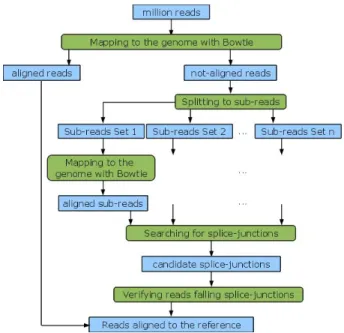
At first, in the analysis of RNA-Seq data, the obtained sequences are aligned to the reference genome. The aligner presented here, TopHat [38], consists of many sub-tasks, some of them have to be executed sequentially, whereas oth-ers can run in parallel (Figure 1). These sub-tasks can have different resource-demand characteristics: needing extensive computational power, demanding high I/O access, or requir-ing extensive memory size.
In Figure 1, the green boxes represent simplified sub-tasks of the workflow application, whereas the blue boxes repre-sent the data transfered between the sub-tasks. The first sub-task aligns input reads to the given genome using the Bowtie program [21]. Unaligned reads are then divided into shorter sub-sequences that are further aligned to the refer-ence genome in the next sub-task. If sub-sequrefer-ences coming from the same read were aligned successfully to the genome, that may indicate that this read was straddling a ‘gap’ in the gene, falling on a so-called splice-junction. After verification of candidate reads falling on splice junctions, these and the
Figure 1: Overview of the TopHat Aligning Ap-proach
reads that were aligned in the first sub-task are combined to create an output with a comprehensive list of localized alignments.
2.2 Problem Description
In the course of a comprehensive study of some of the largest available RNA-Seq data sets [20], it has been noticed that even with modern dedicated servers (having large mem-ory size and high CPU capacities) the analysis of such large data sets can be challenging and requires prior knowledge about the resource-demand characteristics of the workflow application to execute.
In such studies, the analysis of one data set can easily take days. The analysis time is related to both the size of the in-put data set and the complexity of the studied organism. Like many such tools, TopHat creates large temporary files (up to TBs per data set), and these accumulate during ex-ecution. With fixed resources, it can therefore easily occur that in the middle of an analysis run there is unexpectedly no more space on the disks, especially when several instances have been executed in parallel. Thus, without appropriate prior knowledge about resource demands across execution time, the instances of TopHat running in parallel may trig-ger a crash and lead to the loss of several days of calculation time.
For higher efficiency in such analyses, we propose the use of appropriate strategies to monitor the resource consump-tion behaviours of workflow applicaconsump-tions and apply knowl-edge databases to manage and allocate resources appropri-ately. In the next section, we describe management tools that can be used to this end.
3.
CLOUD MANAGEMENT TECHNIQUES
Cloud computing facilitates the implementation of scal-able on-demand computing infrastructures combining con-cepts from virtualization, the Grid, and distributed systems [3, 29, 32]. Cloud resources are provisioned based on Service
Level Agreements (SLAs), which are contracts specified and signed between Cloud providers and their customers detail-ing the terms of the agreement, includdetail-ing non-functional re-quirements, such as Quality of Service (QoS) and penalties in case of violations [5, 10, 18]. The Cloud opens the door for a fundamental change in how workflow applications are designed and deployed in bioinformatics research laborato-ries [13]. Its on-demand resource availability and seemingly infinite scalability can augment traditional in-house com-pute and storage capacity. In this section, we present a monitoring framework and a knowledge management tech-nique that provide state-of-the-art techtech-niques for resource management in Cloud environments.
3.1 LoM2HiS Monitoring Framework
Monitoring techniques are the basis for efficient resource and SLA management in Clouds. Normally, SLA parameters such asavailability, throughput,andresponse timerepresent the performance goals of applications but they differ from the Cloud resource metrics such asuptime, downtime, CPU, memory, andstorage.
In order to bridge this gap and guarantee the SLAs of ap-plications, a Low-level resource Metrics to High-level SLA (LoM2HiS) monitoring and mapping framework was designed [7]. The LoM2HiS framework monitors Cloud infrastructure resource metrics to determine their status while applications are being provisioned in a Cloud environment. Figure 2 de-picts an overview of the LoM2HiS framework. This frame-work aims to address two issues:
• monitoring of low-level resource metrics
• mapping the monitored metrics into SLA parameters so as to monitor the application SLA at runtime.
It consist of two core components namely, theHost monitor
and theRun-time monitor, as shown in Figure 2. The Run-time monitor is designed to monitor services (applications) based on the negotiated and agreed SLA objectives.
Figure 2: LoM2HiS Framework Overview
As shown in Figure 2, after agreeing on SLA terms, the ser-vice provider creates mapping rules for the LoM2HiS map-pings (step 1 in Figure 2) using Domain Specific Languages (DSLs). Once the customer requests the provisioning of an
agreed service (step 2), the Run-time monitor loads the ser-vice SLA from the agreed SLA repository (step 3). Serser-vice provisioning is based on infrastructure resources, which rep-resent hosts and network resources in a computational envi-ronment. The monitoring agents such as Gmond from the Ganglia project [24] measure the resource metrics, and the Host monitor accesses the measured metrics for processing (step 4). The Host monitor extracts the metric-value pairs from the raw metrics and transmits them periodically to both the run-time monitor (step 5) and the knowledge com-ponent (step 6) using a novel communication mechanism.
Upon reception of the measured metrics, the Run-time Monitor maps the low-level metrics based on predefined map-ping rules to form the equivalence of the agreed SLA objec-tives. These mapping rules are predefined depending on applications types, raw metrics, and parameters involved. The definition of the mapping rules may include different complexity levels, e.g., 1 :nor n :m. An example rule is presented in Equation 1. It shows how to map the SLA pa-rameterAvailability from the low-level metricsuptime and
downtime: Availability= 1− downtime uptime+downtime ∗100. (1)
The resulting mapping is stored in the mapped metric repos-itory (step 7), which also contains the predefined mapping rules. The Run-time monitor uses the mapped values to monitor the status of the deployed service applications at runtime. In case future SLA violation threats are detected, it notifies the knowledge component for preventive actions (step 8) and the knowledge component’s decision is executed on the infrastructure resources (step 9). The concept of de-tecting future SLA violation threats is designed by defining a more restrictive threshold than the SLA violation threshold that is known as threat threshold. Thus, calculated SLA values are compared against the predefined threat thresh-olds in order to inform the knowledge management to react before real SLA violations can occur.
In designing LoM2HiS, the separation of the Host moni-tor and the Run-time monimoni-tor makes it possible to deploy these two components on different hosts. This decision is focused towards increasing the scalability of the framework and facilitating its usage in distributed and parallel environ-ments. To this end, a scalable communication mechanism is designed for exchanging messages between the two compo-nents. The communication mechanism exploits the capabil-ities of the Java Messaging Service (JMS) API [16], which is a Java message oriented middleware for sending messages between two or more clients. In order to use JMS, there is a need for a JMS provider that is capable of managing a large number of sessions and queues. We use the well established open source Apache ActiveMQ [1] for this purpose.
We have successfully utilized the LoM2HiS framework for resource monitoring and detecting SLA violations in private Cloud environments and related areas [8, 35]. We have also evaluated it using different application types [9]. In this work, we apply it to workflow applications.
3.2 Knowledge Management Techniques
In the previous section, we discussed how resources are being monitored in Cloud environments. In this section we present a knowledge management technique that utilizes the
monitored information to provide proactive actions for re-source management.
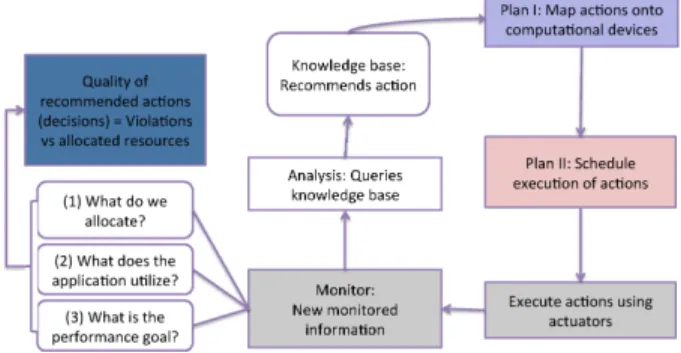
The term knowledge management (KM) in our context, means intelligent usage of measured data, obtained by mon-itoring, for the decision making process to satisfy application performance goal defined in SLA agreements while optimiz-ing the computational resource usage. Apart from the mon-itoring phase (as shown in Figure 3), the knowledge man-agement consist of three other phases namelyanalysis, plan,
and execute. The core of the KM is a knowledge database that interacts with these phases in the management process. Figure 3 presents an overview of the knowledge manage-ment. The monitoring phase delivers the monitored infor-mation, which includes details about the actual resource al-location status, the utilization of the resources by the work-flow applications, and the applications’ performance goal defined in the SLA. Theanalysisphase processes the tored data. It provides an interface for receiving the moni-tored information from the monitoring phase. It analyses the received information to determine the exact resource SLA threat threshold that is violated, and then decides on the exact reactive action to carry out in order to prevent a future SLA violation. The plan phase plans the execu-tion of the recommended acexecu-tions and prevents oscillaexecu-tion effects (i.e., allocating and deallocating the same resource interchangeably) in the operations. This phase is divided into two parts: plan I andplan II.Plan I is responsible for mapping actions onto physical and virtual machines in the Cloud environments and managing those machines. Plan II
is in charge of planning the order and timing of the actions. Theexecute phase is the final one. It executes the recom-mended actions on the computational devices with the help of software actuators.
Figure 3: Knowledge Management Overview
We have successfully applied different techniques such as Case-Based Reasoning, rule-based, etc for knowledge man-agement in Cloud environments [25–27]. In the next section, we show how these techniques are applied to optimize work-flow application execution.
4. OPTIMIZING WORKFLOW EXECUTION
In this section, we apply the Cloud management tech-niques described in Section 3 to optimize scientific data analysis processes. The objective is to address the prob-lems affecting workflow application executions as outlined in Section 2.2.
4.1 Work
fl
ow Execution Monitoring
Scientific workflow applications are resource intensive and can take considerable amount of time to complete. The suc-cessful completion of data analysis using workflow applica-tions in the life sciences is paramount to the scientist. To facilitate this objective, we apply the LoM2HiS framework to monitor the workflow application executions in order to supervise the computational resource status.
Normally, workflow applications are composed of other applications (sub-tasks) linked together to achieve a com-mon goal (as shown in Figure 1). A workflow application can be executed in a distributed system using multiple com-putational nodes in which case some parts of the application might execute on a different node. Thus, the successful com-pletion of a workflow application depends on the comcom-pletion of its composed parts.
To demonstrate our approach, we apply the Cloud man-agement techniques to support scientific data analysis pro-cesses as shown in Figure 1. For simplicity and ease of un-derstanding, we use a reduced version of Figure 1 in this demonstration.
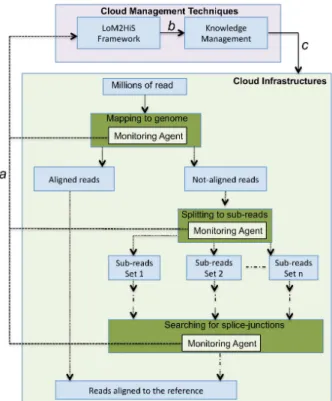
As described in Section 3.1, the LoM2HiS framework con-sists of three main components: i) the Monitoring agents
that monitors single computational nodes; ii) theHost mon-itorthat gathers and processes monitored information from the Monitoring agents; and iii) theRun-time monitor that maps metrics and monitors application SLAs. Figure 4 presents how we applied the monitoring components to effi-ciently manage the scientific data analysis processes.
Figure 4: Applying LoM2HiS to Workflow Applica-tion
The TopHat workflow application execution is composed of different applications (sub-tasks) running sequentially and in parallel (as shown in Figure 1). Thus, it is necessary to monitor the computational node used to execute each of
these sub-tasks in order to dynamically allocate resources if needed. As depicted in Figure 4, we integrate a Moni-toring agent in each of these computational node used for the execution of the workflow application. The monitoring agents monitor the low-level resource metrics’ status (e.g., CPU, memory, disk space, etc.) of each node and commu-nicate the monitored information (arrow a in Figure 4) to the LoM2HiS framework for processing.
The monitored information consist of unique IDs for each of the computational node and their resource metrics. Thus, the LoM2HiS framework is capable of determining the spe-cific node and the exact resource metric that might be lack-ing in the near future. It passes this information to the knowledge management component (arrow b in Figure 4) to take appropriate actions to ensure the availability of this resource for computations (arrowc in Figure 4).
4.2 On-Demand Resource Allocation
This section describes how we apply the knowledge man-agement techniques to allocate resources on-demand based on the monitored information. The aims are to efficiently manage computational resources to support the execution of the workflow applications.
To achieve these aims, we introduce a speculative knowl-edge management technique utilizing rule-based approach [27]. This approach ensures that at every point in time the computational nodes posses enough resources for the work-flow application. Furthermore, it ensures that resources are not wasted by reducing the amount of resources allocated to a node if necessary.
In the life sciences, it has been identified that CPU, stor-age, and memory are the crucial computational resources for workflow execution. To demonstrate our speculative ap-proach, we define SLAs to represent the workflow applica-tion performance goals. The SLA specifies objective values for the required computational resources. Enforcing these objectives guarantees the application performance and its successful completion. The following is an example of SLA specifications: CP U utilization ≤100%, storage≥19GB, and memory ≥ 8192M B. The initial size of a computa-tional node is determined based on the SLA of the applica-tion to be executed.
In a further step, we introduce three notions for resource management: allocated, utilized, and specified – allocated
means the amount of resources allocated to a computational node, utilized means the amount of resources used by the application executing on the computational node, and spec-ified means the assumed amount of resources required for successful completion of the workflow application. AnSLA violation occurs, if less resource is allocated than the ap-plication utilizes (or wants to utilize) with respect to the specified objective in the SLA. Consequently, we try to al-locate less than specified, but more than utilized in order to avoid SLA violations on the one hand and on the other hand to avert resource wastage.
We define allocating more or less than utilized to be called
over-provisioning orunder-provisioning, respectively. In or-der to know whether a resource r is in danger of under-provisioning or already is under-provisioned, or whether it is over-provisioned, we calculate the current utilization utr=
user
prr×100, where userand prrsignify how much of a resource r was used and allocated, respectively, and divide the per-centage range into three regions using threat thresholds. In
Figure 5: Example Behaviour of Actions at Time Intervals t1-t6
this case we define two threat thresholdsT Tlowr andT Thighr
representing the higher and the lower boundaries as shown in Figure 5:
• Region −1: Danger of provisioning, or under-provisioning (> T Thighr )
• Region 0: Well provisioned (≤T Thighr and≥T Tlowr )
• Region +1: Over-Provisioning (< T Tlowr )
The idea of this rule-based design is to maintain an ideal value that we call target value tv(r) for the utilization of a resource r, in exactly the centre of region 0. So, if the utilization value after some measurement leaves this region by using more (Region -1) or less resources (Region +1), then we reset the utilization to the target value, i.e., we in-crease or dein-crease allocated resources so that the utilization is again at region 0 using Equation 2.
tv(r) =T T
r
low+T Thighr
2 %. (2)
As long as the utilization value stays in region 0, no action will be executed. E.g., forr = storage, T Tlowr = 60%,and
T Thighr = 80%, the target value would betv(r) = 70%.
Fig-ure 5 presents the regions and measFig-urements (expressed as utilization of a certain resource) at time stepst1, t2, . . . , t6. At t1 the utilization of the resource is in Region −1, be-cause it is in danger of a violation. Thus, the knowledge database recommends to increase the resource such that at the next iterationt2 the utilization is at the center of Re-gion 0, that is, the target value. At time steps t3 and t4
utilization stays in the center region 0 and consequently, no action is required. Att5, the resource is under-utilized and
so the knowledge database recommends the decrease of the resource totv(r), which is attained att6.
A large enough span between the thresholds T Tlowr and T Thighr helps to prevent oscillations of repeatedly
increas-ing and decreasincreas-ing the same resource. However, to further reduce the risk of oscillations, we suggest to calculate a pre-diction for the next value based on the latest measurements. Thus, an action is only invoked when the current AND the predicted measurement exceed the respective thresholds. So, especially when only one value exceeds the threshold, no ac-tion is executed
Based on this technique, we can provision scientific data analysis processes with enough resources to achieve high per-formance and to ensure their successful completion. In the next section, we present some evaluations of our approach.
5. EVALUATION
In this section, we present the evaluation of our approach. The goals of the evaluation are to show the applicability of LoM2HiS framework to monitor workflow application exe-cution and the usage of the knowledge management tech-niques to efficiently manage resources. We first discuss the environmental setups, the workflow application used, and later present the achieved results.
5.1 Experimental Setup
The evaluation is carried out in a virtualized Cloud envi-ronment. The workflow application is executed using virtual machines and each of them can have its capacity increased up to the values presented in Table 1.
Table 1: Computational Node Capacity
OS CPU Cores Memory Storage
Linux/Ubuntu Intel Xeon(R) 3 GHz 2 9 GB 19 GB
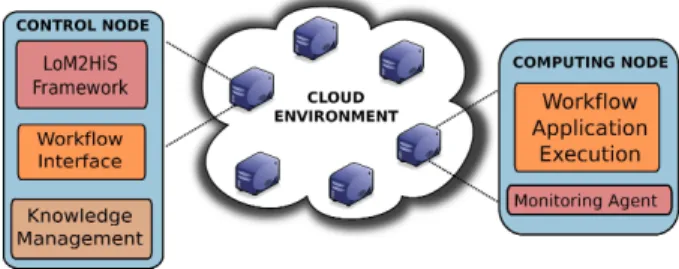
The virtual machines (VMs) represent computational nodes for the execution of the workflow applications. The VMs in our evaluation environment are created using VMWare tools. Figure 6 presents an overview of the evaluation testbed. The testbed in Figure 6 represents a setup for efficient man-agement of application execution in a Cloud environment. This is a research model of a Cloud environment and does not represent any standard. The purpose of the testbed is to present a proof of our concept and to demonstrate how work-flow application executions could be efficiently managed in a Cloud environment.
On the testbed, one of the nodes acts as the control en-tity. It hosts the LoM2HiS framework, the knowledge man-agement component, and provides an interface for deploying workflow applications.
Figure 6: Evaluation Testbed
The evaluation of our approach is based on the bioinfor-matic workflow applicationTopHat, which was described in Section 2.1. It aligns RNA-Seq reads to mammalian-sized genomes using the ultra high-throughput short read aligner
Bowtie [21], and then analyses the mapping results to iden-tify splice junctions between exons. Furthermore, it uses the Sequence Alignment/Map (SAM) tools in it execution. SAM tools provide various utilities for manipulating alignments in the SAM format, including sorting, merging, indexing and generating alignments in a per-position format [22].
We analysed a set of RNA-Seq data using the TopHat
workflow application, and the achieved results are presented in the next section.
5.2 Monitoring Results
As outlined in Section 4.1, we use the LoM2HiS framework to monitor the TopHat workflow application while analysing RNA-Seq data for the duration of three hours execution. We monitored the status of the resource metricsCPU, memory
andstorage at runtime with a measurement interval of one minute. The achieved results are presented as follows. Note that the monitored results presented are from one of the computational node and not the entire Cloud environment. The resource consumption behaviours on the different com-putational nodes are similar, thus, we present the results from one node for simplicity and ease of understanding our approach.
The aim of the monitoring processes is to timely detect the unavailability of computational resources. To realize this, LoM2HiS utilizes monitoring agents to monitor the re-source status and compares them against thethreat thresh-olds, which are defined values to signal the shortage of com-putational resources, in its monitoring operations. The threat thresholds can be dynamically or statically defined. In this paper, the knowledge management dynamically updates the initial defined threat thresholds.
Figure 7 presents the monitored results for the CPU usage. From the results, it can be observed that the TopHat work-flow application in some time intervals is very CPU inten-sive. For example from the execution time 52 to 80. These time intervals where the CPU usage is 100% are the critical ones that need to be managed. The LoM2HiS framework is configured in this case with a threat threshold value of about 80% CPU utilization. This means, once the CPU utilization exceeds this threshold, it sends a notification message to the knowledge management to provide preventive actions to avoid reaching 100% utilization, because at that point the performance of TopHat degrades and there might be risk of failures. 20 40 60 80 100 120 0 20 40 60 80 100 120 140 160 180 CPU Usage (%)
Execution Time (min)
CPU
Figure 7: Monitored CPU Utilization
The monitored results of the memory usage are depicted in Figure 8. As shown in the figure, the memory consump-tion increases along the execuconsump-tion line of the TopHat work-flow application. It is difficult to predict the total amount of memory the application might require in the next time inter-val or to successfully complete the data analysis. Thus, we define a threat threshold value that is about 2GB less than the current allocated memory. That is, once the memory utilization exceeds the threat threshold value, a notification message is sent to the knowledge database for resource allo-cation decisions.
Figure 9 shows the utilization of storage resource by the TopHat workflow application. According to the figure, the
1e+06 2e+06 3e+06 4e+06 5e+06 6e+06 7e+06 8e+06 9e+06 0 20 40 60 80 100 120 140 160 180 Memory Capacity (KB)
Execution Time (min) Memory
Figure 8: Monitored Memory Utilization
storage utilization increases along the execution line. In this case, one can notice some jumps in the utilization lines. These jumps can be high depending on the size of the data set to be analysed. Therefore, the threat threshold value for managing storage resource is set to about 4GB less than the current allocated storage, in order not to risk failure situations before the knowledge management can react to allocate more storage resources.
15 15.5 16 16.5 17 17.5 18 18.5 19 0 20 40 60 80 100 120 140 160 180 Storage Capacity (GB)
Execution Time (min)
Storage
Figure 9: Monitored Storage Utilization
Generally, the threat thresholds are defined to accom-modate reaction time for the knowledge management so that the resource allocation procedures are carried out early enough before the system runs out of resources. In the next section, we discuss how the knowledge management deals with the notification messages.
5.3 Ensuring Resource Availability
This section shows via simulations how the knowledge management approach reacts to the monitored data and en-ables seamless workflow application execution, as well as an economically efficient use of resources. In order to demon-strate our approach, we simulate three scenarios, where we set up and manage our virtual machines (VMs) differently. In the first scenario, we assume a static configuration with a fixed initial resource configuration of the VMs. Normally, when setting up such a testbed as described in Section 5.1, an initial resource specification is done based on previously monitored data and earlier experiences. The first ten mea-surements of CPU, memory, and storage lie in the range of [140, 12500] MIPS∗, [172, 1154] MB, [15.6,15.7] GB, re-spectively. So we initially configured our VMs with resource
∗The conversion of CPU utilization into MIPS is based on
the assumption that an Intel Xeon(R) 3 GHz processor de-livers 10000 MIPS for 100% resource utilization of one core, and linearly degrades with CPU utilization.
values greater than the maximum of the respective intervals, i.e., with 15000 MIPS of CPU, 4096 MB of memory, and 17.1 GB of storage. In the second scenario, we apply our knowl-edge management approach to these initial configurations. The third scenario presents a best case scenario, where we assume to have an oracle that predicts the maximal resource consumption that we statically set our VM configuration to. We use this scenario to compare the wastage in resource utilization.
(a) Number of Resource Violations in the Scenarios
(b) Resource Utilizations Levels.
(c) Reconfiguration Actions to Allocate Resources.
Figure 10: Autonomic Resource Managements
In Figure 10, we present the number of resource violations, the achieved resource utilizations, as well as the number of reconfiguration actions, respectively, for every parameter in the different scenarios. These results are achieved by apply-ing the scenarios to the monitored results of Figures 7, 8, and 9. As shown in Figure 10(a), we experience violations in almost half of the cases for scenario 1. This is especially crucial for parametersmemory andstorage, where program execution would fail, if the system runs out of memory or storage, whereas for a violation of the CPU parameter, it would “only” degrade the performance and delay the success-ful termination of the workflow application. With scenario 2 we can reduce the SLA violations to a minimum. In this case, we completely avoid violations formemoryandstorage, and only encounter three violations forCPU. For scenario 3, we encounter no violations. However, this scenario wastes resources due to over-provisioning.
Figure 10(b) shows the resource utilization levels. It is
clearly highest when a lot of violations occur, so for Scenario 1. This holds because when a parameter is violated, then the resource is almost used up, meaning more of the resource would be needed to fulfill the needs. A huge advantage of Scenario 2 is that it does not run into any crucial SLA vio-lation, but achieves a higher resource utilization (about 7% better on average) as compared to Scenario 3. The numbers of autonomic resource reallocation actions are shown in Fig-ure 10(c). Of course, Scenarios 1 and 3 do not execute any reallocation action, but for the operations of the knowledge management in Scenario 2, the amount of executed reallo-cation actions stays very low, which means it does not affect the overall system performance.
According to our findings in [27], we set the threat thresh-oldsT Tlow= 50% andT Thigh= 75% as discussed in Section
4.2.
Based on these observations, we conclude that by using the suggested Cloud management techniques we can guar-antee the performance and successful completion of work-flow applications. Furthermore, we can efficiently manage resources to avoid considerable wastage, extra maintenance costs, and CO2emissions due to the unnecessary energy con-sumption of unused resources.
6. RELATED WORK
Currently, a number of workflow systems exist that are applicable in the area of life sciences. While these workflow systems are valuable in the explorative analysis of data, they do not provide resource management capabilities to ensure the performance and successful completion of many modern more demanding workflow applications.
Hullet al. [15] discuss the Taverna system, a workbench designed to build workflows for bioinformatics. It is a Java application that is capable of building complex workflows which can access both remote and local processors of differ-ent kinds, launch the execution of workflow applications, and display different types of results. The strength of this system lies in its simple interface and its flexibility to support access to services via different types of interfaces. However, it does not provide efficient resource management capabilities.
Altintaset al.[2] propose Kepler, an open source system based on the Ptolemy II tool from the University of Cali-fornia Berkeley. Ptolemy can combine concurrent compo-nents that are independent and autonomous through a well-defined model of computation that governs all interactions and thus, guarantees the correct operation of the system. The independent components can be used to achieve differ-ent goals for workflow applications. But it does not facilitate adequate resource management to support the execution of the workflow applications.
Deelmanet al.[6] present Pegasus, a workflow manager that supports automatic conversion of high-level workflow descriptions to executable workflows and enacts them in a Condor-based Grid infrastructure. It consist of a Metadata Catalogue Service (MCS) and implementations of workflow reduction, resource selection, and task clustering to optimize execution performance. Pegasus implements both data and computational abstractions and can therefore perform some management functions but suffers from a lack of openness and standardization.
Other advanced workflow systems including Galaxy [12] and Wildfire [36] offer an easy way to access local and remote resources and perform automatic analyses to test
hypothe-ses or process data. However, many well known challenges, in the field of data integration and workflow systems for bioinformatics [11, 23], are still not solved such as transfer-ring large amount of data, which might incur high cost of transfer and storage on remote locations.
Despite their utility, the above mentioned workflow sys-tems lack the capabilities of on-line resource monitoring of application execution as obtainable in Cloud environments. Moreover, they are not capable of dynamic resource manage-ment (i.e., dynamically allocating and deallocating resources to applications) utilizing knowledge databases as basis for decision making.
7.
CONCLUSION AND FUTURE WORK
With the recent fast development of high-throughput tech-nologies in the life sciences, huge amounts of data are being generated and stored in different databases. The analysis of these large-scale data sets by scientists in a search for biomedically interesting patterns presents serious technical challenges. Scientific workflow applications can be instru-mental in addressing these challenges, provide a certain de-gree of automation, and thus, empower advanced more com-plex studies in the life sciences.
The analysis of scientific data using workflow applications is computationally intensive and requires adequate availabil-ity of resources to achieve satisfactorily high performance and successful execution completion. Lack of computational resources disrupts the analysis process, causing a waste of time and money. Traditional computational environments consist of static limited resources and are, therefore, not well suited for the execution of large workflow applications. Cloud computing is proving to be a valuable complement to these traditional static compute facilities. Cloud technol-ogy promises scalable and on-demand resource provisioning. With this technology, it is now possible to dynamically allo-cate resources to workflow application executions.
In this paper, we have presented a novel Cloud resource monitoring technique and a knowledge management strat-egy. This technique is responsible for monitoring Cloud en-vironments where scientific workflow applications are being executed, in order to determine their resource consumption behaviours and the status of the computational resources. The knowledge management uses the monitored information to dynamically allocate resources at runtime to the workflow applications. We have discussed in detail the design of these Cloud management techniques and their applicability to op-timize workflow application execution.
We have evaluated our approach using the autonomous workflow application TopHat in an analysis of RNA-Seq data for a duration of about three hours. We have shown how we detected resource bottlenecks at runtime and how the knowl-edge management could dynamically allocate more resources in such cases. Based on our evaluations, we can conclude that we have successfully utilized Cloud management tech-niques to optimize the execution of a scientific workflow ap-plication to guarantee its performance goals and successful completion.
In the future, we intend to integrate these Cloud man-agement techniques into workflow systems to achieve self-manageable autonomic systems that are capable of man-aging computational resources for data analysis, aiming to fully maximize the power of computational methods and
in-ference from experimental data in the life sciences by means of workflow applications.
Acknowledgements
This work is supported by the Vienna Science and Technol-ogy Fund (WWTF) under the grant agreement ICT08-018 Foundation of Self-governing ICT Infrastructures (FoSII). PPL and DPK gratefully acknowledge support by the Vi-enna Science and Technology Fund (WWTF), Baxter AG, the Austrian Institute of Technology, and the Austrian Cen-tre of Biopharmaceutical Technology.
8. REFERENCES
[1] ActiveMQ. Messaging and integration pattern provider.
http://activemq.apache.org/.
[2] I. Altintas, C. Berkley, E., M. Jones, B. Ludascher, and S. Mock. Kepler: an extensible system for design and execution of scientific workflows.Scientific and Statistical Database Management, 16th International Conference on, pages 423 – 424, 2004.
[3] R. Buyya, C. S. Yeo, S. Venugopal, J. Broberg, and I. Brandic. Cloud computing and emerging IT platforms: Vision, hype, and reality for delivering computing as the 5th utility.Future Generation Computer Systems, 25(6):599–616, 2009.
[4] C. Cantacessi, A. R. Jex, R. S. Hall, N. D. Young, B. E. Campbell, A. Joachim, M. J. Nolan, S. Abubucker, P. W. Sternberg, S. Ranganathan, M. Mitreva, and R. B. Gasser. A practical, bioinformatic workflow system for large data sets generated by next-generation sequencing.Nucleic Acids Research, 38(17):e171, 2010.
[5] M. Comuzzi, C. Kotsokalis, G. Spanoudkis, and R. Yahyapour. Establishing and monitoring SLAs in complex service based systems. InProceedings of the 7th International Conference on Web Services (ICWS’09), 2009.
[6] E. Deelman, G. Singh, M.-H. Su, J. Blythe, Y. Gil, C. Kesselman, G. Mehta, K. Vahi, G. B. Berriman, J. Good, A. Laity, J. C. Jacob, and D. S. Katz. Pegasus: A framework for mapping complex scientific workflows onto distributed systems. Sci. Program., 13:219–237, July 2005.
[7] V. C. Emeakaroha, I. Brandic, M. Maurer, and S. Dustdar. Low level metrics to high level slas -lom2his framework: Bridging the gap between monitored metrics and sla parameters in cloud environments. In2010 International Conference on High Performance Computing and Simulation (HPCS), pages 48 –54, July 2010.
[8] V. C. Emeakaroha, R. N. Calheiros, M. A. S. Netto, I. Brandic, and C. A. F. De Rose. DeSVi: An architecture for detecting SLA violations in cloud computing infrastructures. InProceedings of the 2nd International ICST Conference on Cloud Computing (CloudComp’10), 2010.
[9] V. C. Emeakaroha, M. A. S. Netto, R. N. Calheiros, I. Brandic, R. Buyya, , and C. A. F. De Rose.
Towards autonomic detection of sla violations in cloud infrastructures.Future Generation Computer Systems, 2011.
[10] S. Ferretti, V. Ghini, F. Panzieri, M. Pellegrini, and E. Turrini. Qos-aware clouds. In2010 IEEE 3rd International Conference on Cloud Computing (CLOUD), pages 321 –328, july 2010.
[11] A. Goderis, P. Li, and C. Goble. Workflow discovery: the problem, a case study from e-science and a graph-based solution.Web Services, IEEE International Conference on, 0:312–319, 2006. [12] J. Goecks, A. Nekrutenko, J. Taylor, and The Galaxy
Team. Galaxy: a comprehensive approach for supporting accessible, reproducible, and transparent computational research in the life sciences.Genome Biology, 11(8):R86, 2010.
[13] B. D. Halligan, J. F. Geiger, A. K. Vallejos, A. S. Greene, and S. N. Twigger. Low cost, scalable proteomics data analysis using amazon ˜Os cloud computing services and open source search algorithms.
J. Proteome Res., 8(6):3148 – 3153, 2009.
[14] D. Hollingsworth. The workflow reference model. In
Technical Report (WFMC- TC00-1003) Workflow Management Coalition, 1995.
[15] D. Hull, K. Wolstencroft, R. Stevens, C. Goble, M. R. Pocock, P. Li, and T. Oinn. Taverna: a tool for building and running workflows of services.Nucleic Acids Research, 34(suppl 2):W729–W732, 1 July 2006. [16] JMS. Java messaging service.
http://java.sun.com/products/jms/. [17] J. O. Kephart and D. M. Chess. The vision of
autonomic computing.IEEE Computer, 36(1):41–50, 2003.
[18] B. Koller and L. Schubert. Towards autonomous SLA management using a proxy-like approach.Multiagent Grid Systems, 3(3):313–325, 2007.
[19] D. P. Kreil. From general scientific workflows to specific sequence analysis applications: The study of compositionally biased proteins.PhD thesis, 2001. [20] P. P. Labaj, G. G. Leparc, B. E. Linggi, L. M.
Markillie, H. S. Wiley, and D. P. Kreil.
Characterization and improvement of RNA-Seq precision in quantitative transcript expression profiling.Bioinformatics, 27(13):i383–i391, 2011. [21] B. Langmead, C. Trapnell, M. Pop, and S. Salzberg.
Ultrafast and memory-efficient alignment of short DNA sequences to the human genome.Genome Biology, 10(3):R25, 2009.
[22] H. Li, B. Handsaker, A. Wysoker, T. Fennell, J. Ruan, N. Homer, G. Marth, G. Abecasis, R. Durbin, and 1000 Genome Project Data Processing Subgroup. The sequence alignment/map format and samtools.
Bioinformatics, 25(16):2078–9, 2009.
[23] B. Linke, R. Giegerich, and A. Goesmann. Conveyor: a workflow engine for bioinformatic analyses.
Bioinformatics, 27(7):903–911, 2011.
[24] M. L. Massie, B. N. Chun, and D. E. Culler. The Ganglia distributed monitoring system: Design, implementation and experience.Parallel Computing, 30(7):817–840, 2004.
[25] M. Maurer, I. Brandic, V. C. Emeakaroha, and S. Dustdar. Towards knowledge management in self-adaptable clouds. InIEEE 2010 Fourth
International Workshop of Software Engineering for Adaptive Service-Oriented Systems, Miami, USA, 2010.
[26] M. Maurer, I. Brandic, and R. Sakellariou. Simulating autonomic sla enactment in clouds using case based reasoning. InServiceWave 2010: Proceedings of the 2010 ServiceWave Conference, Ghent, Belgium, 2010. [27] M. Maurer, I. Brandic, and R. Sakellariou. Enacting
slas in clouds using rules. InProceedings of Euro-par 2011, 2011.
[28] N. Merchant, J. Hartman, S. Lowry, A. Lenards, D. Lowenthal, and E. Skidmore. Leveraging cloud infrastructure for life science research laboratories: A generalized view. InInternational Workshop on Cloud Computing at OOPSLA09, Orlando, USA, 2009. [29] D. Nurmi, R. Wolski, C. Grzegorczyk, G. Obertelli,
S. Soman, L. Youseff, and D. Zagorodnov. The Eucalyptus open-source cloud-computing system. In
Proceedings of the 9th International Symposium on Cluster Computing and the Grid (CCGRID’09), 2009. [30] E. Pennisi. Will computers crash genomics? Science,
331(6018):666–668, 2011.
[31] G. E. Robinson, J. A. Banks, D. K. Padilla, W. W. Burggren, C. S. Cohen, C. F. Delwiche, V. Funk, H. E. Hoekstra, E. D. Jarvis, L. Johnson, M. Q. Martindale, C. M. Rio, M. Medina, D. E. Salt, S. Sinha, C. Specht, K. Strange, J. E. Strassmann, B. J. Swalla, and L. Tomanek. Empowering 21st century biology.BioScience, 60(11):923–930, 2010. [32] B. Rochwerger, D. Breitgand, E. Levy, A. Galis,
K. Nagin, L. Llorente, R. Montero, Y. Wolfsthal, E. Elmroth, J. Caceres, M. Ben-Yehuda,
W. Emmerich, and F. Galan. The RESERVOIR model and architecture for open federated cloud computing.
IBM Journal of Research and Development, 53(4):Paper 4, 2009.
[33] P. Romano. Automation of in-silico data analysis processes through workflow management systems.
Briefings in Bioinformatics, 9(1):57–68, October 2007. [34] D. Smedley, M. A. Swertz, K. Wolstencroft,
G. Proctor, M. Zouberakis, J. Bard, J. M. Hancock, and P. Schofield. Solutions for data integration in functional genomics: a critical assessment and case study.Briefings in Bioinformatics, 9(6):532–544, September 2008.
[35] C. Stoegerer, I. Brandic, V. C. Emeakaroha,
W. Kastner, and T. Novak. Applying availability slas to traffic management systems. In Proceedings of the IEEE Intelligent Transportation Systems Conference (ITSC 2011), 2011.
[36] F. Tang, C. L. Chua, L.-Y. Ho, Y. P. Lim, P. Issac, and A. Krishnan. Wildfire: distributed, grid-enabled workflow construction and execution.BMC
Bioinformatics, 6(69), 2005.
[37] A. Tiwari and A. K. Sekhar. Workflow based framework for life science informatics.Computational Biology and Chemistry, 31(5-6):305 – 319, 2007. [38] C. Trapnell, L. Pachter, and S. L. Salzberg. Tophat:
discovering splice junctions with RNA-Seq.