RESTRICTED USE PESTICIDE
DUE TO AVIAN AND AQUATIC TOXICITY
FOR RETAIL SALE TO AND USE ONLY BY CERTIFIED APPLICATORS OR PERSONS UNDER THEIR DIRECT SUPERVISION AND ONLY FOR THOSE USES COVERED BY THE CERTIFIED APPLICATOR’S CERTIFICATION.
THIS PRODUCT MUST NOT BE USED ON GOLF COURSES AND SOD FARMS.
GOWAN DIAZINON 4E
Insecticide
For control of certain insects on fruits, nuts, vegetables, field crops, lawns, and ornamentals
ACTIVE INGREDIENT: % BY WT.
Diazinon: O,O-diethyl O-(2-isopropyl-6-methyl-4-pyrimidinyl) phosphorothioate... 48.0% OTHER INGREDIENTS*... 52.0% TOTAL 100.0% Contains 4 lbs. diazinon per gallon
*Contains xylene range aromatic solvent
KEEP OUT OF REACH OF CHILDREN
CAUTION
Si usted no entiende la etiqueta, busque a alguien para que se la explique a usted en detalle. (If you do not understand the label, find someone to explain it to you in detail).
FIRST AID
IF SWALLOWED: Call physician or Poison Control Center immediately. DO NOT INDUCE VOMITING. Vomiting may cause aspiration pneumonia. Do not give anything by mouth if person is unconscious or convulsing.
IF INHALED: Remove victim to fresh air. If not breathing, give artificial respiration, preferably mouth-to-mouth. Get medical attention. IF ON SKIN: Wash promptly with soap and water. Rinse thoroughly. Get medical attention.
IF IN EYES: Rinse eyes with plenty of water. Call a physician if irritation persists.
NOTE TO PHYSICIAN: This product is an organophosphate insecticide. If symptoms of cholinesterase inhibition are present, atropine sulfate by injection is antidotal. 2-PAM is also antidotal and may be administered, but only in conjunction with atropine. This product contains a xylene range aromatic solvent which may present an aspiration hazard. Gastric lavage may be indicated if product was taken internally.
FOR EMERGENCY MEDICAL RESPONSE AND HAZARD COMMUNICATION ONLY, CALL 1-800-228-5635 EXT. 283. PRECAUTIONARY STATEMENTS
HAZARDS TO HUMANS AND DOMESTIC ANIMALS CAUTION
Harmful if swallowed, inhaled, or absorbed through skin. Causes moderate eye injury. Avoid contact with skin, eyes, or clothing. Avoid breathing vapor or spray mist. Avoid contamination of food and feed. Food utensils such as tablespoons and measuring cups should not be used for food purposes after use in measuring pesticides. Keep out of reach of domestic animals. Do not use on humans, household pets, or livestock. Do not contaminate ornamental fishponds.
PERSONAL PROTECTIVE EQUIPMENT (PPE)
Some materials that are chemical-resistant to this product are listed below. If you want more options, follow the instructions for category F on an EPA chemical resistance category selection chart.
Applicators and other handlers must wear:
• Long-sleeved shirt and long pants
• Chemical-resistant gloves, such as barrier laminate, butyl or nitrile rubber ≥ 14 mils or Viton ≥ 14 mils
• Shoes plus socks
Discard clothing and other absorbent materials that have been drenched or heavily contaminated with this product's concentrate. Do not reuse them. Follow manufacturer's instructions for cleaning/maintaining PPE. If no such instructions for washables, use detergent and hot water. Keep and wash PPE separately from other laundry.
Engineering Controls Statements: When handlers use closed systems, enclosed cabs, or aircraft in a manner that meets the requirements listed in the Worker Protection Standard (WPS) for agricultural pesticides [40 CFR 170.240(d)(4-6)], the handler PPE requirements may be reduced or modified as specified in the WPS.
USER SAFETY RECOMMENDATIONS Users should:
• Wash hands before eating, drinking, chewing gum, using tobacco, or using the toilet.
• Remove clothing immediately if pesticide gets inside. Then wash thoroughly and put on clean clothing.
NET CONTENTS ______ GALLONS
Gowan Company
EPA Reg. No. 10163-100 P.O. Box 5569
ENVIRONMENTAL HAZARDS
This product is highly toxic to birds, fish, and other wildlife. Birds, especially waterfowl, feeding or drinking on treated areas may be killed. Because of the migratory habits of Atlantic coast waterfowl, do not apply this product to lawns in Nassau County, New York between November 1 and May 20. Do not exceed maximum permitted label rates. Rates above those recommended significantly increase potential hazards to birds, especially waterfowl. Avoid overlapping of sprays. On lawns, if waterfowl (ducks or geese) can be expected in the treated area after treatment (except spot treatment), apply at least ¼ inch of water immediately after spraying this product; however, stop watering before puddling occurs. Keep out of lakes, streams, ponds, tidal marshes, and estuaries. Do not apply directly to water, to areas where surface water is present, or to intertidal areas below the mean high water mark. Drift and runoff may be hazardous to aquatic organisms in neighboring areas. Shrimp and crab may be killed at application rates recommended on this label. Do not apply where fish, shrimp, crab, and other aquatic life are important resources. Do not contaminate water by cleaning of equipment or disposal of equipment washwaters.
This pesticide is highly toxic to bees exposed to direct treatment or to residues on blooming crops or weeds. Do not apply this pesticide or allow it to drift to blooming crops or weeds if bees are visiting the treatment area.
PHYSICAL OR CHEMICAL HAZARDS Do not use, pour, spill, or store near heat or open flame.
DIRECTIONS FOR USE
It is a violation of Federal law to use this product in a manner inconsistent with its labeling.
Do not apply this product in a way that will contact workers or other persons, either directly or through drift. Only protected handlers may be in the area during application. For any requirements specific to your State or Tribe, consult the agency responsible for pesticide regulation.
AGRICULTURAL USE REQUIREMENTS
Use this product only in accordance with its labeling and with the Worker Protection Standard, 40 CFR Part 170. This Standard contains requirements for the protection of agricultural workers on farms, forests, nurseries, and greenhouses, and handlers of agricultural pesticides. It contains requirements for training, decontamination, notification, and emergency assistance. It also contains specific instructions and exceptions pertaining to the statements on this label about personal protective equipment (PPE) and restricted-entry interval. The requirements in this box only apply to uses of this product that are covered by the Worker Protection Standard.
Do not enter or allow worker entry into treated areas during the restricted-entry interval (REI). Exception: If the product is soil-injected or soil-incorporated, the Worker Protection Standard under certain circumstances, allows workers to enter the treated area if there will be no contact with anything that has been treated.
PPE required for early entry to treated areas that is permitted under the Worker Protection Standard and that involves contact with anything that has been treated, such as plants, soil, or water is:
• Coveralls
• Chemical-resistant gloves, such as barrier laminate, butyl or nitrile rubber ≥ 14 mils or Viton ≥ 14 mils
• Shoes plus socks
NON-AGRICULTURAL USE REQUIREMENTS
The requirements in this box apply to uses of this product that are NOT within the scope of the Worker Protection Standard for agricultural pesticides (40 CFR Part 170). The WPS applies when this product is used to produce agricultural plants in farms, forests, nurseries, or greenhouses.
Do not permit children or pets to go onto treated areas until sprays have dried.
WORK SAFETY RULES
Repeated exposures to cholinesterase inhibitors such as are contained in this product may, without warning, cause prolonged susceptibility to very small doses of any cholinesterase inhibitor. When handling Gowan Diazinon 4E, do not rub eyes or mouth with hands. If you feel sick in any way, STOP work and get help right away. See STATEMENT OF PRACTICAL TREATMENT section of this label.
FAILURE TO FOLLOW THE DIRECTIONS FOR USE AND PRECAUTIONS ON THIS LABEL MAY RESULT IN POOR INSECT CONTROL, CROP INJURY, OR ILLEGAL RESIDUES.
PHYTOTOXICITY STATEMENT
As is common with most emulsifiable concentrate formulations, adverse effects such as spotting or discoloration of the fruit or foliage can occur. Some conditions known to contribute to phytotoxicity include but are not limited to: high temperatures, poor spray drying conditions, excessive spray runoff, certain spray mixtures, stage of crop development, or tank mixes with other pesticides.
RESISTANCE MANAGEMENT STATEMENT
Based on historical use patterns in some areas, certain pest species listed on this label may have developed resistance to Gowan Diazinon 4E. Consult your local agriculture advisor, State Cooperative Extension Service, or regional Gowan Company representative for recommendations.
GENERAL INFORMATION
Gowan Diazinon 4E is an emulsifiable solution which, when diluted with water according to the directions, is intended for the control of insect pests of agricultural crops and other plants. Do not use on food crops grown in greenhouses. Do not use in barns or dwellings. Do not use on livestock.
In the directions for use which follow, best control is obtained when application is made at first sign of pests. Application should be repeated only as directed to maintain control.
To avoid spray drift, do not apply under windy conditions. Avoid spray overlap, since crop or plant injury may result.
Note: The California Department of Agriculture has set a 5-day reentry period for diazinon on grapes, peaches, and nectarines. Five days should elapse between the time of application and the time a worker may enter the field to engage in any activity requiring substantial contact with treated foliage. When a mixture of two or more organophosphate pesticides are applied in combination, the interval should be prolonged by adding to the largest applicable interval an additional 50% of that interval.
CHEMIGATION
Refer to section entitled APPLICATION THROUGH IRRIGATION SYSTEMS-CHEMIGATION for use directions for chemigation. Do not apply this product through any irrigation system unless the labeling on chemigation is followed.
PREHARVEST INTERVAL
The required days to wait between the last application and harvest are given in ( ) after each crop name.
Note: To protect bees, do not apply this product to fruit trees when trees or substantial numbers of weeds in the orchard are in bloom.
FRUIT AND NUT CROPS - REI 24 hours Gowan Diazinon 4E may be applied using ground or aerial application
equipment as specified in the following table. This table indicates the minimum amount of water that can be used for the various methods of application. The rate of Gowan Diazinon 4E for aerial spray or concentrated spray applied to fruit trees by ground equipment is based on a dilute full cover spray applied with conventional ground equipment at a rate of 300-400 gallons of water per acre. The specific amount of
product to be used appears under the separate directions for use for each crop. If the rate calls for 1 pint of Gowan Diazinon 4E in 100 gallons of water, this amounts to 3 - 4 pints of product per acre when applied at the usual dilute ground spray volumes of 300 - 400 gallons of water per acre. In no case should the amount of product used per acre exceed the maximum amount per acre per application that is specified in the directions for individual crops.
Crop Aerial Application Min. GPA Ground Application Min. GPA Dilute Concentrate Almonds* 20 100 20 Apricots 20 100 20 Blackberries** 20 100 20 Boysenberries** 20 100 20 Cherries 20 100 20 Cranberries 20 15 - Dewberries** 20 100 20 Grapes 20 100 20 Loganberries** 20 100 20 Nectarines 20 100 20 Peaches 20 100 20 Plums 20 100 20 Prunes 20 100 20 Raspberries** 20 100 20 Strawberries 20 100 20 Walnuts 20 100 20 *CA Only
**CA, OR, or WA only
FRUIT AND NUT CROPS
CROP PEST RATE COMMENTS
San Jose Scale, Parlatoria Scale 1-1½ pts. in 100 gals. water
Apply in 100 gals. water plus 2-3 gals. dormant oil or 1-1½ gals. superior type oil. Apply as dormant spray only.
ALMONDS (California Only)
• Do not apply more than 6 pts. of diazinon or 9 gals. of oil per acre. Brown Mite (Clover Mite),
Two-spotted Spider Mite, Olive Scale Crawler, San Jose Scale Crawler
Apply as infestations occur. Repeat application after 14 days if necessary. Olive scale crawler: Use ½ pt. plus 1½ gals. of light medium horticultural oil per 100 gals. of water. Apply when scale crawlers are present. Apricot Mealybug
1 pt. in 100 gals. water
Apply as a cover spray from petal fall to June. Allow 14 days between applications.
APRICOTS (21)
• Do not apply more than 4 pts. of product per acre per application and no more than 12 pts. of product per acre per season.
• For application by irrigation systems, apply specified dosage per acre. Follow all directions under the APPLICATION THROUGH IRRIGATION SYSTEMS-CHEMIGATION section.
Leafhoppers, Thrips, Aphids, Twospotted Spider Mite, Raspberry Fruitworm, Raspberry Sawfly
1 qt. per acre Apply as insects occur. Repeat application after 14 days if necessary. Apply in a minimum of 100 gals. of water per acre (200 gals. per acre maximum). For raspberry fruitworm make one application when blossom buds separate. Make a second application immediately before blossoms open.
Dryberry Mite 1-2 qts. per acre
Apply as a dormant spray in the early spring when canes are still on the ground and buds are closed. Make a second application when buds are well developed but still closed. Apply in a minimum of 100 gals. of water per acre.
Raspberry Crown Borer (Raspberry Root Borer)
2 qts. per acre Apply a single application in a minimum of 100 gals. of water per acre as a drench to the crown and lower canes in the spring before buds break.
CANEBERRIES (Blackberries, Boysenberries, Dewberries, Loganberries, Raspberries) (California, Oregon and Washington only) (7)
• Do not apply more than 2 qts. of product per acre per application and no more than 5 qts. of product per acre per season.
• For application by irrigation systems, apply specified dosage per acre. Follow all directions under the APPLICATION THROUGH IRRIGATION SYSTEMS-CHEMIGATION section.
Eyespotted Bud Moth, Fruittree Leafroller
1 pt. in 100 gals. water
Apply in cover spray as infestations occur beginning at petal fall. Repeat application after 7 days if necessary. CHERRIES (21)
Leafhoppers 1 pt. in 100 gals. water
Make 3-4 applications beginning at petal fall and continuing through the growing season as infestations occur. Allow 7 days between applications.
FRUIT AND NUT CROPS (Continued)
CROP PEST RATE COMMENTS
Cherry Fruitfly ½-1 pt. in 100 gals. water
Make 3-4 applications beginning when adult flies begin to emerge and repeating at 10-day intervals.
San Jose Scale Crawler 1 pt. in 100 gals. water
Apply during the pre-pink stage or when crawlers first appear.
Cherry Rust Mite ½-1 pt. in 100 gals. water
Apply to trees as a single supplemental spray after harvest.
CHERRIES (21) (Continued)
• Do not apply more than 4 pts. of product per acre per application and no more than 12 pts. of product per acre per season.
• For application by irrigation systems, apply specified dosage per acre. Follow all directions under the APPLICATION THROUGH IRRIGATION SYSTEMS-CHEMIGATION section.
Blackheaded Fireworm (Rhopobota neavans)
2 qts. per acre Use in a minimum of 15 gals. of water per acre for ground application and up to 400 gals. of water per acre for chemigation. Apply to larval stage. Pheromone trap captures and sweep monitoring may be used to optimize treatment timing. Repeat application after 14 days if necessary. A maximum of 6 applications per season is permitted.
Cranberry Fruitworm, Cranberry Tipworm
2-3 qts. per acre
Use in a minimum of 15 gals. of water per acre for ground application and up to 400 gals. of water per acre for chemigation. Cranberry growth stage and/or berry inspection for eggs may be used to optimize treatment timing; consult your local extension agent or pest management adviser. Repeat application after 14 days if necessary. A maximum of 4 applications per season is permitted for the 3 qt. rate. A maximum of 6 applications is permitted for the 2 qt. rate.
CRANBERRIES (7)
• Do not apply more than 12 qts. of product per acre per season.
• Do not use water from irrigated or flooded cranberry bed for drinking purposes or to irrigate crops other than those appearing on EPA-approved diazinon labels.
• For application by irrigation systems, apply specified dosage per acre. Follow all directions under the APPLICATION THROUGH IRRIGATION SYSTEMS-CHEMIGATION section.
Pacific Spider Mite, Leafhoppers, Grape Berry Moth, Grape Leaffolder, Omnivorous Leafroller, Aphids, Spider Mites
1-2 pts. per acre in 100 gals. water
Apply as pest occurs as a thorough cover spray. Repeat application after 7 days if necessary.
Drosophilia spp. 6 fl. oz. Use per acre in a minimum of 100 gals. of water (300 gals. of water maximum). Apply as pest occurs as a thorough cover spray. Repeat application after 7 days if necessary.
GRAPES (28)
• Do not apply more than 2 pts. of product per acre per application and no more than 10 pts. per acre per season.
• For application by irrigation systems, apply specified dosage per acre. Follow all directions under the APPLICATION THROUGH IRRIGATION SYSTEMS-CHEMIGATION section.
Oriental Fruit Moth Apply at 100% petal fall. Make 2 additional applications at 10-15 day intervals. Time the last application to peak adult flight.
Brown Mite (Clover Mite), Two-spotted Spider Mite, Olive Scale Crawler, San Jose Scale Crawler, Peach Twig Borer
1 pt. in 100 gals. water
Apply as infestations occur. Repeat application after 14 days if necessary.
NECTARINES (21)
• Do not apply more than 4 pts. of product per acre per application and no more than 12 pts. per acre per season.
• For application by irrigation systems, apply specified dosage per acre. Follow all directions under the APPLICATION THROUGH IRRIGATION SYSTEMS-CHEMIGATION section.
Brown Mite (Clover Mite), Two-spotted Spider Mite, Olive Scale Crawler, San Jose Scale Crawler
1 pt. in 100 gals. water
Apply as infestations occur. Repeat application after 14 days if necessary.
Oriental Fruit Moth Apply at 100% petal fall. Make 2 additional applications at 10-15 day intervals. Time the last application to peak adult flight.
Peach Twig Borer Apply as insects occur in May and June. Allow 7 days between applications.
PEACHES (21)
Leafhoppers
1 pt. in 100 gals. water
Make 3-4 applications beginning at petal fall and continuing through the growing season. Allow at least 7 days between applications.
FRUIT AND NUT CROPS (Continued)
CROP PEST RATE COMMENTS
White Peach Scale 1½-2 pts. in 100 gals. water
Apply postharvest timed to coincide with peak crawler and immature scale activity. Under conditions of heavy infestation, 2 applications (7 days apart) may be needed. Do not apply before fruit is harvested. PEACHES (21)
(continued)
• Do not apply more than 4 pts. of product per acre per application and no more than 12 pts. of product per acre per season.
• For application by irrigation systems, apply specified dosage per acre. Follow all directions under the APPLICATION THROUGH IRRIGATION SYSTEMS-CHEMIGATION section.
Brown Mite (Clover Mite), European Red Mite
1 pt. in 100 gals. water Leafcurl Plum Aphid, Mealy Plum
Aphid, Thistle Aphid
½-1 pt. in 100 gals. water
Apply as needed every 7 days. PLUMS (21)
• Do not apply more than 4 pts. of product per acre per application and no more than 12 pts. of product per acre per season.
• For application by irrigation systems, apply specified dosage per acre. Follow all directions under the APPLICATION THROUGH IRRIGATION SYSTEMS-CHEMIGATION section.
Brown Mite (Clover Mite), European Red Mite
1 pt. in 100 gals. water Leafcurl Plum Aphid, Mealy Plum
Aphid, Thistle Aphid
½-1 pt. in 100 gals. water
Apply as needed every 7 days. PRUNES (21)
• Do not apply more than 4 pts. of product per acre per application and no more than 12 pts. of product per acre per season.
• For application by irrigation systems, apply specified dosage per acre. Follow all directions under the APPLICATION THROUGH IRRIGATION SYSTEMS-CHEMIGATION section..
Aphids, Twospotted Spider Mite 1 pt. in 100 gals. water per
acre
Apply as pests occur. Repeat application, if necessary, after 7 days.
Cyclamen Mite 1 qt. in 100 gals water per acre
Direct spray to the plant crown. Plants should be sufficiently agitated to assure thorough coverage of the foliage. Repeat application after 7 days if necessary. Mole Cricket 1 qt. per acre Broadcast in sufficient water to obtain even coverage
when insects are present. Apply 1-2 days before transplanting and immediately incorporate into the top 1-2 ins. of soil.
Strawberry Leafroller ¾-1 pt. in 100 gals. water
Apply 200 gals. of spray per acre when blossoms show color.
STRAWBERRIES (5)
• Do not apply more than 1 qt. of product per acre per application and no more than 4 qts. of product per acre per season.
• For application by irrigation systems, apply specified dosage per acre. Follow all directions under the APPLICATION THROUGH IRRIGATION SYSTEMS-CHEMIGATION section.
Aphids, Spider Mites 1 qt. per acre Codling Moth, Scale Crawlers,
Walnut Caterpillar
3 qts. per acre
Apply as a foliar spray. Repeat application in 14 days if necessary.
WALNUTS (California only) (45)
• Do not apply more than 3 qts. of product per acre per application and no more than 9 qts. of product per acre per season.
• Do not apply within 45 days of harvest or after husks open or illegal residues may occur.
• Make ground application in a minimum of 100 gals. of water per acre.
• For application by irrigation systems, apply specified dosage per acre. Follow all directions under the APPLICATION THROUGH IRRIGATION SYSTEMS-CHEMIGATION section.
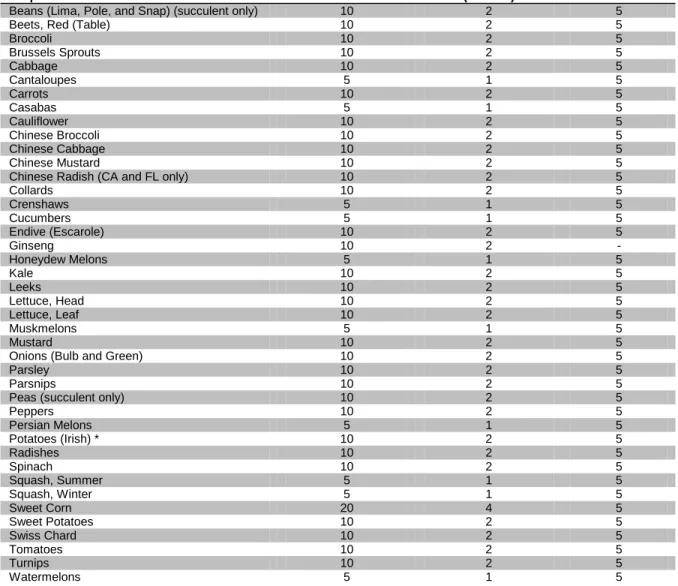
VEGETABLE CROPS - REI 24 hours For foliar or soil applications, Gowan Diazinon 4E should always be
applied as a spray in sufficient water to assure thorough coverage of the foliage or soil. Gowan Diazinon 4E may be applied using ground or aerial application equipment as specified in the following table. This
table indicates the minimum amount of water that can be used for the various methods of application. The specific amount of product to be used appears under the separate directions for use for each crop.
Ground Min. Gals./ Aerial
Application 1000 Sq. Ft. Application
Crop Min. GPA (Ground) Min. GPA
Beans (Lima, Pole, and Snap) (succulent only) 10 2 5
Beets, Red (Table) 10 2 5
Broccoli 10 2 5 Brussels Sprouts 10 2 5 Cabbage 10 2 5 Cantaloupes 5 1 5 Carrots 10 2 5 Casabas 5 1 5 Cauliflower 10 2 5 Chinese Broccoli 10 2 5 Chinese Cabbage 10 2 5 Chinese Mustard 10 2 5
Chinese Radish (CA and FL only) 10 2 5
Collards 10 2 5 Crenshaws 5 1 5 Cucumbers 5 1 5 Endive (Escarole) 10 2 5 Ginseng 10 2 - Honeydew Melons 5 1 5 Kale 10 2 5 Leeks 10 2 5 Lettuce, Head 10 2 5 Lettuce, Leaf 10 2 5 Muskmelons 5 1 5 Mustard 10 2 5
Onions (Bulb and Green) 10 2 5
Parsley 10 2 5
Parsnips 10 2 5
Peas (succulent only) 10 2 5
Peppers 10 2 5 Persian Melons 5 1 5 Potatoes (Irish) * 10 2 5 Radishes 10 2 5 Spinach 10 2 5 Squash, Summer 5 1 5 Squash, Winter 5 1 5 Sweet Corn 20 4 5 Sweet Potatoes 10 2 5 Swiss Chard 10 2 5 Tomatoes 10 2 5 Turnips 10 2 5 Watermelons 5 1 5
*Do not use on commercially grown potatoes which will be hand-harvested.
Observe stated time intervals between last application and harvest as well as intervals between and maximum numbers of applications per season. Do not apply to food crops grown in greenhouses.
NOTES: (1) Soil Incorporation: Following application of this product to control vegetable soil insects, immediately incorporate the product into the soil to the recommended depth (see directions for individual crops) using a rotary hoe, cultivator, disk, harrow, or other suitable means. For control of surface cutworms, incorporate 2-3 ins.; for subterranean cutworms, incorporate 3-6 ins. (2) To Protect Bees: Foliar applications of this product should not be made to peas if these crops or weeds in the treatment area are in bloom or to corn during the pollen shed period. (3) Diazinon will not control organophosphate-resistant leafminers.
VEGETABLE CROPS
CROP PEST RATE/ACRE COMMENTS
Cutworms 2-4 qts. Broadcast just before planting and immediately incorporate into the soil. See Soil Incorporation note.
Wireworms 3-4 qts. Broadcast just before planting and immediately incorporate into the top 4 - 8 ins. of soil.
BEANS (Lima, Pole, and Snap) (succulent only) (7)
Black Bean Aphid, Mexican Bean Beetle, Dipterous Leafminer
VEGETABLE CROPS (Continued)
CROP PEST RATE/ACRE COMMENTS
Cucumber Beetle ¾ pt. Apply in 100 gals. of water per acre as insects occur. Repeat application, as necessary, every 5 days.
BEANS (Lima, Pole, and Snap) (succulent only) (7) (continued)
• Do not make more than 3 foliar applications per season.
• Bean forage or bean hay may be fed to dairy and beef cattle and sheep. Wait 4 days following treatment if forage is to be cut for hay.
• To protect bees, do not apply foliarly if the crop or weeds in the treatment area are in bloom.
• For application by irrigation systems, apply specified dosage per acre. Follow all directions under the APPLICATION THROUGH IRRIGATION SYSTEMS-CHEMIGATION section.
Leafhoppers, Spider Mites 1 pt. Apply as pests occur. Repeat application, as necessary, every 5 days.
BEANS (Lima) (succulent only) (7)
• Do not make more than 3 foliar applications per season.
• Bean forage or bean hay may be fed to dairy and beef cattle and sheep. Wait 4 days following treatment if forage is to be cut for hay.
• To protect bees, do not apply foliarly if the crop or weeds in the treatment area are in bloom.
• For application by irrigation systems, apply specified dosage per acre. Follow all directions under the APPLICATION THROUGH IRRIGATION SYSTEMS-CHEMIGATION section.
Cutworms 2-4 qts. Broadcast just before planting and immediately incorporate into the soil. See Soil Incorporation note. Mole Cricket 1 qt. One to two days before planting, broadcast and
immediately incorporate into the top 1-2 in. of soil.
Wireworms 3-4 qts. Broadcast just before planting and immediately incorporate into the top 4 - 8 in. of soil.
Dipterous Leafminer ½-1 pt. Apply as insects occur. Repeat application, as necessary, every 7 days.
BEETS, RED (Table) (14)
• Do not make more than 5 foliar applications per season.
• For application by irrigation systems, apply specified dosage per acre. Follow all directions under the APPLICATION THROUGH IRRIGATION SYSTEMS-CHEMIGATION section.
Root Maggot 2-3 qts. Broadcast just before planting and immediately incorporate into the top 3-4 in. of soil. Use 4-8 oz. in 50 gals. of transplant water as a drench application when 200-300 gals. of water are used per acre. Apply ½-1 cup (4-8 oz.) per plant by hand or by tractor mounted sprayer equipped with drop nozzles to direct spray to the base of the plant. Note: Transplant water treatments may result in stand reduction due to plant stress at time of transplanting.
Cutworms 2-4 qts. Broadcast just before planting and immediately incorporate into the soil. See Soil Incorporation note. Mole Cricket 1 qt. One to two days before planting, broadcast and
immediately incorporate into the top 1-2 in. of soil.
Wireworms 3-4 qts. Broadcast just before planting and immediately incorporate into the top 4 - 8 in. of soil.
Aphids, Diamondback Moth, Imported
Cabbageworm, Dipterous Leafminer
½-1 pt. Apply as insects occur. Repeat application, as necessary, every 7 days.
BROCCOLI (7)
• Do not make more than 5 foliar applications per season.
• For application by irrigation systems, apply specified dosage per acre. Follow all directions under the APPLICATION THROUGH IRRIGATION SYSTEMS-CHEMIGATION section.
Root Maggot 2-3 qts. Broadcast just before planting and immediately incorporate into the top 3-4 in. of soil. Use 4-8 oz. in 50 gals. of transplant water as a drench application when 200-300 gals. of water are used per acre. Apply ½-1 cup (4-8 oz.) per plant by hand or by tractor mounted sprayer equipped with drop nozzles to direct spray to the base of the plant. Note: Transplant water treatments may result in stand reduction due to plant stress at time of transplanting.
Cutworms 2-4 qts. Broadcast just before planting and immediately incorporate into the soil. See Soil Incorporation note. Mole Cricket 1 qt. One to two days before planting, broadcast and
immediately incorporate into the top 1-2 in. of soil.
Wireworms 3-4 qts. Broadcast just before planting and immediately incorporate into the top 4-8 in. of soil.
Aphids, Diamondback Moth, Imported Cabbageworm
½-1 pt. Apply as insects occur. Repeat application, as necessary, every 7 days.
BRUSSELS SPROUTS (7)
• Do not make more than 5 foliar applications per season.
• For application by irrigation systems, apply specified dosage per acre. Follow all directions under the APPLICATION THROUGH IRRIGATION SYSTEMS-CHEMIGATION section.
VEGETABLE CROPS (Continued)
CROP PEST RATE/ACRE COMMENTS
Root Maggot 2-3 qts. Broadcast just before planting and immediately incorporate into the top 3-4 in. of soil. Use 4-8 oz. in 50 gals. of transplant water as a drench application when 200-300 gals. of water are used per acre. Apply ½-1 cup (4-8 oz.) per plant by hand or by tractor mounted sprayer equipped with drop nozzles to direct spray to the base of the plant. Note: Transplant water treatments may result in stand reduction due to plant stress at time of transplanting.
Cutworms 2-4 qts. Broadcast just before planting and immediately incorporate into the soil. See Soil Incorporation note. Mole Cricket 1 qt. One to two days before planting, broadcast and
immediately incorporate into the top 1 - 2 in. of soil. Wireworms 3-4 qts. Broadcast just before planting and immediately
incorporate into the top 4 - 8 in. of soil. Aphids, Diamondback
Moth, Imported
Cabbageworm, Dipterous Leafminer
½-1 pt. Apply as insects occur. Repeat application, as necessary, every 7 days.
CABBAGE (21)
• Do not make more than 5 foliar applications per season.
• For application by irrigation systems, apply specified dosage per acre. Follow all directions under the APPLICATION THROUGH IRRIGATION SYSTEMS-CHEMIGATION section.
Cutworms 2-4 qts. Broadcast just before planting and immediately incorporate into the soil. See Soil Incorporation note. Mole Cricket 1 qt. One to two days before planting, broadcast and
immediately incorporate into the top 1-2 in. of soil.
Wireworms 3-4 qts. Broadcast just before planting and immediately incorporate into the top 4-8 in. of soil.
Aphids 1 pt. Apply as insects occur. Repeat application, as necessary, every 7 days.
CARROTS (14)
• Do not make more than 5 foliar applications per season.
• For application by irrigation systems, apply specified dosage per acre. Follow all directions under the APPLICATION THROUGH IRRIGATION SYSTEMS-CHEMIGATION section.
Root Maggot 2-3 qts. Broadcast just before planting and immediately incorporate into the top 3-4 in. of soil. Use 4-8 oz. in 50 gals. of transplant water as a drench application when 200-300 gals. of water are used per acre. Apply ½-1 cup (4-8 oz.) per plant by hand or by tractor mounted sprayer equipped with drop nozzles to direct spray to the base of the plant. Note: Transplant water treatments may result in stand reduction due to plant stress at time of transplanting.
Cutworms 2-4 qts. Broadcast just before planting and immediately incorporate into the soil. See Soil Incorporation note. Mole Cricket 1 qt. One to two days before planting, broadcast and
immediately incorporate into the top 1-2 in. of soil.
Wireworms 3-4 qts. Broadcast just before planting and immediately incorporate into the top 4-8 in. of soil.
Aphids, Diamondback Moth, Imported
Cabbageworm, Dipterous Leafminer
½-1 pt. Apply as insects occur. Repeat application, as necessary, with a minimum of 7 days between applications.
CAULIFLOWER (7)
• Do not make more than 5 foliar applications per season.
• For application by irrigation systems, apply specified dosage per acre. Follow all directions under the APPLICATION THROUGH IRRIGATION SYSTEMS-CHEMIGATION section.
Aphids, Diamondback Moth, Imported
Cabbageworm, Dipterous Leafminer
½-1 pt. Apply as insects occur. Repeat application, as necessary, every 7 days.
CHINESE BROCCOLI (10)
• Do not make more than 5 foliar applications per season.
• For application by irrigation systems, apply specified dosage per acre. Follow all directions under the APPLICATION THROUGH IRRIGATION SYSTEMS-CHEMIGATION section.
Aphids, Diamondback Moth, Imported
Cabbageworm, Dipterous Leafminers
½-1 pt. Apply as insects occur. Repeat application, as necessary, every 7 days.
CHINESE CABBAGE (Bok Choy and Napa ) (10)
• Do not make more than 5 foliar applications per season.
• For application by irrigation systems, apply specified dosage per acre. Follow all directions under the APPLICATION THROUGH IRRIGATION SYSTEMS-CHEMIGATION section.
VEGETABLE CROPS (Continued)
CROP PEST RATE/ACRE COMMENTS
Aphids, Diamondback Moth, Imported
Cabbageworm, Dipterous Leafminer
½-1 pt. Apply as insects occur. Repeat application, as necessary, every 7 days.
CHINESE MUSTARD (Gai Choy) (10)
• Do not make more than 5 foliar applications per season.
• For application by irrigation systems, apply specified dosage per acre. Follow all directions under the APPLICATION THROUGH IRRIGATION SYSTEMS-CHEMIGATION section.
Aphids, Diamondback Moth, Imported
Cabbageworm, Dipterous Leafminer
1 pt. Mix in a minimum of 100 gals. of water per acre and apply as a foliar spray as pests occur. Repeat application as necessary, every 14 days.
CHINESE RADISH (Japanese Radish or Daikon) (FL and CA only) (10)
• Do not make more than 3 foliar applications per season.
• For application by irrigation systems, apply specified dosage per acre. Follow all directions under the APPLICATION THROUGH IRRIGATION SYSTEMS-CHEMIGATION section.
Cutworms 2-4 qts. Broadcast just before planting and immediately incorporate into the soil. See Soil Incorporation note. Mole Cricket 1 qt. One to two days before planting, broadcast and
immediately incorporate into the top 1-2 in. of soil.
Wireworms 3-4 qts. Broadcast just before planting and immediately incorporate into the top 4-8 in. of soil.
Aphids, Diamondback Moth, Imported
Cabbageworm, Harlequin Bug, Corn Earworm
½-1 pt. Apply as insects occur. Repeat application, as necessary, every 7 days.
COLLARDS (10)
• Do not make more than 5 foliar applications per season.
• For application by irrigation systems, apply specified dosage per acre. Follow all directions under the APPLICATION THROUGH IRRIGATION SYSTEMS-CHEMIGATION section.
Cutworms 2-4 qts. Broadcast just before planting and immediately incorporate into the soil. See Soil Incorporation note. Wireworms 3-4 qts. Broadcast just before planting and immediately
incorporate into the top 4-8 in. of soil. Aphids, Serpentine
Leafminer, Thrips, Striped Cucumber Beetle, Melonworm
1 pt. Apply as insects occur. Repeat application, as necessary, every 7 days.
CUCUMBERS (7)
• Do not make more than 5 foliar applications per season.
• For application by irrigation systems, apply specified dosage per acre. Follow all directions under the APPLICATION THROUGH IRRIGATION SYSTEMS-CHEMIGATION section.
Cutworms 2-4 qts. Broadcast just before planting and immediately incorporate into the soil. See Soil Incorporation note. Mole Cricket 1 qt. One to two days before planting, broadcast and
immediately incorporate into the top 1-2 in. of soil.
Wireworms 3-4 qts. Broadcast just before planting and immediately incorporate into the top 4-8 in. of soil.
Aphids, Dipterous Leafminer
½-1 pt. Apply as insects occur. Repeat application, as necessary, every 7 days.
ENDIVE (Escarole) (14)
• Do not make more than 5 foliar applications per season.
• For application by irrigation systems, apply specified dosage per acre. Follow all directions under the APPLICATION THROUGH IRRIGATION SYSTEMS-CHEMIGATION section.
Leafhoppers, Aphids, Lygus Bugs, Flea Beetles, Jumping Plant Lice
¾ - 1 pt. Spray when insects first appear. For heavy insect infestations, use 1 pt. per acre. Apply by ground equipment using 10-100 gals. of water per acre.
GINSENG (30)
• Do not apply more than one application per growing season.
• Do not apply during flowering of three or four-year old crops.
• Do not graze treated areas or feed treated forage to livestock.
• For application by irrigation systems, apply specified dosage per acre. Follow all directions under the APPLICATION THROUGH IRRIGATION SYSTEMS-CHEMIGATION section..
Cutworms 2-4 qts. Broadcast just before planting and immediately incorporate into the soil. See Soil Incorporation note. Mole Cricket 1 qt. One to two days before planting, broadcast and
immediately incorporate into the top 1-2 in. of soil.
Wireworms 3-4 qts. Broadcast just before planting and immediately incorporate into the top 4-8 in. of soil.
Aphids, Diamondback Moth, Imported
Cabbageworm, Harlequin Bug, Corn Earworm
½-1 pt. Apply as insects occur. Repeat application, as necessary, every 7 days.
KALE (10)
• Do not make more than 5 foliar applications per season.
• For application by irrigation systems, apply specified dosage per acre. Follow all directions under the APPLICATION THROUGH IRRIGATION SYSTEMS-CHEMIGATION section.
VEGETABLE CROPS (Continued)
CROP PEST RATE/ACRE COMMENTS
LEEKS - SEE ONIONS
Cutworms 2-4 qts. Broadcast just before planting and immediately incorporate into the soil. See Soil Incorporation note.
Mole Cricket 1 qt. One to two days before planting, broadcast and immediately incorporate into the top 1-2 in. of soil.
Wireworms 3-4 qts. Broadcast just before planting and immediately incorporate into the top 4-8 in. of soil.
Aphids, Dipterous Leafminer
½-1 pt. Apply as insects occur. Repeat application, as necessary, every 7 days.
LETTUCE (Head and Leaf) (14)
• Do not make more than 5 foliar applications per season.
• For application by irrigation systems, apply specified dosage per acre. Follow all directions under the APPLICATION THROUGH IRRIGATION SYSTEMS-CHEMIGATION section.
Cutworms 2-4 qts. Broadcast just before planting and immediately incorporate into the soil. See Soil Incorporation note.
Wireworms 3-4 qts. Broadcast just before planting and immediately incorporate into the top 4-8 in. of soil.
Aphids, Dipterous Leafminer, Thrips, Striped Cucumber Beetle, Melonworm, Leafhoppers, Spider Mites
½-1½ pts. Apply as insects occur. Repeat application, as necessary, every 7 days.
MELONS (Cantaloupes, Casabas, Crenshaws, Honeydews, Muskmelons, Persians, and hybrids of these), WATERMELONS (3)
• Do not make more than 5 foliar applications per season.
• For application by irrigation systems, apply specified dosage per acre. Follow all directions under the APPLICATION THROUGH IRRIGATION SYSTEMS-CHEMIGATION section.
Cutworms 2-4 qts. Broadcast just before planting and immediately incorporate into the soil. See Soil Incorporation note.
Mole Cricket 1 qt. One to two days before planting, broadcast and immediately incorporate into the top 1-2 in. of soil.
Wireworms 3-4 qts. Broadcast just before planting and immediately incorporate into the top 4 - 8 in. of soil.
Aphids, Dipterous Leafminer, Diamondback Moth, Imported
Cabbageworm
½-1 pt. Apply as insects occur. Repeat application, as necessary, every 7 days.
MUSTARD (10)
• Do not make more than 5 foliar applications per season.
• For application by irrigation systems, apply specified dosage per acre. Follow all directions under the APPLICATION THROUGH IRRIGATION SYSTEMS-CHEMIGATION section.
Onion Maggot 2-4 qts. Broadcast just before planting and mix into the top 3-4 in. of soil. Note: Diazinon will not control organophosphate-resistant onion maggots.
Onion Thrips 1 pt. Apply as thrips appear. Repeat application, as necessary, every 7 days.
Wireworms 3-4 qts. Broadcast just before planting and immediately incorporate into the top 4-8 in. of soil.
ONIONS (Bulb and Green), GARLIC, LEEKS, SPRING ONIONS OR SCALLIONS, JAPANESE BUNCHING ONIONS, GREEN SHALLOTS, GREEN ESCHALOTS (14)
• Do not make more than 3 foliar applications per season.
• For application by irrigation systems, apply specified dosage per acre. Follow all directions under the APPLICATION THROUGH IRRIGATION SYSTEMS-CHEMIGATION section.
Cutworms 2-4 qts. Broadcast just before planting and immediately incorporate into the soil. See Soil Incorporation note.
Wireworms 3-4 qts. Broadcast just before planting and immediately incorporate into the top 4-8 in. of soil.
PARSLEY
• For application by irrigation systems, apply specified dosage per acre. Follow all directions under the supplemental labeling, APPLICATION THROUGH IRRIGATION SYSTEMS-CHEMIGATION
Aphids, Flea Beetles, Dipterous Leafminer
½-1 pt. Apply as insects occur. Repeat application, as necessary, every 7 days.
PARSNIP (14)
• Do not make more than 5 foliar applications per season.
• For application by irrigation systems, apply specified dosage per acre. Follow all directions under the APPLICATION THROUGH IRRIGATION SYSTEMS-CHEMIGATION section.
Cutworms 2-4 qts. Broadcast just before planting and immediately incorporate into the soil. See Soil Incorporation note. Wireworms 3-4 qts. Broadcast just before planting and immediately
incorporate into the top 4-8 in. of soil. Aphids, Dipterous
Leafminer
¾-1 pt. Apply as insects occur. Repeat application, as necessary, every 5 days.
PEAS (succulent only) (7)
• Do not make more than 3 foliar applications per season.
• Vines and hay may be fed to dairy and beef cattle and sheep. To avoid illegal residues, wait 7 days following treatment if forage is to be cut for hay.
• To protect bees, do not apply foliarly if the crop or weeds in the treatment area are in bloom.
• For application by irrigation systems, apply specified dosage per acre. Follow all directions under the APPLICATION THROUGH IRRIGATION SYSTEMS-CHEMIGATION section.
VEGETABLE CROPS (Continued)
CROP PEST RATE/ACRE COMMENTS
Cutworms 2-4 qts. Broadcast just before planting and immediately incorporate into the soil. See Soil Incorporation note. Mole Cricket 1 qt. One to two days before planting, broadcast and
immediately incorporate into the top 1-2 in. of soil.
Wireworms 3-4 qts. Broadcast just before planting and immediately incorporate into the top 4-8 in. of soil.
Aphids, Serpentine Leafminer
½-1 pt. Apply as insects appear. Repeat application, as necessary, every 7 days.
PEPPERS (5)
• Do not make more than 5 foliar applications per season.
• For application by irrigation systems, apply specified dosage per acre. Follow all directions under the APPLICATION THROUGH IRRIGATION SYSTEMS-CHEMIGATION section.
Cutworms (Surface and Subterranean)
2-4 qts. Broadcast just before planting and immediately incorporate into the soil. See Soil Incorporation note. Wireworms 3-4 qts. Broadcast just before planting and immediately
incorporate into the top 4-8 in. of soil. Southern Potato Wireworm
(Southeastern U.S.)
2-4 qts. For potatoes grown on mineral soils in the Southeast, apply before planting and immediately incorporate into the top 3-6 in. of soil depending on location of wireworms. Aphids, Flea Beetles,
Colorado Potato Beetle, Dipterous Leafminer
½-¾ pt. Apply as insects occur. Repeat application, as necessary, every 7 days.
Banded Cucumber Beetle, Leafhoppers, Southern Armyworm
¾-1 pt. Apply as insects occur. Repeat application as necessary, every 7 days.
POTATOES (35)
• Do not make more than 5 foliar applications per season.
• Do not use on commercially grown potatoes which will be hand-harvested.
• For application by irrigation systems, apply specified dosage per acre. Follow all directions under the APPLICATION THROUGH IRRIGATION SYSTEMS-CHEMIGATION section.
Cutworms 2-4 qts. Broadcast just before planting and immediately incorporate into the soil. See Soil Incorporation note. Mole Crickets 1 qt. One to two days before planting, broadcast and
immediately incorporate into the top 1-2 in. of soil.
Wireworms 3-4 qts. Broadcast just before planting and immediately incorporate into the top 4-8 in. of soil.
Aphids, Flea Beetles, Dipterous Leafminer
½-1 pt. Apply as insects occur. Repeat application, as necessary, every 7 days.
RADISHES (14)
• Do not make more than 3 foliar applications per season.
• For application by irrigation systems, apply specified dosage per acre. Follow all directions under the APPLICATION THROUGH IRRIGATION SYSTEMS-CHEMIGATION section.
Cutworms 2-4 qts. Broadcast just before planting and immediately incorporate into the soil. See Soil Incorporation note. Wireworms 3-4 qts. Broadcast just before planting and immediately
incorporate into the top 4-8 in. of soil. Aphids, Dipterous
Leafminer
½-1 pt. Apply as insects occur. Repeat application, as necessary, every 7 days.
SPINACH (14)
• Do not make more than 5 foliar applications per season.
• For application by irrigation systems, apply specified dosage per acre. Follow all directions under the APPLICATION THROUGH IRRIGATION SYSTEMS-CHEMIGATION section.
Cutworms 2-4 qts. Broadcast just before planting and immediately incorporate into the soil. See Soil Incorporation note. Wireworms 3-4 qts. Broadcast just before planting and immediately
incorporate into the top 4-8 in. of soil. Aphids, Serpentine
Leafminer, Thrips, Striped Cucumber Beetle, Melonworm, Leafhoppers, Spider Mites
½-1½ pts. Apply as insects occur. Repeat application, as necessary, every 7 days.
SQUASH, SUMMER (7), WINTER (3)
• Do not make more than 5 foliar applications per season.
• For application by irrigation systems, apply specified dosage per acre. Follow all directions under the APPLICATION THROUGH IRRIGATION SYSTEMS-CHEMIGATION section.
VEGETABLE CROPS (Continued)
CROP PEST RATE/ACRE COMMENTS
Cutworms 2-4 qts. Broadcast just before planting and immediately incorporate into the soil. See Soil Incorporation note. Seedcorn Maggot 2-4 qts. Broadcast just before planting and immediately
incorporate into the top 2 in. of soil.
Wireworms 3-4 qts. Broadcast just before planting and immediately incorporate into the top 4-8 in. of soil.
Corn Earworm 1-1¼ qts. Apply when silks first appear. Repeat application every 7 days if necessary.
Corn Rootworm (Adult) ½-1 pt. Apply as insects occur. Repeat application, as necessary, every 7 days.
Corn Leaf Aphid 1-2 pts. Apply in sufficient water to provide complete coverage to the upper portions of the plants. Repeat application, as necessary, every 7 days.
Grasshoppers, Spider Mites, Flea Beetles
1 pt. Apply as insects occur. Repeat application, as necessary, every 7 days.
Sap Beetle 2-2½ pts. Consult local agricultural authorities for proper timing of sprays. Repeat application, as necessary, every 7 days. SWEET CORN (7)
• Do not make more than 5 foliar applications per season.
• To protect bees, do not apply foliarly to corn during the pollen shed period.
• Allow 7 days after the last application before grazing or cutting for forage.
• Forage may be fed to beef, dairy cattle, and sheep.
• For application by irrigation systems, apply specified dosage per acre. Follow all directions under the APPLICATION THROUGH IRRIGATION SYSTEMS-CHEMIGATION section.
Wireworms 3-4 qts. Broadcast just before planting and immediately incorporate into the top 4-8 in. of soil.
SWEET POTATOES
• For application by irrigation systems, apply specified dosage per acre. Follow all directions under the APPLICATION THROUGH IRRIGATION SYSTEMS-CHEMIGATION section.
Cutworms 2-4 qts. Broadcast just before planting and immediately incorporate into the soil. See Soil Incorporation note. Wireworms 3-4 qts. Broadcast just before planting and immediately
incorporate into the top 4-8 in. of soil. Aphids, Diamondback
Moth, Imported
Cabbageworm, Harlequin Bug
½-1 pt. Apply as insects occur. Repeat application, as necessary, every 7 days.
SWISS CHARD (14)
• Do not make more than 5 foliar applications per season.
• For application by irrigation systems, apply specified dosage per acre. Follow all directions under the APPLICATION THROUGH IRRIGATION SYSTEMS-CHEMIGATION section.
Cutworms 2-4 qts. Broadcast just before planting and immediately incorporate into the soil. See Soil Incorporation note. Mole Cricket 1 qt. One to two days before planting, broadcast and
immediately incorporate into the top 1-2 in. of soil.
Wireworms 3-4 qts. Broadcast just before planting and immediately incorporate into the top 4-8 in. of soil.
Aphids, Dipterous Leafminer
½ pt. Apply as insects appear. Repeat application, as necessary, every 7 days.
Banded Cucumber Beetle, Fall Armyworm, Southern Armyworm, Beet Armyworm
¾-1 pt. Apply as insects appear. Repeat application, as necessary, every 7 days.
Vinegar Fly (Drosophila spp.)
½-1½ pts. Apply as insects appear. Repeat application, as necessary, every 7 days.
TOMATOES (1)
• Do not make more than 5 foliar applications per season.
• For application by irrigation systems, apply specified dosage per acre. Follow all directions under the APPLICATION THROUGH IRRIGATION SYSTEMS-CHEMIGATION section.
Cutworms 2-4 qts. Broadcast just before planting and immediately incorporate into the soil. See Soil Incorporation note.
Mole Crickets 1 qt. One to two days before planting, broadcast and immediately incorporate into the top 1-2 in. of soil.
Wireworms 3-4 qts. Broadcast just before planting and immediately incorporate into the top 4 - 8 in. of soil.
Aphids, Flea Beetles, Dipterous Leafminer
½-1 pt. Apply as insects occur. Repeat application, as necessary, every 7 days.
TURNIPS (roots and tops) (14)
• Do not make more than 5 foliar applications per season.
• For application by irrigation systems, apply specified dosage per acre. Follow all directions under the APPLICATION THROUGH IRRIGATION SYSTEMS-CHEMIGATION section.
FIELD CROPS - REI 24 HOURS
Soil and foliar applications of Gowan Diazinon 4E should always by applied as a spray in sufficient water to ensure thorough coverage. For foliar applications, observe stated time intervals between last application and harvest, as well as intervals between applications and total number of applications that can be made per season.
FIELD CROPS
CROP PEST RATE/ACRE COMMENTS
Aphids, Spider Mites 1 qt. Apply as pests occur. Repeat application, as necessary, every 14 days.
HOPS (14)
• Do not make more than 4 applications per season.
• For application by irrigation systems, apply specified dosage per acre. Follow all directions under the APPLICATION THROUGH IRRIGATION SYSTEMS-CHEMIGATION section.
Wireworms 3-4 qts. Broadcast just before planting. Incorporate into soil 4-6 in.
• Do not apply more than 4 qts. of this product to the soil per season. Aphids, Beet Leafhopper,
Dipterous Leafminer
¾-1 pt. Apply as insects occur. Repeat application, as necessary, every 7 days.
Grasshoppers 1 pt. Apply as insects occur. Repeat application, as necessary, every 7 days.
SUGAR BEETS (14)
• Do not make more than 5 applications per season.
• Tops may be fed to beef and dairy animals.
• For application by irrigation systems, apply specified dosage per acre. Follow all directions under the APPLICATION THROUGH IRRIGATION SYSTEMS-CHEMIGATION section.
GRASSLAND INSECTS
AREA PEST RATE/ACRE COMMENTS
Grasshoppers ¾-1 pt. Spray in water (minimum of 1 gal. of water per acre) for aerial applications or a minimum of 5 gals. of water per acre for ground applications or in oil (a minimum of 1 gal. of oil per acre) when insects first appear, preferably in the nymphal state. Thorough coverage of the foliage is essential.
DITCH BANKS, ROADSIDES, WASTELAND, NONCROP AREAS, BARRIER STRIPS
• Do not graze or use treated grass for forage or feed. ORNAMENTAL STATEMENT
Before treating a large number of ornamental plants with Gowan Diazinon 4E alone or as a tank mixture with any other material, make a test application on a few plants and observe for 7 to 10 days prior to treating large areas to reduce the possibility of plant injury.
INSECT CONTROL ON ORNAMENTALS - REI 12 HOURS
CROP PEST RATE COMMENTS
Aphids, Bagworm, Carnation Bud Mite, Carnation Shoot Mite, Clover Mite, Cyclamen Mite, Dipterous Leafminer, European Pine Shoot Moth, European Red Mite, Flea Beetles, Holly Bud Moth, Leafhoppers, Obscure Root Weevil, Omnivorous Leaftier, Privet Mite, Scale Crawler (Cottony-cushion, Lecanium, Pine Needle, San Jose, Soft), Thrips, Twospotted Spider Mite, Juniper Webworm, Whiteflies
½ fl. oz. per 3 gals. water or 1 pt. per 100
gals. of water
Try to spray underside of leaves and penetrate dense foliage. Repeat as necessary.
Apple-and-Thorn Skeletonizer, Cotoneaster Webworm, Fall Webworm, Hemlock Chermes, Oak Looper, Obliquebanded Leafroller, Pear Slug, Tent Caterpillar
1½ fl. oz. per 3 gals. of water or 3 pts. per 100
gals. of water
Try to spray underside of leaves and penetrate dense foliage. Repeat as necessary.
Mimosa Webworm ½ fl. oz. in 3 gals. of water or 1 pt. in 100
gals. of water
Apply as a thorough foliar spray when adults first appear. Try to spray underside of leaves and penetrate dense foliage. Make a second and third application at 4-5 week intervals.
ARBORVITAE, AZALEA, BIRCH, BOXWOOD, CAMELLIA, CARNATION, CHRYSANTHEMUM, DOUGLAS FIR, ELM, GLADIOLI, HAWTHORN, HOLLY, JUNIPER, LILAC, LOCUST, MAPLE, OAK, PINE, ORNAMENTAL PLUM, POPLAR, RHODODENDRON, ROSE, SPRUCE, and WILLOW
• Do not use on Ferns, Poinsettia, Hibiscus, Papaya, Pilea, and Gardenia since injury to the plants may occur.
LAWN PEST CONTROL
(Excluding Golf Courses and Sod Farms) PRECAUTIONS: Birds, especially waterfowl, feeding or drinking on
treated areas may be killed. Apply this product only as specified on this label. Because of the migratory habits of certain waterfowl, do not apply in Nassau County, New York between November 1 and May 20. Do not exceed maximum permitted label rates, since rates above those recommended significantly increase potential hazards to birds,
especially waterfowl. Avoid overlapping sprays. If waterfowl (ducks or geese) can be expected to enter the treated area after treatment (except spot treatments), water lawn with at least ¼ inch of water immediately after application; however, stop water before puddling occurs.
PEST RATE/1,000 SQ. FT. COMMENTS
Lawn Chinch Bug 2-3 fl. oz. Apply in 3 gals. of water. Use higher rate for longer residual control and in lawns of dense growth such as St. Augustine lawns.
Ants, Armyworms, Bermudagrass Mite, Clover Mite, Crickets, Cutworms, Digger Wasp, Earwigs, Frit Fly, Lawn Billbug, Leafhoppers, Sod Webworm (Lawn Moth), Sowbug (Pillbug), Springtail (Collembola)
2-3 fl. oz. Apply in 3 gals. of water. Spot spray anthills and wasp ground nest openings. For digger wasps, apply at dusk when wasps are not active. For frit flies, before treatment mow grass and water well, but delay application until grass is dry. For billbug control, apply when activity is first observed or when chewed or brown grass is present, indicating damage from this insect.
3 fl. oz. Apply in 3 gals. of water. For brown dog ticks, spray grass and under shrubbery, particularly near house.
Brown Dog Tick, Chiggers, Fleas
• Do not apply to animals.
Hyperodes Weevil 3 fl. oz. Apply in 3 gals. of water. Treat problem areas in mid-April and again in mid-May. Millipedes 3 fl. oz. Apply in 3 gals. of water.
Rhodesgrass Scale 3 fl. oz. Apply in 3 gals. of water. Apply when crawlers first emerge. White Grubs (such as Japanese
Beetle Larvae, European Chafer, Southern Chafer)
3 fl. oz. Apply in 3 gals. of water. Apply any time between late July and early October.
NUISANCE PESTS IN OUTSIDE AREAS
PEST RATE COMMENTS
3 fl. oz. Apply in 3 gals. of water and thoroughly spray window and door screens, sills, foundations, porch and patio walls, entranceways, walks, garbage cans, tree trunks, and into cracks and other places where insects can hide. To prevent entry into houses, spray a five-foot band of soil around the house next to the foundation and spray the foundation of the house to a height of 2-3 ft. Repeat application as necessary.
Ants, Boxelder Bug, Brown Dog Tick, Chiggers, Clover Mite, Cockroaches, Crickets, Earwigs, Fleas, Flies, Millipedes, Sowbugs (Pillbugs), Spiders, Springtails (Collembola)
• Do not apply to animals.
• Do not treat plants (other than tree trunks) at this nuisance pest rate. APPLICATION THROUGH IRRIGATION SYSTEMS – CHEMIGATION
Apply this product only through sprinkler, including center pivot, lateral move, end tow side (wheel) roll, traveler, big gun, solid set, or hand move, or drip (including surface and subsurface) irrigation systems. Do not apply this product through any other type of irrigation system. Crop injury, lack of effectiveness, or illegal pesticide residues in the crop can result from nonuniform distribution of treated water.
If you have questions about calibration, you should contact State Extension Service specialists, equipment manufacturers, or other experts.
Do not connect an irrigation system (including greenhouse systems) used for pesticide application to a public water system unless the pesticide label prescribed safety devices for public water systems are in place.
A person knowledgeable of the chemigation system and responsible for its operation or under the supervision of the responsible person, shall shut the system down and make necessary adjustments should the need arise.
Mix in clean supply tank the recommended amount of this product for acreage to be covered, and needed quantity of water.
This product should not be tank-mixed with other pesticides, surfactants, or fertilizers unless prior use has shown the combination non-injurious under your conditions of use. Follow precautionary statements and directions for all tank-mix products.
On all crops, use sufficient gallonage of water to obtain thorough and uniform coverage but not cause runoff or excessive leaching. This will vary depending on equipment, pest problem, and stage of crop growth. Application of more or less than optimal quantity of water may result in decreased chemical performance, crop injury, or illegal pesticide residues.
Meter this product into the irrigation water uniformly during the period of operation. Do not overlap application. Follow recommended label rates, application timing, and other directions and precautions for crop being treated. Continuous mild agitation of pesticide mixture may be needed to assure a uniform application, particularly if the supply tank requires a number of hours to empty.
Do not apply when wind speed favors drift beyond the area intended for treatment.
CHEMIGATION SYSTEMS CONNECTED TO PUBLIC WATER SYSTEMS
Note: Gowan Company does not encourage connecting chemigation systems to public water supplies. The following information is provided for users who have diligently considered all other application and water supply options before electing to make such a connection.
Public water systems means a system for the provision to the public of piped water for human consumption if such system has at least 15 service connections or regularly serves an average of a least 25 individuals daily at least 60 days out of the year. Chemigation systems connected to public water systems must contain a functional reduced-pressure zone, backflow preventer (RPZ) or the functional equivalent in the water supply line upstream from a point of pesticide introduction. As an option to the RPZ, the water from the public water system should be discharged into a reservoir tank prior to pesticide introduction. There shall be a complete physical break (air gap) between the outlet end of the fill pipe and the top or overflow rim of the reservoir tank of at least twice the inside diameter of the fill pipe.
The pesticide injection pipeline must contain a functional, automatic, quick-closing check valve to prevent the flow of fluid back toward the injection pump.
The pesticide injection pipeline must contain a functional, normally closed, solenoid-operated valve located on the intake side of the injection pump and connected to the system interlock to prevent fluid from being withdrawn from the supply tank when the irrigation system is either automatically or manually shutdown.
The system must contain functional interlocking controls to automatically shut off the pesticide injection pump when the water pump motor stops, or in cases where there is no water pump, when the water pressure decreases to the point where pesticide distribution is adversely affected.
Systems must use a metering pump, such as a positive displacement injection pump (e.g., diaphragm pump) effectively designed and
constructed of material that are compatible with pesticides and capable of being fitted with a system interlock.
SPRINKLER CHEMIGATION (FOLIAR SPRAY USES) The system must contain a functional check valve, vacuum relief valve and low pressure drain appropriately located on the irrigation pipeline to prevent water source contamination from backflow. The pesticide injection pipeline must contain a functional, automatic, quick-closing check valve to prevent the flow of fluid back toward the injection pump. The pesticide injection pipeline must also contain functional, normally closed, solenoid-operated valve located on the intake side of the injection pump and connected to the system interlock to prevent fluid from being withdrawn from the supply tank when the irrigation system is either automatically or manually shut down. The system must contain functional interlocking controls to automatically shut off the pesticide injection pump when the water pump motor stops. The irrigation line or water pump must include a functional pressure switch which will stop the water pump motor when the water pressure decreases to the point where pesticide distribution is adversely affected.
Systems must use a metering pump, such as a positive displacement injection pump (e.g., diaphragm pump) effectively designed and constructed of materials that are compatible with pesticides and capable of being fitted with a system interlock.
Do not apply when wind speed favors drift beyond the area intended for treatment.
DRIP (INCLUDING SURFACE AND SUBSURFACE) CHEMIGATION (SOIL DRENCH USES)
The system must contain a functional check valve, vacuum relief valve and low pressure drain appropriately located on the irrigation pipeline to prevent water source contamination from backflow.
The pesticide injection pipeline must contain a functional, automatic, quick-closing check valve to prevent the flow of fluid back toward the injection pump.
The pesticide injection pipeline must also contain a functional, normally closed, solenoid-operated valve located on the intake side of the injection pipe and connected to the system interlock to prevent fluid from being withdrawn from the supply tank when the irrigation system is either automatically or manually shut down.
The system must contain functional interlocking controls to automatically shut off the pesticide injection pump when the water pump motor stops. The irrigation line or water pump must include a functional pressure switch which will stop the water pump motor when the water pressure decreases to the point where pesticide distribution is adversely affected.
Systems must use a metering pump such as a positive displacement injection pump (e.g., diaphragm pump) effectively designed and constructed of materials that are compatible with pesticides and capable of being fitted with a system interlock.
STORAGE AND DISPOSAL
DO NOT contaminate water, food or feed by storage or disposal. Open dumping is prohibited.
PESTICIDE DISPOSAL: Pesticide wastes are toxic. Improper disposal of excess pesticide, spray mixture, or rinsate is a violation of Federal law. If pesticide, spray mixture, or rinsate cannot be disposed of by use according to the label instructions, contact your State Pesticide or Environmental Control Agency or the Hazardous Waste representative at the nearest EPA Regional Office for guidance.
CONTAINER DISPOSAL: Triple rinse (or equivalent). Then puncture and dispose of in a sanitary landfill, incinerate, or burn, if allowed by state and local authorities. Stay out of smoke from burning container. For minor spills, leaks, etc., follow all precautions indicated on this label and clean up immediately. Take special care to avoid contamination of equipment and facilities during cleanup and disposal of wastes. FOR 24 HOUR EMERGENCY ASSISTANCE (SPILL, LEAK OR FIRE),
CALL CHEMTREC® (800) 424-9300.
For other product information, contact Gowan Company or see Material Safety Data Sheet.
NOTICE ON CONDITIONS OF SALE
Our recommendations for use of this product are based upon tests believed to be reliable. The use of this product being beyond the control of the manufacturer, no guarantee, expressed or implied, is made as to the effects of such or the results to be obtained if not used in accordance with directions or established safe practice. The buyer must assume all responsibility, including injury or damage, resulting from its misuse as such, or in combination with other materials.