Efficient Commit Processing in
High-Availability Main-Memory Databases
Heine Kolltveit
Abstract
Database systems are currently being used as backbone to thousands of appli-cations. Some of these have very high demands for high availability and fast real-time responses. Examples include telecommunication systems, trading systems, online gaming and sensor networks.
Disk-based databases are too slow to facilitate the short response time requirements of these types of systems. Main-memory databases, however, provide short response times and, if replicated, the required level of avail-ability. Still, the execution of transactions should be optimized to support as many transactions per second as possible while keeping the response times at acceptable levels.
The focus of this work is how to improve the performance of main-memory primary-backup systems by looking at the execution of transactions and com-mit protocols. Furthermore, system resilience to failures is addressed. We have examined existing solutions both for distributed environments in general and main-memory primary-backup systems in particular.
The main contribution of this thesis deals with protocols and several opti-mizations for committing transactions in replicated main-memory databases. The protocols reduce the overhead by sending messages in a circular fashion. In addition, the results of an extensive investigation of existing commit proto-cols and optimizations for them are presented as related work. Furthermore, the protocols are extended to multiple copies and an approach to handle failures in non-deterministic environments. This improves the resilience to failures.
The suggested protocols and optimizations have been evaluated. The results show a 50% increase in throughput and a reduction in transaction re-sponse time are achieveable compared to state-of-the-art protocols. Through-put for single-tuple transactions can be further improved by 80% – 130%, depending on the ratio between reads and writes. Hence, the work clearly has merit for distributed databases with high availability and short real-time response requirements.
Preface
This thesis is submitted to the Norwegian University of Science and Technol-ogy in partial fulfillment of the degree PhD. The work has been carried out at the Database System Group, Department of Computer and Information Science (IDI). The study was funded by the Faculty of Information Tech-nology, Mathematics and Electrical Engineering through the “forskerskolen” program. Some minor grammatical and spelling errors have been corrected in the papers in Part II compared to their published versions.
Acknowledgement
First of all, I would like to thank my supervisor Professor Svein-Olaf Hvasshovd for his advice, collaboration, and ideas, and for providing valuable comments to drafts of the thesis and papers. I would also like to thank my co-advisors Dr. Ing. Øystein Torbjønsen and Professor Svein Erik Bratsberg for their guidance and valuable feedback during this work.
Moreover, I’ve received comments and help from various sources during the years I’ve been working on my thesis. I was sharing office with Jørgen Løland and enjoyed many motivating conversations with him. Together with the rest of the lunch team; Jeanine Lilleng, Jon Olav Hauglid, Norvald Ryeng and others, we have enjoyed many stimulating discussions on subjects both on and off topic.
Kjetil Nørv˚ag has been helpful commenting on my papers and taught me much about scientific publishing. I thank the administrative staff at IDI and the Database System Group in general for providing a good scientific environment where I could carry out my research.
Finally, I would like to thank my brother, Njal Karevoll, for discussing my ideas and helping me evolve, and my parents for always supporting me.
Contents
I
Background and Context
1
1 Introduction 3
1.1 Motivation . . . 3
1.1.1 The Challenges of Main-Memory Commit Processing . 10 1.2 Research Questions . . . 11
1.3 Research Methodology . . . 12
1.4 Thesis Organization . . . 13
2 Fault Tolerance in Distributed Systems 15 2.1 Dependability and Fault Tolerance . . . 15
2.1.1 Terminology . . . 15
2.1.2 Module Reliability and Availability . . . 16
2.1.3 Failure Classification . . . 16
2.1.4 Failure Semantics . . . 17
2.1.5 Failure Masking . . . 18
2.1.6 Liveness and Safety . . . 18
2.2 Distributed Systems . . . 19
2.2.1 Characteristics of Distributed Systems . . . 19
2.2.2 Distributed Applications . . . 19
2.2.3 Real-Time Systems . . . 20
2.3 Replication in Distributed Systems . . . 20
2.3.1 Group Communication . . . 21 2.3.2 Replica Consistency . . . 24 2.3.3 Replica Determinism . . . 24 2.3.4 Replication Strategies . . . 25 2.3.5 Orphan Requests . . . 29 2.4 Transactions . . . 30 2.4.1 Properties . . . 30 2.4.2 Concurrency Control . . . 31 2.4.3 Recovery . . . 32
2.4.4 Transactional Systems Architectures . . . 34 v
vi Contents
2.4.5 Distributed Transaction Entities . . . 34
2.4.6 Atomic Commitment . . . 35
3 Survey of Commit Processing 37 3.1 Commit Processing: Blocking Approaches . . . 37
3.1.1 Two-Phase Commit . . . 37
3.1.2 Presumed Abort . . . 38
3.1.3 Presumed Commit . . . 39
3.1.4 Other Optimizations . . . 40
3.1.5 One-phased Commit Protocols . . . 42
3.1.6 Optimistic Protocols . . . 45
3.2 Commit Processing: Non-Blocking Approaches . . . 46
3.2.1 Extra Round of Messages . . . 46
3.2.2 Broadcast and Multicast . . . 47
3.2.3 Replicated Coordinator . . . 49
3.2.4 Other Non-Blocking Approaches . . . 53
3.3 Managing Non-Determinism in Replicated Transactional Sys-tems . . . 54
4 Conclusions 57 4.1 Contributions of this thesis . . . 57
4.2 Limitations . . . 59
4.3 Future Work . . . 59
Bibliography 60
II
Publications
73
I Preventing Orphan Requests by Integrating Replication and Transactions 75 I.1 Introduction . . . 77I.2 System Model . . . 79
I.3 Related Work . . . 80
I.4 Integration of Transactions and Replication . . . 81
I.4.1 Replicating the Transaction Manager . . . 81
I.4.2 Replicating the Transaction Participants . . . 82
I.4.3 Transaction Termination in Failure Scenarios . . . 85
Contents vii
I.5.1 Prototype Implementation . . . 86
I.5.2 The Test Environment . . . 86
I.6 Comparing the Test Results . . . 88
I.6.1 Cost of Replication . . . 89
I.6.2 Fail-over Delay . . . 90
I.7 Conclusion and Further Work . . . 90
II The Circular Two-Phase Commit Protocol 95 II.1 Introduction . . . 97
II.2 Related Work . . . 98
II.3 System Model . . . 100
II.4 The Non-Blocking Atomic Commitment Problem . . . 101
II.5 The Circular Two-Phase Commit Protocol . . . 101
II.5.1 Detailed Description . . . 104
II.5.2 Correctness . . . 107
II.5.3 C1PC . . . 110
II.6 Evaluation . . . 111
II.7 Conclusion . . . 112
III Efficient High-Availability Commit Processing 117 III.1 Introduction . . . 119
III.2 Related Work . . . 121
III.2.1 Optimizations . . . 121
III.2.2 Performance evaluations . . . 122
III.3 Commit Protocols . . . 123
III.3.1 Two-Phase Commit . . . 123
III.3.2 Replicated Two-Phase Commit . . . 123
III.3.3 Circular Two-Phase Commit . . . 124
III.3.4 One-Phased Protocols . . . 125
III.4 Dynamic Coordinators . . . 126
III.4.1 Dynamic Backup Coordinator . . . 126
III.4.2 Dynamic Primary Coordinator . . . 127
III.4.3 Dynamic Primary Coordinator using Piggybacking . . . 128
III.5 The Simulation Model . . . 128
III.6 Simulation Results . . . 131
III.6.1 Average Response Time . . . 131
III.6.2 Response Time Demands . . . 133
III.6.3 Distribution . . . 134
viii Contents
III.8 Evaluation and Conclusion . . . 136
IV Main-Memory Commit Processing: The Impact of Priorities141 IV.1 Introduction . . . 143
IV.2 Related Work . . . 144
IV.3 Priorities and Piggybacking . . . 145
IV.3.1 Priority of Tasks by the Transaction Manager . . . 145
IV.3.2 Priority and Piggybacking Messages over the Network . 146 IV.4 The Simulation Model . . . 147
IV.5 The Simulation Results . . . 147
IV.5.1 Average Response Time . . . 147
IV.5.2 Response Time Demands . . . 148
IV.6 Analysis . . . 150
IV.7 Evaluation and Conclusion . . . 151
V Main-Memory Commit Protocols for Multiple Backups 155 V.1 Introduction . . . 157
V.2 Related Work . . . 158
V.3 Main-Memory Commit Protocols . . . 159
V.3.1 R2PC . . . 159
V.3.2 C2PC . . . 159
V.3.3 R1PC . . . 160
V.3.4 C1PC . . . 161
V.4 Extending to Multiple Backups . . . 161
V.4.1 R2PC . . . 161
V.4.2 C2PC . . . 161
V.4.3 RC2PC . . . 162
V.4.4 One-Phased Multiple Backups Protocols . . . 163
V.5 The Simulation Model . . . 163
V.6 Simulation Results . . . 163
V.6.1 Average Response Time . . . 164
V.6.2 Response Time Demands . . . 165
V.7 Analysis . . . 167
V.8 Evaluation and Conclusion . . . 168
VI Efficient Execution of Small (Single-Tuple) Transactions in Main-Memory Databases 173 VI.1 Introduction . . . 175
VI.2 Related Work . . . 177
VI.2.1 Transaction Type . . . 177
Contents ix
VI.3 Using The Semantics of Read and Write Operations . . . 180
VI.3.1 Simple Update . . . 180
VI.3.2 Simple Query . . . 181
VI.4 Correctness . . . 182
VI.4.1 The Non-Blocking Atomic Commitment Problem . . . 182
VI.4.2 Proof . . . 183
VI.5 The Simulation Model . . . 185
VI.6 Simulation Experiments . . . 188
VI.6.1 Average Response Time . . . 188
VI.6.2 Response Time Demands . . . 189
VI.7 Analysis . . . 191
List of Figures
1.1 The Home Location Register in mobile networks . . . 7
2.1 Active replication . . . 26
2.2 Passive replication . . . 27
2.3 Semi-passive replication . . . 28
2.4 A non-deterministic passive server causing a replicated invo-cation . . . 29
2.5 An example of an orphan request . . . 30
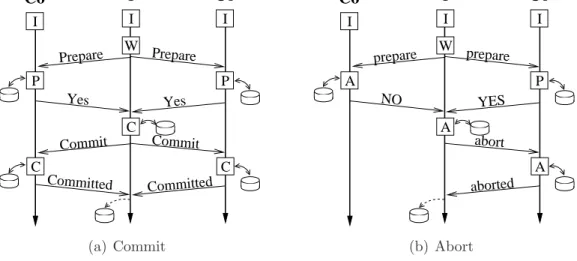
3.1 The two-phase commit protocol . . . 38
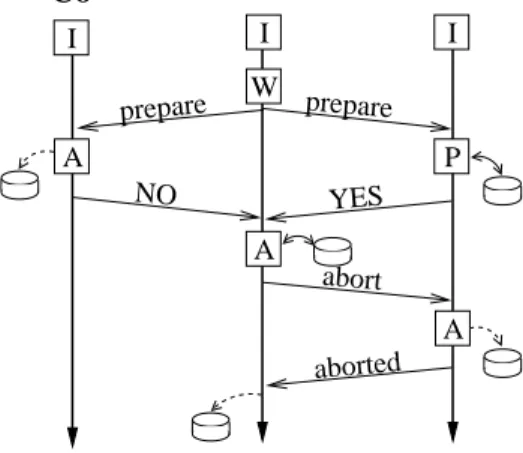
3.2 The two-phase presumed abort protocol, abort case . . . 39
3.3 The two-phase presumed commit protocol, commit case . . . . 40
3.4 The two-phase protocol with linear commit optimization . . . 40
3.5 The two-phase protocol with read-only optimization . . . 41
3.6 The Unsolicited Vote approach . . . 43
3.7 The Early Prepare approach . . . 44
3.8 The Coordinator Log approach . . . 44
3.9 The Implicit Yes-Vote approach . . . 46
3.10 The Three-Phase Commit protocol . . . 47
3.11 The SPAC and NB-SPAC protocols . . . 48
3.12 The Backup Commit Protocol . . . 50
3.13 The ClustRa Commit protocol . . . 51
3.14 The 2-safe Primary-Backup Commit Protocol . . . 52
3.15 The MySQL Cluster Commit protocol . . . 53
I.1 An orphan request caused by non-determinism in serverA . . 78
I.2 The execution and join phase of a transaction . . . 82
I.3 The successful termination of a transaction . . . 82
I.4 A failure of a primary, and the consequent fail-over . . . 83
I.5 A failure of a primary, without the fail-over . . . 84
I.6 A double fail-over . . . 84 xi
xii List of Figures
I.7 A checkpoint and a possible orphan request in service B . . . 85
I.8 A model of the system used for testing . . . 87
II.1 Execution of various atomic commitment protocols . . . 102
II.2 Examples of C1PC execution . . . 110
II.3 Delays and total overhead for various ACPs . . . 111
III.1 Legend for Fig. III.2 and Fig. III.3 . . . 124
III.2 Main-memory commit protocols . . . 124
III.3 Execution of C2PC with optimizations . . . 127
III.4 The logical model of the system . . . 129
III.5 Average response times using dynamic coordinators . . . 132
III.6 95% maximum response time for C1PC based protocols . . . . 133
III.7 Distribution of response times for C1PC and DPC-P . . . 134
III.8 Comparing analysis and simulations for all protocols using DPC-P . . . 135
IV.1 Changes in response time by using piggybacking and priorities 149 IV.2 95% maximum response time using piggybacking and priorities150 IV.3 Comparison of analysis and simulations . . . 150
V.1 Main-memory commit protocols for one backup . . . 160
V.2 Commit protocols for multiple backups, all executed with EA 162 V.3 Two-phased protocols executed with EA . . . 165
V.4 One-phased protocols executed with EA . . . 166
V.5 Two-phased protocols using the EA optimization . . . 167
V.6 One-phased protocols using the EA optimization . . . 168
V.7 Comparison of analysis and simulations . . . 168
VI.1 Existing commit processing approaches and optimizations for main memory . . . 179
VI.2 The protocol for single-update . . . 181
VI.3 Logical model of the system . . . 185
VI.4 The average response time. . . 189
VI.5 The maximum response time for the 95% quickest transactions190 VI.6 Comparison between analyzes and simulations of SUSR . . . . 191
List of Tables
I.1 A summary of the response times for the test runs in Section
I.5.2 . . . 88
III.1 The input parameters of the simulation . . . 130
IV.1 The input parameters of the simulation . . . 148
V.1 The input parameters of the simulation . . . 164
VI.1 The input parameters of the simulation . . . 186
Part I
Background and Context
Chapter 1
Introduction
The topic of this thesis is commit processing in replicated main-memory database systems with shared-nothing architecture. The focus is on how performance of main-memory commit processing can be improved and how to manage the effects of non-determinism while incurring minimum performance degradation. High availability and consistency must not be jeopardized.
This chapter first presents the motivation and the objectives for our work, and then discusses the research questions and methodology.
1.1
Motivation
Currently, database systems are used to store information for a wide variety of applications. These applications range from small personal archives with contact information for friends and family to complex commercial database systems storing huge amounts of mission critical and sensitive data. Natu-rally, the requirements for databases differ as well. For instance, the user could happily be waiting several seconds before getting a contact’s telephone number, or if it is unavailable, to search for it using the white or yellow pages. Unavailability or slow response in databases used by business appli-cations could, however, be financially devastating and, in worst case, cause injuries or deaths.
High availability and real-time responses are not required for all business applications, but many systems do. Examples include real-time process con-trol systems, telephone switching networks, sensor networks, trading systems, embedded systems and electronic toll collecting systems. Typically, these sys-tems generate a very large transaction workload against the database, and a large part of the workload consists of short read and update transactions.
As part of the ACID properties [44], the database must ensure that the 3
4 Chapter 1. Introduction
transaction is completed as an atomic operation or not at all. In addition, the outcome of the transaction, including caused state changes, must be persistently stored before the new data is made available to the outside world or other transactions. This is called commit processing. Commit processing should add as little overhead as possible to transaction processing. The standard commit processing protocol is the 2-phase commit protocol (2PC), which requires two rounds of messages and two disk writes per cohort. For real-time systems, however, the overhead of the industry standard 2PC is too large. Existing research has mostly focused on reducing the number of disk writes or communication steps, and the very few approaches that avoid disk writes are not very efficient [55].
The rest of this section presents the main-memory database, which pro-vides the setting for this thesis as it has the potential of fulfilling high avail-ability and real-time response requirements. Main memory is then classified and precompiled transactions are presented. Finally, motivating examples of existing and emerging applications for the results of the work in this thesis are given.
Main-Memory Databases
Traditional databases are disk-based [39, 11]. To be storedpersistently, data and log must be written to disk. This ensures data can be restored after a system crash. However, read and write accesses to disk takes time, which led to main-memory databases or MMDBs [33]. The advantage of using main memory is that reading and writing is very fast. Measurements presented in [9], shows that main-memory databases can outperform commercial disk-based systems by a factor of 40 for a simple lookup for a phone number. The disadvantages are that main-memory size is limited and data in it isvolatile; i.e., data is lost after a crash. However, by connecting many nodes together using a communication network, these disadvantages can be reduced. The possible size of the database becomes the total size of main memory in all machines in the distributed system. In addition, data can be replicated across nodes, ensuring persistence and availaibility: If one node goes down, the other takes over the processing of transactions.
Many commercial and research MMDBs have been developed: Oracle TimesTen [106] (earlier Smallbase [48]), MySQL Cluster [77], GigaSpaces [36], ClustRa [50], Polyhedra [87], DataBlitz [9] (earlier Dal´ı [53]), solidDB [100], FastDB [28], MonetDB [46], RODAIN [65], etc. For an MMDB to reach its full performance potential, all parts of the transaction processing and data storage must be tailored to main-memory environments. This thesis concentrates on the final part of transaction processing, where the outcome
1.1. Motivation 5
for each transaction is decided, namely the commit processing.
MMDB Classification
MMDBs can be classified according to their access methods, log policy and persistence policy. For the first, since data resides in main memory, special access methods yield better results than traditional ones. The second governs whether the log is saved to disk or not. In MMDBs, data can be kept in main memory, while the log is written to disk to enable disk-based recovery after a crash, or both the log and data reside in main memory only. The third determines if the log is persistently stored or not. If it is written to disk, it is persistently stored if Write Ahead Logging is used; i.e., the log is on disk before the data. If not, the database cannot be guaranteed to be recoverable. In pure main-memory systems, both log and data are saved in main memory only. It can, however, be made persistent by usingreplication between processes at different physical locations.
This thesis is in the context of a shared-nothing pure main-memory sys-tem where both data and log are kept in main memory only and replication is used for persistence. This setting provides very good support for databases with high availability requirements and soft real-time deadlines, where a high percentage of transactions should be completed within a short timeframe.
With such response time requirements, precompiled transactions or per-sistent stored modules are needed. These are presented below.
Persistent Store Modules Standard SQL queries often have multiple request-reply interactions before a transaction is committed. The interac-tions add extra communication time, and if a user needs to react to par-ticipate in the interaction, even more time is added. Stored procedures or Persistent Store Modules [52], however, is a sort of precompiled transaction which is compiled and stored in the database. Later, it is called with pos-sible parameters, and the client receives the results. These transactions are important in real-time environments with short deadlines.
General Profile And Motivating Examples
This work is focused on improving the performance and resilience of system which has these general properties and requirements:
• Real-time environments
6 Chapter 1. Introduction
• Clients require very short response times
• The updates must be readily available to the read transactions
• Transactional consistency – the consistency should not be relaxed
• High availability
This rest of this section presents some motivating examples of existing and emerging applications which exhibit these properties.
Home Location Register The Home Location Register (HLR) is the central database in any GSM (Global System for Mobile communications) network. Its requirements are [94]:
• It must be able to handle thousands of updates and reads per second generated by the millions of subscribers, i.e. high throughput.
• The updates and reads must happen in real-time and have response time within a few tens of milliseconds.
• It must have high availability corresponding to a maximum unavail-ability of 10−6, since any unavailability cause the entire network to be
unavailable.
• It must be scalable, facilitating an increase in the subscription base. These requirements are achievable by MMDBs. Existing MMDBs like Oracle TimesTen, MySQL Cluster and solidDB advertise being used for tele-phony switching networks [106, 77, 100]. The mobile industry is huge and growing. There are currently over 3.3 billion subscribers worldwide [92], and the world’s largest mobile network operator (China Mobile) had over 356 million subscribers in China and Pakistan in October 2007 [74]. The first nine months of 2007, the total revenue for China Mobile was USD 35 billion [15]. A smaller example is Telenor Mobile Norway. It has 2.8 million sub-scribers by third quarter 2007 and total revenue of USD 2 billion in 2006. The potential financial losses for a mobile network operator, if the system does not fill the requirements, are huge. For instance, without the HLR, no mobile devices belonging to the network can be contacted.
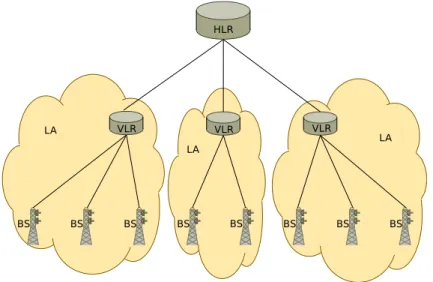
GSM networks use a two-level location system. As shown in Figure 1.1, the HLR is the top-level. Its main purpose is to manage the mobility of mobile devices. It contains information about all mobile devices currently authorized to use the network or subscribers. The information covers the details of every valid SIM card the operator has issued and they include a
1.1. Motivation 7
Figure 1.1: The Home Location Register in mobile networks
unique identifier for each SIM card, the telephone number(s) of the SIM card, GSM services, GPRS settings, call divert settings and the current location of the subscriber. There is generally one HLR per mobile network, although numbers can be partitioned across multiple database partitions. Data in HLR is stored until the subscriber leaves the operator.
A Visiting Location Register or VLR is the second-level database, which temporarily stores information about local subscribers in a region. These local subscribers are the devices that have roamed into the area of a Base Station, or BS, the VLR serves. The information is stored in the VLR until the subscriber moves to a Location Area (LA) served by another VLR or has been out of reach for a predetermined period of time. Each BS is connected to only one VLR, and each VLR is connected to only one HLR, as shown in Figure 1.1. An LA potentially includes tens or hundreds of BSs.
A HLR may manage tens of millions of mobile devices. When a device moves from one BS to another, the system must update the location of the device. Movements of mobile phones within the same LA are handled by the VLR. If a device moves to a BS connected to another VLR, the HLR manages the movement. Using assumptions from [72], each subscriber generates approximately one HLR update transaction per hour. Thus, 10 million subscribers generate a total load of around 2700 update transactions per second. These transactions require from 10 to 20 ms response time [50] to avoid glitches in calls when the device moves from one LA to another.
When a mobile device tries to make a call to another mobile device, the VLR is queried to see if the outgoing call is allowed. If it is allowed,
8 Chapter 1. Introduction
the HLR is used to lookup the VLR that is currently associated with the receiving device. If an associated VLR is found and no call forwarding has been issued, the VLR is contacted for the exact location of the device, and the call is routed through the appropriate BS. This process is called call delivery.
Each called delivered to a mobile device currently subscribing to the HLR results in one read transaction issued against the HLR. Again, using assump-tions from [72], each subscriber makes 1.4 calls per hour. This gives a load of almost 3900 read transactions per second. It is commonly required that 95% of calls are set up in 5 to 50 milliseconds [50].
Trading Systems Trading is the short-term selling or buying of stocks and other equities, with the intent of making money by utilizing short-term fluctuations in the market. Generally, the positions in the securities are shorter than one week. Security trading systems are designed to find good trading opportunities by monitoring the market. The system must discover such opportunities and execute the trade before they vanish [33].
The inputs to a trading system include the ticker (trades made) and orders placed for each security, prices of raw materials, and indices. For instance, if a trader follows oil-related companies, the input could be the tickers from all oil companies at all stock exchanges worldwide, the crude oil prices in USA, Europe, and Asia and indices related to energy and oil across the planet. The processing of such inputs should be made as fast as possible to enable the system to react quickly. A trade can be won or lost in milliseconds. A quicker response could mean more income, which means the processing should be as real-time as possible. In addition, the more information a system can handle, the more reliable trades are achieved.
The possible amount of input is huge. For instance, the New York Stock Exchange has up to 14 million trades in one day. For each trade, both a seller and a buyer place a bid, and the trade is executed, causing at least two updates to the trading system. Assuming that 25% of the transactions happen at the peak hour, the system must be able to receive around 2.000 updates per second. To watch other securities and markets, and handle the top short-term peaks of trading, the system must be able to handle higher throughputs as well.
Any unavailability could be financially devastating. While the system is down, the rest of the market would continue trading, causing many lost trading opportunities and, even worse, massive losses could occur since the system is not able to sell stocks, which then plummets. Thus, a trading system should have high availability.
1.1. Motivation 9
The discussion above shows that trading systems require high availability and real-time responses and, thus, are suitable as a motivating example for this thesis.
Online Gaming The gaming industry has evolved from an annual sale of USD 2.6 billion in 1996 to USD 7.4 billion in 2006 [5]. As more people get Internet access, the number of online games and gamers grow as well. In 2006, forty-four percent of most frequent gamers play games online. A special type of online games is called Massively Multiplayer Online Games or MMOG for short. These games enable the user to interact with many other users in a virtual game world. In 1991, the limit was around 50 simultaneous players. In 2000, there were many with thousands of players, and the record to date is 41,690 simultaneous players in one game [27]. There were at least 13 million subscriptions of MMOGs in 2006 (exponentially growing), and the worlds largest MMOG subscriber base was the 7 million subscribers of World of Warcraft [70]. In January 2008, the number of monthly subscribers passed 10 millions [110], however, they are currently partitioned to separate “universes” of a maximum of around 4.000 players.
Guild Wars is a MMOG, which can handle 2,500 – 3,500 players per game server. The database (Windows SQL server – Enterprise Edition) handles the load spikes of up to 5,000 transactions per second. However, as noted, the database is a bottleneck, and a scale-out is needed to add more features to the game [73].
Typically, MMOGs require high throughput (tens of thousands of simulta-neous users produce a lot of input and need a lot of output), high availability (gamers frequently threaten to quit playing when servers are unavailable) and real-time responses (the gamer must be presented the new state of the game in milliseconds, for instance, to avoid being killed in combat). Thus, main-memory databases and the work in this thesis should be considered.
Sensor Networks A sensor network consists of a number of sensors (both wired and wireless) which report on the status of some real-world condition. The conditions include sounds, motions, temperature, pressure and moisture, velocity, etc. The sensors send their data to a central system that makes decisions based both on current and past inputs. To enable the networks to make better decisions, both the number of sensors and the frequency of updates should be increased. Thus, sensor networks must be able to tolerate an increasing load. For applications such as health care in a hospital, automatic car driving systems, space shuttle control, etc., data is needed in real-time, and must be extremely reliable and available, as any unavailability
10 Chapter 1. Introduction
or extra delay could result in deaths.
Roaming Between Different Networks IPv6 extend the number of IP addresses to enable all devices to have a separate IP address. Such devices may be mobile and can move away from the home network. Mobile IPv6 is an internet protocol to manage this movement. When a device moves to another network, then the IP address of the device is changed. To keep the existing connections open, the old IP address must be linked to the new one for each service it is currently using. This must be done in asecure andreliable way. In today’s system, a handover takes 2 seconds. For some applications, this delay is unacceptably long. To reduce this time, a system with less delay is needed.
1.1.1
The Challenges of Main-Memory Commit
Processing
At the end of transaction execution, a termination protocol is executed to ensure ACID properties [44]. This commit processing has been found to take up to one third of the total processing time [101]. For distributed systems with network messages and delays, the relative cost has been found to be even higher [59, 45]. For this reason, commit processing is a widely studied subject. The research community has focused on both increasing the resilience and improving the performance of these ever since the original paper on the two-phase commit protocol by Jim Gray [37] was published 30 years ago.
However, research of commit processing in replicated main-memory sys-tems has been lacking. The classical challenges of distributed databases apply to main memory as well: How to improve the performance during normal failure-free operation and at the same time increase the resilience to failures. Both challenges affect the other one. Here, they are presented as two separate entities, and special issues related to main memory are noted.
Performance during Failure-Free Operation
During normal operation, failures are rare. Thus, the most common case is a transaction that encounters no failures and commits successfully and the system should be optimized accordingly. Commit processing should add as little overhead to transaction processing as possible, both as total work-load added to the system and latency for each transaction. Main-memory commit processing has a huge potential advantage since it avoids the costly synchronous disk-writes [33]. However, to keep the data and logs persistent,
1.2. Research Questions 11
one or more backups must exist. Updating these backups as a part of the commit protocol requires both communication delays when messages are sent over the network and processing time. Thus, commitment protocols should keep the overhead of updating the backups at a minimum.
Resilience to Failures
Even though it is a rare event, processes do fail at times. Therefore, the commit processing algorithms must be able to handle such failures. For pure main-memory systems, a crash failure of a process will lead to the loss of all data and logs at the crashed process. Thus, it is important that another process is ready to take over the processing. In addition, to maintain consistency, the system must maintain a backup of the data of the crashed process.
Some systems exhibit non-deterministic behavior; i.e., a re-execution of the same request with the same input values does not necessarily result in the same output value (see Section 2.3.3 for more details). Non-determinism can be introduced by timeouts and multithreading, but others also exist. If care is not taken, non-determinism in a server can jeopardize consistency. Assuming that servers can act as clients towards other servers and a request from a non-deterministic client is sent to a server. Then, the client fails, and since there is no guarantee the client sends out the same request again, the request is now invalid. Therefore, its effects should be removed to keep the system consistent. In replicated systems, this matter is made worse, since a backup replica of the client would take over the processing, and this change is transparent to the rest of the system. Hence, non-determinism must be managed to ensure consistency.
1.2
Research Questions
Based on the discussion in the previous section, the main research question of the thesis is:
Q-1 How can commit processing be tailored to main-memory primary-backup transactional systems to improve performance and fault tolerance? The special properties of main memory (fast, volatile and limited size) call for specialized commit protocols to exploit the performance potential. Performance is both system throughput and transaction response time. This means that both the total amount of work done for each transaction and the latency of each transaction should be minimized.
12 Chapter 1. Introduction
The possible inconsistencies caused by replicated invocations in a non-deterministic environment should be managed. This must be done while keeping in mind the requirements of Question Q-1. Thus, an additional research question is needed:
Q-2 How can non-determinism be managed in main-memory primary-backup transactional systems, while adding minimal overhead?
Transactions are designed to keep a system consistent, as a part of the ACID properties. Therefore, they seem well suited to handle the possible inconsistencies arising from non-deterministic execution. However, since the group communication (replication) system is designed to hide the replication from any application, replica failures are also hidden from the transaction manager. Thus, this issue must be handled in transactional systems as well, while adding as little overhead as possible. Since failures are rare, extra over-head during failure-free scenarios should not be traded for reduced overover-head after failures.
1.3
Research Methodology
Research in the field of computer science has been divided into three cate-gories [19]: Theory, abstraction and design. This thesis fits into the Design paradigm. It is characterized by its engineering roots, and its goal is to construct a system that solves aproblem. Its phases are:
1. State requirements 2. State specifications
3. Design and implement the system 4. Test the system
The research presented here aims at solving the problems of improving the performance of main-memory commit processing and managing non-determinism.
To be able tostate requirements, the solutions must be applicable to exist-ing transactional database systems. Therefore, common terminology in the field of distributed systems and related research must be understood. Then, westate specifications for the methods to solve the problems in Section 1.1.1. To verify the validity of the methods, they are designed and implemented, and finally the system istested.
1.4. Thesis Organization 13
Evaluation of the various commit processing protocols and techniques can be done by real experiments or simulations. Real experiments are important as they allow testing the methods on a computer that is more complex than the model used to design them. However, the required hardware may not be available and experiments across many processes are hard to reproduce. Actually, it is impossible to guarantee that processes in a cluster all starts in the exact same state for two tests. Therefore, any rigorous comparison between the methods cannot be performed. In contrast, simulations can be performed with limited hardware and the experiments can be fully controlled. The initial state of the system can be guaranteed to be the same and two methods can be compared. Real experiments have been used in Paper 1, while Papers 2 – 6 use simulations.
Simulation results should be verified by statistical analysis. In this thesis, it is based on queuing theory, and it is important to validate the sanity of the results. Statistical analysis has been used in Papers 2 – 6.
1.4
Thesis Organization
This thesis is divided into two parts. The first discusses the background and context for the research. Chapter 1 presents the motivation and challenges of the topic together with the research questions and approach. In Chapter 2, fundamentals of fault tolerance in distributed systems such as terminol-ogy, replication, and transaction are presented. Chapter 3 is a survey of existing techniques, protocols, and optimizations for commit processing and solving the orphan request problem. The first part is concluded in Chapter 4 by summarizing the main contributions of this research, discussing some limitations and proposing directions for future work.
The contributions of this thesis are gathered in the second part. Pa-per 1 addresses the issue of handling orphan requests in a non-deterministic transactional system. Paper 2 presents commit protocols for main memory primary-backup systems. Paper 3 presents dynamic coordinator optimiza-tions for main-memory commit processing. Paper 4 uses priorities and pig-gybacking to improve further on these commit protocols. Paper 5 generalizes the protocols for use in multiple backups systems. Finally, Paper 6 examines how to use the type of transaction to improve the performance of systems with many short write-only and read-only transactions.
Chapter 2
Fault Tolerance in Distributed
Systems
In this chapter, a brief introduction to dependability and general fault-tolerant computing is given. Then, distributed systems and methods for achieving fault tolerance in distributed systems, replication, and transactions are presented.
2.1
Dependability and Fault Tolerance
The exact meaning of fault tolerance is dependant on the context. Here, the context and terminology used in this thesis are defined.
2.1.1
Terminology
The dependability of a system is how much trust can justifiably be placed on a service based on the quality of the delivered service [62].
A service is a collection of operations that can be invoked by the users of the service or the passage of time [21]. A user is another system or com-ponent that can be either hardware or software. A server is an entity that implements a service and processes the service requests from the users. A server iscorrectif it executes according to an agreed-upon description of the expected service, the service specification. If server S executes correctly only if serverR executes correctly thenS depends onR [21].
When there is a deviation between the delivered behavior and the speci-fied behavior of a service, a failure has occurred. An error is a part of the system state that iserroneous and can cause a failure. The cause of an error is a fault. Faults can be introduced during all lifecycle phases of a system,
16 Chapter 2. Fault Tolerance in Distributed Systems
thus, design faults, implementation faults and operational faults can exist. They can also be classified into transient, intermittent or permanent faults [61]. Hence, a latent error is created by a fault. The error becomes effective when it cause the service to be incorrect. An effective fault is called afailure [62].
To achieve a dependable system the combined uses of different types of methods must be used together [62]:
• Fault-avoidance: Thepreventionof faults at the time of construction.
• Fault-tolerance: Provide a well-defined failure behavior or mask com-ponent failures to users [21].
• Error-removal: Using verification to remove latent errors.
• Error-forecasting: The estimation of the kinds of errors and their frequency and impact.
A processor can have both volatile storage and stable storage. Stable storage [60] survives a processor crash, while volatile does not. In disk-based systems, the first is typically a disk or tape device, while the latter is main memory or caches. In replicated systems, the main memory from multiple shared-nothing processors can be used to create stable storage.
2.1.2
Module Reliability and Availability
Thereliability of a component is the time from the starting moment to the next failure. It is quantified asmean-time-to-failure or MTTF for short. The service outage time is called mean-time-to-repair or MTTR for short. The
availability of the system is the ratio between service time and total time, which is quantified by (MT T F/(MT T F +MT T R)) [39].
The availability of a system has been classified into the number of nines in the percentage of time it is available [39]. Many systems require a downtime of less than five minutes per year. The availability of such a system would have to be 99.999%, or five nines. To facilitate the high availability require-ment of the entire system, each of therelied upon subsystems or components must have an availability of six nines.
2.1.3
Failure Classification
A system can display various kinds of failures. These failures can be classified into four different types of failures [21]:
2.1. Dependability and Fault Tolerance 17
• Omission failures: A server does not respond to an input.
• Timing failures: A server responds correctly, but it arrives too early or too late. When it arrives too late, it is called a performance failure.
• Response failures: A server responds incorrectly. Two types of re-sponse failures exist: A value failure occurs when the output is in-correct, and a state transition failure occurs when the internal state transition of the server is incorrect.
• Crash failures: Following an omission failure, the server does not respond to inputs until it restarts. An amnesia crash has occurred if the server restarts in the initial state. If some of the state from before the crash is retained after restart, a partial-amnesia crash failure has happened. A pause crash failure has occurred if all state from before the crash is retained. A halting crash occurs if the server is never restarted after a crash.
A component is failfast if it stops working after a fail has been detected [39]. This can be beneficial since transient bugs are removed from the system, while transactions make sure the system stay consistent. Processes that act in this way are also called fail-crash processes.
An execution is failure-free if no failures happen during the time span that is currently studied. The time span can be the time to process a request or a transaction.
2.1.4
Failure Semantics
To a programmer of recovery actions it is very useful to know which kinds of failures the server is likely to display. Otherwise, every possible failure sce-nario would have to be handled. Thus, it is important to specify which types of failures (omission, timing, response, crash) a server is likely to exhibit. This is called the failure semantics of a component [21].
For example, if a component has a tendency to respond too late, the component has performance failure semantics. If a component can display any failure, the component has arbitrary failure semantics [21].
There will always be a chance that arbitrary failures can occur. Thus, fail-ures not contained in the failure semantics of a component can occur. They are called catastrophic failures [21] and the probability of such failures should be specified.
18 Chapter 2. Fault Tolerance in Distributed Systems
2.1.5
Failure Masking
Well-defined failure semantics for a component is important. It provides a way for the system to mask failures of the component. A failure ismasked
by either hiding all its consequences or changing it into a more benign type of failure. Two types of failure masking exist: Hierarchical failure masking and group failure masking. These two can be used separately or together. First, hierarchical failure masking is presented and, second, group failure masking is introduced.
Hierarchical failure masking
A user of a server can mask the server’s failures. This is calledhierarchical failure masking [21]. By looking at the failure semantics of a server, the programmer of another server thatdepends on it can mask the failures for its users. Consider a server S depending on a server R. R has omission failure semantics. IfS notices that R did not respond to some input, it can resend the input untilRresponds. This masks the omission failure of Rfor a user of
S, but can cause other failures. For example, if response time requirements ofS is stringent,Smay exhibit performance failure semantics because of the omission failure ofR.
Group failure masking
A group is a collection of servers executing the same service. A server in a group is called a member. It can logically be seen as one unit from the rest of the system. A server failure can be masked by such grouping. Group failure maskinglogically groups independent, physically distributed servers together to provide a correct service despite failures in some of them [21]. The group will produce a group output and the individual server’s failures are masked. Depending on the implementation and requirements, the output can be a majority vote for the member outputs or the output from a fastest member or a special member of the group. For any group, the maximum number of members that can fail while the group still operates correctly is
k. If k is one, the group is single-fault tolerant, and if k is larger than one, the group ismultiple-fault tolerant [21].
2.1.6
Liveness and Safety
Both liveness and safety are properties needed to make a system available and consistent. The first property causes a system to eventually do some-thing good (i.e., the eventual execution of input and the delivery of output
2.2. Distributed Systems 19
according to the service specification), while the latter causes a system to do nothing wrong (i.e., not leaving it in an inconsistent state) [4].
Systems can implement both liveness and safety mechanisms. Liveness is aforward recovery concept: The system tries to construct an error-free state from the current, erroneous state. Section 2.3 presents a liveness mechanism. Safety on the other hand is abackward recovery concept: The system removes the erroneous state by undoing actions until a correct state is achieved. Sec-tion 2.4 introduces a safety mechanism.
2.2
Distributed Systems
A distributed system is composed of independent physical nodes (inter-changeably processes) connected through a network. A node is a computer comprised of software and hardware components. All communication be-tween the nodes is performed by sending messages over the network. The distribution of the nodes is transparent to a user of the system, i.e., it is not possible to see the distributed nature of the system for a client.
The next sections present the characteristics of distributed systems and distributed applications.
2.2.1
Characteristics of Distributed Systems
Message delivery can be reliable or unreliable. A reliable communication channel has these properties:
• It does not lose messages; i.e., any message sent from one process is eventually delivered to another process.
• It does not change messages; i.e., the message delivered is identical to the sent one.
• It does not copy messages; i.e., no message is delivered twice.
Messages can be grouped together to save processing and communication overhead. This is called piggybacking [11] and is used to increase the throughput of a system at the cost of delaying some messages until there are more going to the same destination or the wait is determined to be too long.
2.2.2
Distributed Applications
Adistributed applicationis a program executing onvirtual nodes in a dis-tributed system. The virtual nodes are spread out across the physical nodes
20 Chapter 2. Fault Tolerance in Distributed Systems
(computers). They work together to supply a service by sending messages through the network. Many different applications may exist in the same dis-tributed system. Each virtual node (server) offers a service to the others. A user of the server is called aclient. From now on in this thesis, aserveris a process executing a virtual node program. However, the concept of a server is not static. A server can act as a client to another server and so on. Thus, a single virtual node can be both a server and a client at the same time, but for two separate requests.
2.2.3
Real-Time Systems
A real-time system must be able to perform (some of) its tasks within a given deadline. For instance, there may be a maximum time from a real-world event to the system reacts. In a hard real-time system, completing a request after its deadline is useless and may lead to the failure of the system. However, in asoft real-time system, some late requests are tolerated, but too many of them lead to decreased quality of service.
For both real-time and non-real-time systems, the response time of a transaction can be measured. In this thesis, the response time of a transac-tion is defined as the time from the transactransac-tion request is sent from the client until a reply has been received. The length of the response time depends on the total delay of the transaction. The delay is determined by the longest path of operations that has to be completed in a serial manner. This is also called the critical path. To reduce the response time of a transaction, either the delay or the total load on the system (which would make queues shorter) must be reduced.
2.3
Replication in Distributed Systems
Replication is a technique used to achieve three improvements for distributed systems: Performance enhancement, increased availability, and fault-tolerance. These can be accomplished all at once.
In a distributed environment, any process may fail at any given time. A
single point of failureis a component that, if it fails, causes full or partial loss of the provided service of a system. For a user, the unavailability can be perceived as anything from a slight nuisance to highly critical, depending on the type of service and the length of the outage. Examples of components include routers, communication lines, CPUs, disks, etc.
Group failure masking (see Section 2.1.5) solves the problem of single points of failures by introducing redundancy; having more than one copy
2.3. Replication in Distributed Systems 21
of each component. The copies are kept together in a logical group, and a member of the group is a replica. This enables the system to stay opera-tional, despite failures. In the domain of distributed systems, redundancy, amongst others, can be introduced by executing the same service on multiple processors. This is called replication of processes. This thesis focuses on the replication, thus other types of redundancy are outside the scope.
Replication of servers may seem straightforward, but to ensure both con-sistency and availability of the system, special care must be taken. For instance, group management is needed to manage each replicated group. De-pending on the type of replication or replication strategy used, the demands from the group management facilities change.
The rest of this section presents general group communication, replica consistency, and replica determinism, and the most common replication strate-gies.
2.3.1
Group Communication
Group communication was first presented in the context of distributed op-erating systems [18]. The fundamental idea is to be able to treat the entire group as one entity [43]. This requires coordination, i.e., some form of in-ternal communication, within the group to maintain and manage it and to keep the global group state consistent. Group communication must ensure two properties [109]: Agreement properties and ordering properties. The first guarantees that the members agree on certain things, while the latter ensures that all members see the events in the same order.
Many group communication kits are available, some for academic research and some for commercial use: ISIS [12], TOTEM [75] and Transis [26], MAE-STRO/ENSAMBLE [107], Phoenix [67], JGroups (formerly JavaGroups) [8], CORBA OGS [30], Eternal [76], Jgroup [69], IRL [7] and JMSGroups [57]. For a thorough presentation, the reader is referred to [7] and [56].
The rest of this section presents the agreement and ordering properties, and touches upon the problems related to process failures.
Failure Detectors
The FLP impossibility result [31] states that, in an asynchronous system, processes cannot be guaranteed to reach an agreement in the presence of a process crash. The cause is that a crashed process cannot be distinguished from a slow process. However, this result can be circumvented by introducing failure detectors [17]. Afailure detector is a distributed oracle, which tells the correct processes whether a process is faulty or not.
22 Chapter 2. Fault Tolerance in Distributed Systems
Failure detectors have been classified according to the mistakes they can exhibit [17]:
• Completeness
¦ Strong Completeness: Eventually every process that crashes is permanently suspected by every correct process
¦ Weak Completeness: Eventually every process that crashes is per-manently suspected by some correct process
• Accuracy
¦ Strong Accuracy: No process is suspected before it crashes
¦ Weak Accuracy: Some correct process is never suspected
¦ Eventual Strong Accuracy: There is a time after which correct processes are not suspected by any correct process
¦ Eventual Weak Accuracy: There is a time after which some correct process is never suspected by any correct process
As failure detectors are unreliable, except for the perfect failure detector with strong accuracy and strong completeness, processes are not marked as failed, but as suspected to have failed or just suspected.
Agreement
To be able to cooperate the members on a group must agree on certain things: (1) on some value, (2) the set of members and (3) the delivery of a message. The first is the Consensus Problem [83]. The group must choose a value out of a set of one or more values proposed by one or more members of the group. They must agree even though processes may crash in the middle of the consensus protocol. It has been shown that consensus can be solved in an asynchronous system augmented with an unreliable failure detector if the majority of processes are correct [17].
The second, agreement on the set of members, is managed by a group membership protocol, GMP. It is responsible for keeping a current group view or view of the group and to avoid it being a single point of failure, it must be distributed. GMP works like this: If a Leave message is received from a member, it is removed from the view. Similarly, a process is included in the view by sending a Join message to the service. Any change in the set of members in the view is called a view change. If view changes are allowed GMP is called dynamic. If not, i.e., the set of members stays the same during the entire lifetime of a system, it is calledstatic.
2.3. Replication in Distributed Systems 23
If a group member fails, it will not send out a Leavemessage. Therefore, the failure detector is responsible for updating GMP with the suspected processes. These are removed from the group. Messages from processes not currently in the group are not delivered, and processes not in the group do not deliver messages from the group.
A message that is intended for all members of a group must be delivered by all or none. The third, agreement on the delivery of a message, covers this. Basic multicast [78] is executed simply by making the sender process send the message to each member of the group one by one. However, if the sender fails after it has sent to some, but not all of the members, they will not agree on whether the message was delivered or not.
Usingreliable multicast [78], delivery of messages is guaranteed to be once and only once for all correct members.
All agreement protocols can be made uniform [78], by ensuring that, if any member (failed or not) delivers the message, then all correct members of the group will eventually deliver it.
A communication failure can cause a group to be divided into one or more partitions. Apartition is a subset of the nodes contained in the group. For some applications, each of these partitions can process requests on its own and its state can be merged later when communication is restored. Others, however, can only process requests at the majority partition.
Ordering
The processes must be able to agree on the ordering of events. An event is an action in the system. Events are distributed to other processes through the communication channels using messages. Ordering can be imposed on reliable multicast to fulfill the requirements of the system specification: First-In First-Out (FIFO), Causal and Total Order. The first ensures that if two messages were sent by the same process, it is delivered by each receiver in the same order.
The second ensurescausal ordering. This means that, if a messagemwas delivered by a processp, beforepsent out messagen, then all other processes will deliver m before n. Causal ordering implies FIFO.
The third is also called atomic multicast. It requires that all processes deliver all events in the same order. It has been shown that atomic broadcast is reducible to the consensus problem [17].
24 Chapter 2. Fault Tolerance in Distributed Systems
2.3.2
Replica Consistency
When multiple replicas of data exist, consistency must be handled. This applies to both replication for fault tolerance and replication for performance and availability. The consistency model of a group is the behavior its clients can observe. To achieve fault tolerance using replication, the replicas must obey a strong consistency criterion, i.e., sequential consistency [58] or linearizability [47]. Both require the following criteria to be satisfied [105]:
• The result of any execution by all processes is the same as if the op-erations were executed in some sequential order and the opop-erations of each individual process appear in this sequence in the order specified by its program.
Linearizability is stronger and has the following additional requirement [105]:
• If the timestamp of an operation is smaller than the timestamp of an-other operation, then the operation with the smaller timestamp should precede the other in the sequence.
Using linearizability, each replica must ensure that it has executed every pre-ceding operation before executing the next one. This requires the system to wait until it is guaranteed that no preceding operations arrive late. Because of this requirement, an asynchronous system cannot ensure linearizability. Thus, asynchronous systems use sequential consistency.
2.3.3
Replica Determinism
Some replication techniques, like active replication [98], require all replicas to behave identically. If, for instance, there are two replicas of a server group giving diverging replies to a client, it has no way to know which result is the correct one. In addition, if the internal state changes of the server replicas differ, it leads to inconsistencies that may later spread to other parts of the system. Therefore, all correct replicas must agree to the same result. This can be done by making the execution of the replicas deterministic.
Schneider [98] defines replica determinism as follows: “A replica group is deterministic if, in the absence of faults, given the same initial state for each replica and the same set of input messages, each replica in the group produces the same ordered set of output messages.” Poledna [86] argues that this definition is too restrictive, as it does not cover all replication techniques and it does not capture the timing requirements of real-time systems. For this thesis, however, the above definition by Schneider suffices.
2.3. Replication in Distributed Systems 25
Many sources cause non-deterministic execution. The most obvious one is a mathematical random function, but more subtle sources are also at work. A timeout is one example: Say, for instance, that a server group waits for a reply from another server and the reply is received close to the expiration of the timeout. Some servers may decide that it came just in time, while others decide it came too late. Even with global coordination of the timeout, their respective decisions can diverge because of tiny differences in the pro-cessing speed or network delay. Other sources of non-determinism include inconsistent inputs from analog sensors, multithreading, inconsistent order of requests, and non-deterministic programming-language specific constructs [86].
2.3.4
Replication Strategies
There are different ways to do the processing of request within a replicated group. These are calledreplication strategies. They decide how the group is addressed both from an intra group and a inter group perspective. There are two main types of replication: Active [97] and passive (or the primary-backup approach [14]). Other types of replication, e.g. semi-active [108] and semi-passive [23], also exist.
The rest of this section presents these four types of replication. Quorum replication is not discussed here.
Active Replication
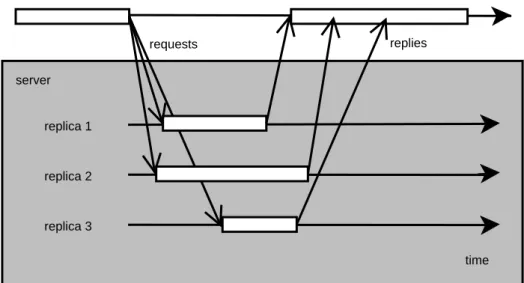
One way to perform replication is that all members of the group actively receive, process, and reply to all requests in parallel. This is called active replication or the state-machine approach [98]. In addition, they are all equal, i.e., there is no distinguished member or leader of the replicas.
Active replication is illustrated in Figure 2.1. A client invokes a service with three replicas by multicasting the request. Each of them processes the request, and replies to the client. Depending on the policy, the client can choose to wait for a reply from all replicas, a majority of them or just the first reply before it continues processing.
Group communication, discussed in Section 2.3.1, is required to ensure that all of the servers see the same set of messages and thus stay consistent. In addition, as mentioned in Section 2.3.3, replicas must be deterministic to avoid jeopardizing consistency.
26 Chapter 2. Fault Tolerance in Distributed Systems replica 1 replica 2 replica 3 client requests replies server time
Figure 2.1: Active replication
Passive Replication
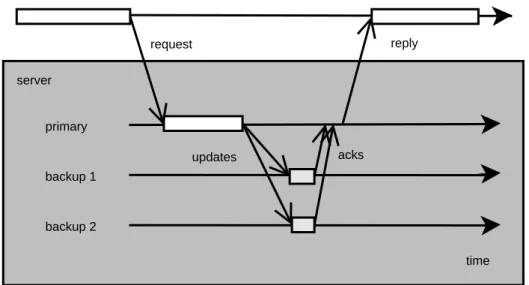
In passive replication, or the primary-backup approach [14], only one replica is active. That replica is the leader (primary replica or just primary) of the group, and it receives, processes, and replies to requests from clients. The primary updates one or more backups periodically or at certain events. Since there is only one replica processing the requests, non-determinism can be allowed.
The backups modifies its own state according to the updates received from the primary and in the case of a primary failure, the backups elect a new primary to take over the processing. This election is carried out by a group management protocol as discussed in Section 2.3.1. These mechanisms are called a failover and a request is said failover to the backup if it is sent to the backup instead of to the failed primary.
Figure 2.2 illustrates the passive replication scheme. The client sends requests only to the primary, and only the primary processes them. At certain intervals, the backups are updated. In the figure, the backups are updated in a synchronous manner (using acknowledgement messages) after the primary has finished processing and before it replies to the client. Asynchronous updates and periodic checkpointing [11] can also be used.
Semi-Active Replication
This is a hybrid technique that allows both non-deterministic execution and active replication. One of the replicas is called theleaderwhile the others are
2.3. Replication in Distributed Systems 27 primary backup 1 backup 2 client request reply server time updates acks
Figure 2.2: Passive replication
called followers [108]. As in active replication, all the replicas process the request, but it is up to the leader to process the non-deterministic parts and notify the followers. The leader decides on the ordering of requests and sends its decisions to the followers. In addition, only the leader’s reply is received by the client, because identical replies are removed by the communication system.
This technique has been developed in the context of Delta-4 [88]. It is de-signed to be a dependable real-time architecture. Real-time systems require low response times and need to quickly respond to events. If, for instance, an alarm condition is raised, the event needs to be handled immediately. Thus, the specification also allows pre-emption of execution.
Semi-Passive Replication
Semi-passive replication [22, 23] is a variation of the passive replication tech-nique. The client-server interaction, the timeout policy, and the selection of the update values differ. As will be shown later, the latter is actually also a selection of the primary. Since only one of the replicas actually processes the request, non-determinism is allowed.
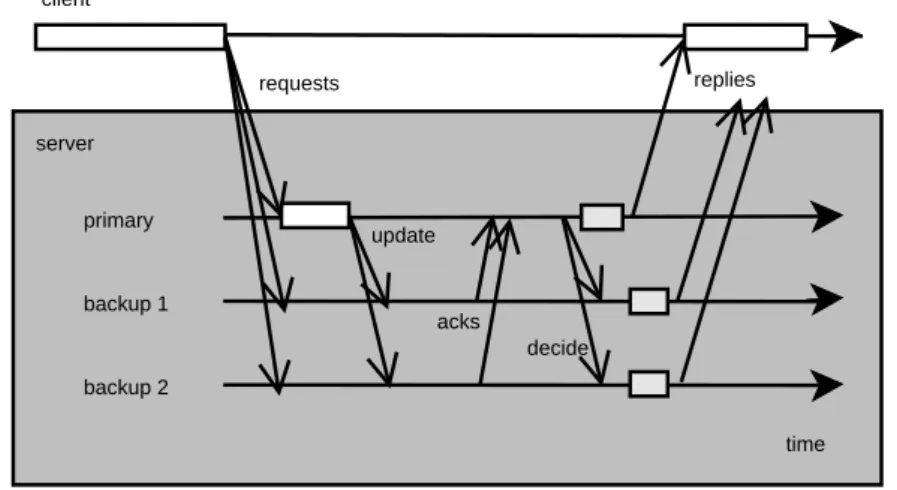
Figure 2.3 shows how semi-passive replication works in the failure-free case. The client starts by sending the request to all replicas. The primary processes the request and proposes an update value to the backups. When a majority of the replicas has agreed upon the value, the primary sends the decision to all backups, updates its own state and replies to the client. As
28 Chapter 2. Fault Tolerance in Distributed Systems primary backup 1 backup 2 client requests replies server time update acks decide
Figure 2.3: Semi-passive replication
each of the backups receives the update, it updates its state and replies to the client. To mask the replication from the client, duplicate replies are discarded by the communication system.
If the primary fails or is suspected to have failed, one of the backups also proposes a value. Since a process in an asynchronous system can be falsely suspected to have failed (see Section 2.3.1), two or more values might be proposed for the same request. A consensus protocol, presented in Section 2.3.1, solves this. This has the effect of masking process failures in the server group from the client.
In standard passive replication, a process is removed from the server group if it is suspected to have failed. When it has recovered, it may join the group again. Both of these operations, which are taken care of by the group membership protocol (see Section 2.3.1), are time consuming and degrade the performance of the system. A timeout mechanism is usually used to detect a failed process. The length of the timeout is a tunable parameter. If an aggressive value is chosen, a slow process might be incorrectly removed from the group, and then subsequently rejoin it. This causes two executions of the costly leader election part of the group membership protocol. If a conservative value is chosen, a failure can lead to a long period where the system is just waiting for the timeout. For time-critical systems, this is unacceptable.
Semi-passive replication avoids this problem by using two different time-out values: an aggressive timetime-out for the suspicion of a failure and a conser-vative for the exclusion of a process from the group. After the first timeout, but before the latter, the other processes keep sending messages to the sus-pected process. As only a majority of the processes needs to answer for the
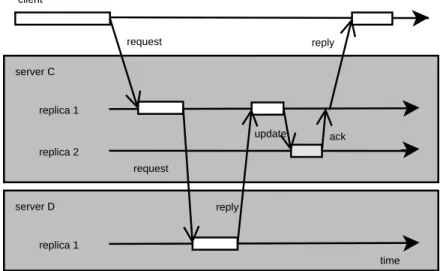
2.3. Replication in Distributed Systems 29 replica 1 replica 2 client request reply server C time replica 1 server D request reply update ack
Figure 2.4: A non-deterministic passive server causing a replicated invocation consensus protocol to reach an agreement, this will not affect the performance of the system.
2.3.5
Orphan Requests
Passive replication allows non-deterministic execution of replicas. Figure 2.4 shows the failure-free execution of a request by passively replicated, non-deterministic server C. The primary replica of server C receives a request from the client and makes a request for server D. After a reply has been received byC, it processes the message and updates the state of the backup replica, before replying to the client.
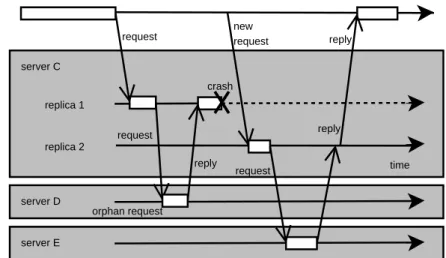
Unfortunately, non-determinism can introduce consistency problems be-tween replicas. If a primary crashes, inconsistencies may spread throughout the system [85, 84]. Figure 2.5 illustrates the situation. If the primary of C
sends a request toD and subsequently fails, one of the backups becomes the primary. Because of non-deterministic execution of C, there is no guarantee that the new primary sends an identical request to D. In fact, it may not invoke D at all, but rather a different server E or it may not send a request at all.
Now consider D processing the request received from the failed, old pri-mary. The processing causes a change in the state of D. The new state is thus an inconsistent state. To make matters even worse, a subsequent invo-cation to or fromDcan leak the inconsistency to the rest of the system. The request from the failed primary is called anorphan request. It is crucial that the effects of these requests are undone to avoid inconsistencies.