MAGERIT – version 3.0
Methodology for Information Systems Risk
Analysis and Management
Book I - The Method
Promoted by: Directorate General for Administrative Modernisation, Procedures and Promotion of e-Government Project team:
Direction:
Miguel A. Amutio, Ministerio de Hacienda y Administraciones Públicas Javier Candau, Centro Criptológico Nacional, Ministerio de la Presidencia. Consultant:
José Antonio Mañas, Professor, Universidad Politécnica de Madrid Digital edition with Adobe Acrobat 5.0
Madrid, July, 2014
Available this publication at: Portal de Administración Electrónica (PAe): http://administracionelectronica.gob.es/
Published by:
© Ministry of Finance and Public Administration Technical Secretariat
Information, Documentation and Publications Unit Publications Center
Edita:
© Ministerio de Hacienda y Administraciones Públicas Secretaría General Técnica
Subdirección General de Información, Documentación y Publicaciones Centro de Publicaciones
Colección: administración electrónica NIPO: 630-14-162-0
Contents
1. Introduction ... 6
1.1. Good governance ...6 1.2. Trust ...6 1.3. Management ...7 1.4. Magerit ...71.5. Introduction to risk analysis and management ...8
1.6. Risk analysis and management in context ...10
1.6.1. Awareness and training ...10
1.6.2. Incidents and recovery ...11
1.7. Organisation of guides ...11
1.7.1. Method of use ...12
1.7.2. The elements catalogue ...12
1.7.3. The Guide of techniques ...13
1.8. Evaluation, certification, auditing and accrediting ...13
1.9. When should risks be analysed and managed? ...15
2. Overview ... 17
3. Risk analysis method ... 20
3.1. Concepts ...20
3.1.1. Step 1: Assets ...20
3.1.2. Step 2: Threats ...24
3.1.3. Determination of the potential impact ...26
3.1.4. Determination of the potential risk ...27
3.1.5. Step 3: Safeguards ...28
3.1.6. Step 4: residual impact ...32
3.1.7. Step 5: residual risk ...32
3.2. Formalization of the activities ...32
3.2.1. RAM.1: Characterization of assets ...34
3.2.2. RAM.2: Characterization of the threats ...37
3.2.3. RAM.3: Characterization of safeguards ...39
3.2.4. RAM.4: Estimated risk status ...41
3.3. Documentation ...42
3.4. Checklist ...43
4. Risk management process ... 44
4.1. Concepts ...45
4.1.1. Evaluation: interpretation of the residual impact and risk values ...45
4.1.2. Risk acceptance ...46
4.1.3. Treatment ...46
4.1.4. Quantitative study of costs/benefits ...47
4.1.5. Qualitative study of costs and benefits ...50
4.1.6. Mixed study of costs / benefits ...50
4.1.7. Risk treatment options: elimination ...50
4.1.8. Risk treatment options: mitigation ...50
4.1.9. Risk treatment options: sharing ...51
4.1.10. Risk treatment options: funding ...51
4.2. Formal activities ...51
4.2.1. Roles and functions ...52
4.2.2. Context ...54
4.2.3. Criteria ...54
4.2.4. Risk assessment ...55
4.2.5. Decisions on treatment ...55
4.2.6. Communication y consultation ...55
4.2.7. Monitoring and review ...56
5. Risk analysis projects ... 58
5.1. Roles and functions ...58
5.2. RAP.1 – Preliminary activities ...60
5.2.1. RAP.11: Study of timeliness ...60
5.2.2. RAP.12: Definition of the scope of the project ...62
5.2.3. RAP.13: Project planning ...64
5.2.4. RAP.14: Project launch ...65
5.3. RAP.2 – Development of the risk analysis ...66
5.4. RAP.3 – Communication of results ...67
5.5. Project control ...67
5.5.1. Milestones ...67
5.5.2. Output documents ...67
6. Security plan ... 68
6.1. SP.1 – Identification of security projects ...68
6.2. SP.2 – Implementation plan ...70
6.3. SP.3 – Implementation ...71
6.4. Security plan control list ...71
7. Development of information systems ... 72
7.1. Start of the processes ...72
7.2. ISS – Information System Security ...73
7.2.1. Life cycle of applications ...74
7.2.2. Context ...75
7.2.3. Specification stage: information gathering ...75
7.2.4. Design stage: options analysis ...76
7.2.5. Support to development: critical items ...76
7.2.6. Acceptance and implementation: critical items ...76
7.2.7. Operation: dynamic analysis and management ...77
7.2.8. Maintenance cycle: marginal analysis ...78
7.2.9 Termination ...78
7.2.10 Security documentation ...78
7.3. DPS – Development Process Security ...79
7.4. References ...80
8. Practical advice ... 81
8.1. Reach and depth ...81
8.2. Identifying assets ...81
8.3. Discovering and modelling the dependencies between assets ...83
8.4. Valuing assets ...86 8.5. Identifying threats ...87 8.6. Valuing threats ...88 8.7. Choosing safeguards ...89 8.8. Successive approximations ...89 8.8.1. Baseline protection ...89
Appendix 1. Glossary ... 91
1.1. Terms ...91Appendix 2. References ... 95
Appendix 3. Legal framework ... 96
Appendix 4. Evaluation and certification framework ... 97
A4.1. Information security management systems (ISMS) ...97
A4.1.1. Certification ...98
A4.1.2. Accrediting by the certification organisation ...99
A4.1.3. Terminology ...99
A4.2. Common evaluation criteria (CC) ...100
A4.2.1. Beneficiaries ...102
A4.2.2. Security requirements ...102
A4.2.4. Use of certified products ...104
A4.2.5. Terminology ...104
Appendix 5. Tools ... 106
5.1. PILAR ...107
Appendix 6. Evolution of Magerit ... 108
A6.1. Evolution from Magerit version 2 ...108
1. Introduction
The CSAE1 prepares and promotes Magerit2 in response to the perception that the government
(and, in general, the whole society) increasingly depends on information technologies for achieving its service objectives. The use of information and communication technologies (ICT) clearly benefits the citizens; but it also entails certain risks that must be sensibly managed with security measures that sustain the trust of service users.
1 CSAE: Higher Council for Electronic Government (Consejo Superior de Administración Electrónica).
2 MAGERIT: Risk Analysis and Management Methodology for Information Systems.
1.1. Good governance
Risk management is a cornerstone in good governance handbooks [ISO 38500], public or private, where it is essential for governance decisions to be based on the knowledge of the risks involved:
1.6.12 Proposal
Compilation of benefits, costs, risks, opportunities, and other factors applicable to decisions to be made. Includes business cases.
Covering risks in general and ICT risks in particular:
This standard establishes principles for the effective, efficient and acceptable use of IT. Ensuring that their organisations follow these principles will assist directors in balancing risks and encouraging opportunities arising from the use of IT
The need of a balance between risks and opportunities in order to take the best decisions is recurrently stressed.
In short, risk management is critical to good governance of organisations. In particular, the risks derived from the use of information technologies shall be communicated to governing bodies and contextualized in the mission of the organisation.
Being aware of the risks will ensure that systems will work as the Management expects, providing a balanced framework for Governance, Risk Management and Compliance (GRC), three areas that must be integrated and lined up to prevent conflicts, duplication of activities and no-man’s lands.
Governing bodies do not only have to manage ICT risks. Moreover, they must not manage ICT risks separately from other risks. While Magerit is specialized in ICT risks, we must be fully aware that it is essential to advise governing bodies of the opportunities and risks derived from information technologies, for them to be included in a comprehensive framework, and to take the best decisions for the organisation.
1.2. Trust
Trust is the strong hope that something will work as expected. Trust is a critical value in any organisation providing services. Public administrations are especially sensitive to trust perceived by society.
On the one hand, we strongly depend on information systems to achieve our objectives; but, on the other hand, their security is a recurring concern. People involved, who often are not technicians, wonder if these systems can be trusted. Trust is undermined with every failure, especially when investments do not translate into absence of incidents. Ideal systems do not fail. But the truth is that we accept to live with failing systems. The issue is not so much the lack of incidents in those systems, but the confidence that they are under control: to know what it might happen and what to do when it happens. The fear of the unknown is the main cause of distrust and, consequently, knowledge brings confidence: to know the risks in order to face and control them.
1.3. Management
Knowing the risks to which work elements are subject, is simply essential to manage them.
Since Magerit was first published in 1997, risk analysis has been consolidated as a necessary step for security management, as clearly recognised in the OECD guidelines3, which state in principle 6:
6) Risk evaluation. The participants must carry out risk evaluations.
Within the National Security Framework [RD 3/2010], Chapter II, Basic Principles, reads: Article 6. Security management based on risks
1. The analysis and management of risks will form an essential part of the security process and must be kept permanently updated.
2. Risk management will allow the maintenance of a controlled environment, reducing risks to acceptable levels. Reducing these levels will be achieved by deploying security measures to establish a balance between the nature of the information and the processes, the risks to which the information is exposed and security measures.
1.4. Magerit
According to ISO 31000 terminology, Magerit responds to what is called “Risk Management Process”, section 4.4 (“Implementing Risk Management”) within the “Framework for Risk Management”. In other words, MAGERIT implements the Risk Management Process within a working framework for governing bodies to make decisions taking into account the risks derived from the use of information technologies.
Figure1. ISO 31000 – Framework for risk management
There are several approaches to the problem of analyzing the risks supported by ICT systems: informal handbooks, methodical approaches or supporting tools. All of them aim at objectifying risk analysis to know how secure (or unsecure) systems are. The great challenge of these approaches is the complexity of the problem they have to face; complexity in the sense that there are many elements to be considered and, if it is not done rigorously, the conclusions will be unreliable. Thus, the ultimate aim of using Magerit is to make a methodical approach that leaves no room for improvisation, and not to depend on the analyst’s whim.
Magerit seeks to achieve the following objectives: Direct objectives:
1. To make those responsible for information systems aware of the existence of risks and of the need to treat them in time.
2. To offer a systematic method for analysing these risks.
3. To help in describing and planning the appropriate measures for keeping the risks under control.
Indirect objectives:
4. To prepare the organisation for the processes of evaluating, auditing, certifying or accrediting, as relevant in each case.
It also aims to achieve uniformity in the reports containing the findings and conclusions from a risk analysis and management project:
Value model
Description of the value of the assets for the organisation as well as the dependencies between the various assets.
Risk map
Summary of the threats to which the assets are exposed.
Statement of applicability
For a set of safeguards indicate which ones are applicable in the information system under study, and which ones are meaningless.
Safeguard evaluation
Evaluation of the effectiveness of the existing safeguards in relation to the risks systems face.
Risk status
Classification of the assets by their residual risk; that is, by what could happen, taking the safeguards used into consideration.
Deficiencies report (Vulnerabilities report)
Absence or weakness of the safeguards that appear as appropriate to reduce the risks to the system.
Compliance
Meeting some requirements. Formal statement that it is in line and in accordance with the corresponding regulations.
Security plan
Group of security programs that put the risk treatment decisions into action.
1.5. Introduction to risk analysis and management
Security is the capability of networks or information systems to resist accidents or illegal or malicious actions that compromise the availability, authenticity, integrity and confidentiality of the data stored or transmitted and of the services that these networks and systems offer or make accessible, with a specific level of confidence.
The objective is to protect the organisation’s mission, taking different security dimensions into account:
Availability
Readiness of the services to be used when necessary. Lack of availability causes an interruption of services. Availability directly affects organisation’s productivity.
Integrity
Maintenance of completeness and correctness of data. Without integrity, information may appear to be altered, corrupt or incomplete. Integrity directly affects the correct undertaking of an organisation’s functions.
Confidentiality
Information must only reach authorised persons. Lack of confidentiality or secrecy could cause leaks of information as well as unauthorised accesses. Confidentiality is difficult to recover. Loss of confidentiality undermines the confidence of others in the organisation, and may involve the breach of laws and contractual commitments related to the custody of the information.
These canonical dimensions of security may be extended with other ones that bring us closer to the users’ perception of the security of their information systems:
Authenticity (of who uses the data or services)
An entity is who it claims to be or guarantee the source from which the data originated. Against the authenticity of the information we can have manipulation of origin or of data. Against the authenticity of users accessing services, we can have spoofing.
Accountability:
Guarantee that it will be always possible to determine who did what and when. Accountability is essential to analyse incidents, prosecute attackers and learn from experience. Accountability maps into integrity of activity logs.
All these features may or may not be required, depending on the situation. Where required, they are not achieved at zero cost; usually it means that effort is required to achieve them. Risk analysis and management methodologies are used to rationalise this effort.
Risk
Estimate of the degree of exposure to a threat that may occur on one or more assets causing damage to the Organization.
Risk is an indicator of what could happen to assets if not properly protected. It is important to know what features are of interest in each asset and to what extent these features are in danger, that is, analyze the system:
Risk analysis
A systematic process for estimating the magnitude of the risks to which an organisation is exposed.
Knowing what may happen, decisions are made:
Risk treatment
Process devoted to modify identified risks.
There are multiple ways of dealing with risks: preventing or reducing their likelihood, minimizing their consequences, sharing them with other organisation (typically hiring a service or a cover insurance), or, ultimately, accepting them and foreseeing resources to act when needed.
Note that one legitimate option is to accept the risk. One frequently hears that absolute security does not exist; effectively, it is always necessary to accept a risk which however, must be known and subjected to the quality threshold required by the service.
In fact, sometimes we accept operational risks of activities that may yield benefits surpassing the risks involved, or risks that we must face up to. That is the reason why broader definitions of risk are sometimes used:
effect of uncertainty on objectives. [ISO Guide 73]
Because all this is very delicate, it is not merely technical, and it includes the decision to accept a certain level of risk, it is essential to know in which conditions one is working and thus be able to ascertain to what level the system is trustworthy. This requires a methodical approach to make informed decisions, and be ready to explain rationally the decisions taken.
1.6. Risk analysis and management in context
Risk analysis and treatment activities are not an end in themselves but form part of the continuous activity of security management.
Risk analysis allows the determination of the assets, their value and how they are protected. In co-ordination with the organisation’s objectives, strategy and policies, risk treatment activities allow a security plan to be prepared which, when implemented and operated, meets the proposed objectives with the level of risk accepted by the Management. These activities as a whole are called Risk Management Process.
The implementation of security controls requires a managed organisation and the informed participation of all persons working with the information system. These persons are responsible for the daily operation, the reaction to incidents and the general monitoring of the system to determine if it effectively and efficiently meets the proposed objectives.
This working plan must be recurrent since information systems are rarely immutable; normally they are subject to continuous development both own (new assets) and the environment (new threats), requiring periodic reviews to learn from experience and to adapt to the new context.
Risk analysis provides a model of the system in terms of assets, threats and safeguards and is the foundation for controlling all activities on a well-founded base. The treatment phase structure actions that are undertaken on security to meet the needs identified by the analysis.
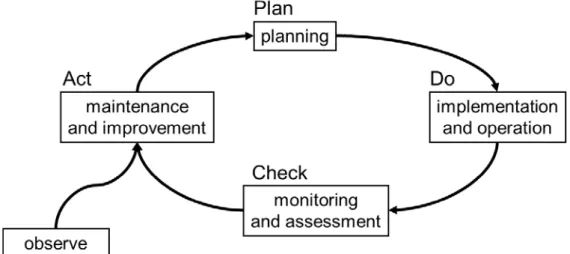
Information security management systems (ISMS) [ISO 27001] identify four main processes:
Figure 2. PDCA cycle
Risk analysis is part of planning, where treatment decisions are taken. These decisions materialize in the implementation phase, when it is recommended to deploy some elements that allow controlling the measures implemented in order to assess their effectiveness and to act accordingly, within a framework of excellence or constant improvement.
1.6.1. Awareness and training
The best security plan would be seriously undermined without the active collaboration of the persons involved in the information system, especially if the attitude is negative, and contrary or one of “fighting against the security measures”. This requires the creation of a “security culture” which, coming from top management, encourages the awareness of all those involved of its need and relevance.
There are three basic pillars for creating this culture:
• A corporate security policy which is understood (written so as to be understood by those who are not experts in the matter) which is published and kept updated.
• Security policies that, in specific areas of activity, clarify the stance of the Organisation; i.e., defining the correct use and what non-compliance means.
• Continuous training at all levels, with reminders of routine precautions and specialised activities, depending on the responsibility assigned to each job.
So that these activities fit into the organisation, it is essential that security is:
• Unobtrusive, so that it does not unnecessarily impede daily activities or compromises the achievement of the proposed productivity objectives.
• “Natural,” so that it does not cause avoidable errors and facilitates compliance with the proposed good practices.
• Practised by management leading by example in a daily activity, and reacting swiftly to changes and incidents.
1.6.2. Incidents and recovery
People involved in the use and operation of the system must be aware of their role and continued relevance to prevent problems and to react when they do occur. It is important to create a culture of responsibility in which potential problems, discovered by those close to the affected assets, re communicated to the decision points. Thus, the security system will respond to the situation.
When an incident occurs, time starts to run against the system: its survival depends on the speed and correctness of the reporting and reaction activities. Any error, lack of precision or ambiguity in these critical moments is amplified, turning what could be a mere incident into a disaster.
It is necessary to learn continuously from both successes and failures and to incorporate them into the risk management process. The maturity of an organisation is reflected in the orderliness and realism of its value model and, as a result, in the suitability of all types of safeguards, from tactical measures to an optimal organisation.
1.7. Organisation of guides
This version 3 of Magerit has been structured into two books and a technical guide: • Book I – The method
• Book II – Catalogue of elements
• Guide of Techniques – Compilation of different kinds of techniques that could be useful to apply the method.
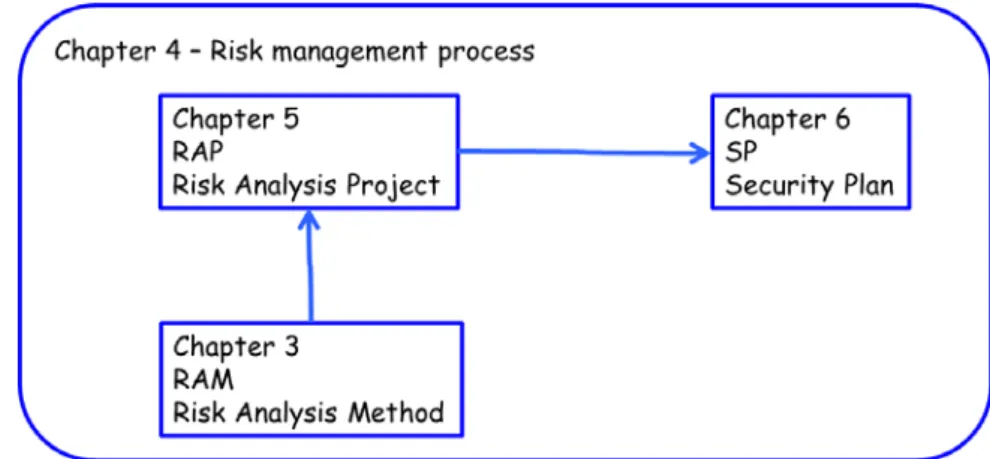
This book is structured as follows:
• Chapter 2 presents informal concepts. Particularly, analysis and treatment activities are framed within an integral risk management process.
• Chapter 3 defines exactly the steps and formalizes risk analysis activities.
• Chapter 4 describes risk treatment options and criteria and formalizes risk treatment activities.
• Chapter 5 is focused on risk analysis projects, on which we will be immersed in order to carry out the first risk analysis of a system and, on a temporary basis, when substantial changes have been made and the model has to be widely redone.
• Chapter 6 formalizes the activities of security plans, sometimes called master plans or strategic plans.
• Chapter 7 is focused on the development of information systems and on how risk analysis serves to manage the final product security from its initial conception to its production, as
• Chapter 8 anticipates some problems recurrently coming up when analysing risks. Annexes contain reference material:
1. A glossary.
2. Bibliographical references used in developing this methodology.
3. Legal references covering the tasks of risk analysis and management in Spanish Public Administration.
4. Standards for evaluation and certification.
5. The features required from present or future tools for supporting the risk analysis and management process.
6. A comparison of how Magerit version 1 has developed into version 2, and then into version 3.
1.7.1. Method of use
The activities to be carried out are always explained informally and, in some cases, they are presented as tasks that can be planned and monitored:Figure 3. Formal activities
In small systems, these activities can be conducted with almost no conventionalism; but when the system grows bigger and engages different people and working teams for several weeks, months or years, a formal planning helps to keep the process under control.
This method has been designed following a “greatest extent” criteria, reflecting all kinds of situations. In practice, the user can find situations where scope is more restricted. In that case, it is advisable to be practical and try not to apply all the tasks depicted in Magerit from the beginning. The most sensible thing to do is to make a iterative approach, firstly applying the method in general terms, and then revising the model to dig into more detail. The risk management process must identify, and urgently handle critical risks, and progressively handle less critical ones. As the saying goes “the perfect is the enemy of the good.” The sensible thing to do is to harmonize efforts with the value of information and the services provided.
Thus, Magerit should be understood as a guide that may and must be tailored on a case-by-case basis and according to the different circumstances.
1.7.2. The elements catalogue
A separate book proposes a catalogue -open to additions- that provides guidelines for: • Types of assets.
• Dimensions for evaluating assets. • Criteria for evaluating assets.
• Typical threats to information systems.
• Safeguards to be considered for protecting information systems. There are two objectives:
1. Firstly, to facilitate the work of those involved in a project in the sense of giving them standard elements that they can adapt quickly, concentrating on the specifics of the system under analysis.
2. And secondly, to provide uniform results from the analysis, promoting uniform terminology and criteria that allow the comparison with and even integration of analyses carried out by different teams.
Each section includes XML notation to be used for regularly publishing the elements in a standard format that can be processed automatically by analysis and management tools.
If the reader uses a risk analysis and management tool; this catalogue will form part of it. If the analysis is carried out manually;, this catalogue provides a wide starting base for quick progress without distractions or oversights.
1.7.3. The Guide of techniques
A separate book provides additional information and guides on some techniques often used when carrying out risk analysis and management projects:
• Techniques specific to risk analysis: • Analysis using tables.
• Algorithmic analysis. • Attack trees
• General techniques: • Graphical techniques.
• Work sessions: interviews, meetings and presentations. • Delphi evaluation.
This is a reference guide. As the reader progresses through the project’s tasks, the use of certain specific techniques is recommended, to which this guide is an introduction, and references are provided so that the reader can learn more about the techniques described.
1.8. Evaluation, certification, auditing and accrediting
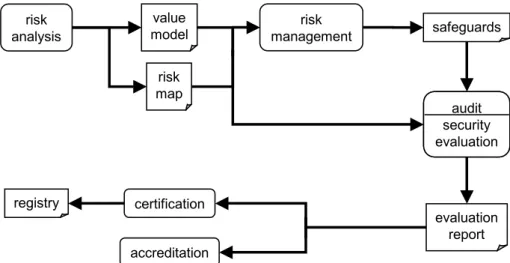
Risk analysis is the cornerstone in the processes of evaluating, certifying, auditing and accrediting that establish to what extent the information system is trustworthy. Given that no two information systems are alike, the evaluation of each specific system requires adapting to its components. Risk analysis provides an overview of each system, its value, the threats to which it is exposed and the safeguards with which it is equipped. Risk analysis is therefore an obligatory step towards carrying out all the above mentioned tasks, listed in the following diagram:
Figure 4. Certification and accreditation of information systems
risk analysis certification evaluation report registry value model risk map risk management safeguards accreditation audit security evaluation audit security evaluation
This section provides a conceptual presentation of these activities. The reader will find a specific discussion of the standards relating to management systems and security products in Appendix 4.
Evaluation
The evaluation of security and information systems is increasingly frequent, both internally as part of management processes and by independent external evaluators. Evaluations establish to what extent an information system is trustworthy.
Certification
The evaluation may lead to a certification or registration of the system’s security. In practice, products are certified and security management systems are certified. The certification of products is in any case impersonal: “This has these technical properties.” However, the certification of management systems is concerned with the “human component” of the organisations, seeking to analyse the way in which the systems are used.4
Certification means that a known party assumes in writing a responsibility on the correctness of the certified items. The subject of the certification - product or system - is submitted to a series of evaluations aimed at an objective: What is it wanted for?5 A certificate states that a system can
protect data from threats with a certain level of quality (protection capacity). It states this on the basis that a series of safeguards has been observed to exist and operate. This means that there are risk analysis concepts behind a certificate.
Risk analysis must have been carried out before certification in order to know the risks and control them by adopting suitable controls. This will also be a control point for the management of the product or system.
Accrediting
Some certifications are designed to accredit the product or system. Accrediting is a specific process, the object of which is to qualify the system to form part of wider systems. It can be seen as a certification for a specific purpose.
Audit
Although not the same, internal or external audits of information systems are not very far from this world.
• Some are required by law in order to operate in a specific sector. • Others are required by the organisation’s management itself.
• Others are required by collaborating organisations that have their own level of risk connected with ours.
An audit may serve as a risk analysis that allows (1) to know what is at play; (2) to know what the system is exposed to; and (3) to evaluate the effectiveness and efficiency of the safeguards.
Frequently, auditors start with an implicit or explicit risk analysis either carried out by themselves or audited by them in the first phase of auditing, because it is difficult to form an opinion of what is not known. On the basis of the risk analysis, the system can be analysed and the Management informed as to whether the system is under control, that is, if the security measures adopted are justified, implemented and monitored so that the system of indicators available to the Management can be trusted for managing the systems’ security.
4 There are vehicles with high technical features and others with lower ones, just as there are drivers who are real professionals and others of whom it is impossible to explain how they are qualified as “suitable to handle vehicles.” The ideal is to put a powerful car in the hands of a great driver. We have a great variety of situations of lesser confidence: greater risk. 5 And thus we have systems suitable for “human consumption” or for “use in conditions of
extreme heat.”
The conclusion of the audit is a report on the deficiencies found, which are simply inconsistencies between the needs identified in the risk analysis and those discovered during the inspection of the system in operation.
The audit report must describe the suitability of the measures and controls to the present regulations, identifying their deficiencies and proposing corrective or complementary measures. It will also include the data, facts and comments that support the conclusions reached and the proposed recommendations. [RD 1720/2007, article 96.2].
In the case of the government, there are some fundamental references with regard to which audits can and must be made:
• Spanish Royal Decree 1720/2007 of 21 December, 2007
• Spanish National Security Framework - Royal Decree 3/2010, of January 8th, which regulates the National Security Framework within the e-government scope
The audits must be repeated regularly both to follow the evolution of the risk analysis (which must be updated regularly) and to follow the evolution of the security plan determined by the Risk Management activities.
1.9. When should risks be analysed and managed?
A risk analysis is recommended in any organisation that depends on information and communication systems to carry out its purpose; specifically, in any environment in which goods and services are handled electronically, whether in a public or private context. Risk analysis allows decisions to be made on investment in technology, from the acquisition of production equipment to the deployment of an alternative centre to ensure the continuity of the activity, including decisions on the acquisition of technical safeguards and on the selection and training of personnel.
Risk analysis is a management tool that allows decisions to be made. Decisions may be made before deploying a service or when it is operating. It is very desirable to carry it out beforehand so that the measures that must be taken are incorporated into the design of the service, in the choice of components, in the development of the applications and in the user manuals. Anything that involves correcting unforeseen risks is costly in both internal and external time, which could damage the organisation’s image and may eventually cause a loss of confidence in its capability. It has always been said that prevention is better than cure and this applies here: don’t wait until a service is failing - it is necessary to anticipate and be prepared.
Carrying out a risk analysis is laborious and costly. Preparing a map of assets and valuing them requires the collaboration of many people within the organisation from management levels to technicians. Not only must many people be involved but uniformity of criteria must be achieved between them because, although it is important to quantify the risks, it is even more important to define their relationships since a mass of data typically appears in a risk analysis. The way to tackle the complexity is to concentrate on the most important (maximum impact, maximum risk) and to remove the secondary or insignificant, but if the data are not well sorted in relative terms, it is impossible to interpret them.
To summarise, a risk analysis is not a minor task that anyone can carry out in their spare time. It is an important task that requires effort and co-ordination and must therefore be planned and justified.
Certification and accrediting
If certification for the system is sought, risk analysis is a prior requisite that will be required by the evaluator. It is the source of information for determining the relationship of relevant controls for the system and which must therefore be inspected. See Appendix 4.1 on the certification of information security management systems (SGSI).
The risk analysis is also a requirement for systems accrediting processes6. These processes are
necessary for handling classified national, EU, NATO or other information from other international 6 In the formal meaning of authorisation for handling classified information. The accrediting
agreements. The first step in the process is to carry out a risk analysis to identify threats and safeguards and to satisfactorily manage risks to the system.
By law
Risk analysis may also be required by legal precept. Such is the case of the Royal Decree 3/2010, dated January 8, that regulates the National Security Framework within the sphere of the Electronic Administration. Chapter II, Basic Principles, states:
Article 6. Security management based on risks.
1. The analysis and management of risks will form an essential part of the security process and must be kept permanently updated.
2. Risk management will allow the maintenance of a controlled environment, reducing risks to acceptable levels. Reducing these levels will be achieved by deploying security measures to establish a balance between the nature of the information and the processes, the risks to which the information is exposed and security measures.
This same Royal Decree 3/2010, in its Chapter III, Minimum Requirements, states: Article 13. Risk analysis and management
1. Each organisation developing and establishing systems for processing information and communications will carry out its own risk management.
2. This management will be done by analysing and processing the risks to which the system is exposed. Without prejudice to the terms of appendix II, an internationally-recognised method will be used.
3. The measures adopted to mitigate or eliminate the risks will be justified and there will always exist proportionality between them and the risks.
Act 11/2007, dated June 22, regulating electronic citizen Access to Public Services, in its Article 1, Purpose of this Act, states:
2. Public Administration Entities must use information technology according to what is stated in this Act, ensuring availability, access, integrity, authenticity, confidentiality and preservation of data, information and services they manage in the exercise of their powers.
Similarly, Organic Law 15/1999, 13 December, on the protection of personal data, states in its article 9 (Data security):
1. The person responsible for the file and, where appropriate, the person responsible for its handling, must adopt the necessary technical and organisational measures that guarantee the security of the personal data and prevent its alteration, loss, unauthorised treatment or access, taking into account the state of the art, the nature of the data stored and the risks to which they are exposed, whether by human action or from the physical or natural environment.
Finally, continuous risk management is one of the basic principles of the aforementioned National Security Framework.
To conclude
Analyse and manage the risks when there is a direct or indirect legal requirement and whenever required for the responsible protection of organisation’s assets.
2. Overview
Two main tasks need to be carried out:
I. risk analysis,
Establishes what the organisation has at its disposal and calculates possible events.
II. risk treatment,
Allows a thorough and sensible defence schema, preventing anything bad from happening and at the same time being prepared to tackle emergencies, survive incidents and continue operating under the best possible conditions; as nothing is perfect, we say that risk is reduced to a residual level that is accepted by the Management.
Both activities, analysis and treatment, are combined into the process named Risk Management.
Figure 5. Risk management Elements:
1. Assets, which are the elements in the information system (or closely related to it) that are direct or indirectly valuable to the organisation.
2. Threats, which are incidents that may impact the assets, causing damage to the organisation.
3. Safeguards (or countermeasures), which are defence elements deployed so that those threats do not cause [so much] damage.
These elements allow the estimation of: 4. The impact: what may happen. 5. The risk: what is likely to happen.
Risk analysis allows these elements to be analysed methodically to reach conclusions with a basis and decide on treatment.
Informally, it can be said that the management of security in an information system is the management of its risks and that the analysis allows this management to be rationalised.
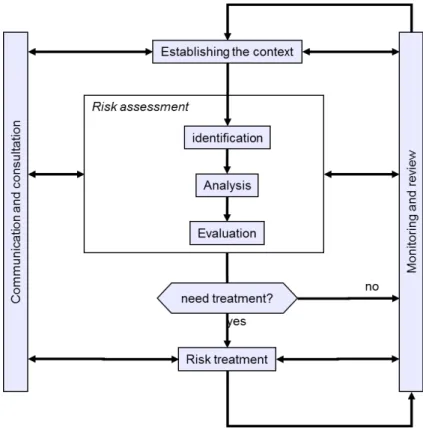
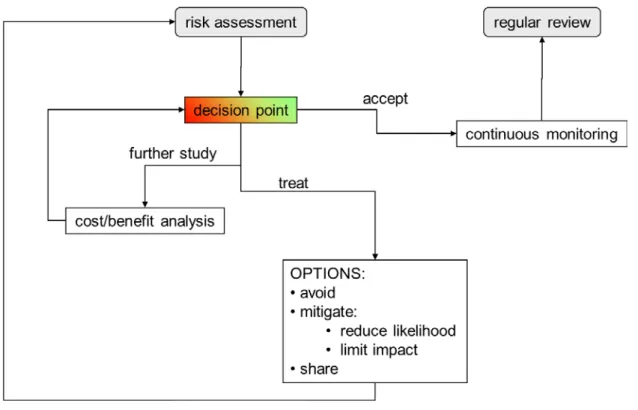
Formally, risk management is structured methodically in the ISO standards (see Appendix 4.1). ISO uses he following diagram:
Figure 6. Risk management process (source: ISO 31000)
Establishing the context requires the definition of parameters as well as external and internal parameters that allow a framing of the policy to be followed to manage the risks. One element to be highlighted is the scope of the analysis, including its own obligations and those incurred in, as well as relations with other organisations, either for exchange of information and services or providers of subcontracted services. See [ISO 31000] for a further development of factors which establish the context.
Risk identification prepares a list of potentially dangerous spots. All that is identified will be analysed in the following stage. Whatever is not identified will remain as a hidden or ignored risk.
Risk evaluation evaluates identified risks, either quantifying their consequences (quantitative analysis) or sorting out their relative importance (qualitative analysis). Either way we will obtain, as a result, a structured vision that allows focusing on the essential.
Risk assessment goes one step further from the technical analysis and maps consequences into business terms. Here, perception, strategy and policy factors come into consideration allowing decision-making concerning which risks are acceptable or not, as well as in what set of circumstances we can accept a given risk or work on its treatment.
Risk treatment gathers activities aimed at changing the risk situation. It is an activity with numerous options as we will see later on.
Communication and consultation. It is important not to forget that information systems must support Organisation’s mission. It seems absurd to have an extremely secure system that keeps the organisation from reaching its goals. A balance between security and productivity needs to be kept, and within that balance, it is necessary to count on the cooperation of several interlocutors:
• Users whose needs are to be kept into account and who are to be informed to actively cooperate in the system’s operation within the security parameters established by the Management.
• External suppliers, who must be given clear instructions in order to be able to demand both required levels of service as well as the management of security incidents that may occur • Stakeholders, to establish communication channels that consolidate the belief that the
information system will respond without any surprises to attend to the organisation’s mission and that any incidents will be contained according to plan.
Monitoring and inspection. It is important not to forget that risk analysis is an activity that is conducted in an office. It is thus of paramount importance to check what is happening in practice and to act accordingly, reacting diligently to incidents and continuously improving our knowledge of the system and its environment to improve the analysis and adjust it to the experience.
3. Risk analysis method
3.1. Concepts
Risk analysis is a methodical approach to estimate the risk, following specific steps:
1. Determine the relevant assets for the organisation, their inter-relationships and their value i.e. what prejudice (cost) would be caused by their degradation.
2. Determine the threats to which those assets are exposed.
3. Determine what safeguards are available and how effective they are against the risk.
4. Estimate the impact, defined as the damage to the asset arising from the appearance of the threat.
5. Estimate the risk, defined as the impact weighted by the rate of occurrence (or the expectation of occurrence) of the threat.
6. In order to organize the presentation, the concepts of “impact and potential risk” are introduced between steps 2 and 3. These assessments are “theoretical”: in case no safeguard were deployed. Once this theoretical scenario is obtained, the safeguards of step 3 are included, thus deriving realistic impact and risk estimates.
The following figure shows this first round. The steps are described in the following sections:
Figure 7. Elements for potential risk analysis assets assets threats threats frequency frequency impact impact value value risk risk are subject to have a degradation degradation cause a with a given
3.1.1. Step 1: Assets
An asset is a component or function of an information system that may be subject to deliberate or accidental attacks that may have consequences for the organisation. Assets include: information, data, services, applications (software), equipment (hardware), communications, media, facilities, and personnel.
There are two essential types of assets in an information system: • the information it handles and
• the services it provides.
These essential assets mark the security requisites for all other assets. Other relevant assets, subordinated to that essence can be identified:
• Data that materialize the information.
• Auxiliary services needed to organize the system. • Computer applications (software) that process data.
• Computer equipment (hardware) that hosts data, applications and services. • Information media, which store data.
• Auxiliary equipment that complements computer equipment. • Communications networks that exchange of data.
• Facilities that house computer communications equipment. • The persons who use or operate all the above elements.
Not all the assets are of the same type. The threats and safeguards are different according to the type of assets7. Chapter 2 of the “Elements catalogue” gives a list of types of assets.
Dependencies
The essence is the managed information and services provided. But these depend on other, more prosaic, assets such as equipment, communications or the often-forgotten persons who work with them.
Therefore, assets are organised into trees or graphs showing dependencies, where the security of the assets higher up in the tree depends on assets in the lower positions. When we move top-down, we talk about dependencies: upper assets depend on lower assets to protect their security requirements. And the other way round, when we move bottom-up, incidents on lower assets have an impact on the upper ones.
Thus, the concept of “dependencies between assets” or the degree to which a higher asset is affected by a security incident in a lower one seems important8.
A “higher asset” is said to depend on the “lower asset” when the security needs of the higher one are translated into the security needs of the lower one. In other words, when the occurrence of a threat in the lower asset has a detrimental effect on the high asset. Informally, this could be interpreted as the lower assets being the pillars supporting the security of the higher assets.
Although it is necessary to adapt to the organisation being analysed in each case, assets can frequently be structured into layers, where the upper layers depend on the lower ones:
• essential assets
• information that is handled • services provided
• internal services
• that structure the information system in an orderly manner • computer equipment
• applications (software)
• computer equipment (hardware) • communications
7 A remote access service is not attacked or defended in the same way as a work place.
8 An example can be better than a thousand words. If the building housing the equipment burns down, what ceases to function is the service perceived by the user at a distance. If the portable computer of an executive containing strategic company information is stolen, what suffers is the confidentiality of that information. Installations can be rebuilt, but the opportunity of providing the service may be lost. Theft is overcome by buying another
• media: disks, tapes, etc. • the environment:
• equipment and supplies: energy, air conditioning, etc. • furniture
• all services subcontracted to third parties • physical facilities
• staff
• users
• operators and managers • developers
Valuation
Why is an asset of interest? Because of its value.
We are not talking of what things cost, but their value. If something is of no value, discard it. If an asset cannot be easily discarded, this is because it is of value. This is what needs to be discovered since this is what has to be protected.
Valuation can be observed from the perspective of the ‘need to protect’. The more valuable an asset, the higher the protection level it will require in the appropriate security dimension (or dimensions).
The value may be its own or may be accumulated. Lower assets in the dependencies diagram are said to accumulate the value of the assets that are supported by them.
The core value is usually in the information that is handled by the system and the services provided (named essential assets). All other assets are subordinated to exploitation needs and protection of the essential.
Dimensions
It may be interesting to look at the different dimensions of an asset:
• Its confidentiality: What damage would be caused by unauthorised access? This valuation is typical of information.
• Its integrity: What damage would be caused if it were damaged or corrupt? This evaluation is typical of information.
• Its availability: What damage would be caused if it were not available or could not be used? This valuation is typical of services.9
In systems dedicated to e-government or e-commerce, knowledge of those involved is fundamental in order to be able to provide the service correctly and to be able to track down failures (accidental or deliberate) that may occur. Therefore, it is interesting to calibrate for the essential assets:
• Its authenticity: To what extent is harmful the lack of knowledge about who has done what? This valuation is typical of services (user authenticity) and of data (authenticity of the persons accessing the data for writing or, simply, querying).
• The accountability of the use of the service: what damage would be caused by not knowing to whom the service is provided? That is, who does what, when?
• The accountability of access to the data: what damage would be caused by not knowing who accesses the data and what they do with them?
9 There are end services that provide the organisation’s final mission. There are internal services used by the organisation to structure its own distribution of responsibilities. Finally there are services acquired from other organisations: external supplies.
Chapter 3 of the “Elements catalogue” provides a list of security dimensions.
In a tree of dependencies in which the upper assets depend on the lower ones, it is essential to value these upper assets, those that are important in themselves. This value automatically accumulates in the lower ones, notwithstanding that these may add their own valuation.
How much is the ‘health’ of the assets worth?
Once it has been determined which security dimensions are of interest in an asset, it must be valued. The valuation is the determination of the loss of value caused by an incident. There are many factors to be considered:
• Replacement cost: acquisition and installation.
• Labour cost invested in recovering (the value of) the asset. • Loss of income.
• Loss of capacity to operate: lack of confidence of users and suppliers resulting in a loss of activity, or in worse economic conditions
• Penalties due to non-compliance with the law or with contractual obligations. • Damage to other assets, internal or external.
• Injury to persons. • Environmental damage.
The evaluation may be quantitative (with a quantity) or qualitative (on a scale of levels). The most important criteria to be respected are:
• Uniformity: It is important to be able to compare values even if they are of different dimensions in order to be able to combine own and accumulated values as well as to be able to determine if the damage is more serious in one dimension or in another.
• It is important to be able to see the relative value of an asset in comparison with other assets.
All these criteria are met with financial valuations (the monetary cost required to “repair” the asset) and it is frequently tempting to put a price on everything. If this is achieved, fine. It is even easy to put a price on the most tangible aspects (equipment, working hours, etc.) but when entering into more abstract evaluations (intangible, such as the organisation’s reputation) the exact financial valuation can be slippery and the cause of heated arguments between experts.
Chapter 4 of the “Elements catalogue” gives some guidelines for the systematic valuation of assets.
Qualitative valuation
Qualitative scales allow rapid progress, positioning the value of each asset in the relative order with respect to the others. The scales are frequently provided as “orders of magnitude” for providing estimates of the order of magnitude of the risk.
The limitation of qualitative valuations is that they do not allow values to be compared beyond their relative order - the values cannot be added.
The “Guide of techniques” describes an analysis model based on qualitative valuations.
Quantitative valuation
Absolute numerical valuations require great effort but do not have the problems of qualitative valuations. Adding numerical values is absolutely “natural” and the interpretation of the results is never cause for controversy.
If the valuation is monetary, financial studies can also be made comparing what is at risk with what the solution costs by answering the questions:
• Which group of safeguards optimises the investment? • Over what period of time is the investment recovered? • What is the reasonable cost of an insurance policy?
The “Guide of techniques” gives an analysis model based on quantitative valuations.
The value of an interruption to the service
Nearly all the dimensions described above can be assessed by a single measure, qualitative or quantitative, but there is one exception: the availability.
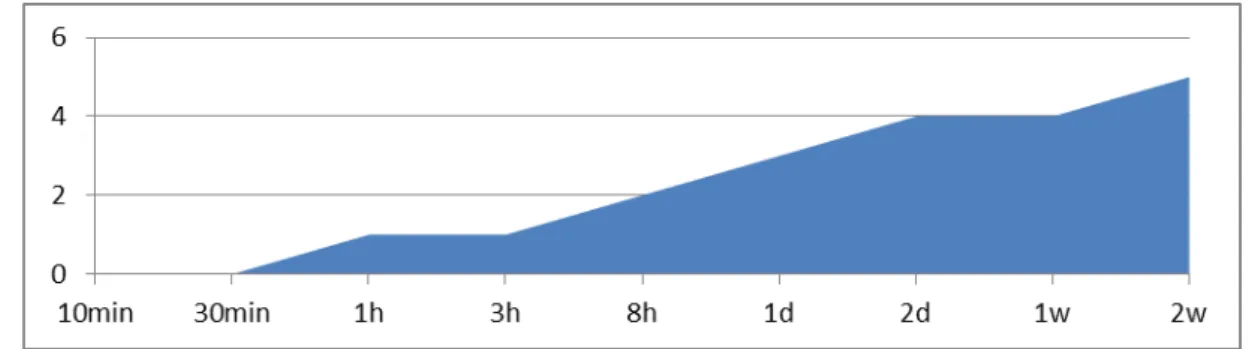
Interrupting a service for one hour is not the same as interrupting it for a day or for a month. One hour’s stoppage may be irrelevant while a day without service may cause moderate damage; but a month’s stoppage implies the termination of the activity. Unfortunately, there is no proportional relationship between the length of the downtime and its consequences.
Thus, the valuation of the [interruption of the] availability of an asset requires the use of a more complex structure, summarised in the following diagram:
Figure 8. Cost of the (interruption of the) availability
This shows a series of steps of an interruption that end with the total, permanent destruction of the assets. In the above example, stoppages of up to six hours can be withstood without consequences. But after six hours, the alarms start to ring and increase if the stoppage exceeds two days. If the stoppage exceeds one month, it could be said that the organisation has lost its operating capacity: it is dead. From the point of view of cures, the graph directly states that not a single euro must be spent to prevent stoppages of less than six hours. A certain cost is worthwhile to prevent a stoppage from exceeding six hours or two days. When evaluating the cost of preventing the stoppage from exceeding one month, the entire value of the organisation must be weighed against the cost of the safeguards - it may not be worth it.
3.1.2. Step 2: Threats
The next step is to determine the threats that may affect each asset. Threats are things that could happen to our assets and impair its value.
Threat
Events that can cause an incident in the organization, causing damage to property or intangible losses on its assets.
Threat identification
Chapter 5 of the “Elements catalogue” gives a list of typical threats.
Of natural origin
The information system is a passive victim of natural disasters (earthquakes, floods …); we have to assess what the consequences are.
Environmental (of industrial origin)
The information system is a passive victim of some industrial disasters (pollution, contamination, electric failures ...); we have to assess what the consequences are.
Application failures
There are problems caused by design and/or implementation failures that have negative consequences for the system. They are commonly called technical vulnerabilities or just “vulnerabilities”10.
10 These defects are usually known as CVE (Common Vulnerability Enumeration), an international de facto standard. Most of these defects often affect software applications.
11 Installations may catch fire but not applications. Persons may be subjected to a bacteriological attack but not services. Computer viruses affect applications but not persons. 12 Readers familiar with Magerit v1.0 will notice the absence of the “vulnerability” concept (the
potential or possibility that a threat will occur to an asset) which is incorporated using the
Accidental threats caused by people
People with access to the information system can cause unintentional problems, especially due to error or default.
Caused by people deliberately
People with access to the information system can cause intentioned problems: deliberate attacks either to get unfair advantage or with the intention of causing damages to the rightful owners.
Not all threats affect all assets11 but there is a certain relationship between the type of asset and
what could happen to it.
Valuation of threats
When an asset is the victim of a threat, not all of its dimensions are affected and not all to the same degree.
Once it has been determined that a threat may damage an asset, the exposure of the asset12 must
be estimated considering two aspects:
Degradation: The amount of damage done to the [value of the] asset.
Likelihood: How often the threat occurs.
Degradation measures the damage caused by an incident if it occurs.
Degradation is often described as a fraction of the asset’s value and therefore expressions appear such as that an active has been “totally degraded,” or “very slightly degraded”. When the threats are not intentional, it is probably enough to know the physically damaged fraction of the asset in order to calculate the proportional loss of value. But when the threat is intentional, one cannot think in such a simple-minded manner since the attacker may cause a great deal of damage indirectly. Likelihood of occurrence is more complex to determine and explain. Sometimes it is qualitatively modeled through a nominal scale:
VH very high almost certain easy H high very high medium M medium possible difficult
L low unlikely very difficult VL very low very rare extremely difficult
Table1. Value degradation
Sometimes, the likelihood is numerically modeled as a rate of occurrence. It is common to use one year as a reference, so that it uses the annual rate of occurrence as a measure of the likelihood of something happening. Typical values are:
100 very frequent daily 10 frequent monthly
1 normal annually
1/10 infrequent every few years
Table 2. Likelihood
3.1.3. Determination of the potential impact
Impact is the measurement of the damage to an asset arising from the occurrence of a threat. By knowing the value of the assets (in various dimensions) and the degradation caused by the threats, their impact on the system can be derived directly.
It should not be forgotten the dependencies between assets. Frequently, the value of the information system is on the services it provides and the data it handles while the threats usually appear in the supporting assets.
Accumulated impact
This is calculated for an asset taking into account:
• Its accumulated value (its own plus the accumulated value of the assets that depend on it). • The threats to which it is exposed.
The accumulated impact is calculated for each asset, for each threat and in each evaluation dimension, being a function of the accumulated value and of the degradation caused.
The greater the intrinsic or accumulated value of an asset, the greater the impact. The greater the degradation of the attacked asset, the greater the impact.
Because the accumulated impact is calculated on the assets that carry the weight of the information system, it allows the determination of the safeguards to be adopted in the working media: protection of equipment, back-up copies, etc.
Deflected impact
This is calculated for an asset taking into account: • Its intrinsic value.
• The threats to which the assets on which it depends are exposed.
The deflected impact is calculated for each asset, for each threat and in each valuation dimension, being a function of the intrinsic value and of the degradation caused.
The greater the intrinsic value of an asset, the greater the impact.
The greater the degradation of the attacked asset, the greater the impact. The greater dependency on the attacked asset, the greater the impact.
Because the deflected impact is calculated on assets that have their own value, it allows the determination of the consequences of the technical incidents on the mission of the information system. It is therefore a management presentation that helps in making one of the critical decisions of a risk analysis: accepting a certain level of risk.
Aggregation of impact values
The above paragraphs determine the impact of a threat on an asset in a certain dimension. These single impacts may be aggregated under certain conditions:
• The deflected impact on different assets may be aggregated.
• The accumulated impact on assets that are not inter-dependent and that do not depend on any higher asset may be aggregated.
• The accumulated impact on assets that are not independent must not be aggregated because this would imply overrating the impact by including the accumulated value of the higher assets several times.
• The impact of different threats on the same asset may be aggregated although it is useful to consider to what measure the different threats are independent and may be concurrent. • The impact of a threat in different dimensions may be aggregated.
3.1.4. Determination of the potential risk
Risk is the measurement of the likely damage to the system. Knowing the impact of the threats to the assets, the risk can be derived directly simply by taking into account the likelihood of occurrence.
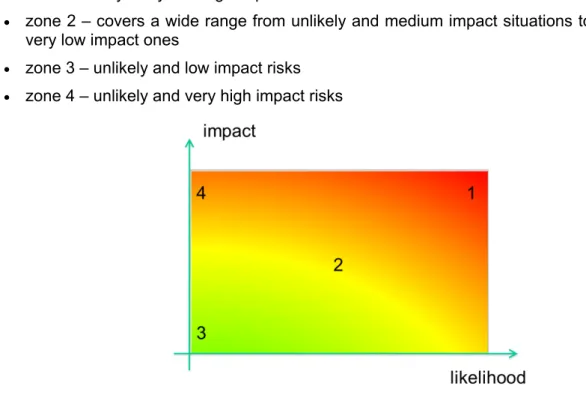
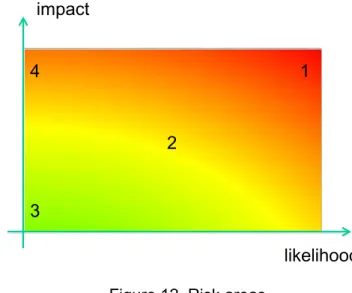
Higher impact and higher likelihood increase risk. We should consider several zones when managing risks.
• zone 1 – very likely and high impact risks
• zone 2 – covers a wide range from unlikely and medium impact situations to very likely and very low impact ones
• zone 3 – unlikely and low impact risks • zone 4 – unlikely and very high impact risks
Figure 9. Risk as a function of impact and likelihood
Accumulated risk
This is calculated for an asset taking into account:
• The accumulated impact on an asset arising from a threat. • The likelihood of threats.
The accumulated risk is calculated for each asset, for each threat and each valuation dimension, being a function of the accumulated value, the degradation caused and the likelihood of occurrence.
Because the accumulated risk is calculated on the assets that support the weight of the information system, it allows the determination of the safeguards that must be employed in the working media: protection of equipment, back-up copies, etc.
Deflected risk
This is calculated for an asset taking into account: • The deflected impact on an asset due to a threat. • The likelihood of the threat.
The deflected risk is calculated for each asset, for each threat and in each valuation dimension, being a function of the intrinsic value, the degradation caused and the likelihood of occurrence. Because the deflected risk is calculated on the assets that have intrinsic value, it allows the determination of the consequences of technical incidents on the mission of the information system. It is therefore a management presentation that helps in making one of the most critical decisions in a risk analysis: accepting a certain level of risk.
Aggregation of risks
The above paragraphs determine the risk to an asset of a threat in a certain dimension. These single risks may be aggregated under certain conditions:
• The deflected risk on different assets may be aggregated.
• The accumulated risk on assets that are not inter-dependent and do not depend on any common higher asset may be aggregated.
• The accumulated risk on assets that are not independent must not be aggregated since this would imply overrating the risk by including the accumulated value of higher assets several times.
• The risk deriving from different threats on the same asset may be aggregated, but it should be considered to what extent different threats are independent and can be concurrent,. • The risk of a threat in different dimensions may be aggregated.
3.1.5. Step 3: Safeguards
So far, safeguards have not been taken into consideration. Thus, we are evaluating the impacts and risks to which the assets would be exposed if they were not protected in any way.
Safeguards or counter-measures are procedures or technological mechanisms that reduce the risk. There are threats that can be removed simply by suitable organisation; others require technical devices (programs or equipment) while others need physical security. Finally, there is the personnel policy.
Chapter 6 of the “Elements catalogue” gives a list of suitable safeguards for each type of asset.
Selection of safeguards
Given the wide variety of safeguards, it is necessary to go through all of them and retain only those which are relevant for protecting the asset. When making the selection, we should consider the following aspects:
1. Kind of assets to be safeguarded; each asset must be safeguarded in a specific way 2. Security aspect/aspects that require to be safeguarded
3. Threats we need to be safeguarded against 4. Potential alternative safeguards
Furthermore, it is advisable to establish a principle of proportionality and take into account the following:
1. The value to protect in the asset, either intrinsic or accumulated, focusing on the most valuable assets and ignoring the irrelevant
2. The likelihood of occurrence of a threat, focusing on the most important risks (see risk zones)
3. Risk coverage provided by alternative safeguards
Therefore, there are two kinds of statements to reject a given safeguard:
• it does not apply – when a safeguard does not apply because it is not technically suitable for the assets to be protected, does not provide the necessary protection or does not protect the asset against the threat in question.
• it is not justified – when the safeguard applies but it is disproportionate to the risk.
As a result, we will have a “statement of applicability” or group of safeguards that must be analysed as part of our protection system.
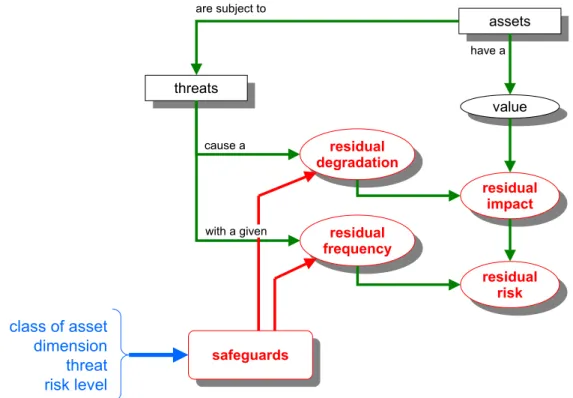
The effect of safeguards
Safeguards are taken into account in the calculation of risk in two ways: Reducing the likelihood of occurrence of threats
These ones are called preventive safeguards. Ideally, they completely prevent a threat from occurring.
Impact limitation
There are safeguards that directly limit any degradation while others allow the immediate detection of the attack to stop the escalation of the incident. There are even some safeguards that are focus on quick recovery of the system after the threat destroys it. In all of these versions, the threat occurs but the consequences are limited.
Figure 10. Elements to estimate residual risk
assets assets threats threats residual frequency residual frequency residual impact residual impact value value residual risk residual risk are subject to have a residual degradation residual degradation cause a class of asset dimension threat risk level safeguards safeguards with a given
Type of protection
It is customary to speak of different types of protection provided by the safeguards: [PR] prevention
A safeguard is preventive when it reduces the chances of the incident to happen. If the safeguard fails, and the incident occurs, the impact is not changed.
Examples: user authorisation, privilege management, …, capacity planning, …, software development standards, …, testing before deploying, …, separation of duties, …
[DR] deterrence
A safeguard deters attackers when these ones do not dare to attack. If the safeguard is not effective enough, the attack will occur, the impact is not changed.
Examples: high walls, armed guards, prosecution warnings, … [EL] elimination
A safeguard eliminates an incident when it prevents the incident from occurring. These safeguards work before the incident happens. They do not limit damages if the safeguard is not perfect, and the incident occurs.
Examples: removing standard user accounts, accounts without a strong password, unnecessary services, in general any activity that bastions an asset,…, channel encryption, …, fire-proof cabinets, …
[IM] impact minimization
A safeguard minimizes impact when it does not prevent the incident to occur, but limits the consequences.
Examples: network isolation upon intrusion detection, services halt when attacked, insurance, law compliance, …
[CR] correction
A safeguard is corrective when it actuates after the incident or attack has occurred, repairing the damages.
See recovery below.
Examples: incident management, alternative communication lines, alternative power supplies, …
[RC] recovery
Safeguards that, after the incident has occurred, are able to recover the previous situation after a while. The incident is not less likely, but the consequences are limited.
Examples: back-up copies, … [MN] monitoring
Monitoring safeguards discover incidents by inspecting activity logs. If the safeguard is fast enough, it may enable reaction or recovery safeguards. If the safeguard is not fast enough to act on real time, the discoveries are still useful to learn from the experience, and improve the security.
Examples: activity logs, web download log, … [DC] detection
Safeguards that detect incidents and enables or fires immediate reaction. Examples: anti-virus, IDS, smoke detectors, …
[AW] awareness
Awareness safeguards are those ones devoted to improve the capabilities of the people that may interact with the system. Awareness reduces unintentional errors. Training of operators improves the reaction time to incidents, and the performance of recovery safeguards.
Examples: personnel training, … [AD] administration
Administrative safeguards are those ones devoted to check every element of the system, preventing anything to work unnoticed. A good administrative safeguard impedes open doors that might be exploited.
Examples: inventory of assets, …, risk analysis, …, continuity plan, …
The following table links each kind of protection with the former model (decreasing degradation and likelihood):
effect type of protection preventive: reduce likelihood [PR] prevention
[DR] deterrence [EL] elimination
reduce degradation [IM] impact minimization [CR] corrective
[RC] recovery strengthen the effect of the other [MN] monitoring
[DC] de detection [AW] awareness [AD] administrative
Table2. Safeguard types
Effectiveness of safeguards
Safeguards are characterized by their effectiveness against the risk they intend to counter. The ideal safeguard is 100% effective; this effectiveness includes two factors:
From the technical point of view:
• It is technically suitable to confront the risk • It is always on
From the point of view of the safeguard operation
• It is perfectly deployed, configured and maintained