Federal Publications Key Workplace Documents 3-1-2019
SBA Veterans Assistance Programs: An Analysis of Contemporary
SBA Veterans Assistance Programs: An Analysis of Contemporary
Issues
Issues
Robert Jay Dilger
Congressional Research Service
Sean Lowry
Congressional Research Service
Follow this and additional works at: https://digitalcommons.ilr.cornell.edu/key_workplace
Thank you for downloading an article from DigitalCommons@ILR. Thank you for downloading an article from DigitalCommons@ILR. Support this valuable resource today!
Support this valuable resource today!
This Article is brought to you for free and open access by the Key Workplace Documents at DigitalCommons@ILR. It has been accepted for inclusion in Federal Publications by an authorized administrator of DigitalCommons@ILR. For more information, please contact [email protected].
If you have a disability and are having trouble accessing information on this website or need materials in an alternate format, contact [email protected] for assistance.
Abstract Abstract
[Excerpt] This report opens with an examination of the economic circumstances of veteran-owned businesses drawn from the Bureau of the Census’s 2012 Survey of Business Owners (SBO). It then provides a brief overview of veterans’ employment experiences, comparing unemployment and labor force participation rates for veterans, veterans who have left the military since September 2001, and nonveterans. The report also describes employment assistance programs offered by several federal agencies to assist veterans in their transition from the military to the civilian labor force and examines, in greater detail, the SBA’s veteran business development programs, the SBA’s efforts to assist veterans’ access to capital, and the SBA’s veteran contracting programs. It also discusses the SBA’s Military Reservist Economic Injury Disaster Loan program and P.L. 114-38, the Veterans Entrepreneurship Act of 2015, which authorized and made permanent the SBA’s recent practice of waiving the SBAExpress loan program’s one time, up-front loan guarantee fee for veterans (and their spouse).
Keywords Keywords
Small Business Administration, military veterans, employment, entrepreneurship training
Comments Comments
Suggested Citation Suggested Citation
Dilger, R. J., & Lowry, S. (2019). SBA veterans assistance programs: An analysis of contemporary issues (CRS Report R42695). Washington, D.C.: Congressional Research Service.
SBA Veterans Assistance Programs:
An Analysis of Contemporary Issues
Updated March 1, 2019
Congressional Research Service
https://crsreports.congress.gov R42695
Summary
Several federal agencies, including the Small Business Administration (SBA), provide training and other assistance to veterans seeking civilian employment. For example, the Department of Defense (DOD), in cooperation with the SBA, Department of Labor, Department of Veterans Affairs, and several other federal agencies, operates the Transition Goals Plans Success program (Transition GPS), which provides employment information and entrepreneurship training to exiting military servicemembers to assist them in transitioning from the military to the civilian labor force.
In recent years, the unemployment rate among veterans as a whole has generally been similar to or lower than the unemployment rate for nonveterans 18 years and older. However, veterans who have left the military since September 2001 have experienced higher unemployment than other veterans and, in some years, higher unemployment than nonveterans. As a result, Congress has focused much of its attention on finding ways to assist veterans who have left the military since September 2001.
The SBA provides management and technical assistance services to more than 100,000 veterans each year through its various management and technical assistance training partners (e.g., Small Business Development Centers, Women’s Business Centers [WBCs], Service Corps of Retired Executives [SCORE], and Veterans Business Outreach Centers [VBOCs]). The SBA’s Office of Veterans Business Development (OVBD) also administers several programs to assist veterans, including the Operation Boots to Business: From Service to Startup initiative which is part of DOD’s Transition GPS program.
The expansion of federal employment training programs targeted at specific populations, such as women and veterans, has led some Members and organizations to ask if these programs should be consolidated. In their view, eliminating program duplication among federal business assistance programs across federal agencies, and within the SBA, would result in lower costs and improved services. Others argue that keeping these business assistance programs separate enables them to offer services that match the unique needs of various underserved populations, such as veterans. In their view, instead of considering program consolidation as a policy option, the focus should be on improving communication and cooperation among the federal agencies providing
assistance to entrepreneurs.
This report opens with an examination of the economic circumstances of veteran-owned businesses drawn from the Bureau of the Census’s 2012 Survey of Business Owners (SBO). It then provides a brief overview of veterans’ employment experiences, comparing unemployment and labor force participation rates for veterans, veterans who have left the military since
September 2001, and nonveterans. The report also describes employment assistance programs offered by several federal agencies to assist veterans in their transition from the military to the civilian labor force and examines, in greater detail, the SBA’s veteran business development programs, the SBA’s efforts to assist veterans’ access to capital, and the SBA’s veteran contracting programs. It also discusses the SBA’s Military Reservist Economic Injury Disaster Loan program and P.L. 114-38, the Veterans Entrepreneurship Act of 2015, which authorized and made permanent the SBA’s recent practice of waiving the SBAExpress loan program’s one time, up-front loan guarantee fee for veterans (and their spouse).
Contents
SBA Assistance for Veterans ... 1
An Economic Profile of Veteran-Owned Businesses ... 3
Demographics ... 4
Employment, Payroll, and Sales/Receipts ... 5
Access to Capital ... 6
Veterans’ Employment Data ... 7
Veterans’ Employment and Business Development Programs ... 8
The SBA’s Veterans Business Development Programs ... 9
Congressional Issues: Duplication of Services ... 11
Veterans’ Access to Capital ... 15
SBA’s 7(a) Loan Guaranty Program ... 15
SBA’s 504/CDC Loan Guaranty Program ... 17
SBA’s 7(a) Loan Guaranty Subprograms and Fee Waivers ... 18
Congressional Issues: Access ... 20
Federal Contracting Goals for Service-Disabled Veteran-Owned Small Businesses ... 22
The Military Reservist Economic Injury Disaster Loan Program ... 27
Concluding Observations ... 29
Tables
Table 1. Source of Capital for Veteran Business Owners Starting or Acquiring Their Businesses, 2012 ... 6Table 2. Source of Capital for Veteran Businesses Owners Expanding or Making Capital Improvements to Their Businesses, 2012 ... 7
Table 3. 7(a) Loan Guaranty Program Approvals, FY2010-FY2018 ... 16
Table 4. 504/CDC Loan Guaranty Program Approvals, FY2010-FY2018 ... 17
Table 5. Federal Contracting Goals and Percentage of FY2017 Federal Contract Dollars Awarded to Small Businesses, by Type ... 23
Contacts
Author Information ... 30SBA Assistance for Veterans
The Small Business Administration (SBA) administers several programs to support small business owners and prospective entrepreneurs. For example, it provides education programs to assist with business formation and expansion; loan guaranty programs to enhance small business owners’ access to capital; and programs to increase small business opportunities in federal contracting, including oversight of the service-disabled veteran-owned small business federal procurement goaling program.1 The SBA also provides direct loans for owners of businesses of
all sizes, homeowners, and renters to assist their recovery from natural disasters.
The Military Reservist Economic Injury Disaster Loan (MREIDL) program is also of interest to veterans. It provides direct loans of up to $2 million to small business owners who are not able to obtain credit elsewhere meet ordinary and necessary operating expenses that they could have met but are not able to because an essential employee has been called up to active duty in his or her role as a military reservist or member of the National Guard due to a period of military conflict.2
The SBA provides management and technical assistance to more than 100,000 veterans each year through its various training partners (e.g., Small Business Development Centers, Women’s Business Centers, SCORE [formerly the Service Corps of Retired Executives], and Veterans Business Outreach Centers [VBOCs]). In addition, the SBA’s Office of Veterans Business Development (OVBD) administers several programs to assist veteran-owned small businesses.3
The SBA’s OVBD received an appropriation of $12.7 million for FY2018.4
The SBA has always assisted veteran small business owners and aspiring veteran entrepreneurs. In recent years, they have focused increased attention on assisting veterans transition from the military to the civilian labor force. For example, the SBA’s OVBD, in partnership with Syracuse University, launched the Operation Boots to Business: From Service to Startup initiative for transitioning servicemembers in July 2012. The program consists of a two-day introductory course on entrepreneurship followed by an eight-week, on-line course to prepare
servicemenmbers and military spouses “for post-service career success as business owners.”5
1 For further information and analysis concerning the Small Business Administration’s (SBA’s) entrepreneurial
education programs, see CRS Report R41352, Small Business Management and Technical Assistance Training Programs, by Robert Jay Dilger. For further information and analysis concerning the SBA’s access to capital programs, see CRS Report R41146, Small Business Administration 7(a) Loan Guaranty Program, by Robert Jay Dilger and CRS Report R41184, Small Business Administration 504/CDC Loan Guaranty Program, by Robert Jay Dilger.
2 SBA, “Disaster Assistance Program: SOP 50-30-7,” May 13, 2011, p. 48, at https://www.sba.gov/sites/default/files/
sops/SOP%2050%2030%207.pdf; and 13 C.F.R. §123.508. For further information and analysis concerning the SBA’s disaster assistance loan program, see CRS Report R41309, The SBA Disaster Loan Program: Overview and Possible Issues for Congress, by Bruce R. Lindsay.
3 SBA, “FY2019 Congressional Budget Justification and FY2017 Annual Performance Report,” pp. 91-96, at
https://www.sba.gov/sites/default/files/aboutsbaarticle/SBA_FY_19_508-Final-FINAL.PDF.
4 H.Rept. 116-9, conference report accompanying P.L. 116-6, the Consolidated Appropriations Act, 2019, p. 680. The
SBA anticipated that it would spend $25.9 million on the Office of Veterans Business Development (OVBD) in FY2018, using funds from its salaries and expenses account to supplement OVBD’s appropriation. See SBA, “FY2019 Congressional Budget Justification and FY2017 Annual Performance Report,” p. 91, at https://www.sba.gov/sites/ default/files/aboutsbaarticle/SBA_FY_19_508-Final-FINAL.PDF.
5 SBA, “Operation Boots to Business: From Service to Startup,” at http://www.sba.gov/bootstobusiness; and Institute
for Veterans and Military Families, Syracuse University, “White Paper: Operation Boots to Business Veteran Entrepreneurship Assessment,” June 2016, p. 2, at https://www.sba.gov/sites/default/files/
b2b_vet_entrepreneurship_assessment.pdf. The eight-week, on-line course provides instruction on the “elements of a business plan, evaluating venture ideas, identifying components of business venture strategies and interrelations of
Congress provided the SBA’s OVBD an additional $7 million in FY2014 to expand the Boots to Business initiative “nationwide to the 250,000 yearly transitioning servicemembers in all
branches of the military.”6 The initiative’s two-day Introduction to Entrepreneurship course is
currently offered at 213 military institutions worldwide and is “a standard portion of the curricula offered at the revised Transition Assistance Program (TAP) to servicemembers.”7
TAP
isadministered by the Department of Defense (DOD) in cooperation with the Department of Labor (DOL), Department of Veterans Affairs (VA), Department of Education (DOE), Department of Homeland Security (DHS), Office of Personnel Management (OPM), and the SBA.8
Congress has approved additional appropriations to continue the initiative, and it was expanded in 2014 to include veterans of all eras, active duty servicemembers (including National Guard and Reserves), and their partner or spouse via the Boots to Business: Reboot initiative.9 In FY2017,
17,320 servicemembers participated in the Boots to Business program.10
During the 114th Congress, legislation was introduced and reported favorably by the Senate
Committee on Small Business and Entrepreneurship to provide the Boots to Business initiative statutory authorization (S. 1866, the Veterans Small Business Ownership Improvements Act of 2015). Similar legislation was introduced during the 115th Congress (S. 121, the Veterans Small
Business Ownership Improvements Act, and H.R. 5193, the Veteran Entrepreneurship Training Act of 2018). To date, nearly 70,000 servicemembers have participated in the initiative.11
The expansion of federal employment training programs targeted at specific populations, such as women and veterans, has led some Members and organizations to ask if these programs should be consolidated. In their view, eliminating program duplication among federal business assistance programs across federal agencies, and within the SBA, would lower costs and improve services. Others argue that keeping these business assistance programs separate enables them to offer services that match the unique needs of underserved populations, such as veterans. Instead of
marketing, accounting/finance, operations/production, and human resources.” See ibid., p. 15.
6 SBA, “FY2014 Congressional Budget Justification and FY2012 Annual Performance Report,” p. 52, at
https://www.sba.gov/sites/default/files/files/1-508-Compliant-FY-2014-CBJ%20FY%202012%20APR.pdf. Recommended FY2014 funding levels for the SBA’s noncredit programs are in the Explanatory Statement accompanying the Consolidated Appropriations Act, 2014 (Division E-Financial Services and General Government Appropriations Act, 2014), pp. 37-39, at http://docs.house.gov/billsthisweek/20140113/113-HR3547-JSOM-D-F.pdf.
7 Institute for Veterans and Military Families, Syracuse University, “White Paper: Operation Boots to Business Veteran
Entrepreneurship Assessment,” June 2016, p. 13, at https://www.sba.gov/sites/default/files/ b2b_vet_entrepreneurship_assessment.pdf.
8 The Department of Defense introduced a redesigned curriculum for the TAP program, called the Transition Goals
Plans Success pilot program (Transition GPS), at seven military bases in the summer of 2012. Transition GPS is now offered nationwide. It includes a five-day core program intended to ensure that servicemembers are “career ready” when they leave military service. The core curriculum includes the following modules: pre-separation counseling (4 hours), Department of Veterans Affairs benefits (6 hours), employment workshop (24 hours), financial planning (4 hours), resilient transition (1 hour), and a crosswalk between military and civilian skills that includes a “skills gap” analysis (2 hours). Transition GPS is mandatory for nearly all exiting servicemembers. See U.S. Department of Defense, “Turbo Tap,” at http://www.turbotap.org/register.tpp.
9 Institute for Veterans and Military Families, Syracuse University, “White Paper: Operation Boots to Business Veteran
Entrepreneurship Assessment,” June 2016, p. 2, at https://www.sba.gov/sites/default/files/ b2b_vet_entrepreneurship_assessment.pdf.
10 The SBA reports that the Boots for Business program had 4,514 participants in FY2013, 14,684 participants in
FY2014, 14,457 participants in FY2015, and 17,966 participants in FY2016. See SBA, “FY2019 Congressional Budget Justification and FY2017 Annual Performance Report,” p. 92, at https://www.sba.gov/sites/default/files/
aboutsbaarticle/SBA_FY_19_508-Final-FINAL.PDF.
consolidating these programs, their focus is on improving communication and cooperation among the federal agencies providing assistance to entrepreneurs.
This report examines the economic circumstances of veteran-owned businesses drawn from the Bureau of the Census’s 2012 Survey of Business Owners (SBO). It also provides a brief overview of veterans’ employment experiences, comparing unemployment and labor force participation rates for veterans, veterans who have left the military since September 2001, and nonveterans. The report also describes employment assistance programs offered by several federal agencies to assist veterans transitioning from the military to the civilian labor force and examines, in greater detail, the SBA’s veteran business development programs, the SBA’s efforts to enhance veterans’ access to capital, and the SBA’s veteran contracting programs.
It also discusses the SBA’s Military Reservist Economic Injury Disaster Loan programand P.L. 114-38, the Veterans Entrepreneurship Act of 2015, which authorized and made permanent the SBA’s recent practice of waiving the SBAExpress loan program’s one time, up-front loan guarantee fee for veterans (and their spouse).
An Economic Profile of Veteran-Owned Businesses
From 1972 to 2012, the U.S. Bureau of the Census’s SBO was sent every five years, for years ending in “2” and “7,” to a stratified random sample of nonfarm businesses in the United States that file Internal Revenue Service tax forms as individual proprietorships, partnerships, or any type of corporation, and with receipts of $1,000 or more.12 It asked for information about the
characteristics of the businesses and their owners. About 66% of the 1.75 million businesses that received the 2012 SBO responded.13 The SBO provided “the only comprehensive, regularly
collected source of information on selected economic and demographic characteristics for businesses and business owners by gender, ethnicity, race, and veteran status.”14
The SBO provided estimates of the number of employer and nonemployer firms and their sales and receipts, annual payroll, and employment. Data aggregates were provided by gender,
ethnicity, race, and veteran status for the United States by North American Industry Classification System (NAICS) classification; the kind of business; and state, metropolitan and micropolitan statistical area, and county. This information was combined with data collected through the Census Bureau’s main economic census and administrative records to provide a variety of searchable data products on Census’s website, http://www.census.gov/econ/sbo/, including the most detailed economic information available on veterans and veteran-owned firms.
The Census Bureau has discontinued the SBO and is currently collecting data on business
receipts, payroll, and employment by demographic characteristics, such as gender, ethnicity, race, and veteran, status through its new, annual American Business Survey (ABS). The first set of data from the ABS is scheduled to be released in December 2019.15 Although now somewhat dated,
12 U.S. Bureau of the Census, “Methodology – 2007 Survey of Business Owners,” at http://www.census.gov/econ/sbo/
methodology.html?2007; and U.S. Bureau of the Census, “Methodology - 2012 Survey of Business Owners,” at http://www.census.gov/econ/sbo/methodology.html.
13 U.S. Bureau of the Census, “Methodology - 2012 Survey of Business Owners,” at http://www.census.gov/econ/sbo/
methodology.html.
14 U.S. Bureau of the Census,“Survey of Business Owners (SBO),” at https://www.census.gov/econ/overview/
mu0200.html.
15 U.S. Bureau of the Census, “Census Bureau Announces New 2017 Annual Business Survey,” at
the 2012 SBO provides the most detailed economic information available on veterans and veteran-owned firms.
Demographics
The Bureau of the Census estimates that in 2012 about 9.2% of nonfarm firms in the United States (2.54 million of 27.62 million) were owned by veterans.16 Four states had more than
100,000 veteran-owned firms: California (254,873), Texas (215,217), Florida (187,074) and New York (138,670). Of the 2.54 million veteran-owned, nonfarm firms in 2012,
82.3% (2.09 million) had no paid employees and 17.7% (450,807) had paid employees. This ratio is similar to comparable national figures of 80.4% (22.20 million) with no paid employees and 19.6% (5.42 million) with paid
employees.17
84.3% (2.14 million) were owned by a male, 15.1% were owned by a female (384,549), and 0.6% (14,035) were owned equally by a male and a female. Veteran-owned firms were more likely than other firms in 2012 to be owned by a male. The comparable national figures are 54.3% (14.99 million) were owned by a male, 36.0% (9.93 million) were owned by a female, and 9.0% (2.50 million) were owned equally by a male and a female.18
85.1% (2.16 million) were owned by a Caucasian, 10.7% (270,702) were owned by an African American, 2.1% (52,933) were owned by an Asian, 1.3% (34,174) were owned by an American Indian or Alaska Indian, 0.3% (7,011) were owned by a native Hawaiian or other Pacific Islander, and 2.2% (56,091) were owned by “some other race.” Veteran-owned firms were somewhat more likely than other firms in 2012 to be owned by a Caucasian and somewhat less likely to be owned by an Asian. The comparable national figures for 2012 are 78.7% (21.74 million) were owned by a Caucasian, 9.4% (2.59 million) were owned by an African American, 7.0% (1.94 million) were owned by an Asian, 1.0% (274,238) were owned by an American Indian or Alaska Indian, 0.2% (55,077) were owned by a native Hawaiian or other Pacific Islander, and 4.3% (1.18 million) were owned by “some other race.”19
16 An additional 599,335 nonfarm U.S. firms (about 2.2% of all nonfarm U.S. firms) were owned equally (50%-50%)
by veterans and nonveterans. See U.S. Bureau of the Census, “Preliminary Statistics for All U.S. Firms by Sector, Veteran Status, and Gender for the U.S. and States: 2012,” at http://factfinder.census.gov/faces/tableservices/jsf/pages/ productview.xhtml?pid=SBO_2012_00CSA02&prodType=table. Veteran status was based on self-identification. Respondents were asked to report if a business owner is a veteran of the U.S. military service including the Coast Guard. Businesses could be categorized as: veteran-owned (U.S. military service veterans own 51% or more of the equity, interest, or stock of the business); equally veteran/nonveteran-owned (50% veteran and 50% nonveteran ownership of the equity, interest, or stock of the business); or nonveteran-owned (nonveterans own 51% or more of the equity, interest, or stock of the business).
17 U.S. Bureau of the Census, “Preliminary Statistics for All U.S. Firms by Sector, Veteran Status, and Gender for the
U.S. and States: 2012,” at http://factfinder.census.gov/faces/tableservices/jsf/pages/productview.xhtml?pid= SBO_2012_00CSA02&prodType=table.
18 Ibid.
19 The total percentage exceeds 100 because each owner had the option of selecting more than one race and was
included in each race selected. See U.S. Bureau of the Census, “American Fact Finder: Preliminary Statistics for All U.S. Firms by Sector, Veteran Status, and Race for the U.S. and States: 2012,” at http://factfinder.census.gov/faces/ tableservices/jsf/pages/productview.xhtml?pid=SBO_2012_00CSA04&prodType=table.
3.3% (76,250 of the 2,299,501 reporting) were owned by an individual under the age of 35, 22.6% (520,472) were owned by an individual aged 35 to 54, and 74.5% (1,712,779) were owned by an individual aged 55 or older. Veteran-owned firms were more likely than other firms in 2012 to be owned by an individual aged 55 or older. The comparable national figures (minus veterans) for 2012 are 14.7% (2,943,446 of the 19,990,309 reporting) of nonfarm firms were owned by an individual under the age of 35; 48.1% (9,613,854) were owned by an
individual aged 35 to 54; and 37.2% (7,433,009) were owned by an individual aged 55 or older.20
7.3% (167,052 of the 2,292,035 reporting) were owned by an individual who reported that he or she had a service-connected disability.21
In addition, 99.8% of veteran-owned employer firms (441,799) had fewer than 500 employees and 0.2% (686) had at least 500 employees. This ratio is similar to comparable national figures for 2012, according to which 99.7% (5.41 million) had fewer than 500 employees and 0.3% (17,724) had at least 500 employees.22
Employment, Payroll, and Sales/Receipts
In 2012, veteran-owned firms employed more than 5.5 million persons, reported a total payroll of $220.8 billion, and generated more than $1.47 trillion in total sales/receipts.23
Veteran-owned employer firms
employed 5.5 million persons (about 4.8% of total U.S. employment); reported a total payroll of $220.8 billion (about 4.2% of total U.S. payroll); generated $1.375 trillion in total sales/receipts (about 4.2% of total U.S.
receipts); and
had average sales/receipts of $3.1 million.24
Veteran-owned nonemployer firms
generated 6.4% ($94.5 billion) of the total sales/receipts generated by veteran-owned firms; and
had average sales/receipts of $45,198.
The comparable national figures for sales/receipts in 2012 were $6.0 million for employer firms and $47,679 for nonemployer firms.25
20 U.S. Bureau of the Census, “American Fact Finder: Statistics for Owners of Respondent Firms by Owner’s Age by
Gender, Ethnicity, Race, and Veteran Status for the U.S.: 2012,” at http://factfinder.census.gov/faces/tableservices/jsf/ pages/productview.xhtml?pid=SBO_2012_00CSCBO08&prodType=table.
21 U.S. Bureau of the Census, “American Fact Finder: Statistics for Veteran Owners of Respondent Firms by Owner’s
Service-Disabled Veteran Status and Gender for the U.S.: 2012,” at http://factfinder.census.gov/faces/tableservices/jsf/ pages/productview.xhtml?pid=SBO_2012_00CSCBO12&prodType=table.
22 U.S. Bureau of the Census, “American Fact Finder: Statistics for All U.S. Firms With Paid Employees by Industry,
Veteran Status, and Employment Size of Firm for the U.S. and States: 2012,” at http://factfinder.census.gov/faces/ tableservices/jsf/pages/productview.xhtml?pid=SBO_2012_00CSA12&prodType=table.
23 U.S. Bureau of the Census, “Preliminary Statistics for All U.S. Firms by Sector, Veteran Status, and Gender for the
U.S. and States: 2012,” at http://factfinder.census.gov/faces/tableservices/jsf/pages/productview.xhtml?pid= SBO_2012_00CSA02&prodType=table.
24 Ibid. 25 Ibid.
Access to Capital
As shown in Table 1, in 2012, veterans most frequently used personal or family savings to start or acquire a business (886,471 veterans, or 59.4% of respondents), followed by a personal or business credit card (148,856 veterans, or 10.0% of respondents), a business loan from a bank or financial institution (116,045 veterans, or 7.8% of respondents), and personal or family assets other than the owner’s savings (92,748 veterans, or 6.2% of respondents).
Table 1. Source of Capital for Veteran Business Owners Starting or Acquiring Their Businesses, 2012
Source of Capital Veteran Responses Number of Veteran Respondents Percentage of
Personal or Family Savings 886,471 59.4%
Personal or Business Credit Card 148,856 10.0
Business Loan from a Bank or Financial Institution 116,045 7.8
Personal or Family Assets Other Than the Owner’s
Savings 92,748 6.2%
Personal or Family Home Equity Loan 39,014 2.6
Business Loan or Investment from Family or Friends 20,882 1.4
Government-Guaranteed Business Loan from a Bank or
Financial Institution 9,869 0.7
Investment from Venture Capitalists 2,707 0.2
Business Loan from a Federal, State, or Local
Government 2,002 0.1
Grant 1,478 0.1
Other Source(s) of Capital 28,686 1.8
Did Not Need Any Capital to Start or Acquire Their
Business 353,917 17.9
Did Not Recall Where They Received the Capital to Start
or Acquire Their Business 83,047 5.6
Total Responses/Respondents 1,785,722 responses
(1,492,583 respondents)
112.5% (100.0%)
Source: U.S. Bureau of the Census, “American Fact Finder: Statistics for All U.S. Firms by Sources of Capital
Used to Start or Acquire the Business by Industry, Gender, Ethnicity, Race, and Veteran Status for the U.S.: 2012,” at http://factfinder.census.gov/faces/tableservices/jsf/pages/productview.xhtml?pid=
SBO_2012_00CSCB13&prodType=table.
Note: The sum of the number of responses for each source of capital exceeds the total number of respondents
and the sum of the percentages for each source of capital exceeds 100.0% because each owner had the option of selecting more than one source of capital.
As shown in Table 2, the source of capital most frequently used by veterans to expand or make capital improvements to an existing business in 2012 was personal or family savings (313,296 veterans, or 20.8% of respondents). The next most frequently used source of capital to expand or make capital improvements to an existing business was a personal or business credit card (114,815 veterans, or 7.6% of respondents), followed by business profits or assets (82,182 veterans, or 5.5% of respondents), and a government-guaranteed business loan from a bank or financial institution (64,499 veterans, or 4.3% of respondents).
Table 2. Source of Capital for Veteran Businesses Owners Expanding or Making Capital Improvements to Their Businesses, 2012
Source of Capital Veteran Responses Number of Veteran Respondents Percentage of
Personal or Family Savings 313,296 20.8%
Personal or Business Credit Card 114,815 7.6
Business Profits or Assets 82,182 5.5
Government-Guaranteed Business Loan from a Bank or
Financial Institution 64,499 4.3
Personal or Family Assets Other Than the Owner’s
Savings 35,220 2.3
Personal or Family Home Equity Loan 20,173 1.3
Business Loan or Investment from Family or Friends 5,923 0.4
Business Loan from a Federal, State, or Local
Government 3,062 0.2
Business Loan from a Bank or Financial Institution 1,324 0.1
Investment from Venture Capitalists 1,200 0.1
Grant 1,369 0.1
Other Source(s) of Capital 9,651 0.6
Did Not Expand or Make Capital Improvements 931,199 61.8
Wanted To Expand or Make Capital Improvements But
Could Not Obtain Funding 18,840 1.3
Did Not Recall Where They Received the Capital to
Expand or Make Capital Improvements to Their Business 101,230 6.7
Total Responses/Respondents 1,703,983 responses
(1,505,631 respondents)
113.8% (100.0%)
Source: U.S. Bureau of the Census, “American Fact Finder: Statistics for All U.S. Firms by Sources Used to
Finance Expansion or Capital Improvements by Industry, Gender, Ethnicity, Race, and Veteran Status for the U.S.: 2012” at http://factfinder.census.gov/faces/tableservices/jsf/pages/productview.xhtml?pid=SBO_2012_00CSCB28& prodType=table.
Note: The sum of the number of responses for each source of capital exceeds the total number of respondents
and the sum of the percentages for each source of capital exceeds 100.0% because each owner had the option of selecting more than one source of capital.
Veterans’ Employment Data
The Department of Labor’s Bureau of Labor Statistics (BLS) provides monthly updates of the employment status of the nation’s veterans. The BLS reports that as of January 2019, there were about 19.0 million veterans.26 There were 9.4 million veterans in the civilian labor force (i.e., they
were either employed or unemployed and available for work, except for temporary illness, and had made specific efforts to find employment sometime during the four-week period ending with
26 DOL, Bureau of Labor Statistics, “Table A-5. Employment status of the civilian population 18 years and over by
the reference week). Of those veterans in the civilian labor force, about 9.0 million were employed and about 344,000 were unemployed.27
In recent years, the unemployment rate among veterans as a whole has generally been lower than the unemployment rate for nonveterans 18 years and older. However, veterans who have left the military since September 2001 have experienced higher unemployment than other veterans and, in some years, higher than nonveterans as well. In January 2019, the unemployment rate for nonveterans 18 years and older was 4.3% which was higher than for veterans as a whole (3.7%), veterans who left the military prior to September 2001 (3.3%), and for veterans who left the military since September 2001 (4.2%).28
Veterans who have left the military since September 2001 also have a higher labor force participation rate (78.0%) than other veterans (40.0%) and nonveterans aged 18 and older (62.7%).29 The higher labor force participation rate for veterans who left the military since
September 2001 was not wholly unexpected. They entered the civilian workforce more recently and have had less time to develop a reason (e.g., health issue, family responsibility,
discouragement, retirement) to withdraw from the civilian workforce than other veterans and nonveterans aged 18 and older.
The lower labor force participation rate for other veterans was also not wholly unexpected. They entered the civilian workforce earlier and have had more time to develop a reason to withdraw from the civilian workforce than veterans who left the military since September 2001 and nonveterans aged 18 and older.30
Veterans’ Employment and Business
Development Programs
Several federal agencies, including the SBA, sponsor employment and business development programs to assist veterans in their transition from the military into the civilian labor force. As discussed, the expansion of federal employment and business development training programs targeted at specific populations, such as women and veterans, has led some Members and organizations to ask if these programs should be consolidated. Others question if the level of communication and coordination among federal agencies administering these programs has been sufficient to ensure the programs are being administered in the most efficient and effective manner.
27 Ibid. 28 Ibid. 29 Ibid.
30 A report by the Council of Economic Advisers and the National Economic Council attributed lower labor force
participation for veterans to several factors, including the difficulty many civilian employers have in understanding a military resume and how military job titles translate into civilian job skills, the presence of a service-connected disability, especially among the post-9/11 veteran population, and the number of post-9/11 veterans (about 217,000) who have been diagnosed with post-traumatic stress disorder. See Executive Office of the President, Council of Economic Advisers and the National Economic Council, “Military Skills for America’s Future: Leveraging Military Service and Experience to Put Veterans and Military Spouses Back to Work,” May 31, 2012, pp. 4-6, at
The SBA’s Veterans Business Development Programs
In an effort to assist veteran entrepreneurs, the SBA has either provided or supported management and technical assistance training for veteran-owned small businesses since its formation as an agency.31 The SBA provides management and technical assistance to more than 100,000 veterans
each year through its various training partners (e.g., Small Business Development Centers, Women’s Business Centers, SCORE [formerly the Service Corps of Retired Executives], and Veterans Business Outreach Centers [VBOCs]).32
In addition, the SBA’s OVBD administers several programs to assist veteran-owned businesses, including
the Entrepreneurship Bootcamp for Veterans with Disabilities Consortium of Universities, which provides “experiential training in entrepreneurship and small business management to post-9/11 veterans with disabilities” at eight
universities;33
the Veteran Women Igniting the Spirit of Entrepreneurship (V-WISE) program, administered through a cooperative agreement with Syracuse University, which offers women veterans a 15-day, online course focused on entrepreneurship skills and the “language of business,” followed by a 3-day conference (offered twice a year at varying locations) in which participants “are exposed to successful entrepreneurs and CEOs of Fortune 500 companies and leaders in government” and participate in courses on business planning, marketing, accounting and finance, operations and production, human resources, and work-life balance;34
the Operation Endure and Grow Program, administered through a cooperative agreement with Syracuse University, which offers an eight-week online training program “focused on the fundamentals of launching and/or growing a small business” and is available to National Guard and reservists and their family members;35
the Boots to Business initiative, which is “an elective track within the
Department of Defense’s revised Training Assistance Program called Transition Goals, Plans, Success (Transition GPS) and has three parts: the Entrepreneurship Track Overview—a 10-minute introductory video shown during the mandatory five-day Transition GPS course which introduces entrepreneurship as a post-service career option; Introduction to Entrepreneurship—a two-day classroom course on entrepreneurship and business fundamentals offered as one of the three Transition GPS elective tracks; and Foundations of Entrepreneurship—an
31 U.S. Congress, Senate Committee on Banking and Currency, Extension of the Small Business Act of 1953, report to
accompany S. 2127, 84th Cong., 1st sess., July 22, 1955, S.Rept. 84-1350 (Washington: GPO, 1955), p. 17. 32 SBA, “FY2019 Congressional Budget Justification and FY2017 Annual Performance Report,” pp. 91-96, at
https://www.sba.gov/sites/default/files/aboutsbaarticle/SBA_FY_19_508-Final-FINAL.PDF.
33 Syracuse University, “About the EBV,” Syracuse, NY, at http://whitman.syr.edu/ebv/about/.
34 Syracuse University, “Women Veterans Igniting the Spirit of Entrepreneurship (V-WISE),” Syracuse, NY, at
http://whitman.syr.edu/vwise/about.aspx.
35 Syracuse University, “About Operation Endure and Grow,” Syracuse, NY, at
week, instructor-led online course that offers in-depth instruction on the elements of a business plan and tips and techniques for starting a business”;36
the Boots to Business: Reboot initiative, which expanded the Boots to Business initiative in 2014 to include veterans of all eras, active duty servicemembers (including National Guard and Reserves), and their partner/spouse;
the Veterans Institute for Procurement (VIP) program, which is designed to increase the ability of veteran-owned businesses to win government contracts by providing “an accelerator-like, in-residence educational training program for owners, principals, and executives of veteran-owned businesses, consisting of a three-day comprehensive certification program instructed by professional service experts, government officials, and agency representatives”;37 and
the VBOC program, which provides veterans and their spouse management and technical assistance training at 22 locations, including assistance with the Boots to Business initiatives, the development and maintenance of a 5-year business plan, and referrals to other SBA resource partners when appropriate for additional training or mentoring services.38
The SBA also continues to work closely with the Interagency Task Force for Veterans Small Business Development, which was established by executive order on April 26, 2010, held its first public meeting on October 15, 2010, and issued its first report on November 1, 2011, to identify “gaps in ensuring that transitioning military members who are interested in owning a small business get needed assistance and training.”39 The task force’s second report, issued on
November 29, 2012, focused on progress made since the initial report.40 The task force continues
36 SBA, “Operation Boots to Business: From Service to Startup,” at https://www.sba.gov/offices/headquarters/ovbd/
resources/160511; SBA, “Operation Boots to Business: Fact Sheet,” at https://www.sba.gov/sites/default/files/files/ B2B_Fact%20Sheet.pdf; and SBA, “SBA Awards Funding to Nonprofit Organizations Providing “Boots to Business” Entrepreneurship Training,” at https://www.sba.gov/about-sba/sba-newsroom/press-releases-media-advisories/sba-awards-funding-nonprofit-organizations-providing-boots-business-entrepreneurship-training.
37 SBA, “FY2018 Congressional Budget Justification and FY2016 Annual Performance Report,” p. 98, at
https://www.sba.gov/sites/default/files/aboutsbaarticle/FINAL_SBA_FY_2018_CBJ_May_22_2017c.pdf.
38 SBA, Office of Veterans Business Development, “Resources: Veterans Business Outreach Center (VBOC)
Program,” at https://www.sba.gov/offices/headquarters/ovbd/resources/1548576. VBOC grants, starting at $180,000, “are made for up to a three-year period of performance, consisting of a base period of 12 months from the date of award and up to two renewal option periods of 12 months each. Exercise of the option periods will be solely at SBA’s discretion and is subject to continuing program authority, the availability of funds, and the recipient’s continued satisfactory performance and compliance.” Also, “funding per VBOC will vary based on proposed Boots to Business (B2B) program delivery and associated outreach.” See SBA, Office of Veterans Business Development, “FY 2015 Program Announcement No. VBOC-2015-02,” pp. 6-7, at https://www.sba.gov/offices/headquarters/ovbd/spotlight. In FY2013, the Veterans Business Outreach Centers Program conducted its ninth annual “Customer Satisfaction Survey.” The FY2013 survey found that 91% of the clients using the centers were satisfied or highly satisfied with the quality, relevance, and timeliness of the assistance provided. See SBA, “FY2015 Congressional Budget Justification and FY2013 Annual Performance Report,” p. 81,
https://www.sba.gov/sites/default/files/files/FY%202015%20CBJ%20FY%202013%20APR%20FINAL%20508(1).pdf
39 SBA, Office of Veterans Business Development, “Interagency Task Force,” at https://www.sba.gov/offices/
headquarters/ovbd/resources/14372; and The Interagency Task Force on Veterans Small Business Development, “Report to the President: Empowering Veterans Through Entrepreneurship,” November 1, 2011, at
https://www.sba.gov/sites/default/files/FY2012-Final%20Veterans%20TF%20Report%20to%20President.pdf.
40 The Interagency Task Force on Veterans Small Business Development, “Heroes on the Home Front: Supporting
Veteran Success as Small Business Owners,” November 29, 2012, at https://www.sba.gov/sites/default/files/files/ Veterans_Report_FINAL.pdf. The Interagency Task Force on Veterans Small Business Development includes senior-level representatives of the SBA, the Departments of Defense, Labor, Treasury, and Veterans Affairs, the General Services Administration, the Office of Management and Budget, and four representatives from veterans’ service or
to meet on a quarterly basis to foster communication and monitor agency progress in assisting transitioning servicemembers.
Congressional Issues: Duplication of Services
The SBA’s OVBD, which serves as the SBA’s focal point for its veteran assistance programs, was created by P.L. 106-50, the Veterans Entrepreneurship and Small Business Development Act of 1999. The act addressed congressional concerns that the United States generally, and the SBA in particular, was not, at that time, doing enough to meet the needs of veteran entrepreneurs, especially service-disabled veteran entrepreneurs.41 At that time, several Members of Congress
argued that “the needs of veterans have been diminished systematically at the SBA” as evidenced by the agency’s elimination of direct loans, including direct loans to veterans, in 1995; and a decline in the SBA’s “training and counseling for veterans … from 38,775 total counseling sessions for veterans in 1993 to 29,821 sessions in 1998.”42 To address these concerns, the act
authorized the establishment of the federally chartered National Veterans Business Development Corporation (known as the Veterans Corporation and reconstituted, without a federal charter, in 2012 as Veteranscorp.org).43 Its mission is to
(1) expand the provision of and improve access to technical assistance regarding entrepreneurship for the Nation’s veterans; and (2) to assist veterans, including service-disabled veterans, with the formation and expansion of small business concerns by working with and organizing public and private resources, including those of the Small Business Administration, the Department of Veterans Affairs, the Department of Labor, the Department of Commerce, the Department of Defense, the Service Corps of Retired Executives…, the Small Business Development Centers…, and the business development staffs of each department and agency of the United States.44
P.L. 106-50 reemphasized the SBA’s responsibility “to reach out to and include veterans in its programs providing financial and technical assistance.”45 It included veterans as a target group for
the SBA’s 7(a), 504 Certified Development Company (504/CDC), and Microloan lending programs. It also required the SBA to enter into a memorandum of understanding with SCORE to, among other things, establish “a program to coordinate counseling and training regarding entrepreneurship to veterans through the chapters of SCORE throughout the United States.”46 In
addition, it directed the SBA to enter into a memorandum of understanding with small business
military organizations appointed by the SBA administrator. SBA Acting Associate Administrator Barbara Carson serves as its chair. See Executive Order 13540, “Interagency Task Force on Veterans Small Business Development,” 75 Federal Register 22497-22498, April 29, 2010; and U.S. Small Business Administration, “Inter-Agency Task Force on Veterans Small Business Development: Kick Off Meeting Wednesday, September 15, 2010,” at https://www.sba.gov/ offices/headquarters/ovbd/resources/14368.
41 P.L. 106-50, the Veterans Entrepreneurship and Small Business Development Act of 1999, Section 101. Findings. 42 U.S. Congress, House Committee on Small Business, Veterans Entrepreneurship and Small Business Development
Act of 1999, report to accompany H.R. 1568, 106th Cong., 1st sess., June 29, 1999, H.Rept. 106-206 (Washington: GPO,
1999), pp. 14-15.
43 Veteranscorp, “About Us,” Oxford, MD at
http://www.veteranscorp.org/2012/01/a-new-veteranscorp-org-gets-the-chance-to-help-veteran-entrepreneurs-2/.
44 P.L. 106-50, the Veterans Entrepreneurship and Small Business Development Act of 1999, Section 33. National
Veterans Business Development Corporation. Also, see 15 U.S.C. §657c.
45 U.S. Congress, House Committee on Small Business, Veterans Entrepreneurship and Small Business Development
Act of 1999, report to accompany H.R. 1568, 106th Cong., 1st sess., June 29, 1999, H.Rept. 106-206 (Washington: GPO,
1999), p. 14.
development centers, the VA, and the National Veterans Business Development Corporation “with respect to entrepreneurial assistance to veterans, including service-disabled veterans.”47 The
act specified that the following services were to be provided:
(1) Conducting of studies and research, and the distribution of information generated by such studies and research, on the formation, management, financing, marketing, and operation of small business concerns by veterans.
(2) Provision of training and counseling to veterans concerning the formation, management, financing, marketing, and operation of small business concerns.
(3) Provision of management and technical assistance to the owners and operators of small business concerns regarding international markets, the promotion of exports, and the transfer of technology.
(4) Provision of assistance and information to veterans regarding procurement opportunities with Federal, State, and local agencies, especially such agencies funded in whole or in part with Federal funds.
(5) Establishment of an information clearinghouse to collect and distribute information, including by electronic means, on the assistance programs of Federal, State, and local governments, and of the private sector, including information on office locations, key personnel, telephone numbers, mail and electronic addresses, and contracting and subcontracting opportunities.
(6) Provision of Internet or other distance learning academic instruction for veterans in business subjects, including accounting, marketing, and business fundamentals.
(7) Compilation of a list of small business concerns owned and controlled by service-disabled veterans that provide products or services that could be procured by the United States and delivery of such list to each department and agency of the United States. Such list shall be delivered in hard copy and electronic form and shall include the name and address of each such small business concern and the products or services that it provides.48
The SBA’s OVBD was established to address these statutory requirements by promoting “veterans’ small business ownership by conducting comprehensive outreach, through program and policy development and implementation, ombudsman support, coordinated agency initiatives, and direct assistance to veterans, service-disabled veterans, reserve and National Guard members, and discharging active duty service members and their families.”49
As mentioned previously, the OVBD provides, or supports third parties to provide, management and technical assistance training services to more than 100,000 veterans each year. These services are provided
through funded SBA district office outreach; OVBD-developed and distributed materials; websites; partnering with DOD [Department of Defense], DOL [Department of Labor] and universities; agreements with regional veterans business outreach centers; direct guidance, training and assistance to Agency veteran customers; and through enhancements to intra-agency programs used by the military and veteran communities.50
47 Ibid., Section 302. Entrepreneurial Assistance. 48 Ibid.
49 SBA, “FY2013 Congressional Budget Justification and FY2011 Annual Performance Report,” p. 62, at
https://www.sba.gov/sites/default/files/files/FY%202015%20CBJ%20FY%202013%20APR%20FINAL%20508(1).pdf
50 SBA, “FY2013 Congressional Budget Justification and FY2011 Annual Performance Report,” p. 62, at
The expansion of the SBA’s veteran outreach efforts has led some Members and organizations to ask if the nation’s veterans might be better served if some of the veteran employment and business development programs offered by federal agencies were consolidated. For example, as mentioned previously, DOD, in cooperation with several federal agencies, operates the recently revised Transition Assistance Program, Transition GPS, which provides employment information and training to exiting servicemembers to assist them in transitioning from the military into the civilian labor force. In addition, DOL’s Jobs for Veterans State Grants program provides states funding for Disabled Veterans’ Outreach Program specialists and Local Veterans’ Employment Representatives to provide outreach and assistance to veterans, and their spouses, seeking employment.51 DOL also administers the Veterans Workforce Investment Program, which
provides grants to fund programs operated by eligible state and local government workforce investment boards, state and local government agencies, and private nonprofit organizations to provide various services designed to assist veterans’ transitions into the civilian labor force.52 The
DOL-administered Homeless Veterans Reintegration Program provides grants to fund programs operated by eligible state and local government workforce investment boards, state and local government agencies, and private nonprofit organizations that provide various services designed to assist homeless veterans achieve meaningful employment and to aid in the development of a service delivery system to address problems facing homeless veterans.53
Advocates of consolidating veteran employment and business development programs argue that eliminating program duplication among federal agencies would result in lower costs and
improved services. For example, H.R. 4072, the Consolidating Veteran Employment Services for Improved Performance Act of 2012, which was introduced during the 112th Congress and ordered
to be reported by the House Committee on Veterans’ Affairs on April 27, 2012, would have transferred several veteran employment training programs from the DOL to the VA.54
In addition, in 2011, 2012, 2013, 2014, and 2015, the House Committee on Small Business, in its “Views and Estimates” letter to the House Committee on the Budget, recommended that funding for the SBA’s VBOCs be either eliminated or transferred to the Department of Veterans Affairs because, as it stated in 2012, “the SBA already provides significant assistance to veterans who are seeking to start or already operate small businesses. The VBOCs duplicate services already available from the SBA, other entrepreneurial development partners and programs available from the Department of Veterans Affairs.”55 In 2014, the House Committee on Small Business also
51 For information on the Disabled Veterans’ Outreach Program and Local Veterans’ Employment Representatives
Program, see DOL, “Jobs for Veterans State Grants,” at http://www.dol.gov/vets/grants/state/jvsg.htm.
52 For further information and analysis of federal programs outside of the SBA that are designed to assist veterans
seeking civilian employment, see CRS Report R42790, Employment for Veterans: Trends and Programs, coordinated by Benjamin Collins.
53 For further information and analysis concerning the Homeless Veterans Reintegration Program, see CRS Report
RL34024, Veterans and Homelessness, by Libby Perl.
54 U.S. House of Representatives, Committee on Veterans’ Affairs, “Debunking the Myths: H.R. 4072,” at
http://veterans.house.gov/4072.
55 U.S. House of Representatives, Committee on Small Business, “Views and Estimates of the Committee on Small
Business on Matters to be set forth in the Concurrent Resolution on the Budget for Fiscal Year 2012,” March 17, 2011, at http://smallbusiness.house.gov/uploadedfiles/march_17_views_and_estimates_letter.pdf. Also, see U.S. House of Representatives, Committee on Small Business, “Views and Estimates of the Committee on Small Business on Matters to be set forth in the Concurrent Resolution on the Budget for Fiscal Year 2013,” March 7, 2012, at
http://smallbusiness.house.gov/uploadedfiles/views_and_estimates_fy_2013.pdf; U.S. House of Representatives, Committee on Small Business, “Views and Estimates of the Committee on Small Business on Matters to be set forth in the Concurrent Resolution on the Budget for Fiscal Year 2014,” February 27, 2013, at http://smallbusiness.house.gov/ uploadedfiles/revised_2014_views_and_estimates_document.pdf; U.S. House of Representatives, Committee on Small
recommended that if additional funds were to be provided to VBOCs, those funds should come from the SBA’s Boots to Business initiative.
Advocates of consolidating federal veteran employment and business development programs cite U.S. Government Accountability Office (GAO) reports that have characterized the broader category of federal support for entrepreneurs, including veteran entrepreneurs, as fragmented and having overlapping missions. For example, in 2012, GAO identified 53 programs within the SBA and the Departments of Commerce, Housing and Urban Development, and Agriculture designed to support entrepreneurs, including 36 programs that provide entrepreneurs technical assistance, such as business training, counseling, and research and development support. GAO found that “the overlap among these programs raise[s] questions about whether a fragmented system is the most effective way to support entrepreneurs” and suggested agencies should “determine whether there are more efficient ways to continue to serve the unique needs of entrepreneurs, including consolidating programs.”56
Instead of consolidating programs, some argue that improved communication and cooperation among the federal agencies providing entrepreneur support programs, and among the SBA’s management and technical assistance training resource partners, would enhance program
efficiencies while preserving the ability of these programs to offer services that match the unique needs of various underserved populations, such as veterans. For example, during the 111th
Congress, the House passed H.R. 2352, the Job Creation Through Entrepreneurship Act of 2009, on May 20, 2009, by a vote of 406-15. The Senate did not take action on the bill. In its committee report accompanying the bill, the House Committee on Small Business concluded at that time that
each ED [Entrepreneurial Development] program has a unique mandate and service delivery approach that is customized to its particular clients. However, as a network, the programs have established local connections and resources that benefit entrepreneurs within a region. Enhanced coordination among this network is critical to make the most of scarce resources available for small firms. It can also ensure that best practices are shared amongst providers that have similar goals but work within different contexts.57
The bill was designed to enhance oversight and coordination of the SBA’s management and technical assistance training programs by requiring the SBA to coordinate these programs “with State and local economic development agencies and other federal agencies as appropriate” and to “report annually to Congress, in consultation with other federal departments and agencies as appropriate, on opportunities to foster coordination, limit duplication, and improve program delivery for federal entrepreneurial development activities.”58
Business, “Views and Estimates of the Committee on Small Business on Matters to be set forth in the Concurrent Resolution on the Budget for Fiscal Year 2015,” March 25, 2014, at http://smallbusiness.house.gov/uploadedfiles/3-25-2014_revised_budget_views_and_estimates__fy_2015_v2.pdf; andU.S. House of Representatives, Committee on Small Business, “Views and Estimates of the Committee on Small Business on Matters to be set forth in the Concurrent Resolution on the Budget for Fiscal Year 2016,” February 12, 2015, at http://smallbusiness.house.gov/uploadedfiles/2-12-2015_views_and_estimates_document.pdf.
56 U.S. Government Accountability Office (GAO), 2012 Annual Report: Opportunities to Reduce Duplication, Overlap
and Fragmentation, Achieve Savings, and Enhance Revenue, GAO-12-342SP, February 28, 2012, p. 55, at
http://www.gao.gov/assets/590/588818.pdf. Also see GAO, Entrepreneurial Assistance: Opportunities Exist to Improve Programs’ Collaboration, Data-Tracking, and Performance Management, GAO-12-819, August 23, 2012, pp. 60-61, at http://www.gao.gov/assets/650/647267.pdf.
57 U.S. Congress, House Committee on Small Business, Job Creation Through Entrepreneurship Act of 2009, report to
accompany H.R. 2352, 111th Cong., 1st sess., May 15, 2009, H.Rept. 111-112 (Washington: GPO, 2009), pp. 17-18. 58 H.R. 2352, the Job Creation Through Entrepreneurship Act of 2009, Section 601. Expanding Entrepreneurship.
In a related development, as mentioned previously, the Obama Administration formed the
Interagency Task Force for Veterans Small Business Development by executive order on April 26, 2010. The SBA’s representative chairs the task force, which is composed of senior
representatives from seven federal agencies and four representatives from veterans’
organizations.59 One of the task force’s goals is to improve “collaboration, integration and focus
across federal agencies, key programs (e.g., the Transition Assistance Program), veterans’ service organizations, states, and academia.”60
On November 1, 2011, the task force issued 18 recommendations, including recommendations designed to increase and augment federal entrepreneurial training and technical assistance programs offered to veterans. For example, it recommended the development of a “standardized, national entrepreneurship training program specifically for veterans” that “could utilize expert local instructors, including academics and successful small business owners, to provide training in skills used to create and grow entrepreneurial ventures and small business. The national program could provide engaging training modules and workshops dedicated to the basics of launching a business.”61 The task force also recommended the development of a web portal “that
allows veterans to access entrepreneurship resources from across the government.”62 Since then,
the task force has met quarterly and its annual reports document its efforts to address the 18 recommendations.63
Veterans’ Access to Capital
The SBA administers several loan guaranty programs, including the 7(a) and the 504/CDC programs, to encourage lenders to provide loans to small businesses “that might not otherwise obtain financing on reasonable terms and conditions.”64
SBA’s 7(a) Loan Guaranty Program
The SBA’s 7(a) loan guaranty program is considered the agency’s flagship loan guaranty
program. Its name is derived from Section 7(a) of the Small Business Act of 1953 (P.L. 83-163, as amended), which authorizes the SBA to provide business loans to American small businesses. The 7(a) program provides SBA-approved lenders a guaranty of up to 85% of loans of $150,000 or less and up to 75% of loans exceeding $150,000, up to the program’s maximum gross loan
59 The seven federal agencies are the SBA, U.S. General Services Administration, U.S. Office of Management and
Budget, and the Departments of Defense, Labor, Treasury, and Veterans Affairs. The four veterans’ organizations are Association of State Directors of Veterans Affairs, Student Veterans of America, the American Legion, and VET-Force.
60 Interagency Task Force on Veterans Small Business Development, “Report to the President: Empowering Veterans
Through Entrepreneurship,” November 1, 2011, p. 6, at https://www.sba.gov/sites/default/files/FY2012-Final%20Veterans%20TF%20Report%20to%20President.pdf.
61 Ibid., p. 15. 62 Ibid., p. 8.
63 SBA, “Office of Veterans Business Development, Resources: Interagency Task Force on Veterans Small Business
Development,” at https://www.sba.gov/offices/headquarters/ovbd/resources/14372.
64 SBA, Fiscal Year 2010 Congressional Budget Justification, p. 30, at https://www.sba.gov/sites/default/files/
aboutsbaarticle/Congressional_Budget_Justification_2010.pdf. Also see no credit elsewhere clause in P.L. 83-163, the Small Business Act (as amended).
amount of $5 million (up to $3.75 million maximum guaranty). In FY2018, the average approved 7(a) loan amount was $420,401.65
Proceeds from 7(a) loans may be used to establish a new business or to assist in the operation, acquisition, or expansion of an existing business. Specific uses include to acquire land (by purchase or lease); improve a site (e.g., grading, streets, parking lots, and landscaping); purchase, convert, expand, or renovate one or more existing buildings; construct one or more new
buildings; acquire (by purchase or lease) and install fixed assets; purchase inventory, supplies, and raw materials; finance working capital; and refinance certain outstanding debts. The 7(a) program’s loan maturity for working capital, machinery, and equipment (not to exceed the life of the equipment) is typically 5 years to 10 years, and the loan maturity for real estate is up to 25 years. Interest rates are negotiated between the borrower and lender but are subject to maximum rates.66
As shown in Table 3, the number and amount of veteran 7(a) loan approvals have generally increased since FY2012. In FY2018, the SBA approved 60,353 7(a) loans totaling nearly $25.4 billion, including 3,084 loans to veterans (5.3%) totaling $969 million (3.8%). In FY2018, the average approved veteran 7(a) loan amount was $314,360.67
Table 3. 7(a) Loan Guaranty Program Approvals, FY2010-FY2018
($ in millions)
FY loans approved total # of 7(a)
total amount of 7(a) loans
approved # of veteran 7(a) loans approved
total amount of veteran 7(a) loans
approved 2018 60,353 $25,372 3,084 $969 2017 62,430 $25,447 3,300 $984 2016 64,074 $24,128 3,264 $1,157 2015 63,461 $23,584 3,109 $1,215 2014 52,044 $19,191 2,101 $605 2013 46,395 $17,865 2,224 $604 2012 44,376 $15,153 2,256 $597 2011 53,710 $19,640 3,269 $920 2010 47,000 $12,406 3,201 $615
Sources: U.S. Small Business Administration, “SBA Lending Statistics for Major Programs (as of 9/30/2014),” at
http://www.sba.gov/sites/default/files/aboutsbaarticle/WebsiteReport_asof9_30_2014.pdf; and “SBA Lending Statistics for Major Programs (as of 9/30/2018),” at https://www.sba.gov/sites/default/files/aboutsbaarticle/ WebsiteReport_asof_20180930.pdf.
Notes: The number of 7(a) loans approved annually is typically 10% to 20% higher than the number of loans
disbursed (e.g., a borrower decides not to accept the loan or a change in business ownership). The amount of 7(a) loans approved annually is typically 10% to 15% higher than the amount disbursed.
65 SBA, “SBA Lending Statistics for Major Programs (as of 9/30/2018),” at https://www.sba.gov/sites/default/files/
aboutsbaarticle/WebsiteReport_asof_20180930.pdf.
66 For further information and analysis concerning the SBA’s 7(a) loan guaranty program, see CRS Report R41146,
Small Business Administration 7(a) Loan Guaranty Program, by Robert Jay Dilger.
67 SBA, “SBA Lending Statistics for Major Programs (as of 9/30/2018),” at https://www.sba.gov/sites/default/files/
SBA’s 504/CDC Loan Guaranty Program
The SBA’s 504/CDC loan guaranty program is administered through nonprofit certified
development companies (CDCs). It provides long-term fixed rate financing for major fixed assets, such as land, buildings, equipment, and machinery. Of the total project costs, a third-party lender must provide at least 50% of the financing, the CDC provides up to 40% of the financing through a 100% SBA-guaranteed debenture, and the applicant provides at least 10% of the financing. The 504/CDC program’s name is derived from Section 504 of the Small Business Investment Act of 1958 (P.L. 85-699, as amended), which provides the most recent authorization for the sale of 504/CDC debentures.68 In FY2018, the average approved 504/CDC loan amount was $806,324.69
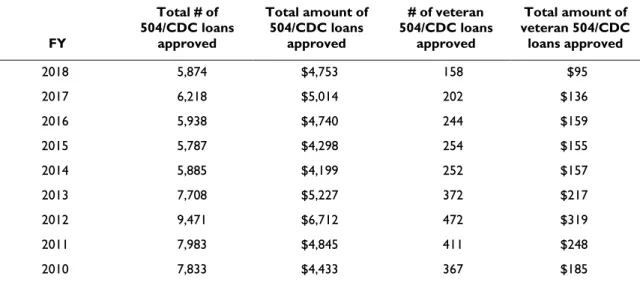
As shown in Table 4, in recent years, the amount of veteran 504/CDC loan approvals peaked in FY2012, declined in FY2013 and FY2014, increased in FY2015, FY2016, and FY2017, and declined somewhat in FY2018.
In FY2018, the SBA approved 5,874 504/CDC loans totaling $4.75 billion, including 158 loans to veterans (2.7%) totaling $95 million (2.0%). In FY2018, the average approved veteran 504/CDC loan amount was $601,202.70
Table 4. 504/CDC Loan Guaranty Program Approvals, FY2010-FY2018
($ in millions) FY Total # of 504/CDC loans approved Total amount of 504/CDC loans approved # of veteran 504/CDC loans approved Total amount of veteran 504/CDC loans approved 2018 5,874 $4,753 158 $95 2017 6,218 $5,014 202 $136 2016 5,938 $4,740 244 $159 2015 5,787 $4,298 254 $155 2014 5,885 $4,199 252 $157 2013 7,708 $5,227 372 $217 2012 9,471 $6,712 472 $319 2011 7,983 $4,845 411 $248 2010 7,833 $4,433 367 $185
Sources: U.S. Small Business Administration, “SBA Lending Statistics for Major Programs (as of 9/30/2014),” at
http://www.sba.gov/sites/default/files/aboutsbaarticle/WebsiteReport_asof9_30_2014.pdf; and “SBA Lending Statistics for Major Programs (as of 9/30/2018),” at https://www.sba.gov/sites/default/files/aboutsbaarticle/ WebsiteReport_asof_20180930.pdf.
Notes: Based on previous experience, the number of 504/CDC loans approved is typically about 4% to 5%
higher than the actual number of loans disbursed (e.g., some borrowers decide not to accept the loan or there is a change in ownership); and the amount of debentures (loans) approved is typically 10% to 12% higher than the amount of debentures disbursed.
68 For further information and analysis concerning the SBA’s 504 Certified Development Company (504/CDC) loan
guaranty program, see CRS Report R41184, Small Business Administration 504/CDC Loan Guaranty Program, by Robert Jay Dilger.
69 SBA, “SBA Lending Statistics for Major Programs (as of 9/30/2018),” at https://www.sba.gov/sites/default/files/
aboutsbaarticle/WebsiteReport_asof_20180930.pdf.
SBA’s 7(a) Loan Guaranty Subprograms and Fee Waivers
The SBA administers several 7(a) loan guaranty subprograms that offer streamlined and
expedited loan procedures to encourage lenders to provide loans to specific groups of borrowers identified by the SBA as having difficulty accessing capital. In the past, the Patriot Express program (2007-2013) encouraged lenders to provide loans to veterans and their spouses. It provided loans of up to $500,000 (with a guaranty of up to 85% of loans of $150,000 or less and up to 75% of loans exceeding $150,000).71
The SBA considered the Patriot Express program a success, but some veterans’ organizations expressed concern that many veterans, especially during and immediately following the Great Recession (December 2007 to June 2009), experienced difficulty finding lenders willing to provide them Patriot Express loans.72 In addition, GAO reported in September 2013 that with the
exception of loans approved in 2007, Patriot Express loans defaulted at a higher rate than regular 7(a) loans and loans made under the SBAExpress program (a 7(a) loan guaranty subprogram offering streamlined borrower application and lender approval procedures).73 Over its history, the
Patriot Express program disbursed 9,414 loans totaling more than $791 million.74
On January 1, 2014, the SBA implemented a new, streamlined application process for 7(a) loans
of $350,000 or less. As part of an overall effort to streamline and simplify its loan application
process, the SBA also eliminated several 7(a) subprograms, including the Patriot Express program. In anticipation of ending the Patriot Express program, the SBA announced on No