International Conference on Knowledge Transfer, 2015,
Putrajaya Marriott Hotel, MALAYSIA, 1-3 December 2015
Solving Airport Gate Allocation Problem using Simulated Kalman Filter
Zulkifli Md Yusof, Siti Nurzulaikha Satiman, Kamil Zakwan Mohd Azmi, Badaruddin
Muhammad, Saifudin Razali, and Zuwairie Ibrahim
Faculty of Electrical and Electronics Engineering
Universiti Malaysia Pahang, 26600 Pekan, Pahang, Malaysia
[email protected]
Zulfakar Aspar
Faculty of Electrical Engineering
Universiti Teknologi Malaysia Pahang, 81310 Johor Bahru, Johor, Malaysia
Suraya Ismail
Wise Aviation Sdn. Bhd.
Abstract
Airport gate allocation problem refers to the search for optimal assignment of flights to gates at an airport. Assignment of flight to gates has become very complex nowadays, especially for a big size airport. In this study, the airport gate allocation problem is solved using a recently introduced meta-heuristic called simulated Kalman filter (SKF). The SKF is driven by the estimation capability of a well-known Kalman filter. The objective of this study is to minimize the total walking distance. Since the airport gate allocation problem is a combinatorial optimization problem, the original SKF is extended such that it can be used to solve combinatorial optimization problems. A small case study with 15 flights and 16 gates has been chosen. Preliminary results show that SKF is a promising algorithm for solving the airport gate allocation problem.
Keywords: Airport Scheduling, Gate Assignment, Simulated Kalman Filter, Walking Distance.
1. Introduction
Various approaches have been employed for solving airport gate allocation problems (AGAP) such as linear programming (Bihr, 1990), tabu search (Xu & Bailey, 2001), simulated annealing (Drexl & Nikulin, 2008), coevolutionary (Silva Garza and Campos Licastro, 2013), and genetic algorithm (Li & Xu, 2012) (Hu & Di Paolo, 2007) (Gu & Chung, 1999). Inspired by the
estimation capability of Kalman filter, we have recently introduced a novel estimation-based optimization algorithm called simulated Kalman filter (SKF) (Ibrahim et al., 2015). Since the SKF algorithm has not been applied in AGAP, this paper introduces the first application of SKF algorithm in AGAP.
The objective of AGAP is to find the optimal assignment of flights to gates at an airport. The quality of the assignment can be evaluated based on certain objectives, such as to minimize the total connection times by passengers (Xu & Bailey, 2001) (Ding, Lim, Rodrigues, and Zhu, 2004) or to minimize the total walking distance (Silva Garza and Campos Licastro, 2013).
This paper is organized as follows. At first, SKF will be briefly introduced followed by the description of the implementation of SKF in solving AGAP. Lastly, a conclusion will be provided at the end of this paper.
2. Simulated Kalman Filter
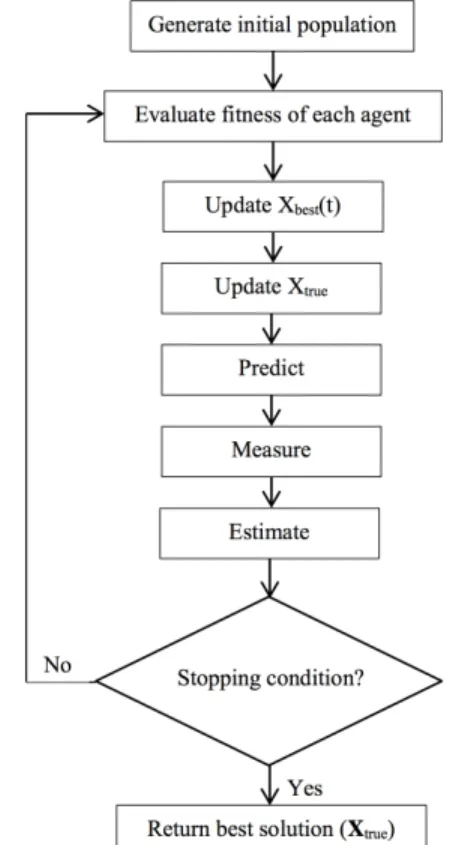
Every agent in SKF is regarded as a Kalman filter. Based on the mechanism of Kalman filtering and measurement process, every agent estimates the global minimum/maximum. Measurement, which is required in Kalman filtering, is mathematically modelled and simulated. Agents communicate among them to update and improve the solution during the search process. The simulated Kalman filter (SKF) algorithm is illustrated in Figure 1.
Consider n number of agents, SKF algorithm begins with initialization of n agents, in which the states of each agent are given randomly. The maximum number of
International Conference on Knowledge Transfer, Putrajaya Marriott Hotel, 1-3 December 2015
iterations, tmax, is defined. The initial value of error covariance estimate, 𝑃(0), the process noise value, 𝑄, and the measurement noise value, 𝑅, which are required in Kalman filtering, are also defined during initialization stage.
Then, every agent is subjected to fitness evaluation to produce initial solutions {X1(0), X2(0), X3(0), …, Xn -2(0), Xn-1(0), Xn(0)}. The fitness values are compared
and the agent having the best fitness value at every iteration, t, is registered as Xbest(t). For function
minimization problem,
𝑿𝐛𝐞𝐬𝐭 𝑡 = min1∈3,….,7𝑓𝑖𝑡1(𝑿 𝑡 ) (1) whereas, for function maximization problem,
𝑿𝐛𝐞𝐬𝐭 𝑡 = max
1∈3,….,7𝑓𝑖𝑡1 𝑿 𝑡 (2) The-best-so-far solution in SKF is named as Xtrue. The Xtrue is updated only if the Xbest(t) is better
((𝑿𝐛𝐞𝐬𝐭 𝑡 < 𝑿𝐭𝐫𝐮𝐞 for minimization problem, or 𝑿𝐛𝐞𝐬𝐭 𝑡 > 𝑿𝐭𝐫𝐮𝐞 for maximization problem) than the
Xtrue.
The subsequent calculations are largely similar to the predict-measure-estimate steps in Kalman filter. In the prediction step, the following time-update equations are computed.
𝑿𝒊 𝑡|𝑡 = 𝑿𝒊 𝑡 (3) 𝑃 𝑡|𝑡 = 𝑃 𝑡 + 𝑄 (4) where Xi(t) and Xi(t|t) are the current state and current
transition/predicted state, respectively, and P(t) and
P(t|t) are the current error covariant estimate and current transition error covariant estimate, respectively. Note that the error covariant estimate is influenced by the process noise, Q.
The next step is measurement, which is a feedback to estimation process. Measurement is modelled such that its output may take any value from the predicted state estimate, 𝑿1 𝑡|𝑡 , to the true value, 𝑿CDEF. Measurement,
Zi(t), of each individual agent is simulated based on the
following equation: 𝒁𝒊 𝑡 = 𝑿𝒊 𝑡|𝑡 +
sin 𝑟𝑎𝑛𝑑×2𝜋 × 𝑿𝒊 𝑡|𝑡 − 𝑿𝒕𝒓𝒖𝒆 (5) The sin 𝑟𝑎𝑛𝑑×2𝜋 term provides the stochastic aspect of SKF algorithm and 𝑟𝑎𝑛𝑑 is a uniformly distributed random number in the range of [0,1].
The final step is the estimation. During this step, Kalman gain, 𝐾(𝑡), is computed as follows:
𝐾 𝑡 =Z [|[ \]Z [|[ (6) Then, the estimation of next state, Xi(t+1), and the
updated error covariant are computed based on Eqn. (7) and Eqn. (8), respectively.
𝑿1 𝑡 + 1 = 𝑿1 𝑡|𝑡 + ∆i (7)
𝑃 𝑡 + 1 = 1 − 𝐾 𝑡 × 𝑃 𝑡|𝑡 (8) where ∆i = 𝐾 𝑡 × (𝒁1 𝑡 − 𝑿1 𝑡|𝑡 ). Finally, the next iteration is executed until the maximum number of iterations, tmax, is reached.
Figure 1. The original simulated Kalman filter (SKF) algorithm.
In order to solve a combinatorial optimization problem using SKF, the ∆i term in Eqn. (7) is mapped
into a probabilistic value [0,1]. Then the probabilistic value will be compared with a random number [0,1] to update a bit string or solution.
For solving combinatorial optimization problem using SKF, most of the calculations are similar to the original SKF. Modifications are needed only during initialization and generation of solution to combinatorial optimization problem.
During the initialization of agents, a random bit string, Σ1 , is generated for each agent. Each bit in the bit string is associated to a dimension. The length of the bit string is problem dependent and subjected to the size of the problem.
In binary gravitational search algorithm (BGSA) (Rashedi, Nezamabadi & Saryazdi, 2010), a function shown in Figure 2 is used to map a velocity value into a probabilistic value within interval [0,1]. Similar function is used in this study. The term ∆i is mapped to
a probabilistic value within interval [0,1] using a probability function, 𝑆(∆𝑖 𝑡 ), as follows:
𝑆 ∆𝑖 𝑡 = tanh ∆𝑖 𝑡 (9) After the 𝑆 ∆𝑖 𝑡 is calculated, a random number,
rand, is generated and a binary value at dimension d of an ith agent, Σ1c, is updated according to the following rule:
International Conference on Knowledge Transfer, Putrajaya Marriott Hotel, 1-3 December 2015
Figure 2. A probabilistic function (Rashedi, Nezamabadi & Saryazdi, 2010). Table 1. Flight arrival from Penang. Departure
(PENANG) Arrive (KLIA) Flight Number
06:50 07:50 F2 08:35 09:35 F1 11:20 12:20 F2 13:10 14:10 F1 14:10 15:10 F2 17:10 18:10 F1 18:20 19:20 F2 19:25 20:25 F3 20:55 21:55 F1 23:30 00:20 F2
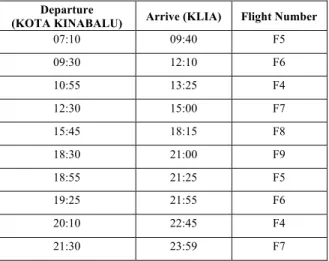
Table 2. Flight arrival from Kota Kinabalu. Departure
(KOTA KINABALU) Arrive (KLIA) Flight Number
07:10 09:40 F5 09:30 12:10 F6 10:55 13:25 F4 12:30 15:00 F7 15:45 18:15 F8 18:30 21:00 F9 18:55 21:25 F5 19:25 21:55 F6 20:10 22:45 F4 21:30 23:59 F7
Table 3. Flight arrival from Kuching. Departure
(KUCHING) Arrive (KLIA) Flight Number
07:00 08:45 F11 09:20 11:00 F10 10:40 12:25 F13 11:55 13:45 F12 15:05 16:45 F11 16:15 17:55 F10 17:35 19:20 F13 18:30 20:15 F12 19:10 21:00 F14 19:45 21:25 F15 22:50 00:50 F10 if 𝑟𝑎𝑛𝑑 < 𝑆 ∆𝑖 𝑡 then Σ1c 𝑡 + 1 = complementΣ 1c 𝑡 + 1 else Σ1c 𝑡 + 1 = Σ 1 c 𝑡 + 1 end (10)
3. Airport Gate Allocation Problem
The AGAP involves a number of parameters as follows:
n number of flights
m number of gates
w number of time windows
𝜔k walking distance between gate k and
entrance/exit
Once a flight arrived at an assigned gate, the passengers have to walk from the date to the entrance/exit hall. In this study, the objective is to minimize the total walking distance between gates and an entrance/exit. This objective is mathematically represented as
𝑚𝑖𝑛 𝑥1g h 1i3 𝜔g where
𝑥1g ∈ {0,1} 1 iff time window i is assigned to gate k; 0 otherwise.
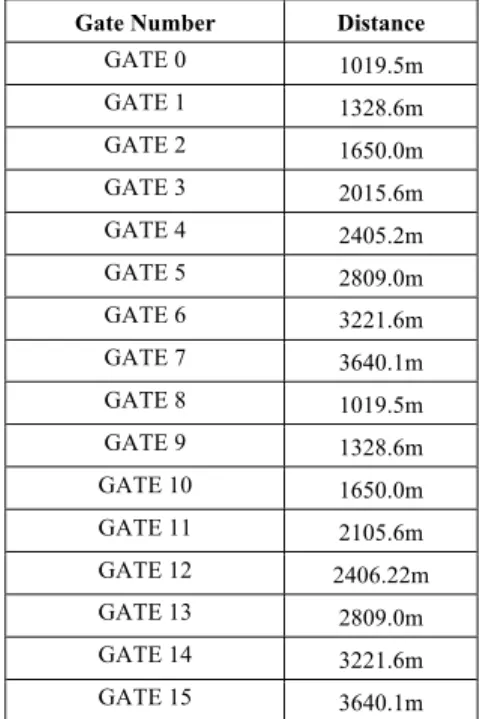
In this paper, only flights arrive from Penang, Kota Kinabalu, and Kuching at KLIA are considered as a case study. The arrival time of those flights are tabulated in Table 1, Table 2, and Table 3. This information is obtained from Malaysian Airlines website (http://www.malaysiaairlines.com). Based on this case study, the number of flights, n = 15. Also, number of gates, m = 16, is considered and the distance between gates (in meter) to entrance/exit is shown in Table 4.
International Conference on Knowledge Transfer, Putrajaya Marriott Hotel, 1-3 December 2015 Table 4.Distance between gates to entrance/exit.
Gate Number Distance
GATE 0 1019.5m GATE 1 1328.6m GATE 2 1650.0m GATE 3 2015.6m GATE 4 2405.2m GATE 5 2809.0m GATE 6 3221.6m GATE 7 3640.1m GATE 8 1019.5m GATE 9 1328.6m GATE 10 1650.0m GATE 11 2105.6m GATE 12 2406.22m GATE 13 2809.0m GATE 14 3221.6m GATE 15 3640.1m
In this study, a time window is defined as a duration (from the arrival to the next departure) of a flight at an airport. The time windows are obtained based on the information in Table 1, Table 2, and Table 3. A time window is associated to a flight as shown in Table 5.
4. Application of Simulated Kalman Filter
in Airport Gate Allocation Problem
The AGAP is a combinatorial optimization problem. Many combinations of time window to gate number matching exist and the best or optimal matching can be obtained by employing meta-heuristic algorithms such as SKF. In this study, solution representation as shown in Figure 3 is employed. This solution representation requires binary assignment of gates and the assignment is shown in Table 6. Since 16 gates involve in this case study, a 4-bit string is required to represent a gate.
The SKF algorithm for combinatorial optimization problem, as explained in section 2, is employed in solving AGAP. The experimental setting for SKF is shown in Table 7.
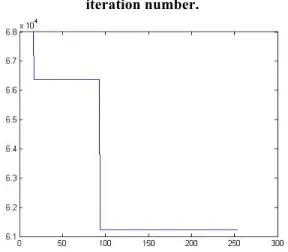
Figure 4 and Figure 5 shows two examples of convergence curve based on different maximum iteration values. The convergence curves show that the generation of better gate assignment can be obtained using SKF algorithm. Example of solution produced by SKF algorithm is shown in Table 8 where the shortest walking distance is 6.0337m.
Table 5. Time window, flight, and duration. Time Window Flight Duration
TW1 F4 6AM – 10AM TW2 F1 7AM – 9AM TW3 F10 7AM – 9AM TW4 F7 7AM – 11AM TW5 F2 8AM – 10AM TW6 F12 8AM – 11AM TW7 F11 9AM – 12PM TW8 F8 9AM – 1 PM TW9 F1 10AM – 11AM TW10 F9 10AM – 1PM TW11 F10 12PM – 3PM TW12 F2 12PM – 2PM TW13 F5 12PM – 4PM TW14 F13 2PM – 4PM TW15 F1 2PM – 4PM TW16 F6 3PM – 7PM TW17 F2 3PM – 5PM TW18 F12 3PM – 6PM TW19 F4 4PM – 7PM TW20 F3 5PM – 6PM TW21 F7 5PM – 8PM TW22 F11 5PM – 8PM TW23 F10 6PM – 9PM TW24 F8 6PM – 10PM TW25 F1 7PM – 9PM TW26 F13 8PM – 10PM TW27 F9 9PM – 12AM TW28 F2 9PM – 10PM TW29 F16 9PM – 12AM TW30 F3 10PM – 11PM
5. Conclusion
This paper introduced the first application of SKF in AGAP. The original SKF algorithm is extended such that it can be used for solving combinatorial optimization problems such as AGAP. A small scale problem which consists of 15 flights, 16 gates, and an entrance/exit is considered in the experiments. Simulation results show that the SKF algorithm is able to minimize the total walking distance and optimal matching between flights and gates can be obtained.
The next step is to consider larger scale of problem with more flights and gates. Also, the fitness function used for the evaluation of flight-gate matching shall be improved to obtain robust solution. Different variant of SKF algorithms for combinatorial optimization problems will be considered and tested to find the best algorithm for AGAP.
6. Acknowledgement
This work is financially supported by the Knowledge Transfer Program (KTP) Fund (RDU141012) awarded by Ministry of Higher Education to Universiti Malaysia Pahang.
International Conference on Knowledge Transfer, Putrajaya Marriott Hotel, 1-3 December 2015
TW1 TW2 TW3 TW4 ••• ••• ••• TW29 TW30
XXXX XXXX XXXX XXXX XXXX XXXX XXXX XXXX XXXX
X is either 0 or 1 Figure 3. Solution representation.
Table 6. Binary assignment of each gate. Binary Representation Gate Number
0000 G0 0001 G1 0010 G2 0011 G3 0100 G4 0101 G5 0110 G6 0111 G7 1000 G8 1001 G9 1010 G10 1011 G11 1100 G12 1101 G13 1110 G14 1111 G15
Table 7. Experimental setting parameters. SKF Parameters Parameter Value Error covariant, P 1000 Process noise, Q 0.5 Measurement noise, R 0.5 Rand [0,1] xmin -100 xmax 100 Number of agents 100
Table 8.Example of solution. Time Window Gate Time Window Gate TW1 G15 TW16 G13 TW2 G10 TW17 G9 TW3 G13 TW18 G10 TW4 G11 TW19 G11 TW5 G2 TW20 G12 TW6 G6 TW21 G8 TW7 G9 TW22 G6 TW8 G13 TW23 G0 TW9 G8 TW24 G15 TW10 G2 TW25 G2 TW11 G4 TW26 G1 TW12 G14 TW27 G10 TW13 G8 TW28 G13 TW14 G4 TW29 G9 TW15 G1 TW30 G5
Figure 4. Convergence curve based on 100 iterations. In this figure, the y-axis is the total walking distance in meter (m) and x-axis is the
iteration number.
Figure 5. Convergence curve based on 250 iterations. In this figure, the y-axis is the total walking distance in meter (m) and x-axis is the iteration number.
References
Bihr, R. (1990). A Conceptual Solution to the Aircraft Gate Assignment Problem using 0,1 Linear Programming. Computers & Industrial Engineering. 19: 280–284.
International Conference on Knowledge Transfer, Putrajaya Marriott Hotel, 1-3 December 2015
Ding, H., Lim, A., Rodrigues, B. and Zhu, Y. (2004). Aircraft and Gate Scheduling Optimization at Airports. In Proceedings of the 37th Hawaii International Conference on System Sciences.
Drexl, A. and Nikulin, Y. (2008) Multicriteria Airport Gate Assignment and Pareto Simulated Annealing.
IIE Transactions. 40: 385–397.
Gu, Y. and Chung, C. A. (1999) Genetic Algorithm Approach to Aircraft Gate Reassignment Problem.
Journal of Transportation Engineering. 125: 384– 389.
Hu, X. B. and Di Paolo, E. (2007) An Efficient Genetic Algorithm with Uniform Crossover for the Multi-Objective Airport Gate Assignment Problem. In Proceedings of the IEEE Congress on Evolutionary Computation (CEC07), 55–62.
Ibrahim, Z., Abdul Aziz, N. H., Ab Aziz, N. A., Razali, S., Shapiai, M. I., Nawawi, S. W., and Mohamad, M. S. (2015). A Kalman Filter Approach for Solving Unimodal Optimization Problems. ICIC Express Letters (accepted).
Li, W. and Xu, X. (2012) Optimized Assignment of Airport Gate Configuration based on Immune Genetic Algorithm. Measuring Technology and Mechatronics Automation in Electrical Engineering. 347–355.
Rashedi, E., Nezamabadi-Pour H., and Saryazdi, S. (2010). BGSA: Binary Gravitational Search Algorithm. Natural Computing. 9: 727-745. Silva Garza, A. G. and Campos Licastro, A. P. T.
(2003). A Coevolutionary Method for Automating Airport Gate Scheduling. Proceedings of the Fourth Mexican International Conference on Computer Science.
Xu, J. and Bailey, G. (2001). The Airport Gate Assignment Problem: Mathematical Model and a Tabu Search Algorithm. In Proceedings of the 34th Hawaii International Conference on System Sciences.