123
P
art I of this two-part article, which appeared inthe Spring 2013 issue of the American Journal of Family Law, focused on major concerns relating to shared residential custody, the children’s perspective, parental confl ict, and cooperation and income. Part II discusses characteristics of fathers, outcomes for children (e.g., academic and behavioral), and stability of shared parenting. The studies referenced appear at the end of the article .
CHARACTERISTICS OF SHARED PARENTING FATHERS
An issue raised in regard to shared parenting is that these fathers are somehow “better” than other fathers to begin with. If this is true, then what-ever benefi ts are associated with shared parent-ing might have accrued even if these children had lived mainly with their mothers. To my knowledge, no study has compared the quality of father-child relationships before and after divorce to the type of parenting plan the parents chose. However, there are at least three reasons not to assume that the majority of shared parenting fathers are far “better” parents than fathers who only see their children every other weekend.
First, many “weekend” fathers say they wanted shared residential custody. For some, their work schedules or their low incomes made it unfea-sible for their children to live with them. For oth-ers, they could not afford or did not believe that they could win a legal battle for shared parenting. Consequently, these fathers yielded to the mothers’ wishes that the children live with her (70–72). In the Stanford Custody project, for example, only 30% of the fathers who wanted joint residential custody
were awarded it (62). And, according to 320 college students who lived with their mothers after their parents’ divorce, half of their fathers had wanted equal parenting time (34). We have no reliable way of determining how many fathers have wanted, but were denied or never pursued, shared residential custody. Whether or not a father has a shared par-enting plan is not the most reliable way to assess how much he may have wanted to share the par-enting, however.
It is not the aim of this article to assess how accurate fathers are in their assumptions about bias against them in family court. Some evidence suggests that the fathers might be wrong. For example, in a survey of 345 divorcing couples in North Carolina, 20% of the fathers were awarded shared parenting by a judge, versus only 5% who
Shared Residential Custody:
Review of the Research (Part II of II)
DR. LINDA NIELSENLinda Nielsen, Ed.D. is a professor of Adolescent and Educational Psychology at Wake Forest University in Winston Salem North Carolina. Her areas of expertise are father-daughter relationships and shared parenting after divorce. Her work on fathers and daughters, with an emphasis on divorced fathers, has been featured on PBS, NPR and in numerous magazines and newspapers internationally. In addition to numerous journal articles, she has written four books on father-daughter relation-ships and a college textbook on adolescent psychology. A member of the Association of Family and Conciliation Courts and the Southeastern Psychological Association, she has made numerous presentations on shared par-enting and divorced fathers and has served as an expert witness on shared parenting research. More information about her work is available on her website www.wfu. edu/~nielsen or through email [email protected].
had reached their shared parenting agreement with a mediator and 10% with a lawyer (73). On the other hand, lawyers and judges in several surveys have stated that there is a bias against fathers in the fam-ily courts (74–78). Likewise, in a recent study of 367 people who had been summoned for jury duty, nearly 70% said that children should live equal time with each parent. However, only 28% believed that a judge would make that decision (79). The important point is that a father who believes that a judge or his state’s custody laws are biased against fathers is less likely to try to negotiate a shared par-enting agreement than a father who believes that there is no bias. This situation is acknowledged in the legal profession as “bargaining in the shadow of the law” – meaning that even though only 10% of divorced couples have their case decided by a judge, 100% of them are nonetheless infl uenced by their state’s custody laws in regard to shared resi-dential parenting (80). Given this circumstance, it is overly simplistic to assume that those fathers who have a shared residential parenting agreement are always more dedicated or somehow “superior” to fathers whose children live with their mother.
OUTCOMES FOR CHILDREN: ACADEMIC, BEHAVIORAL, PSYCHOLOGICAL, PHYSICAL
How well do most children fare in shared par-enting families? Compared to children who live with their mother, are they signifi cantly better or worse off on measures of academic, social, psy-chological or physical well-being? The twenty fi ve studies presented in Tables 1 and 2 address these questions.
Beginning with the oldest studies, the most meth-odologically impressive is the Stanford Custody
Project, where data were collected over a four year period (1984–1988) from 1100 divorced families with 1386 children. Four years after the divorce, the dual residence adolescents were better off academically, emotionally, and psychologically than the sole resi-dence children. These children were less likely to be stressed by feeling the need to take care of their mother. On the other hand, when their parents were not getting along well, these teenagers were more likely than those in sole residence to feel caught in the middle of the disagreements. Fortunately, their parents were not more likely than other divorced parents to drag them into their confl icts. Moreover, having a closer relationship with both parents gen-erally offset the negative impact of the parents’ con-fl icts. Children in both types of families were more stressed, anxious, and depressed when there were large discrepancies in their parents’ parenting styles. But the impact was the worst on the children who rarely got to spend time with their father, and not on those in dual residence. What is especially notewor-thy about this longitudinal study is that even after controlling for parents’ educations, incomes, and levels of confl ict, the shared residential children had the better outcomes (47;62).
Overnight time provides a more natural familial setting.
A number of smaller studies conducted at around the same time as the Stanford Study also found equal or better outcomes for children in shared parenting families. Four years after their parents divorce, the 11 children in dual residence were not signifi cantly different from the 89 children in dual residence in regard to stress, confusion, or insecurity (54). In a larger study, three years after the divorce, the 62 dual residence children were less depressed, stressed, and agitated than the 459 children in sole residence. What is especially note-worthy is that all of these children had similar scores on these measures at the time their parents divorced (55). In a much smaller study by the same researchers, there were no differences on these measures between the nine children in dual resi-dence and the 144 children in maternal or paternal residence. Given the very small number of shared parenting families, it is not surprising that family income, confl ict, and domestic violence accounted for half of the differences in children’s well-being
Table 1 Dual Residence Families: Changes in Parenting Plans over Time
Years Separated Unchanged
Brotsky 1.5 80% Cashmore 2–4 55% Kaspiew 3–4 70% Kline 2 80% Lodge 2–3 67% Maccoby 3.5 50% McIntosh 4 65% Melli 3 90%
in all families. In a San Francisco study where par-ents were receiving free counseling for their ongo-ing confl icts, the children in the 26 dual residence families were better off in regard to stress, anxiety, behavioral problems, and adjustment to moving between homes than the children in the 13 sole residence families. It is important to note that the children whose parents needed the most counsel-ing initially to make shared parentcounsel-ing work ended up as well off as children whose parents initially were getting along fairly well (53). Similarly in a
Canadian study, 85% of the shared parenting cou-ples said that they felt close to their children and that the children had adapted well to living in two homes (52).
SIMILAR CONCLUSIONS IN MOST AMERICAN STUDIES
More recent American studies reach simi-lar conclusions. In the Wisconsin study with
Table 2 Outcomes for Children
Shared Residence (35–50% Overnight time Share) or Sole Residence
Shared/Sole Cognitive Academic Psychological & Emotional Delinquency Drug/ Alcohol Aggression Physical Health Relation-ship with Parents
Bjarnason 2200 25,578 better better
Breivik 41 409 equal better better
Brotsky 26 13 better better
Buchannan 97 150 better better better better better
Cashmore
*CSA 440 148 better better better
* LSAC 84 473 better better better
Campana 207 272 better better
Fabricius 30 201 better
Fabricius 337 686 better
Fabricius 130 136 better better
Frank 16 90 better
Jablonska 443 2920 better
Janning 5 17 better
Kaspiew* 645 7118 better better
Kline 35 58 better equal better
Lee 20 39 better
Lodge 105 518 equal equal better
Luepnitz* 11 89 equal equal
Melli* 597 600 better better
McIntosh # 17-70 14-624 mixed mixed equal
McIntosh 42 44 better equal better
Neoh 27 37 better
Pearson* 62 459 better better
* 9 83 equal equal
Spruijt 135 350 better
* number of families, not number of children
590 shared parenting families, these children were less depressed, had fewer health problems and stress-related illnesses, and were more satisfi ed with their living arrangement than the children in the 590 sole residence families (Melli & Brown, 2008). The children were 30% less likely to have been left with babysitters or in daycare. Nearly 90% of their fathers attended school events, as compared to only 60% of the other fathers. Almost 60% of the moth-ers said that the fathmoth-ers were very involved in mak-ing everyday decisions about their children’s lives. In fact, 13% of the mothers wished that the fathers were less involved. Likewise, 80 college students from shared parenting families had fewer health problems and fewer stress-related illnesses than the 320 students who had lived in sole residence (81). For middle and high school students, children were less depressed, less aggressive, and had higher self-esteem when their divorced parents had an authori-tative rather than a permissive parenting style. But, because the 207 children in shared residence were more likely than the 272 in sole residence to have two authoritative parents, their outcomes were bet-ter (82). With younger children aged six to ten, the 20 children in shared parenting families were less aggressive and had fewer behavioral problems than the 39 children sole residence (83). In a very small convenience study with only eleven elemen-tary school children in shared parenting families, the parents and the children agreed that making friends and maintaining their contact with friends was not a problem even though the parents’ homes were in different neighborhoods (84).
International Studies
International studies have also found children in shared parenting families doing equally as well or better than other children of divorce. In a large Swedish study, the 443 children in shared parent-ing families had more close friends and had fewer problems making friends. They were no more likely than the 2920 children in sole residence to be aggressive, violent, or abuse drugs and alco-hol (85). A Norwegian study also found that 41 shared parenting adolescents were no more likely to drink or use drugs than the 409 in sole residence. However, they were less likely to smoke, to be depressed, to engage in antisocial behavior, and to have low self esteem (86). In a small Norwegian study where all 15 adolescents had lived in dual residence from three to ten years, all but one was satisfi ed with shared parenting – mainly because
it enabled them to maintain close relationships with both parents (87). Likewise, in a Dutch study with 135 adolescents in shared parenting, the girls were less depressed, less fearful, and less aggres-sive that the daughters in the 250 sole residence families (5).
Because Australia revised its custody laws in 2006 in ways that were more favorable to shared residential custody, this research has attracted considerable attention. The largest is a random national survey of 645 dual residence parents and 7118 sole residence parents one to two years after separation (57). Despite the fact that the shared par-enting couples were just as likely as others to report domestic violence before their separation, there was no evidence to suggest that this had any more negative effect on the dual residence children than those living in sole residence. Even after accounting for parents’ levels of education and violence, the shared parenting children had marginally better outcomes on the behavioral and emotional mea-sures than those in sole residence. As expected, regardless of their living arrangement, children whose parents had a history of violence had more behavioral and emotional problems.
Daughters were more than 2.2 times as likely to have diffi culty talking with their fathers.
The other large Australian government report presents data from two separate studies (59). The fi rst was a longitudinal study of 84 dual residence and 473 sole residence families with children who were fi rst assessed at ages four to fi ve and again two years later – the Longitudinal Study of Australian Children (LSAC) survey. The second was a survey of 440 parents with dual residence and 419 with sole residence (CSA). In the CSA survey, accord-ing to the fathers, the children in shared care were doing better socially, emotionally, and academi-cally. According to the mothers, the children were no better or no worse in shared care. In the LSAC study, according to teachers’ reports, at the end of the two year period, the shared care children had fewer peer problems, fewer academic diffi culties, and less hyperactive behavior than those in sole residence. Even though there was too much varia-tion in scores within each group to achieve sta-tistically signifi cant differences, the shared care children had higher scores on socio-emotional and
language development. Even though violence, fam-ily income, and parents’ educational levels were more strongly correlated with children’s outcomes than was the parenting plan, the authors conclude that, “[o]verall this research paints a positive pic-ture of shared care both in terms of parental satis-faction and children’s wellbeing.”
These conclusions are confi rmed in several smaller Australian studies. Comparing 105 ado-lescents living in shared care, 398 living with their mother and 120 living with their father, the shared care children had the best relationships with both parents, their stepparents, and their grandpar-ents two years after their pargrandpar-ents’ separation (58). Interestingly, even though the shared care parents reported being no more cooperative than the other divorced parents, their children reported them as getting along better than did the children living with the mother or their father. The shared care children were just as well adjusted socially and academically as the other children, but they were much more likely than the children who lived with their mothers to confi de in their fathers (80% versus 45%) and to say they had a close relationship with him (97% versus 65%). In small study with 27 chil-dren in shared residence, 37 in maternal residence and 24 in intact families, the children in sole resi-dence were signifi cantly more hyperactive than the others. All children’s stress levels were in the nor-mal range, although those in shared parenting had somewhat higher scores. The children were equally satisfi ed in shared or sole residency. But the parents in the shared care families were more satisfi ed and less stressed (88).
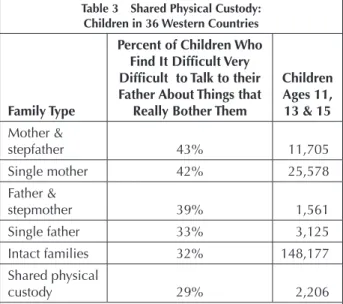
The largest, most recent and most internation-ally representative study further confi rms the ben-efi ts associated with shared parenting (89;90). Data were gathered from 36 Western countries from nearly 200,000 children: 148,177 in intact, 25,578 in single mother, 3,125 in single father, 11,705 in mother/stepfather, 1,561 in father/stepmother, and 2,206 in shared parenting families. The chil-dren were 11, 13, and 15 years olds who were in the World Health Organization’s 2005/2006 nation-ally representative data base. The shared parent-ing children were the least likely to say they had a “diffi cult” or “very diffi cult” time talking to their fathers about things that really bothered them (29%) than the other children, including the chil-dren in intact families (32%). As Table 3 illustrates, children living with their single mother or with their mother and stepfather had the most diffi -culty communicating with their fathers (42% and
43% respectively). When asking how satisfi ed they were with their lives, the children in intact fami-lies were the most content. As Table 4 illustrates, the shared parenting children were more satisfi ed with their lives than the children in all other families, except intact families. Even when the children’s perceptions of their families’ fi nancial situations were factored in, the children with separated par-ents were still less satisfi ed than those with mar-ried parents – and the shared parenting children were still the most satisfi ed.
Overall then, children in shared parenting fami-lies are better off in terms of academic, psycho-logical, emotional, and social well-being, as well as their physical health. But are there relation-ships with their fathers any more meaningful or any closer and more enduring than those children who live with their mother and see their fathers periodically?
OUTCOMES FOR CHILDREN: RELATIONSHIPS WITH PARENTS
As previously discussed, nonresidential father-ing time is closely related to the quality and the endurance of the father-child relationship. Given this correlation, fathers and children in shared par-enting families should be expected to have better relationships than those who only see each other a few days a month. But do they? Is shared parenting
Table 3 Shared Physical Custody: Children in 36 Western Countries
Family Type
Percent of Children Who Find It Diffi cult Very Diffi cult to Talk to their Father About Things that
Really Bother Them
Children Ages 11, 13 & 15 Mother & stepfather 43% 11,705 Single mother 42% 25,578 Father & stepmother 39% 1,561 Single father 33% 3,125 Intact families 32% 148,177 Shared physical custody 29% 2,206
Bjarnason, T. et al (2012). Joint physical custody and
communication with parents: A cross national study of children in 36 western countries. Children & Society, 26. 51–62.
correlated with stronger or more enduring bonds between fathers and children?
To begin, it is worth noting that even when the children live with their mother, spending overnight time in their father’s home is associated with closer relationships. For 60 adolescents, those who spent overnights at their father’s home had a closer rela-tionship with him than those who only saw him during the day. This held true even when the over-all amount of time they spent together was equal and regardless of the amount of confl ict between the parents. Apparently, overnight time provides a more natural, familial setting where children and fathers can relate in more meaningful, more relaxed ways. Then too, this kind of time together may help adolescents and their fathers experience and appre-ciate their bond in more powerful ways (29). Amount of Time Together
But are the number of days spent living with their father related to the quality of their relation-ship years after their parents’ divorce? Is their relationship any better if they spent more than a couple of weekends a month together and are greater amounts of time associated with better rela-tionships? In answering this question, the most methodologically sophisticated study is based on 1030 young adults whose parents divorced before they were sixteen (91). Nearly 400 of them had lived in shared parenting families. The number of days they lived with their fathers each month and the present quality of their relationship was highly correlated. The more days they had lived together each month, the better their relationship. The researchers also addressed the complicated question: was spending time together associated with any better relationship for those who did not have a particularly good one? In other words, for the worst relationships, was spending more time together still associated with a higher rating? To answer this question, the researchers separately analyzed data for the top 20% with the highest rat-ings and the 20% with the lowest ratrat-ings. In both groups, spending more time together was still associated with higher quality relationships. Those who lived together more of the time, had the bet-ter relationships – especially those who had lived together 35% to 50% of the time. Beyond 50% time, the quality of relationships was not highly corre-lated with time.
Many other recent studies confi rm these results. For 400 university students, almost all (93%) of the
80 students who had lived in dual residence fami-lies said that this had been the best parenting plan for them, as compared to only 30% of the other stu-dents. Nearly 70% of the sole residence students felt that it would have been in their best interests to have lived more with their father. More than half (55%) said that their fathers had wanted equal resi-dential custody, but their mothers had opposed it. Even those who spent two weekends every month with their fathers said that this was not nearly enough time together. The dual residence children had closer relationships with their fathers and their mothers than the others (34). Likewise, three years after their parents’ divorce, 80% of the children in the 597 shared parenting Wisconsin families were spending just as much time with their father and were more satisfi ed with their relationship with him. In contrast, more than half of the children in sole residence families were spending far less time with their fathers and were unhappy about this loss. A number of their relationships had ended altogether (56). In a much smaller study, the fi ve young adults from shared parenting families had better relationships with their fathers and were more likely to feel their parents had equal author-ity than the 15 who had lived with their mother and spent varying amounts of time with their father (92).
International Studies, Same Conclusions
International studies reach the same conclusion. In the Netherlands, 135 children in shared parent-ing families had as close a relationship with both parents as the 2000 children from intact families. Their relationships with their fathers were closer than the relationships of children who had spent time regularly with their father, but lived with their mother (5). Likewise, 16 Canadian college students in dual residence had better relation-ships with both parents than the 90 students who had lived with their mothers (93). In an excep-tionally large international study, as Table 4 illus-trates, data were gathered from 36 countries, where 2206 children were in dual residence and 25,578 in maternal residence. The shared parenting children communicated better with their fathers than the children in all other family types, includ-ing intact families. This is especially noteworthy in regard to daughters, since the daughters were more than 2.2 times as likely as sons to have diffi -culty talking with their fathers regardless of living arrangements (89).
Older studies reached similar conclusions. In the Stanford Custody Study, four years after their par-ents’ divorce, the dual residence adolescents had closer and more trusting relationships with their fathers than adolescents who had only spent every other weekend with their fathers (Buchanan & Maccoby, 1996). Likewise, in two smaller studies involving 110 shared parenting families one year after divorce, 90% of the mothers said that their children had good relationships with their fathers, compared to only 50% of the sole residence mothers (55).
Most adolescents wish that they had more say in when to switch homes.
Although not directly measuring the qual-ity of the father-child bond, several studies have compared the fathers’ stress and dissatisfaction in shared and in sole residence families. Stressed, unhappy fathers are less likely to interact with their children in ways that promote a meaningful rela-tionship (39). Given this, if fathers in shared parent-ing are less stressed and less dissatisfi ed than other divorced fathers, it is logical to assume that their children will probably benefi t. And indeed, fathers in shared parenting feel less stressed (88) and more satisfi ed than fathers whose children live with their mother (4;57).
In sum, children in shared parenting families generally have stronger, more enduring relation-ships with their fathers than children who lived with their mother. Leaving aside the other benefi ts associated with shared parenting, the quality and endurance of the father-child bond in and of itself is compelling data.
SHARED PARENTING: NEGATIVE OUTCOMES In contrast to the majority of studies show-ing equal or better outcomes for shared parentshow-ing families, two Australian studies by one group of researchers reached more negative conclusions (68). These two studies have received considerable media coverage, for example, in an ABC news story entitled “Shared parenting hurting children” (94). They are also frequently cited in academic journals and at professional conferences for judges, lawyers, and policymakers as arguments against shared
parenting (11;95–97) . Both studies were released in a 169-page report commissioned by the Australian government, but neither was peer-reviewed in an academic journal. Understandably, many people may only read the 20-page synopsis of this lengthy report. Unfortunately, this can lead to misunder-standings or misinterpretations of the actual data, especially if readers are not aware of the method-ological shortcomings of the studies.
First and foremost, these parents and children were not representative of most divorced families. In the fi rst study, “the data are from a small nonran-dom select group of cases – high confl ict families seeking help from community mediation” (p. 15). “The small high confl ict nature of the sample means that care should be taken not to generalize this fi nd-ing” (p. 14). A number of these parents had never been married to each other, and the children were more than twice as likely as children of divorce in other studies to test in the borderline or high cate-gory for psychological problems (p. 58). In the sec-ond study, 90% of the infants’ parents had never been married and 30% had never lived together – neither had 57% of the parents of the two to three year olds and 49% of the four to fi ve year olds. Limitations in the Australian Studies
Other methodological problems have also been pointed out by several renowned scholars (99,100). First, the sample sizes were extremely small for many of the comparisons. For instance, there were fewer than 20 mothers in several of the groups pro-viding data on children’s wheezing, irritability, visual monitoring, or persistence; and no more than 25 two to three year olds in shared care on any of the seven factors being measured. Second, for children under the age of two, shared care meant anywhere from 4 to 10 overnights a month – a very broad defi -nition that did not distinguish between parents who were providing a great deal of overnight care and those who were not. Third, “visual monitoring” was measured and interpreted in ways that have no established validity or reliability. The authors devised their own measure and then interpreted the results from their perspectives on attachment theory. They chose three questions from the Communication and Symbolic Behavior Scales and asked the moth-ers to answer “yes” or “no” to each question: “When this child plays with toys, does he/she look at you to see if you are watching? When you are not paying attention, does the child try to get your attention? Does the child try to get you to notice interesting
objects – just to get you to look at the objects, not to get you to do anything with them?” On the basis of these three questions, the researchers concluded that shared care children were worse off because these mothers said their infants and toddlers were more likely to visually monitor them.
A fourth limitation is that the authors drew con-clusions about children’s stress and parent-child attachment based on how frequently their moth-ers said that they wheezed – which is of question-able reliability and validity. Despite acknowledging that the differences were not statisti cally sig-nifi cant until they added socio-economic status (p. 135), the authors nonetheless concluded that: “[h]igher rates of wheezing in the shared group are congruent with the attachment/stress hypoth-esis. Several studies confi rm a link between nega-tive emotional family environment and the onset of asthma and wheezing in infancy.” (p. 147). The authors have made a remarkable leap of logic by implying that the stress of shared care was respon-sible for the wheezing – and that this wheezing was caused by stress, rather than by physical problems such as bronchitis and asthma, which most com-monly cause wheezing in the general population of children this age. Indeed, from infancy on, boys are nearly twice as likely as girls to have asthma. Consequently boys wheeze more than girls, with 25%–30% of infants having at least one episode of wheezing before the age of one, increasing to 40% by age four (98,101). Because there were more boys in shared care than in primary care families, espe-cially for the four to fi ve year olds, the shared care “children” (boys) would predictably have more wheezing – as would any group of children who had more boys. Second, wheezing is correlated with many environmental factors having nothing to do with stress – allergens in the child’s food, in the home (including cockroach feces, mold, and dust mites), and in the air. As for the connection between stress and wheezing, asthmatic children who wheeze the most are also the most likely to have mothers who are more anxious, depressed, stressed, and demoralized (102,103). However, this correlational data should never be used to suggest that these mothers “caused” their children’s wheez-ing. It could very well be that having an extremely asthmatic child who wheezes frequently causes mothers to become more stressed and depressed. The point is that wheezing, in and of itself, is not a valid or reliable measure of stress, and should not be used to make assumptions about stress or par-ent-child attachment in shared care families.
As is true for any lengthy report, merely read-ing the synopsis might lead to overly simplis-tic and overly negative conclusions about shared care. For example, according to the synopsis, “not surprisingly” shared care families “tended” to revert to primary mother residence and were more than twice as likely to fail if the plan came about through mediation (p. 12). Looking closely at the data, we see that 53% of the 131 families started out with shared care, decreasing to only 43% four years later. Over four years, 18% of shared care families changed to primary and 14% of primary care changed to shared, so, apparently, both types of families were about equally likely to revert to a different plan (p. 35–36). In the “more than twice as like to fail” group, there were only 23 couples – couples who had a number of factors working against them that may have had an equal or greater impact on their failure than having a mediated parenting plan. Compared to the 46 couples who maintained shared care, these 23 couples started out with more confl ict, more children, worse father-child relationships, and less income and education. Reading Reports in their Entirety
A few other examples highlight the importance of reading reports in their entirety. The synop-sis states that shared care children were the least satisfi ed of all care groups and reported the most confl ict. Later in the report, we see that 13 of the 44 children in continuous primary care and 20 of the 42 in continuous shared care were dissatis-fi ed with their arrangement – a difference of only 7 dissatisfi ed children. The least satisfi ed chil-dren were those in “rigid” shared care. But these were the families where the parents’ high ongo-ing confl icts were creatongo-ing the most distress for the children. What readers may also overlook in the synopsis is that, overall, the shared care chil-dren were not more distressed by their parents’ confl icts than primary care children. Moreover, we might have concluded that being in shared care somehow increased children’s problems with inat-tentiveness and hyperactivity, since the synopsis states that they had “greater diffi culties in atten-tion, concentraatten-tion, and task completion by the fourth year of this study” (p. 14). As it turns out, the shared and the primary care group means were within the normal range on the test for hyperactiv-ity and inattention. The only children who were in the “borderline” range (borderline x = 5.0 − 6.0 for boys) for hyperactivity/inattention were the
10 boys in “rigid” shared care whose score (x = 5.2) was much higher than the general popula-tion mean (x = 3.1) (p. 63). Then, too, the synop-sis states that amounts of overnight time were not associated with children feeling that their father was more emotionally available. This might easily confuse readers who do not read later in the report, “[g]reater amounts of overnight time with a father confi dent in his own parenting ability from the out-set was important to children’s perceptions of their fathers’ capacity to understand, be interested, and responsive to their needs” (p. 54).
Changing parenting plans over the years is not necessarily a bad thing.
Other misunderstandings might occur in regard to the synopsis statements about children under the age of three. “Infants under two years of age living with their non-resident parent for only one or more nights a week were more irritable and more watchful and wary of separation than young chil-dren primarily in the care of one parent” (p. 9 ). The shared care children “showed signifi cantly lower lev-els of persistence with routine tasks, learning, and play than children in the other two groups” (p. 17). “Thus regardless of socio economic background, parenting or inter-parental cooperation, shared overnight care of children under four years of age had an independent and deleterious impact on several emotional and behavioral regulation out-comes” and was associated with “severely distressed behaviors in their relationship with the primary parent” (p. 9). What is not stated until Appendix 1 is that the shared care infants had exactly the same irritability score as the 3851 infants from intact fami lies (x = 2.50) and had almost the same score on visual monitoring as the 4041 infants from intact families, x = 2.48 and 2.41, respectively. Moreover, the authors later acknowledge that the differ-ences in the ratings for infant irritability and visual monitoring became signifi cant only after parenting warmth, confl ict and SES were added to the model (p. 132–133). (Italics are mine)
More Nuanced Conclusion
In sum, the limitations of this study call for a more nuanced and less negative conclusion than what is offered at the end of the synopsis:
“[b]y implication shared care should not normally be the starting point for discussions about parent-ing arrangements for very young children” (p. 10). These two Australian studies are certainly not alone in having shortcomings and limitations. Indeed, all studies have their fl aws and limitations. What is troubling, however, is that they are so widely disseminated and so often cited as evidence that shared parenting is “bad” for young children. Moreover, putting so much emphasis on these two studies may lead to overlooking the more positive outcomes in the other 25 international studies: chil-dren in shared parenting families generally have equal or better outcomes on measures of emotional, behavioral, psychological, physical, and academic well-being. Above all, they generally have far better relationships with both parents than children who live with only one of their parents.
CHILDREN’S PERSPECTIVES ON SHARED PARENTING
Leaving aside the academic, behavioral, or psy-chological benefi ts, how do the children themselves feel about shared parenting? Most researchers have not asked the children how they feel about liv-ing with both parents. However, those that have are remarkably consistent in their results. So how happy or satisfi ed are most of these children? Do they feel that the stress and hassle is worth it? Or do they feel like “suitcase kids” who are “bounced around” and “homeless”?
Fortunately, most children feel the benefi ts out-weigh the hassles and inconveniences of living in two homes. In a survey with 136 Australian chil-dren, most of those in shared care liked living with both parents – mainly because they appreciated the importance of having a close relationship with both parents. Although many said it was inconvenient keeping up with their things in two homes, this was also true for children who only spent week-ends with their fathers (59). In another Australian study with 105 adolescents in dual residence, most agreed and were satisfi ed with their parents’ deci-sion (58). Similar results emerged from a British study with 73 shared parenting children. Despite having to adjust to different household rules and to make the emotional shift when changing from one home to the other, most preferred living with both parents to living with only one. Given their busy social lives, adolescents felt more inconvenienced than younger children. Some children wished they
could live in one home because they found the other parent boring, because that parent had fewer creature comforts to offer, or because they disliked a stepparent or stepsiblings. Still, most felt that having a close relationship with both parents out-weighed the hassles – and many enjoyed having a break from each parent from time to time (104). Likewise, in depth interviews with 15 Norwegian children ages nine to 18 who had lived three to 10 years in shared families found that only one of the children would have preferred to live in one home. Although some said that it would be more con-venient to live in one home, they felt dual residence was the best choice because they loved both par-ents equally (87). Similarly, in the Swedish national health and welfare study, most dual residence chil-dren said that they were glad to have the chance to develop close relationships with both parents. Although some wanted to live in only one home, they did not want to hurt their parents’ feelings by suggesting a change (8). For another 31 American adolescents living in dual residence four years after their parents’ divorce, most felt that this was the best arrangement for them (47). Likewise, 80 American college students at the University of Arizona reported that living with both parents had been in their best interests, in contrast to 70% of the other 330 students who wished that their divorced parents had allowed the children to live in both homes (34).
Overall then, most children feel that living with both parents is a sacrifi ce, a compromise, and a trade-off. But it is one they generally feel is worth making for the payoff: a better relationship with both parents. Not surprisingly, most children – especially adolescents – wish that they had more say in when to switch homes and how long to stay with each parent. Understandably though, the kind of ever-changing “fl exibility” that children would ideally like to have would be diffi cult, if not impos-sible, for most parents to provide, given their own demanding schedules at work and at home.
STABILITY OF SHARED PARENTING FAMILIES A fi nal concern about shared parenting is that these children may have a less “stable” lifestyle, meaning that these families cannot maintain this lifestyle. Consequently, these children will have to undergo the stressful ordeal of moving back to live with their mother – a move that results primarily from the stress and unhappiness of “experimenting
with” shared parenting. Several studies from 25 to 30 years ago found that many children who started out living in both homes moved back to live full-time with their mothers in a relatively short period of time. Most of these studies, however, were based on small, non-representative samples of extremely high-confl ict couples, many of whom were still in the midst of legal battles over custody (105). This kind of instability appears to be far less common today, as Table 4 illustrates.
Beginning with the oldest studies, in the Stanford Custody Study, roughly 50% of the chil-dren moved from dual to sole residence, but another 20% moved from sole to dual residence. Moreover, the moves took place over the course of four years. Most children who moved back to live with their mother full time did not move because of family stress and unhappiness. Most moved for economic reasons. Either their fathers could no longer afford to maintain housing suit-able for the children or he had to move out of town to fi nd a job. Interestingly, too, as children approached adolescence, they were more likely to move full-time to their father’s home than to their mother’s (47,62). In smaller studies from the 1980s, most dual residence families were still functioning two years after the divorce: 65% in 48 families (53), 94% of 440 families, 80% in 110 families (55) and 80% in 38 families (61). More recently, in the Wisconsin study with 597 shared parenting families, three years after their divorce
Table 4 Children’s Satisfaction with Life Compared to Children from Intact Families
After Controlling for Their Perceptions of Their Family’s Economic
Situation Intact Family Contrast Contrast
Shared custody − .26 * − .21 * Mother & stepfather − .41 * − .33 * + Single mother − .44 * − .28 * + Single father − .58 * − .49 * + Father & stepmother − .63 * − .62 * +
* Children are signifi cantly less satisfi ed than those in intact families (p<.001)
+ Children are signifi cantly more satisfi ed after factoring in their economic situation but remain statistically less satisfi ed than children in intact families.
90% of the children were still living in dual resi-dence (106). Likewise, 94% of the 440 families in a recent Australian study were still sharing the parenting two to four years after separating (59). Understandably, young, never married, low income, poorly educated ,or physically abusive couples are the least likely to succeed at maintain-ing their shared parentmaintain-ing family (68).
Overall then, shared parenting families are sta-ble when the parents have formerly been married, are not physically abusive, and are not struggling with poverty. It is also worth noting, however, that changing parenting plans over the years is not necessarily a bad thing. These changes might refl ect the kind of fl exibility that better meets dren’s needs as they age. Just because some chil-dren move from dual to sole residence or vice versa does not necessarily mean that there will be a “bad” outcome or that the family is “unstable.” “Instability” should not be confused with “fl ex-ibility.” Making a change in the initial parenting plan may mean that the parents are being fl ex-ible and responsive in ways that will benefi t their child (4).
CONCLUSION
Given what decades of research have taught us about the importance of nonresidential fathering time, the benefi ts associated with shared parent-ing, the characteristics of these parents, and the over-emphasis on divorced parents’ confl ict, it is unfortunate that this body of research continues to be ignored in a number of recent publications (italics are mine). For example, “Research shows that the best interests of children are not connected to any particular pattern of care or amount of time” (with their fathers) (95). “No convincing argu-ment can be made on behalf of shared care for the children’s benefi t.” “The research makes clear that father presence and frequency of contact in and of itself is not a signifi cant factor.” The message from this research should be clear: it is of crucial impor-tance in every case to try to minimize the degree of confl ict between the adults, even if this leads us to the now almost heretical conclusion that to con-tinue to expose the primary career and child to continuing confl ict through the promotion of con-tact with the father may be doing more harm than good. Moreover, the levels of confl ict between parents show no sign of diminishing with time (97). “It is clear from recent Australian research that
many shared care arrangements are tried out on a temporary basis but do not endure long term.” “In fact, there is little if any evidence that the mere amount or frequency of contact (with fathers) is better or worse for children” (11). Given the grow-ing popularity of shared residential parentgrow-ing, pol-icymakers and professionals who work in family court, as well as parents, should fi nd the research compelling. As demonstrated in this review, overall, these studies have reached four general conclusions:
• First and foremost, most of these children fare as well or better than those in maternal residence – especially in terms of the quality and endurance of their relationships with their fathers.
• Second, parents do not have to be exception-ally cooperative, without confl ict, wealthy, and well educated or mutually enthusiastic about sharing the residential parenting in order for the children to benefi t.
• Third, young adults who have lived in these families say that this arrangement was in their best interest – in contrast to those who lived with their mothers after their parents’ divorce.
• And fourth, our country, like most other industrialized countries, is undergoing a shift in custody laws, public opinion, and parents’ decisions – a shift towards more shared resi-dential parenting.
With the research serving to inform us, we can work together more effectively and more knowl-edgeably to enhance the well-being of children whose parents are no longer living together.
REFERENCES
1. Kelly, J. (2007) Children’s living arrangements follow-ing divorce. Family Process46, 35–52.
2. George, T. (2008) Residential time summary reports. Washington State Center for Court Research, Olympia, Wash.
3. Venohr, J., and Kaunelis, R. (2008) Child support guidelines. Family Court Review43, 415–428.
4. Smyth, B. (2009) A 5 year retrospective of shared care research in Australia. Journal of Family Studies15, 36–59. 5. Spruijt , E., and Duindam, V. (2010) Joint physical custody in the Netherlands and the well being of chil-dren. Journal of Divorce & Remarriage51, 65–82.
6. Skinner, C., Bradshaw, J., and Davidson, J. (2008) Child support policy: An international perspective. The Stationery Offi ce, London.
7. Skjorten, K., and Barlindhaug, R. (2007) The involve-ment of children in decisions about shared residence. International Journal of Law, Policy and Family21, 373–385. 8. Singer, A. (2008) Active parenting or Solomon’s jus-tice? Alternating residence in Sweden for children with separated parents. Utrech Law Review4, 35–47.
9. Toulemon, L. (2008) Two home family situations of chil-dren and adults. Institute of national demographics, Paris. 10. Masardo, A. (2009) Managing shared residence in Britain and France: Questioning a default primary carer model. In Social Policy Review (Rummery, K., Greenland, F., and Holden, C., Eds.) pp. 197–214, Polity Press, Bristol. 11. Trinder, L. (2010) Shared residence: review of recent research evidence. Family Law40, 1192–1195.
12. Amato, P., and Gilbreth, J. (1999) Nonresident fathers and children’s well being: a meta-analysis. Journal of Mar-riage and Family61, 557–573.
13. Amato, P., and Dorius, C. (2012) Fathers, children and divorce. In The Role of the Father in Child Development (Lamb, M., Ed.) pp. 177–201, John Wiley & Sons, New York. 14. Aquilino, W. (2010) Noncustodial father child rela-tionship from adolescence into young adulthood. Journal of Marriage and Family68, 929–945.
15. Dunn, J., Cheng, H., O’Connor, T., and Bridges, L. (2004) Children’s perceptions on their relationships with nonresident fathers. Journal of Child Psychology and Psychi-atry45, 553–566.
16. Harvey, J., and Fine, M. Children of divorce (2010) Routledge, New York.
17. Laumann, L., and Emery, R. (2000) Distress among young adults from divorced families. Journal of Family Psychology14, 671–687.
18. Peters, B., and Ehrenberg, M. (2008) The infl uence of parental separation on father-child relationships. Journal of Divorce & Remarriage49, 78–108.
19. Schwartz, S., and Finley, G. (2005) Divorce variables as predictors of young adults fathering reports. Journal of Divorce and Remarriage44, 144–164.
20. Struss, S., Pfeiffer, C., Preus, U., and Felder, N. (2001) Adolescents perceptions of visitation arrangements. Jour-nal of Divorce & Remarriage35, 75–89.
21. Berg, E. (2003) Effects of closeness to custodial par-ents and nonresident parpar-ents on adolescent self esteem. Journal of Divorce & Remarriage40, 69–86.
22. Dunlop, R., Burns, S., and Berminghan, S. (2001) Par-ent child relations and adolescPar-ent self image following divorce. Journal of youth and Adolescence30, 117–134. 23. Carlson, M. (2006) Family structure, father involve-ment and adolescent outcomes. Journal of Marriage and Family,68, 137–154.
24. Coley, R., and Medeiros, B. (2007) Nonresident father involvement and delinquency. Child Development 78, 132–147.
25. King, V., and Soboleski, D. (2006) Nonresident fathers’ contributions to adolescent well-being. Journal of Marriage and Family,68, 537–557.
26. Menning, C. (2006) Nonresident fathering and school failure . Journal of Family Issues27, 1356–1382.
27. Menning, C. (2006) Nonresident fathers’ involve-ment and adolescents’ smoking. Journal of Health and Social Behavior47, 32–46.
28. Booth, P., Scott, M., and King, V. (2010) Father resi-dence and adolescent problem behavior. Journal of Family Issues3, 585–605.
29. Cashmore, J., Parkinson, P., and Taylor, A. (2008) Overnight stays and children’s relationships with parents after divorce. Journal of Family Issues29, 707–733.
30. Emery, R. The truth about children and divorce (2004) Viking, New York.
31. Finley, G., and Schwartz, S. (2007) Father involve-ment and young adult outcomes. Family Court Review45, 573–587.
32. Marquardt, E. Between two worlds: Inner lives of children of divorce (2005) Crown, New York.
33. Smith, A. (2003) Re-thinking children’s involvement in decision making. Family Law Journal259, 259–266. 34. Fabricius, W. (2003) Listening to children of divorce: New Findings That Diverge From Wallerstein, Lewis, and Blakeslee. Family Relations52, 385–396.
35. Parkinson, P., Cashmore, J., and Single, J. (2005) Ado-lescents’ views on the fairness of parent arrangements after separation. Family Court Review43, 430–445.
36. Shulman, S., and et al. (2001) How young adults per-ceive parental divorce. Journal of Divorce and Remarriage
34, 3–17.
37. Braithwaite, D., and Baxter, L. (2006) You’re my parent but you’re not. Journal of Applied Communication Research34, 30–48.
38. Kelly, J. (2012) Risk and protective factors for chil-dren of divorce. In Parenting plan evaluations: Applied research for the family court (Kuehnle, K., and Drozd, L., Eds.) pp. 145–173, Oxford University Press, New York. 39. Lamb, M. Role of the father in child development (2010) Wiley, New York.
40. Johnston, J., Roseby, V., and Kuehnle, K. In the name of the child: Understanding and helping children of con-fl icted and violent divorce (2009) Springer, New York. 41. Birnbaum, R., and Bala, N. (2010) Toward the differ-entiation of high confl ict families: An analysis of social science research and Canadian case law. Family Court Review48, 403–416.
42. Birnbaum, R., and Fidler, B. (2010) The emergence of parallel parenting orders. Canadian Family Law Quarterly, 111–121.
43. Emery, R., Otto, R., and O’Donohue, W. (2005) Assessment of child custody evaluations. Psychological Science in the Public Interest6, 1–29.
44. Afi fi , T., and Hamrick, K. (2006) Risk and resiliency in postdivorce families. In Handbook of Divorce (Fine, M., and Harvey, J., Eds.) pp. 435–457, Routledge, New York. 45. Ahrons, C. (2007) Family ties after divorce. Family Process46, 53–65.
46. Amato, P., and Dorius, C. (2010) Fathers, children and divorce. In Role of the Father in Child Development (Lamb, M., Ed.) Wiley & Sons, New York.
47. Buchanan, C., and Maccoby, E. Adolescents after divorce. (1996) Harvard University, Cambridge, Mass. 48. Emery, R., Sbarra, D., and Grover, T. (2005) Divorce Mediation. Family Court Review43, 22–37.
49. Fabricius, W., Braver, S., Diaz, P., and Velez, C. (2010) Custody and parenting time. In The role of the father in child development (Lamb, M., Ed.) John Wiley & Sons, New York.
50. Gunnoe, M., and Braver, S. (2001) Effects of joint legal custody on mothers, fathers, and children. Law and Human Behavior25, 25–43.
51. Sandler, I., Miles, J., Cookston, J., and Braver, S. (2008) Effects of parenting in high and low confl ict divorces. Family Court Review46, 282–296.
52. Irving, H., and Benjamin, M. (1991) Shared and sole custody parents. In Joint custody and shared parenting (Folberg, J., Ed.) pp. 114–132, Guilford Press, New York. 53. Brotsky, M., Steinman, S., and Zemmelman, S. (1991) Joint custody through mediation. In Joint custody and shared parenting (Folberg, J., Ed.) pp. 167–186, Guilford, New York.
54. Luepnitz, D. (1991) Maternal, paternal and joint cus-tody. In Joint custody and shared parenting (Folberg, J., Ed.) pp. 105–113, Guilford Press, New York.
55. Pearson, J., and Thoennes, N. (1991) Child custody and support after divorce. In Joint custody and shared parenting (Folberg, J., Ed.) pp. 185–209, Guilford Press, New York.
56. Melli, M., and Brown, P. (2008) Exploring a new fam-ily form- the shared time famfam-ily. International Journal of Law, Policy and Family22, 231–269.
57. Kaspiew, R., Gray, M., Weston, R., Moloney, L., Hand, K., and Qu, L. (2009) Evaluation of 2006 family law reforms in Australia. Australian Institute of Family Studies, Sydney.
58. Lodge, J. and Alexander, M. (2010) Views of adoles-cents in separated families. pp. 1–77, Australian Institute of Family Studies, Sydney.
59. Cashmore, J. and Parkinson, P. (2010) Shared care parenting arrangements since the 2006 family law reforms. University of New South Wales Social Research Centre, Sydney.
60. Pearson, J., and Thoennes, N. (1991) Child custody and child support after divorce. In Joint custody and shared parenting (Folberg, J., Ed.) pp. 185–209, Guilford Press, New York.
61. Kline, M., Tschann, J., Johnston, J., and Wallerstein, J. (1989) Children’s adjustment in joint and sole physical custody families. Developmental Psychology25, 430–438. 62. Maccoby, E., and Mnookin, R. Dividing the child (1992) Harvard University Press, Cambridge, Mass. 63. Kitterod, R. and Lyngstad, J. (2011) Untraditional caring arrangements among parents living apart in Norway. pp. 1–32, Statistics Norway, Research Depart-ment, Oslo, Norway.
64. Juby, J., Burdais, C., and Gratton, N. (2005) Sharing roles, sharing custody. Journal of Marriage and Family 67, 157–172.
65. Cook, S. and Brown, P. (2006) Recent trends in children’s placement in divorce. University of Wisconsin, Madison. 66. Grall, T. (2006) Custodial mothers and fathers. In Current populaton reports pp. 60–230, Census Bureau, Washington, D.C.
67. Stamps, K., Booth, A., and King, V. (2009) Adoles-cents with nonresident fathers: Are daughters more dis-advantaged than sons? Journal of Marriage and the Family
71(3), 650–662.
68. McIntosh, J., Smyth, B., Kelaher, M., and Wells, Y. L. C. (2010) Post separation parenting arrangements: outcomes for infants and children. Australian Government, Sydney, Australia.
69. Nielsen, L. Fathers and Daughters: Contemporary Research and Issues (2012) Routledge, New York.
70. Frieman, B. (2007) Helping professionals understand challenges of noncustodial parents. Journal of Divorce and Remarriage39, 167–173.
71. Kruk, E. (2010) Parental and social institutional responsibilities to children’s needs after divorce. Journal of Men’s Studies18, 159–178.
72. Stone, G., and Dudley, J. Fathering at risk: Helping nonresidential fathers (2006) Men’s Studies Press, Harriman, Tenn.
73. Peeples, R., Reynolds, S., and Harris, C. (2008) Fac-tors that inhibit successful mediation in high confl ict cus-tody cases. Wake Forest Law Review43, 505–525.
74. Braver, S., Cookston, J., and Cohen, B. (2002) Experi-ences of family law attorneys with current divorce prac-tice. Family Relations51, 325–334.
75. Dotterweich, D. (2000) Attitudes regarding gender bias in child custody cases. Family and Conciliation Courts Review38, 208.
76. Stamps, L. (2002) Maternal preference in child cus-tody decisions. Journal of Divorce and Remarriage37, 1–12. 77. Wallace, S., and Koerner, S. (2003) Infl uence of family factors on judicial decisions in contested custody cases. Family Relations52, 180–188.
78. Williams, G. (2007) Judicial response to joint custody statutes. Law and Society Conference, Las Vegas.
79. Braver, S., Ellman, I., Votruba, A., and Fabricius, W. (2011) Lay ludgments about child custody after divorce. Psychology, Public Policy and Law17, 212–238.
80. Mnookin, R., and Kornhauser, L. (1979) Bargaining in the shadow of the law: The case of divorce. Yale Law Journal88, 950–997.
81. Fabricius, W., and Luecken, L. (2007) Postdivorce liv-ing arrangements, parent confl ict and physical health for children of divorce. Journal of Family Psychology21, 195–205. 82. Campana, K., Henderson, S., and Stolberg, A.(2008) Parenting styles and children’s adjustment to divorce. Journal of Divorce & Remarriage48, 1–20.
83. Lee, M. (2002) Children’s adjustment in maternal and dual residence arrangements. Journal of Family Issues
23, 671–687.
84. Prazen, A., Wolfi nger, N., Cahill, C., and Jones, L. (2011) Joint physical custody and neighborhood friend-ships in middle childhood. Sociological Inquiry81, 247–259. 85. Jablonska, B., and Lindberg, L. (2007) Risk behaviors and mental distress among adolescents in different family structures. Social Psychiatry and Epidemiology42, 656–663.
86. Breivik, K., and Olweus, D. (2006) Adolescent’s adjustment in four family structures. Journal of Divorce & Remarriage44, 99–124.
87. Haugen, G. (2010) Children’s perspectives on shared residence. Children and Society24, 112–122.
88. Neoh, J., and Mellor, D. (2010) Shared parenting: Adding children’s voices. Journal of Child Custody7, 155–175. 89. Bjarnason, T. A. A. (2012) Joint physical custody and communication with parents: A cross national study of children in 36 western countries. Journal of Comparative Family Studies42, 871–890.
90. Bjarnason, T. A. A. (2010) Life satisfaction among chil-dren in different family structures: A comparative study of 36 Western countries. Children and Society26, 51–62. 91. Fabricius, W., Diaz, P., and Braver, S. (2011) Parent-ing time, parent confl ict and children’s physical health after divorce. In Parenting plan evaluations: Applied research for the family court (Kuehnle, R., and Drozd, R., Eds.) pp. 100–130, Oxford University Press, Cambridge.
92. Janning, M., Laney, J., and Collins, C. (2010) Spatial and temporal arrangements: Young adults’ postdivorce experiences. Journal of Divorce & Remarriage51, 413–427. 93. Frank, H. (2007) Young adults’ relationships with parents: Marital status, confl ict and post divorce predic-tors. Journal of Divorce and Remarriage46, 105–124.
94. Fullterton, T. (2009) Shared parenting hurting children. 95. Fehlberg, B., Smyth, B., Maclean, M., and Roberts, C. (2011) Caring for children after parental separation: Would legislation for shared parening time help children? International Journal of Law, Policy and the Family, 1–16. 96. Gilmore, S. (2010) Shared parenting: the law and the evidence. Seen and Heard20, 21–35.
97. Harris, S. (2011) Resisting the march towards 50/50 shared residence. Journal of Social Welfare and Family Law
32, 257–274.
98. Kerns, S., and Prinz, R. (2012) Coparenting children with attention defi cit disorders and disruptive behavior disorders. In Parenting plan evaluations: applied research for the family court (Kuehnle, K., and Drozd, L., Eds.) pp. 330–369.
99. Lamb, M. (2012) Critical analysis of research on par-enting plans and children’s well-being. In Parenting plan evaluations: Applied research for the family court (Kuehnle, K., and Drozd, L., Eds.) pp. 214–246, Oxford University Press, New York.
100. Parkinson, P., and Cashmore, J. (2011) Parenting arrangements for young children: Messages for research. Australian Journal of Family Law25, 236–257.
101. Weiss, L. (2008) Wheezing in children. American FAmily Psysician15, 1109–1114.
102. Carmo, B. (2009) Minor psychiatric disorders in mothers and asthma in children. Social Psychiatry and Epi-demilogy4, 416–420.
103. Reyes, M. (2011) Relationship between maternal demoralization, wheeze and immunoglobulin in innter city children. Journal of Allergy, Asthma and Immunology
107, 42–49.
104. Smart, C. The changing experience of childhood: Fami-lies and divorce (2001) Polity Press, Cambridge, England. 105. Cloutier, R., and Jacques, C. (1997) Evolution of custody arrangements. Journal of Divorce and Remarriage
28, 17–33.
106. Berger , L., Brown, P., Joung, E., Melli, M., and Wimer, L. (2008) Stability of child physical placements after divorce. Marriage and Family70, 273–283.