Original Contribution
Tramadol-induced apnea
Hossein Hassanian-Moghaddam MD
a,⁎
, Hoorvash Farajidana MD
b,
Saeedeh Sarjami MD
c, Hamid Owliaey MD
aa
Department of Clinical Toxicology, Shahid Beheshti University of Medical Scienses, Tehran 13336, Iran b
Department of Forensic Medicine, Tehran University of Medical Scienses, Tehran 14176, Iran c
Private Clinic, Child & Adolescent Psychiatry, Tehran 15879, Iran
Received 9 December 2011; revised 10 May 2012; accepted 11 May 2012
Abstract
Background and Objectives: In contrast with other opioids, there are few cases of tramadol-related respiratory depression described in the literature, and renal impairment is a proposed risk factor. The aim of this study is to determine the prevalence of and predisposing factors for tramadol-related apnea in patients referred to our center.
Patients and Methods:All patients referred to Loghman-Hakim Hospital between February 2009 and April 2010 with pure tramadol intoxication were identified retrospectively. Data collected included the patient's age, sex, ingested dose, route of exposure, reason for poisoning (acute overdose or supratherapeutic use), previous history of suicidal attempts, previous history of drug or substance abuse (including tramadol), and clinical features on admission including seizures and apnea.
Results:We identified 525 patients with deliberate self-poisoning (359; 68.4%) or abuse (146; 27.8%), and in 114 (21.7%) of these, there was a history of tramadol abuse. Four hundred twenty-nine (81.7%) of patients had acute poisoning and were referred to hospital within 6 hours of ingestion. Nineteen patients (3.6%) experienced apnea and received respiratory support (16; 84.2%) or naloxone administration (3; 15.8%) within 24 hours of ingestion (mean, 7.7 ± 7 hours; range, 1-24 hours). The mean dose ingested by patients experiencing apnea was 2125 ± 1360 mg (range, 200-4600 mg), which was significantly higher than those who did not experience apnea, 1383 ± 1088 mg (range, 100-6000 mg),Pb.001. One death occurred in each group, which was significant (Pb.001). Renal impairment was not observed in any of the patients who experienced apnea.
© 2013 Elsevier Inc. All rights reserved.
1. Introduction
Tramadol is a widely used analgesic with a dual mechanism of action: weak agonist at theμ-opioid receptor and inhibition of serotonin and norepinephrine reuptake[1]. It is generally considered to lack the serious adverse effects of pure opioid receptor agonists, such as respiratory
depression and drug dependence [2]. Although it appears be a safe and effective analgesic, adverse effects are reported particularly from abuse and intoxication [3]. Intravenous exposure to tramadol has caused apnea[4,5]and death due to nonrespiratory etiology [6,7]. In some autopsied cases associated with tramadol, the route of exposure was not clear [8-10]. In studies involving oral administration of tramadol, death was attributed to coingestion of other central nervous system depressants particularly benzodiazepines, barbiturates, and/or drugs with serotonergic effects[11-14]. Impaired clearance of the metabolite in patients with renal
⁎Corresponding author.
E-mail address:[email protected](H. Hassanian-Moghaddam).
www.elsevier.com/locate/ajem
0735-6757/$–see front matter © 2013 Elsevier Inc. All rights reserved.
impairment has also been thought to contribute to deaths
[15,16].
Tramadol was marketed in Iran in 2002[17], and since then, its use has increased. The Iranian Ministry of Health reported that 24 million tramadol tablets (100 mg) were sold from March 21, 2004, through March 20, 2005, during an Iranian year. In the next year, sales increased to 162 million and then 350 million the following year (2006-2007), consistent with a 14.6-fold increase over 2 years [18]. Because of increasing misuse among adolescents, tramadol was classified as a controlled drug in Iran in April 2007[19]. However, undocumented supply (eg, without a prescription) appears to be common, so these data most likely underes-timate the true usage of tramadol in Iran[20].
The incidence of tramadol poisoning has also increased during this time. Interestingly, there were no reports of acute poisoning noted 2003 to 2005 [21-23]. The Iranian Pharmacovigilance Center reported 337 cases of tramadol-induced adverse drug reaction with therapeutic use, includ-ing 3 deaths from April 2002 to February 2005 [17]. A retrospective study in Tehran noted that tramadol exposure was present in more than 15% of hospitalized poisoned patients who were older than 12 years (2006 to 2007)[24]. Forensic data from Tehran show an increasing incidence of death due to tramadol, from 4 cases in 2005 to 62, 98, and 130 cases in 2006, 2007, and 2008, respectively, a 32.5 times increase in deaths[25].
Opioid agonist activity appears to be an important contributor to death from tramadol poisoning, including respiratory depression and apnea. The aim of this study was to determine the prevalence of and predisposing factors for tramadol-related apnea in poisoned patients referred to our center.
2. Patients and methods
In this retrospective study, all patients referred to Loghman-Hakim Hospital (February 2009 to April 2010) due to pure tramadol poisoning were identified via coding by medical records; patients with coingestants were excluded. Data recorded in the medical records include patient demographics, details of the exposure, clinical observations, and important complications, which include respiratory arrest and seizures. Extracted data included the patient's age, sex, number and strength of tramadol tablets, route of exposure, type of exposure (acute overdose or suprather-apeutic dosing), previous history of suicidal attempts, previous history of drug or substance abuse, history of tramadol abuse, seizure and apnea occurrence, elapsed hours of intoxication/adverse effects, and length of hospitalization were recorded. All of the tramadol preparations taken by our patients are registered medical products in our country.
Data were collected by use of a predetermined question-naire. Apneawas defined as sudden complete cessation of breathing and cyanosis, requiring medical intervention.
Apnea could also be diagnosed in the prehospital setting from data routinely recorded by personnel of emergency medical service, which are paramedics and/or physicians who go to the scene. Because of retrospective nature and the likelihood of selection bias, details on milder forms of respiratory depression were not included in this study.
In hospital, all patients had received therapeutic in-terventions including standard supportive care and gut decontamination including charcoal administration when indicated. According to our hospital protocol, naloxone administration was not routinely administered for loss of consciousness in tramadol poisoning unless there was rapid progression of respiratory depression.
Statistical analysis was performed using SPSS software (SPSS, Chicago, IL). Here, continuous data were analyzed using the Studentttest if the data were normally distributed (according to the Kolmogorov-Smirnov test); otherwise, the Mann-Whitney U test was used. Categorical data were compared using Pearsonχ2test.Pb.05 was considered to
be statistically significant.
3. Results
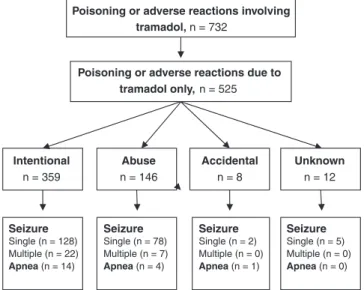
During the 14 months encompassed by this study, nearly 32 000 patients presented to our institution, and 14 000 of these were hospitalized. We identified 732 patients (~ 5.4% of hospitalized patients) with a history of tramadol exposure, of which 525 reported poisoning with tramadol as the sole agent so were included in the study; seeFig. The mean age was 22.8 ± 6.9 years (range, 3-72 years), and they were predominately males (70.1%). The reason for presentation was intentional self-poisoning in 359 patients (68.4%) or abuse in 146 patients (27.8%). Eight patients (1.5%) had accidental poisoning, and data were unavailable in 12
Poisoning or adverse reactions involving tramadol, n = 732
Poisoning or adverse reactions due to tramadol only, n = 525 Intentional n = 359 Abuse n = 146 Seizure Single (n = 128) Multiple (n = 22) Apnea (n = 14) Accidental n = 8 Unknown n = 12 Seizure Single (n = 78) Multiple (n = 7) Apnea (n = 4) Seizure Single (n = 2) Multiple (n = 0) Apnea (n = 1) Seizure Single (n = 5) Multiple (n = 0) Apnea (n = 0)
Fig. Flow chart of hospitalized tramadol-related intoxication/ adverse effect in Loghman-Hakim Hospital 2010.
patients. However, there was a history of tramadol abuse in 204 patients (38.9%) and addiction history to substances in 86 patients (16.4%), whereas data were not recorded in 21 (4%) and 142 (27%) patients, respectively.
In all patients, the route of exposure was oral. Documen-tation was insufficient to identify patients ingesting sustained release formulation, although we anticipate that most exposures were with immediate release preparations. Two hundred sixty-four patients (50.3%) presented within 1 to 3 hours of tramadol ingestion, and 165 (31.4%) presented to hospital 3 to 6 hours postingestion.
Tonic-clonic seizures occurred in 242 patients (46.1%); there was a single episode in 213 (88.1%) patients, or they were recurrent in 29 patients (11.9%). Apnea was observed in 19 (3.6%) of patients within 24 hours of ingestion (mean, 7.7 ± 7 hours; range, 1-24) (Table 1). Treatment for apnea included intubation and ventilation in 16 patients (84.2%) or naloxone administration in the remaining 3 patients (15.8%). The minimum tramadol dose associated with apnea was only
200 mg. Regarding risk factors, none of the patients had a history of medical comorbidities or evidence of renal impairment based on routine blood tests.
The clinical characteristics of the patients with tramadol-induced apnea are compared with those without apnea in
Table 2. No statistically significant differences were observed, with the exception of ingested dose and mortality.
4. Discussion
This is the first large cohort study describing an incidence of apnea in 3.6% of patients with isolated tramadol overdose. No definite risk factors for the development of apnea were identified. Although the mean dose ingested was statistically larger in those who developed apnea, a wide range of doses (as low as 200 mg) were reported. The mortality from tramadol poisoning appeared to be increased in those patients with apnea;
Table 1 Characteristics of 19 tramadol alone–induced apnea patients N Age (y) and sex Elapsed hours (ingestion-admission) Manner of ingestion Dose (mg) Apnea time postingestion Naloxone administration Seizure episodes Addiction history Tramadol abuser Hospital stay (d) Suicide history Death
1 40M 3-6 Abuse 1000 – Nil Yes Yes 24-48 Yes Yes
2 26M 3-6 Abuse 500 1.30 Nil Yes Unknown 0-24 No No
3 22F 1-3 Abuse 2000 6.00 Nil Yes No 0-24 No No
4 40M 1-3 Abuse 200 1.00 Nil Yes Yes 0-24 Yes No
5 22M 3-6
Self-poisoning
2700 4.00 One Unknown No 48-72 Yes No
6 17F 1-3
Self-poisoning
1000 5.00 One No No 24-48 No No
7 20F 1-3
Self-poisoning
3500 6.00 One Unknown Yes 0-24 Yes No
8 24M N9
Self-poisoning
1500 24.00 Yes One No Yes 48-72 Yes No
9 24M N9 Self-poisoning 4000 12.00 One No Yes 0-24 No No 10 18F 1-3 Self-poisoning 1500 14.00 Yes Nil No No 48-72 No No 11 41F 1-3 Self-poisoning 3000 5.00 Nil No No 0-24 No No 12 21F 6-9 Self-poisoning 1000 11.00 Nil No No 0-24 Yes No 13 29M 1-3 Self-poisoning 3000 6.00 Nil Yes No 0-24 No No 14 20M 1-3 Self-poisoning 4600 8.00 Nil No Yes 48-72 No No 15 17M 1-3 Self-poisoning 2000 1.00 Nil No Yes 0-24 No No
16 24M 1-3 Abuse 1000 1.30 Nil Unknown Unknown 0-24 No No
17 19M N9
Self-poisoning
4000 24.00 Yes Nil No No 48-72 No No
18 23M 3-6
Self-poisoning
4000 8.00 Nil Unknown Yes 48-72 No No
19 20F 1-3
Self-poisoning
although overall numbers were low so further studies are required to confirm this association.
Tramadol is an agonist atμ-opioid receptors as well as on the noradrenergic and serotonergic systems. Cytochrome P450 (CYP) 2D6 catalyses O-demethylation of tramadol to the more active M1 (O-desmethyl tramadol) enantiomers, which have an affinity at theμ-receptor that is 200 times that of (+) tramadol. Furthermore, it has an elimination half-life of 9 hours, compared with 6 hours for tramadol, and, therefore, may accumulate with regular dosing.
There is a large interindividual variability in the enzyme activity of CYP2D6 within a population and between ethnic groups [1,26,27]. The production of M1 enantiomers can vary more than 30-fold between poor and extensive metabolizers, which, in turn, is associated with variability in the analgesic and toxic effects of tramadol[28].
Dopamine release in various regions of the central nervous system is associated with dependency. Agonists of
μ-opioid receptors stimulate the release of dopamine as well as inhibiting gamma aminobutyric acid (GABA) release, which inhibits dopamine release [26,29,30]. Because tramadol and its metabolites are agonists at μ -opioid receptors, tramadol use is associated with depen-dence. Considering that ethnic groups from the Middle East and East Africa are more likely to be ultrarapid metabolizers compared with those from Middle Europe and North America (incidence 21%-29% vs 0.5%-1%, respec-tively), we expect that people in the Middle East are more susceptible to opioid effects, including dependency, seizure, sedation, and respiratory depression. The preva-lence of tramadol-induced seizures in substance abusers from Mediterranean countries is 54%, which is high; here, the frequency of the CYP2D6 ultrarapid metabolizers is up to 12% of population [3,31]. Similarly, in Iran, the mortality from tramadol intoxication is largely due to seizures and is as high as 7.4%[32]; we anticipate that the frequency of ultrarapid metabolizers is similar in Iran to Mediterranean countries.
The mechanism of tramadol-induced seizures is poorly described, although high concentrations of tramadol can inhibit GABA receptors [33,34]. Inhibition of GABA
receptors can potentiate the severity of seizures in animal models[34,35]. In addition, inhibition of GABA receptors by tramadol can be secondary to its opioid receptor agonist activity[34], and continuing this agonist activity on opioid receptor has been shown to evoke seizure due to inhibition of GABA pathways [36,37]. However, multiple factors may contribute to the development of seizures in patients ingesting tramadol, including an underlying seizure disorder, concomitant use of proconvulsant medications, withdrawal from ethanol or depressants of the central nervous system, or head injuries.
There are conflicting data on the proconvulsant effect of naloxone in tramadol intoxicated patients. The manufac-turer's package insert cautions against using naloxone in patients with tramadol overdose because animal studies demonstrated that this increased the risk of seizures[38]. In animals poisoned by tramadol, naloxone administration increased the occurrence seizures, which was thought to be a dose-dependent effect of the (−) enantiomer[39]. Clinical experience has also shown a varying association. Naloxone administration to 8 cases with sedation and respiratory depression was followed by immediate convulsions in 1 patient [40]. We noted seizures in 1 of the 3 patients administered naloxone in our series. In a clinical study comparing the effect of 0.8 mg naloxone in tramadol overdose, compared with supportive care, seizures occurred in 28.3% vs 11.2% of patient, respectively [41]. Another study did not demonstrate a proconvulsive effect of naloxone but instead suggested that it improved clinical outcomes
[42]. The association between seizures and naloxone administration in such patients is unclear and may simply reflect the exposure to tramadol. To reduce the inclusion of cases of other serotoninergic neuromuscular effects in this study, we only considered cases of generalized tonic-clonic seizures. The higher incidence of seizures noted in our series may reflect a referral bias. More research is required to clarify the relevance of animal data to human exposures.
Our study shows that oral tramadol can induce apnea from either overdose or within the therapeutic dose range. The minimum dose of tramadol that caused apnea in our study was 200 mg, and a significantly higher mean dose of
Table 2 Comparison between the patients with tramadol alone–induced apnea and the others
Variable Apnea patients Other patients Pvalue (applied statistical test)
Age 24.6 (± 7.6) 22.8 (± 6.9) .40 (Studentttest)
Sex (male/female) 12/7 356/150 .50 (Pearsonχ2)
Dose ingested by the history 2184.2 (± 1371) 1358.4 (± 1071.8) .001 (MWU) History of drug or substance abusea(positive/negative) 5/10 81/287 .303 (Pearsonχ2) History of suicidal attempt (positive/negative) 7/12 133/373 .307 (Pearsonχ2)
Seizure (positive/negative) 6/13 236/270 .196 (Pearsonχ2)
Tramadol dependencya(positive/negative) 9/8 195/292 .197 (Pearsonχ2) Self-poisoning (positive/negative) 14/5 345/161 .613 (Pearsonχ2)
Death (positive/negative) 1/18 1/505 .001 (Pearsonχ2)
Data are presented as mean value (± SD). Abbreviation: MWU, Mann-WhitneyUtest.
a
tramadol was observed in patients who developed apnea (Table 2). Administration of (+)-M1 to rats in doses greater than 2.5 mg/kg induced dose-dependent respiratory depres-sion. In contrast, doses of (−)-M1 up to 8 mg/kg showed neither antinociception nor respiratory effects [43]. In another study, intravenous administration of 1, 2, and 4 mg/kg tramadol altered the apneic thresholds in cats, decreasing their sensitivity to carbon dioxide [44]. Oral administration of 100 mg tramadol depressed respiration in 10 healthy volunteers, by reducing the ventilatory carbon dioxide sensitivity by 30% without a change in the metabolic or arousal state. The authors suggested that the effect of 100-mg tramadol is equivalent to that of intravenous morphine 0.13 mg/kg in healthy volunteers without pain [45]. Therefore, significant opioid effects may be observed in patients administered therapeutic doses of tramadol.
To our knowledge, no clinical study evaluated the prevalence of apnea in the patients who ingested oral tramadol alone. Spiller et al [40]demonstrated respiratory depression in 2 (2%) of 87 cases ingesting tramadol alone, although the route of exposure was not mentioned.
In another prospective study on 427 cases (including some mixed overdoses), 62 (14.8%) had respiratory depression, of whom 19 (3.6%) experienced apnea. There was significant correlation between the dose of tramadol and respiratory depression [46]. Shadnia et al [47]described 2 deaths in their study, which one of them had respiratory depression. In a tramadol-induced adverse drug reaction study, 12 (4.8%) and 73 (29.3%) of 249 cases report dyspnea and convulsion, respectively. Three deaths (1.2%) suspected to be induced by tramadol[20]. In addition, there are some case reports, which describe respiratory depression by intravenous tramadol or in renal impairment patients
[4,5,15].
Regarding risk factors, our study demonstrated that the occurrence of apnea was statistically independent of age, sex, history of addiction to other opioids and tramadol, the reason for poisoning, history of suicide attempt, and seizure occurrence. It is not surprising that mortality would be higher in apnea patients. We did not identify any demographic or clinical features predisposing to apnea in this study. In particular, renal impairment was not present in any of the patients who experienced apnea.
5. Conclusions
Tramadol abuse and intoxication are social and health concerns in Iran, in particular to the younger population. We observed that apnea occurs in 3.6% of cases when tramadol was the sole poison, and this may occur up to 24 hours postingestion and is not preceded by prominent central nervous system depression or seizures. The cases of apnea presented here are a fraction of the number of patients with lesser degrees of respiratory depression due to tramadol; these cases also need prompt diagnosis and treatment.
Therefore, we advise that observation for at least 24 hours is required in patients presenting with tramadol poisoning. These severe manifestations of poisoning could be more common in our patients, due to ethnic susceptibility factors. Further clinical studies to measure tramadol, its metabolites, and their ratio as well as the metabolic activity of CYP2D6 may clarify the patterns of tramadol abuse observed in Iran.
Acknowledgment
The authors wish to thank Dr Darren Roberts for his comments on the manuscript and English linguistic assistance.
References
[1] Grond S, Sablotzki A. Clinical pharmacology of tramadol. Clin Pharmacokinet 2004;43(13):879-923.
[2] Payne KA, Roelofse JA. Tramadol drops in children: analgesic efficacy, lack of respiratory effects, and normal recovery times. Anesth Prog 1999;46(3):91-6.
[3] Jovanovic-Cupic V, Martinovic Ž, Nešic N. Seizures tramadol associated with intoxication and abuse of tramadol. Clin Toxicol 2006;44:143-6.
[4] Pandey R, Elakkumanan LB, Garg R, Gupta P, Darlong V, Punj J. Prolonged apnea after small single dose of intravenous tramadol. AANA J 2010;78(2):110-2.
[5] Tantry TP, Kadam D, Shetty P, Adappa KK. Tramadol-induced respiratory depression in a morbidly obese patient with normal renal function. Indian J Anaesth 2011;55(3):318-20.
[6] De Decker K, Cordonnier J, Jacobs W, Coucke V, Schepens P, Jorens PG. Fatal intoxication due totramadol alone: case report and review of the literature. Forensic Sci Int 2008;175(1):79-82.
[7] Clarot F, Goullé JP, Vaz E, Proust B. Fatal overdoses of tramadol: is benzodiazepine a risk factorof lethality? Forensic Sci Int 2003;134(1): 57-61.
[8] Musshoff F, Madea B. Fatality due to ingestion of tramadol alone. Forensic Sci Int 2001;116(2-3):197-9.
[9] De Backer B, Renardy F, Denooz R, Charlier C. Quantification in postmortem blood and identification in urine of tramadol and its two main metabolites in two cases of lethal tramadol intoxication. J Anal Toxicol 2010;34(9):599-604.
[10] Tjäderborn M, Jönsson AK, Hägg S, Ahlner J. Fatal unintentional intoxications with tramadol during 1995-2005. Forensic Sci Int 2007;173(2-3):107-11.
[11] Michaud K, Augsburger M, Romain N, Giroud C, Mangin P. Fatal overdose of tramadol and alprazolam. Forensic Sci Int 1999;105(3): 185-9.
[12] Goeringe KE, Logan BK, Christian GD. Identification of tramadol and its metabolites in blood from drug-related deaths and drug-impaired drivers. J Anal Toxicol 1997;21:529-37.
[13] Levine B, Ramcharitar V, Smialek JE. Tramadol distribution in four postmortem cases. Forensic Sci Int 1997;86(1-2):43-8.
[14] Moore KA, Cina SJ, Jones R, Selby DM, Levine B, Smith ML. Tissue distribution of tramadol andmetabolites in an overdose fatality. Am J Forensic Med Pathol 1999;20(1):98-100.
[15] Stamer UM, Stüber F, Muders T, Musshoff F. Respiratory depression with tramadol in a patient with renal impairment and CYP2D6 gene duplication. Anesth Analg 2008;107(3):926-9.
[16] Mattia C, Mazzaferro S, Coluzzi F, Luzi M. Respiratory depression following iatrogenic tramadoloveruse in a patient with chronic renal failure. J Headache Pain 2008;5(2):137-9.
[17] Gholami K, Shalviri G, Zarbakhsh A, Daryabari N, Yousefian S. New guideline for tramadol usage following adverse drug reactions reported to the Iranian Pharmacovigilance Center. Pharmacoepidemiol Drug Saf 2007;16(2):229-37.
[18] Hassanian-Moghaddam H, Kolahi AA. Tramadol intoxication /abuse: a new issue on high-accesspopulation. 6th Annual Congress of Asia Pacific Association of Medical Toxicology; 2007. 12-14December, Bangkok, Thailand.
[19] List of narcotic drugs under control. Secretary for food and drug affairs, Ministry of Health & Medical Education Iran [Persian language]. 2007http://fdo.behdasht.gov.ir/uploads/114_1206_13.pdf. Retrieved December 4, 2011.
[20] Soleymani F, Shalviri G, Abdollahi M. Pattern of use and adverse drug reactions of tramadol; a review of 336, 610, 664 insured prescriptions during 5 years. Int J Pharmacol 2011;7(4):757-60.
[21] Karbakhsh M, Salehian Zandi N. Acute opiate overdose in Tehran: the forgotten role of opium. Addict Behav 2007;32(9):1835-42. [22] Hassanian-Moghaddam H, Sarjami S, Pajoumand A. One year
epidemiological study of acute adult and adolescent poisoning admitted to Loghman Hospital, Tehran. 2004–2005. Scientific. J Forensic Med 2007;13(4):235-40 [In Persian].
[23] Hassanian-Moghaddam H, Pajoumand A. One year epidemiological study of acute adult and adolescent poisoning admitted to Loghman hospital, Tehran 2005–2006. Pajouhandeh 2007;57(12):169-76 [In Persian].
[24] Hassanian-Moghaddam H, Rashidi B. Mortality and complication associated with acute tramadolintoxication. EAPCCT XXVIII Inter-national Congress 6–9 May; 2008. Seville, Spain.
[25] Iravani FS, Akhgari M, Jokar F, Bahmanabadi L. Current trends in tramadol-related fatalities, Tehran, Iran 2005-2008. Subst Use Misuse 2010;45(13):2162-7.
[26] Zhou S-F. Polymorphism of human cytochrome P450 2D6 and its clinical significance. Clin Pharmacokinet 2009;48(11):689-723. [27] Gan SH, Ismail R, Wan Adnan WA, Zulmi W. Impact of CYP2D6
genetic polymorphism on tramadol pharmacokinetics and pharmaco-dynamics. Mol Diagn Ther 2007;11:171-81.
[28] Raffa RB. Basic pharmacology relevant to drug abuse assessment: tramadol as example. J Clin Pharm Ther 2008;33(2):101-8. [29] Lötsch J, Skarke C, Liefhold J, Geisslinger G. Genetic predictors of the
clinical response to opioid analgesics: clinical utility and future perspectives. Clin Pharmacokinet 2004;43(14):983-1013.
[30] Somogyi AA, Barratt DT, Coller JK. Pharmacogenetics of opioids. Clin Pharmacol Ther 2007;81(3):429-44.
[31] Ingelman-Sundberg M, Oscarson M, McLellan RA. Polymorphichu-man cytochrome P450 enzymes: an opportunity for individualized drug treatment. Trends Pharmacol Sci 1999;20:342-9.
[32] Goodarzi F, Mehrpour O, Eizadi-Mood N. A study to evaluate factors associated with seizure intramadol poisoning in Iran. Indian Journal of Forensic Medicine & Toxicology 2011;5(2):66-9.
[33] Hara K, Minami K, Sata T. The effects of tramadol and itsmetabolite on glycine, gamma-aminobutyricacidA, and N-methyl-D-aspartate recep-tors expressed in Xenopus oocytes. Anesth Analg 2005;100(5):1400-5.
[34] Rehni AK, Singh I, Kumar M. Tramadol-induced seizurogenic effect: a possible role of opioid-dependent gamma aminobutyric acid inhibitory pathway. Basic Clin Pharmacol Toxicol 2008;103(3): 262-6.
[35] Sun C, Mtchedlishvili Z, Erisir A, Kapur J. Diminished neurosteroid sensitivity of synaptic inhibition and altered location1.of the alpha4 subunit of GABA(A) receptors in an animal model of epilepsy. J Neurosci 2007;27(46):12641-50.
[36] Miura M, Saino-Saito S, Masuda M, Kobayashi K, Aosaki T. Compartment-specific modulation of GABAergic synaptic transmis-sion by mu-opioid receptor in the mouse striatum with green fluorescent protein-expressing dopamine islands. J Neurosci 2007; 27(36):9721-8.
[37] Frenk H. Pro- and anticonvulsant actions of morphine and the endogenous opioids: involvement and interactions of multiple opiate and non-opiate systems. Brain Res 1983;287(2):197-210.
[38] Nelson LS. Opioids. In: Nelson LS, Lewin NA, Howland MA, Hoffman RS, Goldfrank LR, Folmenbaum NE, editors. Goldfrank's Toxicologic emergencies. 9th ed. New York, NY, USA: McGraw-Hill; 2011. p. 559-78.
[39] Raffa RB, Stone Jr DJ. Unexceptional seizure potential of tramadol or its enantiomers or metabolites in mice. J Pharmacol Exp Ther 2008; 325(2):500-6.
[40] Spiller HA, Gorman SE, Villalobos D, Benson BE, Ruskosky DR, Stancavage MM, et al. Prospective multicenter evaluation of tramadol exposure. J Toxicol Clin Toxicol 1997;35(4):361-4.
[41] Frahani A. Doctoral Thesis; Comparing the prevalence seizure in patients affected with tamadolpoisoning between two group treated and untreated with naloxone in Ardabil's EmamKhomeinihospital: http://eprints.arums.ac.ir/2751/. Retrieved December 4, 2011. [42] Saidi H, Ghadiri M, Abbasi S, Ahmadi SF. Efficacy and safety of
naloxone in the management of postseizure complaints of tramadol intoxicated patients: a self-controlled study. Emerg Med J 2010; 27(12):928-30.
[43] Valle M, Garrido MJ, Pavón JM, Calvo R, Trocóniz IF. Pharmaco-kinetic-pharmacodynamic modeling of the antinociceptive effects of main active metabolites of tramadol, (+)-Odesmethyltramadoland (− )-O-desmethyltramadol, in rats. J Pharmacol Exp Ther 2000;293(2): 646-53.
[44] Teppema LJ, Nieuwenhuijs D, Olievier CN, Dahan A. Respiratory depression by tramadol in the cat: involvement of opioid receptors. Anesthesiology 2003;98(2):420-7.
[45] Nieuwenhuijs D, Bruce J, Drummond GB, Warren PM, Dahan A. Influence of oral tramadol on the dynamic ventilatory response to carbon dioxide in healthy volunteers. Br J Anaesth 2001;87(6): 860-5.
[46] Hassanian-Moghaddam H, Rashidi B. Mortality and complication associated with acute tramadol intoxication. EAPCCT XXVIII International Congress 6–9 May; 2008. Seville, Spain.
[47] Shadnia S, Soltaninejad K, Heydari K, Sasanian G, Abdollahi M. Tramadol intoxication: a review of114 cases. Hum Exp Toxicol 2008;27(3):201-5.