Statement of context
St Andrew’s Healthcare, Northampton, United Kingdom, is an independent sector provider of mental health care and a registered charity. Spring Hill House is a low secure unit within the hospital’s Women’s Service, treating 23 adult women with borderline personality disorder (BPD) (American Psychiatric Association 1994) who are detained under the Mental Health Act (1983, amended 2007).
When dialectical behavioural therapy (DBT) (Linehan 1993a) was intro-duced in 1997 as the key psychological treatment, the four DBT skills modules (Linehan 1993b) replicated much of the work that occupational therapists had previously undertaken. The skills modules in DBT are as follows: core mindfulness, distress tolerance, interpersonal effectiveness and emotion regulation skills. These were the issues being addressed by occupational therapy in programmes that included anger management, anxiety manage-ment and communication and interaction skills training. In doing so, the occupational therapists realised that they had followed custom and practice without the benefits of a guiding conceptual model and, consequently, had tried to ‘fill a gap’ (Fortune 2000, p227) by providing a psychologically focused service. When DBT was implemented, the opportunity arose for the occupa-tional therapists to use their profession-specific skills (College of Occupaoccupa-tional Therapists 2006) by focusing on core occupational issues related to self-maintenance, productivity and leisure (Reed and Sanderson 1999).
Reflection on practice
Borderline personality disorder and the Model of
Human Occupation Screening Tool
To ensure that the service provided by the occupational therapy team was effective and evidence based, the team members accepted that they needed
The development of an effective occupational
therapy assessment and treatment pathway
for women with a diagnosis of borderline
personality disorder in an inpatient setting:
implementing the Model of Human Occupation
Sarah Lee
1and Maria Harris
2Key words:
Inpatient rehabilitation, borderline personality disorder, specific assessment and treatment pathways.This article describes the implementation of a comprehensive occupational therapy graded assessment and treatment pathway within an inpatient specialist unit for women with borderline personality disorder. It was developed after a review concluded that treatment sessions lacked an occupational evidence base. The Model of Human Occupation was therefore used to ensure the delivery of an optimum, consistent programme that could meet the occupational needs of this specific group of patients.
© The College of Occupational Therapists Ltd.
Submitted: 8 January 2010.
Accepted: 20 September 2010.
1Occupational Therapy/Dialectical Behavioural
Therapy Clinical Specialist,
St Andrew’s Healthcare, Northampton.
2Senior Occupational Therapist, St Andrew’s
Healthcare, Northampton.
Corresponding author:
Sarah Lee, Occupational Therapy/Dialectical Behavioural Therapy Clinical Specialist, St Andrew’s Healthcare, Spring Hill House, Billing Road, Northampton NN1 5DG. Email: [email protected]
Reference:Lee S, Harris M (2010) The development of an effective occupational therapy assessment and treatment pathway for women with a diagnosis of borderline personality disorder in an inpatient setting: implementing the Model of Human Occupation. British Journal of Occupational Therapy, 73(11),559-563.
to have a clearer understanding of the nature of BPD and how it has an impact on the occupational needs of this specific patient group. By studying the diagnostic criteria for BPD, the occupational therapists gained valuable insight into the very complex and precise traits of the disorder. The recognition and understanding of both the diagnosis and the daily impact on life for individuals with BPD prompted the occupational therapists to consider available models of practice in order that the nature of the patients’ occupational strengths and needs could be identified clearly and addressed.
A review was undertaken of models of practice and the occupational therapists decided to use the Model of Human Occupation (MOHO) (Kielhofner 2008) as their preferred model of choice. This decision was based on the fact that MOHO assessments are tested for validity and reliability but mostly do not rely on a standardised process, thus giving them greater clinical utility; moreover, they are occupation focused, evidence based and theoretically driven (Kramer et al 2008). In particular, the Model of Human Occupation Screening Tool (MOHOST) includes most of the concepts of MOHO and was seen to provide the occupational therapists with a methodical means of charting occupational change (Parkinson et al 2008). The occupational therapists also noticed that links could be made between the diagnostic criteria for BPD and the six key elements in the MOHOST (see Tables 1, 2 and 3). It was apparent that when indi-viduals with BPD were emotionally dysregulated the areas of volition, habituation and personal causation were adversely affected, resulting in maladaptive behaviours that had an impact on participation in daily occupations. Previous life experience and an invalidating environment (Linehan 1993a) had also resulted in a lack of opportunity to establish adaptive occupations.
Translating assessment into treatment
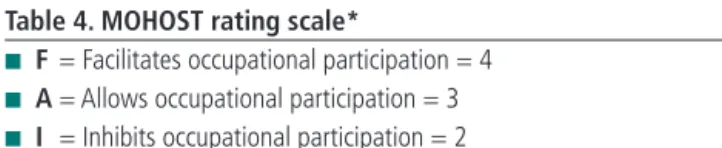
The occupational therapists were now able to articulate the impact of BPD on occupational participation and began to develop an increased occupational focus. First, they com-pleted the MOHOST to assess the impact of occupational performance on occupational participation for each individ-ual. Once all of the MOHOSTs were completed, the patients were grouped according to their ratings (see Table 4) and on whether their participation was identified as:
■ Mostly restricting occupational participation
■ Mostly inhibiting occupational participation
■ Mostly allowing occupational participation
■ Mostly facilitating occupational participation.
Next, the decision was made to review the treatment sessions provided so that the MOHOST could be used not only as an assessment but also as a guide to effective treatment, grouping individuals together with similar needs and allowing them to recognise the progress that they made as their occupational participation improved. The idea was to produce multiple treatment pathways, offering choice to individuals and a platform for them to practise and improve on their areas of need, in addition to ensuring that groups were not randomly selected.
Table 1. Criteria for borderline personality disorder (BPD)* The criteria for BPD include:
■ A pattern of intense and unstable interpersonal relationships
■ Frantic efforts to avoid real or imagined abandonment
■ Identity disturbance and problems with sense of self
■ Impulsivity that is potentially self-damaging
■ Recurrent suicidal or parasuicidal behaviour
■ Affective instability
■ Chronic feelings of emptiness
■ Inappropriate intense or uncontrollable anger
■ Transient stress-related paranoid ideation or severe dissociative symptoms *DSM-IV diagnostic criteria for borderline personality disorder (American Psychiatric Association 1994).
Table 2. Six key elements of the Model of Human Occupation Screening Tool (MOHOST)*
■ Motivation for occupation
Appraisal of ability, expectations of success, interest, choices
■ Pattern of occupation
Routine, adaptability, roles, responsibility
■ Communication and interaction skills
Non-verbal skills, conversation, vocal expression, relationships
■ Process skills
Knowledge, timing, organisation, problem solving
■ Motor skills
Posture and mobility, coordination, strength and effort, energy
■ Environment
Physical space, physical resources, social groups, occupational demands *Parkinson et al (2008).
Table 3. Predominant links of MOHOST concepts and BPD traits*
■ Motivation for occupationwill be influenced by frantic efforts to avoid real or imagined abandonment and identity disturbance, problems with self and chronic feelings of emptiness, transient stress-related paranoid ideation and severe dissociative symptoms
■ Pattern of occupationwill be influenced by a pattern of intense and unstable relationships, impulsivity and recurrent suicidal or parasuicidal behaviour
■ Communication and interaction skillswill be influenced by affective instability and inappropriate intense or uncontrollable anger
■ Process skillsmay be influenced by transient stress-related paranoid ideation, severe dissociative symptoms, impulsivity and recurrent suicidal or parasuicidal behaviour
■ Motor skillsmay be influenced by problems with self and chronic feel-ings of emptiness, transient stress-related paranoid ideation and severe dissociative symptoms
■ The clinical environmentwill be modified to manage risk-associated recurrent suicidal and parasuicidal behaviour, impulsivity and transient stress-related paranoid ideation
*Parkinson et al (2008) and American Psychiatric Association (1994).
Table 4. MOHOST rating scale*
■ F= Facilitates occupational participation = 4
■ A= Allows occupational participation = 3
■ I = Inhibits occupational participation = 2
■ R= Restricts occupational participation = 1 *Parkinson et al (2008).
Table 5. Treatment pathways Activities of daily living
■ Personal self-care, laundry, self-soothe, environmental maintenance, community access
Vocational
■ Low level craft, craft, creative projects, sheltered work, voluntary placements
Culinary
■ No-bake baking, baking, individual cooking, group cooking, self-catering
Horticultural
■ Micro-gardening, courtyard gardening, secret garden, allotment, community conservation
The occupational therapists wanted to devise treatment pathways that would encompass the elements required for occupational balance (Creek 2003), while accommodating the most common occupations engaged in by this specific group of patients. The pathways devised needed to allow for the three elements of participation; namely, to be patient centred and meaningful and to have involvement in the environment (World Health Organisation 2002, Kielhofner 2008, Vessby and Kjellberg 2010). The activities had to allow opportunities for individuals to participate in occu-pations that would translate into established long-term adaptive occupational performance. Since human occupation comprises three main areas of doing, namely activities of daily living, play and productivity (Kielhofner 2008), the occupational pathways were designed to encompass these areas. Each pathway followed the same format (see Fig. 1) to ensure that the occupational therapists worked in struc-tured groups based on rating scores and that any changes in mental state could be addressed.
3. By making the treatment process more transparent and continually evaluating the changes to the treatment pro-gramme, the occupational therapists hoped to demon-strate that the occupational therapy role made a valuable contribution that enhanced meaningful participation.
Participation/commitment to the
treatment process
Following completion of every 12-week timetable and sub-sequent reassessment, each patient is given individual verbal feedback and a written copy of her MOHOST ratings, high-lighting both progress and ongoing areas of need. This collaborative process has afforded the patients the time to discuss any areas of concern that they may have and also alleviated anxiety regarding the reasons for the pathway. The weekly drop-in sessions for those at the latter end of the pathways also provides regular opportunities to discuss progress or concerns in order to monitor and amend sessions as necessary. The initial verbal feedback from the patients indicates a greater level of understanding of the occupa-tional therapy process (see Table 6). The patients have also acknowledged their increased awareness of the function of occupational participation in their recovery and their recognition of the compatibility of occupational therapy with the skills learnt in DBT.
Furthermore, the work undertaken by the occupational therapy team over the last 21⁄
2 years has ensured that the
multidisciplinary team has a full understanding of the clinical reasoning of occupational therapy as an integral treatment that is fundamental to the recovery of this difficult and challenging group of patients.
Participation/involvement in everyday
activities
The quality, quantity and consistency of occupational therapy have been central to increased participation in occupation for this specific inpatient group. The occupational path-ways have provided the patients with the opportunity to participate in a variety of everyday activities that have the potential to affect their quality of life, whilst allowing the individual to work on specific problem areas as identified by the MOHOST. The graded pathways allow individuals an
Fig 1. Example of a graded treatment pathway using scoring from rating scales.
It was paramount at this juncture to acknowledge the importance of encouraging occupational participation on three different levels, as described by Vessby and Kjellberg (2010):
1. Participation /commitment to the treatment process 2. Participation / involvement in everyday activities 3. Participation /actively engaging in meaningful
occupations.
These were interpreted as follows:
1. Patients and team members needed to understand that the unit had an all-encompassing treatment programme and that occupational therapy was an integral part of this treatment programme that they were required to attend actively
2. The pathways needed to enable participation in a range of occupational forms related to activities of daily living, leisure and vocation and the changes to the occupational therapy service needed to be sufficiently flexible to meet the needs of individuals (see Table 5)
initial structure while they are struggling with risk behaviours and emotional dysregulation. As they gain greater under-standing of the impact of the maladaptive behaviours on occupational participation, their understanding of mean-ingful activities increases and there is greater collaboration in identifying and participating in activities that are mean-ingful to the individual.
The sessions engaged the individuals in activities that optimised occupational performance, regardless of fluctu-ations in mental state. They also allowed involvement in the environment at all levels, from unit-based sessions to community sessions, dependent on levels of risk behaviours.
The occupational therapy programme has allowed and actively encouraged individuals to make occupational choices and to take responsibility for their recovery. Further work is now required to collate available electronic data to analyse the degree of increased participation.
Participation/actively engaging in
meaningful occupations
It should be acknowledged that limitations exist in max-imising participation in meaningful occupation due to the specialist nature of the service and the compulsory nature of the expectation that patients will participate in occupa-tional therapy. Moreover, the unit accommodates a single diagnostic group, with a ward programme that includes an incentive programme, a risk management structure and contingencies for maladaptive behaviours. Such limitations of an inpatient setting have been well recognised (Swenson et al 2001) and provide extra challenges to occupational therapists who are seeking to enable patients to acquire new skills in a safe and secure environment with a daily programme of activities.
Although the changes that have been implemented have achieved increased participation in a range of everyday activities, there is acknowledgement that it is more difficult to generalise the skills to the wider community environment. In recognition of this, the final stage in each pathway allows greater opportunity to make the transition with reduced support and an expectation that the individual will seek support as required through the weekly drop-in sessions with the occupational therapist.
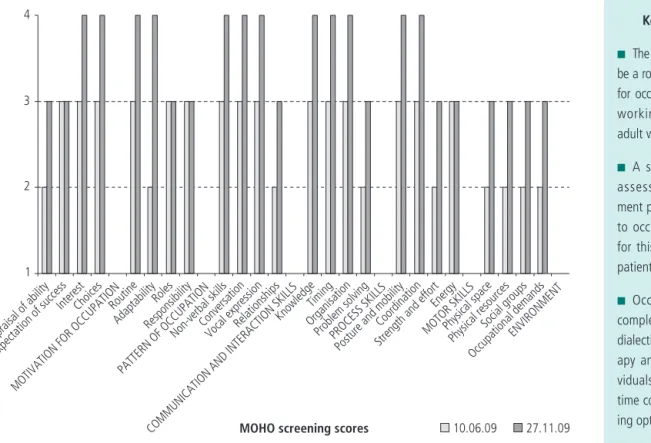
Despite limitations, it is notable that patients have voiced increased awareness of their occupational perfor-mance and the many different roles required in achieving a ‘life worth living’ (Linehan 1993a, p99) and a realisation that they have an active involvement, following assessment, in their treatment and rehabilitation. In addition, the effectiveness of occupational therapy has been evidenced by using the MOHOST as an outcome measure. A graph has been devised as an easy visual record, charting the scores from each MOHOST and clearly tracking occupa-tional changes over periods of time (see Fig. 2). This graph is shared with the patients and is included in their clinical review documentation for both clinicians and the home funding team. It has resulted in positive feedback being received from the external clinicians when they complete questionnaires related to treatment interventions on the unit, following the clinical reviews.
Overall, the occupational therapy team members have found that this way of working has increased their under-standing of both BPD and the importance of a theoretical framework to define clearly a treatment pathway that is patient centred and provides meaningful participation in different environments. Although the evaluation of this service review is limited to qualitative evidence, plans are now in progress to provide quantitative evidence through data analysis and comparative case studies from the scores collated over the 2-year period.
Table 6. Verbal feedback statements from patients
Strengths and limitations of occupational therapy assessment and treatment pathways
Strengths
■ ‘Very beneficial – helps kick start motivation to engagement in everyday activities … ’
■ ‘Provides a structure and balance to day instead of ruminating on negative thoughts and emotions … ’
■ ‘Never had such balance in my day before.’
■ ‘Really helpful to have ongoing support throughout stages of pathways through to community placements to help maintain balance … ’
■ ‘Gives you a focus … a structure in the day … ’
Limitations
■ ‘In latter stages of pathway when actively involved in community placements can be frustrating to be expected to attend a few sessions on ward … ’
■ ‘In latter stages of pathways there is risk of over-engagement due to amount of sessions provided in ratio to involvement in community activities … difficult to maintain a balance … this is from my personal perspective … ’
Table 7. Verbal feedback from members of multidisciplinary team Strengths and limitations of occupational therapy assessment and treatment pathways
Strengths
■ ‘The occupational therapists brought forward a programme which is specific and measurable in a way that allows the tailoring of need and current ability to the individual’s programme. The occupational therapists’ clarity in their role in the unit team, their consistent offering of the programme and enhanced contentment at work has been evident. The patients also express greater understanding of the need and valuing for such input, and attendance has improved very significantly.’
■ ‘Nursing staff, through training sessions, have a greater understanding of the rationale and theory of occupational therapy and therefore actively support the programme.’
■ ‘There has been an increase in the uptake of sessions since the pathways were implemented.’
Limitations
■ ‘The unit runs from admission through to rehabilitation with one clinical team, one specific diagnostic group. Transferring the pathways to other mental health settings with involvement of several clinical teams and mixed diagnosis may present different challenges.’
Summary
The process of adopting a conceptual model of practice to inform assessment and treatment can be lengthy, but this paper has demonstrated that it is possible to adopt a model of practice in a specialist setting. By implementing an assessment based on the Model of Human Occupation and grading treatment pathways to match patients’ needs, the service has integrity and emphasises the core purpose of occupational therapy. There is the capacity now to review the occupational therapy provision using outcome measure-ment and the therapists have a greater resolve to continue to demonstrate the efficacy of their services in future. Acknowledgements
The development of the occupational therapy assessment and treatment pathway owes a debt to many professionals and patients. We would like to acknowledge the support, understanding and encouragement from our colleagues within the Women’s Service at St Andrew’s Healthcare. In particular, Dr David Nevison-Andrews (Consultant Psychiatrist); Dr Emily Fox (Consultant Psychologist); Donard Johnston (Unit Manager); Dr Clive Long (Group Head of Psychology); Alison May (Senior Occupational Therapist); Zachary Brandon (Senior Occupational Therapist); and Helen Bass (Occupational Therapist).
Conflict of interest: None.
References
American Psychiatric Association (1994) Diagnostic and Statistical Manual of Mental Disorders, 4th edition. Washington, DC: APA.
College of Occupational Therapists (2006) Recovering ordinary lives: the strategy for occupational therapy in mental health services, a vision for the next 10 years. London: COT.
Creek J (2003) Occupational therapy defined as a complex intervention.
London: COT.
Fortune T (2000) Occupational therapists: is our therapy truly occupational or are we merely filling gaps? British Journal of Occupational Therapy, 63(5), 225-30. Kielhofner G (2008) Model of Human Occupation: theory and application.
4th ed. Baltimore, MD: Lippincott Williams and Wilkins.
Kramer J, Bowyer P, Kielhofner G (2008) Evidence for practice from the Model of Human Occupation. In: G Kielhofner (2008) Model of Human Occupation: theory and application.4th ed. Baltimore, MD: Lippincott Williams and Wilkins, 466-505.
Linehan M (1993a) Cognitive behavioral treatment of borderline personality disorder.New York: Guilford Press.
Linehan M (1993b) Skills training manual for treating borderline personality disorder.New York: Guilford Press.
Mental Health Act (1983) Amended 2007 (c.12). London: Stationery Office. Available at: http://www.opsi.gov.uk/acts/acts2007/ukpga 20070012 en 1
Accessed on 23.07.10.
Parkinson S, Forsyth K, Kielhofner G (2008) The Model of Human Occupation Screening Tool (MOHOST), version 2.0.Chicago: University of Illinois at Chicago.
Reed K, Sanderson SR (1999) Concepts of occupational therapy. 4th ed. Baltimore, MD: Lippincott Williams and Wilkins.
Swenson CR, Sanderson C, Dulit RA, Linehan M (2001) The application of dialectical behaviour therapy for patients with borderline personality disorder on inpatient units. Psychiatric Quarterly, 72(4), 307-24. Vessby K, Kjellberg A (2010) Participation in occupational therapy research:
a literature review. British Journal of Occupational Therapy, 73(7), 319-26. World Health Organisation (2002) Towards a common language for functioning
disability and health, ICF. Geneva: WHO.
Key messages
■ The MOHOST proved to be a robust and critical tool for occupational therapists working with inpatient adult women with BPD.
■ A structured graded assessment and treat-ment pathway is essential to occupational recovery for this specific group of patients.
■ Occupational therapy complements the role of dialectical behaviour ther-apy and allows the indi-viduals to structure their time constructively, ensur-ing optimum recovery.