An Online Energy Saving Resource Optimization
Methodology for Data Center
Jingling Yuan
Computer Science and Technology School, Wuhan University of Technology, 430070, Wuhan, China Email: [email protected]
Xuyang Miao, Lin Li and Xing Jiang
Computer Science and Technology School, Wuhan University of Technology, Wuhan, China Email: [email protected], [email protected], [email protected]
Abstract—In order to reduce energy consumption of data centers while employing infrastructure resource effectively, a comprehensive resource management method using an improved online energy saving mapping algorithm for virtual machines of data centers is proposed. An intelligent feedback management framework is built for online resource optimization. We propose reinforcement learning and threshold based virtual machine migration to find the lowest energy consumption mapping between virtual machines and host of data centers dynamically and avoid the resources contention in physical machines. Our experimental results shows that the proposed effective online energy saving resource optimization methodology can reduce data center energy consumption by at least 30.3% compared to traditional random placement and save at least 10% running time compared to the offline Q-Learning scheduling algorithm.
Index Terms—Reinforcement learning, Energy saving online mapping, Intelligent feedback framework, Virtualization
I. INTRODUCTION
As the development of cloud computing and the urgent needs of super-computing power by the whole world, the performance and energy consumption problems of the data center has become the focus of the global concern. According to the U.S. Environmental Protection Agency, the total energy consumption of data centers and their cooling system was projected at 1.2% the total U.S. energy consumption and doubles every five years [1]. And in 2006, it was 1.5% of all U.S. energy consumption, projected at that point to double by 2011[2]. In 2010, data centers has consumed 0.5% of the world’s total electricity usage and if the demand of energy continues, is projected to quadruple by 2020[2]. From the view of business costs, the energy consumption of the cloud data service will grow 76% between 2007 and 2030 while the revenue of that grows from 56 billion in 2009 to 150 billion in 2013. With the trend continues, the running costs of cloud computing will be more than its hardware equipment purchase cost sooner or later. For example, recently Microsoft expressed publicly “managing servers will spend more money than purchasing new servers by 2015” [3]. Therefore, the energy consumption should be
considered as an important factor when designing the data center.
The research on energy saving management for data centers plays an important role in the field of cloud computing. Existing work mainly focus on energy saving mechanism from both hardware and software. The research trend of infrastructure for data center aims at exploring renewable energy such as solar power[4-5] and control energy consumption directly through DVFS
technology (Dynamic Voltage and Frequency
Scaling)[6-8]. The development costs of this kind of methods are relatively high.
The research on software mainly considers task scheduling and resource allocation. Some scholars focus on scheduling and distribution policy by using optimization algorithm. For example, Shekhar studied the inter-relationships between energy consumption, resource utilization, and performance of consolidated workloads, and then modeled the consolidation problem as a modified bin packing problem to find effective energy saving solutions [9]. Economical approaches are also used for managing shared server resources, where a greedy resource allocation is used to distribute each web workload among different servers assigned to each service, which reduced server energy usage by 29% or more for a typical web workload [10]. Other scholars aim at reducing the number of running machines to save energy by using the placement or migration of virtual machines. For instance, Li propose the Enacloud which supports applications scheduling and live migration to minimize the number of running machines [11]. Liu propose reducing data center power consumption via VM (virtual machine) migration optimal VM placement while reducing the human intervention [12]. Truong has designed a Green Scheduling Algorithm integrating a neural network predictor to predict future load demand based on historical demand. This technique turns off unused servers and restarts them to minimize the number of running servers [13]. Rade propose two low-overhead fully decentralized algorithms for the CPU-speed distributed dynamic speed scaling and provide closed-form conditions to ensure stability of the algorithms on the theoretical side [14]. The balance
between energy and performance has not been considered fully, and no common framework built of the above methods.
Others explored the fusion of various techniques to
improve the data center energy efficiency. Berral propose a vertical power-aware framework to provide an intelligent consolidation methodology using different
techniques such as turning on/off machine
s, power-aware consolidation algorithms, and machine learning techniques to improve scheduling decisions and reduce power consumption[15]. However, the scheme has little expanded to the virtualized data center.
In order to gain significant energy savings in data centers, an online feedback virtual machine mapping framework is proposed. Our technique provides an intelligent consolidation methodology by using both virtual machine mapping and improved online reinforcement learning to allocate virtual machines to suitable hosts aiming at providing the lowest energy consumption of data centers. The improved reinforcement learning model are employed to dynamically predict the lowest power consumption of target hosts of data centers after allocation of virtual machine, and the threshold based VM migration is applied to avoid resources contention and improve the scheduling decisions.
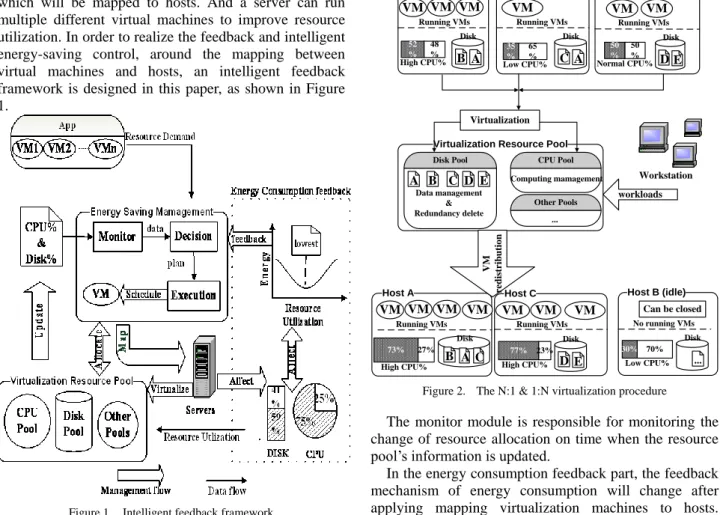
II. INTELLIGENT FEEDBACK FRAMEWORK In data centers, tasks are allocated to virtual machines which will be mapped to hosts. And a server can run multiple different virtual machines to improve resource utilization. In order to realize the feedback and intelligent energy-saving control, around the mapping between virtual machines and hosts, an intelligent feedback framework is designed in this paper, as shown in Figure 1.
Figure 1. Intelligent feedback framework
In Figure 1, the intelligent feedback framework includes three parts that are virtualization resource pool, energy consumption feedback and intelligent energy-saving management.
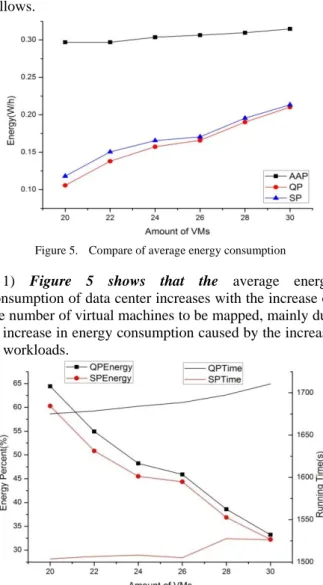
In the virtualization resource pool, the N:1 virtualization technology[16] is applied to virtualize the resources of several physical machines to a whole logical server for unified administration, namely, a virtualization resource pool including CPU pool, Disk pool and so on. And there is another technology called 1:N virtualization which allocates the workload to several VMs and establish multiple VMs with different operating systems on one host. In this kind of mechanism, the VMs on a host run independently which can improve resource utilization of severs and weaken the platform relativity of workloads. The figure 2 shows the virtualization procedure including N:1 and 1:N mapping and reveals suitable mappings can improve utilization of hosts and save energy. For example, the storage information A existing on host A and host B is merged in the management of Disk pool and the idle host C can be closed after VMs redistribution because of no running VMs. And at the same time, the resource utilization of other hosts are improved.
Host A
VM
Virtualization Resource Pool
Other Pools Host A A B Disk 52 % 48 % High CPU% VM VM VM Running VMs Host B A C Disk 35 % 65 % Low CPU% VM Running VMs Host C VM E D Disk 50 % 50 % Normal CPU% VM Running VMs Disk Pool A B C D E Virtualization CPU Pool Computing mamagement Data management & Redundancy delete ... Workstation workloads 73% 27% High CPU% VM VM VM Running VMs Host C VM VM E D Disk 77% 23% High CPU% VM Running VMs V M re d is tr ib u ti o n A B C Disk Host B (idle) Can be closed ... Disk 30% 70% Low CPU% No running VMs
Figure 2. The N:1 & 1:N virtualization procedure The monitor module is responsible for monitoring the change of resource allocation on time when the resource pool’s information is updated.
In the energy consumption feedback part, the feedback mechanism of energy consumption will change after applying mapping virtualization machines to hosts. Because virtual machines are created or destroyed dynamically with the execution of workloads, resource pool resources change during runtime. And the research [9] shows the relations between energy consumption of the server or host and the CPU-Disk utilization of itself;
that is, when the disk utilization reaches 50% and CPU utilization is at 70% of the host, the host has the lowest energy consumption. So, the direct feedback of theserver or host energy consumption transforms to the indirect feedback of its CPU-Disk utilization. Usually, the CPU or Disk utilization information of resource pool collected is updated to the decision module by the monitor module, and at the same time the decision module gets the information of energy consumption feedback of previous operations from feedback signal.
The energy saving management part includes three modules: monitor, decision and execution. The monitor module collects the information of virtualization resource pool and then sends it to the decision module. In the decision module, the suitable lowest mapping between virtualization machines and hosts is predicted on time by using an optimization online reinforcement learning algorithm named Sarsa [17] to learn from previous complex system information. And the previous information includes the resource requirements of virtual machines allocated to run workloads besides the update of the monitor module and the feedback of the energy consumption.
The three parts work together to achieve a balance between allocation on line and energy saving by using intelligent feedback and decision. First, when a new workload comes, the workload’s resource requirement is sent to the decision module. The decision module makes intelligent energy-saving plan by learning from the information collected by the monitor module and the energy feedback according to the requirement. Then, resources are allocated to virtual machines or recovered to virtualization resource pool and the virtual machines are mapped to the suitable hosts by the execute module in accordance with the plan ahead. After that, the resource utilization situation in the virtualization resource pool is changed and updated to the monitor module while the feedback of the servers’ energy consumption is also back to the decision module. Finally, new information and feedback will be learned by the decision module to predict the next step suitable mapping. The whole process can get the most suitable mapping between virtual machines and hosts on time.
III. ONLINE SCHEDULING METHODOLOGY BASED ON SARSA AND THRESHOLD
Modern data centers workloads are changing rapidly, and the number of tasks and the resource requirement of virtual machines are not known clearly in advance. At the same time, the running time or delay of the offline scheduling methodology based on reinforcement learning[16] increases exponentially with the scale of state-action sets growing when the number of virtual machines and hosts are large. Therefore, the online scheduling methodology based on Sarsa algorithm [17] and Threshold controlling is proposed to predict a VM-host mapping on time and guarantee the real-time performance of decisions.
Sarsa algorithm is a kind of online Q-Learning algorithm which uses the real-time Q value rather than
using the maximum Q value in every iteration like Q-Learning algorithm. The actions in each state depend on the real state, and the state-action set will be updated to a new state-action set on time. Sarsa involves a five factor group (s,a,r,s’,a’),that is why the algorithm be named Sarsa. In the five factor, s & a is the original state-action set, r is the reward in next state, and s’ & a’ is the new state-action set. In this paper, the update formula of Sarsa algorithm is as follow:
γ is the discount factor, and α is the learning factor. , the Q value of older state t, will be updated to the new Q value after executing the action. And is the reward of the current sate after executing the action. And is the state-action set at the t+1 state.
InitializeState: Host Amount hosts VM Amount vms AllocatedVMs MapBetweenVmAndHostList EndState: MapBetweenVmAndHostList AllocatedVMs allocatedVms is vms InPut:
List<VM>,List<Host> /*the VM list and Host list*/ OutPut:
List<Map<vm,host>> /*mapping table of VM and Host*/ /*The process of online learning*/
Initialize Q(S,a) arbitrarily, a to the policy to be evaluated For (#vm 1 to vms)
{
Update s
/*Choose a from s using policy derived from Q*/
#targetHost=1 /*default number of the target host is # 1*/ For (#host 2 to hosts)
{
/* choose the lowest energy consumption host for vm*/ If( allocated vm to available #host )
&&(#host.power < #targetHost.power) { /* using threshold to optimize the targetHsot
If(host.MaxUtilizationAfterAllocation > UtilizationThreshold.) Continue; #targetHost = #host } Return #targetHost }
a Choose the minimum power consumed host that be allocated to the vm Take action a Update map<#vm,#host> MapBetweenVmAndHostList.addList<map<#vm,#host> update s s’ a a’ } until s is EndState Return List<Map<vm,host>>
The scheduling algorithm shown in figure 3 is used to find the lowest energy consumption mapping between virtual machines and hosts by using Euclidean distance. The energy level can be described by using the Euclidean distance formula
from the research in [9]. And with the CPU% as the x axis, the Disk% as the y axis, and the calculated Euclidean distance as the z axis, and the energy states are divided into 7 levels as shown in Figure 4. The state transfer occurs between levels.
Figure 4. State space distribution by Euclidean distance First of all, the information of hosts’ CPU and Disk utilization is recorded in a list before mapping virtual machines to hosts. Then the estimated CPU and Disk utilization after mapping is calculated according to the waiting virtual machine’s resource demands. Next, the optimal host is predicted on time by the reinforcement learning module based on both the Euclidean distance and the CPU & Disk utilization information list. Finally, according to the result of mapping, the energy state is updated.
However, in order to avoid resource contention on the host, the threshold needs to be set in the mapping of VMs when superabundant virtual machines are allocated to one host. This is because the delay caused by resource contention reduces performance and increases energy consumption of the data center. For example, the longer the running time is, the more the energy of cooling equipment need. Therefore, if the CPU or Disk utilization of the target host is above the default threshold after mapping the coming virtual machine, the target host will be replaced with another new suboptimal host in order to avoid resource contention.
IV. EXPERIMENTS AND ANALYSIS
Our experiment applied CloudSim[18] simulation platform to establish six mapping solutions between 20, 24, 26, 28, and 30 virtual machines and 10 physical machines separately by using three kinds of policy and compared the energy consumption and running time of those solutions in Figure 5 and 6.
The three polices are as follows. 1) Average Allocation Policy (AAP) creates virtual machines in the physical machine with the most CPU resources. 2) Q-Learning Policy [16] (QP) obtains the overall optimal physical host
in the current state by using Q-Learning algorithm which is an offline scheduling methodology. 3) Sarsa Policy (SP), as an online scheduling methodology, can obtain the local optimal physical host on time in the current state by using our optimized Sarsa algorithm.
The parameters used in our experiment are explained as follows. The default threshold of QP and SP in experiment is 0.8 which means the coming virtual machine needs a new suboptimal host to run when the CPU utilization of one host is over 80% in order to avoid resource contention. The learning factor of Sarsa update formula is 0.25 and discount factor is 0.9 in our experiments and the same to QP.
The Dynamic Voltage and Frequency (DVFS) technology can adjust voltage and frequency of CPU dynamically to the different resource requirement of workloads. In our simulation, the technology is used as a simplified form. The CPU frequency of hosts is scaled to 4 levels such as 250MIPS, 500MIPS, 700MIPS and 1000MIPS, and the corresponding energy consumption of the CPU frequencies are 2%, 3%, 5% and 8% of host’s total power.
We analyze and compare the results of the energy consumption and running time of these three policies as follows.
Figure 5. Compare of average energy consumption 1) Figure 5 shows that the average energy consumption of data center increases with the increase of the number of virtual machines to be mapped, mainly due to increase in energy consumption caused by the increase of workloads.
2) The horizontal comparison of figure 5 shows that the growth of the average energy consumption of data center of AAP is less obvious than that of QP and SP. That is because in AAP, the host with the most idle resources is selected to allocate VM every time, and that leads to maximize the number of running hosts and lower the average resource utilization of data center hosts. The average energy consumption changes not obviously with a large number of running low resource utilization hosts.
3) The vertical contrast of figure 5 shows that the effective energy of QP and SP is much more obvious than AAP, and the energy saving effect of QP is slightly better than SP. And it also reveals SP and QP reduce at least 30% energy consumption per hour compared with AAP. This illustrates the energy saving effect of the power-aware VM scheduling is very evident, and as an offline scheduling, the QP gets the optimized mapping between VMs and Hosts. However, the online SP gets the suboptimal one while guaranteeing real-time performance.
4) Figure 6 compares the running time between QP and SP and their energy-saving percent relative to AAP. QP and SP improve at least 30% energy consumption per hour relative to AAP, and SP uses less running time by at least 10% compared with that of QP, but QP saves about 2% energy more than SP.
5) From Figure 6, it is estimated that the energy consumption gap between QP and SP will be narrower but the running time of QP will be longer than SP with the increase of VM’s amount because the large amount of VMs leads to delay increase.
V. CONCLUSION
An online energy saving framework for data center by using reinforcement learning and intelligent feedback are proposed in this paper in order to realize energy saving from the view of software optimization. And the results of the simulation experiment on CloudSim platform shows the proposed intelligent framework and online mapping methodology can effectively improve the average resource utilization of data centers and reduce the energy consumption while guaranteeing real-time performance. In the future, we expect that the better resource energy-saving management mechanism will be addressed combining with software and hardware.
ACKNOWLEDGMENT
This work was supported by The Scientific Research Foundation for the Returned Overseas Chinese Scholars and The Fundamental Research Funds for the Central Universities and NFSC51208388.
REFERENCE
[1] Report to congress on server and data center energy
efficiency-public law 109-431. USEPA07b. U.S.
Environmental Protection Agency. July 2007.
[2]W. Forrest, “How to cut data centre carbon emissions”,
http://www.computerweekly.com/Articles/2008/12/05/233 748/How-to-cut-data-centre-carbon-emissions.htm.
December 2008.
[3]IEA (International Energy Agency). WORLD ENERGY
OUTLOOK 2009 FACT SHEET.
http://www.worldenergyoutlook.org/docs/weo2009/fact sheets WEO 2009.pdf, November 2009.
[4]Chao Li, Amer Qouneh, Tao Li,“Characterizing and Analy
zing Renewable Energy Driven Data Centers”,Internation
al Conference on Measurement and Modeling of Compute r Systems (SIGMETRICS), June 2011 (Short Paper).
[5]Chao Li, Wangyuan Zhang, Chang-Burm Cho, Tao Li,
“SolarCore: Solar energy driven multi-core architecture
power management”, High Performance Computer
Architecture (HPCA), 2011, pp.205-216
[6]J. Lee and N. Kim, “Optimizing Throughput of Power- and
Thermal-Constrained Multicore Processors Using DVFS
and Per-Core Power-Gating”, DAC 2009, pp. 47-50.
[7]X.Run,X.Qin,Z.Zong,K.Bellam,and M.Nijim, “An
energy-efficient scheduling algorithm using dynamic
voltage scaling for parallel applications on clusters”, in
the 16th IEEE Interational Conference on Computer Communications and Networks(ICCCN),August 2007, pp.735-740.
[8]Y.C.Lee and A.Y.Zomaya, “Minimizing energy
consumption for precedence-constrained applications
using dynamic voltage scaling”, in CCGRID'09:
Proceedings of the 2009 9th IEEE/ACM International Symposium on Cluster Computing and the Grid, 2009,pp. 92-99.
[9]Shekhar Srikantaiah, Aman Kansal, FengZhao, “Energy
Aware Consolidation for Cloud Computing”,
HotPower’08 Proceeding of the 2008 conference on Power aware computing and systems, pp. 10-10.
[10]J. Chase, D. Anderson, P. Thakar, A. Vahdat, R. Doyle,
“Mamaging energy and server resources in hosting
centers”, 18th ACM symposium on Operating systems
principles(SIGOPS), 35(5). pp. 103-116, 2001.
[11]Bo Li, Jianxin Li, Jinpeng Huai, Tianyu Wo, Qin Li,
Liang Zhong, “EnaCloud: An Energy-saving Application
Live Placement Approach for Cloud Computing
Environments”, CLOUD 2009, pp. 17-24.
[12]L.Liu, H. Wang, X. Liu, W. He, Q. Wang, and Y. Chen,
“GreedCloud: a new architecture for green data center”,
In 6th international conference industry session and
Autonomic computing and computing and
communications, pp. 29-38. ACM New York, NY, USA,
2009.
[13]Truong Vinh Truong Duy, Yukinori Sato and Yasushi
Inoguchi, “Performance evaluation of a Green Scheduling
Algorithm for energy savings in Cloud computing”,
Parallel & Distributed Processing, Workshops and Phd Forum (IPDPSW) IEEE,619 – 624,2010.R. Bianchini , R.
Rajaniony. Power and energy management for server
systems. Computer(Long beach, CA), 37(11), pp. 68-76,2004.
[14]Rade Stanojevic and Robert Shorten, “Distributed
dynamic speed scaling”, INFOCOM IEEE, pp. 1-5,2010
[15]Berral, J.L.; Gavalda, R.; Torres, J.; “Adaptive scheduling
on Power-Aware Managed Data -centers using machine
learning[C]”, 2011 12th IEEE/ACM International
Conference, Grid Computing(GRID 2011), pp. 66-73
[16]Jingling Yuan, Xing Jiang, Luo Zhong, Hui Yu, “Energy
Aware Resource Scheduling Algorithm for Data Center
Using Reinforcement Learning[C]”, 2012 5th ICICTA, pp.
435-438
[17]G.A. Rummery, M. Niranjan, “On-Line Q-Learning using
Connectionist Systems”, technical report no.166,
[18]Rodrigo N. Calheiros, Rajiv Ranjan, Cesar A.F. De Rose, and Rajkumar Buyya, “CloudSim: A Toolkit for
Modeling and Simulatioin of Cloud Compting
Enviroments and Evaluation of Resource Provisioning
Algorithms”, Software: Practice and Experience (SPE),
Volume 41, Number 1, pp. 23-50.
[19]Xiaojun Chen, Jing Zhang, Junhuai Li and Xiang Li, “A
Resource Management Methodology for Collaborative Computing System over Multiple Virtual Machines”, JOURNAL OF SOFTWARE, VOL. 6, NO. 11, NOVEMBER 2011, pp2282-2291
[20]Jianhua Gu, Jinhua Hu, Tianhai Zhao, Guofei Sun, “A
New Resource Scheduling Strategy Based on Genetic
Algorithm in Cloud Computing Environment”,
JOURNAL OF COMPUTERS, VOL. 7, NO. 1, JANUARY 2012, pp42-52.
[21]Feng Xia, Longhua Ma, Wenhong Zhao, Youxian Sun,
Jinxiang Dong, “Enhanced Energy-Aware Feedback Scheduling of Embedded Control Systems”, JOURNAL OF COMPUTERS, VOL. 4, NO. 2, FEBRUARY 2009, pp103-111.
Jingling Yuan, female, associate professor in Computer Science and Technology School at Wuhan University of Technology. She was born in Wuhan city, Hubei province, P.R. China in November, 1975. She received a Ph.D. in Civil Engineering from Wuhan University of Technology.
Her research interests include
artificial intelligent, machine learning, multi-/many core architecture analysis and resource allocation. In recent years, she committed herself to the research of artificial intelligent algorithm that was applied in multi-core architecture analysis and resource management. She went to the Intelligent Computer Architecture Design Laboratory at the University of Florida in the United States as a visiting scholar from 2008 to 2009. During this period she participated in the research about
multi-core architecture design, analysis and resource
management and obtained some research achievements.
Xuyang Miao, male, master students. He was born in Nantong city, Jiangsu province, P.R. China in October, 1989. He received bachelor’s degree in Computer Science and Technology
School at Wuhan University of
Technology in 2011. His research interests include multi-core architecture analysis and resource allocation.
Lin Li, female, associate professor in Computer Science and Technology
School at Wuhan University of
Technology. She was born in Hengyang city, Hunan province, P.R. China in October, 1977. She received her Ph.D. degree in Information Technology of the University of Tokyo, Japan. The major research areas are artificial intelligence and data mining algorithms, especially Web mining and information retrieval. She committed to data mining, machine learning and knowledge discovery technologies. The past five years she presided over one of the National Natural Science Foundation of China and the Scientific Research Foundation for the Ministry of Education in the field of data mining, received first-class subsidy of the China Postdoctoral surface Fund in the field of traffic information.
She published articles in the international conference and international English magazine by the first author and was retrieved by EI and SCI (such as the top conference of artificial intelligence AAAI and data mining PAKDD, Journal of the English magazine WWW and Expert Systems with Applications etc.)
Xing Jiang, male, master student. He was born in Wuhan city Hubei province, P.R. China. He received master’s degree in Computer Science and Technology School at Wuhan University of Technology in 2012.
Now, he is working in Wuhan
FiberHome International Technologies Co., Ltd. The major research areas are artificial intelligence algorithms, resource scheduling in virtual machines.