User’s Information Manual
WARNING: If the information in this manual is not followed exactly, a fire or
explosion may result causing property damage, personal injury, or loss of life.
FOR YOUR SAFETY
Advertissement: Quiconque ne respecte pas à la lettre le instructions dans le
présent manuel risque de déclencher un incendie ou une explosion entraînant
des dommages matériels, des lésions corporelles ou la perte de vies humaines.
M2 Series Furnaces
— Ne pas entreposer ni utiliser de l’essence ni d’autres vapeurs ou liquides
inflammables dans le voisinage de cet appareil, ni de tout autre appareil.
— QUE FAIRE S’UL Y A UNE ODEUR DE GAZ
•
Ne pas tenter d’allumer aucun appareil.
•
Ne toucher à aucun interrupteur électrique; n’utiliser aucun téléphone
dans le bâtiment.
— Do not store or use gasoline or other flammable vapors and liquids in the
vicinity of this or any other appliance.
— WHAT TO DO IF YOU SMELL GAS:
•
Do not try to light any appliance.
•
Do not touch any electrical switch; do not use any phone in your
building.
•
Immediately call your gas supplier from a neighbor's phone. Follow the
gas supplier's instructions.
•
If you cannot reach your gas supplier, call the fire department.
•
Extinguish any open flame.
— Installation and service must be performed by a qualified installer, service
agency, or the gas supplier.
2
IMPORTANT
Read this owner information thoroughly before attempting to operate or
maintain this furnace to become familiar with the capabilities and use of your
heating appliance. Keep this with literature on other appliances where you
have easy access to it in the future. If a problem occurs, check the instructions
and follow the recommendations given. If the suggestions do not eliminate
your problem, call your NORDYNE Servicing Contractor (Service PRO).
Any additions, changes, or conversions required in order for the appliance to
satisfactorily meet the application needs must be made by a qualified installer,
service agency, or the gas supplier using factory specified and approved
parts.
For Recreational Vehicle Installation Only:
WARNING: If the information in this manual is not followed exactly, a fire or
explosion may result causing property damage, personal injury, or loss of life.
– Do not store or use gasoline or other flammable vapors and liquids in
the vicinity of this or any other appliance.
– WHAT TO DO IF YOU SMELL GAS:
Evacuate all persons from the vehicle.
Shut off the gas supply at the gas container or source.
Do not touch any electrical switch, or use any phone or radio in the
vehicle.
Do not start the vehicle's engine or electric generator.
Contact the nearest gas supplier or qualified service technician for
repairs.
If you cannot reach a gas supplier or qualified service technician,
contact the nearest fire department.
Do not turn on the gas supply until the gas leak(s) has been repaired.
– Installation and service must be performed by a qualified installer,
service agency or the gas supplier.
Downflow Furnace
Upflow Furnace
1
Ignitor (Not Shown)
2
Flame Sensor (Not Shown)
3
Gas Valve
4
Flame Roll-out Switch
5
Pressure Switch
6
Control Board
7
Blower Door Switch
8
Vent Safety Switch
9
Low Voltage Transformer
10 Supply Air Limit Switch
11 Circulating Air Blower Assembly
12 Induced Draft Blower
13 J Trap Hard Tube
14 In-Line Drain Assembly
15 Burner View Port
16 Front Header Box
17 Combustion Air Intake
18 Exhaust Vent
19 Attachment Bracket
3 4 9 10 11 12 17 19 5 6 7 8 15 16 13 14 21 11
Ignitor (Not Shown)
2
Flame Sensor (Not Shown)
3
Gas Valve
4
Flame Roll-out Switch
5
Pressure Switch
6
Control Board
7
Blower Door Switch (Not Shown)
8
Vent Safety Switch
9
Low Voltage Transformer
10 Supply Air Limit Switch
11 Circulating Air Blower Assembly
12 Induced Draft Blower
13 J Trap Hard Tube
14 In-Line Drain Assembly
15 Burner View Port
3 4 9 10 12 19 5 6 8 14 16 20 11 1 13
4
ABOUT YOUR CENTRAL
FURNACE SYSTEM
NORDYNE has been involved in the design of products for the manufac-tured home industry since the first manufactured home or trailer was built.
NORDYNE originated the sealed combustion system, which separates the furnace combustion system from the living area of the home and is now a standard for the manufactured home industry.
NORDYNE engineers developed the first central heating system and the first central air conditioner for manu-factured homes.
NORDYNE is dedicated to bringing to its customers the finest heating and cooling comfort possible. NORDYNE constantly seeks to fur-ther refine its products to continu-ously provide exceptional comfort. Follow the instructions in this booklet carefully and this appliance will pro-vide many years of superior perfor-mance.
If you wish to cool your home auto-matically with a central air condition-ing system investigate the excellent NORDYNE cooling systems available from your heating and cooling con-tractor. These systems are designed to work best with your NORDYNE furnace and have been carefully en-gineered to deliver optimal perfor-mance when mated with NORDYNE manufactured home furnaces. NORDYNE also offers water heat-ers, fireplaces and ventilating sys-tems specifically designed for manu-factured housing applications. Ask your manufactured home retailer, your heating and cooling contractor, or your distributor for more information. Write directly to the factory (PO Box 46911, St. Louis, MO 63146) if you are un-able to locate a source for NORDYNE manufactured housing products in your area.
1. Furnace Location
The furnace area and the vicinity of any other gas appliance must be kept clear and free of combustible materials, gasoline, and other flammable vapors and liquids. Do not store or use flammable items such as paint, varnish, or strippers in the vicinity of the furnace.
Do not use the furnace closet or area next to the furnace as a storage area. This area must be kept clear, clean, and free of lint. The furnace must also be kept clear of loose or exposed insulation materials. Examine the furnace area when the furnace is installed or when insulation is added. Some insulation materials may be combustible.
Do not use this furnace if any part has been under water. Immediately call a qualified service technician to inspect the furnace and to replace any part of the control system and any gas control which has been under water.
Familiarize yourself with the controls that shut off the gas and electrical power to the furnace. If the furnace is to be shut down for an extended period of time, turn off both the gas and electrical power. For your safety always turn off both the gas and electrical power before performing service or maintenance on the furnace.
2. Combustion Air Supply
A furnace needs an adequate supply of combustion and ventilation air for proper and safe operation. Follow the installation instructions included with the furnace to properly vent air to the combustion air inlet and exhaust the products of combustion to the outside from the exhaust vent.
If the furnace is operated with a restricted combustion air supply, the pressure switch will open, turning off the gas supply to the burners. (See Figure 1). DO NOT install a jumper wire across this switch to defeat its function. If this switch must be replaced, use only authorized replacement parts from your authorized distributor.
GENERAL INFORMATION
This furnace has been designed and built to provide many years of safe and dependable home comfort, pro-viding it is properly installed and main-tained. With regular maintenance, this furnace will operate satisfactorily year after year. Abuse, improper use, and/ or improper maintenance can shorten the life of the furnace and create haz-ards for you. Please read this manual carefully to familiarize yourself with operation, maintenance, and safety procedures for this furnace.
A regular service and maintenance schedule should be established to insure efficient and safe operation of the furnace. See Section 5 for main-tenance procedures and schedules.
Devices attached to the flue or vent for the purpose of reducing heat loss up the chimney have not been tested and have not been included in the design certification of this furnace. We, the manufacturer, can not and will not be responsible for injury or damage caused by the use of such untested and/or uncertified devices, accessories, or components.
Be sure that the thermostat is prop-erly installed and is not being affected by drafts or heat from lamps or other appliances.
To avoid possible equipment damage, fire, or death, the following instructions must be observed regarding furnace location, combustion air requirements, and operation procedures.
!
WARNING:
Inspect the furnace installation to en-sure that the vent and combustion air intake pipes have been installed prop-erly.
If the furnace is operated with inadequate combustion air supply, the flame roll-out control switch located above the burners may open, turning off the gas supply to the burners. The flame roll-out control is a manually resettable device (See Figure 1). DO
NOT install a jumper wire across this
switch to defeat its function. DO NOT reset the control without identifying and correcting the fault condition which caused the control to trip. If this switch must be replaced, use only authorized replacement parts from your authorized distributor.
Air openings in warm air registers, and return air grilles must not be restricted.
To maximize heat exchanger life, the combustion air must be free of chemicals which form corrosive acidic compounds in the combustion gases. Some examples of these chemicals are chlorine, fluorine, and sulphur. Some common sources of these chemicals are detergents, bleaches, aerosol sprays, cleaning solvents, and a wide variety of commercial and household products.
3. Return Air Supply
For upflow models, the return air opening is located in the bottom of the furnace. For downflow models, the return air opening is located at the top of the furnace. The floor or platform on which the furnace is mounted must provide sound physical support of the furnace with no gaps, cracks, or sagging between the furnace and floor or platform. The circulating air ductwork must not be connected to any other heat producing device such as a fireplace insert, stove, etc. Doing
4. Vent System
The furnace must always be connected to an approved vent pipe to carry the furnace combustion products outdoors. At the beginning and end of each heating season, inspect the outdoor vent terminal closely with a flashlight to determine if any of the conditions listed under the following warning exist.
• Do not place combustible materials on or against the furnace cabinet.
• Do not store gasoline or any other flammable vapors and liquids in the vicinity of the furnace.
• Annually inspect the furnace, ductwork, and vent system for signs of physical deterioration. • Change or replace the air filters monthly during any period when the circulating blower is operating regularly.
• Always replace the doors on the furnace after servicing or cleaning/changing the filters. Do not operate the furnace without all doors and covers in place, except to check burner operation.
• Avoid operating the furnace when windows and doors are open.
• Be sure that the thermostat is
Combustion air must not be drawn from a corrosive atmosphere.
CAUTION:
!
Failure to prevent products of combustion from being circulated into the living space can create potentially hazardous conditions including carbon monoxide poisoning that could result in personal injury or death.
WARNING:
!
Never operate the furnace without a filter in place. Dust and lint in the return air can build up on the internal components, resulting in a loss of efficiency, equipment damage, and possible fire.
WARNING:
!
5. Maintenance
Proper maintenance is most important to achieve the best performance from this furnace and should be performed
WARNING:
Do not operate your furnace if you find any of the following conditions. Such conditions may allow toxic fumes to escape into your home:
• Obstructions or
restrictions in the vent pipe and/or chimney.
• Holes or cracks in the vent pipe.
• Visible corrosion in the vent pipe.
• Horizontal vent pipes that do not slope upward. If any of the above conditions are found in the vent pipe, call a qualified service technician to install new vent pipe.
!
properly installed and is not being affected by drafts or heat from lamps or other appliances. Air Filter(s) — An air filter is supplied
with the furnace as shipped from the factory. The filter must be removed and cleaned monthly during the heating season to ensure proper furnace operation. New or newly renovated homes may require more frequent changing until the construction dust has been removed. Always replace the filter with a filter of
6
the burner through the view hole to make sure that the flame is drawn into the center of the heat exchanger tube (See Figure 2). In a properly adjusted burner assembly, the flame bends down and to the right at the end of the heat exchanger tube, and the end of the flame will be out of sight around the bend. The flame color should be blue, however some light yellow streaks may occur on the outer portions of the flame.
Always replace the door(s) on the furnace after servicing or cleaning/ changing the filters. Do not operate the furnace without the door(s) in place.
Lubrication — The bearings in the
circulating air blower motors used in these furnaces are pre-lubricated and sealed at the factory. No further oiling of the bearings is required for the life of the motor.
Blower Compartment — The blower
compartment should be cleaned monthly during the heating and cooling seasons to remove any dirt and lint that may have accumulated in the compartment or on the blower and motor. Buildup of dirt and lint on the blower and motor can create excessive loads on the motor resulting in higher than normal operating temperatures and possible shortened service life.
Burner Maintenance — Check the
burner flames at the start of every heating season. Set the thermostat to a temperature setting above the room temperature. Remove the top door from the furnace and visually inspect
6. Operating Instructions
READ THE SAFETY INFORMA-TION ON PAGE 7 BEFORE OPERATING.
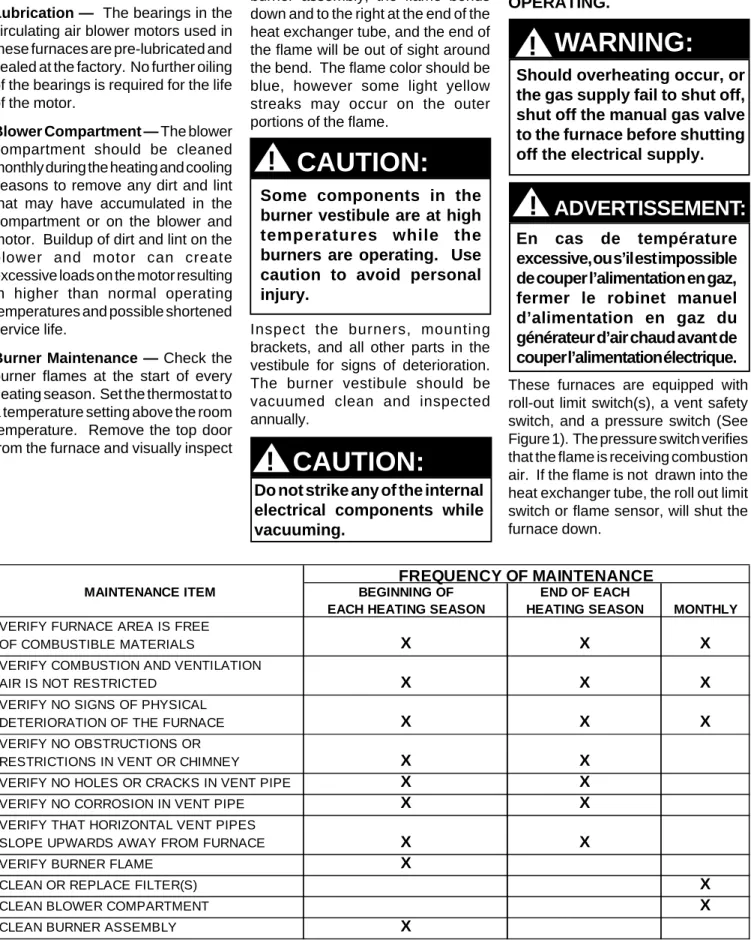
Table 1. Maintenance Table
Some components in the burner vestibule are at high temperatures while the burners are operating. Use caution to avoid personal injury.
CAUTION:
!
Do not strike any of the internal electrical components while vacuuming.
CAUTION:
!
MAINTENANCE ITEM BEGINNING OF END OF EACH
EACH HEATING SEASON HEATING SEASON MONTHLY
VERIFY FURNACE AREA IS FREE
OF COMBUSTIBLE MATERIALS X X X
VERIFY COMBUSTION AND VENTILATION
AIR IS NOT RESTRICTED X X X
VERIFY NO SIGNS OF PHYSICAL
DETERIORATION OF THE FURNACE X X X
VERIFY NO OBSTRUCTIONS OR
RESTRICTIONS IN VENT OR CHIMNEY X X
VERIFY NO HOLES OR CRACKS IN VENT PIPE X X
VERIFY NO CORROSION IN VENT PIPE X X
VERIFY THAT HORIZONTAL VENT PIPES
SLOPE UPWARDS AWAY FROM FURNACE X X
VERIFY BURNER FLAME X
CLEAN OR REPLACE FILTER(S) X
CLEAN BLOWER COMPARTMENT X
CLEAN BURNER ASSEMBLY X
FREQUENCY OF MAINTENANCE
Should overheating occur, or the gas supply fail to shut off, shut off the manual gas valve to the furnace before shutting off the electrical supply.
WARNING:
!
En cas de température excessive, ou s’il est impossible de couper l’alimentation en gaz, fermer le robinet manuel d’alimentation en gaz du générateur d’air chaud avant de couper l’alimentation électrique.
ADVERTISSEMENT:
!
These furnaces are equipped with roll-out limit switch(s), a vent safety switch, and a pressure switch (See Figure 1). The pressure switch verifies that the flame is receiving combustion air. If the flame is not drawn into the heat exchanger tube, the roll out limit switch or flame sensor, will shut the furnace down.
Inspect the burners, mounting brackets, and all other parts in the vestibule for signs of deterioration. The burner vestibule should be vacuumed clean and inspected annually.
WARNING:
If you do not follow these
instructions exactly, a fire or explosion may
result causing property damage, personal
injury, or loss of life.
1. STOP! Read the safety information above on this label. 2. Set the thermostat to the lowest setting.
3. Turn off all electrical power to the appliance.
4. The appliance’s ignition device automatically lights the burner. Do not try to light burner by hand.
5. Remove the furnace door (upper door if two-door model). 6. Push lever in slightly and move left to OFF. (See Figure 1) 7. Wait five (5) minutes to clear out any gas. Then smell for
gas, including near the base of the unit.
If you smell gas, STOP! Follow “B” in above information. If you don’t smell gas, go to the next step.
8. Push lever in slightly and move left to “ON”. (See Figure 1 ) 9. Replace the furnace door.
1. ATTENTION! Lire d'abord la liste des mesures de sécurité ci-dessus.
2. Mettre le thermostat à la position minimale. 3. Couper le courant électrique qui mène à l’appareil. 4. Cet appareil ménager étant doté d’un système d’allumage
automatique, ne pas essayer d'allumer le brûleur manuellement.
5. Retirer la porte à volets d’aération de la chaudière.
6. Pousser légèrement le levier et le déplacer vers la gauche pour l’amener sur OFF (ARRÊT). (Voir la Figure)
7. Attendre cinq (5) minutes pour s’assurer de la dissipation du gaz.
En cas d’odeur, ARRÊTER LE PROCÉDÉ. Suivre les instruc-tions ci-dessus (Section B). En l’absence de toute odeur de gaz, avancer à l’étape suivante.
8. Pousser légèrement le levier et le déplacer vers la droite pour l’amener sur ON (MARCHE). (Voir la Figure)
9. Remettre en place la porte à volets d’aération de la chaudière.
MODE D'EMPLOI
A. This appliance does not have a pilot. It is equipped with an ignition device which automatically lights the burner. Do not try to light the burner by hand.
B. BEFORE OPERATING smell all around the appliance area for gas. Be sure to smell next to the floor because some gas is heavier than air and will settle on the floor.
WHAT TO DO IF YOU SMELL GAS • Do not try to light any appliance.
• Do not touch any electrical switch; do not use any phone in your building.
• Immediately call your gas supplier from a neighbor’s phone. Follow the gas supplier’s instructions.
• If you can’t reach your gas supplier, call the fire department. C. Use only your hand to push in or turn the gas control lever.
Never use tools. If the lever will not push in or move by hand, do not try to repair it, call a qualified service technician. Force
or attempted repair may result in a fire or explosion. D. Don’t use this appliance if any part has been under water.
Immediately call a service technician to inspect the appliance and to replace any part of the control system and any gas control which has been under water.
OPERATING INSTRUCTIONS
A. Cet appareil ménager n'a pas de veilleuse. II est doté d’un système d’allumage automatique. Ne pas essayer d'allumer le brûleur manuellement.
B. AVANT L’USAGE. Attention à une possible odeur de gaz surtout au niveau du plancher où les gaz les plus lourds ont la tendance de se concentrer.
EN CAS D’ODEUR DE GAZ.
• Ne mettre en marche aucun appareil électrique.
• Ne toucher à aucun commutateur électrique, ne pas employer le téléphone.
• Quitter le bâtiment immédiatement et avertir la compagnie du gaz en utili sant le téléphone d'un voisin.
• A défaut de la compagnie du gaz, avertir le service des pompiers.
C. Tourner le robinet à gaz levier. Ne jamais employer d’outils. En levier de difficulté, ne pas essayer de le réparer vous-même. Appeler un spécialiste. Forcer ou tenter de réparer le robinet peut entraîner une explosion ou un incendie.
D. II est déconseillé d’utiliser cet appareil en contact prolongé avec l’eau. Faire inspecter ou remplacer toute commande par un technicien qualifié si un des systèmes de contrôle du gaz s'est trouvé sous l'eau.
ATTENTION!
L’inobservation de cesinstructions peut entraîner un incendie ou une explosion pouvant causer des dammages à votre propriété à votre personne, ou la mort.
POUR VOTRE SÉCURITÉ.
À LIRE AVANT L’EMPLOI
FOR YOUR SAFETY
READ BEFORE OPERATING
LEVER (LEVIER)
10. Rebrancher l’appareil sur le réseau électrique. 11. Ajuster le thermostat à la position désirée.
12. Si l’appareil ne fonctionne pas, suivre les “Directives d’arrêt” cidessous et appeler le technicien de service.
10. Turn on all electrical power to the appliance.
11. Turn the thermostat to a desired setting.
12. If the appliance will not operate, follow the instructions “To Turn Off Gas To Appliance” and call your service technician.
MANUFACTURER WARRANTY, OWNER RESPONSIBILITIES
It is the sole responsibility of the homeowner to make certain the gas furnace has been correctly set up and adjusted to operate properly.
NORDYNE warrants this furnace to be free from defects in material or workmanship for a period of one year. A warranty certificate with full details is included with this document. However, NORDYNE will not be responsible for any costs found necessary to correct problems due to improper setup, improper installation, furnace adjustments, improper operating procedure on the part of the user, etc.
Some specific examples of service calls which cannot be included in warranty payments are:
1. Converting the furnace to use another type of gas.
2. Repairing duct work in the home found to be faulty. 3. Correcting wiring problems in
the electrical circuit supplying the furnace.
4. Resetting circuit breakers, blown fuses or other switches. 5. Correcting problems due to
improper gas supply pressure to the furnace.
6. Providing instructional training on how to light and operate the furnace.
7. Correcting any problems caused by installation of an air conditioner, heat pump or other air comfort devices.
8. Revising installation of the furnace flue assembly. 9. Adjusting or calibrating of
thermostat.
10. Removing any construction debris which has fallen into flue system.
Carefully review these responsibilities with your dealer, service company, or gas supplier so there will be no misunderstanding at a later time.
Read Your Warranty
Please read your limited warranty completely. It contains valuable information about your furnace. If you have any questions about the warranty information, contact your NORDYNE distributor.
The vent safety switch shuts the furnace down if the vent becomes blocked or restricted.
Furnace Fails To Operate — If the
furnace does not operate, check the following:
1) Is the thermostat operating properly?
2) Are the blower door(s) in place? 3) Is the furnace disconnect closed? 4) Has the circuit breaker tripped
(or fuse blown)? 5) Is the gas turned on? 6) Is the filter dirty or plugged? If the combustion and circulating air blowers are operating, and items 1 through 6 have been checked without identifying the cause of the problem, press the red reset buttons on the vent safety and the roll out limit switches. (See Figure 1).
IMPORTANT: If the furnace operates after depressing the reset button on the vent limit or roll out limit, it is an indication of a potentially serious problem in the installation. Follow the instructions "To Turn Off Gas To the Appliance" located in these instructions or on the door of the furnace. Contact a qualified serviceman to identify and repair the problem.
Figure 2. Burner Inspection
Burner Flame
Manifold
St. Louis, MO
707811-0 Specifications and illustrations subject to change without notice and without incurring obligations. Printed in U.S.A. (08/98)
¢7078110%¤