A molecular phylogeny of the Sierra-Finches (
Phrygilus
, Passeriformes): Extreme
polyphyly in a group of Andean specialists
Leonardo Campagna
a, Kathryn Geale
b, Paul Handford
c, Darío A. Lijtmaer
a, Pablo L. Tubaro
a,
Stephen C. Lougheed
b,⇑a
División de Ornitología, Museo Argentino de Ciencias Naturales ‘‘Bernardino Rivadavia’’, Av. Ángel Gallardo 470, Ciudad de Buenos Aires, C1405DJR Buenos Aires, Argentina bDepartment of Biology, Queen’s University, 116 Barrie Street, Kingston, Ontario, Canada K7L 3N6
c
Department of Biology, University of Western Ontario, London, Ontario, Canada N6A 5B7
a r t i c l e
i n f o
Article history:
Received 4 April 2011 Revised 11 July 2011 Accepted 12 July 2011 Available online 23 July 2011
Keywords: Andes mountains DNA barcodes Neotropics Phrygilus Polyphyly ‘‘Tanager-finches’’
a b s t r a c t
The unparalleled avian diversity of the Neotropics has long been argued to be in large part the evolution-ary consequence of the incredible habitat diversity and rugged topography of the Andes mountains. Var-ious scenarios have been proposed to explain how the Andean context could have generated lineage diversification (e.g. vicariant speciation or parapatric speciation across vertical ecological gradients), yet further study on Andean taxa is needed to reveal the relative importance of the different processes. Here we use mitochondrial and nuclear DNA sequences to derive the first phylogenetic hypothesis for
Phrygilus(Sierra-Finches), one of the most species-rich genera of mainly Andean passerines. We find
strong evidence that the genus is polyphyletic, comprising four distantly related clades with at least nine other genera interspersed between them (Acanthidops,Catamenia,Diglossa,Haplospiza,Idiopsar,
Melano-dera,Rowettia,SicalisandXenodacnis). These fourPhrygilusclades coincide with groups previously
estab-lished mainly on the basis of plumage characters, suggesting single evolutionary origins for each of these. We consider the history of diversification of each clade, analyzing the timing of splitting events, ancestral reconstruction of altitudinal ranges and current geographical distributions.Phrygilusspecies origins date mainly to the Pleistocene, with representatives diversifying within, out of, and into the Andes. Finally, we explored whetherPhrygilusspecies, especially those with broad altitudinal and latitudinal Andean distri-butions, showed phylogeographic structure. Our best-sampled taxon (Phrygilus fruticeti) exhibited no clear pattern; however, we found deep genetic splits within other surveyed species, withPhrygilus
uni-colorbeing the most extreme case and deserving of further research.
Ó2011 Elsevier Inc. All rights reserved.
1. Introduction
The Andes mountains are considered a key factor in the origin of the vast avian biodiversity of the Neotropics (e.g. Fjeldså and Krabbe, 1990; Roy et al., 1997). However the speciation processes are not fully understood and several alternative patterns have been described. Elevation shifts could have promoted speciation: some Andean taxa could have been derived from lowland species through colonization of newly arisen areas during Andean uplift (Bates and Zink, 1994; McGuire et al., 2007; Sedano and Burns, 2010; Weir, 2006) and others seem to have originated via dispersal events from the Andean highlands to lower areas (Brumfield and Edwards, 2007; Fjeldså and Rahbek, 2006; Sedano and Burns, 2010).Brumfield and Edwards (2007)found evidence for the latter
inThamnophilus antshrikes, where transitions from high altitude to
lower altitudinal ranges were more common than in the opposite
direction. However,Sedano and Burns (2010)found most specia-tion events to occur within the highlands or lowland areas during the evolution of tanagers (Thraupini), with transitions between altitudinal ranges being relatively uncommon. McGuire et al. (2007)found diversification of Andean hummingbirds to have oc-curred either within the highlands or lowlands, but also identified dispersals events from, and invasions into the Andes to be associ-ated with speciation events. Allopatric speciation within the Andes could have occurred when populations became physically or eco-logically isolated during periods of orogeny in the Miocene, or more recently during Pleistocene Milankovitch cycles (Cheviron et al., 2005; Fjeldså, 1994; Guarnizo et al., 2009; Haffer, 1969; Weir, 2006). Recent studies of Andean taxa identified these pro-cesses as being important in shaping various avian radiations (e.g.Brumfield and Edwards, 2007,Thamnophilus;Burns and Naoki,
2004,Tangara;Chesser, 2000,Muscisaxicola;Cheviron et al., 2005,
Geositta; García-Moreno, 2001, Hemispingus; Lougheed et al.,
2000,Poospiza;Mauck and Burns, 2009,Diglossa; McGuire et al.,
2007, Trochilidae; Pérez-Emán, 2005, Myioborus). The factors
1055-7903/$ - see front matterÓ2011 Elsevier Inc. All rights reserved. doi:10.1016/j.ympev.2011.07.011
⇑ Corresponding author. Fax: +1 613 533 6617.
E-mail address:[email protected](S.C. Lougheed).
Contents lists available atScienceDirect
Molecular Phylogenetics and Evolution
implicated in differentiation among species have also been sug-gested to shape phylogeographic patterns in some Andean taxa (Cadena et al., 2007,Buarremon brunneinuchaandBuarremon torqu-atus;Miller et al., 2007,Myadestes ralloides;Puebla-Olivares et al.,
2008,Aulacorhynchus prasinus;Weir et al., 2008,Chlorospingus
oph-thalmicus). Finally, the uplift of the mountains could have created
vertical ecological gradients that promoted parapatric speciation (Endler, 1977), although to our knowledge no unequivocal exam-ple of this has yet been reported in Andean birds. The difficulty in disentangling the relative importance of these scenarios arises from the fact that they are not mutually exclusive and could have influenced speciation in a taxon- and region-specific way during different periods in time (Sedano and Burns, 2010). Additional phy-logenetic and phylogeographic studies of an array of Andean taxa will help provide insights into the speciation mechanisms that lead to the high avian biodiversity of the region. In particular, further work on taxa that span both highlands and lowlands may provide an ‘evolutionary snapshot’ of the role that the Andes had in the diversification of those groups of species (Brumfield and Edwards, 2007). The species-rich and widely-distributed genusPhrygilus, the Sierra-Finches, provides an ideal case because it is one of the few predominantly Andean genera of passerines.
To provide some context, only 13.6% of Neotropical passerine species are found regularly above 3000 m of altitude (Ridgely and Tudor, 1989, 1994), with the proportion of oscines being slightly higher than that of suboscines (15.6% vs. 12.3%). Among the oscines, roughly a fourth of the species adapted to higher alti-tude belong to three genera:Diglossa,HemispingusandPhrygilus.
Asthenes and Muscisaxicola encompass a fifth of the highland
suboscine species. While phylogenetic studies already exist for
Diglossa (Mauck and Burns, 2009), Hemispingus (García-Moreno,
2001) andMuscisaxicola(Chesser, 2000), the evolutionary affinities
ofAsthenesandPhrygilusremain to be investigated. Our study
fo-cuses on the evolutionary affinities withinPhrygilus, a genus con-taining 11 finch-like species (12–18 cm from bill to tail) found predominantly in open grassland habitats across the Andes moun-tains, from Venezuela to Argentina (Ridgely and Tudor, 1989, also seeTable 1). This genus offers the advantage that it spans a wide range of elevations, including species found solely in the lowlands (e.g.Phrygilus carbonarius), altitude specialists likePhrygilus
dorsa-lisandPhrygilus erythronotusfound exclusively above 4000 m and
species like Phrygilus plebejus that cover the entire altitudinal range. Moreover, some have broad latitudinal distributions along the Andes (e.g.Phrygilus alaudinus,Phrygilus fruticetiandPhrygilus
unicolor), while others have restricted ranges in the mountains
(e.g.P. dorsalisandP. erythronotus).Phrygilustaxa with wide altitu-dinal and geographical distributions are good candidates for phy-logeographic studies that may also offer insights on how the Andes have influenced diversification. While no complete phylog-eny of Sierra-Finches exists to date,Klicka et al. (2007) included
fourPhrygilusspecies within a broader study aimed to clarify the
taxonomy of the tribe Cardinalini. Although not all relevant nodes were highly supported, their study suggested that representatives from the generaCatamenia,Haplospiza,Diglossaand Sicaliswere interspersed amongPhrygilus species.Ridgely and Tudor (1989)
also comment on the affinities among species within Phrygilus, dividing the Sierra-Finches into four phenotypic groups, mainly on the basis of plumage traits (Table 1). Overall, this suggests the need for a phylogenetic analysis ofPhrygilus, including a robust test of the monophyly of the genus.
Our study uses mitochondrial and nuclear DNA sequence data to derive the first phylogenetic hypothesis for allPhrygilusspecies. We subsequently use this phylogeny to: (1) test for the monophyly of the genus; (2) test for the monophyly of each one of the plumage groups defined by Ridgely and Tudor (1989); (3) assess species-level monophyly and quantify the extent of genetic diversity Table
1 Distribution and plumage groups of Phrygilus taxa ( Fjeldså and Krabbe, 1990; Ridgely and Tudor, 1989 ). Plumage group a, b Species (samples) Range c Elevation (m) d Habitat Mostly plain gray; females brown and streaky. CLADE I. P. unicolor (5) Andes from Venezuela to Patagonia 3000–4500, lower in south (G) Páramo and puna grasslands; timberline shrubbery P. plebejus (6) Andes from Ecuador to N Chile and Argentina 2500–4500, sea level locally (G) Páramo and puna grasslands Yellow bill, with gray to black underparts; females streaky. CLADE II. P. alaudinus (7) Andes from Ecuador to central Chile and NW Argentina Lowlands to about 3500 (G) Open stony or sandy areas, low bushes and sparse grass cover P. fruticeti (29) Andes from Peru to N Chile and Argentina, Patagonia 2000–4000, sea level in S (G) Shrubby areas P. carbonarius (5) Central Argentina Steppes of Patagonia (L) Semi-open shrubby steppes Hooded effect (gray to black); females duller. CLADE III. P. atriceps (11 ) Andes of S Peru to N Chile and Argentina Mostly above 3000 (H) Shrubby slopes and valleys in semi-open areas with cactus growth P. gayi (4) Chile and Argentina Mostly 1500–3500, sea level locally (G) Grasslands and woodlan d borde rs with shrubby vegetation P. punensis (3) Andes of Peru and NW Bolivia 2000–4000 (H) Rocky, shrubby slopes P. patagonicus (5) S Chile and Andean slopes of S Argentina Sea level up to 1800 (L) Nothofagus forest borders and openings, shrubby cleared areas Large, gray above, white below, with back rufous or gray; sexes alike. CLADE IV. P. dorsalis (1) Andes of SW Bolivia, N Chile and NW Argentina Above 4000 (H) High puna grasslands and rocky slopes P. erythronotus (3) Andes of SW Bolivia and adjacent Peru and Chile above 4000 (H) high puna grasslands and rocky slopes a Groups defined by Ridgely and Tudor (1989) . b Plumage groups are indicated by clade numbers in figures. c N, North; S, South; E, East; W, Wes t. d (H), Highland specialist; (L), Lowland species; (G), Generalist. For more detail see Section 2.5 .
within species; (4) study the history of diversification of the genus in relation to the Andes mountains. We also use evidence from both DNA sequences and microsatellite loci to explore the phylog-eographic structure withinP. fruticeti; a species widely distributed across the Andes mountains and Patagonia.
2. Methods
2.1. Taxon sampling and data sets
Samples used in this study were either collected by P Handford and SC Lougheed, collected during several field trips organized by the Ornithology Division of the Museo Argentino de Ciencias Natu-rales ‘Bernardino Rivadavia’ (MACN), or loaned by the Louisiana State University Museum of Natural Sciences. The majority of the samples used come from vouchered specimens (88%), the remain-ing ones were unambiguously identified in the field and therefore also included in our study. All 11 currently-recognizedPhrygilus
species are represented in our data set and when available we in-cluded multiple individuals per species (range 1–29 individuals) and from as many localities of their geographical distribution as possible (range 1–11) (details provided inAppendix A).
We chose to assess species level monophyly using Cytochromec
oxidase I (COI) since this locus is used in DNA barcoding with high success in species level delimitation and identification (Hebert et al., 2003). Various studies have shown specifically that DNA bar-codes can separate and identify even sister or closely related spe-cies in diverse avian orders (Chaves et al., 2008; Kerr et al., 2009; Tavares and Baker, 2008; Vilaça et al., 2006).
To rigorously test the monophyly of the genus we used both COI and cytochromeb(Cytb), which allowed us to obtain sequences from several putative outgroup species available in online reposi-tories such as GenBank (www.ncbi.nlm.nih.gov) and BOLD (www.boldsystems.org), seeSupplementary Table 1for details. Se-quences were downloaded from species considered to be close al-lies ofPhrygilusbyJønsson and Fjeldså (2006), Klicka et al. (2007)
andRidgely and Tudor (1989).Jønsson and Fjeldså (2006)included
Phrygiluswith over 20 other genera in ‘Passeroidea clade 13’, while
Ridgely and Tudor (1989)suggestedCatamenia,Diuca,Idiopsarand
Melanodera were the closest relatives of Phrygilus. Klicka et al.
(2007) supported the proximity of some of these genera to
Phrygiluswhile also addingSicalis. Finally, we included
representa-tives from the generaGubernatrixandRowettiabecause there is at
least indirect evidence that these taxa could be related to Diuca
(Bertonatti and López Guerra, 1997) andMelanodera(Ridgely and Tudor, 1989), respectively. Based on preliminary analyses with the COI and Cytbdatasets, we chose candidate species suspected of makingPhrygiluspolyphyletic for which samples were obtained for more detailed phylogenetic analysis from the tissue collection of the Ornithology Division of the MACN (see Appendix A).
Sturnella loyca was used to root all trees since this taxon is
unequivocally outside of our ingroup taxa (Jønsson and Fjeldså, 2006).
We obtained COI sequences for all individuals and a subset of these from eachPhrygilusspecies, belonging to different localities (between 3 and 5 when more than one was available) was selected to conduct phylogenetic analyses with a greater array of mitochon-drial and nuclear sequence data. The species selected based on our COI and Cytbanalyses as candidates for makingPhrygilus polyphy-letic were also included in this restricted data set.
2.2. DNA extraction, amplification and sequencing protocols
DNA sources for this study included frozen pectoral muscle, li-ver or blood. DNA was extracted following the protocol described byIvanova et al. (2006)using individual spin columns (Epoch Life Sciences, Missouri City, TX). We amplified a total of 3925 base pairs (bp) from five gene fragments using polymerase chain reaction (PCR). We included three mitochondrial regions, COI (694 bp), Cytb(922 bp) and the control region (CR, 1050 bp); one Z-linked marker, intron 3 of the muscle skeletal receptor tyrosine kinase gene (MUSK, 678 bp); and one autosomal intron, intron 5 of the b-fibrinogen gene (Fib5, 581 bp). This combination comprises genes with a range of substitution rates with the objective of achieving resolution at both deep and recent nodes. We conducted COI amplification followingKerr et al. (2009). Cytband CR PCRs used conditions outlined by Sato et al. (2001). Finally Fib5 and MUSK PCRs were conducted in 25
l
l of KCl PCR buffer (Fermentas, Burlington, ON) containing 2l
l of genomic DNA, 0.4l
M of each primer, 0.2 mM of dNTPs, 1 U of Taq DNA polymerase (Fermentas) and MgCl2concentrations indicated inTable 2. PCRs were runun-der the following thermal cycle profile: 5 min at 94°C followed by 35 cycles of 30 s at 94°C, 45 s at the annealing temperature spec-ified in Table 2and 1.5 min at 72°C, and finally 5 min at 72°C. Amplification of MUSK was unsuccessful for most of the selected outgroup taxa and therefore sequences from this marker for those
Table 2
Primers and PCR conditions used to amplify loci in this study.
Locus Primer name and sequence Annealing temperature Mg2+concentration References
COI BirdF1 50-TTCTCCAACCACAAAGACATTGGCAC-30 51°C 2.5 mM Kerr et al. (2009)
COIbirdR2 50-ACGTGGGAGATAATTCCAAATCCTGG-30
CytB CB1 50-CCAACATCTCHKCHTGATGAAAYTT-30 56–58°C 1.5–2 mM Sato et al. (1999)
CB2 50-GATGAAKGGGTVTTCTACTGGTTG-30
CR M1 50-CATCAGACAGTCCATGAAATGTAGG-30 56–58°C 3.5 mM Sato et al. (1999)
H1261 50-AGGTACCATCTTGGCATCTTC-30
Fib5 Fib5 50-CGCCATACAGAGTATACTGTGACAT-30 50°C 2–2.5 mM Kimball et al. (2009)
Fib6 50-GCCATCCTGGCGATTCTGAA-30
Musk MUSK-I3F2 50-AAATAACCCGACCACCTGTAAA-30 56–60°C 2–3.5 mM Kimball et al. (2009)
MUSK-I3R2 50-TAGGCACTGCCCAGACTGTT-30
Escl6 F 50-CATAGTGATGCCCTGCTAGG-30 56°C 2.5 mM Hanotte et al. (1994)
R 50-GCAAGTGCTCCTTAATATTTGG-30
Mcyl4 F 50-ATAAGATGACTAAGGTCTCTGGTG-30 56°C 2.5 mM Double et al. (1997)
R 50-TAGCAATTGTCTATCATGGTTTG-30
Pdol3 F 50-CTGTTCATTAACTCACAGGT-30 52°C 2.5 mM Neumann and Wetton (1996)
R 50-AGTGAAACTTTAATCAGTTG-30 Gf05 F 50-AAACACTGGGAGTGAAGTCT-30 52°C 2.5 mM Petren (1998) R 50-AACTATTCTGTGATCCTGTTACAC-30 Gf08 F 50-TGGGAGAGCAAGGTGGGAACAG-30 62°C 2.5 mM Petren (1998) R 50-TGGAGTGGTGATTAAACCAGCAGG-30 Gf12 F 50-AATCCTTCTCGTCCCTCTTGG-30 56°C 2.5 mM Petren (1998) R 50-TTTGAGTGTGCAGCAGTTGG-30
species could not be included in the study. Primer sequences and original references, annealing temperatures and MgCl2
concentra-tions used for all PCR reacconcentra-tions in this study are detailed inTable 2. PCR products were visualized on a 2% agarose gel stained with ethidium bromide, purified using the QIAquick PCR purification Kit (QIAGEN, Mississauga, ON) and sequenced bi-directionally using primers indicated inTable 2. Approximately half of the COI sequences were obtained at the Canadian Centre for DNA Barcod-ing (Guelph, ON, Canada) from part of an ongoBarcod-ing project to bar-code the birds of Argentina. All other sequencing was conducted at the London Regional Genomics Centre (London, ON) and the Unidad de Genómica, Instituto de Biotecnología, Instituto Nacional de Tecnología Agropecuaria (Buenos Aires, Argentina). All se-quences were deposited in Genbank; for accession numbers see
Appendix A.
2.3. Genetic variability and phylogenetic analyses
Sequences were aligned using BioEdit 7.0.9.0 (Hall, 1999) and K2P genetic distances calculated for the COI dataset with MEGA 4 (Tamura et al., 2007). K2P COI distances were used to assess divergence within and between species since this is the preferred metric when there are few substitutions among sequences (Nei and Kumar, 2000). For this reason this same model is used for spe-cies-level analysis and identification in DNA barcoding (Hebert et al., 2003). Protein coding mitochondrial sequences were visually inspected to verify lack of indels and translated into amino acids to confirm absence of stop codons. Since phylogenetic signal may vary across loci (Edwards et al., 2005), we built individual gene trees for each of the five selected markers and also combined them to produce mitochondrial DNA trees (mtDNA: COI + Cyt b+ CR), nuclear DNA trees (nuDNA: Fib5 + MUSK), and multi-gene trees (including all 5 loci). For samples to be included in the multi-gene analysis, sequences from at least three markers (including one nu-clear locus) had to be available. We did not have access to tissue samples fromMelanodera xanthogrammaandIdiopsar brachyurus
and only Cytbsequences from these taxa were available on Gen-Bank. However we still included these species in our multi-gene analyses since our Cyt btree showed strong evidence that they are closely related to somePhrygilustaxa. The missing data intro-duced by including these taxa did not preclude us from obtaining a nearly fully resolved topology. We performed Bayesian phyloge-netic analyses using MrBayes 3.1.2 (Huelsenbeck and Ronquist, 2001; Ronquist and Huelsenbeck, 2003) and maximum parsimony (MP) analysis using TNT 1.1 (Goloboff et al., 2003). For Bayesian analysis, we selected the model of nucleotide evolution for each lo-cus with jModelTest 0.1.1 (Guindon and Gascuel, 2003; Posada, 2008). Likelihood calculations were carried out using 11 substitu-tion schemes, unequal base frequencies, a proporsubstitu-tion of invariable sites, rate variation among sites with four rate categories and a fixed tree estimated with the BIONJ option. The Akaike information criterion was used to choose the model that fit each data partition best and these were subsequently used in MrBayes, choosing the closest available model. We ran jModelTest twice for each locus, first for the sequences used in the single gene trees and then for the subset of these used in the multi-gene tree. Even though a smaller number of sequences were used in the second case, espe-cially compared to the Cytband COI data sets, the best fit nucleo-tide substitution model did not differ. The General Time Reversible model (GTR,Tavaré, 1986) with gamma-distributed rate variation across sites (+G) and a proportion of invariable sites (+I) was cho-sen for the COI, Cytband MUSK data sets; the GTR + G for the CR data set and the Hasegawa, Kishino and Yano two-parameter model (HKY,Hasegawa et al., 1985) for the Fib5 dataset.
For each tree we ran two independent Bayesian analyses with between four and six chains under default priors for all parameters
for seven to ten million generations. At this point the standard devia-tion of split frequencies was <0.01 indicating that both runs had con-verged. We sampled trees every 100 generations, discarding the first 25% (17,500–25,000 trees) as part of the burn-in period. We con-firmed that runs had reached a stationary state using the ‘‘cumula-tive’’ and ‘‘compare’’ functions implemented in the software AWTY (Wilgenbusch et al., 2004). The Potential Scale Reduction Factor ( Gel-man and Rubin, 1992) was also very close to one for all parameters, indicating that we had adequately sampled their posterior distribu-tions. To produce the mtDNA, nuDNA and multi-gene tree we concat-enated loci and placed each gene in a different partition allowing it to vary according to the model of evolution selected by jModelTest. Par-titions were unlinked prior to the analysis, allowing parameters to be estimated separately while producing a posterior tree distribution from which a 50% majority rule consensus was obtained.
To analyze the sensitivity of topologies to the method of phylogenetic reconstruction we performed MP heuristic searches consisting of 1000 random addition sequences with the TBR branch-swapping algorithm (saving 100 trees per replication). Data sets were analyzed under an equal weighing scheme for the three codon positions and also by down-weighting third codon positions by a factor of two, five and ten. Since similar results were obtained under the four weighing schemes we only show results from the equal weights MP topologies. A strict consensus was obtained from all equally parsimonious trees. To assess the robust-ness of the nodes of the resulting phylogenies, we performed 1000 standard bootstrap pseudoreplicates (Felsenstein, 1985) each consisting of 100 random addition sequences followed by TBR (retaining ten trees in each pseudoreplicate).
2.4. Estimation of diversification times
We estimated species and internal node ages using time to most recent common ancestor (TMRCA) with a Bayesian approach implemented in the BEAUti/BEAST v1.4.8 package (Drummond and Rambaut, 2007). To obtain absolute times we used the Cytb
data set and a calibration of 2.1% per million years (Weir and Schluter, 2008). The analysis was run for 100 million generations using a GTR + I + G model of nucleotide substitution with four rate categories, assuming a constant population size and a relaxed uncorrelated lognormal clock. We checked for convergence in parameter estimations by verifying that trends were not observed in traces and that effective sample sizes were adequate using Tracer v1.4 (Rambaut and Drummond, 2007).
2.5. Character reconstruction of ancestral altitudinal ranges
The 11 Phrygilusspecies were classified into three categories based on their breeding distributions: lowland species (L), high-land specialists (H) and generalists (G) (seeTable 1), according to their altitudinal range as described byRidgely and Tudor (1989). If a species is found from sea level up to 1800 m, we considered it a lowland species, taxa found at sea level and also above 3000 m were categorized as generalists, and finally taxa found mainly above 2000/3000 m (and never at sea level) were consid-ered to be highland specialists. These categories capture the varia-tion in altitudinal ranges observed in the genus and differ from previous studies of Andean taxa (Brumfield and Edwards, 2007,
Thamnophilus; Sedano and Burns, 2010, Tangara) mainly in the
lower bound for H. Both of these studies included species that are rarely found above 3000 m and included taxa found above 500 m in the H category. In a recent study on Yellow-billed Pintails
(Anas georgica), a species distributed throughout the Andes and
occurring from sea level to up to 5000 m, McCracken et al. (2009) found evidence of local adaptation to oxygen partial pressures in globin genes comparing lowland (<1809 m) and
highland (>3063 m) populations. We therefore used 2000/3000 m as the lower limit for H as these values may capture the physiolog-ical constraints that some altitude specialistPhrygilustaxa experi-ence. We used MP to optimize this three-state character on the
Phrygilusphylogeny considering states to be ordered in the
se-quence L–G–H, implying two steps from L to H. We believe this to be the most likely evolutionary sequence for high altitude adap-tation from a physiological, ecological and geological perspective. Because we found evidence of polyphyly in Phrygilus (see Sec-tion3.1), we reconstructed ancestral character states separately in each monophyletic plumage group using the branching order from the multi-gene phylogeny with TNT 1.1. Since we are not cer-tain that our study identified all the taxa that makePhrygilusa polyphyletic taxon, the sister species to each plumage group and therefore the character state of the root of every clade was consid-ered to be unknown. For clades I and IV, optimizations were trivial since all group members had the same character state.
2.6. Phylogeographic analysis of genetic variation within P. fruticeti
Samples were genotyped for six previously published microsat-ellite loci developed for various passerine species that show allele variation inP. fruticeti(seeTable 2for details). An M13 tag (50
-CAC-GACGTTGTAAAACGA-30) was added to the 50 end of the forward
primer of each pair. PCRs were conducted in 10
l
l of KCl PCR buffer containing 2l
l of genomic DNA, 0.15l
M of each primer, 0.1 mM of dNTPs, 2.5 mM MgCl2, 6l
M of labeled Well-Red M13(Sigma-Al-drich, Oakville, ON, Canada) and 0.5 U of Taq DNA polymerase. PCRs were run under the following thermal cycle profile: 3 min at 95°C followed by 35 cycles of 30 s at 95°C, 45 s at the annealing temperature specified in Table 2 and 45 s at 72°C, and finally 10 min at 72°C. PCR products were genotyped using a Beckman Coulter CEQ8000 capillary automated sequencer and alleles were scored using the CEQ 8000 Genetic Analysis System.
Assessment of molecular diversity, tests of Hardy-Weinberg equilibrium and linkage disequilibrium, andFSTcalculations were
completed using Arlequin v3.5.1.2 (Excoffier and Lischer, 2010). To assess population structure we used the Bayesian approach implemented in the program Structure v2.3.3 (see Pritchard et al., 2000) that identifies the number of subpopulations (K) that best fit the data. We used the admixture ancestry model with cor-related allele frequencies (Falush et al., 2003). The analysis was run for values ofK= 1 through 5 for 2,200,000 generations, discarding the initial 200,000 as part of the burn-in period.
3. Results
3.1. Phrygilus is a polyphyletic genus
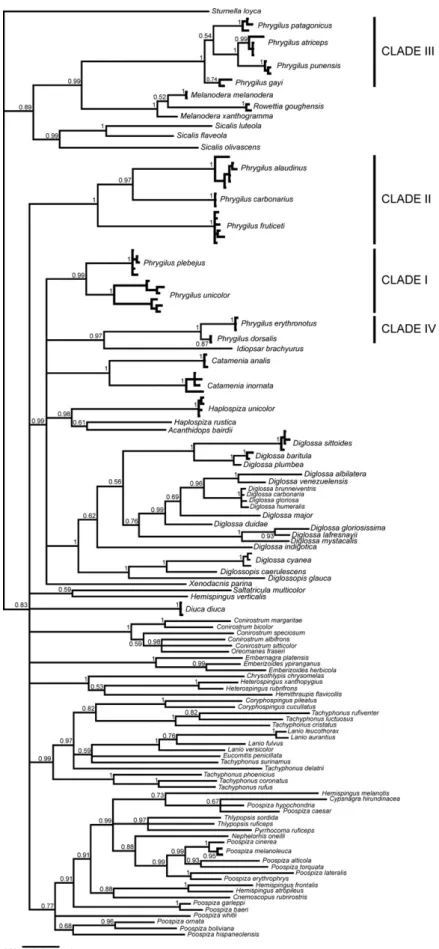
The Bayesian COI and Cytbindividual gene trees (Figs. 1 and 2
respectively) identified four well supported clades (I–IV) within
Phrygilusin relation to the 86 outgroup species tested belonging
to 31 different genera. These clades coincide with the plumage groups proposed byRidgely and Tudor (1989)and described in Ta-ble 1. Although support for some internal nodes was low (posterior probability < 0.95), both trees suggested that many non-Phrygilus
taxa were interspersed amongPhrygilusspecies, making the genus polyphyletic. MP trees did not resolve below the level of the four apparently monophyletic Phrygilus clades (data not shown). To achieve further resolution, we chose a subset of samples from each
Phrygilusspecies and selected taxa that putatively made the genus
polyphyletic and from these samples obtained data from additional loci (CR, Fib5 and MUSK). Except for the MUSK topology where most outgroups were absent, individual gene trees built with these loci also showed evidence of polyphyly forPhrygilus(Supplemental
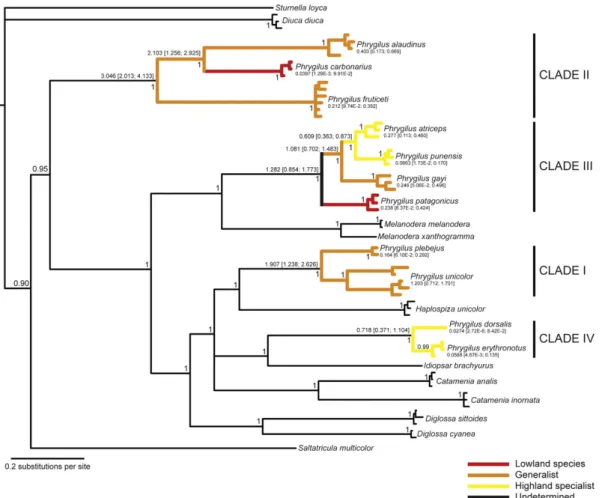
Fig. 1). While both CR and MUSK topologies show high support for clades I–IV, the resolution with the Fib5 data set was low and only supported clade IV (Supplemental Fig. 1).Fig. 3shows the concat-enated multi-gene tree from MrBayes (MP produced similar re-sults, see Supplemental Fig. 2). The concatenated tree confirms, with posterior probabilities of 1, that the genera Catamenia,
Diglossa, Haplospiza, Idiopsar and Melanodera are interdigitated
among clades comprised of Phrygilus species. Constraining the monophyly ofPhrygilusproduced a Bayesian topology that differed significantly according to a likelihood ratio test from that of the unconstrained tree [2(ln L1ln L0) = 480.24, d.f. = 1, p< 0.001]. Moreover, the topology inFig. 3suggests that the four plumage groups are not closely related to each other, with a deep node dividing clade II from the remaining taxa. Similar results were ob-tained when mitochondrial and nuclear loci where concatenated and analyzed separately (seeSupplementary Fig. 3).
3.2. Species affinities within plumage groups: diversification times and altitude ancestral reconstructions
The branching order within each of the four plumage groups indicated inTable 1is fully resolved and highly supported in the Bayesian concatenated tree (Fig. 3). This topology is identical to the multi-gene MP tree (Supplementary Fig. 2) with respect to clades I–IV and does not conflict with highly supported nodes ob-tained using other means of analyzing the data (individual gene, mtDNA and nuDNA trees). Since there is strong evidence for the polyphyly of the genus, we limited our analysis of diversification timing and ancestral altitude character reconstruction to each of the four plumage groups separately. Species and internal node TMRCA values estimated using BEAST are indicated inFig. 3, to-gether with upper and lower limits of 95% confidence intervals. Altitudinal ranges were mapped and ancestral states reconstructed using MP and superimposed on the concatenated topology (Fig. 3). Both clades I and IV are comprised of sister species that share the same altitudinal range category (generalist for clade I and high-land specialist for clade IV), suggesting that speciation in the latter occurred within the highlands. Clade IV is the youngest plumage group, with an estimated divergence time of approximately 0.7 million years (Myr) before present, while clade I is much older (roughly 2 Myr) with significant genetic structure present within
P. unicolor.
Clade II is the oldest plumage group, with an estimated date of 3 Myr before present, withP. alaudinusandP. carbonariushaving diverged approximately 2 Myr ago. The topology of the tree pre-sented inFig. 3suggests thatP. carbonariushas occupied the low-lands from an ancestral condition of altitudinal generalists.
The branching order for clade III is fully resolved and highly supported inFig. 3. Alternative tree topologies, for example those obtained in the Bayesian COI and Cytbindividual gene trees (Figs. 1 and 2), were poorly supported (posterior probabilities < 0.95). CR, MUSK and Fib5 individual gene trees as well as the nuDNA topol-ogy do not fully resolve the branching order of the clade ( Supple-mental Figs. 1 and 3), presumably due to incomplete lineage sorting in nuclear genes and possibly homoplasy in the control re-gion. There is evidence that adaptation to high altitude is a derived condition in this clade, withPhrygilus punensisandPhrygilus atri-cepsdiverging in the highlands close to 0.6 Myr ago. The ancestral state of the group is undetermined since it depends on the charac-ter state present in the sischarac-ter species to the clade. If the clade of
Melanodera/Rowettiaspecies were indeed the true sister to clade
III (which is as of yet uncertain, see Section4.1), the ancestral char-acter state could be lowland or altitudinal generalist (Rowettiaand
Melanodera melanoderaare lowland species whileM.
xanthogram-mais a generalist). Altogether the history of diversification of this clade suggests a succession of species from lowlands to highlands;
however the ancestral character state of this group remains uncertain.
3.3. Intraspecific divergence and species level monophyly
The average interspecific distance inPhrygilusis 11.3%, ranging from 2.5% in the pairP. punensis/P. atricepsto a maximum of 14.7%
in the pairPhrygilus gayi/P. alaudinus. If clades I–IV are considered separately, average interspecific divergence is lower (clade I, 4.78%; clade II, 8.75%; clade III, 3.88%; and clade IV, 2.57%). The COI Bayesian tree (Fig. 1) shows that, except for P. dorsalis for which we have only one COI sequence, all the species in the group are monophyletic. The CytbBayesian tree (Fig. 2) confirms this pattern for all Phrygilus species (including P. dorsalis). Various
Fig. 1.Bayesian 50% majority rule consensus tree with posterior probabilities indicating node support based on analysis of 694 bp of the COI gene. Names of taxa are
indicated only once for simplicity. Hence unnamed terminals represent cases in which more than one sample per species was available and illustrate level of divergence within species. Support for within species clades are not shown for simplicity. Clades I–IV represent morphology groups defined byRidgely and Tudor (1989)as detailed in
species of the group do not show reciprocal monophyly from the perspective of the nuclear loci analyzed (Supplementary Figs. 1 and 3), probably as a consequence of large effective population size
and incomplete lineage sorting. Finally, a few species show lack of monophyly in the CR (Supplementary Fig. 1) possibly due to homo-plasy in this highly variable marker.
The average intraspecific distance is 0.54%, ranging from 0.03%
in P. plebejus to 3.04% in P. unicolor. Three species had at least
one individual differing by more than 1% from the remaining mem-bers:P. fruticeti(average 0.37%; range 0–1.4%),P. alaudinus(0.45%, 0–1.5%) andP. unicolor(3.04%, 0.3–5%). These are species that oc-cupy the broadest geographical ranges (seeTable 1). Divergence
in P. unicolor was observed between individuals from southern
Peru/Northern Argentina and individuals from Northern Peru, while theP. alaudinusindividual sampled in Peru differed from those obtained in Argentina. While in this study we do investigate the phylogeographic structure ofP. fruticeti, further study is war-ranted to understand the basis of these deeper COI divergences
forP. alaudinusandP. unicolor. For details on inter and intraspecific
K2P COI distances seeSupplementary Table 2.
Fig. 3.Bayesian 50% majority rule consensus tree with posterior probabilities indicating node support based on 3925 bp from the concatenated data set (COI, CytB, CR, MUSK
and Fib5). Altitudinal ranges were mapped and ancestral states reconstructed separately on clades I–IV using MP. Species ages and internal nodes in clades I–IV were dated using TMRCA values from Cytbsequences and a calibration of 2.1% per million years (Weir and Schluter, 2008). Estimates of time are indicated in million years before present together with upper and lower limits of 95% confidence intervals in square brackets. Other details as inFig. 1.
Table 3
PairwiseFSTvalues (below diagonal) and their respective p values with standard deviation (above diagonal) between populations ofP. fruticeti
calculated using data from six microsatellite loci. All comparisons were not statistically significant after Bonferroni corrections were applied. NegativeFSTvalues should be interpreted as zero. Sample sizes are indicated in each row next to population names.
Río Negro Jujuy Catamarca Peru
Río Negro (12) – 0.2752 ± 0.0049 0.7410 ± 0.0046 0.0454 ± 0.0020 Jujuy (9) 0.0145 – 0.4949 ± 0.0055 0.4139 ± 0.0044 Catamarca (5) 0.0032 0.0190 – 0.1941 ± 0.0039
Peru (3) 0.0623 0.0289 0.0717 –
Table 4
PairwiseFSTvalues (below diagonal) and their respective p values with standard deviation (above diagonal) between populations ofP. fruticeti, calculated using COI haplotypes. Comparisons that were statistically significant after Bonferroni corrections were applied are indicated in bold. NegativeFSTvalues should be interpreted as zero. Sample sizes are indicated in each row next to population names.
Río Negro Jujuy Catamarca Peru
Río Negro (13) – 0.1583 ± 0.0036 0.1801 ± 0.0037 0.0017 ± 0.0004
Jujuy (8) 0.0362 – 0.4638 ± 0.0055 0.3455 ± 0.0049 Catamarca (5) 0.0542 0.0166 – 0.0191 ± 0.0013
3.4. Phylogeographic population structure of P. fruticeti
P. fruticetiindividuals were divided by collection locality into
four regional groups spanning the species range from north to south: Peru, Jujuy, Catamarca and Río Negro (the last three belong-ing to Argentina). The specimen from the province of Neuquén (Argentina) was included with those from the adjacent province of Río Negro. The bird from Tacna (Peru) was grouped with those from Lima (Peru), although this locality is approximately equally distant from the samples from Jujuy (Argentina); the inclusion of the Tacna sample in the Jujuy group did not alter our conclusions. We found between 7 (locusPdol3) and 20 (locusEscl6) alleles per locus across the 29 individuals analyzed. Within population ob-served heterozygosity averaged across loci ranged from 0.53 (Cata-marca) to 0.72 (Peru), with an average value of 0.66. Expected heterozygosity across loci ranged from 0.76 (Río Negro) to 0.83 (Ju-juy), with an overall average of 0.79.
Sequential Bonferroni corrections (Rice, 1989) were applied to results from tests of deviation from Hardy-Weinberg equilibrium and linkage disequilibrium, and to tests of significance for pairw-aise estimates ofFST. We found that only one of the 24
locus/pop-ulation combinations deviated from Hardy-Weinberg expectations: locus Pdol3 in Jujuy showed heterozygote defi-ciency. When all samples were pooled, both Escl6 and Pdol3
showed heterozygote deficiencies that were statistically significant from Hardy-Weinberg predictions. There was no evidence of link-age disequilibrium in the four populations and across all samples combined. The highest pairwise FST was obtained between the
northernmost and southernmost localities (Peru/Río Negro, Ta-ble 3), although this value was not significant after sequential Bon-ferroni correction. PairwiseFSTvalues were also calculated using
COI haplotype data (Table 4) and significant differences were found between Peru and Río Negro. Finally, results from Structure sug-gest that our population samples most likely comprise a single ge-netic population (K= 1, data not shown).
4. Discussion
We use a combination of gene fragments and different tree building algorithms to rigorously test the monophyly of the genus
Phrygilus, in addition to deriving the first phylogenetic hypothesis
of affinities among all of its members. We found strong evidence that the genus is polyphyletic, comprised of four distantly related clades. These clades coincide with the grouping ofPhrygilusspecies proposed by Ridgely and Tudor (1989) mainly on the basis of plumage traits, suggesting a single evolutionary origin for those phenotypic traits. Among our initial objectives was to study the diversification of the genus in relation to the Andes mountains; however given thatPhrygilus is not monophyletic we restricted such analysis to the four distinct clades. Below we discuss the bio-geographical implications for the diversification of plumage groups in relation to the Andes by examining estimated dates of nodes, ancestral character reconstruction of altitudinal ranges and present geographic distributions of species. Finally, we analyze intraspe-cific genetic patterns withinPhrygilusspecies, particularly in rela-tion toP. fruticeti which was studied in greater detail than the remaining species of the group.
4.1. Polyphyly in Phrygilus
Previous molecular phylogenetic work by Klicka et al. (2007)
suggested thatPhrygilusmay not be monophyletic. Our multi-gene tree confirms that representatives from at least five other genera are included within the assemblage containing all 11 recognized
Phrygilusspecies. Considering the strong support for the
mono-phyly ofDiglossa(Mauck and Burns, 2009) and assuming that
Cata-menia is monophyletic (this has not been tested and Catamenia
homochroawas not included in our study), at least 26 taxa are
inter-spersed among members of Phrygilus (3 Catamenia species, 18
Diglossa, 2Haplospiza, 1 Idiopsar, and 2 Melanodera). This list is
incomplete and it is likely that other taxa not included in our study fall within our ingroup. Our list of outgroup species for the COI and Cytbdatasets was derived mainly from the supertree suggested by
Jønsson and Fjeldså (2006), to which we addedDiuca,Gubernatrix,
Idiopsar,Melanodera,RowettiaandSicalis. This tree was constructed
using information from molecular phylogenies of passerine birds available to date, which included only 37% of known passerines. Subsequently we selected a subset of species from our initial analy-sis for which tissues were available to build a multi-gene tree. This required us to leave out genera likeAcanthidops,Rowettia,Sicalis
andXenodacnisthat could also makePhrygiluspolyphyletic
accord-ing to phylogenies based exclusively on mitochondrial markers (Figs. 1 and 2). Support for the monophyly of the four plumage groups proposed byRidgely and Tudor (1989)was robust, suggest-ing that the plumage patterns used to describe them arose only once. We suggest thatPhrygilusclades I–IV should be allocated to separate genera or subsumed within other genera pending further study with detailed taxon sampling. Under the former suggestion, clade III, which containsP. gayi, would retain the namePhrygilusasCabanis (1844)used this species to describe the genus.
4.2. Diversification of plumage groups: biogeographical implications
Although the extreme polyphyly ofPhrygilusprecludes our ana-lyzing the history of diversification of the genus, the analysis of each plumage group separately still provides useful insight on the origins of these Andean taxa. To draw biogeographical conclusions regard-ing the history of diversification of clades I–IV we must rely on two assumptions. First, our absolute estimation of species ages and timing of splitting events must be accurate. Many calibrations have been proposed for divergence rates in avian mtDNA (Lovette, 2004), the most broadly used being the calibration of 2% sequence divergence per million years first obtained byShields and Wilson (1987)using restriction fragment polymorphism (RFLP) data in
An-serandBrantageese. We use the similar result obtained recently by
Weir and Schluter (2008)of 2.1% sequence divergence per million years for the avian cytochromeb. The second assumption is that cur-rent ranges of species (geographical and altitudinal) still roughly correspond to the ancestral ranges at the time of speciation. Geolog-ical events that may lead to vicariance (such as mountain uplifts) are generally established on time scales that are long even relative to speciation times, and it is uncertain when these barriers have been sufficient to isolate populations of organisms (Ribas et al., 2005). Therefore, if a species shifted its range after splitting from a sister taxon (e.g. through competition with other species) we could incor-rectly infer that a dispersal event or a change in altitude contributed to speciation (Heads, 2009). Given these limitations, the following inferences appear justified.
High-altitude specialization (species found strictly above 3000 m) occurred independently twice in the same region of the central Andes (northern Argentina and Chile, southern Peru and Bolivia): within clades III and IV. The split between P. atriceps
andP. punensisdates roughly to the middle Pleistocene (clade III;
ca. 0.6 Myr before present) within the central Andean highlands. This region had reached its current elevation roughly 6 Myr ago (Garzione et al., 2008), suggesting that if vicariant events are in-volved in the speciation process of these two species, Pleistocene glaciations or concomitant vegetation shifts rather than orogenesis could have been involved. The same processes could have affected
P. dorsalisandP. erythronotusthat show a virtually identical
IV;ca. 0.7 Myr before present). These two originations of high-alti-tude specialists represent the most recent speciation events within the four plumage groups, suggesting that perhaps Pleistocene gla-ciations had a greater effect on speciation of populations restricted to the highlands, as suggested byWeir (2006).
The split betweenP. plebejusandP. unicolordates to the early Pleistocene (clade I,ca. 1.9 Myr before present); however it is dif-ficult to comment on the possible origin of this species pair since they both currently span most of the Andes, from Venezuela to Argentina and from sea level to up to 4500 m.
Phrygilus alaudinusandP. fruticetialso have broad geographical
distributions and altitude ranges (the ancestral condition in clade II); howeverP. carbonariusseems to have occupied the Patagonian lowlands during the early Pleistocene (ca.2 Myr ago). Clade II is the oldest of the four plumage groups dating to the Pliocene (ca.3 Myr before present).
Interestingly, the pattern of branching in clade III implies suc-cession of species across an altitudinal gradient from the Southern to the Central Andes. This clade dates roughly to the early Pleisto-cene (ca.1.3 Myr before present) when most of the Andes had al-ready reached their current elevation (Garzione et al., 2008; Gregory-Wodzicki, 2000), implying that any major physical barri-ers already existed at the time of speciation. Our results suggest that species in clade III adapted to higher elevations while expand-ing northward into the Central Andes. It is possible that the clade originated in the Patagonian lowlands; however we cannot unam-biguously reconstruct the altitudinal range of the ancestor of this group. This pattern of diversification is consistent both with parap-atric speciation occurring across a vertical gradient (Endler, 1977) or vicariance occurring after the major Andean uplift.
Finally,Vuilleumier (1991)consideredP. patagonicusandP. gayi
to be sister species and hypothesized that a habitat shift between steppe-like environments (the most common Phrygilus habitat)
andNothofagusforests contributed to the origin of theNothofagus
specialistP. patagonicusfrom populations ofP. gayi. In this study, we find evidence suggesting these two species are not sister taxa (Fig. 3). Moreover, the sister clade to Clade III must first be unam-biguously determined before the most likely direction of the hab-itat transition can be inferred.
Studying the phylogeographic patterns across the entire range of eachPhrygilusspecies will be crucial to achieving a better under-standing of the mechanisms by which the Andes influenced the diversification of these species. Comparisons with other co-distrib-uted taxa from the region (e.g. theAsthenesCanasteros) will also cast light on the relevance and generality of these processes (Nelson and Platnick, 1980).
4.3. Species level monophyly and within-species diversity in Phrygilus
The ability to detect intraspecific genetic patterns and/or lack of reciprocal monophyly increases with better coverage of the species range. Not allPhrygilusspecies were sampled in the same depth in this study, with 1–29 samples per species from 1 to 11 localities analyzed. We found average distances among taxa to be high (never below 2.5% K2P distance in COI), observing species level monophyly in all cases where such evaluations were possible. Spe-cies ages ranged from roughly 0.03 Myr (P. dorsalis) to 1.2 Myr (P.
unicolor) as estimated using BEAST and Cytbsequences. We were
able to detect cases of high intraspecific divergence, suggestive of genetic structure. Interestingly, the three species that had at least one individual with more than 1% K2P distance in COI from the remaining members of the same species were those that occupy the broadest geographical ranges: P. alaudinus,P. fruticeti andP.
unicolor. The most extreme case was that of P. unicolor, with an
average intraspecific distance of 3.04% (range: 0.3–5%). This value is high compared to intraspecific genetic distances obtained from
other Neotropical birds (Campagna et al., 2010; Kerr et al., 2009). Within the broadest mitochondrial survey carried out to date in the region,Kerr et al. (2009)compared 500 species of Argentine birds, finding only five species with a maximum difference over 4.5% K2P distance in COI. Two of these species,Cinclodes fuscus
and Upucerthia dumetaria, were considered to have more than
one lineage deserving full species status after detailed studies were carried out (Areta and Pearman, 2009; Sanín et al., 2009). Alto-gether these results highlight the need for a comprehensive study of the variation inP. unicoloracross its range, particularly focusing on the central Andean region where we identify diverging lineages. It is possible that this region also represents a point where popula-tions ofP. alaudinusdiverge since our sample from Arequipa, Peru differed in 1.5% from those from northern Argentina.
Finally, our analysis of phylogeographic structure within P.
fruticetidid not find such striking divergence as that we discovered
inP. unicolor.FSTcalculations based on COI haplotypes implied
sig-nificant isolation betweenP. fruticetipopulations sampled on the northern and southern extremes of the species distribution. The same pattern was obtained withFSTcalculations from
microsatel-lite allele frequencies, although statistical significance was lost after sequential Bonferroni corrections. When all samples were considered together, two loci showed statistically significant departures from Hardy-Weinberg expectation in the direction of heterozygote deficiencies. This suggests that isolation between populations ofP. fruticetiexists to some extent and that our ability to detect this fine structure could be limited by our sample sizes. Alternatively, a combination of recent origin (ca. 0.2 Myr ago) and a rapid range expansion could also underlie the genetic pattern observed withinP. fruticeti.
Acknowledgments
We thank Michael Andersen, Rubén Bárquez, George Barrowc-lough, Pilar Benites, Ines Bonansea, Kimberly Bostwick, Sebastián Cabbanne, Muir Eaton, Isabel Gomez, Cecilia Kopuchian, Paul Mar-tin, Horacio Matarazzo, Kevin McCracken, Kazuya Naoki, Ricardo Ojeda, Mark Robbins, Paul Sweet, Marcos Vaira and Robert Wilson for helping with fieldwork in various collection expeditions or for providing specimens. We are grateful to Robb Brumfield and Donna Dittmann from the Louisiana State University Museum of Zoology for providing tissue samples. We would like to thank Yolanda Davies for assistance with specimen curation at the MACN and Zhengxin Sun (Department of Biology, Queen’s University) and Natalia Ivanova (Biodiversity Institute of Ontario) for their work in the laboratory. For authorizing permits we thank the National Fau-na authorities of Bolivia and of ArgentiFau-na, the Argentine NatioFau-nal Parks Administration, and the authorities of the Offices of Fauna of Buenos Aires, Catamarca, Jujuy, Misiones, Neuquén, Río Negro, Santiago del Estero and Tucumán provinces, Argentina. This project was funded by grants from the Natural Sciences and Engineering Council of Canada (PH, SCL), Grants PIP 112-200801-00741 (PLT) and PIP 114-200901-00385 (DAL) of the Consejo Nacional de Inves-tigaciones Científicas y Técnicas of Argentina, the Richard Louns-bery Foundation (PLT), IDRC/University of Guelph ‘‘Engaging Developing Nations in the International Barcode of Life Project (iBOL)’’ (PLT) and UBACyT 2010-2012 01/1240 (PLT). We thank the Willi Hennig Society for providing a free edition of TNT 1.1. Part of this work was carried out using the resources of the Computa-tional Biology Service Unit from Cornell University, which is partially funded by Microsoft Corporation.
Appendix A
Table A1
Samples fromPhrygilusand closely related species used in this study. Species Museum and
Catalogue Numbera
Collection Localityb
CO1 Cytb CR FIB5 MUSK
Phrygilus alaudinus MACN-Or-ct 823 Volcán, Jujuy, Argentina (2175) FJ028033 JN417870 JN417822 JN417927 JN417983
Phrygilus alaudinus MACN-Or-ct 1017 Volcán, Jujuy, Argentina (2175) FJ028032 JN417871 - JN417928 JN417984
Phrygilus alaudinus QU SCL001 Tafí del Valle, Tucumán, Argentina (2000) JN417768 JN417873 JN417821 JN417930 JN417986
Phrygilus alaudinus LSUMZ 103849 Arequipa, Peru (425) JN417769 JN417872 JN417820 JN417929 JN417985
Phrygilus alaudinus QU SCL054 Yavi, Jujuy, Argentina (3515) JN417770 - - -
-Phrygilus alaudinus QU SCL067 Yavi, Jujuy, Argentina (3515) JN417771 - - -
-Phrygilus alaudinus MACN-Or-ct 1029 Volcán, Jujuy, Argentina (2175) FJ028031 - - -
-Phrygilus atriceps MACN-Or-ct 881 Quebraleña, Jujuy, Argentina (3650) JN417772 JN417874 JN417823 JN417931 JN417987
Phrygilus atriceps MACN-Or-ct 1169 Río Punilla, 35 km N Antofagasta de la Sierra, Catamarca, Argentina (4140)
FJ028037 JN417875 JN417824 JN417932 JN417988
Phrygilus atriceps LSUMZ 103864 Arequipa, Peru (3900) JN417773 JN417876 JN417825 JN417934
-Phrygilus atriceps MACN-Or-ct 1173 Río Punilla, 35 km N Antofagasta de la Sierra, Catamarca, Argentina (4140)
FJ028038 - - JN417933
-Phrygilus atriceps MACN-Or-ct 868 Quebraleña, Jujuy, Argentina (3650) JN417774 - - -
-Phrygilus atriceps MACN-Or-ct 878 Quebraleña, Jujuy, Argentina (3650) FJ028036 - - -
-Phrygilus atriceps MACN-Or-ct 1064 Quebraleña, Jujuy, Argentina (3650) FJ028035 - - -
-Phrygilus atriceps MACN-Or-ct 1074 Quebraleña, Jujuy, Argentina (3650) FJ028034 - - -
-Phrygilus atriceps QU PH10 Tucumán, Argentina (unknown) JN417775 - - -
-Phrygilus atriceps QU PH9 Tucumán, Argentina (unknown) JN417776 - - -
-Phrygilus atriceps QU PH8 Tucumán, Argentina (unknown) JN417777 - - -
-Phrygilus carbonarius MACN-Or-ct 2738 San Antonio Oeste, Río Negro, Argentina (0) FJ028039 JN417877 - JN417935
-Phrygilus carbonarius MACN-Or-ct 2740 San Antonio Oeste, Río Negro, Argentina (0) FJ028040 JN417878 - - JN417989
Phrygilus carbonarius MACN-Or-ct 2830 Las Grutas, Río Negro, Argentina (0) JN417778 JN417879 JN417826| JN417936
-Phrygilus carbonarius MACN-Or-ct 2732 San Antonio Oeste, Río Negro, Argentina (0) FJ028041 - - -
-Phrygilus carbonarius MACN-Or-ct 2737 San Antonio Oeste, Río Negro, Argentina (0) JN417779 - - -
-Phrygilus dorsalis LSUMZ 17176 Argentina (unknown) JN417780 JN417880 JN417827 JN417937 JN417990
Phrygilus erythronotus LSUMZ 61440 Puno, Peru (4865) JN417781 JN417881 JN417828 JN417938
-Phrygilus erythronotus LSUMZ 61441 Puno, Peru (4865) JN417782 JN417882 JN417829 JN417939 JN417991
Phrygilus erythronotus LSUMZ 61468 Tacna, Peru (4590) JN417783 JN417883 JN417830 JN417940 JN417992
Phrygilus fruticeti MACN-Or-ct 642 Estancia Neneo Ruca, Pilcaniyeu, Rio Negro, Argentina (850)
JN417784 JN417884 JN417831 JN417941 JN417993
Phrygilus fruticeti MACN-Or-ct 877 Quebraleña, Jujuy, Argentina (3650) JN417785 JN417885 - JN417942
-Phrygilus fruticeti MACN-Or-ct 2690 El Bolsón, Río Negro (700) JN417786 JN417886 JN417832 JN417943 JN417995
Phrygilus fruticeti LSUMZ 52450 Tacna, Peru (3724) JN417787 JN417887 JN417833 JN417944 JN417997
Phrygilus fruticeti LSUMZ 58326 Lima, Peru (3050) JN417788 JN417888 JN417834 JN417945 JN417996
Phrygilus fruticeti LSUMZ 58327 Lima, Peru (3050) JN417789 JN417890 JN417835 JN417946 JN417994
Phrygilus fruticeti MACN-Or-ct 574 Estancia Neneo Ruca, Pilcaniyeu, Rio Negro, Argentina (850)
JN417790 - - -
-Phrygilus fruticeti MACN-Or-ct 640 Estancia Neneo Ruca, Pilcaniyeu, Rio Negro, Argentina (850)
JN417791 - - -
-Phrygilus fruticeti MACN-Or-ct 651 Estancia Neneo Ruca, Pilcaniyeu, Río Negro, Argentina (850)
JN417792 - - -
-Phrygilus fruticeti MACN-Or-ct 662 Estancia Neneo Ruca, Pilcaniyeu, Río Negro, Argentina (850)
FJ028045 - - -
-Phrygilus fruticeti MACN-Or-ct 663 Estancia Neneo Ruca, Pilcaniyeu, Río Negro, Argentina (850)
JN417793 - - -
-Phrygilus fruticeti MACN-Or-ct 876 Quebraleña, Jujuy, Argentina (3650) FJ028043 - - -
-Phrygilus fruticeti MACN-Or-ct 1031 7 KM NW Tumbaya, Jujuy, Argentina (2200) FJ028042 - - -
-Phrygilus fruticeti MACN-Or-ct 1092 Quebraleña, Jujuy, Argentina (3650) JN417794 - - -
-Phrygilus fruticeti MACN-Or-ct 1270 Pastos Largos, Catamarca, Argentina (3381) JN417795 - - -
-Phrygilus fruticeti MACN-Or-ct 1273 Pastos Largos, Catamarca, Argentina (3381) JN417796 - - -
-Phrygilus fruticeti MACN-Or-ct 1284 Pastos Largos, Catamarca, Argentina (3401) JN417797 - - -
-Phrygilus fruticeti MACN-Or-ct 1286 Pastos Largos, Catamarca, Argentina (3401) JN417798 - - -
-Phrygilus fruticeti MACN-Or-ct 1317 Pastos Largos, Catamarca, Argentina (3679) FJ028046 - - -
-Phrygilus fruticeti MACN-Or-ct 2697 Comallo, Río Negro, Argentina (850) JN417799 - - -
-Phrygilus fruticeti MACN-Or-ct 2708 Comallo, Río Negro, Argentina (850) JN417800 - - -
-Phrygilus fruticeti MACN-Or-ct 2719 Comallo, Río Negro, Argentina (850) JN417801 - - -
-Phrygilus fruticeti MACN-Or-ct 2723 Comallo, Río Negro, Argentina (850) JN417802 - - -
-Phrygilus fruticeti MACN-Or-ct 4549 Collon Curá, Neuquén, Argentina (1200) HM396104 - - -
-Phrygilus fruticeti QU SCL06005 Río Yavi, Jujuy, Argentina (3450) JN417803 - - -
-Phrygilus fruticeti QU SCL06009 Río Yavi, Jujuy, Argentina (3450) JN417804 - - -
-Phrygilus fruticeti QU SCL06011 Iruya, Jujuy, Argentina (2740) JN417805 - - -
-Phrygilus fruticeti QU SCL58 Río Yavi, Jujuy, Argentina (3450) JN417806 - - -
-Phrygilus fruticeti MACN-Or-ct 661 Estancia Neneo Ruca, Pilcaniyeu, Río Negro, Argentina (850)
FJ028044 - - -
-Phrygilus gayi MACN-Or-ct 820 7 KM NW Tumbaya, Jujuy, Argentina (2200) JN417807 - JN417836 JN417947 JN417998
Phrygilus gayi MACN-Or-ct 1018 Volcán, Jujuy, Argentina (2250) FJ028047 JN417890 JN417837 JN417948 JN417999
Phrygilus gayi MACN-Or-ct 1325 Río Chaschuil, Pastos Largos, Catamarca, Argentina (3269)
FJ028049 JN417891 JN417838 JN417949 JN418999
Phrygilus gayi MACN-Or-ct 1022 7 KM NW Tumbaya, Jujuy, Argentina (2200) FJ028048 - - -
-Phrygilus patagonicus MACN-Or-ct 2585 Refugio Cerro Perito Moreno, Depto. Bariloche, Río Negro, Argentina (1130)
FJ028052 JN417892 JN417839 - JN418001
Phrygilus patagonicus MACN-Or-ct 2602 Refugio Cerro Perito Moreno, Depto. Bariloche, Río Negro, Argentina (1130)
JN417808 JN417893 - JN417950 JN418002
Appendix B. Supplementary material
Supplementary data associated with this article can be found, in the online version, atdoi:10.1016/j.ympev.2011.07.011.
References
Areta, J.I., Pearman, M., 2009. Natural history, morphology, evolution, and taxonomic status of the earthcreeperUpucerthia saturatior(Furnariidae) from the Patagonian forests of South America. Condor 111, 135–149.
Bates, J.M., Zink, R.M., 1994. Evolution into the Andes: molecular evidence for species relationships in the genusLeptopogon. Auk 111, 507–515.
Bertonatti, C., López Guerra, A., 1997. Hibridación entre Cardenal Amarillo (Gubernatrix cristata) y Diuca Común (Diuca diuca) en estado silvestre, en Argentina. El Hornero 14, 243–246.
Brumfield, R.T., Edwards, S.V., 2007. Evolution into and out of the Andes: a Bayesian analysis of historical diversification inThamnophilus antshrikes. Evolution 61, 346–367.
Burns, K.J., Naoki, K., 2004. Molecular phylogenetics and biogeography of Neotropical tanagers in the genusTangara. Mol. Phylogen. Evol. 32, 838–854. Cabanis, J.L., 1844. Archiv. f. Naturg. 10, 289.
Cadena, C.D., Klicka, J., Ricklefs, R.E., 2007. Evolutionary differentiation in the Neotropical montane region: Molecular phylogenetics and phylogeography of
Buarremonbrush-finches (Aves, Emberizidae). Mol. Phylogen. Evol. 44, 993– 1016.
Campagna, L., Lijtmaer, D.A., Kerr, K.C.R., Barreira, A.S., Hebert, P.D.N., Lougheed, S.C., Tubaro, P.L., 2010. DNA barcodes provide new evidence of a recent radiation in the genusSporophila(Aves: Passeriformes). Mol. Ecol. Resour. 10, 449–458.
Chaves, A.V., Clozato, C.L., Lacerda, D.R., Sari, E.H.R., Santos, F.R., 2008. Molecular taxonomy of Brazilian tyrant-flycatchers (Passeriformes:Tyrannidae). Mol. Ecol. Resour. 8, 1169–1177.
Chesser, R.T., 2000. Evolution in the high Andes: the phylogenetics ofMuscisaxicola
ground-tyrants. Mol. Phylogen. Evol. 15, 369–380.
Cheviron, Z.A., Capparella, A.P., Vuilleumier, F., 2005. Molecular phylogenetic relationships among the Geositta miners (Furnariidae) and biogeographic implications for avian speciation in Fuego-Patagonia. Auk 122, 158–174.
Table A1(continued)
Species Museum and Catalogue Numbera
Collection Localityb
CO1 Cytb CR FIB5 MUSK
Phrygilus patagonicus MACN-Or-ct 2605 Refugio Cerro Perito Moreno, Depto. Bariloche, Río Negro, Argentina (1130)
JN417809 JN417894 JN417840 JN417951 JN417003
Phrygilus patagonicus MACN-Or-ct 615 Refugio Cerro Perito Moreno, Depto. Bariloche, Río Negro, Argentina (1130)
FJ028050 - - -
-Phrygilus patagonicus MACN-Or-ct 617 Refugio Cerro Perito Moreno, Depto. Bariloche, Río Negro, Argentina (1130)
FJ028051 - - -
-Phrygilus plebejus MACN-Or-ct 1069 Quebraleña, Jujuy, Argentina (3650) FJ028053 JN417895 JN417841 JN417952 JN418004
Phrygilus plebejus MACN-Or-ct 1315 Pastos Largos, Catamarca, Argentina (4033) FJ028056 JN417896 JN417842 JN417953 JN418005
Phrygilus plebejus QU SCL06018 8 km E Susques, Jujuy, Argentina (3755) JN417810 JN417898 JN417844 -
-Phrygilus plebejus MACN-Or-ct 869 Quebraleña, Jujuy, Argentina (3650) FJ028054 - - -
-Phrygilus plebejus MACN-Or-ct 1089 Quebraleña, Jujuy, Argentina (3650) FJ028055 - - -
-Phrygilus plebejus LSUMZ 61485 Arequipa, Peru (3222) JN417811 JN417897 JN417843 -
-Phrygilus punensis LSUMZ 61412 Cusco, Peru (3630) JN417812 JN417899 - JN417954 JN418006
Phrygilus punensis LSUMZ 61454 Puno, Peru (4394) JN417813 JN417900 JN417845 JN417955
-Phrygilus punensis LSUMZ 61455 Puno, Peru (4394) JN417814 JN417901 JN417846 JN417956
-Phrygilus unicolor MACN-Or-ct 1302 Río Punilla, 35 km N of Antofagasta de la Sierra, Catamarca, Argentina (4140)
FJ028057 JN417926 JN417847 JN417957 JN418007
Phrygilus unicolor LSUMZ 7709 Huánuco, Peru (3450) JN417815 JN417902 JN417848 JN417958 JN418008
Phrygilus unicolor LSUMZ 32262 Cajamarca, Peru (3150) JN417816 JN417903 JN417849 JN417959 JN418009
Phrygilus unicolor LSUMZ 61420 Cusco, Peru (4428) JN417817 JN417904 JN417850 JN417960 JN418010
Phrygilus unicolor LSUMZ 61444 Puno, Peru (4865) JN417818 JN417905 JN417851 JN417961 JN418011
Catamenia analis MACN-Or-ct 5118 8 km W Villa Ventana, Buenos Aires, Argentina (590)
HM396263 JN417908 JN417854 JN417964
-Catamenia analis MACN-Or-ct 825 Volcán, Jujuy, Argentina (2175) FJ027317 JN417906 JN417852 JN417962
-Catamenia analis MACN-Or-ct 1035 Volcán, Jujuy, Argentina (2175) FJ027315 JN417907 JN417853 JN417963
-Catamenia inornata MACN-Or-ct 832 Volcán, Jujuy, Argentina (2175) FJ027320 - JN417855 JN417965
-Catamenia inornata MACN-Or-ct 880 Quebraleña, Jujuy, Argentina (3650) FJ027318 JN417909 JN417856 JN417966
-Catamenia inornata MACN-Or-ct 1049 Volcán, Jujuy, Argentina (2175) FJ027319 JN417910 JN417857 JN417967
-Diglossa cyanea MACN-Or-ct 3820 Camino Chuspipata, Nor Yungas, La Paz, Bolivia (2757)
JN419244 JN417911 JN417858 JN417968
-Diglossa cyanea MACN-Or-ct 3829 Camino Chuspipata, Nor Yungas, La Paz, Bolivia (2757)
JN419243 JN417912 JN417859 JN417969
-Diglossa sittoides MACN-Or-ct 1012 Volcán, Jujuy, Argentina (2250) FJ027505 JN417914 JN417860 JN417971
-Diglossa sittoides MACN-Or-ct 3857 Camino Chuspipata, Nor Yungas, La Paz, Bolivia (2757)
JN419245 JN417915 JN417861 JN417972
-Diglossa sittoides MACN-Or-ct 979 Sierra Santa Bárbara, Jujuy, Argentina (1975) FJ027506 JN417913 JN417862 JN417970
-Diuca diuca MACN-Or-ct 647 Estancia Neneo Ruca, Pilcaniyeu, Río Negro, Argentina (850)
FJ027508 JN417916 JN417863 JN417973
-Diuca diuca MACN-Or-ct 693 Estancia Neneo Ruca, Pilcaniyeu, Río Negro, Argentina (850)
FJ027509 JN417917 JN417864 JN417974
-Diuca diuca MACN-Or-ct 2682 El Bolsón, Río Negro, Argentina (700) FJ027510 JN417918 JN417865 JN417975 JN418012
Haplospiza unicolor MACN-Or-ct 2969 Parque Nacional Iguazú, Iguazú, Misiones, Argentina (80)
FJ027642 JN417920 - JN417976
-Haplospiza unicolor MACN-Or-ct 3578 Arroyo Yacuí, Parque Nacional Iguazú, Misiones, Argentina (241)
JN419247 JN417921 JN417866 JN417977
-Haplospiza unicolor MACN-Or-ct 2008 Parque Uruguaí, paraje María Soledad, General Belgrano, Misiones, Argentina (304)
JN419246 JN417919 - JN417978
-Melanodera melanodera MACN-Or-ct 208 Argentina (unknown) FJ027797 JN417922 JN417867 JN417979
-Melanodera melanodera MACN-Or-ct 209 Argentina (unknown) FJ027796 JN417923 - JN417980
-Saltatricula multicolor QU SCL041 Quimili, Santiago del Estero, Argentina (141) JN417819 JN417924 JN417868 JN417981 JN418013
Sturnella loyca MACN-Or-ct 678 Estancia Neneo Ruca, Pilcaniyeu, Río Negro, Argentina (850)
FJ028336 JN417925 JN417869 JN417982 JN418014
a
MACN-Museo Argentina de Ciencias Naturales; QU-Queen’s University; LSUMZ-Louisiana State University Museum of Zoology