Wellesley College
Wellesley College Digital Scholarship and Archive
Afterschool Matters
Wellesley Centers for Women
Spring 2018
Afterschool Matters Spring 2018
National Institute for Out-of-School Time
Follow this and additional works at:
https://repository.wellesley.edu/afterschoolmatters
Part of the
Social and Behavioral Sciences Commons
This Book is brought to you for free and open access by the Wellesley Centers for Women at Wellesley College Digital Scholarship and Archive. It has been accepted for inclusion in Afterschool Matters by an authorized administrator of Wellesley College Digital Scholarship and Archive. For more information, please [email protected].
Recommended Citation
National Institute for Out-of-School Time, "Afterschool Matters Spring 2018" (2018).Afterschool Matters. 37. https://repository.wellesley.edu/afterschoolmatters/37
Afterschool Matters
Critical Friendship
Helping Youth Lift as They
Climb Together
Tanya G. Wiggins
Youth-Led Participatory
Action Research
Promoting Youth Voice and Adult
Support in Afterschool Programs
Yolanda Anyon, Heather Kennedy, Rebecca Durbahn, and Jeffrey M. Jenson
Seed Balls and the Circle of Courage
A Decolonization Model of Youth
Development in an Environmental
Stewardship Program
A. R. S. Wenger-Schulman and Lauren Hoffman
VOICES FROM THE FIELD
Positive Change Through a
Credential Process
Tinnycua Williams
Number 27 • Spring 2018
NEW FROM NIOST
Measuring Program Quality, Part 2
Addressing Potential Cultural Bias
in a Rater Reliability Exam
Amanda Richer, Linda Charmaraman, and Ineke Ceder
BOOK REVIEW
Beyond “Research Into Practice”
Afterschool Matters Editorial Review Board
Dale Curry
International Institute for Human Service Workforce Research and Development, Kent State University
Tina Kauh
Robert Wood Johnson Foundation
Anne Lawrence
Center for Educational Options
Rebekka Lee
Harvard School of Public Health
Rebecca London
University of California Center for Collaborative Research for an Equitable California
Ellen Markowitz
SuperStarters Sports Assistant Professor Curry School of Education University of Virginia
Deborah Moroney
American Institutes for Research
Carol Tang
Children’s Creativity Museum
National
Institute on
Out-of-School
Time
AT T H E W E L L E S L E Y C E N T E R S F O R W O M E N Photo CreditsPage 10, the Bridge Project, Denver, CO; page 19, the Green Team at M.S. 88, Brooklyn, NY
See the inside back cover for the call for papers for future issues of Afterschool Matters.
ii
WelcomeCritical Friendship
Helping Youth Lift as They
Climb Together
Tanya G. Wiggins
Critical friendships can help youth build their own social capital and counteract negative messages from society and peers.
Youth-Led Participatory Action Research
Promoting Youth Voice
and Adult Support in
Afterschool Programs
Yolanda Anyon, Heather Kennedy, Rebecca Durbahn, and Jeffrey M. JensonParticipatory action research with a social justice emphasis can help keep middle school students engaged in afterschool.
Seed Balls and the Circle of Courage
A Decolonization Model of
Youth Development in an
Environmental Stewardship
Program
A. R. S. Wenger-Schulman and Lauren Hoffman Drawing on child-centered pedagogy from Native American traditions, facilitators help young New Yorkers take responsibility for the local ecology.VOICES FROM THE FIELD
Positive Change Through a Credential Process Tinnycua Williams Being forced to earn a school-age care credential was an unexpected boon for this afterschool program director.
NEW FROM NIOST Measuring Program Quality, Part 2
Addressing
Potential
Cultural Bias
in a Rater
Reliability Exam
Amanda Richer, Linda Charmaraman, and Ineke CederLike assessments of youth outcomes, the instruments used to assess program quality need to be as free from bias as possible.
BOOK REVIEW Beyond “Research Into Practice” Diane Gruber Review of Creating Research-Practice Partnerships in Education by Penuel & Gallagher
1
10
19
37
28
table of
contents
Afterschool Matters Number 27, Spring 2018
WELCOME
Wellesley College, home of the National Institute on Out-of-School Time, has a significant connection to Marjory Stoneman Douglas High School, site of the Parkland, Florida, school shooting. Stoneman Douglas graduated from Wellesley in 1912 as an English major. She was an activist who devoted her life to protecting the Florida Everglades from destruction. In 1977, Stoneman Douglas won Wellesley’s Alumnae Achievement Award, the college’s highest honor. In 1993, she was awarded the Presidential Medal of Freedom.
The values of Stoneman Douglas’ life—and our field’s commitment to the value of the life of every student, in school and out—are reflected in this issue of
Afterschool Matters.
Our authors remind us that afterschool programs nurture positive peer relationships that in turn foster learning in and out of the classroom. They show us how afterschool programs help young people take on leadership roles to work toward social justice and environmental stewardship. Articles by an Afterschool Matters Fellow and by our own NIOST researchers point toward the critical roles of professional development and quality assessment in reaching our common vision of quality afterschool for all.
These are turbulent times. Our children’s lives are at risk. Principles that guide our work—the right of every child to be protected from harm, the vital importance of youth development in building sustainable communities, the value of youth voice—swirl with debates about mental health care, public safety, and federal investments in afterschool programming.
How shall we navigate these turbulent times? Every afterschool practitioner and stakeholder has his or her own answers to this question. One answer we can share is simply to hold true to our values—the values embodied in the work we do every day to lift up the field and change children’s lives.
GeorGia Hall, PH.D.
Senior Research Scientist, NIOST Managing Editor, Afterschool Matters
Afterschool Matters
Georgia Hall Managing Editor Sara Hill Senior Research Consultant Jan Gallagher Editor Daniella van Gennep Designer
Afterschool Matters is a national, peer-reviewed journal dedicated to promoting professionalism, scholarship, and consciousness in the field of afterschool education. Published by the National Institute on Out-of-School Time with legacy support from the Robert Browne Foundation, the journal serves those involved in developing and running programs for youth during the out-of-school hours, in addition to those engaged in research and shaping policy. For information on Afterschool Matters and the Afterschool Matters Initiative, contact Georgia Hall Senior Research Scientist National Institute on
Out-of-School Time Wellesley Centers for Women
Wellesley College 106 Central Street Wellesley, MA 02481 [email protected]
Critical Friendship
Helping Youth Lift as They Climb Together
Tanya G. Wiggins Friendship and peer groups are important to youth.
However, adults in afterschool programs and other youth-serving community-based organizations often either ignore peer relationships or deem them detri-mental to desired youth outcomes. What would it mean to consider young people’s friendships in a different light? How can this important element of their experi-ence support positive youth outcomes? One possibility is the cultivation of critical friendships.
The term critical friendship has been used in teacher professional learning communities for at least 20 years. Costa and Kallick (1993) define critical friend as “a trusted person who asks provocative questions, provides data to be examined through another lens, and offers a
critique of a person’s work as a friend” (p. 50). Critical friendship offers a new perspective on youth relation-ships. An exploration of how youth participants in a community-based organization developed their own critical friendships can push adults engaged in youth work to create conditions that support positive peer relationships.
Friends and Peer Influence
With Sallee and Tierney (2007), I define friendships as in-formal peer groups or networks formed by young people themselves based on common interests or identity or on sustained interaction. Young people select friends based on common characteristics or on what the networks have to offer (Kiesner, Poulin, & Nicotra, 2003). They may choose a
TANYA G. WIGGINS, EdD, is a clinical assistant professor in edu-cation at Pace University who has spent half of her 20 years as an educator serving youth in community-based organizations. She seeks to bridge research and practice by exploring the ways in which youth support their own educational achievement and by examining community-based youth organizations as educational spaces.
network, for example, to offset the impact of another net-work, affirm an identity, or gain access to resources (Horvat & Lewis, 2003; Sallee & Tierney, 2007; Stanton-Salazar & Spina, 2000).
Research on peer influence among youth casts peers in one of two contrasting roles. In one, peers are generally viewed as negative influences. For example, Dishion, Mc-Cord, and Poulin (1999)
hypoth-esized that high-risk adolescents would escalate problem behavior when involved in interventions delivered in groups with other high-risk youth. Their longitudinal study appeared to prove their hy-pothesis: In some instances, aggre-gating high-risk youth reinforced problem behavior. Another study found that, over time, young peo-ple who were more susceptible to the influence of friends were also more apt to be pressured into risky behaviors and to experience de-pression (Allen, Porter, & McFar-land, 2006). Fordham and Ogbu (1986), in their study of the role
of peer networks in African-American students’ school success, saw that peer relationships helped to create an oppositional cultural frame of reference that conflicted with academic achievement. A more recent study viewed peer groups as a means of socializing school misconduct, deviancy, and aggression (Ellis & Zarbatany, 2007).
The other role in which research casts peer relation-ships is a positive one. For example, in a study of high-achieving students, Hébert and Reis (1999) found that students’ belief in themselves was reinforced by a network of high-achieving peers. Network members encouraged one another even through periods of academic under-achievement, when support served as a buffer against fail-ure. Horvat and Lewis (2003) found that the peer groups of high-achieving African-American female students were diverse; by developing supportive segments of their networks, the young women “managed” their academic success, affirming their academic pursuits and counter-ing any negative influences of other network segments. Another study found that participation in supportive networks acted to balance against conflicting messages from the dominant structure and from other networks (Stanton-Salazar & Spina, 2000). Tighter networks can increase the likelihood of goal achievement (Sallee & Tierney, 2007). Darensbourg and Blake (2014) found that
young people who participated in a peer network that provided academic support were more likely than others to view school as useful for their futures.
Social Capital
The concept of social capital serves as a guide in discuss-ing critical friendship. Pierre Bourdieu (1986) and James
Coleman (1988) present founda-tional work on social capital and its use. Bourdieu (1986) defines social capital as the sum total of actual or potential resources an individual can access as a result of being a member of a group. To develop social capital, Bourdieu says, an individual must build and main-tain relationships embued with a sense of social obligation or pre-sumed rights. Bourdieu considers social capital to be a tool for social reproduction in favor of the domi-nant class. This position, however, ignores the potential for other uses.
In contrast, Coleman (1988) defines social capital as a bridge between the idea that individual action can be driven by social norms, rules, and obligations and the idea that in-dividual action is driven by independent benefit. Norms strengthen ties among members of a group and reinforce the belief that individuals in the group should work for the collective good. Individual members internalize group norms through rewards or sanctions by the group. The relations among group members create a sense of obligation, which serves as capital that individuals can access. Although he acknowledges that individuals can be linked in more than one context, Coleman views the family as the primary source of the social capital chil-dren need for future outcomes. This view presumes that young people do not have the ability to produce social capital of their own, thus placing them in a position of powerlessness. Though research demonstrates that youth must have access to institutional members who provide access to institutional information and resources (Stanton-Salazar & Dornbusch, 1995), critical friendship presents the possibility that youth can themselves gener-ate social capital.
Methods and Analysis
My study of critical friendship took place in ACCESS (a pseudonym), a community-based youth
organiza-2 Afterschool Matters, 27 Spring 2018
Research on peer influence
among youth casts peers
in one of two contrasting
roles. In one, peers are
generally viewed as
negative influences.... The
other role in which
research casts peer
relationships is a
tion that serves over 400 middle school, high school, and college youth in a large city in the northeastern U.S. The population of students is approximately 70 percent African American and 30 percent Latino/a. Nearly 100 percent of ACCESS students graduate from high school, and almost 90 percent of those students graduate from college in six years or less.
At the time of my study, I was an ACCESS staff mem-ber working with middle school participants. Many high school students knew me either through their previous experience in the middle school program or through ca-sual contacts during program time. Though my role as a staffer led to “inescapable influence” (Maxwell, 2005) on the research, my insider status also gave students a level of comfort in sharing freely with me and gave me a deep understanding of the context (Anderson, Herr, & Nihlen, 1994). I was careful to monitor my level of sub-jectivity to avoid presenting an “authorized statement” of youth experiences (Peshkin, 1988).
The participant pool for this study cut across key ACCESS populations. It consisted of students who had joined ACCESS prior to the year of study and who had just completed their first year of high school or their first year of college. Based on consent and availability, 17 participants with varying lengths of ACCESS mem-bership were selected: nine high school students and eight college students. The high school participants were predominantly female (56 percent) and Latino/a (44 percent); length of membership ranged from one to al-most four years. The selected college participants were predominantly female (75 percent) and African Ameri-can (75 percent). Pseudonyms were created for all study participants. In order to mitigate researcher bias, par-ticipants were given the opportunity to respond to and clarify their interview transcripts.
Data were collected using focus groups—two high school groups and one college group—and individual interviews. All focus groups included members who had joined ACCESS at various points during middle school. These varied points of entry allowed for exploration of variations in how students viewed and used their friend networks; it also protected against key informant bias (Maxwell, 2005).
Interview participants were chosen from focus groups based on their availability. I conducted 13 inter-views, six with high school students and seven with col-lege students. Interview questions asked about partici-pants’ connection to ACCESS, how they distinguished between close ACCESS friends and other ACCESS peers, and the degree to which they and their friends influenced
one another. Interviewees were also asked to draw a pic-ture of their educational journey that indicated how their ACCESS friends helped or hindered their achievement.
Focus groups and interviews were transcribed, coded, and analyzed, using both inductive and deductive meth-ods, to address three key research questions:
• How do peer networks developed in a community-based youth organization influence African-American and Latino/a students’ goals of educational achieve-ment?
• How are these networks formed?
• How do students understand the role played by these networks in their educational achievement?
Transcripts were analyzed using deductive methods to identify evidence of friends serving as buffers against failure (Hébert & Reis, 1999), providing affirmation of academic identity (Horvat & Lewis, 2003), or provid-ing access to resources (Sallee & Tierney, 2007). Draw-ings were analyzed along with transcripts; together they enabled comparison of individuals’ experience with the collective representation provided in focus group data. The data were examined a second time using inductive methods to identify trends related to how participants described friends, what their points of entry to ACCESS were, how they felt their ACCESS friends influenced their goals, and how they used their friend groups.
Findings on ACCESS Critical Friendships
ACCESS friend groups were often formed within grades. Unsurprisingly, high school participants reported that they became friends with people with whom they had common interests or with whom they engaged consis-tently. For example, Lazar and Sam became friends after Lazar asked Sam for help in an ACCESS class they took together. For Benny and Sam, common interests were the catalyst. They discovered their shared love for music during an ACCESS trip. As Sam recalled in his interview, having other things in common besides their desire to achieve sustained their friendship: “We just went from hip-hop to our love of capoeira, and also paired with us liking school and actually wanting to succeed.... That’s why we stay friends, even if during the summers I don’t see him.”
High school participants also talked about the im-portance of spending time together. For many, time created bonds they described as being more like fam-ily ties than friendships. Students who entered ACCESS later than others, however, could encounter challenges in forming friendships. Some expressed frustration with
4 Afterschool Matters, 27 Spring 2018
the difficulty of entering friend groups that were already formed. However, the challenges were not insurmount-able. Time was a factor, as Quinn explained: “It’s like adding a new member to the family. They have to slowly catch up until [you] do things together with that new member. Then you feel more comfortable and allow them into the ACCESS family.”
Although college participants talked more about per-sonalities, they shared similar perspectives on how they formed ACCESS friendships. Jewel became friends with Keisha despite having perceived her personality as “ag-gressive” at first. After their families met at an ACCESS event, Jewel and Keisha participated in a sleepover that helped Jewel to see beyond her
initial perception. She came to ap-preciate how Keisha’s personality balanced out her own.
Jewel also echoed the chal-lenges the high school students cited of making friends in her AC-CESS cohort. When she joined in seventh grade, many of Jewel’s AC-CESS peers came from the same middle school and had joined AC-CESS the year before. Jewel noted: “It was hard to work your way into the group.”
Like the high school students, college participants also described their ACCESS friendships as “fam-ily.” As they talked about their
con-nections in the focus group, their playfulness, honesty, and lively debate provided evidence of the closeness of their relationships. Time was a major factor; the college focus group participants averaged six years of ACCESS membership. Their view of their ACCESS group as fam-ily was realistic, not idealized. India described how time built strong bonds that could survive through conflict and challenging dynamics: “I think because it’s ACCESS people, because I grew up with them, because I love them to a certain extent, I’m always going to be around.” More explicitly than the high school group, college participants said that, in addition to time, shared goals shaped ACCESS friendships and distinguished them from other friendships. “We’re all going for the same goals,” Michelle explained. “We want to be successful. We want to have a degree. So we’re very motivated, whereas some other friends, they’re motivated—just for other things.”
Strong relationships and shared goals created cal friendships among ACCESS participants. These
criti-cal friendships had three elements: sharing knowledge and information, affirming one another’s academic iden-tity, and establishing a system of accountability for their outcomes. Taken together, these aspects of the critical friendships point out the power of youth to create their own social capital.
Sharing Knowledge and Information
High school focus group participants particularly empha-sized how ACCESS friends studied together, shared in-formation about program opportunities, and exchanged study tips and tricks. Fully half of the high school in-terviewees explicitly mentioned sharing knowledge or
information. Quinn described how he would study for state exams with ACCESS friends and count on them to help reduce his test anxi-ety. Akilah recalled that an ACCESS friend shared how she organized her binder and suggested that Akilah put more recent notes in the front of her own binder so they would be easier to reference. Lisette had an ACCESS friend recommend a book to help her with a class in which she was having difficulty. These ex-amples show how ACCESS friends shared knowledge to support one another’s academic success.
This sharing was not limited to academic skills or content. Study participants also pointed ACCESS friends to more general resources that could help them achieve their goals. For example, Evelyn, a high school participant, shared that she looked to her ACCESS friends to make her aware of programs and opportunities that could support her desire to go to college. Her drawing of her educational journey showed a big circle labeled “ME” with “college” written in big letters above it. Smaller circles represent-ing friends were connected to the ME circle with arrows going both ways. Evelyn explained:
So...college is my goal, and that’s me, and then my ACCESS friends, and we...share information about certain things.... I give them information; they give me information to help me go to college, or to help me do things that put me on the path to go to college. Sam expressed a similar view: “I’m going to gain more than just knowledge. I’m going to gain resources, people who can help me later or I can end up helping....
Like the high school
students, college
participants also described
their ACCESS friendships
as “family.” As they talked
about their connections in
the focus group, their
playfulness, honesty, and
lively debate provided
evidence of the closeness
Wiggins CRITICAL FRIENDSHIP 5 Having friends opens doors.” Like Evelyn, Sam believed
that his ACCESS friends offered information or resources that would help him reach his goals. He also saw the relationships as reciprocal, citing his ability to help his friends in return.
College participants discussed sharing information less often than did the high school students. Neverthe-less, Pia shared a story about how she and her ACCESS friend Isaac shared resources while in college. In high school, Pia and Isaac were accepted
by the same university. When Pia found out that Isaac did not plan to attend an event for accepted students, she made sure he would not miss out by inviting him to join her and her family. Then, after the school year began, Isaac recipro-cated by finding course notes for Pia when illness forced her to miss class. “I didn’t even have to ask him,” Pia said. “He knew I wasn’t in class, so he texted me and told me to meet him in the library. He found notes for both of us so that we had something to study from.” Affirmation of Academic Identity
Both high school and college focus group and interview participants cited the importance of mutual recognition of one another’s academic identities. Being able to live out their intellectual selves with one another affirmed ACCESS friends’ self-identification as students and of-fered refuge from other spaces and friend groups where their academic identities were not welcome.
Several high school participants in both focus groups talked about their inability to discuss school or education with their friends outside of ACCESS. For ex-ample, Benny, an avid skateboarder, explained that his skateboarding friends could not imagine him beyond his skater identity.
When I talk about ACCESS, people are like, “You go to school, after school?” They thought I wasn’t that kind of person. They think I’m a rebel, or a person that doesn’t really care about school. I actually do, and they’re like, “Explain to us what this program is again?” Though Benny seemed to appreciate his connection with his skateboarding friends, he perceived that they were unable to negotiate who he was as both a skater and a scholar.
Evelyn similarly shared that she was unable to ex-press her academic identity with school friends: “My friends really aren’t interested in college, or beyond right now. They’re, like, pass Algebra II, pass Spanish, pass Chemistry, that’s it.... They don’t really see beyond that.” To Evelyn, her school friends’ goals seemed shortsighted in comparison to the goals of her ACCESS friends, who, like her, wanted to get into and graduate from college.
College focus group and interview participants also appreciated the capacity of AC-CESS friends to affirm their identi-ties as academics and intellectuals. They experienced friendships in which they could talk about what they were learning as both com-forting and enriching. Pia shared in the focus group that she could talk about school with ACCESS friends or relate school experiences to ACCESS experiences without conversations being “stiff.” India and Isaac said that they valued in-tellectual exchanges with their AC-CESS friends on a variety of issues. College participants also shared that they affirmed each other’s academic identities in times of doubt. For example, Pia said that she could not complain about her grades with friends outside of ACCESS:
I don’t complain about my schoolwork with regular friends like I do with my ACCESS friends, because nobody understands why I’m complaining that I got a B instead of an A except for my ACCESS friends.... We know if you try hard, you expect something. Being able to express these frustrations to ACCESS friends provided comfort for Pia, affirming her expecta-tions for herself and strengthening her resolve. Lauren, another college participant, explained this element of critical friendship in this way:
In high school, I felt like the smartest person in the world, and then I got to [college] and it’s “Oh, snap!” I always have [ACCESS friends] there to be like, “Oh, Lauren, you’re a brainiac,” so I have people who know that side of me and can remind me of what I am. ACCESS friends who, over time, developed a collec-tive identity as intellectuals encouraged Lauren in mo-ments of self-doubt and helped her renew her confidence in her abilities.
Being able to live out their
intellectual selves with one
another affirmed ACCESS
friends’ self-identification
as students and offered
refuge from other spaces
and friend groups where
their academic identities
6 Afterschool Matters, 27 Spring 2018
System of Accountability
Another aspect of critical friendships that both high school and college study participants discussed was a system of accountability. Accountability was established both through the time participants spent together in ACCESS and through the culture created by structured ACCESS activities and programming. This system of ac-countability included established norms and expecta-tions, goal setting and management, sources of motiva-tion, and critical feedback.
Established Norms and Expectations
The time ACCESS students spent sharing their goals and dreams helped to establish a set of norms and expectations. Sam, a high school participant, spoke of setting and managing his goals because his ACCESS friends had shared their own goals and dreams:
Having them always telling you about what they want to do, you really start thinking.... It just makes you think they’re starting to get their stuff to-gether, so you have to follow suit, which forces you to think differently so you keep up. College participants, in
refer-ring to ACCESS friends as “family” durefer-ring their focus group and interviews, evoked a strong sense of mutual obligation accompanied by norms and expectations that governed their interactions. Having known one another since middle school, several college participants talked about how they expected to interact with ACCESS friends and what would happen when those expectations were not met. For example, Mike tied his expectations for his ACCESS friends to his recognition of those friends as fam-ily. “Because it’s family, I hold them to a certain standard.... I know we all have the same vision of success, so certain things I just would not like to hear when it comes to fam-ily.” He went on to say, “I realize that [this attitude has] worked against me sometimes.” Mike recognized that sometimes ACCESS friends were annoyed by his expecta-tions though they might generally appreciate the impor-tance of shared norms.
Goal Setting and Management
High school participants talked about how sharing goals created an implicit expectation of achievement, thereby igniting a process of evaluating the expectations they set for themselves. This process encouraged them to consider multiple pathways for achievement in case they encoun-tered roadblocks. Sam, for example, said that he realized that choosing college as a goal wasn’t enough; he had to develop a specific plan for achieving his goal. Sam’s case illustrates how sharing goals made participants want to refine their goals in order to align themselves with their ACCESS friends.
College participants echoed Sam’s sentiments. When asked how ACCESS friends affected her think-ing about her educational goals, Pia answered right away, “I definitely think it raised the bar.... I think, are my goals as high as they should be? Am I aiming too low?” She went on to share that, when she expressed doubt about pursuing educational opportunities, her ACCESS friends would encourage her to take the risk. Regular conversations with them about the future seemed to inspire Pia to reflect on her goals and standards and, when she felt unsure, to aim higher.
Sources of Motivation
Study participants cited ACCESS events, as well as rela-tionships, as sources of motivation. Events that pushed participants outside their comfort zones reinforced their commitment to their goals by providing evidence of their capabilities. For example, student leadership retreats fea-tured team-building activities that both challenged partic-ipants and strengthened their relationships. Quinn, a high school participant, considered the effect of such shared experiences: “[If] I feel like quitting or take it down a notch and not challenge myself, I’ll have somebody from ACCESS who would be like, ‘Come on, remember when we did this and that, and you’re going to quit now?’” Hav-ing experienced shared challenges, participants knew not only their own capabilities but also those of their friends. Quinn believed that ACCESS friends armed with such knowledge would not allow one another to attempt any-thing less than what they were capable of achieving. Simi-larly, India, a college participant, said:
College participants, in
referring to ACCESS
friends as “family” during
their focus group and
interviews, evoked a
strong sense of mutual
obligation accompanied by
norms and expectations
that governed their
Wiggins CRITICAL FRIENDSHIP 7 It’s good to have somebody around that’s always
go-ing to expect greatness from you and know what you’re capable of, and they’re kind of pushing you.... ACCESS put us in so many situations where we had to show our greatness.... We each know what every-body’s talents are.... They push you toward what they know you’re good at,
what they know you enjoy, be-cause they’ve been able to see it better than anybody.
Knowledge of one another’s talents and abilities served as a source of motivation for ACCESS friends. This part of the account-ability system depended both on the time ACCESS friends spent to-gether and on the program oppor-tunities ACCESS provided.
Critical Feedback
Another element of the system of accountability is critical feedback. Critical feedback includes asking
thought-provoking questions, giving honest but con-structive feedback, and calling members to task when group norms and expectations are not being met. An exchange during the college focus group perfectly illus-trates how ACCESS friends held one another account-able. Isaac starts off by comparing his relationship with his ACCESS friend Mike to other relationships:
Isaac: Whenever I deal with Mike it’s always some-thing positive, it’s always somesome-thing progressive, it’s always something uplifting. Whenever I hang out with him, it’s never something, like, “Oh, let’s go get drunk.” It’s never something like, “Let’s go run to town and be vandals,” you know? [Group laughs] Pia: What is that? Who you dealing with? [Laughing] Mike, you better get him!
Isaac: But I have friends that I do that with.
India: That’s not what your ACCESS friends let you do! Though they did it in a lighthearted way, the focus group participants called Isaac to task for choices that would run counter to his success. They referred to their shared norms and made it clear that they held Isaac not to his other friends’ standards but to ACCESS standards.
College participant Zara represented elements of critical feedback in her drawing of the role her ACCESS friends played in her journey to college graduation. Zara explained that the emoji-like image she drew with an ex-clamation point next to it was the “punch in the face” AC-CESS friends would deliver to motivate her to get back
on track should she fall off course. Zara’s analogy of a punch in the face makes it clear that she did not ex-pect this wake-up call to be sooth-ing. Critical feedback includes giv-ing and receivgiv-ing honest responses to critical friends’ choices, especially when those choices stray from in-tended goals.
Similarly, critical feedback in the ACCESS system of accountabil-ity supported India in her college application. In her interview, India admitted to having procrastinated in applying to her first-choice col-lege for fear being rejected. As the application deadline drew near, her ACCESS friends discovered she had not yet applied and questioned her until she submit-ted the application. They refused to allow her to set her sights on lesser goals. In the end, India was accepted and spent her first year at her first-choice college.
What Can Organizations Do?
The critical friendships of ACCESS youth in this study highlight the power of youth to create their own social capital. Providing one another with access to resources, sharing their academic identities, and enforcing their multifaceted system of accountability gave ACCESS participants a kind of power or agency they could not generally experience in other spaces. Young people in programs like ACCESS who develop their own critical friendships can ultimately use their power to circum-vent existing power structures that often bar access to resources they need to realize their goals.
Although this study represents a small sample of participants in one urban youth program, it nonetheless provides lessons to youth-serving organizations. When seen through the lens of critical friendships, peer rela-tionships represent an underutilized resource for youth-serving programs. Organizations can consider four tips to promote the development of critical friendships.
Knowledge of one
another’s talents and
abilities served as a source
of motivation for ACCESS
friends. This part of the
accountability system
depended both on the
time ACCESS friends spent
together and on the
program opportunities
8 Afterschool Matters, 27 Spring 2018
Make Time
Study participants overwhelmingly discussed the role time played in the development of their critical friend-ships. Both high school and college respondents talked about how important it was to have spent extended pe-riods of time together to develop their friendships. To meet this need, youth-serving organizations can create programs that encourage long-term participation, which may be as important as drop-in services that meet spe-cific needs. Long-term participation creates the oppor-tunity for consistent exposure to and interaction with peers, which, in turn, is a vital element in the formation of critical friendships.
Make Memories
In addition to time, critical friendships also need to build on common experiences. Youth-serving organizations can offer shared experiences that both challenge partici-pants and enable them to display their strengths. Study participants described ACCESS retreats as an example. Program activities that are less intense but more frequent could serve the same purpose. Activities that build criti-cal friendships enable participants to gain insight into themselves and their peers and to make connections with those peers.
Make Space
Participants in youth-serving programs often live multi-networked lives. Their networks are sources of agency and power that adult leaders seldom take into account. ACCESS participants willingly shared information, resources, and skills to support one another in reaching their shared goals. They were explicitly conscious of this knowledge sharing as a benefit of their ACCESS relationships. Programs and organizations can empower youth agency by providing time and opportunity for participants to share their knowledge and resources. One option is short, structured activities similar to speed networking panels. Another is simply providing informal spaces where young people can gather to converse. Set the Tone
In talking in his interview about how his ACCESS friends affirmed his academic identity, Quinn acknowledged the influence of ACCESS: “Not just because ACCESS is an educational environment, and that’s the energy that we have to accept, but I just feel like I can talk to ACCESS friends and it won’t be a problem.” The energy transmitted by the organization helped to support ACCESS participants’ academic identities and aspirations.
Youth-serving organizations transmit clear messages to participants through their physical space, their pro-grams, and especially the interactions they encourage. The ways in which staff work with youth participants and adult colleagues can create a culture that supports the development of critical friendships. Youth workers must engage program participants in a way that assumes they have strengths, talents, knowledge, information, and resources that are valuable and worth sharing. The ways in which staff engage young people set an example for how young people should engage one another. Adult facilitators’ care and concern for all participants serves as a model for participants’ care and concern for each other. Adults can also demonstrate accountability. Programs can explicitly set expectations for interactions through participant orientations, physical reminders in the space, and staff-participant interactions. Modeling respectful and caring interactions will inform the norms and ob-ligations that participants develop as they build critical friendships.
References
Allen, J., Porter, M., & McFarland, F. (2006). Leaders and followers in adolescent close friendships: Susceptibility to peer influence as a predictor of risky behavior, friendship instability, and depression.
Development and Psychopathology, 18, 155–172. Anderson, G. L., Herr, K., & Nihlen, A. S. (1994).
Studying your own school: An educator’s guide to qualitative practitioner research. Thousand Oaks, CA: Corwin. Bourdieu, P. (1986). The forms of capital. In J. G. Richardson (Ed.), Handbook of theory and research for the sociology of education, pp. 241–258. New York, NY: Greenwood.
Coleman, J. (1988). Social capital in the creation of human capital. American Journal of Sociology, 94 (Supplement), S95–S120.
Costa, A., & Kallick, B. (1993). Through the lens of a critical friend. Educational Leadership, 51(2), 49–51. Darensbourg, A., & Blake, J. (2014). Examining the aca-demic achievement of black adolescents: Importance of peer and parental influences. Journal of Black Psychology, 40(2), 191–212.
Dishion, T., McCord, J., & Poulin, F. (1999). When interventions harm: Peer groups and problem behavior.
American Psychologist, 54(9), 755–764.
Ellis, W., & Zarbatany, L. (2007). Peer group status as a moderator of group influence on children’s deviant,
Wiggins CRITICAL FRIENDSHIP 9 aggressive and prosocial behavior. Child Development,
78(4), 1240–1254.
Fordham, S., & Ogbu, J. (1986). Black students’ school success: Coping with the “burden of ‘acting white.’”
Urban Review, 18(3), 176–206.
Hébert, T., & Reis, S. (1999). Culturally diverse high-achieving students in an urban high school. Urban Education, 34(4), 428–457.
Horvat, E., & Lewis, K. (2003). Reassessing the “burden of acting white”: The importance of peer groups in managing academic success. Sociology of Education, 74(4), 265–280.
Kiesner, J., Poulin, F., & Nicotra, E. (2003). Peer relations across contexts: Individual-network homoph-ily and network inclusion in and after school. Child Development, 74(5), 1328–1343.
Maxwell, J. (2005). Qualitative research design: An interactive approach (2nd ed.). Thousand Oaks, CA: Sage.
Peshkin, A. (1988). In search of subjectivity—one’s own. Educational Researcher, 17(7),17–21.
Sallee, M., & Tierney, W. (2007). The influence of peer groups on academic success. College & University, 82(2), 7–14.
Stanton-Salazar, R., & Dornbusch, S. (1995). Social capital and the reproduction of inequality: Information networks among Mexican-origin high school students.
Sociology of Education, 68(2), 116–135.
Stanton-Salazar, R., & Spina, S. (2000). The network orientations of highly resilient urban minority youth: A network-analytic account of minority socialization and its educational implications. Urban Review, 32(3), 227–261.
Yolanda Anyon, Heather Kennedy, Rebecca Durbahn, and Jeffrey M. Jenson
Youth-Led Participatory Action Research
Promoting Youth Voice and Adult Support in Afterschool Programs
Afterschool programs often find it challenging to retain participants as they transition from childhood into early adolescence and enter middle school (Deschenes et al., 2010). During this developmental period, many young people, as they experience a growing need for autonomy, begin to disconnect from pro-social institutions (Eccles et al, 1993; Meece, Anderman, & Anderman, 2006). This is especially true for low-income youth of color, who are more likely than other young people to experience discrimination and disengagement from school and adult authorities (Anyon, Zhang, & Hazel, 2016; Travis & Leech, 2014). These trends pose a significant challenge to out-of-school time (OST) programs that aim to serve disadvantaged youth.
How can afterschool programs engage middle school students of color as they enter their teenage years?
We asked this question while working with the Bridge Project, a drop-in community-based academic enrich-ment program serving low-income children and adoles-cents of color living in public housing in Denver, Colo-rado. Faced with dwindling enrollment among middle school participants, we turned to the research literature for guidance about how to respond to early adolescents’
YOLANDA ANYON,PhD, is an assistant professor in the Graduate School of Social Work at the University of Denver. Her community- engaged research focuses on the role of schools and community-based organizations in shaping outcomes of youth of color.
HEATHER KENNEDY, MPH, is a PhD student at the Graduate School of Social Work at the University of Denver. Her scholarship includes community-engaged research and teaching activities that disrupt adultism.
REBECCA DURBAHN is a PhD student at the Graduate School of So-cial Work at the University of Denver. Her research explores childhood trauma and the associations among body-focused, experiential, and neurodevelopmental interventions.
JEFFREY M. JENSON is the Winn Endowed Professor for Children and Youth in the Graduate School of Social Work at the University of Denver. His research focuses on the application of a public health ap-proach to preventing child and adolescent behavior problems.
Anyon, Kennedy, Durbahn, & Jenson YOUTH-LED PARTICIPATORY ACTION RESEARCH 11
Youth-Led Participatory Action Research
increasing desire for independence while also keeping them connected to the program. Studies suggest that two strategies may be key to keeping middle school students engaged: (1) allow young people to have a voice in decision-making and (2) create more egalitarian rela-tionships between adolescents and program staff (Deschenes et al., 2010; Ginwright & James, 2002; Grossman & Bulle, 2006; Hansen & Larson, 2007; Strobel, Kirsh-ner, O’Donoghue, & McLaughlin, 2008). We decided to explore these strategies by increasing opportuni-ties for youth-led research at the Bridge Project.
Youth-led participatory action research (YPAR) is an approach that is designed to support participants’ self-determination and increase
power-sharing between youth and adults. Very broadly, YPAR involves young people in gathering information about pressing school or community issues and advocat-ing for solutions to these issues (Kirshner, O’Donoghue, & McLaughlin, 2005; Ozer, Ritterman, & Wanis, 2010). There is growing evidence that YPAR creates opportu-nities for adolescents to engage in programmatic, orga-nizational, and policy-level decision-making (Ozer & Wright, 2012). Studies have documented the unique and developmentally responsive relationships that are built through YPAR as young people renegotiate power dynamics with adults (Kirshner, 2008; Ozer, Newlan, Douglas, & Hubbard, 2013).
Inspired by this literature, we piloted a YPAR pro-gram to assess whether middle school participants in-creased their perceptions of (1) opportunities for voice and choice in the program, such as planning and leading activities or making rules, and (2) supportive relation-ships with program staff who listen, show respect, and care about their ideas. We surveyed YPAR participants and a comparison group to chart the change they expe-rienced on these two dimensions during nine months of programming. This article shares the results of our study, which has implications for OST programs interested in retaining participants during the transition from child-hood to early adolescence.
Youth-Led Participatory Action Research
In YPAR projects, young people identify a problem of concern, gather data about it, and then make recommendations for im-provement. For example, par-ticipants might select the topic of school violence, survey their peers to assess their experiences, and then present their results and sug-gested solutions to the local school board.
Principles of YPAR
This process is captured more fully in the stages of YPAR outlined by Ozer and colleagues (2010):
• Young people begin by explor-ing social justice issues in their school, program, or community. They then choose a topic to ex-plore in depth.
• Once they have selected their problem of interest, they gain hands-on experience in various research meth-ods, such as surveys, interviews, focus groups, or doc-umentary videos.
• As participants collect data from stakeholders to an-swer their research question, they also think strategi-cally about how to create social change by building alliances with stakeholders.
• After identifying the main findings from their research, youth generate recommendations for change and ad-vocate for their solutions.
Rodriguez and Brown (2009) conceptualized YPAR as being guided by three key principles. YPAR is: • Inquiry-based. Topics of investigation are grounded
in young people’s life experiences and concerns. • Participatory. Young people share power with adults
in making decisions about their project and how to move it forward.
• Transformative. The purpose of YPAR is to improve the lives of marginalized youth and their communities. Impact of YPAR on Youth Voice and Adult Support Studies suggest great potential for YPAR projects to im-prove opportunities for youth voice and transform typi-cal relationships between youth and adults. For example, several qualitative investigations indicate that YPAR
cre-Youth-led participatory
action research (YPAR) is
an approach that is
designed to support
participants’
self-determination and increase
power-sharing between
youth and adults. Very
broadly, YPAR involves
young people in gathering
information about pressing
school or community
issues and advocating for
ates space for young people to make choices about their learning and give input to decision-makers. Studies of YPAR have also shown that participants regularly made decisions about their daily experiences in the program, along with broader topics like issue selection and action steps (Kohfeldt, Chhun, Grace, & Langhout, 2011; Ozer & Douglas, 2015; Ozer et al., 2013). Finally, scholars have noted the positive impact of involving YPAR par-ticipants in school reform and community change move-ments, where they plan and lead activities that aim to create social change (Berg, Coman, & Schensul, 2009; Livingstone, Celemencki, & Calixte, 2014; Mitra & Ser-riere, 2012; SerSer-riere, Mitra, & Reed, 2011).
Investigators have found that dynamics between participants and project facilitators in YPAR programs are more egalitarian than those in traditional youth-serving organizations, suggesting that YPAR programs may be more responsive to early adolescents’ need for indepen-dence (Kirshner, 2008; Mitra, Lewis, & Sanders, 2013; Ozer et al., 2013). Inclusivity,
honoring the diverse experiences and perspectives of participants, and stepping back to allow youth to make mistakes were key re-lational strategies for adults in YPAR programs (Messias, Fore, McLoughlin, & Parra-Medina, 2005; O’Donoghue & Strobel, 2007). Finally, studies indicate that YPAR creates opportunities for youth to speak to decision-makers and feel heard and seen by adults in new ways (Gomez
& Ryan, 2016; Ozer & Wright, 2012). These claims are supported by evidence that adults’ connections to adolescents are stronger in all types of afterschool pro-grams when their relationships reflect increasing trust in and autonomy of youth participants, shared decision- making power, and partnership in program implementa-tion (Grossman & Bulle, 2006; Jones & Deutsch, 2011).
Social Justice Youth Development
Our belief that involvement in YPAR would lead partici-pants to perceive that they had more voice and choice was guided by the social justice youth development framework (Ginwright & Cammarota, 2002; Ginwright & James, 2002). This framework builds on theories of positive youth development to account for the experi-ences of low-income youth of color with discrimination, inequality, and negative stereotypes of their communities,
each of which compounds the developmental challenges all young people face (Swanson, Spencer, dell’Angelo, Harpalani, & Spencer, 2002). For example, the literature on positive youth development suggests that supportive relationships and opportunities for choice and voice are key factors in program impact (Hansen & Larson, 2007; National Research Council & Institute of Medicine, 2002). Social justice youth development posits that such constructs need to be extended and contextualized for low-income youth of color, with an emphasis on power sharing and the promotion of systematic change through collective action (Ginwright & Cammarota, 2002; Gin-wright & James, 2002).
Strong evidence confirms that Latino/a and Black ado-lescents frequently experience discrimination and harass-ment from public authority figures, such as teachers and police officers, and that they are more likely than other youth to have adult responsibilities like caring for sib-lings (Anyon et al., 2016; Travis & Leech, 2014). These
dynamics may create conditions for general distrust of nonfamilial adults and resistance toward typical power arrangements based on age. Simi-larly, evidence shows that marginal-ized youth have few opportunities for leadership and civic engagement (Jacobsen & Linkow, 2012; Litten-berg‐Tobias & Cohen, 2016). Social justice youth development therefore suggests that the foundations of ef-fective OST programs serving youth of color are egalitarian dynamics be-tween youth and adults and opportu-nities for young people to take leadership roles in influenc-ing their social contexts (Ginwright & Cammarota, 2002; Ginwright & James, 2002; Travis & Leech, 2014). Social justice youth development also suggests that programs will have limited success in cultivating caring relationships and engaging youth in leadership opportunities if they ig-nore power dynamics and the contexts that shape young people’s understanding of agency and leadership. Instead, this framework proposes that youth voice and caring adult relationships in YPAR projects will be stronger because the YPAR approach is more developmentally and culturally re-sponsive than traditional youth development approaches.
Purpose and Method
The following research question guided this pilot study: Does participation in a YPAR program increase opportu-nities for youth voice and adult support? Drawing on a
12 Afterschool Matters, 27 Spring 2018
Our belief that
involvement in YPAR
would lead participants to
perceive that they had
more voice and choice was
guided by the social justice
youth development
framework.
Anyon, Kennedy, Durbahn, & Jenson YOUTH-LED PARTICIPATORY ACTION RESEARCH 13 social justice youth development framework, we
hypoth-esized that youth involved in YPAR would report more leadership opportunities and more positive relationships with adults than a comparison group of youth from the same afterschool program.
Setting
This YPAR curriculum was nested in a drop-in academic enrichment program, the Bridge Project, which aims to mitigate the extremely elevated school push-out rates in public housing communities through educational enrich-ment and social-emotional learning programs (Jenson, Alter, Nicotera, Anthony, & Forrest-Bank, 2013). In a typical year, it serves approximately 500 youth between the ages of 5 and 18 who reflect the diversity of their neighborhoods: 37 percent are Latino/a, 40 percent are African American or African refugees, 9 percent are Asian, 8 percent are multiracial, 5 percent are White, and 1 per-cent are Native American. Households in all these neigh-borhoods are classified as “extremely poor,” with average annual incomes of less than $8,490 for a family of four. YPAR Curriculum
The YPAR program that is the focus of this study was guided by the Youth Engaged in Leadership
and Learning (YELL) curriculum, a structured and sequenced approach to implementing YPAR in afterschool contexts developed by the John W. Gardner Center for Youth and Their Communities at Stanford Univer-sity (Anyon et al., 2007). This free and publicly available curriculum first focuses on developing young people’s leadership and decision-making skills and then takes partici-pants through a process of gathering information about pressing com-munity issues and making recom-mendations to an external audience. Young people make decisions both about day-to-day processes, such as norm setting, and about
project-level strategies, such as topic selection and data collection methods. The curriculum encourages a youth-adult part-nership model in which adults work with rather than for
youth participants (Anyon et al., 2007).
The complete curriculum of 55 lesson plans, ranging from 60 to 120 minutes, was consolidated into 26 ses-sions to be implemented once a week for 90 minutes with
middle school participants. Lessons included five core components: opening circle, community builder, main activity, debrief, and closing circle. The curriculum uses an eight-step YPAR process that enables participants to: 1. Create a sense of group unity, learn about inequality,
and build leadership skills
2. Explore issues in the community and select one topic that will be the focus for the rest of the program year 3. Investigate this topic using the Internet and surveys,
photos, interviews, or focus groups
4. Organize and analyze the information collected 5. Explore different ways to create social change 6. Create a product (such as a presentation, video, or
bro-chure) that will highlight research findings and recom-mendations
7. Take action and share this product with one or more external audiences
8. Reflect on the experience and celebrate successes Lessons include topics such as team building and communication, understanding the root causes of social problems, research methods, data analysis, developing recommendations, and social action approaches. Studies of YELL in other communities in-dicate that the program promotes participatory behaviors, socio- political awareness, critical think-ing, problem-solving behaviors, and public speaking skills (Anyon & Naughton, 2003; Conner & Strobel, 2007; Harden et al., 2015; Kirshner, 2008; Ozer & Douglas, 2013).
Adult Facilitators and Training Project facilitators were seven mas-ter’s students in social work who were completing their required field placement at the Bridge Project. Four were Latino/a and three were White. All but one were female. To strengthen fidelity to the program model and social justice youth development principles, facilitators participated in a weekly hour-long program coaching seminar for independent study credit. On aver-age, they spent 22 hours in these coaching sessions, which were facilitated by a doctoral student with support from this study’s principal investigator (a faculty member) and students’ field placement supervisors. Each seminar
be-Young people make
decisions both about
day-to-day processes, such as
norm setting, and about
project-level strategies,
such as topic selection and
data collection methods.
The curriculum encourages
a youth-adult partnership
model in which adults
work
with
rather than
for
gan with a role play, continued with structured reflections and group discussions on implementation struggles and successes, and ended with planning and consultation. Fa-cilitators also submitted weekly fidelity forms, which were used to monitor student progress and identify opportuni-ties to support facilitators when they struggled to imple-ment social justice youth developimple-ment strategies.
Example Projects
During the year of this study, YELL participants devel-oped projects focused on issues that were salient to their daily lives, including police brutality, discrimination to-ward the LGBTQ community, self-care for women, and the need for urban gardens. For example, the group fo-cused on police brutality drew on current events around the country related to racial profiling and on group mem-bers’ own experiences, both positive and negative, with the police in their community. Their research involved analysis of media coverage of police violence and their personal reactions. Advocacy activities included a youth dialogue at the neighborhood police station, followed by a presentation to board members of the city housing authority about the group’s concerns and recommenda-tions for changing dynamics between youth and police. Another example of participant research involved eco-mapping community resources by walking the neighbor-hood and completing field notes about plant life, gar-dens, and types of food outlets. Through this hands-on research, the young people learned about food deserts, participated in workshops about pollinators, and then used this information to combat food deserts by devel-oping a community garden at their program site.
Sample
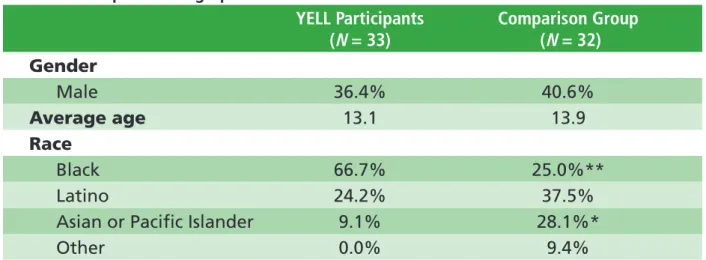
A total of 89 middle school students were enrolled in the Bridge Project during the year of the study. Of the 82 youth who completed a pre-participation survey, 65 also completed a post-participation survey and therefore were included in the study sample. Of these, 33 young people were in the program group who participated in YELL, and 32 were in the comparison group who participated in other Bridge Project activities but did not attend YELL sessions. As shown in Table 1, YELL participants were be-tween the ages of 11 and 17, with an average age of 13.1. More than half were female. A high proportion identified as Black or African refugees, followed by Latino/a and then Asian or Pacific Islander. Comparison group members were similar in age and gender but were less likely than YPAR participants to be Black and more likely to be Asian. Procedures and Data Collection
Informed parental consent and youth assent to partici-pate in the study were obtained during program regis-tration. Participants completed the Survey of Academic and Youth Outcomes – Youth Version (SAYO-Y, National Institute on Out of School Time, 2015) at the beginning and end of the program year, in fall 2014 and spring 2015. Graduate research assistants administered the survey with support from program staff. Youth inde-pendently completed the survey using paper and pencil; adults were available to answer clarifying questions. Measures
Two scales from the SAYO-Y were used to measure youth voice and adult support at pretest and posttest. The
Re-14 Afterschool Matters, 27 Spring 2018
Table 1. Participant Demographic Characteristics
YELL Participants
(N = 33)
Comparison Group
(N = 32)
Gender
Male
36.4%
40.6%
Average age
13.1
13.9
Race
Black
66.7%
25.0%**
Latino
24.2%
37.5%
Asian or Pacific Islander
9.1%
28.1%*
Other
0.0%
9.4%
*p < .05; **p < .001, based on a two-sample test of proportions. p values are indicators of mathematical confidence suggesting that results are not due to chance.
sponsibility and Leadership subscale included five items to assess youth voice:
• “Do you get to help plan activities for the program?” • “Do you get the chance to lead an activity?”
• “Are you in charge of doing something to help?” • “Do you get to help make decisions or rules?”
• “Do you get to do things to help people in your community?”
The Supportive Relationships with Staff Members scale included four items assessing young people’s con-nections to program staff:
• “Is there an adult here who is interested in how you think about things?”
• “Is there an adult here that you can talk to when you are upset?”
• “Is there an adult here who helps you when you are having a problem?”
• “Is there an adult here who you will listen to and respect?”
Possible responses to all questions for both scales were yes (4), mostly yes (3), mostly no (2), and no (1). In our sample, tests of reliability resulted in strong evidence of in-ternal consistency (α = .88 for Responsibility and Leader-ship and α = .81 for Supportive Adults); this result is con-sistent with other studies using these measures (National Institute on Out of School Time, 2015; Surr et al., 2012).
Findings
To assess whether YELL participants’ perception of youth voice and adult support improved during the program more than the comparison group’s, we matched students’ survey responses from pretest to posttest and then com-pared how scores changed. As shown in Figure 1, YELL participants’ scores on both SAYO-Y scales improved be-tween pretest and posttest. The differences were statisti-cally significant; the p values in the figures are indicators of mathematical confidence suggesting that our results are not due to chance. For the survey scale for youth voice, YELL participants reported an initial score of 2.97, which rose 0.30 points to 3.27 by the spring. For adult support, YELL participants reported a score of 3.44 in the fall, which improved 0.43 points to 3.87 in the spring. In contrast, among the comparison group nonparticipants, scores declined slightly for both youth voice (from 2.56 to 2.53) and adult support (from 3.78 to 3.61). This trend was not statistically significant, suggesting that the comparison group’s scores were relatively stable.
Participants’ own words confirm these quantitative findings. In response to an open-ended survey item ask-ing participants to describe what they liked about YELL, one respondent wrote, “It is a program where you get to show leadership [and] do a project where you can help the community.” Another participant observed, “There’s really cool staff” who facilitate YELL. Taken together, these results suggest that the program may have
im-Anyon, Kennedy, Durbahn, & Jenson YOUTH-LED PARTICIPATORY ACTION RESEARCH 15
Figure 1. Youth Voice and Adult Support Scores
4
3.5
3
2.5
2
Youth Voice Scores Adult Support Scores
*p < .01 *p < .001
2.97 3.27 2.56 2.53 3.44 3.87 3.78 3.61
n
Pre
n
Post
YELL Participants* (N = 33) Comparison Group (N = 32) YELL Participants* (N = 33) Comparison Group (N = 32)
proved participants’ perceptions that they had leadership opportunities and adult support.
Discussion
Findings from this study suggest that YPAR may be a promising approach to increasing opportunities for lead-ership among low-income youth of color and improv-ing youth-adult relationships in community-based after-school programs. Youth who participated in a 26-week YPAR curriculum experienced positive and statistically significant changes in perceived youth voice and adult support, in contrast to a lack of change in the compari-son group. Our study findings parallel previous qualita-tive evidence that YPAR creates opportunities for adoles-cents to take on meaningful leadership roles, engage in programmatic decision-making, and negotiate new rela-tional dynamics with adults (Anyon & Naughton, 2003; Conner & Strobel, 2007; Kirshner, 2008).
Guided by a social justice youth development framework, we propose that these results may reflect the unique opportunities afforded to youth in YPAR projects. For example, the YELL program manual highlights the critical role of adult facilitators in the process of sup-porting youth voice, directing program staff to take on the roles of “facilitator, mentor, and partner” (Anyon et al., 2007, p. 10). Program activities are intentionally de-signed to support youth voice and adult relationships. At the start of the curriculum, youth are charged with creating their group norms, whereas in other Bridge Project programs behavioral expectations are often de-termined by adults. At midyear, participants vote to se-lect a community issue or problem that is important to them to become the focus of their research. At the end of the curriculum, youth work with adult facilitators to create a product of their choosing and share their work with others in the community. These are just some of the ways that YELL, and YPAR projects more broadly, create environments that are culturally and developmentally re-sponsive to the needs, interests, and experiences of low-income early adolescents of color.
Study Limitations
Our pilot study found evidence that supports use of YPAR in community-based OST programs. However, several limitations must be considered. The sample size is small, and the program and comparison group partici-pants were not randomly assigned. Anecdotally, practi-tioners reported that schedule conflicts were the most common factor contributing to participation in YELL. In addition, the YELL and comparison groups differed
significantly by race, so that selection biases might have influenced perceptions of youth voice and adult support. This concern is tempered by evidence from the literature that Black youth, who were a larger proportion of the YELL group than of the comparison group, experience high rates of marginalization (Travis & Leech, 2014).
Another set of limitations has to do with confound-ing effects. YELL participants also used other Bridge Proj-ect services. For example, they could participate in a sci-ence and engineering program on a different day of the week and could access tutoring and homework help in the hour before YELL sessions began. Changes in SAYO-Y measures could be due to participants’ involvement in other programming.
Finally, our research included only Bridge Project participants who completed surveys at both the begin-ning and the end of the program year. As a result, partici-pants who experienced less transience or were generally more engaged in program services than other students were overrepresented in both the treatment and compar-ison groups. Such sample biases limit the generalizability of our pilot study.
A Promising Approach
Our findings suggest that YPAR is a promising approach to supporting self-determination and developmentally appropriate adolescent-adult relationships for low- income youth of color in community-based afterschool programs. YPAR may therefore be an important strategy for increasing young people’s engagement in OST pro-grams, particularly during the transition from childhood to early adolescence. Additional studies of the YELL cur-riculum and of other YPAR strategies are needed to more fully understand the potential of these approaches and their impact on program participants.
References
Anyon, Y., Brink, K., Crawford, M., Fernandez, M., Hofstedt, M., Osberg, J., & Strobel, K. (Eds.). (2007).
Youth engaged in leadership and learning: A handbook for program staff, teachers, and community leaders. Palo Alto, CA: Stanford University, John W. Gardner Center for Youth and Their Communities.
Anyon, Y., & Naughton, S. (2003). Youth empowerment: The contributions and challenges of youth-led research in a high-poverty, urban community. Palo Alto, CA: Stanford University, John W. Gardner Center for Youth and Their Communities.
Anyon, Y., Zhang, D., & Hazel, C. (2016). Race, exclusionary discipline, and students’ connectedness to school adults. American Journal of Community Psychology, 57, 342�