University of
Cape Town
Determinants of the development of a local currency bond
market: the significance of macroeconomic stability
A Dissertation presented to
TheDevelopment Finance Centre (DEFIC)
Graduate School of Business University of Cape Town
In partial fulfilment
of the requirements for the Degree of Master of Commerce in Development Finance
by Isaac Matshego
mtsisa002
October 2018
University of
Cape Town
The copyright of this thesis vests in the author. No
quotation from it or information derived from it is to be
published without full acknowledgement of the source.
The thesis is to be used for private study or
non-commercial research purposes only.
Published by the University of Cape Town (UCT) in terms
of the non-exclusive license granted to UCT by the author.
ii
PLAGIARISM DECLARATION
Declaration
1. I know that plagiarism is wrong. Plagiarism is to use another’s work and pretend that it is one’s own.
2. I have used the APA convention for citation and referencing. Each contribution to, and quotation in, this proposal from the work(s) of other people has been attributed, and has been cited and referenced.
3. This research work is my own work.
4. I have not allowed, and will not allow, anyone to copy my work with the intention of passing it off as his or her own work.
5. I acknowledge that copying someone else’s assignment or essay, or part of it, is wrong, and declare that this is my own work.
iii
ABSTRACT
Bond market capitalisation in Sub-Saharan Africa is low even compared with the other developing economies. This dissertation thus examines the drivers of the development of local currency bond markets in 15 Sub-Saharan African economies over the period from 2003 to 2013, with a focus on the significance of macroeconomic stability proxied by exchange rate volatility. The empirical analysis focuses on government bond capitalisation, while the corporate bond market analysis focuses on seven of these economies for the period of 2004 to 2015. Possible explanatory factors are identified from the literature which attributes the development of local currency bond markets in developing economies to macroeconomic and institutional factors.
The results of a dynamic panel data model show that macroeconomic instability is significant and negatively associated with local currency bond market capitalisation. In contrast, capital account openness is found to expand the investor base, for the low to lower-middle income economies in particular, while monetary credibility is positive and significant for bond market development irrespective of the monetary policy framework. Thus, this research suggests that the optimal set of policy options for local currency bond market development should encompass exchange rate stabilisation, capital account liberalisation, and monetary credibility.
iv
ACKNOWLEDGEMENTS
“I used to think that if there was reincarnation, I wanted to come back as the president or the pope or as a .400 baseball hitter. But now I would like to come back as the bond market. You can intimidate everybody.”
James Carville
This seminal statement captures the significant role of bond markets in developed financial markets. It piqued my staunch interest in bond markets in developing economies, Sub Saharan Africa in particular. Completing this paper has been a journey that would not have been possible without the glory and blessings of the Almighty.
To Remo, the many days of being an absent father have paid off.
To my mother and aunt, Maema & Tebogo, thank you for inculcating my passion for education and the appreciation of the rewards of hard work.
To my colleague Matimba Khosa for the encouragement to undertake this research.
Kopano Bolokwe (Botswana Stock Exchange), Dr. F.E Nkwede (Ebonyi State University, Nigeria) and Sarwat Jahan (International Monetary Fund), your help with collecting some of the data is highly appreciated.
To Adjunct Prof. Sean Gossel for patiently drilling into me the difference between the science of academic research and the art of commercial writing. Without his patient guidance and prompt responses the completion of this dissertation would not have been easily accomplished.
v
TABLE OF CONTENTS
PLAGIARISM DECLARATION i
ABSTRACT ii
TABLE OF CONTENTS iii
LIST OF FIGURES AND TABLES iv
GLOSSARY OF ABBREVIATIONS AND ACRONYMS v
1. INTRODUCTION 1
1.1. Background of the study 1
1.2. Statement of research problem 3
1.3. Statement of research objectives 3
1.4 Justification of the study 4
2. LITERATURE REVIEW 5
2.1. Introduction 5
2.2. The concept of ‘Original Sin’ 5
2.3. Macroeconomic and institutional determinants of
bond market development 8
2.4. Local currency bond markets in Sub-Saharan Africa 12
2.5. Conclusion of the literature review 14
3. DATA DESCRIPTION AND METHODOLOGY 16
3.1. Data description 16
3.2. Econometric framework 20
3.3. Specification of the model 21
4. DATA LIMITATIONS AND ASSUMPTIONS 23
4.1. Data limitations and assumptions 23
4.1.1. Data limitations 23
4.1.2. Data assumptions 23
5. RESEARCH FINDINGS, ANALYSIS AND DISCUSION 25
5.1. Introduction 25
5.2. Data analysis 25
5.3. Dynamic panel results 28
vi
6. CONCLUSION 37
6.1. Summary of the study 37
6.2. Policy implications and recommendations 38
7. RECOMMENDATIONS FOR FUTURE RESEARCH 39
8. APPENDICES 40
a. Appendix A Central government and corporate outstanding bonds
data date ranges 40
b. Appendix B Information on dependent and independent
variables 41
c. Appendix C Exchange rate classification 42
d. Appendix D Inflation targeting in Sub-Saharan African
economies 43
e. Appendix E Fragile economies 43
vii LIST OF TABLES
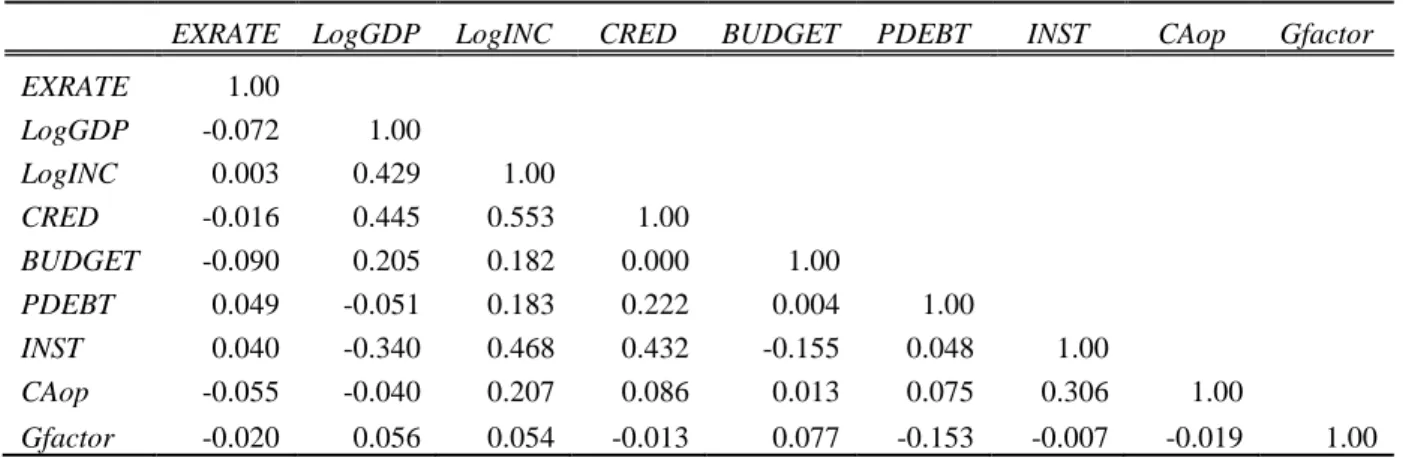
Table 5.1 CORRELATION MATRIX 25
Table 5.2 DESCRIPTIVE STATISTICS 26
Table 5.3 UNIT ROOT TESTS RESULTS 27
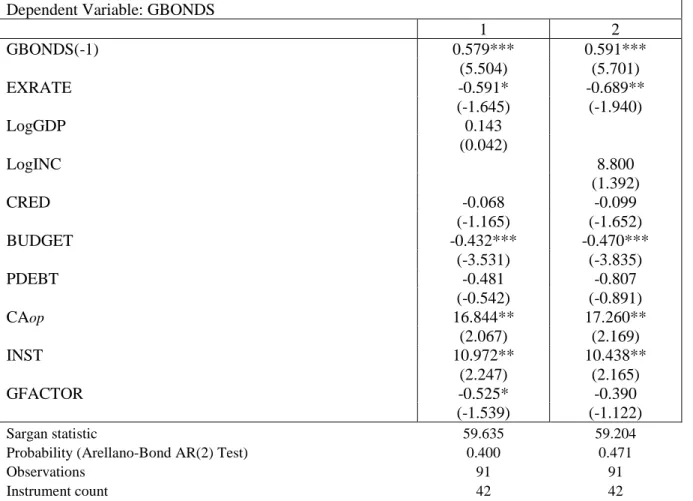
Table 5.4a DYNAMIC PANEL RESULTS – GMM ESTIMATIONS 31
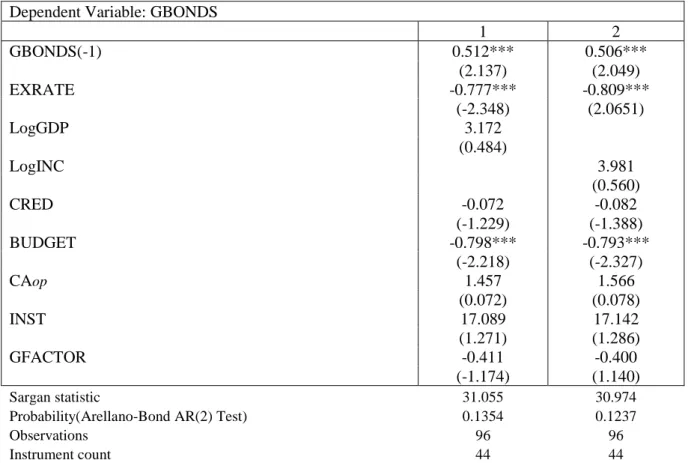
Table5.4b DYNAMIC PANEL RESULTS –
EXCLUDING MAURITIUS AND SOUTH AFRICA 32
Table 5.4c DYNAMIC PANEL RESULTS –
EXCLUDING FRAGILE EXONOMIES 33
Table 5.4d DYNAMIC PANEL RESULTS –
INFLATION TARGETING FRAMEWORK 34
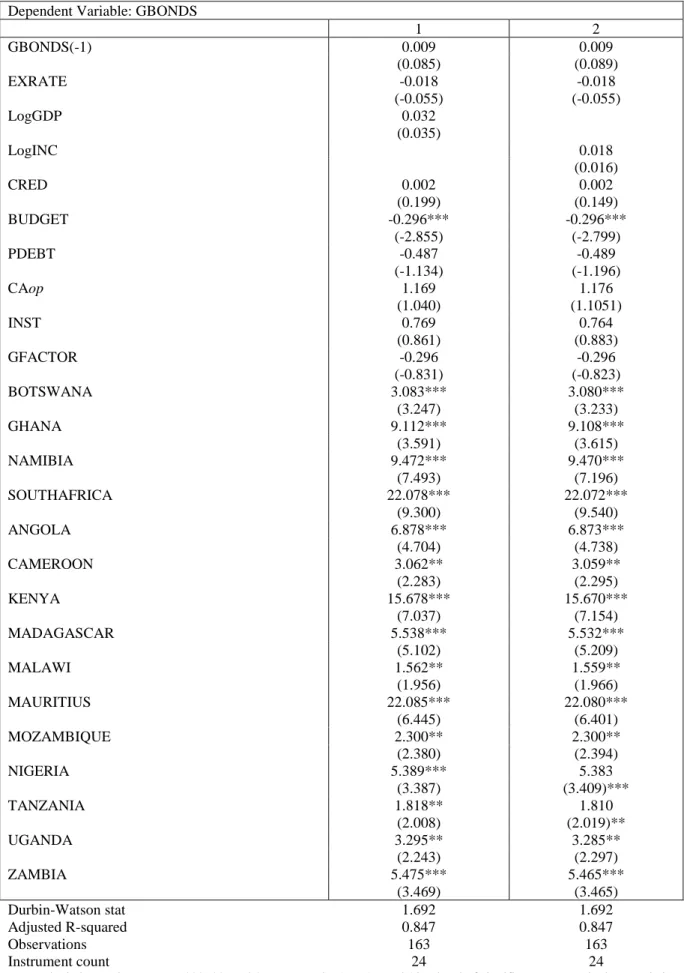
Table 5.4e STATIC PANEL RESULTS –
viii LIST OF ACRONYMS
BIS: Bank for International Settlements
CEMAC: Central African Economic and Monetary Community (Cameroon, Chad, Central African Republic, Congo Republic, Equatorial Guinea and Gabon)
CPI: Consumer Price Index
G7: Group of 7 leading industrial nations (Canada, France, Germany, Italy, Japan, United Kingdom and the United States)
GARCH: Generalised autoregressive conditional heteroscedasticity GLS: Generalised least squares
GDP: Gross domestic product, a measure of the nominal size of the economy GMM: Generalised method of moments
IMF: International Monetary Fund LSPE: Least-squares panel estimator
M2: Broad money, includes cash in circulation, all callable deposits and all outstanding credit
LCMB: Local currency bond market
OECD Organisation for Economic Co-operation and Development OLS: Ordinary least squares
OLS-PCSE: Panel-corrected ordinary least squares USD: United States dollar
1 Chapter 1: INTRODUCTION
1.1 Background of the study
Since the 1990s, Sub-Saharan Africa (SSA) has been the world’s second fastest growing region, behind Asia (International Monetary Fund, 2016a). However, it remains the least developed across the globe, highlighting the need for continued development expenditure. Consequently, attracting infrastructure development is one of the key objectives across the subcontinent as demographic profiles shift, mainly as a result of rapid urbanisation, which in turn drives the need for the provision of power, water, transport and technology (PwC, 2014).
Financial markets in SSA economies, most of which are categorised as low- and middle-income are still not well developed relative to the rest of the world (International Monetary Fund, 2016a). The level of financial intermediation in SSA remains low compared with that of other developing regions (Allen, Otchere and Senbet, 2011) and the region’s financial markets are dominated by the banking sector, the lending activities of which are geared mainly towards short- to medium-term loans (Mu, Phelps and Stotsky, 2013). This characteristic hinders the mobilisation of domestic capital for long-term financing, particularly for infrastructure projects. Consequently, SSA bond market capitalisation is below those of other developing regions, but its share of domestic debt is higher (Mu et al., 2013). Thus, access to funding is commonly highlighted as the leading challenge for large, complex infrastructure projects across SSA (PwC, 2014: 2).
Ehlers (2014) stresses that most of the growth of infrastructure financing across the globe is carried by banks, which hold predominantly short-term liabilities and therefore cannot commit most of their assets to long-term lending due to the risk of liquidity mismatch. Additionally, higher capital requirements, as per Basel III regulations, are limiting bank funds available for long-term project finance. The situation requires SSA economies to develop sources of long-term funding to meet their developmental needs. In some SSA economies, government financing has been dominated by central bank issuance and external borrowing from multilateral and bilateral creditors, while the issuance of local currency bonds has been virtually non-existent1.
Some countries, however, have been able to increase foreign participation in domestic bond markets and thus broaden the investor base2.
1For example, in Swaziland, the central bank’s claims on the government surged by 363% in the 12 months to August 2016, while Malawi’s budget shortfall has been funded mainly by borrowing from the central bank, with the Reserve Bank of Malawi’s outstanding credit to the central government rising by 87% in the nine months to September 2016.
2 For example, in South Africa, non-residents hold 35% of total bonds outstanding, 90% of which are denominated in the local
currency (South African Reserve Bank, 2017). Non-resident investors’ holdings of local-currency government bonds in Zambia rose by an equivalent of 2.5% of GDP in 2017, raising foreign investor holdings of public commercial debt to over 60% (S&P Global Ratings, 2017: 6)
2
Demand for foreign currency bonds issued by Sub-Saharan sovereigns has been strong in recent years. Presbitero, Gura, Adedeji and Njie (2016) highlight that of the 15 low-income developing countries that have issued debut international sovereign bonds since 2015, 11 were in SSA. Ghana (September 2007), Zambia (September 2012), Rwanda (April 2013), Kenya (June 2014) and Ethiopia (December 2014) are among the SSA countries that have been able to float debut US dollar-denominated global bonds at favourable yields in recent years. Ghana was the first SSA sovereign after South Africa to float Eurobonds with a nominal value US$750 million, and then subsequently issued foreign currency debt in July 2013, September 2014, September 2016 and May 2018 totalling US$6,25 billion. All these bonds were on average three times oversubscribed, with the 2016 issue five times oversubscribed. Zambia also floated two more Eurobonds by the end of 2015, bringing the total value of its foreign currency bonds to US$3,0 billion. These developments reflected the strong appetite for frontier-market debt against the backdrop of low returns in developed financial markets. However, foreign currency borrowing exposes issuers to long-term currency fluctuations (Reserve Bank of Australia, 2003).
The need to develop local currency markets for long-term debt is critical not only for infrastructure finance, but essentially for emerging market economies (EMEs) to avoid financing large budget deficits by central bank borrowing. Turner (2002) notes that bond markets facilitate the financing of budget deficits in a non-inflationary manner and they enhance the effectiveness of monetary policy. The objective for the development of bond markets is therefore not to replace bank finance, but to reinforce it (Mu et al., 2013).
The motivation to develop capital markets for infrastructure financing is affirmed by the macroeconomic benefits of deep local currency long-term debt markets. Well-functioning local currency bond markets (LCBMs) and macroeconomic stability tend to be self-reinforcing, and thus significantly contribute to the reduction of risks associated with mismatches in currency, maturity and capital structure that can inhibit long-term capital formation (Miyajima, Mohanty and Chan, 2015). In addition, deeper local currency debt markets boost the ability of a country to withstand volatile capital flows, reduce the reliance on foreign borrowing and the risks associated with foreign currency fluctuations that create currency mismatches between domestic assets and foreign liabilities, facilitate the reduction of current account imbalances, mitigate the need to hold a high stock of foreign exchange reserves for precautionary purposes, and allow balance sheets to adjust more smoothly, thereby improving the capacity of macroeconomic policies to respond to shocks (International Monetary Fund, 2016b: 5). Deep LCBMs therefore help to mitigate the occurrence of the “original sin” (Eichengreen, Hausmann & Panizza, 2003), which describes the inability of a government to raise debt in its local currency as global financial flows are denominated in a few reserve currencies, and as a result accumulates large foreign-currency liabilities. ’Original sin’ relates to both the difficulty in borrowing from foreign investors as well as issuing long-term debt instruments in the domestic market.
3
Given this backdrop, this research seeks to examine the significance of macroeconomic stability to the development of LCBMs in SSA. A stable macroeconomic policy framework is reflected primarily by steady output growth, low and stable inflation, low long-term interest rates, low fiscal deficits, and a low national debt burden relative to the size of the economy. Macroeconomic stability is influenced by the government through fiscal and monetary policies, and this is consistent with the trend of more stable macroeconomic environments in SSA over the past three decades, which Allen, Otchere & Senbet (2011:80) identified as the benefit of serious economic and financial reforms implemented since the 1980s. International Monetary Fund (2016a) data indicates that the SSA inflation rate averaged 8.6% per annum over the 10-year period of 2006 to 2016 compared to 11.2% for the period of 1996 to 2006, and more than 30% in the 1980s. This improvement can be ascribed to the reforms adopted in the 1980s and 1990s, which comprised exchange rate liberalisation accompanied by structural reforms, lower fiscal deficits and limits on monetary expansions (Maehle, Teferra & Khachatryan, 2013).
1.2 Statement of research problem
The low level of financial development, particularly of LCBMs, inhibits the development of infrastructure, and thus economic development, as the subcontinent undergoes significant demographic shifts. PwC (2014) lists Ghana and Nigeria among the fastest urbanising countries across the globe, which highlights the need for these nations to raise large volumes of long-term infrastructure finance, an objective that is constrained by the limited size of long-term credit markets in these economies. SSA bond markets are small and illiquid, with primary markets for government bonds existing in some countries, but liquid secondary markets for bonds are virtually non-existent outside South Africa. LCBM capitalisation as a percentage of GDP in SSA is well below those of other developing regions such as Asia, Central Europe and most of Latin America (Christensen, 2004; Osano, 2011; Mu et al., 2013), which elevates the need to adopt policies that will contribute to the development of long-term debt markets (Allen et al., 2011).
This study aims to apply econometric analysis to assess the association between macroeconomic stability and the demand for local currency bond markets in Sub-Saharan Africa over the period of 2003 to 2015.
Hence, the primary research question is as follows:
Is macroeconomic stability as proxied by exchange rate volatility a significant factor for local currency bond market capitalisation in Sub-Saharan Africa?
4
In addition, the following related sub-questions will also be assessed:
• What is the linkage between capital account openness and macroeconomic stability in SSA economies?
• To what extent does a possible association between monetary credibility and government bond market development in SSA differ between those that have adopted inflation targeting and those that have not?
1.3 Statement of research objectives
The research analyses the relationship between the stability of macroeconomic variables and the demand for local currency long-term debt. Allen et al. (2011) starts from the premise that macroeconomic stability is beneficial to the development of local currency financial markets. This study thus seeks to test this hypothesis, with a specific focus on the local currency bond market. The analysis further examines whether explicit inflation targeting policies contribute to local currency bond market capitalisation in SSA economies.
To account for the presence of endogeneity among the independent variables, the study employs a GMM model.
1.4 Justification for the study
Research on the development of LCBMs in SSA is relatively limited. Most available studies of EME bond markets focus on Asian, Central European and Latin American economies. The unavailability of data has limited the scope of research on SSA bond markets, despite these having experienced encouraging growth in recent years (Thotho, 2014).
This study will add to the body of research on SSA bond markets by encompassing the latest data on African central government debt compiled by the Organisation for Economic Cooperation and Development (OECD, 2015) and corporate bond market data drawn from primary sources and Bloomberg. Adelegan and Radzewicz-Bak (2009), Mu et al. (2013), Berensmann, Dafe and Volz (2015), Essers, Blommestein, Cassimon, and Ibarlucea Flores (2016) and Dafe, Essers and Volz (2017) are the few comprehensive papers that are dedicated to the analysis of LCBMs in SSA. Mu et al. (2013) cover LCBMs in 36 economies over the period 1980 to 2010, but this period does not sufficiently incorporate the era of very low global interest rates and ample liquidity, which began in 2009 and has prompted the global investors’ search for yield. Additionally, while existing studies focus on the relationship between bond market development and institutional and macroeconomic factors, none of
5
the studies to date have analysed the contribution of explicit inflation targeting policies to LCBM capitalisation in SSA, hence this study fills the gap.
6 Chapter 2: LITERATURE REVIEW
2.1 Introduction
The volume of studies on the development of financial markets in both developed and developing economies is extensive, and, although the focus on SSA is increasing, the literature is scant relative to research on Asian and Latin American markets. Additionally, there is even less research on LCBMs in SSA, as most of the papers are devoted to the analysis of the expansion of banking and equity markets. The literature dedicated to emerging economies explores the determinants of the ability to borrow in international and domestic markets, in either foreign or domestic currency, with particular attention paid to the appropriate policy measures that foster local-currency borrowing capacity. Most existing research therefore addresses the basis of the inability of emerging markets to issue local-currency debt, the main theme of which is whether it is a consequence of exogenous factors (the effect of which cannot be ameliorated by macroeconomic and institutional policies), or evidence of policy shortcomings within these countries.
The literature review is thus divided into four parts. In the first section, research on the concept of ‘Original Sin’ and its determinants is reviewed. Secondly, studies that focus on a broader spectrum of the drivers of the aggregate financial sector and capital markets, with a particular focus on LCMBs in emerging economies, are reviewed. The third section focuses on papers that analyse LCMB development in SSA economies. The final section concludes the literature review.
2.2 The concept of ‘Original Sin’
The long-standing characteristic of emerging markets relates to the inability to float domestic denominated international debt instruments, in addition to a considerable reliance on local currency-denominated short-term domestic borrowing. The central hypothesis of ‘Original Sin’ associates the inherent macroeconomic volatility of small economies with the dominance of foreign currency-denominated debt in their external obligations (Eichengreen and Hausmann, 1999). “Domestic Original Sin” denotes the inability to issue long-term debt instruments in the domestic market at fixed rates, while “international Original Sin” identifies the difficulty in raising domestic currency-denominated debt in global markets.
Eichengreen and Hausmann (1999) characterise ‘Original Sin’ as not being confined to emerging economies only but being broadly prevalent in developed economies, persistent over long periods of up to 150 years, accounted for by more than just bad policies and weak institutions, while it exacerbates
7
macroeconomic instability and limits policy flexibility. The study argues that ‘dollarisation’ – abandoning the domestic currency in favour of a reserve currency – does not offer redemption as it erodes a country’s ability to pursue other macroeconomic objectives. Developing domestic long-term credit markets is renounced on the basis that deep and liquid domestic financial markets take a long time to establish; hence countries would have to grapple with low growth and macroeconomic instability for long periods.
Eichengreen, Hausmann and Panizza (2003a and 2003b) attribute the inability of some countries to issue international debt in their local currencies to the denomination of global financial flows in a few reserve currencies, the aftermath of which is the accumulation of large foreign-currency liabilities. Global bond issuance and bank debt are predominantly accounted for by a small number of currencies, primarily the G7 currencies and financial centre units such as the Australian dollar and the Swiss franc, due to the high transaction costs of holding multiple currencies. Residents of these countries issue 83% of international debt instruments, but their currencies account for more than 95% of global bond denomination, well above their global GDP shares. The difficulty of raising international debt denominated in local currency is, therefore, primarily a consequence of exogenous factors. ‘Original Sin’ is thus a “push” factor, the effect of which cannot be countered by policy measures in the small economies.
Macroeconomic instability, reflected by high output variability and exchange rate volatility, as well as the volatility of capital flows and country credit ratings, is associated with the dominance of foreign-currency debt (Eichengreen, Hausmann and Panizza, 2003a). Indebted economies that suffer from ‘Original Sin’ are afflicted by currency mismatches and debt intolerance. The former reflects the dominance of foreign currency liabilities which propagate the balance-sheet effects of domestic exchange rate fluctuations, while the latter relates to the low capacity of EMEs to sustain high external debt stocks, expressed as the foreign debt-to-GDP ratio (Eichengreen, Hausmann and Panizza, 2003b). Hausmann and Panizza (2003) concede that there is no perfect measure of ‘Original Sin’ but extend the analysis to domestic debt issuance. The paper, based on 1998 annual data of 21 EMEs, regresses variables that encompass institutional factors, monetary policy credibility, fiscal solvency, the legal framework relating to contract enforcement, the de facto exchange rate regime, and political economy factors as well as international factors. Economic size, domestic credit extension and a composite of these variables are found to be the only significant determinants of the ability to issue domestic currency debt in international markets. The high prevalence of ‘Original Sin’ in small economies confirms the negative association between economic size and the ability to issue domestic currency debt. Some emerging economies’ ability to issue local currency debt is underpinned principally by their larger nominal GDP. In contrast, the level of development, institutional quality, monetary credibility, fiscal solvency, low public debt, exchange rate flexibility and the depth of domestic markets all display a weak
8
effect on international ‘Original Sin’. Hausmann and Panizza thus concur that ‘Original Sin’ persists over extended periods, as the process of establishing policy credibility is long. In countries that have experienced some moderation in international ‘Original Sin’, such as the Czech Republic, Hong Kong, Singapore and South Africa, multinational institutions issue local currency bonds and swap the proceeds and future obligations into reserve currencies. They thus propose that multilateral efforts, such as launching a basket of emerging economy local currency bonds, are the only sure way to recover from ‘Original Sin’.
Regarding domestic ‘Original Sin’, Hausmann and Panizza argue that monetary credibility and the imposition of capital controls expand the domestic investor base and thus attenuate its effects. The prevalence of international ‘Original Sin’, however, does not signal the presence of domestic Original Sin. The inability to borrow domestically over the long-term and at fixed rates is a symptom of international ‘Original Sin’ because foreign investors seldom demand local-currency debt where local capital markets are not well-developed. Hence, redemption from domestic ‘Original Sin’ does not signify the ability to borrow offshore in domestic currency, which supports the deduction of Eichengreen and Hausmann (1999) that deep and liquid local capital markets are the prerequisite for, but do not signal, redemption from international ‘Original Sin’.
Cohen (2005) attributes ‘Original Sin’ in both industrialised and emerging economies to currency stability and relative interest rates. Strong and high interest rate currencies are found to attract higher bond inflows compared with their peers. EME currency denomination is inhibited by the shallowness of domestic currency capital markets and limited exchange rate hedging instruments, hence the incidence of currency mismatches.
In response to studies countering this hypothesis, Hausmann and Panizza (2010) augment the work of Eichengreen and Hausmann (1999) and that of Eichengreen, Hausmann and Panizza (2003a and 2003b) that covered the period 1993 to 2001 to include global debt data up to 2008. Applying BIS data on international bonds and US Treasury figures on US dollar-based investors’ holdings of foreign-issued debt to two of the three indices of ‘Original Sin’, originally developed by Eichengreen, Hausmann and Panizza (2003a), they find global bond issuance to be still dominated by reserve currencies, which accounted for 96% of currency denomination, while residents of these economies accounted for only 85% of bond issuance. The key findings reflect modest reductions in the incidence of international ‘Original Sin’, as only a few economies managed to increase their capacity to borrow internationally in local currency. The share of bonds issued in reserve currencies by the rest of the world declined from 90% in 1999 to a still high 75% in 2008, while only seven of the 65 developing economies analysed issued at least 15% of their debt in local currency. Moreover, domestic bond issuance is found to be more long-term and at fixed-rates, while the reliance on foreign-currency debt declined as evidenced by lower stock of gross and net foreign debt. Aggregate currency mismatches moderated, and policy
9
flexibility improved, but these were attributed to less external borrowing and the accumulation of foreign-exchange reserves more than an improved capacity to borrow in domestic currency. Despite these positive developments, participation of foreign investors in local currency bond markets remained limited. Hausmann and Panizza thus conclude that ‘Original Sin’ is still widely prevalent.
The literature on ‘Original Sin’ posits that a large economic size is the precondition for a deep and liquid domestic credit market. In addition, the ability to borrow abroad in local currency is found to be a function of the reserve status of the local currency. The usability of a wider basket of currencies is inhibited by transaction costs, and hence countries that borrow internationally are beleaguered by currency mismatches. The accumulation of net foreign debt complicates the pursuit of macroeconomic stability through the balance-sheet effects of exchange rate depreciations, while adopting reserve currencies or pegging the local currency also inhibits policy flexibility. ‘Original Sin’ is not restricted to emerging economies as it has prevailed in some developed economies over long periods. Restrictions on domestic capital flows are found to moderate domestic ‘Original Sin’, although deep and liquid domestic markets do not necessarily attenuate the incidence of international ‘Original Sin’. Policy efforts would, without multilateral measures to promote emerging market local-currency debt instruments in international markets, fail to remedy the effects of ‘Original Sin’ expeditiously. Some countries improved their capacity to borrow in domestic currency in both international and domestic markets, but the improvement was negligible, hence ‘Original Sin’ is still widely prevalent.
Research that rejects the hypothesis, however, accentuates the role of factors besides country size and currency stability in LCBM development, and the merits of global financial integration.
2.3 Macroeconomic and institutional determinants of bond market development
Numerous studies counter the ‘Original Sin’ hypothesis by emphasising the significance of both endogenous and exogenous factors for the capacity of emerging economies to develop government and corporate bond markets. The determinants of LCBM development are split into macroeconomic and institutional factors – creditor-friendly policies and creditor-friendly laws (Burger and Warnock, 2006a). Eichengreen and Luengnaruemitchai (2004) argue that the determinants of LCBM can be categorised into four groups. Structural factors are nominal GDP size and trade openness. Financial factors include banking sector depth and the interest-rate spread. Developmental factors are the level of income per capita and the institutional framework, while the macroeconomic factors encompass the overall fiscal balance, the interest rate, exchange-rate flexibility and the capital controls regime.
Most papers distinguish the determinants into only macroeconomic and institutional factors by aggregating the four factors. Structural, financial and developmental factors are combined into macroeconomic determinants, and the list expands to include monetary policy credibility, proxied by the inflation rate, and GDP growth rate. Institutional factors relate mainly to the rule of law and investor
10
protection regulations. The breadth of the investor base, comprising of both domestic and foreign investors, signifies the extent of redemption from ’Original Sin’. A diverse domestic investor base with a large non-bank sector is an indicator of redemption from domestic ‘Original Sin’, while global investor demand reflects the extent of redemption from international ‘Original Sin’. The distinction into macroeconomic and institutional factors however, is not strictly adhered to as, for instance, investor demand can be a function of both structural and institutional factors. Additionally, the list is not exhaustive, with researchers adding factors according to their relevance to a particular approach. Ceccheti and Krause (2001) adopt a broad focus on conditions that facilitate aggregate financial development. A study of the connection between higher macroeconomic stability and financial structure across 23 developed and developing economies over two periods – 1982 to 1989 and 1990 to 1997 – finds support for the view that financial development, exhibited by central-bank independence and less government intervention in the financial sector through less direct ownership of banking assets, boosts monetary policy effectiveness and improves the stability of inflation and economic output variability. The study, however, cautions that deposit insurance could prompt a reliance on bank credit more than capital markets and in that way inhibit the development of alternative sources of finance.
Eichengreen and Luengnaruemitchai (2004) explore debt issued by local residents and targeted at the domestic investor base in 41 developed and EMEs for the period 1990 to 2001, focusing on Asian emerging economies. The panel GLS regression finds that although there is evidence of a “minimum efficient scale” required for LCBM development, the link with economic size proves to be tenuous. The level of economic development or income level – proxied by GDP per capita – reflects a more significant role. Exchange rate stability and large banking systems have a positive association with LCBMs, strong fiscal balances impede the bond market by limiting public debt issuance, and weak institutional governance weighs down principally on corporate debt issuance. Exchange controls are found to inhibit foreign participation in LCBMs and thus constrain their development.
Mehl and Reynaud (2005) reject the Hausmann and Panizza (2003) approach that capital controls moderate the prevalence of domestic ‘Original Sin’. An analysis of a broader sample of 33 countries over the period 1994 to 2004 applies a random-effects tobit estimation to develop an empirical framework independent of the determinants of international ‘Original Sin’, and expands macroeconomic and institutional factors to the structure of interest rates and the debt burden. High inflation, an inverted yield curve – depicted by short-term interest rates that are higher than long-term rates – an elevated debt service-to-GDP ratio and a low private savings-to-GDP ratio are all found to impede the ability to develop domestic fixed-interest markets. The study concludes that developing LCBMs is not a necessarily long process as sound macroeconomic policies, attractive long-term yields and policies to expand the domestic investor base are found to swiftly boost LCBMs. Thus, domestic ‘Original Sin’ is not an inherent characteristic of emerging economies and can be overcome by appropriate policies.
11
Burger and Warnock (2006a) utilise a more comprehensive set of 2001 public and private bonds of 49 developed and developing economies issued in both domestic and international markets to underline the contribution of prudent domestic policies. An OLS regression that controls for the interdependence between inflation, fiscal-deficit financing and bond market depth gives results that are consistent with prior studies. Macroeconomic variables and institutional factors – primarily the quality of rule of law and creditor rights – reflect a positive association with LCBM and banking system size. Public and private debt markets are subject to the same determinants, with the extent of government borrowing in particular being significant for the size of the government bond market. The results show that budget deficits impact private bond issuance through the inflation channel – inflationary deficit financing stunts the development of private bond markets, while monetary policy credibility is also significant for the development of a private bond market. Burger and Warnock thus conclude that better policies and laws foster LCBM development, reduce currency mismatches and limit the incidence of financial crises, while the development of banking and bond markets is found to be complementary. The results therefore suggest that ‘Original Sin’ is not an inherent characteristic of emerging economies.
Eichengreen and Luengnaruemitchai (2006) expand their 2004 study by incorporating foreign bond inflows to analyse the determinants of foreign investor participation in LCBMs. The study focuses on bond flows to East Asia using International Monetary Fund data on bilateral international portfolio holdings of long-term debt for the years 2001 to 2003. The results of a gravity model, which predicts bilateral capital flows based on economic size and distance between countries, shows that economic size of the source and destination markets is significant, but not a prerequisite, for LCBM development. Local credit ratings, as well as the institutional framework display a positive association. Bond flows are negatively associated with the source country interest rate fluctuations and the volatility of the bilateral exchange rate, while capital controls are found to restrict flows in both directions.
Burger and Warnock (2006b) examine data on US dollar-based investors’ holdings of local currency bonds across 41 developed and emerging economies for 1998 to 2001. The study constructs a simple model of global portfolio allocation in which the mean, variance and skewness of bond returns influence investors’ holdings, in line with the work of Harvey et al. (2003). The results indicate that US investors shun bonds with volatile and negatively skewed returns. More prudent macroeconomic policies (to the extent that they limit the volatility and negative skewness of US-dollar returns of local bonds) help to improve the diversification benefits of LCBMs and thus attract foreign investors into local currency bonds. It is thus concluded that prudent macroeconomic policies can trigger a virtuous circle in which the attractiveness of LCBMs leads to further deepening of domestic capital markets by boosting foreign investor demand.
Claessens, Klingebiel and Schmukler (2007) extend the analysis of the determinants of government bond market development and the currency composition thereof to include short-term debt instruments,
12
and apply a dynamic regression to instruments across the maturity curve, from Treasury bills to long-term bonds in 35 developed economies and EMEs for the period 1993 to 2000. Consistent with the ‘Original Sin’ hypothesis, the results show a strong positive association between local and foreign currency bond issuance and nominal GDP. Countries with less developed domestic financial markets are found to be more reliant on foreign-currency financing. The findings affirm that EMEs are highly ‘debt-intolerant’, but the inability to issue domestic-currency debt, however, extends beyond size and domestic market depth. The inflation rate, the strength of the fiscal position, monetary policy credibility and capital account openness are inversely associated with LCBM development, while exchange rate flexibility has a positive association. Emerging economies with inflexible exchange rate regimes are found to have less developed domestic currency bond markets. Hence, institutional and macroeconomic conditions prove to be significant for the broadening of the domestic investor base.
Peiris (2010) conducts a panel data estimation of bond data of 10 large emerging economies for which foreigners’ holdings of local bonds were disclosed, over the period 2000 to 2009. The results show that foreign participation is a beneficial condition for LCBM development. Bond yields fall and become less volatile, market liquidity and efficiency improve, while the institutional framework strengthens in the long run. However, sudden stops and withdrawals of capital flows often result in local bond market instability, although a GARCH model reflects inconclusive evidence on the contribution of foreign participation to the volatility of financial markets. Thus, although foreign participation increases the susceptibility of domestic markets to global shocks, it is found to be generally beneficial for domestic capital markets.
Burger, Warnock and Warnock (2010) expand the work of Burger and Warnock (2006a and 2006b) using US Treasury data of 2008 USD-based investors’ holdings of foreign bonds of 47 economies to assess the fundamental factors supporting the attractiveness of local currency bonds to these investors. Using a Bayesian decision theoretic framework of Harvey et al. (2010) they find that lower inflation volatility and stronger legal rights stimulate foreign-investor demand for local-currency debt instruments, enhances emerging-market returns, and lengthens the maturity profile of domestic debt through various channels. For instance, exchange rate stability enhances foreign currency returns of local currency bonds. In the absence of capital controls the diversification benefit of EME bonds is elevated, which helps to attract flows from US dollar-based investors, thus broadening the investor base. Consequently, Burger, Warnock and Warnock (2010) conclude that emerging economies with better macroeconomic stability and stronger institutional frameworks “pull’ US-dollar based capital.
Miyajima et al. (2015) similarly shows that favourable macroeconomic conditions and institutional frameworks improve the attractiveness of EME assets. The study examines monthly bond yield data for 11 EMEs – including South Africa – with sizable LCBM and significant foreign investor holdings for the period January 2000 to May 2014. The fixed-effect, static panel framework confirms that improved
13
macroeconomic stability, reflected by more stable EME bond yields, has moderated the volatility of asset returns. Changes in global factors, proxied by changes in US long-term interest rates, have a positive but diminishing effect, while investor sentiment on its own proved to have an insignificant influence. The dynamic panel VAR model reflects the positive effect of stronger institutions and better market infrastructure on market depth. Since the 2008 global financial crisis foreign capital inflows have proven to be less responsive to higher global risk aversion and tighter global monetary conditions, factors that have historically inhibited such flows. The allure of EME bonds as an alternative asset class for advanced-economy bonds has thus risen. The paper predicted that a more stable global macroeconomic environment and the hunt for yield on the back of persistently low interest rates in the major developed markets would continue to drive demand for EME assets. The theory of ‘Original Sin’ is thus losing its robustness as capital is pushed to emerging economies’ LCBMs.
Park (2016) regresses quarterly data to analyse the influence of economic factors on the size and local-currency share of public and corporate bond markets in 10 Asian economies over the period 1996 to 2015. Consistent with the results of Burger and Warnock (2006a), bond market capitalisation-to-GDP shows a strong positive association with economic size and currency composition. The fiscal balance, bank credit extension, sovereign credit rating and quality of rule of law have a positive association. Inflation significantly hampers bond market size, although the effect on local-currency share proved insignificant due to the significantly positive effect of exchange rate flexibility. The regression of corporate bond market data reflected similar results for most independent variables. However, inflation has a negative effect on the maturity profile, exchange rate flexibility is insignificant for duration, while the availability of short-term bank loans shortens the maturity profile of corporate bonds. Park thus concludes that better macroeconomic management and rule of law stimulate local-currency government and corporate bond issuance.
A few studies focus on the relationship between inflation and bond markets in inflation targeting economies. Rose (2014) estimates the association between inflation and local-currency bond markets in 32 countries with an explicit inflation target, utilising data over the period 1970 to 2012. Inflation targeting economies with bond markets are found to experience inflation that is three to four percentage points lower compared with inflation targeters without bond markets. Hence, although inflation targeters already reflect lower inflation than non-inflation targeters, the existence of a market for long-maturity fixed-rate nominal bonds helps to lower the inflation rate even further. This suggests that bond market development reinforces macroeconomic stability.
Ogrokhina and Rodriguez (2016) conducted a comprehensive study on the contribution of inflation targeting to debt denomination in developing economies. They empirically examined the currency denomination of internationally-issued debt of all borrowers in 75 inflation targeting and non-inflation targeting developing economies over the period 1994 to 2003. In addition to findings that are similar to
14
those of prior studies regarding the various control variables, inflation targeting economies are found to reduce their foreign-currency debt denomination by three percentage points faster than non-inflation targeting countries, while countries with a fixed inflation target reduce their foreign currency-denominated debts more than countries with a flexible target. Thus, monetary credibility in the form of a commitment to an inflation target is found to contribute to the ability of developing countries to issue local currency debt in international markets.
Thus in summary, the literature on the determinants of LCBM development generally rejects the main arguments of the ‘Original Sin’ hypothesis on the basis that the ability to issue domestic-currency debt to both international and domestic investors is not primarily determined by country size. Instead, improvements in macroeconomic stability and the institutional framework are found to assuage the effects of ‘Original Sin’ and help to develop LCBMs. Reforms that mobilise institutional savings, extending participation to foreign investors and the development of risk management instruments help to expand the investor base, while regulatory measures to improve secondary market liquidity also boost the demand for local-currency bonds. Foreign investor participation is found to be beneficial for LCBM development as extending access to foreign investors expands the investor base and helps to moderate domestic ‘Original Sin’, a significant development in the quest to overcome ‘Original Sin’. The role of explicit inflation targeting is found to boost policy credibility and thus support the demand for local currency long-term bonds.
2.4 Local currency bond markets in Sub-Saharan Africa
The majority of SSA is low-income economies that have been extremely dependent on concessional external financing. The subcontinent’s domestic debt markets are characterised by short-term maturity structures, limited capitalisation and narrow domestic investor bases due to low levels of per capita income (Christensen, 2004). Bond markets are thus small and illiquid relative to banking and equity markets, and compared with the other developing regions (Khan, 2005; Andrianaivo and Yartey, 2009; Allen et al., 2011). Khan (2005) pinpoints the high prevalence of domestic ‘Original Sin’, with SSA domestic debt markets shown to be shallow and the average maturity of public debt being less than one year. There is therefore a need to develop domestic sources of long-term finance, a sine qua non that is accentuated by declining volumes of concessional loans and lower foreign aid (Adelegan and Radzewicz-Bak, 2009).
Many SSA economies have gained access to global markets in recent decades, but the borrowing is overwhelmingly denominated in foreign currency. According to Gevorkyan and Kvangraven (2016), 14 SSA economies have issued US dollar and euro denominated international bonds totalling more than USD15 billion since 2006. The study develops empirical models suitable for panels with missing data to secondary bond market yields of nine SSA economies from 2006 to 2014 to assess the determinants
15
of borrowing costs in SSA. The study finds that international ‘Original Sin’ is still widely persistent in SSA, while foreign debt accumulation precipitates the inability of SSA economies to cope with debt levels that are easily manageable for developed economies and raises the need to accumulate foreign exchange reserves to limit currency mismatches. Borrowing costs of commodity-dependent, first-time sovereign issuers in international markets are found to be driven by global factors, mainly investor sentiment, commodity prices and liquidity. Gevorkyan and Kvangraven conclude that SSA economies should take advantage of favourable global conditions to advance macroeconomic reforms and thus reduce their external vulnerability. The study consequently agrees with the literature that advocates for improvements in macroeconomic and institutional structures to boost the capacity to borrow internationally in local currency and develop domestic credit markets.
Despite the need to develop domestic bond markets in SSA, comprehensive literature that analyses the development of both public and corporate bond markets in SSA is limited to just a few studies, which are reviewed below.
Adelegan and Radzewicz-Bak (2009) apply the panel data approach of Eichengreen and Luengnaruemitchai (2004) to the analysis of government and corporate bond markets of 23 SSA economies over the period 1990 to 2008. The GMM model finds that no variable is singularly significant for the development of domestic bond markets. The depth of the domestic financial sector and the level of private savings prove a positive association with LCBM development. A M2-to-GDP ratio above 50% generally exhibited a higher level of domestic long-term public debt-to-GDP. The level and volatility of interest rates, exchange-rate volatility and capital controls have a significant negative association. At a disaggregated level, public and private bond market development are negatively related to interest-rate and exchange-rate volatility, and capital controls as well as the size of the budget balance, while institutional factors including the investment climate and bureaucratic quality were also significant for the latter. Private bond issuance is determined principally by the level of economic development and the size of the banking sector, which both displayed a positive relationship.
Mu et al. (2013) apply a two-phase estimation technique under fixed effects and GMM estimation to a larger sample of government securities and corporate bond markets in 36 SSA economies over the years 1980 to 2010. Nominal GDP size is found to have a negative association with the public debt market under the fixed effects analysis, but this is contrasted by the GMM model’s positive relation, which is consistent with earlier studies. The cost of bank credit, budget balance, exchange-rate volatility and financial account openness have a negative effect, while English legal origin, strong institutional and governance frameworks, and low domestic interest-rate volatility are conducive to LCBM development. The results of the sample of 24 corporate bond markets points to the significance of fewer variables relative to the public bond market, probably due to the public debt market having a significant influence on the private market. In addition to economic size and GDP per capita, the private sector credit-to-GDP
16
ratio and capital account openness have a significant and positive association. Trade openness has a negative association with both public and private markets, while the effect of land area is ambiguous. The GMM results thus confirm the significance of macroeconomic factors for both government and private bond markets, with economic size and the level of development significant and positively related to LCBM development. The deduction that well-functioning credit markets facilitate economic stability is consistent with the “supply-leading” hypothesis.
Berensmann, Dafe and Volz (2015) utilise the African Financial Markets Initiative3 (AFMI) database of
treasury bonds of 27 SSA sovereigns over the period of 2007 to 2012. The one-year lag of the control variables tests whether changes in the dependent variable are influenced by changes in the latter, although this approach does not test for the direction of causality. The study found significant positive relationships between LCBM size and macroeconomic and institutional factors consistent with the results of Mu et al. (2013), Eichengreen and Luengnaruemitchai (2004) and Claessens et al. (2007). The level of economic development, however, was insignificant when Mauritius and South Africa were excluded, while a large stock of foreign exchange reserves was found to negate the need to borrow in domestic markets. Exchange rate volatility – measured by the five-year rolling standard deviation of the log of the exchange rate against the US dollar – showed a positive coefficient, although it was not significant. Thus, contrary to the prior studies, macroeconomic stability – also proxied by inflation – was found to be insignificant for LCBM development.
Essers, Blommestein, Cassimon and Ibarlucea (2016) utilise the OECD (2013) dataset of 15 SSA bond markets for the period 2003 to 2012 to analyse the key drivers of LCBM capitalisation. Consistent with the objective of assessing the determinants of local-currency-denominated bond market development, the panel data framework deviates from that of Mu et al. (2013) by excluding domestically-issued foreign currency instruments. The results generally accord with those of Mu et al. (2013) in the sense that macroeconomic variables overall reflect similar associations with LCBM development. The two-step GMM estimations validate the significance of economic size to LCBM development through the broad domestic investor base, economies of scale and the attractiveness to foreign investors. Larger fiscal balances and lower inflation, as well as higher institutional quality boost government LCBM capitalisation. Thus, lower fiscal balances are generally found to constrain LCBM size. Other government debt is found to have a negative correlation, although the coefficient is insignificant. The study adds the nature of the political arrangement to institutional factors and finds that stronger democratic political systems are positively associated with LCBM capitalisation. Thus, consistent with the conclusions of Adelegan and Radzewicz-Bak (2009) and Mu et al. (2013), Essers et al. (2016) finds
3The African Financial Markets Initiative is the African Development Bank’s programme to further develop domestic debt markets on the continent by strengthening domestic bond market infrastructure and investing in local currency denominated debt www.africanbondmarkets.org
17
that macroeconomic stability and higher institutional quality positively contribute to LCBM development.
Dafe, Essers and Volz (2017) extend the analysis to data on bond tenors and bond yields of 28 SSA economies over the period of 2000 to 2014 drawn from the AFMI database. POLS and fixed effects regression analyses show the influence of macroeconomic and institutional variables similar to the results of Mu et al. (2013) and Berensmann et al. (2015). Bond durations are longer where overall financial development is deeper and governments are credible, and are negatively associated with inflation. Bond yields – of a sample of 14 countries – are higher in smaller, lower income countries with shallow financial markets, and have a strong positive relationship with inflation, high fiscal deficits and concentrated banking sectors. Generally, deeper LCBMs facilitate the lengthening of bond tenors while longer bond tenors are associated with lower yields.
Thus in summary, the few studies that focus on SSA economies reach conclusions that conform to those of research focused on other regions. Sound macroeconomic management and better institutional governance positively contribute to local currency bond market development in SSA. Although African countries are increasingly floating fixed-rate local currency bonds with an initial duration of at least 10 years, investor bases are still dominated by commercial banks, corporate bond issues remain scarce and secondary bond market liquidity is limited. Some SSA economies have gained access to international markets in recent years. The international borrowing, however, is still overwhelmingly denominated in foreign currency. The situation thus emphasises the need for LCBM development as the region faces declining sources of foreign assistance.
2.5 Conclusion of the literature review
The literature underlines the clear divide regarding the basis of the ability of emerging economies to borrow internationally in domestic currency and long term and at fixed rates domestically. The ‘Original Sin’ hypothesis ascribes the inability of some economies to borrow in domestic currency and long term in domestic markets to global factors that are exogenous to these economies. The views in the opposing literature heralds the contribution of prudent macroeconomic and sound institutional frameworks in boosting the capacity of economies to reduce their external vulnerability.
Eichengreen and Hausmann (1999) pioneered the ‘Original Sin’ hypothesis, which attributes the failure of some economies to borrow internationally in domestic currency to the dominance of reserve currencies in international capital flows. Emerging economies, which are characterised mainly by small economic size and shallow domestic bond markets that hinder their ability to issue local currency bonds in international markets, are afflicted by ‘Original Sin’. Studies find however that ‘Original Sin’ is not restricted to emerging economies only.
18
The opposing literature espouses improvements in macroeconomic management and institutional governance as enablers of emerging economies to develop LCBMs and the capacity to attract foreign capital inflows. Although GDP size determines the breadth of the domestic investor base and the attractiveness of the domestic market to foreign investors, it is generally found not to be a hindrance to LCBM capitalisation. Burger and Warnock (2006a) and Mu et al. (2013) are amongst studies that found banking and bond market development to be complementary, although macroeconomic stability and strong institutional governance are additional requisites for compensating investors for the risk of holding instruments whose returns are capped by associated interest rates. In contrast to Hausmann and Panizza (2003), capital controls are found to inhibit capital flows between source and destination economies and thus limit the development of LCBM in capital-scarce economies. As such, appropriate policy actions in EMEs help to broaden the domestic investor base and attract foreign investors, and thus foster the development of LCBM. Lower inflation facilitates the development of the local currency bond market, while the effectiveness of an inflation targeting policy is found to be reinforced by developed bond markets.
The long history of ‘Original Sin’ in SSA economies has resulted in governments being reliant on short-term domestic borrowing and foreign credit facilities. Khan (2005) finds ‘Original Sin’ to be persistent in SSA more so than in other regions, while Gevorkyan and Kvangraven (2016) shows that, although more SSA economies have gained international market access, the borrowing is still dominated by foreign currency debt. Declining foreign aid and concessional credit facilities magnify the need for the development of sufficiently deep and liquid domestic markets, which will attract foreign-investor participation. The results of studies on the determinants of bond markets in SSA reach conclusions that are similar to conclusions concerning other regions. Hence, advances in macroeconomic management and institutional government facilitate SSA bond market growth.
While existing studies focus on the relationship between bond market development and institutional and macroeconomic factors, this study examines the contribution of explicit inflation targeting policies to the size of local currency fixed-interest debt, and consequently LCBM capitalisation in SSA. The study therefore utilises an inflation targeting framework instead of the volatility of the inflation rate.
19
Chapter 3: DATA DESCRIPTION AND METHODOLOGY
3.1 Data description
This study focuses on the significance of macroeconomic stability in facilitating demand for domestic debt securities issued by both public and private entities. Pradhan et al. (2015) identifies four dimensions of bond market development: domestic private debt securities; domestic public debt securities; international private debt securities and international public debt securities. This study is, however, restricted to local-currency denominated public and private debt securities to analyse the determinants of the ability of SSA economies to overcome ‘Original Sin’.
The dependent variable is the ratio of outstanding central government bonds-to-GDP ratio (Gbonds). Similarly, the corporate bond market size is proxied by outstanding non-central government sector bonds-to-GDP ratio (Cbonds)4.
For government bonds, data collection follows the approach of Essers et al. (2016) in utilising OECD data presented in the African Central Government Debt: Statistical Yearbook (hereafter referred to as the “African Debt Yearbook”), which presents figures on central government debt for the period of 2003 to 2013. The database covers 17 African countries: Angola, Cameroon, Gabon, Kenya, Madagascar, Malawi, Mauritius, Morocco, Mozambique, Namibia, Nigeria, Sierra Leone, South Africa, Tanzania, Tunisia, Uganda and Zambia. The data is converted to US dollar values at end of year exchange rates drawn from the African Debt Yearbook. The OECD database is more comprehensive and reliable compared with BIS and IMF data utilised by Mu et al. (2013), which combined primary and secondary data, while large data gaps were found in the World Bank International Debt Statistics database. The AFMI database lists 40 African countries, 37 of which are in Sub-Saharan Africa, hence it is seemingly more extensive than the African Debt Yearbook. The AFMI, however, has no figures available for eight of the SSA economies, while it includes fixed-interest securities of short-term duration (1-year bonds) and has large data gaps over the period of 2000 to 2016 for most of the remaining countries. The OECD database is accordingly more suitable for a comprehensive study of SSA central government bond markets.
This study draws data from OECD (2015), the fifth edition which covers data for 2003 to 2013, and therefore contains a sample consisting of 15 SSA economies for the following reasons:
• The focus is only on SSA economies and thus Morocco and Tunisia are excluded.
20
• Sierra Leone is excluded as the government issues fixed-interest debt instruments with a maximum duration of only one year (OECD, 2015: 175).
• Gabon is excluded from the sample due to the limited data series, as only 2008 and 2009 figures are available (OECD, 2015: 68).
• For Namibia the OECD (2015) has central government marketable securities values from 2003 to 2007 only. The Bank of Namibia Quarterly Bulletin contains figures of central government domestic debt internal registered stock5 for the period of 2001 to 2018, hence these are utilised
in place of those in the African Debt Yearbook. Data differences between the two series are negligible for all but one of the years.
• Data on Botswana and Ghana is added to augment the sample, as central government local currency bond market figures are available. Values for Botswana are obtained from the Bank of Botswana (2017) database, while for Ghana the data are from the Bank of Ghana Quarterly Bulletin6. The figures for Namibia, Botswana and Ghana thus conform to the OECD’s condition
of primary data.
Corporate bond market data consists of private bonds and fixed-interest, medium- to long-term debt issued by state-owned corporations. The sample is smaller than the central government sample due to the limited availability of these figures. Mu et al. (2013) indicates that with the possible exception of South Africa, corporate ownership is limited and there is dominance of state-owned entities in SSA economies, and as a result corporate LCBMs in SSA are virtually non-existent. This characteristic poses a challenge for the analysis of corporate bond markets, but the reasonable size of the corporate bond market in the middle-income SSA economies facilitates some basic analysis. Annual values of outstanding local-currency corporate bonds for the period 2006 to 2015 were drawn from Bloomberg. The sample includes Botswana, Namibia, Mauritius, Nigeria, Kenya, Mozambique, South Africa, Tanzania and Uganda. The figures incorporate bond liabilities of state-owned enterprises.
Control Factors
The independent variables have been selected in accordance with the studies that analyse the role of endogenous and exogenous variables in LCBM development reviewed in section 2.3. Data on the variables, which are discussed below, is drawn from the International Monetary Fund World Economic Outlook (October 2017) database, the World Bank Development Indicators and the relevant studies7.
The figures are converted to their natural logarithms where applicable.
5 The Bank of Namibia describes these as fixed interest capital market instruments issued for longer maturities exceeding 12
months and holders may earn half-yearly interest (coupon).
6 Government of Ghana (GOG) fixed rate, limited duration, medium- to long-term local currency marketable debt instruments
that pay interest at regular, specified intervals (excluding the 5-year Golden Jubilee bond). 7Information on the dependent and independent variables is presented in Appendix B.
21 Exchange rate volatility (EXRATE)
Macroeconomic stability is defined as the low variability of key macroeconomic variables (Ceccheti and Krause 2001; World Bank, 2015). Asamoah, Adjasi and Alhassan (2016) define volatility as short-term deviations of a variable relative to its long-short-term trend. World Bank (2015) lists macroeconomic variables as being the growth rate of real output, the inflation rate and the current account balance, while the overall fiscal deficit, interest rate variability and exchange rate volatility are classified as policy stability indicators. Cariolle (2012) stresses that the different indicators of macroeconomic volatility, based on stationary series, produce closely correlated results.
This study thus utilises exchange rate volatility as an indicator of macroeconomic stability in accordance with Asamoah, Adjasi and Alhassan (2016). Volatility is measured by applying the general autoregressive conditional heteroskedastic GARCH (1,1) model of Bollerslev (1986), which is an extension of the autoregressive conditional heteroskedastic (ARCH) model of Engel (1982). The quarterly average exchange rate is utilised to derive the volatility series and the frequency of the series is converted to annual average values for each year. The study draws from the exchange rate classification of Ilzetzki, Reinhart and Rogoff (2017), which updates the work of Reinhart and Rogoff (2002)8. A value of one is assigned for the year when a country adopted a fixed exchange rate regime
against a G7 currency. This is the case for Cameroon, which is a member of CEMAC – a monetary union whose common currency, the CFA franc, has been pegged to the euro at CFAfr655.96 since January 1999. A negative relationship between macroeconomic instability and demand for local currency bonds is expected, as volatility increases the uncertainty of future returns.
Economic size (LogGDP)
The nominal value of all economic activity within a particular year as measured by the log of nominal GDP (in US dollars) is an indicator of the overall size of the economy. Larger economies are generally found to have deeper financial markets and consequently it is expected that GDP will have a positive association with local currency bond market capitalisation.
Level of income (LogINC)
The level of income or economic development is measured by the log of GDP per capita in US dollars as per the approach of Eichengreen and Luengnaruemitchai (2004). Mehl and Reynaud (2005) used the gross private savings-to-GDP ratio as a proxy for the size of the domestic investor base. The depth of the domestic investor base is expected to display a positive relationship with the dependent factors in accordance with Eichengreen and Luengnaruemitchai (2004), Mehl and Reynaud (2005) Mu et al. (2013) and Berensmann et al. (2015).