Applied Biosystems SOLiD
®
EZ Bead
™
Enricher
Publication Part Number 4454036 Rev. CFor Research Use Only. Not intended for any animal or human therapeutic or diagnostic use. Information in this document is subject to change without notice.
APPLIED BIOSYSTEMS DISCLAIMS ALL WARRANTIES WITH RESPECT TO THIS DOCUMENT, EXPRESSED OR IMPLIED, INCLUDING BUT NOT LIMITED TO THOSE OF MERCHANTABILITY OR FITNESS FOR A PARTICULAR PURPOSE. TO THE FULLEST EXTENT ALLOWED BY LAW, IN NO EVENT SHALL APPLIED BIOSYSTEMS BE LIABLE, WHETHER IN CONTRACT, TORT, WARRANTY, OR UNDER ANY STATUTE OR ON ANY OTHER BASIS FOR SPECIAL, INCIDENTAL, INDIRECT, PUNITIVE, MULTIPLE OR CONSEQUENTIAL DAMAGES IN CONNECTION WITH OR ARISING FROM THIS DOCUMENT, INCLUDING BUT NOT LIMITED TO THE USE THEREOF, WHETHER OR NOT FORESEEABLE AND WHETHER OR NOT APPLIED BIOSYSTEMS IS ADVISED OF THE POSSIBILITY OF SUCH DAMAGES.
LIMITED USE LABEL LICENSE
The purchase of this product conveys to the purchaser the limited, non-transferable right to use the product only to perform internal research for the sole benefit of the purchaser. No right to resell this product or any of its components is conveyed expressly, by implication, or by estoppel. This product is for internal research purposes only and is not for use in commercial applications of any kind, including, without limitation, quality control and commercial services such as reporting the results of purchaser’s activities for a fee or other form of consideration. For information on obtaining additional rights, please contact [email protected] or Out Licensing, Life Technologies, 5791 Van Allen Way, Carlsbad, California 92008.
NOTICE TO PURCHASER: DISCLAIMER OF LICENSE
Purchase of this software product alone does not imply any license under any process, instrument or other apparatus, system, composition, reagent or kit rights under patent claims owned or otherwise controlled by Applied Biosystems, either expressly, or by estoppel.
TRADEMARKS
The trademarks mentioned herein are the property of Life Technologies Corporation or their respective owners. Covaris is a registered trademark of Covaris, Inc.
© 2011 Life Technologies Corporation. All rights reserved.
Part Number 4454036 Rev. C June 2011
Contents
About This Guide . . . 5
Purpose . . . 5
User attention words . . . 5
CHAPTER 1
Site Preparation Tasks . . . 7
Overview . . . 8
Assign personnel . . . 9
Select the site . . . 10
Space requirements . . . 10
Environmental requirements . . . 13
Ventilation and waste collection requirements . . . 14
Electrical requirements . . . 15
Computer requirements . . . 15
Safety and materials requirements . . . 16
Receive and inspect the system . . . 18
Move the crated instrument to the laboratory . . . 19
CHAPTER 2
Checklists . . . 21
Overview . . . 22
Personnel checklist . . . 22
Space and layout checklist . . . 22
Environmental checklist . . . 23
Ventilation and waste collection checklist . . . 23
Electrical checklist . . . 23
Safety checklist . . . 24
Materials checklist . . . 24
System receipt and inspection checklist . . . 25
Move the crated instrument checklist . . . 25
APPENDIX A
Safety . . . 27
Symbols on this instrument . . . 27
Contents
Physical injury . . . 29
Electrical . . . 30
Overvoltage rating . . . 30
Cleaning and decontamination . . . 30
Safety and electromagnetic compatibility (EMC) standards . . . 31
Safety . . . 31
EMC . . . 31
Environmental Design . . . 31
Chemical safety . . . 32
Documentation and Support . . . 33
Related documentation . . . 33
Obtaining SDSs . . . 33
Obtaining support . . . 33
About This Guide
CAUTION! ABBREVIATED SAFETY ALERTS. Hazard symbols and hazard types specified in procedures may be abbreviated in this document. For the complete safety information, see the “Safety” appendix in this document.
IMPORTANT! Before using this product, read and understand the information the “Safety” appendix in this document.
Purpose
The Applied Biosystems SOLiD® EZ Bead™ Enricher Site Preparation Guide provides
information you need to fully prepare your site for the arrival and primary installation of the SOLiD® EZ Bead™ Enricher.
User attention words
Five user attention words may appear in this document. Each word implies a particular level of observation or action as described below:
Note: Provides information that may be of interest or help but is not critical to the use of the product.
IMPORTANT! Provides information that is necessary for proper instrument operation or accurate chemistry kit use.
CAUTION! Indicates a potentially hazardous situation that, if not avoided, may result in minor or moderate injury. It may also be used to alert against unsafe practices.
WARNING! Indicates a potentially hazardous situation that, if not avoided, could result in death or serious injury.
DANGER! Indicates an imminently hazardous situation that, if not avoided, will result in death or serious injury.
About This Guide
User attention words
Except for IMPORTANTs, the safety alert words in user documentation appear with an open triangle figure that contains a hazard symbol. These hazard symbols are identical to the hazard symbols that are affixed to the instrument. See the “Safety” appendix for descriptions of the symbols.
1
Site Preparation Tasks
This chapter includes the following topics:
■ Overview . . . 8
■ Assign personnel . . . 9
■ Select the site . . . 10
■ Space requirements . . . 10
■ Environmental requirements . . . 13
■ Ventilation and waste collection requirements . . . 14
■ Electrical requirements . . . 15
■ Computer requirements . . . 15
■ Safety and materials requirements. . . 16
■ Receive and inspect the system . . . 18
Chapter 1 Site Preparation Tasks
Overview
1
Overview
Before the Applied Biosystems SOLiD® EZ Bead™ Enricher arrives, prepare your site
according to the instructions in this chapter. Checklists are provided in Chapter 2, Checklists.
Site preparation
schedule
To minimize the time between the shipment arrival and system installation:
1.
Complete the site preparation tasks (Chapter 1).2.
Fill out the corresponding checklists (Chapter 2).3.
Before the Enricher arrives, verify that:• All checklists are complete. • The purchase order is complete.
• You have considered all components and options in preparing the site.
Site preparation
process
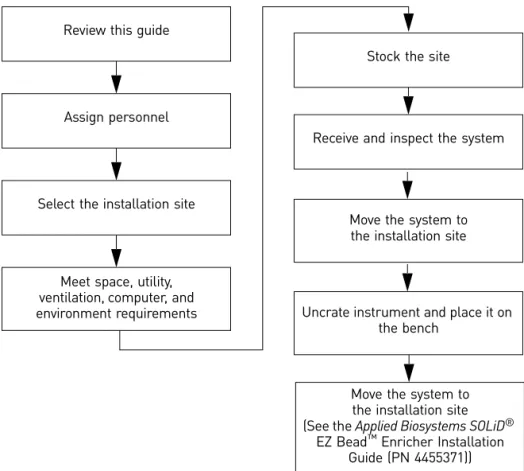
The general site preparation tasks and a suggested sequence for completing the tasks are summarized in Figure 1. The sequence can vary, but always review this guide first.
Figure 1 Site preparation tasks and their suggested sequence
Review this guide
Assign personnel
Select the installation site
Meet space, utility, ventilation, computer, and environment requirements
Stock the site
Receive and inspect the system
Move the system to the installation site
Uncrate instrument and place it on the bench
Assign personnel
Laboratory safety
representative
The laboratory safety representative should be familiar with laboratory safety procedures and know the location of all the safety equipment.
Tasks and personnel
Table 1 summarizes specific site-preparation tasks and suggests the personnel to accomplish the tasks. Use the table to help schedule and manage the site-preparation process.Table 1 Suggested personnel tasks
Personnel Tasks
Site Preparation/ Installation Coordinator
• Reviews the site preparation guide for safety information and system requirements. • Coordinates personnel and tasks.
• Orders required materials. • Chooses the site.
• Reviews checklists with applicable personnel to verify that the site is properly prepared. • Receives and inspects the system.
• Schedules the installation and informs personnel of the installation date. • Ensures that the site is clear of unnecessary material on the installation day. • Is available to assist throughout installation.
Laboratory Safety Representative
• Reviews the site preparation guide for safety information.
• Ensures that the required safety practices and equipment are in place. Laboratory Personnel/
Primary Users
• Review safety information.
• Ensure that all customer-provided materials for installation are present at the site. • Uncrate the instrument and place it on the bench.
• Move the system to the installation site. See the Applied Biosystems SOLiD® EZ Bead™ Enricher Installation Guide (PN 4455371).
Facilities Personnel • Ensure that installation requirements are met for: – Space at the installation site
– Building clearances – Temperature and humidity – Ventilation and waste collection – Electrical supply
– Computer (laptop)
– Safety and installation materials
• If possible, move the crated system to the site before the installation date. • Are available to assist the laboratory personnel throughout installation. • At least 2 people are available to move and position the system.
Chapter 1 Site Preparation Tasks
Overview
1
Select the site
When deciding where to install the instrument, refer to the following sections for site requirements:
• “Space requirements” on this page
• “Environmental requirements” on page 13
• “Ventilation and waste collection requirements” on page 14
• “Electrical requirements” on page 15
• “Computer requirements” on page 15
• “Safety and materials requirements” on page 16
IMPORTANT! The site cannot be designated BioSafety Level 3 (BSL-3) or BioSafety Level 4 (BSL-4). Applied Biosystems does not service or repair instruments in areas designated BSL-3 or BSL-4.
Space requirements
WARNING! To prevent contamination, the Applied Biosystems SOLiD EZ Bead Enricher must not be placed in the same room that is used to prepare emulsions containing library template and P1 Beads.
CAUTION! The Applied Biosystems SOLiD EZ Bead Enricher has components that cause vibration. It is important that the instrument is placed on a stable surface.
Required tools
Pallet jack to expedite the handling of the instrument crate and a utility knife to open the crate.System components
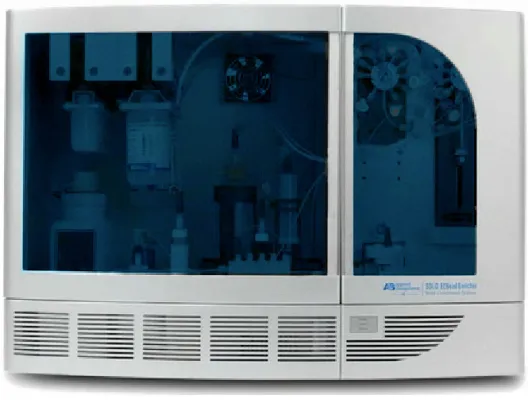
The SOLiD® EZ Bead™ Enricher (Figure 2) includes the:• Enricher
• Waste bottle (inside the instrument)
• Small bottle racks with the bottles attached (inside the instrument) • Large bottle racks with the bottles attached (inside the instrument) • Dell™ Latitude™ E6500 laptop, or equivalent, and cables
• USB cord (connecting cord)
Figure 2 Applied Biosystems SOLiD® EZ Bead™ Enricher
Instrument front panel
Figure 3 shows the Enricher’s front panel, which includes the indicator lights.
Figure 3 SOLiD® EZ Bead™ Enricher indicator lights
Connections to the computer (laptop) and power outlet
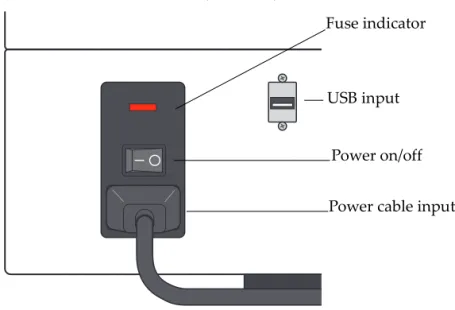
Figure 4 shows the Enricher connections to the computer (laptop) as well as the power outlet input.
Chapter 1 Site Preparation Tasks
Overview
1
Figure 4 Connections to the computer and power outlet
Layout requirements
Figure 5 on page 12 shows a typical layout and some basic layout considerations for the SOLiD EZ Bead Enricher. For details on the Enricher space requirements, see“Space requirements” on page 10.
Figure 5 Layout requirements (not to scale)
USB input
Power on/off Power cable input Fuse indicator
Dimensions and
weights
The table below indicates dimensions and weights of the system components. Ensure that the installation site (floor space and/or bench space) can accommodate the dimensions and support the weights.
Required clearances
Clearance on all sidesAt least 50 cm (20 in.) of clearance for ventilation, service access, and cable routing. Allow space to move the instrument for easy access to the back and sides.
Vertical clearance
At least50 cm (20 in.) of unobstructed vertical clearance above the top of theEnricher to allow the top to be lifted during service.
Environmental requirements
Altitude
This Enricher is for indoor use only and for altitudes not exceeding 2000 m (6562 ft.) above the sea level.Temperature and
humidity
requirements
Ensure that the installation site is maintained under the following conditions:
IMPORTANT! The Enricher is for indoor use only.
Avoid placing the system (the instrument and laptop) adjacent to heaters, cooling ducts, or in direct sunlight. Fluctuations between day and night temperatures can cause system instability.
Pollution
The Enricher has a Pollution Degree rating of II. It may be installed in an environment that has nonconductive pollutants only, such as dust particles or wood chips. Typical environments with a Pollution Degree II rating are laboratories, sales, and commercial areas.Component Width Depth Height Weight
SOLiD® EZ Bead™ Enricher crate Includes the laptop and other contents. See “System components” on page 10.
61.6 cm (24.25 in.) 85.1 cm (33.5 in.) 76.8 cm (30.25 in) 56.7 kg (125 lbs)
SOLiD EZ Bead Enricher 49.53 cm (19.5 in.) 73.2 cm (28.75 in.) 52.4 cm (20.63 in.) 39.0 kg (86 lbs) Dell™ Latitude™ E6500 laptop, or
equivalent
35.81 cm (14.1 in.) 25.65 cm (10.1 in.) 3.3 cm (1.3 in.) 3.6 kg (5.2 lbs)
Condition Acceptable range
Temperature 15 to 30°C (59 to 86 °F)
Chapter 1 Site Preparation Tasks
Ventilation and waste collection requirements
1
Ventilation and waste collection requirements
Ventilation
requirements
At least 50 cm (20 in.) of clearance around the instrument for ventilation.
Collecting liquid
waste
Liquid waste is collected in the waste bottle inside the instrument. Empty the waste bottle into a hazardous waste container according to all local, state/provincial, and/or national regulations, then return the waste bottle to the instrument.
WARNING! CHEMICAL WASTE HAZARD. Waste produced by Applied Biosystems instruments can be hazardous and can cause injury, illness, or death.
WARNING! CHEMICAL STORAGE HAZARD. Never collect or store waste in a glass container because of the risk of breaking or shattering. Reagent and waste bottles can crack and leak. Each waste bottle should be secured in a low-density polyethylene safety container with the cover fastened and the handles locked in the upright position. Wear appropriate eyewear, clothing, and gloves when handling reagent and waste bottles.
Cleaning or
decontaminating the
instrument
Refer to the Applied Biosystems SOLiD® EZ Bead™ Enricher Getting Started Guide
(PN 4443496) for information on how to clean or decontaminate the instrument. • Wear appropriate protection, including gloves, laboratory goggles, and coat
whenever you work with the fluids used on this instrument, or parts that may come into contact with these fluids.
• Use only the cleaning agents as described in the Applied Biosystems SOLiD® EZ
Bead™ Enricher Getting Started Guide (PN 4443496). Use of cleaning agents not
described in this manual can impair the instrument. Contact your local Life Technologies sales office if you have any questions.
• Wipe off any liquid on or around the instrument using a lint-free tissue.
• Clean off any build-up crystals on the instrument, including the tube connections, with deionized water and lint-free tissue.
• Clean the reagent racks with deionized water, or presaturated Isopropyl Alcohol (IPA) wipes, and lint-free tissue.
Electrical requirements
Disconnecting
power
In case of emergency, you must be able to immediately disconnect the main power supply to the instrument.
Power connectors
and receptacles
The SOLiD EZ Bead Enricher is shipped to customers in North America with NEMA 5–15 power connectors. These connectors require NEMA 5-15 electrical receptacles (standard 10 A wall receptacles) with proper grounding.
WARNING! Do not use extension cords.
System electrical
requirements
The Enricher is configured to use voltages of 100 to 240 VAC at 50 or 60 Hz. Table 2
provides electrical specifications for the SOLiD® EZ Bead™. For all indicated input
voltages, a 10 A circuit is required.
WARNING! Protective grounding is required for all devices. Ensure that each device is properly grounded via the ground pin of each cord set.
Power line regulator
In areas where the supplied power is subject to voltage fluctuations exceeding ±10% of the nominal value, a power line regulator may be required. High or low voltages can adversely affect the electronic components of the instrument.Note: The use of an Uninterrupted Power Supply (UPS) is recommended.
Computer requirements
The integrated Dell™ Latitude™ E6500 laptop, or equivalent, provided by Applied Biosystems has the Microsoft Windows®XP operating system with Service Pack 3 installed.
CAUTION! Do not install additional software on the laptop. Changes to the configured software could void the instrument warranty and cause the system to be nonoperational.
IMPORTANT! Applied Biosystems strongly recommends that you do not connect the laptop to the internet to prevent virus attacks.
CAUTION! No antivirus software is installed on the laptop.
Table 2 SOLiD EZ Bead Enricher Electrical specifications Input Voltage (VAC) Frequency (Hz) Power (W)
Chapter 1 Site Preparation Tasks
Electrical requirements
1
Safety and materials requirements
Safety practices
IMPORTANT! The site must not be designated BioSafety Level 3 (BSL-3) or BioSafety Level 4 (BSL-4). Applied Biosystems does not install, service, or repair instruments in areas designated BSL-3 or BSL-4.IMPORTANT! A safety representative from your facility must ensure that: • Personnel establish and follow all applicable safety practices and policies
to protect laboratory personnel from potential hazards.
• All applicable safety devices and equipment are available at all times.
Required safety
equipment
Your laboratory has specific safety practices and policies designed to protect laboratory personnel from potential hazards that are present. Applied Biosystems expects that you will follow all applicable safety-related procedures at all times. The following safety protection and equipment must be available at the installation site:
• Protection from any sources of hazardous chemicals that may be present in the area.
• Appropriate fire extinguisher:
– You are responsible for providing an appropriate fire extinguisher for use on or near Applied Biosystems equipment.
– The types and sizes of fire extinguishers shall be suitable for use on electrical and chemical fires as specified in current codes, regulations, and/or
standards, and with approval of the Fire Marshall or other authority having jurisdiction.
– The installation of appropriate fire extinguishers shall be in addition to other fire-protection systems and not as a substitute or alternative to them.
• Eyewash • Safety shower
• Eye and hand protection • Adequate ventilation • First-aid equipment • Spill cleanup equipment • Applicable SDSs
Materials for
general installation
Provide the following materials for the installation:
• Safety glasses, lab coats, chemical-resistant, disposable gloves (powder-free) • Lint-free tissues
Materials for routine
operation
The following supplies and consumables are necessary for routine operation of the SOLiD EZ Bead Enricher. Before the system is installed, contact the Applied Biosystems sales representative to order these additional supplies. For details, refer to the Applied Biosystems SOLiD® EZ Bead™ Enricher Getting Started Guide
(PN 4443496).
Table 3 Required equipment
Product name Vendor and part number
SOLiD® EZ Bead™ Enricher Applied Biosystems 4448420
Covaris® S2 System†
† For system materials summary, refer to “Covaris® S2 System Materials Summary,” in the SOLiD™ 4 System
Site Preparation Guide (PN 4448639).
Applied Biosystems 4387833 (110 V) or
Applied Biosystems 4392718 (220 V) 6-Tube Magnetic Stand Applied Biosystems
AM10055 NanoDrop® ND-1000 Spectrophotometer
(computer required)
Thermo Scientific ND-1000
Labquake Rotisserie Rotator, Barnstead/Thermolyne Thermo Scientific 400110
Scale, 250g capacity MLS‡
‡ Major Laboratory Supplier.
Incubator (37°C) MLS Vortexer MLS Picofuge MLS Pipettors 2 μL, 200 μL, and 1000 μL MLS Ice bucket MLS
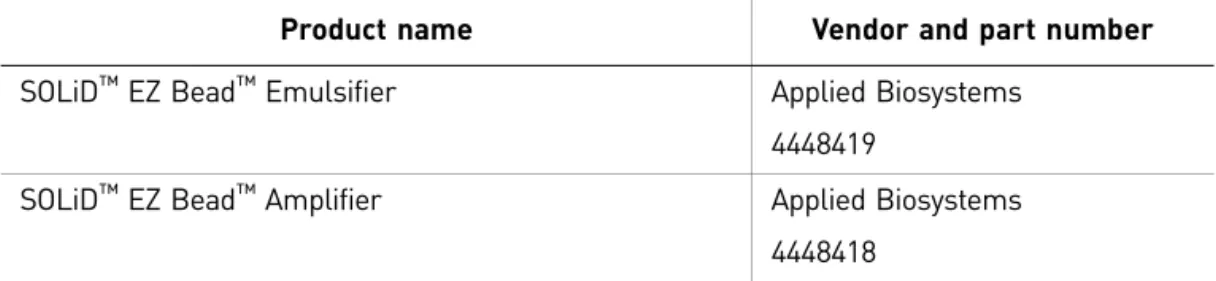
Table 4 Optional equipment†
† Each kit contains other components. For details refer to the Applied Biosystems SOLiD® EZ Bead™ Enricher
Getting Started Guide (PN 4443496).
Product name Vendor and part number
SOLiD™ EZ Bead™ Emulsifier Applied Biosystems 4448419
SOLiD™ EZ Bead™ Amplifier Applied Biosystems 4448418
Chapter 1 Site Preparation Tasks
Electrical requirements
1
IMPORTANT! For the storage conditions, see the package label or the product insert.
IMPORTANT! For the storage conditions, see the package label or the product insert.
Receive and inspect the system
Shipped contents
The SOLiD EZ Bead Enricher includes the: • Enricher• Waste bottle (inside the instrument)
• Small bottle racks with the bottles attached (inside the instrument) • Large bottle racks with the bottles attached (inside the instrument) • Dell™ Latitude™ E6500 laptop, or equivalent, and cables
• USB cord (connecting cord)
• Documents. See “Related documentation” on page 33.
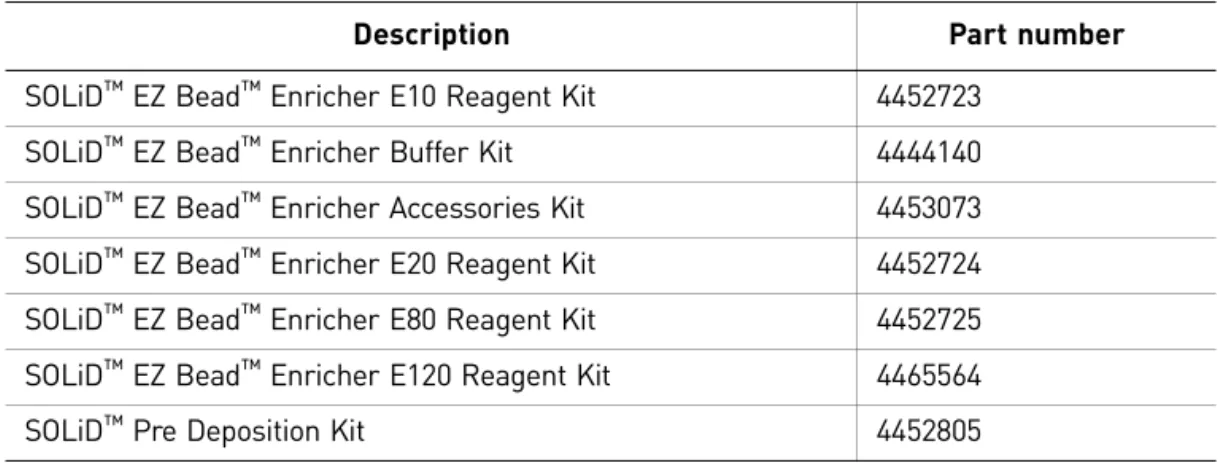
Table 5 Required kits†
† Each kit contains other components. For details refer to the Applied Biosystems SOLiD® EZ Bead™ Enricher
Getting Started Guide (PN 4443496).
Description Part number
SOLiD™ EZ Bead™ Enricher E10 Reagent Kit 4452723 SOLiD™ EZ Bead™ Enricher Buffer Kit 4444140 SOLiD™ EZ Bead™ Enricher Accessories Kit 4453073 SOLiD™ EZ Bead™ Enricher E20 Reagent Kit 4452724 SOLiD™ EZ Bead™ Enricher E80 Reagent Kit 4452725 SOLiD™ EZ Bead™ Enricher E120 Reagent Kit 4465564 SOLiD™ Pre Deposition Kit 4452805
Table 6 Optional kits†
† Each kit contains other components. For details refer to the Applied Biosystems SOLiD® EZ Bead™ Enricher
Getting Started Guide (PN 4443496).
Product name Units Catalog
number
Move the crated instrument to the laboratory
Move schedule
Before the date of installation:• Clear the installation site of all unnecessary materials to provide a clear path from the delivery area to the bench.
• Move the crated SOLiD® EZ Bead™ Enricher from the receiving area to the
installation site. See “Required tools” on page 10.
• Move the other shipping containers from the shipping area to the installation site.
Required building
clearances
To move the Enricher shipment crate to the installation site, verify that the building clearances allow passage of the following crate dimensions:
Instrument weight
The instrument weighs approximately 39.0 kg (86 lbs). The crate weighs approximately 56.7 kg (125 lbs) and has the following specifications.WARNING! PHYSICAL INJURY HAZARD. Do not attempt to lift the crated SOLiD® EZ Bead™.
Move and lift the
instrument
CAUTION! PHYSICAL INJURY HAZARD. If you decide to lift or move the instrument after it has been installed, do not attempt to lift or move the instrument without the assistance of others, the use of appropriate moving equipment, and proper lifting techniques. Improper lifting can cause painful and permanent back injury. Depending on the weight, moving or lifting an instrument may require two or more persons.
CAUTION! Do not tip the crate on end. Tipping damages the hardware and electronics.
Crate Dimension Minimum Building Clearance Height 76.71 cm (30.2 in.) Length 84.84 cm (33.4 in.) Depth 61.29 cm (24.13 in.)
Component Width Depth Height Weight
SOLiD EZ Bead Enricher crate Includes the laptop and other contents. See “System components” on page 10.
Chapter 1 Site Preparation Tasks
Move the crated instrument to the laboratory
2
Checklists
This chapter includes the following topics:
■ Overview . . . 22
■ Personnel checklist . . . 22
■ Space and layout checklist. . . 22
■ Environmental checklist . . . 23
■ Ventilation and waste collection checklist . . . 23
■ Electrical checklist . . . 23
■ Safety checklist . . . 24
■ Materials checklist . . . 24
■ System receipt and inspection checklist . . . 25
Chapter 2 Checklists
Overview
2
Overview
Before using the checklists, read all previous sections in this guide.
Use the checklists in this chapter to ensure that you have made all preparations for installing the system.
In the following checklists, date each item after verifying its completion.
Personnel checklist
For more information, see “Assign personnel” on page 9.
Space and layout checklist
For more information, see “Space requirements” on page 10.
Date Verified Designated Personnel
Site Preparation/Installation coordinator Laboratory safety representative Laboratory personnel:
• To ensure that customer-supplied materials are on hand Facilities personnel:
• To provide environmental, electrical, and computer site-preparation requirements
• To verify that at least 2 people are available for uncrating
Date Verified Requirements
Location is away from: • Heating or cooling ducts • Direct sunlight
Air space of 50 cm (20 in.) around the instrument.
Space for the computer desk is within 100 cm (40 in) of the SOLiD® EZ Bead™ Enricher.
Computer workspace allows for proper ergonomics during use. Location accommodates the dimensions and weights specified in
Environmental checklist
For more information, see “Environmental requirements” on page 13.
Ventilation
and waste collection checklist
See “Ventilation and waste collection requirements” on page 14.
Electrical checklist
For more information, see “Electrical requirements” on page 15.
Date Verified Requirement
The altitude does not exceed 2000 m (6562 ft) above sea level.
The conditions specified in “Temperature and humidity requirements” on page 13 have been met.
Pollution Degree II – Only nonconductive pollutants, if any, are present.
Date Verified Requirement
At least 50 cm (20 in.) of clearance around the instrument for ventilation. Liquid waste is collected in the waste bottle inside the instrument. The waste bottle handling conditions specified in “Collecting liquid waste” on page 14 have been met.
The cleaning, or decontaminating, the instrument conditions specified in
“Cleaning or decontaminating the instrument” on page 14.
Date Verified Requirement
The main power supply to the instrument can be immediately disconnected.
Appropriate grounded power receptacles are available (see “Electrical requirements” on page 15).
The main power supply to the instrument can accommodate the length of the instrument's power cord.
Chapter 2 Checklists
Safety checklist
2
Safety checklist
For more information, see “Safety practices” on page 16.
Materials checklist
For more information, see “Safety and materials requirements” on page 16.
Date Verified Requirement
The site is not designated BioSafety level 3 (BSL-3) or BioSafety level 4 (BSL-4).
Safety practices and policies to protect laboratory personnel from potential hazards are in place and are followed.
Protection from any sources of hazardous chemicals that may be present in the area.
Appropriate fire extinguisher is available Eye and hand protection are provided Eyewash is provided
Safety shower is available First-aid equipment is available Spill cleanup equipment is available SDSs readily available and accessible
Date Verified Requirement
Materials for general installation Safety glasses and lab coats
Chemical-resistant disposable gloves (powder free) Lint-free tissues
Isopropanol HPLC-grade or better Water, Milli-Q grade
Three sizes of micropipettors and tips: • 1- to 10-µL
System receipt and inspection checklist
For more information, see “Receive and inspect the system” on page 18.
Move the crated instrument checklist
For more information, see “Move the crated instrument to the laboratory” on page 19.
Date Verified Action
Verified that items on the packing list are those that were ordered. Otherwise, reported to Applied Biosystems about discrepancies in the packing list.
Received the system and inspected the shipping containers for mishandling or damage.
Reported to the Applied Biosystems service representative: • Any damage to the shipping containers
• Tip indicators or shock indicators that show evidence of mishandling during transit
Date Verified Item
The measured building clearances can accommodate the SOLiD® EZ Bead™ Enricher crate and pallet jack (see “Required building clearances”
on page 19).
Moved all the crated equipment to the laboratory before the date of the scheduled installation.
WARNING! PHYSICAL INJURY HAZARD. Incorrect lifting can cause painful and sometimes permanent back injury. Use proper lifting techniques when lifting or moving items. At least 2 people must be available to move the crated equipment.
Chapter 2 Checklists
System receipt and inspection checklist
A
Safety
WARNING! GENERAL SAFETY. Using this product in a manner not specified in the user documentation may result in personal injury or damage to the instrument or device. Ensure that anyone using this product has received instructions in general safety practices for laboratories and the safety information provided in this document.
• Before using an instrument or device, read and understand the safety information provided in the user documentation provided by the manufacturer of the instrument or device.
• Before handling chemicals, read and understand all applicable Safety Data Sheets (SDSs) and use appropriate personal protective equipment (gloves, gowns, eye protection, etc). To obtain SDSs, see the “Documentation and Support” section in this document.
Symbols on this instrument
Symbols may be found on the instrument to warn against potential hazards or convey important safety information. In this document, the symbol is used along with user attention words described in the “About This Guide” section to highlight important safety information. The following table gives the meaning of these symbols.
Symbol English Français
Caution, risk of danger
Consult the manual for further safety information.
Attention, risque de danger Consulter le manuel pour d’autres renseignements de sécurité. Caution, risk of electrical shock Attention, risque de choc électrique
On On (marche)
Off Off (arrêt)
On/Off On/Off (marche/arrêt)
Standby En attente
Safety
Symbols on this instrument
A
Terminal that can receive or supply alternating current or voltage
Borne pouvant recevoir ou envoyer une tension ou un courant de type alternatif Terminal that can receive or supply
alternating or direct current or voltage
Borne pouvant recevoir ou envoyer une tension ou un courant continu ou alternatif
Do not dispose of this product in unsorted municipal waste
To minimize negative environmental impact from disposal of electronic waste, do not dispose of electronic waste in unsorted municipal waste. Follow local municipal waste ordinances for proper disposal provision and contact customer service for information about responsible disposal options.
Ne pas éliminer ce produit avec les déchets usuels non soumis au tri sélectif.
Pour minimiser les conséquences négatives sur l’environnement à la suite de l’élimination de déchets électroniques, ne pas éliminer ce déchet électronique avec les déchets usuels non soumis au tri sélectif. Se conformer aux ordonnances locales sur les déchets municipaux pour les dispositions d’élimination et
communiquer avec le service à la clientèle pour des renseignements sur les options d’élimination responsable.
Conformity mark Description
Indicates conformity with safety requirements for Canada and U.S.A.
Indicates conformity with European Union requirements for safety and electromagnetic compatibility.
Indicates conformity with Australian standards for electromagnetic compatibility.
Safety alerts on this instrument
The SOLiD® EZ Bead™ Enricher contains safety warnings on the back of the
instrument (on the manufacturing and ratings label).
Additional text may be used with one of the symbols described above when more specific information is needed to avoid exposure to a hazard. See the following table for safety alerts found on the instrument.
Instrument safety
General
CAUTION! Do not remove instrument protective covers. If you remove theprotective instrument panels or disable interlock devices, you may be exposed to serious hazards including, but not limited to, severe electrical shock, laser exposure, crushing, or chemical exposure.
CAUTION! Solvents and Pressurized Fluids. To avoid hazards associated with high-pressure fluids in polymeric tubing:
• Be aware that PEEK™ tubing is a polymeric material. Use caution when
working with any polymer tubing that is under pressure.
• Always wear eye protection when near pressurized polymer tubing. • Extinguish all nearby flames if you use flammable solvents.
• Do not use PEEK tubing that has been severely stressed or kinked. • Do not use PEEK tubing with tetrahydrofuran or nitric and sulfuric acids. • Be aware that methylene chloride and dimethyl sulfoxide cause PEEK tubing
to swell and greatly reduce the rupture pressure of the tubing.
• Be aware that high solvent flow rates (~40 mL/min) may cause a static charge to build up on the surface of the tubing. Electrical sparks may result
Physical injury
CAUTION! MOVING AND LIFTING INJURY. The instrument is to be movedand positioned only by the personnel or vendor specified in the applicable site preparation guide.
Improper lifting can cause painful and permanent back injury.
Things to consider before lifting or moving the instrument or accessories:
English French translation
CAUTION! Hazardous chemicals. Read the Safety Data Sheets (SDSs) before handling.
ATTENTION! Produits chimiques dangereux. Lire les fiches
signalétiques (FS) avant de manipuler les produits.
CAUTION! Hazardous waste. Refer to SDS(s) and local regulations for handling and disposal.
ATTENTION! Déchets dangereux. Lire les fiches signalétiques (FS) et la réglementation locale associées à la manipulation et à l’élimination des déchets.
Safety
Instrument safety
A
• If you decide to lift or move the instrument after it has been installed, do not attempt to do so without the assistance of others, the use of appropriate moving equipment, and proper lifting techniques.
• Ensure you have a secure, comfortable grip on the instrument or accessory. • Make sure that the path from where the object is to where it is being moved
is clear of obstructions.
• Do not lift an object and twist your torso at the same time. Keep your spine in a good neutral position while lifting with your legs.
• Participants should coordinate lift and move intentions with each other before lifting and carrying.
• For smaller packages, rather than lifting the object from the packing box carefully tilt the box on its side and hold it stationary while someone else slides the contents out of the box.
Electrical
WARNING! ELECTRICAL SHOCK HAZARD. Severe electrical shock canresult from operating the SOLiD® EZ Bead™ Enricher without its instrument
panels in place. Do not remove instrument panels. High-voltage contacts are exposed when instrument panels are removed from the instrument.
WARNING! Ensure appropriate electrical supply. For safe operation of the instrument:
• Plug the system into a properly grounded receptacle with adequate current capacity.
• Ensure the electrical supply is of suitable voltage.
• Never operate the instrument with the ground disconnected. Grounding continuity is required for safe operation of the instrument.
WARNING! Power Supply Line Cords. Use properly configured and approved line cords for the power supply in your facility.
WARNING! Disconnecting Power. To fully disconnect power either detach or unplug the power cord, positioning the instrument such that the power cord is accessible.
Overvoltage rating
The Applied Biosystems SOLiD® EZ Bead™ Enricher has an installation (overvoltage)category of II, and is classified as a portable equipment.
Safety and electromagnetic compatibility (EMC) standards
The instrument design and manufacture complies with the standards and
requirements for safety and electromagnetic compatibility as noted in the following table:
Safety
EMC
Environmental
Design
Reference DescriptionEU Directive 2006/95/EC European Union “Low Voltage Directive” UL 61010-1 Safety requirements for electrical equipment for
measurement, control, and laboratory use – Part 1: General requirements
EN 61010-1:2001 Safety requirements for electrical equipment for measurement, control, and laboratory use – Part 1: General requirements
IEC 081, EN 61010-2-081
Safety requirements for electrical equipment for measurement, control and laboratory use – Part 2-081: Particular requirements for automatic and semi-automatic laboratory equipment for analysis and other purposes
Reference Description Directive 2004/108/EC European Union “EMC Directive”
EN 61326 Electrical Equipment for Measurement, Control and Laboratory Use – EMC Requirements – Group 1, Class B:
AS/NZS 2064 Limits and Methods of Measurement of Electromagnetic Disturbance Characteristics of Industrial, Scientific, and Medical (ISM) Radiofrequency Equipment
ICES-001, Issue 3 Industrial, Scientific and Medical (ISM) Radio Frequency Generators
Reference Description
Directive 2002/96/EC European Union “WEEE Directive” – Waste electrical and electronic equipment
Safety
Chemical safety
A
Chemical safety
WARNING! GENERAL CHEMICAL HANDLING. To minimize hazards, ensure laboratory personnel read and practice the general safety guidelines for chemical usage, storage, and waste provided below, and consult the relevant SDS for specific precautions and instructions:
• Read and understand the Safety Data Sheets (SDSs) provided by the
chemical manufacturer before you store, handle, or work with any chemicals or hazardous materials. To obtain SDSs, see the “Documentation and Support” section in this document.
• Minimize contact with chemicals. Wear appropriate personal protective equipment when handling chemicals (for example, safety glasses, gloves, or protective clothing).
• Minimize the inhalation of chemicals. Do not leave chemical containers open. Use only with adequate ventilation (for example, fume hood). • Check regularly for chemical leaks or spills. If a leak or spill occurs, follow
the manufacturer's cleanup procedures as recommended in the SDS. • Ensure use of primary and secondary waste containers. (A primary waste
container holds the immediate waste. A secondary container contains spills or leaks from the primary container. Both containers must be compatible with the waste material and meet federal, state, and local requirements for container storage.)
• After emptying a waste container, seal it with the cap provided.
• Characterize (by analysis if necessary) the waste generated by the particular applications, reagents, and substrates used in your laboratory.
• Ensure that the waste is stored, transferred, transported, and disposed of according to all local, state/provincial, and/or national regulations.
WARNING! HAZARDOUS WASTE (from instruments). Waste produced by the instrument is potentially hazardous. Follow the guidelines noted in the preceding General Chemical Handling warning.
WARNING! 4L Reagent and Waste Bottle Safety. Four-liter reagent and waste bottles can crack and leak. Each 4-liter bottle should be secured in a low-density polyethylene safety container with the cover fastened and the handles locked in the upright position.
WARNING! Waste Bottle Safety. Never collect or store waste in a glass container because of the risk of breaking or shattering. Reagent and waste bottles can crack and leak. Each waste bottle should be secured in a low-density
Documentation and Support
Related documentation
The following related documents are shipped with the system:
Note: For additional documentation, see “Obtaining support”.
Obtaining SDSs
Safety Data Sheets (SDSs) are available from www.appliedbiosystems.com/sds
Note: For the SDSs of chemicals not distributed by Applied Biosystems, contact the chemical manufacturer.
Obtaining support
For the latest services and support information for all locations, go to:
www.appliedbiosystems.com
At the website, you can:
• Access worldwide telephone and fax numbers to contact Technical Support and Sales facilities
• Search through frequently asked questions (FAQs) • Submit a question directly to Technical Support
• Search for user documents, SDSs, vector maps and sequences, application notes, formulations, handbooks, certificates of analysis, citations, and other product support documents
• Obtain information about customer training
Document Part
number Description
Applied Biosystems SOLiD® EZ Bead™ Enricher
Getting Started Guide
4443496 Describes the SOLiD® EZ Bead™ Enricher hardware and software and provides information on preparing, maintaining, and troubleshooting the system. Also describes how to perform emulsion break and enrichment using the SOLiD® EZ Bead™ Enricher.
Applied Biosystems SOLiD® EZ Bead™ Enricher
Quick Reference Card
4443497 The document is designed to help you quickly learn to use the SOLiD® EZ Bead™ Enricher.
Documentation and Support
Index
B
biosafety levels 10
building clearances, required 19
C
checklists electrical 23 environmental 23 inspection 25 layout 22 materials 24moving the instrument 25
personnel assignments 22 safety 24 site 22 site preparation 21 space 22 system receipt 25 ventilation 23 waste collection 23 chemical safety 32 cleaning safety 30 clearances building 19 required 13 system components 13 consumables, ordering 17 crate
See also moving the crated system dimensions 19
reporting shipping damage or tipping 18
D
damage, reporting 18
decontamination safety 30
dimensions of system components 13
documentation, related 33
E
electrical 15 electrical checklist 23 electrical requirements 15 electrical safety 30 electrical specifications 15electromagnetic compatibility (EMC) standards 31
environmental checklist 23
environmental requirements 13
F
facilities personnel, tasks 9
fire extinguisher 16
I
inspection checklist 25
installation checklist 8
conditions for postponing 8
scheduling 8
installation category 30
installation coordinator 22
,
24instrument safety 29
L
laboratory layout, typical 12
laboratory personnel, tasks 9
laboratory safety representative 9
layout checklist 22
lifting, safety 19
installation site. See laboratory layout
M
materials checklist 24
Index
building clearances 19
no lifting caution 19
safety 19
weight 19
moving the instrument checklist 25
O
overvoltage category (rating) 30
P
personnel assignments 9
,
22personnel checklist 22
personnel tasks 9
physical injury safety 29
positioning system components 12
preinstallation review of site preparation 8
R
reporting, shipping damage 18
requirements
component clearances and positioning 13
electrical 15 environmental 13 no tipping 19 physical clearances 13 quick disconnect 10 space 10
,
13 system layout 12temperature and humidity 13
S
safety
alerts on instrument 29
checklist 24
chemical 32
cleaning and decontamination 30
electrical 30
instrument 29
electrical quick disconnect 10
lifting 19
safety practices, required 16
shipping crate. See Crate shipping damage, reporting 18
shipping list, verifying 10
,
18shipping, reporting damage 18
site checklist 22
site preparation
See also requirements checklists 21 flowchart 8 overview 8 schedule 8 tasks 9 tasks overview 8
site preparation process, overview 8
site. See laboratory space checklist 22 space requirements 10
,
13 specifications 15 support, obtaining 33 symbols, on instrument 27 system building clearances 19 components 10 dimensions 13 layout 12 positioning components 10,
12 requirements 10 weight 13system layout requirements 12
system receipt checklist 25
T
tasks
facilities personnel 9
laboratory personnel 9
V
ventilation checklist 23W
WARNINGs lifting 19tipping the instrument 19
waste collection checklist 23