econ
stor
www.econstor.eu
Der Open-Access-Publikationsserver der ZBW – Leibniz-Informationszentrum Wirtschaft
The Open Access Publication Server of the ZBW – Leibniz Information Centre for Economics
Nutzungsbedingungen:
Die ZBW räumt Ihnen als Nutzerin/Nutzer das unentgeltliche, räumlich unbeschränkte und zeitlich auf die Dauer des Schutzrechts beschränkte einfache Recht ein, das ausgewählte Werk im Rahmen der unter
→ http://www.econstor.eu/dspace/Nutzungsbedingungen nachzulesenden vollständigen Nutzungsbedingungen zu vervielfältigen, mit denen die Nutzerin/der Nutzer sich durch die erste Nutzung einverstanden erklärt.
Terms of use:
The ZBW grants you, the user, the non-exclusive right to use the selected work free of charge, territorially unrestricted and within the time limit of the term of the property rights according to the terms specified at
→ http://www.econstor.eu/dspace/Nutzungsbedingungen By the first use of the selected work the user agrees and declares to comply with these terms of use.
zbw
Leibniz-Informationszentrum WirtschaftSchnabl, Gunther
Working Paper
Capital markets and exchange rate stabilization
in East Asia: Diversifying risk based on currency
baskets
HWWI Research Paper, No. 2-1
Provided in cooperation with:
Hamburgisches WeltWirtschaftsInstitut (HWWI)
Suggested citation: Schnabl, Gunther (2006) : Capital markets and exchange rate stabilization in East Asia: Diversifying risk based on currency baskets, HWWI Research Paper, No. 2-1, http://hdl.handle.net/10419/48254
Paper 2-1 by the HWWI Research Programme International Trade and Development
HWWI Research
Capital Markets and Exchange
Rate Stabilization in East Asia −
Diversifying Risk Based on
Currency Baskets
Gunther Schnabl
Gunther Schnabl Leipzig University
Marschenerstr. 31 | 04109 Leipzig | Germany Tel +49 (0)341 97 33 561 | Fax +49 (0)341 97 33 569 [email protected]
HWWI Research Paper
Hamburg Institute of International Economics (HWWI) Neuer Jungfernstieg 21 | 20354 Hamburg | Germany Tel +49 (0)40 34 05 76 - 0 | Fax +49 (0)40 34 05 76 - 76 [email protected] | www.hwwi.org
ISSN 1861-504X
Editorial Board:
Thomas Straubhaar (Chair) Katharina Michaelowa
© Hamburg Institute of International Economics (HWWI) | 2006
All rights reserved. No part of this publication may be reproduced, stored in a retrieval system, or transmitted in any form or by any means (electronic, mechanical, photocopying, recording or otherwise) without the prior written permission of the publisher.
Capital Markets and Exchange Rate Stabilization in East Asia –
Diversifying Risk Based on Currency Baskets
Gunther Schnabl Leipzig University
Marschenerstr. 31, 04109 Leipzig, Germany Tel. +49 341 97 33 561 – Fax. +49 341 97 33 569
E-mail: [email protected]
March 7, 2006
Abstract:
Before and after the Asian crisis, the dollar has been the dominant anchor and reserve currency in East Asia. Due to underdeveloped capital markets and a very limited international role of the domestic currencies, the East Asian countries (except Japan) are likely to continue exchange rate stabilization and accumulation of international reserves. Yet expectations about a further depreciation of the dollar may trigger a broader orientation of exchange rate policies based on basket strategies. While the direction of trade suggests a substantial weight for the Japanese yen in East Asian countries’ currency baskets, the role of the euro is enhanced by expectations about its long-term stability. (Rolling) econometric estimations of the basket structures in East Asia suggest growing weights of the euro and the yen in the currency baskets of Indonesia, Korea, Philippines, Singapore, Taiwan and Thailand. In contrast, for China, Hong Kong and Malaysia, the dollar remains the dominant anchor currency.
Key Words: East Asia, Currency Basket, Exchange Rate Policies, International Role of the Euro. JEL: F31.
This paper was prepared for a HWWA/HWWI conference on East Asian Monetary and Financial Integration which was held in Hamburg on December 15-16, 2005. For information on the conference please visit:
1. Introduction: More Exchange Rate Flexibility in East Asia?
Before the 1997/98 Asian crisis, China, Hong Kong, Indonesia, Korea, Malaysia, the Philippines, Singapore, Taiwan and Thailand pursued a common exchange rate peg to the US dollar. This (informal) East Asian dollar standard (McKinnon and Schnabl 2004a) was beneficial for growth in the region for several reasons. First, it ensured macroeconomic stability by pinning down domestic inflation to US inflation. Second, the joint peg to the dollar not only provided low transactions costs for trade with the US, but also for intra-regional trade flows, which make up about 50% of overall East Asian trade. Third, exchange rate stability provided low transaction costs for short-term and long-term international and intra-regional capital flows. With the onset of the East Asian crisis, the East Asian dollar standard fell apart. While China, Hong Kong, Singapore and Taiwan kept their exchange rates rather stable against the dollar, the currencies of the crisis countries Indonesia, Korea, Malaysia, Philippines and Thailand depreciated sharply against the dollar. The depreciation of the respective currencies went along with cumbersome recessions.
The post-crisis policy recommendations for the exchange regimes in East Asia have been of diverse nature. Associating exchange rate stability against the dollar with too low risk premia on volatile capital inflows, the IMF recommended more exchange rate flexibility (Fischer 2001). In contrast, McKinnon and Schnabl (2004a, 2004b) argued that exchange rate stabilization against the dollar is fully rational even post-crisis due to the high degree of dollarization of international and intra-regional trade and capital flows. A third strand of literature has proposed maintaining the exchange rate pegs in the region, while at the same time pegging to more than one anchor currency. According to Williamson (2000 and 2005) currency basket arrangements would be beneficial as they stabilize the nominal effective exchange rates. To maintain intra-regional exchange rate stability, Ogawa and Ito (2002) have proposed coordinating the currency baskets in the region.
While exchange rate volatility against the dollar – in particular at high frequencies – declined after the East Asian crisis up to late 2004 (close) to the pre-crisis levels, over the year 2005 exchange rate volatility against the dollar increased substantially. As will be argued in this paper, the rising exchange rate flexibility against the dollar could be due to a higher exchange rate stability against the Japanese yen and the euro reflecting the importance of Japan as a trading partner in the region, as well as the growing role of the euro as a (stable) international currency.
2. The Rationale for Exchange Rate Stabilization in East Asia
Despite policy recommendations to pursue more exchange rate flexibility, fully flexible exchange rates such as the dollar-euro rate are unlikely for the East Asian currencies (except the Japanese yen) for several interdependent reasons: transactions costs for international trade, macroeconomic stabilization, and dollarization of international capital flows.
The positive effect of exchange rate stability on international trade via lower transaction costs has found new support by a branch of literature building upon Frankel and Rose (2002). For East Asia, the common dollar peg has not only been beneficial for trade with the US, but particularly for intra-regional trade, which is mostly invoiced in US dollars.1 By jointly pegging to the dollar, the East Asian countries also avoided “beggar-thy-neighbor” depreciation, thereby enhancing macroeconomic stability in the region.
Macroeconomic stabilization is another important motivation for exchange rate stabilization. By pegging the exchange rate to the dollar or the euro, a small open economy can sustain a stable price level for two reasons. First, undisciplined monetary policy which aims to finance public expenditure via inflation tax is contained (Crocket and Goldstein 1976). Second, even if public expenditure is sound, in a small open economy nominal exchange rate fluctuations are likely to translate into fluctuations of the domestic price level. Exchange rate stabilization is equivalent to the stabilization of the domestic price level (McKinnon 1963).
Besides international trade and macroeconomic stabilization, international capital flows have gained increasing importance as an explanatory variable for exchange rate stabilization in countries with underdeveloped capital markets in domestic currencies, as they are prevalent in most East Asian countries (excluding Japan). The incentive for exchange rate stabilization arises from the fact that private and public agents in developing countries and emerging markets find themselves unable to borrow or to lend in their domestic currencies.
2.1 Liability Dollarization
As put forward by Eichengreen and Hausmann (1999), due to a long history of inflation and currency depreciation, banks and enterprises in emerging markets and developing countries cannot use their currencies to borrow abroad or to borrow long-term, even domestically, a phenomenon they have called original sin. International creditors lend in dollars or euro and thereby shift the exchange rate risk of open positions in foreign debt to the debtor countries. The consequence is a currency mismatch as projects that are financed with foreign currency generate domestic currency.
If private banks are able to shift the foreign exchange risk of international borrowing to (private) domestic debtors by foreign currency lending, the currency risk is transformed into default risk, as households and small private enterprises tend to remain unhedged. The upshot is that liability dollarization creates an incentive for exchange rate stabilization at both high frequencies (i.e., daily exchange rate fluctuations) and low frequencies (fluctuations of the exchange rate level over months, quarters and years).
Short-term exchange rate stabilization
With domestic foreign exchange markets being small and illiquid, most international short-term payment transactions of emerging markets and developing countries are denominated in US dollars or euro. Domestic currencies are mostly not accepted as international means of payment. In East Asia, the dollar has not only been used for goods and capital transactions with the US, but also for invoicing intra-regional trade and capital flows. In these underdeveloped capital markets, an active forward market in foreign exchange against the dollar (or euro) is for the most part non-existent. If hedging instruments are available, the costs of hedging dollar liabilities, i.e. the premium on buying dollars forward with the domestic currency, is high. The foreign exchange risk of short-term capital transactions typically remains un-hedged.
Monetary authorities can provide an informal hedge for private short-term capital transactions by minimizing daily exchange rate fluctuations. This provides a compensation for the underdeveloped private market in forward exchange. In practice, the monetary authorities establish formal or informal limits to daily exchange rate fluctuations defined in percent
exchange rate changes (Chmelarova and Schnabl 2006). Private banks and enterprises can repay their short-term foreign currency (dollar) liabilities with minimal exchange rate risk. As shown in Figure 1, except for crisis periods, exchange rate volatility against the dollar of the East Asian countries has tended to be smaller than for freely floating currencies such as the Japanese yen and the euro (before 1999 the German mark). In contrast, the monetary authorities of large countries with highly developed capital markets (mainly the US, the euro area and Japan) can leave day-to-day exchange rate fluctuations to market forces for two reasons. First, private transactions with emerging markets and developing countries are mainly invoiced in domestic currencies. Second, for transactions between large countries well-developed domestic capital markets provide a broad variety of instruments to hedge the foreign exchange exposures at low costs.
[Figure 1 around here]
Long-term exchange rate fluctuations
At low frequencies, the rationale for exchange rate stabilization in debtor countries originates in long-term liability dollarization. If net debt is denominated in foreign currency, long-term exchange rate stability is equivalent to reducing default risk on balance sheets (Eichengreen and Hausmann 1999). In particular, a sharp depreciation puts balance sheets at risk, possibly forcing indebted enterprises and financial institutions into default. In case of an appreciation, the competitiveness and profit margins of the export industry are at risk. Even low-frequency exchange rate fluctuations around a constant level may pose a risk for the domestic economy, as larger uncertainty is reflected in higher risk premiums on domestic interest rates.
To shield domestic enterprises and financial institutions against this uncertainty, the authorities may control low-frequency exchange rate fluctuations to enhance the stability of the domestic financial system. In practice, the monetary authorities in emerging markets and developing countries use the smoothing of daily exchange rate fluctuations as an “intermediate target” to control long-term fluctuations of the exchange rate level (Chmelarova and Schnabl 2006). As shown in Figure 2, most East Asian currencies have fluctuated significantly less since the Asian crisis against the dollar than the freely floating euro/dollar exchange rate. In contrast, large countries with highly developed capital markets can allow for more long-term exchange rate
flexibility for two reasons. First, with international debt denominated in domestic currency, balance sheets are not exposed to exchange rate fluctuations. Second, given the lower degree of openness, export industries are less important for economic growth.
[Figure 2 around here]
2.2 Asset Dollarization
While liability dollarization provides an important rationale for exchange rate stabilization in internationally indebted emerging markets, international creditor countries such as China and Russia are also at risk. Supported by the continuous rise in the US current account deficit, an increasing number of countries in East Asia, Latin America, the Middle East and the Commonwealth of Independent States (CIS) are running sustained current account surpluses. In East Asia, while China, Japan, Singapore and Taiwan exhibited current account surpluses for most of 1990s, the crisis countries Indonesia, Korea, Malaysia, Philippines and Thailand have reversed their current account positions during or after the Asian crisis and have remained net exporters since then. East Asia has become the most important creditor in the international capital markets.
McKinnon and Schnabl (2004b) explain the rationale for exchange rate stabilization in creditor countries which are not able to lend internationally in their domestic currencies. Due to underdeveloped financial markets, capital controls, or even simply the fact that the dollar seems to be a more reliable store of value than the domestic currencies, private investors find dollar assets more attractive than international claims denominated in domestic currency. Conversely, the United States as the largest debtor country is disinclined to incur debts denominated in foreign currencies. The position of the US dollar as the world’s prominent international currency allows US private and public agents to borrow internationally in domestic currency. The exchange rate risk of international lending is shifted to the creditors.
By fixing exchange rates at high frequencies, the authorities can hedge the risk for private, short-term international lending. If capital markets are underdeveloped, forward transactions by risk-averse East Asian traders wanting to hedge their open positions in foreign exchange are difficult, even for net international creditors. The authorities can provide an overall hedge by minimizing
exchange rate fluctuations on a daily basis. In contrast, day-to-day exchange rate fluctuations in Japan, the US and euro area are left to market forces.
At low frequencies, the motivation for exchange rate stabilization by international creditor countries can be linked to the perception of risk by private and public holders of net foreign currency assets. Based on sustained current account surpluses, Japan, China, Korea and Taiwan (among other East Asian countries) have accumulated substantial amounts of international assets. Due to the asymmetric nature of the world currency system, the most part of these international assets can be assumed to be denominated in US dollars, for instance held in US government bonds. When East Asian investors accumulate their assets in US dollars, they become anxious about an appreciation of the domestic currency because their savings would lose value in terms of domestic currency. This “fear of appreciation” may be compensated by higher interest rates in the debtor country as suggested by the open interest rate parity. But with varying interest rates in the anchor country, the perception of risk may change. If the depreciation pressure on the anchor currency is sustained, individual or institutional holders of large dollar assets will increasingly be at risk.
This sets the stage for official foreign exchange intervention. Once private investors decide to repatriate their international assets—or decide to convert domestic dollar assets into domestic currency assets in highly dollarized countries, such as Russia—the appreciation of the domestic currency will reduce the value of dollar assets in domestic balance sheets. For example, Japanese insurance companies, whose liabilities to annuity holders are in yen but with a substantial share of their assets in dollars, the reduction in the yen value of their dollar assets could wipe out their net worth. In China, firms and households will hold dollar assets only if there is a substantial business convenience in doing so, or the interest rate on dollar assets is higher. The primary downside risk is that the yuan (yen) could appreciate against the dollar, and thus reduce the yuan (yen) value of their dollar assets.
Depending on how sensitive domestic holders of dollar assets are to this risk, periodic runs from dollars into yuan and yen could occur simply based on rumors of appreciation. The reaction of monetary authorities will depend on the exchange rate regime. In Japan, where the exchange rate is principally flexible, foreign exchange intervention is restricted to periods when the exchange rate level is perceived to be too high and detrimental for growth (Hillebrand and Schnabl 2005). Despite its status as independently floating, Japan has accumulated the largest stock of
international assets to date. China, which has been committed to a tight peg to the dollar, has absorbed private capital inflows on a more regular basis. Note that any rise in appreciation expectations will further add to the speed of reserve accumulation.
3. Currency Diversification in International Reserves and Currency Baskets
Given this rationale for exchange rate stabilization, it seems unlikely that East Asian countries will pursue fully flexible exchange rate strategies in the short and medium term. Instead, they will tend to stabilize exchange rates in the form of tight or soft pegs based on smoothing daily exchange rate fluctuations. McKinnon and Schnabl (2004a) have shown that, post-crisis, the East Asian emerging market countries (except Japan) have returned to their pre-crisis exchange rate stability against the dollar, at least at high frequencies, i.e. day-to-day or week-to-week exchange rate fluctuations. Indeed, measured as an arithmetic average of month-to-month percent exchange rate changes of all East Asian countries, exchange rate volatility against the dollar has gradually declined up to the year 2004.
[Figure 3 around here]
3.1 The Risk of One-Sided Dollar Pegs
Although the dollar remains the most important anchor currency in the region, Figure 3 also suggests that East Asian exchange rate volatility against the dollar was on the rise in 2005. Frankel and Chinn (2005) argue that the role of the dollar as an international currency may be challenged by the euro, depending on the long-term inflation expectations for the US economy. In East Asia, the degree of macroeconomic stabilization which is achieved via an exchange rate peg hinges not only on domestic efforts to keep the exchange rate stable against the anchor currency, but also on the monetary policy in the anchor country.
While low and stable inflation has been a crucial prerequisite for the dominant role of the dollar as an international currency, the degree of price stability has fluctuated over time. Since the late 1960s, the US dollar has experienced several phases of rising inflation and sustained depreciation pressure. In these periods a relatively loose US monetary policy has been
transmitted via reserve accumulation into rising inflationary pressure in countries stabilizing their currencies against the US dollar. Back in the late 1960s and early 1970s, an expansionary fiscal and monetary stance in the US contributed to a world-wide increase of inflation, which finally triggered the breakdown of the Bretton Woods system. While the European currencies were de-linked from the dollar in the early 1970s (thereafter stabilizing their exchange rates against the German mark), most countries outside of Europe, for instance in East Asia, continued to peg their currencies more or less tightly to dollar. The international role of the dollar was enhanced by its dominant role as an invoicing currency for international trade, the deepness of US capital markets and the lack of alternative international currencies.
More recently, an exceptionally loose fiscal and monetary stance under the Bush administration has triggered a discussion about a revived (informal) Bretton Woods system and the impact of fast reserve accumulation on the countries stabilizing their exchange rates against the dollar (Dooley, Folkerts-Landau and Garber 2004). When the Federal Reserve kept the interest rate at historically low levels starting from 2001 up to 2004, the dollar came under strong depreciation pressure. As many countries at the US periphery continued to stabilize exchange rates against the dollar, they accumulated large amounts of dollar reserves. Figure 4 shows the substantial speed of reserve accumulation in East Asia which has accelerated in many countries since 2001, most dramatically in China, Korea, Malaysia and Japan.
[Figure 4 around here]
The fast reserve accumulation has two main downsides. First, as under fixed exchange rates the scope for sterilization of foreign exchange intervention is limited, many countries in East Asia, Latin America and the Middle East experienced fast monetary expansion. Although inflation has been contained in most countries so far, the fast growth of monetary aggregates has contributed to surging stock and real estate prices. An eventual burst of such “bubbles” may result in cumbersome crises as experienced after the Asian crisis and painful post-bubble recessions as experienced in Japan since the early 1990s.
Second, for countries with sustained current account surpluses rising world inflation has a negative impact on the real value of export revenues and international assets. If, as in the case for many commodity exporting countries, export revenues are earned in dollars and spent on imported goods from the euro area, dollar depreciation against the euro erodes the real
purchasing power of dollar denominated earnings. For international creditor countries, such as Japan, China, Russia or Saudi Arabia, which have accumulated large stocks of dollar denominated international assets, the appreciation of domestic currencies reduces the value of these assets in terms of domestic currencies (section 2).
The upshot is that between 2001 and 2004, private and public investors reacted differently to the sustained dollar depreciation. While the sharply rising US current account deficit went along with rising current account surpluses in countries stabilizing their exchange rates against the dollar, private investors tended to convert dollar positions into domestic currencies, bringing their domestic currencies under appreciation pressure. In contrast, the monetary authorities in many emerging markets in East Asia, the Middle East, Latin America and the CIS tended to resist this appreciation pressure via foreign exchange intervention. From the perspective of the monetary authorities, this “leaning against the wind” in the build-up of international assets is fully rational because it shields export industries against appreciation and maintains the nominal value of the large stocks of international dollar assets. Both factors contribute to macroeconomic stabilization.
In the longer-term, however, the monetary authorities of East Asian countries may change their exchange rate targets. If they expect the depreciation of the dollar to continue, they may consider reducing dependency on the dollar as an anchor and reserve currency (Chinn and Frankel 2005). The current expectations about the future value of the US dollar hinge on the expected macroeconomic policies in the US. During 2004 and 2005, the interest rate increases of the Federal Reserve helped to sustain the value of the dollar, which appreciated against most currencies during 2005. Yet if the US fiscal deficit and the low private savings rate are expected to continue, and if a burst of the current “real estate bubble” seems likely, the future federal funds rate may be expected to be lower. The implication would be a higher level of US inflation and further depreciation pressure on the dollar.
3.2 Diversification of Risk
If central banks around the world that have in the past used the dollar as the predominant anchor and reserve currency see a certain probability of a sustained dollar decline, they may consider reducing their dependency on the US currency. In contrast to former periods of dollar
depreciation such as in the 1970s, today the euro has become a viable competitor as a pegging and reserve currency (Chinn and Frankel 2005, ECB 2005). Although the integration of the European financial markets is still lagging behind the US, deep and liquid euro capital markets provide a broad variety of investment opportunities. In addition, the European Central Bank may be perceived as more inflation-averse than the Federal Reserve, strengthening the attractiveness of the euro as an international currency.2
Instead of solely pegging to the dollar, the East Asian countries may peg to a basket of currencies for several reasons. Williamson (2000 and 2005) has proposed that a currency basket for the East Asian countries should reflect the direction of trade (rather than the currency denomination of trade). The benefit would be nominal effective exchange rate stability3 and lower fluctuations of overall trade (Gudmundsson 2005). The weights of such a currency basket would closely reflect the trade structure of the respective countries, giving substantial weights to the dollar, the yen and the euro but also to smaller currencies such as the Korean won, the Malaysian ringgit and the Chinese yuan.4
In particular, Japan is one of the most important trading partners of the smaller East Asian countries. The strong depreciation of the Japanese yen against the dollar after 1995 (when the smaller East Asian countries kept their exchange rates tightly pegged to the dollar) contributed to the Asian crisis (McKinnon and Schnabl 2003). For this reason, Kawai (2002) has proposed that the yen should receive major weight in the East Asian currency baskets in order to maintain intra-East Asian exchange rate stability, including Japan. Reflecting the argument of McKinnon and Schnabl (2004a) that the common peg of the East Asian currencies to the dollar contributed to the stabilization of intra-regional exchange rates and thereby fostered intra-regional trade, Ogawa and Ito (2002) have proposed a coordination of weights of all East Asian currencies. This could be achieved by Williamson’s (2005) proposition that dollar, yen and euro should be treated equally in the East Asian exchange rate strategies.
2 Schnabl (2005) shows how the Central Bank of Russia has promoted the role of the euro as anchor, intervention and reserve
currency during 2005.
3 In contrast, for small countries that have one major trading partner, it makes sense to peg to one currency instead of a basket. 4 In July 2005 China announced a currency basket which claimed to contain dollar, yen and euros, but also a substantial
Beside this purely trade-oriented approach, macroeconomic stabilization matters. As shown above, since 2001 the tight pegs of the dollar in East Asia have contributed to a fast accumulation of foreign reserves. With underdeveloped capital markets and partially free capital flows the scope for sterilization is limited. The respective expansion of money supply may be regarded as a threat to price and macroeconomic stability. Given the need for exchange rate stabilization as outlined in section 2, the domestic price level can be regarded as a function of the price level of the anchor country. In the case of a currency basket, the domestic price level would be a function of the price levels of all anchor countries. From this perspective, countries will be inclined to give a higher weight to currencies which are regarded as particularly stable. From this point of view, the Japanese yen may not qualify as an anchor currency as long as the zero interest rate policy and deflation continue.
Furthermore, the expectations about the longer-term stability of specific anchor currencies will also have an impact on the choice of the currency composition of foreign reserves. In the past, the foreign reserves of the East Asian countries were widely considered to be in US dollars, as Asia was widely dollarized and exchange rates stabilized against the dollar. However, if the East Asian central banks expect a further depreciation of the dollar, they may wish to diversify their portfolio of international currencies giving a higher weight to the euro (or the yen).
This can be achieved with the help of two strategies. First, while pegging against the US dollar continues (and therefore foreign reserves are accumulated in US dollars), dollar assets may be converted into euro assets. Although the peg against one anchor currency would be compatible with a diversification of reserves, the downside of this strategy is that dollar sales will put further depreciation pressure on the dollar and therefore will require additional foreign exchange intervention. This effect could be avoided if the restructuring of the currency structure of official foreign reserve holdings takes place in times of dollar appreciation as was the case in 2005. Although there is no need to give different currencies similar proportions as anchor and reserve currencies, countries may strive to “harmonize” the currency structure of the foreign assets with the weights of the currencies in their intervention baskets. Gudmundsson (2005) argues that many central banks use a minimum variance analysis to determine their reserve composition. This implies that the reserve structure mirrors the intervention basket structure to reduce the nominal fluctuations of the worth of the international reserves. For instance, Russia had given
the dollar (euro) a weight of 60% (33%) in foreign reserves and 65% (35%) in the currency basket in mid-2005 (Schnabl 2005).
To this end, the desire to diversify the currency denomination of international reserves may enhance the role of the euro in possible basket strategies. This implies causality from the certain policy goals with respect to the reserve composition to the exchange rate target. Further note that exchange rate stabilization based on basket strategies also would allow to fully hedge the foreign exchange risk of international payments flows, as uncertainty only originates in the exchange rate fluctuations between dollar, euro and yen. For these exchange rate fluctuations, the highly developed capital markets in Japan, the US and the euro area provide sufficient tools for hedging the foreign exchange risk.
4. Estimation of Baskets Structures
Frankel and Wei (1994) have proposed an OLS estimation which allows for tracking the structures of undisclosed currency baskets. The empirical analysis of the currency basket structures in East Asia proceeds in two stages. First, we test for the basket structures before the Asian crisis, which are expected to reveal a strong weight of the US dollar. Second, based on a rolling window approach, possible changes of the basket structures are identified with a special focus on the year 2005.
Following Frankel and Wei (1994), we use an “outside” currency—the Swiss franc—as a numéraire for measuring exchange rate volatility for any East Asian country (except Japan). This volatility could then be partitioned among movements in major currencies against the Swiss franc. For example, if changes in the Korean won against the Swiss franc are largely explained by the changes of the US dollar against the Swiss franc, the US dollar has very high weight in the Korean currency basket. We regress the exchange rates of each of the nine East Asian currencies on the US dollar, the Japanese yen, and the euro5 with the Swiss franc as numéraire:
t ranc EuroSwissf anc YenSwissfr sfranc DollarSwis ssfranc urrencySwi EastAsianc
e
e
e
u
e
t t t t=
α
1+
α
2+
α
3+
α
4+
(1)The multivariate OLS regression6 is based on first differences of logarithms in the exchange rate e. The residuals are controlled for heteroscedasticity. The daily data are compiled from Bloomberg. The α coefficients represent the weights of the respective currencies in the currency basket. If the East Asian currency is closely fixed to one of the major currencies appearing on the right hand side of equation 1, the corresponding α coefficient will be close to unity. If a coefficient is close to zero, there is no exchange rate stabilization against that particular currency.
4.1 The Pre-Crisis Currency Baskets
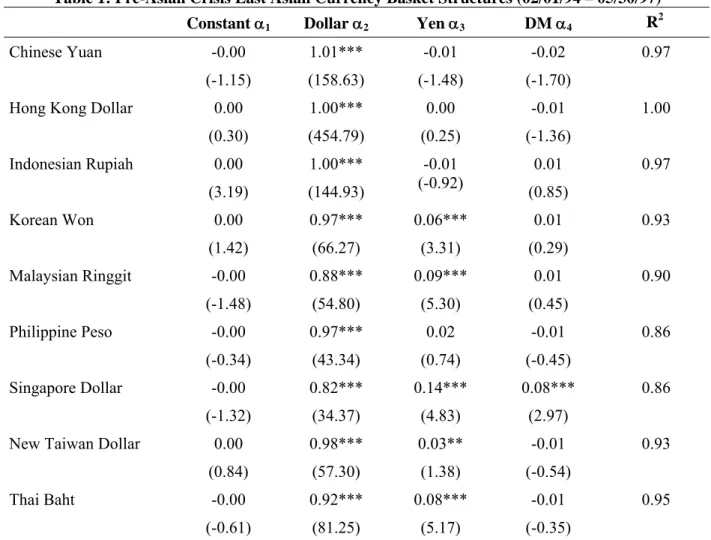
First, we estimate the composition of East Asian countries’ currency baskets for the pre-Asian crisis period which starts in February 1994 when China unified its foreign exchange market, and ends in May 1997 before the first major turbulence (869 observations). Table 1 reports the results showing the high weights of the dollar in the East Asian currency baskets. The estimates for α2 are all close to unity, ranging from 0.82 for the Singapore dollar up to 1.00 for the Chinese
yuan, the Hong Kong dollar, and the Indonesian rupiah. The correlation coefficients (R2) being close to unity indicate that fluctuations of the East Asian exchange rate against the Swiss franc can be almost fully explained by fluctuations of the dollar against the Swiss franc.
The results show that high weights of the dollar can be achieved also under a downward crawling peg arrangement as in Indonesia. Before the Asian crisis, Indonesia let its currency crawl smoothly downward at 4 to 5% percent per year, but kept the rupiah virtually fixed to the dollar on a day-to-day basis. The α2 coefficients of the Korean won, the Philippine peso, and the
Taiwan dollar are very close to unity with lower, but still large t-statistics. For the Thai baht and the Malaysian ringgit, the α2-coefficients are still close to 0.9 with some small weight for the yen
as measured by α3.
Singapore shows the lowest weight for the dollar (82%) and a smaller (but highly statistically significant) weight for the yen (14%) and the German mark (8%). There is some evidence of small weights of the yen in the pre-crisis East Asian currency baskets in the cases of Korea (6%), 5 Before 01/01/1999 the euro is represented by the German mark as the most important currency of the European Monetary
System.
Malaysia (9%), Singapore (14%), Taiwan (3%) and Thailand (8%). However, except for Singapore there is no evidence of exchange rate stabilization against the German mark. All in all, before the Asian crisis, East Asia can be characterized as adhering to an informal dollar standard. [Table 1 about here]
4.2 Changing Currency Structures
As outlined in section 3, after the Asian crisis there were policy recommendations to increase the weights of the Japanese yen in the East Asian currency baskets to minimize macroeconomic turbulence caused by bilateral exchange rate fluctuations against the Japanese yen. Starting in 2001, there was also a rationale for putting the euro into the currency basket not only because of trade linkages, but also because of the high degree of stability and the wish to diversify international reserves. The year 2005 would have been optimal timing for a change of the currency basket structure away from the dollar to the euro as the dollar appreciated against the euro due to rising US interest rates.
Using rolling regressions, the country panels in Figure 5 summarize the dollar’s weight in each East Asian currency basket since the early 1990s. Based on daily data, the rolling 130-day α2
coefficients are plotted for each of the East Asian countries (except Japan). A window of 130 days corresponds to an observation period of six months (5 observations per week). The first window starts on January 1, 1990 and ends on June 29, 1990. The α2 coefficients are calculated
for the first period. Then the window is shifted by one day and the coefficients are calculated again, up to December 2005. A value of unity stands for a 100 percent weight of the respective currency in the respective currency basket. If the coefficient rises above 1, the estimation process is unstable.
[Figure 5 about here]
Figure 5 shows the time path of the dollar weights in the East Asian currency baskets. China and Hong Kong have a very stable dollar weight of unity for the whole observation period, despite China’s official shift toward a currency basket regime in July 2005, China seems to have decreased the weight of the dollar in its basket slightly. In Malaysia, which has allowed for more
exchange rate flexibility since July 2005, the weight of the dollar remains close to unity. For the other countries in the pre-crisis period, the dollar weights are slightly more volatile but close to unity. During the Asian crisis, the exchange rate stabilization (against the dollar) broke down in Indonesia, Korea, Malaysia, the Philippines and Thailand, which is reflected in sharp declines of the α2 coefficients.
Post-crisis Figure 5 suggests a declining trend for the weight of the dollar for Indonesia, Korea, the Philippines, Singapore, Taiwan and Thailand. For these countries in 2005 the suggested weights of the dollar based on the Frankel and Wei (1994) estimation range between 45% in Korea up to 83% in the Philippines, while the weights of the dollar remain high for China, Hong Kong and Malaysia. This may suggest an ongoing trend away from the dollar to the yen and the euro.
As the appreciation of the dollar in 2005 provided an occasion to shift the structure of the currency baskets away from the dollar toward yen or euro, the rolling weights of both currencies in the East Asian currency baskets are estimated for this time period. Figure 6 shows the weights of the euro in 2005. While before the Asian crisis the German mark did not have a significant weight in the East Asian currency baskets (except for Singapore), in 2005 the α4 coefficients
increased significantly for all countries except for China, Hong Kong and Malaysia. Although the coefficients are rather volatile—which may be an indicator for unstable estimations—this may provide first evidence for a growing role of the euro in East Asian exchange rate policies. A similar trend is found for the Japanese yen (α3 coefficient). Except for China, Hong Kong and
Malaysia, there are already significant weights for the yen at the beginning of 2005, which seem to further increase during this year for most countries (McKinnon and Schnabl 2003). The weights are highest for Korea and Taiwan, which are important trading partners of Japan and which compete with Japan in third markets due to a similar export structure. We also observe discretionary jumps of the weights around July 21, 2005, when China announced its currency basket (although the Chinese exchange rate policy remains dominated by the US dollar).7
[Figure 6 and Figure 7 about here]
7 To control for distortions caused by the discretionary jump in the yuan/dollar exchange rate on July 21 2005 this observation
Finally, to obtain a comprehensive picture of the structure of currency baskets in East Asia, we calculate arithmetic averages of the weights of the dollar, the yen and the euro in the currency baskets of the nine East Asian countries (except Japan) during 2005. The result is shown in Figure 8, which implies a rising weight for both euro and the yen. The yen seems on average to have received a higher weight than the euro. The official announcement of the Chinese currency basket on July 21, 2005, seems to have triggered an adjustment of the basket structures in other Asian countries although the weights of yen and euro in the Chinese currency basket still appear to be very small.
[Figure 8 about here]
5. Conclusion
Before the 1997/98 East Asian crisis, the East Asian countries (except Japan) pegged their currencies tightly to the dollar, forming an informal dollar standard. As the motivations for pegging to the dollar—i.e. macroeconomic stabilization, dollar denomination of international and intra-regional trade and capital flows—remained unchanged after the crisis, the East Asian countries (except Japan) have maintained or returned to their dollar pegs. However, the sustained depreciation pressure on the US dollar which can be linked to the rising US twin deficit has led to rising reserve accumulation in US dollars which constitutes a risk for macroeconomic stability. Expectations about a further decline of the dollar are likely to create an incentive to diversify the risk of one-sided dollar pegs based on basket strategies.
In East Asia, the yen and the euro may enter the currency baskets for (partially) different reasons. As Japan is a more important trading partner than the euro area and an important competitor in third markets, the yen may enter the currency basket to equilibrate intra-Asian competitiveness. Macroeconomic stabilization will matter less in the case of Japan because of the still ongoing zero interest rate policy and deflation. In contrast, trade with the euro area (competition in third markets) is less important, but the role of the euro as a macroeconomic anchor and international store of value is growing. This may in the long-term further enhance the role of the euro in East Asia, both for exchange rate stabilization and as a store of value for international reserves.
References:
Chinn, Menzie / Frankel, Jeffrey 2005: Will the Euro Eventually Surpass the Dollar as Leading International Reserve Currency? NBER Working Paper 11510.
Chmelarova, Viera / Schnabl, Gunther 2006: Exchange Rate Management in Developed and Underdeveloped Capital Markets. Mimeo.
Crockett, Andrew / Goldstein, Morris 1976: Inflation under Fixed and Flexible Exchange Rates. IMF Staff Papers 23, 509-544.
Dooley, Michael / Folkerts-Landau, David / Garber, Peter 2004: The Revived Bretton Woods System: The Effects of Periphery Intervention and Reserve Management on Interest Rates and Exchange Rates in Center Countries. NBER Working Paper 10332.
European Central Bank ECB 2005: Review of the International Role of the Euro. Frankfurt December 2005.
Eichengreen, Barry / Hausmann, Ricardo 1999: Exchange Rates and Financial Fragility. NBER Working Paper 7418.
Fischer, Stanley 2001: Exchange Rate Regimes: Is the Bipolar View Correct? Journal of Economic Perspectives 15, 3-24.
Frankel, Jeffrey / Rose, Andrew 2002: An Estimate of the Effect of Common Currencies on Trade and Income. Quarterly Journal of Economics 117, 437–66.
Frankel, Jeffrey / Wei, Shang-Jin 1994: Yen Bloc or Dollar Bloc? Exchange Rate Policies in East Asian Economies. In Takatoshi Ito and Anne Krueger (eds.): Macroeconomic Linkages: Savings, Exchange Rates, and Capital Flows, Chicago, pp. 295-329.
Gudmundsson, Mar 2005: The Role of the Effective Exchange Rate in Monetary Frameworks: The International Experience. Mimeo.
Ogawa, Eiji / Ito, Takatoshi 2002: On the Desirability of a Regional Basket Currency Arrangement. Journal of the Japanese and International Economies 16, 317-334.
Hillebrand, Eric / Schnabl, Gunther 2005: A Structural Break in the Effects of Foreign Exchange Intervention. Mimeo.
Kawai, Masahiro 2002: Exchange Rate Arrangements in East Asia: Lessons from the 1997/98 Currency Crisis. Monetary and Economic Studies 20, 167-204.
McKinnon, Ronald 1963: Optimum Currency Areas. American Economic Review 53, 717–25. McKinnon Ronald / Schnabl, Gunther 2003: Synchronized Business Cycles in East Asia and
Fluctuations in the Yen/Dollar Exchange Rate. The World Economy 26, 8, 1067-1088.
McKinnon, Ronald / Schnabl, Gunther 2004a: The East Asian Dollar Standard, Fear of Floating, and Original Sin. Review of Development Economics 8, 3, 331-360.
McKinnon, Ronald / Schnabl, Gunther 2004b: A Return to Exchange Rate Stability in East Asia? Mitigating Conflicted Virtue. International Finance 7, 2, 169-201.
Schnabl, Gunther 2005: The Russian Currency Basket. The Rising Role of the Euro for Russia’s Exchange Rate Policies. Mimeo.
Volz, Ulrich 2006: Three Cases for Monetary Integration in East Asia. Mimeo.
Williamson, John 2000: Exchange Rate Regimes for Emerging Markets: Reviving the Intermediate Option, Washington D.C., Institute for International Economics.
Williamson, John 2005: A Currency Basket for East Asia, Not Just for China. Institute for International Economics: Policy Briefs in International Economics 05-1.
Figure 1: Exchange Rate Volatility Against the US Dollar of Selected Crisis and Non-Crisis Currencies, 1990:01-2005:12 (Daily) -4% -3% -2% -1% 0% 1% 2% 3% 4% 01.01.90 01.01.93 01.01.96 01.01.99 01.01.02 01.01.05 Chinese Yuan -4% -3% -2% -1% 0% 1% 2% 3% 4% 01.01.90 01.01.93 01.01.96 01.01.99 01.01.02 01.01.05
Hong Kong Dollar
-4% -3% -2% -1% 0% 1% 2% 3% 4% 01.01.90 01.01.93 01.01.96 01.01.99 01.01.02 01.01.05 Indonesian Rupiah -4% -3% -2% -1% 0% 1% 2% 3% 4% 01.01.90 01.01.93 01.01.96 01.01.99 01.01.02 01.01.05 Korean Won -4% -3% -2% -1% 0% 1% 2% 3% 4% 01.01.90 01.01.93 01.01.96 01.01.99 01.01.02 01.01.05 Malaysian Ringgit -4% -3% -2% -1% 0% 1% 2% 3% 4% 01.01.90 01.01.93 01.01.96 01.01.99 01.01.02 01.01.05 Philippine Peso -4% -3% -2% -1% 0% 1% 2% 3% 4% 01.01.90 01.01.93 01.01.96 01.01.99 01.01.02 01.01.05 Singapore Dollar -4% -3% -2% -1% 0% 1% 2% 3% 4% 01.01.90 01.01.93 01.01.96 01.01.99 01.01.02 01.01.05
New Taiwan Dollar
-4% -3% -2% -1% 0% 1% 2% 3% 4% 01.01.90 01.01.93 01.01.96 01.01.99 01.01.02 01.01.05 Thai Baht -4% -3% -2% -1% 0% 1% 2% 3% 4% 01.01.90 01.01.93 01.01.96 01.01.99 01.01.02 01.01.05 Japanese Yen -4% -3% -2% -1% 0% 1% 2% 3% 4% 01.01.90 01.01.93 01.01.96 01.01.99 01.01.02 01.01.05
Euro (Deutsche Mark )
-4% -3% -2% -1% 0% 1% 2% 3% 4% 01.01.90 01.01.93 01.01.96 01.01.99 01.01.02 01.01.05 Swiss Franc Source: Bloomberg. Volatility is daily percentage changes against the dollar.
Figure 2: East Asian Exchange Rates Against the Dollar, 1990:1-2005:12 80 90 100 110 120 130 140
Jan 90 Jan 92 Jan 94 Jan 96 Jan 98 Jan 00 Jan 02 Jan 04
Chinese Yuan 80 90 100 110 120 130 140
Jan 90 Jan 92 Jan 94 Jan 96 Jan 98 Jan 00 Jan 02 Jan 04
Hong Kong Dollar
80 90 100 110 120 130 140
Jan 90 Jan 92 Jan 94 Jan 96 Jan 98 Jan 00 Jan 02 Jan 04
Korean Won 80 90 100 110 120 130 140
Jan 90 Jan 92 Jan 94 Jan 96 Jan 98 Jan 00 Jan 02 Jan 04
Malaysian Ringgit 80 90 100 110 120 130 140
Jan 90 Jan 92 Jan 94 Jan 96 Jan 98 Jan 00 Jan 02 Jan 04
Philippine Peso 80 90 100 110 120 130 140
Jan 90 Jan 92 Jan 94 Jan 96 Jan 98 Jan 00 Jan 02 Jan 04
Singapore Dollar 80 90 100 110 120 130 140
Jan 90 Jan 92 Jan 94 Jan 96 Jan 98 Jan 00 Jan 02 Jan 04
Taiwan Dollar 80 90 100 110 120 130 140
Jan 90 Jan 92 Jan 94 Jan 96 Jan 98 Jan 00 Jan 02 Jan 04
Thai Baht 80 90 100 110 120 130 140
Jan 90 Jan 92 Jan 94 Jan 96 Jan 98 Jan 00 Jan 02 Jan 04
Euro Source: IMF: IFS, Central Bank of China. Index 1999.01=100.
Source: IMF. Regional exchange rate volatility defined as arithmetic averages of 12 month rolling standard deviations. 0.5% 0.7% 0.9% 1.1% 1.3% 1.5% 1.7% 1.9% 2.1% 2.3% 2.5%
Jan 00 Jan 01 Jan 02 Jan 03 Jan 04 Jan 05
percent
Figure 3: Exchange Rate Volatility in East Asia and Emerging Europe
East Asia (against the dollar) Emerging Europe (against the euro)
Figure 4: Official Foreign Exchange Reserves of East Asian and G3 Countries in Billions of Dollars, 1980:01-2005:6 (Monthly) 0 100 200 300 400 500 600 700 800
Jan 90 Jan 92 Jan 94 Jan 96 Jan 98 Jan 00 Jan 02 Jan 04 China 0 20 40 60 80 100 120 140
Jan 90 Jan 92 Jan 94 Jan 96 Jan 98 Jan 00 Jan 02 Jan 04 Hong Kong 0 5 10 15 20 25 30 35 40 45 50 1990M1 1992M1 1994M1 1996M1 1998M1 2000M1 2002M1 2004M1 Indonesia 0 20 40 60 80 100 120 140 160 180 200 220
Jan 90 Jan 92 Jan 94 Jan 96 Jan 98 Jan 00 Jan 02 Jan 04 Korea 0 10 20 30 40 50 60 70 80
Jan 90 Jan 92 Jan 94 Jan 96 Jan 98 Jan 00 Jan 02 Jan 04
Malaysia 0 2 4 6 8 10 12 14 16 18
Jan 90 Jan 92 Jan 94 Jan 96 Jan 98 Jan 00 Jan 02 Jan 04
Philippines 0 10 20 30 40 50 60 70 80 90 100 110 120
Jan 90 Jan 92 Jan 94 Jan 96 Jan 98 Jan 00 Jan 02 Jan 04
Singapore 0 40 80 120 160 200 240 280
Jan 90 Jan 92 Jan 94 Jan 96 Jan 98 Jan 00 Jan 02 Jan 04
Taiwan 0 10 20 30 40 50
Jan 90 Jan 92 Jan 94 Jan 96 Jan 98 Jan 00 Jan 02 Jan 04
Thailand 0 100 200 300 400 500 600 700 800 900
Jan-90 Jan-92 Jan-94 Jan-96 Jan-98 Jan-00 Jan-02 Jan-04 Japan 0 20 40 60 80 100 120 140
Jan-90 Jan-92 Jan-94 Jan-96 Jan-98 Jan-00 Jan-02 Jan-04 Germany 0 10 20 30 40 50 60
Jan-90 Jan-92 Jan-94 Jan-96 Jan-98 Jan-00 Jan-02 Jan-04
US Source: IMF: IFS. Billions of Dollars. Note different scales on the y-axis.
Figure 5: Dollar’s Weight in East Asian Currency Baskets, 130-Trading-Day Rolling Regressions for α2, 1990:01-2005:12 (Daily) 0.0 0.2 0.4 0.6 0.8 1.0 1.2 1.4 1.6 01.01.90 01.01.93 01.01.96 01.01.99 01.01.02 01.01.05 Chinese Yuan 0.0 0.2 0.4 0.6 0.8 1.0 1.2 1.4 1.6 01.01.90 01.01.93 01.01.96 01.01.99 01.01.02 01.01.05 Hong Kong Dollar
0.0 0.2 0.4 0.6 0.8 1.0 1.2 1.4 1.6 01.01.90 01.01.93 01.01.96 01.01.99 01.01.02 01.01.05 Indonesian Rupiah 0.0 0.2 0.4 0.6 0.8 1.0 1.2 1.4 1.6 01.01.90 01.01.93 01.01.96 01.01.99 01.01.02 01.01.05 0.0 0.2 0.4 0.6 0.8 1.0 1.2 1.4 1.6 01.01.90 01.01.93 01.01.96 01.01.99 01.01.02 01.01.05 Korean Won Malaysian Ringgit
0.0 0.2 0.4 0.6 0.8 1.0 1.2 1.4 1.6 01.01.90 01.01.93 01.01.96 01.01.99 01.01.02 01.01.05 Philippine Peso 0.0 0.2 0.4 0.6 0.8 1.0 1.2 1.4 1.6 01.01.90 01.01.93 01.01.96 01.01.99 01.01.02 01.01.05 0.0 0.2 0.4 0.6 0.8 1.0 1.2 1.4 1.6 01.01.90 01.01.93 01.01.96 01.01.99 01.01.02 01.01.05 Taiwan Dollar 0.0 0.2 0.4 0.6 0.8 1.0 1.2 1.4 1.6 01.01.90 01.01.93 01.01.96 01.01.99 01.01.02 01.01.05 Thai Baht Singapore Dollar
Figure 6: Euro’s Weight in East Asian Currency Baskets, 130-Trading-Day Rolling Regressions for α2, 2005:01-2005:12 (Daily) 0.0 0.1 0.2 0.3 0.4 0.5 03.01.2005 03.04.2005 03.07.2005 03.10.2005 Chinese Yuan 0.0 0.1 0.2 0.3 0.4 0.5 03/01/05 03/04/05 03/07/05 03/10/05 Hong Kong Dollar
0.0 0.1 0.2 0.3 0.4 0.5 03/01/05 03/04/05 03/07/05 03/10/05 Indonesian Rupiah 0.0 0.1 0.2 0.3 0.4 0.5 03/01/05 03/04/05 03/07/05 03/10/05 0.0 0.1 0.2 0.3 0.4 0.5 03/01/05 03/04/05 03/07/05 03/10/05 Korean Won Malaysian Ringgit
0.0 0.1 0.2 0.3 0.4 0.5 03/01/05 03/04/05 03/07/05 03/10/05 Philippine Peso 0.0 0.1 0.2 0.3 0.4 0.5 03/01/05 03/04/05 03/07/05 03/10/05 0.0 0.1 0.2 0.3 0.4 0.5 03/01/05 03/04/05 03/07/05 03/10/05 Taiwan Dollar 0.0 0.1 0.2 0.3 0.4 0.5 03/01/05 03/04/05 03/07/05 03/10/05 Thai Baht Singapore Dollar
Figure 7: Yen’s Weight in East Asian Currency Baskets, 130-Trading-Day Rolling Regressions for α2, 2005:01-2005:12 (Daily) 0.0 0.1 0.2 0.3 0.4 0.5 03.01.2005 03.04.2005 03.07.2005 03.10.2005 Chinese Yuan 0.0 0.1 0.2 0.3 0.4 0.5 03/01/05 03/04/05 03/07/05 03/10/05 Hong Kong Dollar
0.0 0.1 0.2 0.3 0.4 0.5 03/01/05 03/04/05 03/07/05 03/10/05 Indonesian Rupiah 0.0 0.1 0.2 0.3 0.4 0.5 03/01/05 03/04/05 03/07/05 03/10/05 Korean Won 0.0 0.1 0.2 0.3 0.4 0.5 03/01/05 03/04/05 03/07/05 03/10/05 Malaysian Ringgit 0.0 0.1 0.2 0.3 0.4 0.5 03/01/05 03/04/05 03/07/05 03/10/05 Philippine Peso 0.0 0.1 0.2 0.3 0.4 0.5 03/01/05 03/04/05 03/07/05 03/10/05 Singapore Dollar 0.0 0.1 0.2 0.3 0.4 0.5 03/01/05 03/04/05 03/07/05 03/10/05 Taiwan Dollar 0.0 0.1 0.2 0.3 0.4 0.5 03/01/05 03/04/05 03/07/05 03/10/05 Thai Baht
Figure 8: The Changing East Asian Currency Structure in 2005 0% 20% 40% 60% 80% 100% 03.01.2005 03.03.2005 03.05.2005 03.07.2005 03.09.2005 03.11.2005 pe rc e nt euro yen dollar 21 July 2005
Table 1: Pre-Asian Crisis East Asian Currency Basket Structures (02/01/94 – 05/30/97) Constant α1 Dollar α2 Yen α3 DM α4 R
2 Chinese Yuan -0.00 (-1.15) 1.01*** (158.63) -0.01 (-1.48) -0.02 (-1.70) 0.97 Hong Kong Dollar 0.00
(0.30) 1.00*** (454.79) 0.00 (0.25) -0.01 (-1.36) 1.00 Indonesian Rupiah 0.00 (3.19) 1.00*** (144.93) -0.01 (-0.92) 0.01 (0.85) 0.97 Korean Won 0.00 (1.42) 0.97*** (66.27) 0.06*** (3.31) 0.01 (0.29) 0.93 Malaysian Ringgit -0.00 (-1.48) 0.88*** (54.80) 0.09*** (5.30) 0.01 (0.45) 0.90 Philippine Peso -0.00 (-0.34) 0.97*** (43.34) 0.02 (0.74) -0.01 (-0.45) 0.86 Singapore Dollar -0.00 (-1.32) 0.82*** (34.37) 0.14*** (4.83) 0.08*** (2.97) 0.86 New Taiwan Dollar 0.00
(0.84) 0.98*** (57.30) 0.03** (1.38) -0.01 (-0.54) 0.93 Thai Baht -0.00 (-0.61) 0.92*** (81.25) 0.08*** (5.17) -0.01 (-0.35) 0.95 Source: Datastream. Daily data. T-Statistics in Parentheses. * significant at the 10% level. ** significant at the 5% level. *** significant at the 1% level. 869 observations. White heteroscedasticity-consistent standard errors & covariance.
The Hamburgisches WeltWirtschaftsInstitut (HWWI) is an independent economic research institute, based on a non-profit public-private partnership, which was founded in 2005. The University of Hamburg and the Hamburg Chamber of Commerce are shareholders in the Institute .
The HWWI’s main goals are to:
• Promote economic sciences in research and teaching; • Conduct high-quality economic research;
• Transfer and disseminate economic knowledge to policy makers, stakeholders and the general public.
The HWWI carries out interdisciplinary research activities in the context of the following research programmes: Economic Trends and Hamburg, Interna-tional Trade and Development, Migration Research and InternaInterna-tional Climate Policy.
Hamburg Institute of International Economics (HWWI) Neuer Jungfernstieg 21 | 20354 Hamburg | Germany Tel +49 (0)40 34 05 76 - 0 | Fax +49 (0)40 34 05 76 - 76 [email protected] | www.hwwi.org