Systematic Structural Testing of Firewall Policies
JeeHyun Hwang, Tao Xie, Fei Chen, and Alex X. Liu
Abstract—Firewalls are the mainstay of enterprise security and the most widely adopted technology for protecting private networks. As the quality of protection provided by a firewall directly depends on the quality of its policy (i.e., configuration), ensuring the correctness of firewall policies is important and yet difficult. To help ensure the correctness, we propose a systematic structural testing approach for firewall policies. We define struc-tural coverage (based on coverage criteria of rules, predicates, and clauses) on the firewall policy under test. To achieve high structural coverage effectively, we have developed four automated packet generation techniques: the random packet generation, the one based on local constraint solving (considering individual rules locally in a policy), the one based on global constraint solving (considering multiple rules globally in a policy), and the one based on boundary values.
We have conducted an experiment on a set of real policies and a set of faulty policies to detect faults with generated packet sets. Generally, our experimental results show that a packet set with higher structural coverage has higher fault-detection capability (i.e., detecting more injected faults). Our experimental results show that a reduced packet set (maintaining the same level of structural coverage with the corresponding original packet set) maintains similar fault-detection capability with the original set. Index Terms—Firewall policy, validation, test packet genera-tion, structural coverage, fault detection.
I. INTRODUCTION
S
ERVING as the first line of defense against malicious attacks and unauthorized traffic, firewalls are crucial el-ements in securing the private networks of most businesses, institutions, and home networks. A firewall is typically placed at the point of entry between a private network and the outside Internet such that all network traffic has to pass through it. In a distributed system, messages are encapsulated into packets, which often pass through multiple access points in a network and firewalls are responsible for filtering, monitoring, and securing such packets [1]. Corruption or misconfiguration in firewalls may cause that the firewalls fail to filter malicious packets properly and affect the performance and security of a distributed system.As security problems of firewalls are often caused by mis-configuration in firewall policies, correctly specifying firewall Manuscript received December 4, 2010; revised May 23, 2011 and October 8, 2011. The associate editor coordinating the review of this paper and approving it for publication was E. Bertino.
The preliminary version of this paper titled “Systematic Structural Testing of Firewall Policies” was published in the Proceedings of the 2008 IEEE International Symposium on Reliable Distributed Systems (SRDS), pages 105–114.
J. Hwang and T. Xie are with the Dept. of Computer Science, North Car-olina State University, Raleigh, NC 27695-8206 (e-mail: [email protected], [email protected]).
F. Chen and A. X. Liu are with the Department of Computer Science and Engineering, Michigan State University, East Lansing, MI 48824-1266 (e-mail:{feichen, alexliu}@cse.msu.edu).
Digital Object Identifier 10.1109/TNSM.2012.012012.100092
policies is a critical and yet challenging task for building reliable firewalls [2]. There are many factors for misconfig-uring firewall policies. First, the rules in a firewall policy are logically entangled because of the conflicts among rules and the resulting order sensitivity. Second, a firewall policy may consist of a large number of rules. A firewall on the Internet may consist of hundreds or even a few thousands of rules. Last but not the least, an enterprise firewall policy often consists of legacy rules that are written by different operators, at different times, and for different reasons, which make maintaining firewall policies even more difficult.
To help ensure the correctness of firewall policies, re-searchers and practitioners have developed various firewall analysis and testing tools. The main function of these firewall analysis tools is to detect “bad smell” (i.e., “anomalies”) in firewall policies based on some common patterns of firewall configuration mistakes [3], [4]. Such firewall analysis tools are certainly useful; however, the main drawback of such tools is that the “anomalies” may not be mistakes and the number of “anomalies” could be too large to be practically useful. Several firewall policy testing techniques have been proposed [5]–[7]. However, these firewall policy testing techniques are not based on well-established testing techniques in software engineering. For example, these techniques do not consider coverage criteria [8] for firewall policy testing
In this paper, we propose firewall policy testing based on the concept of firewall policy coverage, which helps test a firewall policy’s structural entities (i.e., rules, predicates, and clauses) to check whether each entity is specified correctly. In firewall policy testing, test inputs and outputs are packets and their evaluated decisions (against the firewall policy under test), respectively. Given test packets and the policy under test, when evaluating packets against the policy, our coverage measurement tool measuresfirewall policy coverage—- which entities of the policy are involved (called “covered”) in the evaluation. Moreover, our systematic firewall policy testing helps detect faults with the test packets, which often do not fol-low some configuration mistake patterns (e.g., anomalies [3], [4] and configuration errors [2]). Intuitively, policy testers shall generate test packets to achieve high structural coverage, which helps investigate a large portion of policy entities for fault detection.
As it is tedious for policy testers to manually generate test packets for firewall policies, we have developed an automated packet-generation tool (that can generate packets) for four packet-generation techniques: the random packet generation technique, the one based on local constraint solving (consid-ering individual rules locally in a policy), the one based on global constraint solving (considering multiple rules globally in a policy), and the one based on boundary values. As gener-1932-4537/12/$31.00 c2012 IEEE
Rule Source IP Source Port Destination IP Destination Port Protocol Decision
r1 * * 192.168.0.0/16 * * accept
r2 1.2.3.0/24 * * [1,28−1] TCP discard
r3 * * * * * discard
Fig. 1. An example firewall policy.
ated packets are often large and manual inspection of packet-decision pairs is tedious, we have developed an automated packet reduction tool to reduce the number of packets while keeping the same level of structural coverage.
We have conducted an experiment on a set of real firewall policies with mutation testing [9], which is a specific form of fault injection that creates faulty versions of a policy by making small syntactic and semantic changes. We generate packet sets (for each policy) with the packet generation techniques. Our experimental results show that a packet set with higher structural coverage (including rule, predicate, and clause coverage) often achieve higher fault-detection capabil-ity (i.e., detecting more injected faults), which is measured through the number of “killed mutants” (i.e., detected faults). On the comparison of packet sets and their reduced packet sets, our experimental results also show that a reduced packet set achieves similar fault-detection capability with the original packet set.
The rest of the paper is organized as follows. Section II presents background information on firewall policies. Sec-tion III presents a firewall policy model. SecSec-tion IV describes structural coverage criteria of a firewall policy. Section V illustrates a framework of our proposed packet-generation techniques, test reduction technique, and a mechanism of measuring fault-detection capability. Section VI describes an implementation of our framework. Section VII illustrates our experiments of measuring policy coverage and fault-detection capability. Section VIII discusses related work. Section IX concludes the paper.
II. FIREWALLPOLICY
A firewall policy is composed of a sequence of rules that specify under what conditions a packet is accepted and discarded while passing between a private network and the outside Internet. In other words, the policy describes a sequence of rules to decide whether packets are accepted (i.e., being legitimate) or discarded (i.e., being illegitimate). A rule is composed of a set of fields (generally including source/destination IP addresses, source/destination port num-bers, and protocol type) and a decision. Each field represents the range of possible values (to match the corresponding value of a packet), which are either a single value or a finite interval of non-negative integers.
A packet matches a rule if and only if each value of the packet satisfies the corresponding values in the rule. Upon finding a matching rule, the corresponding decision of that rule is derived. When evaluating a packet, the firewall policy follows the first-match semantic: the first matching rule is given the highest priority among all the matching rules.
Figure 1 shows an example of a firewall policy. The symbol “*” denotes that the corresponding field’s range (in a rule) is equal to the domain of the field and is satisfied by any packet.
An IP address is a 32 bit value (e.g., 192.168.0.0), which is represented as a four-part dotted-decimal address. Classless Inter-domain Routing (CIDR) notation is used to represent IP ranges over an IP address with a subnet mask (e.g., /16 or /24). For example, the range of 192.168.0.0/24 implies IP addresses from 192.168.0.0 to 192.168.0.255. This range consists of all possible IP addresses starting with the same left-most 24 bits (i.e., 192.168.0) on the given IP address. Each of the remaining 8 bits (which do not have fixed values) is either 0 or 1.
The example has three firewall rules r1, r2, andr3. Rule
r1accepts any packet whose destination IP address is the net-work192.168.0.0/16(which indicates the range [192.168.0.0, 192.168.255.255]). Ruler2 discards any packet whose source IP address is the network 1.2.3.0/24 (which indicates the range [1.2.3.0, 1.2.3.255]) and port is the range [1,28−1]
with the TCP protocol type. Rule r3 is a tautology rule to discard all packets. Consider that a packet whose destination IP address is 192.168.0.0 and protocol type is UDP. When evaluating the packet, we find that the packet can match both
r1 andr3. Among the two rules, as r1 is the first-matching rule, the packet is evaluated to be accepted (with regards to the decision ofr1). If a packet matches no rules in a firewall policy, there exists an implicit last tautology rule to discard the packet.
III. FIREWALLPOLICYMODEL
This section illustrates a model of a firewall policy based on common generic features. A firewall policy is composed of a sequence of rules, each of which has the form (called the generic representation) as follows.
predicate → decision (1) A predicate in a rule is a boolean expression overfields
on which a packet arrives. The decision of a rule can be
accept ordiscard and returned as the evaluation result when the predicateis evaluated to be true.
The predicate is represented as a conjunction form as follows.
F1∈S1∧...∧Fn∈Sn (2)
In a policy model, we represent a value in afield Fi (e.g., IP address) with its corresponding rangeSi (e.g.,Fi ∈[2,5])
to simplify the representation format. We refer to each Fi∈ Sias aclause, which can be evaluated to either true or false.
Table I summarizes the notations used in this paper.
The first-match semantic (of a firewall policy) shows the same behavior with the execution of a series of IF-THEN-ELSEstatements in program code. Given a sequence of rules, the following process is iterated until reaching the last rule: if apredicatein a rule is evaluated true, then the corresponding decision is returned; otherwise, the next rule (if exists) is evaluated.
TABLE I
SUMMARY OF NOTATIONS
P a set of predicates of the rules in a policy
C a set of clauses of the predicates in a policy
ri a rule in a firewall policy
pi a predicate in a ruleri
ci anith clause in a predicate
Fi a field (e.g., IP address)
Di domain of fieldFi(e.g.,[0,232−1]for the IP address)
Si a subset of domainDi(e.g., [2,5])
Cpi(cj) a constraint of a clausecjin a predicatepi
C(pi) a constraint of a predicatepi k a packet
r1:F1∈[2,5]∧F2∈[5,10]→accept r2:F1∈[6,7]∧F2∈[5,10]→discard
Fig. 2. Example firewall rules.
IV. STRUCTURALCOVERAGECRITERIA
In firewall testing, exhaustive testing (i.e., executing all pos-sible test packets) is time consuming and inefficient. Instead of exhaustive testing, we focus on testing to cover only specific entities (i.e., a predicate tested to be false or true) based on a set of defined coverage criteria.
A. Definition
Treating the firewall policy under test as program code (i.e., IF-THEN-ELSE statements), we apply structural coverage criteria similar to the ones defined by Ammann et al [10]. In this paper, a test suite is a set of packet-decision pairs to check whether a packet is evaluated to its corresponding ex-pected decision. We define rule, predicate, and clause coverage criteria as follows.
Definition 1: Rule Coverage Criterion (RCC) for a test suite requires that for each rule r in a policy, the evaluation of the test packets in the test suite needs to match r (i.e., make r’s predicate p to be evaluated to true) at least once, respectively.
In other words, RCC requires that for each predicate p,
p is evaluated to true at least once. Figure 2 shows example firewall rules where only two fieldsF1 andF2 are used.
For example, given two test packets,k1(3, 5) andk2(6, 10) over two fields F1 andF2, both predicatesp1 and p2 (ofr1 andr2, respectively) are evaluated totrue.RCCis achieved by these two test packets. More specifically, k1 evaluates p1 totrue, causingr1’s decision to be returned without further evaluatingp2.k2evaluatesp1tofalseand next evaluatesp2 totrue. Note that when a packet finds the first-matching rule
r (i.e., evaluating a predicate to true), policy evaluation stops and returnsr’s decision as a final decision.
Definition 2: Predicate Coverage Criterion (P CC)for a test suite requires that for each predicate p of the rules in a policy, the evaluation of the test packets in the test suite needs to make p to be evaluated to true and false at least once, respectively.
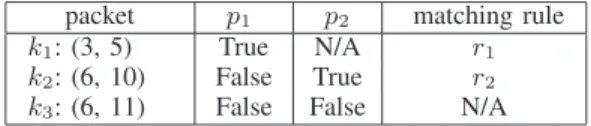
To achieveP CC, in addition tok1 andk2, we require one more packet such as k3 (6, 11) that evaluates p2 to false. Figure 3 illustrates these three test packets that evaluate
packet p1 p2 matching rule k1: (3, 5) True N/A r1
k2: (6, 10) False True r2
k3: (6, 11) False False N/A
Fig. 3. Sample packets for all combinations oftrueandfalsevalues of predicatesp1 andp2.
packet c1 c2 p1= (c1 ∧c2) k1: (3, 5) True True True k2: (6, 10) False True False k3: (3, 11) True False False k4: (6, 11) False False False
Fig. 4. Sample packets for all combinations oftrueandfalsevalues of clausesc1andc2.
all combinations of true and false (of p1 and p2). N/A represents a not-applicable predicate or rule during packet evaluation. For k1, we mark N/A in p2’s evaluation because
k1’s decision is determined without further evaluatingp2. Covering every predicate in a firewall requires at most 2n
test packets, where n is the number of rules. However, the minimal number of test packets (for P CC) could be less than 2n because a single test packet can satisfy multiple true or false branches of predicates. As RCC and P CC
do not require each clause to be covered, we then define clause coverage criterion (CCC), which specifically targets at covering each clause in a predicate.
Definition 3: Clause Coverage Criterion (CCC)for a test suite requires that for each clause c of the predicates in a policy, the evaluation of the test packets in the test suite needs to make c to be evaluated to true and false at least once, respectively.
InCCC, each clause is required to be evaluated to true and false at least once independently from other clauses. Consider thatp1includes two clausesc1andc2(with regards toF1andF2, respectively). Note that the boolean value ofp1 is equal toc1 ∧c2. Figure 4 illustrates four test packets that evaluate all combinations of trueand false(ofc1 andc2) and the corresponding boolean value ofp1. There are several ways to cover clauses inp1: (1) selectk2 andk3 or (2) select
k1 andk4. However, instead of the first selection, the second selection has an advantage to increase the coverage in terms ofRCC andP CC.
B. Structural Coverage
We have developed three structural coverage measurements that monitor whether rules, predicates, or clauses are covered when evaluating packets against the policy under test. For each structural coverage criterion, we define coverage mea-surements as follows.
Rule coverage measurements.For the rule coverage crite-rion,rule coverageis the percentage of the number of covered rules (i.e., predicates being evaluated to true) in a policy.
Predicate coverage measurements.For the predicate cov-erage criterion, predicate coverage is the percentage of the number of covered predicates (i.e., predicates being evaluated to true or false) inP over 2× |P|.
Fig. 5. Framework overview.
Clause coverage measurements. For the clause coverage criterion,clause coverageis the percentage of the number of covered true or false values of clauses in C over 2× |C|.
C. Structural Coverage and Fault Detection
Policy testers may generate and select a test suite to achieve a certain (high) level of coverage. However, our main objec-tive, through testing, is to detect faults in the firewall policy while reaching a certain level of coverage. Coverage analysis helps investigate a larger portion of entities for fault detection using a test suite that achieves higher structural coverage.
Consider that a fault in entities (i.e., rules, predicate, or clause) may cause to output incorrect decisions when evalu-ating some packets. A fault in a rule’s decision (e.g., using acceptby mistake instead ofdiscard) is discovered if and only if the rule is covered and the derived decision is verified. A test suite with high rule coverage may detect such faults easily and increase our confidence on the correctness of the policy against such faults. Similarly, a test suite with high predicate/clause coverage may have a high chance to detect faults in predicates/clauses. Therefore, we are interested in covering each entity at least once to exercise a wide range of the policy’s behavior.
V. FRAMEWORK
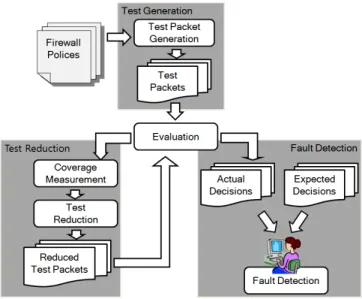
This section presents our framework for testing firewall policies. Figure 5 shows the overview of framework of our approach. Our framework includes three phases: test packet generation, test reduction, and fault detection. In the test packet generation phase, our test packet generation compo-nent analyzes a firewall policy and generates test packets to cover entities (e.g., predicates and clauses) in the policy. We propose four different test packet generation techniques described in Section V-A. In the test reduction phase, the test reduction component reduces the number of packets based on coverage criteria by including only packets that help increase policy coverage measurement during evaluation. In the fault detection phase, the policy authors manually inspect whether
the actual decisions (i.e., evaluated decisions of the generated packet against the firewall policy) are consistent with expected decisions. If the authors find any inconsistent decisions, the authors determine that they detect a fault in the policy.
A. Test Packet Generation
As manually generating packets for testing policies is tedious, we have developed four techniques to automatically generate packets for the policy under test. The objective is to generate packets for achieving high structural coverage. This section describes four packet generation techniques (developed in our approach): the random packet generation technique, the packet generation technique based on local constraint solving, the packet generation technique based on global constraint solving, and the packet generation technique based on boundary values. The key difference between the second and third techniques is the scope (i.e, local or global) of constraints used in the packet generation. While the second and third techniques generate packets based on random values within values solved by each constraint solving, the fourth one generates test packets based on boundary values within values solved by local constraint solving.
In this section, p and C(p) denote a predicate and its constraint, respectively. To evaluate p to be true (false), a packet should satisfy the constraintC(p) (¬C(p)) (for the
true (false) branch of p).C(p)is represented in the form ofCp(c1)∧.... ∧Cp(cn), where Cp(c1), ..., Cp(cn)are the
constraints of the clausec1, ...,cn inp, respectively.
1) Random Packet Generation Technique: The random packet generation technique is straightforward. A packetk is in the form of (k1, ...,kn), wherek1, ...,knare numeric values
over fields (such as source addresses), whose domains are denoted byD1, ...,Dn). Given the domains of the policy under
test, the generator for the technique automatically generates a packet k by randomly selecting k1, ..., kn (within the
domain D1, ..., Dn, respectively). While the technique does
not require the policy itself in test generation and can quickly generate a large number of test packets, the technique often lacks effectiveness to achieve high structural coverage with the generated packets. Due to randomness, the number of the entities (i.e., predicates or clauses) being covered is often small in comparison to the total number of the entities in the policy under test.
2) Packet Generation Technique based on Local Constraint Solving: In general, packet generation should focus on gen-erating packets to cover those entities (i.e., predicates and clauses) that have not been covered previously. Different from the preceding technique, the technique based on local con-straint solving statically analyzes the entities in an individual rule and generates packets to evaluate the constraints (i.e., conditions) of the entities to be true or false. The technique takes into account local constraints (given by a rule) without considering the impact of other rules in the policy.
More specifically, the generator constructs constraintsC(p)
and¬C(p)(for bothtrueandfalsebranches ofp) for each rule. The generator generates a packet based on the concrete values to satisfy each constraint. As the generator generates packets based on satisfying constraints in predicates, the
generated packets may not be effective in covering each clause (to betrue andfalse). To target at covering many clauses, the generator constructs combinations ofCp(ci)and¬Cp(ci).
For example, combinationsCp(c1)∧....∧Cp(cn)(fortrue
branches of all clauses) and ¬Cp(c1) ∧ .... ∧ ¬Cp(cn) (for
false branches of all clauses) can be considered.
There are two major limitations of the technique. First, the generated packets may fail to cover target entities due to overlapping predicates (i.e., predicates that can be satisfied by the same packet) across multiple rules. As shown in Figure 1, a packet k (whose destination IP address is 192.168.0.0
and protocol type is UDP) satisfies the predicates of both
r1 and r3 but fails to be evaluated against r3, which can be k’s potential target entities. Second, the technique cannot determine whether a structural entity could be covered in advance. Some rules may be completely shadowed by other rules and never evaluated. In such cases, there is no criterion to decide whether to generate additional packets (based on other more capable solutions to solve the same constraints) or stop testing.
3) Packet Generation Technique based on Global Con-straint Solving: To better generate packets to cover target entities, our generator (based on global constraint solving) analyzes the policy under test and generates packets by solving global constraints (collected from the policy). The motivation of global constraint solving is to take into account the influ-ence of overlapping predicates across rules. Covering entities in a rule requires that the predicates of all the preceding rules should be evaluated to false. To find such entities, we define rule reachability as follows.
Definition 4: Rule reachability of a packet k to reach a rule ri in a policy requires that k evaluates ri’s preceding
rules’ predicates to false and reaches the rule.
We may generate packets to reach and evaluate all the reachable rules in the policy. To cover entities in a rule ri,
we explore a (path) constraintP ath(ri)that represents ruleri
reachability.P ath(ri)is additionally used upon the preceding
technique to cover target entities by taking into account the impact of overlapping predicates in the preceding rules.
More specifically, P ath(ri) is represented as the form of
¬C(p1)∧....∧ ¬C(pi−1)whereC(p1), ...,C(pi−1)are the predicate constraints in the preceding rulesr1, ...,ri−1. Given the path constraint P ath(ri), to cover the predicatepi inri, the generator constructs two constraints P ath(ri) ∧ C(pi)
(for thetruebranch ofpi after reachingri) andP ath(ri)∧
¬C(pi)(for thefalsebranch ofpiafter reachingri). As the
generator generates packets based on solutions of constraints
P ath(ri)∧C(pi)andP ath(ri)∧ ¬C(pi), the packets reach ri and exerciseri’strueandfalse branches, respectively.
To cover many clauses in a ruleri, the generator constructs
constraints as follows. The generator conjunctsP ath(ri)with
the combinations of positive or negative constraints of clauses inri.
Given the constraints, the generator generates packets based on solutions for the collected constraints. This technique is useful to generate packets with high structural coverage by taking into account the impact of the preceding rules of a target rule. However, this technique requires higher analysis time (e.g., constraint-solving cost) than the two preceding
techniques.
Algorithm 1: Packet Generation Technique based on Boundary Values
Input: Firewall policyP wherenis the number of rules,r1,r2, ...,
rn.Cp(c1), ...,Cp(cm)where eachCp(cj)is thejth clause constraint of constraintsCpof a rule.D1,D2, ...,Dmwhere
Djis a domain of thejth field.
Output: A set of packets.
output=; fori:= 1tondo Cp= constraints ofri; forj:= 1tomdo kj=MinValue(Cp(cj)); k= (k1,k2, ...,kj); output=output∪k; forj:= 1tomdo l=MinValue(Cp(cj));
ifl≤MinV alue(Dj)then
kj=l; else kj=l−1; k= (k1,k2, ...,kj); output=output∪k; forj:= 1tomdo kj=MaxValue(Cp(cj)); k= (k1,k2, ...,kj); output=output∪k; forj:= 1tomdo r=MaxValue(Cp(cj));
ifr≥MaxV alue(Dj)then
kj=r; else kj=r+ 1; k= (k1,k2, ...,kj); output=output∪k; returnoutput
4) Packet Generation Technique based on Boundary Values:
To better generate packets to detect a fault in a firewall policy, our generator (based on boundary values) analyzes the policy under test and generates packets based on boundary values by solving local constraints (collected from the policy). The generated packets include boundary values, which are on the range boundaries (i.e., the smallest value and the largest value) of each field. Intuitively, when a fault is injected to a firewall policy, it is likely that the policy includes a faulty policy behavior on range boundaries of a field instead of other values. The technique selects boundary values instead of random values from values satisfying rule constraints. Boundary values are the values around the smallest and largest values of a clause in a rule. For example, Figure 2 has a rule r1 that includes two fields F1 ∈ [2,5] and F2 ∈ [5,10]. For the smallest value 2 of F1, boundary values are 1 and 2 that evaluate F1 to be false and true, respectively. For the largest value 5 of F1, boundary values are 5 and 6 that evaluate F1 to be true and false, respectively. Similarly, we can select boundary values4,5, 10, and11forF2∈[5,10].
Given boundary values of F1 and F2, we can generate four packets (1,4),(2,5),(5,10), and (6,11) to cover true and false branches of clauses in r1.
More specifically, the generator generates packets based on boundary values to covertrueandfalsebranches of clauses
in a rule ri. Algorithm 1 presents our technique to generate
packets based on boundary values. Note thatCp(cj)is thejth
clause constraint in a rule. In the algorithm, Lines 4-7 present that the generator generates a packet based on the smallest boundary values S to satisfy positive constraints (i.e.,Cp(c1)
∧....∧Cp(cn)fortruebranches of all clauses) of each rule.
Lines 8-15 present that the generator generates a packet based on boundary values (next toS) to satisfy negative constraints (i.e., ¬Cp(c1) ∧ .... ∧ ¬Cp(cn) for false branches of all clauses) of each rule. Lines 16-19 present that the generator generates a packet based on the largest boundary valuesL to satisfy positive constraints of each rule. Lines 20-27 present that the generator generates a packet based on boundary values (next to L) to satisfy negative constraints of each rule.
The generator generates packets based on boundary values within solutions for the collected constraints. This technique generates packets with high structural coverage (that can be achieved based on local constraint solving) and fault detection with using boundary values instead of any other values feasible to cover a target entity.
However, the packets generated based on boundary values of a rule’s constraints could not reach the rule due to the impact of overlapping predicates in the preceding rules. To further generate packets based on correctly identified boundary values, we leverage an existing technique [11] to remove redundant overlapping predicates of firewall policies. In ad-dition, this redundancy removal technique helps reduce the number of generated packets based on boundary values when redundant rules are removed and the number of rules is decreased.
B. Test Reduction
It is tedious for the policy authors to manually inspect a test suite, which is a set of packet-decision pairs. Therefore, we should reduce the size of the test suite for inspection without incurring substantial loss in fault-detection capability. Since structural coverage is an important factor for reflecting fault-detection capability, we can reduce the size of the test suite while keeping its coverage level.
Given a packet set, we evaluate each packet set against the policy. We use a greedy algorithm that removes a packet from the packet set if and only if evaluating the packet does not increase any of the coverage metrics that are achieved by previously evaluated packets in the packet set.
C. Measuring Fault-Detection Capability
Fault detection is a focus of any testing process. In this paper, we aim to investigate the relationship between firewall policy structural coverage achieved by a packet set and the packet set’s fault-detection capability. We adopt mutation testing [9] to measure the fault-detection capability of the packet set.
In policy mutation testing, we inject a fault into the original policy and thereby create a mutant (faulty version). Injected faults can be of various types including simple mistakes (e.g., incorrect decision in a rule) and complex configuration errors involving multiple rules. The intuition behind mutation testing is that if a policy contains a fault, there will usually be a set
of mutants that can be detected (killed) only by a test packet that also detects that fault.
When different decisions are produced by the evaluations of the same test packet on the original policy and its mutant, the test packet is adequate to detect the fault in the mutant and we say that the mutant is “killed”. When various mutants are used, fault-detection capability of a test suite is measured through the mutant-killing ratio, which is the number of mutants killed by the test suite divided by the total number of mutants.
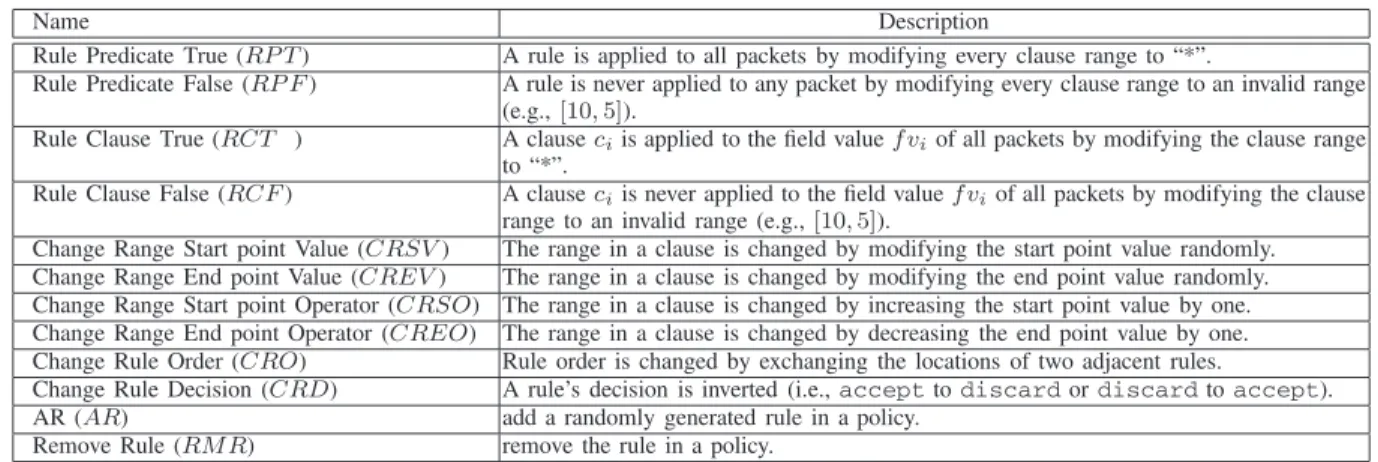
Table II shows the chosen mutation operators for firewall policies and their descriptions. Mutation operators may change predicates, clauses, or decisions of a policy. We classify mutation operators into two groups: (1) rule-level mutation op-erators includingRP T,RP F,CRO,CRD,ARandRM R
and (2) clause-level mutation operators includingRCT,RCF,
CRSV,CREV,CRSO, andCREO. The first group adds, removes, or modifies a rule in a policy. The number of generated mutants with each mutation operator is equal to the number of rules of the policy. The second group modifies a clause in a rule. The number of generated mutants with each mutation operator is equal to the number of clauses.
However, syntactic changes of firewall policies cannot guar-antee semantic changes of the firewall policies. In other words, the mutant generator for each mutation operator may generate semantically equivalent mutants, which are mutants with the same behaviors as the original policy; an equivalent mutant cannot be killed by any test packet. In order to guarantee semantic changes of firewall policies after fault injection, we leverage an existing change-impact analysis tool [13] on firewall policies to determine whether the modifications incur any semantic changes. Given two policies p1 (an original policy) and p2 (its corresponding mutant), change-impact analysis is to analyze what would be different policy behaviors betweenp1 andp2.
VI. IMPLEMENTATION
Our implementation (written in Java) includes four compo-nents: packet generation, packet evaluation, packet reduction, and mutation generation. In the packet generation component, for packet generation based on local constraint solving, our packet generator selects random values (that satisfy a given constraint) for each field value of a test packet. For packet generation based on global constraint solving, we leveraged a theorem prover called Z31. The component statically analyzes and finds concrete solutions (i.e., numeric values), each of which is transformed to a test packet. If no solution exists, Z3 outputsunsolvable. For packet generation based on boundary values, our packet generator selects boundary values (that satisfy a given constraint) for each field value. In order to remove redundancy, we leverage an existing tool [13] to detect redundancy in a firewall policy.
In the packet evaluation component, we developed a generic firewall evaluation engine to simulate evaluating packets against the policy under test. The engine parses and stores rules as aList. When evaluating a packet, the engine searches for the first-applicable rule and outputs the rule’s decision. The engine also automatically compares the evaluated decisions
TABLE II
MUTATION OPERATORS FOR POLICY MUTATION TESTING.
Name Description
Rule Predicate True (RP T) A rule is applied to all packets by modifying every clause range to “*”.
Rule Predicate False (RP F) A rule is never applied to any packet by modifying every clause range to an invalid range (e.g.,[10,5]).
Rule Clause True (RCT ) A clauseciis applied to the field valuefviof all packets by modifying the clause range to “*”.
Rule Clause False (RCF) A clauseciis never applied to the field valuefviof all packets by modifying the clause range to an invalid range (e.g.,[10,5]).
Change Range Start point Value (CRSV) The range in a clause is changed by modifying the start point value randomly. Change Range End point Value (CREV) The range in a clause is changed by modifying the end point value randomly. Change Range Start point Operator (CRSO) The range in a clause is changed by increasing the start point value by one. Change Range End point Operator (CREO) The range in a clause is changed by decreasing the end point value by one. Change Rule Order (CRO) Rule order is changed by exchanging the locations of two adjacent rules.
Change Rule Decision (CRD) A rule’s decision is inverted (i.e.,accepttodiscardordiscardtoaccept). AR (AR) add a randomly generated rule in a policy.
Remove Rule (RMR) remove the rule in a policy.
(on the policy and the mutated policies) and log “killed” mutant information if the decisions are inconsistent.
In the packet reduction component, our packet reduction tool observes the details of covered entities and their covering packets as well as the details of uncovered entities when evaluating a packet set.
In the mutation generation component, our mutator auto-matically generates mutant policies by modifying the policy under test using the selected mutation operator.
VII. EXPERIMENTS
We carried out our experiments on a laptop PC running Windows XP SP2 with 1G memory and dual 1.86GHz In-tel Pentium processor. Our packet generation tool generates packet sets using the four techniques (random packet genera-tion, packet generation based on local constraint solving, one based on global constraint solving, and one based on boundary values). We useRand,Local, andGlobalto denote the packet sets generated by these first three techniques, respectively. We use Bound1 and Bound2 to denote the packet sets generated by the fourth technique on an original policy and its redundancy-removed policy, respectively. For each policy, we measured the structural coverage of each packet set and reduce the size of each packet set while keeping the same level of structural coverage. We use Rand−, Local−, Global−,
Bound−1, and Bound−2 to denote the reduced packet sets, respectively.
The mutator generates mutants (using the defined mutation operators) by seeding faults in each policy (with one mutant including one seeded fault). For each policy and its mutants, the evaluation engine checked if a mutant is “killed” and measured mutant-killing ratios of each packet set (i.e., the number of mutants killed by the packet set divided by the total number of mutants).
We compare our proposed four packet-generation tech-niques in terms of effectiveness to achieve structural coverage by the generated packet sets. In order to investigate the effect of structural coverage on fault-detection capability, we aim to demonstrate that packet sets with higher coverage can detect more faults than packet sets with lower coverage. We have also conducted the same experiment with reduced packet sets to
further investigate whether this reduction significantly affects their fault-detection capability.
A. Instrumentation
We conducted experiments on 14 real-life firewall policies collected from a variety of sources. For the local and global constraint-solving packet-generation techniques, we first gen-erated the following two constraints for each rule: (1) a constraint for evaluating every clause in the rule to true and (2) a constraint for evaluating clauses, each of which is within (but not equal to) its domain, to false and the remaining clauses (which subsume their domains) to true. Because many clauses in firewall policies subsume their domains (e.g., clauses with “*” marks in Figure 1) and these clauses cannot be evaluated to false, we evaluated such clauses to true in the second constraint as described earlier. The local constraint-solving packet-generation technique generated
n×2packets. The global constraint-solving packet-generation technique conjuncts the path constraint for a target rule with its two preceding constraints to form a new constraint for solving. If the new constraint is found to be infeasible (due to the impact of the path condition), this technique cannot generate packets to satisfy such constraints and may include fewer than n×2 packets. The packet-generation technique based on boundary values generated at most n×4 packets. The technique removes duplicate packets to reduce the number of packets. Moreover, the technique removes redundancy to help reduce the number of rules, which reflects the number of packets.
When generating mutants, mutation operators may generate a mutated policy that is the same (syntactically or semanti-cally) as the original policy. As such a mutant does not include any fault, we excluded the mutant. Moreover, we remove all ofRP F andRCF mutants whose policy structure is detected by the mutator to be incorrect.
B. Comparison of Structural Coverage
Table III shows the basic statistics of each firewall policy. Columns 1-3 show subject names, numbers of rules, and generated mutants for each firewall policy. Column group “# Packets” shows the size of the generated packet sets Rand,
TABLE III
EXPERIMENTAL RESULTS ON FIREWALL POLICIES
Policy # Rules # Mutants # Packets # Reduced packets Gen time (ms) Rand Local Global Bound1Bound2 Rand−Local−Global−Bound−1 Bound−2 Global
1 (Firewall1) 3 51 6 6 6 10 10 1 3 3 3 3 112 2 (Firewall2) 5 26 10 10 9 12 6 1 5 4 6 3 172 3 (Firewall3) 28 280 56 56 43 104 29 1 17 17 18 12 1040 4 (Firewall4) 18 206 36 36 26 64 22 1 10 9 12 9 622 5 (Firewall5) 26 378 52 52 44 96 62 2 18 19 22 21 896 6 (Firewall6) 26 338 52 52 39 96 42 2 14 14 15 14 919 7 (Firewall7) 27 360 54 54 41 100 46 3 15 15 16 15 982 8 (Firewall8) 28 494 56 56 53 101 87 3 24 27 29 28 969 9 (Firewall9) 14 185 28 28 25 48 34 2 11 11 13 12 483 10 (Firewall10) 17 179 34 34 29 56 22 1 11 13 14 10 579 11 (Firewall11) 23 233 46 46 34 77 30 3 14 11 15 11 810 12 (Firewall12) 6 44 12 12 11 16 10 1 6 5 7 5 215 13 (Firewall13) 16 152 32 32 23 54 18 1 8 7 9 8 542 14 (Firewall14) 24 313 48 48 40 58 42 2 19 17 18 14 843 Average 18.64 231.36 37.29 37.29 30.21 63.71 32.86 1.71 12.50 12.29 14.07 11.79 656.04
Fig. 6. Rule coverage achieved by each packet set.
Fig. 7. Predicate coverage achieved by each packet set.
Local, Global,Bound1, and Bound2, respectively for each packet generation technique. Columns 9-13 show the size of their reduced packet sets (denoted by Rand−, Local−,
Global−, Bound−1, and Bound−2), respectively. Column 14 shows the analysis time (in milliseconds) for generating
Global(the most costly one among the three techniques) and this analysis time also includes the time to generate and solve constraints. Note that the last row shows the average.
We observe that Global may contain fewer packets than
Rand and Local. The reason is that when solving a global constraint, the constraint can be infeasible to be solved and a constraint solver returns a decision of unsolvable — no packets are generated based on the decision. We observe
Fig. 8. Clause coverage achieved by each packet set.
that Bound2 contains fewer packets than Bound1 since the number of rules in the policy under test is reduced after redundancy removal. The analysis time for Rand, Local,
Bound1, andBound2 is not shown in Table III. The reason is that the time is too short to be measured in milliseconds and negligible (in comparison with that of Global).
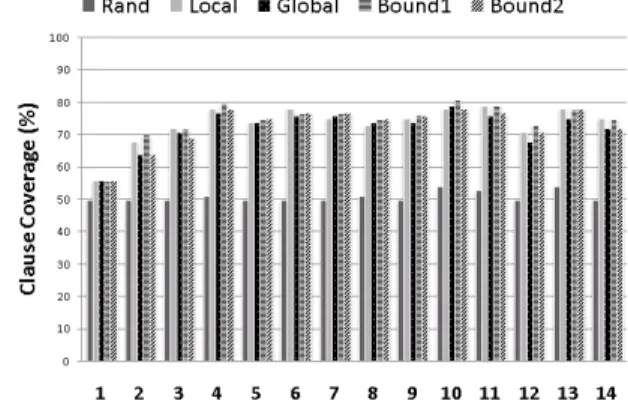
Figures 6, 7, and 8 show the rule, predicate, clause cover-age metrics, respectively, of each policy achieved by Rand,
Local,Global,Bound1, andBound2. We observe thatRand achieved the lowest structural coverage. The reason is that randomly generated field values in generated packets have a low chance of satisfying constraints for a rule, predicate, or clause. We observe thatGlobalachieves higher rule/predicate coverage than other packet sets. This observation is consistent with our expectation described in Section V-A. On average,
Global is approximately 2% (1.5%) and 56% (28%) higher than Local and Rand in terms of rule (predicate) coverage.
Bound1achieves similar rule/predicate coverage withGlobal.
Bound2achieves lower coverage thanBound1because pack-ets (generated based on a redundancy-removed policy) are not suitable to achieve high structural coverage for its original policy due to structure change after redundancy removal.
We also observe that for clause coverage,Globalachieves approximately similar (sometimes less) coverage with Local. As illustrated earlier,Globalmay include fewer packets based on the constructed constraints. When a constraint is found to be infeasible, we did not take into account other clause-constraint combinations, which may be feasible to solve for
Fig. 9. Mutant-killing ratios for all operators by subjects.
Fig. 10. Mutant-killing ratios for all subjects by operators.
covering some of uncovered clauses. Instead,Local,Bound1, and Bound2 may cover some (but not all) target clauses among such uncovered clauses. Furthermore, as our subjects have only a few or no overlapping predicates across rules, the packet-generation technique based on local constraint solving could generate a packet set with almost the highest structural coverage. If predicates are more complex, we expect that
Global shall perform better thanLocal.
C. Comparison of Fault-Detection Capability
To find correlation between each structural coverage and mutation-killing ratios, we classify mutation operations into two categories, rule-level and clause-level mutation operators (explained in Section V-C).
Figure 9 shows the average mutant killing ratios for all operators by policies. We observe that the mutant killing ratios are similar over the generated packet sets and their reduced packet set. ForRand,Local, andGlobal, the largest ratio difference between the generated packet sets and their reduced packet set is less than 2%. Rand andRand− show the lowest mutant-killing ratios. AsRandcontains a relatively large number of packets and the lowest mutant-killing ratios, we observe that the size of a packet set is not highly cor-related with fault-detection capability. We also observe that
Bound1 (Bound−1) achieves the highest mutant-killing ratios among the generated packet sets (the reduced packet sets). WhileLocal,Global, andBound1 achieve similar structural coverage,Bound1 achieves the highest mutant-killing ratios.
This result is expected as the evaluation of these packet sets can involve more structural entities and boundary values than the other packet sets.
We also observe that, in Figure 9, for most cases, killing ratios are below 60%. The reason for such low mutant-killing ratios is that a policy can include various types of faults denoted in Table II and our test packet generation could not find all possible changed behaviors of a given policy. For a
CRO mutated policy, two rules swap locations. In order to detect such a fault, packets should match intersections of two packets. However, our test packet generation does not consider such intersections for test packet generation and cannot easily detect such a fault.
We next present more details about mutants being killed. Figure 10 shows the average mutant killing ratios for all policies by operators. For rule-level mutation operators, we observe thatGlobal,Global−,Bound1, andBound−1 achieve highest mutant-killing ratios. The reason is that the high-est rule/predicate coverage achieved by Global, Global−,
Bound1, and Bound−1 helps exercise more rules and detect faults in rules.
In Figure 10, we observe that our generated packet sets cannot detect any faults in the policies with ARfaults. AR
simulates a forgotten rule in a given policy. The reason for such low mutant-killing ratios is that our test packet generation is based on a set of rules in a given policy and does not have any information of a forgotten rule to help detect its fault. Moreover, randomly generating a packet for fault detection
is not trivial as well due to a large domain of a firewall policy representation. For example, an IP address field in a rule includes a subset of the IP address domain (i.e., [0,28−1]),
which is huge. There is a very low possibility that a randomly generated IP address field value in a packet could detect such a fault. In other words, in order to detect a fault in a rule, a packet matches not only an IP address field in the rule. The packet is required to match other fields in the rule as well. A randomly generated packet may match some of fields, especially when a field is a subset of a relatively small domain (e.g., Boolean). However, matching all of the fields in the rule with a randomly generated packet is not trivial.
Among clause-level mutation operations, Bound1 and
Bound−1 achieves the highest mutant-killing ratios overRCT,
RCF, CREV, and CREO mutated policies. As Bound1 and Bound−1 evaluate more clauses to true or false, the packet sets are more effective to detect faults in a larger portion of clauses in the policy. Bound1 (Bound−1) and
Bound2(Bound−2) detect more faults inCRSV andCRSO mutated policies. The reason is that a packet in Bound1 (Bound−1) andBound2(Bound−2) are based boundary values in the constraint. Therefore,Bound1 (Bound−1) andBound2 (Bound−2) are effective to detect faults caused by the change of the boundary value of a clause over other packet sets.
VIII. RELATEDWORK
Coverage Criteria For Logical Expressions. A firewall policy is translated to program code (i.e., IF-THEN-ELSE statements) that includes a large number of conjunctive logical expressions to illustrate rules. Ammann et al [10] proposed coverage criteria for such logical expressions. For example, they proposed predicate and clause coverage criteria in notions of logical expressions. Although they proposed such criteria, they did not generate test suites for real program code to show the effectiveness of their coverage criteria. We not only propose logical coverage criteria, which are suitable for a firewall policy, but also developed test packet generation and mutation testing techniques to show the effectiveness in terms of fault-detection capability. To the best of our knowledge, there is no existing work targeting at test generation and mutation testing especially for a large number of logical expressions (in a firewall policy) as our work.
Mutation Testing of Specifications. Black et al. [14] and Wimmel et al. [15] proposed mutation testing for specifi-cations. However, their mutation operators change operators (e.g., replacing an expression by its negation) and pre/post conditions of specifications. In our work, instead of changing operators and pre/post conditions, we mutate clauses and a rule’s decision, where policy authors could make mistakes in specifying rules (e.g., specifying incorrect values).
Testing of Access Control Policies. For testing access control policies such as XACML policies [16], Martin et al. [12] proposed to mutate policies [17], and generate random requests automatically. Their proposed structural coverage criteria and mutation operators are not directly applicable to firewall policies due to the semantic and syntactic differences between access control policies and firewall policies. While firewall policies consist of a set of ranges (intervals) in rules,
access control policies consist of structural elements such as policies, rules, subjects, objects, and actions. They do not use a well-established test generation technique to cover certain entities. Our approach uses more advanced technique: the local and global constraint solving mechanisms to generate packets covering certain structural entities effectively.
Firewall Policy Test Criteria.Some researchers proposed firewall testing with test cases generated based on their proposed criteria. J¨urjens et al. [18] proposed specification-based testing, which generates test sequences to cover a state transition model of a firewall and its surrounding network. El-Atawy et al. [19] proposed policy criteria identified by inter-actions between rules, called “policy segmentation” identified by interactions between rules. Different from their approaches, we use structural coverage criteria in each rule to help detect which entities are specified incorrectly. In addition, we also use mutation testing to evaluate our approach.
Firewall Policy Testing. Several firewall policy testing techniques [5]–[7] inject packets into a firewall and check whether the decisions of the firewall concerning the injected packets are correct. However, these techniques lack rigorous-ness in terms of the use of coverage criteria and effective mechanisms for generating covering packets. Furthermore, these testing techniques are inefficient when a tester needs to inject a large number of packets and examine their decisions. In contrast, our approach is based on solid foundations and advanced test-packet generation techniques.
IX. CONCLUSION
We have developed a systematic structural testing approach for firewall policies. We defined three types of structural coverage for firewall policies: rule, predicate, and clause coverage criteria. Among the four proposed packet generation techniques, the global constraint solving technique often gen-erated packet sets to achieve the highest structural coverage. Generally, our experimental results showed that a packet set with higher structural coverage has higher fault-detection ca-pability (i.e., detecting more injected faults). Our experimental results showed that a reduced packet set (maintaining the same level of structural coverage with the corresponding original packet set) maintains similar fault-detection capability with the original set.
ACKNOWLEDGMENT
This work is supported in part by NSF grant CNS-0716579, a NIST grant, NSF grant CNS-0716407, and MSU IRGP Grant.
REFERENCES
[1] S. W. Lodin and C. L. Schuba, “Firewalls fend off invasions from the net,”IEEE Spectrum, vol. 35, no. 2, pp. 26–34, 1998.
[2] A. Wool, “A quantitative study of firewall configuration errors,” Com-puter, vol. 37, no. 6, pp. 62–67, 2004.
[3] E. Al-Shaer and H. Hamed, “Discovery of policy anomalies in distributed firewalls,” inProc. 2004 IEEE Conf. on Communications, pp. 2605–2616. [4] L. Yuan, J. Mai, Z. Su, H. Chen, C.-N. Chuah, and P. Mohapatra, “FIREMAN: a toolkit for FIREwall Modeling and ANalysis,” inProc. 2006 IEEE Symposium on Security and Privacy, pp. 199–213. [5] M. R. Lyu and L. K. Y. Lau, “Firewall security: policies, testing and
performance evaluation,” in Proc. 2000 International Conference on Computer Systems and Applications, pp. 116–121.
[6] A. X. Liu, M. G. Gouda, H. H. Ma, and A. H. Ngu, “Non-intrusive testing of firewalls,” inProc. 2004 International Computer Engineering Conference, pp. 196–201.
[7] D. Hoffman and K. Yoo, “Blowtorch: a framework for firewall test automation,” in Proc. 2005 IEEE/ACM international Conference on Automated Software Engineering, pp. 96–103.
[8] H. Zhu, P. A. V. Hall, and J. H. R. May, “Software unit test coverage and adequacy,”ACM Comput. Surv., vol. 29, no. 4, pp. 366–427, 1997. [9] R. A. DeMillo, R. J. Lipton, and F. G. Sayward, “Hints on test data
selection: help for the practicing programmer,”IEEE Computer, vol. 11, no. 4, pp. 34–41, 1978.
[10] P. Ammann, J. Offutt, and H. Huang, “Coverage criteria for logical ex-pressions,” inProc. 2003 International Symposium on Software Reliability Engineering, pp. 99–107.
[11] A. X. Liu and M. G. Gouda, “Complete redundancy detection in fire-walls,” inProc 2005 Annual IFIP Conference on Data and Applications Security, pp. 196–209.
[12] E. Martin, T. Xie, and T. Yu, “Defining and measuring policy coverage in testing access control policies,” inProc. 2006 International Conference on Information and Communications Security, pp. 139–158.
[13] A. X. Liu, “Change-impact analysis of firewall policies,” inProc 2007 European Symposium Research Computer Security, pp. 155–170. [14] P. E. Black, V. Okun, and Y. Yesha, “Mutation operators for
speci-fications,” inProc. 2000 IEEE International Conference on Automated Software Engineering, pp. 81–88.
[15] G. Wimmel and J. J ¨urjens, “Specification-based test generation for security-critical systems using mutations,” inProc. 2002 International Conference on Formal Engineering Methods, pp. 471–482.
[16] “OASIS eXtensible Access Control Markup Language (XACML),” http: //www.oasis-open.org/committees/xacml/, 2007.
[17] E. Martin and T. Xie, “A fault model and mutation testing of access control policies,” inProc. 2007 International Conference on World Wide Web, pp. 667–676.
[18] J. J ¨urjens and G. Wimmel, “Specification-based testing of firewalls,” in Proc. 2001 International Andrei Ershov Memorial Conference on Perspectives of System Informatics, pp. 308–316.
[19] A. El-Atawy, T. Samak, Z. Wali, E. Al-Shaer, F. Lin, C. Pham, and S. Li, “An automated framework for validating firewall policy enforcement,” inProc. 2007 IEEE International Workshop on Policies for Distributed Systems and Networks, pp. 151–160.
JeeHyun Hwang received the BS degree in com-puter science from Korea University in Korea in 2003 and the MS degree in computer science from the State University of New York in Stony Brook in 2005. He is a Ph.D. student in the department of computer science at North Carolina State Uni-versity. He is a member of the Automated Software Engineering Research Group led by Dr. Tao Xie. His research interests include testing and verifying access control policies.
Tao Xie received the Ph.D. degree from the Uni-versity of Washington in 2005. He received the BS degree from Fudan University in 1997 and the MS degree from Peking University in 2000. He is an associate professor in the Department of Computer Science at North Carolina State University. His primary research interest is software engineering, with an emphasis on automated software testing and mining software engineering data. He is a member of the IEEE.
Fei Chen received the BS degree in Automation from Tsinghua University in 2005 and the MS degree in Automation from Tsinghua University in 2007. He is currently a Ph.D. student in the Department of Computer Science and Engineering at Michigan State University. His research interests include on networking, algorithms, and security.
Alex X. Liu received his Ph.D. degree in computer science from the University of Texas at Austin in 2006. He is currently an assistant professor in the Department of Computer Science and Engineering at Michigan State University. He received the IEEE & IFIP William C. Carter Award in 2004 and an NSF CAREER award in 2009. He received the MSU Col-lege of Engineering Withrow Distinguished Scholar Award in 2011. His research interests focus on networking, security, and dependable systems.