ebXML Business Process Specification Schema
Page i of 136
Copyright © UN/CEFACT and OASIS, 2001. All Rights Reserved.
3
4
ebXML Business Process Specification Schema
5
Version 1.01
6
7
8
Business Process Project Team
9
10
11
11 May 2001
12
13
14
15
16
1 Status of this Document
17
18
This Technical Specification document has been approved by the ebXML Plenary. This material
19
fulfills requirements of the ebXML Requirements document. The formatting for this document
20
is based on the Internet Society’s Standard RFC format.
21
22
This version:
23
www.ebxml.org/specs/ebBPSS.pdf
24
25
Latest version
:
26
www.ebxml.org/specs/ebBPSS.pdf
27
28
29
ebXML Business Process Specification Schema
Page ii of 136
Copyright © UN/CEFACT and OASIS, 2001. All Rights Reserved.
this document.
31
32
Team Lead:
33
Paul Levine, Telcordia
34
35
Editors:
36
Jim Clark, E2Open - previously Edifecs: (Transaction Semantics)
37
Cory Casanave, Data Access Technologies: (UML model)
38
Kurt Kanaskie, Lucent Technologies: (DTD and Examples)
39
Betty Harvey, Electronic Commerce Connection: (DTD documentation)
40
Jamie Clark, McLure-Moynihan, Inc.: (Lega l aspects)
41
Neal Smith, Chevron: (Issues Lists, and W3C schema)
42
John Yunker, Edifecs: (Signal structures)
43
Karsten Riemer, Sun Microsystems: (Overall Document)
44
45
Participants:
46
Antoine Lonjon, Mega
47
J.J. Dubray, Excelon
48
Bob Haugen, Logistical Software
49
Bill McCarthy, Michigan State University
50
Paul Levine, Telcordia
51
Brian Hayes, CommerceOne
52
Nita Sharma, Netfish
53
David Welsh, Nordstrom
54
Christopher Ferris, Sun Microsystems
55
Antonio Carrasco, Data Access Technologies
56
57
58
59
ebXML Business Process Specification Schema
Page iii of 136
Copyright © UN/CEFACT and OASIS, 2001. All Rights Reserved.
2
ebXML BP/CoreComponents metamodel participants ... ii
61
3
Table of Contents... iii
62
4
Introduction...v
63
4.1
Summary of Contents of Document ... 1
64
4.2
Audience ... 1
65
4.3
Related Documents ... 1
66
4.4
Prerequisites... 2
67
5
Design Objectives ... 2
68
5.1
Goals/Objectives/Requirements/Problem Description ... 2
69
5.2
Caveats and Assumptions ... 3
70
5.2.1
Relationship between
ebXML Business Process Specification Schema
and UMM 3
71
6
System Overview ... 5
72
6.1
Key Concepts of the ebXML Business Process Specification Schema ... 10
73
6.2
How to use the ebXML Business Process Specification Schema ... 14
74
6.3
How ebXML Business Process Specification Schema is used with other ebXML
75
specifications ... 14
76
6.4
How to design collaborations and transactions, re-using at design time ... 16
77
6.4.1
Specify a Business Transaction and its Business Document Flow... 16
78
6.4.2
Specify a Binary Collaboration... 22
79
6.4.3
Specify a MultiParty Collaboration ... 25
80
6.4.4
Specify a Choreography... 27
81
6.4.5
The whole model... 31
82
6.5
Core Business Transaction Semantics ... 34
83
6.5.1
Interaction Predictability... 34
84
6.5.2
Creating legally binding contracts ... 37
85
6.5.3
Non-Repudiation... 38
86
6.5.4
Authorization security... 39
87
6.5.5
Document security ... 40
88
6.5.6
Reliability... 41
89
6.5.7
Parameters required for CPP/CPA... 41
90
6.6
Run time Business Transaction semantics ... 41
91
6.6.1
Timeouts... 42
92
6.6.2
Exceptions ... 44
93
6.7
Runtime Collaboration Semantics ... 47
94
6.8
Where the ebXML Business Process Specification Schema May Be Implemented .... 47
95
7
UML Element Specification ... 47
96
7.1
Business Collaborations ... 47
97
7.1.1
MultiPartyCollaboration ... 47
98
7.1.2
BusinessPartnerRole ... 48
99
7.1.3
Performs ... 48
100
7.1.4
AuthorizedRole ... 49
101
7.1.5
BinaryCollaboration... 50
102
ebXML Business Process Specification Schema
Page iv of 136
Copyright © UN/CEFACT and OASIS, 2001. All Rights Reserved.
7.1.8
CollaborationActivity... 52
105
7.2
Business Transactions ... 52
106
7.2.1
BusinessTransaction... 53
107
7.2.2
Business Action... 54
108
7.2.3
RequestingBusinessActivity ... 55
109
7.2.4
RespondingBusinessActivity... 55
110
7.3
Document flow... 56
111
7.3.1
Document Security... 56
112
7.3.2
Document Envelope ... 56
113
7.3.3
BusinessDocument... 58
114
7.3.4
Attachment ... 58
115
7.4
Choreography within Collaborations. ... 59
116
7.4.1
BusinessState ... 59
117
7.4.2
Transition... 59
118
7.4.3
Start ... 60
119
7.4.4
CompletionState... 60
120
7.4.5
Success... 61
121
7.4.6
Failure ... 61
122
7.4.7
Fork ... 62
123
7.4.8
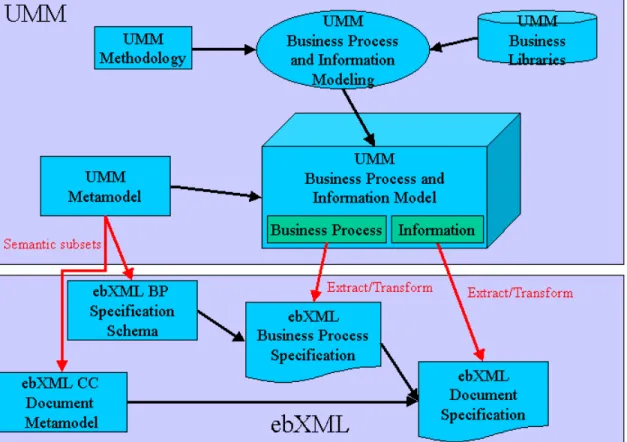
Join... 62
124
7.5
Definition and Scope... 63
125
7.6
Collaboration and transaction well- formedness rules ... 63
126
8
ebXML Business Process Specification Schema – (DTD) ... 65
127
8.1
Documentation for the DTD ... 65
128
8.2
XML to UML cross-reference ... 94
129
8.3
Scoped Name Reference ... 96
130
8.4
Substitution Sets... 97
131
8.5
Sample XML document against above DTD ... 97
132
9
Business signal structures ... 97
133
9.1.1
ReceiptAcknowledgment DTD... 98
134
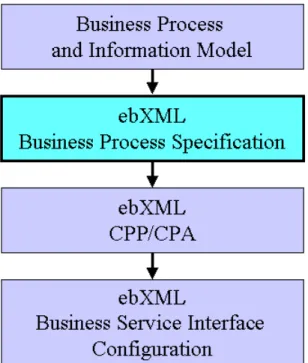
9.1.2
AcceptanceAcknowledgement DTD... 100
135
9.1.3
Exception Signal DTD... 101
136
10
Production Rules... 103
137
Appendix A: Sample XML Business Process Specification ... 105
138
Appendix B: Business Process Specification Schema DTD... 110
139
Appendix C: Business Process Specification Schema XML Schema ... 117
140
11
References ... 129
141
12
Disclaimer ... 129
142
13
Contact Information... 130
143
144
ebXML Business Process Specification Schema
Page v of 136
Copyright © UN/CEFACT and OASIS, 2001. All Rights Reserved.
Executive Summary
146
147
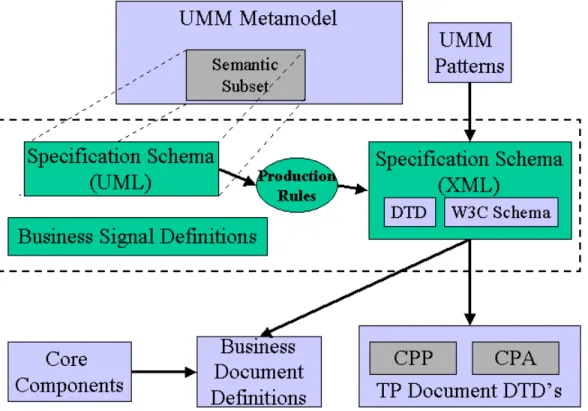
The ebXML Specification Schema provides a standard framework by which business
148
systems may be configured to support execution of business collaborations consisting of
149
business transactions. It is based upon prior UN/CEFACT work, specifically the
150
metamodel behind the UN/CEFACT Modeling Methodology (UMM) defined in the
151
N090R9.1 specification.
152
The Specification Schema supports the specification of Business Transactions and the
153
choreography of Business Transactions into Business Collaborations. Each Business
154
Transaction can be implemented using one of many available standard patterns. These
155
patterns determine the actual exchange of Business Documents and business signals
156
between the partners to achieve the required electronic commerce transaction.
157
The current version of the specification schema addresses collaborations between two
158
parties (Binary Collaborations).
159
It is anticipated that a subsequent version will address additional features such as the
160
semantics of economic exchanges and contracts, more complex multi-party
161
choreography, and context based content.
Copyright © ebXML 2001. All Rights Reserved.
This document describes the Specification Schema, both in its UML form and in
165
its DTD form.
166
The document first introduces general concepts and semantics, then applies
167
these semantics in a detail discussion of each part of the model. The document
168
then specifies all elements in the UML form, and then in the XML form.
169
The keywords MUST, MUST NOT, REQUIRED, SHALL, SHALL NOT, SHOULD,
170
SHOULD NOT, RECOMMENDED, MAY, and OPTIONAL, when they appear in
171
this document, are to be interpreted as described in RFC 2119 [Bra97].
172
173
4.2 Audience
174
The primary audience is business process analysts. We define a business
175
process analyst as someone who interviews business people and as a result
176
documents business processes in unambiguous syntax.
177
An additional audience is designers of business process definition tools who
178
need to specify the conversion of user input in the tool into the XML
179
representation of the Specification Schema.
180
The audience is not business application developers.
181
4.3 Related Documents
182
As mentioned above, other documents provide detailed definitions of some of the
183
components of the ebXML Specification Schema and of their inter-relationship.
184
They include ebXML Specifications on the following topics:
185
186
• ebXML Technical Architecture Specification, version 1.04
187
• ebXML Core Components Dictionary, version 1.04
188
• ebXML Naming Convention for Core Components, version 1.04
189
• ebXML Collaboration-Protocol Profile and Agreement Specification V1.0
190
• ebXML Business Process and Business Information Analysis Overview,
191
version 0.7
192
• ebXML Business Process Analysis Worksheets & Guidelines, version
193
0.10
194
• ebXML E-Commerce Patterns, version 0.99
195
• ebXML Catalog of Common Business Processes, version 0.99
196
• ebXML Message Service Specification V0.99
ebXML Business Process Specification Schema
Page 2 of 136
Copyright © UN/CEFACT and OASIS, 2001. All Rights Reserved.
• UN/CEFACT Modeling Methodology (UMM) as defined in the N090R9.1
198
specification
199
4.4 Prerequisites
200
It is assumed that the audience will be familiar with or have knowledge of the
201
following technologies and techniques:
202
• Business process modeling techniques and principles
203
• The UML syntax and semantics
204
• The Extensible Markup Language (XML)
205
5 Design Objectives
206
5.1 Goals/Objectives/Requirements/Problem Description
207
Business process models describe interoperable business processes that allow
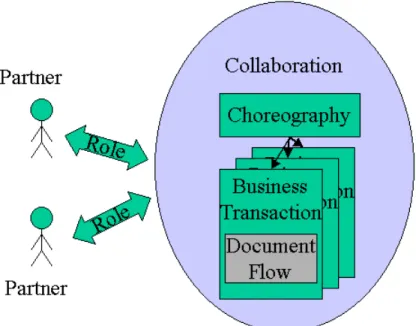
208
business partners to collaborate. Business process models for e-business must
209
be turned into software components that collaborate on behalf of the business
210
partners.
211
The goal of the ebXML Specification Schema is to provide the bridge between
e-212
business process modeling and specification of e-business software
213
components.
214
The ebXML Specification Schema provides for the nominal set of specification
215
elements necessary to specify a collaboration between business partners, and to
216
provide configuration parameters for the partners’ runtime systems in order to
217
execute that collaboration between a set of e-business software components.
218
A specification created against the ebXML Business Process Specification
219
Schema is referred to as an ebXML Business Process Specification.
220
The ebXML Business ProcessSpecification Schema is available in two
stand-221
alone representations, a UML version, and an XML version.
222
The UML version of the ebXML Business Process Specification Schema is
223
merely a UML Class Diagram. It is not intended for the direct creation of ebXML
224
Business Process Specifications. Rather, it is a self-contained statement of all
225
the specification elements and relationships required to be able to create an
226
ebXML compliant Business Process Specification. Any methodologies and/or
227
metamodels used for the creation of ebXML compliant Business Process
228
Specifications must at minimum support these elements and relationships.
229
The XML version of the ebXML Business Process Specification Schema provides
230
the specification for XML based instances of ebXML Business Process
231
Specifications, and as a target for production rules from other representations.
232
Both a DTD and a W3C Schema is provided.
233
The UML and XML based versions of the ebXML Business Process
234
Specification Schema are unambiguously mapped to each other.
ebXML Business Process Specification Schema
Page 3 of 136
Copyright © UN/CEFACT and OASIS, 2001. All Rights Reserved.
5.2 Caveats and Assumptions
236
This specification is designed to specify the run time aspects of a business
237
collaboration.
238
It is not intended to incorporate a methodology, and does not directly prescribe
239
the use of a methodology. However, if a methodology is to be used, it is
240
recommended that it be UN/CEFACT Modeling Methodology (UMM).
241
The ebXML Business Process Specification Schema does not by itself define
242
Business Documents Structures. It is intended to work in conjunction with already
243
existing Business Document definitions, and/or the document metamodel defined
244
by the ebXML Core Components specifications.
245
5.2.1 Relationship between ebXML Business Process Specification
246
Schema and UMM
247
248
The UN/CEFACT Modeling Methodology (UMM) is a methodology for business
249
process and information modeling.
250
This section describes the relationship between UMM and the ebXML Business
251
Process Specification Schema.
252
The UMM Meta Model is a description of business semantics that allows Trading
253
Partners to capture the details for a specific business scenario (a Business
254
Process) using a consistent modeling methodology. A Business Process
255
describes in detail how Trading Partners take on shared roles, relationships and
256
responsibilities to facilitate interaction with other Trading Partners. The
257
interaction between roles takes place as a choreographed set of Business
258
Transactions. Each Business Transaction is expressed as an exchange of
259
electronic Business Documents. The sequence of the exchange is determined
260
by the Business Process, and by messaging and security considerations.
261
Business Documents are composed from re-useable Business Information
262
Objects. At a lower level, Business Processes can be composed of re-useable
263
Common Business Processes, and Business Information Objects can be
264
composed of re-useable Core Components. Common Business Processes and
265
Business Information Objects reside in a UMM Business Library.
266
The UMM Meta Model supports a set of Business Process viewpoints that
267
provide a set of semantics (vocabulary) for each viewpoint and forms the basis of
268
specification of the semantics and artifacts that are required to facilitate business
269
process and information integration and interoperability. Using the UMM
270
methodology and the UMM metamodel, the user may thus create a complete
271
Business Process and Information Model. This model contains more information
272
than what is required for configuring ebXML compliant software. Also the model
273
is syntax independent and not directly interpretable by ebXML compliant
274
software.
275
The ebXML Business Process Specification Schema provides an additional view
276
of the UMM metamodel. This subset is provided to support the direct
277
specification of the nominal set of elements necessary to configure a runtime
278
system in order to execute a set of ebXML business transactions. By drawing
ebXML Business Process Specification Schema
Page 4 of 136
Copyright © UN/CEFACT and OASIS, 2001. All Rights Reserved.
out modeling elements from several of the other views, the ebXML Business
280
Process Specification Schema forms a semantic subset of the UMM Meta Model.
281
Using the ebXML Business Process Specification Schema the user may thus
282
create a Business Process Specification that contains only the information
283
required to configure ebXML compliant software.
284
The ebXML Business Process Specification Schema is available in two
stand-285
alone representations, a UML version , and an XML version. The XML version is
286
intended to be interpretable by ebXML compliant software.
287
The relationship between the UMM Meta Model and the ebXML Business
288
Process Specification Schema is shown in Figure 1.
289
Figure 1. UMM Metamodel and ebXML Business Process Specification Schema
290
291
292
Using the UMM methodology, and drawing on content from the UMM Business
293
Library a user may create complete Business Process and Information Model
294
conforming to the UMM metamodel.
295
Since the ebXML Business Process Specification Schema is a semantic subset
296
of the UMM metamodel, the user may then in an automated fashion extract from
297
the Business Process and Information Model the required set of elements and
ebXML Business Process Specification Schema
Page 5 of 136
Copyright © UN/CEFACT and OASIS, 2001. All Rights Reserved.
relationships, and transform them into an ebXML Business Process Specification
299
conforming to the ebXML Business Process Specification Schema.
300
Likewise, since the ebXML CC document metamodel is aligned with the UMM
301
Metamodel, the user may then in an automated fashion extract from the
302
Business Process and Information Model the required set of elements and
303
relationships, and transform them into an ebXML document model conforming to
304
ebXML Core Component specifications.
305
The UMM methodology is not part of the formal set of ebXML specifications.
306
Likewise, the UMM metamodel in its entirety is not part of the formal set of
307
ebXML specifications. Only the semantic subset represented by the ebXML
308
Business Process Specification Schema and CC are part of the formal set of
309
ebXML specifications.
310
The remainder of this document focuses on the ebXML Business Process
311
Specification Schema and Business Process Specifications created against it. It
312
is understood that proper Business Process and Information Modeling may have
313
taken place prior to beginning the activity of creating a Business Process
314
Specification.
315
6 System Overview
316
The ebXML Business ProcessSpecification Schema provides a standard
317
framework for business process specification. As such, it works with the ebXML
318
Collaboration Protocol Profile (CPP) and Collaboration Protocol Agreement
319
(CPA) specifications to bridge the gap between Business Process Modeling and
320
the configuration of ebXML compliant e-commerce software, e.g. an ebXML
321
Business Service Interface, as depicted in Figure 2.
ebXML Business Process Specification Schema
Page 6 of 136
Copyright © UN/CEFACT and OASIS, 2001. All Rights Reserved.
323
Figure 2: Business Process Specification and Business Service Interface Configuration
324
Using Business Process Modeling, a user may create a complete Business
325
Process and Information Model.
326
Based on this Business Process and Information Model and using the ebXML
327
Business ProcessSpecification Schema the user will then extract and format the
328
nominal set of elements necessary to configure an ebXML runtime system in
329
order to execute a set of ebXML business transactions. The result is an ebXML
330
Business Process Specification.
331
Alternatively the ebXML Business Process Specification may be created directly,
332
without prior explicit business process modeling.
333
An ebXML Business ProcessSpecification contains the specification of Business
334
Transactions and the choreography of Business Transactions into Business
335
Collaborations.
336
This ebXML Business Process Specification is then the input to the formation of
337
ebXML trading partner Collaboration Protocol Profiles and Collaboration Protocol
338
Agreements.
339
These ebXML trading partner Collaboration Protocol Profiles and Collaboration
340
Protocol Agreements in turn serve as configuration files for ebXML Business
341
Service Interface software.
ebXML Business Process Specification Schema
Page 7 of 136
Copyright © UN/CEFACT and OASIS, 2001. All Rights Reserved.
The architecture of the ebXML Business Process Specification Schema consists
343
of the following functional components:
344
• UML version of the Business Process Specification Schema
345
• XML version of the Business Process Specification Schema
346
• Production Rules defining the mapping from the UML version of the
347
Business Process Specification Schema to the XML version
348
• Business Signal Definitions
349
350
Together these components allow you to fully specify all the run time aspects of a
351
business process model.
352
These components are shown (inside the dotted box)in figure 3 below.
353
354
355
Figure 3: Relationship of ebXML Business Process Specification Schema to UMM, CPP/CPA
356
and Core Components
357
358
The following provides a description of each of the components in the ebXML
359
Business Process Specification Schema and their relationship to UMM, and
360
ebXML CC and CPP/CPA:
ebXML Business Process Specification Schema
Page 8 of 136
Copyright © UN/CEFACT and OASIS, 2001. All Rights Reserved.
UML version of Business Process Specification Schema
362
The UML version of the ebXMLBusiness Process Specification Schema is a
363
semantic subset of the metamodel behind UMM as specified in UN/CEFACT
364
TMWG’s N090R9.1
365
N090R9.1 is as of this writing not yet approved by UN/CEFACT. It is the intent to
366
keep the ebXMLBusiness Process Specification Schema and the UN/CEFACT
367
TMWG’s N090 semantically aligned.
368
The UML version of the ebXML Business Process Specification Schema is
369
merely a UML Class Diagram. It is not intended for the direct creation of ebXML
370
Business Process Specifications. Rather, it is a self-contained statement of all
371
the specification elements and relationships required to be able to create an
372
ebXML compliant Business Process Specification.
373
XML version of Business Process Specification Schema
374
The XML version of the ebXML Business Process Specification Schema provides
375
the specification for XML based instances of ebXML Business Process
376
Specifications, and as a target for production rules from other representations.
377
Thus, a user may either create a Business Process Specification directly as an
378
XML document, or may chose to use some other means of specification first and
379
then apply production rules to arrive at the XML document version.
380
Any methodologies and/or metamodels used for the creation of ebXML compliant
381
Business Process Specifications must at minimum support the production of the
382
elements and relationships contained in the XML version of the ebXML Business
383
Process Specification Schema.
384
Both a DTD and a W3C Schema is provided. Each is an isomorphic definition of
385
the UML version of the ebXML Business Process Specification Schema.
386
UMM Business Process Interaction Patterns
387
ebXML Business Service Interfaces are configured to execute the business
388
processes s pecified in a Business Process Specification. They do so by
389
exchanging ebXML messages and business signals.
390
Each Business Transaction can be implemented using one of many available
391
standard patterns. These patterns determine the actual exchange of messages
392
and business signals between the partners to achieve the required electronic
393
commerce transaction.
394
The Business Transaction Interaction Patterns set forth in Chapter 8 of the UMM
395
N090R9.1 document illustrate recommended permutations of message
396
sequences as determined by the type of business transaction defined and the
397
timing policies specified in the transactions.
398
While the UMM patterns themselves are not part of the ebXML specifications, all
399
the security and timing parameters required to express the pattern properties are
400
provided as attributes of elements in the ebXML Business Process Specification
401
Schema.
ebXML Business Process Specification Schema
Page 9 of 136
Copyright © UN/CEFACT and OASIS, 2001. All Rights Reserved.
Business Signal Definitions
403
Business signals are application level documents that ‘signal’ the current state of
404
the business transaction. These business signals have specific business purpose
405
and are separate from lower protocol and transport signals.
406
However, the structures of ebXML business signals are ‘universal’ and do not
407
vary from transaction to transaction. Thus, they can be defined once and for all
408
as part of the ebXML Business Process Specification Schema itself.
409
The Business Process Specification Schema provides both the choreography of
410
business signals, and the structure definition of the business payload of a
411
business signal. The ebXML Message Service Specification signal structures
412
provide business service state alignment infrastructure, including unique
413
message identifiers and digests used to meet the basic process alignment
414
requirements. The business signal payload structures provided herein are
415
optional and normative and are intended to provide business and legal semantics
416
to the business signals.
417
A DTD is provided for each of the possible business signals.
418
Production Rules
419
A set of production rules are provided, defining the mapping from the UML
420
version of the ebXML Business Process Specification Schema to the XML
421
version.
422
The primary purpose for these production rules is to govern the one-time
423
generation of the DTD version of the ebXML Business Process Specification
424
Schema from the UML Class Diagram version of the ebXML Business Process
425
Specification Schema.
426
The Class Diagram version of Business Process Specification Schema is not
427
intended for the direct creation of ebXML Business Process Specifications.
428
However, if a Business Process Specification was in fact (programmatically)
429
created as an instance of this class diagram, the production rules would also
430
apply for its conversion into a DTD conformant XML document.
431
Separately, it is expected that a set of production rules will be constructed for the
432
production of an XML version of an ebXML Business Process Specification from
433
a set of UML diagrams constructed through the use of UMM.
434
An instance of the UML Class Diagram version of the ebXML Business Process
435
Specification Schema will through the application of its production rules produce
436
an XML Specification Document that is analytically, semantically and functionally
437
equivalent to one arrived at by modeling the same subset through the use of
438
UMM and its associated production rules.
439
Relationship to CPP/CPA
440
A Business Process Specification is in essence the machine interpretable run
441
time business process specification needed for an ebXML Business Service
442
Interface. The Business Process Specification is therefore incorporated with or
443
referenced by ebXML trading partner Collaboration Protocol Profiles (CPP) and
ebXML Business Process Specification Schema
Page 10 of 136
Copyright © UN/CEFACT and OASIS, 2001. All Rights Reserved.
Collaboration Protocol Agreements (CPA). Each CPP declares its support for
445
one or more Roles within the Business Process Specification . Within these CPP
446
profiles and CPA agreements are then added further technical parameters
447
resulting in a full specification of the run-time software at each trading partner.
448
Relationship to CC
449
The Business Process Specification Schema does not by itself support the
450
definiton of Business Documents. Rather, a Business Process Specification
451
merely points to the definition of Business Documents. Such definitions may
452
either be XML based, or – as attachments – may be any other structure, or
453
completely unstructured. XML based Business Document Specifications may be
454
based on the ebXML Core Components specifications.
455
Relationship to ebXML Message Service Specification
456
The Business Process Specification Schema will provide choreography of
457
business messages and signals. The ebXML Message Service Specification
458
provides the infrastructure for message / signal identification, typing, and
459
integrity; as well as placing any one message in sequence with respect to other
460
messages in the choreography.
461
462
6.1 Key Concepts of the ebXML Business Process Specification
463
Schema
464
465
The ebXML Business Process Specification Schema provides the semantics,
466
elements, and properties necessary to define business collaborations.
467
A business collaboration consists of a set of roles collaborating through a set of
468
choreographed transactions by exchanging business documents.
469
These basic semantics of a business collaboration are shown in Figure 4.
ebXML Business Process Specification Schema
Page 11 of 136
Copyright © UN/CEFACT and OASIS, 2001. All Rights Reserved.
471
Figure 4. Basic Semantics of a business collaboration
472
473
Two or more business partners participate in the business collaboration through
474
roles. The roles interact with each other through Business Transactions. The
475
business transactions are sequenced relative to each other in a Choreography.
476
Each Business Transaction consists of one or two predefined Business
477
document flows. A Business Transaction may be additionally supported by one
478
or more Business Signals.
479
The following section describes the concepts of a Business Collaboration, a
480
Business Transaction, a Business document flow, and a Choreography
481
1. Business Collaborations
482
A business collaboration is a set of Business Transactions between
483
business partners. Each partner plays one or more roles in the
484
collaboration.
485
The ebXML Business Process Specification Schema supports two levels
486
of business collaborations, Binary Collaborations and Multiparty
487
Collaborations.
488
Binary Collaborations are between two roles only.
ebXML Business Process Specification Schema
Page 12 of 136
Copyright © UN/CEFACT and OASIS, 2001. All Rights Reserved.
Multiparty Collaborations are among more than two roles, but such
490
Multiparty Collaborations are always synthesized from two or more Binary
491
Collaborations. For instance if Roles A, B, and C collaborate and all
492
parties interact with each other, there will be a separate Binary
493
Collaboration between A and B, one between B and C, and one between
494
A and C. The Multiparty Collaboration will be the synthesis of these three
495
Binary Collaborations.
496
Binary Collaborations are expressed as a set of Business Activities
497
between the two roles. Each Business Activity reflects a state in the
498
collaboration. The Business Activity can be a Business Transaction
499
Activity, i.e. the activity of conducting a single Business Transaction, or a
500
Collaboration Activity, i.e. the activity of conducting another Binary
501
Collaboration. An example of the former is the activity of placing a
502
purchase order. An example of the latter is the activity of negotiating a
503
contract. In either case the activities can be choreographed relative to
504
other activities as per below.
505
The ability of a Binary Collaboration to have activities that in effect are
506
executing other Binary Collaborations, is the key to recursive
507
compositions of Binary Collaboration, and to the re-use of Binary
508
Collaborations.
509
In essence each Binary Collaboration is a re-useable protocol between
510
two roles.
511
2. Business Transactions
512
A Business Transaction is the atomic unit of work in a trading
513
arrangement between two business partners. A Business Transaction is
514
conducted between two parties playing opposite roles in the transaction.
515
The roles are always a requesting role and a responding role.
516
Like a Binary Collaboration, a Business Transaction is a re-useable
517
protocol between two roles. The way it is re-used is by referencing it from
518
a Binary Collaboration through the use of a Business Transaction Activity
519
as per above. In a Business Transaction Activity the roles of the Binary
520
Collaboration are assigned to the execution of the Business Transaction.
521
Unlike a Binary Collaboration, however, the Business Transaction is
522
atomic, it cannot be decomposed into lower level Business Transactions.
523
A Business Transaction is a very specialized and very constrained
524
protocol, in order to achieve very precise and enforceable transaction
525
semantics. These semantics are expected to be enforced by the software
526
managing the transaction, i.e. an ebXML Business Service Interface
527
(BSI).
528
A Business Transaction will always either succeed or fail. If it succeeds it
529
may be designated as legally binding between the two partners, or
530
otherwise govern their collaborative activity. If it fails it is null and void,
531
and each partner must relinquish any mutual claim established by the
532
transaction. This can be thought of as ‘rolling back’ the Business
533
Transaction upon failure.
ebXML Business Process Specification Schema
Page 13 of 136
Copyright © UN/CEFACT and OASIS, 2001. All Rights Reserved.
3. Business Document flows
535
A business transaction is realized as Business Document flows between
536
the requesting and responding roles. There is always a requesting
537
Business Document, and optionally a responding Business Document,
538
depending on the desired transaction semantics, e.g. one-way notification
539
vs. two-way conversation.
540
Actual document definition is achieved using the ebXML core component
541
specifications, or by some methodology external to ebXML but resulting in
542
a DTD or Schema that an ebXML Business Process Specification can
543
point to.
544
4. Choreography
545
The Business Transaction Choreography describes the ordering and
546
transitions between business transactions or sub collaborations within a
547
binary collaboration. In a UML tool this can be done using a UML activity
548
diagram. The choreography is described in the ebXML Business Process
549
Specification Schema using activity diagram concepts such as start state,
550
completion state, activities, synchronizations, transitions between
551
activities, and guards on the transitions.
552
5. Patterns
553
The ebXML Business Process Specification Schema provides a set of
554
unambiguous semantics within which to specify transactions and
555
collaborations. Within these semantics the user community has flexibility
556
to specify an infinite number of specific transactions and collaborations.
557
The use of predefined patterns combines this flexibility with a consistency
558
that facilitates faster design, faster implementation, and enables generic
559
processing.
560
A set of predefined transaction interaction patterns, defining common
561
combinations of transaction interaction parameter settings can be found
562
in UMM.
563
While the UMM transaction interaction patterns themselves are not part of
564
the ebXML specifications, all the security and timing parameters required
565
to express the pattern properties are provided as attributes of elements in
566
the Business Process Specification Schema.
567
It is also anticipated that patterns for collaboration choreographies will
568
emerge. An example of such a pattern is in the ebXML E-Commerce
569
Patterns.
570
Re-use, recursion, and patterns are among the key concepts of the ebXML
571
Business Process Specification Schema. The following section will illustrate
572
these key concepts.
ebXML Business Process Specification Schema
Page 14 of 136
Copyright © UN/CEFACT and OASIS, 2001. All Rights Reserved.
6.2 How to use the ebXML Business Process Specification
574
Schema
575
The ebXML Business Process Specification Schema should be used wherever
576
ebXML compliant software is being specified to execute Business
577
Collaborations. The generic term for such software is a Business Service
578
Interface (BSI).
579
The ebXML Business Process Specification Schema is used to specify the
580
business process related configuration parameters for configuring a BSI to
581
execute these collaborations.
582
This section discusses
583
• How the ebXML Business Process Specification Schema fits in with other
584
ebXML specifications.
585
• How to use the ebXML Business Process Specification Schema at design
586
time, either for specifying brand new collaborations and transactions, or
587
for re-using existing ones.
588
• How to specify core transaction semantics and parameters needed for a
589
Collaboration-Protocol Profile and Agreement (CPP/CPA).
590
• Run-time transaction and collaboration semantics that the ebXML
591
Business Process Specification Schema specifies and the Business
592
Service Interface (BSI) is expected to manage.
593
6.3 How ebXML
Business Process Specification Schema
is
594
used with other ebXML specifications
595
596
The ebXML Business Process Specification Schema provides the semantics,
597
elements, and properties necessary to define Business Collaborations.
598
A collaboration consists of a set of roles collaborating through a set of
599
choreographed transactions by exchanging Business Documents.
600
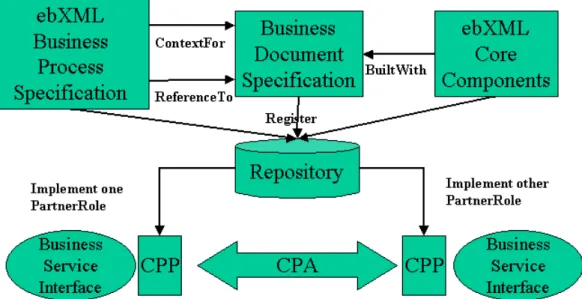
As shown in Figure 5, Business Documents are defined at the intersection
601
between the Business Process Specification and the ebXML Core Component
602
specifications. A Business Process Specification will reference, but not define, a
603
set of required Business Documents. At ebXML Business Documents are either
604
defined by some external document specification, or assembled directly or
605
indirectly from lower level information structures called core components. The
606
assembly is based on a set of contexts, many of which are provided by the
607
business processes, i.e. collaborations that use the documents in their document
608
flows.
609
The combination of the business process specification and the document
610
specification become the basis against which partners can make agreements on
611
conducting electronic business with each other.
612
613
ebXML Business Process Specification Schema
Page 15 of 136
Copyright © UN/CEFACT and OASIS, 2001. All Rights Reserved.
614
Figure 5: ebXML Business Process Specification Schema and other ebXML S pecifications
615
616
The user will extract and transform the necessary information from an existing
617
Business Process and Information Model. Associated production rules could aid
618
in creating an XML version of a Business Process Specification.
619
Alternatively a user would use an XML based tool to produce the XML version
620
directly. Production rules could then aid in converting into XMI, so that it could be
621
loaded into a UML tool, if required.
622
In either case, the XML version of the Business Process Specification gets stored
623
in the ebXML repository and registered in the ebXML registry for future retrieval.
624
The Business Process Specification would beregistered using classifiers
625
derived during its design.
626
When implementers want to establish trading partner Collaboration Protocol
627
Profile and Agreement the Business Process Specification XML document, or
628
the relevant parts of it, are simply imbedded in or referenced by the CPP and
629
CPA XML documents. ebXML CPP and CPA documents can only reference
630
ebXML Business Process Specifications and only XML versions thereof.
631
Guided by the CPP and CPA specifications the resulting XML document then
632
becomes the configuration file for one or more Business Service Interfaces (BSI),
ebXML Business Process Specification Schema
Page 16 of 136
Copyright © UN/CEFACT and OASIS, 2001. All Rights Reserved.
i.e. the software that will actually manage either partner’s participation in the
634
collaboration.
635
6.4 How to design collaborations and transactions, re-using at
636
design time
637
638
This section describes the ebXML Business Process Specification Schema
639
modeling relationships by building a complete Multiparty Collaboration from the
640
bottom up, as follows:
641
1. Specify a Business Transaction
642
2. Specify the Business Document flow for a Business Transaction
643
3. Specify a Binary Collaboration re-using the Business Transaction
644
4. Specify a Choreography for the Binary Collaboration
645
5. Specify a higher level Binary Collaboration re-using the lower level Binary
646
Collaboration
647
6. Specify a Multiparty Collaboration re-using Binary Collaborations
648
Although this section, for purposes of introduction, discusses the specification of
649
a collaboration from the bottom up, the ebXML Business Process Specification
650
Schema very much is intended for specifying collaborations from the top down,
651
re-using existing lower level content as much as possible.
652
The constructs listed above support the specification of fairly complex multi party
653
collaborations. However, an ebXML compliant Business Process Specificaton
654
may be as simple as a single Binary Collaboration referencing a single Business
655
Transaction. This involves only numbers 1 through 3 above. In other words,
656
Higher-level Binary Collaborations, Multi-party Collaborations and choreography
657
expressions are not required for ebXML Business Process Specification
658
compliance.
659
660
661
6.4.1 Specify a Business Transaction and its Business Document
662
Flow
663
664
Figure 6 illustrates a business transaction.
ebXML Business Process Specification Schema
Page 17 of 136
Copyright © UN/CEFACT and OASIS, 2001. All Rights Reserved.
B u s i n e s s A c t i o n n a m e : s t r i n g i s I n t e l l i g i b l e C h e c k R e q u i r e d : B o o l e a n i s A u t h o r i z a t i o n R e q u i r e d : B o o l e a n t i m e T o A c k n o w l e d g e R e c e i p t : T i m e i s N o n R e p u d i a t i o n R e q u i r e d : B o o l e a n i s N o n R e p u d i a t i o n O f R e c i e p t R e q u i r e d : B o o l e a n B u s i n e s s T r a n s a c t i o n A c t i v i t y t i m e T o P e r f o r m : T i m e i s C o n c u r r e n t : B o o l e a n i s L e g a l l y B i n d i n g : B o o l e a n R e q u e s t i n g B u s i n e s s A c t i v i t y t i m e T o A c k n o w l e d g e A c c e p t a n c e : T i m e B u s i n e s s T r a n s a c t i o n n a m e : s t r i n g p a t t e r n : s t r i n g i s G u a r a n t e e d D e l i v e r y R e q u i r e d : B o o l e a n p r e C o n d i t i o n : S t r i n g p o s t C o n d i t i o n : S t r i n g b e g i n s W h e n : S t r i n g e n d s W h e n : S t r i n g 1 n + u s e s 1 + a c t i v i t i e sn 1 1 + r e q u e s t e r 1 + t r a n s a c t i o n 1 D o c u m e n t E n v e l o p e i s P o s i t i v e R e s p o n s e : B o o l e a n 1 0 . . 1 + d o c u m e n t E n v e l o p e1 + r e q u e s t i n g 0 . . 1 R e s p o n d i n g B u s i n e s s A c t i v i t y 1 1 + r e s p o n d e r 1 + t r a n s a c t i o n 1 n 0 . . 1 + d o c u m e n t E n v e l o p e n + r e s p o n d i n g 0 . . 1666
667
Figure 6. UML Diagram of a Business Transaction
668
669
6.4.1.1
Key Semantics of a Business Transaction
670
671
A Business Transaction is the atomic unit of work in a trading
672
arrangement between two business partners.
673
A business transaction consists of a Requesting Business Activity, a
674
Responding Business Activity, and one or two document flows between
675
them. A Business Transaction may be additionally supported by one or
676
more Business Signals that govern the use and meaning of
677
acknowledgements and related matters in the transaction.
ebXML Business Process Specification Schema
Page 18 of 136
Copyright © UN/CEFACT and OASIS, 2001. All Rights Reserved.
Implicitly there is a requesting role performing the Requesting Business
679
Activity and a responding role performing the Responding Business
680
Activity. These roles become explicit when the transaction is used within
681
a Business Transaction Activity within a Binary Collaboration.
682
There is always a Request document flow.
683
Whether a Response document is required is part of the definition of the
684
Business Transaction. Some Business Transactions need this type of
685
request and response, typically for the formation of a contract or
686
agreement. Other Business Transactions are more like notifications, and
687
have only a Request document flow.
688
An abstract superclass, Business Action, is the holder of attributes that
689
are common to both Requesting Business Activity and Responding
690
Business Activity.
691
6.4.1.2
Sample syntax
692
Here is a simple notification transaction with just one document flow:
693
<BusinessTransaction name="Notify of advanceshipment">
694
<RequestingBusinessActivity name="">695
<DocumentEnvelope696
BusinessDocument name="ASN"/>697
</RequestingBusinessActivity>698
<RespondingBusinessActivity name=""699
</RespondingBusinessActivity>700
</BusinessTransaction>701
702
Associated with each document flow can be one or more business signals
703
acknowledging the document flow. These acknowledgment signals are
704
not modeled explicitly but parameters associated with the transaction
705
specify whether the signals are required or not.
706
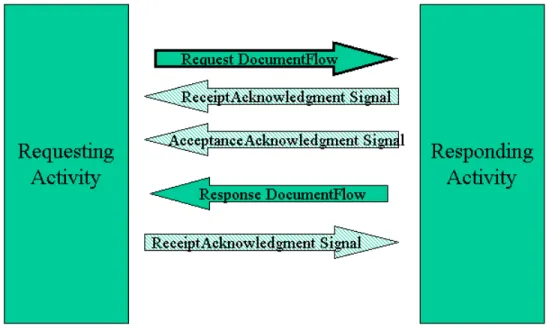
The possible Document Flows and business signals within a Business
707
Transaction are shown in Figure 7.
708
709
710
ebXML Business Process Specification Schema
Page 19 of 136
Copyright © UN/CEFACT and OASIS, 2001. All Rights Reserved.
711
Figure 7: Possible document flows and signals and their sequence
712
713
These acknowledgment signals (a.k.a. Business Signals) are application
714
level documents that ‘signal’ the current state of the business transaction.
715
Whether a receiptAcknowledgement and/or
716
acceptanceAcknowledgement signal are required is part of the pattern
717
specified for the Business Transaction. These business signals have
718
specific business purposes, relating to the processing and management
719
of documents and document envelopes prior to evaluation of their
720
business terms, and are separate from lower protocol and transport
721
signals.
722
The Receipt acknowledgement business signal, if used, signals that a
723
message has been properly received. The property
724
isIntelligibleCheckRequired allows partners to agree that a message
725
should be confirmed by a Receipt acknowledgement only if it also is
726
legible. Legible means that it has been passed a structure/ schema
727
validity check. Both the proper receipt and, if evaluated, the legibility of a
728
message are reviewed (and if present acknowledged) prior to the
729
application of any business rules or evaluation of the terms or guard
730
expressions in the message's business documents or document
731
envelope.
ebXML Business Process Specification Schema
Page 20 of 136
Copyright © UN/CEFACT and OASIS, 2001. All Rights Reserved.
The Acceptance Acknowledgement business signal, if used, signals that
733
the message received has been accepted for business processing. This
734
is the case if the contents of the message's business documents and
735
document envelope have passed a business rule validity check.
736
Failure to send either signal, when required (by specifying a timeout value
737
in timeToAcknowledgeReceipt or timeToAcknowledgeAcceptance), will
738
result in the transaction being null and void, and therefore will prevent any
739
"success" end state that would have depended on receipt of a business
740
document satisfying the associated timeToPerform.
741
742
6.4.1.3
Sample syntax
743
Here is a slightly more complex transaction with two document flows and
744
three business signals.
745
The request requires both receipt and acceptance acknowledgement, the
746
response requires only receipt acknowledgement. “P2D” is a W3C
747
Schema syntax adopted from the ISO 8601 standard and means
748
Period=2 Days. P3D means Period=3 Days, P5D means Period=5 Days.
749
These periods are all measured from original sending of request.
750
<BusinessTransaction name="Create Order">
751
<RequestingBusinessActivity name=""752
isNonRepudiationRequired="true"753
timeToAcknowledgeReceipt=”P2D"754
timeToAcknowledgeAcceptance=”P3D">755
<DocumentEnvelope756
BusinessDocument="Purchase Order"/>757
</RequestingBusinessActivity>758
<RespondingBusinessActivity name=""759
isNonRepudiationRequired="true"760
timeToAcknowledgeReceipt=”P5D">761
<DocumentEnvelope isPositiveResponse="true"762
BusinessDocument="PO763
Acknowledgement"/>764
</DocumentEnvelope>765
</RespondingBusinessActivity>766
</BusinessTransaction>767
768
769
6.4.1.4
Specifying Business Document flows
770
771
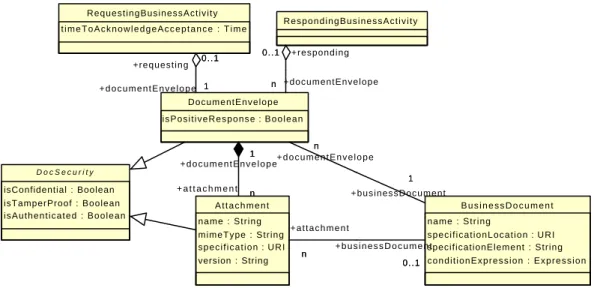
Request document flows and response document flows contain Business
772
Documents that pertain to the Business Transaction. The model for this is
773
shown in Figure 8. Business Documents have varying structures.
774
Business signals, however always have the same structure, defined once
775
and for all as part of the ebXML Business Process Specification Schema.
776
777
ebXML Business Process Specification Schema
Page 21 of 136
Copyright © UN/CEFACT and OASIS, 2001. All Rights Reserved.
778
779
780
781
D o c S e c u r i t y isConfidential : Boolean isTamperProof : Boolean isAuthenticated : Boolean B u s i n e s s D o c u m e n t name : String s p e c i f i c a t i o n L o c a t i o n : U R I specificationElement : String c o n d i t i o n E x p r e s s i o n : E x p r e s s i o n A t t a c h m e n t name : String mimeType : String s p e c i f i c a t i o n : U R I version : String 0..1 n + b u s i n e s s D o c u m e n t 0..1 + a t t a c h m e n t n RequestingBusinessActivity t i m e T o A c k n o w l e d g e A c c e p t a n c e : T i m e DocumentEnvelope i s P o s i t i v e R e s p o n s e : B o o l e a n 1 n +businessDocument 1 + d o c u m e n t E n v e l o p e n n 1 + a t t a c h m e n t n + d o c u m e n t E n v e l o p e 1 1 0..1 + d o c u m e n t E n v e l o p e 1 +requesting 0..1 R e s p o n d i n g B u s i n e s s A c t i v i t y n 0..1 +documentEnvelope n +responding 0..1782
Figure 8: UML Diagram of document flow
783
784
A document flow is not modeled directly. Rather it is modeled indirectly as
785
a Document Envelope sent by one role and received by the other. The
786
Document Envelope is always associated with one Requesting Business
787
Activity and one Responding Business Activity to model the flow.
788
Document Envelopes are named. There is always only one named
789
Document Envelope for a Requesting Activity. There may be zero, one, or
790
many mutually exclusive, named Document Envelopes for a Responding
791
Activity. For example, the Response Document Envelopes for a purchase
792
order transaction might be named PurchaseOrderAcceptance,
793
PurchaseOrderDenial, and PartialPurchaseOrderAcceptance. In the
794
actual execution of the purchase order transaction, however, only one of
795
the defined possible responses will be sent.
796
The Document Envelope represents the flow of documents between the
797
activities. Each Document Envelope carries exactly one primary Business
798
Document.
799
A Document Envelope can optionally have one or more attachments, all
800
related to the primary Business Document. The document and its
801
attachments in essence form one transaction in the payload in the ebXML
802
Message Service message structure.
ebXML Business Process Specification Schema
Page 22 of 136
Copyright © UN/CEFACT and OASIS, 2001. All Rights Reserved.
6.4.1.5
Sample syntax
804
This example shows a business transaction with one request and two
805
possible responses, a success and a failure. The request has an
806
attachment. All the the Business Documents are fully qualified with the
807
schema name.
808
809
<BusinessDocument name=" Purchase Order "
810
specificationLocation="someplace"/>
811
<BusinessDocument name=" PO Acknowledgement "
812
specificationLocation="someplace"/>
813
<BusinessDocument name=" PO Rejection "
814
specificationLocation="someplace"/>
815
<BusinessDocument name="Delivery Instructions"
816
specificationLocation="someplace"/>
817
818
<BusinessTransaction name="Create Order">
819
<RequestingBusinessActivity name=""
820
<DocumentEnvelope isPositiveResponse="true"
821
`
BusinessDocument="ebXML1.0/PO Acknowledgement">
822
<Attachment
823
name=”DeliveryNotes”
824
mimeType=”XML”
825
BusinessDocument=
826
"ebXML1.0/Delivery Instructions"
827
specification=””
828
isConfidential=”true”
829
isTamperProof=”true”
830
isAuthenticated=”true”>
831
</Attachment>
832
</DocumentEnvelope>
833
</RequestingBusinessActivity>
834
<RespondingBusinessActivity name=""
835
<DocumentEnvelope
836
`
BusinessDocument="ebXML1.0/PO
837
Acknowledgement"/>
838
</DocumentEnvelope>
839
<DocumentEnvelope isPositiveResponse="false"
840
`
BusinessDocument=" ebXML1.0/PO Rejection"/>
841
</DocumentEnvelope>
842
</RespondingBusinessActivity>
843
</BusinessTransaction>
844
845
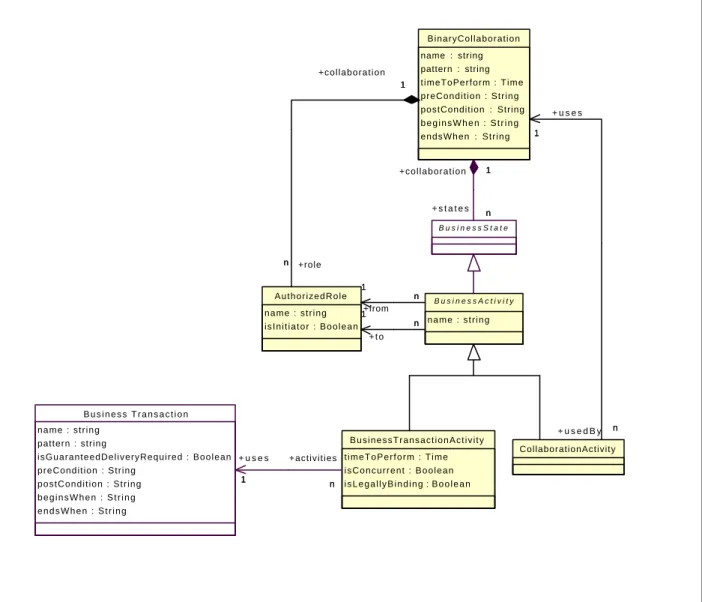
6.4.2 Specify a Binary Collaboration
846
Figure 9 illustrates a binary collaboration.