Collaborative Learning Protocols:
Writing-To-Learn in Networked and Face-To-Face Environments
Rolf Schwonke ([email protected])
Alexander Renkl ([email protected])
Department of Psychology, University of Freiburg Engelbergerstr. 41, D-79085 Freiburg, Germany
Abstract
In this study, we explored the potential of enriching a well-working individual writing-to-learn approach in a face-to-face setting and a net-mediated setting. Thirty-six undergraduate psychology students worked in dyads on a common learning protocol in each of these settings. Effects on the collaboration process and on strategy use in the learning protocols were as-sessed. Participants evaluated the ftf-setting to be both more effective and efficient to reach their individual learning goals. Cognitive and metacognitive learning strategies were used more often, and more effectively, in the ftf-setting, what was attributed to a richer mutual strategic support. The results suggest instructional procedures in order to improve commu-nication and interaction as well as to encourage learners to a more productive use of existing tools and techniques.
Keywords: collaborative learning; CSCL; collaborative writ-ing; writing-to-learn.
Introduction
Writing is a difficult and complex task. It is usually per-formed alone which adds to that difficulty. However, writ-ing holds the strong potential to change the way we think and what we know. This is called the epistemic effect of writing (Bereiter & Scardamalia, 1987). A learning protocol as a written explication of one’s own learning processes and outcomes serves this purpose (Nückles, Schwonke, Ber-thold, & Renkl, 2004). The main goal of writing learning protocols instead of, for example, writing a summary, is to induce a thorough processing of and reflection on the mate-rial to be learnt and thereby foster a deeper understanding. It is quite possible to include a summary of a learning epi-sode’s contents in a learning protocol. Yet, in that case such a summary should merely be used as a basis for further elaboration and reflection. Empirical or theoretical findings described in the summary may, for example, undergo a critical analysis, and highly abstract concepts should be il-lustrated by generating examples of use or by making refer-ences to personal experirefer-ences.
Contemporary theoretical accounts of the mechanisms by which individual thinking and learning might be influenced by group contexts stress the internalization of social proc-esses (Vygotsky, 1978), socio-cognitive conflict (Piaget, 1985), cooperative goal structures (Slavin, 1992), and learn-ing by observation (Bandura, 1986). In connection with writing, Hayes (1996) points out that writing is above all a social activity. Texts themselves are social artifacts and
writing is carried out in social settings. It is argued that col-laborative writing is valuable for writing-to learn because it allows different individuals to bring in their ideas and their expertise, and because others’ points of views have to be taken into account (Speck, Johnson, Dice, & Heaton, 1999). The social processes mediated and stimulated through writ-ing (i.e., negotiation of meanwrit-ing, discussion of conflictwrit-ing points of view) should facilitate the development of a shared understanding of meanings and conventions and should help to overcome idiosyncratic views or beliefs. A learning pro-tocol supports these kinds of collaborative processes by functioning as a shared external memory (Donald, 1991), or a common object to think with (Papert, 1980).
On the other hand, collaborative knowledge-building processes themselves can be difficult and, therefore even add to the complexity of a writing-to-learn task. It is argued that net-mediated environments have the potential to support collaborative knowledge-building processes effectively. Therefore, they may also be valuable to support collabora-tive writing-to-learn tasks. As a result of a growing interest of collaborative writing, a number of computer systems are available that support asynchronous as well as synchronous collaborative writing (e.g., Neuwirth, Kaufer, Chandhok, & Morris, 2001; Pargman, 2003). Especially synchronous ex-changes hold the potential to facilitate the internalization of collaboratively developed strategies, negotiated meanings, and shared understandings. Occurring socio-cognitive con-flicts might be resolved faster, and collaborators may profit from receiving advice, scaffolds, and coaching by their counterparts as well as from giving explanations (e.g., Webb, 1989). In addition, collaborators may learn by ob-serving and imitating their peers’ problem solving activities.
Yet, both asynchronous and synchronous net-mediated collaboration have to cope with known restrictions of com-puter-mediated communication (CMC) that might impede learning. These restrictions refer to the lack of extra-linguistic cues such as nonverbal signals for mood, agree-ment, or disagreeagree-ment, and to difficulties in the coordination of turn-taking. These costs of CMC hinder grounding, that is, the process of developing a shared understanding of the task at hand (Clark & Brennan, 1991), and therefore they may impair the benefits of net-mediated environments.
In this study, a tried-and-tested individual writing-to-learn approach (called the learning-protocol method) is analyzed in two collaborative settings, a face-to-face setting and a net-mediated setting. The scenarios differed with regard to
communication, the writing medium, and the work mode while producing and editing the common document:
Communication: In the net-mediated setting, tion was restricted with regard to the number of communica-tion channels (text vs. speech and gestures). On the other hand, the chat-protocols provided the opportunity to review previous discussion (external memory, discussion thread).
Writing medium: Documents written with pencil and pa-per provide a better overall view than documents presented on a computer screen. Furthermore, creating references be-tween different parts of the text, for example, by making use of graphical representations (e.g., lines or arrows) is easier. On the other hand, text processors are more convenient and efficient to edit and rearrange sentences or paragraphs.
Work mode: The task of producing a common text syn-chronously using pencil and paper almost inevitably induces a division of responsibility. It can be expected that collabo-rators will spontaneously distribute the roles of producer (i.e., the one who writes the text) and consultant or critic. This role division can be expected to be less rigid in a net-mediated setting (using a shared editor). As a result, text production can be expected to be distributed more evenly between the collaborators. This way, both collaborators would have an opportunity to profit from observing their partner’s problem solving activities.
Aims and Research Questions
Although some work has been done on computer-supported collaborative writing (Barile & Durso, 2002; Hodges, 2002; Noel & Robert, 2003), little is known about the potential benefits and drawbacks of collaborative writing as a means to learn and on the potential impacts of the writing medium. Therefore, the goal of this explorative study is to compare different collaborative writing-to-learn settings and thereby derive testable hypotheses as well as to formulate recom-mendations on how to enhance writing-to-learn approaches. Specifically, this study addressed the following questions: 1. How do changes in the task environment (face-to-face
vs. net-mediated collaboration) affect process and out-comes of a writing-to-learn task?
2. What differences can be expected with respect to im-portant characteristics of the writing process (e.g., planning, text production, revising), the focus of col-laboration (e.g., content or coordination), and the use of learning strategies (e.g., organizational, repetitive, elaborative, and metacognitive strategies)?
3. Which demands do the different settings pose on the collaborators (e.g., coordination demands)? Which op-portunities do the different settings offer (e.g., to re-ceive as well as to offer support)?
4. How do potential differences between the settings af-fect the perceived value of collaborative learning pro-tocols?
5. How do the above-mentioned process variables relate to outcome variables (e.g., how does support received from a collaborator relate to the perceived attainment of individual learning goals)?
Method
Participants
Thirty-six undergraduate psychology students (25 female and 11 male, mean age: M = 22 years) who were taking a course in motivational psychology took part in this study. Among other course requirements, the students had to pre-pare two collaborative learning protocols. Alternatively, they were free to hand in a total of four individual learning protocols (no one actually did that); hence, participation in the study was voluntary.
Design
In two sessions of the seminar (the ninth session, t1, and eleventh session, t2, of a total of twelve sessions), the stu-dents were asked to write a learning protocol together with a randomly assigned collaborator in both a net-mediated learning setting (net-setting at t1), and a face-to-face learn-ing settlearn-ing (ftf-settlearn-ing at t2). Hence, each participant took part twice.
Procedure
At each session, (t1 and t2), the students attended a lesson on a topic of motivational psychology (45 minutes). Imme-diately after the lesson, they were asked to fill in a question-naire on demographic variables, beliefs, and attitudes to-wards individual and collaborative learning. After that, each student was randomly assigned to another student, and par-ticipants were introduced to the writing task. In the ftf-setting, the writing instruction consisted of the request to write a learning protocol in close collaboration with the partner. In the net-setting, the same writing assignment was given complemented by a short introduction to the net-based learning environment. Then, the dyads worked on a com-mon learning protocol on the topic of attribution (at t1), or volition (at t2) respectively (about 30 minutes). At t1, they collaborated in the net-based working environment; at t2, they collaborated face-to-face. After finishing the learning protocol, all participants filled in a second questionnaire on different aspects of the collaboration.
Materials
A variety of possibly relevant variables referring to indi-vidual and collaborative learning, to experiences with com-puters and relevant software, and to subjective judgments of the collaboration as well as critical aspects of the learning settings were assessed with paper-and-pencil questionnaires (e.g., coordination demands; focus on topic, structure, and form; relative amounts of planning, text production, and revision; amount of received and given support). Ratings were made on six-point rating scales. In addition, a number of control variables were assessed at each point of meas-urement (e.g., experience with the collaborator, and experi-ences with and attitudes towards collaboration, collaborative writing, and learning protocols). As none of these measures changed significantly from t1 to t2, we took this as an indi-cation of the comparability of the two settings.
Net-based Learning Environment (Net-Setting)
Under practical considerations, it was reasonable to use a usability-tested, easy-to-use, and readily available group-ware tool that supports synchronous collaboration and the sharing of documents. A computer program that meets these requirements is Microsoft NetMeeting™. It provides a vari-ety of net-conferencing tools in an integrated environment. For present purposes, the text chat and file sharing capabili-ties of the program were of special interest.In the net-setting, two participants shared a Microsoft WordPad™ document, employing the file sharing facility of Microsoft NetMeeting. For communication purposes, they were asked to use the text chat tool of NetMeeting. The col-laborative setting was implemented on personal computers with flat-screens that were connected via a local area net-work in a computer pool.
Face-to-Face Learning Environment (Ftf-Setting)
In the ftf-setting, dyads of students worked on a common learning protocol using pencil and paper. The collaboration took place in a classroom. The learning protocols were writ-ten on provided sheets of ruled paper. In contrast to the net-setting, here, the dyads communicated verbally.
Coding and Scoring
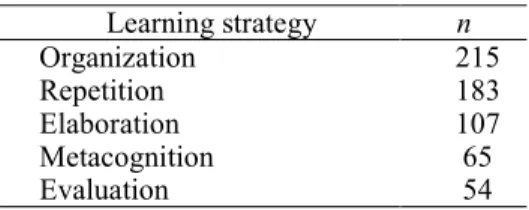
Dependent measures were the quality of the learning proto-cols and subjective judgments concerning different aspects of the collaboration. In order to determine the quality of the learning protocols, the learning protocols (N = 30) were segmented and coded for cognitive and metacognitive learn-ing activities (Weinstein & Mayer, 1986). Table 1 gives an overview of the categories used and the numbers of assigned segments.
Table 1: Categories of learning strategies and absolute frequencies of referring segments in the learning protocols
Learning strategy n Organization 215 Repetition 183 Elaboration 107 Metacognition 65 Evaluation 54 As the writing of a learning protocol is to stimulate the
application of cognitive and metacognitive learning activi-ties, traces of these activities should be discernable in the protocols. In order to identify and organize these traces, the frequencies of statements representing a certain cognitive or metacognitive activity were calculated. The units of analysis were statements that could be understood on their own, whole sentences and clauses. A segment was assigned to a certain category depending on the primary cognitive func-tion of that segment. For example, the statement “In Kel-ley’s covariation principle there are three distinct classes of information…” was coded as an instance of organization, because it makes explicit a part-whole relationship and
thereby adds structure to the mental model of the learner. Each segment was assigned to exactly one category.
In order to control for effects of the different lessons (t1 and t2) that the participants attended to, they were asked to rate the quality of the lessons on several aspects (i.e., struc-ture, clarity, activity of peers, quality of discussions, quality of the presentation, quality of handouts). These indicators were aggregated to an overall quality score of the lesson. Comparing these overall scores, no significant differences were found between the two settings, F < 1. Thus, both set-tings were assumed to have offered similar opportunities for learning.
Results
The results are presented in three subsections. First, we re-port effects of the collaborative setting on learning strategy use in the protocols. Second, impacts of the collaborative settings on the process of collaboration are reported. Finally, findings concerning the relations of process variables and measures of the effectiveness of collaborative learning pro-tocols are presented. Due to the explorative character of the study and the relatively small sample size for all statistical tests reported, an alpha level of .10 was used (to prevent from too many beta errors).
Strategy Use in the Learning Protocols
The length of the learning protocols (number of words) writ-ten in the net-setting (M = 241.25, SD = 94.23) and the ftf-setting (M = 221.71, SD = 55.20) did not show any signifi-cant differences, F < 1, indicating that any differences that were found between protocols for different settings could not be attributed to "lengths effects."
In order to assess potential differences in the use of learn-ing strategies, the frequency of each strategy category per learning protocol was calculated (e.g., number of elabora-tive statements per learning protocol). We found that in both collaborative settings organizational (M = 7.17, SD = 3.37), repetitive (M = 6.10, SD = 6.20), and elaborative statements (M = 5.03, SD = 4.62) were used most often, whereas meta-cognitive (M = 2.17, SD = 1.95), and evaluative statements (M = 1.80, SD = 2.12) were rarely used.
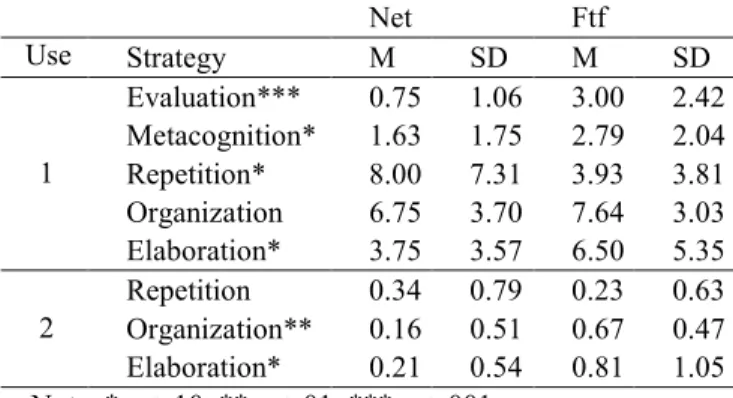
Comparisons of the two collaborative settings (Table 2, upper part) revealed differences in the frequency of cogni-tive strategies (MANOVA with repetition, elaboration, and organization as dependent measures), F(3,25) = 2.53, p = .08, η2 = 0.23, as well as in the frequencies of metacognitive and evaluative strategies (MANOVA with metacognition and evaluation as dependent measures), F(2,26) = 7.29, p = .003, η2 = 0.36. More specifically, repetitive statements were used more often in the net-setting than in the ftf-setting, F(1,27) = 3.03, p = .09, η2 = 0.10. Elaborative
F(1,27) = 3.38, p = .08, η2 = 0.11, metacognitive, F(1,27) = 3.80, p = .06, η2 = 0.12, and especially evaluative state-ments, F(1,27) = 14.73, p = .001, η2 = 0.35, on the other hand, were used more often in the ftf-setting. No differences were found for organizational statements, F < 1.
Moreover, it has often been found that metacognitive ac-tivities are of little value for learning if not followed by any kind of cognitive regulation (e.g., elaboration) (e.g., Ber-thold, Nückles, & Renkl, 2004). The same assumption seems reasonable for evaluative statements (i.e., criticising the learning content or the learning episode) that are not accompanied by any kind of cognitive regulation. Hence, we were interested in whether the different collaborative settings may induce different patterns of comprehension monitoring (and evaluation) and resulting regulative activi-ties. As a dependent measure, the frequencies of organiza-tional, elaborative, and repetitive statements following a metacognitive or an evaluative statement were counted for each collaborative setting. With respect to evaluative state-ments, a MANOVA revealed clear differences between the two collaborative settings in the use of cognitive strategies as regulation, F(3,26) = 6.55, p = .002, η2 = 0.43.
Regula-tion by organizaRegula-tion was found much more often in the ftf-setting than in the net-ftf-setting, F(1,28) = 8.22, p = .008, η2 = 0.23 (see Table 2, lower part). The same was found for
regulation by elaboration, F(1,28) = 3.98, p = .056, η2 = 0.12. No differences were found for regulation by repeti-tion, F < 1.
Table 2: Cognitive and metacognitive statements per learning protocol (1), and cognitive statements per learning
protocol following an evaluative statement (2).
Net Ftf Use Strategy M SD M SD Evaluation*** 0.75 1.06 3.00 2.42 Metacognition* 1.63 1.75 2.79 2.04 Repetition* 8.00 7.31 3.93 3.81 Organization 6.75 3.70 7.64 3.03 1 Elaboration* 3.75 3.57 6.50 5.35 Repetition 0.34 0.79 0.23 0.63 Organization** 0.16 0.51 0.67 0.47 2 Elaboration* 0.21 0.54 0.81 1.05 Note. *p < .10, **p < .01, ***p < .001.
With respect to metacognition, a similar pattern was ob-tained, but differences were less pronounced. Regulation by organization was used more often in the ftf-setting (M = 0.43,
SD = 0.27) than in the net-setting (M = 0.13, SD = 0.29),
F(1,28) = 3.55, p = .07, η2 = 0.11. Differences in the use of repetitive, F(1,28) = 1.60, p = .22, η2 = 0.05, and elaborative strategies, F < 1, did not reach the level of significance.
To sum up, in the net-setting the prevalent strategy was repetition whereas strategies more valuable for deeper learn-ing and comprehension (e.g., elaboration and metacognition) were clearly more represented in the ftf-setting. Moreover, although there were no significant differences in the use of organizational activities, these activities were used more often as regulation (i.e., more strategically) in the ftf-setting.
Collaboration Process
Univariate ANOVAs with reported amount of planning, text production, and revision respectively serving as dependent measures revealed significant differences between the two collaborative settings with respect to planning and text pro-duction. While collaborating in the net-setting, the partici-pants reported having spent more time (in percent) on plan-ning (M = 33.04, SD = 24.85) than in the ftf-setting (M = 20.00, SD = 10.11), F(1,22) = 5.42, p < .03, η2 = .20. Conse-quently, while collaborating in the net-setting participants reported having spent less time on text production (M = 61.09, SD = 24.21) than in the ftf setting (M = 73.48, SD = 13.27), F(1,22) = 5.27, p < .03, η2 = .19. The amount of re-ported revision was relatively low in both the ftf-setting (M = 7. 39, SD = 9.64) and the net-setting (M = 6.30, SD = 7.11), and did not differ significantly, F < 1.
In both settings, the focus of the collaborative work as judged by the participants on six-point rating scales was defi-nitely on the learning contents (M = 4.45, SD = 0.75) and to a significantly less degree on structure (M = 3.35, SD = 0.85) and form (M = 3.27, SD = 0.77), F(2,27) = 21.94, p < .001, η2 = .62.
Effectiveness of Collaborative Learning Protocols
In order to assess the acceptance of the collaborative settings, the participants rated the overall benefits as well as the costs of the collaborative task. ANOVAs showed that participants rated the ftf-setting (M = 3.89, SD = 0.71) to be more benefi-cial than the net-setting (M = 3.28, SD = 1.02), F(1,28) = 3.54, p = .07, η2 = .11. In addition, the participants rated the ftf-setting (M = 3.43, SD = 0.68) to be less demanding than the net-setting (M = 3.94, SD = 0.73), F(1,28) = 3.91, p = .06, η2 = .12. From these measures, the overall efficiency of col-laborative learning protocols was calculated by subtracting the (z-transformed) costs scores from benefit scores. An ANOVA showed that the participants found face-to-face col-laboration to be significantly more efficient (M = 0.72, SD = 1.38) than net-mediated collaboration (M = -0.63, SD = 1.69),F(1,28) = 5.64, p = .03, η2 = .17.
Comparisons of the perceived attainment of individual learning goals showed that participants felt they reached their goals to a higher degree in the ftf-setting (M = 3.96, SD = 0.63) compared to the net-mediated setting (M = 3.44, SD = 0.89), F(1,28) = 3.38, p = .08, η2 = .11. The attainment of individual learning goals was correlated with the reported overall effectiveness of the settings (ftf-setting: r = .59, p = .03, n = 14; net-setting: r = .44, p = .09, n = 16). Interestingly, differences in the reported costs of coordination between the net-setting and the ftf-setting did not reach statistical signifi-cance, F < 1, indicating that perceived coordination demands, although descriptively higher in the net-setting (M = 3.94, SD
= 1.11) than in the ftf-setting (M = 3.61, SD = 0.84), could not account for the differences found in the effectiveness and/or efficiency of the two settings.
A final comparison of the settings referred to the perceived value of collaboration. Participants rated the extent of
organ-izational, elaborative, and metacognitive support that they felt they received from their collaborator. In addition, they rated the extent of support that they felt they gave in these respects (note that support was assessed with a total of six different items). A descriptive comparison of these ratings showed that the ftf-setting reached higher ratings for every aspect of this cost-benefit balance. Yet, while most of these differences failed to reach statistical significance (as analyzed by separate MANOVAs for given and received support), when collabo-rating in the ftf-setting, participants felt they gave signifi-cantly more organizational support to their collaborators (M = 3.62, SD = 0.50) than in the net-setting (M = 3.00, SD = 0.95),
F(1,27) = 4.62, p = .05, η2 = .15. Consistent with that finding, the participants also reported having received more organiza-tional support in the ftf-setting (M = 3.42, SD = 0.73) than in the net-setting (M = 2.87, SD = 0.81), F(1,26) = 3.58, p = .07, η2 = .12.
Correlation analyses revealed that in both settings the per-ceived overall effectiveness was strongly associated with support received from the collaborator (ftf-setting: r = .54, p = .007, n = 24; net-setting: r = .59, p = .002, n = 24). In the ftf-setting, the perceived effectiveness was highly positively cor-related with support given to a collaborator (r = .51, p = .01, n
= 24); this was not the case in the net-setting (r = .27, p = .20,
n = 24). With respect to perceived overall costs of collabora-tion, it was found that in both settings these costs were nega-tively associated with support received from the collaborator. Again, this relationship was more pronounced in the ftf-setting (r = -.53, p = .007, n = 24) than in the net-setting (r = -.35, p = .10, n = 24).
Discussion
In this study, the potentials of enriching a well-working indi-vidual writing-to-learn approach by implementing it in a col-laborative face-to-face setting and a net-based setting were explored. Due to the naturalistic context (a university course), some restrictions in terms of internal validity have to be ac-knowledged. As the factor collaborative setting was con-founded with time and topic, it cannot be ruled out that par-ticipants at t2 (ftf-setting) used more effective strategies cause of being more practiced with learning protocols or be-ing more familiar with the topic. Accordbe-ing to the partici-pants’ ratings, neither the learning episodes, nor the topics differed in important characteristics. However, it still remains the possibility that the judgments itself are distorted by factors that changed between t1 and t2.
External validity seems to be high, as the participants worked in an authentic context (the course) with a clearly stated goal (working on a common learning protocol as a group task in a course session). Moreover, the participants stated that their interest in the contents of the seminar. Also their interest in the contents of each of the two learning epi-sodes was very high, indicating a sufficient commitment and seriousness.
Results indicate that the effectiveness of the collaborative scenarios to support (individual) learning goals was related to their perceived efficiency. The lower efficiency of the
net-setting might be explained by a higher extraneous work load (Sweller & Chandler, 1994) that this setting posed on the par-ticipants. In both settings, participants were confronted with a new mode of creating learning protocols (i.e., collabora-tively). Yet, in the net-setting, they additionally had to cope with a new mode of collaborating (shared editing), and were exposed to an unknown computer environment. The cognitive load assumption is supported by the fact that although virtu-ally all participants reported being familiar with text proces-sors and chat tools, virtually no participant had any previous experience with shared editing. Therefore, it can be assumed that the participants had no working strategies to use this new scenario as an effective instrument to pursue their learning goals. The lack of effective strategies could explain why par-ticipants in the net-setting spent significantly more time on planning and this lack could have lead to the use of simpler strategies (repetition) found in the learning protocols. How-ever, the cognitive load hypothesis is weakened by the fact that reported costs of coordination should have been signifi-cantly higher in the net-setting than in the ftf-setting. This was not the case. In order to test the cognitive load assumption, it would be worth examining whether these detrimental effects would disappear with experience (i.e., practice), so that the postulated positive collaboration effects (e.g., learning by observing, scaffolding, or coaching) could emerge.
Differences in efficiency could also (and perhaps better) be explained by differences in the cost-benefit balance. As ex-pected, in both conditions, the higher the support received from the collaborator, the higher the reported overall effec-tiveness was and the lower the reported overall costs were. Yet, against all odds, a strong positive relationship between the overall effectiveness of the ftf-setting and the support
given to a collaborator was found. In collaborative settings an opportunity to help others might be of particular importance, because (a) it is conform to what people believe about how others (e.g., teachers) expect them to behave in a collabora-tive task, and/or (b) it might give them a feeling of self-efficacy and competence (Ryan & Deci, 2002).
With caution, it can be hypothesized that the differences in the use of strategies in the learning protocols (e.g., regulation by organization) might be attributed to these differences in the cost-benefit relationship. In the ftf-setting, it was appar-ently much easier to support the collaborator, as indicated by the higher ratings for given organisational support. This ease of giving support may be attributed to better opportunities for communicating and interacting. Therefore, it can be assumed that an improvement of the interaction facilities in a net-mediated collaborative writing environment would yield a positive influence on the readiness to giving support. This, on the other hand, should foster the use of more valuable strate-gies, especially a more strategic use of cognitive activities as a means of regulation. Besides the provision of more or richer communication channels, learners should also be encouraged to use existing communication facilities more productively and systematically (e.g., to revisit previous exchanges in a chat-protocol). In the first place this would require the acqui-sition of readily usable conditional knowledge (i.e.,
knowl-edge about when to use a certain tool or technique). Measures such as informed training (e.g., O’Sullivan & Pressley, 1984),
scripted collaboration (e.g., Kollar, Fischer, & Hesse, 2003), and adaptive instructional support (e.g., Schwonke, Hauser, Nückles, & Renkl, in press) are promising ways to provide this knowledge and thereby help learners gain the most from the opportunities that net-based learning scenarios have to offer.
Acknowledgments
The support by Kristen Drake for proof-reading this manu-script is gratefully acknowledged.
References
Bandura, A. (1986). Social foundations of thought and ac-tion: A social cognitive theory. Engelwood Cliffs, NJ: Prentice Hall.
Barile, A. L., & Durso, F. T. (2002). Computer mediated communication in collaborative writing. Computers in Human Behavior, 18, 173-190.
Bereiter, C., & Scardamalia, M. (1987). The psychology of written composition. Hillsdale, NJ, England: Lawrence Erlbaum Associates, Inc.
Berthold, K., Nückles, M., & Renkl, A. (2004). Writing learning protocols: Prompts foster cognitive as well as metacognitive activities and learning outcomes. In J. Elen, P. Gerjets, R. Joiner & P. Kirschner (Eds.), Instructional design for effective and enjoyable computer-supported learning (pp. 193-200). Tübingen: Knowledge Media Re-search Center.
Clark, H. H., & Brennan, S. E. (1991). Grounding in com-munication. In L. B. Resnick, J. M. Levine & S. D. Teasley (Eds.), Perspectives on socially shared cognition
(pp. 127-149). Washington, DC: American Psychological Association.
Donald, M. (1991). Origins of the Modern Mind: Three Stages in the Evolution of Culture and Cognition. Cam-bridge, MA: Harvard University Press.
Hayes, J. R. (1996). A new framework for understanding cognition and affect in writing. In C. M. Levy & S. Rans-dell (Eds.), The science of writing: Theories, methods, individual differences, and applications (pp. 1-27). Hills-dale, NJ, England: Lawrence Erlbaum Associates, Inc. Hodges, G. C. (2002). Learning through collaborative
writ-ing. Reading literacy & language, 36, 4-10.
Kollar, I., Fischer, F., & Hesse, F. W. (2003). Cooperation scripts for computer-supported collaborative learning. In B. Wasson, R. Baggetun, U. Hoppe & S. Ludvigsen (Eds.), Proceedings of the International Conference on Computer Support for Collaborative Learning - CSCL, 2003, COMMUNITY EVENTS - Communication and In-teraction (pp. 59-61). Bergen, NO: InterMedia.
Neuwirth, C. M., Kaufer, D. S., Chandhok, R., & Morris, J. H. (2001). Computer support for distributed collaborative writing: A coordination science perspective. In G. M. Ol-son & T. W. Malone (Eds.), Coordination theory and col-laboration technology (pp. 535-557). Mahwah, NJ, US: Lawrence Erlbaum Associates, Publishers.
Noel, S., & Robert, J.-M. (2003). How the Web is used to support collaborative writing, Behaviour & Information Technology (Vol. 22, pp. 245). United Kingdom: Taylor & Francis Ltd.
Nückles, M., Schwonke, R., Berthold, K., & Renkl, A. (2004). The use of public learning diaries in blended learning. Journal of Educational Media, 29, 49-66. O’Sullivan, T. J., & Pressley, M. (1984). Completeness of
instruction and strategy transfer. Journal of Experimental Child Psychology, 38, 275-288.
Papert, S. (1980). Mindstorms: Children, Computers and Powerful Ideas. New York, NY: Basic Books.
Pargman, T. C. (2003). Collaborating with writing tools. An instrumental perspective on the problem of computer-supported collaborative activities. Interacting with Com-puters, 15, 737-757.
Piaget, J. (1985). The equilibrium of cognitive structures. Cambridge MA: HarvardUniversity Press.
Ryan, R. M., & Deci, E. L. (2002). An overview of self-determination theory. In E. L. Deci & R. M. Ryan (Eds.),
Handbook of self-determination research (pp. 3-33). Rochester, NY: University of Rochester Press. Schwonke, R., Hauser, S., Nückles, M., & Renkl, A. (in
press). Enhancing computer-supported writing of learning protocols by adaptive prompts. Computers in Human Be-havior.
Slavin, R. E. (1992). When and why does cooperative learn-ing increase achievement? In R. Hertz-Lazarowitz & N. Miller (Eds.), Interacting in cooperative groups. The theoretical anatomy of group learning (pp. 145-173). New York: Cambridge University Press.
Speck, B. W., Johnson, T. R., Dice, C. P., & Heaton, L. B. (1999). Collaborative Writing: An annotated bibliogra-phy. New York: Greenwood.
Sweller, J., & Chandler, P. (1994). Why some material is difficult to learn. Cognition & Instruction, 12, 185. Vygotsky, L. S. (1978). Mind in society: The development of
higher psychological processes. Cambridge, MA: Harvard University Press.
Webb, N. M. (1989). Peer interaction and learning in small groups. International Journal of Educational Research, 13, 21-39.
Weinstein, C. E., & Mayer, R. E. (1986). The teaching of learning strategies. In M. Wittrock (Ed.), Handbook of re-search on teaching (pp. 315-327). New York: Mac-millan.