EPA/600/R-99/107 February 2000
National Risk Management Research Laboratory Office of Research and Development U.S. Environmental Protection Agency
Cincinnati, Ohio 45268
Notice
The EPA through its ORD produced this document. It has been subjected to the Agency’s peer and administrative review and has been approved for publication as an EPA document. Mention of trade names or commercial products does not constitute endorsement or recommendation for use.
Foreword
The U.S. Environmental Protection Agency is charged by Congress with protecting the Nation’s land, air, and water resources. Under a mandate of national environmental laws, the Agency strives to formulate and implement actions leading to a compatible balance between human activities and the ability of natural systems to support and nurture life. To meet this mandate, EPA’s research program is providing data and technical support for solving environmental prob-lems today and building a science knowledge base necessary to manage our ecological re-sources wisely, understand how pollutants affect our health, and prevent or reduce environmen-tal risks in the future.
The National Risk Management Research Laboratory is the Agency’s center for investigation of technicological and management approaches for reducing risks from threats to human health and the environment. The focus of the Laboratory’s research program is on methods for the prevention and control of pollution to air, land, water and subsurface resources; protection of water quality in public water systems; remediation of contaminated sites and ground water; and prevention and control of indoor air pollution. The goal of this research effort is to catalyze development and implementation of innovative, cost-effective environmental technologies; de-velop scientific and engineering information needed by EPA to support regulatory and policy decisions; and provide technical support and information transfer to ensure effective implemen-tation of environmental regulations and strategies.
This publication has been produced as part of the Laboratory’s strategic long-term research plan. It is published and made available by EPA’s Office of Research and Development to assist the user community and to link researchers with their clients.
E. Timothy Oppelt, Director
Abstract
Phytoremediation is the name given to a set of technologies that use different plants as a containment, destruction, or an extraction technique. Phytoremediation as a remediation tech-nology that has been receiving attention lately as the results from field trials indicate a cost savings compared to conventional treatments.
The U.S. EPA has a dual role in which it seeks to protect human health and the environment associated with hazardous waste sites, while encouraging development of innovative technolo-gies that might more efficiently clean up these sites.
This Introduction is intended to provide a tool for site regulators, owners, neighbors, and man-agers to evaluate the applicability of phytoremediation to a site. This document defines terms and provides a framework to understand phytoremediation applications. It is a compilation of research and remediation work that has been done to date. The format is intended to be acces-sible to EPA RPMs, state regulators, and others who need to choose between alternate tech-nologies, as well for site owners, consultants, contractors, and students who are interested in basic information. It is not a design manual, and is not intended to provide enough information to choose, engineer, and install a phytoremediation application.
This work may also be used to help guide research, development, and regulation. Areas of needed research have been identified. By compiling the published and unpublished work, re-search repetition can be avoided, and areas of opportunity that need attention should be clear.
Table of Contents
Foreword ... iii Acknowledgements ... xi Chapter 1 Introduction ... 1 1.1 Objectives ... 1 1.2 Approach ... 1 1.3 Report Organization ... 1Chapter 2 Overview of Phytoremediation ... 3
2.1 Background ... 3 2.2 Technical Considerations ... 7 2.3 Economic Considerations ... 7 2.4 Regulatory Considerations ... 9 2.5 Ecosystem Restoration ... 10 2.6 Current Research ... 12
Chapter 3 Evaluation of Phytoremediation Technologies ... 14
3.1 Phytoextraction ... 14 3.2 Rhizofiltration ... 18 3.3 Phytostabilization ... 21 3.4 Rhizodegradation ... 23 3.5 Phytodegradation ... 28 3.6 Phytovolatilization ... 31 3.7 Hydraulic Control ... 34
3.8 Vegetative Cover Systems ... 35
3.9 Riparian Corridors/Buffer Strips ... 39
Chapter 4 Phytoremediation System Selection and Design Considerations ... 41
4.1 Contaminated Media Considerations ... 42
4.2 Contaminant Considerations ... 43
4.3 Plant Considerations ... 44
4.4 Site Considerations ... 48
4.5 Treatment Trains ... 51
4.6 Additional Information Sources ... 51
Chapter 5 Remedial Objectives, Treatability, and Evaluation ... 52
5.1 Remedial Objectives ... 52
5.2 Treatability Studies ... 53
Contents (continued)
Chapter 6 Case Studies ... 58 6.1 Edgewood Area J-Field Toxic Pits Site Aberdeen Proving Grounds
Edgewood, Maryland ... 58 6.2 Carswell Site Fort Worth, Texas ... 60 6.3 Edward Sears Properties Site New Gretna, New Jersey ... 64 6.4 Bioengineering Management: U.S. Nuclear Regulatory Commission
Beltsville, MD ... 67 6.5 Lakeside Reclamation Landfill Beaverton, Oregon ... 68 6.6 Alternative Landfill Cover Demonstration Sandia National Laboratories
Albuquerque, NM ... 70 Appendix A Glossary ... A-1 Appendix B Phytoremediation Database ... B-1 Appendix C References ... C-1 Appendix D Common and Scientific Names of Referenced Plants ... D-1
Figures
Figure 2-1. Mechanisms for phytoremediation. ... 4
Figure 2-2. Example root depths. ... 6
Figure 3-1. Phytoextraction. ... 16
Figure 3-2. Rhizodegradation. ... 24
Figure 3-3. Phytodegradation. ... 29
Figure 3-4. Phytovolatilization. ... 32
Figure 3-5. Hydraulic control of contaminated plume. ... 34
Figure 3-6. Illustration of an Evapotranspiration (ET) cover. ... 36
Figure 3-7. Phytoremediation cover evolution. ... 37
Figure 6-1. Experimental Design ... 61
Figure 6-2. TCE Concentrations ... 63
Figure 6-3. Site Map (Edward Sears Site) ... 65
Tables
Table 2-1. Phytoremediation Applications ... 5
Table 2-2. Root Depth for Selected Phytoremediation Plants ... 6
Table 2-3. Phytoremediation at Superfund Sites ... 8
Table 3-1. Phytoremediation Overview ... 15
Table 4-1. Phytoremediation Technologies Applicable to Different Contaminant Types1,2 ...43
Table 4-2. Plant Selection Process ... 45
Table 5-1. Summary of Phytoremediation Technologies and Method of Contaminant Control 52 Table 5-2. Experimental Factors for Testing in Treatability Studies ... 54
Table 5-3. Information Needed for a Pilot Treatability Study ... 55
Table 5-4. Summary of Monitoring Parameters ... 57
Table 6-1. Monitoring Approaches at the J-Field Site. ... 59
Table 6-3. Estimated Cost of Phytoremediation at the Carswell Site. ... 63
Table 6-2. Average Concentrations of TCE, cis-DCE, and trans-DCE at Carswell Site. ... 63
Table 6-4. Design Type and Completion Dates for the Experimental Covers. ... 67
Table 6-5. Summary of Run-off, Evapotranspiration, and Deep Percolation From the Bioengineered Plots. ... 68
Table 6-6. Summary of Percolation and Precipitation Rates From May 1997 Through March 1998 for the Six Cover Designs. ... 72
Acronyms
AAP Army Ammunition Plant
ACAP Alternative Cover Assessment Program (U.S. EPA) ALCD Alternative Landfill Cover Demonstration
ANOVA Analysis of Variance APG Aberdeen Proving Grounds
ARARs Applicable or Relevant and Appropriate Requirements ASTM American Society for Testing and Materials
BTEX Benzene, Toluene, Ethylbenzene, Xylenes
CERCLA Comprehensive Environmental Response, Compensation, and Liability Act Co Original Concentration
DEPH Diethylhexylphthalate
DNAPL Dense Nonaqueous Phase Liquid
DOD Department of Defense
DOE Department of Energy
EPA Environmental Protection Agency ERT U.S. EPA Emergency Response Team FFDCA Federal Food, Drug, and Cosmetic Act
FIFRA Federal Insecticide, Fungicide, and Rodenticide Act GC/MS Gas Chromatography/Mass Spectroscopy
HCB Hexachlorobenzene
Kow octanol-water partition coefficient LNAPL Light Nonaqueous Phase Liquid
MCL Maximum Contaminant Level
NPDES National Pollutant Discharge Elimination System NPL National Priority List (Superfund)
NRMRL National Risk Management Research Laboratory
OSC On-Scene Coordinator
ORD U.S. EPA Office of Research and Development
OSWER U.S. EPA Office of Solid Waste and Emergency Response PAH Polynuclear Aromatic Hydrocarbons
PCB Polychlorinated Biphenyls
PCE Perchloroethylene, tetrachloroethene
PCP Pentachlorophenol
PRP Potentially Responsible Party
PVC Polyvinyl Chloride
QA/QC Quality Assurance/Quality Control
RCRA Resource Conservation and Recovery Act
RD Remedial Design
RPM Remedial Project Manager
ROD Record of Decision
RTDF Remediation Technologies Development Forum
SITE Superfund Innovative Technology Evaluation Program (EPA)
TCA Tetrachloroethane
TCAA Trichloroacetic acid
TCE Trichloroethylene
TIO U.S. EPA Technology Innovation Office
TPH Total Petroleum Hydrocarbons TSCA Toxic Substances Control Act USDA U.S. Department of Agriculture
UXO Unexploded Ordinance
VOC Volatile Organic Compounds
Acknowledgements
This Introduction to Phytoremediation was written by an EPA Team consisting of Nancy Adams, Dawn Carroll, Kelly Madalinski, Steve Rock, and Tom Wilson as well as Bruce Pivetz of ManTech Environmental Research Services Corporation. Additional assistance was also provided by Todd Anderson, Jon Chappell, Scott Huling, Jessica Palmiotti, and Phil Sayre. The team would like to thank Ed Barth, Michelle Laur, Ken Lovelace, Andrea McLaughlin, Linda Fiedler, Susan Thornloe, and Albert Venosa for their extensive review.
Phytoremediation is an emerging technology that uses various plants to degrade, extract, contain, or immobilize contaminants from soil and water. This technology has been receiving attention lately as an innovative, cost-effective alternative to the more established treatment methods used at hazardous waste sites.
The U.S. Environmental Protection Agency (EPA) seeks to protect human health and the environment from risks associated with hazardous waste sites, while encouraging development of innovative technologies such as phytoremediation to more efficiently clean up these sites.
This document reports the results of phytoremediation efforts as originally reported by researchers. No attempts were made to validate data obtained from the literature.
1.1 Objectives
The objectives of this report are as follows:
• Provide an educational tool for site regulators, owners, neighbors, and managers to evaluate the applicability of phytoremediation to a site. Phytoremediation projects have been proposed or applied to ecosystem restora-tion and soil, surface water, groundwater, and sediment remediation. This document identifies and defines phytoremediation technologies, and provides a guide to current research to aid in evaluation of proposed phytoremediation applications.
• Develop a format that is accessible to EPA and state regulators and others who need to evaluate alternate remedial technologies, as well as to site owners, project managers, consultants, contractors, and students who are interested in basic information.
• Evaluate the various phytoremediation processes (e.g., phytodegradation, rhizofiltration, hydraulic control). • Present phytoremediation system characteristics that
site managers and others might find useful in assess-ing the potential applicability of phytoremediation to a specific site.
• Present case studies illustrating field applications of phytoremediation.
• Provide a detailed bibliography of additional resources for those interested in learning more about phytoremediation. • Provide access to general information on various
re-source applications. However, it should be noted that this document is not a design manual and is not in-tended to provide enough information to engineer and install any phytoremediation application.
• Provide a guide for research, development, and regula-tion, and identify areas of needed research. Through the compilation of published and unpublished work, re-search repetition can be avoided, and areas of opportu-nity that need attention should be clear.
1.2 Approach
The following approach was used to compile and summa-rize information on phytoremediation processes:
• Conduct a comprehensive literature search.
• Contact contractors and researchers to obtain informa-tion on phytoremediainforma-tion applicainforma-tions and cost. • Review and evaluate existing research and field
appli-cations of current phytoremediation projects.
• Assemble a compilation of research and remedial work that has been performed to date.
• Use the resources of the Internet to both gather and disseminate information. The creators of this document have written their sections so that they can be regularly updated to keep them relevant as the technology changes. This document may be accessed on the Internet “www.clu-in.org”.
1.3 Report Organization
This report has been designed to provide quick access to information on the various phytoremediation processes and associated information as follows:
• Chapter 2 provides an overview of phytoremediation in-cluding applications, limits, cost information, and regu-latory concerns. Ecosystem restoration as it applies to phytoremediation processes is also discussed.
Chapter 1
Introduction
• Chapter 3 provides a literature review and evaluation of the major phytoremediation processes. This chapter is divided into subsections that present definitions, mecha-nisms, site characteristics, applicable media, contami-nants amenable to each phytoremediation process, and the associated concentrations where available. The advantages, disadvantages, and current status of each process are also discussed. Finally, an annotated ref-erence list is included at the end of the discussion of each phytoremediation process to provide more detailed, specific information. The purpose of this chapter is to provide site managers with an overview of the various phytoremediation processes as well as what can be expected from each process and its limitations. • Chapter 4 discusses considerations involved in the
se-lection, design, and implementation of phytoremediation systems. It presents information that will help a site manager to identify whether phytoremediation may be appropriate for a site and to select a particular phytoremediation technology, based on the conditions occurring at, or applicable to, a site. This chapter intro-duces issues and concepts that should be considered in the design and implementation of a phytoremediation system.
• Chapter 5 presents the remedial objectives for phytoremediation as well as associated monitoring needed to evaluate system performance. Information on conducting treatability studies is also included in this chapter.
• Chapter 6 presents six case studies where phytoremediation has been applied. The six case stud-ies presented in this chapter illustrate specific field ap-plications of phytoremediation. This chapter includes site descriptions, design considerations, monitoring rec-ommendations, status, and costs of various phytoremediation processes.
• Included as appendices are a glossary of phytoremediation terms, references, common and sci-entific names of referenced plants, and part of the da-tabase that provides information on phytoremediation projects available on the Internet or through EPA. Please note that because phytoremediation is an emerg-ing technology, standard performance criteria for phytoremediation systems have not been developed. Data are being gathered and assessed to develop performance measures that can be used to predict the function and effi-cacy of an individual system.
2.1 Background
Phytoremediation is the name given to a set of technolo-gies that use plants to clean contaminated sites. Many tech-niques and applications have been called phytoremediation, possibly leading to confusion. This document uses the term phytoremediation to refer to a set of plant-contaminant inter-actions, and not to any specific application. Many of the phytoremediation techniques involve applying information that has been known for years in agriculture, silviculture, and horticulture to environmental problems.
The term phytoremediation (phyto = plant and remediation = correct evil) is relatively new, coined in 1991. Basic infor-mation for what is now called phytoremediation comes from a variety of research areas including constructed wetlands, oil spills, and agricultural plant accumulation of heavy met-als. The term has been used widely since its inception, with a variety of specific meanings. In this document phytoremediation is used to mean the overall idea of using plant-based environmental technologies, not any specific application.
Research efforts into remediation can be roughly catego-rized into two sets: exploration of mechanisms and evaluation of claims. Mechanism work has centered on finding theoreti-cal limits, and explanations for results observed in the field. Pilot-scale field work has both preceded and followed explana-tory laboraexplana-tory research, and early successes have piqued interest. Long-term, objective field evaluation is critical to un-derstanding how well phytoremediation may work, what the real cost of application will be, and how to build models to predict the interaction between plants and contaminants. Most of the projects are ongoing and thus provide only preliminary data.
2.1.1
Applications
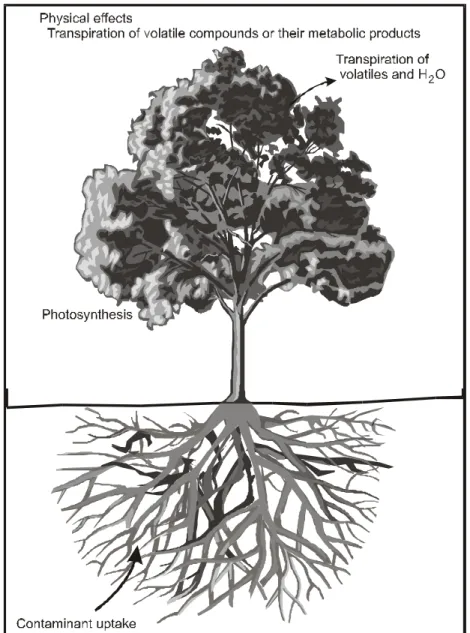
Phytoremediation applications (as shown in Figure 2-1 and Table 2-1) can be classified based on the contaminant fate: degradation, extraction, containment, or a combination of these. Phytoremediation applications can also be classified based on the mechanisms involved. Such mechanisms include ex-traction of contaminants from soil or groundwater; concentra-tion of contaminants in plant tissue; degradaconcentra-tion of contami-nants by various biotic or abiotic processes; volatilization or transpiration of volatile contaminants from plants to the air; immobilization of contaminants in the root zone; hydraulic control of contaminated groundwater (plume control); and
control of runoff, erosion, and infiltration by vegetative cov-ers. A brief explanation of these application categories fol-lows, with more detailed explanations in following chapters.
2.1.1.1 Degradation
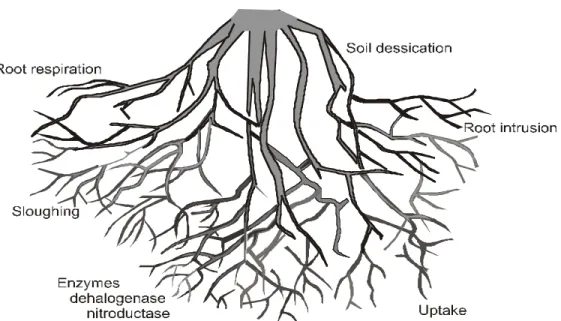
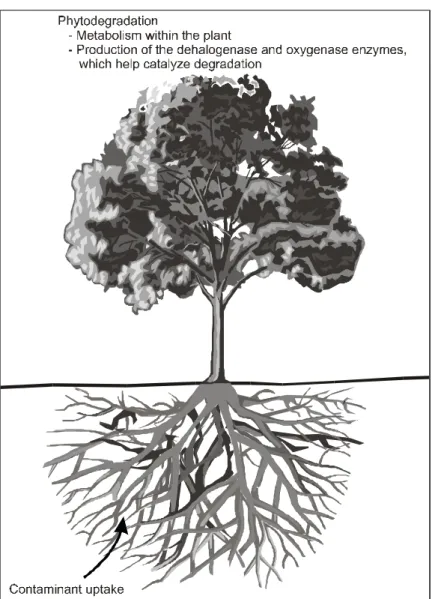
Plants may enhance degradation in the rhizosphere (root zone of influence). Microbial counts in rhizosphere soils can be 1 or 2 orders of magnitude greater than in nonrhizosphere soils. It is not known whether this is due to microbial or fungal symbiosis with the plant, plant exudates including enzymes, or other physical/chemical effects in the root zone. There are, however, measurable effects on certain contaminants in the root zone of planted areas. Several projects examine the in-teraction between plants and such contaminants as trinitro-toluene (TNT), total petroleum hydrocarbons (TPH), pentachlo-rophenol (PCP), and polynuclear aromatic hydrocarbons (PAH). Another possible mechanism for contaminant degradation is metabolism within the plant. Some plants may be able to take in toxic compounds and in the process of metabolizing the available nutrients, detoxify them. Trichloroethylene (TCE) is possibly degraded in poplar trees and the carbon used for tissue growth while the chloride is expelled through the roots. EPA has three projects underway in the field using populus species to remediate TCE. Tests at the University of Wash-ington are being developed to verify this degradation mecha-nism under controlled conditions.
2.1.1.2 Extraction
Phytoextraction, or phytomining, is the process of planting a crop of a species that is known to accumulate contami-nants in the shoots and leaves of the plants, and then har-vesting the crop and removing the contaminant from the site. Unlike the destructive degradation mechanisms, this tech-nique yields a mass of plant and contaminant (typically met-als) that must be transported for disposal or recycling. This is a concentration technology that leaves a much smaller mass to be disposed of when compared to excavation and landfilling. This technology is being evaluated in a Superfund Innovative Technology Evaluation (SITE) demonstration, and may also be a technology amenable to contaminant recovery and recy-cling.
Rhizofiltration is similar to phytoextraction in that it is also a concentration technology. It differs from phytoextraction
Chapter 2
Figure 2-1. Mechanisms for phytoremediation.
in that the mechanism is root accumulation and harvest using hydroponic (soil-less) growing techniques. This is use-ful for separating metal contaminants from water. Rhizofiltration has been demonstrated on U.S. Department of Energy (DOE) sites for radionuclides.
Volatilization or transpiration through plants into the at-mosphere is another possible mechanism for removing a contaminant from the soil or water of a site. It is often raised as a concern in response to a proposed phytoremediation project, but has not been shown to be an actual pathway for many contaminants. Mercury (Hg) has been shown to move through a plant and into the air in a plant that was geneti-cally altered to allow it to do so. The thought behind this media switching is that elemental Hg in the air poses less risk than other Hg forms in the soil. However, the technol-ogy or the associated risk has not been evaluated.
2.1.1.3 Containment and Immobilization
Containment using plants either binds the contaminants to the soil, renders them nonbioavailable, or immobilizes them by removing the means of transport.
Physical containment of contaminants by plants can take the form of binding the contaminants within a humic mol-ecule (humification), physical sequestration of metals as occurs in some wetlands, or by root accumulation in nonharvestable plants. Certain trees sequester large con-centrations of metals in their roots, and although harvesting and removal is difficult or impractical, the contaminants present a reduced human or environmental risk while they are bound in the roots.
Risk reduction may also be achieved by transforming the contaminant into a form that is not hazardous, or by
render-Table 2-1. Phytoremediation Applications
Mechanism Contaminant Media Plant Status Reference
Degradation Atrazine, nitrates Surface Water Poplar Applied Schnoor 1995a Degradation Landfill leachate Groundwater Poplar Applied Licht 1990 Degradation TCE Groundwater Poplar, cottonwood Field demo Rock 1997
Degradation TNT Wetlands Various Field demo Bader 1996
Carreira 1996 McCutcheon 1995
Degradation TPH Soil Grasses, crops Field demo Banks 1997
Drake 1997 Extraction-Concentration Lead Soil Indian mustard Field demo Blaylock 1997 in shoot
Extraction-Concentration Uranium Surface water Sunflower Field demo Dushenkov 1997 in root
Extraction, Volatilization Selenium Soil, Surface Water Various Applied Bañuelos 1996 Terry 1996 ing the contaminant nonbioavailable. EPA and the U.S.
De-partment of Agriculture (USDA) have ongoing research in this area.
Hydraulic control is another form of containment. Ground-water contaminant plume control may be achieved by wa-ter consumption, using plants to increase the evaporation and transpiration from a site. Some species of plants use tremendous quantities of water, and can extend roots to draw from the saturated zone. EPA is pursuing research in this area at a number of sites, including the SITE demon-strations at Ogden, UT and Ft. Worth, TX, and the Emer-gency Response Team (ERT) lead projects at Aberdeen Proving Grounds (Edgewood, MD) and the Edward Sears Properties Site (New Gretna, NJ). Private companies have installed trees as a hydraulic control at many sites.
Vegetative cover (evapotranspiration or water-balance cover) systems are another remediation application utiliz-ing the natural mechanisms of plants for minimizutiliz-ing infil-trating water. Originally proposed in arid and semi-arid re-gions, vegetative covers are currently being evaluated for all geographic regions. The effectiveness in all regions and climates needs to be assessed on a site-specific basis.
If there is potential for gas generation a vegetative cover may not be an option. For example, a municipal solid waste landfill can produce landfill gas that may be of concern to human health and the environment. Sites with requirements to collect and control landfill gas may not meet Federal requirements under the Clean Air Act if a vegetative cover is used.
Hydraulic control for groundwater plumes and water bal-ance covers are two technologies that are being applied in the field prior to model development predicting their be-havior. Under an EPA initiative called Alternative Cover As-sessment Program (ACAP), several of these field
installa-tions will be monitored carefully and consistently to gather data to both evaluate performance and to build and verify models to predict the performance of other proposed in-stallations. Data from a national network of sites that have similar measurement regimes will be a powerful tool for evaluating the appropriateness of a proposed installation, and help develop the tools for predicting the efficacy of similar cover systems.
2.1.2
Limits of Phytoremediation at
Hazardous Waste Sites
As a result of the early information provided by some research and reported by the media, site owners and citi-zen groups are interested in phytoremediation as possibly the cleanest and cheapest technology that may be em-ployed in the remediation of selected hazardous sites. Al-though current research continues to explore and push the boundaries of phytoremediation applications, there are certain limitations to plant-based remediation systems.
2.1.2.1 Root System
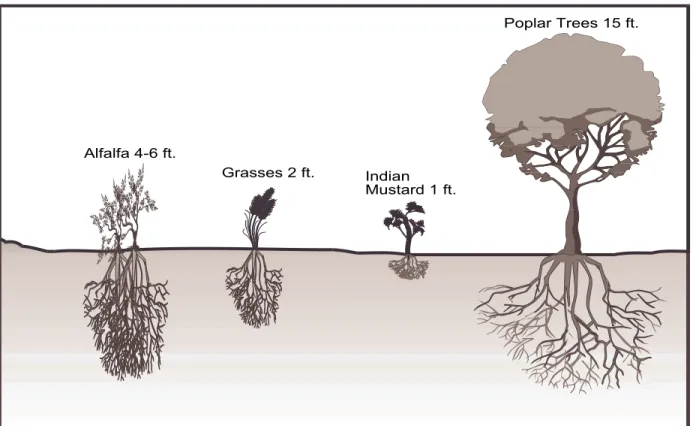
Root contact is a primary limitation on phytoremediation applicability. Remediation with plants requires that the con-taminants be in contact with the root zone of the plants. Either the plants must be able to extend roots to the con-taminants, or the contaminated media must be moved to within range of the plants. This movement can be accom-plished with standard agricultural equipment and practices, such as deep plowing to bring soil from 2 or 3 feet deep to within 8 to 10 inches of the surface for shallow-rooted crops and grasses, or by irrigating trees and grasses with con-taminated groundwater or wastewater. Because these ac-tivities can generate fugitive dust and volatile organic com-pound emissions, potential risks may need to be evalu-ated. As shown in Table 2-2 and illustrated in Figure 2-2, the effective root depth of plants varies by species and depends on soil and climate condition.
2.1.2.2 Growth Rate
Phytoremediation is also limited by the growth rate of the plants. More time may be required to phytoremediate a site as compared with other more traditional cleanup technolo-gies. Excavation and disposal or incineration takes weeks to months to accomplish, while phytoextraction or degrada-tion may need several years. Therefore, for sites that pose acute risks for human and other ecological receptors, phytoremediation may not be the remediation technique of choice.
2.1.2.3 Contaminant Concentration
Sites with widespread, low to medium level contamina-tion within the root zone are the best candidates for phytoremediative processes. High concentrations of con-taminants may inhibit plant growth and thus may limit ap-plication on some sites or some parts of sites. This phyto-toxicity could lead to a tiered remedial approach in which high concentration waste is handled with expensive ex situ techniques that quickly reduce acute risk, while in situ phytoremediation is used over a longer period of time to
clean the high volumes of lower contaminant concentra-tions.
2.1.2.4 Impacts of Contaminated Vegetation
Some ecological exposure may occur whenever plants are used to interact with contaminants from the soil. The fate of the metals in the biomass is a concern. At one site, sunflower plants that extracted cesium (Cs) and strontium (Sr) from surface water were disposed of as radioactive waste (Adler 1996).
Although some forms of phytoremediation involve accu-mulation of metals and require handling of plant material embedded with metals, most plants do not accumulate sig-nificant levels of organic contaminants. While metal accu-mulating plants will need to be harvested and either re-cycled or disposed of in compliance with applicable regu-lations, most phytoremediative plants do not require fur-ther treatment or disposal.
Often overlooked, however, is the possibility that natural vegetation on the site is already creating very similar (but often unrecognized) food chain exposures. In addition, even on currently unvegetated sites, contaminants will be enter-ing the food chain through soil organisms.
The remediation plan should identify and, if possible, quan-tify potential avenues of ecological exposure, and deter-mine if and where any accumulation of toxics in the se-lected plants will occur. Accumulation in fruits, seeds, and Table 2-2. Root Depth for Selected Phytoremediation Plants
Plant Maximum Root Depth Target Contaminants Indian mustard To 12 inches Metals
Grasses To 48 inches Organics Poplar trees To 15 feet Metals, organics,
chlorinated solvents
Alfalfa 4-6 ft.
Grasses 2 ft. Indian
Mustard 1 ft.
Poplar Trees 15 ft.
leaves typically creates more exposure than accumulation in stems and roots. Most organic contaminants do not ac-cumulate in significant amounts in plant tissue.
Some plant-eating animals have been shown to avoid eating plants with elevated metal levels (Pollard 1996). In addition, the increased habitat provided by the plants may in some cases offset any potential localized impacts.
If some organisms (e.g., caterpillars, rodents, deer, etc.) seem likely to ingest significant amounts of the vegeta-tion, and if harmful bioconcentration up the food chain is a concern during the life of the remediation effort, appropri-ate exposure control measures should be implemented including perimeter fencing, overhead netting, and pre-flow-ering harvesting. Phytoextraction techniques aim to har-vest metal-laden crops just as the plants translocate met-als into shoots, thereby limiting availability of contaminants for consumption.
Transfer of the contaminants or metabolites to the atmo-sphere might be the greatest regulatory concern. Transpi-ration of TCE into the atmosphere has been measured (Newman et al. 1997a), but little information is available that would indicate any release of vinyl chloride.
Research being done on the bioavailability of contami-nants and on human health and environmental risk as-sessment is directly related to phytoremediation. Studies are underway to determine if contaminants that are not available to plants for uptake or that are not vulnerable to plant remediation are less of a risk to human health and the environment.
2.2 Technical Considerations
Several key factors to consider when evaluating whether phytoremediation is a potential site remedy are described below.
1. Determine whether evidence of the potential effec-tiveness of phytoremediation is specific to the site matrix and contaminants. If laboratory studies on the plants and contaminants of interest are the primary evidence used to support the use of phytoremediation at the site, the studies should at least show that the plants to be used at the site are capable of remediating site contaminants.
2. Consider the protectiveness of the remedy during the time it takes the plants associated with phytoremediation to establish themselves at the site to a point where they are containing/degrading the contaminants of in-terest.
3. Consider whether phytoremediation is likely to clean up the site in an acceptable time frame.
4. An adequate backup or contingency technology should be identified in the event that phytoremediation is attempted and does not succeed.
Additionally, monitoring the efficacy of any innovative treatment may be more extensive than would be required
for a more accepted technology. Monitoring needs to ad-dress both the decrease in the concentration of the con-taminants in the media of concern, and examine the fate of the contaminants. The monitoring plan must be tailored to the site and plants.
2.2.1
Prior Applications of
Phytoremediation
One indication of acceptability of a technique is previ-ous successful applications on similar sites. Because it is a relatively new technology, phytoremediation does not have a long history of completed cleanups. Table 2-3 lists 12 Superfund sites where phytoremediation has been ac-cepted or is being field-tested for possible remediation of soil or groundwater contamination. Appendix B lists proximately 180 sites where the technology has been ap-plied or is being field-tested. The peer-reviewed field data that are available on these projects are limited. More data should become available in the next few years through the efforts of programs such as the Superfund Innovative nology Evaluation (SITE) program, the Remediation Tech-nologies Development Forum (RTDF), and others.
Results of studies done in greenhouses and on field test plots can be used to show proof of concept, and some of that data may be directly applicable to site-specific consid-eration. If time and funding permit, soil or water from the site should be used in lab or greenhouse studies. Such treatability studies can confirm the effectiveness of the site-specific treatment. Chapter 5 provides more information on treatability studies.
2.3 Economic Considerations
Because phytoremediation is an emerging technology, standard cost information is not readily available. Subse-quently, the ability to develop cost comparisons and to estimate project costs will need to be determined on a site-specific basis. Two considerations influence the econom-ics of phytoremediation: the potential for application, and the cost comparison to conventional treatments. Care must be taken to compare whole system costs, which may in-clude:
Design costs: Operating costs: Site characterization Maintenance Work plan and report preparation Irrigation water Treatability and pilot testing Fertilizer Installation costs pH control
Site preparation Chelating agent Facilities removal Drainage water disposal Debris removal Pesticides
Utility line removal/relocation Fencing/pest control Soil preparation Replanting
Physical modification: tilling Monitoring Chelating agents Soil nutrients
pH control Soil pH
Drainage Soil water
Infrastructure Plant nutrient status Irrigation system Plant contaminant status
roots, shoots, stems,
Fencing leaves)
Planting Tree sap flow monitoring Seeds, plants Air monitoring (leaves, Labor branches, whole tree, area) Protection Weather monitoring
The national potential for phytoremediation could be es-timated by first totaling the number of sites that contain organics and metals suitable for phytoremediation, i.e., those sites that contain contaminants in moderate con-centrations in near-surface groundwater or in shallow soils. Currently, such specific information about hazardous waste sites in the United States is not available. Kidney (1997) has estimated the current domestic market for phytoremediation at only $2 to $3 million for organics re-moval from groundwater, and $1 to $2 million for rere-moval of heavy metals from soils. The same study indicates that by the year 2005, however, the market for phytoremediation of organics in groundwater will be $20 to $45 million, of metals in soils will be $40 to $80 million, and of radionu-clides will be $25 to $50 million.
David Glass (1998) and others have estimated that total system costs for some phytoremediation applications will be 50 to 80% lower than alternatives. Each application of plants will yield a separate performance evaluation includ-ing rate and extent of cleanup and cost. Three actual cost estimates of applications are compared to conventional treatments in Table 2-4.
For some of phytoremediation applications, hypothetical cost comparisons have been projected. These are esti-mates based on laboratory and pilot scale work and tend to reflect projected total project costs.
Phytoextraction Costs
(A) The estimated 30-year costs (1998 dollars) for remediating a 12-acre lead site were $12,000,000 for ex-cavation and disposal, $6,300,000 for soil washing, $600,000 for a soil cap, and $200,000 for phytoextraction (Cunningham 1996).
(B) Cost estimates made for remediation of a hypotheti-cal case of a 20-in.-thick layer of sediments contaminated with Cd, Zn, and 137Cs from a 1.2-acre chemical waste disposal pond indicated that phytoextraction would cost about one-third the amount of soil washing (Cornish et al. 1995).
(C) Costs were estimated to be $60,000 to $100,000 using phytoextraction for remediation of one acre of 20-in.-thick sandy loam compared to a minimum of $400,000 for just excavation and storage of this soil (Salt et al. 1995).
Rhizofiltration Costs
The cost of removing radionuclides from water with sun-flowers has been estimated to be $2 to $6 per thousand gallons of water (Dushenkov et al. 1997).
Phytostabilization Costs
Cropping system costs have been estimated at $200 to $10,000 per hectare, equivalent to $0.02 to $1.00 per cu-bic meter of soil, assuming a 1-meter root depth (Cunningham et al. 1995b).
Hydraulic Control Costs
Estimated costs for remediation of an unspecified con-taminant in a 20-foot-deep aquifer at a 1-acre site were $660,00 for conventional pump-and-treat, and $250,000 for phytoremediation using trees (Gatliff 1994).
Vegetative Cover Costs
Cost estimates indicate savings for an evapotranspira-tion cover compared to a tradievapotranspira-tional cover design to be 20 Table 2-3. Phytoremediation at Superfund Sites
Site Name, State Date Planted Plant Contaminant/Matrix
Carswell Site, TX Spring 1996 Eastern cottonwood tree TCE/groundwater at 4-12 feet Aberdeen Proving Grounds, MD Spring 1996 Hybrid poplar trees TCE/groundwater
Edward Sears Site, NJ Fall 1996 Hybrid poplar trees TCE/groundwater at 8 feet Iowa Army Ammunition Depot, IA Spring 1997 Wetland and terrestrial plants TNT/soil and pond water Fort Wainwright, AK Spring 1997 Felt leaf willow Pesticides/soil and groundwater Kaufman & Minteer, NJ Spring 1997 Hybrid poplar trees PCE/groundwater
Calhoun Park, SC Fall 1998 Local landscaping plants PAH/groundwater at 1-4 feet Solvent Recovery Systems of Spring 1998 Hybrid poplar trees Mixed solvents/groundwater New England, CT
Twin Cities Army Ammunition Spring 1998 Corn, Indian mustard Metals/soil Plant, MN
Bofors-Nobel, MI Planting scheduled Various trees and wetland plants Residual sludge in waste lagoons Del Monte, HI Spring 1998 Koa haole Pesticides/soil and groundwater
to 50%, depending on availability of suitable soil (RTDF 1998).
2.4 Regulatory Considerations
While Federal regulations specific to phytoremediation have not been developed, a range of existing Federal and state regulatory programs may pertain to site-specific de-cisions regarding the use of this technology. These pro-grams include those established under the: Resource Con-servation and Recovery Act (RCRA); Comprehensive En-vironmental Response, Compensation, and Liability Act (CERCLA) referred to as “Superfund”; Clean Air Act (CAA); Toxic Substances Control Act (TSCA); Federal Insecticide, Fungicide, and Rodenticide Act (FIFRA); Federal Food, Drug, and Cosmetic Act (FFDCA); and statutes enforced by the U.S. Department of Agriculture. These programs are discussed in the following sections.
2.4.1
RCRA
RCRA has nine sections (Subtitles) that deal with spe-cific waste management activities. Two of these Subtitles are most likely to pertain to the use of phytoremediation: Subtitle C (Hazardous Waste Management), and Subtitle D (Solid Waste Management).
EPA issued closure requirements for Subtitles C and D treatment, storage, or disposal (TSD) units, which may be closed by removal or decontamination (“clean closure”) or closed with waste in place (“landfill closure”) (see 40 CFR Parts 257, 258, 264, and 265). The regulations include general closure requirements for all RCRA units and spe-cific closure requirements for each type of TSD unit. The requirements are performance-based, and therefore do not stipulate any design standards. EPA delegates these regu-latory programs to the states, which are responsible for their implementation. The Federal requirements are mini-mum requirements that must be incorporated into state regulatory programs; however, states may promulgate clo-sure requirements that are more stringent than those of the Federal program. Site-specific evaluation of the use of alternative covers at TSDs that close as a landfill will need to include consideration of these requirements.
The Corrective Action Program, under RCRA, requires corrective action, as necessary, to protect human health and the environment for releases from solid waste man-agement units at facilities seeking RCRA permits. This pro-gram is implemented primarily through a series of policy directives, and is similar in nature to the Superfund program’s remedy selection process contained in the National Contin-gency Plan (NCP). EPA also delegates the Corrective Ac-tion Program to the states. Policy directives pertinent to the Corrective Action Program are available at http:// www.epa.gov/correctiveaction.
2.4.2
CERLCA (Superfund)
Remedial actions taken under the Superfund program must attain a general standard of cleanup that assures protection of human health and the environment, must be cost effec-tive, and must use permanent solutions and alternative treat-ment technologies or resource recovery technologies to the maximum extent practicable. The regulatory framework for response actions under CERCLA is contained in 40 CFR Part 300, the National Oil and Hazardous Substances Pol-lution Contingency Plan, referred to as the NCP. The rem-edy selection process outlined in the NCP includes a Fea-sibility Study (FS), in which alternatives that represent vi-able approaches are assessed against nine criteria. With respect to phytoremediation, data collected from treatabil-ity studies or other means will provide the necessary scien-tific documentation to allow an objective evaluation (using the nine criteria) of whether phytoremediation is the most appropriate remedial option for a given site.
An important component in Superfund response actions is the requirement that for any material remaining on-site, EPA will attain or exceed any Federal or state limitation, standard, or criteria that is considered to be applicable or relevant and appropriate (ARAR) given the circumstances of the site (for off-site actions, all applicable requirements must be met). Further, on-site remedial actions must at-tain promulgated state ARARs that are more stringent than Federal ARARs. A requirement is applicable if the specific terms of the law or regulations directly address the cir-cumstances at the site. If not applicable, a requirement may nevertheless be relevant and appropriate if circum-stances at the site are sufficiently similar to the problems Table 2-4. Example Cost Comparisons
Phytoremediation Cost Conventional Cost Projected
Problem Application ($ thousand) Treatment ($ thousand) Savings
Lead in soil, 1 acrea Extraction, harvest $150-250 Excavate and landfill $500 50-65%
disposal
Solvents in groundwater, Degradation and $200 install and Pump and treat $700 annual running 50% cost saving 2.5 acresb hydraulic control initial maintenance cost by third year
TPH in soil, 1 acrec In situ degradation $50-100 Excavate and landfill $500 80%
incinerate
a Phytotech estimate for Magic Marker site (Blaylock et al. 1997). b PRP estimate for Solvent Recovery Systems of New England site. c PERF estimate (Drake 1997)
regulated by the requirement. The Maximum Contaminant Levels (MCLs) under the Safe Drinking Water Act are an example of relevant and appropriate requirements.
In order for phytoremediation to be selected as a rem-edy at a CERLCA site, it will be necessary to meet or waive the ARARs identified for the site. ARARs can be waived under six specific circumstances described in the NCP.
2.4.3
CAA
Sections 111 and 112 of the Clean Air Act (CAA) contain the statutory basis for regulation of criteria and hazardous air pollutant emissions from source categories. The New Source Performance Standards and Emission Guidelines for Municipal Solid Waste Landfills, 40 CFR Part 60 Subparts WWW and Cc, are statutorily based on section 111 of the CAA. These standards were promulgated in March 1996 and regulate air emissions of non-methane organic compounds (NMOCs) from municipal solid waste landfills. Specifically, these standards require municipal solid waste landfills with a waste capacity of at least 2.5 million megagrams and with the potentially to emit at least 50 megagrams of NMOC to collect and control landfill gas. A second standard, 40 CFR Part 63 Subpart AAAA, statutorily based on section 112 of the CAA is currently under development. This regulation will regulate hazardous air pollutant emissions from municipal solid waste landfills. These regulations set performance based standards that allow owners and operators a number of op-tions to achieve compliance. EPA delegates the implemen-tation of these regulations to Federal, State and local gov-ernments. These Federal standards establish minimum re-quirements that must be implemented. However, State and local governments may choose to increase the stringency of these requirements. Any site contemplating the use of Phytoremediation needs to consider the requirements es-tablished by Federal, State and local government programs to regulate air emissions from municipal solid waste landfills.
2.4.4
TSCA
Although the EPA does not currently regulate plants in-tended for commercial bioremediation, EPA believes the Toxic Substances Control Act (TSCA) gives it authority to do so if such action is necessary to prevent unreasonable risk to human health or the environment. TSCA gives EPA authority to regulate “chemical substances.” TSCA defines chemical substances broadly to mean all chemicals and mixtures of chemical substances. Living organisms such as plants are mixtures of chemical substances and thus are subject to TSCA. Although TSCA could potentially be applied to plants used in bioremediation, EPA has not yet made a determination of whether such action is neces-sary to protect the environment and human health. EPA to date has only issued regulations for microorganisms under Section 5 of TSCA (EPA, 1997). Further informa-tion on TSCA and biotechnology products can be found at http://www.epa.gov/opptintr/biotech/.
2.4.5
FIFRA/FFDCA
Certain plants engineered to contain sequences that af-ford the plant resistance to pests to enhance the remediation efficacy of the plant could be subject to
re-view by EPA under its authority to regulate pesticides. EPA regulates pesticides under two statutes: the Federal In-secticide, Fungicide, and Rodenticide Act (FIFRA), and the Federal Food, Drug, and Cosmetic Act (FFDCA). Sub-stances that plants produce to protect themselves against pests and disease are pesticides under the definition of FIFRA Section 2 (i.e., if they are “...intended for prevent-ing, destroyprevent-ing, repellprevent-ing, mitigating any pest....”) regard-less of whether the pesticidal capabilities evolved in the plants or were introduced by breeding or through the tech-niques of modern biotechnology. These substances, along with the genetic material necessary to produce them, are designated “plant-pesticides”(EPA, 1994). Additional de-tails about EPA plant pesticide regulations can be found at http://www.epa.gov/fedrstr/EPA-PEST/1994/November/ Day-23/. The U.S. Food and Drug Administration has re-sponsibility for food safety under the FFDCA. It is unlikely FDA would be involved in the review of phytoremediation plants since use of phytoremediation plants as food or as components of food is an unlikely scenario.
2.4.6
Department of Agriculture Statutes
Plants used for phytoremediation could be potentially regulated under several U.S. statutes. The U.S. Depart-ment of Agriculture (USDA) administers several statutes that could be used to regulate such plants: e.g., the Fed-eral Plant Pest Act (7 U.S.C. 150aa et seq.), the Plant Quar-antine Act (7 U.S.C. 151 et seq.), and the Federal Noxious Weed Act (7 U.S.C. 2801 et seq.). Pertinent regulations are found at 7 CFR Parts 319, 321, 330, 340, and 360, respectively. Under USDA authority, one type of plant (transgenic or naturally-occurring) potentially subject to review would be a plant considered to be a plant pest. For additional guidance on USDA regulations pertaining to plants, refer to http://www.aphis.usda.gov/bbep/bp/.
2.5 Ecosystem Restoration
Vegetation is not only an aid to ecosystem restoration, it is a key indicator. Plant species that are present on a site, as well as their quantities and condition, describe a watershed’s health and resilience. Loss of vegetation through clearing, building, and human land use has se-vere ecosystem effects. After a human disturbance such as mining, dumping, industrial, agricultural, or residential use, revegetation may occur slowly. Recolonization of con-taminated or disturbed ground by plants typically starts at the edges of an impacted area. Natural revegetation may take decades or hundreds of years because it is depen-dent on animal and windborne seeding. If replanting is designed and carried out in a way that includes the per-spectives of engineers, botanists, ecologists, landscape architects, and others, the environmental systems can begin to be restored in a few years. In some cases phytoremediation can help restore wild species diversity through habitat growth in addition to aiding in remediation of soil and water.
Despite the general ecological advantages of phytoremediation, adverse ecological effects are possible to both on- and off-site biological communities. In
evaluat-ing such concerns, it is important to compare the relative ecological risks posed by phytoremediation to those risks already occurring on site or those risks posed by alterna-tive cleanup methods. Actions needed to protect ecosys-tems should be clearly specified in the site cleanup plan.
Overall ecological risks associated with remediation of a site are often overlooked, even by interested parties who may be familiar with the human health and ecological risks associated with current site conditions or with the general risks posed by feasible alternative cleanup methods. These overall ecological concerns may be expressed in a limited context that does not help in the selection of an alterna-tive. Often, however, a site visit will broaden the under-standing of interested parties and thus enable them to better assist in identifying options with the greatest overall eco-logical benefits.
Listed below are issues that typically arise in such dis-cussions. Also included are frequently overlooked factors that should be considered in identifying the relative risks.
2.5.1
Introduction of Non-Native Plants
History is rife with disastrous examples of newly intro-duced plant species spreading quickly to damage native ecosystems (e.g., kudzu, Eurasian watermilfoil, etc.). Plants that work best in remediating a particular contaminant may or may not be native to a particular area. Although native plants are most desirable, non-native species may be ac-ceptable under the following circumstances:
• The plants have been previously introduced, and are now so common that their proposed use would not create a new ecological risk.
• The plants are unable to propagate effectively in the wild (e.g., sterility, dependence on human cultivation, etc.).
• Genetically altered plants have been introduced. Man-kind has been using selective breeding to obtain de-sired plant characteristics for at least 10,000 years. Now, researchers in many fields are using new ge-netic engineering techniques to replace selective breed-ing, allowing them to achieve their desired results more quickly and selectively. Decisions on the desirability of using genetically engineered plants must be site spe-cific.
2.5.2
Integration of Phytoremediation
Into the Site’s Long-Term
Landscaping Objectives
Long-term phytoremediation-based treatment can be de-signed into future site landscaping plans, e.g., tree borders used for shading and visual screening can also provide on-going groundwater remediation, etc. Such vegetation can often create valuable ecological niches, particularly in ur-ban industrial areas.
Public Uses
A number of contaminated sites are being converted to parks and other low-intensity public uses. These sites, particularly with their greater flexibility in the timing and design of cleanup, frequently offer significant ecological opportunities. Trees and shrubs do not have to be planted in straight rows to be effective in remediation.
Commercial Uses
Businesses traditionally landscape for aesthetic reasons and storm run-off control. These functions may be com-bined with phytoremediation to offer significant opportuni-ties. Properly designed and located, such landscaping could also provide long-term treatment and enhanced ecologi-cal habitats. A site owner may be willing to significantly expand the land committed to phytoremediative landscap-ing if that commitment would reduce overall cleanup costs and allow quicker site redevelopment. A phased approach, with intensive short-term treatment by one plant species followed by permanent plantings with more beneficial veg-etation, may maximize ecosystem benefits.
Wood Lot Uses
Short-rotation woody crops for pulp, fuel, or timber may be grown on land with nonaccumulating organic contami-nants. The trees could be grown and harvested while re-calcitrant compounds slowly degrade.
2.5.3
Phytoremediation as an Interim
Solution
Phytoremediation is most suitable for remediating sites or portions of sites with widespread, low-mid level con-taminants that are often too expensive to remediate by traditional means. Absent a cost-effective remediation method, contaminants are often left in place, and contact with the waste attempted to be minimized by fences, insti-tutional controls and deed restrictions. Too often no one is required or able to cleanup the site, and many sites have been abandoned with no clean up or controls. Occasion-ally a phytoremediation system may be inexpensive enough that it could be installed during considerations and debate regarding a permanent solution, and removed once a final remedy is implemented. The interim ecosystem benefits, coupled with improved aesthetics, and some containment and/or degradation may combine to make even temporary revegetation worthwhile.
Although phytoremediation may not be the selected fi-nal technique, the benefits of a well-designed, properly in-stalled, and capably managed phytoremediation system may be preferable to the risks posed by leaving a waste site completely untreated during delays in implementing a final remedy.
2.5.4
Ecosystem Restoration at
Phytoremediation Sites
Many sites with contamination support complex ecosys-tems, primarily due to the low level of human activity on the
site. Plants and animals recolonize some areas where de-creased human traffic allows vegetation to take root. Phy-toremediation could aid the natural revegetation underway on such site. Phytoremediation can make use of various types of plants, and it is possible to consider local or native plants as part of a remediation system.
In order to consider using native plants, the remediation potential of plants already growing on the site must be carefully assessed. It must be determined whether these plants are just tolerating the contaminant or whether they are already actively remediating it. A field or greenhouse study may be needed to make this determination.
If non-native plants must be utilized, appropriate control techniques (e.g., sterile plants) should be used to ensure that genetic contamination or invasive spread does not occur.
Phytoremediative plants with desirable ecological values could provide diversified habitat where appropriate. A combination of trees, understory shrubs, and grasses may provide shelter and food for numerous species. Nonphytoremediative plants can be added to supplement ecological values such as soil stabilization or to provide a food source.
Evaluating the ecological recovery of a site is important, but such an evaluation does not have to be expensive or complex. Neighborhood environmental and school groups could “adopt” a brownfield or similar distressed site and provide data of mutual interest (e.g., the local Audubon Society could assess bird habitat utilization; a biology class could track plant species survival and growth, etc.). Prop-erly done, such collaborative monitoring can build commu-nity understanding and support, while also providing data that would be otherwise unaffordable, and is seldom col-lected during remediation. Many sites will not allow access by untrained personnel. Personal protection must always be a foremost concern in any such collaboration.
As noted earlier, phytoremediation offers significant eco-logical promise, but it is not a perfect solution. Ecoeco-logical benefits in one area may create ecological impacts in oth-ers. Negative impacts must be avoided. Some stakehold-ers may disagree with this definition of ecosystem restora-tion because it does not attempt to recreate a pristine eco-system. Although it may not be possible or feasible to re-turn a site to its condition before human impact, phytoremediation may provide realistic opportunities to im-prove the overall ecological health of a site.
2.6 Current Research
To assess the appropriateness of any phytoremediation application, media- and contaminant-specific field data must be obtained that can show the rate and extent of degrada-tion or extracdegrada-tion. The existing knowledge base is limited, and specific data are needed on more plants, contami-nants, and climate conditions.
In addition, monitoring systems need to be standard-ized. Currently there is no industry or research consensus
on which parameters are crucial to measure, and very few projects can afford to sample, analyze, or monitor very many parameters over the years needed for most phytoremediation projects.
The EPA’s Office of Research and Development (ORD) and the Office of Solid Waste and Emergency Response (OSWER) have several programs that investigate the effi-cacy, risk, and cost of phytoremediation. These EPA ac-tivities include EPA in-house laboratory research efforts, support given to universities that are centers for phytoremediation research, and joint EPA-private coopera-tive efforts to field-test phytoremediation.
EPA’s Office of Research and Development manages various in-house research projects, and several EPA labo-ratories have work underway to determine the fate of con-taminants in phytoremediation applications. Steve McCutcheon and Lee Wolfe at the EPA National Exposure Research Laboratory (NERL) in Athens, GA, have explored the degradation of TNT by wetland plants, and continue to investigate plant enzyme and contaminant interactions. Albert Venosa at the EPA National Risk Management Re-search Laboratory (NRMRL) in Cincinnati, OH, is reRe-search- research-ing the effect of plants on oil spills in salt and fresh water wetlands. James Ryan, who is also at EPA-NRMRL, is working with Rufus Chaney of USDA on using plants to immobilize metals in soil. Richard Brenner, also at EPA-NRMRL, is leading a team comparing the use of land farm-ing and phytoremediation on the site of a former manufac-tured gas facility. Harry Compton and George Prince of the ERT are monitoring poplar tree plantings at Superfund sites in MD and NJ (see Table 2-3). Larry Erickson’s EPA-supported Hazardous Substance Research Center at Kan-sas State University has for many years sponsored re-search and symposia on the interaction of plants and con-taminants. Tom Wilson at EPA Region 10 continues to ex-plore and encourage innovative applications and interac-tions between phytoremediation and ecosystem restora-tion.
The Superfund Innovative Technology Evaluation Pro-gram (SITE) demonstrates field-ready technologies that are initiated and installed by the developer of the technol-ogy. SITE began evaluating phytoremediation projects in 1994. Currently four full demonstrations (including two at Superfund sites), and one Emerging Program project have been done or are underway using phytoremediation, coor-dinated by Steve Rock at EPA-NRMRL in Cincinnati, OH. Reports detailing the performance of the demonstrations will be published at the conclusion of the field work. Infor-mation on the SITE program or individual projects can be found at http://www.epa.gov/ORD/SITE.
EPA’s Office of Research and Development and the Of-fice of Solid Waste and Emergency Response (OSWER) jointly support the Remediation Technologies Development Forum (RTDF). The RTDF was established in 1992 by the EPA to foster collaboration between the public and private sectors in developing innovative solutions to mutual
haz-ardous waste problems. The RTDF has grown to include partners from industry, several government agencies, and academia who share the common goal of developing more effective, less-costly hazardous waste characterization and treatment technologies. There are currently seven RTDF Action Teams, including the “Phytoremediation of Organics Action Team.” This Action Team was formed in early 1997, and is currently comprised of three working groups that are concerned with phytoremediation of three separate pollution/matrix situations: petroleum compounds in shal-low soils, chlorinated solvents in near-surface ground-water, and the use of vegetation with high transpiration rates as an alternative cap for hydraulic containment and/ or degradation of various pollutants. The Action Team has held several meetings, and has regular conference calls to select and implement field testing projects. Cur-rent co-chairs in the subcommittees include representa-tives from Chevron, Exxon, the Air Force, and Union Carbide.
To access meeting and teleconference minutes, biblio-graphic information on phytoremediation, and other infor-mation, refer to http://www.rtdf.org. The Technology Innova-tion Office (TIO) within OSWER supports RTDF activities, as well as other efforts aimed at bringing innovative site characterization and treatment technologies to commercial-ization. Further information on the Technology Innovation Office and resources generated by TIO can be found at http://www.clu-in.org.
In addition to EPA efforts, other Federal agencies, uni-versities, consultants, and remediation contractors have research underway in phytoremediation. All these projects expand the knowledge base of what plants can be expected to do consistently, and make the application of innovative technologies more acceptable to regulators and consum-ers.
Continuing research and policy discussions in the re-lated areas of determining possible risk-based alternative endpoints for cleanups, and measuring the intrinsic remediative capacity of a site (natural attenuation) will im-pact the applicability of many biological-based technolo-gies, including plant-based systems.
Enhancements to the various phytoremediation pro-cesses are continuing. Some applied research is directed at selecting and breeding plants that have more of an at-tractive quality such as hyperaccumulation of metal, pro-duction of certain enzymes, and affinity or tolerance for contaminants. Research continues in genetic engineering of plants to combine positive traits, alter enzyme systems, or increase a plant’s natural range.
An engineering approach could be pursued by using ex-isting plant traits as only a part of a remediation system of combined planted systems and mechanical, thermal, or chemical systems in treatment trains. Suggested combi-nations include electrokinetics, bioventing, and surfactant addition.
This chapter presents a literature review and evaluation of the major phytoremediation processes or technologies. The technologies presented represent the major, significant, or widely studied forms of phytoremediation.
This chapter is divided into subsections that present defi-nitions, mechanisms, site characteristics, applicable me-dia, contaminants amenable to each process, and the as-sociated concentrations where available. The advantages, disadvantages, and current status of each process are also discussed. Finally, an annotated reference list is included at the end of the discussion of each process to provide more detailed, specific information.
The purpose of this chapter is to provide site managers with an overview of the various phytoremediation processes as well as what can be expected from the process and its limitations. Therefore, information on applicable contami-nants/concentrations is included even though the informa-tion may not be complete. Table 3-1 presents a summary of the various phytoremediation processes.
3.1 Phytoextraction
3.1.1
Definition/Mechanism
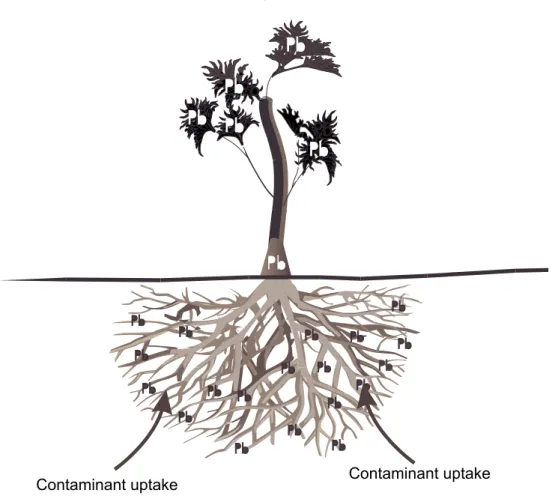
Phytoextraction is the uptake of contaminants by plant roots and translocation within the plants. Contaminants are generally removed by harvesting the plants. This concen-tration technology leaves a much smaller mass to be dis-posed of than does excavation of the soil or other media. This technology is most often applied to metal-contami-nated soil as shown in Figure 3-1.
3.1.2
Media
Phytoextraction is primarily used in the treatment of soil, sediments, and sludges. It can be used to a lesser extent for treatment of contaminated water.
3.1.3
Advantages
The plant biomass containing the extracted contaminant can be a resource. For example, biomass that contains se-lenium (Se), an essential nutrient, has been transported to areas that are deficient in Se and used for animal feed (Bañuelos 1997a).
3.1.4
Disadvantages
Phytoextraction has the following disadvantages:
• Metal hyperaccumulators are generally slow-growing with a small biomass and shallow root systems.
• Plant biomass must be harvested and removed, fol-lowed by metal reclamation or proper disposal of the biomass. Hyperaccumulators may accumulate signifi-cant metal concentrations — e.g., Thlaspi rotundifolium grown in a lead-zinc mine area contained 8,200 g/g Pb (0.82%) and 17,300 g/g zinc (Zn) (1.73%), and Armeria maritima var. halleri contained 1,300 g/g Pb, dry weight basis (Reeves and Brooks 1983).
• Metals may have a phytotoxic effect (Nanda Kumar et al. 1995).
• Phytoextraction studies conducted using hydroponically-grown plants, with the contaminant added in solution, may not reflect actual conditions and results occurring in soil. Phytoextraction coefficients measured under field conditions are likely to be less than those determined in the laboratory (Nanda Kumar et al. 1995).
3.1.5
Applicable Contaminants/
Concentrations
3.1.5.1 Applicable Contaminants
Constituents amenable to phytoextraction include: • Metals: Ag, Cd, Co, Cr, Cu, Hg, Mn, Mo, Ni, Pb, Zn
The relative degree of uptake of different metals will vary. Experimentally-determined phytoextraction coef-ficients [ratio of g metal/g dry weight (DW) of shoot to g metal/g DW of soil] for B. juncea (Nanda Kumar et al. 1995) indicate, for example, that lead was much more difficult to take up than cadmium:
Metal Phytoextraction Coefficient
Cr6+ 58 Cd2+ 52 Ni2+ 31 Cu2+ 7 Pb2+ 1.7 Cr3+ 0.1 Zn2+ 17 • Metalloids: As, Se
Chapter 3
Table 3-1. Phytoremediation Overview
Mechanism Process Goal Media Contaminants Plants Status
Phytoextraction Contaminant extraction Soil, sediment, Metals: Ag, Cd, Co, Indian mustard, Laboratory, pilot, and and capture sludges Cr, Cu, Hg, Mn, Mo, Ni, pennycress, alyssum field applications
Pb, Zn; Radionuclides: sunflowers, hybrid
90Sr, 137Cs, 239Pu, 238,234U poplars
Rhizofiltration Contaminant extraction Groundwater, Metals, radionuclides Sunflowers, Indian Laboratory and
pilot-and capture surface water mustard, water scale
hyacinth
Phytostabilization Contaminant Soil, sediment, As, Cd, Cr, Cu, Hs, Pb, Indian mustard, Field application
containment sludges Zn hybrid poplars,
grasses
Rhizodegradation Contaminant Soil, sediment, Organic compounds Red mulberry, Field application destruction sludges, (TPH, PAHs, pesticides grasses, hybrid
groundwater, chlorinated solvents, poplar, cattail, rice PCBs)
Phytodegradation Contaminant destruction Soil, sediment, Organic compounds, Algae, stonewort, Field demonstration sludges, chlorinated solvents, hybrid poplar,
groundwater phenols, herbicides, black willow, bald surface water munitions cypress
Phytovolatilization Contaminant extraction Groundwater, Chlorinated solvents, Poplars, alfalfa Laboratory and field from media and release soil, sediment, some inorganics (Se, black locust, application
to air sludges Hg, and As) Indian mustard
Hydraulic control Contaminant degradation Groundwater, Water-soluble organics Hybrid poplar, Field demonstration (plume control) or containment surface water and inorganics cottonwood, willow
Vegetative cover Contaminant containment, Soil, sludge, Organic and inorganic Poplars, grasses Field application (evapotranspiration erosion control sediments compounds
cover)
Riparian corridors Contaminant destruction Surface water, Water-soluble organics Poplars Field application (non-point source groundwater and inorganics
control)
• Radionuclides: 90Sr, 137Cs, 239Pu, 238U, 234U • Nonmetals: B
• Organics: The accumulation of organics and subsequent removal of biomass generally has not been examined as a remedial strategy.
3.1.5.2 Contaminant Concentrations
Contaminated soil concentrations used in research studies or found in field investigations are given below. These are total metal concentrations; the mobile or avail-able concentrations would be less.
• 1,250 mg/kg As (Pierzynski et al. 1994). • 9.4 mg/kg Cd (Pierzynski et al. 1994). • 11 mg/kg Cd (Pierzynski and Schwab 1992).
• 13.6 mg/kg Cd (Thlaspi caerulescens) (Baker et al. 1995).
• 2000 mg/kg Cd was used in studies of Cd uptake in vegetables (Azadpour and Matthews, 1996).
• 110 mg/kg Pb (Pierzynski and Schwab 1992). • 625 mg/kg Pb (Nanda Kumar et al. 1995). • 40 mg/kg Se (Bañuelos et al. 1997b).
• 444 mg/kg Zn (Thlaspi caerulescens) (Baker et al. 1995). • 1,165 mg/kg Zn was suspected to have phytotoxic
ef-fects (Pierzynski and Schwab 1992).
Nanda Kumar et al. (1995) reported that the following concentrations were not phytotoxic to Brassica juncea when added to soil mixtures:
2 mg/L Cd2+ 100 mg/L Ni2+ 50 mg/L Cr3+ 500 mg/L Pb2+ 3.5 mg/L Cr6+ 100 mg/L Zn2+ 10 mg/L Cu2+