
61
Behavioral Addictions © 2014 Elsevier Inc.
http://dx.doi.org/10.1016/B978-0-12-407724-9.00004-5 All rights reserved.
CHAPTER
Problematic Online Gaming
Orsolya Király1,2, Katalin Nagygyörgy1,2, Mark D. Griffiths3, Zsolt Demetrovics11Department of Clinical Psychology and Addiction, Institute of Psychology, Eötvös Loránd University, Budapest, Hungary, 2Department of Clinical Psychology and Addiction, Doctoral School of Psychology, Eötvös Loránd University, Budapest, Hungary, 3Nottingham Trent University, Psychology Division, Nottingham, United Kingdom
HISTORY AND TYPOLOGY OF ONLINE GAMES
Since their appearance in the 1990s, online video games have become widely popular and accessible. Nowadays, they are one of the most widespread recreational activities irrespective of culture, age, and gender. Parallel with this, dangers of problematic use have begun to arise. Video games can be played on many different platforms, such as personal computers (PCs), video game con-soles, handheld game concon-soles, or smartphones—all of which can be played via access to the Internet. In this chapter, these games are referred to simply as online games, although several different names (e.g., online video games, Internet video games) can be found in the literature. Another important point to be made is that online gaming differs from online gambling, because there is no money staked during these games in an attempt to win further money.
Video games can be divided into two main groups—online and offline video games—a distinction that can significantly influence player behavior. Offline games are usually (but not always) played alone, they have a well-defined start and finish point, and the goals of the game can usually be achieved by the players themselves without external help from any other player. However, online games are typically played simultaneously by players who can communicate with one another in real time, cooperating or com-peting at will. Because of their inherent structural characteristics, these games do not usually have a predetermined end point. Furthermore, new tasks and quests are frequently added by the game developers and/or game operators. Subsequently, there is no real loss, and tasks can be repeated sev-eral times. Some goals can be achieved alone or together with other players, while others can be completed only by players working together in highly cooperative groups. Competing with fellow players is also possible and leads to immediate social comparison (Griffiths, 2010b; Kim & Kim, 2010;
Williams, Ducheneaut, Xiong, & Yee, 2006). Consequently, online games are distinguished from offline games mostly by their social nature (Charlton & Danforth, 2007; Choi & Kim, 2004; Kim & Kim, 2010). Although in some games the aforementioned characteristics blend, most of them can clearly be specified as offline or online games. Due to these characteristics, the popularity of these game types can differ greatly. De Prato et al. (2010)
indicate that 70% of gamers prefer online as opposed to offline games. Online gamers spend more time gaming than those who play offline games, mostly because of the social nature of these games. They find online games more pleasant and satisfying than offline games and sometimes prefer playing games to real-life activities (Ng & Wiemer-Hastings, 2005). These motives may also account for the findings showing that online games trigger the appearance of problematic use more often than offline games do (Griffiths, Davies, & Chappell, 2004; Griffiths & Meredith, 2009; Rehbein, Psych, Kleimann, Mediasci, & Mossle, 2010).
The first prototypical online games were the text-based virtual worlds called multi-user domains (referred to as MUDs) that appeared in the 1970s (Bartle, 2003). These were persistent1 digital worlds where several players
could “be present” and interact with each other at the same time (using their own imagination instead of graphics). This new environment created so many new possibilities (e.g., real-time chat, interaction between the play-ers, parallel activities, cooperation, competition, social comparison) that the popularity of MUDs continued to increase as the number of Internet users rose. During the same period, table-top role-playing games (RPGs) appeared in which players threw dice to determine the outcomes of moving small figures around a player-drawn map. In both types of game (MUDs and RPGs), players created characters with attributes and skills to help them fight together through dungeons filled with dangerous beasts to acquire magical items (Barnett & Coulson, 2010).
Out of these text-based virtual worlds and table-top role-playing games arose the surprisingly complex (two- and three-dimensional) graphical virtual worlds, known today as MMOGs (massively multiplayer online games), or MMOs for short. The massively component indicates that hun-dreds or even thousands of players can be present in the same virtual game world at any given moment. The multiplayer word refers to the fact that people play simultaneously in the same online world, not in an individual copy of it, while the word online indicates that the game can be played only
1 Persistence refers here to the fact that these digital worlds not only are generated when some players
through a platform with an Internet connection (Barnett & Coulson, 2010). The three mosaic words also hint at the degree of complexity. For the time being, MMOGs are the most complex games and offer persistent virtual spaces for the hundreds of thousands of players that inhabit them. Multi-player online games (MOGs) are arguably simpler. These are also played by groups of players together, but do not offer synchronic spaces, and the num-ber of players is highly limited (e.g., 4–16 players). An online game (OG) simply refers to the fact that such games are played in an Internet-based environment, and the multiplayer mode is not a condition.
MMOs vary in terms of content, challenges, and setting, but all MMOs share six technical and design characteristics that collectively differentiate them from other types of games: persistence, physicality, avatar-mediated play, vertical game play, perpetuity, and social interaction (Chan & Vorderer, 2006). Persistence refers to the fact that the game world exists and changes even when a player is not actively playing (i.e., he or she is away from the keyboard), and as a result the game world may have been altered between two gaming sessions. Physicality means that the game models a more or less realistic world with a consistent set of physical rules, so for example a play-er’s character will die when falling into a precipice. The playplay-er’s character, or avatar, allows for avatar-mediated play, in which the player uses his or her character to interact with the game world and other players. Vertical game play and perpetuity refer to the fact that MMOs—unlike single-player games—cannot be completed; they can be played almost endlessly. After attaining the highest level, players may still remain in the game world and complete more challenges or just participate in the social activities. Even though players can play alone, social interaction, cooperation, and rivalry between the players form an essential part in an individual’s game play (Chan & Vorderer, 2006), and provide the opportunity to make friends, overcoming physical distance and other limitations by way of a variety of specialized communication channels.
MMOs can be divided in three major groups and an “other” category (Nagygyörgy et al., 2012; Rice, 2006):
1. Massively multiplayer online role-playing games (MMORPGs) and their variations: As in traditional role-playing games, players control an avatar that becomes their virtual game self. Players choose a profession that determines their role and abilities. Through fulfilling different tasks or missions in the game, the avatars develop (a vertical development called “leveling up”) and acquire precious objects that lead to the differentia-tion in status between avatars.
2. Massively multiplayer online first person shooters (MMOFPSs) and their variations: These are skill-demanding action games, in which the player controls a single avatar from a first-person perspective. They mostly rely on reaction time and attention abilities and offer several ways of co operation and competition—on an individual or group level—between the players.
3. Massively multiplayer online real-time strategy (MMORTSs) games and their variations: As opposed to the first two game types, here the players typically oversee large troops and/or territories in a virtual world, engage in battles, or conclude alliances with other players. Through successful management, players establish status in the game world and gain esteem from other players.
4. Other online games: This category includes all the other online games, such as sport and racing games, music/rhythm games, multiplayer online social games, or turn-based strategy games. Because this is a mixed cat-egory, all the specific and idiosyncratic characteristics cannot be out-lined. Compared to the other three game types, these games attract fewer players, but at the same time the proportion of female players is much higher (Nagygyörgy, Urbán et al., 2012).
Recent research has shown that 79% of online gamers have a clear gam-ing preference which might suggest that specific games fulfill specific psy-chological needs (Nagygyörgy, Urbán et al., 2012).
DEFINING PROBLEMATIC ONLINE GAMING
Despite the increasing amount of empirical research into problematic online gaming, the phenomenon sadly lacks a consensual definition ( Blaszczynski, 2008; Griffiths & Meredith, 2009; Wood, 2007). One group of researchers consider video games as the starting point for examining the characteristics of this specific pathology (Charlton & Danforth, 2007; Griffiths, 2005a; Griffiths & Meredith, 2009; Peters & Malesky, 2008), whereas others con-sider the Internet as the main platform that unites different addictive Internet activities, including online games (Van Rooij, Schoenmakers, Ver-mulst, Van den Eijnden, & Van de Mheen, 2011; Young, 2009b). Recent studies make an effort to integrate both approaches ( Demetrovics et al., 2012; Kim & Kim, 2010). Therefore, problematic online gaming can be seen either as a specific type of video game addiction, as a variant of Internet addiction, or as an independent diagnosis. In the following, each of these approaches is discussed.
Griffiths (2005a) notes that although each addiction has several particu-lar and idiosyncratic characteristics, they have more commonalities than differences that may reflect a common etiology of addictive behavior. On the grounds of his “components” model of addiction, within a biopsycho-social framework (2005a), he considers online game addiction a specific type of video game addiction that can be categorized as a nonfinancial type of pathological gambling (Griffiths, 2005b). Griffiths (2010a) developed the components of his video game addiction theory by modifying Brown’s (1991, 1993) six addiction criteria. These are (1) salience: This is when video gaming becomes the most important activity in the person’s life and dominates his or her thinking (i.e., preoccupations and cognitive distor-tions), feelings (i.e., cravings), and behavior (i.e., deterioration of socialized behavior). (2) Mood modification: This is the subjective experience that people report as a consequence of engaging in video game play (i.e., they experience an arousing “buzz” or a “high” or, paradoxically, a tranquilizing and/or distressing feel of “escape” or “numbing”). (3) Tolerance: This is the process whereby increasing amounts of video game play are required to achieve the former effects, meaning that for persons engaged in video game playing, they gradually build up the amount of time they spend online engaged in the behavior. (4) Withdrawal symptoms: These are the unpleasant feeling states or physical effects that occur when video gaming is discontin-ued or suddenly reduced, for example, the shakes, moodiness, irritability. (5)
Conflict: This refers to the conflicts between the video game player and those around him or her (i.e., interpersonal conflict), conflicts with other activi-ties (e.g., job, schoolwork, social life, hobbies and interests), or conflicts from within the individual him- or herself (i.e., intrapsychic conflict and/or sub-jective feelings of loss of control) that are concerned with spending too much time engaged in video game play. (6) Relapse: This is the tendency for repeated reversions to earlier patterns of video game play to recur and for even the most extreme patterns typical at the height of excessive video game play to be quickly restored after periods of abstinence or control.
Charlton and Danforth (2007, 2010) analyzed the six criteria presented here and found that tolerance, mood modification, and cognitive salience were indicators of high engagement, while the other components—with-drawal symptoms, conflict, relapse, and behavioral salience—played a central role in the development of addiction.
Porter et al. (2010) do not differentiate between problematic video
game use and problematic online game use. They conceptualized prob-lematic video game use as excessive use of one or more video games
resulting in a preoccupation with and a loss of control over playing video games, and various negative psychosocial and/or physical consequences. Their criteria for problematic video game use did not include other features usually associated with dependence or addiction, such as toler-ance and physical symptoms of withdrawal, because in their opinion there is no clear evidence that problem video game use is associated with these phenomena.
Although Internet Addiction Disorder (IAD) had been a candidate for
DSM-5 inclusion, it was rejected due to lack of scientific justification. How-ever, online gaming addiction, as a specific type of IAD, had been better documented and thus, included in Section III (an appendix of disorders for further study) of the DSM-5 under the name of Internet Gaming Disorder (American Psychiatric Association, 2013b).
The most well-known representative of the approach that considers online games a specific subtype of Internet activities is Young (1998a), who developed her theoretical framework for problematic online gaming from her Internet addiction criteria, which were based on the Diagnostic and Sta-tistical Manual of Mental Disorders, Fourth Edition (DSM-IV) criteria for pathological gambling (American Psychiatric Association, 1994). Her the-ory states that online game addicts gradually lose control over their game play; that is, they are unable to decrease the amount of time spent playing while immersing themselves increasingly in this particular recreational activity and eventually develop problems in their real life (Young, 2009b). The idea that Internet/online video game addiction can be assessed by the combination of an Internet addiction score and the amount of time spent gaming (Han, Hwang, & Renshaw, 2010; Van Rooij et al., 2011) is also reflective of this approach.
Problematic Online Gaming as an Independent Diagnosis
Integrative approaches try to take into consideration both aforementioned approaches. For instance, Kim and Kim (2010) claim that neither the first nor the second approach can adequately capture the unique features of online games such as MMORPGs, therefore, it is absolutely necessary to create an integrated approach. They argue that “Internet users are no more addicted to the Internet than alcoholics are addicted to bottles” (p. 389), which means that the Internet is just one channel through which people may access whatever content they want (e.g., gambling, shopping, chat-ting, sex), and therefore users of the Internet may be addicted to the par-ticular content or services that the Internet provides rather than the
channel itself. On the other hand, online games differ from traditional stand-alone games, such as offline video games, in important aspects such as the social dimension or the role-playing dimension that allow interac-tion with other real players. Their multidimensional Problematic Online Game Use (POGU) model reflects this integrated approach fairly well. It had been developed theoretically on the basis of several studies and theo-ries such as those of Armstrong, Phillips, and Saling (2000), Brown (1991, 1993), Caplan (2002), Charlton and Danforth (2007), Griffiths (1998), Lee
and Ahn (2002), and Young (1999) and resulted in five underlying
dimen-sions: euphoria, health problems, conflict, failure of self-control, and pref-erence of virtual relationship. Demetrovics et al. (2012) also support the integrative approach and stress the need to include all types of online games in addiction models to make comparisons between genres and gamer populations possible [such as those who play online real-time strat-egy (RTS) games and online first-person shooter (FPS) games in addition to the widely researched MMORPG players]. According to their model, six dimensions cover the phenomenon of problematic online gaming: pre-occupation, overuse, immersion, social isolation, interpersonal conflicts, and withdrawal.
Problematic Online Gaming as a Behavioral Addiction
Examining the empirical evidence, one can argue that online game addic-tion can be defined as one type of behavioral addicaddic-tion (Demetrovics & Griffiths, 2012; Grant, Potenza, Weinstein, & Gorelick, 2010), a specific group of mental and behavioral disorders that had not been present yet in
DSM-IV (American Psychiatric Association, 1994) or ICD-10 (World Health Organization, 1994) but has recently been included in DSM-5
(American Psychiatric Association, 2013a) as the second part of the “ Substance-Related and Addictive Disorders” section. At present, the sole behavior in this new category on behavioral addictions is problematic gam-bling disorder. However, Internet gaming disorder has also been included in
DSM-5’s Section III (American Psychiatric Association, 2013b), with a list of proposed diagnostic criteria similar to factors discussed throughout this chapter, to encourage research to determine whether this particular condi-tion should be added to the manual as a disorder in the future.
Nevertheless, the authors of this chapter propose to use the name
problematic online gaming. This term describes both the quintessence of the phenomenon (i.e., not only that the behavior is excessive, but gaming-related problems are also expected to be present), while avoiding the notion
of dependency or disorder. The reason is that the precise future definition and diagnostic criteria need to be clarified and agreed upon on the basis of
DSM-5.
SYMPTOMATOLOGY AND CONSEQUENCES
In the case of problematic online gaming, symptoms and consequences overlap to a significant extent and are therefore discussed together in this section. In the clinical understanding, problematic online gamers spend most of their time playing online games (or in many cases, one single online game) (e.g., Chappell, Eatough, Davies, & Griffiths, 2006; Griffiths, 2008; Porter et al., 2010). Although the amount of time spent on gaming is not predictive on its own (Griffiths, 2005a, 2010b), problematic gamers typically play much more than casual gamers (e.g., Gentile, 2009; Grusser, Thalemann, & Griffiths, 2007; Hussain & Griffiths, 2009). When they cannot play, they think, fantasize, and/or daydream about gaming instead of doing their usual daily activities. They may even dream about games and game playing (Griffiths, 2008; Porter et al., 2010). The activity gains a compulsive quality; namely, the player misses gaming, and as the feeling gets more intense and inner tension arises, the player gets restless, irritable, and moody (Chappell et al., 2006; Griffiths, 2008; Grusser et al., 2007; Hussain & Griffiths, 2009).
In the most extreme cases, the increasing inner tension may turn into aggressive behavior. To decrease this unpleasant feeling, the gamer contin-ues to play on and on (due to tolerance) in ever-increasing amounts (Griffiths, 2008; Hussain & Griffiths, 2009). Such individuals are typically unable to control the activity, and recognize that it causes problems in their lives ( Hussain & Griffiths, 2009; Porter et al., 2010). Should they manage to quit, they typically restart the activity sometime later (i.e., relapse) with the same intensity (Chappell et al., 2006; Griffiths, 2008; Hussain & Griffiths, 2009). Problematic gamers gradually lose interest in other recre-ational activities and start neglecting their everyday obligations, which leads to poorer educational and/or professional performance (Chappell et al., 2006; Gentile, 2009; Griffiths, 2008; Kim & Kim, 2010; Peng & Liu, 2010). The game becomes the absolute priority that usually leads to inter-personal and intrainter-personal conflicts. As a result, their real-life relationships may deteriorate and/or come to an end (Chappell et al., 2006; Griffiths, 2008; Peng & Liu, 2010; Porter et al., 2010), and these players can become lonely (Kim & Kim, 2010; Lemmens, Valkenburg, & Peter, 2011; Van Rooij et al., 2011). To avoid conflicts, some players lie about their online activities
and/or about the amount of time spent on gaming (Griffiths & Meredith, 2009; Young, 2009b).
In addition to psychological symptoms, somatic symptoms can also be observed in the case of problematic online gamers. These extend from ignoring basic biological needs such as eating, sleeping, and personal hygiene (Griffiths & Meredith, 2009; Peng & Liu, 2010; Porter et al., 2010) to differ-ent health problems such as gaining or losing weight, dry or strained eyes, headaches, back aches, carpal tunnel syndrome, repetitive strain injuries (RSIs), and general fatigue or exhaustion (Griffiths & Meredith, 2009; Peng & Liu, 2010; Porter et al., 2010).
Disease Process
Case studies and interviews (Allison, von Wahlde, Shockley, & Gabbard, 2006; Chappell et al., 2006; Griffiths, 2010a; Young, 2010) note that prob-lematic online gaming—like other addictions or probprob-lematic behaviors— evolves gradually. Young (2010) calls the development of addiction a “downward spiral.” At the initiation of the behavior, gaming is only a pleas-ant recreational activity, but slowly the player gets more and more involved until the activity becomes problematic. In Young’s (2009b) opinion, the addiction process begins with a preoccupation with gaming. Gamers think about the game while they are offline when they should be concentrating on other things. This intensifies with time and slowly leads to a point when the game becomes the only priority that replaces all other recreational activities and everyday duties. At this time, other symptoms such as toler-ance, withdrawal, and intrapersonal/interpersonal conflicts are present as well. To date, the duration of problematic use has been researched by a single longitudinal study. Gentile and his colleagues (2011) found that the prob-lematic behavior existed 2 years later with the majority of children (84%) still being considered problematic gamers after the initial data collection. In the 2-year research period, only 1% of children became problematic gamers; therefore, the authors presume that problematic gaming might not be “sim-ply a ‘phase’ that most children go through” (Gentile et al., 2011: pp. e325). Regarding recovery, certain cases (Chappell et al., 2006; Young, 2010) suggest that—like other addictions—problematic online gamers reach a nadir when players become conscious of the problem itself and decide to change it. In such cases, they either seek external (e.g., professional) help or try to recover by themselves. However, given the potentially addictive nature of the problem, relapse appears to be quite frequent in these cases (Chappell et al., 2006; Young, 2010).
ASSESSMENT
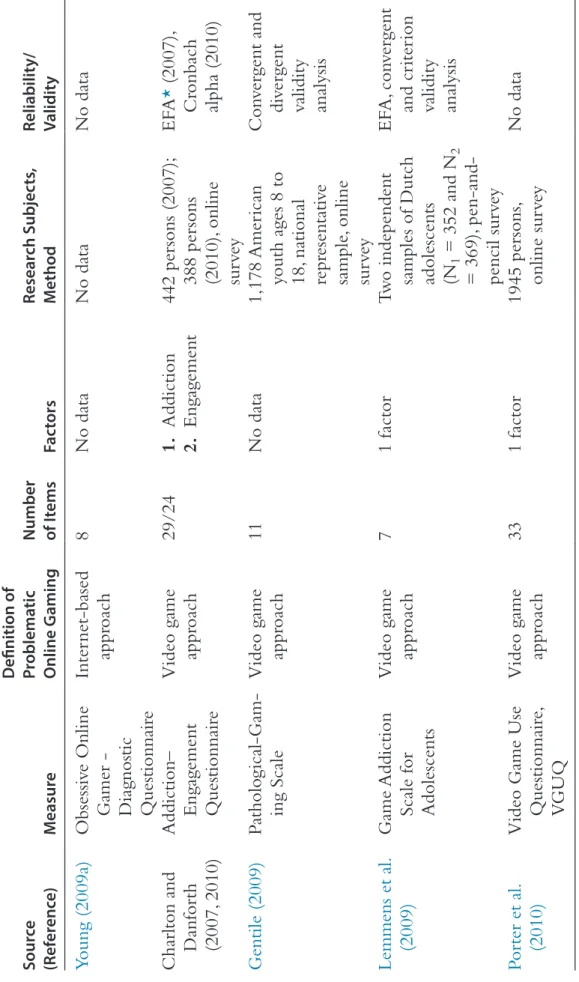
The literature relating to the assessment of problematic online gaming shows there are many measures. Consequently, the aforementioned differences and uncertainties in definition must be continually kept in mind. The majority of researchers apply a theoretical approach. In several cases they have created new measures by modifying scales originally developed for the measure-ment of other behavioral addictions, but without careful psychometric analysis. For instance, the 20-item Internet Addiction Test/Scale (IAT/IAS) developed by Young (1998a, 1999) to measure Internet addiction has been taken as a basis for assessing online gaming addiction in a wide range of studies (Billieux et al., 2011; Jeong & Kim, 2011; Kim, Namkoong, Ku, & Kim, 2008; Kim et al., 2010; King, Delfabbro, & Griffiths, 2010a; Snodgrass, Lacy, Dengah, & Fagan, 2011; Wang & Chu, 2007; Whang, Heo, & Hur, 2004) even though the psychometric properties of the original scale were ambiguous (Demetrovics, Szeredi, & Rózsa, 2008; Koronczai et al., 2011). In other cases, researchers have assessed problematic online gaming by the combination of Internet addiction scores and weekly hours spent on Inter-net video gaming (Han et al., 2010; Van Rooij et al., 2011). This chapter’s authors also consider this approach problematic because players do not neces sarily view online gaming as an Internet activity but rather as “gaming.” This may result in a lower Internet addiction score than is the actual case.
Other researchers propose not distinguishing problematic online gam-ing from problematic video gamgam-ing because the content is important, not the channel. In this approach, criteria for pathological gambling are often used as a starting point (Charlton & Danforth, 2007; Gentile, 2009; Gentile et al., 2011; Lemmens, Valkenburg, & Peter, 2009; Lemmens et al., 2011; Porter et al., 2010).
In addition to the previously discussed approaches, there are also measures that are based on the integrative approach, namely where both the special characteristics of video games and features of the channel (i.e., the Internet) are taken into consideration [i.e., Problematic Online Game Use Scale (POGU) (Kim & Kim, 2010), Online Game Addiction Diagnostic Scale (Lee
& Han, 2007), Problematic Online Gaming Questionnaire (POGQ)
( Demetrovics et al., 2012) and its short form (Pápay et al., 2013), which is reproduced in Appendix 4-1 of this chapter]. Of all the measures discussed, the POGU (Kim & Kim, 2010), the Game Addiction Diagnostic Scale (Lee & Han, 2007), and the POGQ (Demetrovics et al., 2012) and its short form (Pápay et al., 2013) show robust psychometric characteristics (see Table 4.1).
Table 4.1 M easur es of P roblema tic Online G aming Sour ce (R ef er enc e) M easur e De fi nition of Pr oblema tic O nline G aming Number of I tems Fac tors Resear ch Subjec ts , M ethod Reliabilit y/ Validit y Young (2009a) Obsessi ve Online
Gamer - Diagnostic Questionnair
e Inter net-based appr oach 8 No data No data No data
Charlton and Danfor
th
(2007,
2010)
Addiction– Engagement Questionnair
e
Video game appr
oach 29/24 1. Addiction 2. Engagement 442 per sons (2007); 388 per sons (2010), online sur ve y EF A * (2007), Cr onbach alpha (2010) Gentile (2009) Patholo gical-Gam -ing Scale
Video game appr
oach 11 No data 1,178 Amer ican
youth ages 8 to 18, national repr
esentati ve sample , online sur ve y Con vergent and di vergent validity analysis Lemmens et al. (2009) Game Addiction
Scale for Adolescents Video game appr
oach
7
1 f
actor
Tw
o independent samples of Dutch adolescents (N1
= 352 and N 2 = 369), pen-and-pencil sur ve y EF A, con vergent and cr iter ion validity analysis Por ter et al. (2010)
Video Game Use Questionnair
e,
V
GUQ
Video game appr
oach 33 1 f actor 1945 per sons, online sur ve y No data Continued
Kim and Kim (2010)
Pr
ob
lematic
Online Game Use Scale (POGU)
Integ rati ve appr oach 20 1. Euphor ia 2. Health pr ob lem 3. Conflict 4. Failur e of self-contr ol 5. Pr efer ence of vir tual relationship 1,422 5th g rader s, 199 8th g rader s, and 393 11th grader s fr om South K or ea (pen-and-pencil sur ve y) EF A, CF A, **
reliability analysis, con
vergent and discr imi -nant v alidity analysis
Lee and Han (2007) Online game addiction diagnostic scale
Integ rati ve appr oach 30 1. Psycholo gical dependence 2.
Daily life disor
der 3. Inter per sonal relationship tow ar d online 4. T olerance 5. Negati ve beha vior and emotions 6. Mental disor der 7. Ph ysical disor der 2,317 South K or ean elementar y school
students (pen-and- paper sur
ve y) EF A, cr iter ion validity analysis Table 4.1 M easur es of P roblema tic Online G aming— con t’d Sour ce (R ef er enc e) M easur e De fi nition of Pr oblema tic O nline G aming Number of I tems Fac tors Resear ch Subjec ts , M ethod Reliabilit y/ Validit y
Zhou and Li (2009)
Online Game Addiction Index (OGAI)
Integ rati ve appr oach 12 1. Contr ol disor der 2. Conflict 3. Injur y 195 students (age 18–24 y ear s) (in-home sur ve ys) EF A Demetr ovics et al. (2012) Pr ob lematic
Online Gaming Questionnair
e (POGQ) Integ rati ve appr oach 18 1. Pr eoccupation 2. Ov er use 3. Immer sion 4. Social isolation 5. Inter per sonal conflicts 6. W ithdra w al 3,415 online gamer s
(mean age 21 year
s, SD 5.9 year s), online sur ve y EF A, CF A Pápa y et al. (2012) Pr ob lematic
Online Gaming Questionnair
e Shor t F or m (POGQ-SF) Integ rati ve appr oach 12 1. Pr eoccupation 2. Ov er use 3. Immer sion 4. Social isolation 5. Inter per sonal conflicts 6. W ithdra w al 2,774 9th–10th grader s in Hun -gar ian secondar y
general and secondar
y v
oca
-tional schools (mean age 16.4 year
s, SD 0.9), national r epr esen -tati ve sample CF A, cr iter ion validity *EF A= Explorator y Factor Analysis **CF A = Confir mator y Factor Analysis
EPIDEMIOLOGY
Prevalence and Demographics of the Online Gamer Population
At present, it is quite difficult to estimate the prevalence of problematic online gaming due to the lack of a clear definition, the application of mea-sures without proper psychometric characteristics, and studies using different samples and different research methodologies. Large sample studies gener-ally report prevalence values below 10%. A study conducted in the United States on a national representative sample of teenagers (Gentile, 2009) as well as a large sample of Singaporean children (Gentile et al., 2011) reported a problematic game use of approximately 9%. Results of another representa-tive study in Germany showed that 3% of the male and 0.3% of the female students were diagnosed as dependent on video games, while another 4.7% of male and 0.5% of female students were at risk of becoming dependent (Rehbein et al., 2010). On a large Hungarian online gamer sample, 3.4% of gamers belonged to the high-risk group of problematic gaming and another 15.2% to the medium-risk group (Demetrovics et al., 2012). A proportion of 4.6% of Hungarian adolescents (approximately 16 years old) belonging to a national sample were classified as high-risk users (Pápay et al., 2013) (see Table 4.2).
According to an online survey examining all types of online gamers (Nagygyörgy, Urbán et al., 2012) (n = 4374), the mean age was 21 years, and participants were mostly male (91%) and single (66%). Their average weekly game time varied between less than 7 hours (10%) and more than 42 hours (also 10%) with most of the gamers playing 15–27 hours weekly (35%). Furthermore, 16% of all gamers were playing professionally (i.e., they par-ticipate in competitions and earn money if they win). The majority of the sample (79%) had a clear gaming preference; namely, they played one single game type (e.g., MMORPG/MMORTS/MMOFPS/other online games) most of the time.
Data regarding the three main game types give a more nuanced view. The proportion of female gamers is the lowest in the case of massively multiplayer online first-person shooter (MMOFPS) games (1%–2%; Jansz & Tanis, 2007;
Nagygyörgy, Urbán et al., 2012) and the highest between massively
multi-player online role-playing game (MMORPG) users (15%–30%; Cole & Griffiths, 2007; Nagygyörgy, Urbán et al., 2012; Yee, 2006a). MMOFPS users are the youngest (18–19.8 years; Jansz & Tanis, 2007; Nagygyörgy, Urbán et al., 2012), while both massively multiplayer online real-time strategy (MMORTS; 22 years; Nagygyörgy, Urbán et al., 2012) and MMORPG
Table 4.2 P rev alenc e of P roblema tic Online G aming A uthor(s) (refer enc e) Loca tion Resear ch Subjec ts [M ean A ge (M), Standar d De via tion (SD )] M ethod M easur e Crit eria of Pr oblema tic U se Lif e-P re valenc e Value Yee (2006) USA, Canada 3,166 per sons, MMORPG gamer s Online sur ve y Dir
ect question (“Do y
ou consider y our self addicted to MMOR -PGs?” y es/no question)
Yes to the dir
ect
question
50%
Grüsser
,
Thalemann, and Griffiths (2007)
Ger man y 7,069 gamer s (M: 21.1 y ear s, SD: 6.4) Online sur ve y 6 cr iter ia of k ey symp
-toms of a dependence syndr
ome as outlined in WHO’ s ICD-10 3 or mor e cr iter ia fulfilled 11.9% Gentile (2009) USA 1,178 per sons (adolescents age 8–18 y ear s) National repr esenta -tiv e sur ve y (online) Patholo gical Video-Game Use 6 or mor e y es ans w er s 8.5% Por ter et al. (2010) USA, Canada, Eur ope , Australia, Ne w
Zealand, Asia, Central and South Amer
ica 1,945 per sons, gamer s older than 14 y ear s Online sur ve y
Video Game Use Questionnair
e, (V GUQ), 10 cr iter ia: 3 (pr eoccupation), 7 (adv er se consequences), yes/no ans w er s 2 or mor e cr iter ia (pr eoccupa -tion) + 3 or mor e cr iter ia (adv er se conse -quences) 8% Continued
Van Rooij et al. (2011) Netherlands 4,559 per sons (M: 14.4 y ear s, SD: 1.2) (T1) and 3,740 per sons (M: 14.3 y ear s SD: 1.0) (T2) and-pen -cil sur ve y Compulsi ve Inter net Use Scale (CIUS) + w eekly hour s online gaming Latent pr ofile analysis 1.6% (T1), 1.5% (T2) ∼ 1.5% Gentile et al. (2011) Singapor e 3,034 per sons elementar y and secondar y school students 2 y ear s long itudinal study ,
pen-and- paper sur
ve y Patholo gical Video-Game Use 5 or mor e y es ans w er 7.6%–9.9% Lemmens, Valk enb urg, and P eter s (2011) Netherlands 543 adolescent gamer s (M: 13.9 y ear s, SD: 1.4) Long itudinal
pen-and pencil sur
ve y Game Addiction Scale Scor e of 3 or higher 6% (T1), 4% (T2) Rehbein et al. (2010) Ger man y 15,168 ninth grader s (15.3 year s, SD: 0.69) Nationally repr esenta -tiv e sur ve y
Video Game Dependency Scale (KFN-CSAS-II)
Scor
e higher
than 42 dependent player
s; scor
e
betw
een 35
and 41: player
s at r isk Dependent: boys 3%, girls 0.3%; at r isk: bo ys 4.7%, girls 0.5% Table 4.2 P rev alenc e of P roblema tic Online G aming— con t’d A uthor(s) (refer enc e) Loca tion Resear ch Subjec ts [M ean A ge (M), Standar d De via tion (SD )] M ethod M easur e Crit eria of Pr oblema tic U se Lif e-P re valenc e Value
Thomas and Mar tin (2010) Australia 2,031 per sons (705 uni ver sity students, 1,326 secondar y and college students) and-paper sur ve y Adaptation of YDQ (Y oung’ s Diagnostic Question -nair e) to computer games Scor e of 5 or higher 5%
Jeong and Kim (2011)
South K or ea 600 per sons (12–18 y ear s) Nationally rep -re se nt at iv e and-pe nc il sur ve y Young’ s Inter net Addic -tion Test (IA T) modified b y r eplacing the w or d Inter net with gaming Scor e abo ve 80 2.2% Demetr ovics et al. (2012) Hungar y 3,415 per sons, online gamer s (M: 21 y ear s, SD: 5.9) Online sur ve y POGQ Latent pr ofile analysis High-r isk pr ob lematic online gamer s: 3.4%; medium r isk of pr ob lematic use: 15.2% Pápa y et al. (2012) Hungar y 5,045 students fr om second -ar y general and secondar y vocational schools (M: 16.4, SD: 0.9) Nationally repr esenta -tiv e sur ve y and-pencil) POGQ-SF Latent pr ofile analysis 4.6%
players (21–27 years; Nagygyörgy, Urbán et al., 2012; Yee, 2006a) are signifi-cantly older. Among the three main groups, MMORPG gamers spend the most time playing (Nagygyörgy et al., 2013). Because MMORPGs are the most researched games, there is additional information regarding such players that is still unknown in the case of other game types. For instance, half of MMORPG players work full time, 22.2% are students, and 14.8% are home-makers (89.9% of whom were female). Furthermore, 36% of the gamers are married, and 22% of them have children (Yee, 2006a, 2006d). Overall, the demographic composition of MMORPG users is quite varied and probably more diverse than the composition of MMORTS and MMOFPS users, although this needs to be empirically established.
Comorbidity
Problematic online gamers are twice as likely to be diagnosed with some kind of attention deficit disorder (ADD or ADHD) than gamers who play recreationally (Batthyany, Muller, Benker, & Wolfling, 2009; Bioulac, Arfi, & Bouvard, 2008; Chan & Rabinowitz, 2006; Gentile et al., 2011; Han et al., 2009). Depression is also a comorbid clinical disorder that appears in several studies (Gentile et al., 2011; Peng & Liu, 2010). In the case of MMORPG players, depressive symptoms (e.g., sadness, hopelessness, crying spells, insomnia, concentration problems) are related to habitual computer game playing at night (between 10 p.m. and 6 a.m.; Lemola et al., 2011). So far, it is unclear whether problematic online gaming is the reason for or the con-sequence of other psychiatric symptoms (Gentile, 2009). Although longitu-dinal data suggest that pathological gamers exhibit higher levels of depression, anxiety and social phobia during the follow-up period than normal gamers, the causal relation might be reciprocal (Gentile et al., 2011).
ETIOLOGY
As with other addictions, problematic online gaming is the consequence of many different integrated factors. Here the main aspects of gaming that contribute to the appearance and maintenance of problematic behavior in the academic literature are presented.
Neurobiological Aspects
Brain imaging is the newest area of behavioral addictions research and, for this reason, it is still in its infancy. Early studies suggest that cue-induced gam-ing urge activates the same brain regions (i.e., dorsolateral prefrontal cortex,
orbitofrontal cortex, parahippocampal gyrus, and thalamus) that are activated by gambling in the case of pathological gamblers and substance use in the case of substance use abusers (Han et al., 2011; Ko et al., 2009). Other results suggest that the effects of excessive online game playing on working memory may be similar to those observed in patients with substance dependence (Kim et al., 2012). Consequently, researchers assume that problematic online gaming might share the same neurobiological mechanism as pathological gambling and substance dependence (Kuss & Griffiths, 2012c). However, fur-ther research in this area is quite necessary and is almost certain to come.
Personality Aspects
Although it can be argued there is no such thing as an “addictive personal-ity,” some personality characteristics seem to favor the development of problematic game use. For instance, several studies examined the relation-ship between the Big Five personality traits and problematic gaming and found low emotional stability (Charlton & Danforth, 2010; Mehroof & Griffiths, 2010; Nagygyörgy, Mihalik, & Demetrovics, 2012; Peters & Malesky, 2008), low agreeableness (Charlton & Danforth, 2010; Peters & Malesky, 2008), and low extraversion (Charlton & Danforth, 2010) as being associated with the phenomenon. However, in relation to agreeableness and extraversion, the relationship does not seem to be as robust as with that of neuroticism. A possible explanation of these results could be that problem-atic gamers spend more time gaming to avoid real-life social situations that seem threatening because of low social abilities and/or low emotional sta-bility. To such individuals, online environments may seem safe and be pre-ferred to real-life situations. However, this is speculation on the authors’ part, and empirical research is needed to investigate such a hypothesis.
In addition to personality traits, other characteristics have also been examined. A study examining social skills found that the quality of interper-sonal relationships decreased and the amount of social anxiety increased as the amount of time spent playing online games increased (Lo, Wang, & Fang, 2005). Problematic gaming has been negatively correlated with offline social self-efficacy and positively correlated with online social self-efficacy (Jeong & Kim, 2011). This echoes with research showing problematic gamers finding it easier to meet people online and having fewer friends in real life than in games (Porter et al., 2010). Inadequate self-regulation (Seay & Kraut, 2007), low self-esteem (Ko, Yen, Chen, Chen, & Yen, 2005; Lem-mens et al., 2011), low emotional intelligence (Herodotou, Kambouri, & Winters, 2011), above average state and trait anxiety (Mehroof & Griffiths,
2010), increased feeling of loneliness (Lemmens et al., 2011; Seay & Kraut, 2007), narcissistic personality (Kim et al., 2008), and aggression (Kim et al., 2008; Mehroof & Griffiths, 2010) have also been found to be correlated with problematic online gaming. Additional studies report that problematic online gamers have lower life satisfaction (Ko et al., 2005; Wang, Chen, Lin, & Wang, 2008) and decreased psychosocial well-being compared to other gamers ( Lemmens et al., 2011).
Because all the findings from these studies are correlational in nature, causal relations are unknown. Thus, Lemmens et al.’s (2011) longitudinal study worked to address this issue. Their analyses indicated that diminished social competence, lower self-esteem, and increased loneliness predicted an increase in problematic gaming 6 months later. Thus, lower psychosocial well-being can be considered an antecedent of problematic gaming among adolescent gamers. The analyses further indicated that loneliness was also a consequence of problematic gaming. This suggests that displacement of real-world social interaction resulting from problematic game use may dete-riorate existing relationships, which could explain the increase in adolescent gamers’ feelings of loneliness.
Motivational Aspects
Empirical studies suggest that gaming motives also play an important role in the development and maintenance of problematic online gaming ( Demetrovics et al., 2011; Kuss & Griffiths, 2012a, 2012b). Online gaming involves multiple reinforcements whereby different features might be differ-ently rewarding to different people (what could be called “the kitchen sink approach” where game designers include a diverse range of gaming rewards in the hope that at least some of them will appeal to players; Griffiths, 2010a). The game developers’ aim is to satisfy as many different psychologi-cal needs as possible, to motivate the widely heterogeneous gamer commu-nity to play continuously.
The first theoretical model of motivational aspects was developed by
Bartle (1996), who examined early text-based virtual world (MUD) players. He proposed that MUD players can be classified in one of the following four motivational types: achievers, explorers, socializers, and killers. Achiev-ers are motivated by fulfilling game-related goals, explorAchiev-ers try to find out as much as they can about the virtual world, socializers love to meet and befriend other players, and killers prefer to cause distress to others.
Bartle’s theoretical model has been empirically tested by Yee (2006c)
identified 10 motivational components that belong to three main factors labeled as achievement, social, and immersion. The components belong-ing to the achievement factor are advancement, mechanics, and competi-tion. Socializing, relationship, and teamwork are the subcomponents belonging to the social factor and discovery, whereas role-playing, cus-tomization, and escapism contribute to the immersion dimension. Another important finding is that the 10 listed motivational dimensions do not suppress but complement each other depending on the gaming situation. Yee (2006c) found that escapism and advancement subcompo-nents were associated with problematic usage measured by a variation of
Young’s (1998b) diagnostic questionnaire. The escapism motivation
referred to the use of the online environment to avoid thinking about real-life problems, while advancement referred to the desire to gain power, progress rapidly, and accumulate in-game symbols of wealth or status. Yee’s research had been replicated on a European group (French, English, and Italian; Dauriat et al., 2011) and a Hungarian online MMORPG sample (Nagygyörgy, Mihalik et al., 2012) and yielded simi-lar results (i.e., escapism and achievement main factor showed the stron-gest association with problematic online gaming). These models are not suitable for comparing different types of online gamers; therefore, Deme-trovics et al. (2011) developed an empirically based motivational measure called the Motives for Online Gaming Questionnaire (MOGQ) com-prising seven factors (i.e., social, escapism, coping, fantasy, skill develop-ment, recreation, and competition) and makes the comparison between online gamers possible (see Appendix 4-2).
All the aforementioned questionnaires have the structural characteris-tics of online games (or particularly MMORPGs) as their starting point. A different approach is applied by Ryan et al. (2006), who suggested that, as largely individual difference frameworks, these categories or typologies largely reflect the structure and content of current games, rather than the fundamental or underlying motives and satisfactions that can initiate and sustain participation across all potential players and game types. By con-trast, they argued that a true theory of motivation should not focus on behavioral classification constrained by the structure of particular games, but instead address the factors associated with enjoyment and persistence across players and genres, and how games that differ in controllability, structure, and content might appeal to basic human motivational propen-sities and psychological needs. Therefore, they applied the Cognitive Eval-uation Theory (CET) used in the research of intrinsic motivation in the
case of sports and other recreational activities which states that activities induce intrinsic motivation depending on their capacity of satisfying the three basic human needs of autonomy, competence, and relatedness. The results support their conception that the enjoyment of video games and the desire to play again was significantly correlated with the level of autonomy, competence, and relatedness experienced in games (Przybylski, Ryan, & Rigby, 2009; Ryan et al., 2006). However, a connection between the three basic human needs and problematic online gaming has not yet been explored.
Wan and Chiou (2006) developed a different approach. Their starting
point was Maslow’s hierarchy of human needs. Their results showed that the psychological needs of players of online games were closer to the two-factor theory that depicts satisfaction and dissatisfaction dimensions than to differ-ent one-dimensional approaches applied in other empirical studies. The lower hierarchy of human needs refers to “dissatisfactory needs” that includes physical needs, safety needs, belongingness, and self-esteem. The higher hierarchy of human needs means “satisfactory needs” that comprises self-actualization and self-transcendence. Addicted players’ need-gratifica-tion was similar to the feature of dissatisfactory factor. That is, the absence of playing online games is more likely to generate a sense of dissatisfaction; the addicts’ compulsive use of online games appears to stem from the relief of dissatisfaction rather than the pursuit of satisfaction. In contrast, online games tend to provide nonaddicted players with a sense of satisfaction rather than a sense of dissatisfaction. This result is in line with the results of Wang
and Chu (2007), who differentiated harmonious and obsessive passion in
online gaming and found that only obsessive passion (the state when the player is controlled by his player activity instead of controlling it himself) was related to problematic online gaming. Although players with harmoni-ous passion enjoy and feel cheerful about gaming, players with obsessive passion feel fanatic over it and become angry or anxious when they cannot play. A case study of Griffiths (2010b) also demonstrated two excessive gam-ers: a healthy enthusiast who played for joy and recreation and a game addict who played to avoid his life problems and to ease the irresistible urge to play again.
The Role of Structural Characteristics in Problematic Online
Gaming
In the gambling literature, a number of authors have examined the role of structural characteristics of different gambling activities (i.e., slot machines)
because they appear to be important in the acquisition, development, and maintenance of problem gambling behavior (Griffiths, 1993, 1999; Parke & Griffiths, 2007). A similar exploration regarding the structural characteristics of online games has also been suggested (King et al., 2010a; King, Delfabbro, & Griffiths, 2010b). In an early study, Wood et al. (2004) found that a high degree of realism (i.e., realistic sound, graphics, and setting), a rapid absorp-tion rate, character development, the ability to customize the game, multi-player features, winning and losing features, and the ability to save the game at regular intervals 2 were seen by most gamers as essential characteristics of
video games.
King et al. (2010b) tried to enlarge and systematize Wood et al.’s (2004)
list according to the gambling literature. They created a theoretical model that contained five main groups:
• Social features that refer to the socializing aspects of video games, such as how players can communicate with other players, and the features that create a cooperative and competitive community of players.
• Manipulation and control features that refer to the ways in which a player can interact with and control in-game properties using a physical con-trol scheme.
• Narrative and identity features that refer to the ways in which players can take on another identity in the game (as a fictional character or a con-struction of the self ).
• Reward and punishment features that refer to the ways in which players are reinforced for skillful play (i.e., winning) and punished for losing.
• Presentation features that refer to the aesthetic qualities of a video game, such as how the game looks and sounds to players.
In a follow-up empirical study, reward and punishment features, such as earning points, finding rare game items, and fast loading times, were rated by players among the most enjoyable and important aspects of video game playing. Problem video game players reported significantly higher enjoyment of features such as managing in-game resources, earn-ing points, gettearn-ing 100% in the game, and masterearn-ing the game than nonproblem players, which are features that typically take up more play-ing time than other features. In addition, the problem group identified 2 In Wood et al.’s study the possibility to save the game regularly clearly refers to the structural
charac-teristics of offline video games. However, in the case of online games, this feature is present by default because one’s account preserves the current state of the player’s development. When players leave the game and then re-enter it later, they are usually able to continue playing from the same point where they had logged out.
features such as “leveling up,” earning meta-game rewards (e.g., “Achievements”), and fast loading times as having a significantly greater impact on their playing behavior than other players (King, Delfabbro, & Griffiths, 2011).
The relationship between reward and punishment features and problem-atic use has also been stressed in theoretical literature. For instance, this is what Shavaun Scott (2007) refers to when she calls the MMORPGs “the most incredibly complex Skinner boxes that anyone could ever imagine” (for further information on the topic, see Clark & Scott, 2009, pp. 84–89). Similar to the case of slot machines, online game developers apply the prin-ciple of the partial reinforcement effect (PRE) to keep players playing. PRE is a critical psychological ingredient of gaming addiction whereby the re inforcement is instant but intermittent (i.e., people keep responding in the absence of reinforcement hoping that another reward is just around the corner). Magnitude of reinforcement (e.g., a high points score for doing something in-game) is also important. Large rewards lead to fast responding and greater resistance to extinction—in short to increased “addiction” (Griffiths, 2010a). The effectiveness of operant conditioning is responsible for those situations when gamers keep playing or even increase their gam-ing time in spite of the fact that they do not enjoy the activity any more (Yee, 2006b). Such states may easily lead to the appearance of problematic gaming.
The Amount of Gaming Time and Its Relation to Problematic
Online Gaming
Although several studies have reported a strong correlation between the amount of time spent on gaming and problematic use (e.g., Dauriat et al., 2011; Gentile, 2009; Grusser et al., 2007; Hsu, Wen, & Wu, 2009; Porter et al., 2010), excessive game play is not a sufficient condition of addiction or problematic gaming (despite the common colloquial use of the word addiction). According to Griffiths (2005a, pp. 195), “the differ-ence between an excessive healthy enthusiasm and an addiction is that healthy enthusiasms add to life whereas addictions take away from it”; that is, additional negative consequences should be present to make the behavior classified as problematic or an “addiction.” However, knowing that the development of the problematic gaming behavior is always a process, special attention must be given to excessive gamers because they appear to be at higher risk than normal gamers to developing problem-atic behavior.
PREVENTION AND TREATMENT
Prevention
Articles on the topic of prevention (Griffiths, 2003, 2008; Griffiths &
Meredith, 2009) recommend that family members and/or friends initiate
direct conversation with excessive or problematic players by showing true interest toward the game, the gamer, and everything the gamer likes in the virtual environment. Often this is the only topic that the player is willing to talk about or talks about with pleasure, and thus, it facilitates communica-tion and emocommunica-tional attachment with the user. Getting familiar with the games also helps toward establishing the mutually acceptable rules regarding them. If the gamer is a child or a teenager, it is highly recommended that parents or other family members choose the games together with the child using the official ratings as a guide for age appropriateness (e.g., ESRB rat-ings). These should be suitable for children in terms of content (e.g., violent or adult content must be avoided) while at the same time providing enter-tainment. Parents should encourage their children to play together with real-life friends because this helps the developing of personal relationships. This way, communication and cooperation skills learned online can be transferred more easily to real-life situations.
It is also worth determining daily and weekly game time together and in mutual agreement with players themselves, because this way it is easier to ask them to abide by it. It is also important to follow the game manufactur-ers’ recommendations regarding monitor brightness, distance from the monitor, the taking of short and frequent breaks if gaming for a long time, not playing in the case of fatigue, etc. It is also extremely important that the gamer pursues other recreational activities (e.g., sports) in addition to gam-ing. If gamers play suitable games for an appropriate amount of time, playing can have several positive effects such as increasing self-esteem; improving reflexes, reaction time, memory, logical and strategic thinking, social and communication skills; and more (Griffiths, 2008, 2010a).
Treatment
Treatment techniques are based on the ones applied successfully to other behavioral addictions but specified to the particular features of online games (Griffiths, 2008; Griffiths & Meredith, 2009). Several different types of online support forums deal with problematic online gaming and/or its treatment possibilities. Such forum types are (1) the ones run by the parents and other family members of problem gamers who mainly discuss the
nature of the problem, share their experiences, and support each other; (2) the self-help forums where the gamers themselves discuss similar topics and support each other; (3) and the ones established and administered by profes-sional organizations where they offer information regarding the problem in general, provide some kind of criteria for self-assessment, and provide pro-fessionals to contact (Griffiths, 2008; Griffiths & Meredith, 2009). Much of the advice on these forums is based on behavioral reward and punishment systems. A self-help On-Line Gamers Anonymous Organization offers a supportive, Internet-based treatment approach based heavily on the Min-nesota Model system of the 12 steps used by such groups as Alcoholics Anonymous and Gamblers Anonymous (Griffiths, 2008; Griffiths & Mere-dith, 2009).
There are some specialty addiction clinics in a few countries (e.g., United States, China, South Korea, United Kingdom), but few details of the therapeutic programs have been published in the academic literature. Most of the treatment clinics use a diverse range of interventions. The programs mainly follow two approaches: the total abstinence model (e.g., Broadway Lodge treatment center in Somerset, UK) and the harm reduc-tion model that promotes moderareduc-tion and balance and does not require the patient to completely stop game playing or using the computer alto-gether (e.g., Woog Laboratories, California). In addition, there are indi-vidual therapists such as Young (Center for On-Line Addiction) and, before her death, Orzack (Computer Addiction Services), who use multi-modal elements but do not necessarily advocate total abstinence or mod-eration (Griffiths, 2008). The aim of all treatment programs is to increase game addicts’ prosocial skills through social activities and real-life activi-ties that replace time spent gaming. They also provide some form of psy-chotherapy to address comorbid or underlying issues such as depression and anxiety. Treatment programs also integrate management skills (i.e., goal setting or time keeping) to help players control their behavior (Griffiths, 2008).
Among therapies, those applied to other behavioral addictions [e.g., behavioral therapy, cognitive behavioral therapy (CBT), motivational interviewing] are mostly used with further specification. For instance, CBT teaches individuals to identify and eventually solve their underly-ing problem(s) and then to learn copunderly-ing skills to prevent relapse. Although efficient, it is unlikely that CBT can cure addictive playing on its own because the online gaming addiction is likely to have biopsycho-social antecedents that require multimodal treatment interventions.
Therefore, CBT may also be accompanied by (online or in vivo) support groups and/or medication. Finding alternative ways to satisfy under-lying needs that had been relieved by the problematic behavior is also quite important in avoiding relapse (Griffiths, 2008). In Young’s (2010) opinion, therapy should use time management techniques that help the client structure and regulate online gaming sessions, and strategies that help gamers to develop alternative activities that take them away from the computer (e.g., spend more time with family, engage in hobbies or exercise programs). According to Young (2007), online gamers typically suffer interpersonal difficulties such as introversion or social anxiety, which is, in part, why they turn to virtual relationships and games, an issue that should also be addressed during therapy.
Griffiths (2008) sums up that therapeutic techniques appear to be based on CBT, skill training, and humanistic techniques. CBT is used for underlying psychological conditions such as social phobia, anxiety, and depression. Skills training is used for activities such as managing time, finding other rewarding activities, and developing other core life skills. Interpersonal therapy is used for developing personal skills and social functioning, and lastly, couples or family therapy is used for addressing problems caused between partners and family as a result of online gaming behavior.
Other treatment approaches include military-style boot camps in China and South Korea that aim to treat online game addiction by using high-intensity physical activity in natural surroundings to get problem gamers back into real life and find a substitute for the excitement of the cyberworld (Fackler, 2007; Griffiths, 2008). Unfortunately, there is no empirical or anecdotal evidence as to whether such methods are successful in treating online gaming addiction.
Pharmacotherapy
Han et al. (2010; 2012) presented some successful case studies regarding
pharmacotherapeutic treatment. After a 6-week (Han et al., 2010) and a 12-week (Han & Renshaw, 2012) period of bupropion sustained-release treatment, problematic gamers showed significant improvement both in decreased problem behavior and decreased depression scores. The researchers’ pharmacological choice had been driven by the similarities in neurological activity of substance dependence and behavioral addictions such as pathological gambling (Han et al., 2011; Ko et al., 2009; Kuss & Griffiths, 2012).
REFERENCES
Allison, S. E., von Wahlde, L., Shockley, T., & Gabbard, G. O. (2006). The development of the self in the era of the Internet and role-playing fantasy games. American Journal of Psychiatry, 163(3), 381–385.
American Psychiatric Association. (1994). Diagnostic and statistical manual of mental
disorders (4th ed.). Washington, DC: Author.
American Psychiatric Association. (2013a). Substance-related and addictive disorders. Retrieved July 10, 2013, from http://www.dsm5.org/Documents/Substance%20Use%20Disorder %20Fact%20Sheet.pdf.
Case Vignette: Jeremy
Jeremy was a 38-year-old accountant who had been married 13 years and had two children. Over a period of a year and a half, his online playing of Everquest and (subsequently Everquest 2) had gone from about 3 or 4 hours of playing every evening to playing up to 14 hours a day. He claimed that his marital relationship was breaking down, that he was spending little time with his children, and that he constantly called in sick to work so that he could spend the day playing online games. When playing online, he claimed, “Life’s worries go out of the window.” He had tried to quit playing on a number of occasions but could not go more than a few days before he experienced “an irresistible urge” to play again—even when his wife threatened to leave him.
He claimed that giving up online gaming was worse than giving up smoking and that he was “extremely moody, anxious, depressed and irritable” if he was unable to play online. Over the next few months, things got even worse for Jeremy. He was fired from his job for being too unreliable and generally unproductive as a direct result of his excessive gaming (although his employers were totally unaware of his gaming behavior). As a result of Jeremy’s losing his job, his wife also left him. This led to Jeremy “playing all day, every day.” It was a vicious cycle in that his exces-sive online gaming was causing all his problems, yet the only way he felt he could alleviate his mood state and escape his life’s stresses was to play online games.
Jeremy’s behavior fulfills many of the characteristic signs of more traditional addictions. For Jeremy, online gaming was the most important thing in his life; he used gaming as a way of consistently modifying his mood (i.e., to escape other things in his life); he built up tolerance to gaming over time (escalating his gam-ing from 3 to 4 hours a day up to 14 hours a day); he suffered withdrawal effects if unable to play online (e.g., feelings of intense moodiness, anxiety, depression, and irritability); there was conflict in his life as a result of playing online games excessively (losing his family and job because he just could not stop playing); and he experienced relapse as he could not go more than a few days without an irre-sistible urge to play again. In an effort to reconcile with his family, Jeremy eventu-ally asked his general practitioner to refer him to a psychologist who specialized in cognitive-behavioral therapy. However, his wife has now divorced Jeremy and, as far as the authors are aware, CBT treatment is still ongoing.
American Psychiatric Association. (2013b). Internet gaming disorder. Retrieved July 10, 2013, from http://www.dsm5.org/Documents/Internet%20Gaming%20Disorder%20Fact%2 0Sheet.pdf.
Armstrong, L., Phillips, J., & Saling, L. (2000). Potential determinants of heavier Internet usage. International Journal of Human-Computer Studies, 53, 537–550.
Barnett, J., & Coulson, M. (2010). Virtually real: A psychological perspective on massively multiplayer online games. Review of General Psychology, 14(2), 167–179.
Bartle, R. (1996). Hearts, clubs, diamonds, spades: Players who suit MUDs. Retrieved October 17, 2013, from http://www.mud.co.uk/richard/hcds.htm.
Bartle, R. (2003). Designing virtual worlds. Indianapolis: New Riders Press.
Batthyany, D., Muller, K. W., Benker, F., & Wolfling, K. (2009). Computer game playing: clinical characteristics of dependence and abuse among adolescents. Wien Klinische
Wochenschrift, 121(15–16), 502–509.
Billieux, J., Chanal, J., Khazaal, Y., Rochat, L., Gay, P., Zullino, D., et al. (2011). Psychological predictors of problematic involvement in massively multiplayer online role-playing games: Illustration in a sample of male cybercafé players. Psychopathology, 44, 165–171.
Bioulac, S., Arfi, L., & Bouvard, M. P. (2008). Attention deficit/hyperactivity disorder and video games: A comparative study of hyperactive and control children. European Psychia-try, 23(2), 134–141.
Blaszczynski. (2008). Commentary: A response to “problems with the concept of video game ‘addiction’: Some case study examples.” International Journal of Mental Health and Addiction, 6(2), 179–181.
Brown, R. I. F. (1991). Gaming, gambling and other addictive play. In J. H. Kerr & M. J. Apter (Eds.), Adult play: A reversal theory approach (pp. 101–118). Amsterdam: Swets & Zeitlinger.
Brown, R. I. F. (1993). Some contributions of the study of gambling to the study of other addictions. In W. R. Eadington & J. A. Cornelius (Eds.), Gambling behavior and problem
gambling (pp. 241–272). Reno, NV: University of Nevada.
Caplan, S. E. (2002). Problematic Internet use and psychological well-being: Development of a theory-based cognitive-behavioral measurement instrument. Computers in Human
Behavior, 18, 553–575.
Chan, E., & Vorderer, P. (2006). Massively multiplayer online games. In P. Vorderer & J. Bryant (Eds.), Playing video games: Motives, responses, and consequences (pp. 77–88). Hillsdale, NJ: Erlbaum.
Chan, P. A., & Rabinowitz, T. (2006). A cross-sectional analysis of video games and attention deficit hyperactivity disorder symptoms in adolescents. Annals of General Psychiatry, 5, 16.
Chappell, D., Eatough, V., Davies, M., & Griffiths, M. D. (2006). EverQuest—It’s just a computer game right? An interpretative phenomenological analysis of online gaming addiction. International Journal of Mental Health and Addiction, 4(3), 205–216.
Charlton, J. P., & Danforth, I. D. W. (2007). Distinguishing addiction and high engagement in the context of online game playing. Computers in Human Behavior, 23(3), 1531–1548.
Charlton, J. P., & Danforth, I. D. W. (2010). Validating the distinction between computer addiction and engagement: Online game playing and personality. Behaviour & Information
Technology, 29(6), 601–613.
Choi, D. S., & Kim, J. (2004). Why people continue to play online games: In search of critical design factors to increase customer loyalty to online contents. Cyberpsychology & Behavior, 7(1), 11–24.
Clark, N., & Scott, P. S. (2009). Game addiction: The experience and the effects. Jefferson, NC: McFarland & Company, Inc.
Cole, H., & Griffiths, M. D. (2007). Social interactions in massively multiplayer online role-playing gamers. Cyberpsychology & Behavior, 10(4), 575–583.
Dauriat, F. Z., Zermatten, A., Billieux, J., Thorens, G., Bondolfi, G., Zullino, D., et al. (2011). Moti-vations to play specifically predict excessive involvement in massively multiplayer online role-playing games: Evidence from an online survey. European Addiction Research, 17(4), 185–189.


![Table 4.2 Prevalence of Problematic Online Gaming—cont’d Author(s) (reference)LocationResearch Subjects [Mean Age (M), Standard Deviation (SD)]MethodMeasureCriteria of Problematic UseLife-Prevalence Value](https://thumb-us.123doks.com/thumbv2/123dok_us/1378439.2684578/16.892.134.733.152.1128/prevalence-problematic-reference-locationresearch-deviation-methodmeasurecriteria-problematic-prevalence.webp)
