HAL Id: hal-02307171
https://hal.archives-ouvertes.fr/hal-02307171
Submitted on 7 Oct 2019
HAL
is a multi-disciplinary open access
archive for the deposit and dissemination of
sci-entific research documents, whether they are
pub-lished or not. The documents may come from
teaching and research institutions in France or
abroad, or from public or private research centers.
L’archive ouverte pluridisciplinaire
HAL
, est
destinée au dépôt et à la diffusion de documents
scientifiques de niveau recherche, publiés ou non,
émanant des établissements d’enseignement et de
recherche français ou étrangers, des laboratoires
publics ou privés.
Opportunistic Computing to the Smart Agriculture: A
Practical Experiment
Lionel Touseau, Nicolas Le Sommer
To cite this version:
Lionel Touseau, Nicolas Le Sommer. Contribution of the Web of Things and of the Opportunistic
Computing to the Smart Agriculture: A Practical Experiment. Future internet, MDPI, 2019, 11 (2),
pp.33. �10.3390/fi11020033�. �hal-02307171�
Contribution of the Web of Things and of the
Opportunistic Computing to the Smart Agriculture: A
Practical Experiment
Lionel Touseau and Nicolas Le Sommer
{Lionel.Touseau, Nicolas.Le-Sommer}@univ-ubs.fr
IRISA, Université Bretagne Sud
Version January 28, 2019 submitted to Future Internet
Abstract: With the emergence of the Internet of Things, environmental sensing has been gaining interest, 1
promising to improve agricultural practices by facilitating decision-making based on gathered environmental 2
data (i.e., weather forecasting, crop monitoring, soil moisture sensing). Environmental sensing, and by extension 3
what is referred to as precision or smart agriculture, pose new challenges, especially regarding the collection of 4
environmental data in presence of connectivity disruptions, their gathering, and their exploitation by end-users 5
or by systems that must perform actions according to the values of those collected data. In this paper, we 6
present a middleware platform for the Internet of Things that implements disruption tolerant opportunistic 7
networking and computing techniques, and that makes it possible to expose and to manage physical objects 8
through Web-based protocols, standards and technologies, thus providing interoperability between objects and 9
creating a Web of Things (WoT). This WoT-based opportunistic computing approach is backed up by a practical 10
experiment whose outcomes are analyzed in this article. 11
Keywords: Web of Things, Intermittent Connectivity, Opportunistic Computing, Opportunistic Sensing, 12
Precision Agriculture, Smart Agriculture 13
1. Introduction 14
With the recent progress achieved in the automation of farm machinery and in the monitoring of the physical 15
environment, the agriculture moves towards a more environmental-friendly, smart and precise agriculture, 16
addressing challenges ranging from manpower shortage, adaptation to climate changes, optimization of 17
environment resource usage, reduction of the usage of chemical crop protection products, etc. The Internet of 18
Things (IoT) – which aims at connecting to the Internet physical objects that can sense, communicate, compute 19
and sometimes actuate – can indubitably contribute to the development of the smart agriculture and farming. A 20
few number of research works have recently experimented the usage of IoT platforms in the agriculture and 21
farming context [1–3]. These experiments have highlighted several issues that must be addressed to efficiently 22
and automatically collect data in such challenging contexts, especially regarding the network connectivity, the 23
network architecture and the interoperability between physical objects. Applications and services dedicated to 24
smart agriculture and farming can tolerate, in some cases, delays and disruptions in data exchanges. Indeed, some 25
physical objects do not need to be connected to the Internet permanently, because they measure environmental 26
properties that do not evolve quickly (e.g. soil moisture, plant growth), and because they are in sleep mode most 27
of the time for energy saving purposes. An alternative or a complement to long range, low power and low rate 28
wireless standards such as LoRa/LoRaWAN and SigFox, could be to interconnect such devices to gateways 29
opportunistically using data mules and short radio range wireless interfaces such as IEEE 802.15.4 and IEEE 30
802.11 — that allow to transfer, thanks to a higher throughput, a significant amount of data in a short time 31
from sensors (e.g. camera) or to agribots (field maps, tasks to achieve, etc.). Such an alternative, that relies on 32
opportunistic communication and computing techniques, is known as the opportunistic sensing paradigm [4]. 33
Besides these problems, the lack of semantic description and logical representation of physical objects 34
does not allow to easily consolidate collected data with data from external Web services (e.g. weather forecast, 35
plant growth models), to assemble objects to build sophisticated systems, and to create high level services and 36
applications that should help farmers to take decisions, or even to perform tasks automatically. The Web of 37
Things (WoT) [5] is an attractive solution to address these issues. Indeed the WoT extends the IoT, and aims at 38
doing for physical objects what the Web did for information resources, namely an identification of resources using 39
Uniform Resource Identifiers (URIs), a semantic description of resources, an access of resources through standard 40
protocols, and the inclusion in resources of links to other resources in order to enable a scalable discovery of 41
highly distributed resources. Following the trend of Web 2.0 participatory services, in particular Web Mashups, it 42
thus is possible to create applications mixing physical devices with virtual services on the Web — this type of 43
applications is often referred to as physical Mashup [6,7]. 44
In this paper, we present a WoT oriented platform, called ASAWoO1[8], that implements opportunistic and 45
disruption-tolerant networking and computing techniques. This platform makes it possible to define and instantiate 46
logical extensions, called Avatars, of physical objects. Physical objects can be configured and controlled through 47
their avatar. Avatars provide a semantic description of physical objects and of their functionalities. Functionalities 48
are implemented as REST services, and can be deployed dynamically by the avatars themselves according 49
to the description of the physical objects and of the execution context of these ones. Like functionalities, 50
execution contexts are described semantically, thus allowing avatars to reason on these descriptions and to 51
perform adaptations dynamically. REST services can be invoked using standard protocols such as HTTP or 52
CoAP, either using Internet-legacy transport protocols or disruption-tolerant and opportunistic protocols. This 53
platform can be deployed on physical objects themselves provided that they enough processing and memory 54
capacities, on gateways to which physical objects are connected or on cloud infrastructure. Objects can be fixed 55
or mobile. For instance, data generated by the fixed sensors can be collected by data mules (e.g., tractors) and 56
transmitted to their logical representations deployed in a cloud infrastructure. These features make this platform 57
a relevant support for the development and the deployment of cyber-physical systems and applications dedicated 58
to the environmental sensing and to the smart agriculture. In this paper, we also report experiments we achieved 59
with this platform in an experimental agricultural farm. 60
The remainder of this paper is structured as follows. Section2presents research works dealing with 61
opportunistic environmental sensing, and details their limitations. Section3presents the ASAWoO middleware 62
platform, the concept of avatars, and discuss of the advantages such a platform could bring in an opportunistic 63
sensing and actuating context like the smart agriculture and farming. Section4describes the experiments we 64
performed with the ASAWoO platform, and presents some results we obtained. Section5concludes this paper by 65
summarizing our contribution. 66
2. Related work 67
Over the last years, a large majority of research works dealing with agricultural crop monitoring have 68
focused on the development of small-scale testbeds and specialized applications built on wireless networks 69
formed by fixed sensors (WSN) [3,9,10]. [11] is an example of such works that rely on an infrastructure, where 70
all the devices – a meteorological station, a sprinkler system and humidity sensors deployed a the field, a base 71
station installed near the field and connected to the network infrastructure, which plays the role of gateway 72
between the network of sensors and the infrastructure – are in radio range. Some works consider the issues 73
of distances and of intermittent connections – mainly induced by the duty cycles of sensors for energy saving 74
purposes – between the devices, and solves them by adding redundant relays and gateways so as to build a 75
connected network. A few number of works dealing with precision and sustainable agriculture propose to exploit 76
the mobility of devices carried by people or embedded in agricultural vehicles (e.g. farm tractors, agribots) in 77
order to collect data generated by sensors or to deliver data to actuators (e.g. sprinkler system, agribots). Such a 78
collection process, that leverages the contact opportunities between devices, is referred as being opportunistic 79
sensing. 80
Opportunistic sensing and communication techniques, which have an indubitable interest in the agricultural 81
domain, have also been considered in a few number of systems that propose to exploit mobile devices (carried by 82
people or embedded in vehicles) to collectively measure social or environmental data in large-scale pervasive 83
environments. These systems rely on opportunistic and people-centric sensing techniques. They differ from 84
first-generation sensor networks, not only in their goal to support concurrent people-centric and opportunistic 85
sensing applications in urban environments, but also in their hardware and software heterogeneity, high volatility, 86
and very large scale. CarTel [12], MetroSense [13], MobiScopes [14], SenseWeb [15], Urbanet [16] and Urban 87
Atmospheres [17] are examples of such systems. To report information from a given region using these systems, 88
applications run sensing tasks on the mobile devices that are located in this region and that have chosen to 89
participate to the sensing process. Mobile devices report sensor data through opportunistic network connections, 90
such as those they establish with third-party access points existing in their radio range. For instance in CarTel, 91
a network node is a mobile device coupled to a set of sensors. Each node gathers and processes sensor data 92
locally before delivering them to a central portal on the Internet, where the data are stored in a database for 93
further analysis and visualization. Mobile devices opportunistically communicate, using their wireless interface 94
(e.g. Wi-Fi, Bluetooth), with other CarTel mobile devices and with Internet access points found in urban areas. 95
The portal and the mobile nodes use a delay-tolerant network stack, called CafNet, to communicate. CarTel 96
applications run on the portal, and submit SQL queries to a delay-tolerant continuous query processor called 97
ICEDB. This query processor maintains a list of queries submitted by the applications, and pushes them to remote 98
nodes using CafNet. It receives results from remote nodes, and puts them into a relational database. MetroSense 99
adopts a similar approach, and envisions a future Internet in which a large part of the data traffic is generated by 100
sensors carried by people during their daily life. BikeNet [18] and CenceMe [19] are examples of applications 101
based on the MetroSense system. In BikeNet, bicycles equipped with multiple sensors communicated with 102
neighboring bikes as well as the network infrastructure, and deliver sensing data to a Web portal that promotes 103
social networking among cyclists. Similarly in CenceMe, mobile phones collect data about a user’s activity and 104
share it with buddies via a social network. Several other sensing applications have been proposed by project 105
Urban Atmospheres [17] and the MIT Senseable City Lab [20]. Project SenseWeb proposes a Web-based 106
platform and tools to publish and query sensor data across Internet. Sensors can measure various physical 107
variables, can be static or mobile and carried by humans, or embedded in vehicles or on robots. To hide the 108
heterogeneity and the intermittent connectivity of sensors, sensors are connected to a gateway that provides a 109
uniform interface to communicate with them. Urbanet also focuses on sensing in spontaneous urban networks 110
composed of heterogeneous and potentially mobile sensors. But unlike the above-mentioned works, it does not 111
rely on central collection points across the Internet that perform data and task management, and act as mediators 112
between users and the network. Urbanet proposes three middleware solutions to develop distributed sensing 113
applications that don’t require servers or Internet connectivity; sensing applications running on mobile devices. 114
These solutions respectively present the network 1) as a distributed sensor database that can be queried via a 115
SQL-like language, 2) as a single virtual name space that applications use to access individual resources offered 116
by nodes, and 3) as a client-service model where services migrate to different network nodes to maintain a 117
semantically correct and continuous interaction with clients. 118
The above-mentioned works have drawbacks regarding the opportunistic protocol they implement, as well 119
as Web-based approach they propose. Indeed like CafNet [21], opportunistic protocols used in these works 120
often rely on a simple epidemic (nodes exchange with the other nodes they encounter all the messages they 121
have). Yet, such an epidemic approach is known to not be the more efficient one, especially when there is a 122
lot of data to exchange; more sophisticated and efficient opportunistic protocols have indeed been proposed 123
to address the issues of the epidemic routing protocol [22]. Moreover, these works propose a Web portal that 124
renders the data that have been collected from the sensors, and do not propose logical extensions of physical 125
objects in the Web that are able to provide a semantic description of these objects and of their functionalities, and 126
that offer means to configure and to control them through Web standards and protocols. Yet, as mentioned in 127
the introduction of this paper, such an approach offer significant advantages; the physical Mashup being one 128
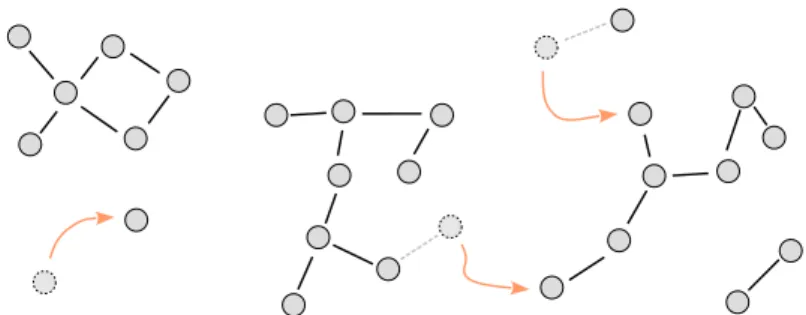
Figure 1.Opportunistic networking in a disconnected mobile network.
of them. WoT solutions have been investigated in the agricultural context [23,24] (and also in the smart home 129
context [25,26]) in order to improve the processing of dataflows produced by sensors and to expose API of 130
physical objects in the Web. Agri-IoT [23] is a data analytic platform composed of multiple layers, allowing 131
to communicate with devices (lower layer), to analyze data (intermediate layers) and to present information 132
to end-users either using dashboards or mobile applications (higher layer). In this platform, sensors, and the 133
data they produce, are semantically described using agricultural ontologies. But again, these solutions do not 134
implement disruption-tolerant or opportunistic networking techniques to cope with the connectivity disruptions 135
that can occur in smart agriculture and farming application domains, and more generally in scenarios involving 136
mobile devices communicating with short range wireless interfaces. 137
In the next section, we present a WoT dedicated platform called ASAWoO. This platform implements 138
opportunistic networking and computing mechanisms, and addresses the drawbacks of above-presented works. 139
3. Leveraging the Web of Things and the opportunistic computing to build systems for the smart 140
agriculture 141
The smart agriculture mainly consists in growing seedlings and plants while preserving natural resources 142
(e.g. water) and limiting crop protection products. To do so, both environmental properties (soil moisture, 143
ambient temperature, sunshine, ...) and crop growth are monitored using fixed sensors or sensors embedded on 144
field machines, drones or agribots. Collected data are compared to agricultural data and models to make decisions 145
about the treatments to be performed and the means to achieve them (traditional agricultural machines, agribots, 146
drones). We argue that models, protocols, techniques and approaches developed both in the WoT and in the 147
opportunistic computing can help develop and deploy cyber-physical systems and applications dedicated to the 148
smart agriculture. In the remainder of this section, we develop and justify these words by explaining successively 149
how the opportunistic computing and the WoT can contribute to the smart agriculture. Before detailing these 150
contributions, we remind the key features of the opportunistic computing and of the WoT. 151
3.1. Contribution of the opportunistic computing 152
This subsection first explains what opportunistic computing is and to what extent it could benefit smart 153
agriculture. Then it thoroughly describes how a support for opportunistic computing was implemented in a Web 154
of Things platform. 155
3.1.1. Definitions of opportunistic computing and sensing, and their suitability for smart agriculture 156
Opportunistic networking is a research field that can be considered as being a derivative of the Delay-Tolerant 157
Networking (DTN) research domain. While DTN [27] characterizes networks with long-delay communications 158
and/or with an unreliable connectivity, opportunistic networks denote mobile networks that exploit transient 159
– and sometimes non-predictable – radio contacts between mobile devices to exchange data [28]. Opportunistic 160
networking therefore mostly targets disconnected mobile ad hoc networks (D-MANETs) as illustrated on Figure1. 161
Yet the differences between these two approaches, which both rely on the “store-carry-and-forward” principle, 162
are marginal, and both terms are indistinctly used in this paper. Numerous opportunistic forwarding protocols 163
have been proposed over the past years [22], investigating forwarding strategies based notably on epidemic 164
approaches or on social criteria (computed from mobility patterns, history of contacts or location information). 165
query sensor G B A S A query (forward) response response (forward) A B G S B response (forward) A B G S C
Figure 2.Opportunistic Sensing in a crop monitoring scenario.
The opportunistic computing [29] is an extension of the opportunistic networking, where resources offered by 166
devices are, in general, abstracted and made available through services, thus allowing devices to access resources 167
provided by the devices they have encountered directly orviaintermediate devices. Opportunistic computing 168
and networking do not make assumptions about the network topology and support frequent and unpredictable 169
changes in this one, as well as its fragmentation. 170
Such features make opportunistic computing and networking interesting for the development of systems 171
dedicated to the smart agriculture. Unlike urban areas that may offer solid network infrastructures favorable 172
to environmental sensing, farms are usually located in rural areas where the cellular network coverage is often 173
lackluster and therefore does not provide a reliable network infrastructure. Furthermore devices involved in smart 174
agriculture (e.g. sensors, agribots, drones) are by nature likely to fall in the D-MANET category, because devices 175
may run out of battery or enter a sleep mode for energy-saving purposes, and because mobile devices enter 176
and exit the communication radius of other nodes as they roam. Computing systems relying on opportunistic 177
communications though make it possible to collect data generated by sparsely distributed sensors, even if these 178
ones are not up at the same time and/or if it does not exist an end-to-end path between some sensors and the 179
gathering point. For this purpose, mobile devices (e.g. tractors, agribots, drones, smartphones carried by farmers) 180
can in addition be used as “data mules” to collect data from sensors directly or to transfer data between the 181
different parts of the network that are isolated from one another. Opportunistic computing furthermore allows 182
farmers to deploy sensors or actuators in their fields and/or in their farms, even on their animals [30], without 183
having to worry about the location, the radio range, the duty cycle and the sleep phases of these devices. 184
For the sake of illustration, let us consider a crop irrigation management application that can process soil 185
moisture data produced by sensors deployed in agricultural fields, and that can trigger the watering system if the 186
soil is too dry and if no rainfall is expected soon. As shown in Figure2two farming vehicles A and B, that act as 187
data mules in this smart agriculture scenario, can participate to the collect of data and to their transmission to the 188
gateway, where they will be analyzed by a WoT application in order to decide if the watering system must be 189
triggered or not. In Figure2.A gatewayGemits a service invocation message to query sensorS. This message is 190
stored and carried by the tractor A. In Figure2.B the tractor enters in the radio range of sensorS, and delivers the 191
message toS. Finally, in Figure2.C the service response sent by sensorSis forwarded back to the gatewayGby 192
the tractorBwhich returns to its shelter located in the gateway vicinity. The experiment further presented in this 193
paper implements a similar scenario. 194
3.1.2. Opportunistic computing implementation in ASAWoO Web of Things platform 195
In project ASAWoO, we have designed and developed a disruption-tolerant RESTful support for the 196
WoT [31]. In this opportunistic computing implementation, resources offered by physical objects are identified by 197
URIs and accessed through stateless services. Service requests and responses are forwarded using the “store, carry 198
and forward” principle. This communication support provides a complete service invocation model, allowing to 199
perform unicast, anycast, multicast and broadcast service invocations either using HTTP or CoAP, which makes 200
it particularly suited for the WoT. It is compliant with the six constraints –the sixth one is optional– defined by 201
the REST architecture style for performance, scalability and simplicity purposes. Indeed, it does not maintain any 202
session state, and implements a loosely-coupled client/server architecture where resources offered by physical 203
objects are accessible through well defined service interfaces. By implementing the “store, carry and forward” 204
principle, it makes it possible to store service responses in the cache of clients and of intermediate nodes, but also 205
the service requests that have been sent in the network. Intermediate hosts equipped with this communication 206
system can also act as proxies, and can respond on behalf of a server if they have the response in their local cache, 207
when this one is still valid. Such an approach improves the performance and the scalability of the system, because 208
it naturally performs load balancing and data caching on intermediate hosts, and thus fulfills both the “system 209
layering” requirement and the “response cacheablilty” requirement promoted by the RESTful architecture style. 210
Finally, as WoT applications can be partially or fully developed in Javascript, a part of the application can be 211
executed on the client side, thus allowing to be compliant with REST optional “code-on-demand” constraint, and 212
to reduce the computation load on the physical objects. 213
Like most of the disruption-tolerant communication systems, our system implements a multiple copy 214
forwarding strategy. It can thus take advantage of these message transmission models to increase the message 215
delivery probability and to reduce the response time in a WoT context. For instance, several sensors can 216
simultaneously be invoked using a multicast transmission model without naming them explicitly. All the 217
responses returned by these sensors will be transmitted to the client. 218
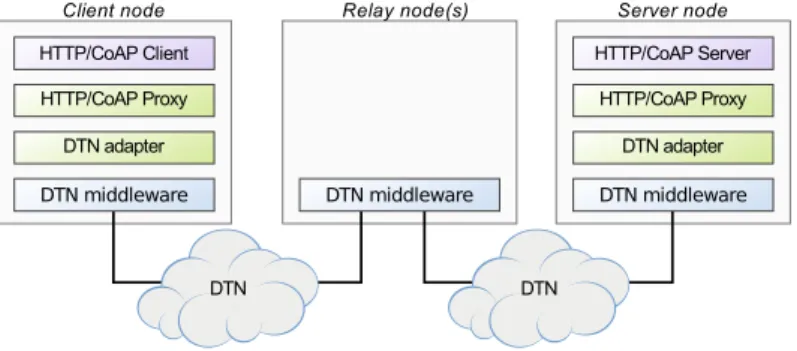
Figure 3.Overview of the implementation of the RESTful opportunistic computing middleware support. The system we have developed allows to invoke services using the HTTP and CoAP application-level 219
protocols. The application-level messages (i.e. HTTP and CoAP messages) can be encapsulated in UDP 220
datagrams, in TCP segments or in messages of a given disruption-tolerant communication system in order 221
to be transmitted to their destination. Different wireless technologies (e.g. Bluetooth, Wi-Fi, zigbee) can be 222
employed to communicate with physical objects. As shown in Figure3, this system is implemented by two 223
main elements, namely an HTTP/CoAP proxy and a DTN adapter. The HTTP/CoAP proxy makes it possible 224
for standard HTTP and CoAP clients and servers to send and receive service requests and responses using 225
disruption-tolerant communication techniques. Thanks to this proxy, programmers can develop HTTP and CoAP 226
WoT applications using regular HTTP and CoAP, libraries. Moreover, standard HTTP and CoAP servers do not 227
need to be modified. This proxy can also invoke remote REST services using Internet-legacy routing protocols 228
(i.e. TCP/IP). The HTTP/CoAP proxy is a common element shared between all the implementations. As for 229
the DTN adapter, it binds the proxy and the disruption-tolerant communication system in charge of forwarding 230
messages in the network. Hence, the DTN adapter depends on the underlying communication system and is 231
specifically developed for each different system. Two adapters have been developed: one relying on the Bundle 232
Protocol (BP) [32], which is the standard message-based protocol over the DTN architecture [33], and another 233
one relying on the C3PO opportunistic communication platform C3PO [34]. This platform provides interesting 234
features to implement the anycast, multicast and broadcast communication models efficiently. For instance, 235
service responses are used to stop the propagation of service requests in the network, and messages can be 236
restricted to a given geographical area. In the experiment presented in the next section, we used the C3PO 237
adapter. The original and efficient features implemented in this RESTful opportunistic computing middleware 238
Interoperability Module
Communication Module Collaboration Module
WoT Module
Functionality Module Reasoning Module Filtering Module
Device Manager
Device Driver Manager Device Configuration WoT Protocol Manager
DTN Communication Network Protocol Manager
Reasoner Context Manager
Functionality Manager Capabilities Manager Collaboration Functionality Discoverer Agent
WoT Application Container
WoT Application Installer WoT Client WoT Server
Privacy Manager WoT Functionality Registry
WoT Functionality Exposer
Ontology cache
DTN Adapter DTN Proxy
Figure 4.Architecture of an avatar.
support allows platform ASAWoO to not have the same drawbacks as those presented in section2, and make it 239
an interesting platform adapted to the opportunistic sensing and to the smart agriculture and farming. 240
3.2. Contribution of the Web of Things 241
The Web of Things allows to control and to communicate with physical objects through the logical software 242
entities that represent them in the Web, and via Web standards and protocols. These logical software entities 243
allow 1) to describe the objects, 2) to syntactically and semantically describe functionalities (i.e. the Web 244
services) providing access to hardware capabilities of the physical objects, 3) to establish communications with 245
the physical objects, by eventually adapting the Web protocols and standards to the proprietary protocols and data 246
formats used by the objects, 4) to provide environment to deliver and to run WoT applications. Thanks to these 247
logical software entities, physical objects can be combined together using Web mashup techniques so as to create 248
complex cyber-physical systems that can be, for instance, designed for the smart agriculture. For instance, a WoT 249
application built on the logical extensions of a crop irrigation system, of sensors deployed in fields to measure soil 250
moiture, and of a weather forecast Web service available on the Internet, could easily be developed using mashup 251
techniques so as to process data produced by sensors, and to trigger the watering system if the soil is too dry 252
and if no rainfall is expected soon. As mentioned before, the data generated by the sensors can be collected by 253
data mules (e.g., tractors) and transmitted to their logical representations deployed in a cloud infrastructure. The 254
application can query these logical representations to obtain the environmental measures, can invoke a forecast 255
Web service available on the Internet, and can decide on the basis of these pieces of information to trigger the 256
watering or not. If so, this application will act on the watering system through its logical representation. 257
In the remainder of this section, we present the concept of avatar [35] and the middleware platform we have 258
proposed in project ASAWoO, and how they can be used in a smart agriculture scenario similar to that described 259
in the previous lines. We also give a comparison of the concept of avatars with the concept of servient proposed 260
by the W3C [36]. 261
3.2.1. Overview of the Avatar concept 262
The purpose of an avatar is to provide device vendors, software developers and end-users with a 263
comprehensible abstraction that makes physical objects accessible on the Web and that extends their status and 264
capabilities (processing, acting, sensing, etc.) into homogeneous and user-understandable functionalities. An 265
avatar can be viewed as a "Web-based cyber-physical object" that defines and embodies high-level behaviors for 266
physical devices. 267
An avatar is composed of 7 modules (see Figure4). The interoperability module makes it possible to 268
configure and to manage the physical object linked to the avatar. It acts as an adaptation layer that hides 269
objects’ own protocols. The communication module provides avatar-to-avatar and avatar-to-Web-browser 270
communications. Different kinds of applicative protocols (e.g. HTTP, CoAP) and transport protocols (UDP, 271
TCP, the disruption-tolerant protocol provided by the opportunistic communication support presented previously 272
in this section) are supported to communicate with the avatars. Moreover, different wireless technologies 273
are currently supported to achieve communications with physical objects, such as Bluetooth, Wi-Fi, Wi-Fi 274
Direct and XBee. The functionality module manages the capabilities and the functionalities of an avatar. Like 275
functionalities, capabilities are pieces of codes that make it possible to exploit the resources offered by the 276
physical objects. But unlike functionalities – which are device independent –, capabilities depend on the physical 277
objects. They can be viewed as implementations of elementary functionalities. Thanks to this approach, an agribot 278
can for instance expose a higher-level of abstraction for the navigation functionality that exploits lower-level 279
functionalities, such as GPS positioning and steering capabilities. Both capabilities and functionalities are 280
described semantically. Reasoning about semantic descriptions of the capabilities and of the functionalities help 281
inferring complex functionalities involving sub-functionalities, thus allowing to define high-level representations 282
that better match the users’ needs than the low-level capabilities. Based on the inferences made by the semantic 283
reasoner, the functionality manager can incrementally deploy new functionalities. These functionalities are 284
filtered by the context manager according to the information it processes continuously, thus allowing to select the 285
implementations of the functionalities that are the most suited to the running conditions of the physical object, as 286
well as to perform dynamic adaptations. Various contextual properties can be taken into account, such as the 287
location of the object, its processing and memory capacities and its power budget. Functionalities are exposed as 288
REST services by the WoT module, and therefore can be invoked remotely by WoT applications (WoTApps) or 289
by other avatars for collaboration purposes. The WoT application container deploys and manages the life-cycle of 290
WoTApps. WoTApps can fully run server-side (i.e. on the avatar), be distributed and executed both on the avatar 291
and in a Web browser, or be exclusively run in a Web browser. Finally, avatars implement a collaboration module 292
relying on an agent-based approach. This module aims at endowing an autonomous behavior to the avatar and 293
physical object, so that they can discover the functionalities they can partially achieve and that require the help of 294
other avatars to be performed. After discovering the missing functionality in another avatar, they can enroll this 295
avatar to provide the functionality. 296
The main differences between the proposition of the W3C for the WoT, called Servient [36], and the 297
avatar-based model reside in the ability of avatars to tolerate the connectivity disruptions, to dynamically 298
adapt their behavior and the functionalities they provide to their running context, to automatically deploy new 299
functionalities inferred on the basis of the semantic description of more elementary ones, and to collaborate 300
with other avatars. Indeed like avatars, servients implement a legacy communication module that makes it 301
possible to communicate with physical objects using proprietary protocols, a protocol binding module that 302
allows to use several types of applicative protocols (MQTT, HTTP, CoAP) to communicate with the servients, 303
a model of resources and of description of objects, and a runtime environment to run WoTApps. These 304
differences between avatars and servients make avatars more suited to develop cyber-physical systems that 305
integrate autonomous mobile objects, and therefore more adapted to systems dedicated to the smart agriculture 306
and farming. Furthermore, the reference implementation of the W3C standard is not as mature as that proposed 307
by the ASAWoO project. Unlike solutions proposed in works [23–26], both Servients and Avatars provide users 308
and developers with a comprehensive virtual representation of physical objects to access and control them. This 309
unified resource representation helps coping with device heterogeneity, which is not well supported in Agri-IoT 310
according to its authors. 311
3.2.2. Avatar runtime environment 312
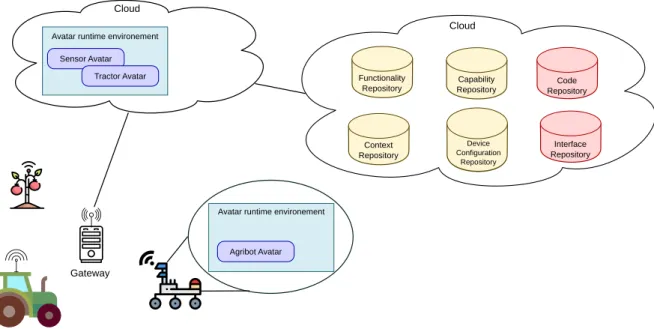
In order to configure themselves automatically, avatars rely on a set of semantic and code repositories 313
as represented on Figure5. These repositories contain device setups, semantic descriptions of capabilities 314
and functionalities of avatars and semantic descriptions of execution contexts. The code repositories provide 315
independent syntactic descriptions of REST interfaces of functionalities, and specific implementations of 316
capabilities, functionalities and WoTApps. Most of capabilities are device dependent, which is not the case of 317
the functionalities. The implementations of functionalities can still differ for non functional purposes such as 318
quality of service requirements. Avatars download pieces of code from the code repositories and deploy them 319
Functionality
Repository RepositoryCapability
Context Repository Device Configuration Repository Code Repository Interface Repository Avatar runtime environement
Avatar runtime environement Sensor Avatar Agribot Avatar Tractor Avatar Cloud Cloud Gateway
Figure 5.Avatar runtime environment.
locally, doing so they instantiate new capabilities and functionalities, and infer new high-level ones progressively. 320
Avatars are executed in a runtime environment that manages their life-cycle and that exposes them in the Web. An 321
avatar is instantiated in the runtime environment either automatically when a new physical object is discovered in 322
the local area network or when a user registers a new device manually. The avatar runtime environment and the 323
code repositories can be installed either in a cloud platform, on a gateway, or even on a physical object if this 324
one has enough processing power and memory capacity. Needless to say, the repositories and the avatar runtime 325
environments can be deployed on separated devices. 326
3.2.3. Technical Implementation 327
The ASAWoO runtime environment is developed in Java and is based on the OSGi Apache Felix platform2. 328
It is designed as a set of services that are deployed using bundles (i.e. a JAR augmented with metadata), and 329
that manage the life-cycle of avatars. An avatar (i.e. the different modules and managers forming the avatar’s 330
architecture) is also implemented as a set of OSGi services. Configuration files and the pieces of code of 331
capabilities, functionalities and WoTApps are also deployed using bundles. Code repositories are implemented 332
by OSGi Bundle Repositories (OBR), which can be either local on remote. An OBR offers a customizable 333
dependency management that has been tuned to take into account functionalities and capabilities requirements. 334
The semantic reasoner module depends on Apache Jena3inference engine and queries Fuseki SPARQL endpoints. 335
In the current implementation, the Vert.x4stack is used to serve WoTApps and to expose functionalities as REST 336
services over HTTP. Vert.x handler mechanism also helps in managing asynchronous calls to functionalites. The 337
opportunistic communication module implementation based on C3PO has already been thoroughly covered in 338
subsection3.1.2and in [31]. 339
ASAWoO source code which is distributed under the CeCILL license (compatible with GNU GPLv2), is 340
available in GIT repository5and users and developers documentation can be accessed on ASAWoO website6. 341 2 http://felix.apache.org/ 3 https://jena.apache.org/ 4 https://vertx.io/ 5 https://gitlab.com/asawoo 6 https://asawoo.gitlab.io/
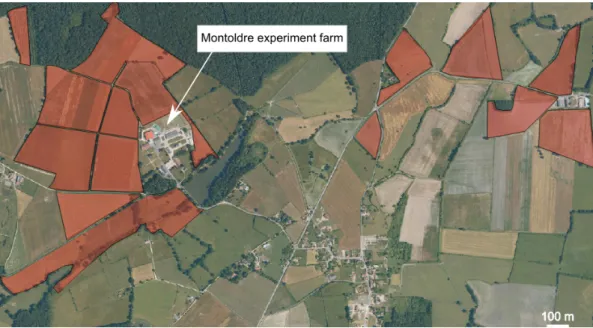
Figure 6.Montoldre experiment farm.
4. Experiment 342
This section describes the experiment conducted during 4 months in Montoldre (France) experimental 343
farm in cooperation with IRSTEA7. This experiment aims firstly at evaluating the effective functioning of the 344
ASAWoO midldleware platform and its performances in real conditions, and secondly at studying the relevance 345
and the viability of a Web of Thing approach in an agricultural context. 346
4.1. Presentation of the experiment environment 347
Montoldre experimental farm is a large plot of agricultural land dedicated to the experimentation of 348
agricultural techniques, especially fertilizer spreading techniques. The area shown on the satellite view Figure6
349
is composed of a dozen fields (in red) maintained by a handful of agricultural vehicles. 350
The application considered in this first experiment consisted in collecting environmental data (humidity 351
and temperature) measured by sensors. This experiment was ran in the early stages of ASAWoO development. 352
Even though the whole middleware was not complete at that time, the opportunistic communication module was 353
operational. Hardened sensors that can be exposed to bad weather conditions were also not ready to use for this 354
experiment. Consequently, we used tiny single-board computers (RaspberryPi’s) equipped with Wi-Fi antennas 355
that produce data exactly as the sensors would have done. As these devices are not hardened, they were placed in 356
farm buildings, as shown in Figure7. These experimental conditions may appear as degraded, but those are not 357
in reality because the communication behavior of sensors has been reproduced as accurately as possible. This 358
experiment allowed us to validate the RESTful opportunistic communication support presented in Section3. 359
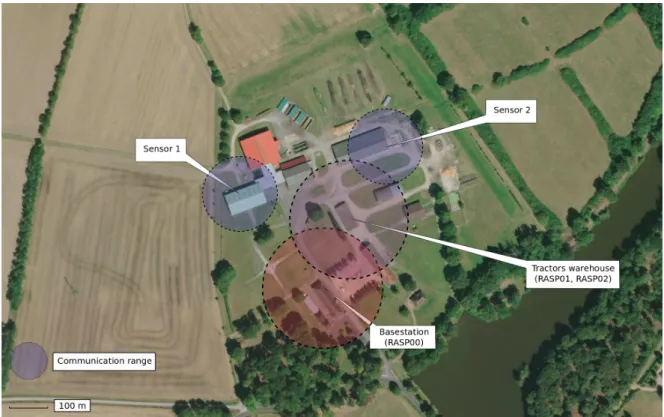
Three instances of ASAWoO runtime have been deployed on RaspberryPi’s equipped with 5dB Wi-Fi 360
antennas. The first one, identified as RASP00, acted as a base station located in IRSTEA office at the limit of 361
Wi-Fi communication range from the tractors’ warehouse. The two other RaspberryPi’s (RASP01 and RASP02) 362
were equipped with an external battery pack and a GPS module. The kits were embedded on two tractors. 363
GPS antennas were placed on the tractors’ roofs and the battery power cords were plugged into the tractors’ 364
cigarette lighters to power up/on the Raspberry and recharge. Two other self-powered RaspberryPi’s with smaller 365
range acting as sensors have been deployed in farm buildings located on tractors paths. Locations of the five 366
nodes are shown on the map Figure7. The embedded system deployed on sensors was restricted to ASAWoO 367
Figure 7.Node locations and their approximate communication ranges. Trip
duration
Number of messages exchanged Number of GPS positions RASP00/
RASP01
RASP00/ RASP02
RASP01/
RASP02 RASP01 RASP02
Day 1 5h09 46 110 48 5 147
Day 2 4h50 28 47 3 0 28
Day 3 6h21 56 0 0 266 0
Day 4 7h31 334 0 0 1005 0
Day 5 7h44 219 0 51 0 2063
Table 1.Data of active days.
communication module since the whole middleware stack was not required. During this experiment, the sensors 368
produced data every 30 minutes. 369
During the 4 months of experimentation, over 30 trips have been monitored. Mobility traces of RASP01 370
and RASP02 (i.e. tractors) have been stored in log files, as well as the contacts and exchanges between tractors 371
and the base station). Logs were compiled and sent to the base station when entering its radio range. A ssh tunnel 372
between the base station at IRSTEA and our lab has been established in order to access the logs, update the code 373
if necessary, and remotely monitor the experiment throughout its progress. The following subsection presents the 374
experiment outcomes, focusing on a few trips involving both tractors or longer activity periods. 375
4.2. Experiment results 376
After 4 months of sparse activity, logs gathered on the base station have been compiled, sanitized and 377
analyzed. Since the two equipped tractors were rarely operating simultaneously, we focused on the logs of days 378
providing the most extensive data. A summary of the activity during these days is presented in Table1. Day 379
one was the experiment setup, we checked that communication was well established between the three nodes, 380
and moved RASP01 and RASP02 to make them enter and exit communication range with each other and with 381
sensors. On day 3, the tractor carrying RASP01 has been spreading fertilizer, and on day 4 it sowed the fields. 382
Day 5 featured the longer trip from RASP02. 383
Average speed Communication range
Maximum range Average range Median range
15,9 km/h 468 m 237 m 185 m
Table 2.Tractors average speed and radio-contact range.
0 0.5 1 1.5 2 00:00:00 01:00:00 02:00:00 03:00:00 04:00:00 05:00:00 06:00:00 Numbe r of Neighb ors of RASP 00 Time (hh:mm:ss) Real traces Estimation (200.0m range) 0 0.5 1 1.5 2 00:00:00 01:00:00 02:00:00 03:00:00 04:00:00 05:00:00 06:00:00 Numbe r of Neighb ors of RAS P01 Time (hh:mm:ss) Real traces Estimation (200.0m range) 0 0.5 1 1.5 2 00:00:00 01:00:00 02:00:00 03:00:00 04:00:00 05:00:00 06:00:00 Numbe r of Neighb ors of RASP 02 Time (hh:mm:ss) Real traces Estimation (200.0m range)
Figure 8.Real contacts vs estimated contacts of RASP00, RASP01 and RASP02 on day 1.
Table2compiles global observations made throughout the experiment. When tractors were active, we 384
reported an average speed of 16km/h which was not an hindrance to message delivery. Opportunistic sensing and 385
the data mule approach is therefore a viable solution in the agricultural context where vehicles speed is moderate. 386
Although cellular network coverage was quite poor on Montoldre site, opportunistic networking via ad hoc Wi-Fi 387
proved to be effective to convey small messages such as environmental data. Under the right circumstances the 388
communication range exceeded our expectations with a recorded maximum range of 468 meters. This result is 389
further supported by the figure8which shows the number of actual contacts at a given time between two nodes 390
versus an estimate derived from the actual node positions and a fixed range of 200 meters. More often than not, 391
actual contacts were established whereas the estimate did not consider the nodes to be within radio range. 392
Contacts durations (i.e. the time periods during which the nodes are in contact and can communicate) are 393
presented on Figure9. On day 5, half of the contacts lasted less than three minutes while only a tenth of the 394
contacts exceeded 10 minutes. The few contacts exceeding one hour were due to RASP02 instance remaining 395
active in the warehouse, within range of the base station. The relatively moderate speed of the tractors combined 396
with the long range Wi-Fi interfaces resulted in long enough contacts allowing for wide communication time 397
periods. Since the size of exchanged messages, were they gossiping relating to the opportunistic communication 398
protocol or sensor data, was quite small (a few bytes), such a time frame is sufficient to perform opportunistic 399
sensing (i.e. collect sensor data and opportunistically forward this data). 400
0 0.2 0.4 0.6 0.8 1 00:00 00:30 01:00 01:30 02:00 02:30 03:00 03:30 Cumul ative Distrib ution Functio n, CDF(con tact duration) Contacts durations (hh:mm)), x 2017-04-11
Figure 9.Cumulative distribution of contacts durations on day 5.
Nevertheless it is worth to note that the experiment did not go smoothly all the way. Sometimes the 401
RaspberryPi was slow to receive the GPS signal, which not only led to missing positions, but also to clock 402
desynchronization and erroneous timestamps since the system clock was set to GPS time. However, logs could be 403
resynchronized using contacts and exchanged messages with the base station. Due to farming vehicle vibrations, 404
sometimes the device got its GPS antenna or its power cord unplugged, and the shutdown and powering up that 405
should have been controlled by the battery was not always done properly, which led to corrupted log files that 406
had to be discarded or corrected. In a concrete deployment, kits should be designed and built to better fit the 407
specificities of agricultural vehicles (e.g. with antivibration material, properly integrated power management and 408
a CMOS clock battery). 409
Lastly, the final encountered issue was the considerable size of the covered area combined with the fact that 410
the two equipped vehicles were hardly running together, which resulted in too few contacts between the mobile 411
nodes outside the vicinity of their rallying point (the warehouse). The lack of contact data does not affect the 412
effectiveness of opportunistic sensing nonetheless. Even though contacts are more likely to occur in the rallying 413
point area, tractors are still able to retrieve data from faraway sensors and forward it to the base station. The 414
two mobile ASAWoO instances were indeed able to successfully gather data from sensors up to the base station 415
without a permanent connectivity between each node. 416
4.3. Evaluation of the Web of Things approach 417
The experiment described in the previous section focused on the validation of ASAWoO opportunistic 418
communication capabilities whereas the Web of Things aspect could not be tested at that time. WoT modules 419
were nonetheless still validated in the later stages of ASAWoO development in another experiment which will be 420
shortly presented in this subsection. During the Montoldre experiment ASAWoO middleware mainly consisted 421
of the avatar core, the functionalities management and registry features (i.e. functionalities were advertised as 422
RESTful services) plus the opportunistic communication module. The second experiment was run in Bordeaux, 423
France. It introduced the device manager and the semantic reasoning features to instantiate capabilities, simple 424
and composite functionalities, as well as the WoT Application module. Unlike the farm experiment which 425
spanned over 4 months, this one lasted only one day. Since the communication module had already been validated 426
in the long-run experiment, the goal was to validate ASAWoO final stage, particularly the WoT related modules 427
(e.g. WoTApp manager, automatic instantiation of functionalities from device configurations and semantic 428
repositories, ...). 429
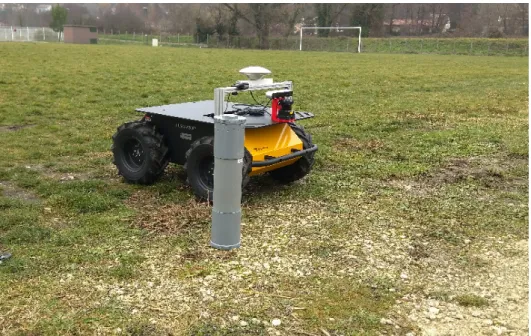
Figure 10.All-terrain mobile platform running ASAWoO next to the base station kit
This experiment was based on the same data collection WoTApp and the same hardware kits. Although 430
the RaspberryPi-based kits (with GPS module and Wi-Fi interface) have been reused, this time the data mule 431
was a robot, the Jackal all-terrain mobile platform8, on which was deployed an instance of ASAWoO hosting
432
its own avatar. Figure10shows a picture of the robot and the packaged base station kit on the experimentation 433
field. In addition to its navigation capabilities, a camera was mounted on the platform. A ROS9 bridge 434
interoperability module was developed for ASAWoO to expose these capabilities, which in turn enabled higher 435
level functionalities such as person detection and video surveillance. The video surveillance and the navigation 436
functionalities were then combined to provide a patrol functionality. 437
The scenario written for this experiment consisted in making the robot patrol from sensor to sensor to 438
collect data as long as it did not encounter a person. If the video surveillance functionality was to trigger an 439
alarm, the reasoning module will give priority to the patrol functionality and use the navigation functionality to 440
go back to a rallying point. This scenario is illustrated on ASAWoO code repository homepage10. 441
During the experiment, all devices hosting an ASAWoO platform were accessible through their second Wi-Fi 442
interface set on access point mode. When connecting to a device’s main WoTApp we could navigate through its 443
neighbors and query their functionalites. Figure11presents a screenshot of the main WoTApp hosted on the 444
robot. It features system functionalities (e.g. functionalities registry, neighborhood, device configuration and 445
WoTApp deployment), as well as other avatars whose remote functionalities can be reached through multi-hop 446
asynchronous DTN RESTful requests. The screenshot shows a JSON-formatted GPS position in response to a 447
GET request sent to a sensor’s LocationService functionality. The retrieved sensor data were also displayed on 448
the data collection WoTApp. 449
It is worth to note that although this paper mainly focuses on sensing functionalities, ASAWoO also supports 450
actuators and the conclusions that we drew also apply to this class of devices. The general practice that has 451
been followed in ASAWoO was to bind actuator functionalities to PUT and POST HTTP methods while GET 452
methods were used for sensor functionalities. In the patrol surveillance scenario, the navigation functionality is 453
an example of an actuator functionality. Eventually, results regarding context adaptation and semantic reasoning 454
performances were presented in [37]. 455
8 Jackal unmanned ground vehicle:https://www.clearpathrobotics.com/jackal-small-unmanned-ground-vehicle/ 9 ROS, Robot Operating System:http://www.ros.org/
Figure 11.Screenshot of ASAWoO administration WoTApp
4.4. Results discussion 456
During the second experiment, the WoT approach allowed us to successfully interact with different devices 457
through their logical representations. Devices heterogeneity was indeed hidden behind avatars using web 458
standards (JSON over HTTP requests). The web browsers from a laptop, a smartphone or a tablet were used 459
interchangeably. 460
Both experiments were conclusive regarding the opportunistic computing aspect. The monitored contact 461
durations and distances between mobile and/or static nodes, resulting from the data mules speed and their 462
communication range, both support the idea that opportunistic sensing is a possible option for smart agriculture. 463
The communication range measured in the second experiment confirmed the first results with a maximum range 464
of 283 meters between the base station and the robot. We however observed that farming vehicles were not 465
operating on a daily basis whereas data gathering depends on their operation frequency for an opportunistic 466
sensing approach entirely relies on nodes mobility. 467
Even though the following perspective is beyond the scope of this article, we argue that the node density 468
issue can be addressed by emulation techniques. At the end of the first experiment, we obtained valuable data 469
on the mobility of farming vehicles in actual conditions. These mobility data could be made available on a 470
service such as CRAWDAD11and leveraged with simulation tools such as LEPTON [38] which is an emulation 471
platform for opportunistic networking development. LEPTON allows the execution of functional code to run 472
in an emulated environment under controlled and repeatable conditions, where only the mobility of nodes is 473
simulated. The possibility to replay scenarios based on actual tractors paths gives the opportunity to evaluate our 474
approach under different conditions and therefore to finely tune scenario parameters such as the number of data 475
mules, their paths and speed, or the positions of sensors, without starting over an actual experimental campaign. 476
Thus, testing different smart agriculture scenarios could indeed help in deducing an optimal setup to improve 477
opportunistic sensing solutions for precision agriculture. 478
5. Conclusion 479
The Internet of Things will become a reality when connected object makers will propose off-the-shelves 480
cyber-physical objects that can communicate and interoperate through open standard protocols and data formats, 481
or that can be connected to Web of Things (WoT) platforms that bridge the gap between proprietary protocols 482
and Web standard formats and protocols. Such objects and platforms appear as attractive solutions to build 483
complex systems notably for the environmental sensing and for the smart agriculture and farming. Nevertheless 484
in challenging environments, such as in agricultural and farming environments, it is often difficult to deploy 485
systems relying exclusively on infrastructure-based networks because rural areas have often a poor network 486
coverage, and because there are frequent and unpredictable connectivity disruptions resulting from both the 487
mobility of agricultural machines (e.g. tractors, agribots, drones) communicating with short range radio interfaces 488
and from the sleep phases kept by some devices for energy saving purposes. 489
In this paper we presented how opportunistic computing can be combined with the WoT to contribute to 490
the smart agriculture, and how such an approach was implemented in a middleware platform called ASAWoO. 491
Opportunistic computing and networking techniques leverage the mobility of agricultural machines to provide 492
intermittent connectivity between physical objects that would not have been connected by any route otherwise. 493
This platform provides a virtual representation of the physical objects in the Web, called avatars, which give 494
access to the objects functionalities in order to allow WoT users to interact with devices at an higher level of 495
abstraction. 496
ASAWoO platform was evaluated in a practical smart agriculture scenario through a 4-month experiment. 497
Two tractors carried ASAWoO instances responsible for collecting data of sensors disseminated in an experimental 498
farm. Experiment results showed that ASAWoO platform was able to perform environmental sensing using 499
opportunistic computing in real conditions, and that the low pace of farming vehicles makes opportunistic 500
computing possible in the agricultural context. Based on these outcomes we conclude that both the integration 501
of sensors and actuators like agribots in WoT applications, and the implementation of opportunistic computing 502
mechanisms are likely to improve agricultural practices and compensate for the potential lack of network 503
infrastructure. Such an approach is not limited to smart agriculture and farming, and could also be transposed to 504
other related critical contexts such as disaster relief. 505
Author Contributions:Data curation, Nicolas Le Sommer; Investigation, Lionel Touseau; Resources, Nicolas Le Sommer; 506
Software, Lionel Touseau and Nicolas Le Sommer; Supervision, Nicolas Le Sommer; Validation, Lionel Touseau; 507
Visualization, Lionel Touseau; Writing - original draft, Lionel Touseau and Nicolas Le Sommer; Writing - review & 508
editing, Lionel Touseau and Nicolas Le Sommer. 509
Funding: This work was supported by the French ANR (Agence Nationale de la Recherche) grant number 510
ANR-13-INFR-012. 511
Acknowledgments: The experiment presented in this article would not have been possible without the helpful support 512
provided by IRSTEA from Montoldre and Clermont-Ferrand. We would also like to thank other partners for their valuable 513
contributions to the ASAWoO project: TWEAK team from Lyon 1 university LIRIS lab (http://liris.cnrs.fr/), COSY team 514
from Valence-Grenoble LCIS lab (http://lcis.grenoble-inp.fr/), and Generation Robots (https://generationrobots.com/). 515
References 516
1. Li, Z.; Wang, J.; Higgs, R.; Zhou, L.; Yuan, W. Design of an Intelligent Management System for Agricultural 517
Greenhouses Based on the Internet of Things. 22017 IEEE International Conference on Computational Science and 518
Engineering (CSE) and IEEE International Conference on Embedded and Ubiquitous Computing (EUC)2017, pp. 519
154–160. 520
2. Vasisht, D.; Kapetanovic, Z.; Won, J.; Jin, X.; Chandra, R.; Sinha, S.; Kapoor, A.; Sudarshan, M.; Stratman, S. 521
FarmBeats: An IoT Platform for Data-Driven Agriculture. 14th USENIX Symposium on Networked Systems Design 522
and Implementation (NSDI 17); USENIX Association: Boston, MA, 2017; pp. 515–529. 523
3. Sreekantha, D.K.; Kavya, A.M. Agricultural crop monitoring using IOT - A study. Proceedings of 2017 11th 524
International Conference on Intelligent Systems and Control, ISCO 20172017, pp. 134–139. 525
4. Zhao, D.; Ma, H.; Liu, L.; Zhao, J. On Opportunistic Coverage for Urban Sensing. Proceedings of 10th International 526
Conference on Mobile Adhoc and Sensor Systems (MASS 2013); IEEE: Hangzhou, China, 2013; pp. 218–226. 527
5. Guinard, D.; Trifa, V.; Mattern, F.; Wilde, E. From the Internet of Things to the Web of Things: Resource-oriented 528
Architecture and Best Practices. InArchitecting the Internet of Things; Uckelmann, D.; Harrison, M.; Michahelles, F., 529
Eds.; Springer, 2011; pp. 97–129. doi:10.1007/978-3-642-19157-2. 530
6. Guinard, D.; Trifa, V.; Wilde, E. A Resource Oriented Architecture for the Web of Things. IEEE International 531
Conference on the Internet of Things (IOT 2010), 2010, pp. 1–8. doi:10.1109/IOT.2010.5678452. 532
7. Wilde, E. Putting Things to REST. Technical report, School Of Information and UC Berkeley, 2007. 533
8. Mrissa, M.; Médini, L.; Jamont, J.P.; Le Sommer, N.; Laplace, J. An Avatar Architecture for the Web of Things. 534
Internet Computing, IEEE2015, pp. 30–38. 535
9. Rehman, A.u.; Abbasi, A.; Islam, N.; Shaikh, Z. A Review of Wireless Sensors and Networks’ Applications in 536
Agriculture2014. 36, 263–270. 537
10. Ojha, T.; Misra, S.; Raghuwanshi, N.S. Wireless sensor networks for agriculture: The state-of-the-art in practice and 538
future challenges.Computers and Electronics in Agriculture2015,118, 66–84. 539
11. Kim, Y.; Evans, R.G.; Iversen, W.M. Remote Sensing and Control of an Irrigation System Using a Distributed 540
Wireless Sensor Network. IEEE Transactions on Instrumentation and Measurement2008,57, 1379–1387. 541
12. Hull, B.; Bychkovsky, V.; Zhang, Y.; Chen, K.; Goraczko, M.; Miu, A.; Shih, E.; Balakrishnan, H.; Madden, S. 542
CarTel: A Distributed Mobile Sensor Computing System. Proceedings of the 4th International Conference on 543
Embedded Networked Sensor Systems; ACM: Boulder, Colorado, USA, 2006; SenSys ’06, pp. 125–138. 544
13. Campbell, A.T.; Eisenman, S.B.; Lane, N.D.; Miluzzo, E.; Peterson, R.A. People-centric Urban Sensing. Proceedings 545
of the Second Annual International Wireless Internet Conference; ACM Press: Boston, Massachusetts, USA, 2006; 546
WICON ’06, pp. 18–31. 547
14. Abdelzaher, T.; Anokwa, Y.; Boda, P.; Estrin, D.; Burke, J.; Leonidas, G.; Madden, S.; Reich, J. Mobiscopes for 548
Human Spaces.IEEE Pervasive Computing2007,6, 20–29. 549
15. Kansal, A.; Nath, S.; Liu, J.; Zhao, F. SenseWeb: An Infrastructure for Shared Sensing. IEEE MultiMedia2007, 550
14, 8–13. 551
16. Riva, O.; Borcea, C. The Urbanet Revolution: Sensor Power to the People! IEEE Pervasive Computing2007, 552
6, 41–49. 553
17. Urban Atmospheres. http://www.urban-atmospheres.net/. 554
18. Eisenman, S.B.; Miluzzo, E.; Lane, N.D.; Peterson, R.A.; Ahn, G.S.; Campbell, A.T. The BikeNet Mobile Sensing 555
System for Cyclist Experience Mapping. Proceedings of the 5th International Conference on Embedded Networked 556
Sensor Systems; ACM: Sydney, Australia, 2007; SenSys ’07, pp. 87–101. 557
19. Miluzzo, E.; Lane, N.D.; Eisenman, S.B.; Campbell, A.T. CenceMe - Injecting Sensing Presence into Social 558
Networking Applications. Smart Sensing and Context, Second European Conference; Springer: Kendal, England, 559
2007; EuroSSC 2007, pp. 1–28. 560
20. MIT Senseable City Lab. 561
21. Chen, K.W. CafNet: A Carry-and-Forward Delay-Tolerant Network. Master’s thesis, Massachusetts Institute of 562
Technology, 2007. 563
22. Mota, V.F.S.; Cunha, F.D.; Macedo, D.F.; Nogueira, J.M.S.; Loureiro, A.A.F. Protocols, Mobility Models and Tools 564
in Opportunistic Networks: A Survey. Computer Communications2014,48, 5–19. 565
23. Kamilaris, A.; Gao, F.; Prenafeta-Boldu, F.X.; Ali, M.I. Agri-IoT: A semantic framework for Internet of 566
Things-enabled smart farming applications. 3rd IEEE World Forum on Internet of Things (WF-IoT 2016); , 567
2016; pp. 442–447. doi:10.1109/WF-IoT.2016.7845467. 568
24. Taylor, K.; Griffith, C.; Lefort, L.; Gaire, R.; Compton, M.; Wark, T.; Lamb, D.; Falzon, G.; Trotter, M. Farming the 569
Web of Things. IEEE Intelligent Systems2013,28, 12–19. doi:10.1109/MIS.2013.102. 570
25. Kamilaris, A.; Trifa, V.; Pitsillides, A. HomeWeb: An application framework for Web-based smart homes. 18th 571
International Conference on Telecommunications (ICT 2011); , 2011; pp. 134–139. doi:10.1109/CTS.2011.5898905. 572
26. Kamilaris, A.; Pitsillides, A.; Trifa, V. The Smart Home meets the Web of Things. International Journal of Ad Hoc 573
and Ubiquitous Computing (IJAHUC)2011,7, 145–154. doi:10.1504/IJAHUC.2011.040115. 574
27. Fall, K. A Delay-Tolerant Network Architecture for Challenged Internets. Proceedings of ACM SIGCOMM03; , 575
2003; pp. 27–34. 576
28. Pelusi, L.; Passarella, A.; Conti, M. Opportunistic Networking: Data Forwarding in Disconnected Mobile Ad Hoc 577
Networks.IEEE Communications Magazine2006,44, 134–141. 578
29. Conti, M.; Giordano, S.; May, M.; Passarella, A. From Opportunistic Networks to Opportunistic Computing. IEEE 579
Communications Magazine2010,48, 126–139. 580
30. Juang, P.; Oki, H.; Wang, Y.; Martonosi, M.; Peh, L.S.; Rubenstein, D. Energy-efficient Computing for Wildlife 581
Tracking: Design Tradeoffs and Early Experiences with ZebraNet. Proceedings of the 10th International Conference 582
on Architectural Support for Programming Languages and Operating Systems (APLOS X); ACM: San Jose, CA, 583
USA, 2002; pp. 96–107. 584
31. Le Sommer, N.; Touseau, L.; Mahéo, Y.; Auzias, M.; Raimbault, F. A Disruption-Tolerant RESTful Support for the 585
Web of Things. 4th International Conference on Future Internet of Things and Cloud (FiCloud 2016); Younas, M.; 586
Awan, I.; Seah, W., Eds.; , 2016; pp. 17 – 24. 587
32. Scott, K.; Burleigh, S. Bundle Protocol Specification. IETF RFC 5050, 2007. 588
33. Cerf, V.G.; Burleigh, S.C.; Durst, R.C.; Fall, K.; Hooke, A.J.; Scott, K.L.; Torgerson, L.; Weiss, H.S. Delay-Tolerant 589
Networking Architecture. IETF RFC 4838, 2007. 590
34. Le Sommer, N.; Launay, P.; Mahéo, Y. A Framework for Opportunistic Networking in Spontaneous and Ephemeral 591
Social Networks. 10th Workshop on Challenged Networks (CHANTS’2015); ACM: Paris, France, 2015. 592
35. Médini, L.; Mrissa, M.; Terdjimi, M.; Khalfi, E.M.; Le Sommer, N.; Capdepuy, P.; Jamont, J.P.; Occello, M.; Touseau, 593
L. Building a Web of Things with Avatars. InManaging the Web of Things: Linking the Real World to the Web; 594
Shengn, M.; Qin, Y.; Yao, L.; Benatallah, B., Eds.; Elsevier, 2016. 595
36. W3C. Web of Things (WoT) Architecture, 2017. 596
37. Terdjimi, M.; Médini, L.; Mrissa, M.; Le Sommer, N. An Avatar-Based Adaptation Workflow for the Web of Things. 597
2016 IEEE 25th International Conference on Enabling Technologies: Infrastructure for Collaborative Enterprises 598
(WETICE); , 2016. doi:10.1109/WETICE.2016.22. 599
38. Sánchez-Carmona, A.; Guidec, F.; Launay, P.; Mahéo, Y.; Robles, S. Filling in the missing link between 600
simulation and application in opportunistic networking. Journal of Systems and Software2018, 142, 57 – 72. 601
doi:10.1016/j.jss.2018.04.025. 602
c
2019 by the authors. Submitted toFuture Internetfor possible open access publication under the terms and conditions of 603
the Creative Commons Attribution (CC BY) license (http://creativecommons.org/licenses/by/4.0/). 604