Mechanical Aspects of
Mechanical Aspects of
Tumour Growth
Tumour Growth
Aim: Are tumors solids or liquids?
Multiphase model Multiphase model tumour cells host cells deformable and degradable ECM extracellular liquid DDDD DDDD
Multiphase models Multiphase models
with
volume ratios
Interaction of the constituents with the liquid Interaction of the constituents with the liquid
Observation:
The interactions involving the liquid phase are much
smaller than those between cells and ECM
Interaction of the constituents with the liquid Interaction of the constituents with the liquid
Adhesion forces Adhesion forces
Human Brain Tumor
Interfering with the adhesion mechanisms Interfering with the adhesion mechanisms
Disrupts actin cytoskeleton removes hyaluronan backbone from membrane
Modelling the interaction between cells and ECM Modelling the interaction between cells and ECM
Modelling the interaction between cells and ECM Modelling the interaction between cells and ECM
Using force balance
i.e., if cells are pulled strong enough they move relative to the ECM if not they stick to the ECM
Summary Summary
Modelling the interaction between cells and ECM Modelling the interaction between cells and ECM
− Adhesion depends on the amount of ECM, e.g.
moves slows down stops
− Different clones have different σ
Modelling the interaction between cells and ECM Modelling the interaction between cells and ECM
Modelling the interaction between cells and ECM Modelling the interaction between cells and ECM
• Non-remodelling ECM • Growth by loss of contact inhibition mechanisms
• Cell ensembles as elastic fluids
• Non-remodelling EC
• Growth by loss of contact inhibition mechanisms
• Cell ensembles as elastic fluids • Vascularised case
Islets of Langerhans Cell volume ratio
Nutrient
Modelling the interaction between cells and ECM Modelling the interaction between cells and ECM
Cell-cell interactions Cell-cell interactions E-cadherin β-catenin α-catenin α-actinin actin P120 cytoplasm
Stress relaxation in a liquid Stress relaxation in a liquid
s λ s str ai n str ess G(s) = relaxation kernel If
Stress relaxation in a solid Stress relaxation in a solid
s λ s str ai n str ess G(s) = relaxation kernel } elasticity
Creep Creep s Λ s str ess str ai n
Plastic re-organisation during growth Plastic re-organisation during growth
Cell re-organisation Cell re-organisation (
Stress relaxation Stress relaxation
G(s) = relaxation kernel
λ2 λ1
• Winters et al., Int. J. Cancer,
114: 371-379,(2005) • Forgacs et al., Biophys. J. 74: 2227–2234 .(1998)
(
}
surface tensionCell re-organisation Cell re-organisation
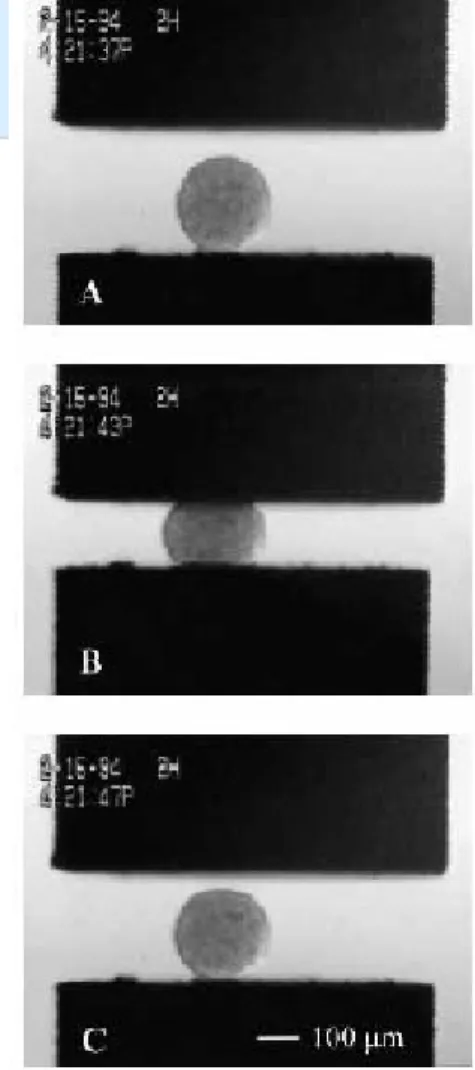
Fig. 5. A spherical heart aggregate on the lower compression plate
(A), compressed for 3.5 hours
(B), and then released (C), temporarily retains flat upper and lower surfaces. Behaving as a Fig. 4. A spherical heart aggregate on the
• Foty et al., PRL 72: 2298-2301 (1996)
Stress relaxation Stress relaxation
Forgacz et al. (1998)
Spheroids are Viscoplastic Spheroids are Viscoplastic
Cell re-organisation Cell re-organisation fluid-like region σ1 solid-like region
• some bonds break • cells re-organise • stress relaxes
yield surface • bonds don’t break
• cells deform • elastic recovery
Multiple Natural Configurations Multiple Natural Configurations
Small elastic deformations
Limit cases: small elastic deformation Limit cases: small elastic deformation
= characteristic time to relax the stress to the yield value
t str ess str ai n t τ str ess str ai n τ Unrecovered ce ll -orga ni sa ti on
Standard tests Standard tests t st rai n str ess t } yield stress = • Stress relaxation T(t) g τ + η γ
• Steady shear rate
.
regardless of imposed strain
Foty's cell reorganisation test Foty's cell reorganisation test
• Imposing a deformation and then releasing the stress
t t str ai n str ess str ai n st re ss
Small elastic deformations
Limit cases: small elastic deformation Limit cases: small elastic deformation
= characteristic time to relax the stress to the yield value
Maxwell fluid Elastic solid Recall
Limit cases: comparison with previous models Limit cases: comparison with previous models
= characteristic time to relax the stress to the yield value
τ0 0 (negligible yield stress)
viscous models (e.g., Byrne-Preziosi, Chaplain et al., King et al.) fluid-like region σ1 solid-like
region surfaceyield
σ2
fluid-like region
σ1 σ2
Limit cases: comparison with previous models Limit cases: comparison with previous models
= characteristic time to relax the stress to the yield value
“large yield stress”
(till yield surface is reached)
“elastic models” (e.g., Araujo et al.)
σ1
yield surface
Example: Growth in a Duct Example: Growth in a Duct
cells tumour
host
ECM
• K = K0 /K=0.1, ratio between the interaction force between tumour cells and the liquid flowing around it and the one between tumour cells and the ECM.
• µ = µ0 /µt =0.1, ratio between the elastic moduli
• τ = τ /µt =0.01, ratio between yield stress and Young modulus
• ηp = νηp /µt =0.01, ratio between the characteristic stress relaxation time due to cell sation and the duplication time.
growth plastic deformatio
stress ECM axial stress wall stress Example: Growth in a Duct Example: Growth in a Duct