Theses: Doctorates and Masters Theses 2010
Analysis avoidance techniques of malicious software
Analysis avoidance techniques of malicious software
Murray Brand
Edith Cowan University
Follow this and additional works at: https://ro.ecu.edu.au/theses
Part of the Computer Sciences Commons
Recommended Citation Recommended Citation
Brand, M. (2010). Analysis avoidance techniques of malicious software. https://ro.ecu.edu.au/theses/138
This Thesis is posted at Research Online. https://ro.ecu.edu.au/theses/138
Copyright
Warning
You
may
or
download
ONE
copy
of
this
document
for
the
purpose
of
your
own
research
or
study.
The
University
does
not
authorize
you
to
copy,
communicate
or
otherwise
make
available
electronically
to
any
other
person
any
copyright
material
contained
on
this
site.
You
are
reminded
of
the
following:
Copyright
owners
are
entitled
to
take
legal
action
against
persons
who
infringe
their
copyright.
A
reproduction
of
material
that
is
protected
by
copyright
may
be
a
copyright
infringement.
Where
the
reproduction
of
such
material
is
done
without
attribution
of
authorship,
with
false
attribution
of
authorship
or
the
authorship
is
treated
in
a
derogatory
manner,
this
may
be
a
breach
of
the
author’s
moral
rights
contained
in
Part
IX
of
the
Copyright
Act
1968
(Cth).
Courts
have
the
power
to
impose
a
wide
range
of
civil
and
criminal
sanctions
for
infringement
of
copyright,
infringement
of
moral
rights
and
other
offences
under
the
Copyright
Act
1968
(Cth).
Higher
penalties
may
apply,
and
higher
damages
may
be
awarded,
Analysis Avoidance Techniques of
Malicious Software
Murray Brand
BEng (Hons) (Electronics and Communications) MEngSc (Electrical Engineering)
GradCert (Computer Security)
A thesis submitted for the Award of
Doctor of Philosophy
At the Faculty of Computing, Health and Science Edith Cowan University, Mount Lawley Campus
Principal Supervisor Professor Craig Valli Associate Supervisor Doctor Andrew Woodward
PUBLICATIONS ARISING FROM THIS RESEARCH
Brand, M. (2007). Forensic Analysis Avoidance Techniques of Malware. Paper presented at the 5th Australian Digital Forensics Conference, Edith Cowan University, Mount Lawley Campus, Western Australia.Szewczyk, P., Brand, M. (2008). Malware Detection and Removal: An Examination of Personal Anti-Virus Software. Paper presented at the 6th Australian Digital Forensics Conference, Edith Cowan University, Mount Lawley Campus, Western Australia.
Valli, C., Brand, M. (2008). Malware Analysis Body of Knowledge. Paper presented at the 6th Australian Digital Forensics Conference, Edith Cowan University, Mount Lawley Campus, Western Australia.
Brand, M., Valli, C., Woodward, A. (2010). Lessons Learned from an Investigation into the Analysis Avoidance Techniques of Malicious Software. Paper presented at the 8th Australian Digital Forensics Conference, Duxton
Hotel, Perth Western Australia.
Brand, M., Valli, C., Woodward, A. (2010). Malware Forensics: Discovery of the intent of Deception. Paper presented at the 8th Australian Digital
Forensics Conference, Duxton Hotel, Perth Western Australia.
Brand, M., Valli, C., Woodward, A. (2010). Malware Forensics: Discovery of the intent of Deception. The Journal of Digital Forensics, Security and Law, 5(4), 31-42.
ABSTRACT
Anti Virus (AV) software generally employs signature matching and heuristics to detect the presence of malicious software (malware). The generation of signatures and determination of heuristics is dependent upon an AV analyst having successfully determined the nature of the malware, not only for recognition purposes, but also for the determination of infected files and startup mechanisms that need to be removed as part of the disinfection process. If a specimen of malware has not been previously extensively analyzed, it is unlikely to be detected by AV software. In addition, malware is becoming increasingly profit driven and more likely to incorporate stealth and deception techniques to avoid detection and analysis to remain on infected systems for a myriad of nefarious purposes.
Malware extends beyond the commonly thought of virus or worm, to customized malware that has been developed for specific and targeted miscreant purposes. Such customized malware is highly unlikely to be detected by AV software because it will not have been previously analyzed and a signature will not exist. Analysis in such a case will have to be conducted by a digital forensics analyst to determine the functionality of the malware.
Malware can employ a plethora of techniques to hinder the analysis process conducted by AV and digital forensics analysts. The purpose of this research has been to answer three research questions directly related to the employment of these techniques as:
1. What techniques can malware use to avoid being analyzed? 2. How can the use of these techniques be detected?
3. How can the use of these techniques be mitigated?
These questions were effectively answered by validating anti-analysis techniques, showing how the techniques can be effectively detected and mitigated as well as by analyzing malware collected from the internet. This research contributes to the knowledge of malware analysis and digital forensics by:
• Demonstrating that anti-analysis techniques can be very effective at hindering analysis by the tools typically used by analysts.
• Showing that the use of anti-analysis techniques can be effectively detected and mitigated by the use of appropriate analysis techniques, scripts and plugins.
• Support of claims virus signature based detection by anti-virus software can be far less than ideal.
• Showing that extensive use of packers and protectors are employed by network based malware collected from the internet to obstruct signature based detection and to hinder analysis.
• Support of an alternate paradigm of malware detection that could use detection of deception and anti-analysis techniques to detect malicious software instead of using virus signatures and heuristics.
• Identification of a Malware Analysis Body of Knowledge (MABOK) that incorporates anti-analysis techniques as a core component.
• Identification of deficiencies in analysis tools given the extent of available anti-analysis techniques.
• Determination of an appropriate analysis methodology tailored for dealing with anti-analysis techniques.
• Development of a taxonomy of analysis avoidance techniques.
DECLARATION
I certify that this thesis does not, to the best of my knowledge and belief: (i) incorporate without acknowledgement any material previously submitted for a degree or diploma in any institution of higher education;
(ii) contain any material previously published or written by another person except where due reference is made in the text; or
(iii) contain any defamatory material.
I also grant permission for the Library at Edith Cowan University to make duplicate copies of my thesis as required.
Signature ………. Date ……….
ACKNOWLEDGEMENTS
This thesis would not have been possible without the guidance and encouragement provided by my Principal Supervisor Professor Craig Valli and Associate Supervior Doctor Andrew Woodward.
TABLE OF CONTENTS
PUBLICATIONS ARISING FROM THIS RESEARCH ... III ABSTRACT ... IV DECLARATION ... VI ACKNOWLEDGEMENTS ... VII LIST OF FIGURES ... XVII LIST OF TABLES ... XX
CHAPTER 1 INTRODUCTION ... 1
1.1. OVERVIEW ... 1
1.2. ASTATEMENTOFTHEPROBLEM ... 2
1.3. RESEARCHQUESTIONS ... 6
1.4. SIGNIFICANCEOFRESEARCH ... 6
1.5. STRUCTUREOFTHISTHESIS ... 8
CHAPTER 2 LITERATURE REVIEW ... 10
2.1. CHARACTERISATIONOFNETWORKBASEDMALWARE ... 10
2.1.1. Worms ... 11 2.1.2. Trojans ... 12 2.1.3. Rootkits ... 14 2.1.4. Backdoors ... 14 2.1.5. Bots ... 14 2.1.5.1. Evolution of Bots ... 15 2.1.6. Blended Threats ... 19 2.1.7. Anatomy of a Worm ... 19 2.1.8. Defence Methods ... 20 2.2. PROFILING ... 21 2.2.1. Static Analysis ... 21 2.2.2. Dynamic Analysis ... 22
2.3. OVERVIEWOFCOMMONMANUALANALYSISMETHODOLOGIES... 25
2.4. OVERVIEWOFANTIFORENSICTECHNIQUES ... 27
2.5. ANTIVIRTUALMACHINE ... 31
2.6. ANTIONLINEANALYSISENGINES ... 34
2.7. ANTIREVERSINGTECHNIQUES ... 35
2.7.1. Eliminating symbolic information ... 36
2.7.2. Code encryption ... 36
2.7.6. Control flow transformations ... 37
2.7.7. Data transformations... 37
2.8. ANTIUNPACKING ... 38
2.8.1. Anti Unpacking by Anti Dumping ... 38
2.8.1.1. Size of Image ... 38
2.8.1.2. Erasing the Header ... 39
2.8.1.3. Nanomites ... 39
2.8.1.4. Stolen Bytes... 39
2.8.1.5. Guard Pages ... 40
2.8.1.6. Imports ... 40
2.8.1.7. Virtual Machines ... 40
2.8.1.8. Anti Unpacking by Anti Debugging ... 41
2.8.1.9. NtGlobalFlag ... 41
2.8.1.10. Heap Flags ... 42
2.8.1.11. The Heap ... 43
2.8.1.12. Special API’s ... 43
2.8.1.12.1. IsDebugger Present ... 43
2.8.1.12.2. Check Remote Debugger Present ... 44
2.8.1.12.3. NtQueryInformationProcess ... 44 2.8.1.12.4. Debug Objects ... 44 2.8.1.12.5. NtQuery Object ... 44 2.8.1.12.6. Thread Hiding ... 45 2.8.1.12.7. Open Process ... 45 2.8.1.12.8. Close Handle ... 45
2.8.1.12.9. Output Debug String ... 45
2.8.1.12.10. Read File ... 46
2.8.1.12.11. Write Process Memory ... 46
2.8.1.12.12. Unhandled Exception Filter ... 46
2.8.1.12.13. Block Input ... 46 2.8.1.12.14. Suspend Thread ... 46 2.8.1.12.15. Guard Pages ... 47 2.8.1.12.16. Alternative Desktop ... 47 2.8.2. Hardware Tricks ... 47 2.8.2.1. Prefetch Queue ... 47 2.8.2.2. Hardware Breakpoints ... 47 2.8.2.3. Instruction Counting ... 48 2.8.2.4. Execution Timing ... 48
2.8.2.5. EIP via Exceptions ... 49
2.8.3. Process Tricks ... 49
2.8.3.1. Header Entry Point ... 49
2.8.3.2. Parent Process ... 50
2.8.3.3. Self Execution ... 50
2.8.3.4. Process Name ... 50
2.8.3.5. Threads ... 50
2.8.3.7. Disassembly ... 51 2.8.3.8. TLS Callback ... 51 2.8.3.9. Device Names ... 51 2.8.3.10. SoftIce Specific ... 52 2.8.3.10.1. Driver Information ... 52 2.8.3.10.2. Interrupt 1 ... 52 2.8.3.11. OllyDbg Specific ... 53 2.8.3.11.1. Malformed Files ... 53
2.8.3.11.2. Initial ESI Value... 53
2.8.3.11.3. Output Debug String ... 53
2.8.3.11.4. Find Window ... 53
2.8.3.11.5. Guard Pages ... 53
2.8.3.12. Hide Debugger Specific ... 54
2.8.3.13. Immunity Debugger Specific ... 54
2.8.3.14. WinDbg Specific ... 54
2.8.3.14.1. Find Window ... 54
2.8.3.15. Miscellaneous Tools ... 54
2.8.3.15.1. Find Window ... 54
2.8.4. Anti Unpacking by Anti Emulating ... 54
2.8.4.1. Software Interrupts ... 55
2.8.4.1.1. Interrupt 3 ... 55
2.8.4.2. Time Locks ... 55
2.8.4.3. Invalid API Parameters ... 55
2.8.4.4. Get Proc Address ... 55
2.8.4.5. Get Proc Address (Internal) ... 56
2.8.4.6. “Modern” CPU Instructions ... 56
2.8.4.7. Undocumented Instructions ... 56
2.8.4.8. Selector Verification ... 56
2.8.4.9. Memory Layout ... 56
2.8.4.10. File Format Tricks ... 56
2.8.4.10.1. Non Aligned Size of Image ... 57
2.8.4.10.2. Overlapping Instructions ... 57
2.8.4.10.3. Non Standard Number of RVA and Sizes ... 57
2.8.4.10.4. Non Aligned SizeOfRawData ... 57
2.8.4.10.5. Non Aligned PointerToRawData ... 57
2.8.4.10.6. No Section Table ... 58
2.8.5. Anti Unpacking by Anti Intercepting ... 58
2.8.5.1. Write->Exec ... 58
2.8.5.2. Write^Exec ... 58
2.8.6. Miscellaneous ... 58
2.8.6.1. Fake Signatures ... 58
2.9. PROCESSINJECTIONTECHNIQUES ... 58
2.13. STRUCTUREDEXCEPTIONHANDLING ... 61
2.14. IMPORTADDRESSTABLE ... 62
2.15. ROOTKITS ... 63
2.15.1. System Service Dispatch Table ... 63
2.15.2. IAT Hooking ... 64
2.15.3. Inline Function Hooking ... 64
2.15.4. SSDT Hooking ... 65
2.15.5. Direct Kernel Object Manipulation ... 65
2.16. PACKERSANDPROTECTORS ... 66
2.16.1. ASProtect ... 71
2.16.1.1. Unpacking ASProtect ... 75
2.16.2. The Problem with Packers ... 77
2.17. PLUGINS ... 78
2.18. SCRIPTINGLANGUAGES ... 80
2.19. TRACING ... 82
2.20. NEWPARADIGMSFORMALWAREDETECTION ... 83
2.20.1. Statistical Structures ... 83
2.20.2. Win 32 API Calls ... 83
2.20.3. System Dependence Graphs... 84
2.20.4. Run Time Behaviour Monitoring ... 84
2.20.5. Obfuscation Detection ... 84
2.21. IMPLICATIONSOFTHELITERATUREREVIEW ... 85
CHAPTER 3 RESEARCH METHODS ... 87
3.1. AMODELOFTHERESEARCHPROCESS ... 87
3.2. RESEARCHPARADIGMS ... 89
3.2.1. Positivism ... 89
3.2.2. Interpretivism ... 90
3.2.3. Critical Research ... 91
3.2.4. Research Paradigm Selected for this Research ... 92
3.3. EMPIRICALRESEARCH ... 92
3.3.1. Selected Empirical Research Method ... 97
3.4. EXPERIMENTALSTRATEGIES ... 97
3.4.1. True Experiment ... 98
3.4.2. Quasi Experiment ... 99
3.5. CHOICEOFRESEARCHMETHOD ... 100
3.6. CONCEPTUALFRAMEWORK ... 100
3.6.1. Validation of Techniques ... 100
3.6.2. Collection of Network Based Malware ... 100
3.6.3. Analysis of Collected Malware Packers ... 102
3.7. RESEARCHDESIGN ... 103
3.7.1. Validate Individual Techniques... 103
3.7.2. Analysis of Collected Malware ... 104
CHAPTER 4 VALIDATION OF ANTI-ANALYSIS TECHNIQUES RESULTS ... 106
4.1. OVERVIEW ... 106
4.2. METHODOLOGY ... 107
4.2.1. Implement the technique in as simple a program as possible ... 108
4.2.2. Observe if the anti-analysis technique is successful or not ... 108
4.2.3. Implement a detection script or employ a detection technique to try to detect the presence of the technique. ... 109
4.2.4. Observe if the detection technique is successful or not. ... 110
4.2.5. Implement a mitigation script or technique to try and mitigate the use of the anti-analysis technique. ... 110
4.2.6. Observe if the mitigation technique is successful or not. ... 110
4.3. KERNEL32ISDEBUGGERPRESENT()QUASIEXPERIMENT ... 111
4.3.1. Implementation of anti-analysis technique ... 111
4.3.2. Effectiveness of anti-analysis technique observation ... 112
4.3.3. Implementation of detection of analysis avoidance technique ... 112
4.3.4. Effectiveness of detection of technique observation ... 113
4.3.5. Implementation of mitigation technique ... 113
4.3.6. Effectiveness of mitigation technique observation ... 113
4.4. PEBISDEBUGGED()QUASIEXPERIMENT ... 114
4.4.1. Implementation of anti-analysis technique ... 114
4.4.2. Effectiveness of anti-analysis technique observation ... 115
4.4.3. Implementation of detection of analysis avoidance technique ... 115
4.4.4. Effectiveness of detection of technique observation ... 116
4.4.5. Implementation of mitigation technique ... 117
4.4.6. Effectiveness of mitigation technique observation ... 117
4.5. PEBNTGLOBALFLAGS()QUASIEXPERIMENT ... 117
4.5.1. Implementation of anti-analysis technique ... 117
4.5.2. Effectiveness of anti-analysis technique observation ... 118
4.5.3. Implementation of detection of analysis avoidance technique ... 118
4.5.4. Effectiveness of detection of technique observation ... 119
4.5.5. Implementation of mitigation technique ... 119
4.5.6. Effectiveness of mitigation technique observation ... 119
4.6. HEAPFLAGSQUASIEXPERIMENT ... 119
4.6.1. Implementation of anti-analysis technique ... 119
4.6.2. Effectiveness of anti-analysis technique observation ... 120
4.6.6. Effectiveness of mitigation technique observation ... 122
4.7. NTQUERYINFORMATIONPROCESS()QUASIEXPERIMENT ... 122
4.7.1. Implementation of anti-analysis technique ... 122
4.7.2. Effectiveness of anti-analysis technique observation ... 124
4.7.3. Implementation of detection of analysis avoidance technique ... 124
4.7.4. Effectiveness of detection of technique observation ... 124
4.7.5. Implementation of mitigation technique ... 124
4.7.6. Effectiveness of mitigation technique observation ... 127
4.8. KERNEL32CHECKREMOTEDEBUGGERPRESENT()QUASIEXPERIMENT ... 127
4.8.1. Implementation of anti-analysis technique ... 127
4.8.2. Effectiveness of anti-analysis technique observation ... 129
4.8.3. Implementation of detection of analysis avoidance technique ... 129
4.8.4. Effectiveness of detection of technique observation ... 129
4.8.5. Implementation of mitigation technique ... 129
4.8.6. Effectiveness of mitigation technique observation ... 132
4.9. UNHANDLEDEXCEPTIONFILTERQUASIEXPERIMENT ... 132
4.9.1. Implementation of anti-analysis technique ... 132
4.9.2. Effectiveness of anti-analysis technique observation ... 134
4.9.3. Implementation of detection of analysis avoidance technique ... 135
4.9.4. Effectiveness of detection of technique observation ... 135
4.9.5. Implementation of mitigation technique ... 135
4.9.6. Effectiveness of mitigation technique observation ... 135
4.10. NTSETINFORMATIONTHREAD()QUASIEXPERIMENT ... 135
4.10.1. Implementation of anti-analysis technique ... 135
4.10.2. Effectiveness of anti-analysis technique observation... 137
4.10.3. Implementation of detection of analysis avoidance technique ... 137
4.10.4. Effectiveness of detection of technique observation ... 137
4.10.5. Implementation of mitigation technique ... 137
4.10.6. Effectiveness of mitigation technique observation ... 137
4.11. KERNEL32CLOSEHANDLE()ANDNTCLOSE()QUASIEXPERIMENT ... 137
4.11.1. Implementation of anti-analysis technique ... 137
4.11.2. Effectiveness of anti-analysis technique observation... 138
4.11.3. Implementation of detection of analysis avoidance technique ... 138
4.11.4. Effectiveness of detection of technique observation ... 139
4.11.5. Implementation of mitigation technique ... 139
4.11.6. Effectiveness of mitigation technique observation ... 139
4.12. USER-MODETIMERSQUASIEXPERIMENT ... 140
4.12.1. Implementation of anti-analysis technique ... 140
4.12.2. Effectiveness of anti-analysis technique observation... 142
4.12.3. Implementation of detection of analysis avoidance technique ... 142
4.12.5. Implementation of mitigation technique ... 142
4.12.6. Effectiveness of mitigation technique observation ... 142
4.13. KERNEL32OUTPUTDEBUGSTRINGA()QUASIEXPERIMENT ... 142
4.13.1. Implementation of anti-analysis technique ... 142
4.13.2. Effectiveness of anti-analysis technique observation ... 143
4.13.3. Implementation of detection of analysis avoidance technique ... 143
4.13.4. Effectiveness of detection of technique observation ... 144
4.13.5. Implementation of mitigation technique ... 144
4.13.6. Effectiveness of mitigation technique observation ... 144
4.14. ROGUEINT3QUASIEXPERIMENT ... 145
4.14.1. Implementation of anti-analysis technique ... 145
4.14.2. Effectiveness of anti-analysis technique observation ... 146
4.14.3. Implementation of detection of analysis avoidance technique ... 146
4.14.4. Effectiveness of detection of technique observation ... 147
4.14.5. Implementation of mitigation technique ... 147
4.14.6. Effectiveness of mitigation technique observation ... 147
4.15. “ICE”BREAKPOINTQUASIEXPERIMENT ... 147
4.15.1. Implementation of anti-analysis technique ... 147
4.15.2. Effectiveness of anti-analysis technique observation ... 149
4.15.3. Implementation of detection of analysis avoidance technique ... 149
4.15.4. Effectiveness of detection of technique observation ... 149
4.15.5. Implementation of mitigation technique ... 149
4.15.6. Effectiveness of mitigation technique observation ... 149
4.16. INTERRUPT2DHQUASIEXPERIMENT ... 149
4.16.1. Implementation of anti-analysis technique ... 149
4.16.2. Effectiveness of anti-analysis technique observation ... 150
4.16.3. Implementation of detection of analysis avoidance technique ... 150
4.16.4. Effectiveness of detection of technique observation ... 151
4.16.5. Implementation of mitigation technique ... 151
4.16.6. Effectiveness of mitigation technique observation ... 151
4.17. POPFANDTHETRAPFLAGQUASIEXPERIMENT ... 151
4.17.1. Implementation of anti-analysis technique ... 151
4.17.2. Effectiveness of anti-analysis technique observation ... 152
4.17.3. Implementation of detection of analysis avoidance technique ... 152
4.17.4. Effectiveness of detection of technique observation ... 152
4.17.5. Implementation of mitigation technique ... 153
4.17.6. Effectiveness of mitigation technique observation ... 153
4.18. SUMMARYOFVALIDATIONOFTECHNIQUESRESULTS ... 153
5.2.1. Anubis ... 156
5.2.2. Virus Total ... 157
5.3. MALWAREFUNCTIONALITY ... 159
5.4. PACKERANALYSIS ... 162
5.5. SUMMARYOFCOLLECTEDMALWARERESULTS ... 165
CHAPTER 6 DISCUSSION ... 167
6.1. DISCUSSONOFVALIDATIONOFANTI-ANALYSISTECHNIQUESRESULTS ... 167
6.2. DISCUSSIONOFCOLLECTEDMALWAREANALYSISRESULTS ... 168
6.3. RESEARCHQUESTION1-WHATTECHNIQUESCANMALWAREUSETOAVOID BEINGANALYZED?... 170
6.4. RESEARCHQUESTION2–HOWCANTHEUSEOFTHESETECHNIQUESBE DETECTED? ... 173
6.5. RESEARCHQUESTION3–HOWCANTHEUSEOFTHESETECHNIQUESBE MITIGATED? ... 176
6.6. LIMITATIONSOFTHESTUDY... 176
6.6.1. Methodology ... 176
6.7. DISCUSSIONOFCONTRIBUTIONTOKNOWLEDGE ... 177
6.7.1. Confirmation that anti-analysis techniques are very effective ... 177
6.7.2. Anti-analysis techniques can be detected and mitigated ... 177
6.7.3. Confirmation that virus signature detection is less than ideal ... 178
6.7.4. Malware extensively uses Packers and Protectors ... 178
6.7.5. Support for a new paradigm for malware detection ... 179
6.7.6. Identification of analysis tool deficiencies ... 179
6.7.7. Determination of suitable malware analysis methodology ... 180
6.7.8. Development of a taxonomy of analysis avoidance techniques ... 181
6.7.9. Malware Analysis Body of Knowledge ... 181
6.8. FUTURERESEARCH... 184
6.8.1. Hypothesis ... 184
6.8.2. Plugin Development ... 184
6.8.3. Collation of Techniques ... 184
6.8.4. Improved Packer Signature Detection... 185
6.8.5. A New Paradigm for Malware Detection ... 185
6.8.6. A Model for Automating the Spiral Analysis Methodology ... 185
CHAPTER 7 CONCLUSION ... 187
7.1. ANALYSISAVOIDANCETECHNIQUESOFMALWARE ... 187
7.2. CONTRIBUTIONTOKNOWLEDGE ... 188
7.2.1. Confirmation that anti-analysis techniques are very effective ... 188
7.2.2. Anti-analysis techniques can be detected and mitigated ... 188
7.2.3. Confirmation that virus signature detection is less than ideal ... 188
7.2.5. Support for a new paradigm for malware detection ... 189
7.2.6. Identification of a Malware Body of Knowledge ... 189
7.2.7. Identification of analysis tool deficiencies ... 189
7.2.8. Determination of a suitable malware analysis methodology ... 189
7.2.9. Development of a taxonomy of analysis avoidance techniques ... 190
7.3. LINKINGOFCONTRIBUTIONSTOKNOWLEDGE ... 190
7.4. LESSONSLEARNEDFROMRESEARCHAPPROACHANDCONDUCT ... 191
7.5. RESEARCHIMPLICATIONS ... 191
LIST OF FIGURES
Figure 1-1 Screen shot from Virus Total showing low detection rate of submitted bot after
examination by thirty one different AV engines. ... 3
Figure 2-1 Example Spam for Instant Messaging (SPIM) message to trick the user into downloading malware. ... 18
Figure 2-2 Anatomy of BugBear.B showing modular nature of the worm. ... 20
Figure 2-3 Possible model for deployment of analysis tools for monitoring malware on victim machine and via external monitoring. ... 23
Figure 2-4 Partial implementation of FindWindowA function to find popular debuggers (Yason, 2007, p. 12) ... 29
Figure 2-5 Partial implementation of code to detect breakpoints (Yason, 2007, p.14) ... 30
Figure 2-6 VMWare detection pseudo code showing that if VMWare is detected, the machine could be damaged (Smith & Quist, 2006). ... 31
Figure 2-7 Code snippet used to detect the presence of VMWare (Innes & Valli, 2006) ... 32
Figure 2-8 Commands that can be used to detect the presence of VMWare (Innes & Valli, 2006) ... 33
Figure 2-9 Heap Flags that can be read and used to detect the presence of a debugger. .... 43
Figure 2-10 Force Flag fields that can be read and used to detect the presence of a debugger. ... 43
Figure 2-11 Signature of the CheckRemoteDebuggerPresent function that can be used to detect the presence of a debugger. ... 44
Figure 2-12 Device names used by popular debugging tools that can be used by malware to detect their presence. ... 52
Figure 2-13 Code snippet showing SetWindowsHook function to load a malicious DLL. ... 59
Figure 2-14 Code snippet showing library injection to load a malicious DLL. ... 59
Figure 2-15 Code snippet using Nebbet shuttle to launch Win32 executable code. ... 60
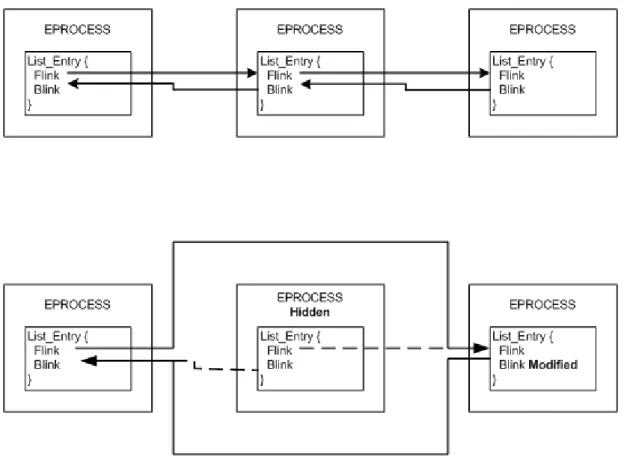
Figure 2-16 Altering the IAT of a program so that rootkit code is called instead (hooking). . 64 Figure 2-17 Using DKOM pointer manipulation to hide a process (Schwittay, 2006, p. 80) .. 66
Figure 2-18 Screen shot of Stud_PE showing detection of PE Pack signature ... 68
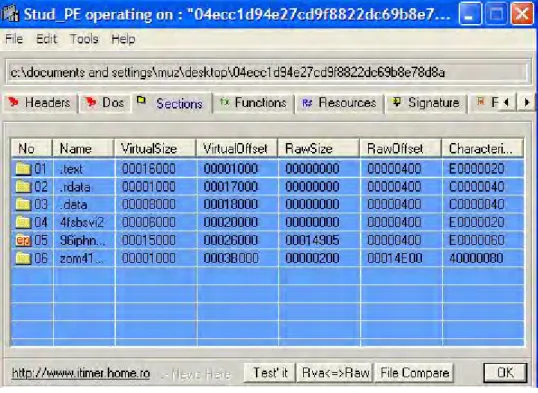
Figure 2-19 Screen shot of Stud_PE showing useful information on sections ... 69
Figure 2-20 Classic entry point signature for recognition purposes... 69
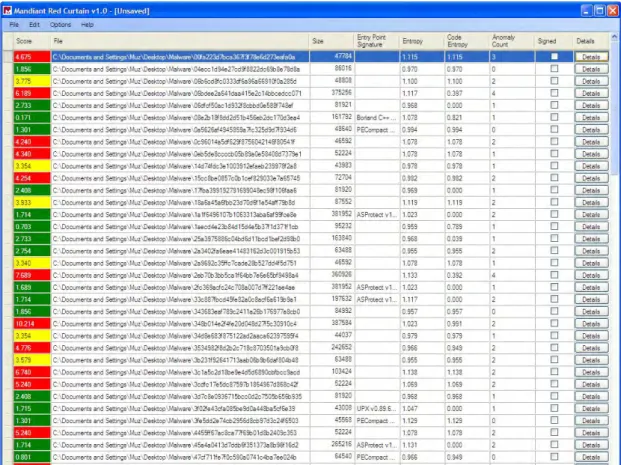
Figure 2-21 Mandiant Red Curtain screen shot showing useful information including entropy and anomaly count ... 70
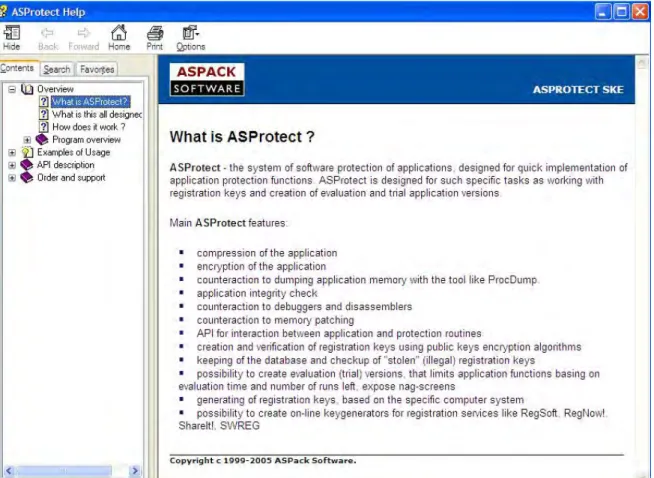
Figure 2-22 List of ASProtect Features ... 72
Figure 2-23 Dialog showing range of available options in ASProtect to protect code and hinder analysis... 73
Figure 2-24 ASProtect completion showing the file size has grown markedly with added protection. ... 74
Figure 2-25 Original Entry Point clearly evident in OllyDbg before protection. ... 74
Figure 2-26 Imports before protection clearly showing imported functions. ... 75
Figure 2-27 Packed View of Entry Point in OllyDbg showing obfuscation. ... 75
Figure 2-29 IDA Stealth Plugin showing available options to hide the debugger from only a
selection of techniques discussed in the literature review. ... 79
Figure 2-30 Olly Advanced Plugin showing available options to hide the debugger from only a selection of techniques discussed in the literature review. ... 80
Figure 2-31 Calling IDA Pro on the command line to run a IDAPython script assists automation of code analysis. ... 82
Figure 3-1 Model of the research process showing the variety of paths that can be undertaken (Oates, 2007, p. 23). ... 88
Figure 3-2 Model of the nepenthes malware collection system depicting the source (highlighted) of malware collected for this research. ... 102
Figure 4-1 Simple flowchart to record if technique was successful or not in detecting the presence of a tool. ... 109
Figure 4-2 Simple flow chart depicting logic of recording the result of script or technique to detect implementation of anti-analysis technique. ... 110
Figure 4-3 Simple flow chart depicting the logic of recording the result of the mitigation script or technique. ... 111
Figure 4-4 Listing of implementation of kernel32 IsDebuggerPresent technique. ... 112
Figure 4-5 IDA Python function detection script used for static analysis. ... 113
Figure 4-6 Listing of implementation of PEB!IsDebugged technique ... 114
Figure 4-7 IDC script PatchIsDebuggerPresent.idc to patch IsDebuggerPresent flag in PEB. ... 115
Figure 4-8 IDC script to find a pattern at run time. ... 116
Figure 4-9 NTGlobal Flags used to detect if program is running inside a debugger... 117
Figure 4-10 Listing of implementation of PEB!NTGlobalFlags technique to detect presence of debugger. ... 118
Figure 4-11 IDC Script to patch NtGlobalFlags at run time to avoid detection of debugger. 119 Figure 4-12 Heap flags that are set when a process is being debugged. These can be used to detect the presence of a debugger. ... 120
Figure 4-13 Listing of implementation of HeapFlags detection technique. ... 120
Figure 4-14 OllyScript to patch Heap Flags ... 122
Figure 4-15 NtQueryInformationProcess call used to retrieve information about the running process ... 122
Figure 4-16 Implementation of NtQueryInformationProcess technique to detect the presence of a debugger (ap0x, 2006) ... 124
Figure 4-17 Signature of NtQueryInformationProcess ... 125
Figure 4-18 Listing of NtQueryInformationProcess avoidance technique (Eagle, 2008b) .... 126
Figure 4-19 Code snippet using NtQueryInformationProcess (Yason, 2007, p.7) ... 126
Figure 4-20 OllyScript to Patch ProcessInformation (Yason, 2007, p.7) ... 127
Figure 4-21 Signature of CheckRemoteDebuggerPresent ... 128
Figure 4-22 Listing of CheckRemoteDebuggerPresent technique to find presence of remote debugger (ap0x, 2006)... 129
Figure 4-24 Resultant patched program after running CheckRemoteDebuggerPresent
detection script. ... 130
Figure 4-25 CheckRemoteDebuggerPresent detection and mitigation IDC Script (Dynamic) ... 131
Figure 4-26 Listing of implementation of SetUnhandledExceptionFilter technique. ... 134
Figure 4-27 NtSetInformationThread signature ... 135
Figure 4-28 Listing of implementation of NtSetInformationThread technique. ... 136
Figure 4-29 Listing of Kernel32 CloseHandle technique to detect presence of debugger .... 138
Figure 4-30 Listing of findFunction script adapted from Eagle (2008a, p.271) ... 139
Figure 4-31 Listing of implementation of RDTSC technique to detect presence of a debugger. ... 141
Figure 4-32 Listing of implementation of OutputDebugStringA to detect presence of a debugger. ... 143
Figure 4-33 Script to patch result of OutputDebugStringA function call to hide presence of debugger. ... 144
Figure 4-34 Listing of implementation of INT3 technique to detect the presence of a debugger (ap0x, 2006) ... 146
Figure 4-35 Listing of implementation of Ice Breakpoint technique to detect the presence of a debugger. ... 148
Figure 4-36 Listing showing use of INT 2DH to raise an exception if the program is not being debugged. ... 150
Figure 4-37 Listing of implementation POPF and the Trap Flag technique to detect the presence of a debugger... 152
Figure 5-1 Virus Total detection rate plot showing less than ideal detection results. ... 159
Figure 5-2 Run time Of Allaple specimens where no activity is recorded could indicate deception. ... 162
Figure 5-3 Graph indicating high measures of entropy of malware exceeding accepted threshold ... 165
Figure 6-1 Graphical representation of Zelter's analysis methodology showing spiral nature through phases. ... 175
Figure 6-2 Extended analysis methodology to cater for anti-forensic techniques. Anti-analysis techniques are mitigated as they are detected. ... 175
Figure 6-3 Malware analysis process incorporating a learning taxonomy that assists in the development of the MABOK. ... 182
Figure 6-4 Model of the learning domain of the Malware Analysis Body of Knowledge (MABOK) ... 183
Figure 6-5 Proposed process model to automate the spiral analysis methodology which recursively and iteratively detects and mitigates static and dynamic anti-analysis techniques ... 186
LIST OF TABLES
Table 2-1 Summary of the propagation methods of worms. ... 12 Table 2-2 Summary of the malicious functionality of trojans. ... 13 Table 2-3 Summary of malware analysis tools showing analysis type, purpose and name of commonly used tool name. ... 24 Table 2-4 Default Hardware Configurations used to find presence of VMWare (Innes & Valli, 2006) ... 32 Table 3-1 Examples of exploratory research questions... 95 Table 3-2 Examples of base-rate research questions ... 96 Table 3-3 Examples of relationship research questions ... 96 Table 3-4 Examples of causality research questions ... 97 Table 4-1 Validation of Techniques Results ... 154 Table 5-1 Ikarus Virus Scanner results showing high incidence of Allaple worm in the
collected malware specimens. ... 157 Table 5-2 Virus Total results from a single submission showing disparity in signatures by different vendors. ... 158 Table 5-3 Submitted malware functionality results ... 160 Table 5-4 Allaple variants detection results ... 160 Table 5-5 Functionality of Allaple variants results ... 161 Table 5-6 Allaple variants showing no activity recorded ... 161 Table 5-7 SigBuster detected packer signature results ... 163 Table 5-8 PEiD signature results indicating disparity in signature matching with those
performed by SigBuster. ... 164 Table 6-1 Validation of techniques results showing validity of technique and the ability to detect and mitigate the techniques. ... 168 Table 6-2 Taxonomy of anti-analysis techniques ... 171
CHAPTER 1
INTRODUCTION
1.1. OVERVIEW
This thesis analyses techniques malicious software (malware) incorporates into its code to prevent and/or hinder the malware forensic analyst from conducting an analysis of the malware. The effectiveness of these techniques was validated in this research. A variety of procedures were developed and examined to determine if these anti-analysis techniques could be detected and mitigated. Malware collected from the internet was also analyzed to partially corroborate these techniques. This research found that a plethora of techniques are available to hinder the malware analyst and all of the techniques that were implemented in the course of this research were found to be effective at hindering analysis. Equally, detection and mitigation techniques were uncovered and also found to be effective at detecting and mitigating the anti-analysis techniques. Malware and forensic analysts and researchers will be the primary users of this research.
Aycock (2006, pp. 1-12) defines malware as “software whose intent is malicious, or whose effect is malicious”. Analysis of malicious software is essential for computer security management and is emerging as an important field of research. This is because malware is often targeted at organizations and is increasingly using anti-analysis techniques to prevent detection and analysis (Masood, 2004).
Anti-Forensics is described by Rogers (2006) as “attempts to negatively affect the existence, amount, and/or quality of evidence from a crime scene, or make the examination of evidence difficult or impossible to extract”. Kessler (2007) extends this definition in a practical sense by saying “anti-forensics, then, is that set of tools, methods, and processes that hinder such analysis”. The movement towards the employment of anti-forensic techniques in malware could be attributed to the substantial illicit financial gain that can now be achieved from employing malware nefariously (Larsson, 2007; Newman, 2006; Sukhai, 2004; Team Cymru, 2006).
Commercial Anti-Virus (AV) software is often limited in its ability to detect and remove malware (Chouchane, Walenstein, & Lakhotia, 2007; Mila Dalla, Mihai, Somesh, & Saumya, 2008; Xuxian, Xinyuan, & Dongyan, 2007; Yin, Song, Egele, Kruegel, & Kirda, 2007; Zhang, Reeves, Ning, & Purushothaman Iyer, 2007; Zhou & Meador Inge, 2008). This is essentially because AV software relies on an analyst having already analyzed collected malware, extracted a signature and made computer virus signature files available to the users of the AV software through very regular updates. Hence, AV software is highly unlikely to detect new malware that is unleashed on the internet, corporate intranet or that has been customized to target specific networks because it has not been previously analyzed and had a signature extracted (Masood, 2004).
1.2. A STATEMENT OF THE PROBLEM
There is a positive feedback loop between malware developers and malware researchers. As soon as a strategy is developed by one side, the other side implements a counter measure. Security professionals in the field need to know how to determine if they are the target of an attack, what the functionality of malware infections is and how to eradicate infections from their systems. This is especially true if a signature does not exist and the forensic analyst is required to analyse the instance of malware. The analysis process can be assisted if the analyst has up to date methodologies and skill sets at their disposal.
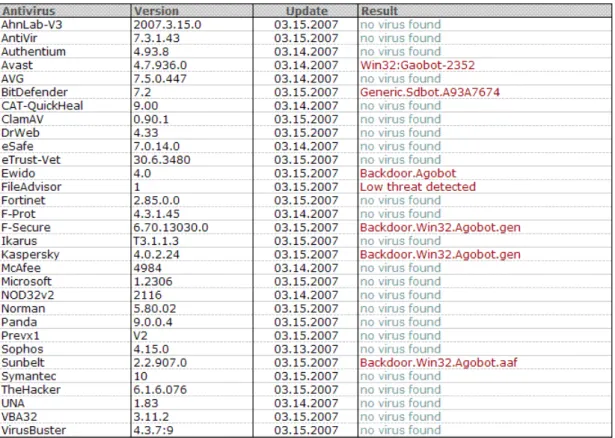
Virus Total provides a web-based, free and independent service that uses multiple anti-virus engines to analyze suspicious files that have been uploaded to their site. Virus Total (2007), on their website, state that “Currently, there is not any solution that offers a 100% effectiveness rate for detecting viruses and malware”. In support of this statement, Figure 1-1 shows the results that were captured from submitting a potentially harmful web robot (bot) that was collected from the ECU
Nepenthes
sensor network, to the Virus Total service.Figure 1-1 Screen shot from Virus Total showing low detection rate of submitted bot after examination by thirty one different AV engines.
Out of the thirty-one antivirus programs that had the bot submitted to them, only six detected the bot, whilst one detected that there was a low threat present. This is not a particularly unusual result, evidenced from this research and supported by other researchers (Bilar, 2005; Masood, 2004; Mohandas, n.d.; Skoudis & Zeltser, 2004; Szewczyk & Brand, 2008; Wysopal, 2009). An analysis of the Win32.Qucan.a worm, by Mohandas
(n.d., p. 20), found that only 50% of the antivirus detection engines were able to detect the worm that he submitted. This finding is well supported by the researchers with indication that the situation is deteriorating. Masood (2004) claims that the percentage of malware that avoids automated detection is growing every day and “manages to wreak havoc on networks”. Skoudis and Zeltser (2004, p. 108) emphasize that with new and fast spreading malware, most computer users would not be able to download a virus definition fast enough to stop them. Rubenking (2007) says that a solution needs to be found where malware can be recognized and cleaned
up whilst not interfering with legitimate programs or interfere with the normal operation of the computer.
Part of the problem is that AV software relies on detecting signatures of malware that has already been analyzed by AV researchers and that the user has already downloaded the latest AV signatures to protect their computers. If newly released and unanalyzed malware is loaded onto a computer, it is highly unlikely that the malware will be detected because a signature will not exist. This undoubtedly can be classified as an incident. “An incident can be thought of as a violation or imminent threat of violation of computer security policies, acceptable use policies, or standard security practices” (NIST, 2004, pp. 2-1). An appropriate strategy and priority must be assigned for the incident. NIST (2004, pp. 3-17) lists a number of criteria for the determination of a suitable strategy, which include consideration of:
• Potential damage to, and theft of resources.
• Need for evidence preservation.
This information is important if the incident is reportable to the appropriate authorities and to assist in risk mitigation. However, the difficulty of obtaining this information must be taken into account. Malware uses a variety of techniques to avoid analysis. This is because there is an increasing profit motive for malware authors whose intention is to keep their malware undetected on computers (Dunham, 2006; Holt, 2007; Schiller et al., 2007; Sukhai, 2004; Team Cymru, 2006).
A significant body of knowledge is required to obtain this information from manual analysis, to either develop an AV signature or to determine the functionality of the malware (Valli & Brand, 2008). A short, non-exhaustive, requisite skills list for Windows-based malware analysis indicated by Valli & Brand could include:
• Assembly language programming.
• Program debugging skills.
• Windows Applications Programming Interface (API) programming.
• Windows Operating System.
• Computer networking skills.
• Malware techniques.
• Reverse engineering skills.
Automated and semi-automated tools exist to assist in this analysis, but malware can detect these tools and alter its behaviour to hide its presence and/or modify its behaviour to not show its true intentions. This is exemplified by the research of Lau and Svajcer (2008). These researchers found that families of malware will adapt its behaviour if it detects it is running in a virtual machine by stopping execution or will run an alternate payload to deceive the forensic analyst. This is because forensic analysis of malware is often performed from within virtual machines. The advantage of using virtual machines for analysis is that they can be reverted to a known state very quickly. This is especially useful for analyzing malware that employs deception. If a deceptive path is executed that adds no value to the analysis but corrupts the host that is running the malware, the host can be reverted back to a known state and analysis continued down an alternate path of execution.
There is evidence that malware writers are targeting specific organizations such as banks. Larsson (2007) claims to have interviewed the creator of the Haxdoor Trojan, which was purportedly used to steal eight million Swedish Kronor from the Nordea bank. The significant issue raised in the article is that the creator of the virus is offering to create and sell customized versions of his malware so that users can steal money from accounts from the bank of their choice. He also offers support to achieve this, such as provision of servers for saving the stolen account information, in a non-traceable way. This sort of supported, targeted attack is not unprecedented. Dunham (2006, p. 11) reports that, in May 2005, an Israeli programmer was arrested for customizing and selling a Trojan horse, called
Hotworld
, to steal proprietary data from specified targets. At least eighty companies were implicated, including private investigation firms. This is significant because it is highly unlikely that such customized malware will be detectedby AV software and in addition, that companies are prepared to pay for stolen information.
1.3. RESEARCH QUESTIONS
The objective of this research has been to find answers to the following research questions:
1. What techniques can malware use to avoid being analyzed? 2. How can the use of these techniques be detected?
3. How can the use of these techniques be mitigated?
Research question one seeks to find out what techniques malware can use to hinder the forensic analyst from fully analyzing it. The objective of the malware is to prevent full discovery of its malicious intent by using deception and obfuscation.
Research question two seeks to determine how the use of these techniques by malware can be detected by an analyst. This information is of value to the forensic analyst so that an appropriate strategy or methodology can be employed to counter the use of the technique. This information could also be of value to the forensic analyst to find evidence of intent to deceive or hide malicious intent.
Research question three seeks to ascertain how the use of these techniques can be mitigated so that analysis can proceed beyond the engagement of the analysis avoidance technique in the code so that discovery of the true intent of the malicious program can be determined.
1.4. SIGNIFICANCE OF RESEARCH
This research contributes to the body of knowledge for malware forensic analysis with particular emphasis given to the advancement of the analysis of the anti-analysis capability of malware.
detection. This was determined primarily from a search of the literature and from validating the techniques in small, standalone programs and observing the effect on common analysis tools such as debuggers using quasi-experimentation. A taxonomy of anti-analysis techniques was developed during the course of this research that amalgamates the classification of techniques from key papers.
The detection of anti-analysis techniques feature far less in the literature than does the discussion of the incorporation of anti-analysis techniques. Detection of anti-analysis techniques in code would not only assist the analyst in investigation of malicious intent and the attempt at deception, it also appears that detection of anti-analysis techniques may be a very good indicator that the code has a malicious intent. This research supports other researcher’s claims that existing AV software, that uses signatures and heuristics, is less than ideal at detecting malware, especially malware that has not been analyzed before. Analysis of network based malware collected from the internet for the purposes of this research is shown to nearly all contain a measure of anti-analysis techniques. Hence this research supports a new paradigm for AV software to rely less on signature detection and to be focused more on the detection of anti-analysis techniques as a good indicator that program under investigation is malicious.
Plugins exist for popular debuggers to hide its presence from discovery by malware that can incorporate anti-analysis techniques. These plugins focus primarily on hiding the presence of the debugger and ordinarily do not log or notify the analyst of the presence of anti-analysis techniques in the code that is being analyzed. This is a significant omission if malicious intent is being investigated, because it will simply not be logged. This research shows that the coverage of mitigation techniques of plugins is much less than the number of anti-analysis techniques that are available. This is significant because a false sense of security from using the plugins may lead to the analyst not conducting a thorough analysis of the malware and being the subject of deception. This suggests a deficiency in existing tools.
A variety of scripting languages and Application Programming Interfaces (API) exist to extend popular debuggers. This research shows how they can be incorporated to successfully detect and mitigate the use of anti-analysis techniques. Given the claim by this research that existing plugins have severe limitations due to their lack of coverage of anti-analysis techniques and lack of logging functionality, scripting of debuggers is an essential skill required for analyzing malicious software. In addition, this research shows that the extent of knowledge required to analyze malware is extensive. A proposed Malware Analysis Body of Knowledge was initiated by the conduct of this research where the treatment of anti-analysis techniques is a key and vital component.
This research examines some of the more well known methodologies for analyzing malware. A suitable methodology that detects the presence of anti-forensic techniques during the analysis process and then mitigates the technique has been identified through the conduct of this research.
This research could also prove to be of benefit to software engineering where requirements dictate that the Intellectual Property (IP) of the software has to be protected from reverse engineering. An understanding of the anti-analysis techniques discussed in this thesis that can be used to hinder the reverse engineering of code could assist in validating such a requirement through Test and Evaluation (T&E).
1.5. STRUCTURE OF THIS THESIS
Chapter 1 of this thesis presents an overview of this thesis, a statement of the problem, the research questions this thesis addresses and highlights the significance of this research for the digital forensic investigator. Malware invariably incorporates anti-forensic techniques and AV software cannot be relied upon to detect the presence of malicious code. This necessitates the development of an appropriate methodology to reveal the true intent of malware.
forensic techniques, previous studies and models to reveal and support lines of enquiry not discussed in the literature.
Chapter 3 justifies the selection of the most appropriate research method, the conceptual framework and research design to address the research questions. The selected research method to address the research questions is positivist, empirical and quasi-experimental. Two lines of experimentation were identified. The first was to implement a number of anti-forensic techniques in small, standalone programs to determine their effectiveness against the software tools likely to be employed by a digital forensic analyst. The second line was to analyze network based malware using anti-virus software.
Chapter 4 presents the results from conducting experiments with anti-forensic techniques. All of the techniques were found to be effective, and that the use of these techniques can be detected and mitigated.
Chapter 5 presents the results of having analyzed network based malware. The results support claims that anti-virus software is much less than ideal at detecting malicious software.
Chapter 6 provides discussion of the results and why the results are significant to the digital forensic analyst. Claims of contribution to knowledge are discussed together with an appropriate methodology that can be employed by analysts when anti-forensic techniques are encountered during their investigations and highlights the limitations of existing tools and anti-virus software. Further lines onf investigation are also identified. Chapter 7 concludes the thesis by linking the claims of contribution to knowledge to the implications of this research.
CHAPTER 2
LITERATURE REVIEW
Code that protects itself from being analyzed is a significant hindrance, not only to automated malware detection tools such as AV software, but also to the manual analysis performed by malware analysts. The purpose of this literature review is to examine the literature related to:
• Characterization of network based malware
• Existing malware analysis methodologies.
• Anti forensic techniques used by malware to avoid analysis.
• Malware detection techniques.
• Packers and protectors.
• New paradigms for malware detection.
These lines of enquiry trace directly to the research questions.
2.1. CHARACTERISATION OF NETWORK BASED MALWARE
Malware presents itself as a significant threat to computer users. Various attack vectors exist as well as the number of malicious payloads that they can contain. Network based malware, such as worms, propogate autonomously via networks and do not propogate in the same fashion as viruses do. Network based malware was collected for the basis of this research, as discussed in the Conceptual Framework section of this thesis, subsection 3.6.2. For this reason, viruses are not included directly in the following discussion. Hence, this subsection introduces worms and how they propogate. It also discusses the various payloads of worms that can include, but not limited to, Trojans, Rootkits, Backdoors and Bots. It is important to note that the payload of worms, such as Bots, have evolved to incorporate anti-forensic techniques. The anatomy of a worm is presented to provide a greater insight into how they function, and how their payloads have evolved to include multiple threats and have become more stealthy to avoid detection. Current detection methods are also discussed.
2.1.1.
Worms
Network worms can propagate to victim computers using a variety of methods. A summarized description of the propagation categories listed by Kaspersky Labs (2007b) is presented in Table 2-1.
Table 2-1 Summary of the propagation methods of worms.
Worm Propagation Method
Email Worms The worm could be an attachment to an email, and the worm is activated when the attachment is opened, or the email contains a link to an infected site. These worms spread though:
• Windows Mail API (MAPI) functions
• Microsoft Outlook Services
• Directly to SMTP servers using code in the worm. Instant
Messaging (ICQ and MSN) Worms
Propagate using instant messaging applications to send links to entries in the contact list to infected sites.
Internet Worms
Spread by:
• Copying to network resources
• Exploitation of Operating System vulnerabilities
• Penetration of services such as FTP and Web
servers.
• Take advantage of malware already installed to install the worm
IRC Worms Utilizes contacts from the infected user to use Internet
Relay Chat (IRC) channels to send links to infected websites or send infected files.
File-sharing Networks or P2P Worms
Uses the P2P network to download and execute infected files.
2.1.2.
Trojans
Table 2-2 Summary of the malicious functionality of trojans.
Trojan Functionality
PSW Trojan Steal passwords and confidential information and send this
information to a remote computer. Trojan
Clickers
Redirect infected machines to web sites to :
• Increment the hit count of a site for the purposes advertising.
• For organizing a Denial of Service (DoS) attack.
• To redirect the victim to an infected site where the victims machine will be attacked by other malware. Trojan
Downloaders
Downloads and installs malware on the victim machine and most likely registers it to auto run without the consent or knowledge of the user.
Trojan Droppers
Consist of multiple payload components to install other malware onto the victim machine so that the installation of the additional components is hidden from the user, and perhaps to trick anti virus software which may not analyse the other components.
Trojan Proxies
Uses the infected machine to give the attacker anonymous access to the intenet. These machines can also be used by an attacker for mass mailing of spam.
Trojan Spies Spy on user activity through the use of spy programs such as key loggers and forward the collected information to the attacker. Can be used to steal banking details and financial information for the purposes of fraud.
Trojan Notifiers
Notify the attacker that the machine has been infected via email, ICQ, or IRC.
2.1.3.
Rootkits
Rootkits are used by an attacker to evade detection by replacing system files. Hoglund and Butler (2005, p. 4) say “a rootkit is a set of programs and code that allow permanent or consistent, undetectable presence on a computer”.
2.1.4.
Backdoors
Contain a remote administration capability so that infected machines can be controlled remotely via a network connection, and may not be visible in the list of currently active programs (VirusList.com, 2009). Activities may include all the functionality listed above and may also
• Send and/or receive files
• Launch and/or delete files
2.1.5.
Bots
The original intention of a robot (bot) was to perform some useful action on an IRC channel whilst the operator or user were engaged in some other task (Schiller et al., 2007, p.7). Bots are capable of taking action on a client machine without a hacker having to have logged onto the infected machine. A collection of Bots is known as a botnet. The botnet is typically under the command of a botherder who can dictate the actions of the botnet through a bot server. The botnet can be divided into divisions which can each be performing different actions, or if the communication channel to one division is lost, the other divisions can continue the mission. Bot clients are modular and adaptive and can be updated with new software, or commanded to perform a malicious action such as a DDoS against a target. The attacker may be distanced from the infected machine by many layers within the hierarchy. The attacker can send commands to an IRC channel through an obfuscating proxy and through multiple hops (Schiller et al., 2007, p.30).
scan for other vulnerable systems, a module to exploit the system it is installed on, such as collecting passwords or keylogging and a module that communicates with a Command and Control Center (C&C). Not only is it important to remove the bot from an infected system, it is important to work out how the bot got onto the system in the first place so the vulnerability can be rectified.
Schiller et al. (2007, p. 24) describes botnet technology as the “next killer Web application” because organized crime have used it as a force multiplier to attack the non-computer literate, including the young and the elderly to derive money. Their discussion continues to say that these criminal organizations have grown large enough to become a “threat to major corporations and even nations”.
The evolution of botnets is important to understand. It shows how they have become more modularized and stealthy as time has progressed. Stealth is a critical component of anti-analysis techniques. The following sub sections discuss this evolution.
2.1.5.1.
Evolution of Bots
PrettyPark (Anonymous, 1999) was the first bot client that made use of
the IRC bot for the purpose of remote control over the internet, and emerged in June 1999 (Canavan, 2005, p. 6). It allowed the attacker to retrieve information from the compromised system and had a basic mechanism for updating itself by downloading and executing new files from IRC. Features of PrettyPark are still evident in IRC bots seen today.
Features discussed by Canavan (2005, p. 6) include:
• The capability to determine system information such as the version of the operating system as well as the user and computer name.
• The ability to retrieve email addresses and login names to
applications such as ICQ.
• The ability to retrieve network settings, user names and passwords.
• The capability of being able to download updates to increase its functionality.
Global Threat (GT) bots began to appear in late 2000 and made use of a Windows shareware IRC client called mIRC (Mardam-Bey, 1995) that include
scripting capabilities that allowed hackers to put together their own scripts to connect to remote servers and await commands. GT bots also made use of tools such as HideWindow (Anonymous, n.d.-f) to conceal its presence on
infected machines and used PsExec (Microsoft, 2008c) to spread itself over
the local network. They also used FireDaemon (FireDaemon Technologies
Ltd, 2009) to install and run as a service and IrOffer (iroffer.org, n.d.) to
perform as a fileserver. These bots were launched as a service by altering the system startup files (Canavan, 2005, p.7). GT bot also had the capability to conduct a DDoS attack by flooding. It could spread itself also by using social engineering ploys including sending an email that claimed to be from a security vendor and if the user clicked on an embedded link they downloaded the bot client from a malicious website. GT bots were not modular, they were all contained within a single package (Schiller et al., 2007, p. 9).
SDBot (sd, 2002) appeared in 2002 and added the feature of a remote
control backdoor (Schiller et al., 2007). The source code was made available by the author, as well as a Web page and contact information through email and ICQ. This made it easy for hackers to modify and maintain. Variants of SDBot can exploit the backdoors of other malware
such as SubSeven (Sub7Crew, n.d.), Mydoom (Anonymous, n.d.-k), Bagle (Anonymous, n.d.-b), Kuang (Anonymous, n.d.-h) and many others.
When these backdoors are found SDBot downloads itself onto the client and
infects it.
Agobot (Gembe, 2002) made use of modular design and appeared in 2002.
It uses IRC for C&C, but is spread using P2P file sharing applications (Schiller et al., 2007, p. 11). It has three modules which retrieves the next module once the primary task of the module has completed. The sequence of events is as follows:
3. Prevents the user from accessing Web sites including AV vendor sites. Capabilities of Agobot discussed by (Schiller et al., 2007) include:
• Able to scan other computers for vulnerabilities.
• Capable of being able to launch DDoS attacks. • Ability to scan for CD keys for games and software.
• Can terminate AV software and security monitoring processes.
• Can modify the host file so that updates will not be downloaded from AV software sites.
• Can install a rootkit to hide itself.
• Incorporates anti reverse engineering techniques to make analysis difficult.
Related bots include Phatbot (Gembe, 2002) which uses public key
cryptography for communication with the C&C over P2P, Polybot (Anonymous, 2004), XtremBot (Anonymous, n.d.-d) and Forbot (Anonymous, n.d.-e). It is also worth noting that this is when the family
lines of bots began to blur and variants appeared which took the best components of other bots and incorporated those features. It became harder to determine from which family a particular bot had evolved from (Canavan, 2005, p. 14). There are reports that AV vendors are becoming less concerned about identifying the particular bot because of the number of variants which have different capabilities (Schiller et al., 2007, p. 12). Instead they are looking at the malicious components of the bot as the source of identification.
Spybot (Anonymous, 2003) is a derivative of SDBot and appeared in 2003
as open source. It adds Spyware capabilities and collects email addresses, lists of visited web sites and logs of activities. Variants can also capture screen shots of the screen, send spam, install a rootkit, control webcams, kill security processes and other malicious acts. It spreads via file sharing applications, exploitation of known vulnerabilities and backdoors left by other malware.
RBot (Anonymous, n.d.-l) appeared in 2003 and is a backdoor Trojan which
uses IRC to communicate with the C&C. It introduced the use of packers and protectors to compress and/or protect the malware. It can scan for shares on networks with Windows machines and attempts enumerate users and attempts to guess weak passwords.
Polybot is derived from the source code of Agobot and appeared in March
2004. It uses polymorphism to change its appearance of the packed and or protected binary for each infection by using a different key each time.
The MyTob (Diabl0, 2005) bot appeared in February 2005 and is a hybrid
that uses its own SMTP engine for sending mass e-email to addresses in the Address Book of the infected computer and has capabilities similar to
Spybot.
(Schiller et al., 2007, p. 15) lists a number of new features appearing as components for bots. These are summarised as follows:
GpCoder (Anonymous, 2005)
– Encrypts a user’s files and then offers tosell the user a decoder.
Serv-U – An FTP server that enables botherders to store stolen software, games, movies and illegal material on the botnets under their control. The data is stored in hidden directories, and the FTP server appears as Windows Explorer in Task Manager.
SPIM – Spam for Instant Messaging. Can be used for phishing attacks which provide links to Web sites that download malicious code to victim machines. An example SPIM message presented by Schiller et.al. (2007, p. 16) is reproduced in Figure 2-1.
ATTENTION...Windows.has.found.55.Critical.System.Errors... To fix the errors please do the following:..
1 Download Registry Update from: www.regfixit.com. 2 Install Registry Update
3 Run Registry Update. 4 Reboot your computer
FAILURE TO ACT NOW MAY LEAD TO SYSTEM FAILURE!
Figure 2-1 Example Spam for Instant Messaging (SPIM) message to trick the user into downloading malware.
2.1.6.
Blended Threats
It is very important to realize that modern malware combines numerous attack vectors and malicious payloads, such that simple classification of malware to an individual type or family is becoming more difficult. Such a combination of threats in an individual instantiation of a malware specimen is known as a blended threat. Virus Bulletin (2008) describes a blended threat as “a sophisticated attack using multiple malware types and vectors to carry out penetration and control of a system”. An example of a blended threat discussed by Virus Bulletin could be initiated be the receipt of a spammed email that contains a link to a hijacked web site that uses
iframes
running malicious javascript. The malicious javascript exploits vulnerabilities in the browser of the user which can then execute code on the users computer to disable security software and download additional malware. Functionality of the downloaded malware could be to run a spam e-mail server or to launch attacks against new victims.2.1.7.
Anatomy of a Worm
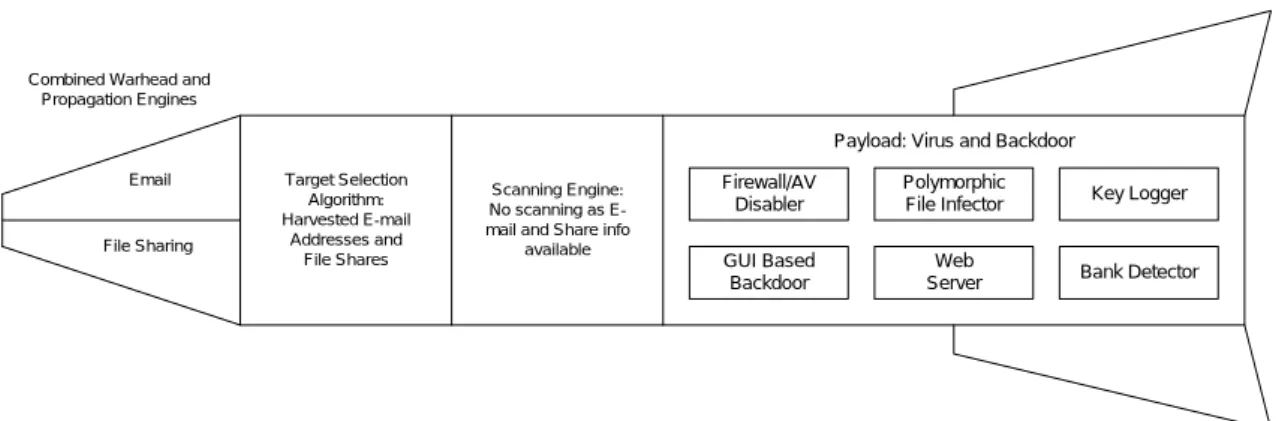
Skoudis and Zeltser (2004) describe the anatomy of a worm with an analogy to a rocket with the following components:
Warhead – Contains exploit(s) to take advantage of vulnerabilities in software to penetrate a target.
Propagation Engine – Mechanism(s) to propagate itself to other vulnerable machines. <