Thammasat Review 2015, 18(1): 163-176
Effects of Teacher Education Programs on Instructional Design
Knowledge with Student Teachers’ Self-efficacy Perception and
TPACK Framework Knowledge
Nuttaporn Kaitbanditkul Suwimon Wongwanich
Department of Education Research and Psychology Faculty of Education,Chulalongkorn University
[email protected] Abstract
This research has two main objectives. Firstly, to develop a causal model of teacher-education programs affecting the instructional design knowledge (and verification of the selected model for fitness for purpose). Secondly, to analyze the nature of direct effect on the mediation of teacher-education programs on instruc-tional design knowledge, as well as the indirect effect mediation of TPACK framework knowledge with self-efficacy perception in the design of teaching programs. The samples consisted of 517 fifth-year student-teachers from universities within the Bangkok catchment area, drawn from a random sampling. The questionnaire for the design of teaching programs became the research instrument and the data were analyzed by Descriptive Statistics, Structural Equation Modeling Analysis (using LISREL Program).
The findings included the following: 1) the model was appropriate for empiri-cal data with Chi-Square value distribution (χ2 = 5.44; df = 8; p-value = .709) (which
was statistically insignificant). Goodness-of-Fit Index (GFI) value was .997 and the Adjusted Goodness-of-Fit Index (AGFI) value was .988, indicating that the model was consistent with empirical data; 2) Causal Model of teacher-training programs affecting the design of instructional knowledge is the partial mediating research model. The design of instructional knowledge benefited directly from the experience gained through teacher-training programs (.34) and indirectly through the involvement of self-efficacy perception and TPACK framework knowledge (.54). All values are at .05 statistical significance level.
Introduction
Teacher-education programs have been the key element involving the individuals who will become the teachers of the future (Archambault & Crippen, 2009; Koehler et al., 2007; Koehler & Mishra, 2009). Particularly in the 21st century, teachers need to possess technological skills for effective teaching development (Clark, 2013). Technology helps improve communications between teachers and pupils (Bransford, Brown & Cocking, 2000), widens the scope of educational opportunities (Gülbahar, 2007; Kozma & Anderson, 2002; Webber, 2003) and can help with exam technique (Bain & Ross, 2000).
Numerous studies are available on technological skills for the teaching profession, for the most part carried out by overseas researchers. Teachers’ techno-logical skills were explored both in the factors affecting these technotechno-logical skills and in their eventual outcome. According to Ertmer (1999), the factors affecting teachers’ technological skills can be classified into extrinsic and intrinsic. Findings indicate that teachers’ competence in technological skills affects pupils’ ability to learn (Wepner, Ziomek & Tao, 2003), since the instruction has been designed using technology as the medium of instruction (Becker, 2000; Harris, 2000). Most of the research conducted overseas on teachers’ technological skills has been centered on the level of technol-ogy employed by the teachers, on the factors linked to the absence of technological skills (Rosen & Weil, 1995; Winnans & Brown, 1992; Dupagne & Krendl, 1992) and the impact of limited technological skills (Brinkerhoff, 2006).
However, research has also revealed that a significant proportion of teachers still lack adequate training and experience to integrate technology into their classroom teaching (Albion, 1999; Liu, 2011). It has been demonstrated that the integration of instructional technology has had positive effects on students, based on the premise that the teacher is central to technology integration in the classroom. Failure to incorporate technology into instruction in the classroom can limit students’ capacity and ability to learn. Teachers are crucial to a successful employment and integration of technology in the classroom. Research indicates that several factors affect teachers’ ability to successful employ technology in the classroom, including inadequate school resources, insufficient quantity of computer devices and limited budget in technology investment (Pelgrum, 2001; Shamburg, 2004). Other factors include teachers’ heavy workload, which impacts on their availability to prepare for, and design, relevant material (Cuban, Kirkpatrick & Peck, 2001; Mumtaz, 2000; Pelgrum, 2001; Shamburg, 2004). Other results point at teachers’ attitude, belief and apprehension about computers (Ertmer, 1999; Becta, 2003), while factors connected to teachers’ education programs rarely reinforce the experience for aspiring teachers towards integration of technology into
study material (Cuban et al., 2001; Loveless, 2003; Mumtaz, 2000; Pelgrum, 2001; Subhi, 1999).
From teacher-education, program-related factors, which have been congruent with TPACK1 framework knowledge, it is said that teachers require
knowledge of body-oriented instruction. The conceptual framework basis was derived from the understanding that the instruction is the crucial issue and must rely on creativity and various other types of knowledge (Spiro, Coulson, Feltovich & Anderson, 1988). Since instructional knowledge skill is the independent and flexible element, it follows that systematic knowledge management is required (Shulman, 1986).
When all issues were taken into account, the teacher-education program was found to have a bearing on knowledge and experience in instructional technology integration (Groff & Mouza, 2008). The trainee teachers became aware that the level of technology incorporated into their teaching was related to their teacher-education program (Albion, 1999; Pajares, 1992). Meanwhile, the important component required by all student-teachers for instructional technology integration is the TPACK framework. Shulman (1986) suggests that student-teachers should integrate content-knowledge with pedagogical knowledge, since both aspects of knowledge are linked. Student-teachers possessing just content-knowledge or pedagogical knowledge may not necessarily become good teachers, since good teachers must know how to transfer their knowledge and be understood by the pupils. For this reason, technological knowledge has been a crucial aspect of learning for all aspiring teachers. One of the most significant developments has been the requirement for student-teachers to know how to integrate all three elements of knowledge, viz. content knowledge, pedagogical knowledge and technological knowledge. The analysis of research documents revealed that teacher-education programs are set to ensure that student-teachers are familiar with TPACK framework knowledge, to enhance how they perceive self-efficacy, namely to have belief in one’s abilities for success in specific situations.
Hence, this research has concentrated on the study of the association of the variables of teacher-education programs and the design of training programs. However, this research demonstrated that self-efficacy perception and TPACK framework knowledge have also contributed to the integration of technology in the teaching by student teachers. This research tracks the development of three variables: teacher-education programs, self-efficacy perception and TPACK framework. According to the result of the study on relevant documents, it is possible that the variables of self-efficacy perception and TPACK framework knowledge will be the moderators from the variables 1 TPACK (Technological Pedagogical Content Knowledge) is a framework that identifies the type of
of teacher-education programs to student teachers’ instructional design knowledge (Albion, 1999; Archambault & Crippen, 2009). This particular point has become a topic in our research. The results of this research should be useful for programs aimed at courses specifically for would-be-teachers, to enhance their potential in academic areas, pedagogy and technology.
Objectives
1. To develop a causal model of teacher-education programs affecting the design of knowledge and verification of suitability.
2. To analyze the mediation nature of direct effect of teacher-education programs in the design of teaching programs, and indirect effect through self-efficacy perception and TPACK framework knowledge towards the design of instruction programs.
Scope of Research
The populations were the trainee-teachers of the universities, both in inter-nal and exterinter-nal governmental regulation in the Bangkok area. They consisted of fifth-year trainee-teachers who were enrolled in professional training, for their potential to help design effective teaching programs integrated with technology. The variables of this research consisted of dependent variables, namely the design of instructional knowledge and independent variable centered on knowledge and experience from the teacher-training programs. The mediator variables were respectively self-efficacy perception (consisting of the indicator for confidence in instructional competency) and TPACK framework knowledge.
Research Conceptual Framework
Nowadays, the emphasis in teacher-education programs should be on training candidates with a potential for a career in academia, where pedagogy and technology are applied in education management to direct the individual towards a professional teaching career in this era of communication technology. Good teach-ers must be able to integrate technology, since teachteach-ers must be able to design and select the appropriate technology media (Becker, 2000; Harris, 2000). It is therefore
essential for student-teachers to receive instruction in the field of technology and multi-media, as they will be required to help students in their school endeavors but also for effective integration of technology with various multi-media, for self-learning and as part of practical training. Moreover, teacher-education programs are essential for students to realize their full potential. This encourages the student-teachers to apply professional experience in training with technology, and to incorporate technology in their teaching (Groff & Mouza, 2008). The conceptual framework is illustrated in Figure 1. 9 10 4 5 6 7 Principle Knowledge Application 1 2 3 8 Specialized
Knowledge KnowledgeIntegrated
T C P TC CC TP CP TPC Knowledge and Experience from Teacher Education Programs TPACK Framework Knowledge Self-Efficacy Perception Instructional Design Knowledge Confidence in Teaching Competency Knowledge and Experience from Studied Course Knowledge and Experience from Experience Training Knowledge and Experience from Instructor’s Instructional Activity
Figure 1 Conceptual framework.
Remarks: 1) Singer & Maher, 2007; 2) Grove, Strudler & Odell, 2004; Judge & O’Bannon, 2007; Liu, 2011; 3) Bai & Ertmer, 2008; 4) Groff & Mouza, 2008; 5) Pajares, 1992; 6) Abbott & Faris, 2000; 7) Bandura, 1986; 8) Archambault & Crippen, 2009; 9) Archambault & Crippen, 2009; Koehler & Mishra, 2009; 10) Koehler & Mishra, 2009.
Research Methodology
Population
The research samples were drawn from a population of fifth-year trainee teachers from 13 universities, both in internal and external governmental regulation in the Bangkok area. The total consisted of 1,878 fifth-year individuals enrolled in training programs. Since the research cannot encompass every individual in the population, the LISREL Model2 for data analysis has been applied. The sample size of 20 people
per parameter is used and 24 parameters were estimated in this research. The proper samples, therefore, should be at least 480 people (20x24). Simple random sampling was applied. Total samples for this research were 517 people.
Research Instrument
Questionnaires were used for data collection, with the questionnaire classified into two parts, as follows:
Part 1. General respondent data, contains checklist for seven items including gender, grade point average, professional training level, academic affiliation, course being studied, professional experience training course and computer program application competency.
Part 2. Characteristic or behavior of respondent about instructional design knowledge, consisting of a 5-rating scale for 62 items.
Checking for Content Validity
The researcher presented the questionnaire to five experts, respectively in the fields of instruction program, technology, communication arts instructor/teacher professional expert, TPACK framework and research instruments. The validity check was consistent with the definition and accuracy for language usage, variable measurement format and measurement ratio of each variable, to find the Indexes of Item-Objective Congruence (IOC)3 from suggestions and scores. The queries with
IOC value from .50 and over were selected. For queries with IOC value less than .50, adjustments were made on the basis of details advised by the relevant expert and further consulted with the thesis advisor before calling the data final. The details of this exercise are shown in Table 1.
2 LISREL (Linear Structural Relations) is an advanced statistical software package employed in the modeling of structural equations (SEM) for different variables.
3 IOC is a procedure employed in test development for the evaluation of content validity when the item is at the development stage.
Table 1 Results of Questionnaire on Query Structure, Weight and Content Validity
Measured Element Number (Items) Interval of IOC
Range 1. Instructional Design Knowledge
Instructional Design Principle Knowledge 7 .80 - 1.00 Application of Instructional Design Knowledge 10 1.00
Total 17 .80 - 1.00
2. Self-Efficacy Perception
Confidence in Instructional Competency 5 1.00
Total 5 1.00
3. TPACK Framework Knowledge
Specialized Knowledge 3 .60 - 1.00
Integrated Knowledge 4 .60 - .80
Total 7 .60 - 1.00
4. Knowledge and Experience from Teacher Education Program
Knowledge and Experience from Studied Course 10 .40 - 1.00 Knowledge and Experience from Professional Experience
Training
5 1.00
Knowledge and Experience from Instructor’s Instructional Activity
18 .40 - 1.00
Total 33 .40 - 1.00
Verification of Instrument Quality in Reliability Aspect
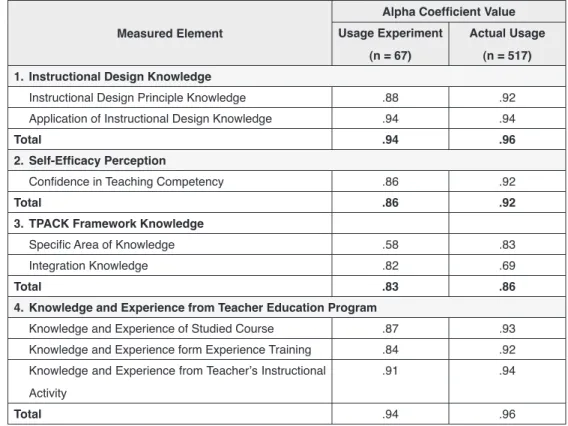
The researcher used the questionnaires to process data from 67 students not captured in the samples, to check the overall quality of the questionnaire through the result analysis, for internal consistency, using Cronbach’s alpha coefficient formula.4
The findings indicate that the reliability of the instrument was between .58 and .94. The researcher then submitted the questionnaire to the actual sample of 517 individuals mentioned earlier. The findings illustrate that the reliability falls between .69 and .94, as shown in Table 2.
Table 2 Instrument Quality Comparison on Reliability from Actual Experiment Measured Element
Alpha Coefficient Value Usage Experiment
(n = 67)
Actual Usage (n = 517) 1. Instructional Design Knowledge
Instructional Design Principle Knowledge .88 .92
Application of Instructional Design Knowledge .94 .94
Total .94 .96
2. Self-Efficacy Perception
Confidence in Teaching Competency .86 .92
Total .86 .92
3. TPACK Framework Knowledge
Specific Area of Knowledge .58 .83
Integration Knowledge .82 .69
Total .83 .86
4. Knowledge and Experience from Teacher Education Program
Knowledge and Experience of Studied Course .87 .93 Knowledge and Experience form Experience Training .84 .92 Knowledge and Experience from Teacher’s Instructional
Activity
.91 .94
Total .94 .96
Data Analysis
1. The purpose of data analysis is to provide answers to the objectives of this research, including checking the model for fitness for purpose and analyzing the nature of mediating effect of model variables.
Research Result
Nature of Mediating Effect of Model Variables
Instructional design knowledge (INSTRUC.DES) is affected by knowledge and experience from the teacher-education programs (TEACHER.ED) at .05 of statistical significance level, .88 of effect size including .34 of direct effect and .54 of indirect effect through self-efficacy perception (SELF.EFF) and TPACK framework knowledge. It was concluded that knowledge and experience from teacher-education programs are partial mediating effects in nature; direct effect and indirect effect through self-efficacy perception. Moreover, TPACK framework knowledge is discovered.
On the basis of self-efficacy perception and TPACK framework knowledge, which are the mediator variables, the findings confirm that self-efficacy perception affects instructional design knowledge with effect size 0.42, which is higher than the effect of TPACK framework knowledge, set at .24. Moreover, self-efficacy perception is also directly related to knowledge and experience by teacher education programs, with effect size .82. These are similar to effect size of knowledge and experience from teacher-education programs toward TPACK framework knowledge with .85. All values were at .05 of statistical significance level.
After analyzing the nature of indirect effect of variables on instructional design knowledge, it has been observed that the effect of knowledge and experience from teacher-education programs on instructional design knowledge through self-efficacy perception variable was .34, which is higher than the .20 mediating effect through TPACK framework knowledge. Overall, indirect effect was .54. Results are illustrated in Table 3 and related Figure 2.
Table 3 Statistical Value of Model Variable Effect Analysis Result
Cause TEACHER.ED SELF.EFF TPACK
Effect TE IE DE TE IE DE TE IE DE SELF.EFF b .54* - .54* - - - -SE (.03) - (.03) - - - -Beta a .82 - .82 - - - -TPACK b .85* - .85* - - - -SE (.04) - (.04) - - - -Beta .85 - .85 - - - -INSTRUCT.DES b .88* .54* .34* .64* - .64* .24* - .24* SE (.04) (.08) (.08) (.10) - (.10) (.10) - (.10) Beta .88 .54 .34 .42 - .42 .24 - .24 Remark: *p<.05
Figure 2 Results of verification for model-fit.
Research Result Discussions
On the basis of the above findings, the overall image fits the conceptual framework and research hypothesis. Other noteworthy research aspects include the following:
1) In this investigation, the researcher developed a causal model of teacher-education program for instructional design knowledge. From related research and document studies, the constructed model was found to fit the empirical data, knowledge and experience from teacher-education programs, TPACK knowledge and self-efficacy perception with positive effect on instructional design knowledge. It may be said that student-teachers with high levels of experience and knowledge from teacher-education programs, TPACK knowledge and self-efficacy perception, may have high levels of instructional design knowledge.
2) The findings also indicate that knowledge and experience from teacher-education programs directly affect instructional design knowledge and indirectly affect self-efficacy perception and TPACK knowledge towards instructional design knowledge. The higher-effect size of indirect effect compared with direct-effect indicated that
TPACK1 TPACK2 TEACHER.ED TPACK SELF.EFF INSTRUCT.DES KNOWLEDGE APPLYING SELF SUBJECT TRAINING ACTIVITY .12 .26 .05 .51* .53* .54* .85* .82* .34* .24* .42* .55* .58* .58* .45* .95* .08 .04 .05 1.00 .11 .13 .27 Chi-square = 5.44, df = 8, p = .71, RMSEA = .00
self-efficacy perception and TPACK framework knowledge are important causal factors for instructional design knowledge. The factor that will cause both self-efficacy perception and TPACK framework knowledge is knowledge and experience from teacher-education programs. In recent research, it has been reported that self-efficacy perception in terms of the use of computer and internet can materially influence the learner’s confidence. Even though self-efficacy perception cannot be taught, teachers are urged to support students’ aspirations to be confident in their self-efficacy goals.
Suggestions
The researcher has advised that the findings be applied to the development of student-teachers’ instructional design knowledge. Future research could evolve as follows:
1. Suggestions on the Application of Findings from Research Exercise a) The findings indicate that teacher-education programs can directly affect instructional design knowledge even though the majority of trainee teachers have knowledge and experience from teacher-education programs at various levels. How-ever, student-teachers appear to be unable to integrate available knowledge with instructional design, for useful purposes. Teacher-education programs should therefore promote and support trainee teachers to be competent in integrating teaching with technology. Moreover, they should arrange programs or activities that promote and encourages student-teachers to be creative and exchange knowledge between friends, student-teachers and instructors.
b) After conducting this research, the authors recognize that self-efficacy perception and TPACK framework knowledge are effective mediator variables, from teacher education-programs to instructional design knowledge. Thus, teacher-educa-tion programs should encourage trainee teachers to use TPACK framework knowledge to build self-efficacy perception, and particularly by using educational technology media in teaching. Moreover, teacher-education programs should focus on the technological media integration by student-teachers at each step of the teaching process during the instructional design stage.
c) Instructional design knowledge is affected by self-efficacy and TPACK framework knowledge. The findings indicate that teacher-education program should enable students to derive adequate levels of TPACK framework knowledge. The format of the activities should also promote and develop student-teachers to gain TPACK framework knowledge. It should also support trainee teachers to be competent in the use of technology, leading to higher self-efficacy perception level and TPACK frame-work knowledge level.
2. Topics for future research:
a) The causal factors of teacher-education programs which impact on the design of instructional knowledge should be developed using university group variables as moderator levels, to establish how they differ from structural equation modeling (SEM) results and to reveal, through further analysis, the existence of factors impacting on the design of teaching programs.
Acknowledgements
The researchers would like to thank the 90th Anniversary of Chulalongkorn University Fund (Ratchadaphiseksomphot Endownment Fund) for this research.
References
Abbott, J. & S. Faris. (2000). Integrating Technology into Pre-service Literacy Instruction: A Survey of Elementary Education Students’ Attitudes toward Computers. Journal of Research on Computing in Education, 33(2), 149-182. Albion, P.R. (1999). Student Teachers’ Use of Computers during Teaching Practice
in Primary Classrooms. Asia-Pacific Journal of Teacher Education, 24(1), 63-73.
Archambault, L. & K.Crippen. (2009). Examining TPACK among K-12 online Distance Educators in the United States. Society for Information Technology and Teacher Education, 9(1), 71-88.
Bai, H. & P. Ertmer. (2008). Teacher Educators’ Beliefs and Technology Uses as Predictors of Preservice Teachers’ Beliefs and Technology Attitudes. Journal of Technology and Teacher Education, 16(1), 93-112.
Bain, A. & K.G. Ross. (2000). School Reengineering and SAT-I Performance: A Case Study. International Journal of Educational Reform, 9(2), 148-154.
Bandura, A. (1986). Social Foundations of Thought and Action: A Social Cognitive Theory. Englewood Cliffs, NJ: Prentice Hall.
Becker, H.J. (2000). Who’s Wired and Who’s not? The Future of Children. The David and Lucille Packard Foundation. http://www.teacherlib.org/articles/becker/ pdf
Becta (British Educational Communications and Technology Agency). (2003). What the Research Says about Barriers to the Use of ICT in Teaching. Retrieved July 2, 2013 from http://www.becta.org.uk/research/ictrn/
Bransford, J., A. Brown & R. Cocking. (2000). How People Learn: Brain, Mind, Experience, and School. Washington, DC: National Academic Press.
Brinkerhoff, R. (2006). Training Impact Evaluation that Senior Managers Believe and Use: The Success Case Method. Telling Training’s Story, 12(3), 25-35. Clark, C. (2013). A Phenomenological Study of the Impact of Pre-service and In-service
Training Regarding the Integration of Twenty-first Century Technologies into Selected Teachers’ Instruction. Lynchburg, VA: Liberty University Press. Cuban, L., H. Kirkpatrick & C. Peck. (2001). High Access and Low Use of
Technol-ogy in High School Classrooms: Explaining an Apparent Paradox. American Educational Research Journal, 38(4), 813-834.
Dupagne, M. & K.A. Krendl. (1992). Teachers’ Attitudes toward Computers: A Review of the Literature. Journal of Research on Computing in Education, 24(3), 420-429.
Ertmer, P.A. (1999). Addressing First- and Second-order Barriers to Change: Strategies for Technology Integration. Educational Technology Research and Development, 47(4), 47-61.
Groff, J. & C. Mouza. (2008). A Framework for Addressing Challenges to Classroom Technology Use. AACE Journal, 16(1), 21-46.
Grove, K., N. Strudler & S. Odell. (2004). Mentoring toward Technology Use: Cooperating Teacher Practice in Supporting Student Teachers. Journal of Research on Technology in Education, 37(1), 85-110.
Gülbahar, Y. (2007). Technology Planning: A Roadmap to Successful Technology In-tegration in Schools. Computers & Education, 49(4), 943-956.
Harris, P. (2000). Using Technology to Create a New Paradigm for a Learner-cen-tered Educational Experience. Technos Quarterly, 9(2). http://www.technos. net /tq_09/2harris.htm
Judge, S. & B. O’Bannon. (2007). Integrating Technology into Field Based Experiences: A Model that Fosters Change. Computers in Human Behavior,
23(1), 286-302.
Koelher, M.J., P. Mishra & K. Yahya. (2007). Tracing the Development of Teacher Knowledge in a Design Seminar: Integrating Content, Pedagogy and Technology. Computers & Education, 49, 740-762.
Koelher, M.J. & P. Mishra. (2009). What is Technological Pedagogical Content Knowledge?, Contemporary Issues in Technology and Teacher Education,
9(1), 60-70.
Kozma, R. & R. Anderson. (2002). Qualitative Case Studies of Innovative Pedagogical Practices Using ICT. Journal of Computer Assisted Learning,
Liu, S.-H. (2011). A Multivariate Model of Factors Influencing Technology Use by Preservice Teachers during Practice Teaching. Educational Technology & Society, 15(4), 137-149.
Loveless, A. (2003). The Interaction between Primary Teachers’ Perceptions of ICT and Their Pedagogy. Education and Information Technologies, 8(4), 313-326. Mumtaz, S. (2000). Factors Affecting Teachers’ Use of Information and Communications
Technology: A Review of the Literature. Journal of Information Technology for Teacher Education, 9(3), 319-341.
Pajares, M.F. (1992). Teachers’ Beliefs and Educational Research: Cleaning up a Messy Construct. Review of Educational Research, 92(3), 307-332.
Pelgrum, W. (2001). Obstacles to the Integration of ICT in Education: Results from a Worldwide Educational Assessment. Computers and Education, 37, 163-178.
Rosen, L. & M. Weil. (1995). Computer Availability, Computer Experience and Technophobia among Public School Teachers. Computers in Human Behavior, 9, 27-50.
Shamburg, C. (2004). Conditions that Inhibit the Integration of Technology for Urban Early Childhood Teachers. Information Technology in Childhood Education Annual, 227-244.
Shulman, L. (1986). Those Who Understand: Knowledge Growth in Teaching.
Educational Researcher, 15(2), 4-14.
Singer, J. & M.A. Maher. (2007). Preservice Teachers and Technology Integration: Rethinking Traditional Roles. Journal of Science Teacher Education, 18(6), 955-984.
Spiro, R.J., R.L. Coulson, P.J. Feltovich & D.K. Anderson. (1988). Cognitive Flexibility Theory: Advanced Knowledge-acquisition in Ill-structured Domains.
Paper presented at the tenth annual conference of the Cognitive Science Society, NJ.
Subhi, T. (1999). Attitudes toward Computers of Gifted Students and Their Teachers.
High Ability Studies, 10(1), 69-85.
Webber, C.F. (2003). Special Issue Focusing on New Technologies and Educative Leadership. Journal of Educational Administration, 41(2), 119–123.
Wepner, S.B., N. Ziomek & L. Tao. (2003). Three Teacher Educators’ Perspectives about the Shifting Responsibilities of Infusing Technology into the Curriculum. Action in Teacher Education, 24(4), 53-63.
Winnans, C. & D. Brown. (1992). Some Factors Affecting Elementary Teachers’ Use of the Computer. Computers in Education, 18, 301-309.